1929 Mercury Dime Coin Value: How Much Is It Worth?
A 1929 Mercury Dime in ordinary circulated condition starts around $7.16 in Good-4 and can reach roughly $158 in Mint State 65, depending on which mint struck it. No proofs were made this year.
Full Bands examples and identified varieties each need their own specific comparisons, so the ranges above cover standard business strikes only.
Fast Way to Identify Your 1929 Mercury Dime
Snap a clear photo of both the front and back of your coin, then upload them for a preliminary identification. This helps pin down which mint produced your dime and whether anything unusual is going on with the strike or surfaces.
It is not a substitute for professional authentication, but it is a solid first step.
1929 Mercury Dime Value
Upload both sides of your 1929 Mercury Dime.
Front Obverse
Upload photo
Back Reverse
Upload photo
Which 1929 Mercury Dime Versions Are Worth Money?
- The San Francisco (S) mint issue guides at about $158 in MS65, the highest of the three standard business strikes in that grade.
- Philadelphia and Denver coins both guide around $95 in MS65, still well above their circulated values of roughly $7 in Good-4.
- Full Bands designation can add a premium to any mint's coin, though no specific FB price is provided here — it depends on the service and the individual coin.
- Several error types have been reported for the 1929 dime, including doubled die obverse, repunched mintmark, clipped planchet, off-center strike, and broadstrike; each requires individual assessment.
Step 1: Identify Your 1929 Mercury Dime Mint Mark and Version
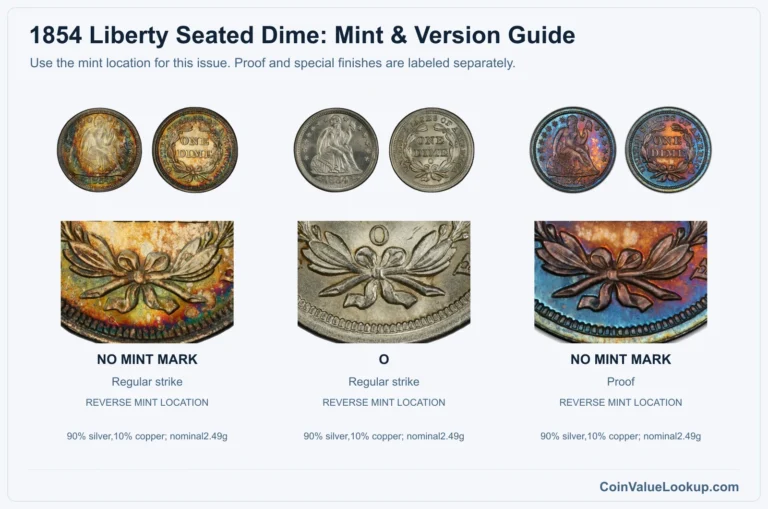
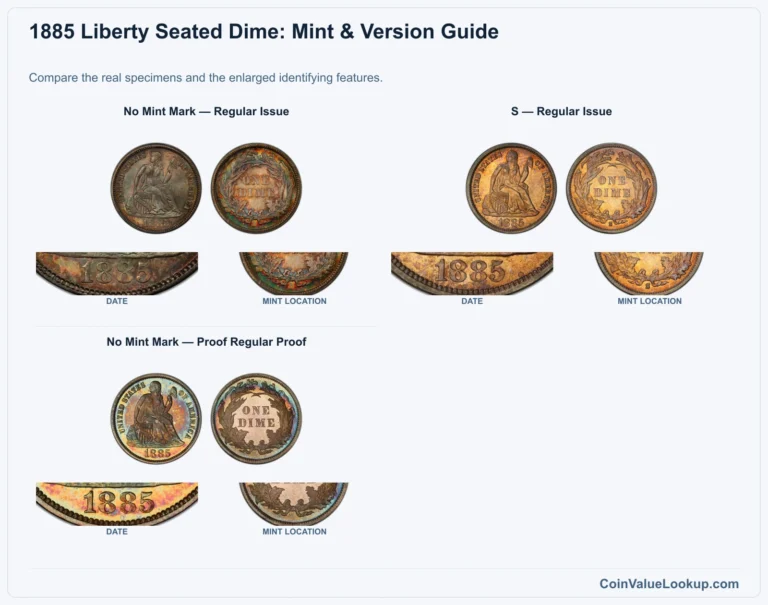
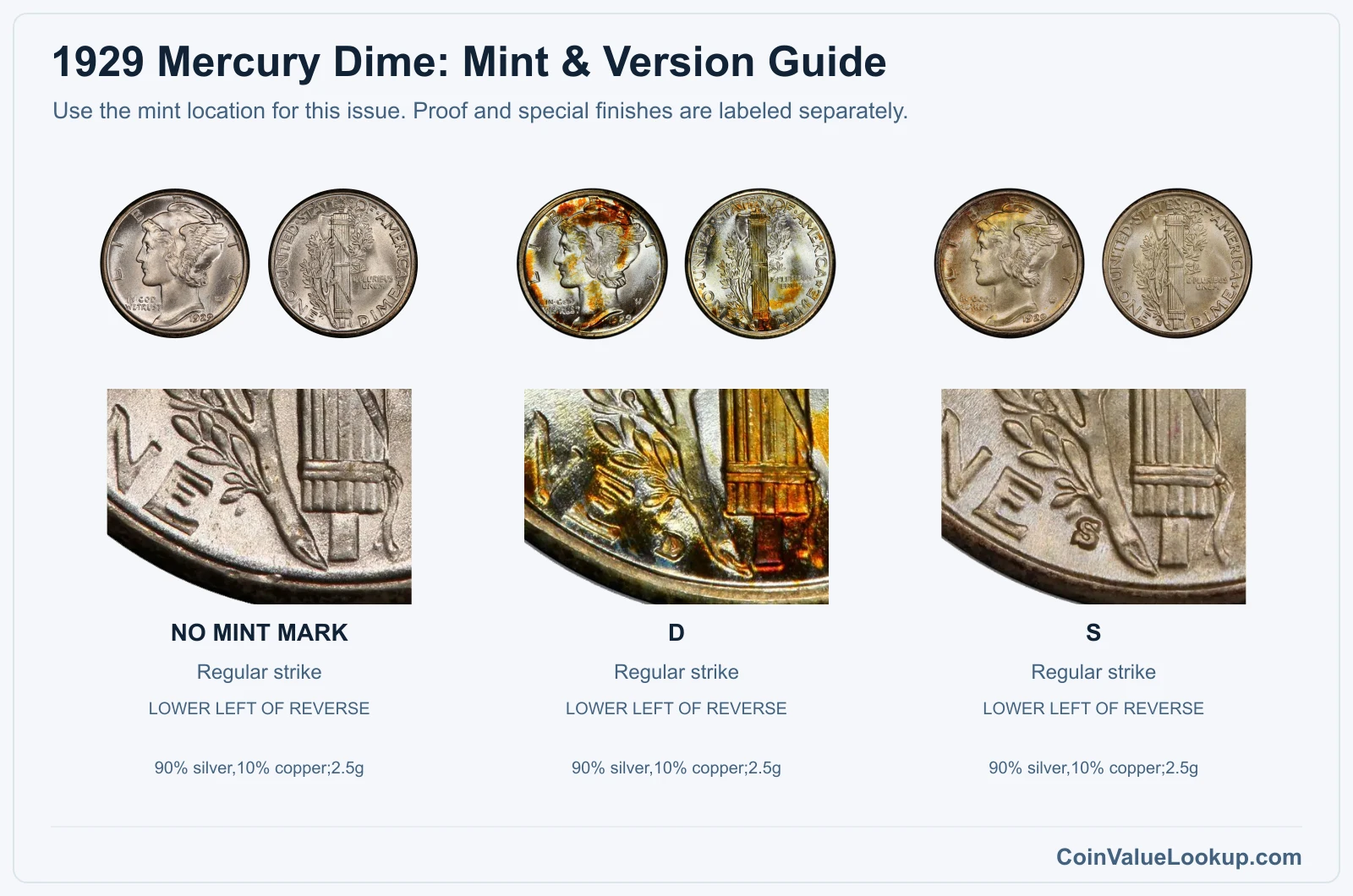
Three mints produced the 1929 Mercury Dime: Philadelphia, Denver, and San Francisco. Philadelphia coins carry no mintmark at all.
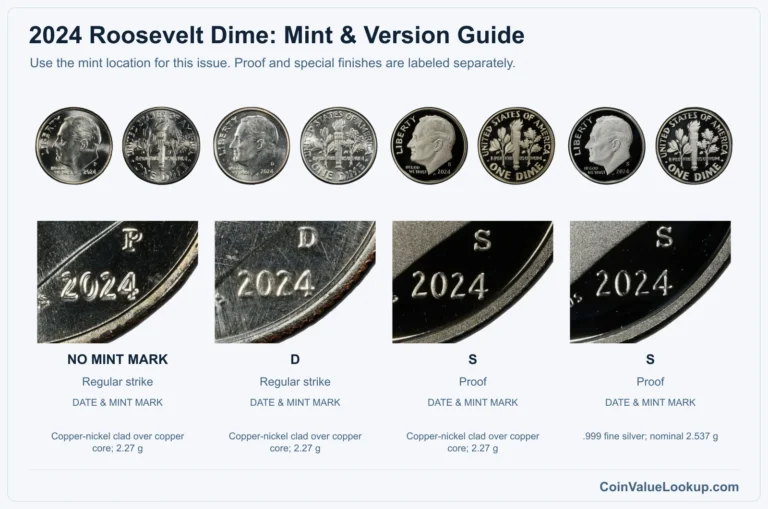
For the D or S, flip your coin over and look at the lower left of the reverse, right next to the word ONE — that is where the small mintmark sits.
Do not confuse the "AW" monogram on the obverse with a mintmark. Those are designer Adolph Weinman's initials, and every Mercury Dime has them regardless of mint.
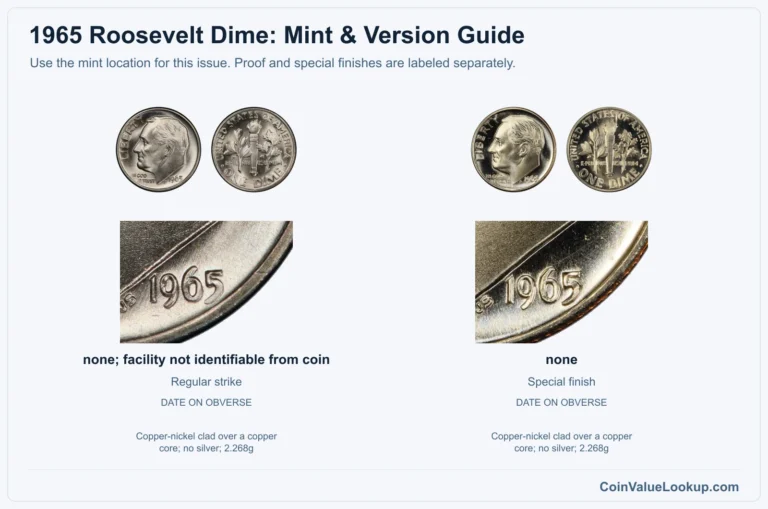
All three versions are struck in 90% silver and 10% copper, weigh about 2.5 grams, measure 17.9 mm across, and have a reeded edge. There is no composition difference between mints this year.
Step 2: Check Your 1929 Mercury Dime Grade
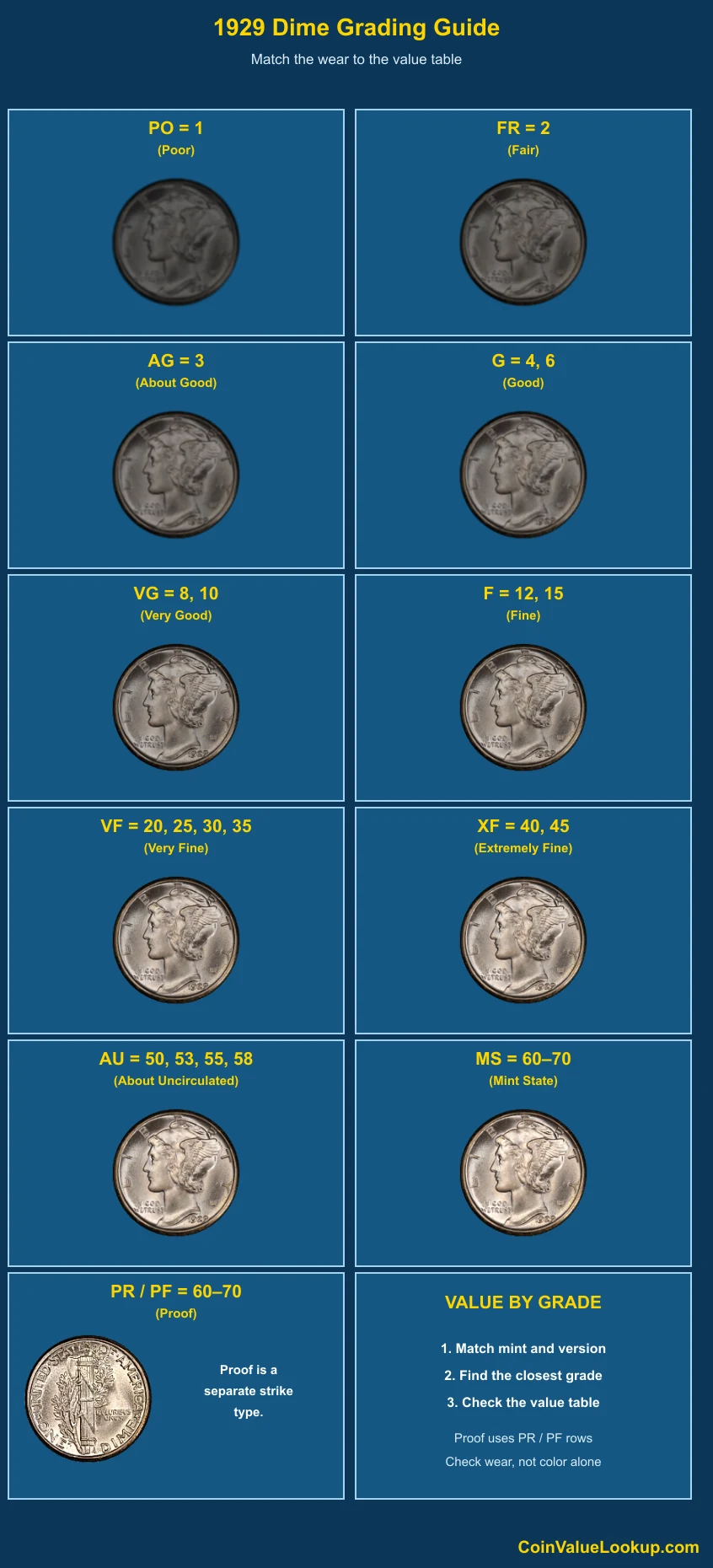
Start with Liberty's hair detail above and in front of her ear. On a well-worn coin that area is flat and featureless; on a lightly circulated piece you will still see individual strands.
The wings on her cap lose definition next, followed by the bands on the reverse fasces.
Luster matters a lot. A coin can look sharp in detail but still show signs of cleaning — unnatural brightness, hairline scratches visible under a light held at an angle.
That will knock the grade and value down significantly.
Weak bands or soft peripheral lettering do not automatically mean circulation wear. Branch-mint strikes from Denver and San Francisco were sometimes softer from the press itself.
Compare your coin to the grading image to judge actual wear versus a soft original strike.
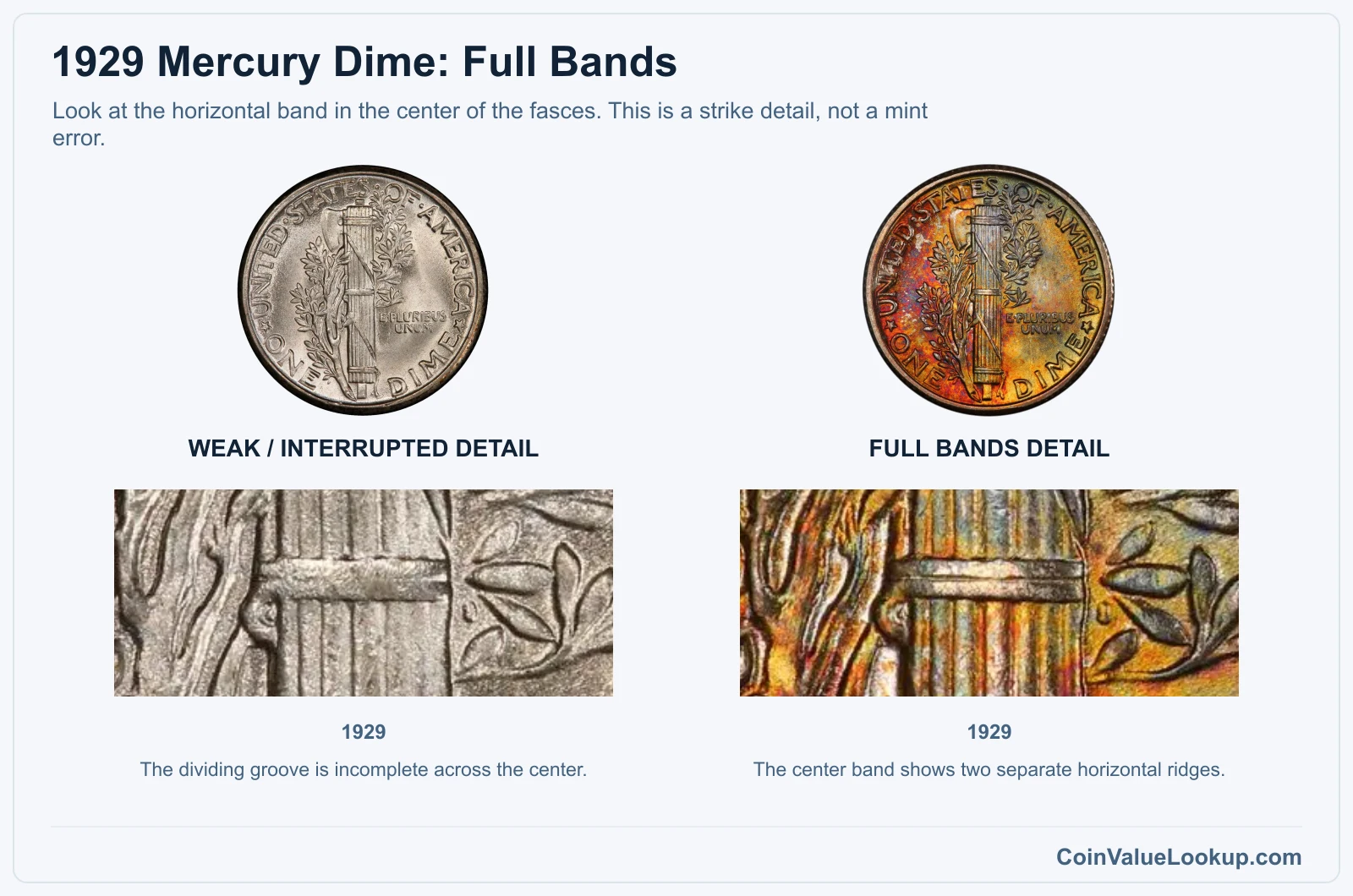
Full Bands is a separate designation that checks the separation of the central and outer bands on the fasces. Different grading services may apply slightly different criteria for that call, so treat it as its own evaluation rather than just a higher number on the Mint State scale.
Step 3: Check 1929 Mercury Dime Value by Mint and Version
1929 Mercury Dime — No Mint Mark — Silver Circulation
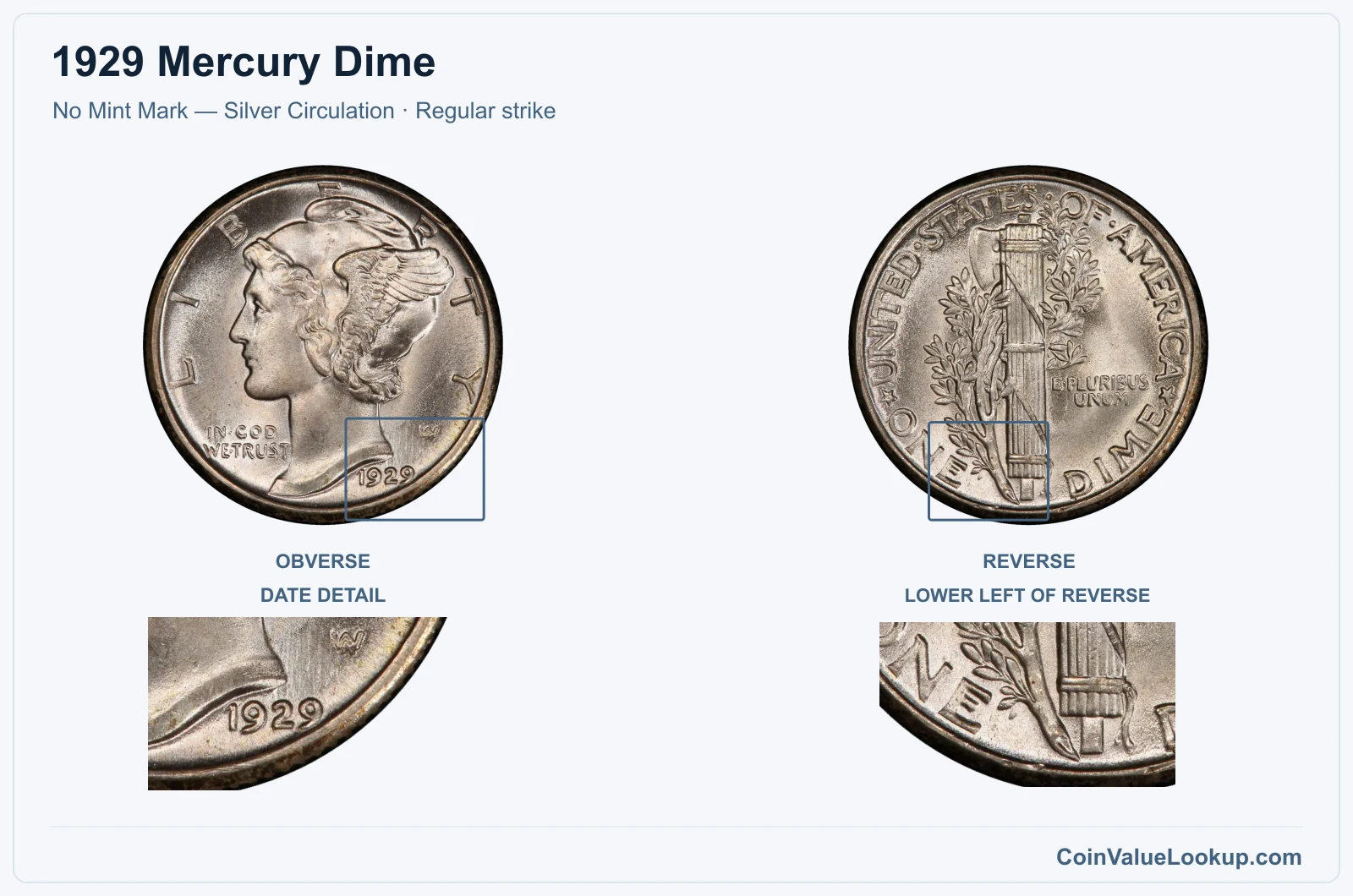
The Philadelphia issue has no mintmark anywhere on the coin. In Good-4 condition it guides at about $7.16, climbing to roughly $95 in MS65 according to USA Coin Book estimates.
That is a standard business strike in 90% silver.
When examining yours, check both sides carefully. The obverse should show the date and Weinman's AW monogram; the reverse should have the fasces with no letter beside ONE.
Coins with original Mint State surfaces and good luster are the ones that command the higher end of the range. Full Bands examples exist but carry their own separate evaluation.
Range Grade
Price Auction Records Appraisal PO PO 1
—
Coin Identifier FR FR 2
—
Coin Identifier AG AG 3
—
Coin Identifier G G 4
—
Coin Identifier
G 6
—
Coin Identifier VG VG 8
—
Coin Identifier
VG 10
—
Coin Identifier F F 12
—
Coin Identifier
F 15
—
Coin Identifier VF VF 20
—
Coin Identifier
VF 25
—
Coin Identifier
VF 30
—
Coin Identifier
VF 35
—
Coin Identifier XF XF 40
—
Coin Identifier
XF 45
—
Coin Identifier AU AU 50
—
Coin Identifier
AU 53
—
Coin Identifier
AU 55
—
Coin Identifier
AU 58
Coin Identifier MS MS 60
—
Coin Identifier
MS 61
Coin Identifier
MS 62
Coin Identifier
MS 63
Coin Identifier
MS 64
Coin Identifier
MS 65
Coin Identifier
MS 66
Coin Identifier
MS 67
Coin Identifier
MS 68
—
—
—
MS 69
—
—
—
MS 70
—
—
—
1929 Mercury Dime — D — Silver Circulation
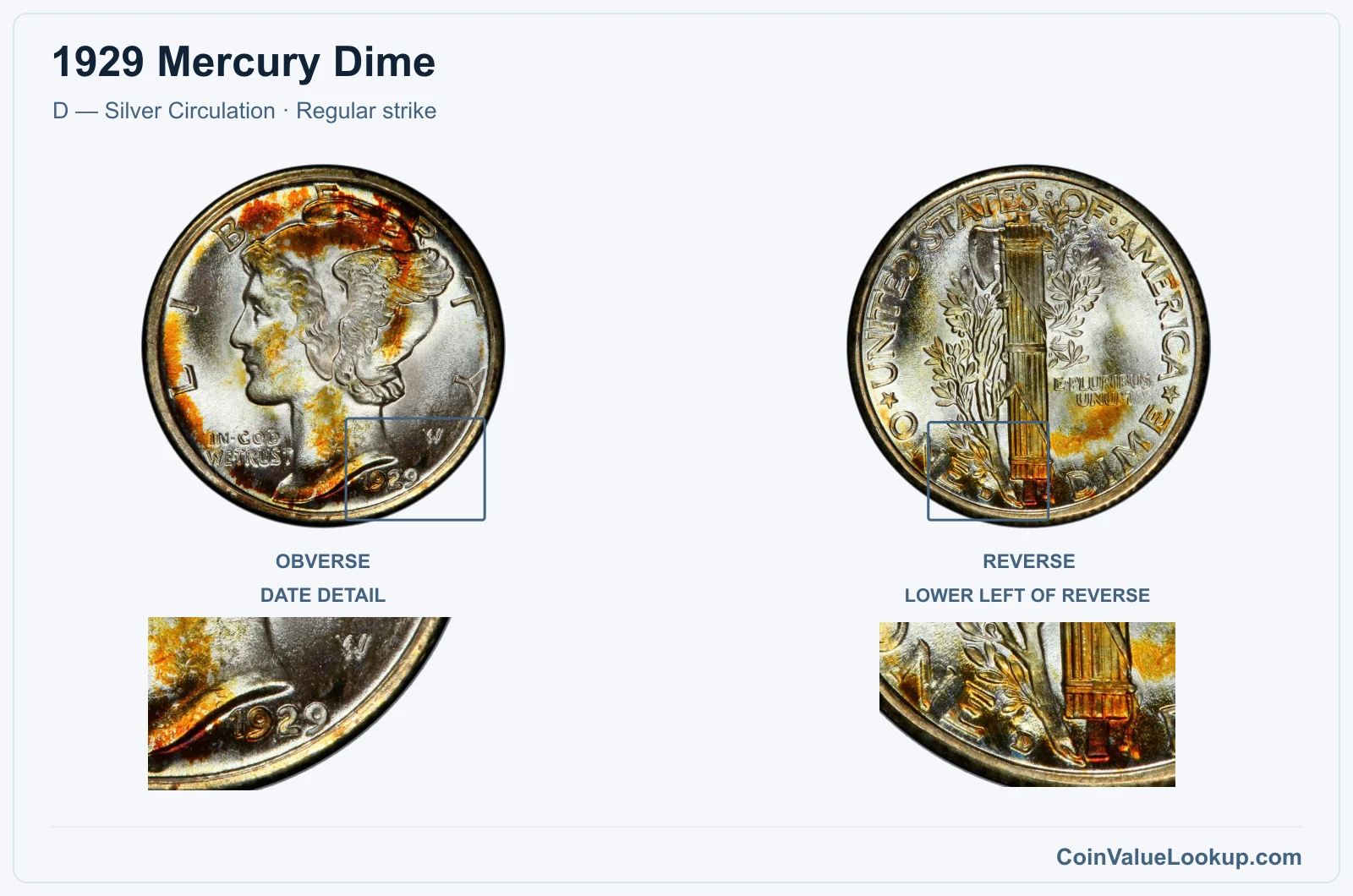
Denver strikes carry a small D on the lower left reverse beside ONE. Guide values run from about $7.16 in Good-4 to around $95 in MS65.
Same silver composition, same weight.
Denver coins from this era can sometimes show a softer strike than Philadelphia pieces, which makes finding a sharp, fully detailed example a bit more rewarding. Do not mistake a weak strike for heavy wear — compare the high points against the comparison image to tell the difference.
Full Bands coins are evaluated separately from the standard MS65 price listed here.
Coin Value Lookup is a good starting point if you want to look up guides for other dates and denominations in the Mercury Dime series or beyond.
Range Grade
Price Auction Records Appraisal PO PO 1
—
Coin Identifier FR FR 2
—
Coin Identifier AG AG 3
—
Coin Identifier G G 4
—
Coin Identifier
G 6
—
Coin Identifier VG VG 8
—
Coin Identifier
VG 10
—
Coin Identifier F F 12
—
Coin Identifier
F 15
—
Coin Identifier VF VF 20
—
Coin Identifier
VF 25
—
Coin Identifier
VF 30
—
Coin Identifier
VF 35
—
Coin Identifier XF XF 40
—
Coin Identifier
XF 45
—
Coin Identifier AU AU 50
Coin Identifier
AU 53
—
Coin Identifier
AU 55
—
Coin Identifier
AU 58
Coin Identifier MS MS 60
—
Coin Identifier
MS 61
—
Coin Identifier
MS 62
Coin Identifier
MS 63
Coin Identifier
MS 64
Coin Identifier
MS 65
Coin Identifier
MS 66
Coin Identifier
MS 67
Coin Identifier
MS 68
Coin Identifier
MS 69
—
—
—
MS 70
—
—
—
1929 Mercury Dime — S — Silver Circulation
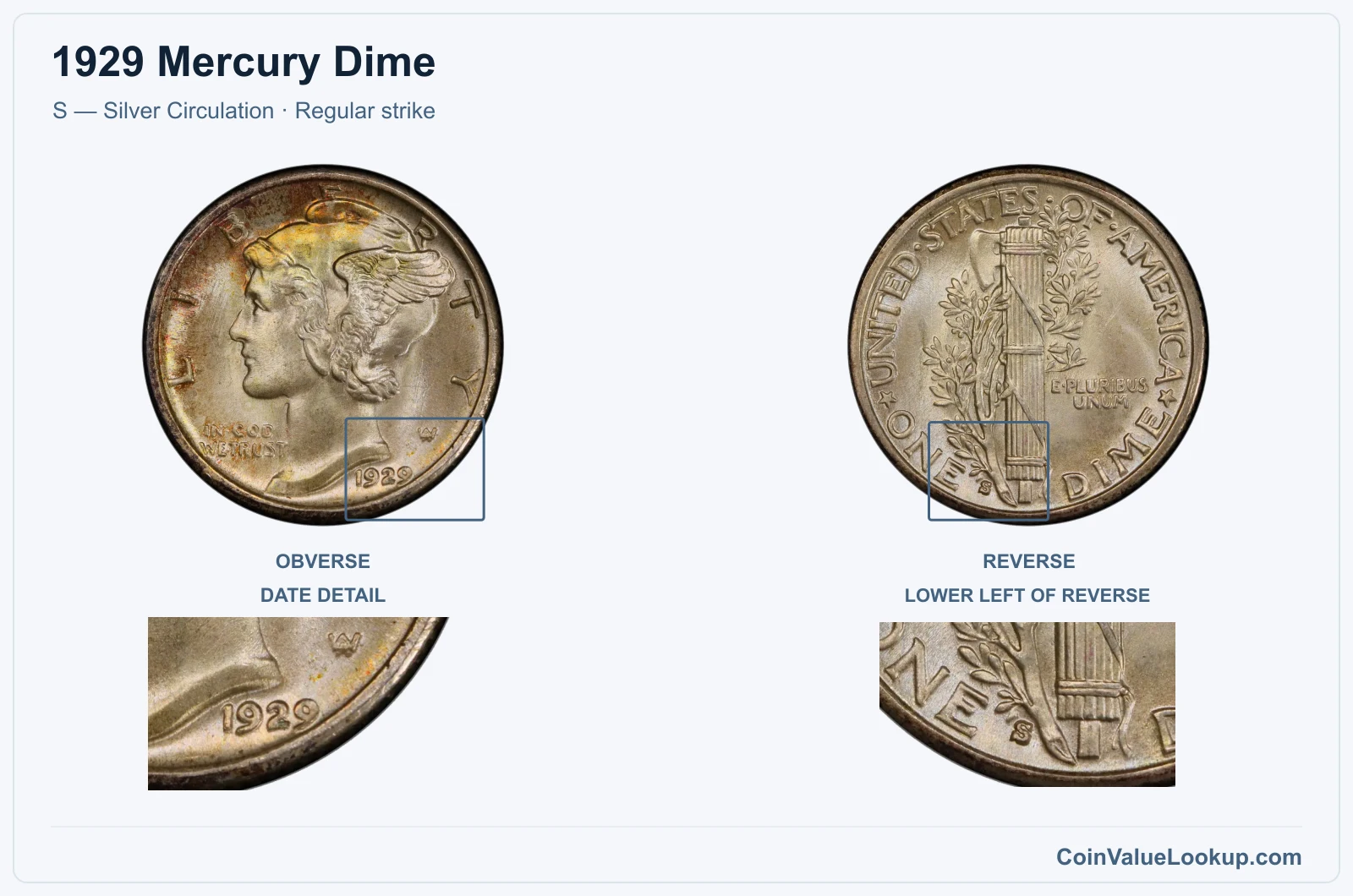
San Francisco coins show an S in the same lower-left reverse position. This is the version that guides highest in uncirculated condition: about $158 in MS65, compared with $95 for the other two mints.
In Good-4 it still sits at roughly $7.16, so the real premium shows up only when the coin has survived in strong condition.
Original surfaces and minimal contact marks matter here. A cleaned or harshly handled S-mint coin loses much of that advantage.
As with all three mints, Full Bands is a separate designation and no FB-specific price is provided in these figures.
Range Grade
Price Auction Records Appraisal PO PO 1
—
Coin Identifier FR FR 2
—
Coin Identifier AG AG 3
—
Coin Identifier G G 4
—
Coin Identifier
G 6
—
Coin Identifier VG VG 8
—
Coin Identifier
VG 10
—
Coin Identifier F F 12
—
Coin Identifier
F 15
—
Coin Identifier VF VF 20
—
Coin Identifier
VF 25
—
Coin Identifier
VF 30
—
Coin Identifier
VF 35
—
Coin Identifier XF XF 40
—
Coin Identifier
XF 45
Coin Identifier AU AU 50
—
Coin Identifier
AU 53
—
Coin Identifier
AU 55
—
Coin Identifier
AU 58
Coin Identifier MS MS 60
Coin Identifier
MS 61
Coin Identifier
MS 62
—
Coin Identifier
MS 63
Coin Identifier
MS 64
Coin Identifier
MS 65
Coin Identifier
MS 66
Coin Identifier
MS 67
Coin Identifier
MS 68
Coin Identifier
MS 69
—
—
—
MS 70
—
—
—
1929 Mercury Dime Error List
1. 1929 Mercury Dime — Doubled Die Obverse
A Doubled Die Obverse on a 1929 dime shows consistent doubling on the obverse lettering or design elements. You are looking for separation or notching on letters like LIBERTY or the date digits — not a flat, shelf-like distortion, which usually points to machine doubling instead.
Compare your coin to a normal 1929 dime under the same lighting. Genuine hub doubling produces a repeatable, directional spread that is visible on multiple design elements.
Machine doubling tends to look flatter and less defined. Reflections from a strong light source can also mimic doubling to the naked eye, so magnification helps.
No specific price is provided for this variety. Value depends on the strength and visibility of the doubling, the coin's overall condition, and market demand at the time of sale.
2. 1929 Mercury Dime — Repunched Mintmark
A Repunched Mintmark occurs when the mintmark punch was applied more than once, leaving a trace of the earlier impression. On a 1929 D or S dime, inspect the mintmark area on the lower left reverse under magnification.
You may see a ghost of a second letter slightly offset from the primary one.
The key distinction is that the remnant looks like part of the same letter in a different position — not a blob or rough patch. Die chips, corrosion around the mintmark, and machine doubling can all create similar-looking marks, so compare at matching magnification against a known normal example.
No adopted price is available for this variety. The premium, if any, depends on how visible the repunching is, the coin's condition, and the specific die pairing involved.
3. 1929 Mercury Dime — Clipped Planchet
A clipped planchet means part of the blank was missing before the coin was struck. On a 1929 dime this can show as a curved, straight, or irregular absence of metal along the rim.
The edge texture at the clip will differ from a normal reeded edge, and you may notice design weakness on the opposite side of the coin — that is a telltale sign the blank was incomplete when it entered the press.
Do not confuse a clip with post-mint damage. A filed notch or corroded edge will not produce that characteristic opposite-side weakness, and the affected area usually looks rougher or more irregular than a genuine clip.
Pricing depends on the size and type of clip, overall coin condition, and whether the date remains visible. No specific price range is provided here.
4. 1929 Mercury Dime — Off-Center Strike
An off-center strike happens when the blank is not seated properly between the dies, leaving part of the design missing and an unstruck crescent of blank metal visible. On a 1929 Mercury Dime, the percentage off-center and whether the date is still readable are the two biggest factors collectors care about.
A coin struck 5% off-center is mildly interesting. One struck 10–20% with a full date gets more attention.
The crescent of blank metal should be smooth and uniform — if the missing area looks rough, chipped, or has a straight edge, you may be looking at a clipped planchet or post-mint damage instead.
No numerical price is provided. Value varies with the degree of misalignment, date visibility, and the coin's overall preservation.
5. 1929 Mercury Dime — Broadstrike
A broadstrike on a 1929-D dime results from the coin being struck without the normal collar that confines the metal and forms the reeded edge. The design spreads outward, making the coin noticeably wider than a standard 17.9 mm dime, and the rim is either weak or absent.
The edge will lack normal reeding.
Look at the full profile of the coin. A genuine broadstrike retains the complete design — it is just spread out.
If part of the design is missing or shifted to one side, that points more toward an off-center strike. A coin flattened after leaving the mint will show damage marks and distorted details rather than the uniform metal flow of a broadstrike.
No specific price is adopted for this error. Condition, the degree of spread, and overall eye appeal all factor into what a given example might bring.