1949 Roosevelt Dime Coin Value: How Much Is It Worth?
The 1949 Roosevelt Dime is a 90% silver coin that still turns up in old collections and coin rolls. Guide estimates from USA Coin Book place ordinary examples at about $5.81 in G4 (a well-worn but readable grade) up to around $73 for an uncirculated MS65 San Francisco strike.
Those are grade-specific retail reference points, not guaranteed offers, and the silver content alone fluctuates with the metal market. Circulated pieces are common enough, but high-grade coins with fully separated torch bands are a different story.
Fast Way to Identify Your 1949 Roosevelt Dime
The quickest way to start figuring out what you have is to upload clear photos of the front and back of your coin. Good lighting and a close shot of the mintmark area help with preliminary identification.
That first look can narrow down which mint produced your dime and whether any obvious variety or error features are worth a closer examination.
1949 Roosevelt Dime Value
Upload both sides of your 1949 Roosevelt Dime.
Front Obverse
Upload photo
Back Reverse
Upload photo
Which 1949 Roosevelt Dime Versions Are Worth Money?
- Uncirculated 1949-S coins can reach about $73 at MS65 per guide estimates, and Full Bands examples in top grades are scarcer still.
- High-grade 1949 Philadelphia (no mintmark) dimes list around $50 at MS65, well above their worn counterparts near $5.81.
- A Repunched S Mintmark variety on 1949-S dimes shows extra S impressions and warrants professional examination.
- Ragged Clipped Planchet errors on 1949-S dimes, confirmed by authentication, carry premiums tied to severity and condition.
- Die crack specimens from 1949-S with raised lines across the obverse or reverse are collected as die-state varieties.
Step 1: Identify Your 1949 Roosevelt Dime Mint Mark and Version
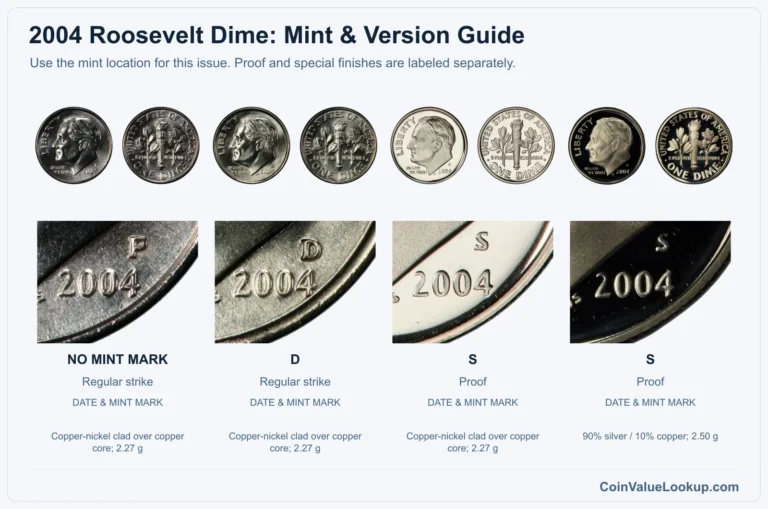
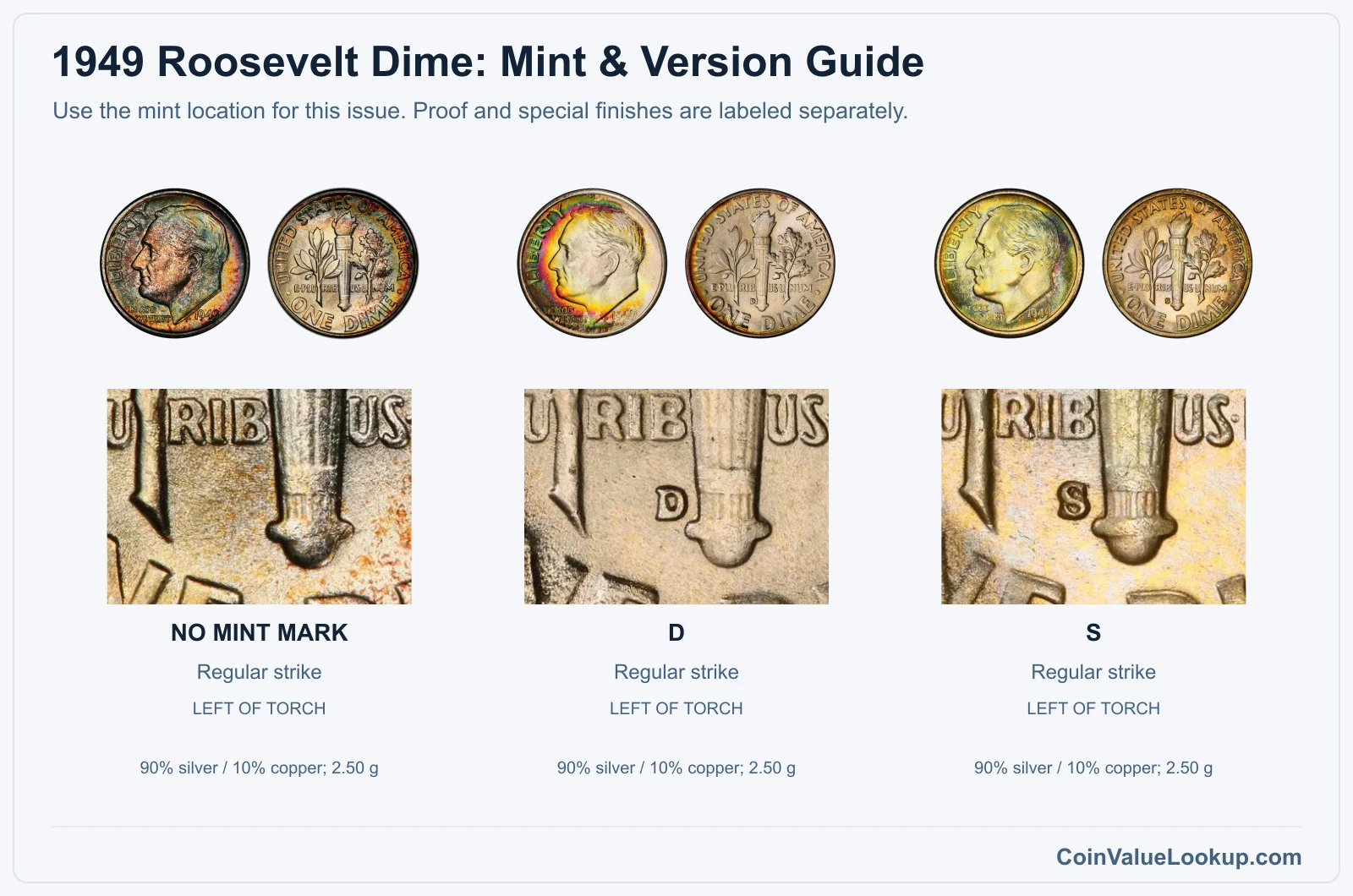
Every 1949 dime carries the Roosevelt portrait on the obverse and a torch flanked by olive and oak branches on the reverse. The date sits at the lower left of Roosevelt's bust.
Flip the coin over and look at the base of the torch for a small letter: a D means Denver, an S means San Francisco, and no letter at all means Philadelphia. The absence of a mintmark on a Philadelphia coin is completely normal and not an error.
All three mints struck these in 90% silver and 10% copper, weighing about 2.50 grams with a diameter of roughly 17.9 mm. No clad version exists for this date.
If your coin is noticeably lighter or has a copper-colored edge stripe, it is not a genuine 1949 dime.
Pay special attention to the San Francisco issue and to Philadelphia coins in high grades. Both can carry meaningful premiums over melt value when the surfaces are original and the torch bands show full separation.
Step 2: Check Your 1949 Roosevelt Dime Grade
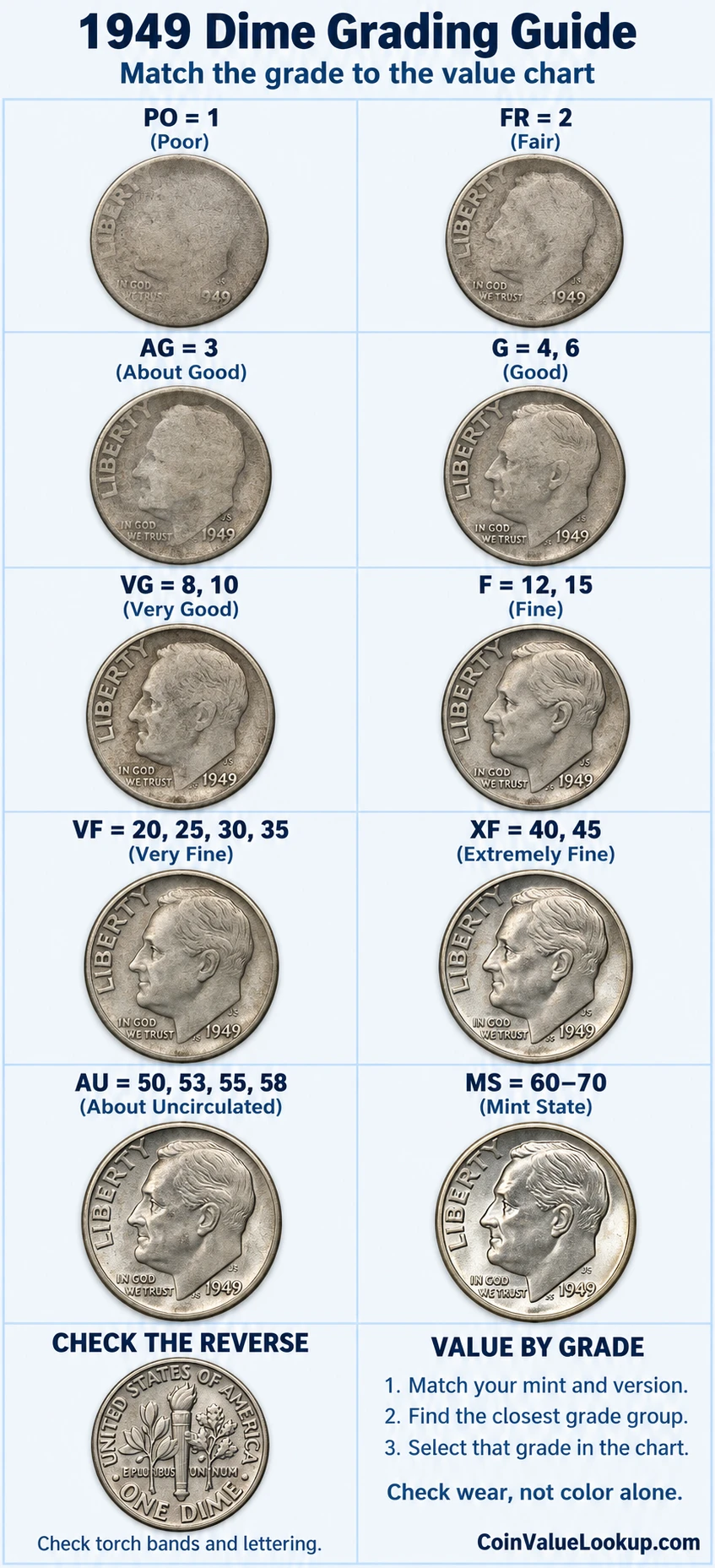
Start on the obverse. Roosevelt's cheekbone and the hair detail directly above the ear wear first; on a lightly circulated coin you will see flatness there before anywhere else.
The jawline softens next. Flip to the reverse and check the upper torch area and the leaf tips, which lose definition as wear progresses.
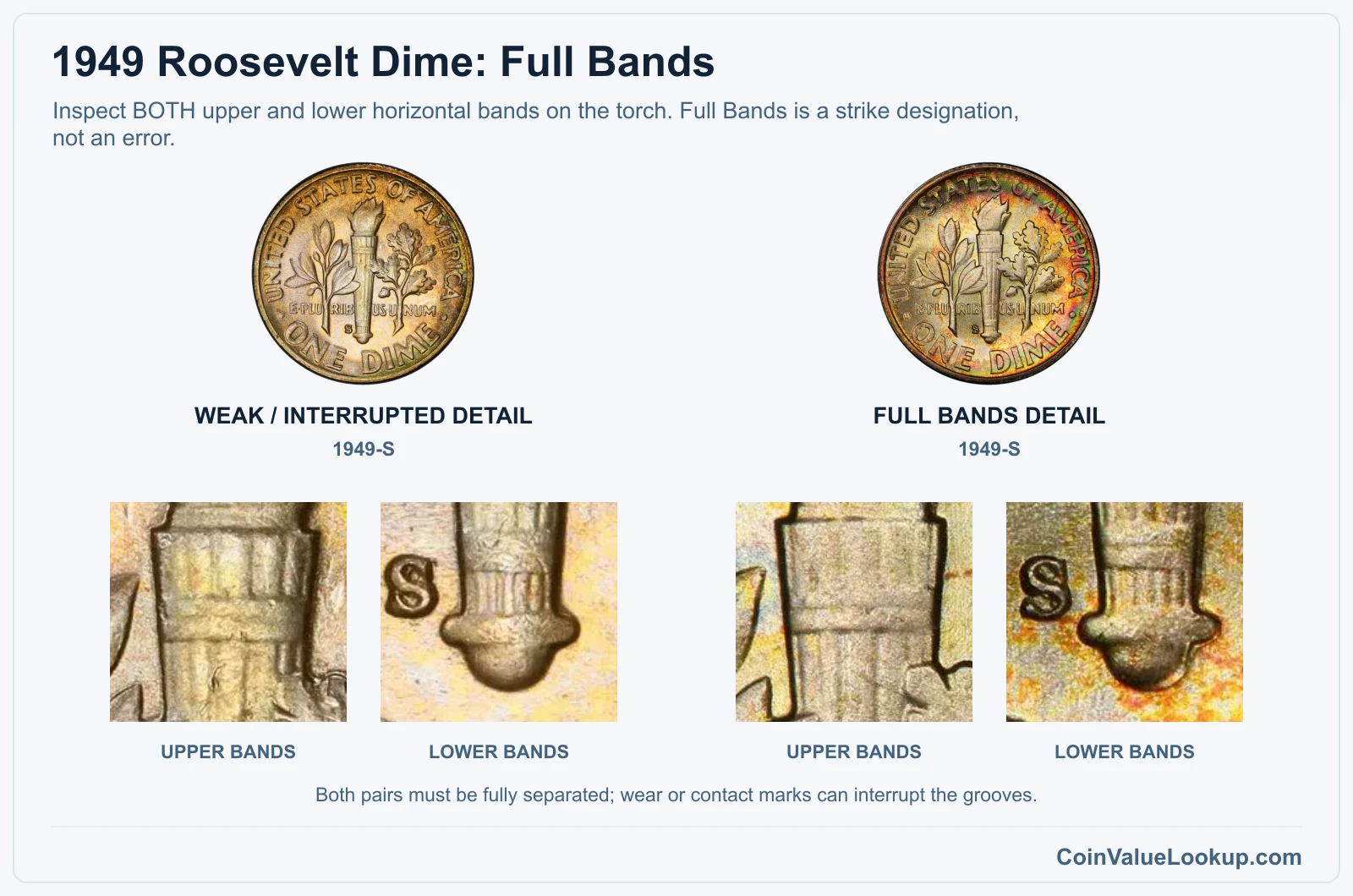
A soft or incomplete torch band does not automatically mean the coin circulated. Some 1949 dimes left the press with weakly struck bands, so compare your coin's overall luster and surface quality against the comparison image for the same grade.
Full Bands is a strike designation recognizing complete separation of both horizontal torch-band pairs; it is not a grade unto itself.
When judging condition, watch for cleaning. A coin that has been polished may look shiny but will show hairline scratches under magnification and typically grades lower than an untouched example with natural toning.
Original surfaces matter more than brightness.
Step 3: Check 1949 Roosevelt Dime Value by Mint and Version
1949 Roosevelt Dime — No Mintmark / Philadelphia
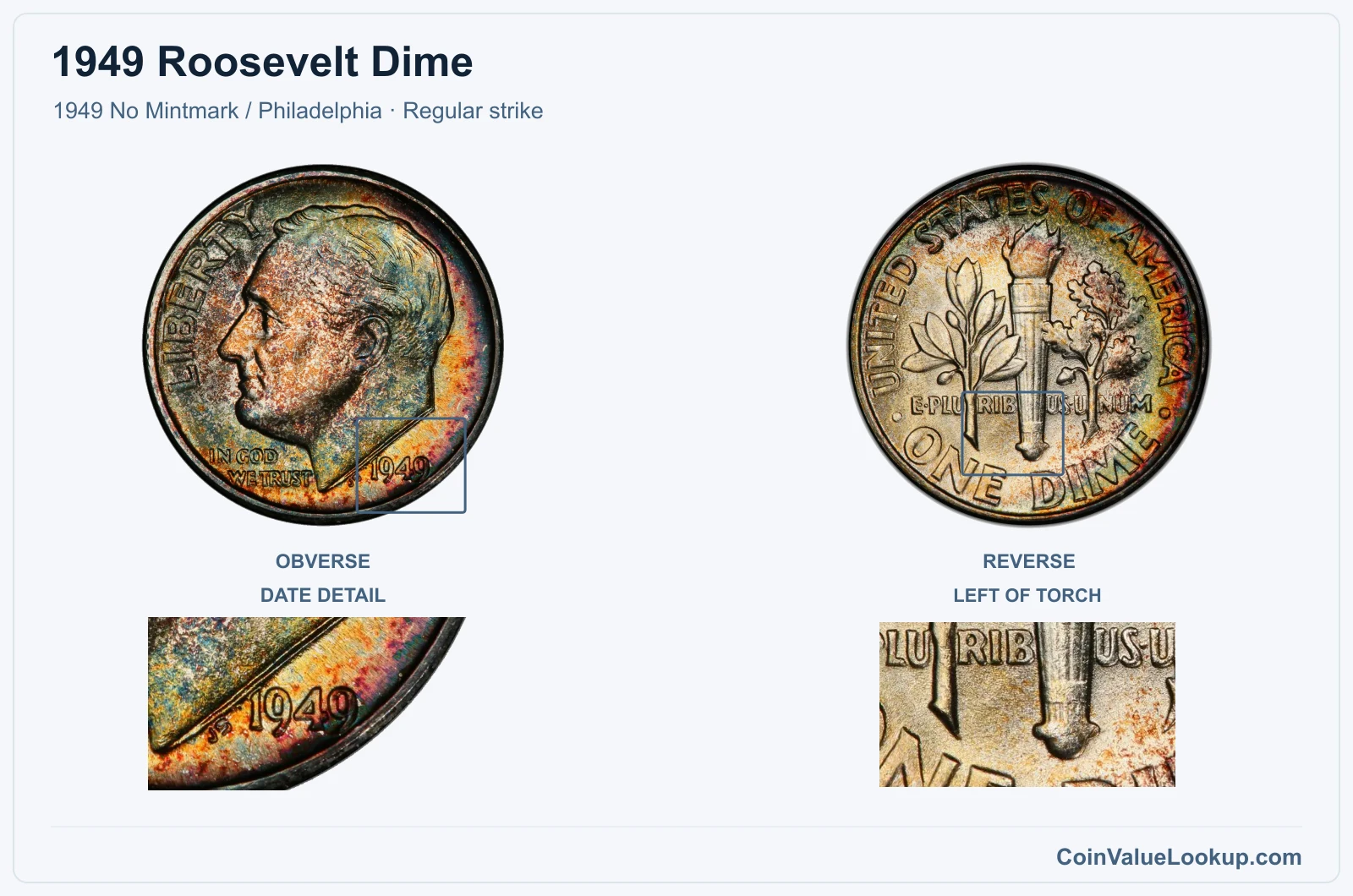
The 1949 Philadelphia dime has no mintmark. You will see only the torch and branch design on the reverse with no small letter near the base.
This is the standard issue, struck in 90% silver.
USA Coin Book lists this version at about $5.81 in G4 and around $50 in MS65. The jump between circulated and uncirculated values is steep because most survivors saw heavy use.
If your coin still has cartwheel luster and sharp hair detail above the ear, it is worth a much closer look.
Full Bands examples in gem grades are particularly scarce for Philadelphia this year. Preserve original surfaces and resist the urge to clean the coin; that will only hurt its grade and appeal.
Range Grade
Price Auction Records Appraisal PO PO 1
—
Coin Identifier FR FR 2
—
Coin Identifier AG AG 3
—
Coin Identifier G G 4
—
Coin Identifier
G 6
—
Coin Identifier VG VG 8
—
Coin Identifier
VG 10
—
Coin Identifier F F 12
—
Coin Identifier
F 15
—
Coin Identifier VF VF 20
—
Coin Identifier
VF 25
—
Coin Identifier
VF 30
—
Coin Identifier
VF 35
—
Coin Identifier XF XF 40
—
Coin Identifier
XF 45
—
Coin Identifier AU AU 50
—
Coin Identifier
AU 53
—
Coin Identifier
AU 55
—
Coin Identifier
AU 58
Coin Identifier MS MS 60
—
Coin Identifier
MS 61
—
Coin Identifier
MS 62
—
Coin Identifier
MS 63
—
Coin Identifier
MS 64
—
Coin Identifier
MS 65
Coin Identifier
MS 66
Coin Identifier
MS 67
Coin Identifier
MS 68
—
—
—
MS 69
—
—
—
MS 70
—
—
—
1949 Roosevelt Dime — D / Denver
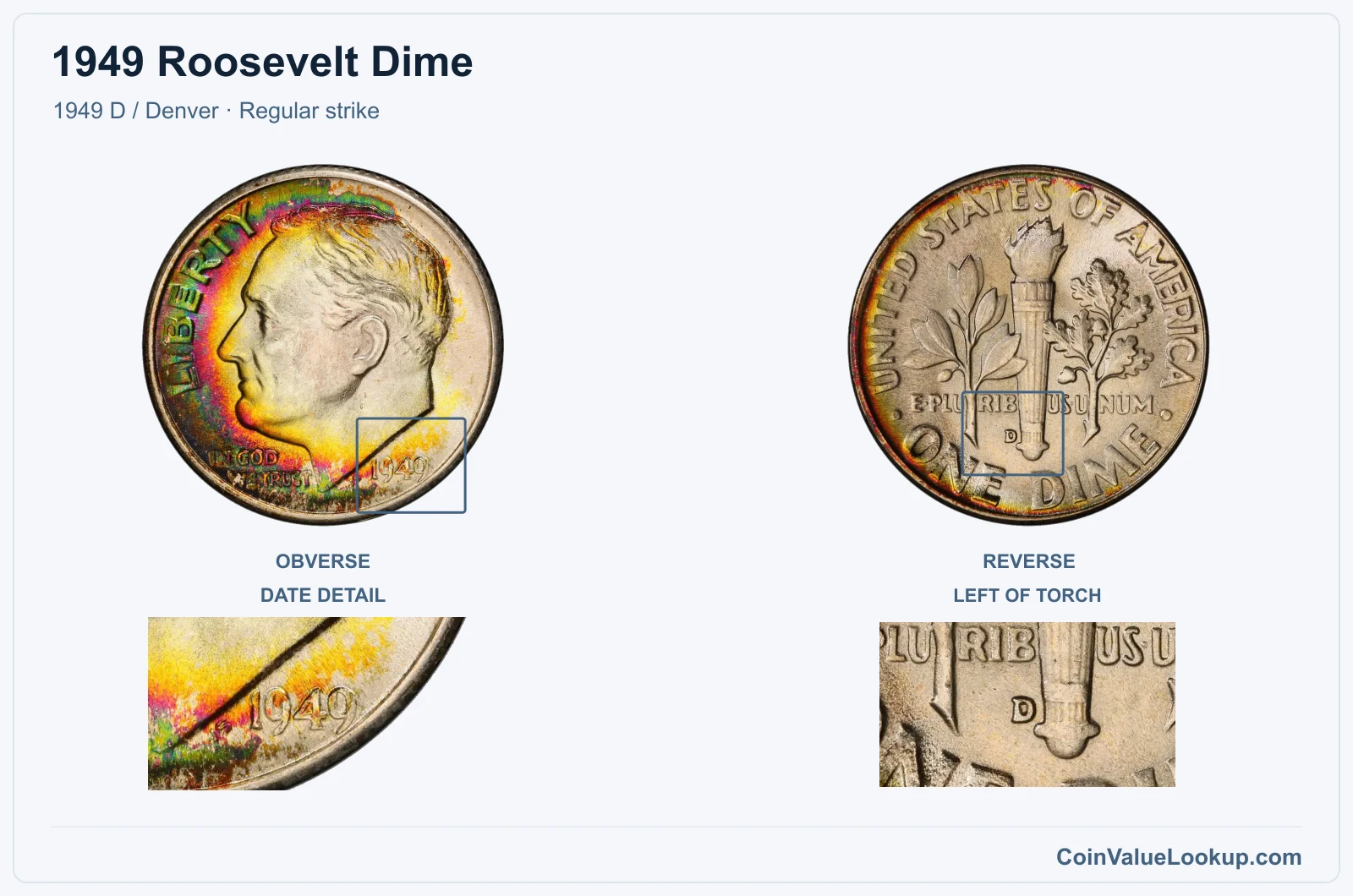
Denver coins carry a small D on the reverse near the torch base. Same composition: 90% silver, 2.50 grams.
Guide values sit at roughly $5.81 in G4 and about $29 in MS65, making it the least expensive mint for this date in uncirculated condition. That does not mean it is worthless in high grade, just that more survivors exist compared to the Philadelphia and San Francisco strikes.
Coin Value Lookup is a handy place to look up guides for other dates and mints in the Roosevelt Dime series if you are working through a whole set.
As always, check for Full Bands separation on the torch. A Denver coin with strong bands and clean luster in MS65 or higher still commands a solid premium over a typical worn piece.
Range Grade
Price Auction Records Appraisal PO PO 1
—
Coin Identifier FR FR 2
—
Coin Identifier AG AG 3
—
Coin Identifier G G 4
—
Coin Identifier
G 6
—
Coin Identifier VG VG 8
—
Coin Identifier
VG 10
—
Coin Identifier F F 12
—
Coin Identifier
F 15
—
Coin Identifier VF VF 20
—
Coin Identifier
VF 25
—
Coin Identifier
VF 30
—
Coin Identifier
VF 35
—
Coin Identifier XF XF 40
—
Coin Identifier
XF 45
—
Coin Identifier AU AU 50
—
Coin Identifier
AU 53
—
Coin Identifier
AU 55
—
Coin Identifier
AU 58
—
Coin Identifier MS MS 60
—
Coin Identifier
MS 61
—
Coin Identifier
MS 62
—
Coin Identifier
MS 63
Coin Identifier
MS 64
Coin Identifier
MS 65
Coin Identifier
MS 66
Coin Identifier
MS 67
Coin Identifier
MS 68
Coin Identifier
MS 69
—
—
—
MS 70
—
—
—
1949 Roosevelt Dime — S / San Francisco
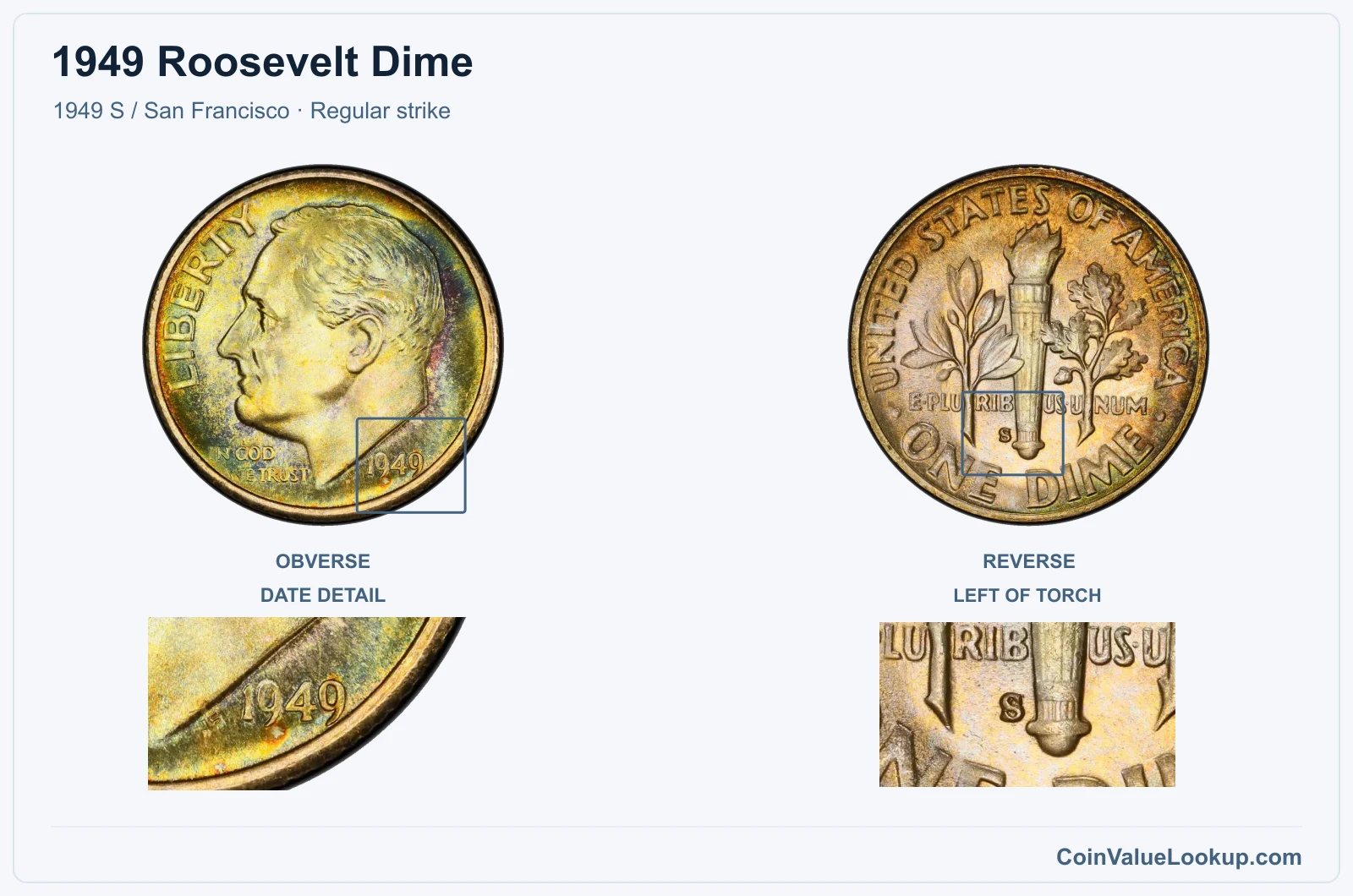
The San Francisco issue shows a small S beside the torch base on the reverse. Among the three regular 1949 mints, this one tends to bring the strongest prices in uncirculated grades.
USA Coin Book estimates about $5.81 in G4 and roughly $73 at MS65 for ordinary business strikes. In lower circulated grades the premium over Philadelphia or Denver is negligible, since the silver content is the same.
The gap widens sharply in mint-state territory, especially for coins that also earn a Full Bands designation.
Several known varieties and errors center on the 1949-S, including a repunched mintmark and documented die cracks. Before you spend on a raw coin at a premium, confirm the mintmark is genuinely an S and not damage or a counterfeit addition.
Original, untouched surfaces with natural toning are what experienced buyers want.
Range Grade
Price Auction Records Appraisal PO PO 1
—
Coin Identifier FR FR 2
—
Coin Identifier AG AG 3
—
Coin Identifier G G 4
—
Coin Identifier
G 6
—
Coin Identifier VG VG 8
—
Coin Identifier
VG 10
—
Coin Identifier F F 12
—
Coin Identifier
F 15
—
Coin Identifier VF VF 20
—
Coin Identifier
VF 25
—
Coin Identifier
VF 30
—
Coin Identifier
VF 35
—
Coin Identifier XF XF 40
—
Coin Identifier
XF 45
—
Coin Identifier AU AU 50
—
Coin Identifier
AU 53
—
Coin Identifier
AU 55
—
Coin Identifier
AU 58
Coin Identifier MS MS 60
—
Coin Identifier
MS 61
—
Coin Identifier
MS 62
—
Coin Identifier
MS 63
—
Coin Identifier
MS 64
Coin Identifier
MS 65
Coin Identifier
MS 66
Coin Identifier
MS 67
Coin Identifier
MS 68
Coin Identifier
MS 69
—
—
—
MS 70
—
—
—
1949 Roosevelt Dime Error List
1. 1949 Roosevelt Dime — Ragged Clipped Planchet
A ragged clipped planchet occurs when the blank is torn or improperly cut before striking, leaving an irregular missing section along the edge. On 1949-S dimes, one authenticated example graded AU55 by ANACS weighed just 1.99 grams, well below the normal 2.50 grams.
To check yours, look for a rough, uneven edge that differs from the smooth rim elsewhere. Examine both adjacent surfaces for any distortion in the design near the clip.
Weight alone cannot prove the error; a broken, corroded, or cut silver dime can mimic the appearance.
No standard price range is established for this variety. Value depends on the severity of the clip, the coin's overall condition, and professional authentication confirming it as a mint-made defect rather than post-mint damage.
If your edge looks suspicious, professional attribution is the safest next step.
2. 1949 Roosevelt Dime — Repunched S Mintmark
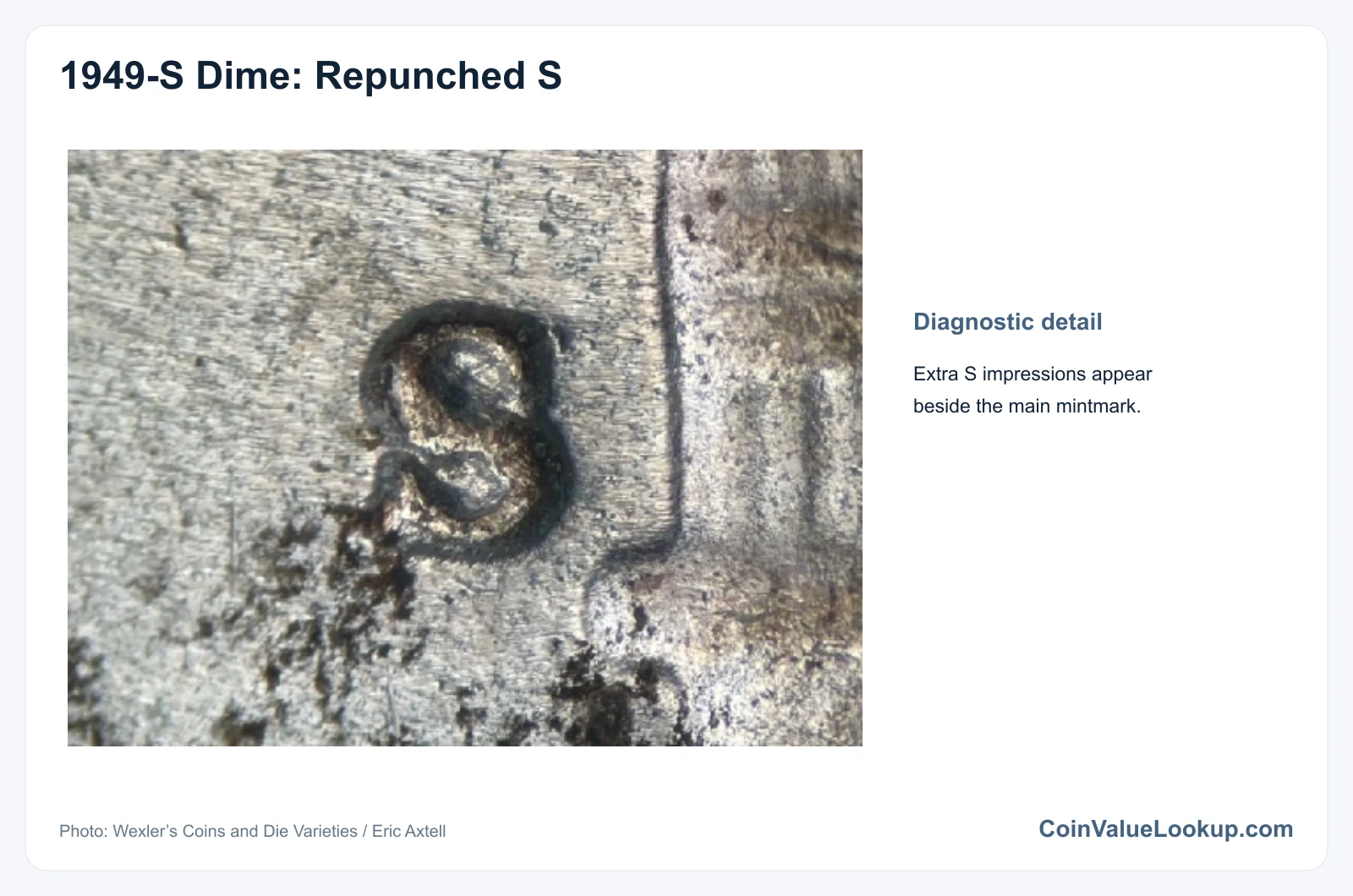
The 1949-S Repunched Mintmark variety shows remnants of additional S impressions to the east and south of the final mintmark position. Under magnification, you can see the rounded contours of at least one earlier S punch partially hidden beneath the primary letter.
This is different from mechanical doubling, which produces flat, shelf-like distortion without the rounded profile of a genuine second punch. Dirt or minor scratches beside the mintmark can also fool the eye, so compare carefully against documented images of this variety.
No specific price range is adopted for this RPM. The premium depends on the clarity of the extra impressions, the coin's grade, and whether it has been professionally attributed.
A strong, obvious repunch on an otherwise attractive coin will draw more collector interest than a faint trace on a heavily worn example.
3. 1949 Roosevelt Dime — Die Cracks
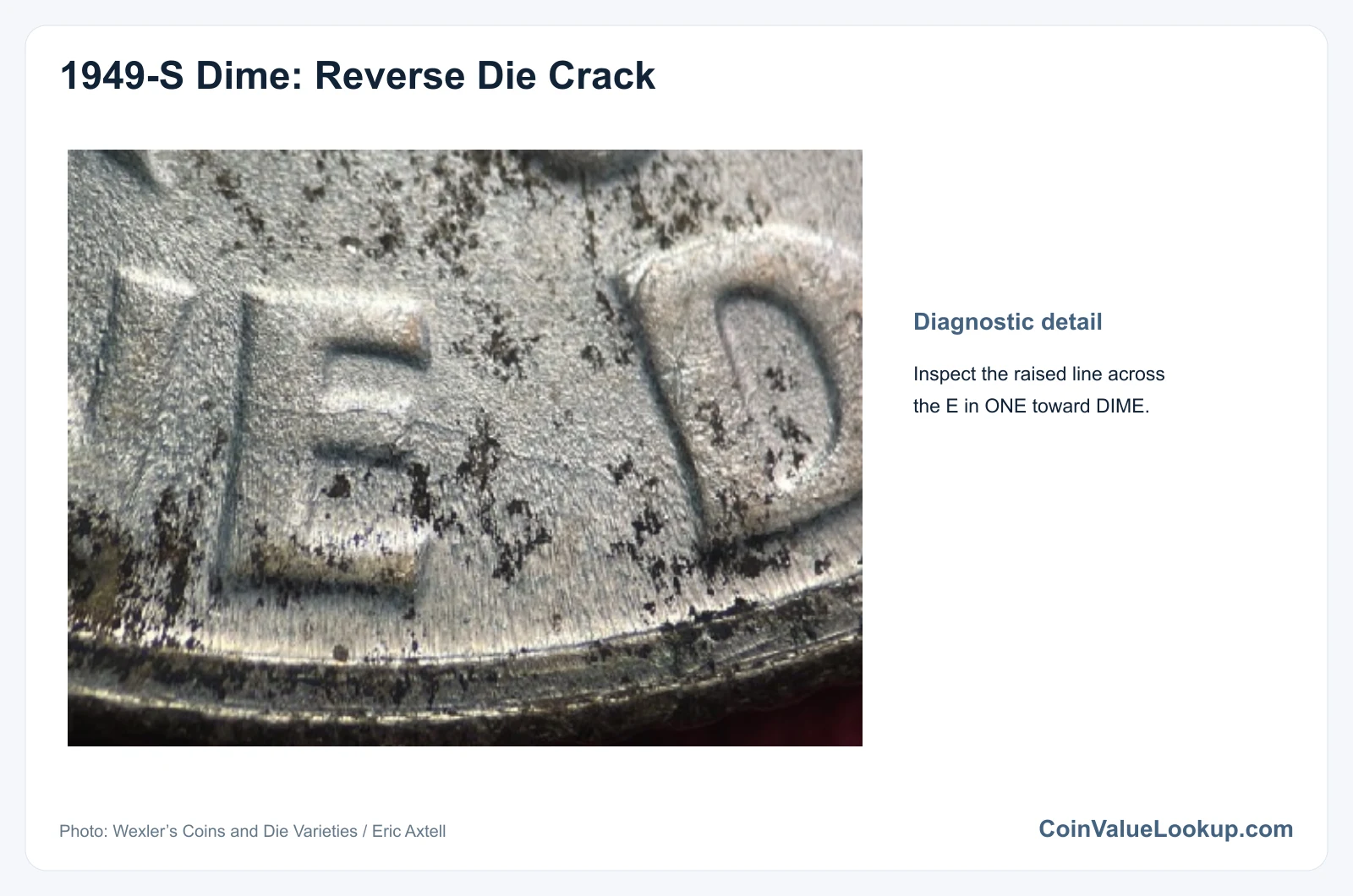
Die cracks on the 1949-S dime appear as thin raised lines on the coin's surface, caused by fractures in the steel die during production. On documented specimens, one crack runs across the back of Roosevelt's head on the obverse, and another crosses through the E in ONE toward the D in DIME on the reverse.
These lines are raised because metal fills the crack in the die during striking. That is the key distinction from post-mint scratches, which are incised into the surface.
If you can feel the line standing above the field with a fingernail or see it raised under magnification, it may be a genuine die crack.
A small die crack alone does not guarantee a large premium. Value depends on the prominence of the crack, the coin's condition, and collector interest in that particular die state.
Professional evaluation helps establish whether the feature is significant enough to warrant a premium.
4. 1949 Roosevelt Dime — Lamination / Split Planchet
Lamination errors on 1949 dimes result from impurities or gas trapped within the silver alloy during the planchet preparation stage. The visible symptom is peeling metal, a retained flap, or an outright separation within the coin's thickness.
To document what you have, photograph both the affected face and the edge together. The edge view can reveal how deep the separation runs.
Scraping from a tool, corrosion pitting, or a deliberately shaved coin can all look similar at first glance, so careful comparison matters.
No standard price range is adopted for this category. The value of a lamination error depends on its size, visibility, overall coin condition, and whether professional attribution confirms it as a genuine mint-produced defect.
Larger, more dramatic examples with retained flaps tend to attract stronger collector interest than subtle surface peels.
5. 1949 Roosevelt Dime — Broadstrike
A broadstrike happens when the coin is struck outside the restraining collar that normally forms the rim and controls the diameter. The result is a coin with outward metal spread, a weak or missing rim, and a slightly larger-than-normal profile, while the design itself remains mostly centered.
Do not confuse a broadstrike with an off-center strike, which shifts the design noticeably to one side. Also watch for coins that were simply flattened after leaving the mint by machinery, a vice, or deliberate abuse; those lack the uniform spreading pattern of a genuine broadstrike.
No specific price range is established for broadstruck 1949 dimes. The premium depends on how dramatic the spread is, the coin's preservation, and professional verification.
Edge profile photos are essential for documenting this type of error accurately.
6. 1949 Roosevelt Dime — Off-Center Strike
An off-center strike occurs when the planchet is not properly seated between the dies, producing a displaced design with a blank crescent on one side. The most collectible examples retain a fully visible date, since without the date the coin cannot be attributed to 1949.
The percentage of off-center displacement matters. A 5% shift is subtle and carries a modest premium at best, while a 10–50% shift with a readable date is far more visually dramatic and desirable.
Compare carefully against a clipped planchet, which removes edge metal but keeps the design centered, and against one-sided die misalignment, which stretches the design rather than shifting it.
No standard price range is adopted for off-center 1949 dimes. Each coin's value depends on the degree of displacement, date visibility, overall condition, and professional confirmation that the error is genuine.