1963 Roosevelt Dime Coin Value: How Much Is It Worth?
The 1963 Roosevelt Dime is a 90% silver coin struck during the final years before the United States switched to clad coinage. A USA Coin Book guide places ordinary circulated examples around $5.81 at G4 and uncirculated pieces up to $10.91 at MS65, while a standard proof runs about $9.87 at PR65.
Metal value fluctuates, so those figures shift with the silver market. Several error varieties and doubled die specimens exist for this date, and those require separate evaluation.
Fast Way to Identify Your 1963 Roosevelt Dime
The quickest way to get a preliminary read on your 1963 dime is to upload clear photos of both sides. Snap the front showing Roosevelt's portrait and the back with the torch and mintmark area.
Good lighting and focus on the mintmark beside the torch base help narrow down the version. From there, we can point you toward the right value branch.
1963 Roosevelt Dime Value
Upload both sides of your 1963 Roosevelt Dime.
Front Obverse
Upload photo
Back Reverse
Upload photo
Which 1963 Roosevelt Dime Versions Are Worth Money?
- Philadelphia and Denver business strikes in upper mint-state grades with Full Bands designation carry stronger guide values than average circulated pieces.
- Philadelphia proofs with undisturbed mirror fields deserve separate comparison; cameo contrast is a distinct designation.
- Double Curved Clip errors on the Philadelphia business strike require authentication before any premium applies.
- Planchet Crack specimens on the Philadelphia business strike are documented but need confirmed diagnostics.
- Split Planchet errors on the 1963-D are dramatically underweight; confirm the separation is not post-mint damage.
- Proof Doubled Die Reverse coins show rounded doubling on ONE DIME and the motto; these must be distinguished from the business-strike doubled reverse.
Step 1: Identify Your 1963 Roosevelt Dime Mint Mark and Version
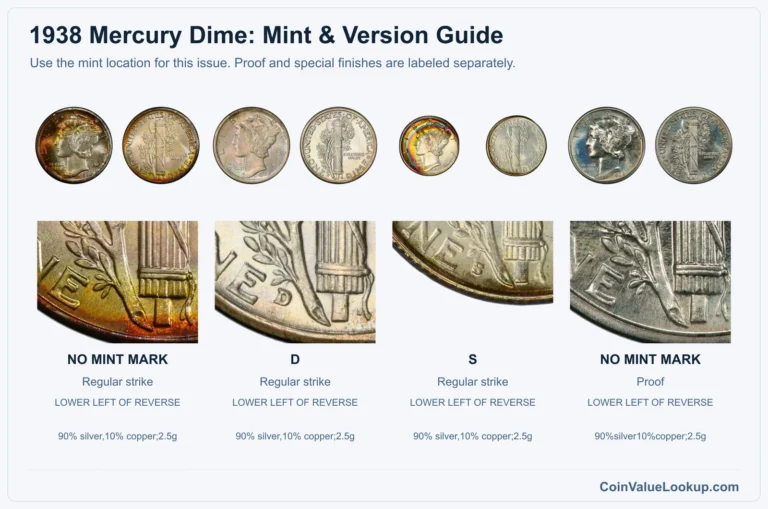
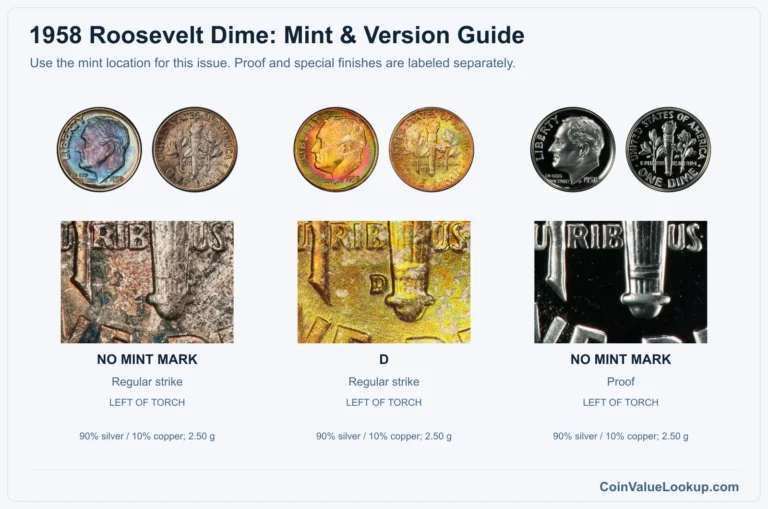
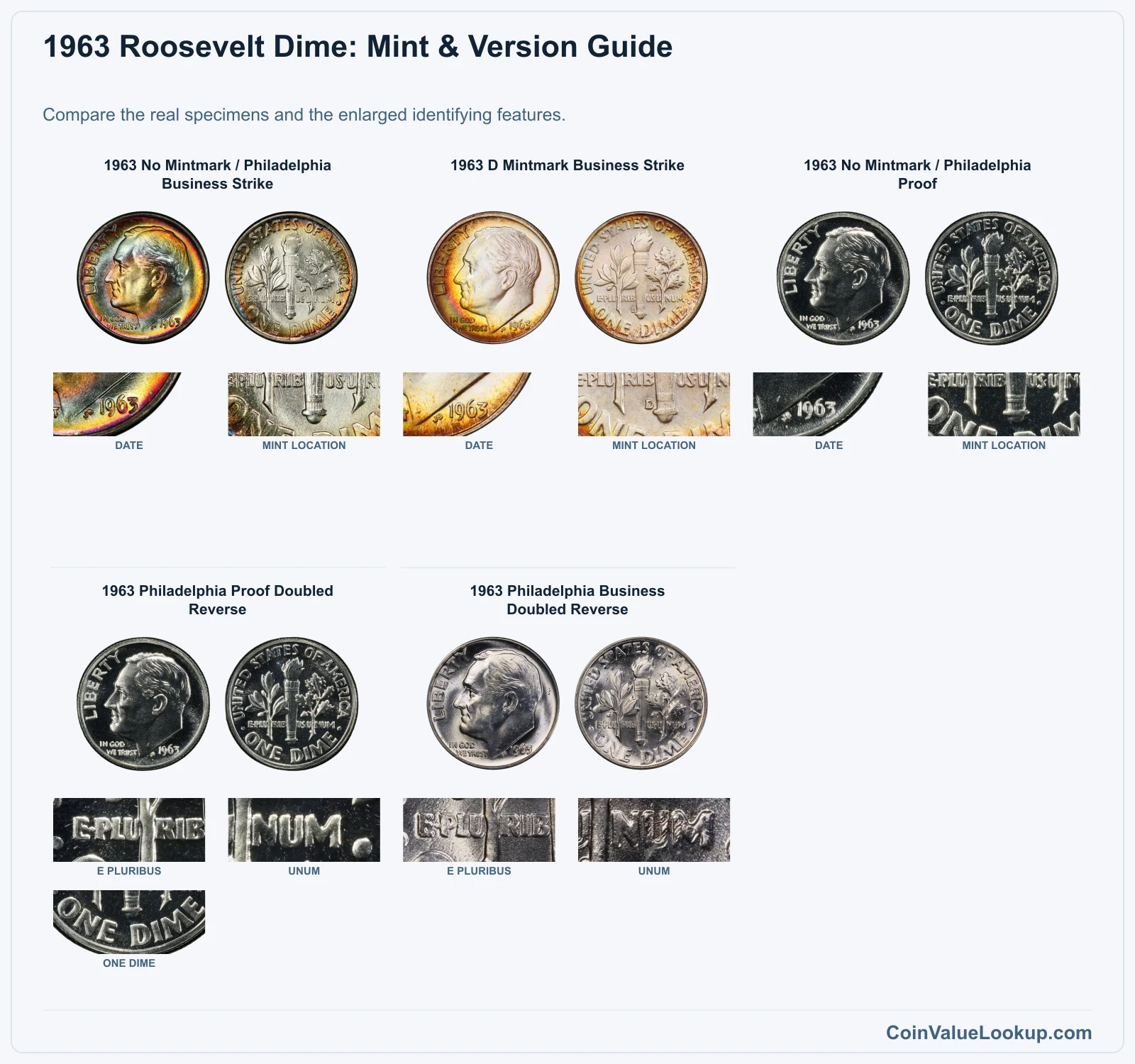
Start with the basics: the date 1963 on the obverse, Roosevelt's profile, and a torch flanked by branches on the reverse. Every regular 1963 dime is 90% silver and 10% copper, weighing about 2.50 grams and measuring roughly 17.9 mm across.
Flip the coin over and look at the base of the torch. A "D" mintmark means Denver.
No mintmark means Philadelphia, which produced both business strikes and proofs that year.
Telling a proof from a business strike matters here. Proofs have mirror-like fields and were sold in sets, not released into circulation.
A proof doubled die reverse and a business-strike doubled die reverse are completely different price branches, so lumping them together will mislead you.
Coin Value Lookup is a useful starting point if you are sorting through a collection and need quick guides for multiple dates and denominations. It can help you figure out which coins deserve a closer look before you spend time on detailed research.
Step 2: Check Your 1963 Roosevelt Dime Grade
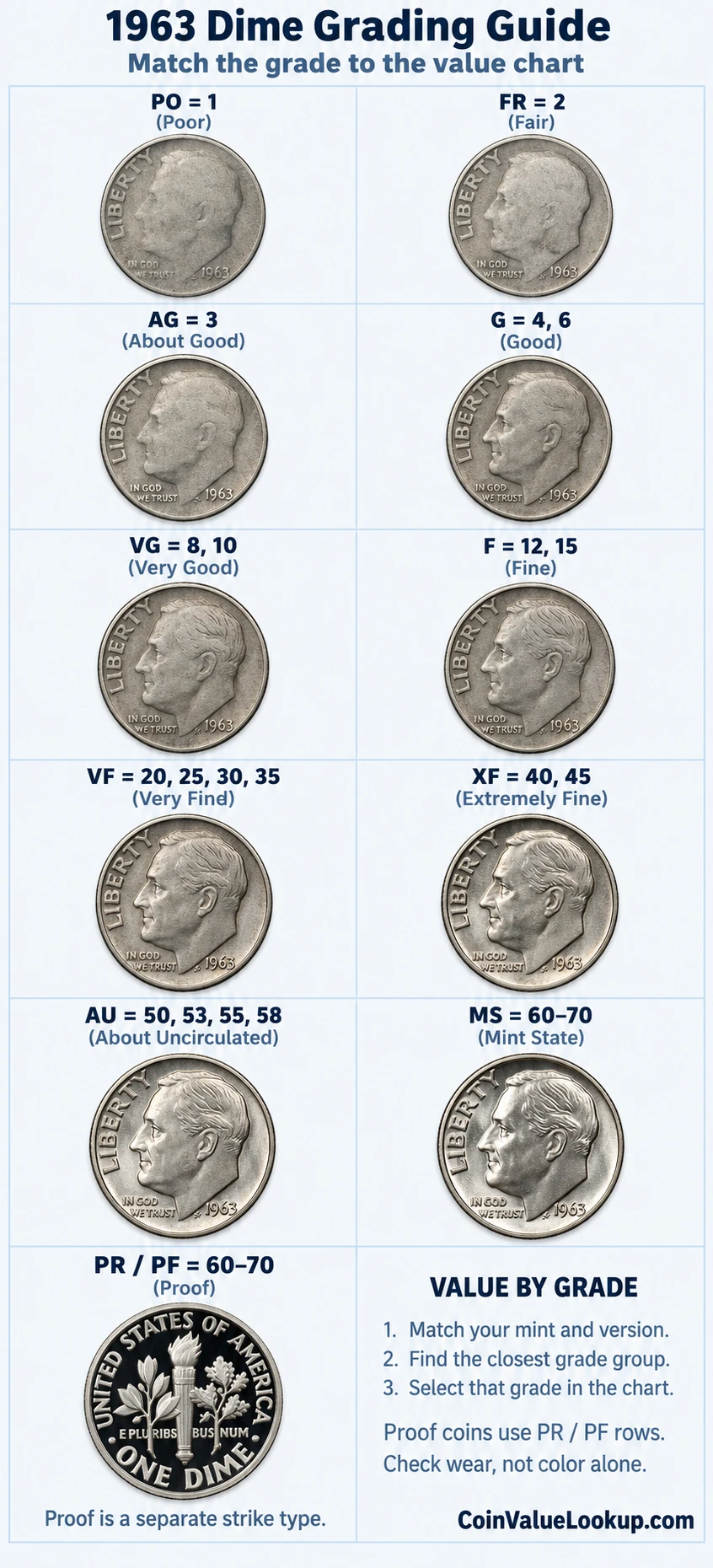
Focus on Roosevelt's cheekbone, jawline, and the hair directly above the ear. Those are the first spots to show friction.
On the reverse, the torch bands and leaf details lose definition early.
Tilt the coin under a single light source. Unbroken cartwheel luster across the fields is a good sign; dull, flat surfaces usually mean wear or cleaning.
Hairline scratches from cleaning can drop a coin's grade and value significantly even if the design looks sharp.
Full Bands is a strike designation, not a grade. It refers to complete separation of both horizontal band pairs on the torch.
A coin can be MS65 without Full Bands, or MS63 with them. Compare your coin to the reference image and match both grade and designation separately.
Brightness alone does not equal a high grade. An original, lightly toned coin with sharp detail often outperforms a harshly dipped, blast-white one.
Step 3: Check 1963 Roosevelt Dime Value by Mint and Version
1963 Roosevelt Dime — No Mintmark / Philadelphia Business Strike
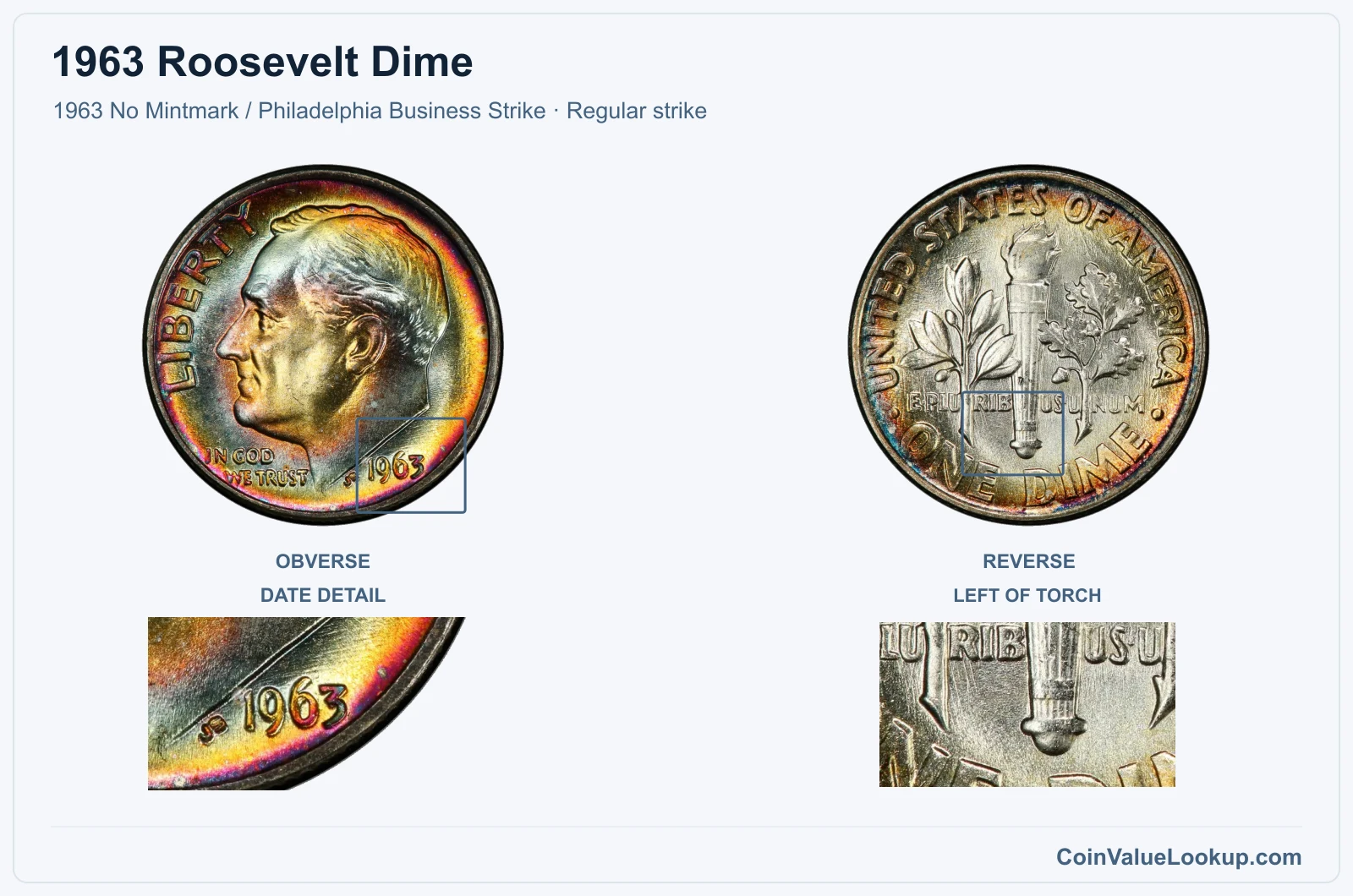
The 1963 Philadelphia business strike carries no mintmark. Look beside the torch base on the reverse and confirm the space is blank.
A USA Coin Book guide lists this version at about $5.81 in G4 and $10.91 in MS65. Most survivors are circulated, so finding one with full original luster and complete torch band separation puts you ahead of the pack.
Compare only against other Philadelphia business strikes with matching Full Bands designation when estimating value.
Range Grade
Price Auction Records Appraisal PO PO 1
—
Coin Identifier FR FR 2
—
Coin Identifier AG AG 3
—
Coin Identifier G G 4
—
Coin Identifier
G 6
—
Coin Identifier VG VG 8
—
Coin Identifier
VG 10
—
Coin Identifier F F 12
—
Coin Identifier
F 15
—
Coin Identifier VF VF 20
—
Coin Identifier
VF 25
—
Coin Identifier
VF 30
—
Coin Identifier
VF 35
—
Coin Identifier XF XF 40
—
Coin Identifier
XF 45
—
Coin Identifier AU AU 50
—
Coin Identifier
AU 53
—
Coin Identifier
AU 55
—
Coin Identifier
AU 58
—
Coin Identifier MS MS 60
—
Coin Identifier
MS 61
—
Coin Identifier
MS 62
—
Coin Identifier
MS 63
Coin Identifier
MS 64
Coin Identifier
MS 65
Coin Identifier
MS 66
Coin Identifier
MS 67
Coin Identifier
MS 68
—
—
—
MS 69
—
—
—
MS 70
—
—
—
1963 Roosevelt Dime — D Mintmark Business Strike
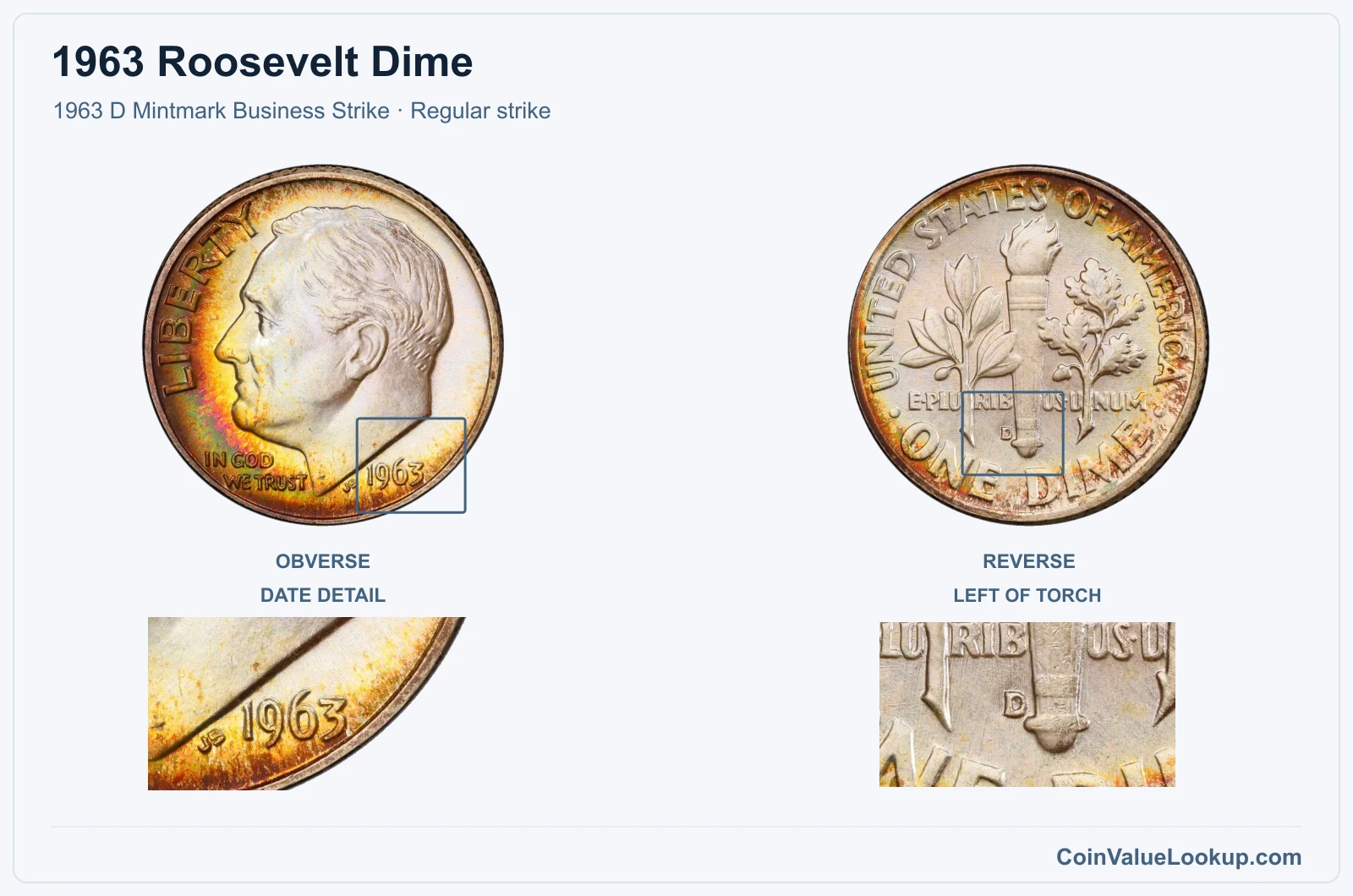
The 1963-D was struck in Denver and shows a small "D" beside the torch base. Guide values from USA Coin Book sit at roughly $5.81 for G4 and $10.91 for MS65, the same range as its Philadelphia counterpart.
Denver dimes from this era are common in circulated grades. The ones worth chasing are well-struck uncirculated examples with sharp torch bands and no contact marks on Roosevelt's cheek.
Range Grade
Price Auction Records Appraisal PO PO 1
—
Coin Identifier FR FR 2
—
Coin Identifier AG AG 3
—
Coin Identifier G G 4
—
Coin Identifier
G 6
—
Coin Identifier VG VG 8
—
Coin Identifier
VG 10
—
Coin Identifier F F 12
—
Coin Identifier
F 15
—
Coin Identifier VF VF 20
—
Coin Identifier
VF 25
—
Coin Identifier
VF 30
—
Coin Identifier
VF 35
—
Coin Identifier XF XF 40
—
Coin Identifier
XF 45
—
Coin Identifier AU AU 50
—
Coin Identifier
AU 53
—
Coin Identifier
AU 55
—
Coin Identifier
AU 58
Coin Identifier MS MS 60
—
Coin Identifier
MS 61
—
Coin Identifier
MS 62
—
Coin Identifier
MS 63
—
Coin Identifier
MS 64
Coin Identifier
MS 65
Coin Identifier
MS 66
Coin Identifier
MS 67
Coin Identifier
MS 68
Coin Identifier
MS 69
—
—
—
MS 70
—
—
—
1963 Roosevelt Dime — No Mintmark / Philadelphia Proof
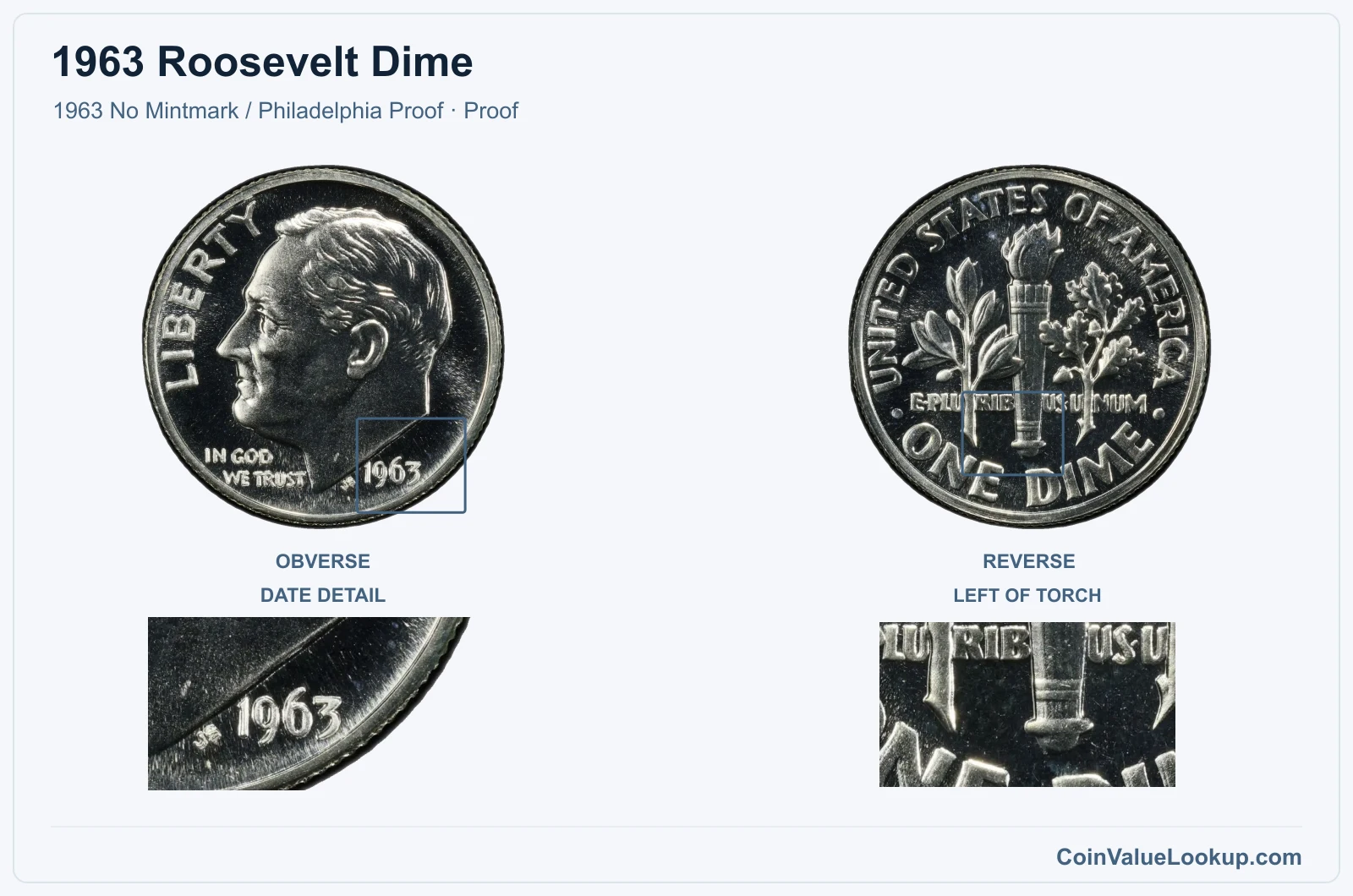
Philadelphia struck proofs for collectors in 1963, and these carry no mintmark just like the business issue. The difference is obvious once you see it: proofs have deeply mirrored fields and frosted design elements when well-preserved.
USA Coin Book places an ordinary PR65 at about $9.87. Cameo contrast, where frosted devices stand against mirror fields, is a separate designation and commands its own comparison.
Do not compare proof prices against business-strike prices; they are different products from different production lines.
Range Grade
Price Auction Records Appraisal PR PR 1
—
Coin Identifier
PR 2
—
Coin Identifier
PR 3
—
Coin Identifier
PR 4
—
Coin Identifier
PR 6
—
Coin Identifier
PR 8
—
Coin Identifier
PR 10
—
Coin Identifier
PR 12
—
Coin Identifier
PR 15
—
Coin Identifier
PR 20
—
Coin Identifier
PR 25
—
Coin Identifier
PR 30
—
Coin Identifier
PR 35
—
Coin Identifier
PR 40
—
Coin Identifier
PR 45
—
Coin Identifier
PR 50
—
Coin Identifier
PR 53
—
Coin Identifier
PR 55
—
Coin Identifier
PR 58
—
Coin Identifier
PR 60
—
Coin Identifier
PR 61
—
Coin Identifier
PR 62
—
Coin Identifier
PR 63
—
Coin Identifier
PR 64
Coin Identifier
PR 65
Coin Identifier
PR 66
Coin Identifier
PR 67
Coin Identifier
PR 68
Coin Identifier
PR 69
Coin Identifier
PR 70
Coin Identifier
1963 Roosevelt Dime — Philadelphia Proof Doubled Reverse
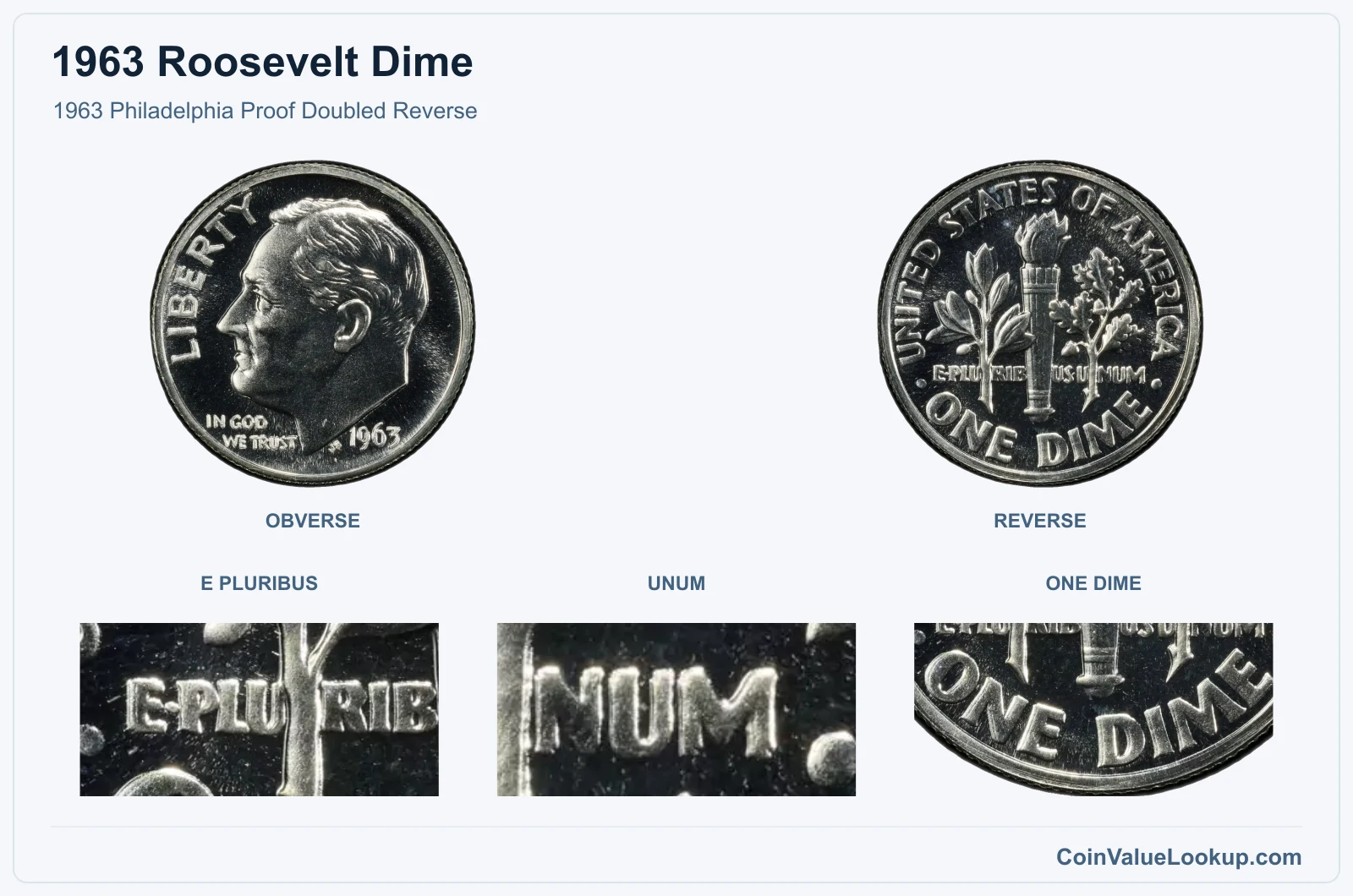
A Philadelphia proof doubled die reverse exists for 1963. The doubling appears on the reverse lettering, particularly ONE DIME and the motto near the torch, and shows rounded separation rather than a flat mechanical shelf.
Because this is a proof, the fields should be mirrored and the surfaces undisturbed by circulation. Authentication and exact attribution by a grading service are essential before placing a value on this variety.
No reliable numeric price range is available from the supplied data, so each specimen is assessed individually based on its certified identity, condition and the strength of the doubling. Keep this branch entirely separate from the business-strike doubled reverse.
Ordinary-issue reference: Ordinary-issue reference only: The table below shows prices for the 1963 Roosevelt Dime (proof). It does not represent the value of the specific 1963 Philadelphia Proof Doubled Reverse variety or its variety premium. Year, mint, metal and strike type are matched; the specific variety is not priced by this table.
Range Grade
Price Auction Records Appraisal PR PR 1
—
Coin Identifier
PR 2
—
Coin Identifier
PR 3
—
Coin Identifier
PR 4
—
Coin Identifier
PR 6
—
Coin Identifier
PR 8
—
Coin Identifier
PR 10
—
Coin Identifier
PR 12
—
Coin Identifier
PR 15
—
Coin Identifier
PR 20
—
Coin Identifier
PR 25
—
Coin Identifier
PR 30
—
Coin Identifier
PR 35
—
Coin Identifier
PR 40
—
Coin Identifier
PR 45
—
Coin Identifier
PR 50
—
Coin Identifier
PR 53
—
Coin Identifier
PR 55
—
Coin Identifier
PR 58
—
Coin Identifier
PR 60
—
Coin Identifier
PR 61
—
Coin Identifier
PR 62
—
Coin Identifier
PR 63
—
Coin Identifier
PR 64
Coin Identifier
PR 65
Coin Identifier
PR 66
Coin Identifier
PR 67
Coin Identifier
PR 68
Coin Identifier
PR 69
Coin Identifier
PR 70
Coin Identifier
1963 Roosevelt Dime — Philadelphia Business Doubled Reverse
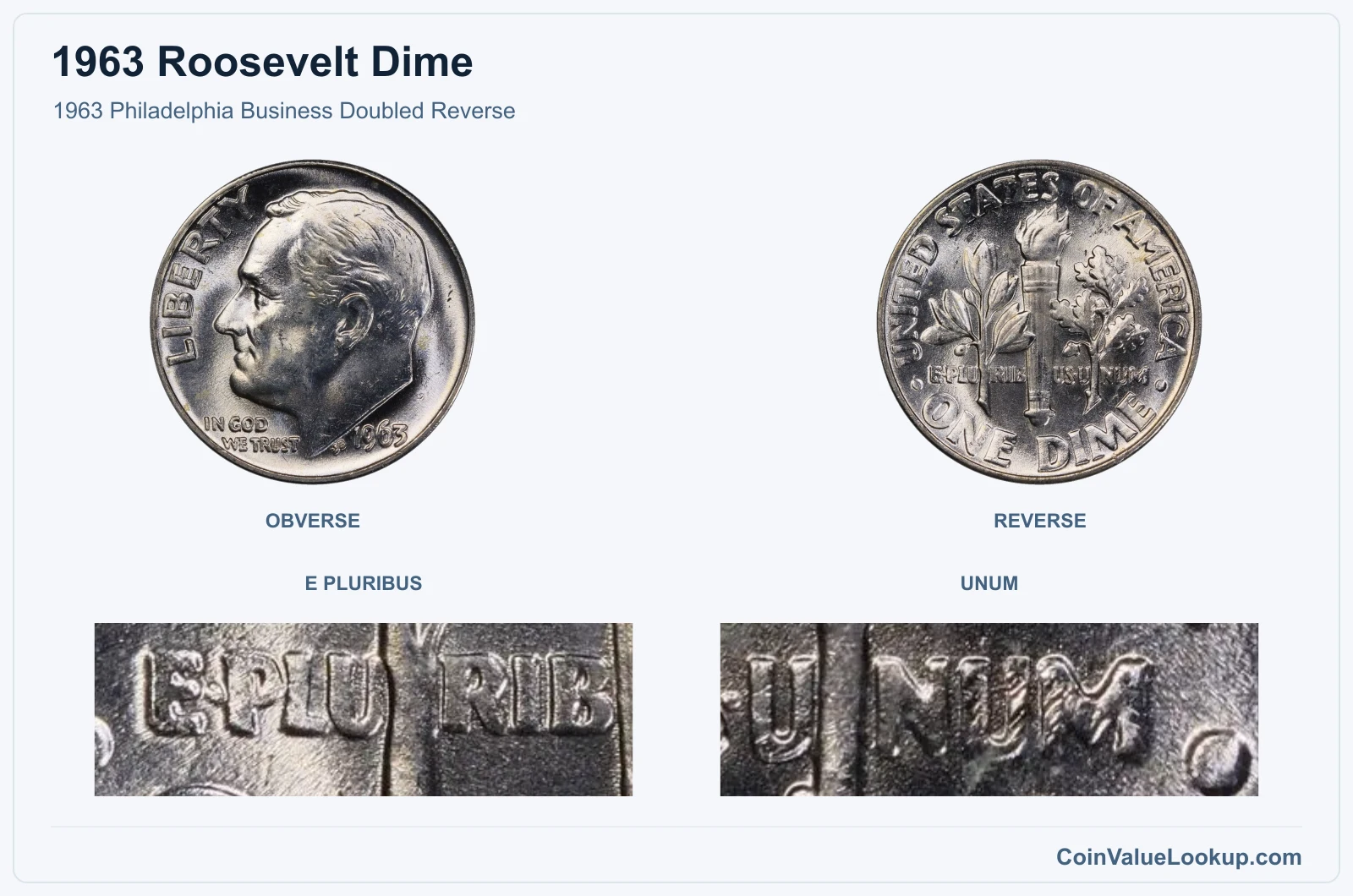
A business-strike doubled die reverse also exists for 1963 Philadelphia dimes, and it is a completely different variety from the proof version. The doubling affects the reverse design elements, but this coin will show normal business-strike luster rather than proof mirrors.
Certified attribution is required to confirm the exact reverse die pairing. No supported price range is available, so value depends on the individual coin's authenticated identity, condition and how pronounced the doubling appears.
If you think you have one, compare carefully at magnification against a known normal reverse before pursuing certification.
Ordinary-issue reference: Ordinary-issue reference only: The table below shows prices for the 1963 Roosevelt Dime (regular strike). It does not represent the value of the specific 1963 Philadelphia Business Doubled Reverse variety or its variety premium. Year, mint, metal and strike type are matched; the specific variety is not priced by this table.
Range Grade
Price Auction Records Appraisal PO PO 1
—
Coin Identifier FR FR 2
—
Coin Identifier AG AG 3
—
Coin Identifier G G 4
—
Coin Identifier
G 6
—
Coin Identifier VG VG 8
—
Coin Identifier
VG 10
—
Coin Identifier F F 12
—
Coin Identifier
F 15
—
Coin Identifier VF VF 20
—
Coin Identifier
VF 25
—
Coin Identifier
VF 30
—
Coin Identifier
VF 35
—
Coin Identifier XF XF 40
—
Coin Identifier
XF 45
—
Coin Identifier AU AU 50
—
Coin Identifier
AU 53
—
Coin Identifier
AU 55
—
Coin Identifier
AU 58
—
Coin Identifier MS MS 60
—
Coin Identifier
MS 61
—
Coin Identifier
MS 62
—
Coin Identifier
MS 63
Coin Identifier
MS 64
Coin Identifier
MS 65
Coin Identifier
MS 66
Coin Identifier
MS 67
Coin Identifier
MS 68
—
—
—
MS 69
—
—
—
MS 70
—
—
—
1963 Roosevelt Dime Error List
1. 1963 Roosevelt Dime — Double Curved Clips
A double curved clip means two overlapping curved segments are missing from the planchet's edge, each caused by the blanking punch overlapping a previously punched hole in the strip. On a 1963 no-mintmark business strike, look for two distinct concave bite marks, usually at different positions along the rim.
The missing areas should show a smooth, natural curve consistent with the blanking process. Post-mint cutting or abrasion can mimic a clip, so check that the design near each clip fades naturally rather than ending in a sharp or irregular line.
Corrosion or color differences alone are not diagnostic. A certified example graded NGC MS61 has appeared at auction.
No numeric price range is adopted for this error; each piece is assessed individually based on authenticated identity, condition and the size of the clips.
2. 1963 Roosevelt Dime — Planchet Crack
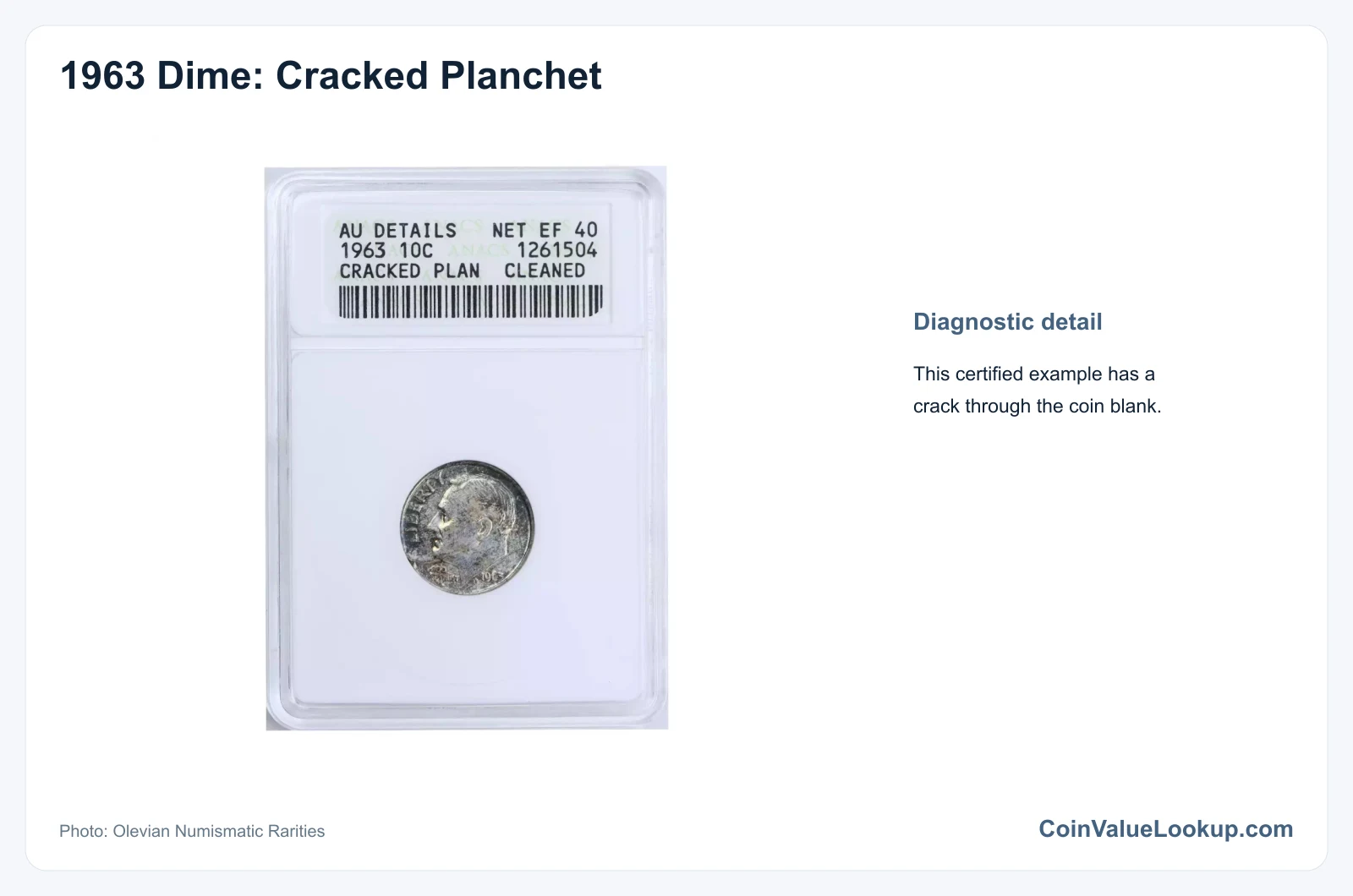
A planchet crack is a fissure in the coin's metal itself, not a raised line left by a cracked die. On 1963 no-mintmark business strikes, a documented specimen shows the crack near the 9:30 position.
Examine the edge at that spot under magnification to see whether the split runs into the body of the coin. A die crack transfers a raised ridge onto the surface, while a planchet crack is an actual separation in the blank metal.
The certified example weighed 2.4 grams and graded NGC MS65. Post-mint scratches, corrosion lines and tool marks can look similar at a glance, so compare against a certified reference at matching magnification before drawing conclusions.
Value depends on the individual coin's authenticated identity and condition.
3. 1963 Roosevelt Dime — Split Planchet
A split planchet occurs when the coin's metal separates internally, leaving an abnormally thin and light piece. The documented 1963-D example weighed only about 1.4 grams, roughly half the normal 2.50-gram weight, and was graded NGC MS62.
The exposed interior surface has a rough, granular texture from the metal tearing apart. This is not a clad layer peeling off; the 1963 dime is solid 90% silver, so what you see is the silver itself splitting within the blank.
If your coin feels suspiciously light and one side looks rough or incomplete, weigh it. Post-mint grinding, deliberate thinning or corrosion can fake the appearance, so authentication is critical.
No supported price range applies; value depends on certified identity and condition.
4. 1963 Roosevelt Dime — Proof Doubled Die Reverse
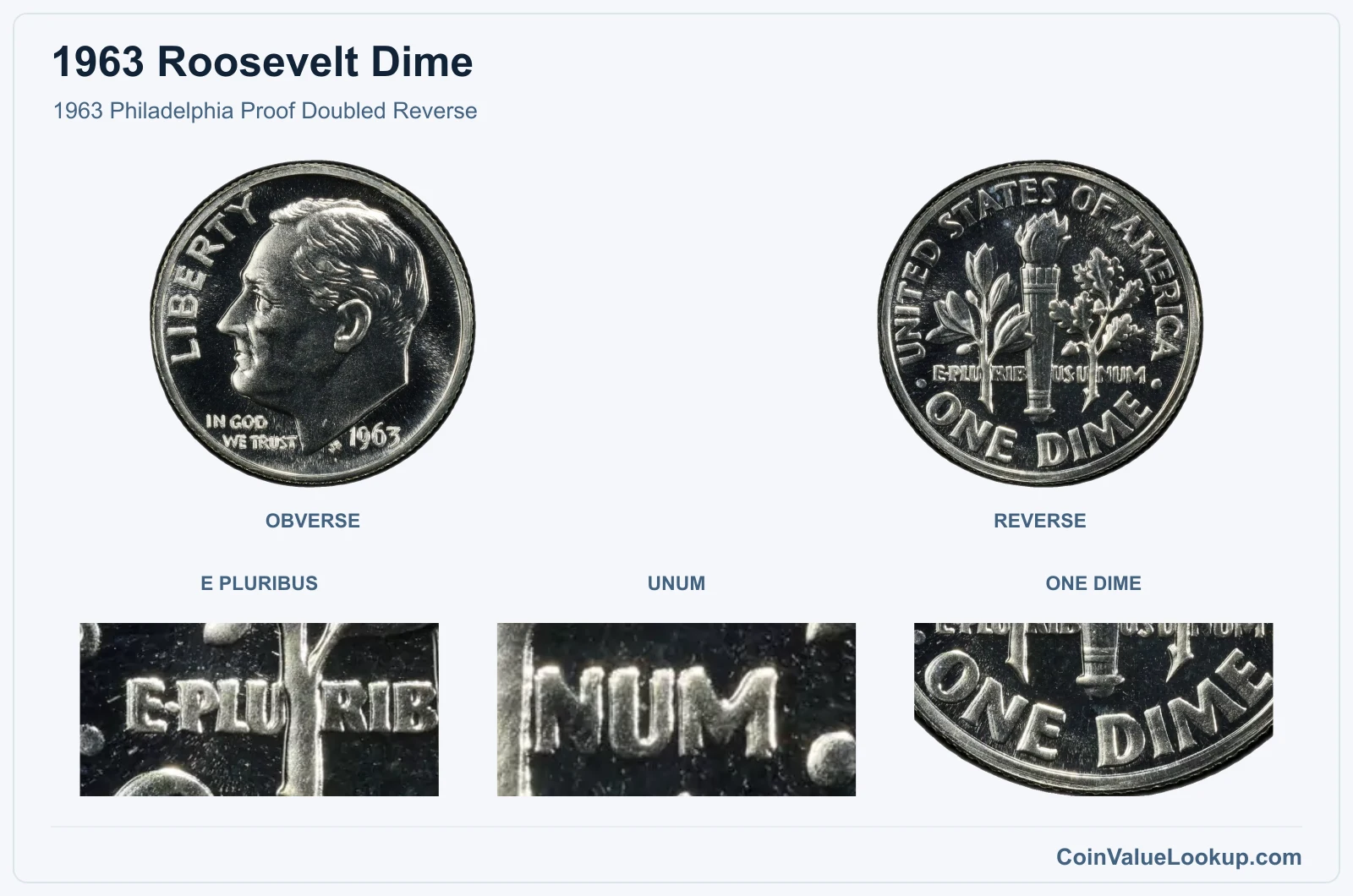
The proof doubled die reverse on a 1963 Philadelphia proof shows rounded doubling on the reverse lettering and design. Under magnification, focus on ONE DIME, the motto and the torch details.
The doubling should appear as consistent separation with rounded edges, not a flat shelf, which would indicate machine doubling. Because this is a proof, the obverse and reverse fields must show mirrored surfaces.
A specimen attributed as a DDR has appeared graded NGC Proof 67 Cameo. Confirm both the proof manufacture and the specific reverse die attribution before assigning any premium.
No numeric price range is adopted for this variety. Each coin's value depends on its certified attribution, the strength of doubling and overall condition.
5. 1963 Roosevelt Dime — Doubled Die Obverse
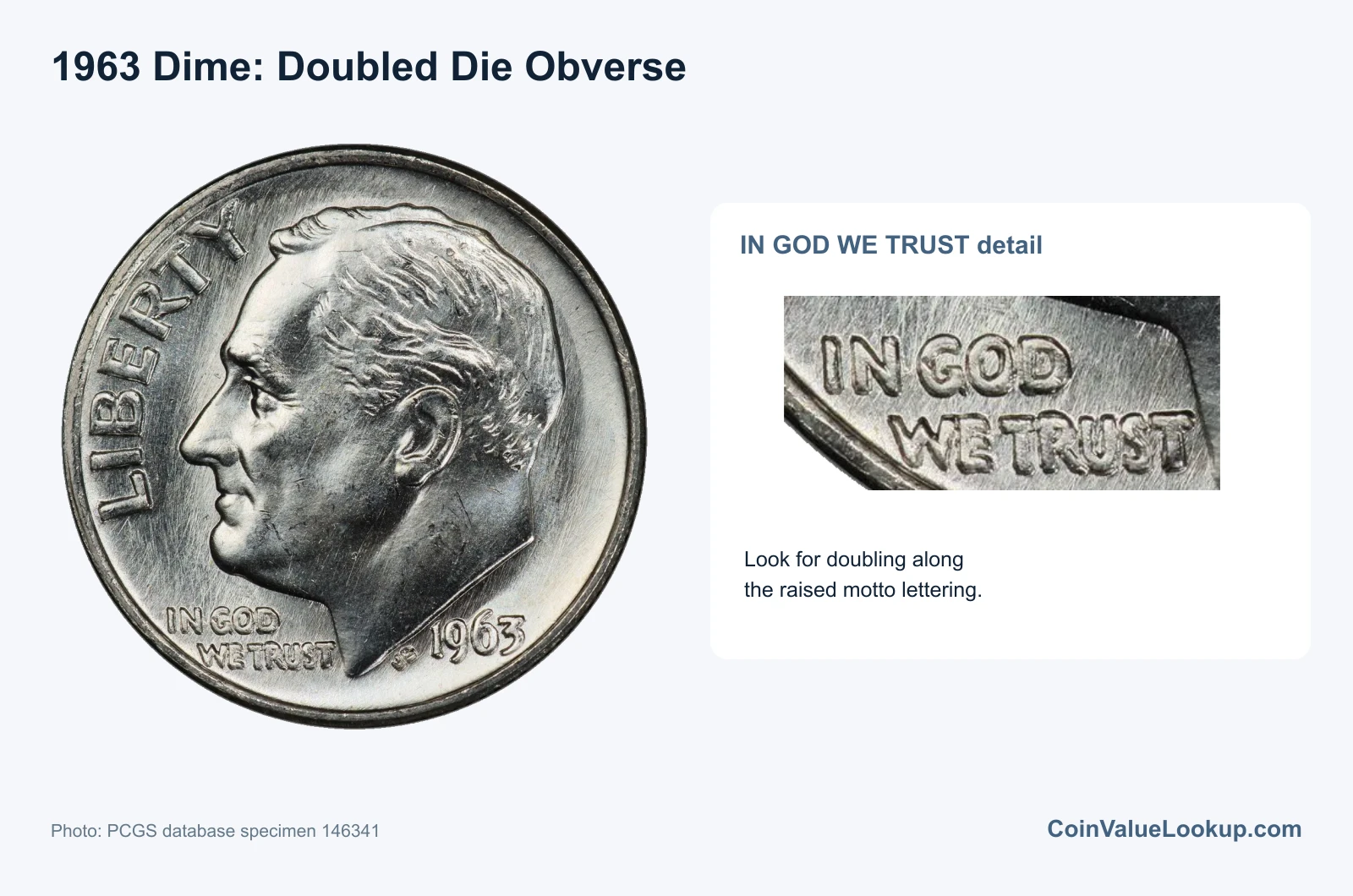
Doubled die obverse varieties have been reported for the 1963 dime. The doubling typically affects obverse lettering or design elements, showing consistent separation or notching rather than a flat shelf.
To check, compare your coin's obverse inscriptions against a known normal specimen under the same lighting and magnification. Machine doubling is the most common lookalike; it produces a flat, shelf-like distortion rather than the rounded, separated profiles of a true doubled die.
Worn die contours and reflections can also fool you. No numeric price range is available for this category, so value depends on the visibility and attribution of the specific doubling, along with the coin's overall condition.
6. 1963 Roosevelt Dime — Repunched Mintmark
Repunched mintmark varieties have been reported for 1963 dimes. These occur when the mintmark punch was applied more than once in slightly different positions, leaving remnants of the earlier impression visible beside or beneath the final mark.
Check the D mintmark near the torch base under magnification and compare against a normal example at the same power. A die chip, corrosion or machine doubling around the mintmark can mimic an RPM, so look for a clear second impression with the same shape as the primary punch.
No numeric price range is adopted. Value depends on the specific repunching, its visibility and the coin's condition, all confirmed through authentication.
7. 1963 Roosevelt Dime — Struck-Through Error
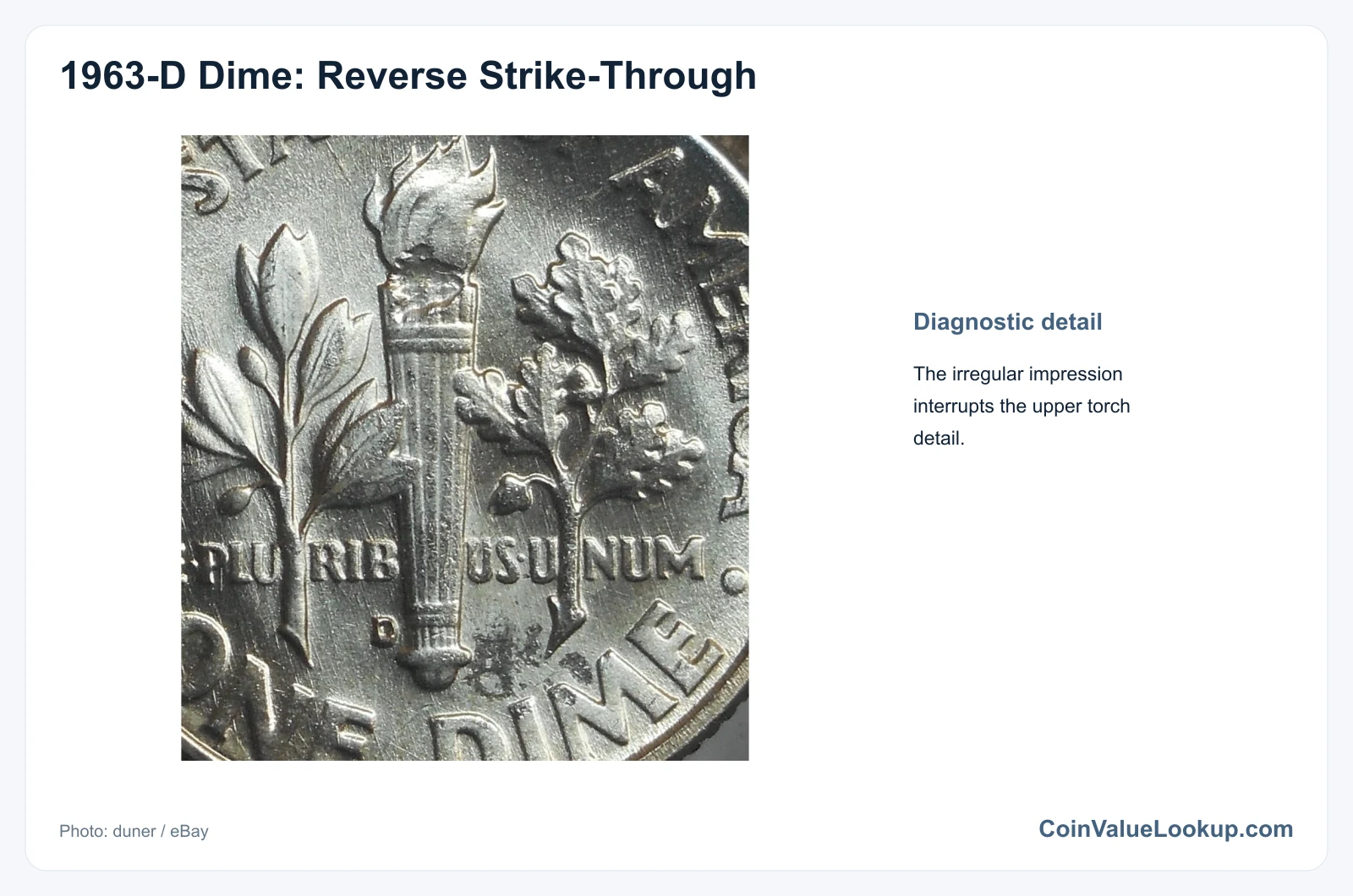
Struck-through errors have been reported for the 1963 dime, including one described with a cameo effect on the reverse. A struck-through happens when foreign material, such as grease, thread or a fragment, sits between the die and the planchet during striking, leaving a depression or obscured area in the design.
Grease fill-ins and retained foreign objects are distinct subtypes, so keep descriptions precise. The affected area will show a localized loss of detail that differs from ordinary wear or cleaning.
Scratches and weak strikes from worn dies are common lookalikes. No supported price range is available; each specimen is valued individually based on its authenticated identity, the nature and size of the obstruction and overall condition.
8. 1963 Roosevelt Dime — Off-Center Strike
Off-center strikes have been reported for the 1963 dime. This error happens when the planchet is not properly seated between the dies, producing a displaced design and an unstruck crescent of blank metal along one edge.
The percentage of off-center displacement and whether the full date remains visible are the two biggest factors in collector interest. A misaligned die can produce a slightly shifted design without the telltale blank crescent, so look carefully at the rim.
Post-mint flattening or a clipped planchet can also create confusion. No numeric price range is adopted for this error.
Value depends on the degree of displacement, date visibility and the coin's authenticated condition.
9. 1963 Roosevelt Dime — Defective Planchet
Defective planchet errors have been reported for the 1963 dime. These involve flaws in the blank metal itself, such as voids, laminations or irregular surfaces, that were present before the coin was struck.
The surrounding design will typically show normal strike detail flowing around or over the defect, confirming it was part of the blank rather than inflicted afterward. Examine both faces and the edge for context.
Post-mint gouges, corrosion pits and deliberate metal removal are common lookalikes, so match your coin against a certified example when possible. No supported price range is available.
Each piece is assessed individually based on its authenticated identity, the nature and severity of the planchet defect and overall condition.