1978 Roosevelt Dime Coin Value: How Much Is It Worth?
Most 1978 Roosevelt dimes in your pocket change are worth face value — ten cents and not a penny more. In uncirculated condition at the MS 65 level, both the Philadelphia and Denver business strikes carry a guide value around $2.79 each.
A standard 1978-S proof sits at about $3.08 in PR 65. The real prizes are authenticated mint errors and coins with exceptional strike quality, which can push well beyond those modest guide figures.
Fast Way to Identify Your 1978 Roosevelt Dime
The quickest way to start figuring out what you have is to upload clear photos of the front and back of your 1978 dime. That lets us run a preliminary identification covering the mint, finish, and any obvious features.
Snap both sides in good light — no need for a professional setup, just steady hands and a sharp image.
1978 Roosevelt Dime Value
Upload both sides of your 1978 Roosevelt Dime.
Front Obverse
Upload photo
Back Reverse
Upload photo
Which 1978 Roosevelt Dime Versions Are Worth Money?
- Philadelphia and Denver business strikes with strong, fully separated torch bands in high Mint State grades can carry a premium over ordinary uncirculated examples.
- 1978-S proofs with undisturbed mirror fields and genuine cameo contrast between frosted devices and reflective surfaces are the pick of the standard issues.
- A compound error combining an off-center strike with triple clips sold for $162 in August 2020 — authentication of the specific features is essential before assigning any premium.
- A strong die clash on a 1978-S proof graded PR 68 Deep Cameo brought $159 in October 2022 — again, professional authentication matters here.
- Double-strike errors with a dramatically off-center second impression are known on the 1978-D; individual assessment by an authentication service determines value.
Step 1: Identify Your 1978 Roosevelt Dime Mint Mark and Version
Start with the basics. Confirm the 1978 date on the obverse alongside Franklin Roosevelt's portrait, and flip it over to verify the torch-and-branches reverse design.
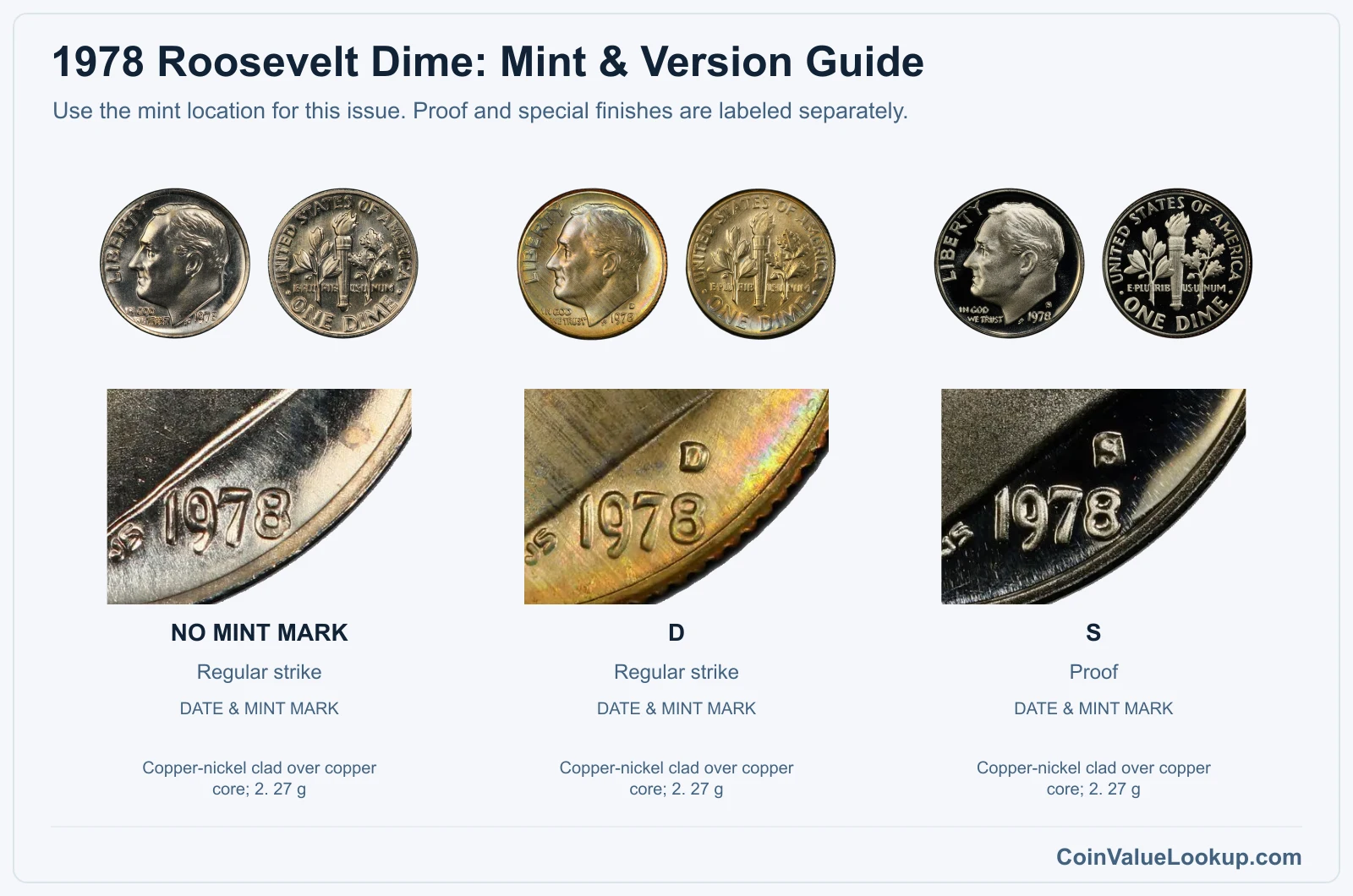
Next, look for a mintmark on the obverse near the date. No mintmark means Philadelphia.
A small "D" means Denver. An "S" indicates a San Francisco proof — these were not sold in circulation and came in sealed sets.
All 1978 dimes are copper-nickel clad, weighing about 2.27 grams and measuring roughly 17.9 mm across. There is no silver version for this year.
If someone offers you a 1978 "silver proof," walk away.
There is also no legitimate 1978 No-S proof variety. Every genuine proof from this year carries the S mintmark.
Step 2: Check Your 1978 Roosevelt Dime Grade
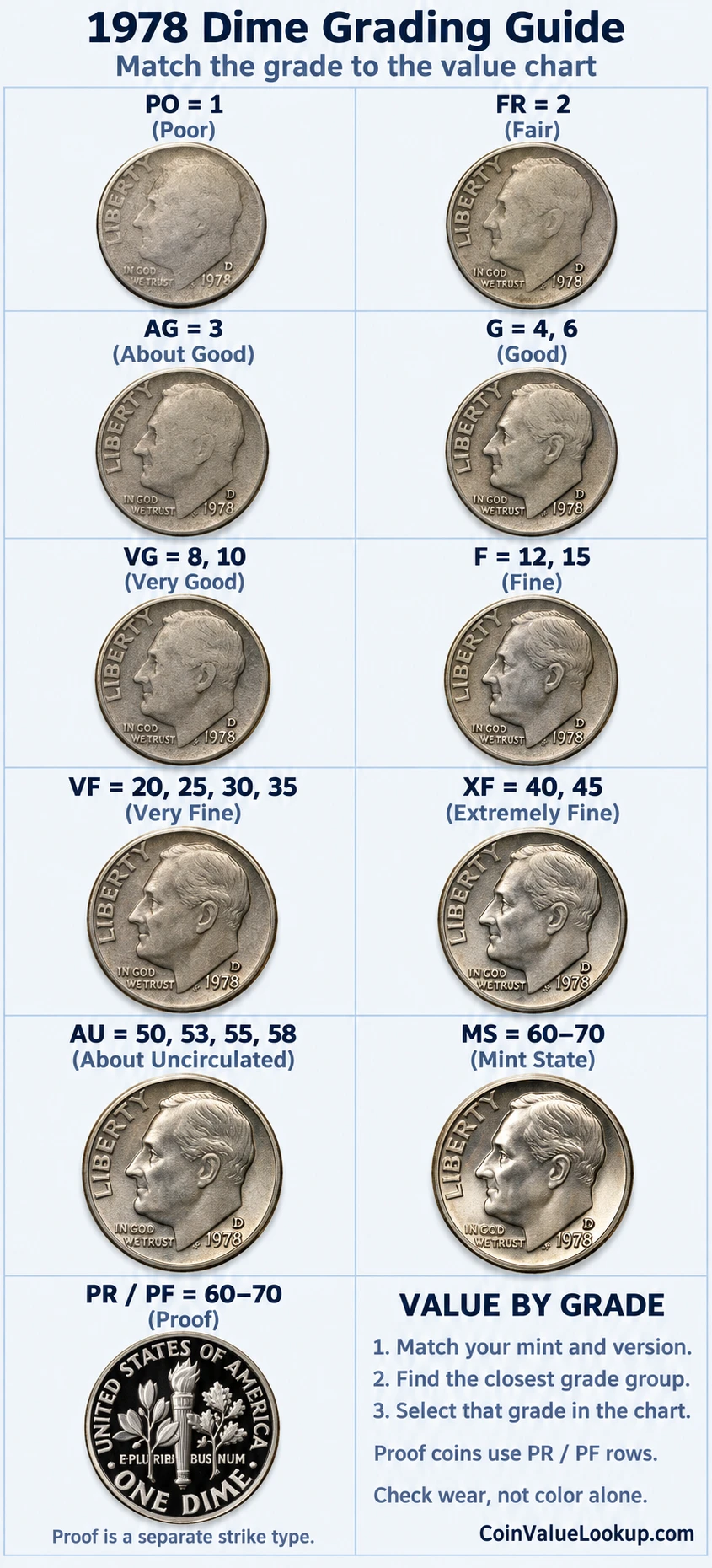
Look at Roosevelt's cheek and jawline first — that is where wear shows up earliest. Then check the hair detail above the ear.
On the reverse, examine the horizontal bands on the torch and the leaf details.
A coin with full original luster and no wear across those high points is in Mint State territory. Don't confuse a weakly struck coin with a worn one; a weak strike will still have luster in the flat areas, while wear strips it away.
Scratches, cleaning, and corrosion all drag a grade down regardless of how sharp the design looks.
The comparison image is your friend here. Hold your coin beside it and match the amount of detail remaining at each checkpoint.
Remember that "proof" describes how the coin was made — mirror fields, frosted devices, struck multiple times on polished planchets. It is not a grade above MS 70.
Proof coins get their own PR scale, and surface quality matters just as much.
Step 3: Check 1978 Roosevelt Dime Value by Mint and Version
1978 Roosevelt Dime — No Mintmark Business Strike
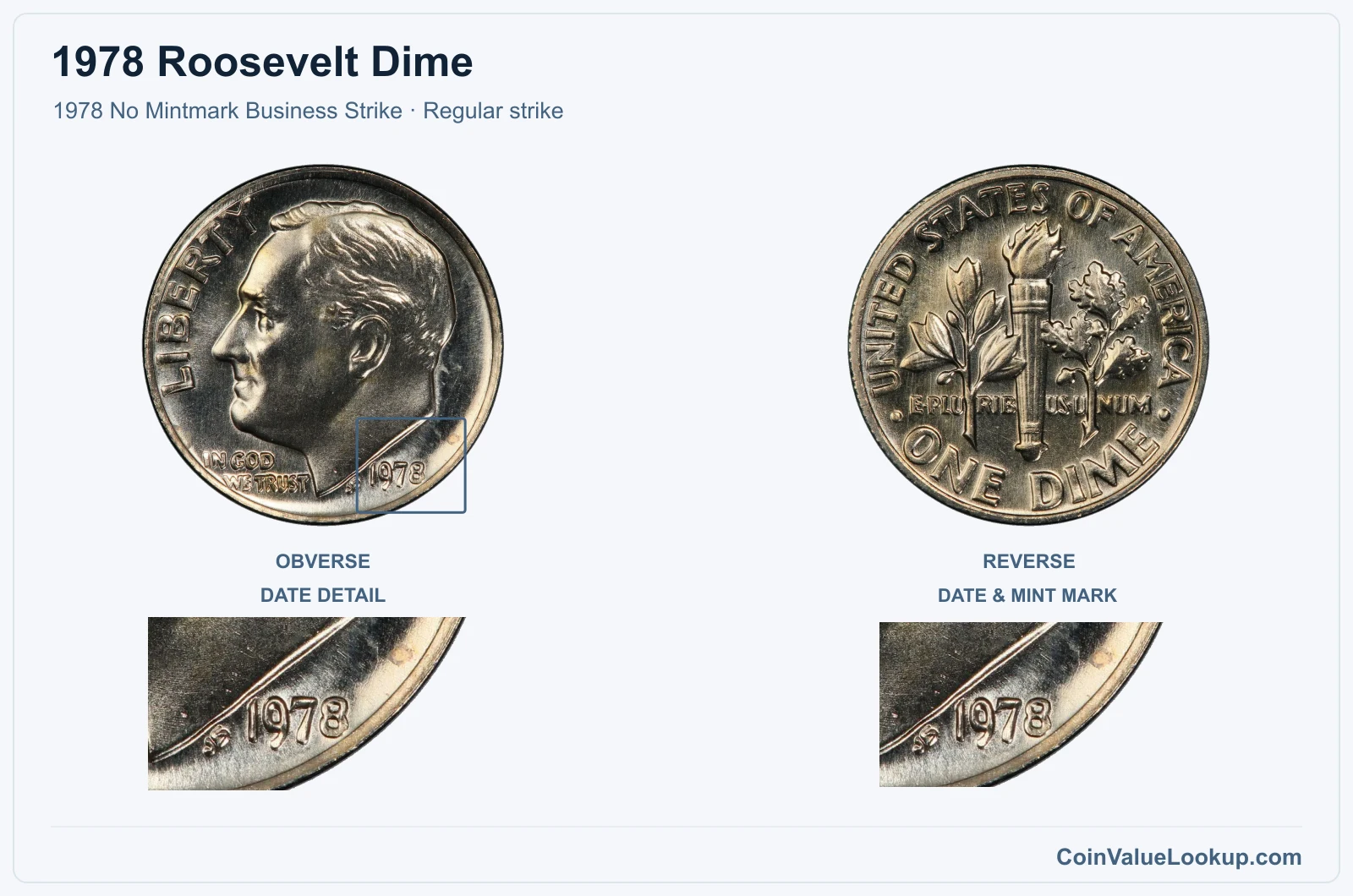
The 1978 no-mintmark dime is the Philadelphia business strike. You will find no letter near the date — that is your confirmation.
It is copper-nickel clad over a copper core, 2.27 grams, and about 17.9 mm in diameter.
In typical circulated condition these are worth face value. A USA Coin Book guide estimate places the MS 65 value at $2.79.
Coins designated Full Bands — meaning both horizontal torch-band pairs are sharply separated — can command a premium over standard uncirculated examples, but that designation requires matched evidence from a grading service, not a squint across the kitchen table.
Coin Value Lookup is a handy starting point if you want to look up guides for other Roosevelt dime dates or denominations while sorting through a collection.
Range Grade
Price Auction Records Appraisal PO PO 1
—
Coin Identifier FR FR 2
—
Coin Identifier AG AG 3
—
Coin Identifier G G 4
—
Coin Identifier
G 6
—
Coin Identifier VG VG 8
—
Coin Identifier
VG 10
—
Coin Identifier F F 12
—
Coin Identifier
F 15
—
Coin Identifier VF VF 20
—
Coin Identifier
VF 25
—
Coin Identifier
VF 30
—
Coin Identifier
VF 35
—
Coin Identifier XF XF 40
—
Coin Identifier
XF 45
—
Coin Identifier AU AU 50
—
Coin Identifier
AU 53
—
Coin Identifier
AU 55
—
Coin Identifier
AU 58
—
Coin Identifier MS MS 60
—
Coin Identifier
MS 61
Coin Identifier
MS 62
—
Coin Identifier
MS 63
—
Coin Identifier
MS 64
—
Coin Identifier
MS 65
Coin Identifier
MS 66
Coin Identifier
MS 67
Coin Identifier
MS 68
—
Coin Identifier
MS 69
—
—
—
MS 70
—
—
—
1978 Roosevelt Dime — D Business Strike
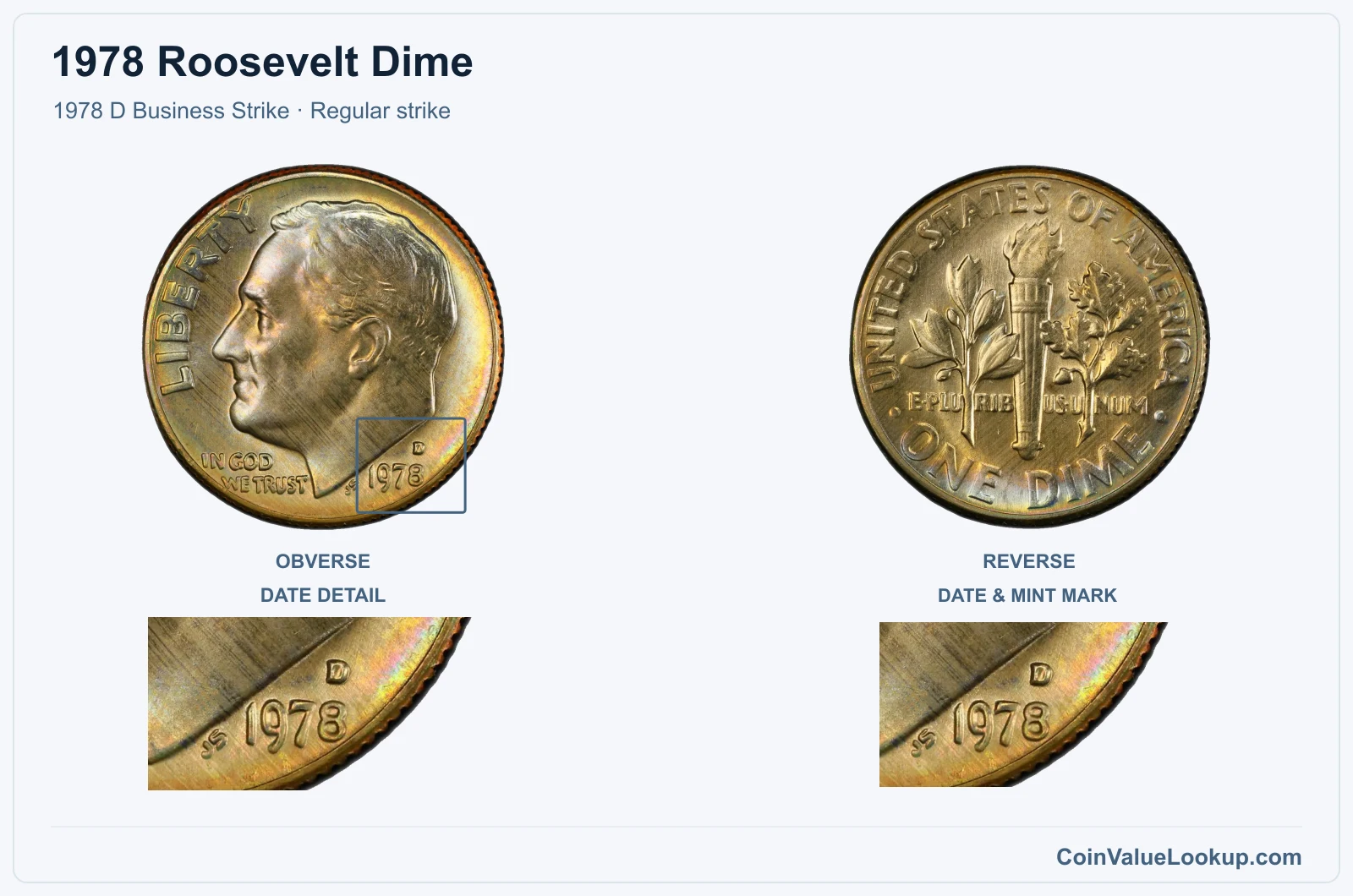
Look for the small "D" mintmark on the obverse near the date. That marks a Denver business strike, same copper-nickel clad composition and 2.27-gram weight as its Philadelphia sibling.
Circulated examples are face-value coins. At the MS 65 grade, the USA Coin Book guide lists $2.79.
Full Bands designation can add a premium in higher Mint State grades, but it must be confirmed by a professional grading service — strong torch bands are a strike characteristic, not something every well-preserved coin automatically has.
Denver dimes from 1978 show up in rolls and collections regularly. They are common coins, so condition and any authenticated error features are what separate a ten-cent piece from something worth chasing.
Range Grade
Price Auction Records Appraisal PO PO 1
—
Coin Identifier FR FR 2
—
Coin Identifier AG AG 3
—
Coin Identifier G G 4
—
Coin Identifier
G 6
—
Coin Identifier VG VG 8
—
Coin Identifier
VG 10
—
Coin Identifier F F 12
—
Coin Identifier
F 15
—
Coin Identifier VF VF 20
—
Coin Identifier
VF 25
—
Coin Identifier
VF 30
—
Coin Identifier
VF 35
—
Coin Identifier XF XF 40
—
Coin Identifier
XF 45
—
Coin Identifier AU AU 50
—
Coin Identifier
AU 53
—
Coin Identifier
AU 55
—
Coin Identifier
AU 58
—
Coin Identifier MS MS 60
—
Coin Identifier
MS 61
—
Coin Identifier
MS 62
—
Coin Identifier
MS 63
—
Coin Identifier
MS 64
—
Coin Identifier
MS 65
—
Coin Identifier
MS 66
Coin Identifier
MS 67
Coin Identifier
MS 68
—
Coin Identifier
MS 69
—
—
—
MS 70
—
—
—
1978 Roosevelt Dime — S Proof
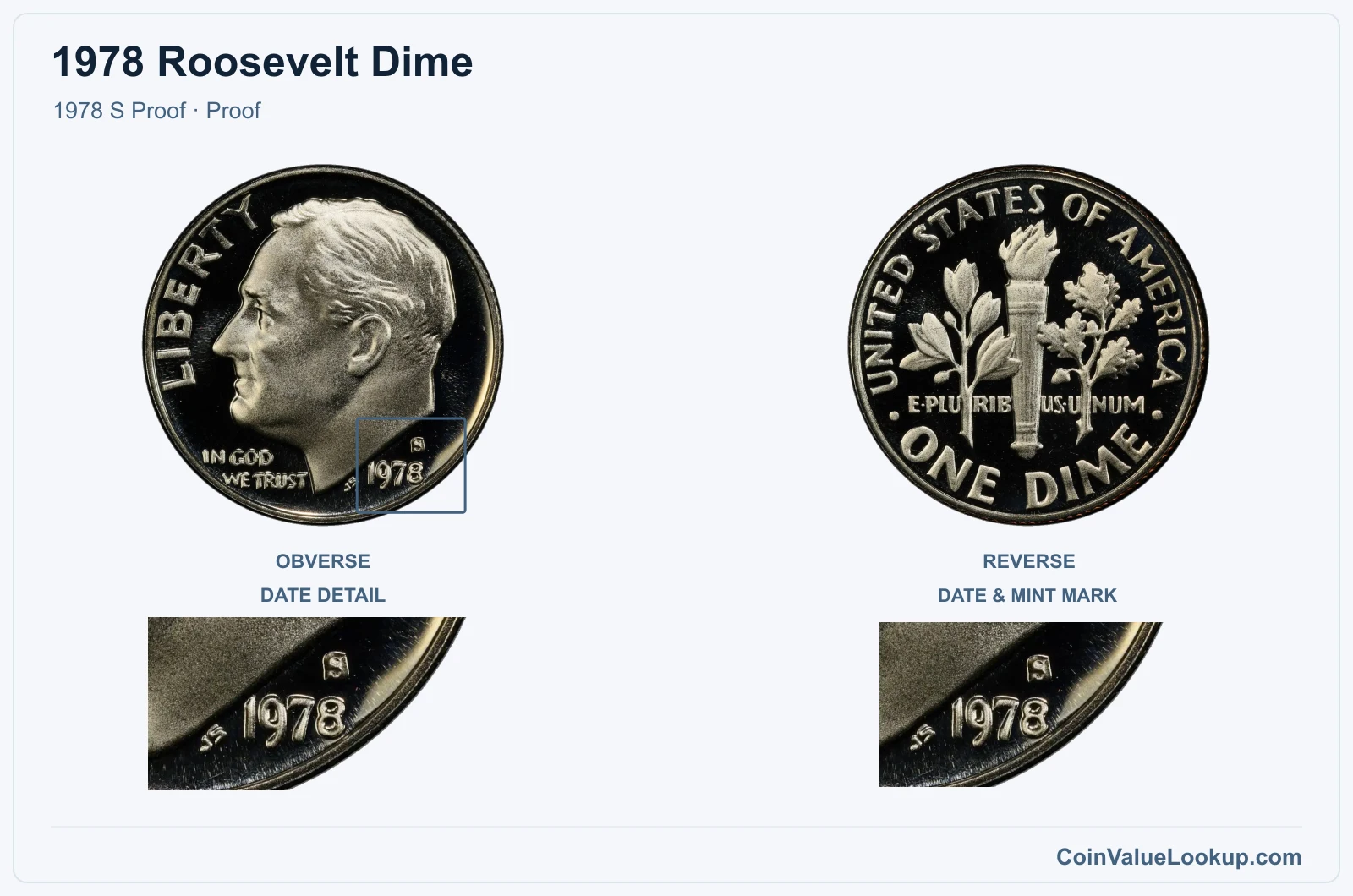
The 1978-S proof was struck at San Francisco and sold in proof sets, not released into circulation. It carries a small "S" mintmark on the obverse.
Same copper-nickel clad composition as the business strikes.
A standard PR 65 example is valued at about $3.08 according to USA Coin Book. Proofs with deep, undisturbed mirror fields and strong frosted contrast on the devices — the cameo or deep cameo look — can be worth more, though the premium depends on the verified designation and grade.
Because proof coins were handled more carefully from the start, surface quality and the absence of haze or hairlines matter a great deal when determining condition. Compare yours to a graded reference image to gauge where it falls.
Range Grade
Price Auction Records Appraisal PR PR 1
—
Coin Identifier
PR 2
—
Coin Identifier
PR 3
—
Coin Identifier
PR 4
—
Coin Identifier
PR 6
—
Coin Identifier
PR 8
—
Coin Identifier
PR 10
—
Coin Identifier
PR 12
—
Coin Identifier
PR 15
—
Coin Identifier
PR 20
—
Coin Identifier
PR 25
—
Coin Identifier
PR 30
—
Coin Identifier
PR 35
—
Coin Identifier
PR 40
—
Coin Identifier
PR 45
—
Coin Identifier
PR 50
—
Coin Identifier
PR 53
—
Coin Identifier
PR 55
—
Coin Identifier
PR 58
—
Coin Identifier
PR 60
—
Coin Identifier
PR 61
—
Coin Identifier
PR 62
—
Coin Identifier
PR 63
—
Coin Identifier
PR 64
—
Coin Identifier
PR 65
—
Coin Identifier
PR 66
—
Coin Identifier
PR 67
—
Coin Identifier
PR 68
Coin Identifier
PR 69
Coin Identifier
PR 70
Coin Identifier
1978 Roosevelt Dime Error List
1. 1978 Roosevelt Dime — Off-Center Strike with Triple Clips
This compound error on a 1978 no-mintmark business strike combines three curved clip omissions from the blanking process with a roughly 10-percent off-center strike, all present on a single coin. The clips appear as crescent-shaped missing sections along the rim where the planchet was punched from an area overlapping previous punch-outs.
To confirm authenticity, look for the characteristic Blakesley effect — a weak area of the rim opposite each clip. The three clips plus the shifted design should be consistent with each other, not random cuts or damage.
A wheel mark on this particular specimen was noted as post-mint damage, which affected its final grade. One example sold for $162 in August 2020 with a Details designation.
That is a single recorded sale, not a guaranteed market price. Later cuts, grinding, or roller-wheel marks from coin-counting machines can mimic clips; professional authentication is the only reliable way to separate the real thing from damage.
2. 1978 Roosevelt Dime — Strong Die Clash on Proof
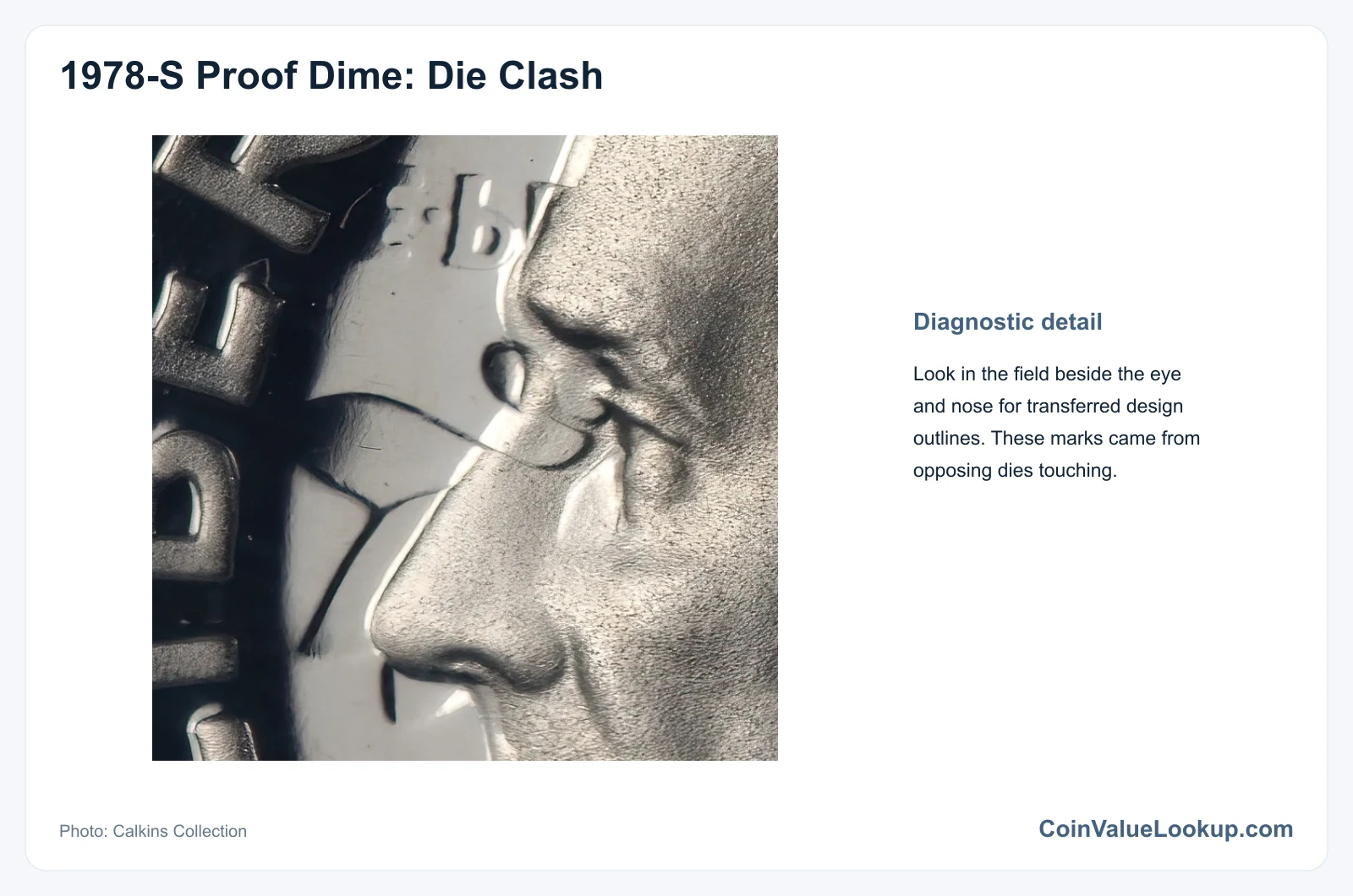
A die clash happens when the obverse and reverse dies strike each other without a planchet between them, leaving faint transferred design outlines in the fields of subsequent coins. On the 1978-S proof, a strong clash shows ghostly impressions from the opposing die alongside the normal proof design.
You will need magnification to spot transferred elements in the mirror fields. Compare your coin carefully against a normal 1978-S proof — any extra outlines in the flat field areas that mirror the opposite die's design are your clue.
One PCGS-graded PR 68 Deep Cameo specimen with a strong obverse and reverse clash sold for $159 in October 2022. That is a single auction result and not a price guarantee.
Do not confuse a die clash with scratches, incuse mirror brockage, or doubled design elements from a double strike — those are different error types with different diagnostics.
3. 1978 Roosevelt Dime — Double Strike with Off-Center Second Strike
A double-strike error on the 1978-D features a surviving first impression plus a second strike delivered approximately 85 percent off center. The second strike is uniface, meaning only one die made contact because the coin was partially obstructed during the second hit.
The visual result is dramatic: you can see the complete original design from the first strike, plus a second, heavily shifted partial impression overlapping it. This is a mechanical error that happened inside the press, not a die variety.
Do not confuse a genuine double strike with minor doubled-die lettering or machine doubling, which are far more subtle and confined to small design elements. A real double strike displaces the entire design.
No specific price range is adopted for this error — value depends on the authenticated identity, the severity of the off-center shift, and the coin's overall condition. Individual assessment by a grading service is the path forward.
4. 1978 Roosevelt Dime — Die Crack / Die Chip
Die cracks and die chips appear as raised lines or small raised blobs on the coin's surface, caused by a fracture in the steel die during production. An interior chip sits within the design field, while a cud is a larger break connected to the rim that leaves a raised, featureless lump.
On a 1978 dime, look along the rim and across open field areas for any raised irregular lines that follow no part of the intended design. They should be raised, not incuse — if a line is cut into the surface, that is a scratch or other post-mint damage.
Corrosion, foreign material stuck to the surface, and incuse scratches can all mimic die cracks at first glance. A genuine crack will be consistent in height and follow a path that makes mechanical sense from the die's perspective.
No specific price is adopted for this category; value depends on the crack's visibility, location, and the coin's overall condition.
5. 1978 Roosevelt Dime — Broadstrike
A broadstrike occurs when a coin is struck without the normal retaining collar that forms the rim and controls diameter. The result is a coin that spreads outward, appearing slightly larger than normal with a weak or absent rim, while retaining a centered (or nearly centered) design.
Check the edge profile. A broadstruck dime will have a different edge appearance than a normal coin — no reeded edge, and the metal may taper or spread unevenly.
The full design should still be visible, just slightly expanded.
Do not confuse a broadstrike with an off-center strike, which shifts the design to one side and loses part of it. Also rule out post-mint flattening, which can spread a coin but leaves telltale surface damage and distorted details.
No specific price is adopted here; value depends on how dramatic the spread is, the coin's condition, and authenticated confirmation of the error.
6. 1978 Roosevelt Dime — Missing Clad Layer
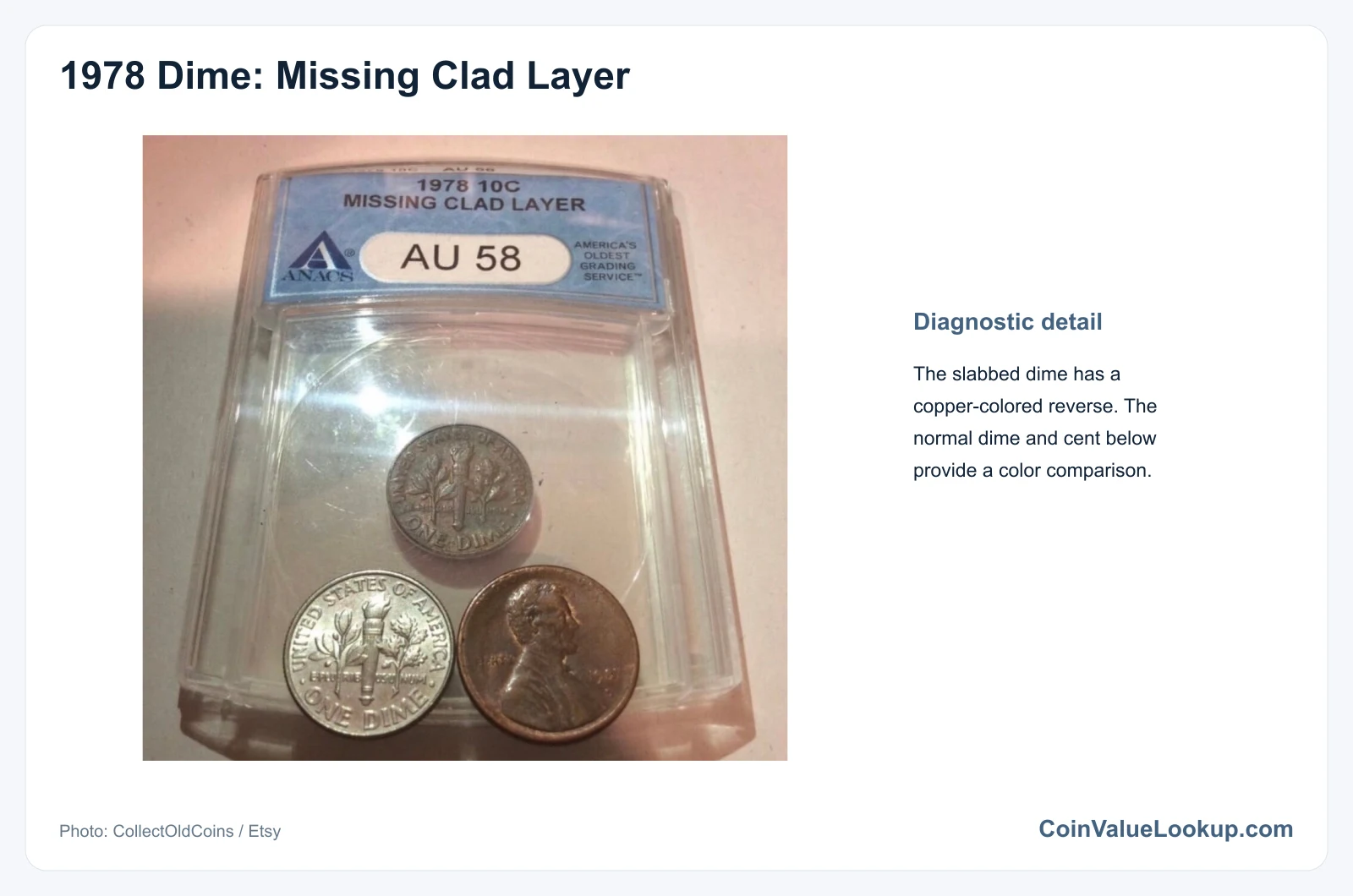
A missing clad layer error means one of the outer copper-nickel layers was absent from the planchet before striking. The exposed side shows a different color and texture — typically the copper core underneath — and the coin will weigh noticeably less than the standard 2.27 grams.
Weigh your coin first. If it is close to normal weight, the odd color is more likely toning, environmental damage, or someone who got creative with chemicals.
A genuine missing clad layer affects one entire face of the coin and is visible on the corresponding edge as well.
Corrosion, plating experiments, and surface stripping after minting can all produce a copper-colored face. The key difference is that a genuine missing clad error will show a clean, struck surface on the exposed core — not pitting, roughness, or tool marks.
No specific price is adopted for this error on the 1978 dime; condition and authentication determine value.
7. 1978 Roosevelt Dime — Struck-Through Error
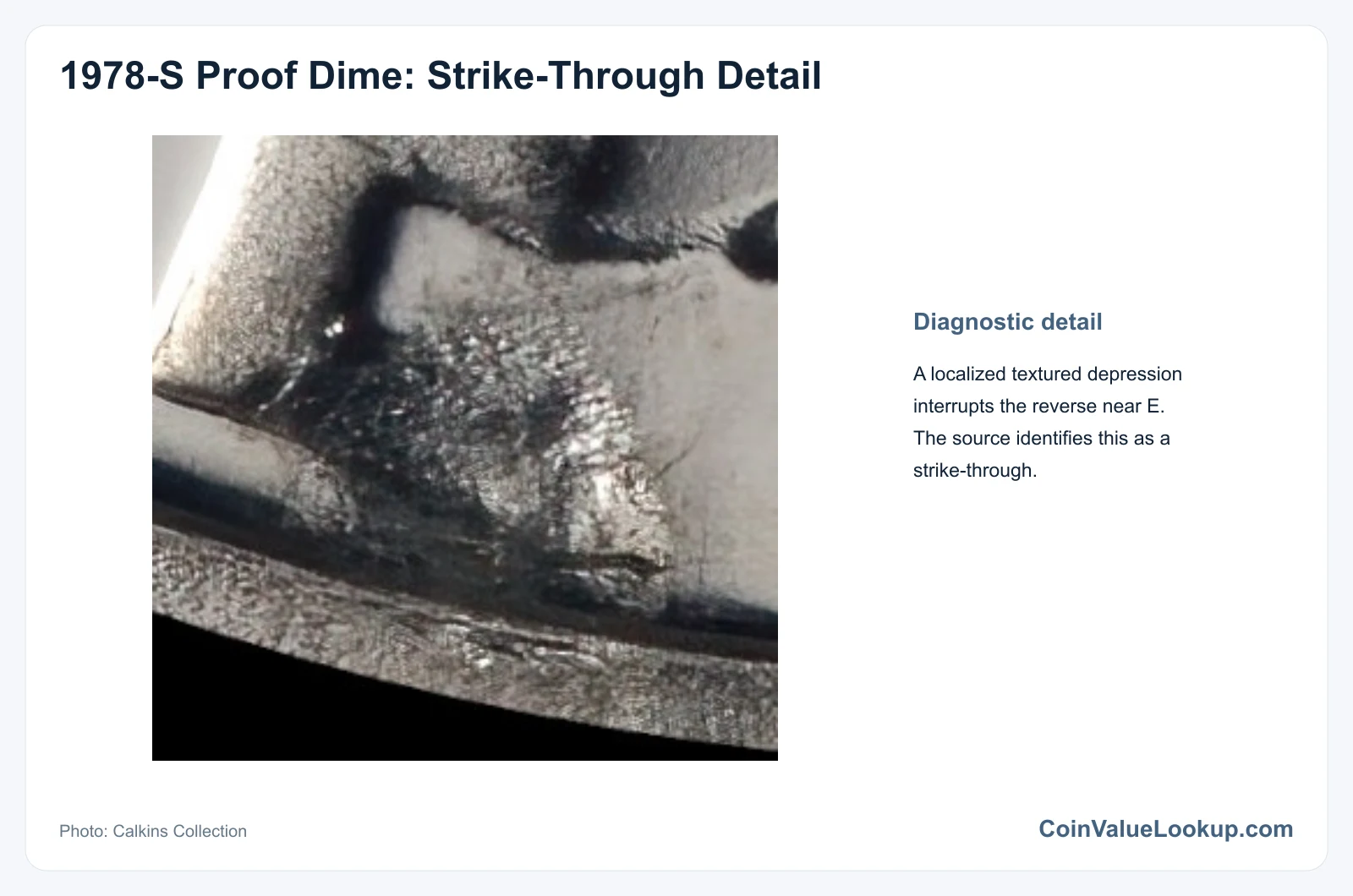
A struck-through error happens when foreign material — grease, a fragment of metal, cloth, or other debris — gets between the die and the planchet during striking. The result is a localized depression or area of incomplete design where the obstruction blocked the die's impression.
Grease-filled dies tend to produce soft, filled-in areas, often in letters or fine details. A retained foreign object may leave a distinct shape or texture pressed into the coin's surface.
These are different sub-types, and each has a different visual signature.
Do not confuse struck-through areas with ordinary wear, cleaning marks, or weak strike. Wear removes metal gradually and follows high points; a struck-through area is a manufacturing defect present from the moment the coin was made.
No specific price is adopted for this category on the 1978 dime — value varies with the size, clarity, and type of the struck-through impression, plus the coin's overall condition.