1980 Roosevelt Dime Coin Value: How Much Is It Worth?
A circulated 1980 Roosevelt dime is worth face value — ten cents. In higher uncirculated grades the numbers climb modestly: a USA Coin Book guide estimate places both the Philadelphia and Denver business strikes at about $2.79 in MS 65, while a standard San Francisco proof starts around $3.08 in PR 65.
The real upside lives in authenticated mint errors and well-preserved examples with crisp torch details.
Fast Way to Identify Your 1980 Roosevelt Dime
Snap a clear photo of the front and back of your 1980 dime and upload both images here for a preliminary identification. The identifier can help you spot the mint mark, confirm the basic variety, and point you toward the right value range.
It is not a substitute for professional authentication or grading, but it is a solid first step.
1980 Roosevelt Dime Value
Upload both sides of your 1980 Roosevelt Dime.
Front Obverse
Upload photo
Back Reverse
Upload photo
Which 1980 Roosevelt Dime Versions Are Worth Money?
- 1980 P or D business strikes grading MS 65 or higher with full torch band separation — guide value around $2.79 at MS 65, with potential for more at higher grades.
- 1980 S proof dimes in PR 65 or above, especially those with strong cameo contrast — guide value starts at $3.08 in PR 65.
- Off-center strikes on 1980-P dimes showing clear displacement and remaining date — value depends on severity and authentication.
- Double strikes with cupped reverse on 1980-P dimes — a dramatic, two-impression error evaluated individually.
- Partial collar with obverse brockage on 1980-P dimes — one example sold for $228 in November 2020.
Step 1: Identify Your 1980 Roosevelt Dime Mint Mark and Version
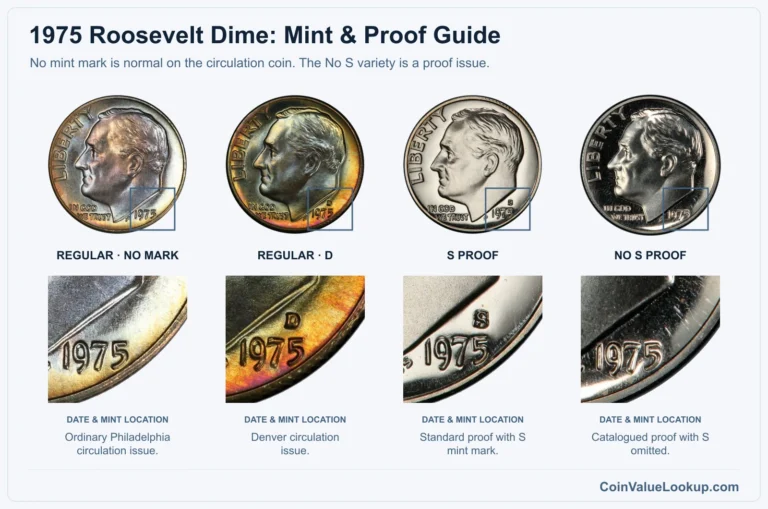
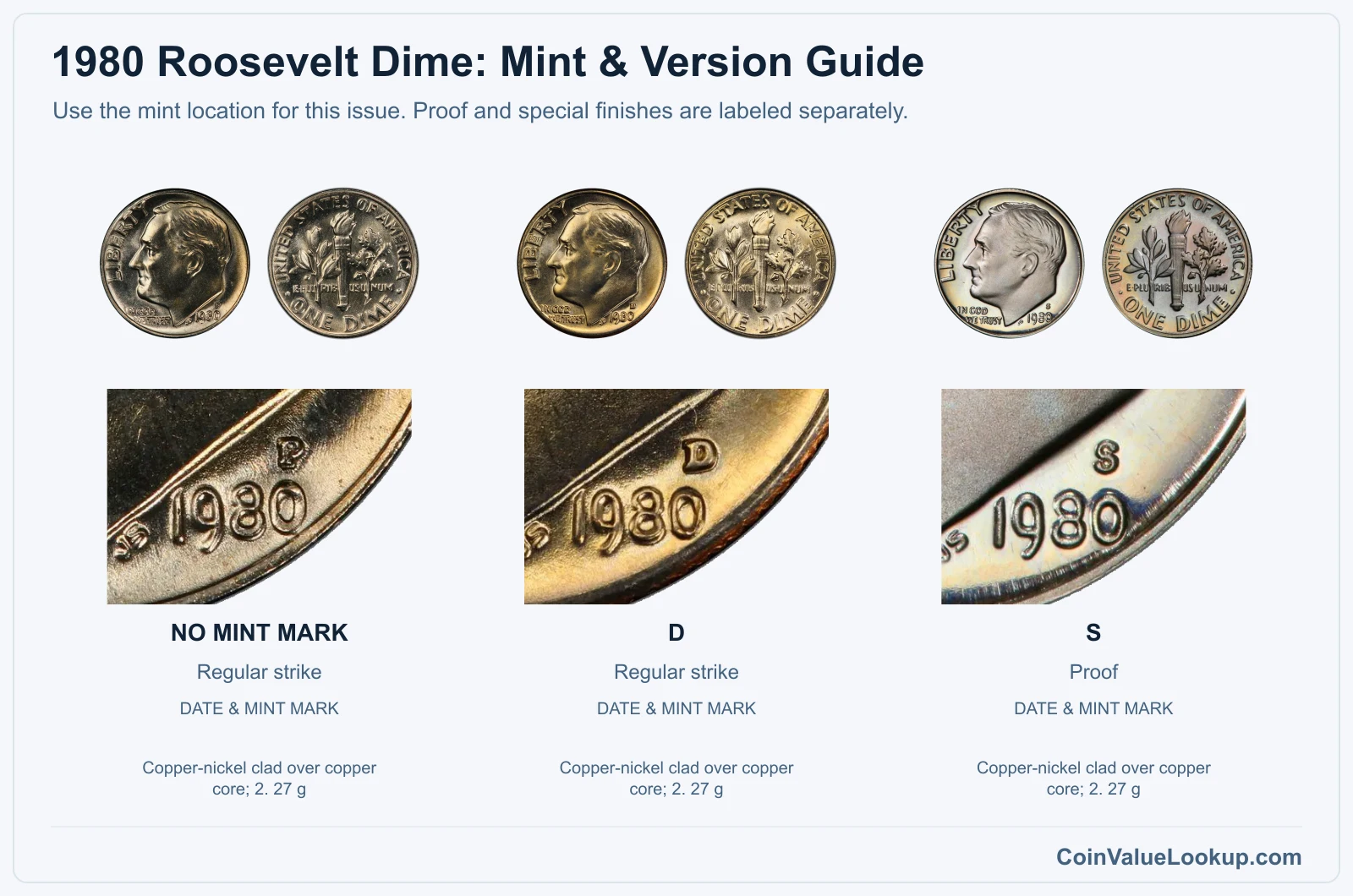
Start by confirming the date reads 1980 and the design shows Roosevelt's portrait on the obverse with a torch flanked by branches on the reverse. 1980 was the first year a "P" mint mark appeared on regular-issue Roosevelt dimes, so Philadelphia coins carry a small P near the date.
Denver strikes show a D in the same spot, and San Francisco proofs display an S.
The composition is copper-nickel clad over a copper core, weighing about 2.27 grams with a diameter near 17.9 mm. There is no silver in these coins.
If your dime looks coppery on the edge, that is normal — it is the copper core peeking through the clad sandwich.
Be careful with the P mint mark. Because it was brand new for this denomination, some strikes are soft or partially filled.
An indistinct or worn P is not the same as a confirmed missing mint mark. Do not assume you have a valuable omission without professional verification.
Step 2: Check Your 1980 Roosevelt Dime Grade
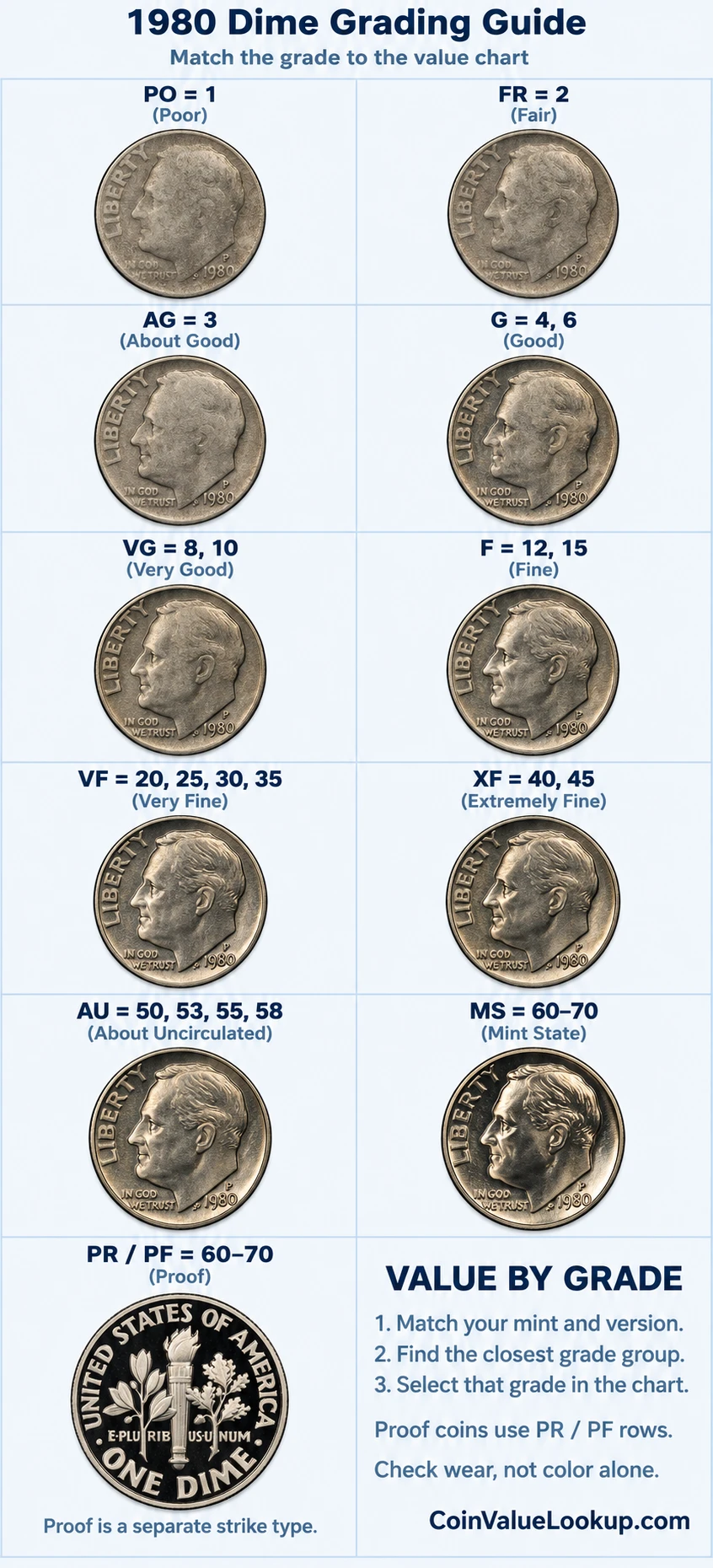
Check Roosevelt's cheek and jawline first — those are the high points that show wear earliest. Then look at the hair detail above the ear.
On the reverse, inspect the torch lines and leaf veins for softness.
Original mint luster matters more than shine. A coin that has been cleaned or polished may look bright but will grade lower because the original surface texture is gone.
Scratches, contact marks, and bag damage all reduce the grade.
When comparing your coin to the reference image, pay attention to how much original frost remains on the flat fields. A coin with full, unbroken cartwheel luster across both sides is a candidate for a Mint State designation.
Full Bands refers to two complete, separated horizontal bands on the torch. This is a strike quality designation recognized by grading services, not an error.
Coins with Full Bands at high grades can command a premium over the standard guide price.
Step 3: Check 1980 Roosevelt Dime Value by Mint and Version
1980 Roosevelt Dime — P Business Strike
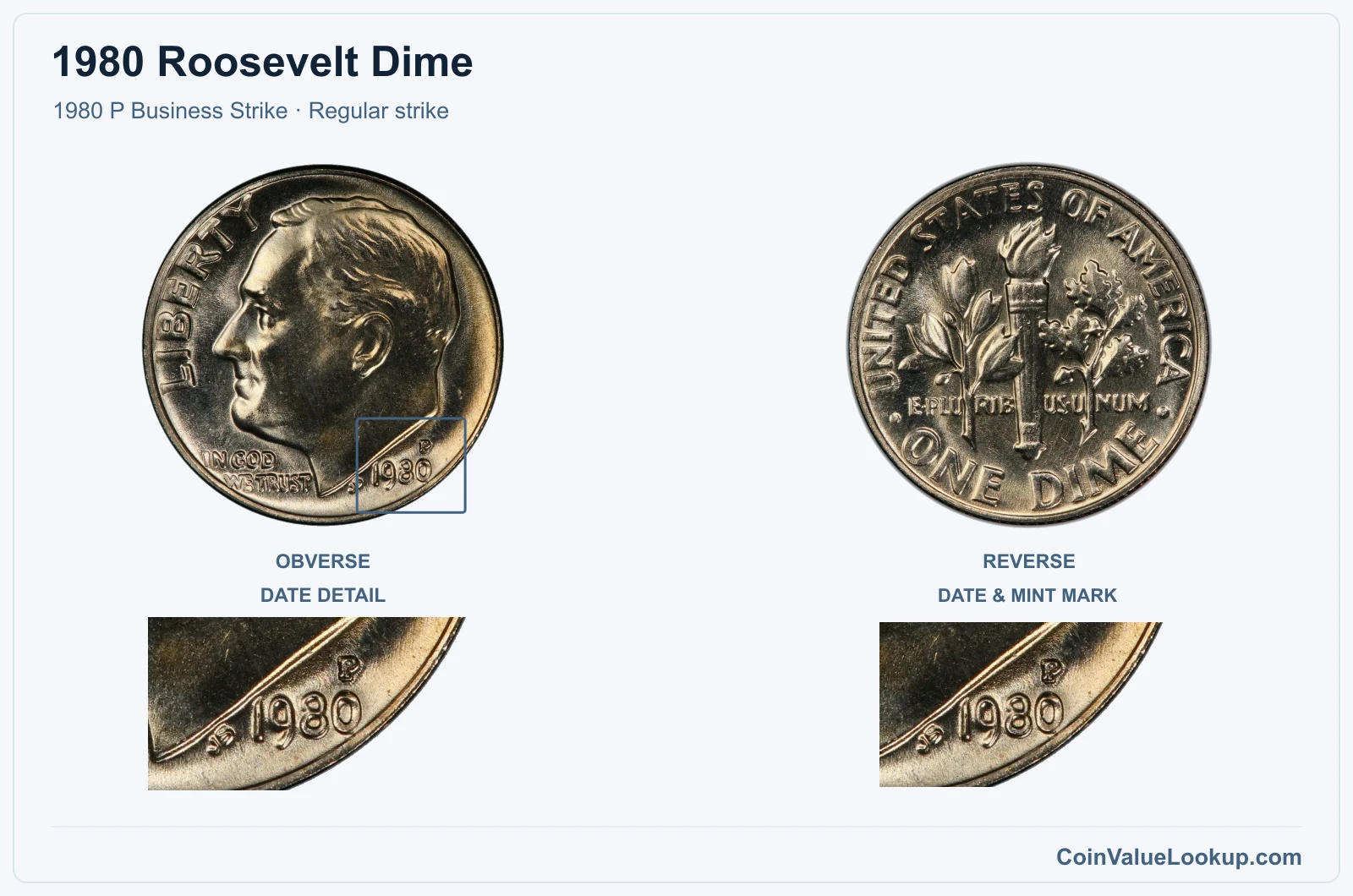
The 1980 P dime is historically notable because it was the first year Philadelphia placed a P mint mark on the Roosevelt dime. Look for the small P to the right of the date on the obverse.
The guide estimate from USA Coin Book is about $2.79 in MS 65.
Circulated examples are common and worth face value. To command a premium, the coin needs to be uncirculated with strong luster and minimal contact marks.
Coins showing full separation of both horizontal torch band pairs — the Full Bands designation — can be worth more at the same numerical grade.
Coin Value Lookup is a handy starting point if you want to compare this dime's guide values with other years or denominations in the Roosevelt series.
Range Grade
Price Auction Records Appraisal PO PO 1
—
Coin Identifier FR FR 2
—
Coin Identifier AG AG 3
—
Coin Identifier G G 4
—
Coin Identifier
G 6
—
Coin Identifier VG VG 8
—
Coin Identifier
VG 10
—
Coin Identifier F F 12
—
Coin Identifier
F 15
—
Coin Identifier VF VF 20
—
Coin Identifier
VF 25
—
Coin Identifier
VF 30
—
Coin Identifier
VF 35
—
Coin Identifier XF XF 40
—
Coin Identifier
XF 45
—
Coin Identifier AU AU 50
—
Coin Identifier
AU 53
—
Coin Identifier
AU 55
—
Coin Identifier
AU 58
—
Coin Identifier MS MS 60
—
Coin Identifier
MS 61
—
Coin Identifier
MS 62
Coin Identifier
MS 63
Coin Identifier
MS 64
Coin Identifier
MS 65
Coin Identifier
MS 66
Coin Identifier
MS 67
Coin Identifier
MS 68
—
Coin Identifier
MS 69
—
—
—
MS 70
—
—
—
1980 Roosevelt Dime — D Business Strike
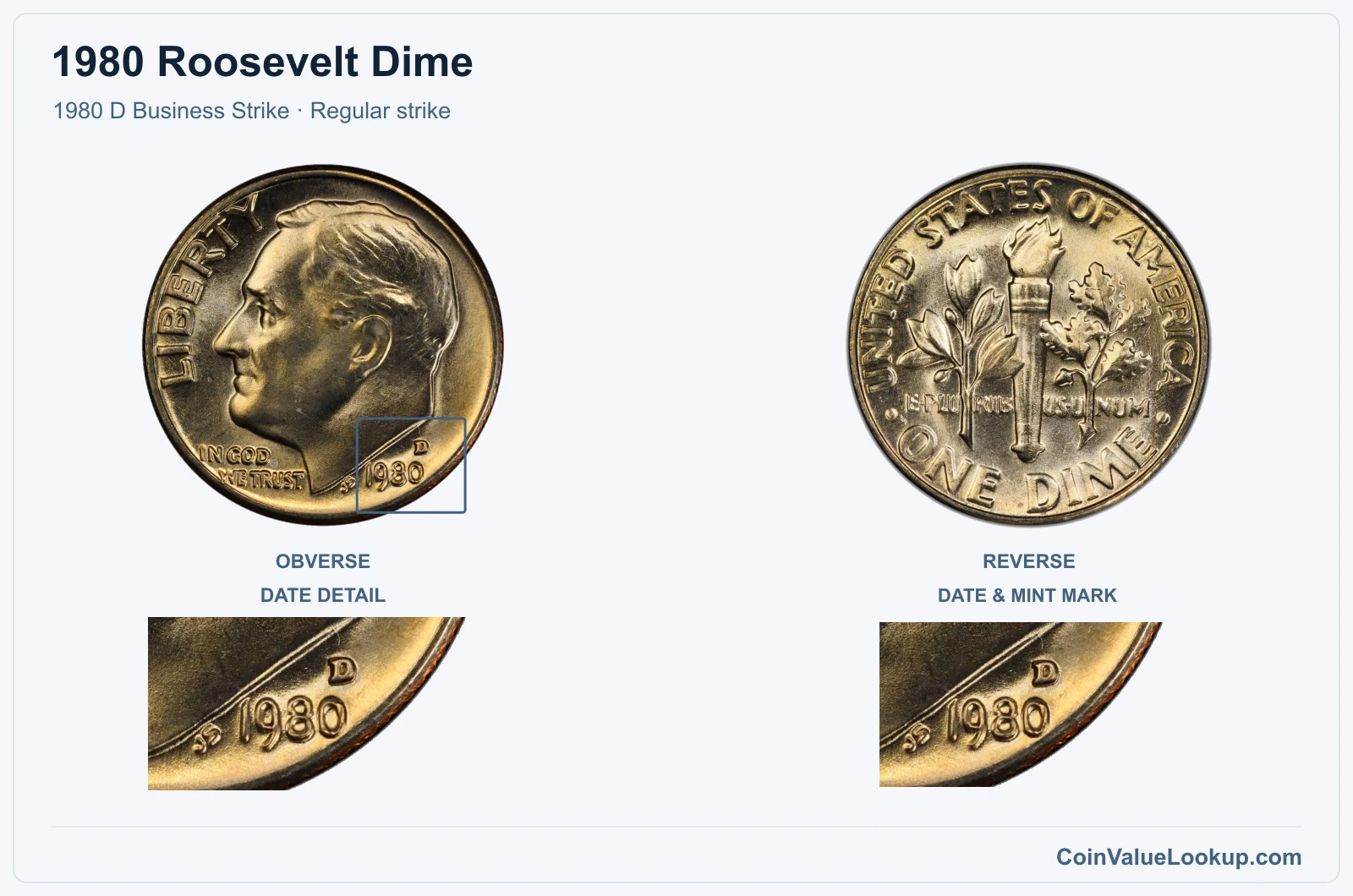
Denver produced its own large run of 1980 dimes, each carrying a D mint mark near the date. The USA Coin Book guide estimate matches Philadelphia at $2.79 in MS 65, so neither mint commands a clear premium over the other in typical grades.
As with the P issue, circulated pieces trade at face value. Focus on surface quality and luster when evaluating an uncirculated example.
Full Bands separation on the torch adds appeal for registry collectors hunting strike quality at the MS 65 level and above.
Range Grade
Price Auction Records Appraisal PO PO 1
—
Coin Identifier FR FR 2
—
Coin Identifier AG AG 3
—
Coin Identifier G G 4
—
Coin Identifier
G 6
—
Coin Identifier VG VG 8
—
Coin Identifier
VG 10
—
Coin Identifier F F 12
—
Coin Identifier
F 15
—
Coin Identifier VF VF 20
—
Coin Identifier
VF 25
—
Coin Identifier
VF 30
—
Coin Identifier
VF 35
—
Coin Identifier XF XF 40
—
Coin Identifier
XF 45
—
Coin Identifier AU AU 50
—
Coin Identifier
AU 53
—
Coin Identifier
AU 55
—
Coin Identifier
AU 58
—
Coin Identifier MS MS 60
—
Coin Identifier
MS 61
—
Coin Identifier
MS 62
—
Coin Identifier
MS 63
—
Coin Identifier
MS 64
—
Coin Identifier
MS 65
Coin Identifier
MS 66
Coin Identifier
MS 67
Coin Identifier
MS 68
—
Coin Identifier
MS 69
—
—
—
MS 70
—
—
—
1980 Roosevelt Dime — S Proof
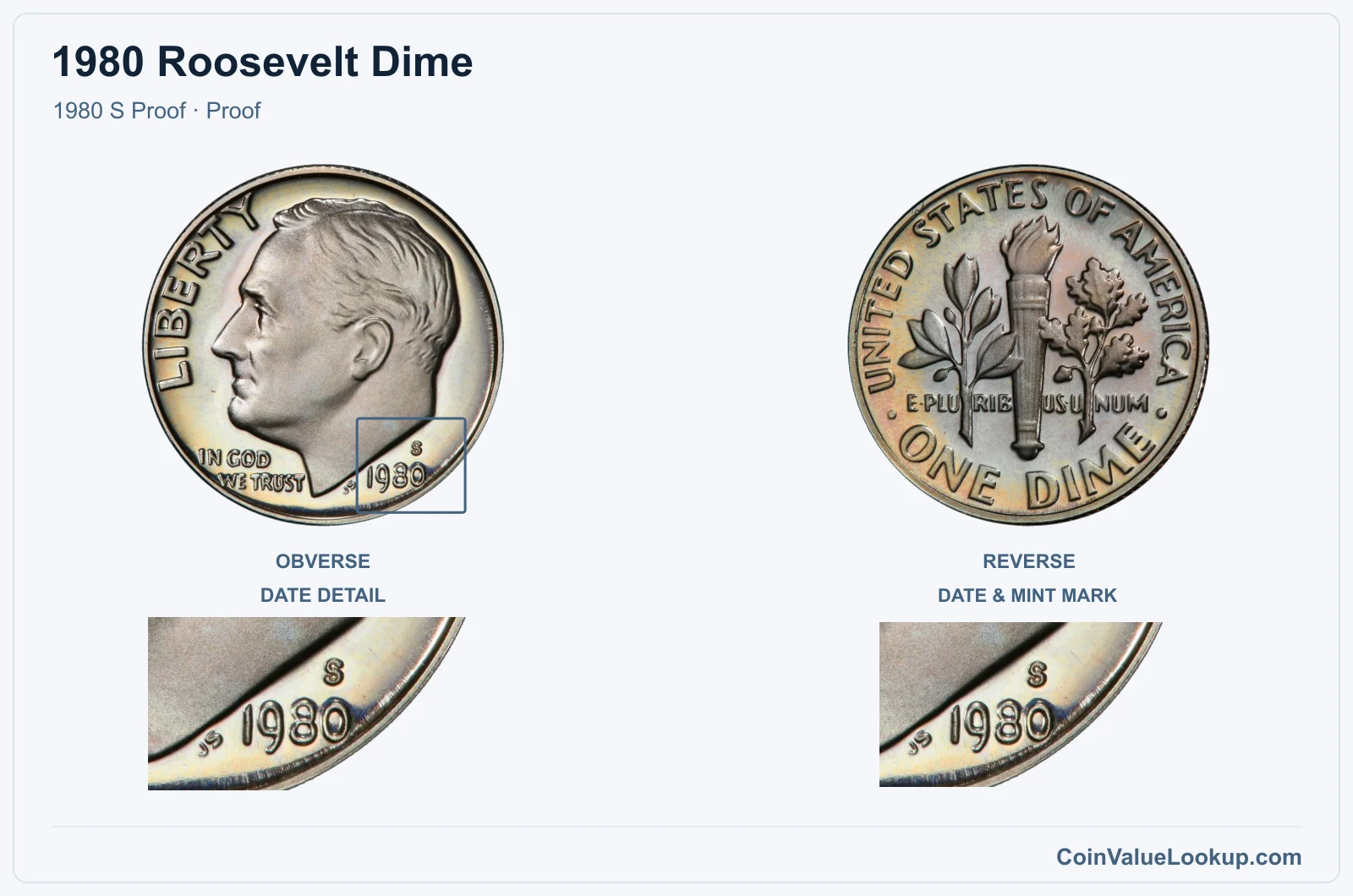
San Francisco struck proof dimes in 1980, identifiable by the S mint mark and the coin's mirror-like fields with frosted devices. These were sold in proof sets, not released into circulation.
The USA Coin Book guide places a standard PR 65 at about $3.08.
Proof is a method of manufacture, not a grade above Mint State. A proof can still have hairlines, haze, or toning that lowers its numerical grade.
Coins with strong contrast between frosted devices and reflective fields may receive a cameo or deep cameo designation from grading services, which can increase desirability beyond the base proof price. Compare any cameo claims to the same proof designation rather than mixing them with business strike values.
Range Grade
Price Auction Records Appraisal PR PR 1
—
Coin Identifier
PR 2
—
Coin Identifier
PR 3
—
Coin Identifier
PR 4
—
Coin Identifier
PR 6
—
Coin Identifier
PR 8
—
Coin Identifier
PR 10
—
Coin Identifier
PR 12
—
Coin Identifier
PR 15
—
Coin Identifier
PR 20
—
Coin Identifier
PR 25
—
Coin Identifier
PR 30
—
Coin Identifier
PR 35
—
Coin Identifier
PR 40
—
Coin Identifier
PR 45
—
Coin Identifier
PR 50
—
Coin Identifier
PR 53
—
Coin Identifier
PR 55
—
Coin Identifier
PR 58
—
Coin Identifier
PR 60
—
Coin Identifier
PR 61
—
Coin Identifier
PR 62
—
Coin Identifier
PR 63
—
Coin Identifier
PR 64
—
Coin Identifier
PR 65
—
Coin Identifier
PR 66
—
Coin Identifier
PR 67
—
Coin Identifier
PR 68
Coin Identifier
PR 69
Coin Identifier
PR 70
Coin Identifier
1980 Roosevelt Dime Error List
1. 1980 Roosevelt Dime — Off-Center Strike
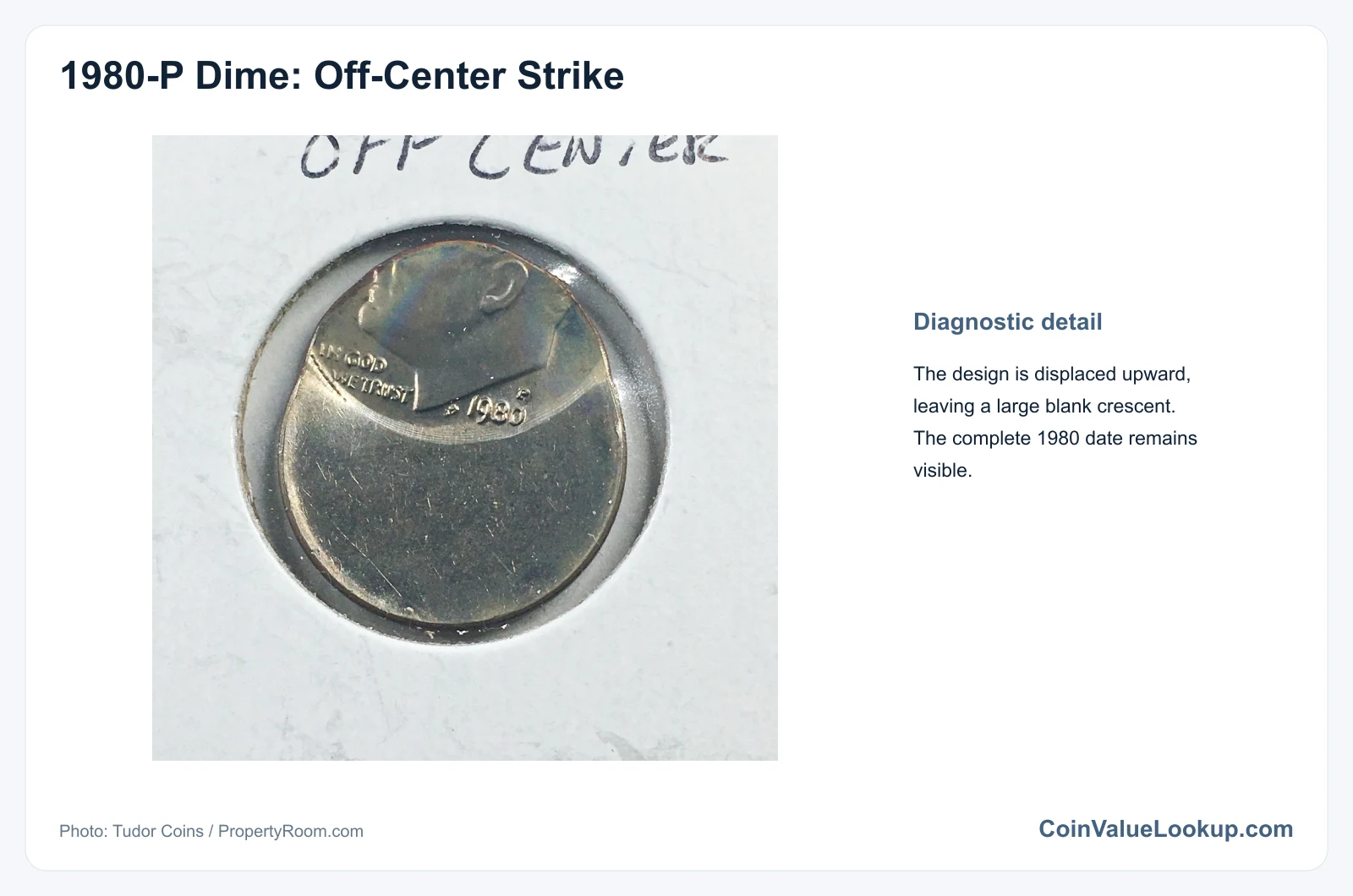
An off-center 1980-P dime shows the design shifted away from center, leaving a crescent of blank metal on one side. The documented example displays roughly 15 percent displacement toward the 2 o'clock position, with unstruck planchet visible opposite the remaining design.
The date must still be readable for the coin to be readily attributable.
Do not confuse this with a misaligned die strike, where the full design is present but slightly shifted, or a centered broadstrike, where the collar was absent but the design stayed centered. A genuine off-center piece has a clear blank area with no design whatsoever.
No specific price range is adopted here. Value depends on the percentage of displacement, date visibility, overall condition, and authentication by a recognized grading service.
Each piece is assessed individually.
2. 1980 Roosevelt Dime — Double Strike with Cupped Reverse
This error on a 1980-P business strike shows two distinct obverse impressions struck at nearly inverted orientations. The second strike also cupped the reverse upward, spreading and distorting that side's design.
One documented example was graded MS 65 by NGC; it appeared in a 2004 Heritage Auctions lot but went unsold.
The visual effect is dramatic — overlapping portraits, doubled lettering, and a noticeably dished reverse. Do not confuse this with a doubled die, which is a single-strike variety showing minor duplication from a hubbing issue.
Ordinary post-mint bending can also cup a coin, but it will not produce a second set of design elements.
Because no sale price was realized on the documented specimen, value must be assessed individually based on the coin's condition, the clarity of both strikes, and third-party authentication.
3. 1980 Roosevelt Dime — Partial Collar with Obverse Brockage
A 1980-P dime with a partial collar and obverse brockage is a compound error — two things went wrong during striking. The partial collar produces a stepped or partly reeded edge where the coin was not fully seated in the collar.
The obverse brockage adds an incuse, mirrored design impression on the obverse, transferred from a previously struck coin that remained in the press.
One documented example, graded NGC Unc Details, sold for $228 in November 2020 through Heritage Auctions. That specimen also showed a wheel mark, which is post-strike damage and was noted as such.
Watch out for vise jobs or rim hammering that can mimic a brockage impression. Genuine brockage details are incuse and mirror-image, struck into the surface with metal flow consistent with minting pressure, not surface-level damage.
4. 1980 Roosevelt Dime — Wrong Planchet / Off-Metal Strike
A wrong-planchet 1980 dime was struck on a blank intended for a different denomination or purpose. The result is a coin that carries the full Roosevelt dime design but on a planchet whose weight, diameter, or edge characteristics do not match the standard 2.27-gram copper-nickel clad specification.
To evaluate a suspect coin, weigh it carefully and measure the diameter. Compare the edge — a normal dime has a reeded edge and visible copper core stripe.
If your coin's measurements deviate significantly and the design is still complete, you may have a wrong-planchet strike.
Plating loss, corrosion, acid exposure, and deliberate alteration can all change a coin's appearance and weight enough to mimic an off-metal strike. Professional authentication is essential.
No specific price range is adopted; value depends on the particular planchet, condition, and third-party verification.
5. 1980 Roosevelt Dime — Missing Clad Layer
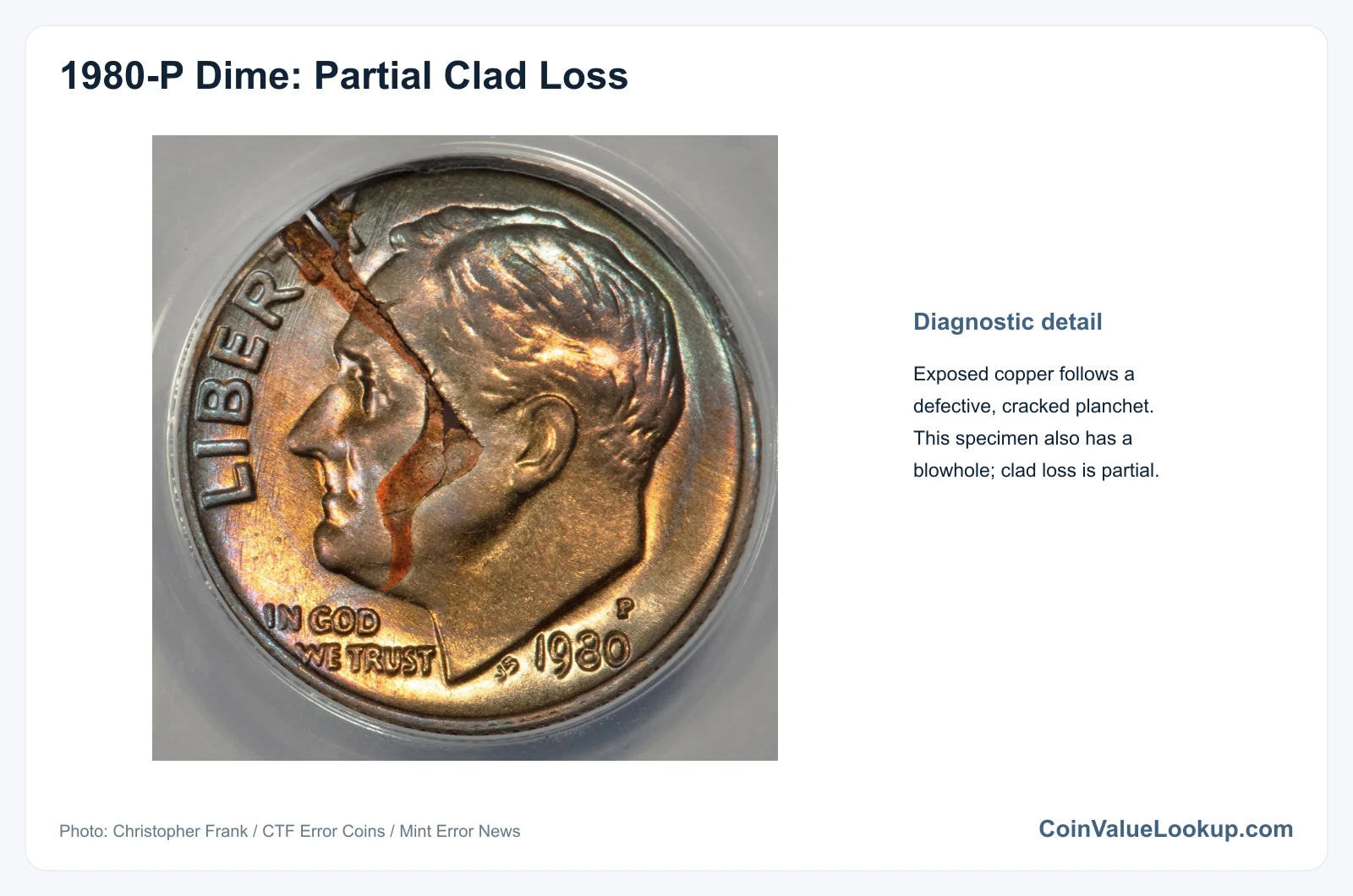
A missing clad layer error means one or both of the outer copper-nickel layers were absent from the planchet before striking. The exposed face typically shows the copper core, giving the coin a distinctly reddish or brownish appearance on the affected side.
The coin will also weigh less than the standard 2.27 grams.
Examine the edge closely. On a normal dime you see the copper-nickel sandwich.
On a missing-clad coin, the layering is visibly absent on one side and the edge profile looks different.
Coins that have been corroded, acid-treated, or had their plating worn away after minting can look similar. The key difference is that a genuine missing-clad error shows full, sharp design detail struck directly into the copper core, while post-mint damage typically leaves pitting or uneven surfaces.
No numerical price is adopted; each piece is evaluated on its own merits with authentication.
6. 1980 Roosevelt Dime — Clipped Planchet
A clipped planchet occurs when the blank is punched from strip metal that overlaps a previously punched hole, producing a coin with a missing curved, straight, or irregularly shaped section. On a 1980 dime, look for a smooth, rounded absence along part of the rim rather than a jagged break.
A useful confirmation is the Blakesley effect — design weakness on the rim directly opposite the clip, caused by reduced metal flow during striking. This weakness should be consistent with the clip location.
Filed edges, deliberate cuts, and corrosion damage can all remove metal from a coin's rim after minting, so authentication matters. Genuine clips show undisturbed metal flow at the boundary.
No specific price range is adopted for this error; value depends on clip size, type, overall condition, and professional verification.