1934 Mercury Dime Coin Value: How Much Is It Worth?
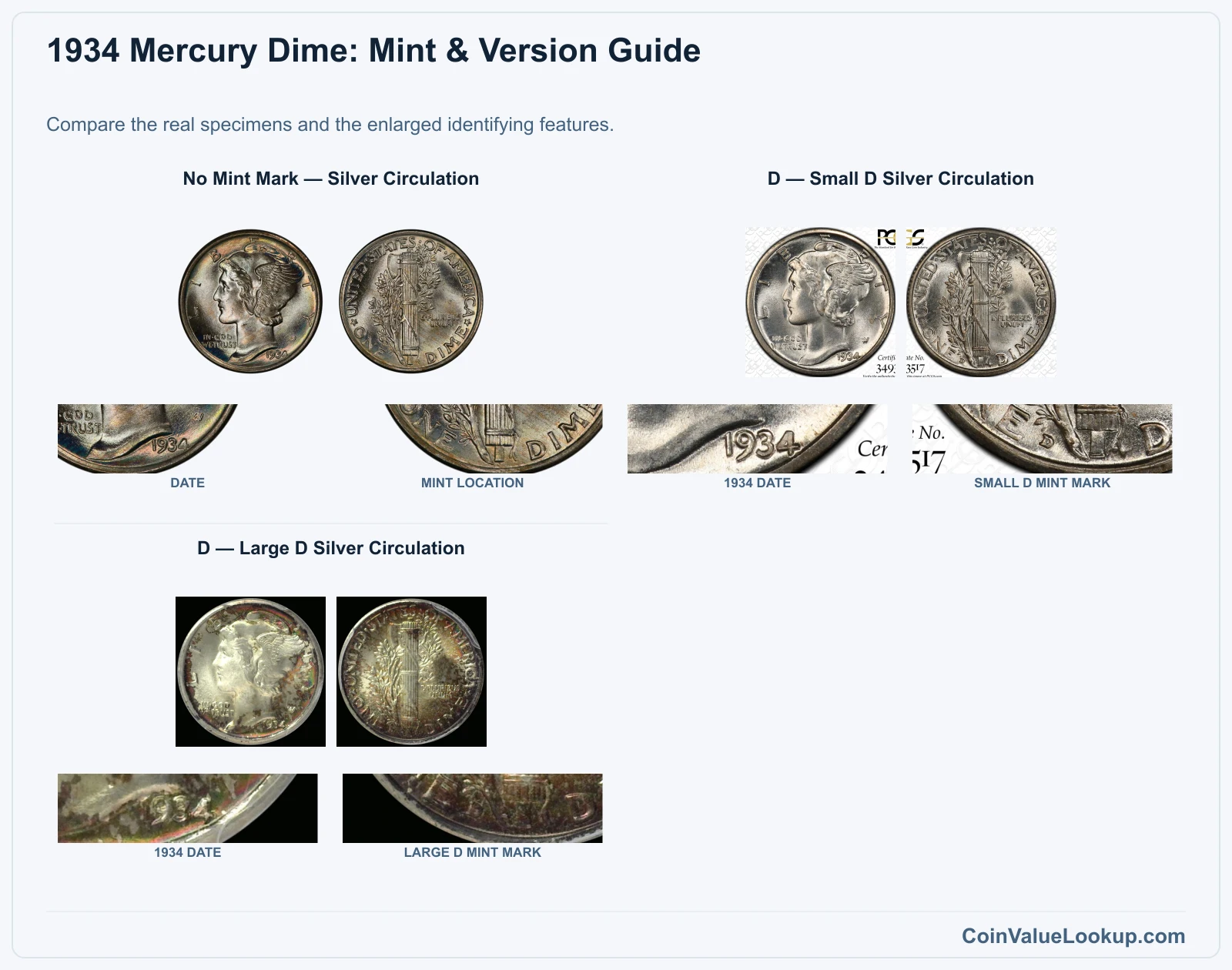
A 1934 Mercury dime in well-worn condition books around $5.73 at the G4 grade level according to USA Coin Book, while a crisp MS65 example can reach roughly $64 to $106 depending on the mint. Full Bands strikes, identified error coins and the Denver mintmark style can shift value further.
Two business-strike mints produced dimes this year — Philadelphia and Denver — with no San Francisco issue.
Fast Way to Identify Your 1934 Mercury Dime
Want a quick read on your 1934 Mercury dime? Upload clear photos of both the front and back, and our identifier can offer a preliminary take on the mint, general condition and version.
This is not a substitute for professional certification, but it gives you a solid starting point before deciding whether to dig deeper.
1934 Mercury Dime Value
Upload both sides of your 1934 Mercury Dime.
Front Obverse
Upload photo
Back Reverse
Upload photo
Which 1934 Mercury Dime Versions Are Worth Money?
- Denver mint dimes exist with two mintmark punch sizes — Small D and Large D — worth comparing side by side even though no separate price premium is currently established.
- Original Mint State surfaces with fully separated fasces bands (Full Bands designation) can attract premiums above the regular MS65 guide figure.
- Error categories such as repunched mintmark, doubled die obverse and off-center strikes have been reported for 1934 dimes and are worth checking under magnification.
Step 1: Identify Your 1934 Mercury Dime Mint Mark and Version
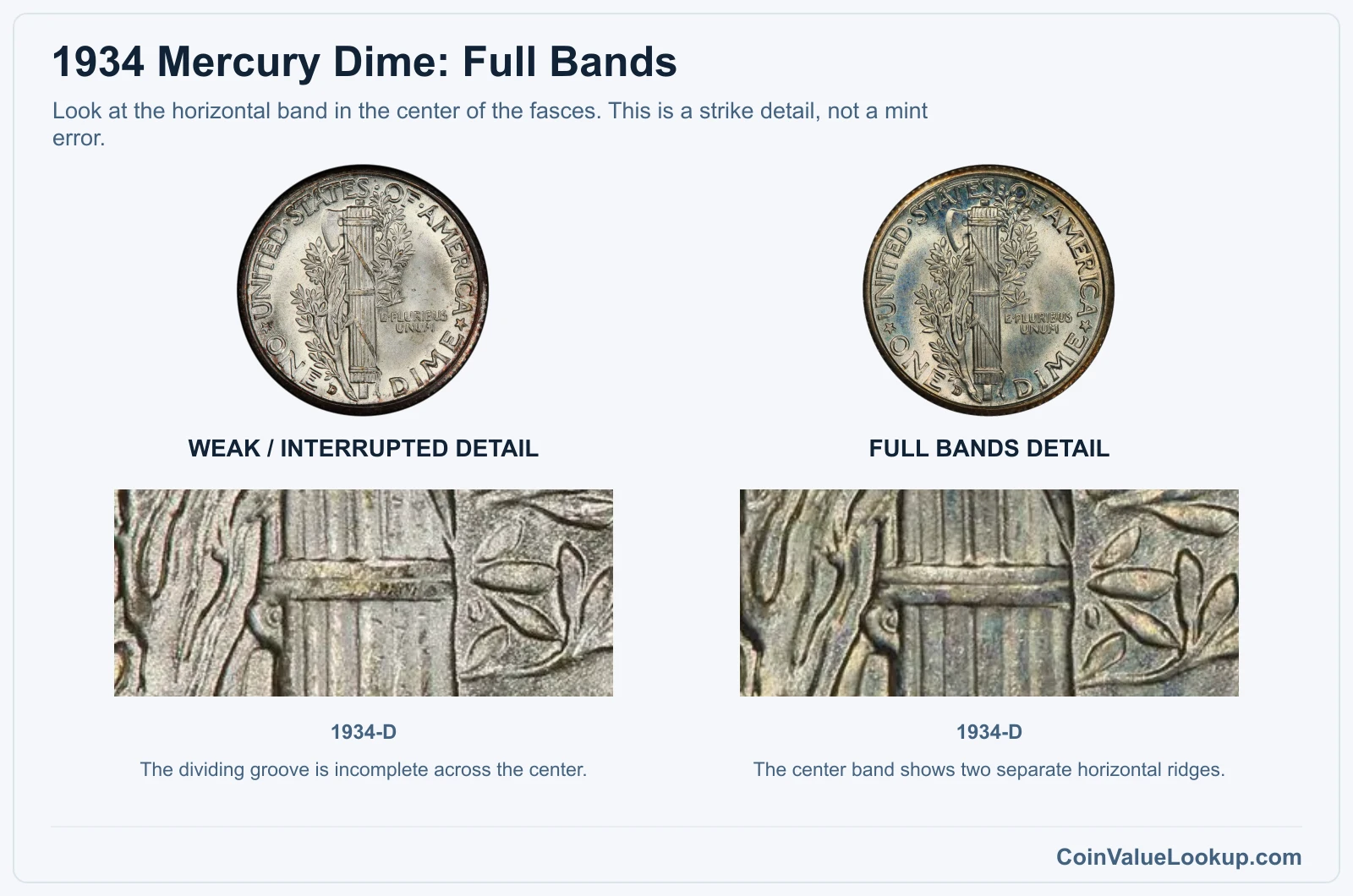
The 1934 Mercury dime was struck at Philadelphia and Denver only. There is no San Francisco issue for this date.
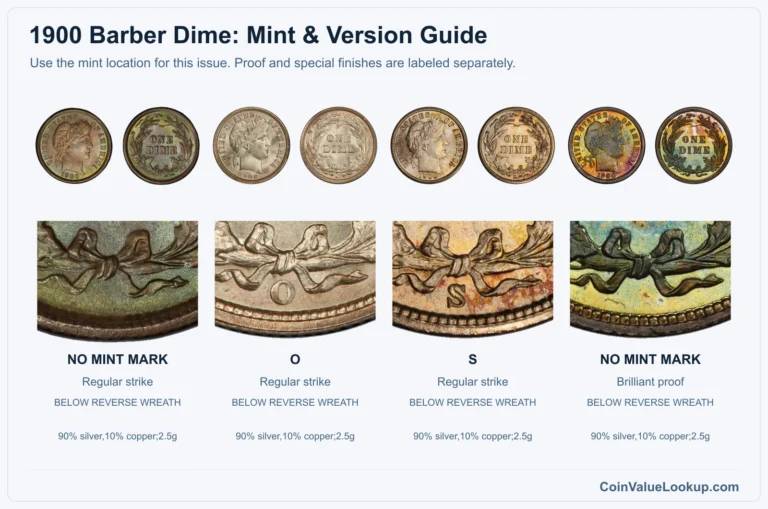
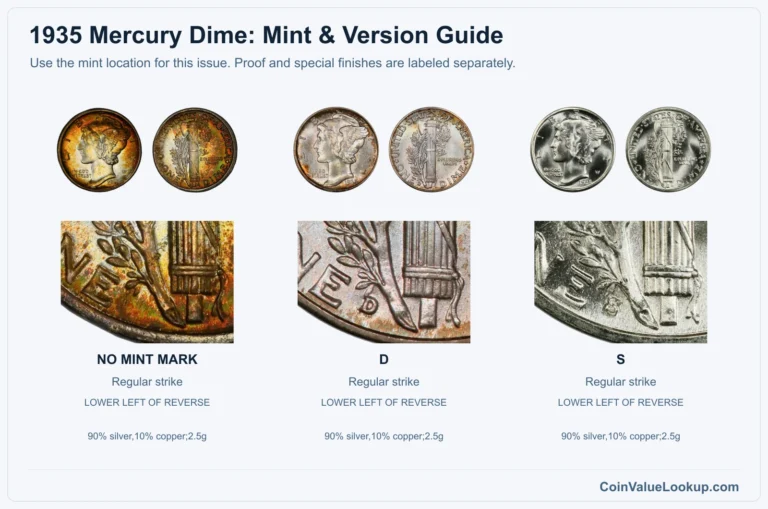
Philadelphia coins carry no mintmark at all. Denver coins show a small "D" on the reverse, tucked to the lower left of the fasces bundle near the word ONE.
Do not confuse the "AW" monogram on the obverse with a mintmark — those are designer Adolph Weinman's initials.
All 1934 dimes are 90% silver and 10% copper, weighing about 2.5 grams with a 17.9 mm diameter and a reeded edge. Proofs were not produced in 1934; the Mercury dime proof series ran from 1936 through 1942.
If someone offers you a 1934 proof, that should raise questions immediately.
Step 2: Check Your 1934 Mercury Dime Grade
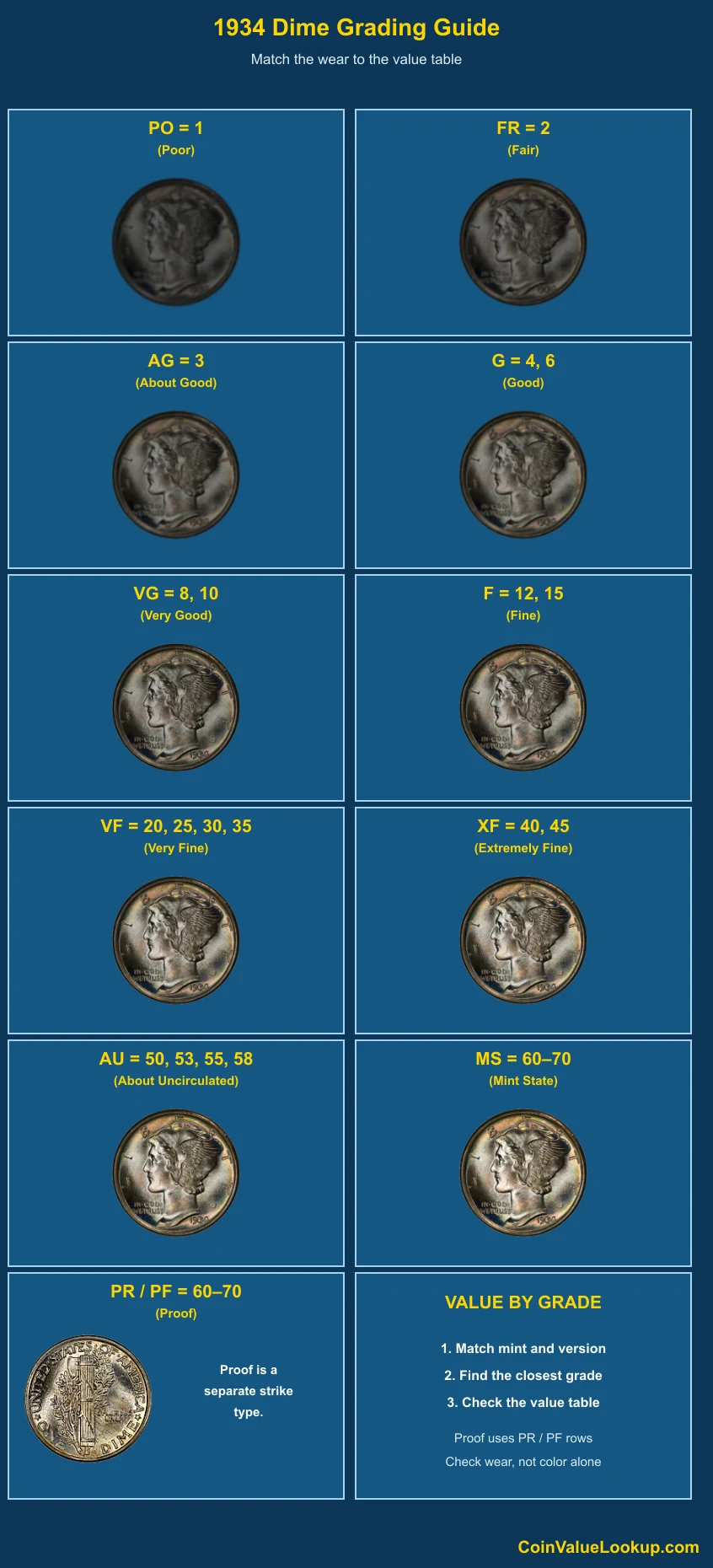
Start by examining the hair detail above and in front of Liberty's ear. On a lightly worn coin those strands remain distinct, while heavy circulation flattens them into a smooth area.
The wing feathers on the cap lose definition next.
Flip the coin over. The fasces bands on the reverse are your wear barometer.
Fully separated horizontal and diagonal bands indicate a strong strike and minimal wear, though weak bands alone do not automatically mean circulation — some coins simply left the press with a soft strike.
Look for contact marks, luster breaks and any signs of cleaning. A cleaned coin may look shiny but will have a different surface texture under magnification.
Use the comparison image alongside your coin at matching angles to judge where it falls on the wear scale.
Full Bands is a separate strike designation evaluated by grading services like NGC, which checks central and outer band separation. Different services may apply slightly different criteria, so a coin that qualifies at one service might not at another.
Step 3: Check 1934 Mercury Dime Value by Mint and Version
1934 Mercury Dime — No Mint Mark — Silver Circulation
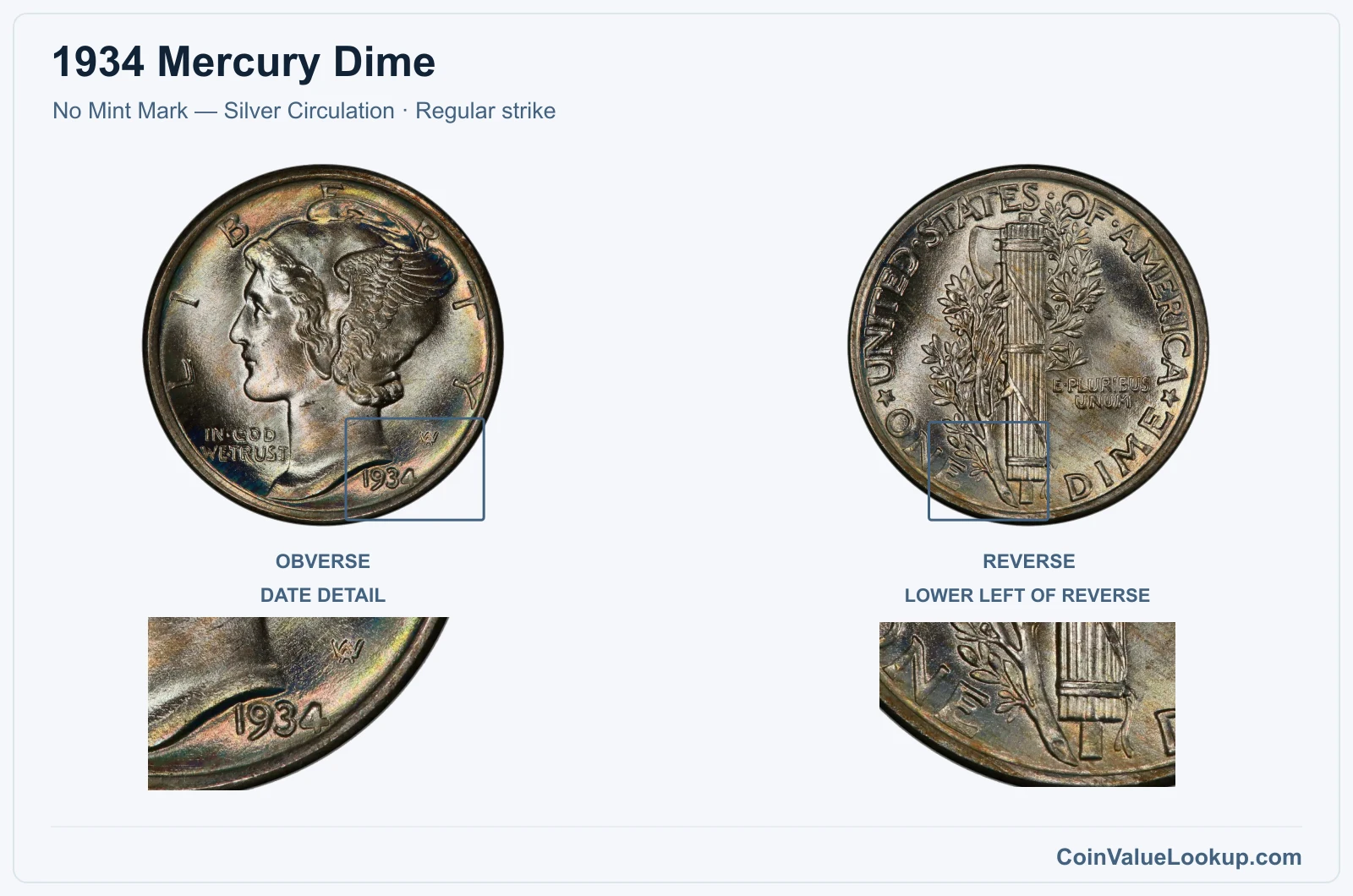
The Philadelphia 1934 dime has no mintmark anywhere on the coin. USA Coin Book lists a guide estimate of about $5.73 in G4 and $64 in MS65 for regular business strikes.
Full Bands examples can carry a premium above those figures, but a separate FB price is not established in the guide data available here.
When examining a Philadelphia coin, confirm the absence of any letter near the fasces on the reverse. Also note the "AW" monogram on the obverse near Liberty's neck — that is the designer's mark, not a mint identifier.
Coin Value Lookup is a handy starting point if you want to look up guides for other dates and denominations in the Mercury dime series.
Range Grade
Price Auction Records Appraisal PO PO 1
—
Coin Identifier FR FR 2
—
Coin Identifier AG AG 3
—
Coin Identifier G G 4
—
Coin Identifier
G 6
—
Coin Identifier VG VG 8
—
Coin Identifier
VG 10
—
Coin Identifier F F 12
—
Coin Identifier
F 15
—
Coin Identifier VF VF 20
—
Coin Identifier
VF 25
—
Coin Identifier
VF 30
—
Coin Identifier
VF 35
—
Coin Identifier XF XF 40
—
Coin Identifier
XF 45
—
Coin Identifier AU AU 50
—
Coin Identifier
AU 53
—
Coin Identifier
AU 55
Coin Identifier
AU 58
Coin Identifier MS MS 60
—
Coin Identifier
MS 61
—
Coin Identifier
MS 62
Coin Identifier
MS 63
Coin Identifier
MS 64
Coin Identifier
MS 65
Coin Identifier
MS 66
Coin Identifier
MS 67
Coin Identifier
MS 68
Coin Identifier
MS 69
—
—
—
MS 70
—
—
—
1934 Mercury Dime — D — Small D Silver Circulation
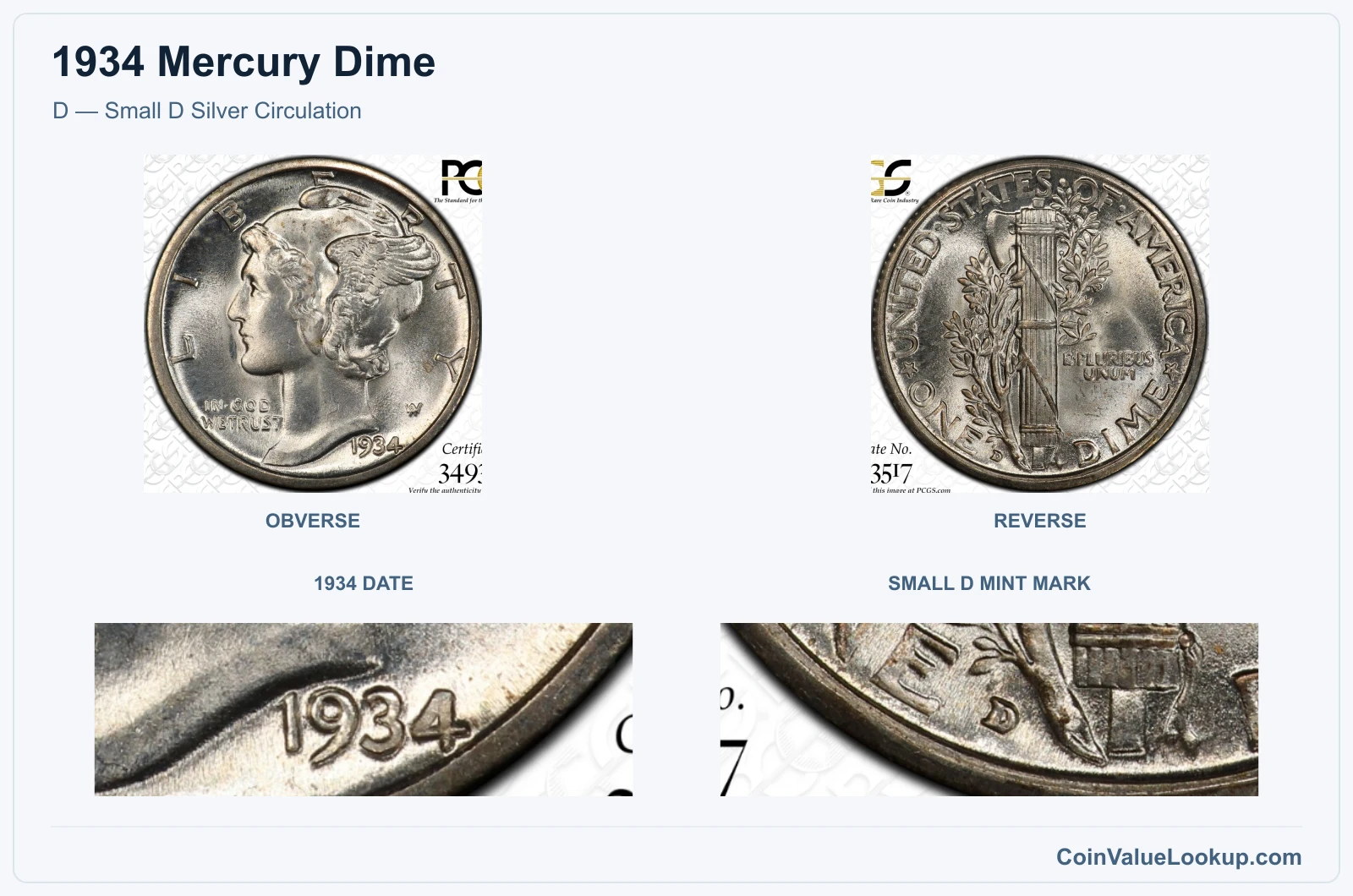
NGC confirms that 1934-D dimes come in a Small D mintmark variety. The "D" sits to the lower left of the fasces on the reverse, and in the small punch version it appears noticeably more compact than the Large D when the two are placed side by side at equal magnification.
The combined 1934-D guide estimate runs about $5.73 in G4 and $106 in MS65, per USA Coin Book. No separate premium for the Small D punch style is currently established.
This is a mintmark style difference, not an error, so think of it as a die-variety collectible rather than a mistake coin.
Ordinary-issue reference: Ordinary-issue reference only: The table below shows prices for the 1934-D Mercury Dime (regular strike). It does not represent the value of the specific D — Small D Silver Circulation variety or its variety premium. Year, mint, metal and strike type are matched; the specific variety is not priced by this table.
Range Grade
Price Auction Records Appraisal PO PO 1
—
Coin Identifier FR FR 2
—
Coin Identifier AG AG 3
—
Coin Identifier G G 4
—
Coin Identifier
G 6
—
Coin Identifier VG VG 8
—
Coin Identifier
VG 10
—
Coin Identifier F F 12
—
Coin Identifier
F 15
—
Coin Identifier VF VF 20
—
Coin Identifier
VF 25
—
Coin Identifier
VF 30
—
Coin Identifier
VF 35
—
Coin Identifier XF XF 40
—
Coin Identifier
XF 45
—
Coin Identifier AU AU 50
—
Coin Identifier
AU 53
—
Coin Identifier
AU 55
Coin Identifier
AU 58
—
Coin Identifier MS MS 60
—
Coin Identifier
MS 61
Coin Identifier
MS 62
—
Coin Identifier
MS 63
Coin Identifier
MS 64
Coin Identifier
MS 65
Coin Identifier
MS 66
Coin Identifier
MS 67
Coin Identifier
MS 68
—
Coin Identifier
MS 69
—
—
—
MS 70
—
—
—
1934 Mercury Dime — D — Large D Silver Circulation
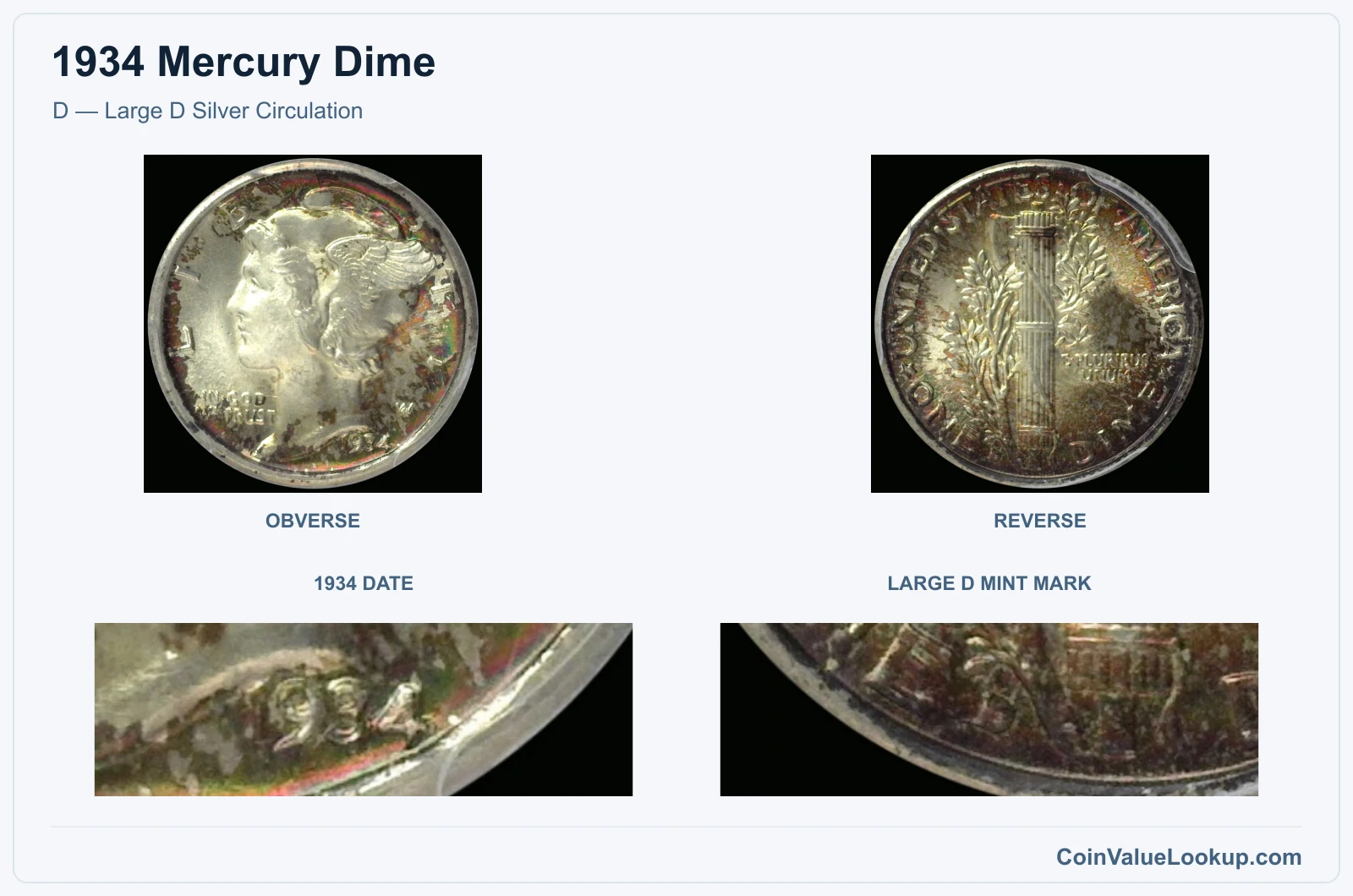
The Large D version of the 1934 Denver dime uses a visibly bigger mintmark punch. Place it next to a Small D example and the size difference is clear, though both sit in the same position on the reverse beside the word ONE.
As with the Small D, the unsplit guide figures for the 1934-D are approximately $5.73 at G4 and $106 at MS65. No distinct premium for the Large D style has been established in available guide data.
Collectors who pursue mintmark varieties will want one of each, but do not confuse this with a scarce error — it is simply a different punch used during production.
Ordinary-issue reference: Ordinary-issue reference only: The table below shows prices for the 1934-D Mercury Dime (regular strike). It does not represent the value of the specific D — Large D Silver Circulation variety or its variety premium. Year, mint, metal and strike type are matched; the specific variety is not priced by this table.
Range Grade
Price Auction Records Appraisal PO PO 1
—
Coin Identifier FR FR 2
—
Coin Identifier AG AG 3
—
Coin Identifier G G 4
—
Coin Identifier
G 6
—
Coin Identifier VG VG 8
—
Coin Identifier
VG 10
—
Coin Identifier F F 12
—
Coin Identifier
F 15
—
Coin Identifier VF VF 20
—
Coin Identifier
VF 25
—
Coin Identifier
VF 30
—
Coin Identifier
VF 35
—
Coin Identifier XF XF 40
—
Coin Identifier
XF 45
—
Coin Identifier AU AU 50
—
Coin Identifier
AU 53
—
Coin Identifier
AU 55
Coin Identifier
AU 58
—
Coin Identifier MS MS 60
—
Coin Identifier
MS 61
Coin Identifier
MS 62
—
Coin Identifier
MS 63
Coin Identifier
MS 64
Coin Identifier
MS 65
Coin Identifier
MS 66
Coin Identifier
MS 67
Coin Identifier
MS 68
—
Coin Identifier
MS 69
—
—
—
MS 70
—
—
—
1934 Mercury Dime Error List
1. 1934 Mercury Dime — Repunched Mintmark
A repunched mintmark on a 1934 dime means the "D" was impressed into the die more than once, leaving traces of a second position beneath or beside the primary letter. Under magnification you may see a partial shadow, notch or secondary outline near the main mintmark.
Compare your coin's mintmark to a normal example at the same magnification. Machine doubling produces a flat, shelf-like distortion rather than a clearly offset secondary image.
Die chips or corrosion around the letter can also mimic a repunch to the untrained eye.
The value of a repunched mintmark depends on the coin's overall condition, the clarity of the extra impression and the specific variety. No established price range is available here, so professional evaluation is the safest route if you believe you have one.
2. 1934 Mercury Dime — Broadstrike
A broadstrike happens when a coin is struck without the normal collar die that constrains the planchet's edge. The result is a dime that looks slightly spread out, with design elements pushed toward the rim and a smooth or irregular edge instead of crisp reeding.
The full design should still be present — that is what separates a broadstrike from an off-center strike, where part of the design is missing entirely. Also rule out post-mint damage; a coin that was flattened by machinery or squeezed in a vise after leaving the mint can mimic the spread look but will usually show surface distortion inconsistent with a single press event.
Condition and the degree of spread influence value. No specific price range is available for a 1934 broadstrike dime from the data here, so third-party grading is worthwhile if you suspect you have a genuine example.
3. 1934 Mercury Dime — Off-Center Strike
An off-center strike occurs when the planchet is not seated properly between the dies, resulting in a displaced design and an unstruck crescent of blank metal on one side. The more dramatic the misalignment, the more visually striking the coin.
Collectors generally prize off-center Mercury dimes that still show the full date, since that confirms the year and keeps the coin identifiable. A coin missing the date loses much of its collectibility.
Do not confuse an off-center strike with a clipped planchet, which has a curved bite taken from the edge before striking. Post-mint flattening or one-sided die misalignment can also create misleading appearances.
The value of a genuine off-center 1934 dime varies with the percentage of offset and overall condition, but no specific price data is available here.
4. 1934 Mercury Dime — Lamination / Split Planchet
A lamination or split planchet error shows up as peeling metal, a retained flap or a visible separation within the coin's alloy. On a 90% silver dime the defect usually traces back to impurities or gas trapped during the planchet rolling process.
Photograph both the affected face and the edge together — the edge profile is often the clearest indicator, revealing layers that should be a single solid piece. A small lamination flake might look like surface corrosion at first glance, so compare carefully.
Scraping, environmental corrosion and deliberately altered coins can all mimic a lamination. Genuine examples show a separation that follows the metal's internal structure rather than surface scratches.
Condition and the size of the affected area influence value, but no specific pricing is available for a 1934 lamination dime from current data.
5. 1934 Mercury Dime — Doubled Die Obverse
A doubled die obverse on a 1934 Mercury dime shows consistent doubling in the lettering or design elements on the front of the coin. Look for separation or notching on features like LIBERTY, IN GOD WE TRUST or the date numerals.
The key word is consistent — genuine hub doubling repeats in the same direction across multiple elements.
Machine doubling is the most common lookalike and produces a flat, shelf-like distortion rather than the rounded, clearly separated secondary image of a true doubled die. Worn die contours and reflected light under certain angles can also trick the eye.
Compare your coin to a confirmed normal strike under matching lighting. The value of a doubled die depends on the strength and location of the doubling, plus the coin's condition.
No established price data is available here for a 1934 DDO dime.