1983 Roosevelt Dime Coin Value: How Much Is It Worth?
Ordinary circulated 1983 Roosevelt dimes are worth face value — ten cents. In uncirculated condition, a USA Coin Book guide estimate places the 1983-P at about $7.88 in MS 65 and the 1983-D at roughly $3.92 in the same grade.
Standard S proofs start around $3.62 at PR 65. The real action is in the scarce No S proof variety and a handful of authenticated mint errors, so keep reading before you toss that dime back in the jar.
Fast Way to Identify Your 1983 Roosevelt Dime
The quickest way to start figuring out what you have is to upload clear photos of both sides of your coin. Front and back shots let us narrow down the mint mark, finish type, and any obvious irregularities.
This is a preliminary identification step — not a substitute for professional grading or authentication — but it can tell you whether deeper investigation is worthwhile.
1983 Roosevelt Dime Value
Upload both sides of your 1983 Roosevelt Dime.
Front Obverse
Upload photo
Back Reverse
Upload photo
Which 1983 Roosevelt Dime Versions Are Worth Money?
- The 1983 No S Proof is the headline variety — an NGC PR 70 Ultra Cameo example sold for $2,760 in January 2024.
- High-grade 1983-P business strikes with clear, separated torch bands can carry a premium above the basic MS 65 guide estimate of $7.88.
- 1983-D business strikes in top uncirculated grades, though the MS 65 guide point is a more modest $3.92.
- Original 1983 S proofs with strong cameo contrast are worth comparing against the PR 65 starting point of $3.62.
- Authenticated off-center strikes and capped-die errors on 1983 dimes have appeared at major auction houses.
Step 1: Identify Your 1983 Roosevelt Dime Mint Mark and Version
First, confirm you are looking at a 1983 date with Roosevelt's portrait on the obverse and a torch flanked by branches on the reverse. The coin should be copper-nickel clad, weighing about 2.27 grams and measuring roughly 17.9 mm across.
There is no silver in any regular-issue 1983 dime.
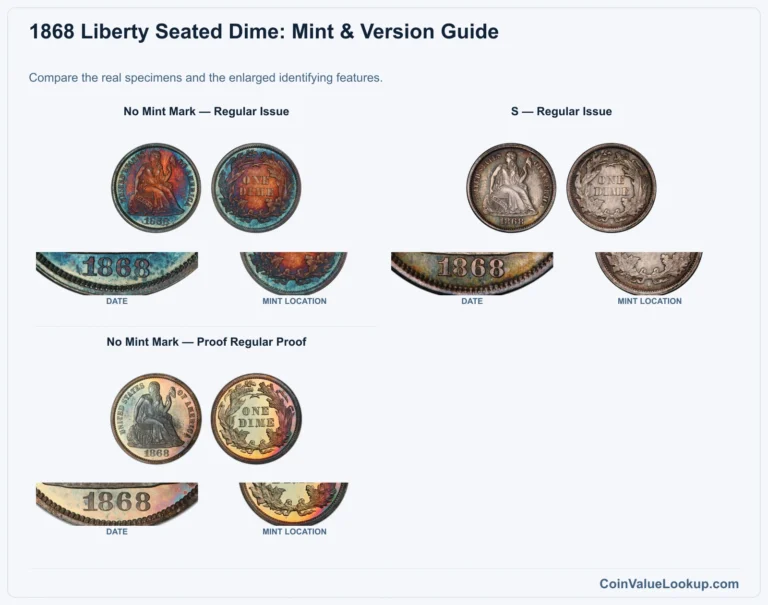
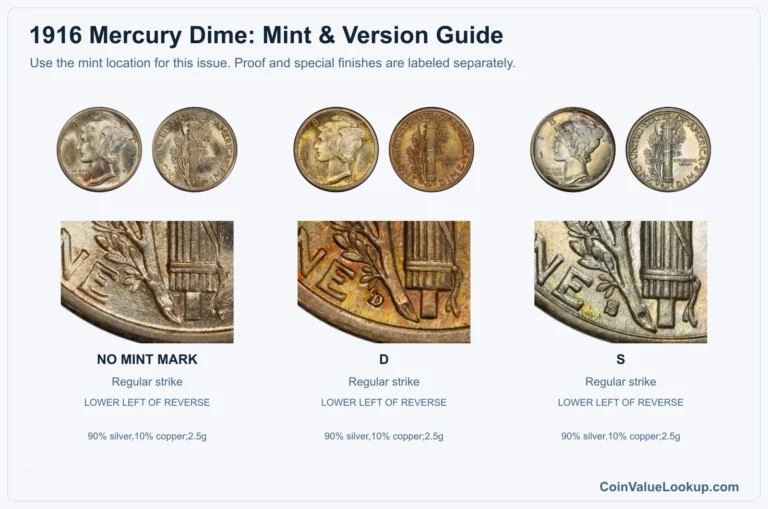
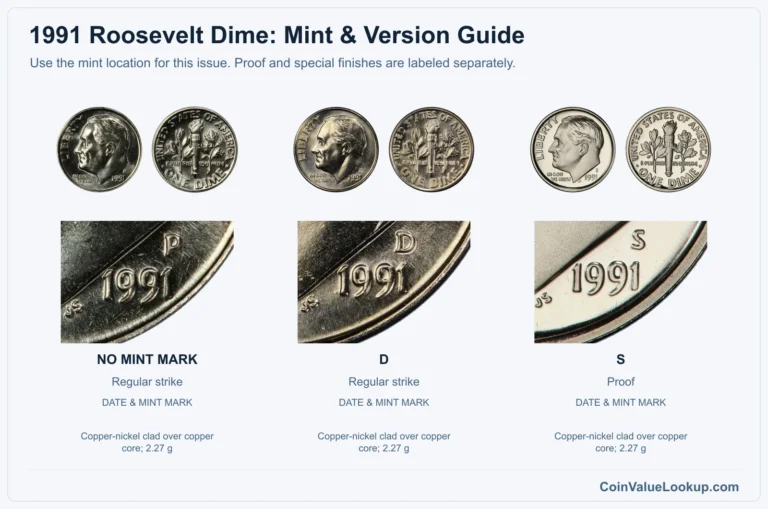
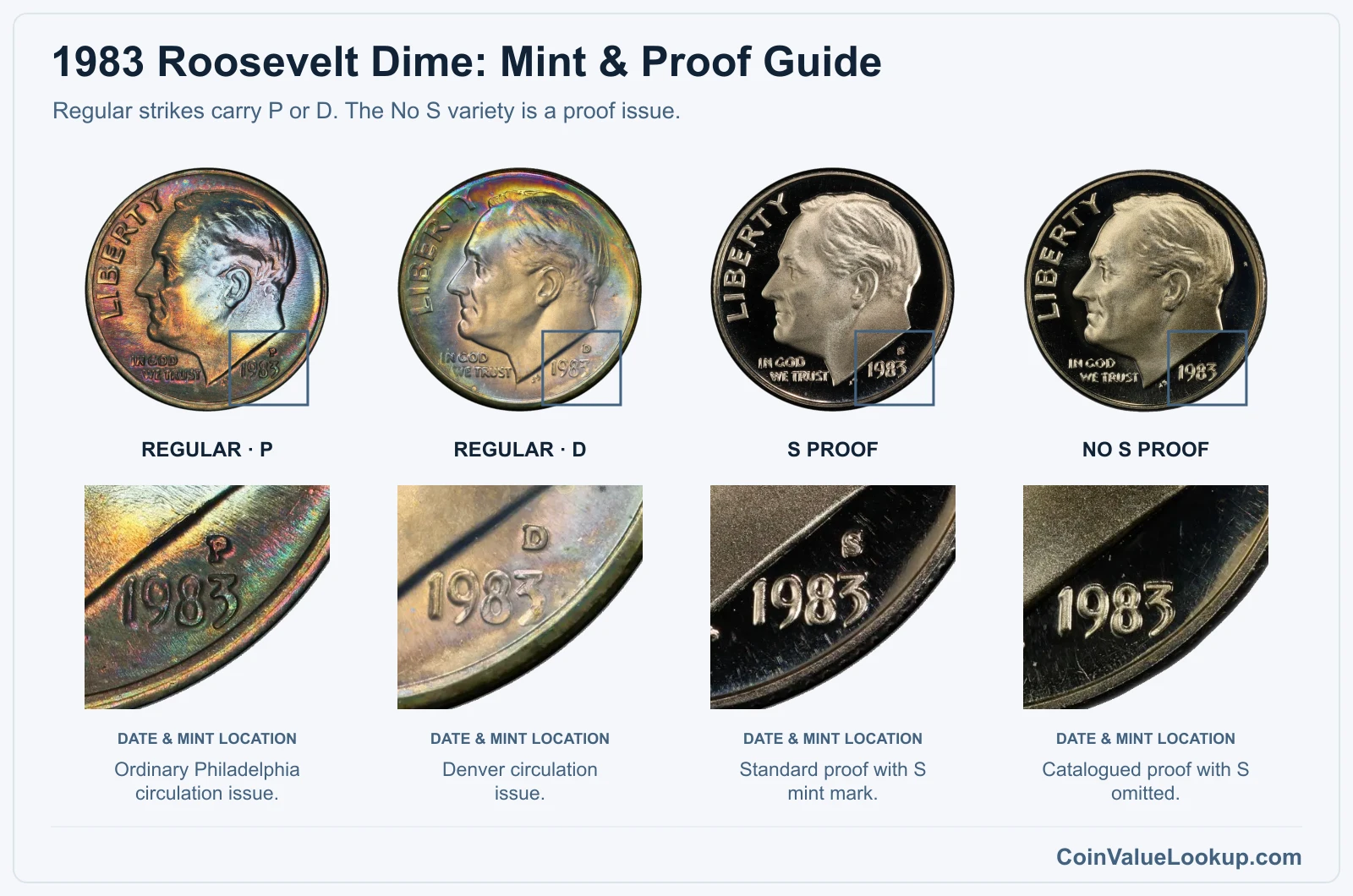
Now find the mint mark on the obverse, near the date. A "P" means Philadelphia business strike.
A "D" means Denver business strike. An "S" means a San Francisco proof, struck with polished dies on polished planchets for collectors.
The tricky one is the No S proof. This is a proof coin — mirror fields, sharp detail — that is simply missing its S mint mark.
Do not confuse it with the 1982 No P business strike, which is a completely different variety from a different year and mint. A business-strike dime with a faint or worn P is not a No S proof.
The manufacturing finish must be genuine proof before the missing letter matters.
Step 2: Check Your 1983 Roosevelt Dime Grade
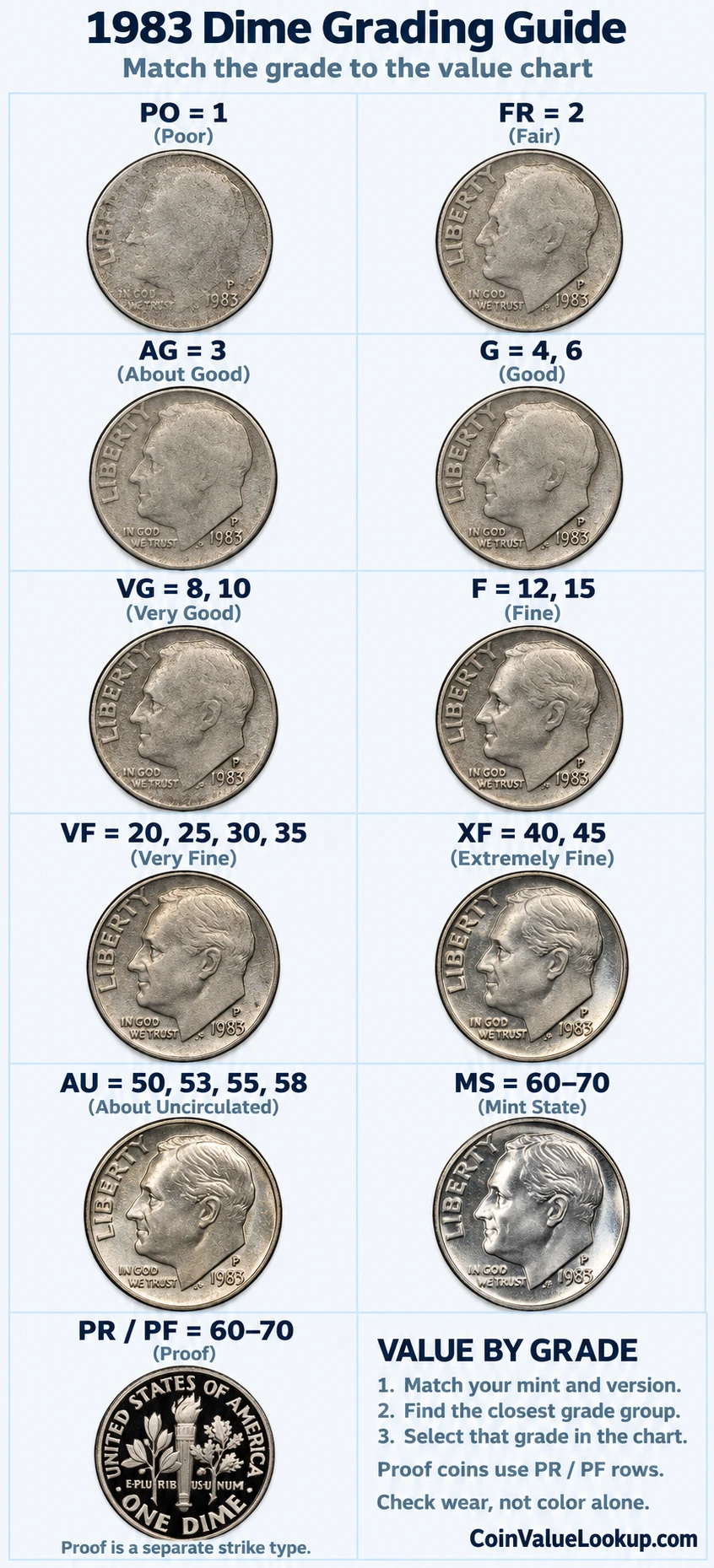
Start with Roosevelt's cheek and jawline on the obverse. In lower grades, these high points lose definition first, followed by the hair detail above the ear.
On the reverse, check the torch lines and the leaf clusters — they flatten quickly once wear begins.
The comparison image is your friend here. Hold your coin next to it and match the surface texture and detail level honestly.
Original luster matters a lot. A coin that has been cleaned or polished may look shiny, but it will grade lower than a naturally toned example with the same detail.
Scratches, contact marks, and rim dings all pull the grade down.
For proof coins, note that "proof" describes how the coin was made, not its numerical grade. A proof can still show handling marks.
Cameo or deep cameo contrast — frosted devices against mirror fields — is a separate designation, and Full Bands on the torch is a strike characteristic, not an error.
Step 3: Check 1983 Roosevelt Dime Value by Mint and Version
1983 Roosevelt Dime — P Business Strike
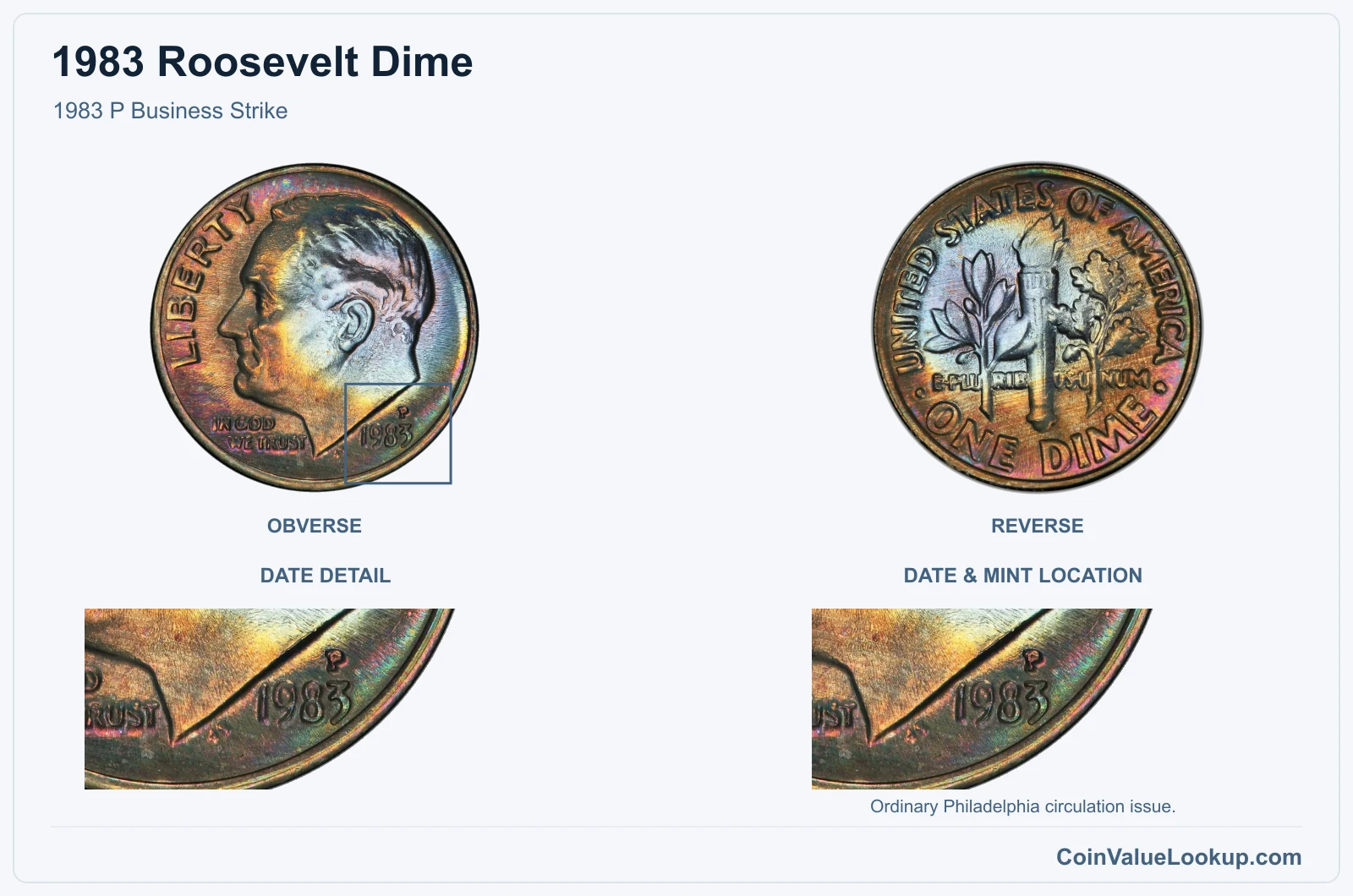
The 1983-P Roosevelt dime is the Philadelphia business strike, marked with a small "P" on the obverse near the date. It is copper-nickel clad over a copper core, weighing 2.27 grams.
In circulated condition these are worth face value.
The USA Coin Book guide places a 1983-P at about $7.88 in MS 65 — a coin with full luster and only minor contact marks. Well-struck examples showing complete separation in both horizontal torch band pairs earn the Full Bands designation, which can push value higher among specialists.
Check yours under magnification.
Range Grade
Price Auction Records Appraisal PO PO 1
—
Coin Identifier FR FR 2
—
Coin Identifier AG AG 3
—
Coin Identifier G G 4
—
Coin Identifier
G 6
—
Coin Identifier VG VG 8
—
Coin Identifier
VG 10
—
Coin Identifier F F 12
—
Coin Identifier
F 15
—
Coin Identifier VF VF 20
—
Coin Identifier
VF 25
—
Coin Identifier
VF 30
—
Coin Identifier
VF 35
—
Coin Identifier XF XF 40
—
Coin Identifier
XF 45
—
Coin Identifier AU AU 50
—
Coin Identifier
AU 53
—
Coin Identifier
AU 55
—
Coin Identifier
AU 58
Coin Identifier MS MS 60
—
Coin Identifier
MS 61
—
Coin Identifier
MS 62
—
Coin Identifier
MS 63
—
Coin Identifier
MS 64
Coin Identifier
MS 65
—
Coin Identifier
MS 66
Coin Identifier
MS 67
Coin Identifier
MS 68
—
—
—
MS 69
—
—
—
MS 70
—
—
—
1983 Roosevelt Dime — D Business Strike
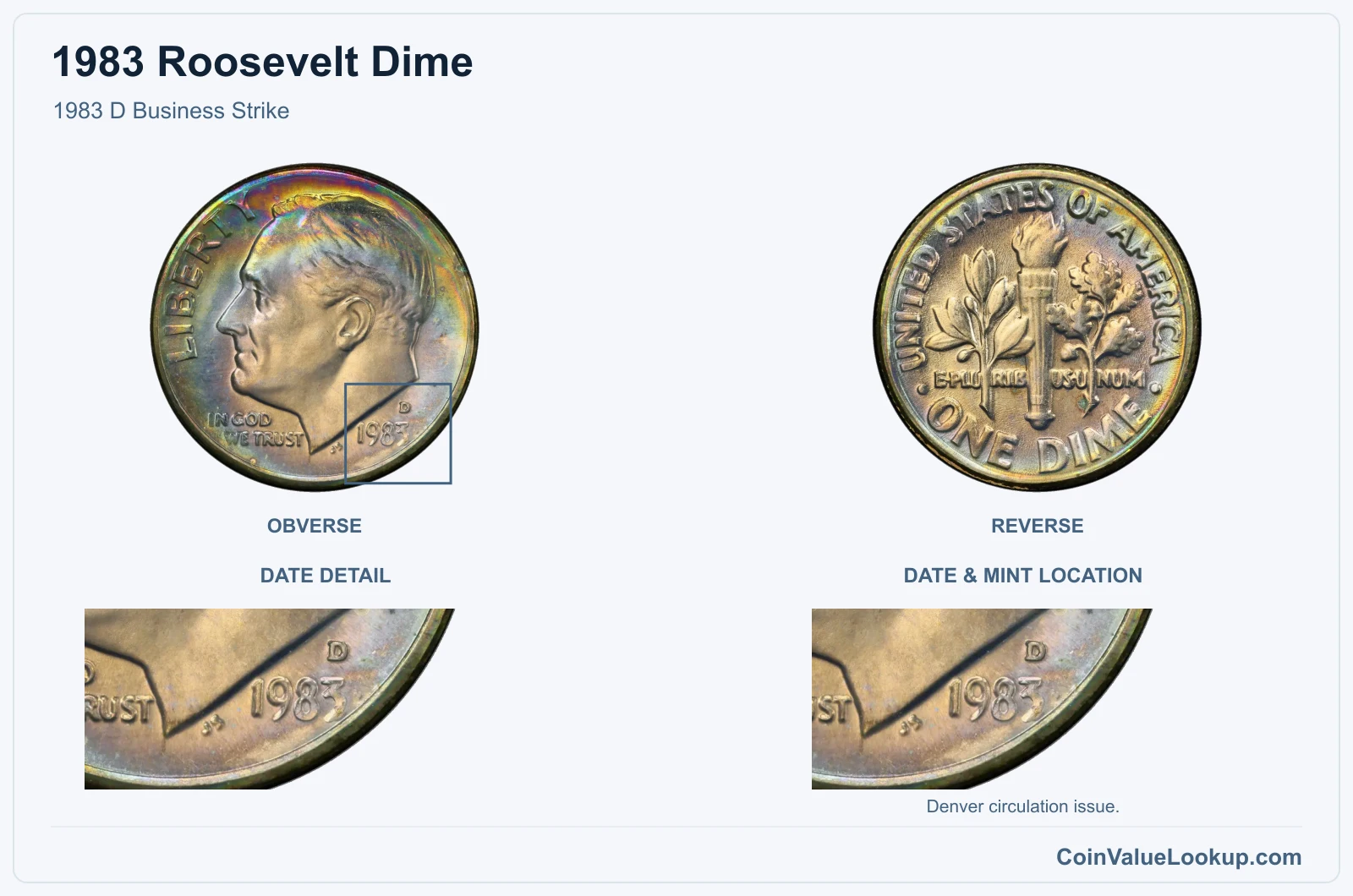
Denver's 1983-D dime carries a "D" mint mark on the obverse. Same composition, same weight, same design — just a different facility.
The MS 65 guide estimate is $3.92, lower than the Philadelphia issue in the same grade. Circulated pieces are worth ten cents.
As with the P, look for fully separated horizontal torch bands if you think you have an uncirculated example; that strike quality detail matters to registry collectors and can influence what someone will pay.
Range Grade
Price Auction Records Appraisal PO PO 1
—
Coin Identifier FR FR 2
—
Coin Identifier AG AG 3
—
Coin Identifier G G 4
—
Coin Identifier
G 6
—
Coin Identifier VG VG 8
—
Coin Identifier
VG 10
—
Coin Identifier F F 12
—
Coin Identifier
F 15
—
Coin Identifier VF VF 20
—
Coin Identifier
VF 25
—
Coin Identifier
VF 30
—
Coin Identifier
VF 35
—
Coin Identifier XF XF 40
—
Coin Identifier
XF 45
—
Coin Identifier AU AU 50
—
Coin Identifier
AU 53
—
Coin Identifier
AU 55
—
Coin Identifier
AU 58
Coin Identifier MS MS 60
—
Coin Identifier
MS 61
—
Coin Identifier
MS 62
—
Coin Identifier
MS 63
—
Coin Identifier
MS 64
Coin Identifier
MS 65
Coin Identifier
MS 66
Coin Identifier
MS 67
Coin Identifier
MS 68
—
—
—
MS 69
—
—
—
MS 70
—
—
—
1983 Roosevelt Dime — S Proof
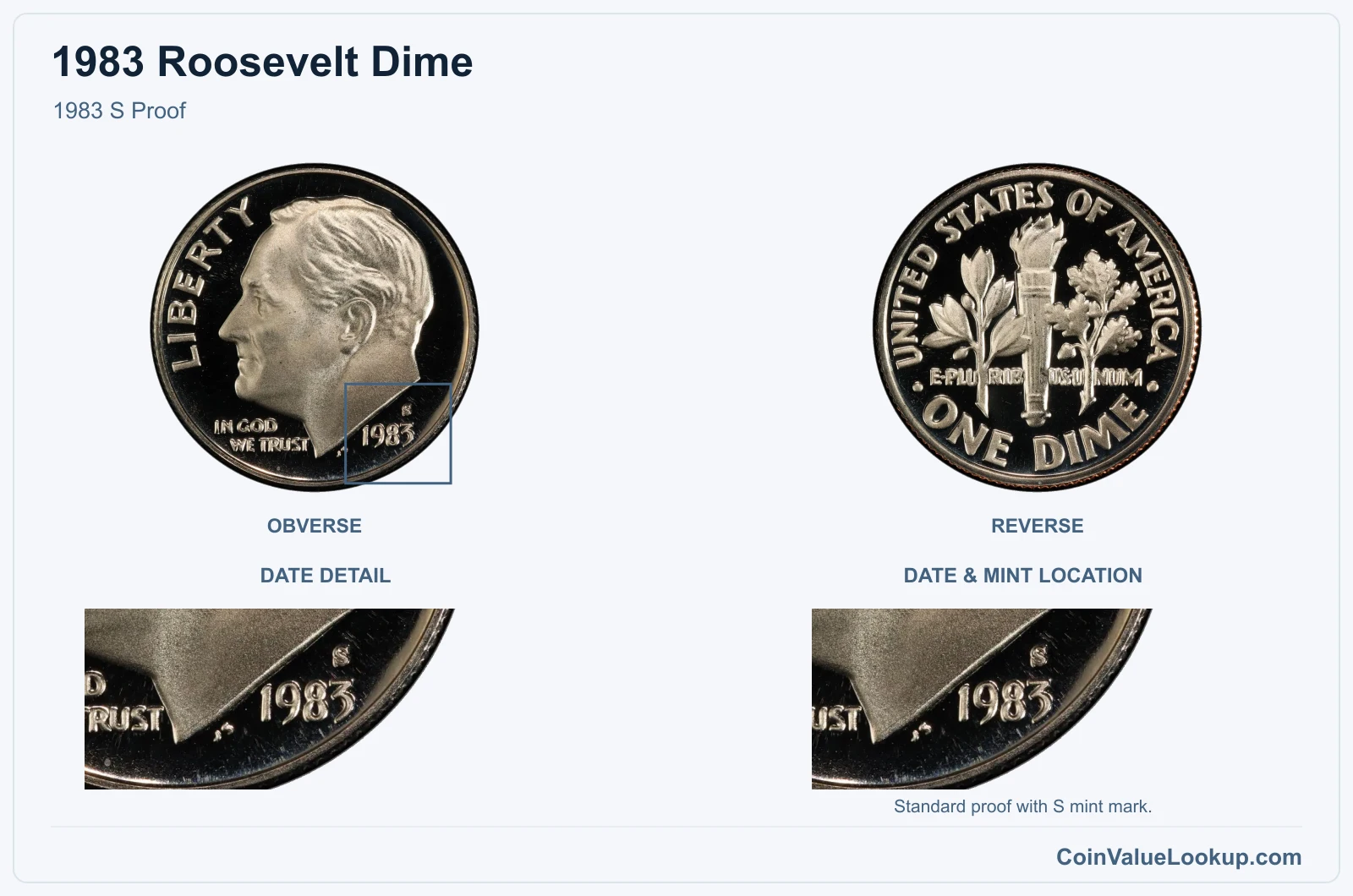
The 1983-S proof was struck at San Francisco on polished planchets with polished dies, producing mirror-like fields and sharp design relief. You will find the "S" mint mark on the obverse.
These were sold in official proof sets, not released into circulation.
A guide estimate for PR 65 is $3.62. Higher grades and strong cameo or deep cameo contrast command more.
If your proof has hairlines, haze, or toning from improper storage, it may grade below PR 65.
Coin Value Lookup is a handy starting point if you want to compare this proof against other Roosevelt dime years or denominations.
Range Grade
Price Auction Records Appraisal PR PR 1
—
Coin Identifier
PR 2
—
Coin Identifier
PR 3
—
Coin Identifier
PR 4
—
Coin Identifier
PR 6
—
Coin Identifier
PR 8
—
Coin Identifier
PR 10
—
Coin Identifier
PR 12
—
Coin Identifier
PR 15
—
Coin Identifier
PR 20
—
Coin Identifier
PR 25
—
Coin Identifier
PR 30
—
Coin Identifier
PR 35
—
Coin Identifier
PR 40
—
Coin Identifier
PR 45
—
Coin Identifier
PR 50
—
Coin Identifier
PR 53
—
Coin Identifier
PR 55
—
Coin Identifier
PR 58
—
Coin Identifier
PR 60
—
Coin Identifier
PR 61
—
Coin Identifier
PR 62
—
Coin Identifier
PR 63
—
Coin Identifier
PR 64
—
Coin Identifier
PR 65
—
Coin Identifier
PR 66
—
Coin Identifier
PR 67
—
Coin Identifier
PR 68
Coin Identifier
PR 69
Coin Identifier
PR 70
Coin Identifier
1983 Roosevelt Dime — No S Proof
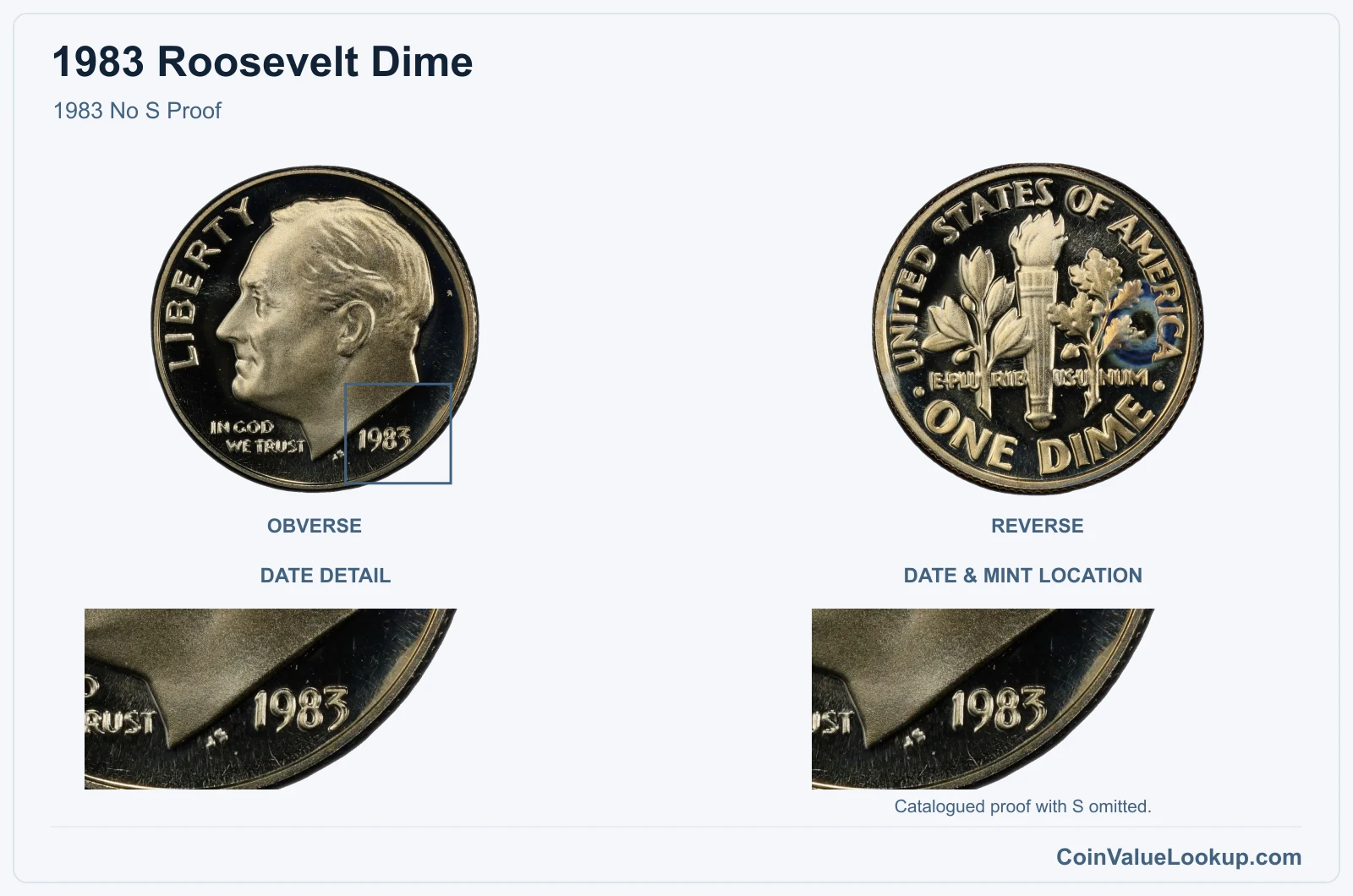
This is the variety that gets people excited — and for good reason. The 1983 No S proof is a San Francisco proof dime struck without the S mint mark.
It is not a business strike with a worn letter; the coin must show genuine proof surfaces: mirrored fields, frosted devices, sharp rims.
An NGC PR 70 Ultra Cameo example sold for $2,760 in January 2024. That is a single recorded sale at the highest possible grade, so do not assume every No S proof is worth the same amount.
Grade, contrast level, and surface quality all matter.
Do not confuse this with the 1982 No P dime, which is a Philadelphia business-strike omission — a completely different coin from a different mint and year. If your dime lacks proof characteristics, the missing letter is not meaningful in this context.
Authentication by a recognized grading service is essential before claiming this variety.
Range Grade
Price Auction Records Appraisal PR PR 1
—
Coin Identifier
PR 2
—
Coin Identifier
PR 3
—
Coin Identifier
PR 4
—
Coin Identifier
PR 6
—
Coin Identifier
PR 8
—
Coin Identifier
PR 10
—
Coin Identifier
PR 12
—
Coin Identifier
PR 15
—
Coin Identifier
PR 20
—
Coin Identifier
PR 25
—
Coin Identifier
PR 30
—
Coin Identifier
PR 35
—
Coin Identifier
PR 40
—
Coin Identifier
PR 45
—
Coin Identifier
PR 50
—
Coin Identifier
PR 53
—
Coin Identifier
PR 55
—
Coin Identifier
PR 58
—
Coin Identifier
PR 60
—
Coin Identifier
PR 61
—
Coin Identifier
PR 62
—
Coin Identifier
PR 63
—
Coin Identifier
PR 64
—
Coin Identifier
PR 65
—
Coin Identifier
PR 66
—
Coin Identifier
PR 67
Coin Identifier
PR 68
Coin Identifier
PR 69
Coin Identifier
PR 70
Coin Identifier
1983 Roosevelt Dime Error List
1. 1983 Roosevelt Dime — No S Proof
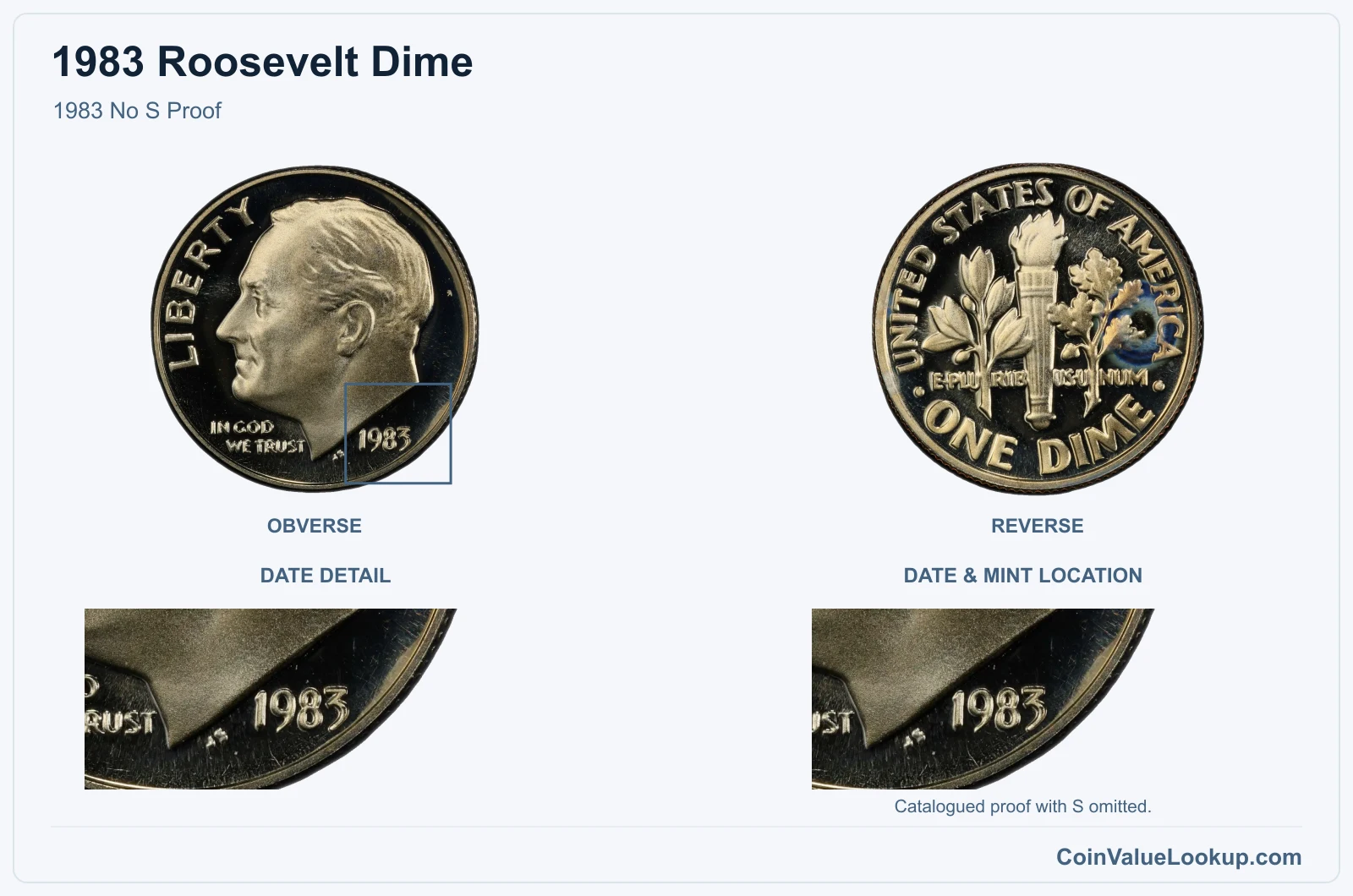
The 1983 No S proof dime is missing its San Francisco mint mark entirely. To identify one, you need to first confirm the coin has genuine proof surfaces — reflective mirror fields with sharply struck devices.
Compare it directly against a normal 1983-S proof; the only difference should be the absent "S" near the date.
This is not the same as a 1982 No P business-strike error. A circulated dime with an indistinct or worn-away P mint mark is not a No S proof.
Coins where the mint mark has been physically removed by abrasion will show tool marks or a disturbed surface under magnification.
An NGC PR 70 Ultra Cameo No S sold for $2,760 in January 2024. That represents a single historical sale at the top possible grade and contrast level.
Individual value depends on authenticated identity and condition. Professional grading-service authentication is the standard for this variety.
2. 1983 Roosevelt Dime — Off-Center Strike
Off-center 1983 dimes result from the planchet being improperly seated when the dies closed. A documented example shows roughly 15 percent displacement toward 11 o'clock, visible on both faces, with the date and P mint mark still legible.
That last part matters: a readable date and mint mark make an off-center coin attributable and more desirable.
Do not confuse a slightly uneven rim or minor one-sided misalignment with a true off-center strike. Genuine off-center errors show a matching crescent of unstruck planchet on both sides.
An authenticated Heritage Auctions example graded ANACS MS 63 has appeared at auction.
No standard price range is established here. Value depends on the percentage of displacement, whether the date is visible, the coin's condition, and third-party authentication.
3. 1983 Roosevelt Dime — Struck Through Capped Die
A struck-through-capped-die error happens when a previously struck coin adheres to the die face and acts as an obstruction for subsequent strikes. On a 1983 dime, this shows up as a softened or distorted design on the capped side while the opposite face retains more normal definition.
The result looks ghostly — blurred devices, spread rims, and sometimes a cupped shape.
Do not mistake heavy wear, surface grinding, or grease-filled letters for a capped-die strike. Genuine examples show characteristic metal flow and progressive distortion consistent with the cap's obstruction, not random damage.
A Heritage Auctions lot graded ANACS MS 60 documents this error on a 1983-P dime.
No standard price range applies. Condition, the degree of distortion, and professional authentication all influence what a collector will pay.
4. 1983 Roosevelt Dime — Repunched Mintmark
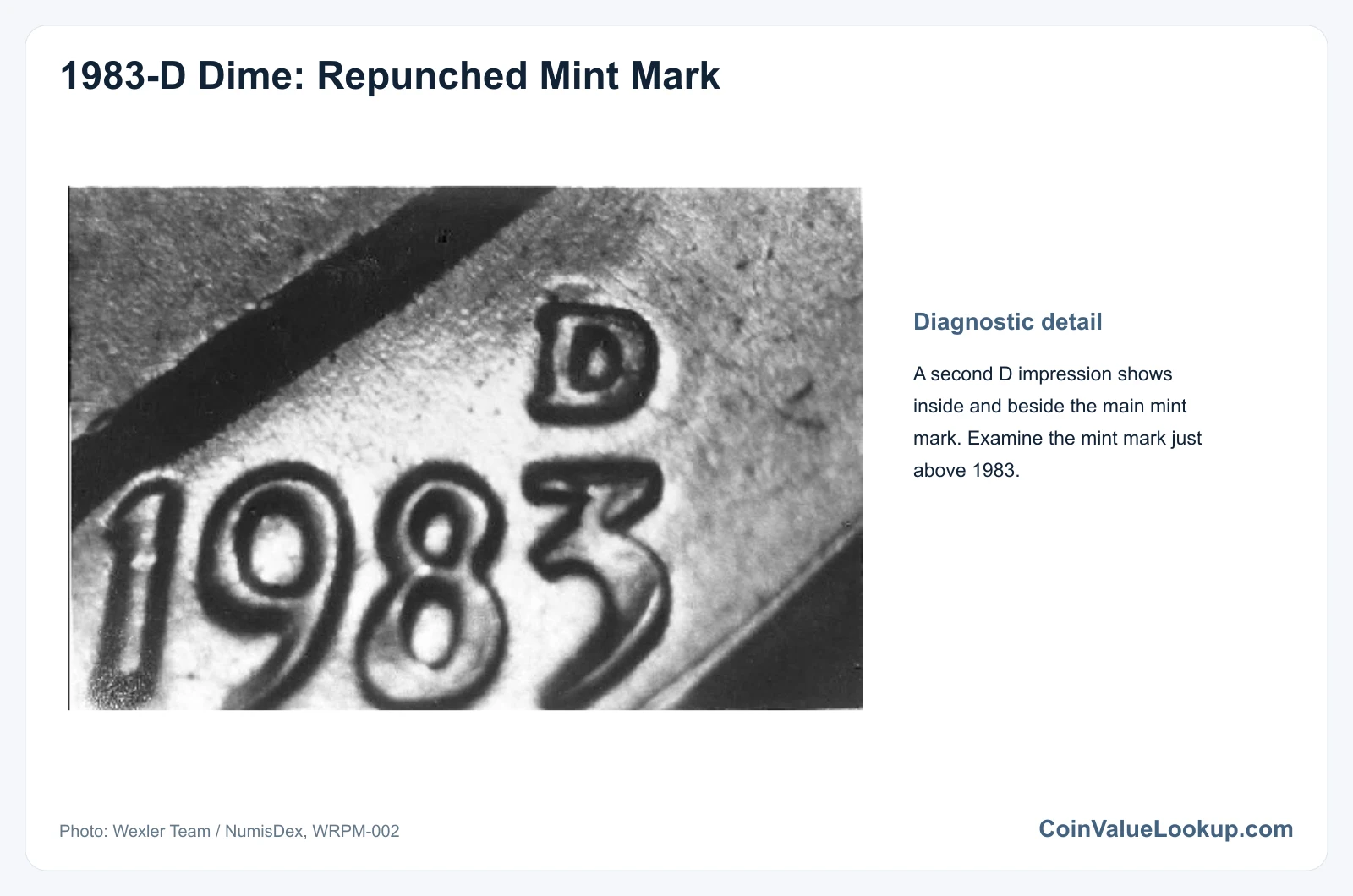
A repunched mint mark on a 1983-D dime shows traces of a second, slightly offset impression of the D. Under magnification you may see a shadow or partial outline of a second punch overlapping the primary mark.
Compare carefully with a normal 1983-D at the same magnification to be sure.
This is different from machine doubling, which produces flat, shelf-like doubling rather than a distinct secondary punch image. Die chips or corrosion around the mint mark can also mimic an RPM at first glance.
No specific price range is established for this variety. The visibility of the repunching, the coin's overall grade, and third-party authentication all factor into what it might bring.
5. 1983 Roosevelt Dime — Broadstrike
A broadstrike occurs when the collar die — the ring that normally contains the planchet and forms the reeded edge — fails to engage during striking. The result is a dime that is slightly wider than normal with a smooth or distorted edge, and the design may spread outward.
The full design is still present and roughly centered, which distinguishes a broadstrike from an off-center error where part of the design is missing. A coin that was flattened after it left the mint will show damage characteristics rather than the even metal spread of a genuine broadstrike.
No specific price range applies. Value depends on how dramatic the spread is, the coin's condition, and whether it has been authenticated by a third-party grading service.
6. 1983 Roosevelt Dime — Clipped Planchet
A clipped planchet error means a portion of the metal blank was missing before the coin was struck. The clip can be curved, straight, or ragged, depending on what went wrong during the blanking process.
Look for a section of missing rim with corresponding metal-flow weakness on the opposite side of the coin — that opposite weakness is a key diagnostic.
Do not confuse a filed edge, an intentional notch, or corrosion-eaten rim with a genuine clip. Post-mint damage typically shows sharp or irregular tool marks and lacks the characteristic strike-through weakness on the far side.
No specific price range is adopted for this error. How much of the planchet is missing, the coin's condition, and professional authentication all play into its value.