2007 Roosevelt Dime Coin Value: How Much Is It Worth?
A worn 2007 Roosevelt dime from your pocket is worth face value — ten cents. In better condition the picture changes a bit: a USA Coin Book guide estimate places an MS65 business strike at about $2.50, an S clad proof at $3.08 in PR65, and an S silver proof at $9.65 in PR65.
Finish, condition, and authenticated errors all shift what a specific coin is worth, so it pays to know exactly which version you have.
Fast Way to Identify Your 2007 Roosevelt Dime
The quickest way to start is to upload clear photos of both sides of your 2007 dime. Our identifier can give you a preliminary read on the mintmark, finish type, and general condition from those images.
It is not a substitute for professional authentication or grading, but it points you in the right direction before you dig deeper.
2007 Roosevelt Dime Value
Upload both sides of your 2007 Roosevelt Dime.
Front Obverse
Upload photo
Back Reverse
Upload photo
Which 2007 Roosevelt Dime Versions Are Worth Money?
- Uncirculated P or D business strikes with sharp, fully separated torch bands (Full Bands designation) command more attention than average examples.
- The 2007-S silver proof, confirmed by weight (2.50 g) and composition, carries a higher guide estimate than the clad proof — $9.65 at PR65.
- Satin Finish dimes from P and D Mint Sets are distinct collectible versions worth evaluating separately from regular strikes.
- Authenticated broadstrikes and die-cap errors on 2007 dimes have documented collector interest, though values depend on the specific coin's condition and features.
Step 1: Identify Your 2007 Roosevelt Dime Mint Mark and Version
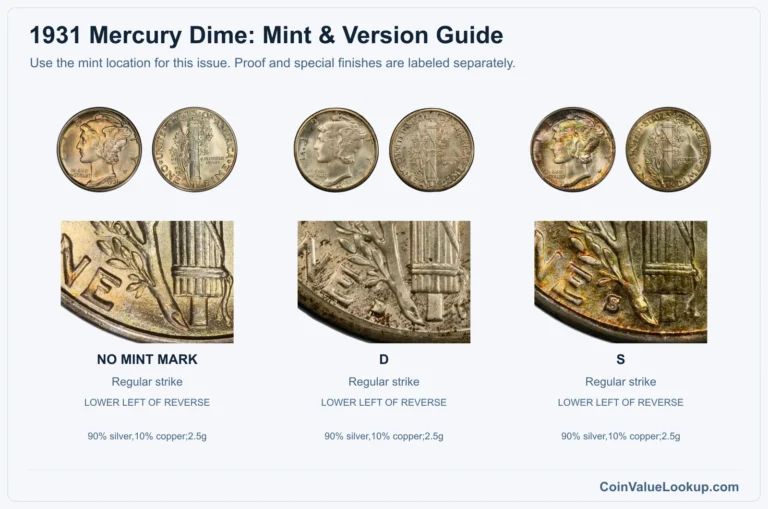
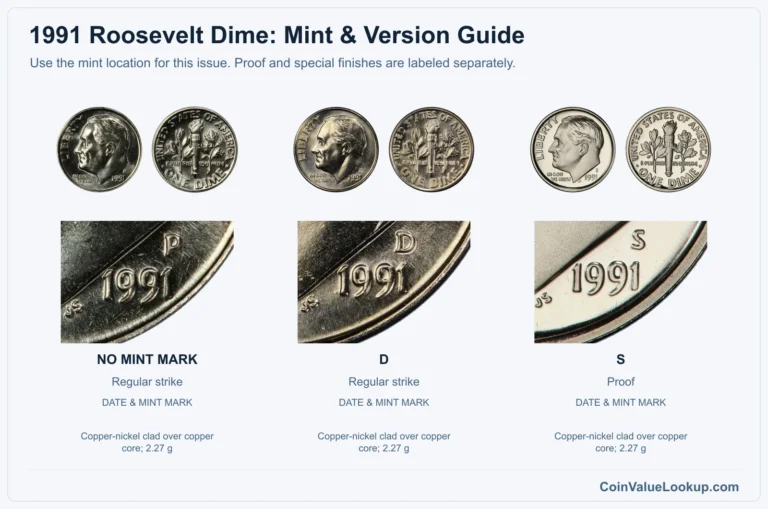
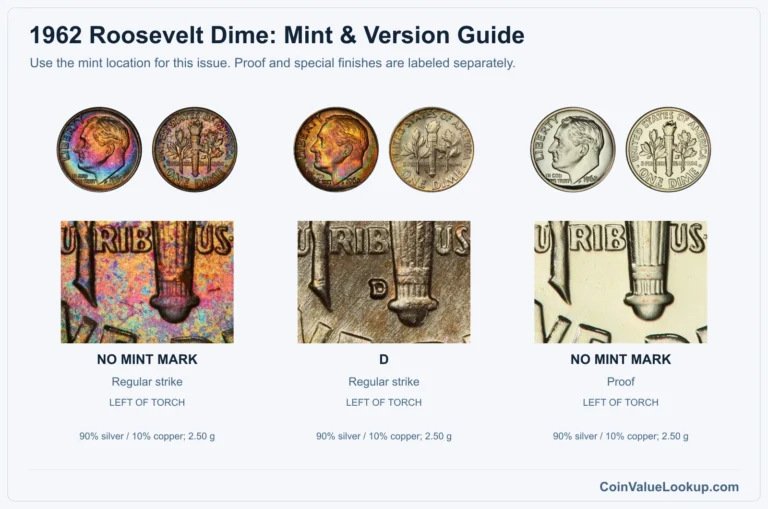
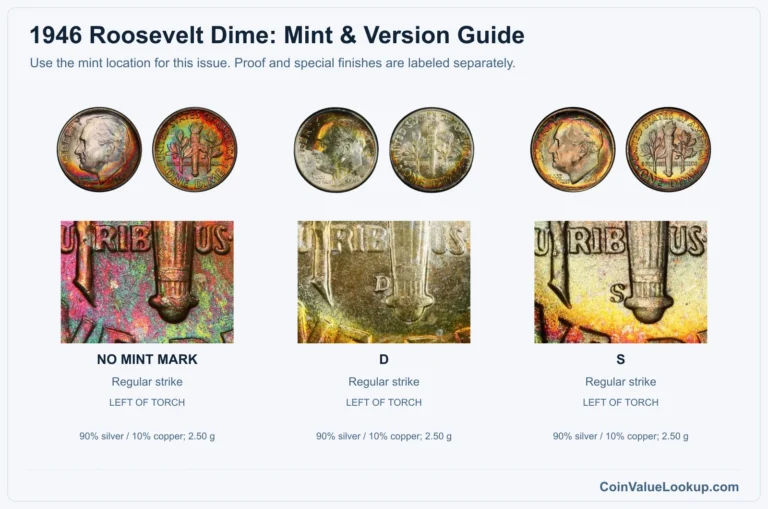
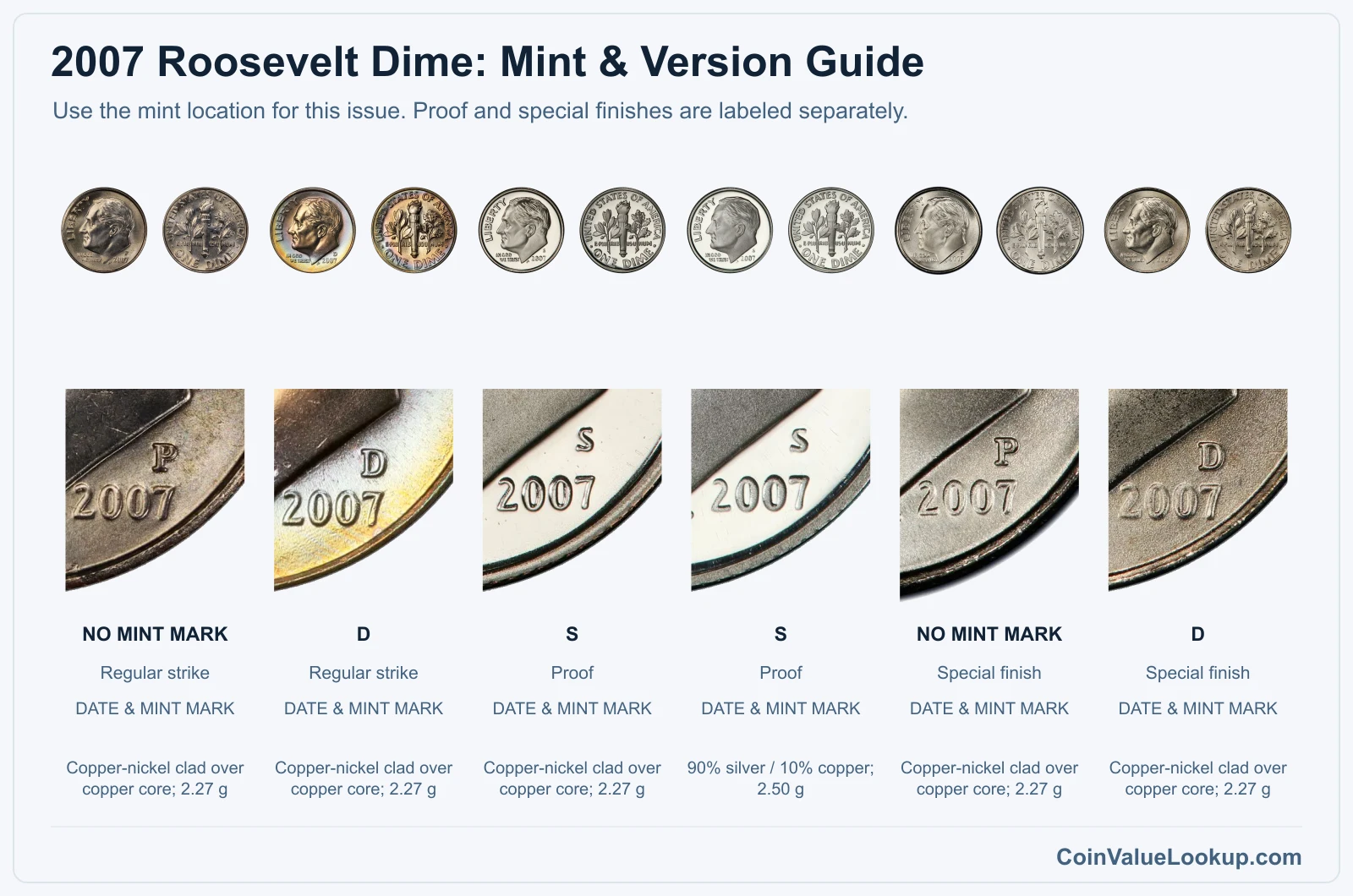
First, confirm the date reads 2007, with Roosevelt's portrait on the obverse and a torch flanked by branches on the reverse. The mintmark sits just above the date on the obverse — look for P, D, or S.
Philadelphia (P) and Denver (D) strikes are the standard circulation coins. Both are copper-nickel clad over a copper core and weigh 2.27 grams.
San Francisco (S) produced two proof versions that share the same mintmark and identical design: a clad proof and a 90% silver proof. You cannot tell them apart by sight alone.
To separate the silver proof from the clad proof, weigh the coin — the silver version comes in at 2.50 grams versus the clad's 2.27 grams. Edge color helps too, but weight and original packaging are the most reliable checks.
Color alone does not authenticate alloy or a missing clad layer.
There are also 2007-P and 2007-D Satin Finish dimes. These came exclusively in Uncirculated Mint Sets sold by the U.S. Mint and have a distinctive soft, even luster different from the frosty look of regular business strikes.
They are separate special-strike issues, not proofs and not errors.
Step 2: Check Your 2007 Roosevelt Dime Grade
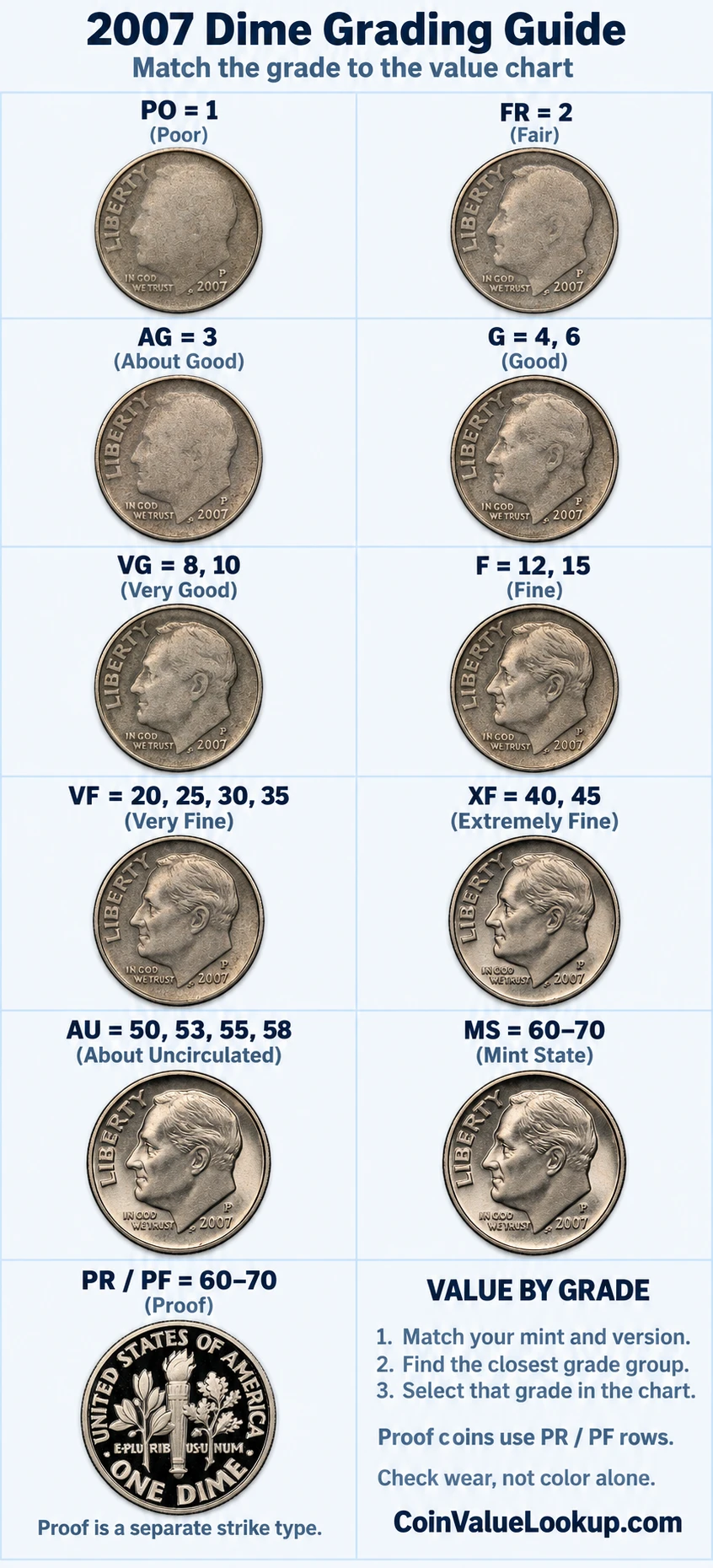
Start with Roosevelt's cheekbone, jawline, and the hair detail above his ear — these are the first places to lose definition from circulation wear. On the reverse, check the torch bands and leaf veins.
A key distinction: weak detail is not always wear. Full Bands (sometimes noted as FB or FT) is a strike designation that refers to complete separation of both horizontal torch-band pairs.
It means the coin was struck sharply, not that it is a different alloy or special variety.
Compare your coin's original luster to the reference comparison image. A coin that still has full cartwheel luster across both sides is likely uncirculated.
If the high points are dull but fields still shine, you are probably looking at light wear — AU territory.
Proof and Satin Finish coins each have their own grading standards and comparison images. Do not grade a proof against a business strike or vice versa.
Cleaned, polished, or damaged coins need condition qualifications regardless of how much detail remains.
Step 3: Check 2007 Roosevelt Dime Value by Mint and Version
2007 Roosevelt Dime — P Business Strike
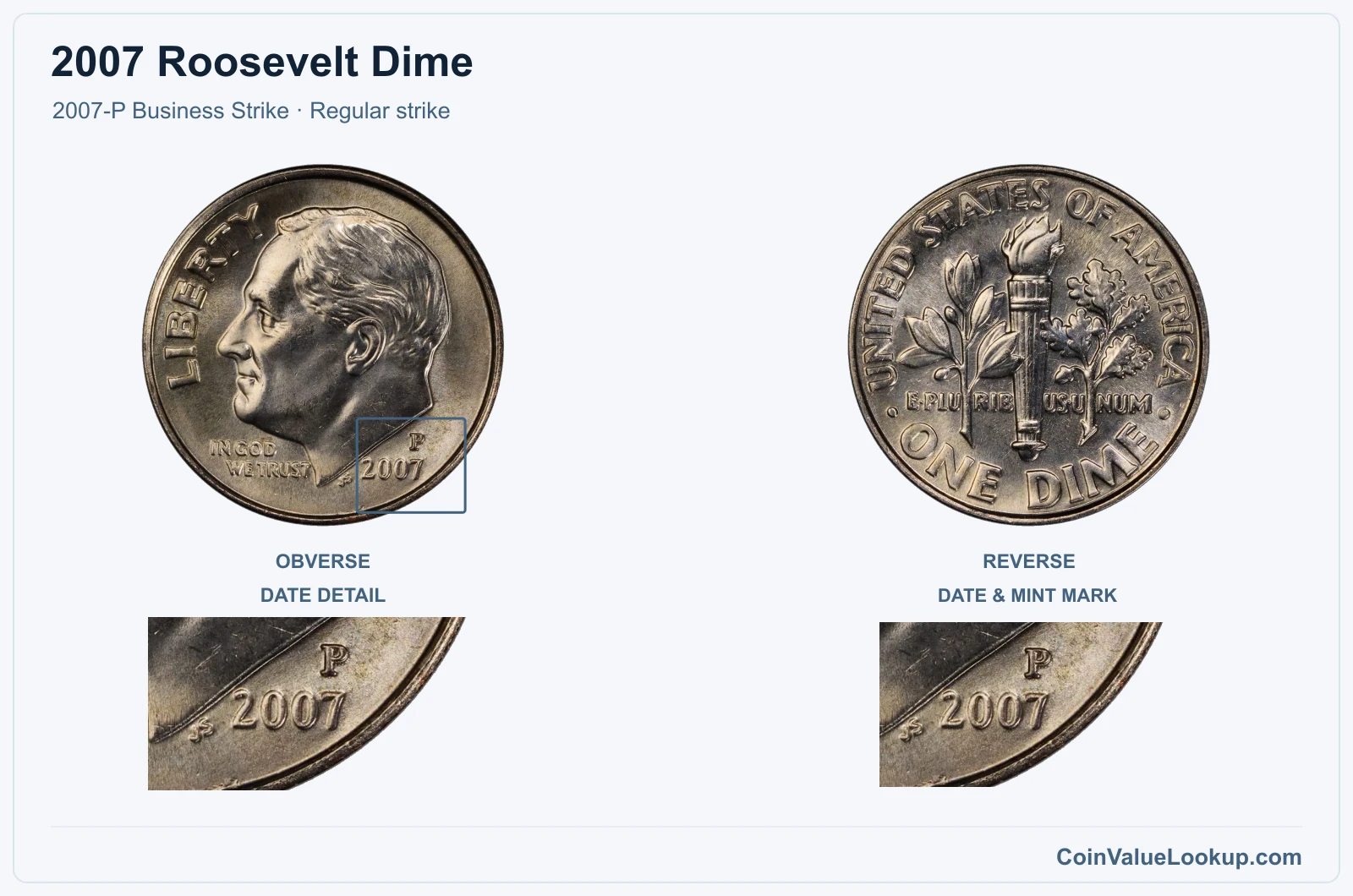
The 2007-P business strike is the most common version — a standard Philadelphia circulation dime. It is copper-nickel clad over a copper core, weighing 2.27 grams, with a P mintmark above the date.
A USA Coin Book guide estimate puts an MS65 example at around $2.50. Worn coins are worth face value.
Pieces with the Full Bands strike designation, showing complete separation of both horizontal torch-band pairs, tend to attract more collector interest than flat-struck examples of the same grade.
Range Grade
Price Auction Records Appraisal PO PO 1
—
Coin Identifier FR FR 2
—
Coin Identifier AG AG 3
—
Coin Identifier G G 4
—
Coin Identifier
G 6
—
Coin Identifier VG VG 8
—
Coin Identifier
VG 10
—
Coin Identifier F F 12
—
Coin Identifier
F 15
—
Coin Identifier VF VF 20
—
Coin Identifier
VF 25
—
Coin Identifier
VF 30
—
Coin Identifier
VF 35
—
Coin Identifier XF XF 40
—
Coin Identifier
XF 45
—
Coin Identifier AU AU 50
—
Coin Identifier
AU 53
—
Coin Identifier
AU 55
—
Coin Identifier
AU 58
—
Coin Identifier MS MS 60
—
Coin Identifier
MS 61
—
Coin Identifier
MS 62
Coin Identifier
MS 63
—
Coin Identifier
MS 64
—
Coin Identifier
MS 65
—
Coin Identifier
MS 66
—
Coin Identifier
MS 67
—
Coin Identifier
MS 68
—
—
—
MS 69
—
—
—
MS 70
—
—
—
2007 Roosevelt Dime — D Business Strike
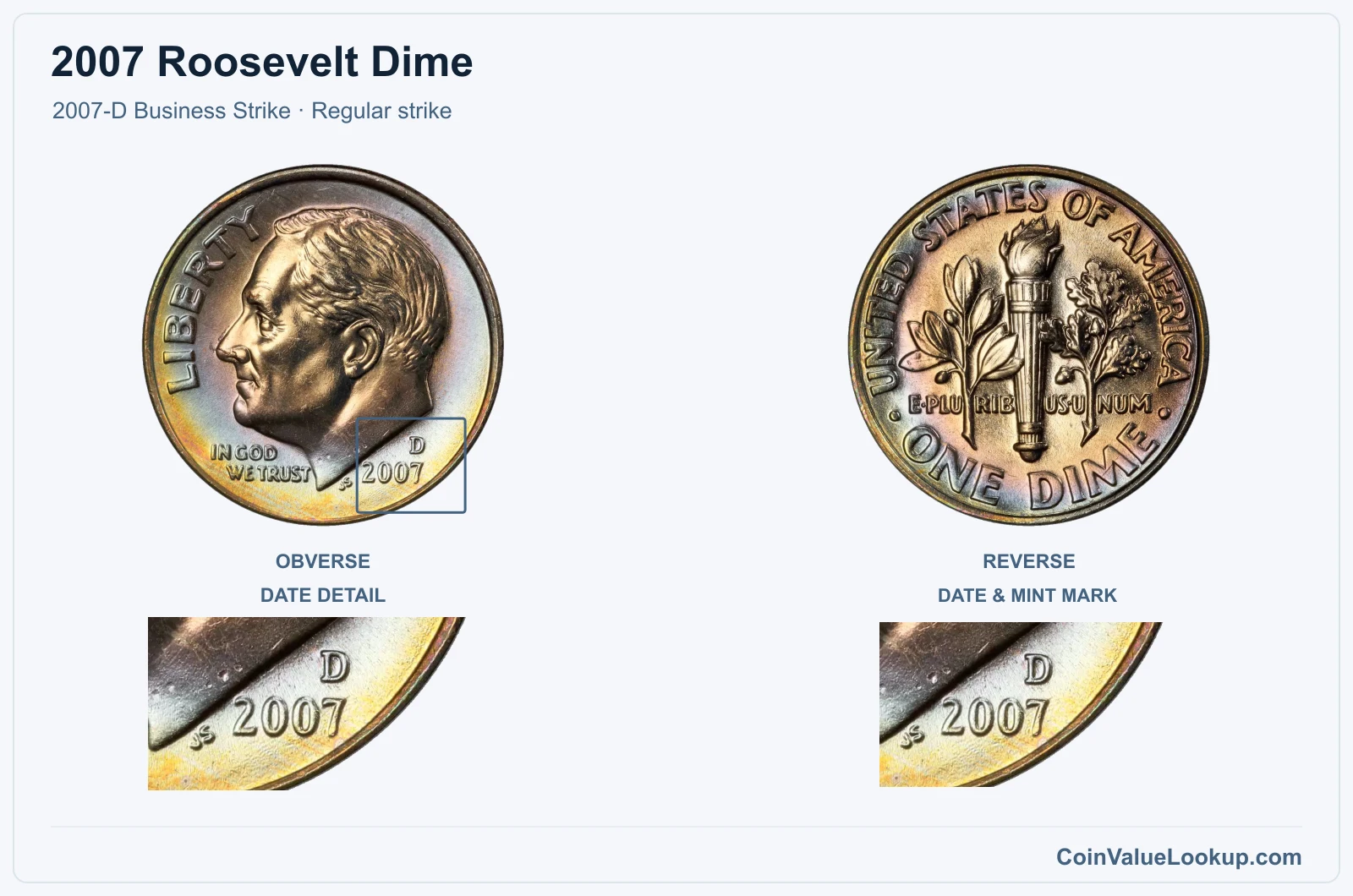
Denver's 2007-D dime mirrors its Philadelphia counterpart in composition, weight, and design. Look for the D mintmark above the date.
The USA Coin Book guide estimate is also about $2.50 at MS65. Circulated examples trade at ten cents.
As with the P mint, a sharply struck coin showing full torch-band separation is more desirable to collectors than one with mushy details in the same numeric grade.
Range Grade
Price Auction Records Appraisal PO PO 1
—
Coin Identifier FR FR 2
—
Coin Identifier AG AG 3
—
Coin Identifier G G 4
—
Coin Identifier
G 6
—
Coin Identifier VG VG 8
—
Coin Identifier
VG 10
—
Coin Identifier F F 12
—
Coin Identifier
F 15
—
Coin Identifier VF VF 20
—
Coin Identifier
VF 25
—
Coin Identifier
VF 30
—
Coin Identifier
VF 35
—
Coin Identifier XF XF 40
—
Coin Identifier
XF 45
—
Coin Identifier AU AU 50
—
Coin Identifier
AU 53
—
Coin Identifier
AU 55
—
Coin Identifier
AU 58
—
Coin Identifier MS MS 60
—
Coin Identifier
MS 61
—
Coin Identifier
MS 62
—
Coin Identifier
MS 63
—
Coin Identifier
MS 64
—
Coin Identifier
MS 65
—
Coin Identifier
MS 66
—
Coin Identifier
MS 67
—
Coin Identifier
MS 68
—
—
—
MS 69
—
—
—
MS 70
—
—
—
2007 Roosevelt Dime — S Clad Proof
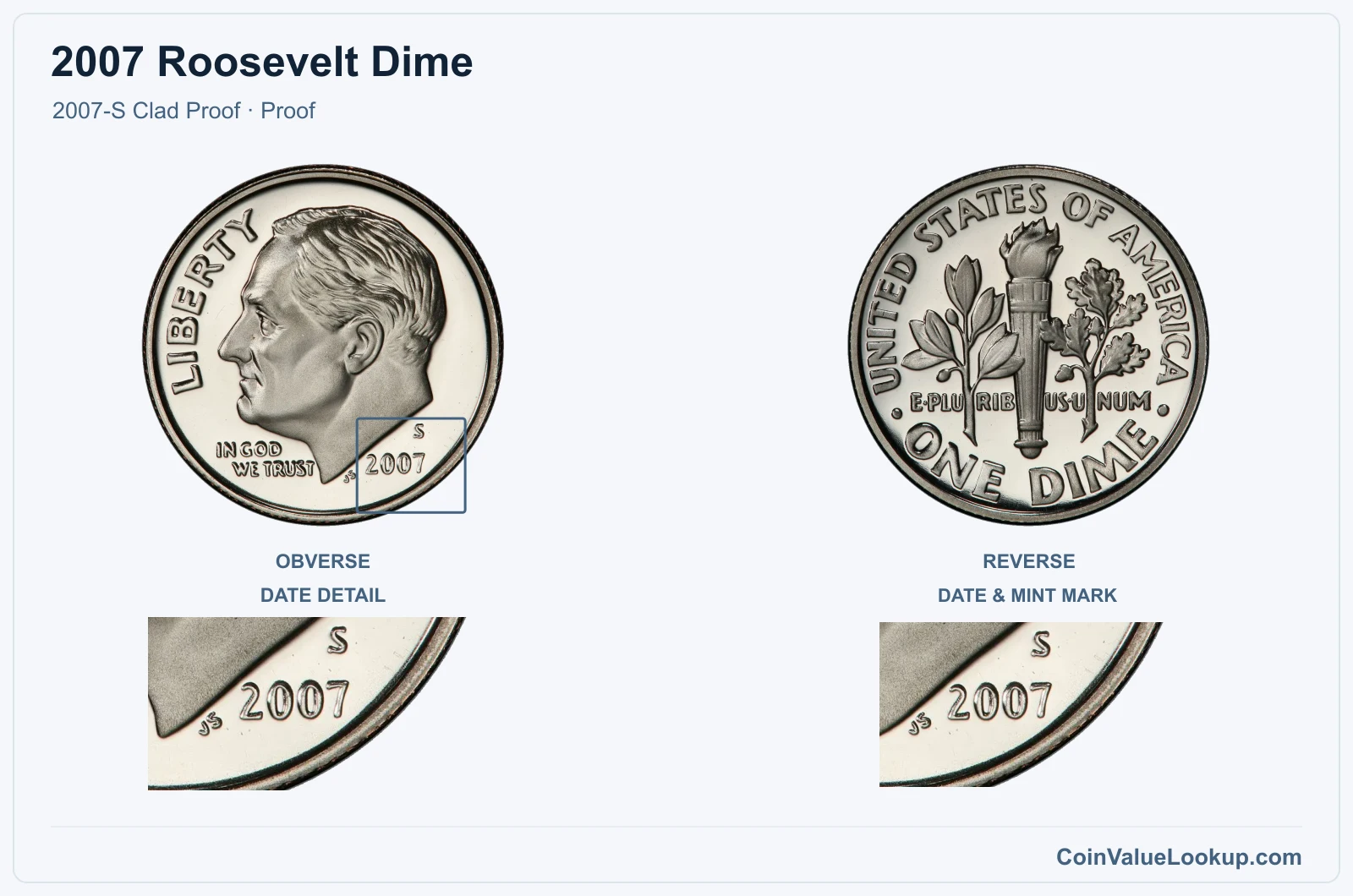
The 2007-S clad proof was struck at San Francisco with polished dies and specially prepared planchets, giving it mirror-like fields and frosted devices. It is still copper-nickel clad over a copper core — same 2.27-gram weight as a business strike.
A USA Coin Book guide estimate places it at about $3.08 in PR65. Because the clad proof and the silver proof share the same S mintmark and design, you need to check weight or edge color to tell them apart.
Packaging from the original U.S. Mint Proof Set is the simplest confirmation.
Coin Value Lookup is a good starting point if you want to compare guide values across different Roosevelt dime years and finishes before deciding whether to pursue professional grading.
Range Grade
Price Auction Records Appraisal PR PR 1
—
Coin Identifier
PR 2
—
Coin Identifier
PR 3
—
Coin Identifier
PR 4
—
Coin Identifier
PR 6
—
Coin Identifier
PR 8
—
Coin Identifier
PR 10
—
Coin Identifier
PR 12
—
Coin Identifier
PR 15
—
Coin Identifier
PR 20
—
Coin Identifier
PR 25
—
Coin Identifier
PR 30
—
Coin Identifier
PR 35
—
Coin Identifier
PR 40
—
Coin Identifier
PR 45
—
Coin Identifier
PR 50
—
Coin Identifier
PR 53
—
Coin Identifier
PR 55
—
Coin Identifier
PR 58
—
Coin Identifier
PR 60
—
Coin Identifier
PR 61
—
Coin Identifier
PR 62
—
Coin Identifier
PR 63
—
Coin Identifier
PR 64
—
Coin Identifier
PR 65
—
Coin Identifier
PR 66
—
Coin Identifier
PR 67
—
Coin Identifier
PR 68
—
Coin Identifier
PR 69
Coin Identifier
PR 70
Coin Identifier
2007 Roosevelt Dime — S Silver Proof
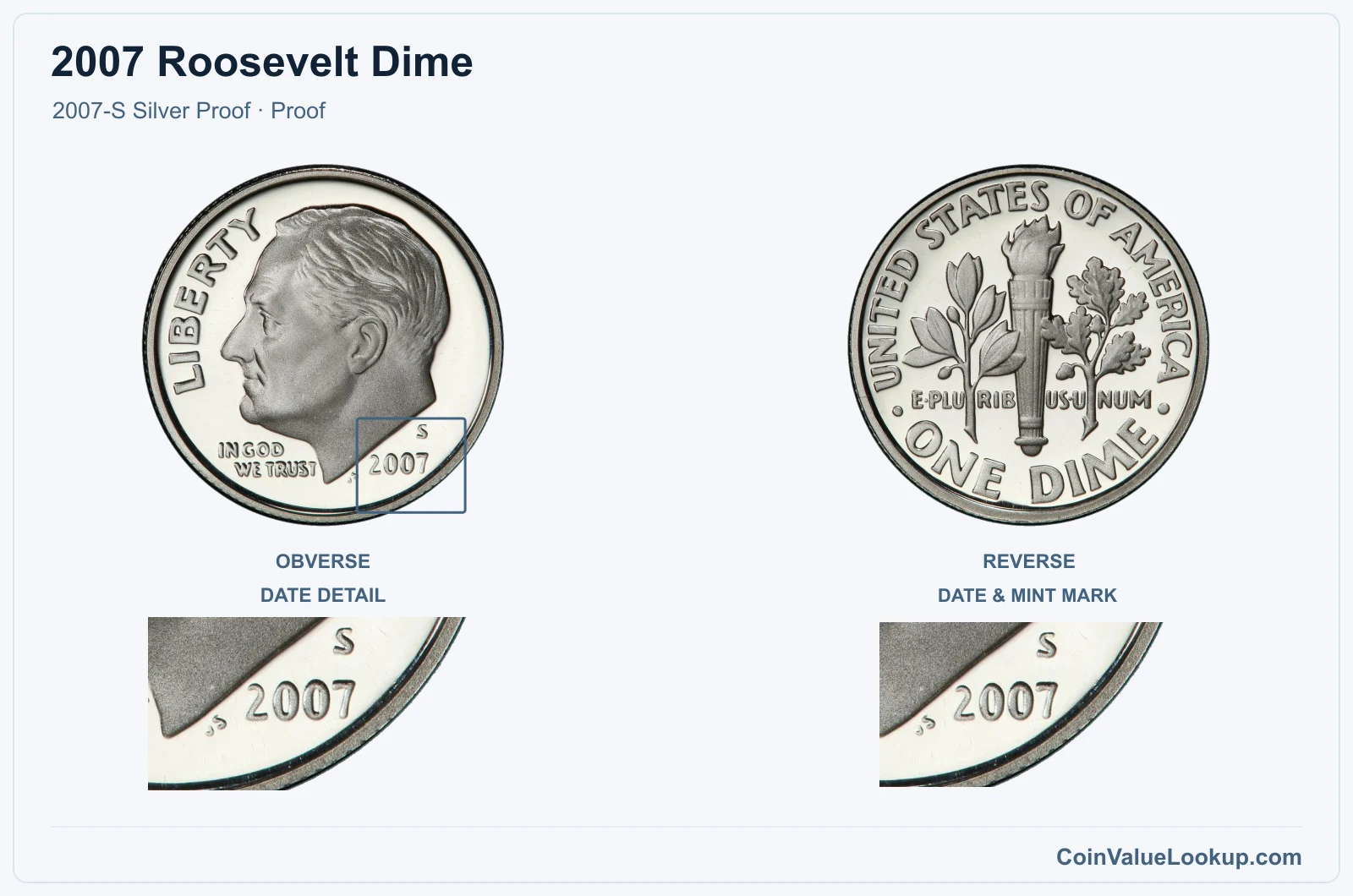
This is the 90% silver version of the 2007-S proof dime, containing silver and copper rather than clad layers. It weighs 2.50 grams — noticeably heavier than the 2.27-gram clad proof if you have a precise scale.
The USA Coin Book guide estimate is approximately $9.65 in PR65, making it the highest individual guide point among regular 2007 dime versions at that grade level. Silver proof dimes have been part of the Mint's Silver Proof Set since 1992.
Original Mint packaging is the easiest way to confirm you have the silver version rather than the clad.
Range Grade
Price Auction Records Appraisal PR PR 1
—
Coin Identifier
PR 2
—
Coin Identifier
PR 3
—
Coin Identifier
PR 4
—
Coin Identifier
PR 6
—
Coin Identifier
PR 8
—
Coin Identifier
PR 10
—
Coin Identifier
PR 12
—
Coin Identifier
PR 15
—
Coin Identifier
PR 20
—
Coin Identifier
PR 25
—
Coin Identifier
PR 30
—
Coin Identifier
PR 35
—
Coin Identifier
PR 40
—
Coin Identifier
PR 45
—
Coin Identifier
PR 50
—
Coin Identifier
PR 53
—
Coin Identifier
PR 55
—
Coin Identifier
PR 58
—
Coin Identifier
PR 60
—
Coin Identifier
PR 61
—
Coin Identifier
PR 62
—
Coin Identifier
PR 63
—
Coin Identifier
PR 64
—
Coin Identifier
PR 65
—
Coin Identifier
PR 66
—
Coin Identifier
PR 67
—
Coin Identifier
PR 68
—
Coin Identifier
PR 69
Coin Identifier
PR 70
Coin Identifier
2007 Roosevelt Dime — P Satin Finish
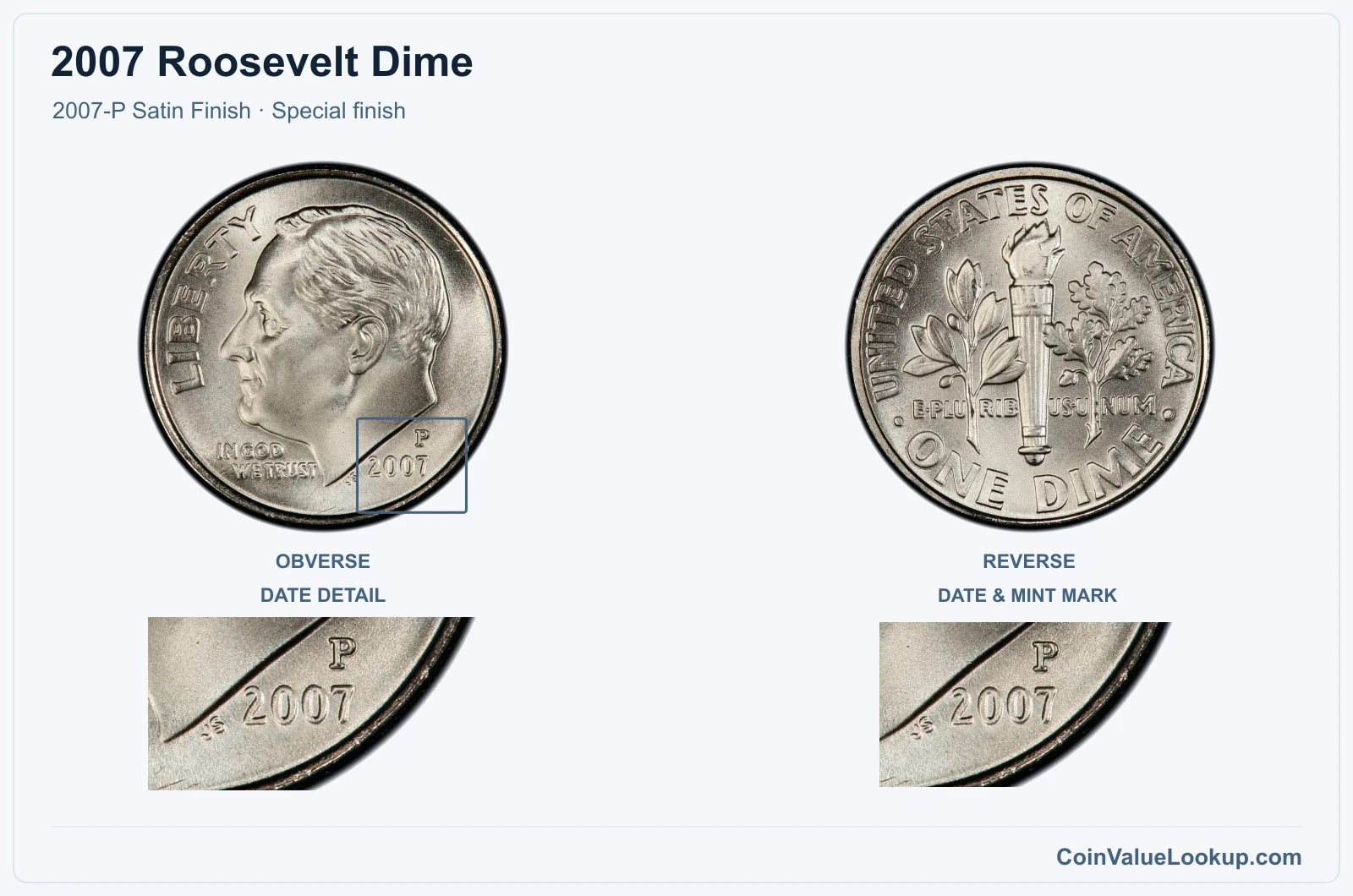
The 2007-P Satin Finish dime was issued only inside the U.S. Mint's annual Uncirculated Coin Set. It has a distinctive soft, even luster that looks different from both a frosty business strike and a mirror-finish proof.
These are clad coins — same copper-nickel composition and 2.27-gram weight as a regular P strike. The Satin Finish series ran from 2005 through 2010 and represents a separate special-strike category, not a proof and not an error.
Value depends on authenticated identity and condition; no specific guide price is adopted here, so individual assessment applies.
Range Grade
Price Auction Records Appraisal SP SP 1
—
Coin Identifier
SP 2
—
Coin Identifier
SP 3
—
Coin Identifier
SP 4
—
Coin Identifier
SP 6
—
Coin Identifier
SP 8
—
Coin Identifier
SP 10
—
Coin Identifier
SP 12
—
Coin Identifier
SP 15
—
Coin Identifier
SP 20
—
Coin Identifier
SP 25
—
Coin Identifier
SP 30
—
Coin Identifier
SP 35
—
Coin Identifier
SP 40
—
Coin Identifier
SP 45
—
Coin Identifier
SP 50
—
Coin Identifier
SP 53
—
Coin Identifier
SP 55
—
Coin Identifier
SP 58
—
Coin Identifier
SP 60
—
Coin Identifier
SP 61
—
Coin Identifier
SP 62
—
Coin Identifier
SP 63
—
Coin Identifier
SP 64
—
Coin Identifier
SP 65
—
Coin Identifier
SP 66
—
Coin Identifier
SP 67
—
Coin Identifier
SP 68
—
Coin Identifier
SP 69
—
Coin Identifier
SP 70
—
—
—
2007 Roosevelt Dime — D Satin Finish
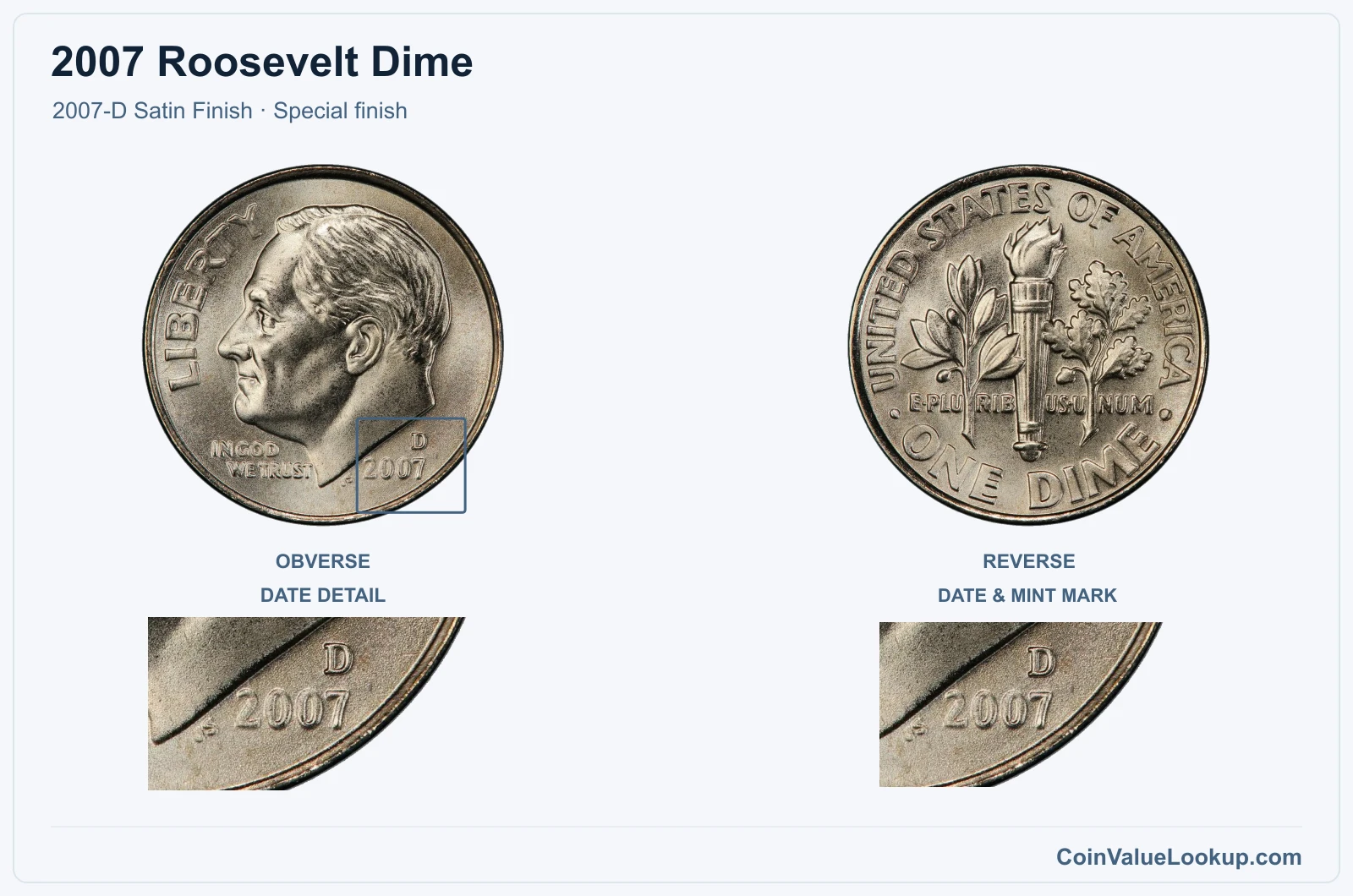
Denver's 2007-D Satin Finish dime is the D-mint counterpart from the same Uncirculated Coin Set program. It carries the D mintmark and has that same soft, uniform satin texture across both sides.
Like the P Satin, it is copper-nickel clad, weighs 2.27 grams, and is a special strike — not a proof. Satin Finish coins are evaluated on their own terms, separate from business strikes and proofs.
No specific guide price is adopted here, so value depends on authenticated identity, condition, and any verified errors.
Range Grade
Price Auction Records Appraisal SP SP 1
—
Coin Identifier
SP 2
—
Coin Identifier
SP 3
—
Coin Identifier
SP 4
—
Coin Identifier
SP 6
—
Coin Identifier
SP 8
—
Coin Identifier
SP 10
—
Coin Identifier
SP 12
—
Coin Identifier
SP 15
—
Coin Identifier
SP 20
—
Coin Identifier
SP 25
—
Coin Identifier
SP 30
—
Coin Identifier
SP 35
—
Coin Identifier
SP 40
—
Coin Identifier
SP 45
—
Coin Identifier
SP 50
—
Coin Identifier
SP 53
—
Coin Identifier
SP 55
—
Coin Identifier
SP 58
—
Coin Identifier
SP 60
—
Coin Identifier
SP 61
—
Coin Identifier
SP 62
—
Coin Identifier
SP 63
—
Coin Identifier
SP 64
—
Coin Identifier
SP 65
—
Coin Identifier
SP 66
—
Coin Identifier
SP 67
Coin Identifier
SP 68
Coin Identifier
SP 69
—
Coin Identifier
SP 70
—
—
—
2007 Roosevelt Dime Error List
1. 2007 Roosevelt Dime — Broadstrike
A broadstrike happens when the collar die — the ring that normally confines the blank during striking — fails to engage. The result is a coin whose metal spreads beyond the standard 17.9 mm diameter, but the design remains complete and roughly centered.
On a 2007-P dime, a broadstrike has been documented on an NGC MS66 FT example. To confirm, look for an expanded, slightly uneven rim and full design detail.
The edge will lack normal reeding because the collar was absent.
Do not confuse a broadstrike with a coin that was hammered or flattened after leaving the mint. Post-mint damage typically shows uneven thinning and contact marks.
An off-center strike is also different — the design shifts rather than simply expanding. Value depends on the individual coin's condition, centering, and authenticated identity.
2. 2007 Roosevelt Dime — Deep Reverse Die Cap
A deep reverse die cap forms when a struck coin sticks to the die and gets struck repeatedly against incoming blanks. Over successive impressions, the adhered coin develops tall, cupped walls — the deeper the cap, the more dramatic the shape.
A 2007-D attributed example graded PCGS MS62 sold for $460 at Heritage Auctions in May 2009. The date on this coin is not visible; the attribution to 2007-D is based on provenance and mint-bag context, not a readable date.
That distinction matters.
Do not mistake a mechanically cupped or spooned coin for a die cap. A genuine cap shows progressive metal flow and evidence of multiple impressions.
If someone offers a "die cap" with a perfectly readable date and no distortion, be skeptical.
3. 2007 Roosevelt Dime — Off-Center Strike
An off-center strike occurs when the blank is not seated properly between the dies. Part of the design is missing, and you will see an unstruck crescent of blank metal along one side.
The most collectible off-center errors still show the full date, because that confirms the year. A coin with no visible date is much harder to attribute and less desirable.
The percentage of off-center shift and how much design remains both affect value.
Do not confuse an off-center strike with a clipped planchet, a misaligned die, or post-mint flattening. A clip removes metal before striking; misalignment shifts the design but still strikes the full planchet area.
Condition, percentage of displacement, and date visibility all factor into what a specific off-center 2007 dime might be worth.
4. 2007 Roosevelt Dime — Die Crack / Die Chip
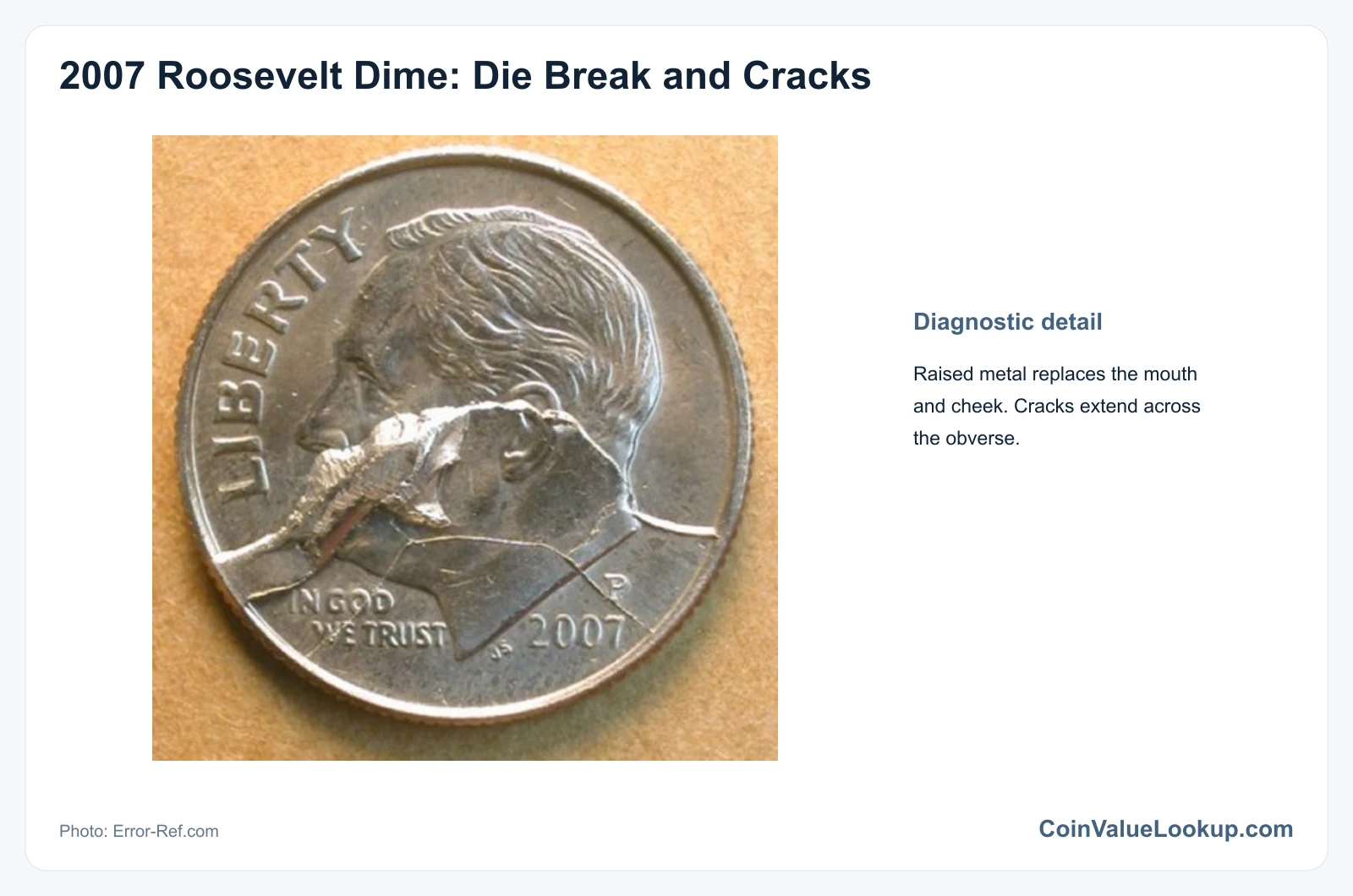
Die cracks show up as thin raised lines on the coin's surface, formed when the steel die itself develops fractures from repeated use. A die chip is a small raised blob where a piece of the die broke away, leaving a void that fills with metal during striking.
A rim cud is a larger, more dramatic version — a die break that connects to the rim, producing a raised, featureless lump along the edge. Interior die cracks that do not reach the rim are generally less valuable than full rim cuds.
Do not confuse die cracks with incuse scratches, corrosion lines, or foreign material stuck to the surface. A genuine die crack is raised above the field, follows a consistent path, and appears on every coin struck by that damaged die.
Value depends on size, location, and visual impact.
5. 2007 Roosevelt Dime — Partial Collar Strike
A partial collar strike — sometimes called a railroad rim — happens when the blank is only partly seated inside the collar die. One section of the rim looks normal with full reeding, while another section shows a stepped or expanded edge where the collar did not confine the metal.
To check, compare the edge profile all the way around. A normal 2007 dime has uniform reeding and a consistent rim height.
A partial collar will show a visible transition between the confined and unconfined portions.
This is different from edge damage, a flattened rim, or a complete broadstrike. Edge damage is irregular and shows contact marks.
A broadstrike has no reeding at all. Condition, the degree of collar displacement, and overall eye appeal influence what a partial collar 2007 dime is worth.
6. 2007 Roosevelt Dime — Lamination / Split Planchet
A lamination error occurs when layers of the planchet metal separate, producing peeling flaps, voids, or splits within the coin. On a clad dime, this can show up as a lifted section of the outer layer or a visible gap along the edge.
Photograph both the affected face and the edge together — that combination is the best way to document this type of error. A retained flap (still attached) is generally more collectible than a missing-layer void.
Do not confuse lamination with scraping, environmental corrosion, or a deliberately cut coin. Post-mint damage tends to leave sharp tool marks or irregular pitting, while a lamination follows the metal's internal structure.
Value depends on the size of the affected area, whether the flap is retained, and the coin's overall condition.
7. 2007 Roosevelt Dime — Struck-Through Error
A struck-through error happens when foreign material — grease, a thread, a metal fragment, or debris — sits between the die and the planchet during striking. The result is a localized depression or incomplete design area where the obstruction blocked the full impression.
Grease-filled die errors are the most common type, producing soft or missing detail in a specific area. A retained struck-through, where the foreign object is still embedded in the coin, is more dramatic and typically more collectible.
Do not confuse this with normal wear, cleaning, scratches, or a weak strike from worn dies. A struck-through depression has a distinct boundary and does not affect the surrounding surfaces.
Value depends on the size, location, and type of obstruction, along with the coin's overall condition.