2020 Roosevelt Dime Coin Value: How Much Is It Worth?
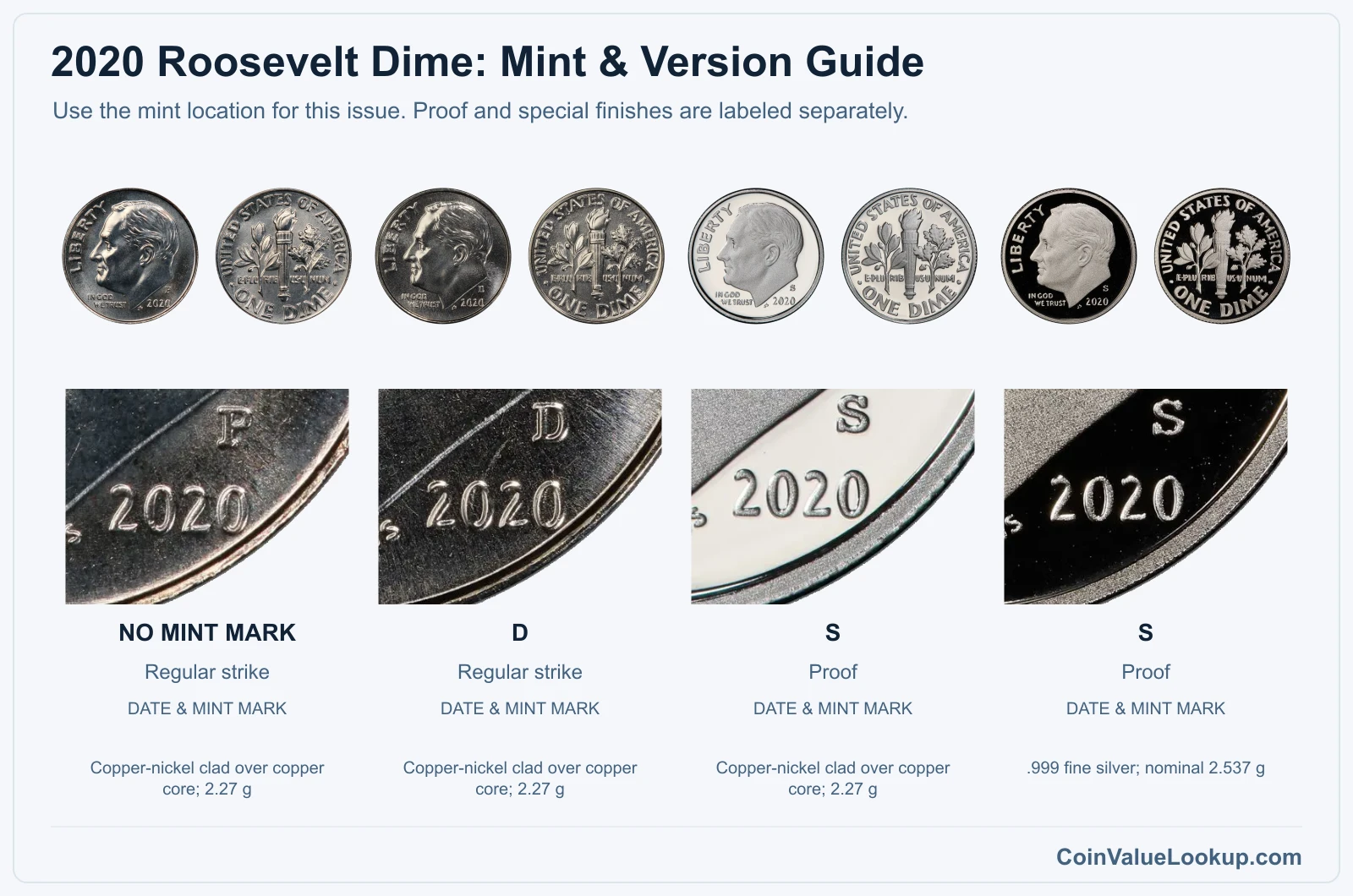
Most 2020 Roosevelt dimes pulled from circulation are worth face value and nothing more. A USA Coin Book guide lists the P or D business strike at about $2.50 in MS65, the S clad proof at $3.08 in PR65, and the S silver proof at $14 in PR65.
Sharp uncirculated examples, properly verified silver proofs, and individually authenticated error coins each deserve their own careful comparison.
Fast Way to Identify Your 2020 Roosevelt Dime
The quickest way to start figuring out what you have is to upload clear photos of both sides of your 2020 dime. Our identifier can offer a preliminary read on mintmark, finish, and general condition.
It is not a substitute for professional authentication or grading, but it helps you know which version to research next.
2020 Roosevelt Dime Value
Upload both sides of your 2020 Roosevelt Dime.
Front Obverse
Upload photo
Back Reverse
Upload photo
Which 2020 Roosevelt Dime Versions Are Worth Money?
- Uncirculated 2020-P or 2020-D dimes with full original luster and sharp torch bands, which move above face value in higher mint-state grades.
- 2020-S silver proof dimes confirmed by weight (about 2.537 g) and uniform silver edge, carrying the highest standard guide value among the four versions.
- Well-preserved 2020-S clad proofs, since proof finish alone does not mean silver and the two S-mint versions differ in both composition and value.
Step 1: Identify Your 2020 Roosevelt Dime Mint Mark and Version
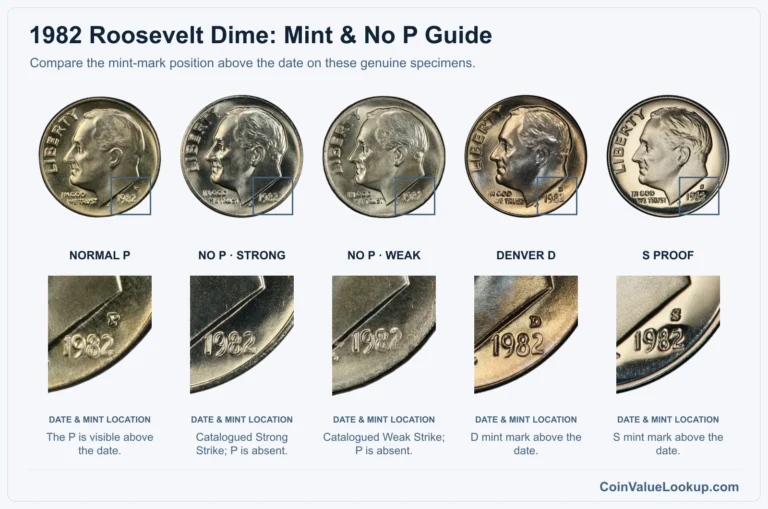
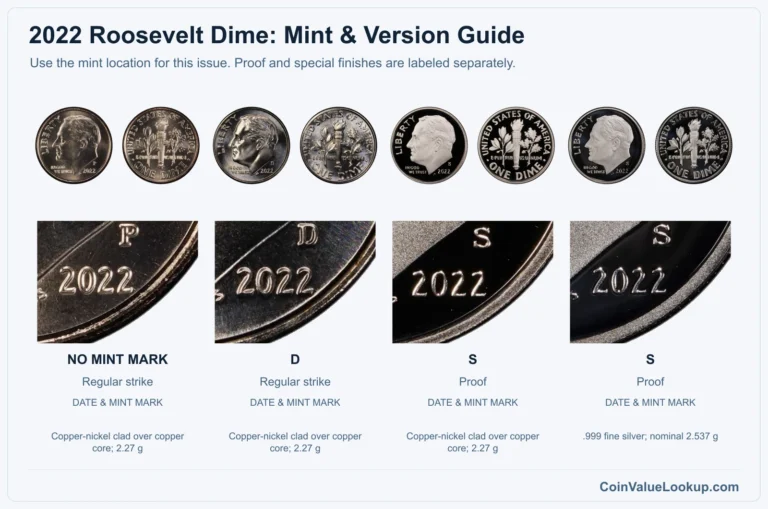
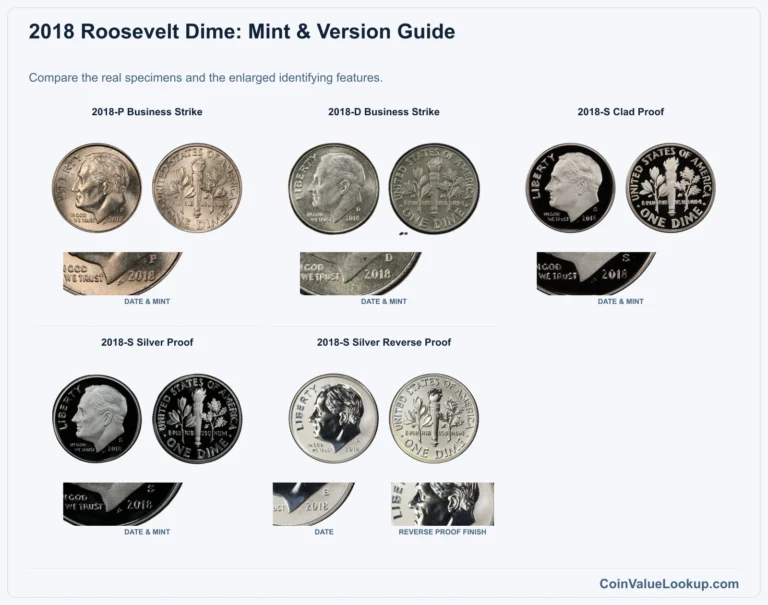
First, confirm you are looking at a 2020 date with the Roosevelt portrait on the obverse and the torch-with-branches reverse. The mintmark sits on the obverse just above the date: P for Philadelphia, D for Denver, or S for San Francisco.
All P and D business strikes and the S clad proof are copper-nickel clad and weigh 2.27 g. The S silver proof is .999 fine silver and nominally weighs 2.537 g.
That weight difference is small but measurable with a decent scale.
Do not assume an S-mint coin is silver. San Francisco produced both a clad proof and a silver proof in 2020.
Check the edge: a clad coin shows a visible layered band, while a silver coin has a uniform silver-colored edge. Original government packaging also helps confirm composition.
Weak detail on the design does not automatically mean you have an error or a missing mintmark. Worn dies, circulation wear, and environmental damage can all mimic error characteristics.
Step 2: Check Your 2020 Roosevelt Dime Grade
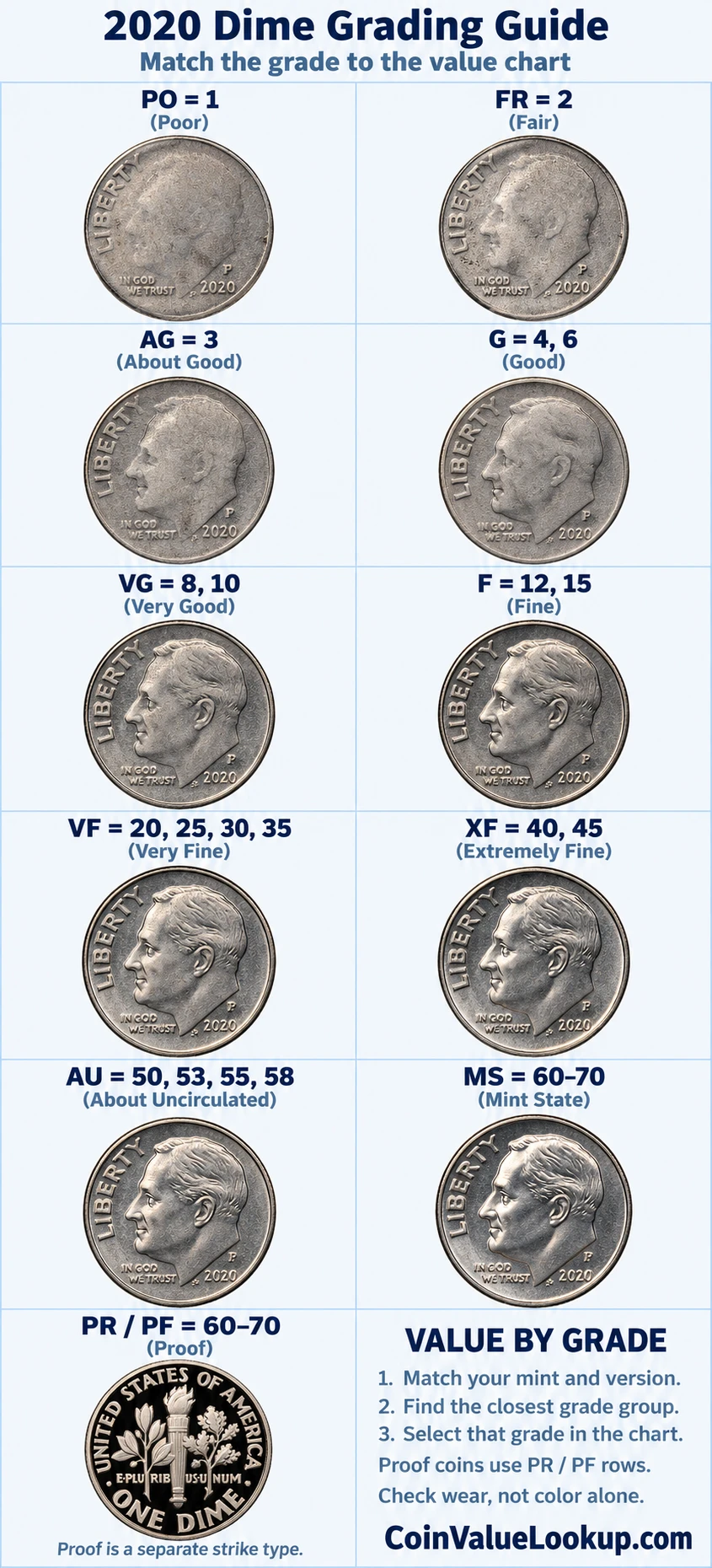
Look at Roosevelt's cheekbone and jawline first. Those are the high points and the first places to lose detail from wear.
On the reverse, inspect the horizontal bands of the torch and the leaf clusters on either side.
Original mint luster matters more than shine. A coin that has been cleaned or polished may look bright but will grade lower than a naturally toned piece with intact surfaces.
Bag marks and contact scratches also reduce the grade.
The comparison image can help you gauge where your coin falls on the wear scale. Match it to the closest condition shown, paying attention to flatness on the hair above the ear and the torch bands.
Full Bands refers to clearly separated horizontal pairs on the torch. It is a strike designation, not an error, and should be evaluated within the same mint and grade.
Proof is a manufacturing finish with mirror fields and frosted devices; it is not a grade above mint state.
Step 3: Check 2020 Roosevelt Dime Value by Mint and Version
2020 Roosevelt Dime — P Business Strike
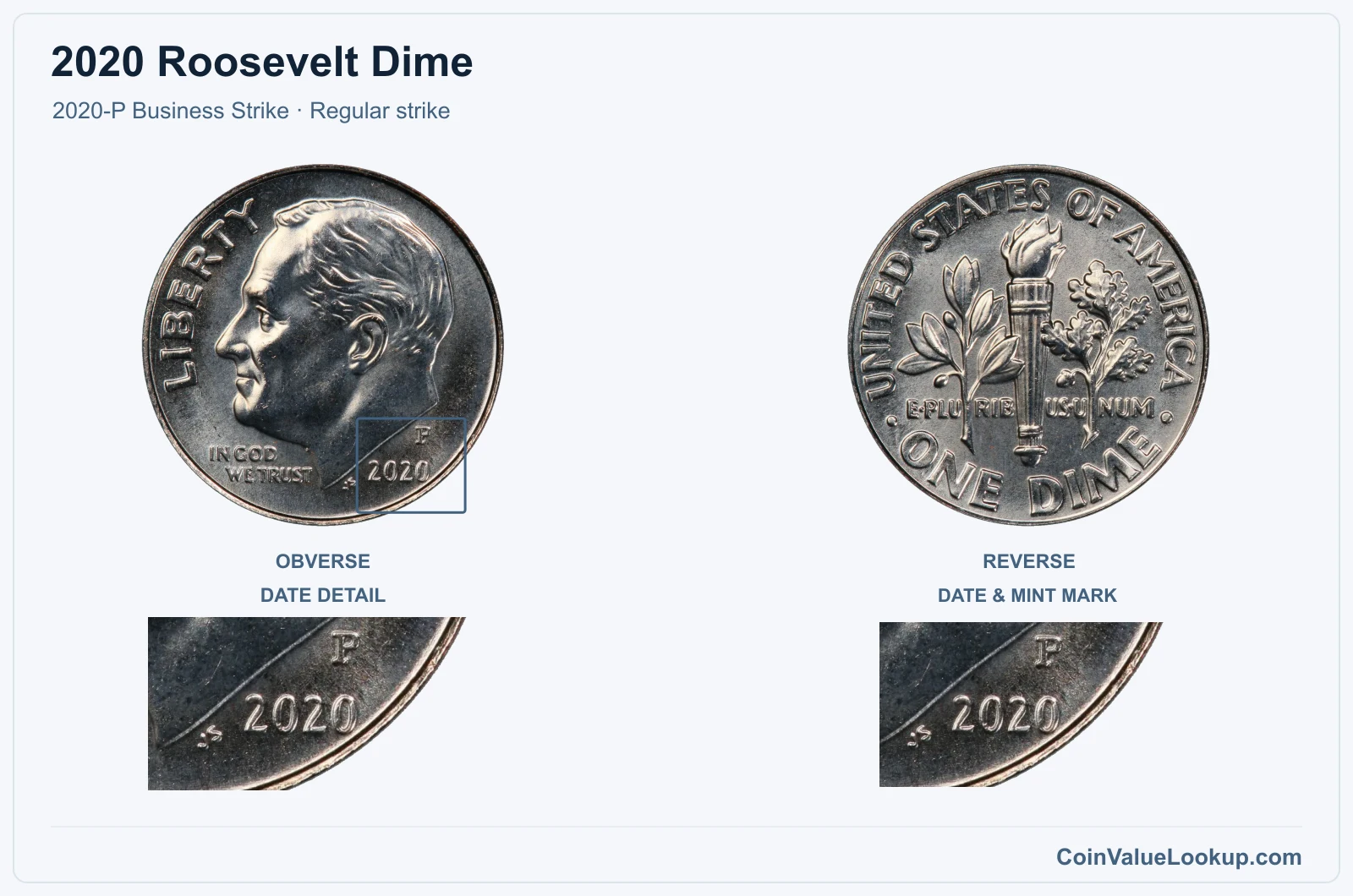
The 2020-P dime was struck at Philadelphia in copper-nickel clad, weighing 2.27 g. It carries a P mintmark on the obverse above the date.
A USA Coin Book guide places this coin at about $2.50 in MS65.
In circulated condition, it is a ten-cent coin. Where it gets interesting is in original, uncirculated rolls or bags where surfaces are clean and the torch bands show full separation.
This version contains no silver regardless of appearance.
Range Grade
Price Auction Records Appraisal PO PO 1
—
Coin Identifier FR FR 2
—
Coin Identifier AG AG 3
—
Coin Identifier G G 4
—
Coin Identifier
G 6
—
Coin Identifier VG VG 8
—
Coin Identifier
VG 10
—
Coin Identifier F F 12
—
Coin Identifier
F 15
—
Coin Identifier VF VF 20
—
Coin Identifier
VF 25
—
Coin Identifier
VF 30
—
Coin Identifier
VF 35
—
Coin Identifier XF XF 40
—
Coin Identifier
XF 45
—
Coin Identifier AU AU 50
—
Coin Identifier
AU 53
—
Coin Identifier
AU 55
—
Coin Identifier
AU 58
—
Coin Identifier MS MS 60
—
Coin Identifier
MS 61
—
Coin Identifier
MS 62
—
Coin Identifier
MS 63
—
Coin Identifier
MS 64
—
Coin Identifier
MS 65
—
Coin Identifier
MS 66
—
Coin Identifier
MS 67
—
Coin Identifier
MS 68
—
Coin Identifier
MS 69
—
—
—
MS 70
—
—
—
2020 Roosevelt Dime — D Business Strike
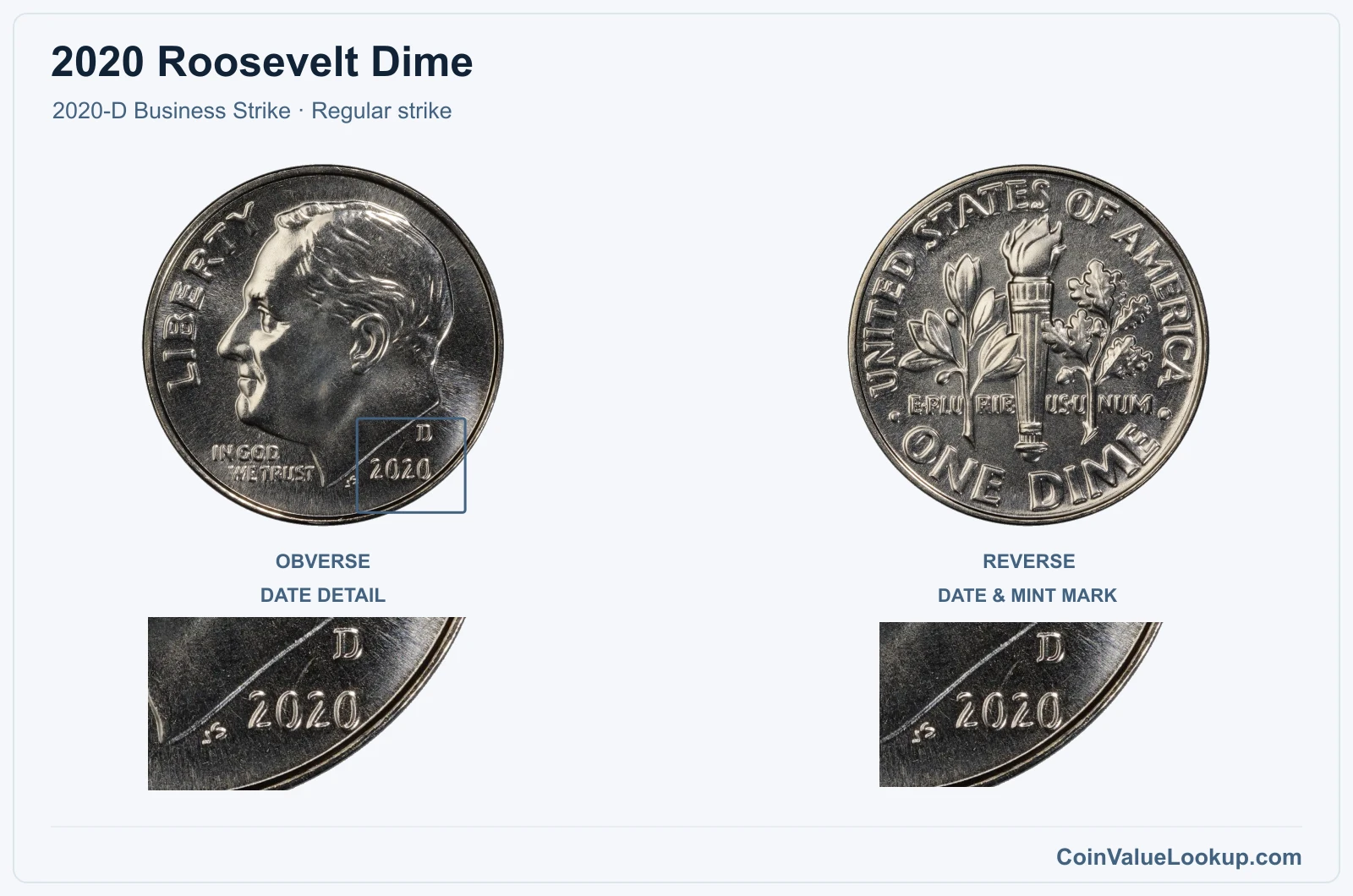
Denver's 2020-D dime is the same copper-nickel clad composition and 2.27 g weight as the Philadelphia issue. Look for the D mintmark on the obverse.
The USA Coin Book guide estimate is $2.50 in MS65.
Circulated examples trade at face value. Uncirculated coins with strong luster and minimal bag marks are the ones worth setting aside.
Match the D mintmark and business-strike finish carefully before checking any value reference.
Range Grade
Price Auction Records Appraisal PO PO 1
—
Coin Identifier FR FR 2
—
Coin Identifier AG AG 3
—
Coin Identifier G G 4
—
Coin Identifier
G 6
—
Coin Identifier VG VG 8
—
Coin Identifier
VG 10
—
Coin Identifier F F 12
—
Coin Identifier
F 15
—
Coin Identifier VF VF 20
—
Coin Identifier
VF 25
—
Coin Identifier
VF 30
—
Coin Identifier
VF 35
—
Coin Identifier XF XF 40
—
Coin Identifier
XF 45
—
Coin Identifier AU AU 50
—
Coin Identifier
AU 53
—
Coin Identifier
AU 55
—
Coin Identifier
AU 58
—
Coin Identifier MS MS 60
—
Coin Identifier
MS 61
—
Coin Identifier
MS 62
—
Coin Identifier
MS 63
—
Coin Identifier
MS 64
—
Coin Identifier
MS 65
—
Coin Identifier
MS 66
—
Coin Identifier
MS 67
—
Coin Identifier
MS 68
—
—
—
MS 69
—
—
—
MS 70
—
—
—
2020 Roosevelt Dime — S Clad Proof
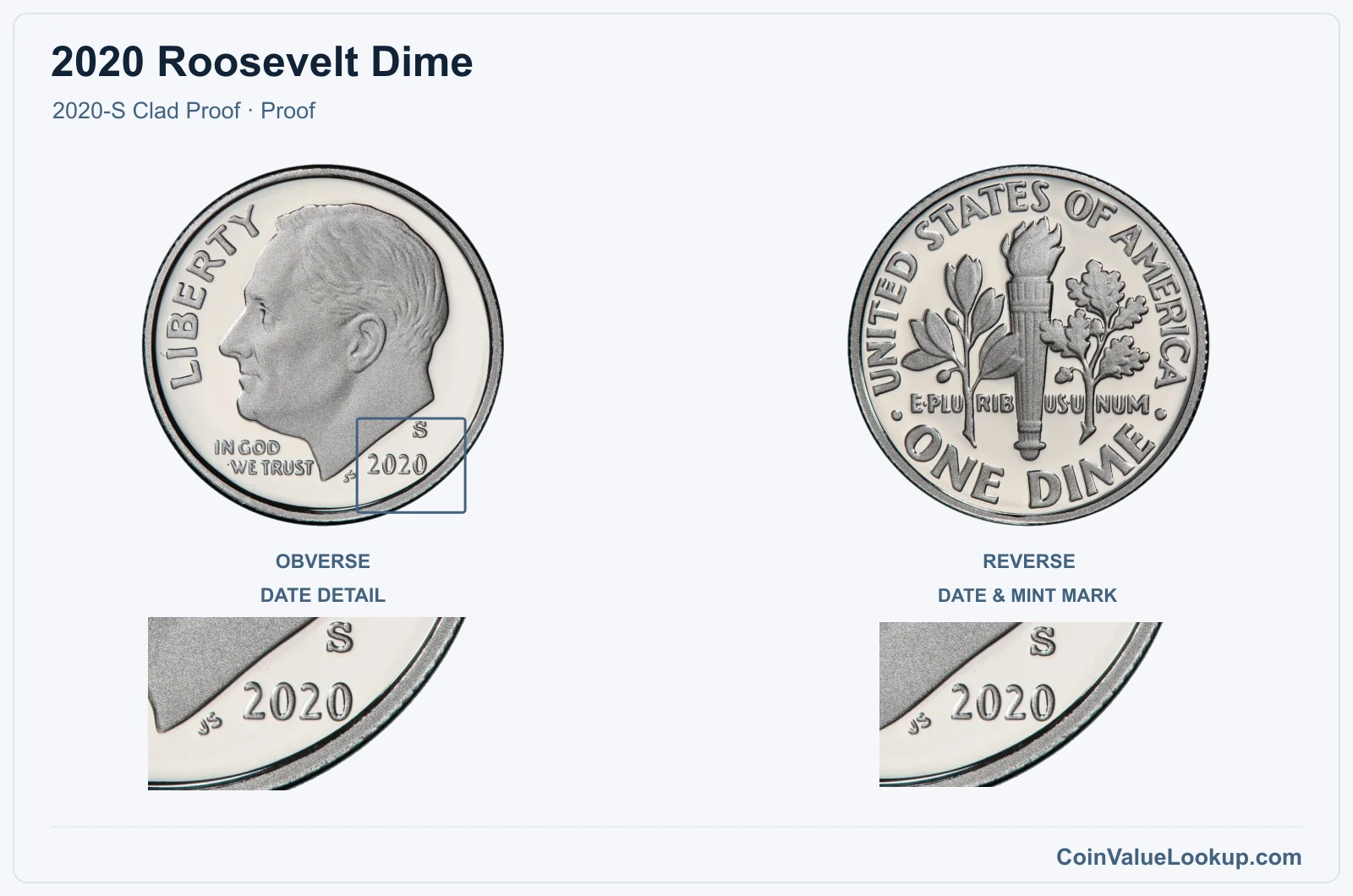
The 2020-S clad proof was struck at San Francisco in copper-nickel clad, the same 2.27 g metal as a business strike. It has mirror-like fields and frosted design elements, typical of proof production.
A USA Coin Book guide lists it at $3.08 in PR65.
This is not a silver coin. The edge will show a visible layered band just like a circulation dime.
Original mint packaging is the easiest confirmation. If you find one loose, weigh it; a reading near 2.27 g points to clad, not silver.
Coin Value Lookup is a good starting point if you want to compare this version against other Roosevelt dime years or denominations quickly.
Range Grade
Price Auction Records Appraisal PR PR 1
—
Coin Identifier
PR 2
—
Coin Identifier
PR 3
—
Coin Identifier
PR 4
—
Coin Identifier
PR 6
—
Coin Identifier
PR 8
—
Coin Identifier
PR 10
—
Coin Identifier
PR 12
—
Coin Identifier
PR 15
—
Coin Identifier
PR 20
—
Coin Identifier
PR 25
—
Coin Identifier
PR 30
—
Coin Identifier
PR 35
—
Coin Identifier
PR 40
—
Coin Identifier
PR 45
—
Coin Identifier
PR 50
—
Coin Identifier
PR 53
—
Coin Identifier
PR 55
—
Coin Identifier
PR 58
—
Coin Identifier
PR 60
—
Coin Identifier
PR 61
—
Coin Identifier
PR 62
—
Coin Identifier
PR 63
—
Coin Identifier
PR 64
—
Coin Identifier
PR 65
—
Coin Identifier
PR 66
—
Coin Identifier
PR 67
—
Coin Identifier
PR 68
—
Coin Identifier
PR 69
—
Coin Identifier
PR 70
—
Coin Identifier
2020 Roosevelt Dime — S Silver Proof
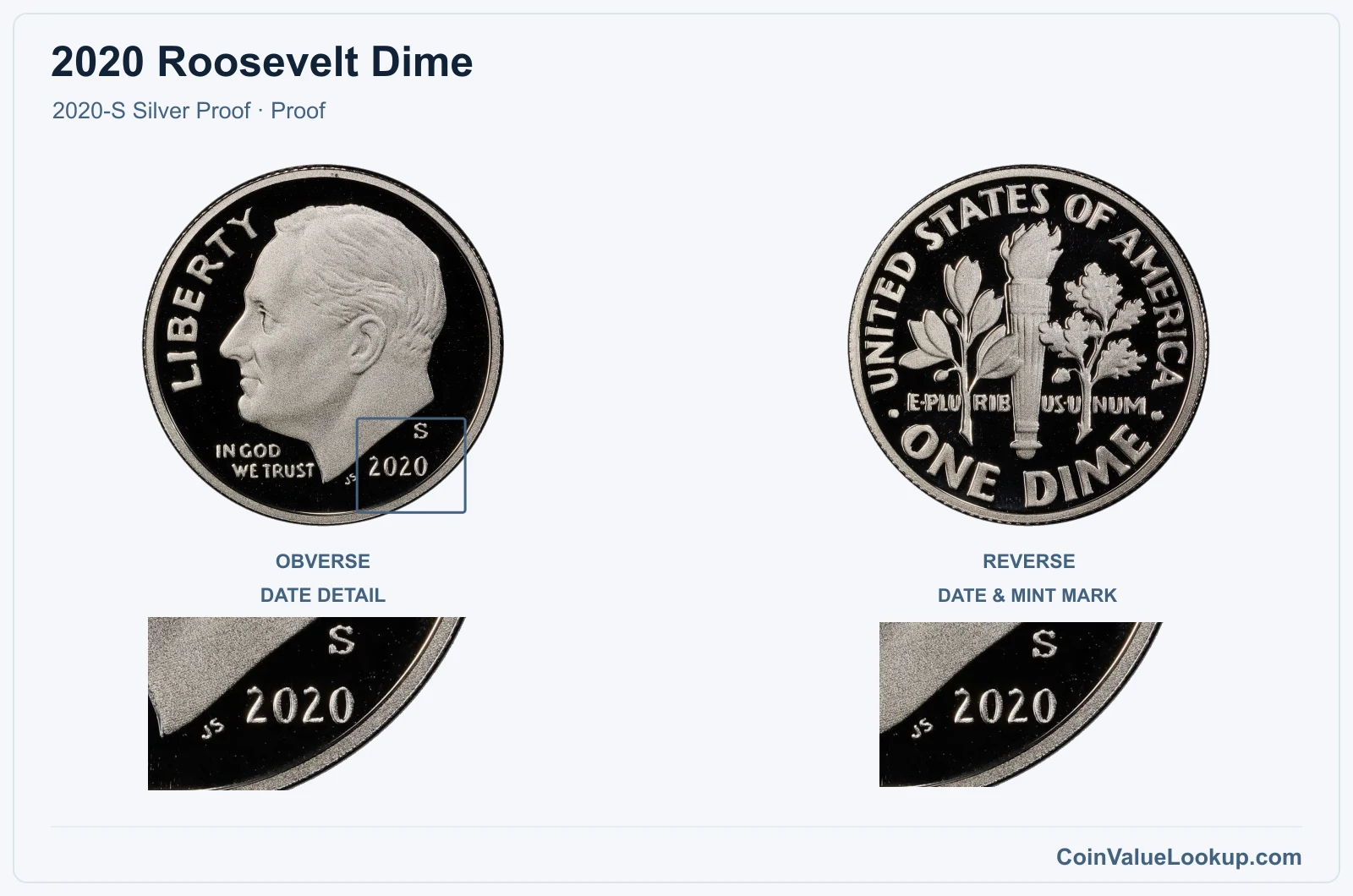
The 2020-S silver proof is .999 fine silver, a composition the Mint adopted for silver proof dimes beginning in 2019, replacing the older 90% silver standard. It nominally weighs 2.537 g, noticeably heavier than the 2.27 g clad versions.
The USA Coin Book guide places this coin at $14 in PR65, the highest guide figure among the four 2020 dime versions at that grade level. Look for a uniform silver-colored edge with no visible copper-nickel layer.
A precise scale and the original government packaging are your best tools for verification. Do not rely on appearance alone, because a well-made clad proof can look very similar under casual inspection.
Range Grade
Price Auction Records Appraisal PR PR 1
—
Coin Identifier
PR 2
—
Coin Identifier
PR 3
—
Coin Identifier
PR 4
—
Coin Identifier
PR 6
—
Coin Identifier
PR 8
—
Coin Identifier
PR 10
—
Coin Identifier
PR 12
—
Coin Identifier
PR 15
—
Coin Identifier
PR 20
—
Coin Identifier
PR 25
—
Coin Identifier
PR 30
—
Coin Identifier
PR 35
—
Coin Identifier
PR 40
—
Coin Identifier
PR 45
—
Coin Identifier
PR 50
—
Coin Identifier
PR 53
—
Coin Identifier
PR 55
—
Coin Identifier
PR 58
—
Coin Identifier
PR 60
—
Coin Identifier
PR 61
—
Coin Identifier
PR 62
—
Coin Identifier
PR 63
—
Coin Identifier
PR 64
—
Coin Identifier
PR 65
—
Coin Identifier
PR 66
—
Coin Identifier
PR 67
—
Coin Identifier
PR 68
—
Coin Identifier
PR 69
—
Coin Identifier
PR 70
—
Coin Identifier
2020 Roosevelt Dime Error List
1. 2020 Roosevelt Dime — Missing Clad Layer
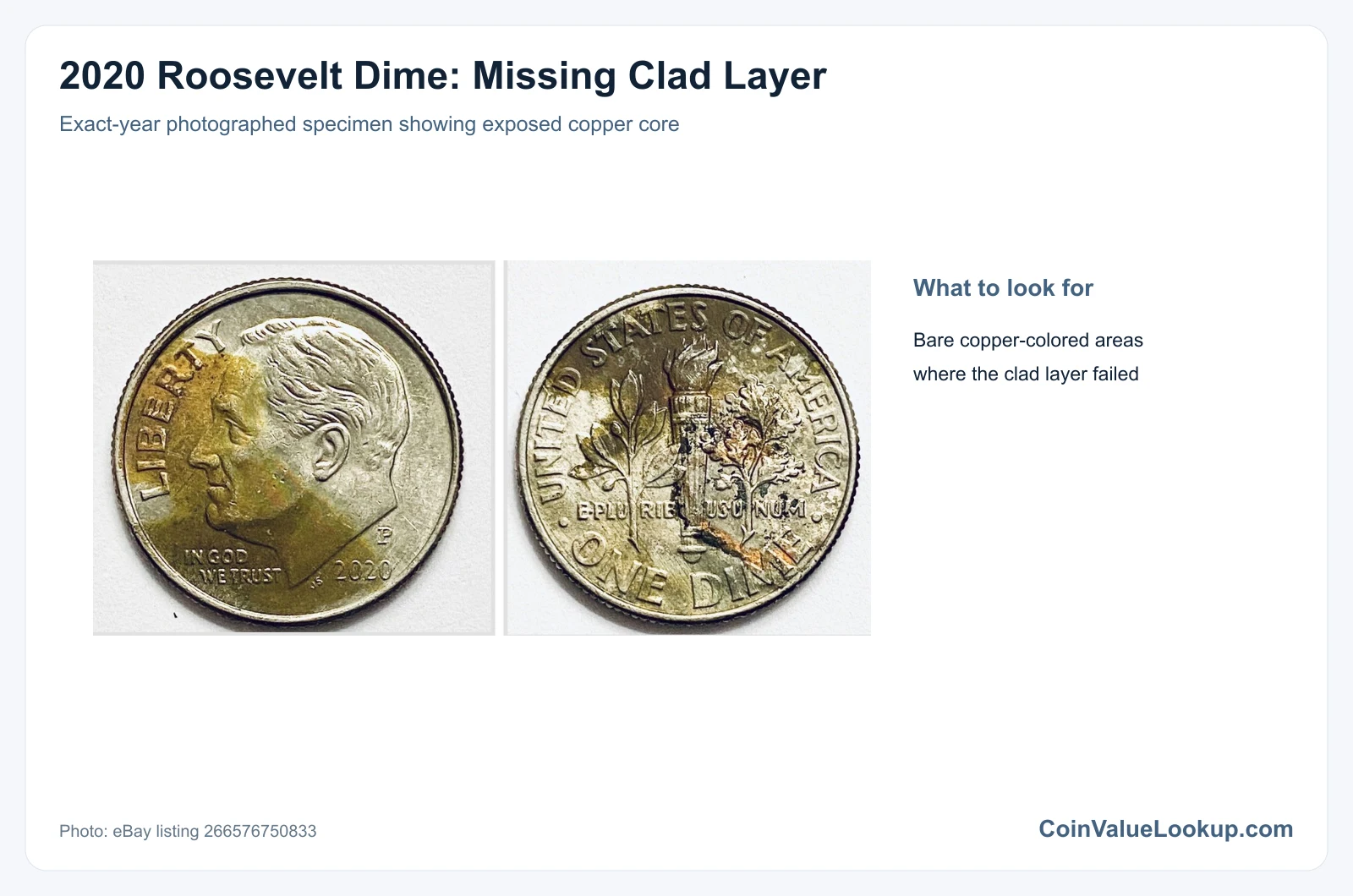
A missing clad layer error occurs when one of the outer copper-nickel layers is absent before striking. The result is a coin that shows the exposed copper core on the affected face, giving it a distinctly different color.
The edge will also look abnormal compared to a standard clad dime.
Weigh the coin. A normal 2020 dime is 2.27 g; a missing clad layer coin will weigh less.
Compare the suspect face and edge carefully to a known normal example.
Do not confuse this with toning, corrosion, plating, or a coin where surface metal was removed after it left the mint. Environmental damage can darken or discolor a dime convincingly.
Condition, the degree of visibility, and confirmation of the specific error all affect what such a coin is worth, and individual assessment is appropriate.
2. 2020 Roosevelt Dime — Broadstrike
A broadstruck dime was struck without the retaining collar that normally confines the blank and forms the reeded edge. The design spreads outward, and the coin appears wider than normal.
The rim may be weak or absent, and the edge profile differs from a standard dime.
Look at the overall shape. The full design should still be present, just expanded.
If part of the design is missing entirely, you may be looking at an off-center strike instead.
Coins flattened after minting by a vise or other pressure can look similar. Post-mint damage usually leaves uneven distortion and tool marks.
Value depends on the condition and how dramatic the broadstrike is; individual professional assessment is the reliable path for pricing.
3. 2020 Roosevelt Dime — Die Crack / Die Chip
Die cracks show up as thin raised lines running across part of the coin's surface. They form when a working die develops a fracture during production.
A die chip is a small raised blob where a piece of the die face broke away. A cud is a larger raised area connected to the rim, created when a chunk of the die edge broke off.
These features are raised because the crack or void in the die fills with metal during striking. Run a fingertip across the area; a genuine die crack feels slightly raised.
Incuse scratches, corrosion, or debris stuck to the surface are common lookalikes but sit into or on top of the surface rather than standing above it.
Value varies with size, location, and overall coin condition. No specific price range is adopted here.
4. 2020 Roosevelt Dime — Doubled Die Obverse
A doubled die obverse on a 2020 dime would show consistent doubling on obverse design elements, such as lettering, the date, or parts of Roosevelt's profile. The key word is consistent: every example struck from that die shows the same doubling in the same location and direction.
Compare suspect areas to a normal 2020 dime under the same lighting. Genuine hub doubling produces separation or notching with depth.
Machine doubling, a far more common occurrence, produces a flat shelf-like distortion that lacks the crispness of a true doubled die.
Tilting the coin under a light source sometimes reveals reflections that mimic doubling. Always check multiple letters or design points for the same directional shift.
Value depends on the strength of the doubling and the coin's condition; individual assessment is warranted.
5. 2020 Roosevelt Dime — Off-Center Strike
An off-center strike happens when the blank is not properly seated between the dies. Part of the design is missing, replaced by a blank crescent of unstruck metal.
The farther off center the strike, the more dramatic the result.
Collectors generally prefer off-center dimes that still show the full date, because the date confirms the year. A coin missing its date is harder to attribute and less desirable.
Look at the blank crescent area: it should be smooth and unstruck, not cut or filed.
Do not confuse an off-center strike with a clipped planchet, which shows a curved or straight bite from the blank, or with post-mint damage from being bent or flattened. Condition and the percentage of displacement both factor into value.
No specific price is adopted for this category.
6. 2020 Roosevelt Dime — Die Cap / Capped-Die Strike
A die cap error is dramatic. It starts when a struck coin sticks to the upper die instead of ejecting.
Subsequent blanks are then struck through that adhered coin, which progressively cups around the die like a bottle cap.
Two different coins result from this process. The coin that stuck to the die becomes cupped and shows a mirror-image brockage on the side facing subsequent blanks.
The coins struck through the cap show a weakened, mushy impression from being struck through metal instead of directly by the die face.
A bent coin, vise damage, or a normal weak strike can superficially resemble cap effects. Genuine cap strikes show progressive cupping and consistent design transfer.
Both sides of the coin need examination. Value depends on the stage of the cap, condition, and professional verification.