1973 Eisenhower Dollar Coin Value: How Much Is It Worth?
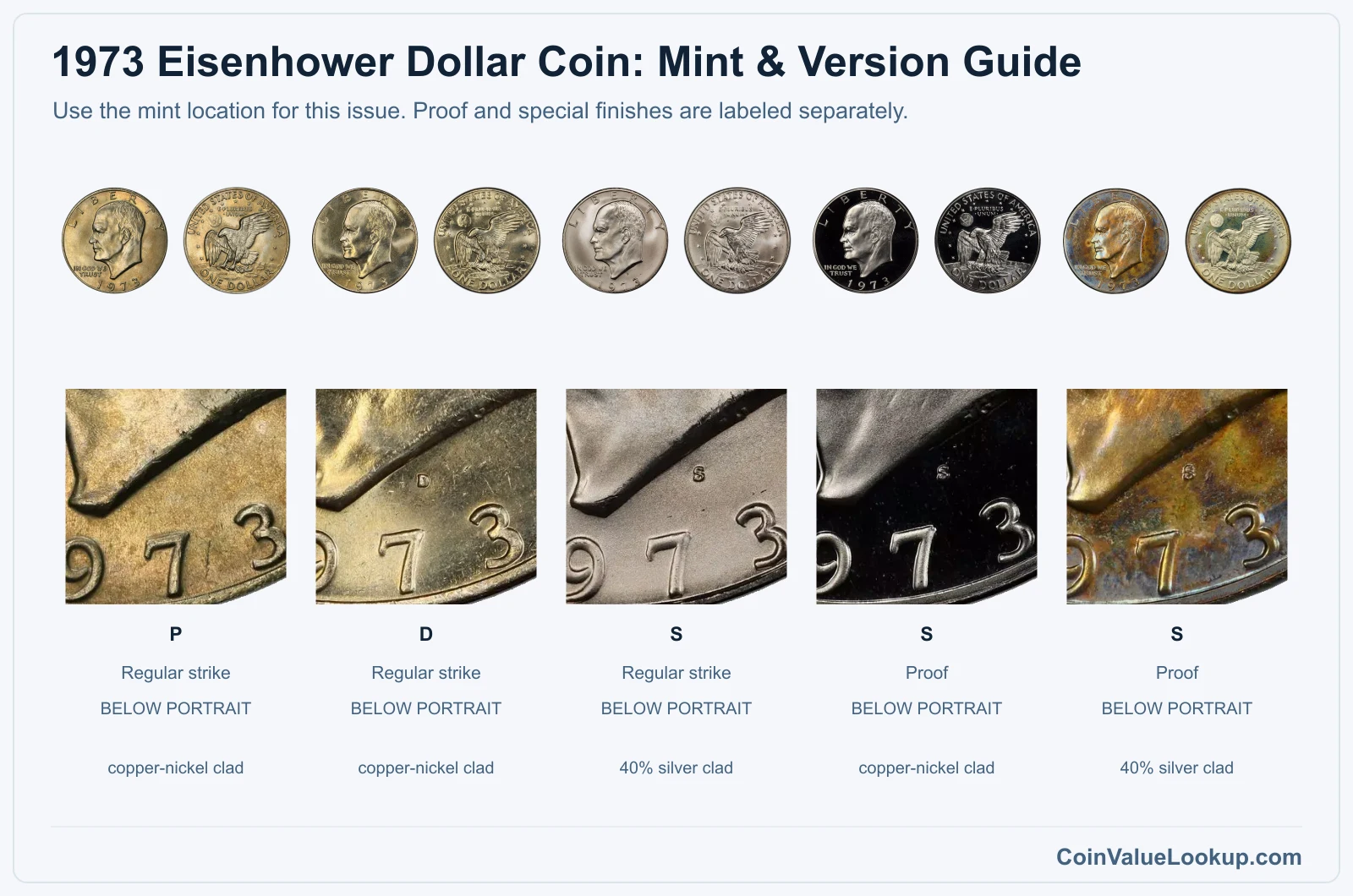
The 1973 Eisenhower dollar comes in several distinct versions, and the difference between them matters a lot for value. Clad pieces from Philadelphia or Denver carry a guide value around $18 at MS63, while the S-mint 40%-silver uncirculated version runs about $37 at MS63.
Silver proofs reach roughly $59 at PR65. Before you get excited, you need to know which metal and finish you actually have.
Fast Way to Identify Your 1973 Eisenhower Dollar
Want a quick read on what you have? Upload clear photos of the front and back of your 1973 Eisenhower dollar, and the identifier can offer a preliminary take on the version you're holding.
It looks at the mint mark location, design details, and visible characteristics. This is not authentication or certification, but it gives you a solid starting point.
1973 Eisenhower Dollar Value
Upload both sides of your 1973 Eisenhower Dollar.
Front Obverse
Upload photo
Back Reverse
Upload photo
Which 1973 Eisenhower Dollar Versions Are Worth Money?
- S-mint 40%-silver proof (PR65 guide around $59) is the premium version among standard issues; confirm both silver content and proof finish before assuming this price.
- S-mint 40%-silver uncirculated (MS63 guide around $37) carries a silver premium over clad but must be distinguished from the silver proof.
- The S clad proof looks similar to the silver proof but guides at about $18 (PR65), so telling them apart saves you from overpaying or undervaluing.
- Genuine striking errors such as double strikes, wrong-planchet strikes, or doubled die obverses on silver proofs have sold individually for hundreds to thousands of dollars at auction.
Step 1: Identify Your 1973 Eisenhower Dollar Mint Mark and Version
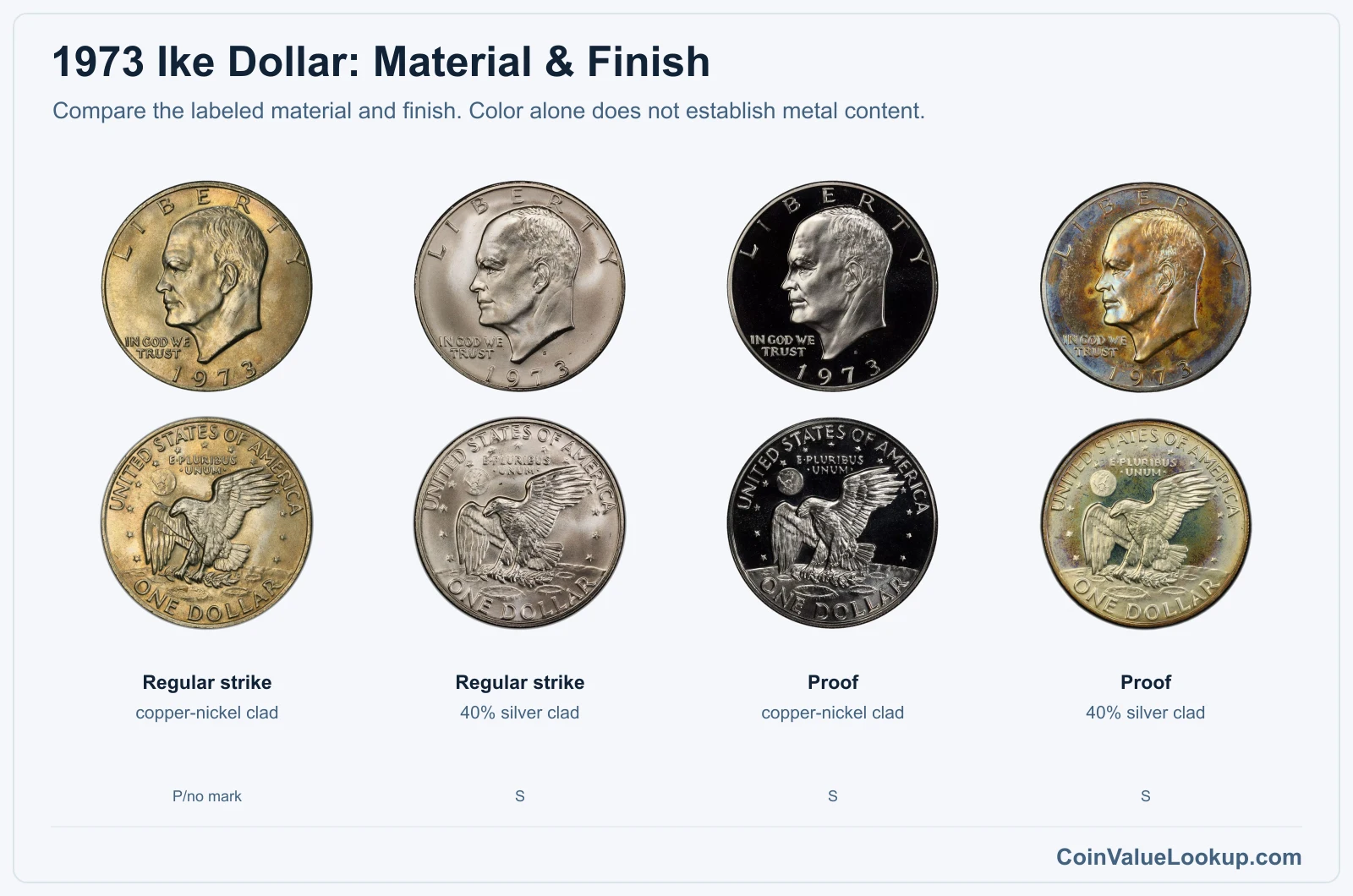
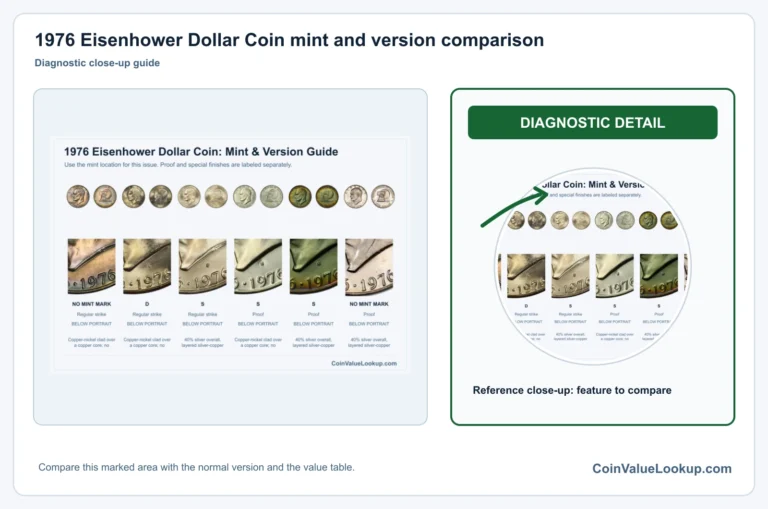
Start by finding the mint mark on the obverse, just above the date and below Eisenhower's neck truncation. No mint mark means Philadelphia.
A "D" means Denver. An "S" means San Francisco, but that single letter does not tell you everything.
Philadelphia and Denver coins are copper-nickel clad. They were originally distributed in Mint sets, not released for general circulation, though plenty have since escaped into the wild as loose coins.
The S mint mark is where things get tricky. San Francisco produced three different products in 1973: a 40%-silver uncirculated coin, a 40%-silver proof, and a copper-nickel clad proof.
Seeing an "S" alone does not confirm silver.
To separate silver from clad, use multiple clues together. A clad coin weighs about 22.7 grams; a silver one about 24.6 grams.
Check the edge: clad coins show a visible copper-colored stripe sandwiched between outer layers, while silver coins have a uniform silvery edge. Original government packaging, if present, also helps.
The silver issues contain 40% silver overall, not 90%.
Step 2: Check Your 1973 Eisenhower Dollar Grade
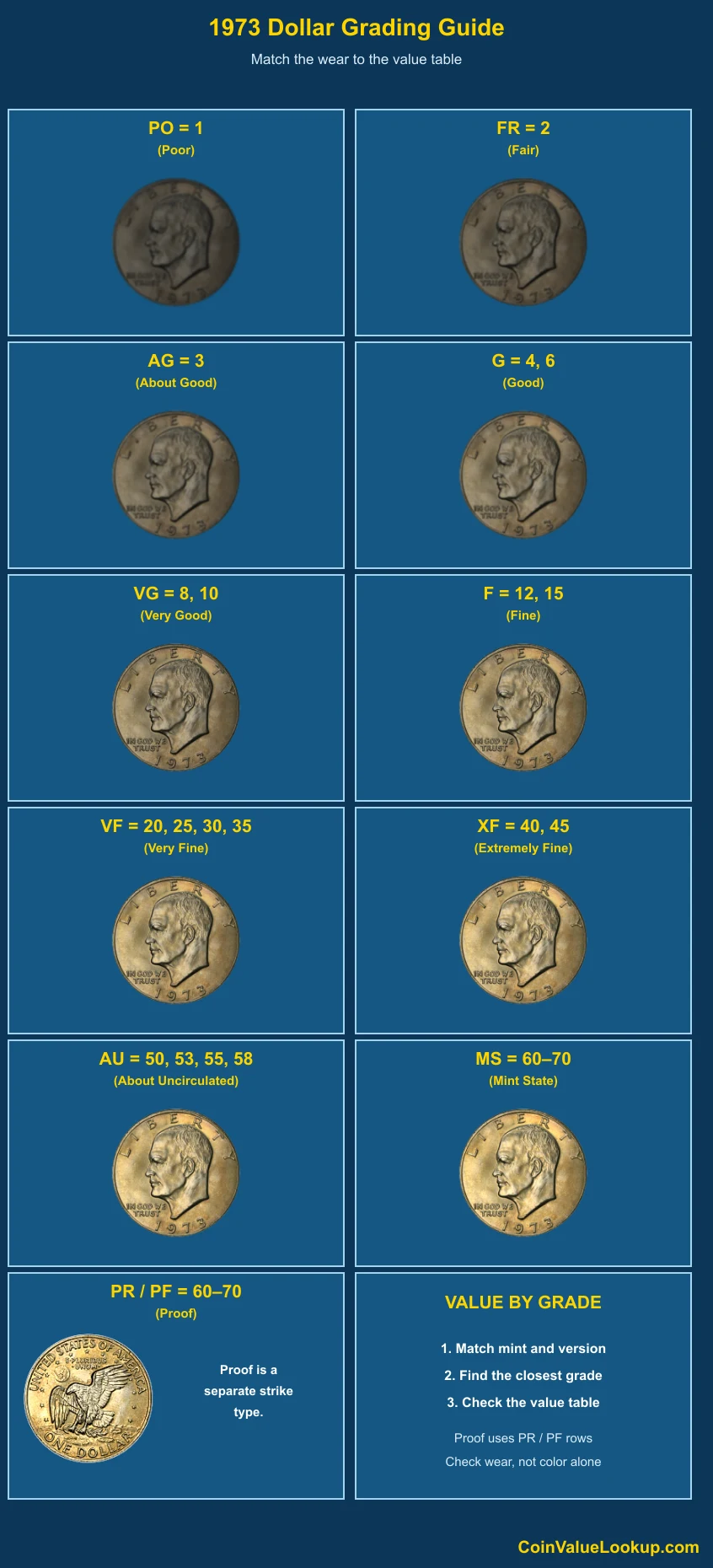
Eisenhower dollars have big, open fields on both sides, and those flat expanses pick up contact marks like a magnet. When grading, look at Ike's portrait for wear on the cheekbone, jawline, and hair above the ear.
On the reverse, check the eagle's breast feathers and the fine details of the lunar surface.
Original luster matters more than raw shininess. A coin that has been cleaned or polished might look bright but will lack the cartwheel frost of an untouched piece, and that costs it grade points.
Proof is a manufacturing method, not a grade that sits above Mint State. A proof coin is graded on the PR scale, and you should never price a proof using an MS63 value or treat a polished business strike as proof quality.
Use the comparison image as a visual reference for wear stages. It gives you a ballpark, not a certified grade.
Professional grading services make the final call.
Step 3: Check 1973 Eisenhower Dollar Value by Mint and Version
1973 Eisenhower Dollar — No Mint Mark, Clad Uncirculated
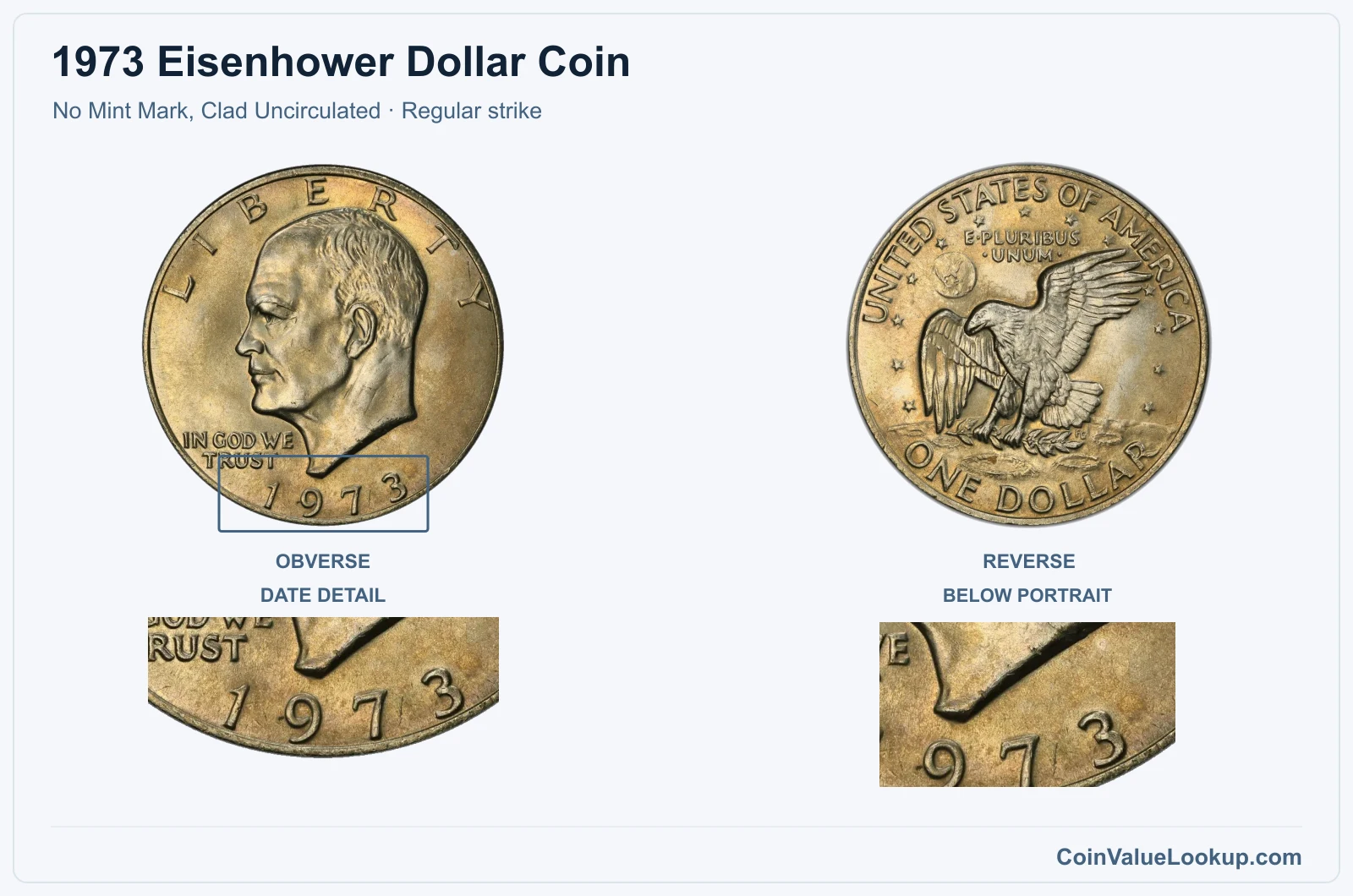
The 1973 Philadelphia Eisenhower dollar has no mint mark on the obverse. It is copper-nickel clad and was originally issued in Mint sets rather than dumped into everyday circulation.
A guide estimate places it at about $18 in MS63 condition.
These are not rare coins by any stretch, but a well-preserved example with clean fields and strong luster is still worth pursuing. Look for bag marks on the cheek and open areas of the reverse, since those are the first places to show contact.
Range Grade
Price Auction Records Appraisal PO PO 1
—
Coin Identifier FR FR 2
—
Coin Identifier AG AG 3
—
Coin Identifier G G 4
—
Coin Identifier
G 6
—
Coin Identifier VG VG 8
—
Coin Identifier
VG 10
—
Coin Identifier F F 12
—
Coin Identifier
F 15
—
Coin Identifier VF VF 20
—
Coin Identifier
VF 25
—
Coin Identifier
VF 30
—
Coin Identifier
VF 35
—
Coin Identifier XF XF 40
—
Coin Identifier
XF 45
—
Coin Identifier AU AU 50
—
Coin Identifier
AU 53
—
Coin Identifier
AU 55
—
Coin Identifier
AU 58
—
Coin Identifier MS MS 60
—
Coin Identifier
MS 61
—
Coin Identifier
MS 62
—
Coin Identifier
MS 63
Coin Identifier
MS 64
Coin Identifier
MS 65
Coin Identifier
MS 66
Coin Identifier
MS 67
Coin Identifier
MS 68
—
—
—
MS 69
—
—
—
MS 70
—
—
—
1973 Eisenhower Dollar — D, Clad Uncirculated
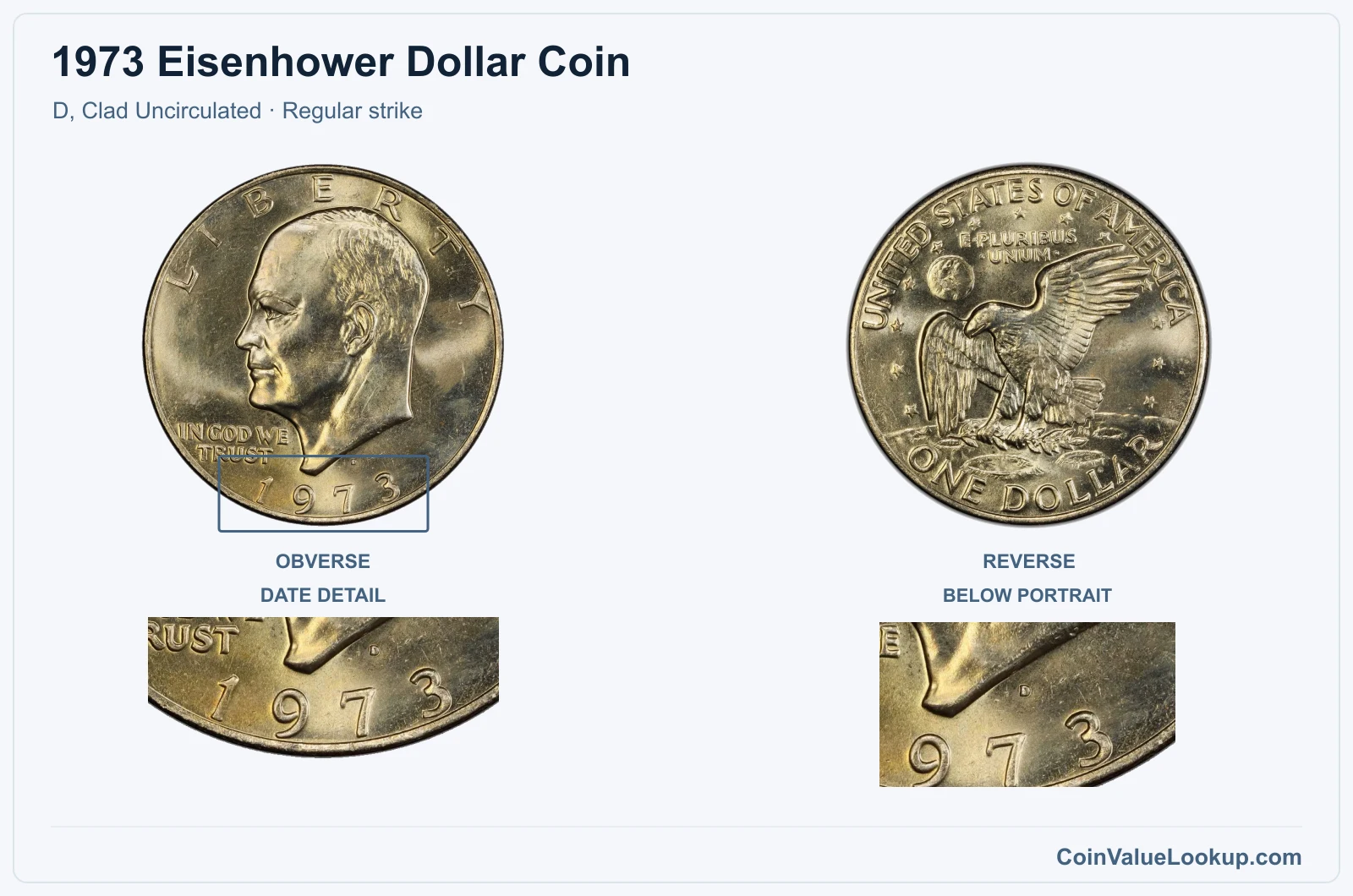
The 1973-D carries a "D" mint mark above the date, struck at Denver. Like its Philadelphia sibling, it is copper-nickel clad and guides at roughly $18 in MS63.
No silver premium applies to a normal 1973-D, regardless of what someone on a marketplace listing might suggest. If you want to compare values across other Eisenhower dollar years, Coin Value Lookup is a good place to look up guides for the series without having to dig through a dozen different sites.
Condition drives price here. Clean surfaces and full strike detail are what separate a dollar-bin coin from one worth grading.
Range Grade
Price Auction Records Appraisal PO PO 1
—
Coin Identifier FR FR 2
—
Coin Identifier AG AG 3
—
Coin Identifier G G 4
—
Coin Identifier
G 6
—
Coin Identifier VG VG 8
—
Coin Identifier
VG 10
—
Coin Identifier F F 12
—
Coin Identifier
F 15
—
Coin Identifier VF VF 20
—
Coin Identifier
VF 25
—
Coin Identifier
VF 30
—
Coin Identifier
VF 35
—
Coin Identifier XF XF 40
—
Coin Identifier
XF 45
—
Coin Identifier AU AU 50
—
Coin Identifier
AU 53
—
Coin Identifier
AU 55
—
Coin Identifier
AU 58
—
Coin Identifier MS MS 60
—
Coin Identifier
MS 61
—
Coin Identifier
MS 62
—
Coin Identifier
MS 63
—
Coin Identifier
MS 64
Coin Identifier
MS 65
Coin Identifier
MS 66
Coin Identifier
MS 67
Coin Identifier
MS 68
—
—
—
MS 69
—
—
—
MS 70
—
—
—
1973 Eisenhower Dollar — S, 40% Silver Uncirculated
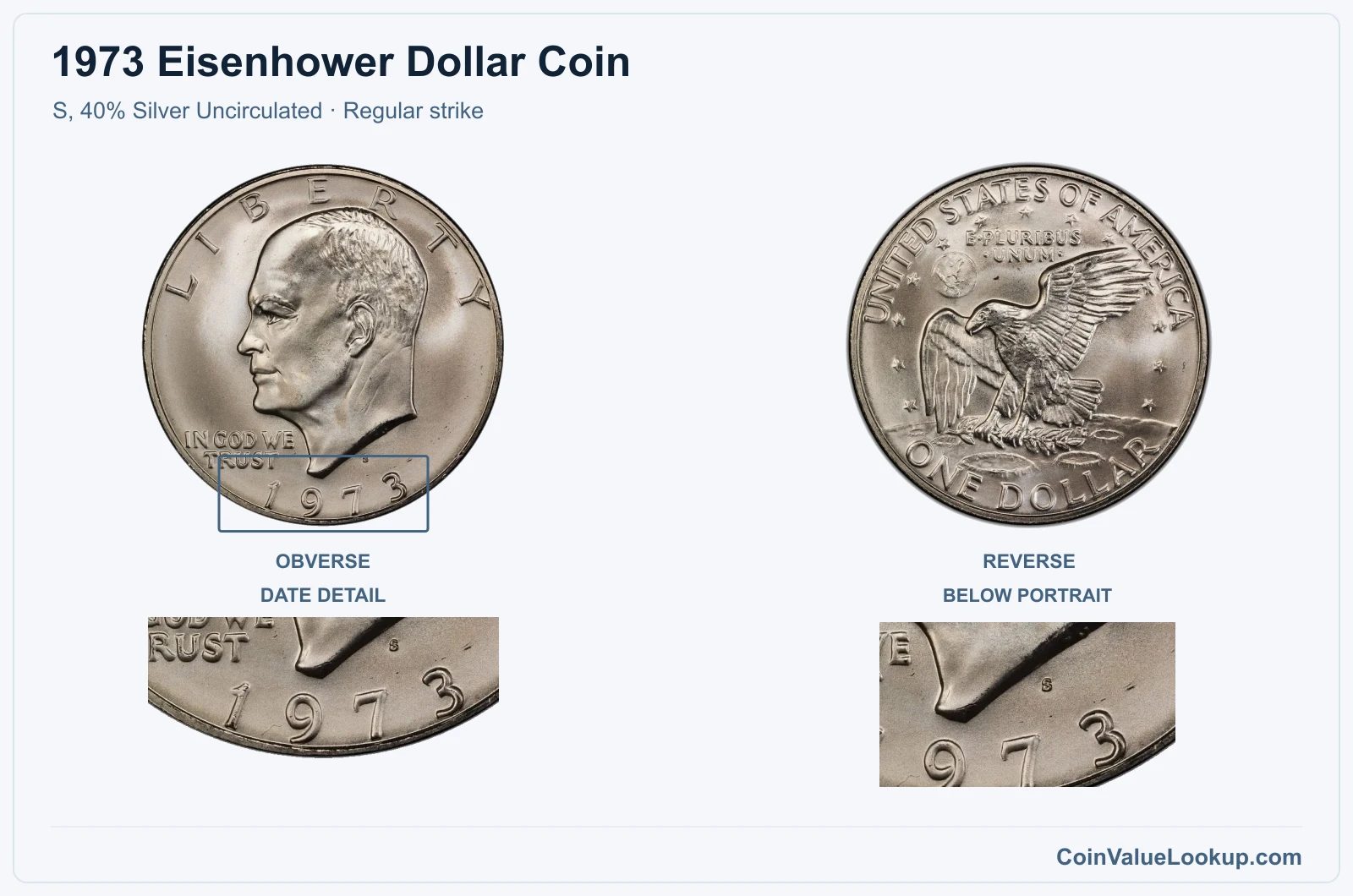
This is the S-mint 40%-silver uncirculated Eisenhower dollar, struck as a collector issue in San Francisco. A guide estimate puts it at about $37 in MS63.
The key word is uncirculated, meaning a business strike, not a proof. It will have a satiny or frosty luster rather than the mirror-like fields of a proof.
Weight should come in around 24.6 grams, and the edge will appear uniformly silver-toned without a copper stripe.
Original blue or brown government packaging is a helpful clue when present, but plenty of these coins have been removed from their holders. If you have a loose S-mint Ike, use weight, edge appearance, and surface finish together to confirm the silver content.
Range Grade
Price Auction Records Appraisal PO PO 1
—
Coin Identifier FR FR 2
—
Coin Identifier AG AG 3
—
Coin Identifier G G 4
—
Coin Identifier
G 6
—
Coin Identifier VG VG 8
—
Coin Identifier
VG 10
—
Coin Identifier F F 12
—
Coin Identifier
F 15
—
Coin Identifier VF VF 20
—
Coin Identifier
VF 25
—
Coin Identifier
VF 30
—
Coin Identifier
VF 35
—
Coin Identifier XF XF 40
—
Coin Identifier
XF 45
—
Coin Identifier AU AU 50
—
Coin Identifier
AU 53
—
Coin Identifier
AU 55
—
Coin Identifier
AU 58
—
Coin Identifier MS MS 60
—
Coin Identifier
MS 61
—
Coin Identifier
MS 62
—
Coin Identifier
MS 63
Coin Identifier
MS 64
Coin Identifier
MS 65
Coin Identifier
MS 66
Coin Identifier
MS 67
Coin Identifier
MS 68
Coin Identifier
MS 69
Coin Identifier
MS 70
—
—
—
1973 Eisenhower Dollar — S, Clad Proof
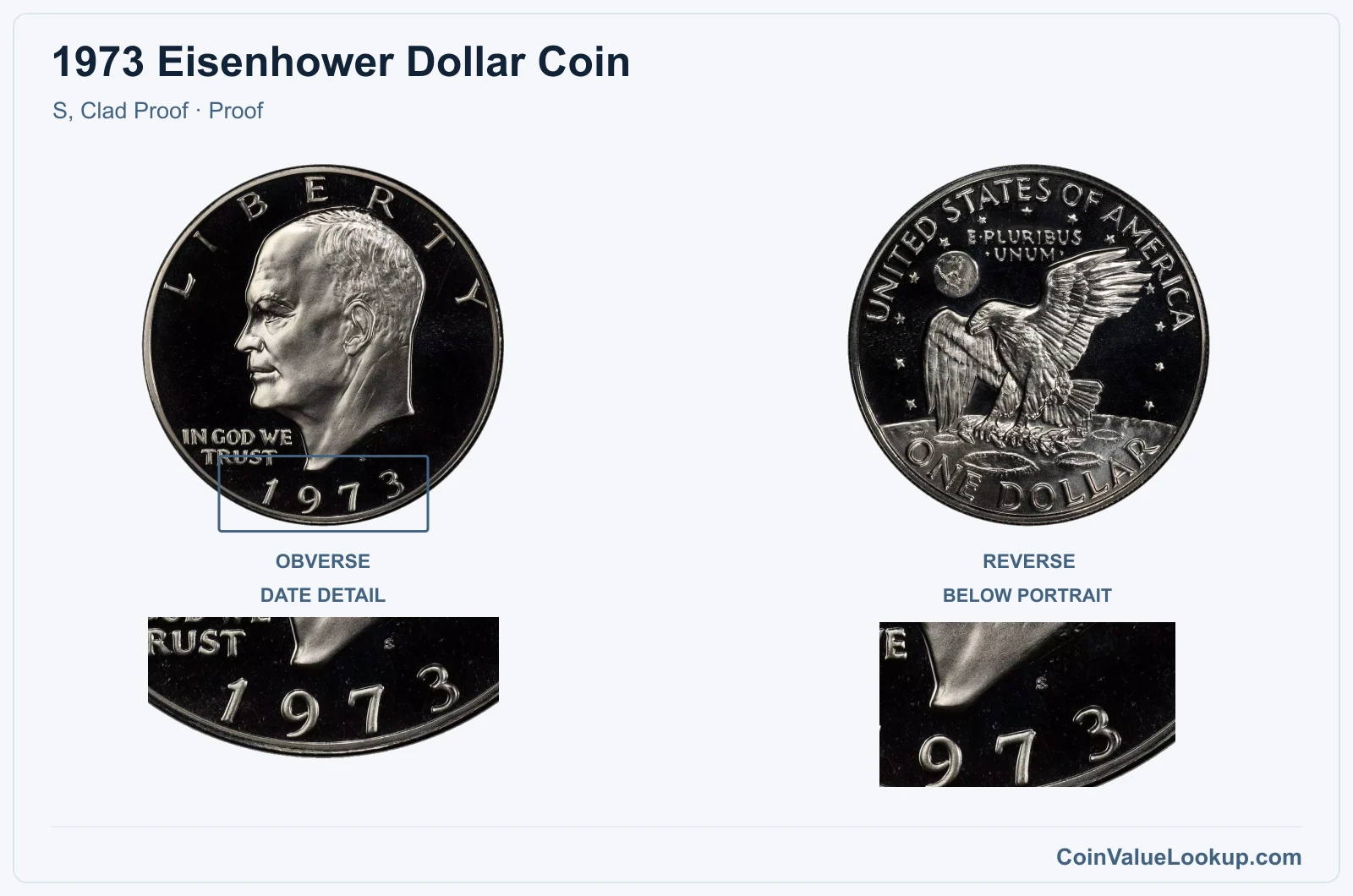
The 1973-S clad proof is copper-nickel clad with a proof finish, meaning mirror-like fields and sharply struck devices. A guide estimate places it at about $18 in PR65.
This is the version most often confused with the more valuable silver proof. Both carry the "S" mint mark.
Both look like proofs. The difference is the metal inside.
Check the edge for a visible copper stripe between the outer layers. Weigh it if you can: around 22.7 grams points to clad, not silver.
Getting this identification wrong in either direction costs you money, so take a moment and actually check.
Range Grade
Price Auction Records Appraisal PR PR 1
—
Coin Identifier
PR 2
—
Coin Identifier
PR 3
—
Coin Identifier
PR 4
—
Coin Identifier
PR 6
—
Coin Identifier
PR 8
—
Coin Identifier
PR 10
—
Coin Identifier
PR 12
—
Coin Identifier
PR 15
—
Coin Identifier
PR 20
—
Coin Identifier
PR 25
—
Coin Identifier
PR 30
—
Coin Identifier
PR 35
—
Coin Identifier
PR 40
—
Coin Identifier
PR 45
—
Coin Identifier
PR 50
—
Coin Identifier
PR 53
—
Coin Identifier
PR 55
—
Coin Identifier
PR 58
—
Coin Identifier
PR 60
—
Coin Identifier
PR 61
—
Coin Identifier
PR 62
—
Coin Identifier
PR 63
—
Coin Identifier
PR 64
—
Coin Identifier
PR 65
—
Coin Identifier
PR 66
—
Coin Identifier
PR 67
Coin Identifier
PR 68
Coin Identifier
PR 69
Coin Identifier
PR 70
Coin Identifier
1973 Eisenhower Dollar — S, 40% Silver Proof
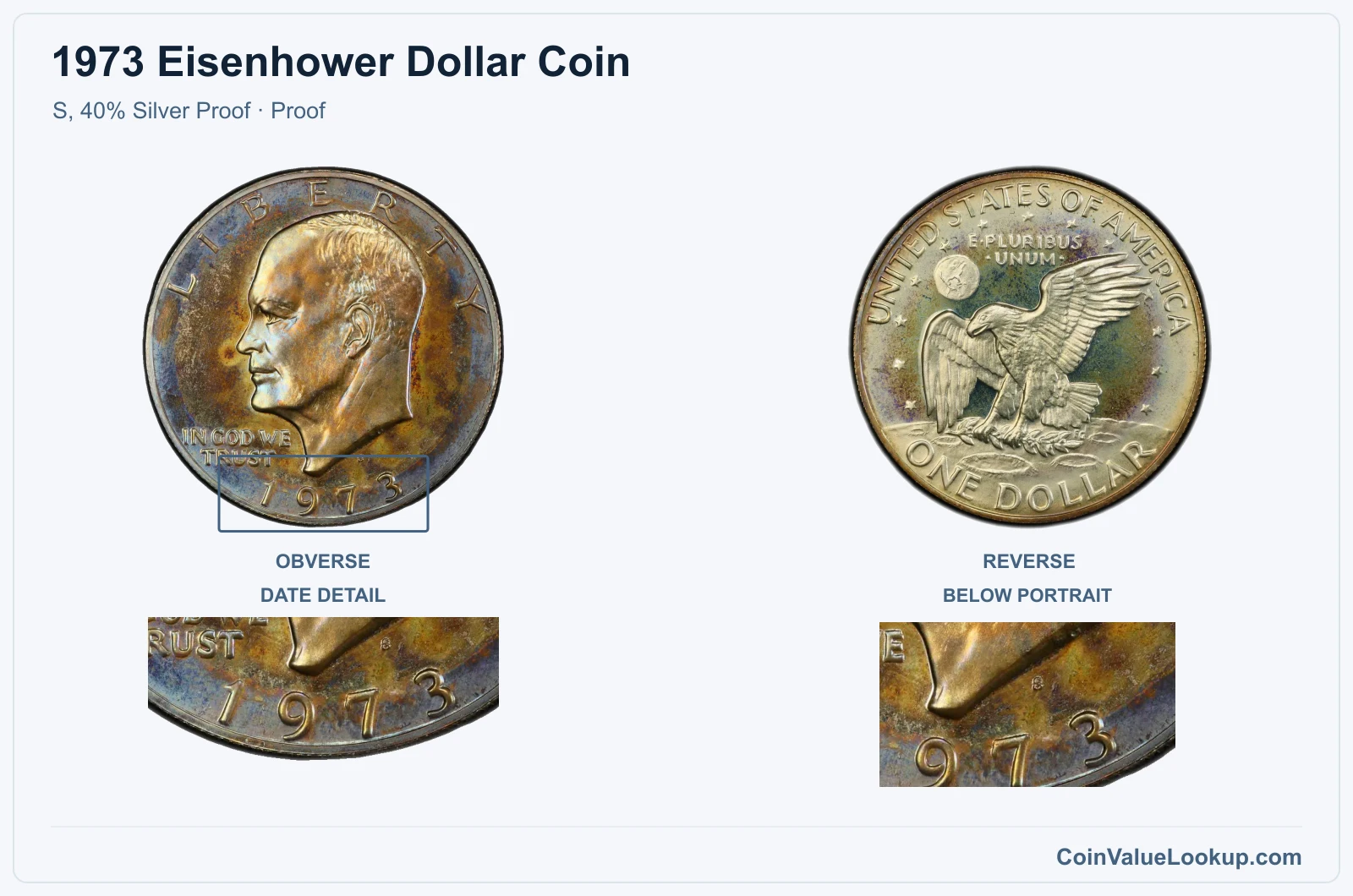
The 1973-S 40%-silver proof is the top-value standard issue for this year, with a guide estimate of about $59 in PR65. It features mirror fields and frosted devices characteristic of proof manufacture, struck on a 40%-silver planchet at San Francisco.
Confirm both the metal and the finish. Silver content shows on the edge as a uniform silvery tone with no copper stripe, and the coin should weigh approximately 24.6 grams.
The proof finish is distinct from the satiny luster of the silver uncirculated version.
Do not assume every pretty S-mint Ike is a silver proof. A clad proof can look nearly identical to the eye.
Weight and edge examination are your best friends here.
Range Grade
Price Auction Records Appraisal PR PR 1
—
Coin Identifier
PR 2
—
Coin Identifier
PR 3
—
Coin Identifier
PR 4
—
Coin Identifier
PR 6
—
Coin Identifier
PR 8
—
Coin Identifier
PR 10
—
Coin Identifier
PR 12
—
Coin Identifier
PR 15
—
Coin Identifier
PR 20
—
Coin Identifier
PR 25
—
Coin Identifier
PR 30
—
Coin Identifier
PR 35
—
Coin Identifier
PR 40
—
Coin Identifier
PR 45
—
Coin Identifier
PR 50
—
Coin Identifier
PR 53
—
Coin Identifier
PR 55
—
Coin Identifier
PR 58
—
Coin Identifier
PR 60
—
Coin Identifier
PR 61
—
Coin Identifier
PR 62
—
Coin Identifier
PR 63
—
Coin Identifier
PR 64
—
Coin Identifier
PR 65
—
Coin Identifier
PR 66
Coin Identifier
PR 67
Coin Identifier
PR 68
Coin Identifier
PR 69
Coin Identifier
PR 70
—
—
—
1973 Eisenhower Dollar Error List
1. 1973 Eisenhower Dollar — Double Strike with Broadstrike
A 1973-S clad proof Eisenhower dollar graded NGC PR67 that was struck twice, with the second impression landing outside the retaining collar, sold for a reported $2,040 at Heritage Auctions in March 2022. That is one documented example, not a general market range.
On a double-struck broadstrike, look for a displaced second impression of the design and an expanded diameter beyond the normal rim. The coin will appear stretched or spread because the collar was not containing the blank during at least one of the strikes.
Do not confuse this with a doubled die, which is a completely different mechanism involving the die itself rather than the striking process. Post-mint damage from squeezing, hammering, or edge impacts can also mimic a broadstrike to an untrained eye.
This specific sale involved a clad proof, so do not transfer that figure to silver dollars or business strikes.
2. 1973 Eisenhower Dollar — Struck on a Half Dollar Planchet
A 1973-S proof Eisenhower dollar struck on a clad half-dollar planchet, also double struck, sold for a reported $7,200 at Heritage Auctions in August 2022, graded NGC PR65 Cameo. This is an individual historical sale, not an established price range.
Because the half-dollar blank is smaller than a dollar blank, the dollar design loses detail around the periphery. You will see the full Eisenhower portrait and eagle but the outer legends and rim may be incomplete or compressed.
The documented example also carried a second strike, compounding the error.
Watch out for the inverse mistake: a 1973-S Kennedy half struck on a dollar planchet is a different error entirely and belongs in a half-dollar guide, not here. Any wrong-planchet claim should be professionally authenticated.
3. 1973 Eisenhower Dollar — Incomplete Planchet Punch
A 1973-D Eisenhower dollar with an incomplete planchet punch has been documented. This error occurs when the blanking die does not fully complete its cut, leaving a curved separation line on the edge of the coin without an entire segment missing.
Look at both faces and pay special attention to the edge near the incomplete cut. You should see a smooth, curved line where the punch stopped, not a jagged break or a straight scratch.
No defensible price range has been adopted for this specific variety. Value depends on the authenticated error type, its severity, and the coin's overall condition, so individual assessment is necessary.
Do not confuse an incomplete punch with a fully separated clip, a post-mint saw mark, or a random scratch across the rim. Professional grading and error attribution are strongly recommended for this type.
4. 1973 Eisenhower Dollar — Doubled Die Obverse on a Silver Proof
A doubled die obverse on the 1973-S 40%-silver proof is a recognized variety. One example graded PCGS PR68DCAM reportedly sold for $110 in April 2020 through a David Lawrence auction.
That is a single historical sale at a very high grade, not a broad market figure.
To identify this variety, compare your coin's obverse lettering against the attributed reference at equivalent magnification. You are looking for a consistent, repeatable second impression in the same direction on multiple letters or design elements.
A true doubled die will show uniform doubling, not random shelf-like distortion.
Machine doubling, which is flat and shelf-like, and bright reflections common to proof surfaces can both fool you into seeing doubling that is not die-related. This variety applies specifically to the 40%-silver proof, not the clad proof or the silver uncirculated version.
Professional attribution is the only reliable confirmation.
5. 1973 Eisenhower Dollar — Off-Center Strike
Off-center strikes have been reported for both the 1973 Philadelphia and 1973-D Eisenhower dollars. In this error, the planchet is not properly centered between the dies during striking, resulting in part of the design being missing and a blank crescent appearing on one side of the coin.
The date should remain visible for the coin to be identifiable and collectible. A larger percentage off-center generally draws more attention, but only if enough of the design survives to confirm the year and denomination.
No numerical price has been adopted for this error. Value depends on the degree of off-center displacement, the condition of the struck portion, and whether key identifiers like the date are readable.
Do not confuse an off-center strike with a clipped planchet, a one-sided die misalignment, or post-mint flattening from a vise or similar tool. Each of those looks different under close inspection.