1863 Liberty Seated Dollar Coin Value: How Much Is It Worth?
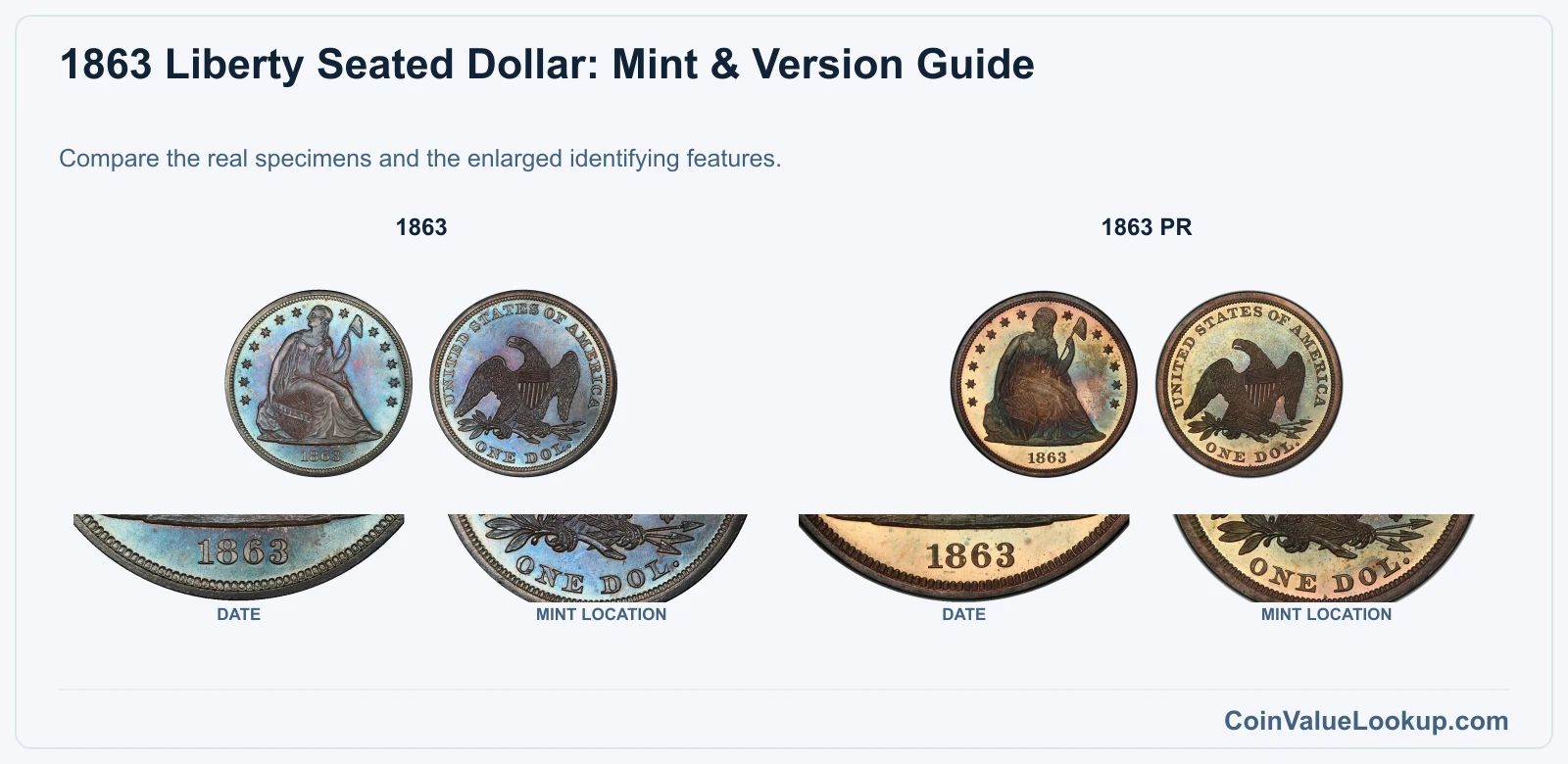
The 1863 Liberty Seated Dollar is a scarce Civil War-era silver dollar that draws serious collector attention. USA Coin Book guide estimates for this date range from roughly $1,167 in Good-4 condition up to $8,623 in MS63, depending on version and grade.
Those figures are guide estimates, not guaranteed offers. Identifying whether you hold a business strike or a proof finish is the first step, since each follows a different value path.
Fast Way to Identify Your 1863 Liberty Seated Dollar
Upload clear photos of both sides of your 1863 Liberty Seated Dollar for a preliminary identification. A front shot helps assess Liberty's detail and wear, while the reverse confirms the no-motto eagle design and checks for a mintmark.
This quick step can point you toward the right version before digging deeper into grade and value.
1863 Liberty Seated Dollar Value
Upload both sides of your 1863 Liberty Seated Dollar.
Front Obverse
Upload photo
Back Reverse
Upload photo
Which 1863 Liberty Seated Dollar Versions Are Worth Money?
- 1863 business strike — guide estimates run $1,167 in G4 to $8,623 in MS63; low surviving population makes even worn examples collectible.
- 1863 Proof — a proof-finish collector coin requiring individual assessment by authenticated identity and condition; not simply a high-grade business strike.
Step 1: Identify Your 1863 Liberty Seated Dollar Mint Mark and Version
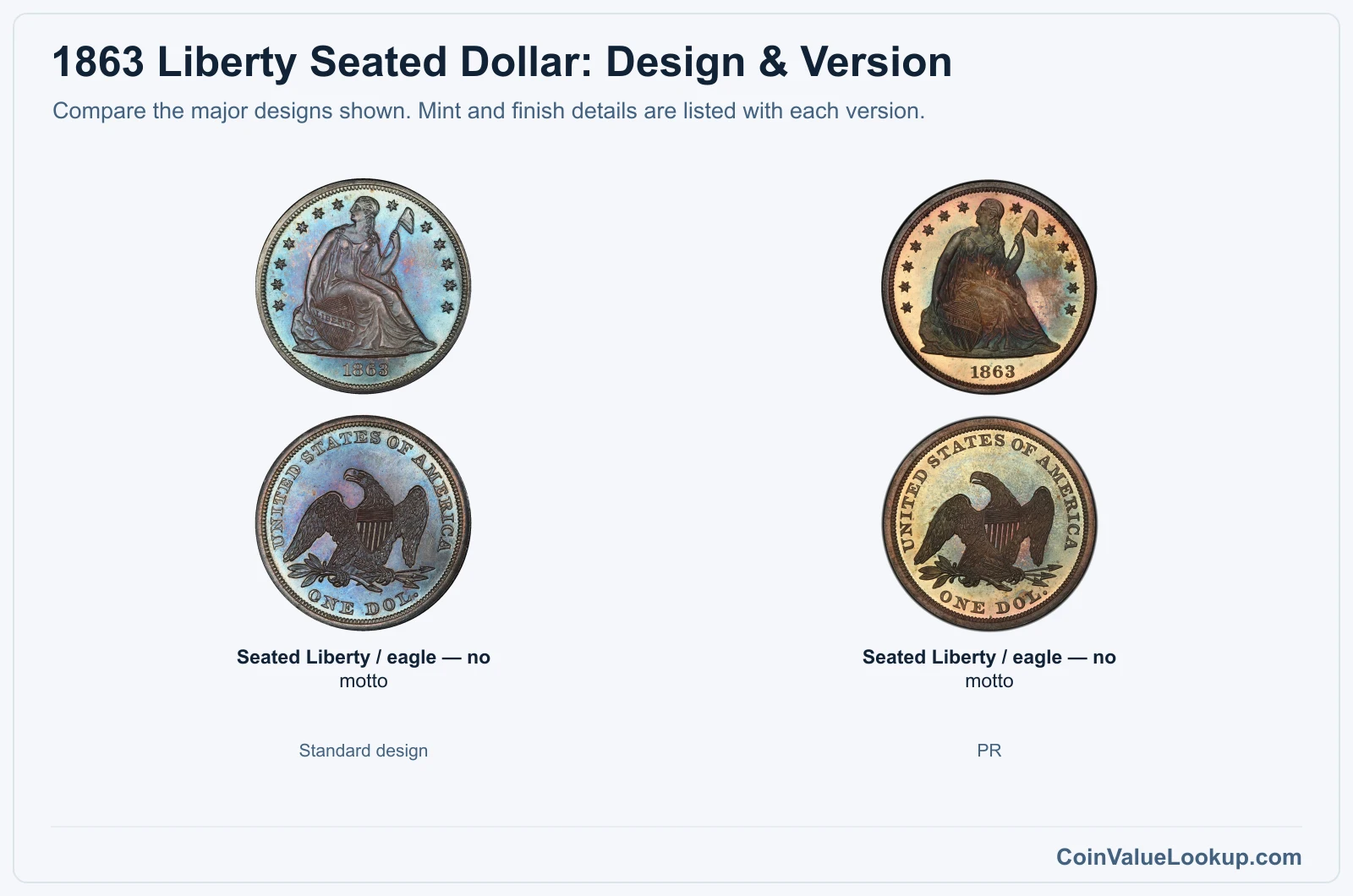
The 1863 Liberty Seated Dollar was struck at the Philadelphia Mint, which used no mintmark. If you see a small letter below the eagle and above "ONE DOL." on the reverse, you have a different date or mint — set it aside for separate research.
This coin is composed of 90% silver and 10% copper, with a standard weight of 26.73 grams. A kitchen scale can help screen out plated fakes or lightweight counterfeits, though it is not a substitute for professional authentication.
The obverse features Liberty seated on a rock, holding a pole topped with a liberty cap. The reverse shows an eagle with outstretched wings.
For 1863, both versions carry the "no motto" reverse — meaning there is no banner reading "IN GOD WE TRUST" above the eagle. That motto was added to this series in 1866.
Two distinct versions exist for 1863: a regular business strike and a proof. These are different manufacturing finishes, not just different grades.
A proof was made with polished dies and specially prepared planchets for collectors, producing mirrored fields and sharp detail. Do not assume a shiny coin is a proof; many business strikes have been polished over the years.
Step 2: Check Your 1863 Liberty Seated Dollar Grade
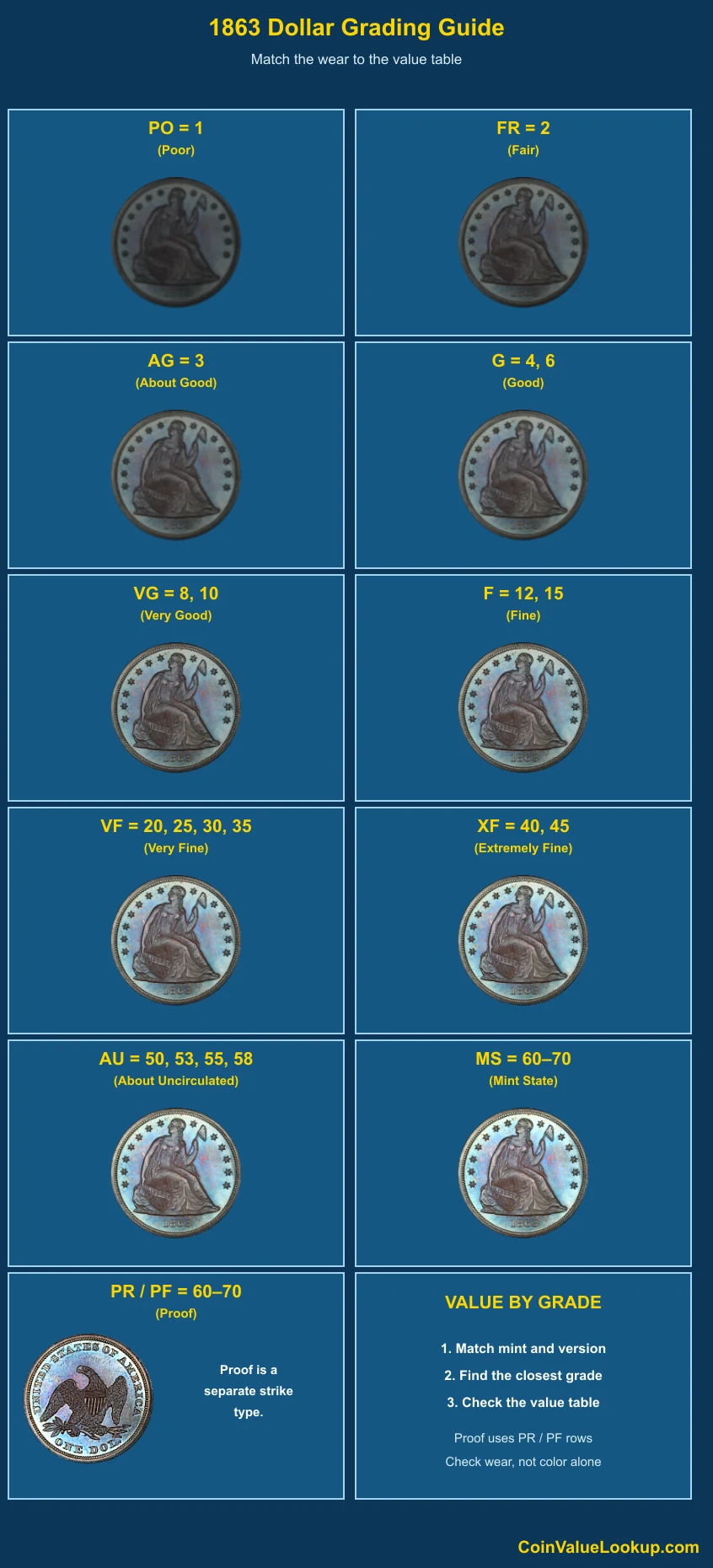
Start with Liberty's head on the obverse. In lower grades, her hair detail above the ear disappears first.
Move to her breast, knee and the horizontal lines of the shield — these are the next wear points as the grade drops. A coin in Good-4 will show Liberty's outline but little interior detail.
On the reverse, check the eagle's breast feathers and wing tips. These wear almost in lockstep with the obverse, so a mismatch can signal cleaning or tooling on one side.
Do not grade a weakly struck area as wear. Some 1863 dollars left the press with soft strikes on Liberty's head or the eagle's talons — that is a strike issue, not circulation damage.
Comparing your coin against a genuine same-type grading image helps separate the two.
Proof examples should be evaluated on an entirely separate scale. Look for consistent mirror fields, minimal hairlines and sharp rims.
A proof with heavy hairlines or cleaning may technically be genuine but will grade far lower than a pristine example. Use the comparison image to see circulated, About Uncirculated and Mint State examples side by side, keeping proofs on their own track.
Step 3: Check 1863 Liberty Seated Dollar Value by Mint and Version
1863 Liberty Seated Dollar
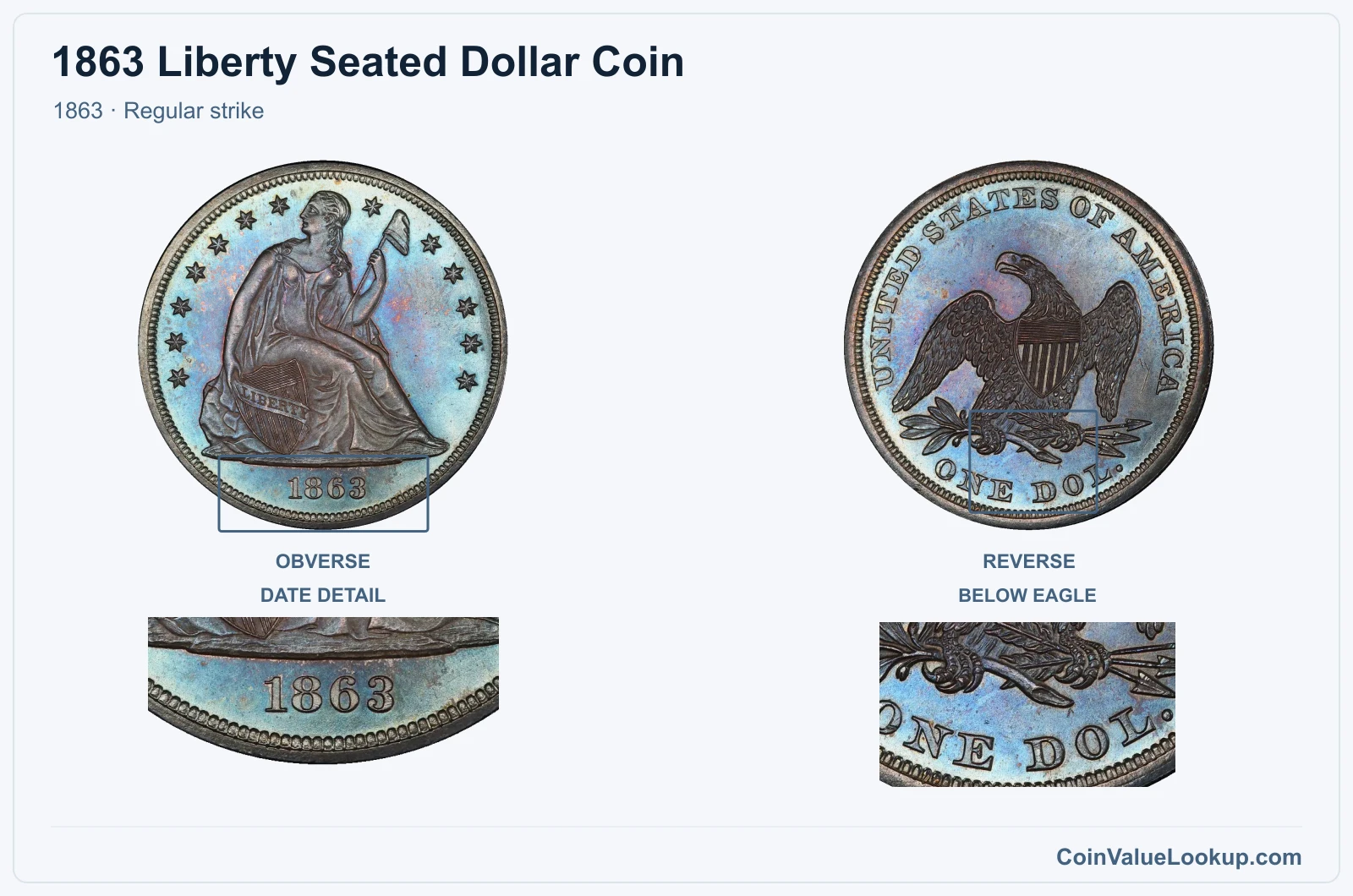
The 1863 business-strike dollar was produced at Philadelphia with no mintmark. It carries the Seated Liberty obverse and no-motto eagle reverse, struck in 90% silver at 26.73 grams.
USA Coin Book guide estimates place this coin at about $1,167 in Good-4 and up to $8,623 in MS63 — these are grade-specific guide figures, not blanket offers.
With the Civil War raging in 1863, relatively few silver dollars entered everyday commerce, meaning survivors are scarce at every grade. Original, uncleaned surfaces matter here.
A coin that has been polished or harshly cleaned loses much of its comparative value, even if the underlying detail looks sharp. Confirm the Philadelphia origin by verifying no mintmark appears on the reverse before using these estimates.
Coin Value Lookup is a handy starting point if you want to look up guides for other dates or denominations in this series. It can help you compare your coin against related issues quickly.
Range Grade
Price Auction Records Appraisal PO PO 1
—
Coin Identifier FR FR 2
—
Coin Identifier AG AG 3
—
Coin Identifier G G 4
—
Coin Identifier
G 6
Coin Identifier VG VG 8
Coin Identifier
VG 10
Coin Identifier F F 12
—
Coin Identifier
F 15
—
Coin Identifier VF VF 20
Coin Identifier
VF 25
Coin Identifier
VF 30
Coin Identifier
VF 35
Coin Identifier XF XF 40
Coin Identifier
XF 45
Coin Identifier AU AU 50
Coin Identifier
AU 53
Coin Identifier
AU 55
Coin Identifier
AU 58
Coin Identifier MS MS 60
Coin Identifier
MS 61
Coin Identifier
MS 62
Coin Identifier
MS 63
Coin Identifier
MS 64
Coin Identifier
MS 65
Coin Identifier
MS 66
Coin Identifier
MS 67
Coin Identifier
MS 68
—
—
—
MS 69
—
—
—
MS 70
—
—
—
1863 Liberty Seated Dollar — PR
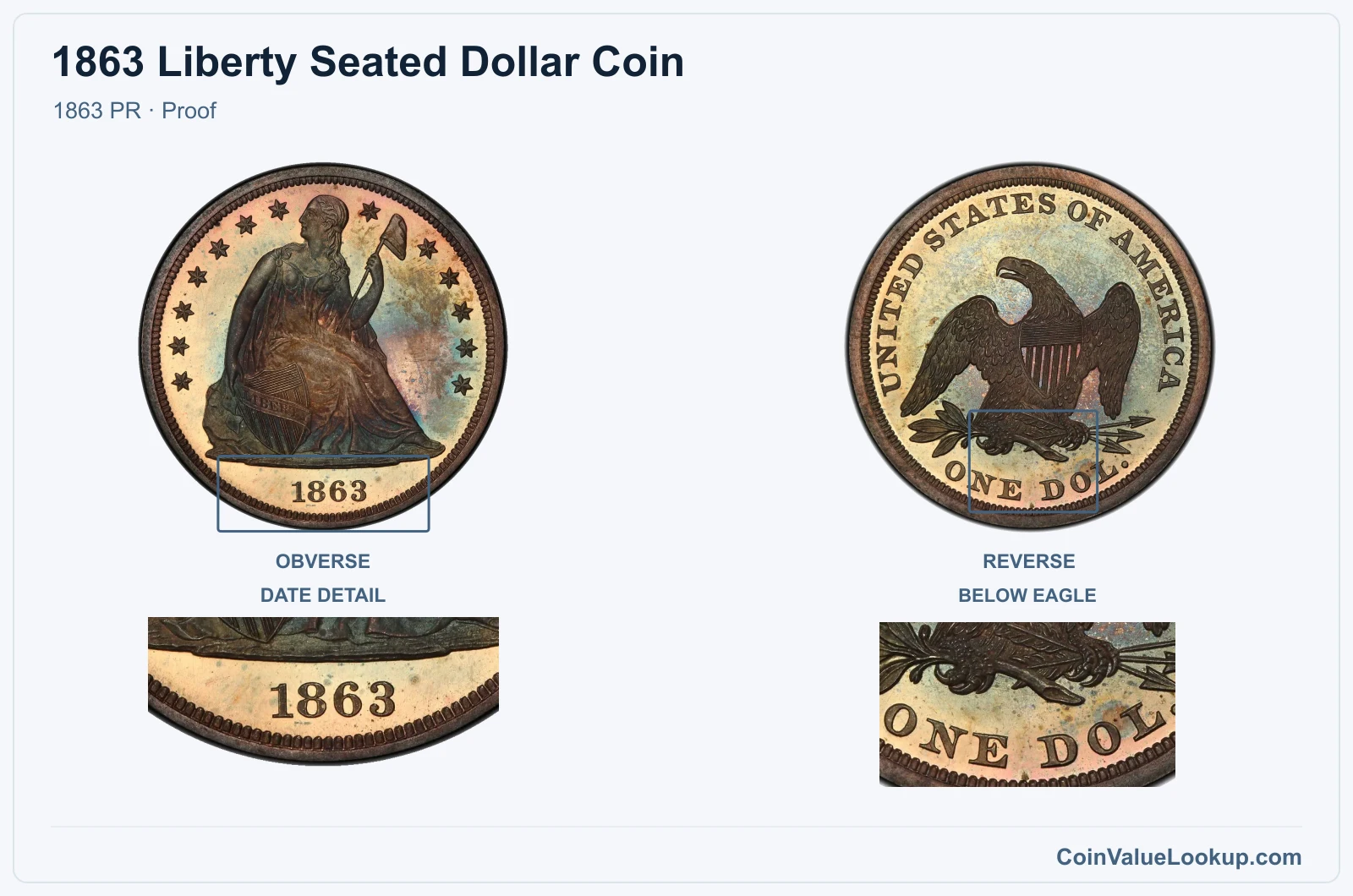
The 1863 Proof Liberty Seated Dollar is a collector-oriented issue struck with polished dies on carefully prepared planchets, also at Philadelphia with no mintmark. A proof is a manufacturing finish — not simply a grade above Mint State.
The mirrored fields should be consistent across both sides, and the design details will appear noticeably sharper than even a high-grade business strike.
No supported numeric price range was adopted for this proof version, so its value depends on individual assessment. Factors include authenticated identity, surface preservation, the presence or absence of hairlines, and whether the coin has been cleaned or retoned.
Third-party grading service confirmation is especially important here, since many polished business strikes have been mistaken for proofs over the decades. If you believe you hold one, professional authentication is worth the cost before drawing any value conclusions.
Range Grade
Price Auction Records Appraisal PR PR 1
—
Coin Identifier
PR 2
—
Coin Identifier
PR 3
—
Coin Identifier
PR 4
—
Coin Identifier
PR 6
—
Coin Identifier
PR 8
—
Coin Identifier
PR 10
—
Coin Identifier
PR 12
—
Coin Identifier
PR 15
—
Coin Identifier
PR 20
—
Coin Identifier
PR 25
—
Coin Identifier
PR 30
—
Coin Identifier
PR 35
—
Coin Identifier
PR 40
—
Coin Identifier
PR 45
—
Coin Identifier
PR 50
—
Coin Identifier
PR 53
—
Coin Identifier
PR 55
—
Coin Identifier
PR 58
Coin Identifier
PR 60
Coin Identifier
PR 61
Coin Identifier
PR 62
Coin Identifier
PR 63
Coin Identifier
PR 64
Coin Identifier
PR 65
Coin Identifier
PR 66
Coin Identifier
PR 67
Coin Identifier
PR 68
—
—
—
PR 69
—
—
—
PR 70
—
—
—