1865 Liberty Seated Dollar Coin Value: How Much Is It Worth?
The 1865 Liberty Seated Dollar is a scarce Civil War-era silver dollar that draws serious collector attention. Guide estimates for the regular business strike range from about $830 in Good-4 condition to around $12,196 in MS63, according to USA Coin Book.
Those are guide anchors for specific grades, not blanket offers for every coin you find in a drawer.
Before you assign a value, you need to pin down whether your coin is a standard business strike or a proof, and whether it has original surfaces or has been cleaned. The proof version and any error varieties follow different valuation paths entirely.
Fast Way to Identify Your 1865 Liberty Seated Dollar
The quickest way to start figuring out what you have is to upload clear photos of the front and back of your coin. Our identifier can give you a preliminary read on the version, mint, and finish so you know which value track to follow.
Good lighting and a steady hand help a lot — phone cameras work fine if you get close enough and avoid glare.
1865 Liberty Seated Dollar Value
Upload both sides of your 1865 Liberty Seated Dollar.
Front Obverse
Upload photo
Back Reverse
Upload photo
Which 1865 Liberty Seated Dollar Versions Are Worth Money?
- The 1865 Proof (PR) is a distinct collectible finish struck at Philadelphia — confirm mirror fields and sharp rims before assuming you have one.
- Verify your coin is an original, uncleaned business strike or authenticated proof before paying any premium; polishing, plating, glare, or unverified error claims do not add value.
Step 1: Identify Your 1865 Liberty Seated Dollar Mint Mark and Version
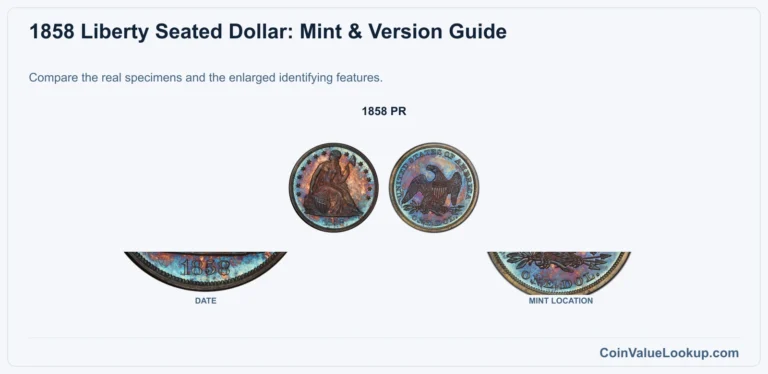
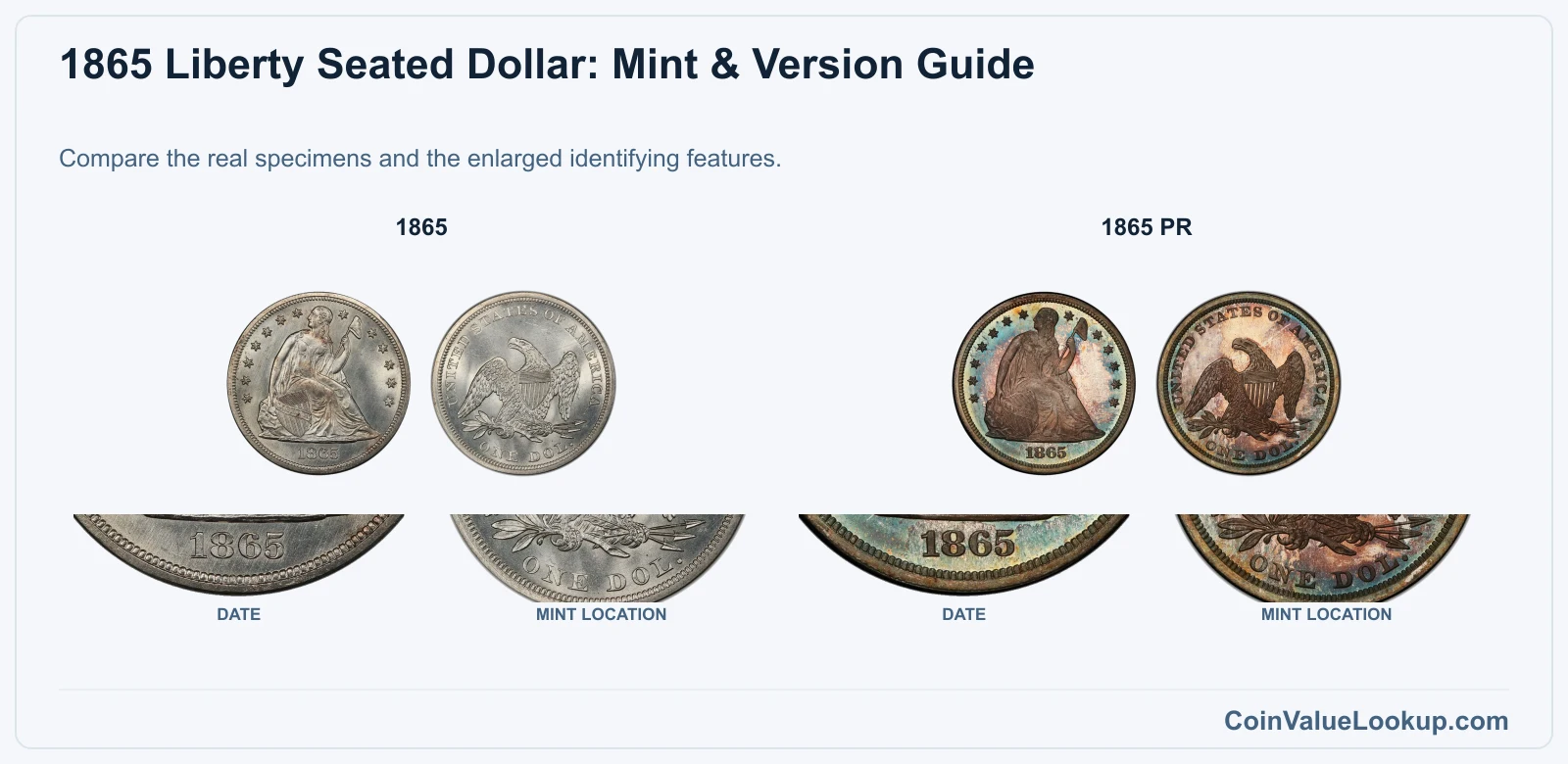
Philadelphia struck the 1865 Liberty Seated Dollar, so there is no mintmark. On branch-mint Seated Dollars you would look on the reverse below the eagle and above the ONE DOL.
denomination, but for 1865 you should see a clean field there.
The coin is 90% silver and 10% copper, with a nominal weight of 26.73 grams. If your coin feels light or doesn't ring right, that is worth investigating before going further.
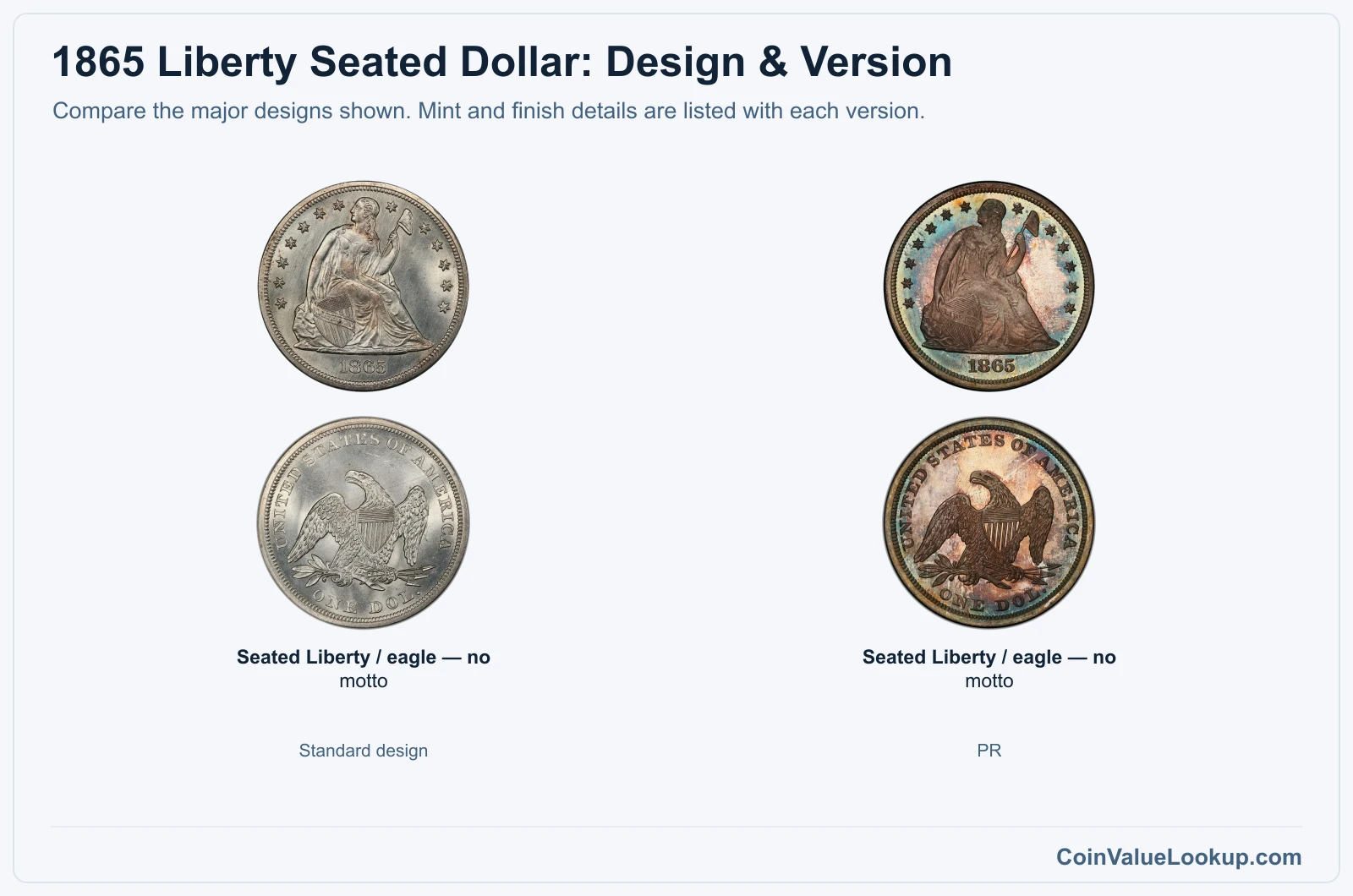
The obverse shows Liberty seated on a rock, holding a pole topped with a liberty cap and resting her hand on a shield. The reverse features an eagle.
The 1865 issue uses the no-motto reverse design.
Two distinct branches exist for this year: the regular 1865 business strike and the 1865 Proof. Telling them apart matters because they follow completely different value tracks.
Proofs have mirrorlike fields, squared-off rims, and typically show sharper design details from the specially prepared dies. A shiny coin is not automatically a proof — many business strikes were polished by past owners, which actually hurts their value.
Step 2: Check Your 1865 Liberty Seated Dollar Grade
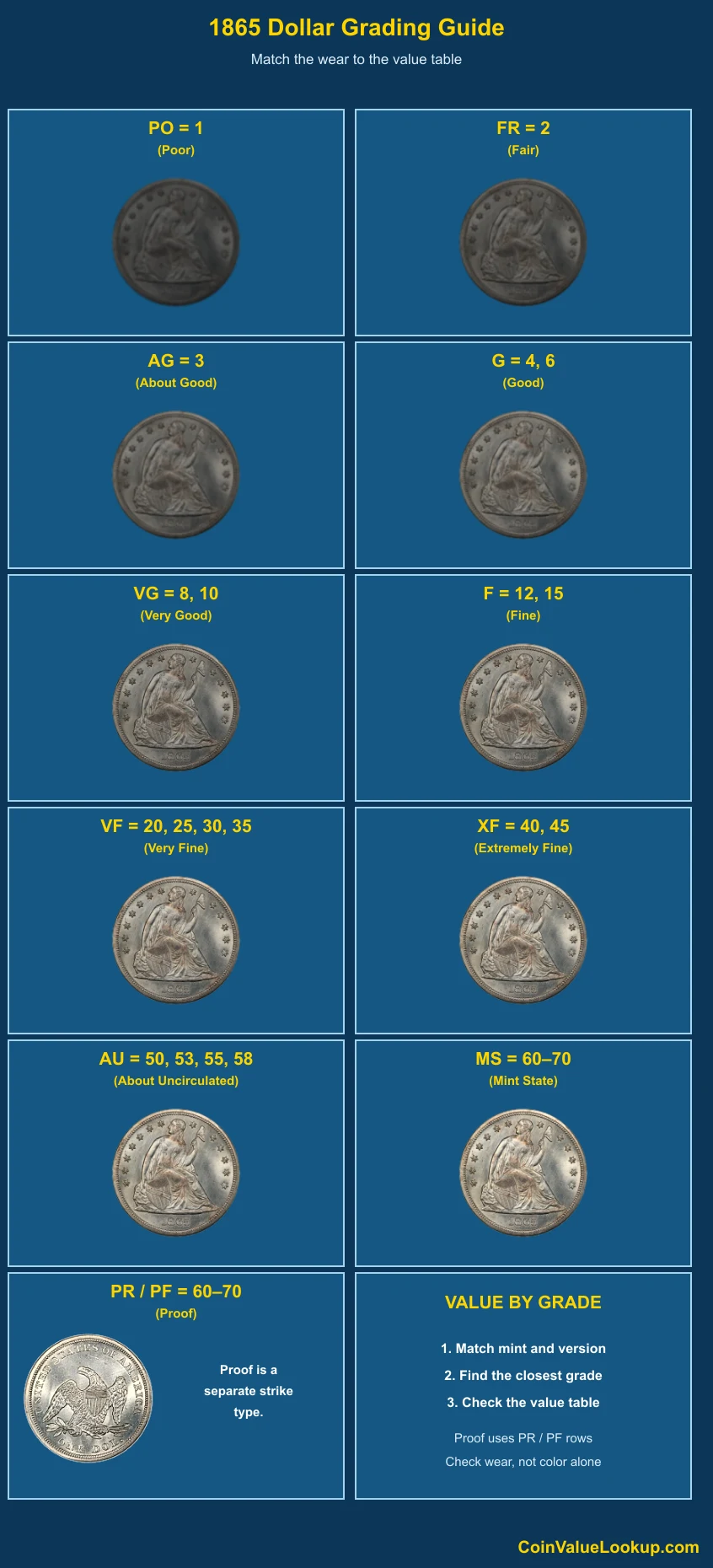
When grading a business-strike 1865 Seated Dollar, focus on four key wear points on the obverse: Liberty's head, her breast and torso area, her knee, and the lines on the shield. On the reverse, check the eagle's breast feathers and wing tips.
A coin in Good-4 will show a flat Liberty outline with most detail worn smooth, but the date and legends remain readable. As you move up through Fine and Very Fine, the shield lines and knee detail start coming back.
At About Uncirculated you will see only the faintest friction on the highest points, with most luster intact in the protected areas. A true Mint State coin has no wear at all, just varying degrees of contact marks and luster quality.
Do not grade a weakly struck head in isolation — some dies were simply soft in that area from the start, so check the overall coin. Use the comparison image of the same type and finish to judge where your piece falls, and keep circulated grades separate from proof evaluations.
Step 3: Check 1865 Liberty Seated Dollar Value by Mint and Version
1865 Liberty Seated Dollar
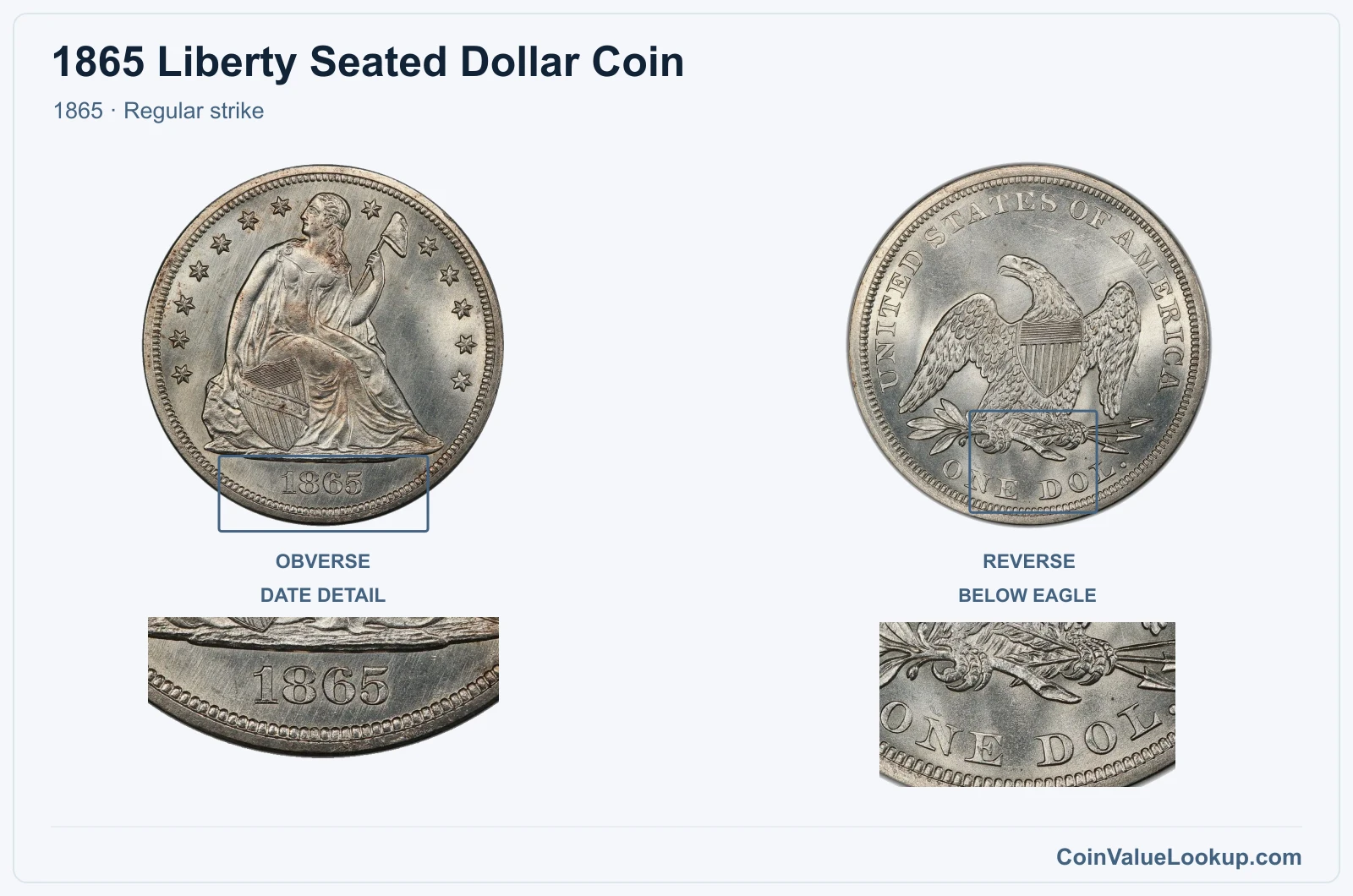
The standard 1865 business strike was produced at the Philadelphia Mint with no mintmark. It features the Seated Liberty obverse paired with the no-motto eagle reverse, struck in 90% silver at a nominal 26.73 grams.
USA Coin Book guide estimates place this coin at roughly $830 in Good-4 and around $12,196 in MS63. Those are bookend anchors for two specific grades, not a sliding scale you can interpolate freely.
Original, unclean surfaces matter enormously at every level — a polished or cleaned example loses much of its comparability to these figures.
Coin Value Lookup is a good starting point if you want to look up guides for other dates or denominations in this series. It can save you time narrowing down what you actually have before diving deeper.
Range Grade
Price Auction Records Appraisal PO PO 1
—
Coin Identifier FR FR 2
Coin Identifier AG AG 3
—
Coin Identifier G G 4
Coin Identifier
G 6
Coin Identifier VG VG 8
—
Coin Identifier
VG 10
Coin Identifier F F 12
Coin Identifier
F 15
Coin Identifier VF VF 20
Coin Identifier
VF 25
Coin Identifier
VF 30
Coin Identifier
VF 35
Coin Identifier XF XF 40
Coin Identifier
XF 45
Coin Identifier AU AU 50
Coin Identifier
AU 53
Coin Identifier
AU 55
Coin Identifier
AU 58
Coin Identifier MS MS 60
Coin Identifier
MS 61
Coin Identifier
MS 62
Coin Identifier
MS 63
Coin Identifier
MS 64
Coin Identifier
MS 65
Coin Identifier
MS 66
—
—
—
MS 67
—
—
—
MS 68
—
—
—
MS 69
—
—
—
MS 70
—
—
—
1865 Liberty Seated Dollar — PR
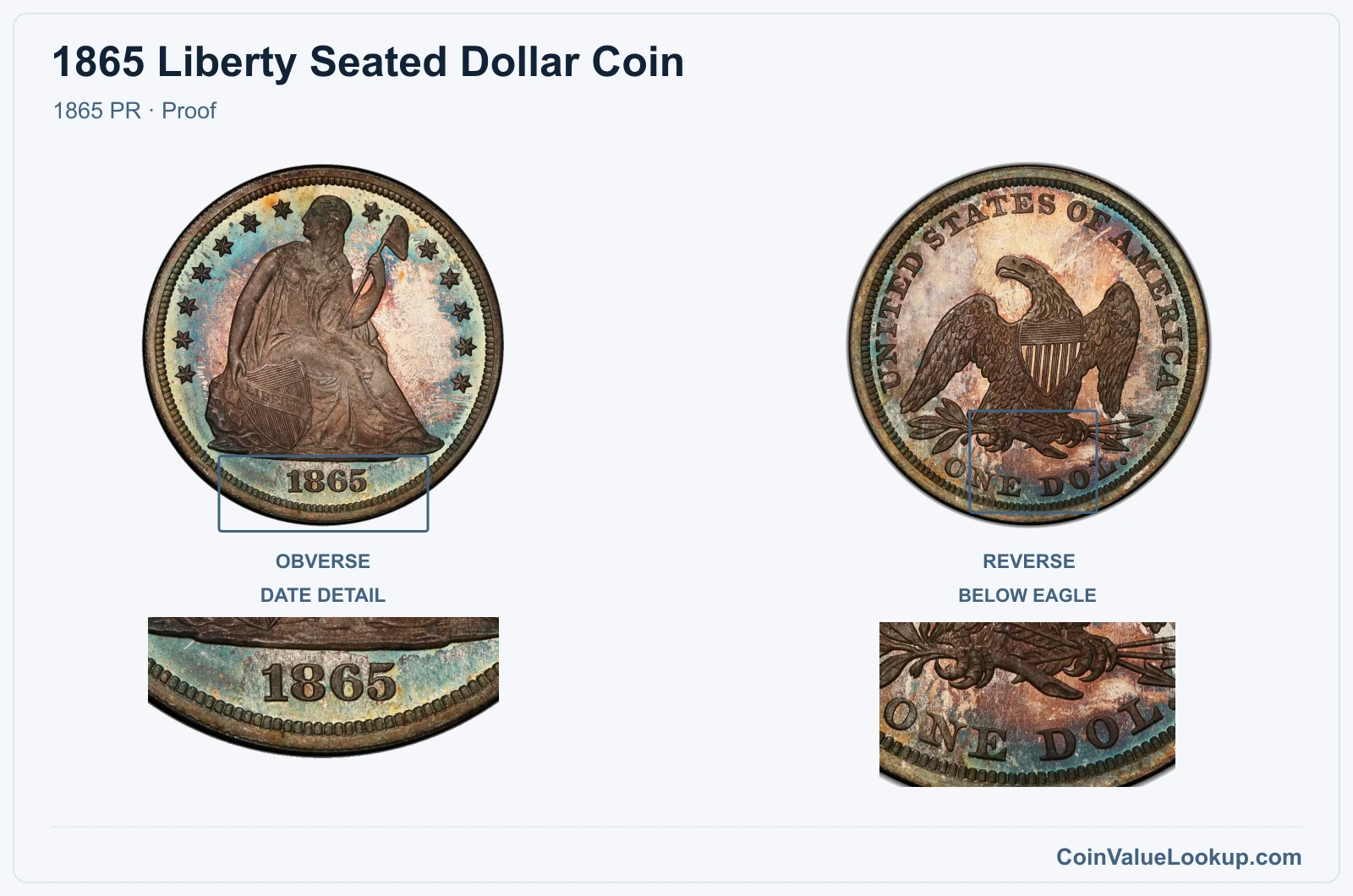
The 1865 Proof is a Philadelphia-struck coin made with specially prepared dies and planchets, producing mirror-like fields and exceptionally sharp design details. A proof is a manufacturing finish, not simply a high-grade or shiny regular coin.
No supported numeric price range is available in the current guide data for this version. Value depends heavily on the coin's authenticated identity, its condition within the proof grading scale, and the presence or absence of problems like hairlines, haze, or re-toning.
Professional authentication from a recognized grading service is the practical way to establish what a specific 1865 Proof is worth, because the market for these relies on third-party confirmation.
Range Grade
Price Auction Records Appraisal PR PR 1
—
Coin Identifier
PR 2
—
Coin Identifier
PR 3
—
Coin Identifier
PR 4
—
Coin Identifier
PR 6
—
Coin Identifier
PR 8
—
Coin Identifier
PR 10
—
Coin Identifier
PR 12
—
Coin Identifier
PR 15
—
Coin Identifier
PR 20
—
Coin Identifier
PR 25
—
Coin Identifier
PR 30
—
Coin Identifier
PR 35
—
Coin Identifier
PR 40
—
Coin Identifier
PR 45
—
Coin Identifier
PR 50
Coin Identifier
PR 53
—
Coin Identifier
PR 55
Coin Identifier
PR 58
—
Coin Identifier
PR 60
Coin Identifier
PR 61
Coin Identifier
PR 62
Coin Identifier
PR 63
Coin Identifier
PR 64
Coin Identifier
PR 65
Coin Identifier
PR 66
Coin Identifier
PR 67
Coin Identifier
PR 68
—
—
—
PR 69
—
—
—
PR 70
—
—
—
1865 Liberty Seated Dollar Error List
1. 1865 Liberty Seated Dollar — Doubled Die Obverse
A Doubled Die Obverse has been reported for the 1865 Liberty Seated Dollar. This type of error results from a misaligned secondary impression of the die during its manufacture, producing consistent doubling in the design elements on the front of the coin.
To check for it, compare the obverse lettering — especially LIBERTY on the shield and the date digits — against a normal 1865 dollar under matching lighting. Genuine doubling shows as a consistent separation or notching on affected letters and design features, visible from multiple angles.
Be careful with lookalikes. Machine doubling produces a flat, shelf-like distortion rather than rounded secondary lettering, and reflections or worn die contours can mimic doubling to the untrained eye.
No specific price data is available for this error on the 1865 dollar; value would depend on the visibility of the doubling, the coin's overall condition, and professional confirmation.
2. 1865 Liberty Seated Dollar — Doubled Die Reverse
A Doubled Die Reverse has also been reported for the 1865 Liberty Seated Dollar. The same basic mechanism applies — a misaligned hub impression during die production — but the affected design sits on the back of the coin.
Examine the reverse legends, particularly ONE DOL. and UNITED STATES OF AMERICA, and compare the eagle's design contours to a known normal example.
Genuine doubled die features will appear as consistent, repeatable separation in the affected areas.
Machine doubling is the most common lookalike here, showing flat displacement rather than true secondary design. Random nicks, damage, or corrosion can also create false positives.
No supported price data exists for this specific variety, so value would be determined by the strength of the doubling, the coin's grade, and authenticated identification by a recognized service.