1871 Liberty Seated Dollar Coin Value: How Much Is It Worth?
The 1871 Liberty Seated Dollar carries guide estimates from roughly $416 in well-worn condition up to $278,962 for the rarest mint version in high grade. That is not a blanket range for every coin you find — mint, finish, and condition matter enormously.
A Philadelphia business strike and a Carson City piece occupy very different worlds. A proof finish is its own category entirely, so identifying your exact version is the essential first step.
Fast Way to Identify Your 1871 Liberty Seated Dollar
The fastest way to start figuring out what you have is to upload clear photos of both the front and back of your coin. Our identifier can offer a preliminary identification of your mint, design details, and general condition from those images.
It will not authenticate or certify, but it gives you a solid starting point before you dig deeper.
1871 Liberty Seated Dollar Value
Upload both sides of your 1871 Liberty Seated Dollar.
Front Obverse
Upload photo
Back Reverse
Upload photo
Which 1871 Liberty Seated Dollar Versions Are Worth Money?
- The 1871-CC (Carson City) is the branch to watch — guide estimates reach $278,962 in MS63, reflecting genuine scarcity from a low-production Western mint.
- The 1871 Proof is a special finish requiring individual assessment by authenticated identity and condition, separate from any business-strike valuation.
Step 1: Identify Your 1871 Liberty Seated Dollar Mint Mark and Version
Start by checking for a mintmark. Philadelphia coins carry no mintmark at all.
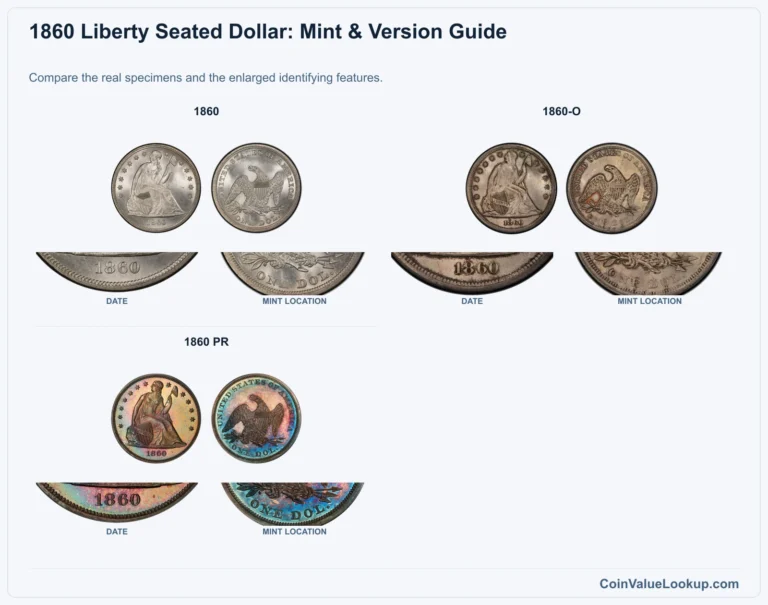
Carson City coins display a small "CC" on the reverse, located below the eagle and above the "ONE DOL." inscription. If you see no mark, your coin is either a Philadelphia business strike or a proof — more on how to tell those apart below.
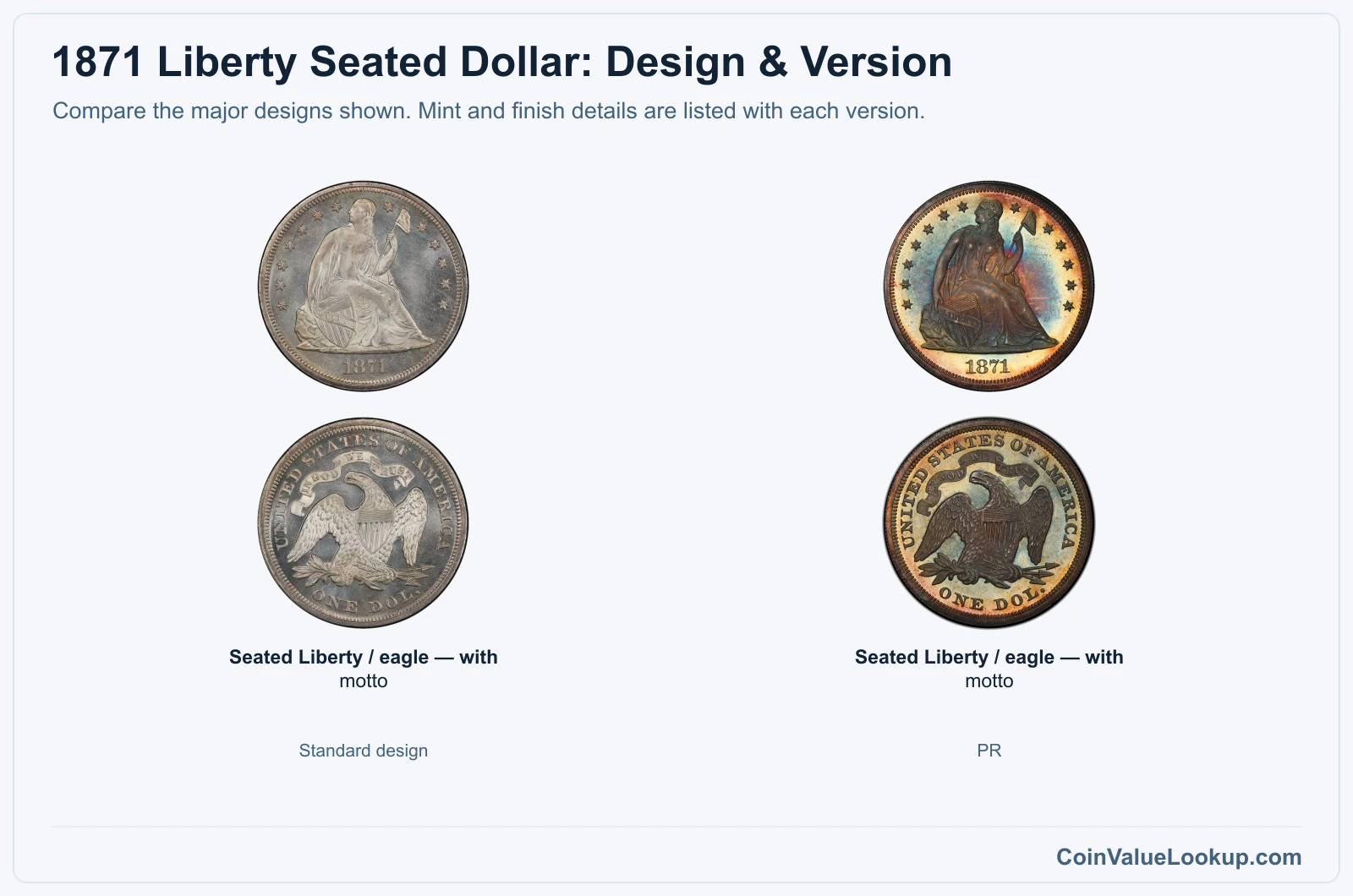
All 1871 Liberty Seated Dollars are struck in 90% silver and 10% copper, with a nominal weight of 26.73 grams. The design features a seated figure of Liberty on the obverse and an eagle on the reverse, with the motto "IN GOD WE TRUST" on a banner above the eagle.
This with-motto reverse was standard by 1871.
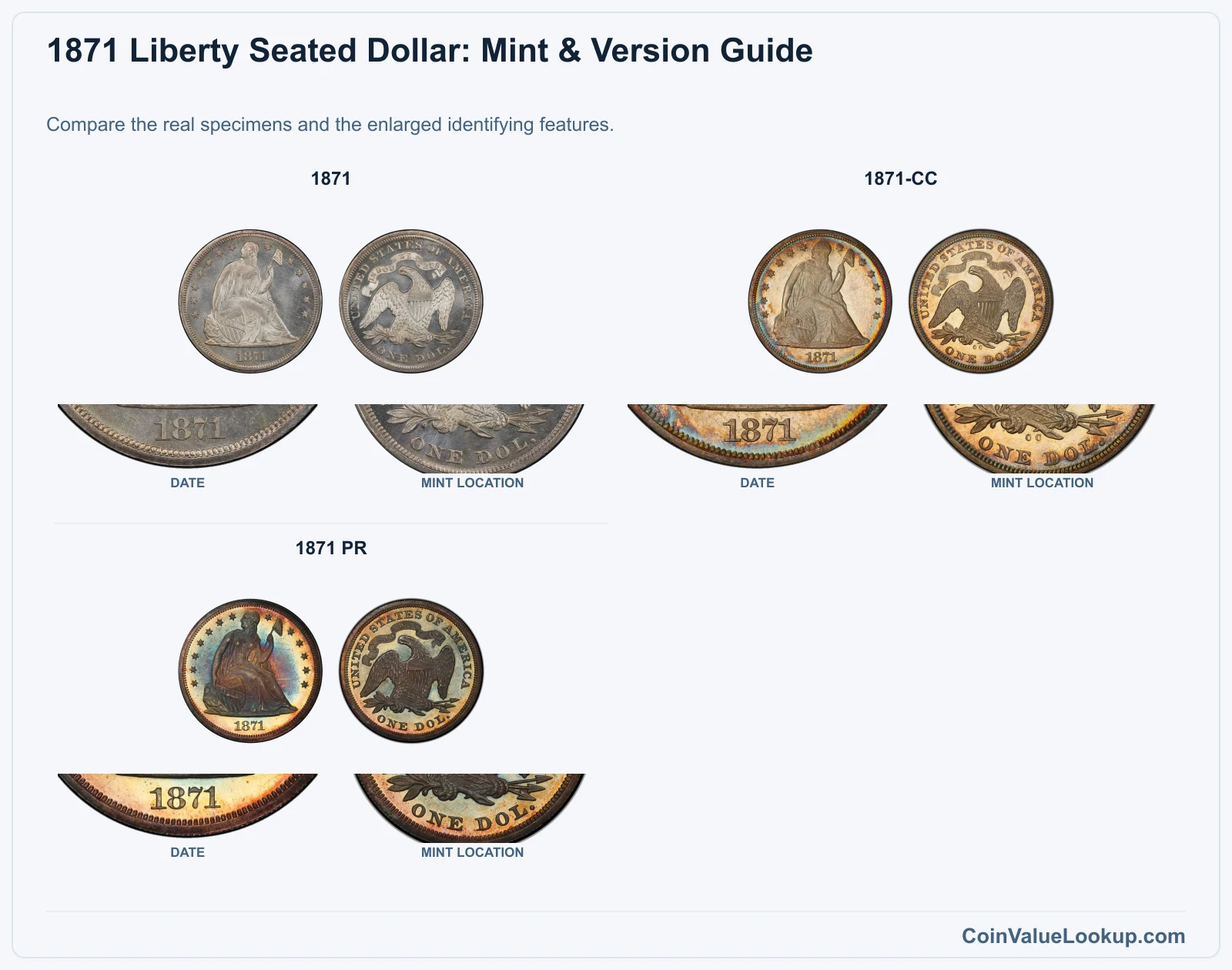
Three distinct versions exist for this year: the 1871 Philadelphia business strike, the 1871-CC from Carson City, and the 1871 Proof. Each has a different value profile, so confirm your version before looking at prices.
Step 2: Check Your 1871 Liberty Seated Dollar Grade
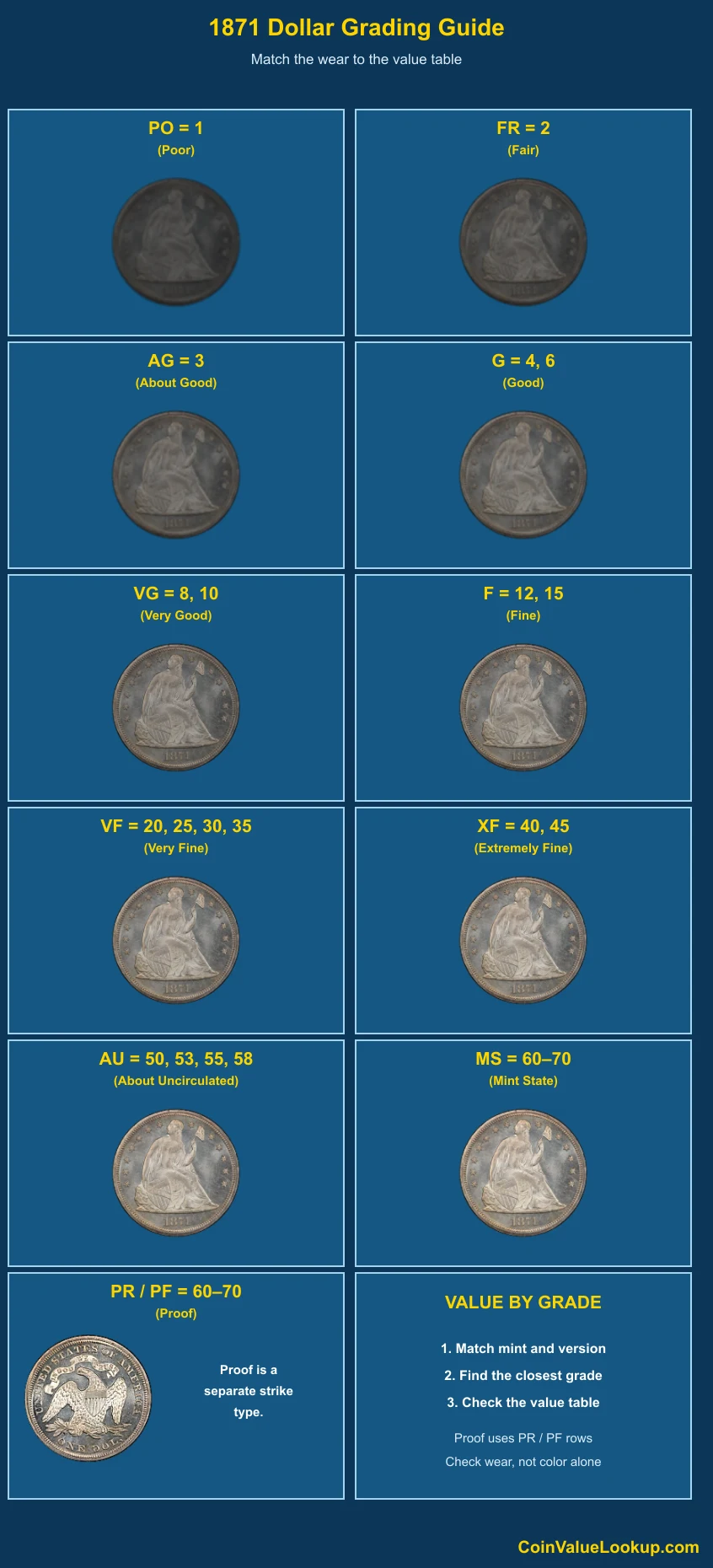
Focus on four key areas for wear: Liberty's head, her breast and knee on the obverse, and the shield she holds. On the reverse, check the eagle's breast feathers and wing tips.
These spots lose detail first as a coin circulates.
Do not mistake a weak strike for heavy wear. Some coins left the press with soft detail on Liberty's head, and that is a manufacturing trait, not damage from use.
Compare your coin to a genuine same-type grading image showing circulated, About Uncirculated, and Mint State examples side by side.
Proof coins get evaluated differently — look for mirrorlike fields, sharp rims, and minimal hairlines rather than the typical wear patterns. A proof is a special manufacturing finish and should never be graded on the same scale as a business strike.
Step 3: Check 1871 Liberty Seated Dollar Value by Mint and Version
1871 Liberty Seated Dollar
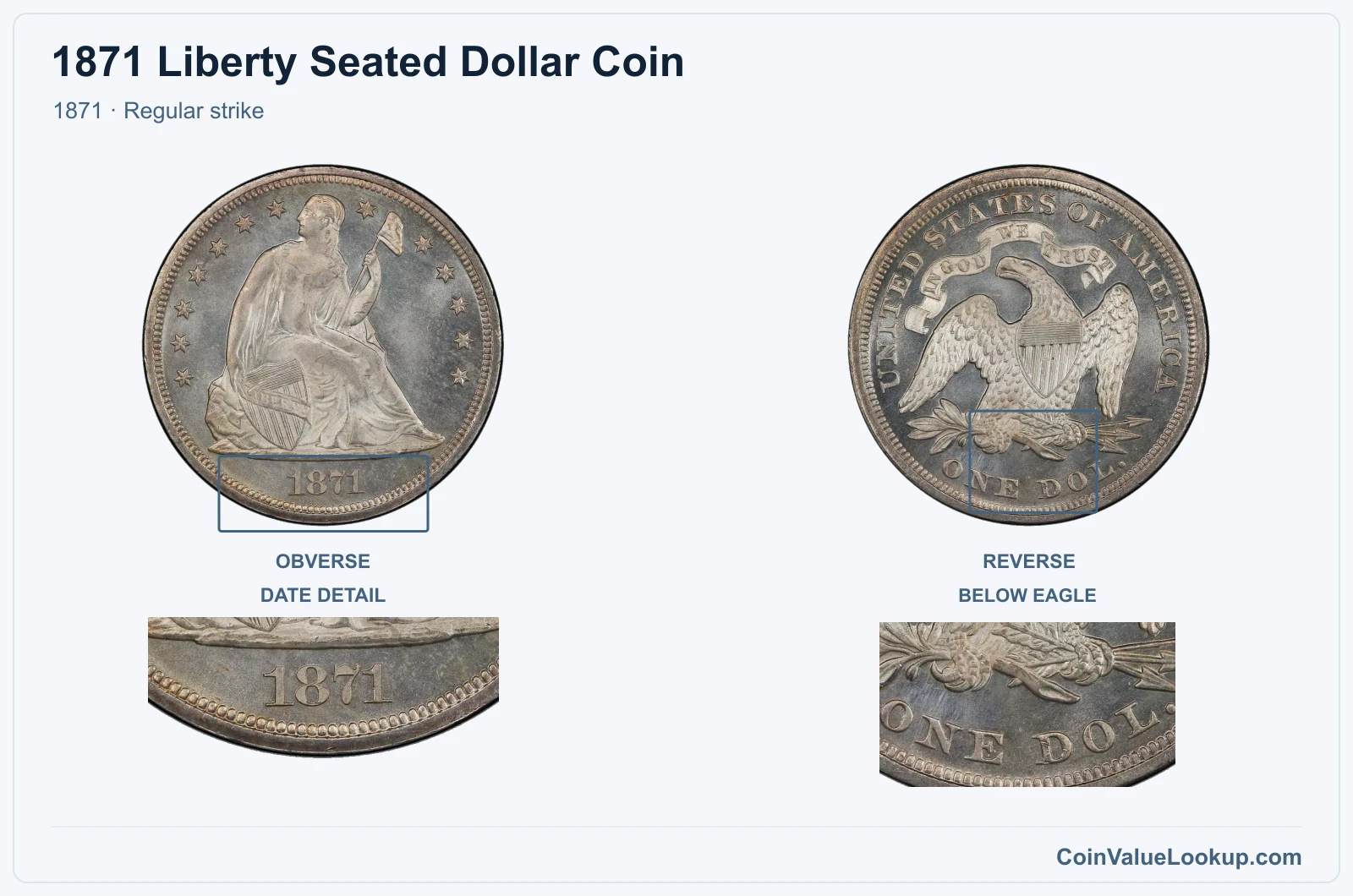
The 1871 Philadelphia business strike has no mintmark. It features the standard Seated Liberty obverse and with-motto eagle reverse in 90% silver.
Guide estimates from USA Coin Book place this version at about $416 in G4 (a heavily worn but readable coin) and around $5,723 in MS63 (a lightly marked uncirculated example). These are guide estimates, not guaranteed sale prices.
Original, uncleaned surfaces matter here — a polished or cleaned coin will trade below these benchmarks regardless of its technical grade.
Range Grade
Price Auction Records Appraisal PO PO 1
—
Coin Identifier FR FR 2
—
Coin Identifier AG AG 3
Coin Identifier G G 4
Coin Identifier
G 6
Coin Identifier VG VG 8
Coin Identifier
VG 10
Coin Identifier F F 12
Coin Identifier
F 15
Coin Identifier VF VF 20
Coin Identifier
VF 25
Coin Identifier
VF 30
Coin Identifier
VF 35
Coin Identifier XF XF 40
Coin Identifier
XF 45
Coin Identifier AU AU 50
Coin Identifier
AU 53
Coin Identifier
AU 55
Coin Identifier
AU 58
Coin Identifier MS MS 60
Coin Identifier
MS 61
Coin Identifier
MS 62
Coin Identifier
MS 63
Coin Identifier
MS 64
Coin Identifier
MS 65
Coin Identifier
MS 66
Coin Identifier
MS 67
—
—
—
MS 68
—
—
—
MS 69
—
—
—
MS 70
—
—
—
1871 Liberty Seated Dollar — CC
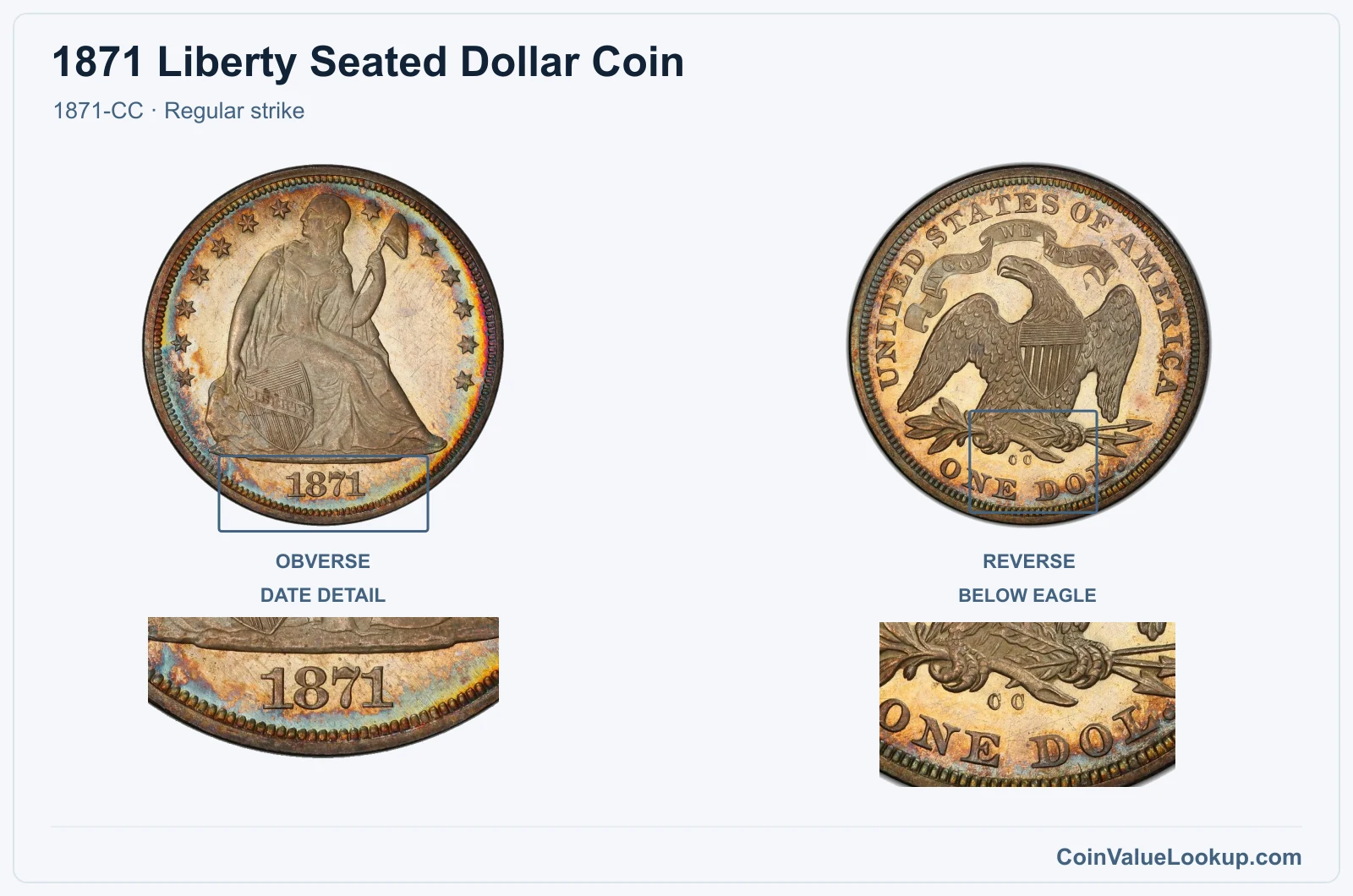
The 1871-CC is the Carson City issue, identified by the small "CC" mintmark on the reverse below the eagle. Carson City dollars from this era were produced in small numbers for commerce in the Western mining regions, and survivors are genuinely scarce across all grades.
USA Coin Book guide estimates start at roughly $4,287 in G4 and climb to approximately $278,962 in MS63. That upper figure reflects how few examples survive in strong uncirculated condition.
Even a well-worn example commands serious money. Confirm the mintmark carefully — fakes exist.
Original surfaces and an authenticated grade matter more than ever at these price levels.
Coin Value Lookup is a good place to look up guides for other dates in this series and compare how different Liberty Seated Dollar years stack up.
Range Grade
Price Auction Records Appraisal PO PO 1
—
Coin Identifier FR FR 2
—
Coin Identifier AG AG 3
—
Coin Identifier G G 4
—
Coin Identifier
G 6
Coin Identifier VG VG 8
Coin Identifier
VG 10
Coin Identifier F F 12
Coin Identifier
F 15
Coin Identifier VF VF 20
Coin Identifier
VF 25
Coin Identifier
VF 30
Coin Identifier
VF 35
Coin Identifier XF XF 40
Coin Identifier
XF 45
Coin Identifier AU AU 50
Coin Identifier
AU 53
Coin Identifier
AU 55
Coin Identifier
AU 58
Coin Identifier MS MS 60
—
Coin Identifier
MS 61
Coin Identifier
MS 62
—
Coin Identifier
MS 63
Coin Identifier
MS 64
Coin Identifier
MS 65
—
—
—
MS 66
—
—
—
MS 67
—
—
—
MS 68
—
—
—
MS 69
—
—
—
MS 70
—
—
—
1871 Liberty Seated Dollar — PR
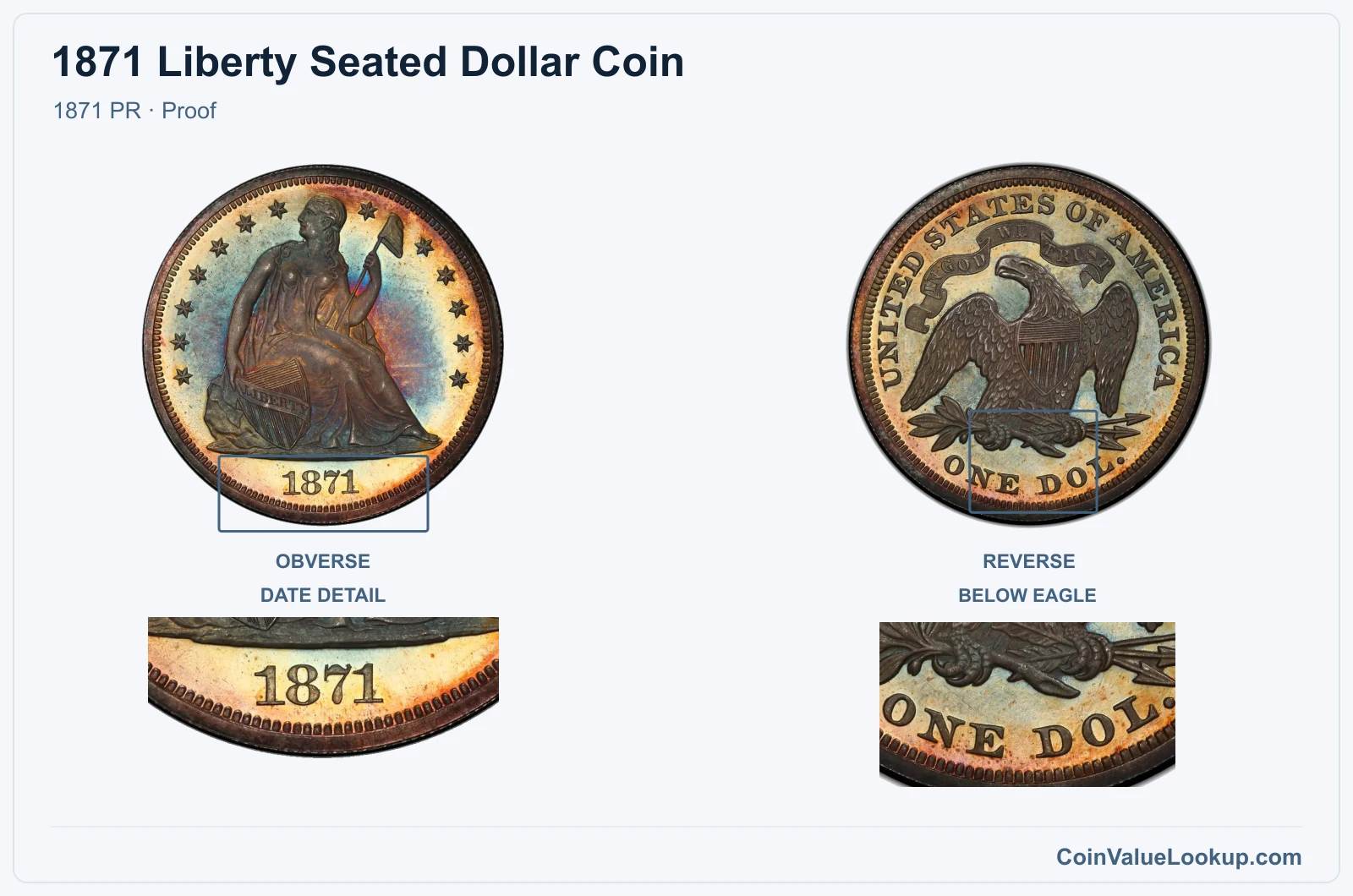
The 1871 Proof was struck at Philadelphia with no mintmark, just like the business strike, so appearance is your main clue. Genuine proofs display deeply mirrored fields, razor-sharp design details, and squared-off rims that business strikes lack.
A proof is a manufacturing finish, not simply a shiny or high-grade regular coin. No supported numeric price range is available for this version in the current data, so value depends on individual assessment — authenticated identity, condition, and any specific characteristics all factor in.
Third-party certification from a major grading service is essentially a requirement before buying or selling one of these.
Range Grade
Price Auction Records Appraisal PR PR 1
—
Coin Identifier
PR 2
—
Coin Identifier
PR 3
—
Coin Identifier
PR 4
—
Coin Identifier
PR 6
—
Coin Identifier
PR 8
—
Coin Identifier
PR 10
—
Coin Identifier
PR 12
—
Coin Identifier
PR 15
—
Coin Identifier
PR 20
—
Coin Identifier
PR 25
—
Coin Identifier
PR 30
—
Coin Identifier
PR 35
—
Coin Identifier
PR 40
—
Coin Identifier
PR 45
Coin Identifier
PR 50
Coin Identifier
PR 53
Coin Identifier
PR 55
Coin Identifier
PR 58
Coin Identifier
PR 60
Coin Identifier
PR 61
Coin Identifier
PR 62
Coin Identifier
PR 63
Coin Identifier
PR 64
Coin Identifier
PR 65
Coin Identifier
PR 66
Coin Identifier
PR 67
Coin Identifier
PR 68
—
—
—
PR 69
—
—
—
PR 70
—
—
—
1871 Liberty Seated Dollar Error List
1. 1871 Liberty Seated Dollar — Misplaced Date
A Misplaced Date variety has been reported for the 1871 Liberty Seated Dollar in Regular Strike form from Philadelphia. On this variety, remnants of date-punch digits appear in an unusual position on the coin — look carefully near or around the normal date area for faint, extra digit impressions that should not be there.
The normal date will still be visible in its expected location.
Do not confuse this with scratches, die cracks, random dents, or an incorrectly attributed die variety. Genuine misplaced date impressions show the distinct shape of numerals, not random linear marks.
Condition, the visibility of the displaced digits, and the specific nature of the error all influence what a collector would pay. No numerical price range is available for this variety in the current data, so individual assessment is necessary.
A source-reported listing is not the same as independent authentication of your specific coin.