1894 Barber Half Dollar Coin Value: How Much Is It Worth?
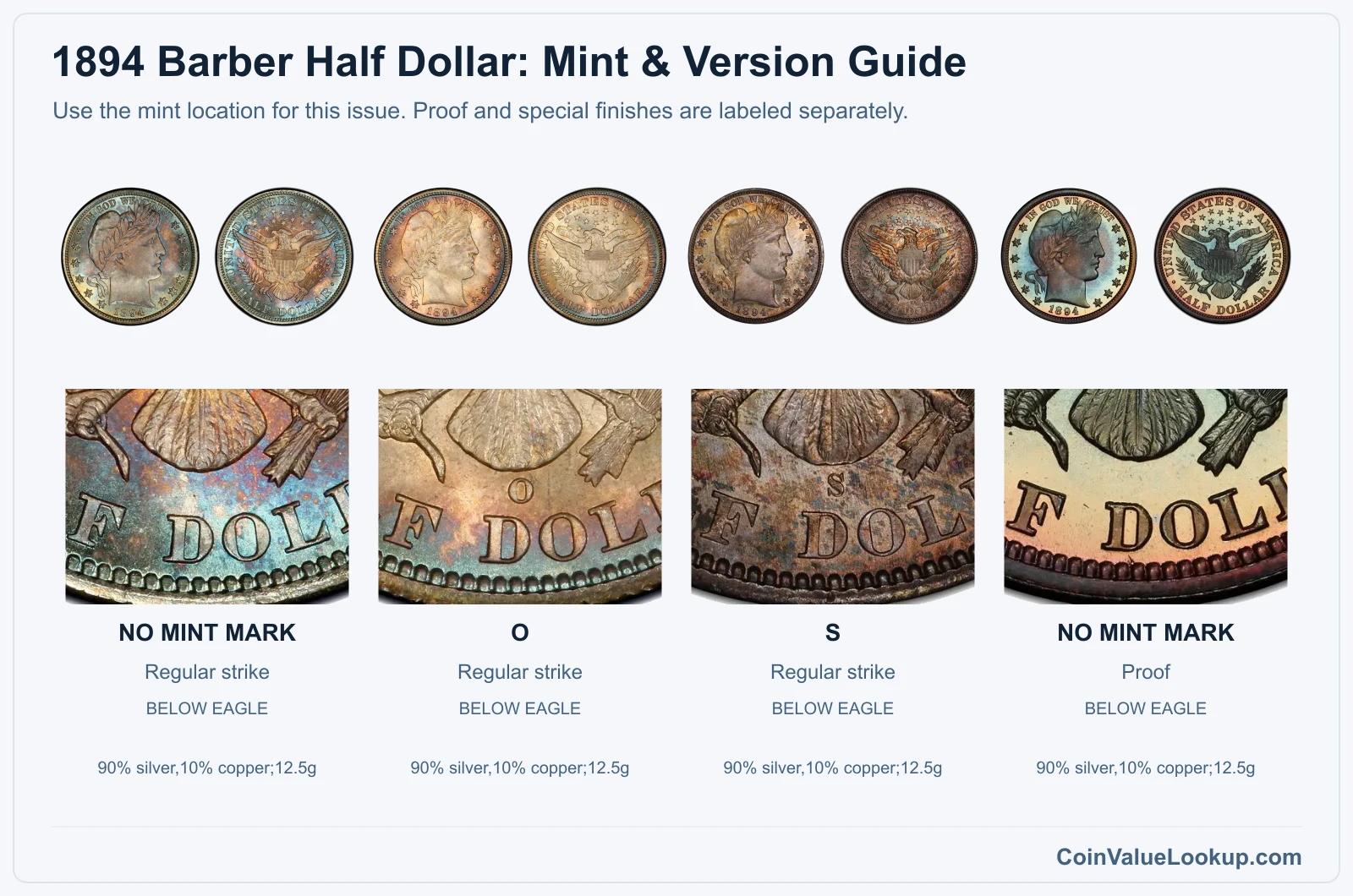
The 1894 Barber Half Dollar spans a range from about $56 at G4 for the San Francisco issue to roughly $1,765 at MS63, based on a USA Coin Book guide snapshot. Three business-strike mints — Philadelphia, New Orleans, and San Francisco — plus a Philadelphia Proof make up the year's lineup.
Condition and original surfaces matter enormously with these coins, so read on before assuming yours is ordinary.
Fast Way to Identify Your 1894 Barber Half Dollar
Snap clear photos of both the front and back of your 1894 half dollar and upload them here for a preliminary identification. Good lighting on the date, Liberty's portrait, and especially the mintmark area beneath the eagle's tail will help pin down which version you have.
This is not a substitute for professional authentication or precise grading.
1894 Barber Half Dollar Value
Upload both sides of your 1894 Barber Half Dollar.
Front Obverse
Upload photo
Back Reverse
Upload photo
Which 1894 Barber Half Dollar Versions Are Worth Money?
- Philadelphia (no mintmark) pieces range from about $68 at G4 to $1,314 at MS63 per the USA Coin Book guide; original uncleaned surfaces in upper grades carry a significant premium over worn examples.
- New Orleans (O mint) coins list from around $61 at G4 to $1,617 at MS63; watch for strike softness that can affect perceived grade.
- San Francisco (S mint) examples show the widest spread, from roughly $56 at G4 to about $1,765 at MS63, making well-preserved specimens especially worth identifying.
- Philadelphia Proofs carry an estimated guide value near $1,363 at PR63; genuine Proofs show mirrored fields and sharp rims that business strikes lack.
- Problem-free coins in upper circulated or Mint State grades can be far more valuable than heavily worn or cleaned pieces of the same mint.
Step 1: Identify Your 1894 Barber Half Dollar Mint Mark and Version
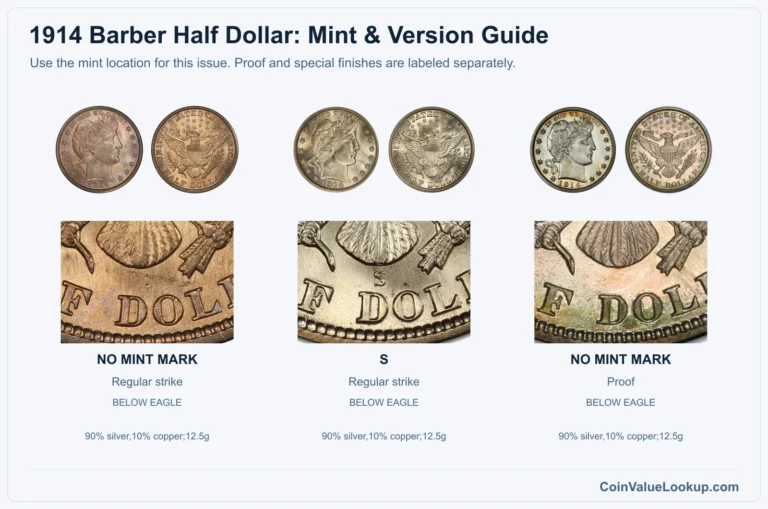
Look for the 1894 date on the obverse beneath Liberty's chin, and confirm HALF DOLLAR on the reverse. The obverse shows a right-facing Liberty head wearing a Phrygian cap with a laurel wreath, while the reverse carries a heraldic eagle with shield.
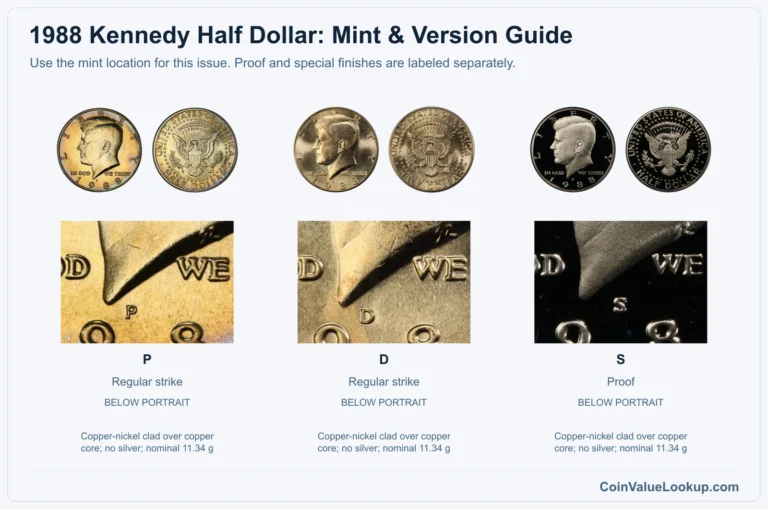
The mintmark sits on the reverse, just below the eagle's tail feathers and above the words HALF DOLLAR. Philadelphia coins have no mintmark at all.
An "O" means New Orleans, and an "S" means San Francisco. There is no "D" mint for this date.
All regular 1894 Barber halves are struck in 90% silver and 10% copper, weigh about 12.5 grams, measure 30.6 mm across, and have a reeded edge. Do not confuse the 1894-S half dollar with the famous 1894-S Barber dime — they are entirely different coins with very different rarity profiles.
Step 2: Check Your 1894 Barber Half Dollar Grade
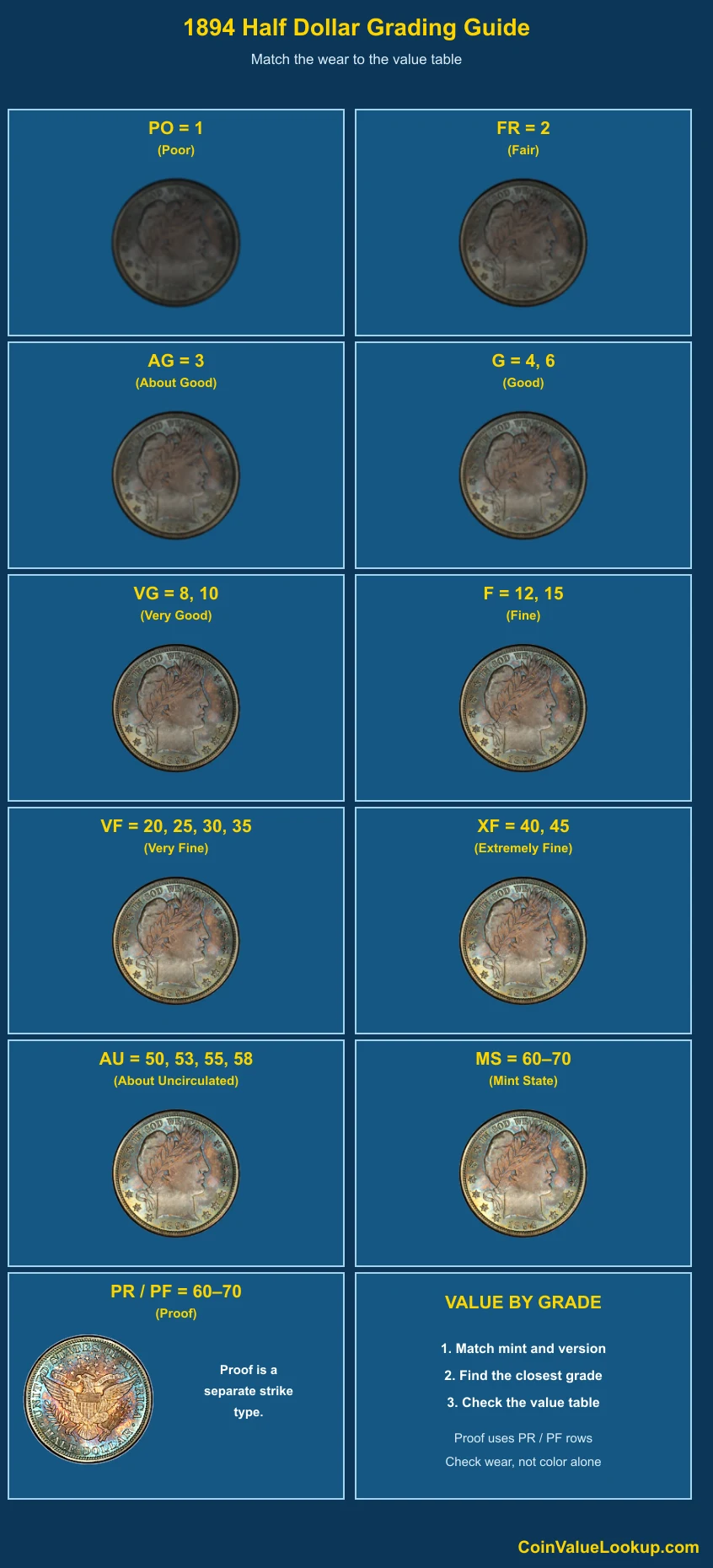
Start with Liberty's cheek and the hair detail above the forehead. On a well-worn coin, the cheek will be flat and the hair ribbons will merge into a smooth surface.
A mid-grade piece retains some separation in the hair curls and a partial LIBERTY on the headband.
Flip to the reverse and check the eagle's head, wing tips, and tail feathers. These high points wear first, so mushy feathers suggest heavy circulation.
Use the comparison image to match your coin's detail against known grades.
New Orleans strikes can show weakness at the eagle's claws and arrow feathers even on higher-grade pieces, so don't mistake a soft strike for wear. Loss of original mint luster is a wear indicator, but a dipped or cleaned coin can also lose luster artificially.
Proof is a manufacturing finish with mirrored fields, not a grade above Mint State — polishing a business strike does not create a Proof.
Step 3: Check 1894 Barber Half Dollar Value by Mint and Version
1894 Barber Half Dollar — No Mint Mark — Regular Issue
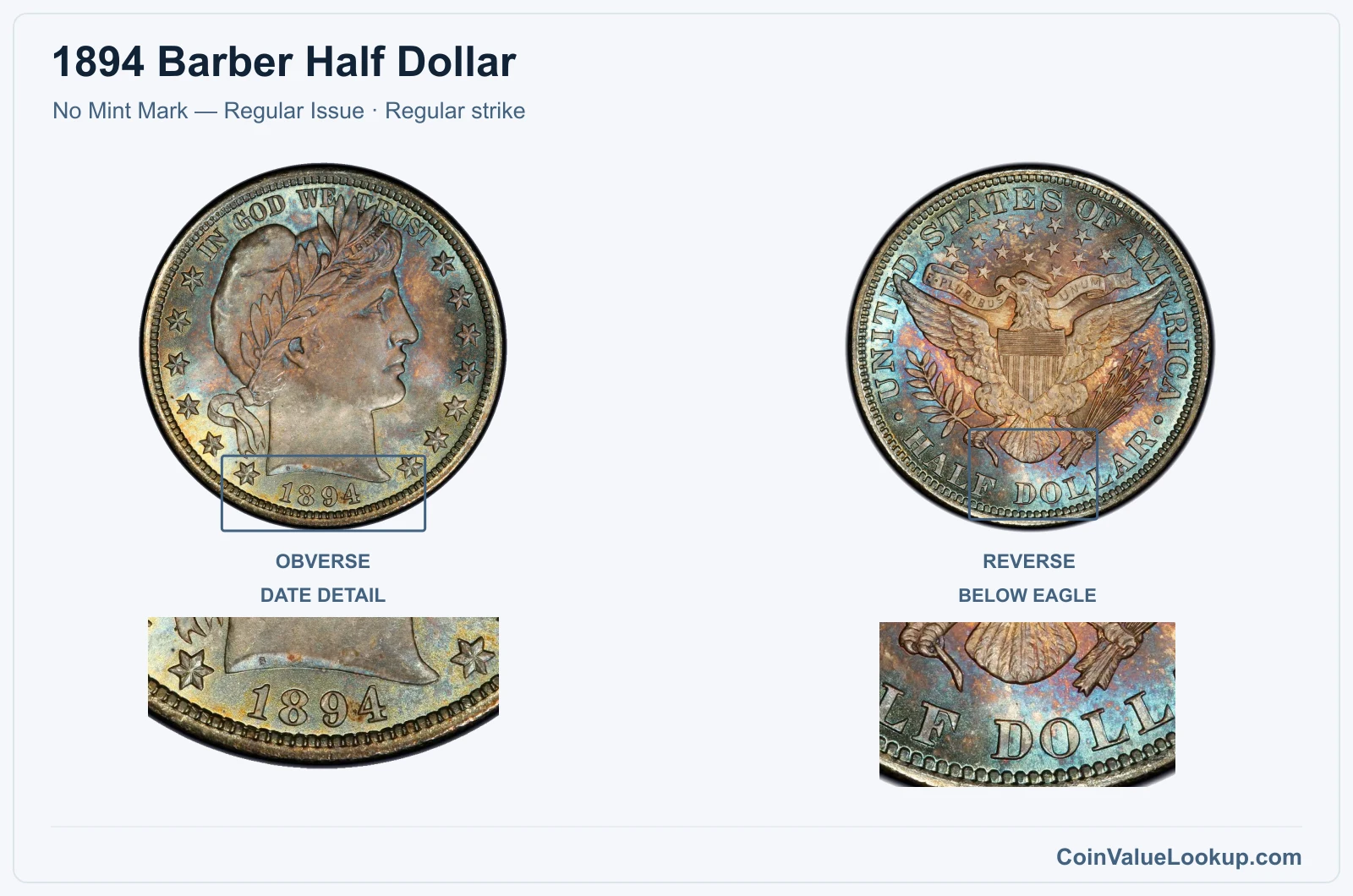
The 1894 Philadelphia half dollar carries no mintmark. Look at the reverse below the eagle's tail — if the space is blank, you have the P-mint issue.
USA Coin Book guide estimates place this version at about $68 in G4 (a heavily worn but readable coin) and around $1,314 in MS63 (a lightly marked uncirculated piece with good luster). The jump between those two figures tells you everything about why condition matters.
Original, uncleaned surfaces are what experienced buyers look for, so resist the urge to polish anything.
Coin Value Lookup is a good starting point if you want to look up other Barber half dollar dates or different denominations from the same era.
Range Grade
Price Auction Records Appraisal PO PO 1
—
Coin Identifier FR FR 2
—
Coin Identifier AG AG 3
—
Coin Identifier G G 4
—
Coin Identifier
G 6
Coin Identifier VG VG 8
Coin Identifier
VG 10
Coin Identifier F F 12
Coin Identifier
F 15
Coin Identifier VF VF 20
Coin Identifier
VF 25
Coin Identifier
VF 30
Coin Identifier
VF 35
Coin Identifier XF XF 40
Coin Identifier
XF 45
Coin Identifier AU AU 50
Coin Identifier
AU 53
Coin Identifier
AU 55
Coin Identifier
AU 58
Coin Identifier MS MS 60
Coin Identifier
MS 61
Coin Identifier
MS 62
Coin Identifier
MS 63
Coin Identifier
MS 64
Coin Identifier
MS 65
Coin Identifier
MS 66
Coin Identifier
MS 67
Coin Identifier
MS 68
—
—
—
MS 69
—
—
—
MS 70
—
—
—
1894 Barber Half Dollar — O — Regular Issue
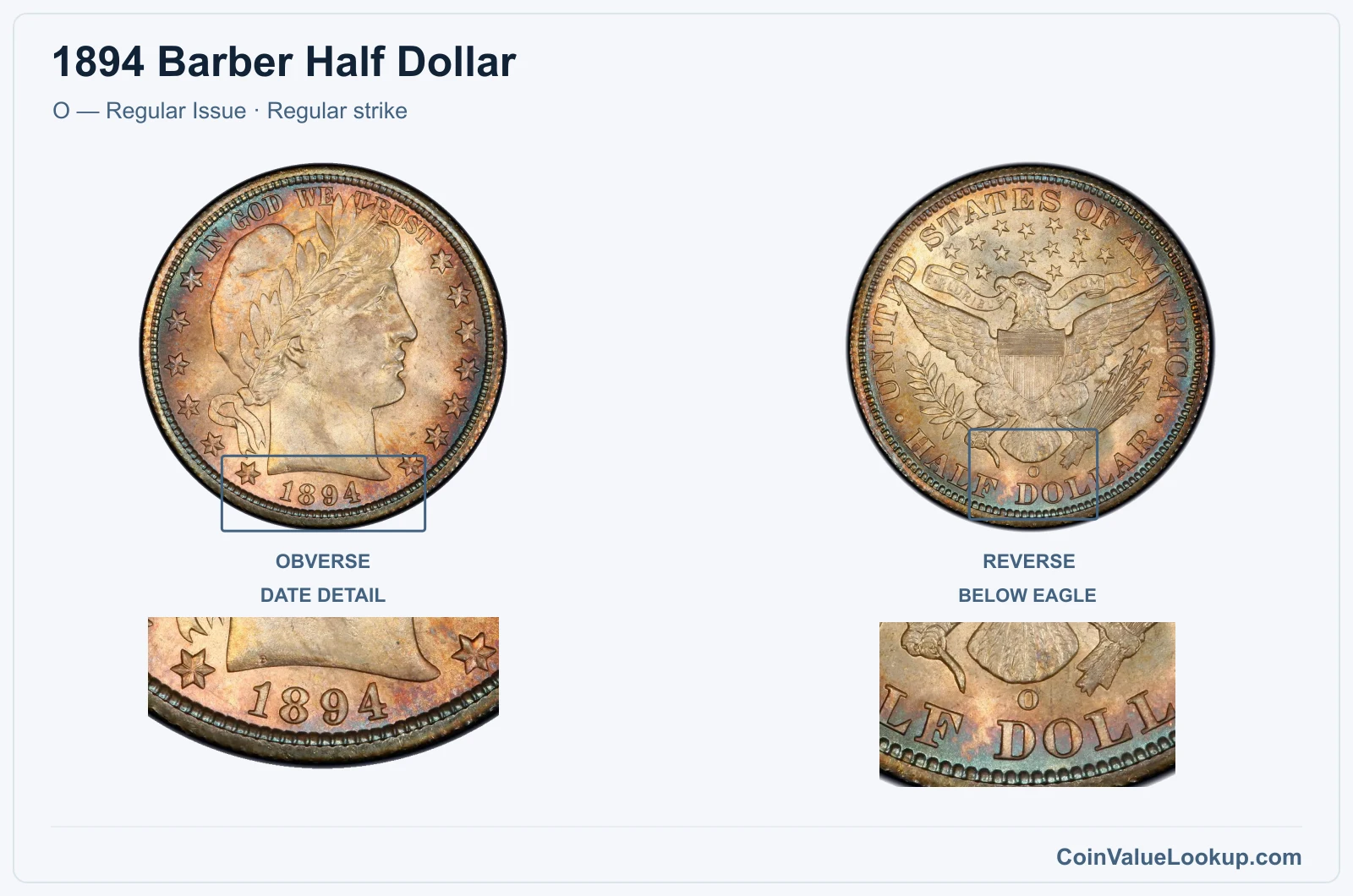
An "O" mintmark below the eagle's tail identifies the New Orleans issue. This mint is known for occasionally softer strikes on Barber halves, particularly at the eagle's claws and arrow feathers on the reverse.
The USA Coin Book guide lists the 1894-O at roughly $61 in G4 and about $1,617 in MS63. That soft-strike tendency means you need to look carefully at the entire coin before deciding whether lost detail comes from wear or from the way it was made.
A weak strike on an otherwise lustrous coin is very different from genuine friction. Evaluate the whole surface, not just one spot.
Range Grade
Price Auction Records Appraisal PO PO 1
—
Coin Identifier FR FR 2
—
Coin Identifier AG AG 3
—
Coin Identifier G G 4
—
Coin Identifier
G 6
—
Coin Identifier VG VG 8
Coin Identifier
VG 10
Coin Identifier F F 12
Coin Identifier
F 15
Coin Identifier VF VF 20
Coin Identifier
VF 25
Coin Identifier
VF 30
Coin Identifier
VF 35
Coin Identifier XF XF 40
Coin Identifier
XF 45
Coin Identifier AU AU 50
Coin Identifier
AU 53
Coin Identifier
AU 55
Coin Identifier
AU 58
Coin Identifier MS MS 60
Coin Identifier
MS 61
Coin Identifier
MS 62
Coin Identifier
MS 63
Coin Identifier
MS 64
Coin Identifier
MS 65
Coin Identifier
MS 66
Coin Identifier
MS 67
Coin Identifier
MS 68
Coin Identifier
MS 69
—
—
—
MS 70
—
—
—
1894 Barber Half Dollar — S — Regular Issue
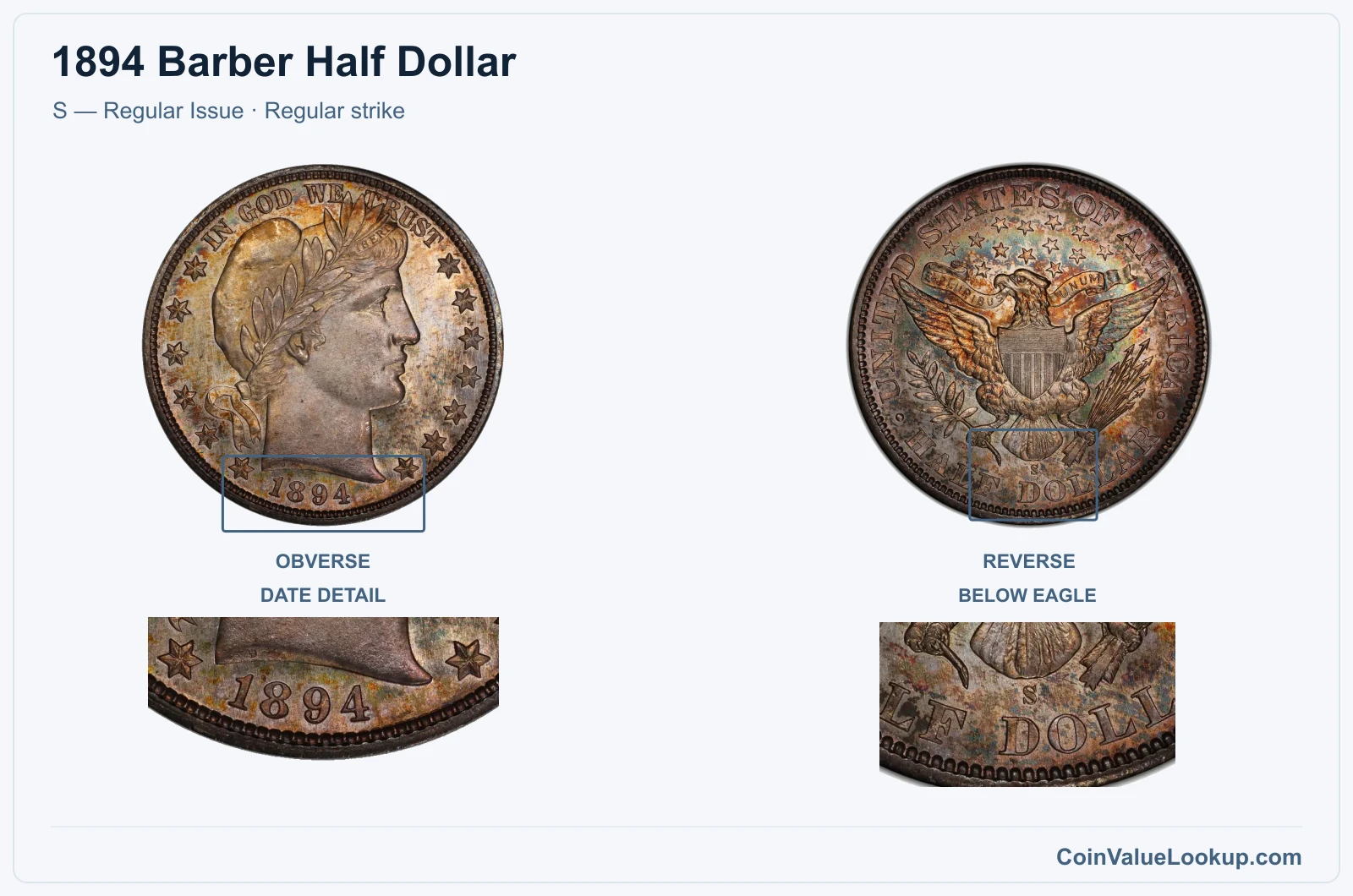
A small "S" below the eagle's tail marks the San Francisco half. Don't confuse this with the legendary 1894-S Barber dime — the half dollar is a regular collectible issue, not a six-figure rarity.
Guide estimates from USA Coin Book put the 1894-S half at approximately $56 in G4 and around $1,765 in MS63. That MS63 figure is the highest among the three business-strike mints for this date, which means a genuinely uncirculated example with original surfaces deserves careful attention.
Check for cleaning or artificial toning, because those problems sharply reduce what a collector will pay.
Range Grade
Price Auction Records Appraisal PO PO 1
—
Coin Identifier FR FR 2
Coin Identifier AG AG 3
—
Coin Identifier G G 4
Coin Identifier
G 6
—
Coin Identifier VG VG 8
Coin Identifier
VG 10
Coin Identifier F F 12
Coin Identifier
F 15
Coin Identifier VF VF 20
Coin Identifier
VF 25
Coin Identifier
VF 30
Coin Identifier
VF 35
Coin Identifier XF XF 40
Coin Identifier
XF 45
Coin Identifier AU AU 50
Coin Identifier
AU 53
Coin Identifier
AU 55
Coin Identifier
AU 58
Coin Identifier MS MS 60
Coin Identifier
MS 61
Coin Identifier
MS 62
Coin Identifier
MS 63
Coin Identifier
MS 64
Coin Identifier
MS 65
Coin Identifier
MS 66
Coin Identifier
MS 67
—
Coin Identifier
MS 68
—
—
—
MS 69
—
—
—
MS 70
—
—
—
1894 Barber Half Dollar — No Mint Mark — Proof
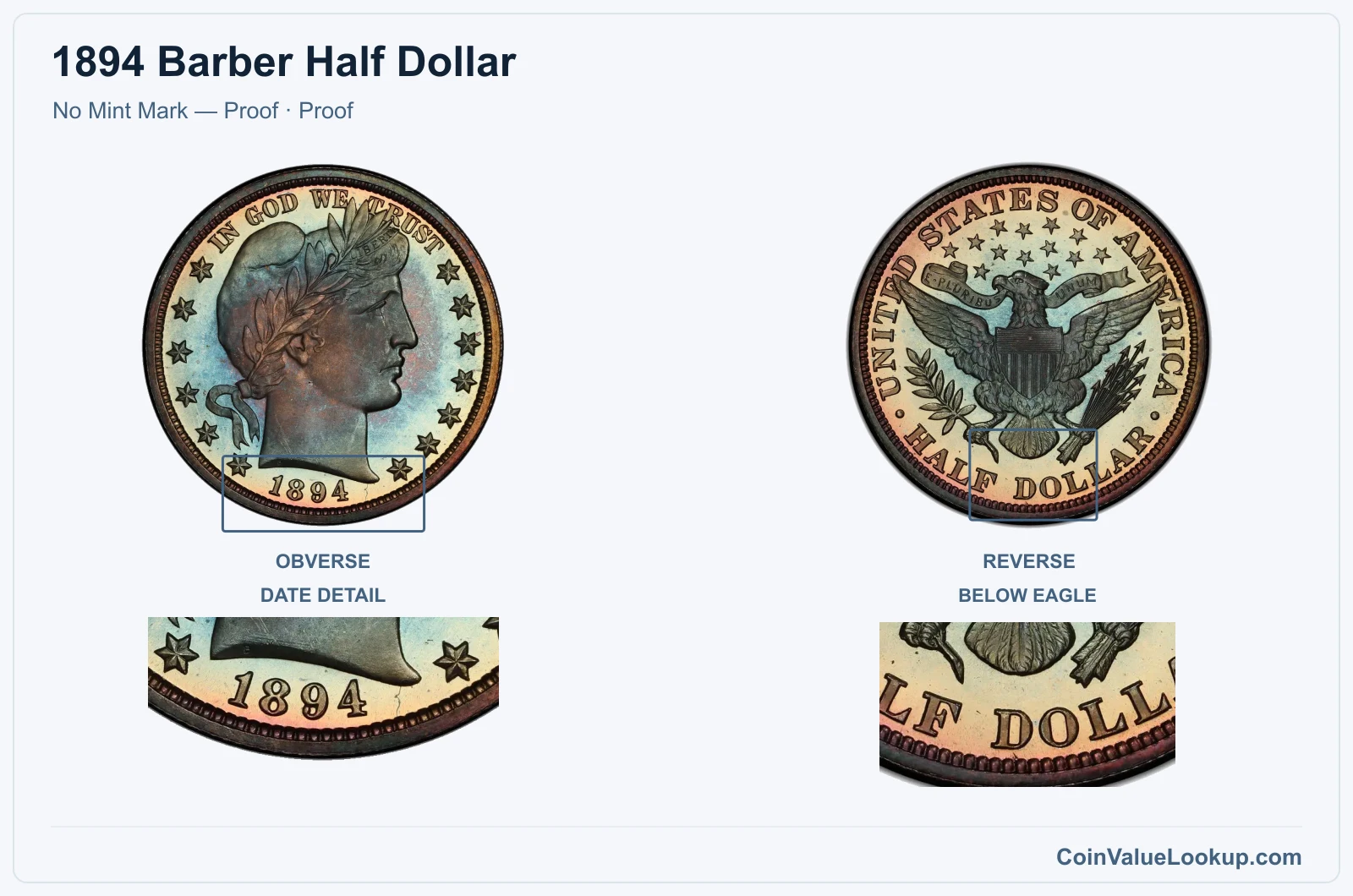
Philadelphia produced Proof Barber halves for collectors, and the 1894 is no exception. Genuine Proofs display deeply mirrored fields, razor-sharp design details, and squared-off rims that business strikes simply do not have.
The USA Coin Book guide places a PR63 example at about $1,363. Proof designation is about how the coin was manufactured — specially prepared dies and planchets, struck multiple times — not about being in better condition than Mint State.
A polished business strike is not a Proof, no matter how shiny it looks. If you suspect you have one, professional attribution from a major grading service is the way to confirm it.
Compare the rim profile and field reflectivity against known Proof examples before drawing conclusions.
Range Grade
Price Auction Records Appraisal PR PR 1
—
Coin Identifier
PR 2
—
Coin Identifier
PR 3
—
Coin Identifier
PR 4
—
Coin Identifier
PR 6
—
Coin Identifier
PR 8
—
Coin Identifier
PR 10
—
Coin Identifier
PR 12
—
Coin Identifier
PR 15
—
Coin Identifier
PR 20
—
Coin Identifier
PR 25
—
Coin Identifier
PR 30
—
Coin Identifier
PR 35
—
Coin Identifier
PR 40
—
Coin Identifier
PR 45
—
Coin Identifier
PR 50
—
Coin Identifier
PR 53
—
Coin Identifier
PR 55
Coin Identifier
PR 58
—
Coin Identifier
PR 60
Coin Identifier
PR 61
Coin Identifier
PR 62
Coin Identifier
PR 63
Coin Identifier
PR 64
Coin Identifier
PR 65
Coin Identifier
PR 66
Coin Identifier
PR 67
Coin Identifier
PR 68
—
Coin Identifier
PR 69
—
—
—
PR 70
—
—
—
1894 Barber Half Dollar Error List
1. 1894 Barber Half Dollar — Off-Center Strike
An off-center strike happens when the planchet isn't seated properly in the press, so part of the design shifts toward one side and leaves an unstruck crescent of blank metal on the opposite edge. On an 1894 half dollar, the specific mint isn't always identifiable on a displaced specimen because the mintmark area may fall in the missing zone.
To spot one, look for a complete design that has visibly migrated away from center, leaving a smooth crescent. The date should still be readable for the coin to have collector interest.
Don't confuse this with a clipped planchet, which removes a curved bite from one edge, or with a coin that was simply flattened or damaged after leaving the mint. Post-mint damage won't show a matching unstruck area with original planchet surface.
No specific price data is available for this error on the 1894 date; value depends on the degree of displacement, date visibility, and overall condition.
2. 1894 Barber Half Dollar — Broadstrike
A broadstrike occurs when the coin is struck without the retaining collar that normally constrains the planchet's edge and forms the reeded rim. The result is a coin with outward metal spread, a larger-than-normal diameter, and a distorted or missing edge reeding.
One cataloged example involves an 1894-O described as a broadstrike with about 5% off-center displacement — a combined error, not two separate premiums.
Check the edge profile first. A genuine broadstrike will show metal that flowed outward uniformly, and the rim will look flattened or absent rather than sharply defined.
Compare this to a coin that was simply squashed after minting, which typically shows uneven damage and tool marks. Also distinguish it from a pure off-center strike, where design loss is more dramatic on one side.
No adopted price range exists for this error on the 1894 half dollar; its value hinges on the degree of spread, the coin's condition, and whether both sides are fully struck.