1895 Barber Half Dollar Coin Value: How Much Is It Worth?
The 1895 Barber Half Dollar spans roughly $56 at G4 to about $2,051 at MS63 across its three business-strike mints, according to a USA Coin Book guide snapshot. Proofs and special varieties carry separate pricing.
Philadelphia, New Orleans, and San Francisco each struck coins this year, and all mints become genuinely scarce once you reach upper circulated and Mint State grades with original surfaces.
Fast Way to Identify Your 1895 Barber Half Dollar
The quickest way to start figuring out what your 1895 half dollar is worth is to upload clear photos of the front and back. Our identifier can give you a preliminary read on the mint, finish, and general condition from those images alone.
Grab a well-lit shot of each side and let the tool do the initial sorting for you.
1895 Barber Half Dollar Value
Upload both sides of your 1895 Barber Half Dollar.
Front Obverse
Upload photo
Back Reverse
Upload photo
Which 1895 Barber Half Dollar Versions Are Worth Money?
- The 1895-O carries the highest guide values in this set, listed at about $87 in G4 and around $2,051 at MS63, reflecting lower survival in higher grades.
- The 1895-S is a collectible San Francisco issue, with guide values of roughly $68 at G4 and $1,540 at MS63.
- Philadelphia Proofs are listed near $1,363 at PR63 and are entirely separate from no-mintmark business strikes.
- Original, problem-free coins in upper circulated or Mint State grades from any mint are significantly more valuable than heavily worn or cleaned examples.
- Check your mintmark and finish carefully before referencing values — an unusual mark alone does not establish a valuable error.
Step 1: Identify Your 1895 Barber Half Dollar Mint Mark and Version
First, confirm you have an 1895 date on the obverse, with Liberty's head facing right and a heraldic eagle on the reverse. The denomination HALF DOLLAR appears below the eagle.
All regular 1895 half dollars are struck in 90% silver and 10% copper, weigh about 12.5 grams, measure 30.6 mm across, and have a reeded edge.
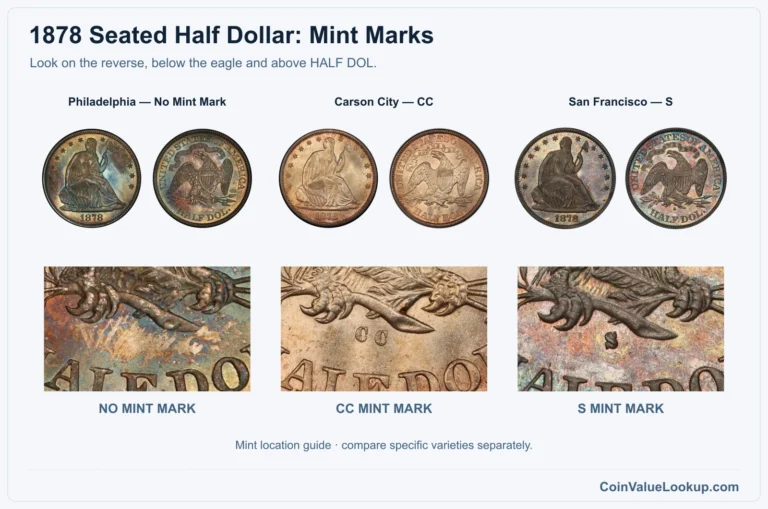
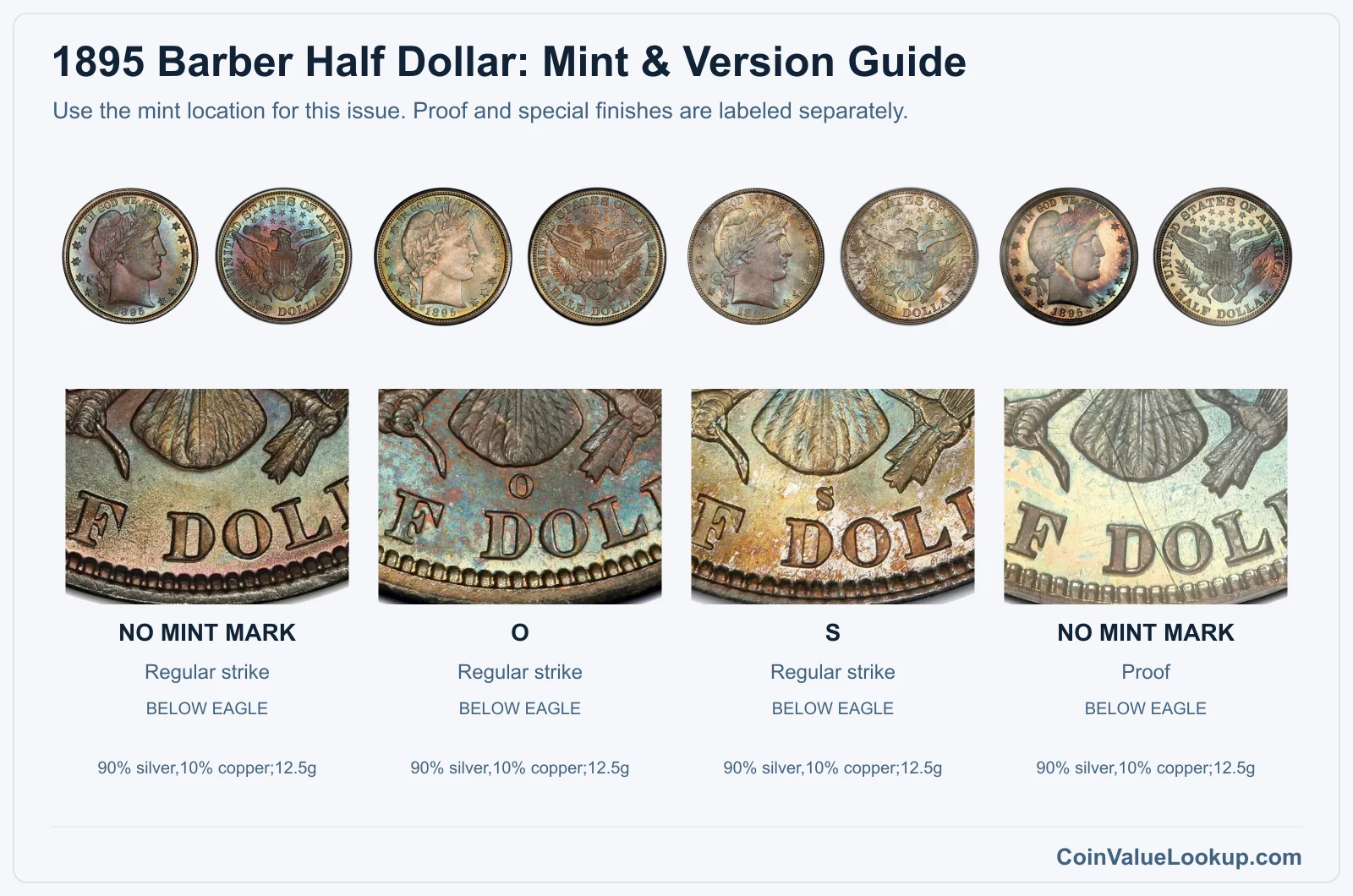
The critical step is finding the mintmark. Look on the reverse, just below the eagle's tail feathers and above the words HALF DOLLAR.
A small "O" means New Orleans, an "S" means San Francisco, and no letter at all means Philadelphia. Get a magnifier if you need one — the mark is small and can hide in wear or toning.
Philadelphia also produced Proof strikes this year, which are a separate category from business strikes. A Proof has deeply mirrored fields and sharp rims; polishing a worn coin does not create a Proof.
If you think you have one, professional attribution is the safest route.
The San Francisco issue is a collectible date, and original problem-free examples from any mint climb sharply in value as condition improves. Read the mint and finish correctly before jumping to a value chart.
Step 2: Check Your 1895 Barber Half Dollar Grade
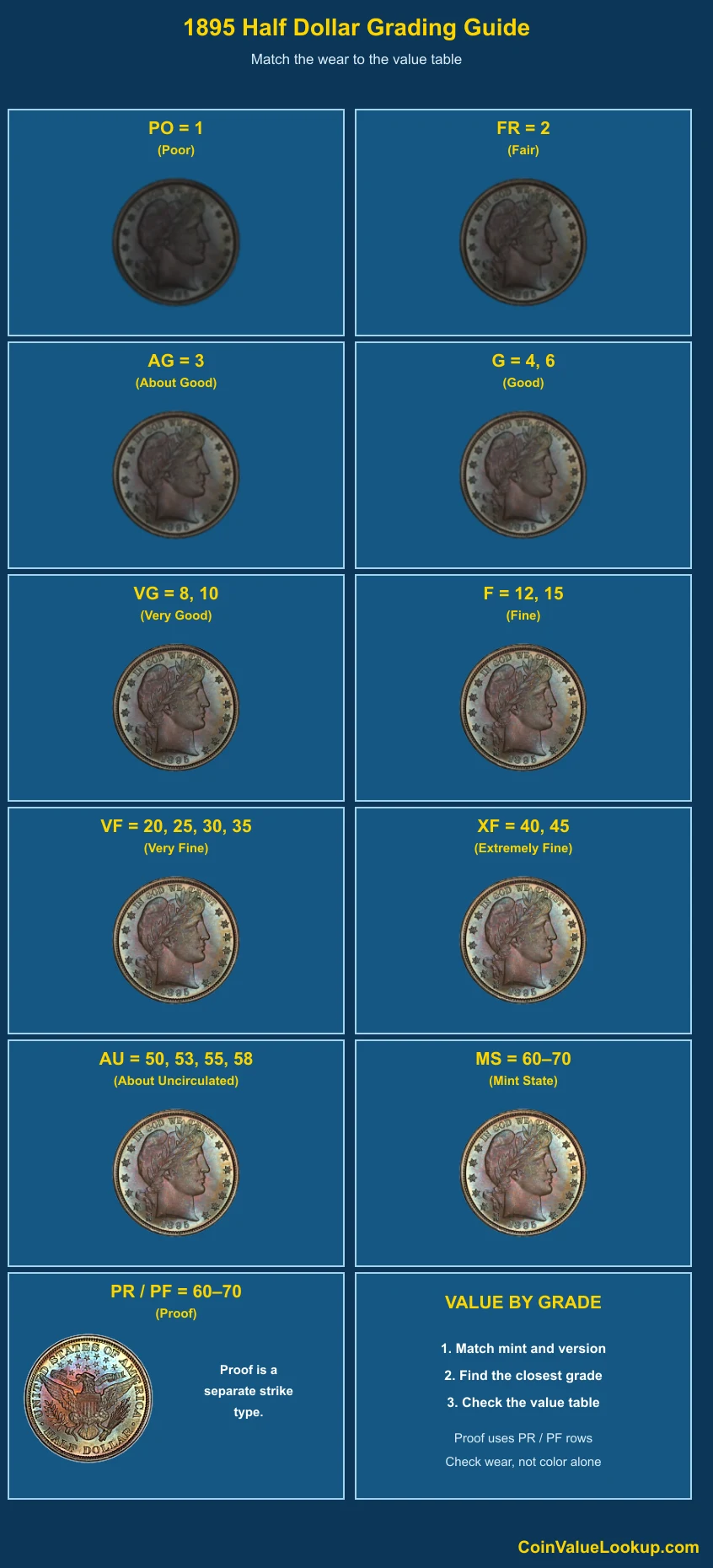
Start with Liberty's cheek and the hair detail just above her ear — these are the first spots to show friction. Then check the headband letters.
On the reverse, look at the eagle's head, wing tips, and tail feathers for matching wear.
Do not grade by the LIBERTY inscription alone. Hub changes during the Barber series can affect how quickly those letters wore, so relying on them exclusively can mislead you.
Use the comparison image to match overall detail loss across the entire coin.
New Orleans strikes deserve extra caution. Weak eagle claws and blurred arrow feathers on an O-mint coin may reflect a soft original strike rather than heavy circulation.
Look at the surrounding luster to decide whether softness is wear or manufacturing.
Separate cleaning and environmental damage from honest wear. A coin that has been harshly cleaned loses luster and develops a distinctive dull, washed-out look.
Original surfaces — even with honest wear — are far more desirable to collectors, and a problem-free upper-circulated piece can be worth considerably more than a cleaned Mint State example.
Remember that Proof is a manufacturing finish, not a grade above Mint State. A Proof can be impaired or low-grade if it has damage, while a business strike can still be superb.
Step 3: Check 1895 Barber Half Dollar Value by Mint and Version
1895 Barber Half Dollar — No Mint Mark — Regular Issue
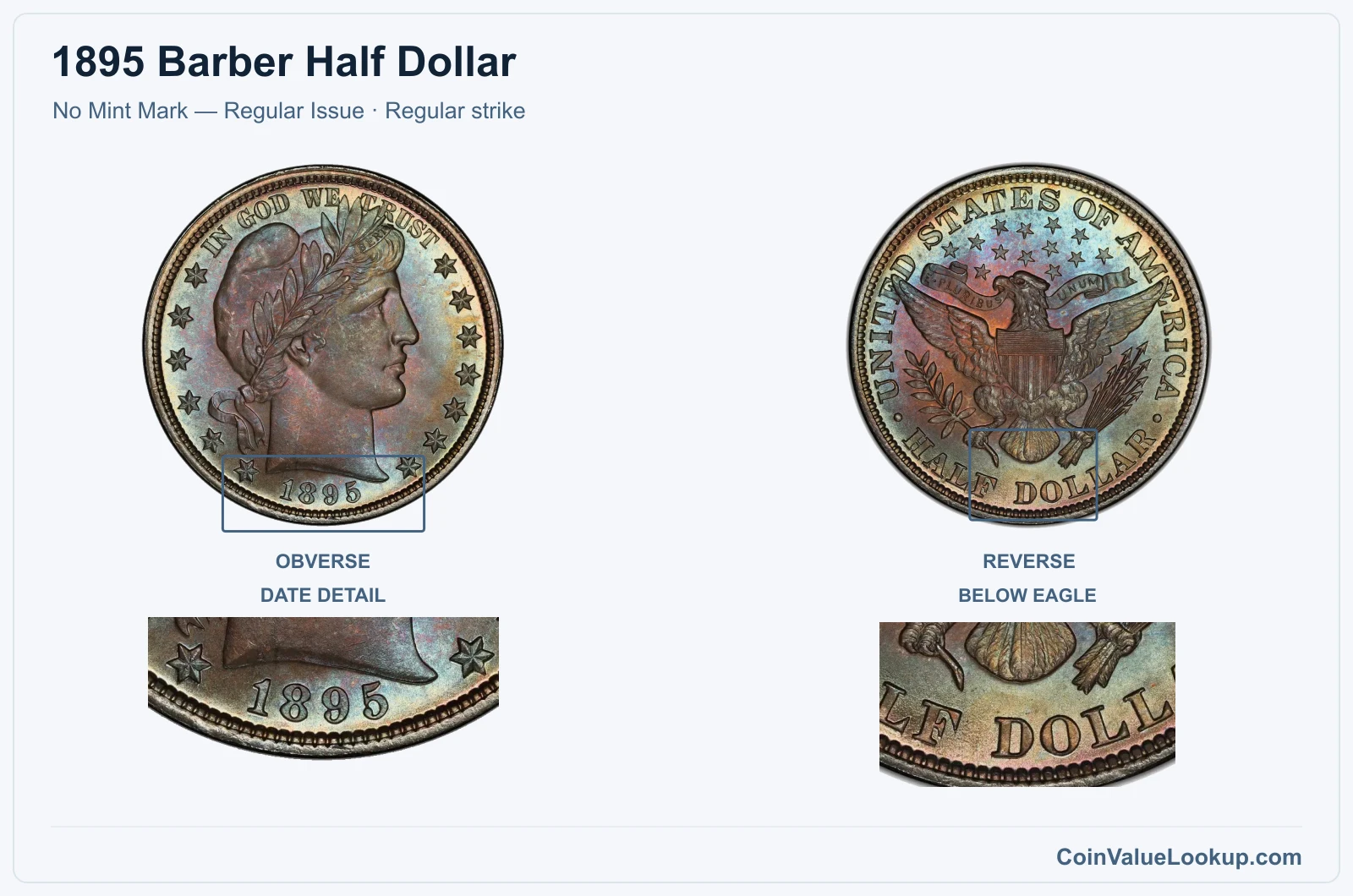
The Philadelphia issue carries no mintmark, so the space below the eagle's tail on the reverse should be blank. In well-worn condition around G4, the USA Coin Book guide lists this coin near $56, climbing to approximately $1,176 at MS63.
That is a dramatic spread, and it tells you that original Mint State survivors are legitimately hard to find.
Condition and originality matter enormously here. A heavily worn piece with clear date and type detail is common enough, but an example with full luster and no cleaning is a different animal.
Before pricing your coin, examine it closely for signs of old cleaning or tooling — those issues reduce value sharply.
Range Grade
Price Auction Records Appraisal PO PO 1
—
Coin Identifier FR FR 2
—
Coin Identifier AG AG 3
—
Coin Identifier G G 4
Coin Identifier
G 6
—
Coin Identifier VG VG 8
Coin Identifier
VG 10
Coin Identifier F F 12
—
Coin Identifier
F 15
Coin Identifier VF VF 20
Coin Identifier
VF 25
Coin Identifier
VF 30
Coin Identifier
VF 35
Coin Identifier XF XF 40
Coin Identifier
XF 45
Coin Identifier AU AU 50
Coin Identifier
AU 53
Coin Identifier
AU 55
Coin Identifier
AU 58
Coin Identifier MS MS 60
—
Coin Identifier
MS 61
Coin Identifier
MS 62
Coin Identifier
MS 63
Coin Identifier
MS 64
Coin Identifier
MS 65
Coin Identifier
MS 66
Coin Identifier
MS 67
Coin Identifier
MS 68
—
—
—
MS 69
—
—
—
MS 70
—
—
—
1895 Barber Half Dollar — O — Regular Issue
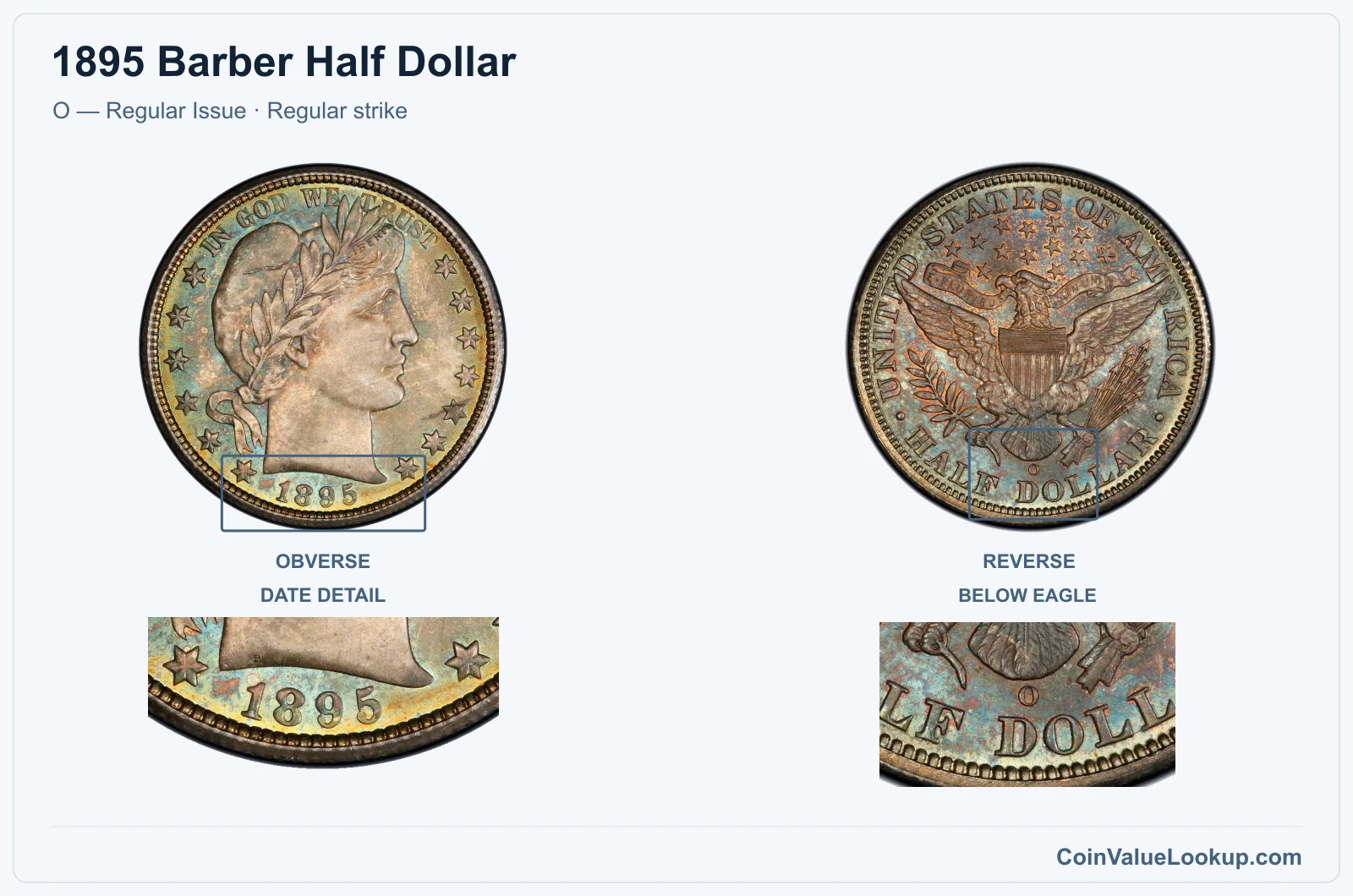
The New Orleans mint placed a small "O" below the eagle's tail feathers. This is the priciest business strike of the three 1895 mints in the guide data, listed near $87 at G4 and around $2,051 at MS63.
Those higher-grade premiums reflect genuine scarcity of surviving pieces with original surfaces.
When examining an O-mint Barber half, pay attention to strike quality. New Orleans coins sometimes have soft detail on the eagle's claws and arrow feathers even on well-preserved pieces, so do not mistake a manufacturing quirk for wear.
Compare luster across the whole coin rather than judging a single soft area.
Coin Value Lookup is a useful starting point if you want to check guide values for other dates and mints in the Barber half series. It can save you time before you commit to a deeper dive.
Range Grade
Price Auction Records Appraisal PO PO 1
—
Coin Identifier FR FR 2
—
Coin Identifier AG AG 3
Coin Identifier G G 4
Coin Identifier
G 6
Coin Identifier VG VG 8
—
Coin Identifier
VG 10
Coin Identifier F F 12
Coin Identifier
F 15
Coin Identifier VF VF 20
Coin Identifier
VF 25
Coin Identifier
VF 30
Coin Identifier
VF 35
Coin Identifier XF XF 40
Coin Identifier
XF 45
Coin Identifier AU AU 50
Coin Identifier
AU 53
Coin Identifier
AU 55
Coin Identifier
AU 58
Coin Identifier MS MS 60
—
Coin Identifier
MS 61
Coin Identifier
MS 62
Coin Identifier
MS 63
Coin Identifier
MS 64
Coin Identifier
MS 65
Coin Identifier
MS 66
Coin Identifier
MS 67
Coin Identifier
MS 68
—
—
—
MS 69
—
—
—
MS 70
—
—
—
1895 Barber Half Dollar — S — Regular Issue
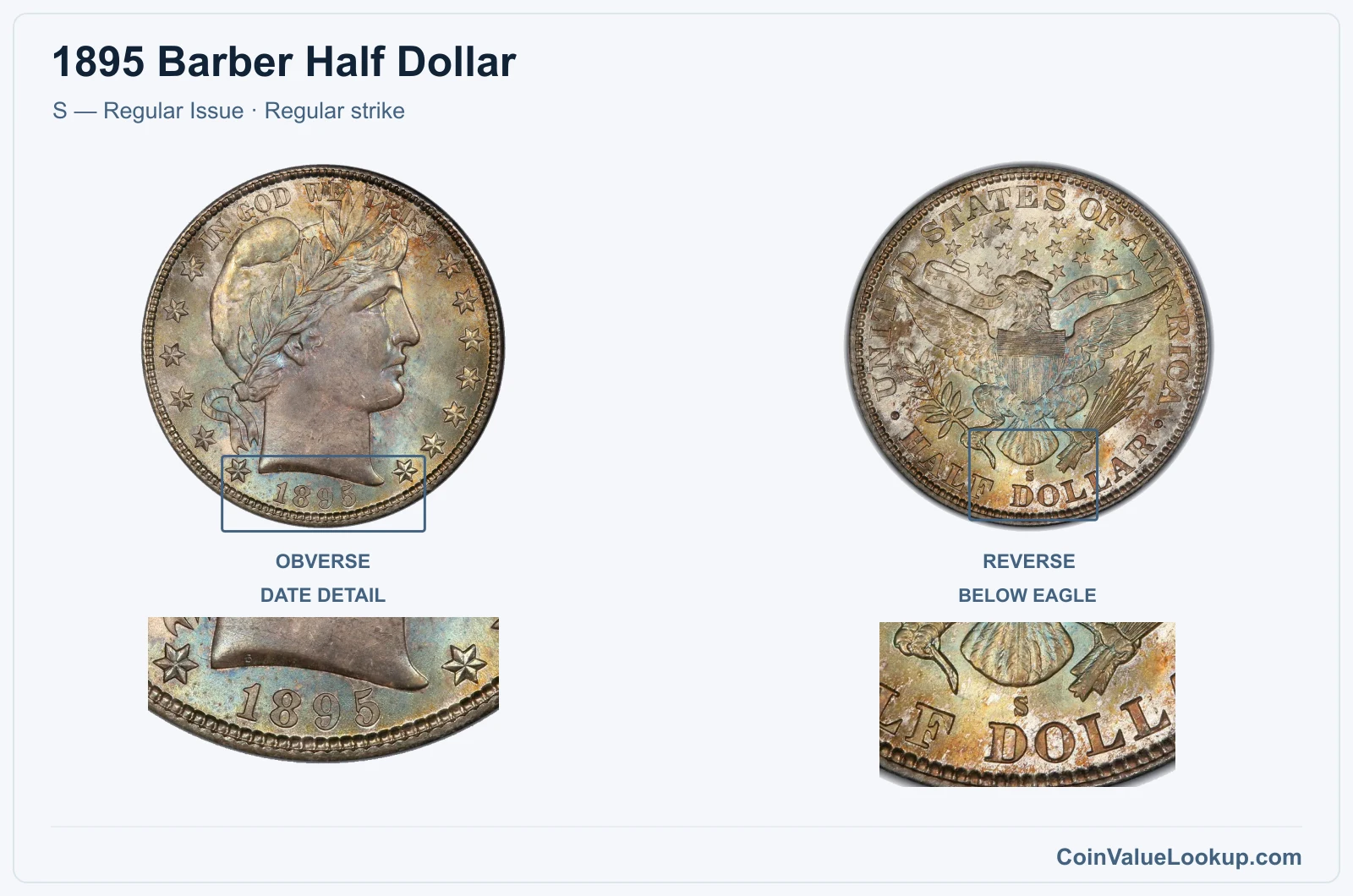
San Francisco placed an "S" mintmark in the same location below the eagle's tail. The 1895-S is a collectible date within the Barber half series.
Guide values sit around $68 at G4 and roughly $1,540 at MS63, so the jump from low grade to high grade is steep.
All three mints share the same 90% silver composition and design, so the mintmark is your only external separator. A loupe helps — the S can be partially obscured by wear or toning on circulated pieces.
Original surfaces and strong detail across Liberty's hair and the eagle's feathers are what push this coin into higher value territory.
Range Grade
Price Auction Records Appraisal PO PO 1
—
Coin Identifier FR FR 2
—
Coin Identifier AG AG 3
Coin Identifier G G 4
—
Coin Identifier
G 6
—
Coin Identifier VG VG 8
Coin Identifier
VG 10
Coin Identifier F F 12
Coin Identifier
F 15
Coin Identifier VF VF 20
Coin Identifier
VF 25
Coin Identifier
VF 30
Coin Identifier
VF 35
Coin Identifier XF XF 40
Coin Identifier
XF 45
Coin Identifier AU AU 50
Coin Identifier
AU 53
Coin Identifier
AU 55
Coin Identifier
AU 58
Coin Identifier MS MS 60
—
Coin Identifier
MS 61
Coin Identifier
MS 62
Coin Identifier
MS 63
Coin Identifier
MS 64
Coin Identifier
MS 65
Coin Identifier
MS 66
Coin Identifier
MS 67
Coin Identifier
MS 68
—
—
—
MS 69
—
—
—
MS 70
—
—
—
1895 Barber Half Dollar — No Mint Mark — Proof
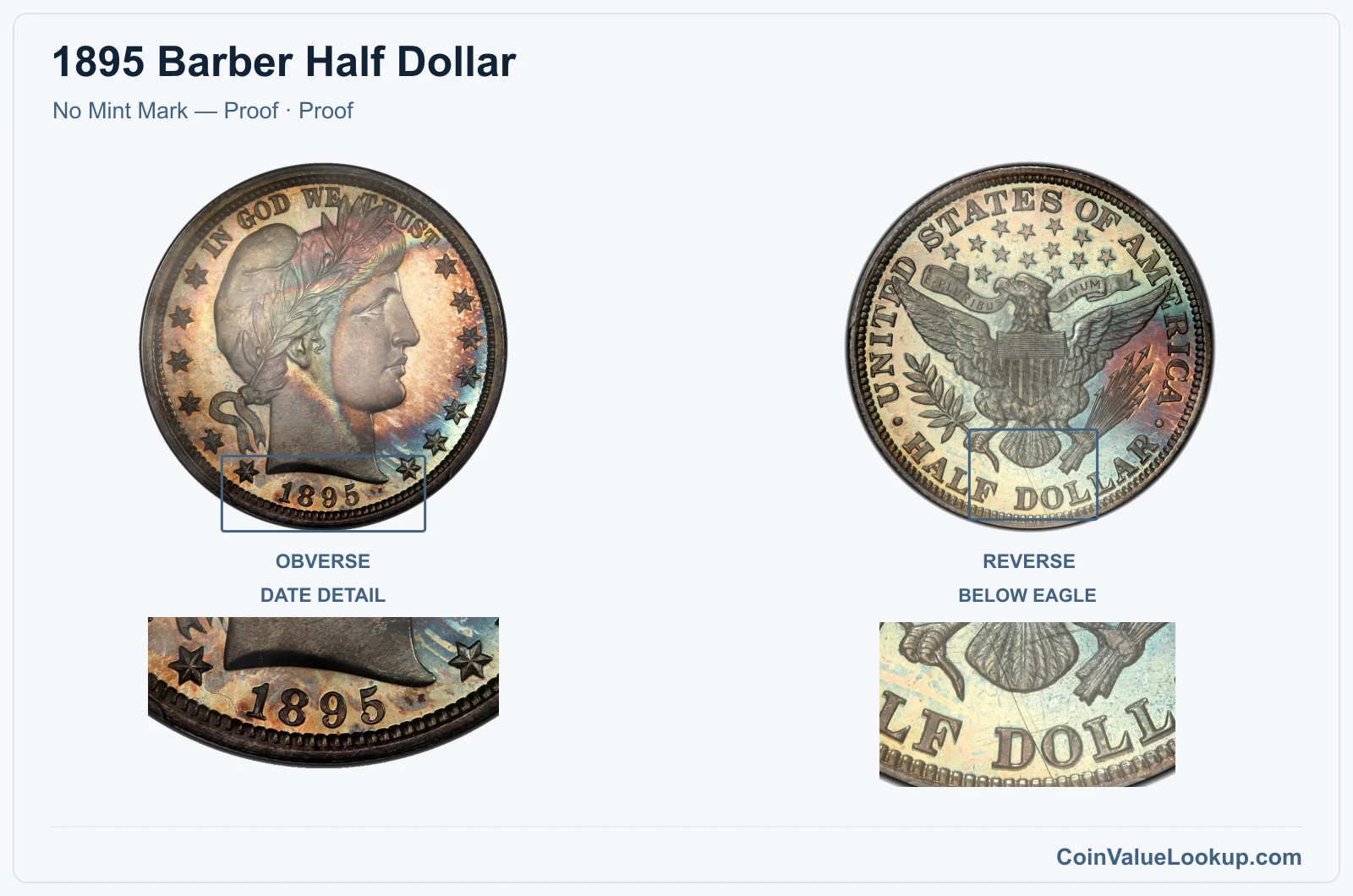
Philadelphia produced Proof Barber halves for collectors in 1895, and these are identified by deeply mirrored fields, razor-sharp design rims, and precise detail that business strikes simply do not match. The USA Coin Book guide lists the 1895 Proof near $1,363 at PR63.
A Proof has no mintmark, just like a Philadelphia business strike, so finish quality is the distinguishing factor. Look for perfectly reflective fields surrounding frosted or equally reflective devices.
If the fields look polished rather than originally mirrored, you may be looking at a cleaned business strike, not a Proof. Polishing a coin at home cannot create this finish — it is struck with specially prepared dies on polished planchets.
Professional authentication is strongly recommended before assuming you hold a genuine Proof. The difference in value is significant, and honest self-assessment matters here.
Range Grade
Price Auction Records Appraisal PR PR 1
—
Coin Identifier
PR 2
—
Coin Identifier
PR 3
—
Coin Identifier
PR 4
—
Coin Identifier
PR 6
—
Coin Identifier
PR 8
—
Coin Identifier
PR 10
—
Coin Identifier
PR 12
—
Coin Identifier
PR 15
—
Coin Identifier
PR 20
—
Coin Identifier
PR 25
—
Coin Identifier
PR 30
—
Coin Identifier
PR 35
—
Coin Identifier
PR 40
—
Coin Identifier
PR 45
—
Coin Identifier
PR 50
—
Coin Identifier
PR 53
—
Coin Identifier
PR 55
—
Coin Identifier
PR 58
—
Coin Identifier
PR 60
Coin Identifier
PR 61
Coin Identifier
PR 62
Coin Identifier
PR 63
Coin Identifier
PR 64
Coin Identifier
PR 65
Coin Identifier
PR 66
Coin Identifier
PR 67
Coin Identifier
PR 68
Coin Identifier
PR 69
—
—
—
PR 70
—
—
—
1895 Barber Half Dollar Error List
1. 1895 Barber Half Dollar — Repunched Date
A repunched date occurs when the date numerals were punched into the working die more than once, leaving traces of the earlier position alongside the final digits. On an 1895 Barber half, look carefully at each numeral — particularly the 1, 8, 9, and 5 — for shadowy remnants or offset outlines that sit slightly off from the primary impression.
This variety has been reported on 1895 Philadelphia Proofs. Do not confuse a repunched date with machine doubling, which tends to produce flat, shelf-like doubling rather than the rounded secondary punch impressions of a true repunched date.
Similarly, post-strike damage that shifts the appearance of the digits is not the same thing.
No specific price range is established for this variety. Value depends on the visibility of the repunching, the coin's overall condition, and collector demand for the specific die marriage.
2. 1895 Barber Half Dollar — Clashed Dies
Clashed dies happen when the obverse and reverse dies strike each other without a planchet between them, transferring ghost impressions of one design onto the opposite die. On the 1895-S Barber half, this has been reported as horizontal shield-line traces visible near Liberty's ear on the obverse — essentially faint lines from the eagle's shield transferred during the clash event.
To spot this, examine the area around Liberty's ear and cheek under magnification. You are looking for straight, regularly spaced lines that do not belong to the normal obverse design.
Random scratches, contact marks, or raised lines from a damaged die are not clash marks — true clash traces align with features of the opposite die.
No numerical price range is adopted for this variety. Its value depends on how clearly the clash evidence shows, the coin's grade, and collector interest.
3. 1895 Barber Half Dollar — Repunched Mintmark
A repunched mintmark appears when the mintmark punch was applied to the working die in slightly different positions, leaving remnants of the first placement visible beside or beneath the final letter. On an 1895 half dollar, inspect the O or S mintmark under magnification for notching, doubling, or a secondary outline that does not match the final mark's exact position.
Do not confuse this with machine doubling, which creates a flat, spread image rather than a distinctly offset second punch. Die chips or corrosion around the mintmark can also mimic a repunched appearance, so compare your coin against a known normal example at the same magnification.
No specific price range is established. Value varies with the strength and clarity of the repunching, the overall grade of the coin, and how well documented the particular die pair is among specialists.
4. 1895 Barber Half Dollar — Off-Center Strike
An off-center strike happens when the planchet is not seated properly between the dies, resulting in part of the design being displaced toward one edge while the opposite edge remains blank in an unstruck crescent. On a Barber half, this is quite unusual and eye-catching.
The key detail for value is whether the full date remains visible — an off-center coin that still shows 1895 is far more collectible than one where the date has slipped off the planchet. Look for a smooth, unstruck crescent along one rim rather than a clipped or damaged edge.
A clip has a distinct curved or straight cut; post-mint flattening can look superficially similar but lacks the crescent of blank planchet.
No numerical price range is adopted here. The percentage of off-center displacement, date visibility, and overall condition all influence what a collector would pay.
5. 1895 Barber Half Dollar — Rotated Dies
A rotated die error means the obverse and reverse dies were not aligned in their normal orientation. On standard US coins, when you hold the obverse upright and flip the coin top to bottom, the reverse should also appear upright.
If the reverse is turned at an angle, you have a die rotation.
To test this, hold your 1895 half dollar with Liberty facing you correctly, then rotate it along the vertical axis like turning a page. The eagle on the reverse should be right-side up.
Any measurable rotation — especially beyond about 15 degrees — is considered a collectible error. Slight rotations are more common and less valuable than dramatic ones.
Make sure you are not simply turning the coin sideways or looking at a rotated photograph. No numerical price range is established for this variety; value depends on the degree of rotation and the coin's condition.