1898 Barber Half Dollar Coin Value: How Much Is It Worth?
The 1898 Barber Half Dollar spans roughly $48 at G4 to around $3,103 at MS63, depending on mint and condition, based on a USA Coin Book retail-guide snapshot. Three business-strike mints were active this year: Philadelphia, New Orleans, and San Francisco.
The New Orleans issue is notably scarce in better grades, and a proof version was struck at Philadelphia. Original, problem-free examples in upper circulated or Mint State grades can command far more than their heavily worn counterparts.
Fast Way to Identify Your 1898 Barber Half Dollar
Snap clear photos of both the front and back of your 1898 Barber Half Dollar and upload them for a preliminary identification. This helps confirm the date, mintmark, and overall condition.
It is not a substitute for professional authentication or exact grading, but it gives you a solid starting point before deciding your next step.
1898 Barber Half Dollar Value
Upload both sides of your 1898 Barber Half Dollar.
Front Obverse
Upload photo
Back Reverse
Upload photo
Which 1898 Barber Half Dollar Versions Are Worth Money?
- The 1898-O half dollar is scarce in better grades; an MS63 example lists around $3,103 in one retail guide versus $68 at G4.
- The 1898-S half dollar follows a similar price curve, with an MS63 guide value near $3,103 versus $61 at G4.
- Philadelphia proof strikes in PR63 condition list around $1,363 and are a distinct collectible finish, not simply a high-grade business strike.
- Philadelphia business strikes are the most affordable entry point at about $48 in G4, but jump to around $1,261 at MS63.
- Original, problem-free coins in upper circulated and Mint State grades are far more valuable than heavily worn or cleaned pieces.
- Always confirm the mintmark and finish before consulting value charts; an unusual mark alone does not establish a valuable error.
Step 1: Identify Your 1898 Barber Half Dollar Mint Mark and Version
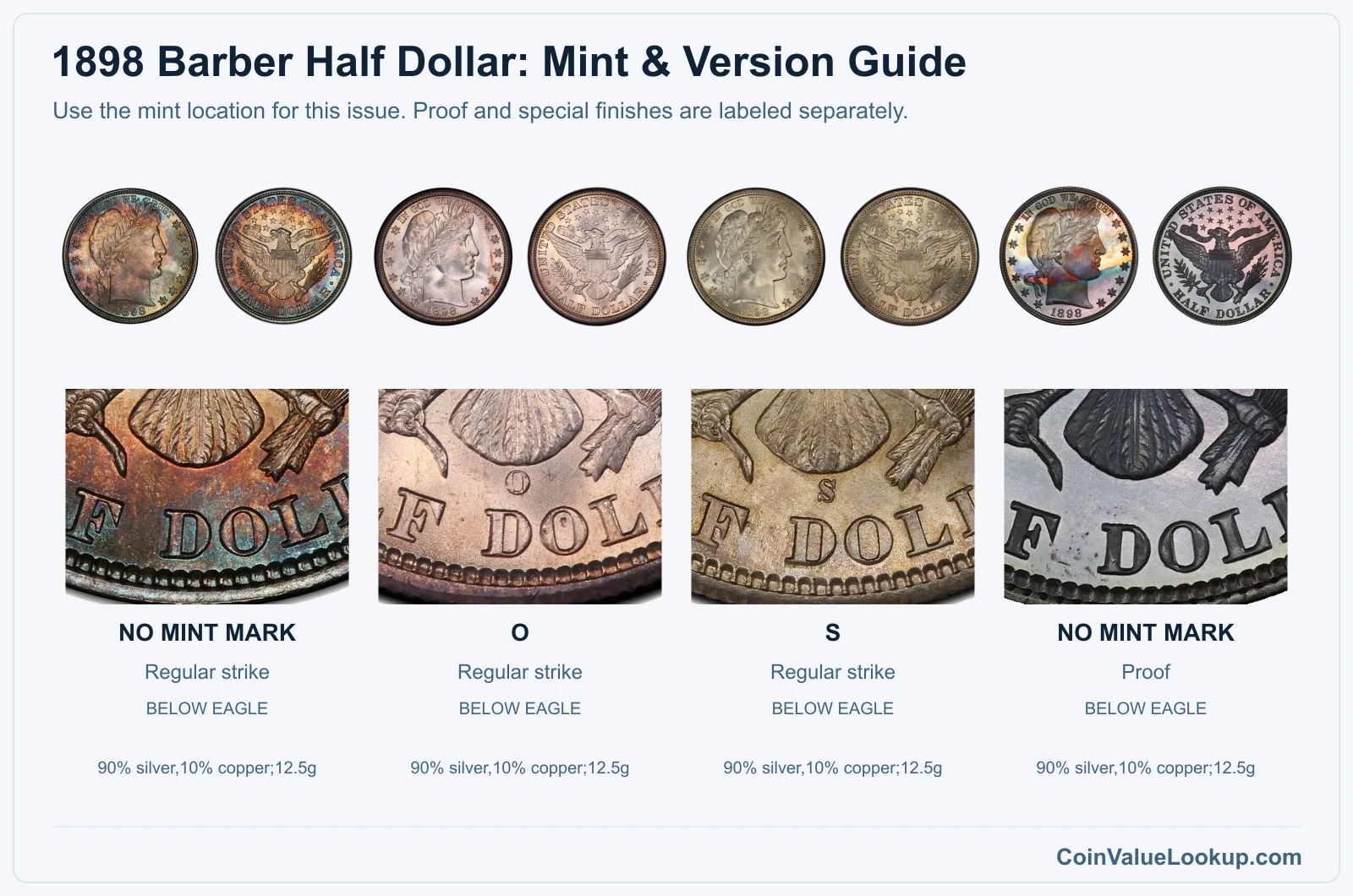
Start by confirming the 1898 date on the obverse, which shows a right-facing Liberty head. The reverse features a heraldic eagle with HALF DOLLAR below.
All regular issues are struck in 90% silver and 10% copper, weigh approximately 12.5 grams, measure 30.6 mm in diameter, and have a reeded edge.
The mintmark is on the reverse, located just below the eagle's tail feathers and above HALF DOLLAR. Philadelphia coins carry no mintmark.
New Orleans coins show an O, and San Francisco coins show an S.
A rumored Micro O variety for the 1898-O has circulated among collectors, but the Barber Coin Collectors' Society summary does not confirm it with certainty. The recognized Micro O belongs to the 1892-O issue.
If you believe your coin has an unusually small O mintmark, professional attribution is the right path rather than assuming it matches a confirmed variety.
Step 2: Check Your 1898 Barber Half Dollar Grade
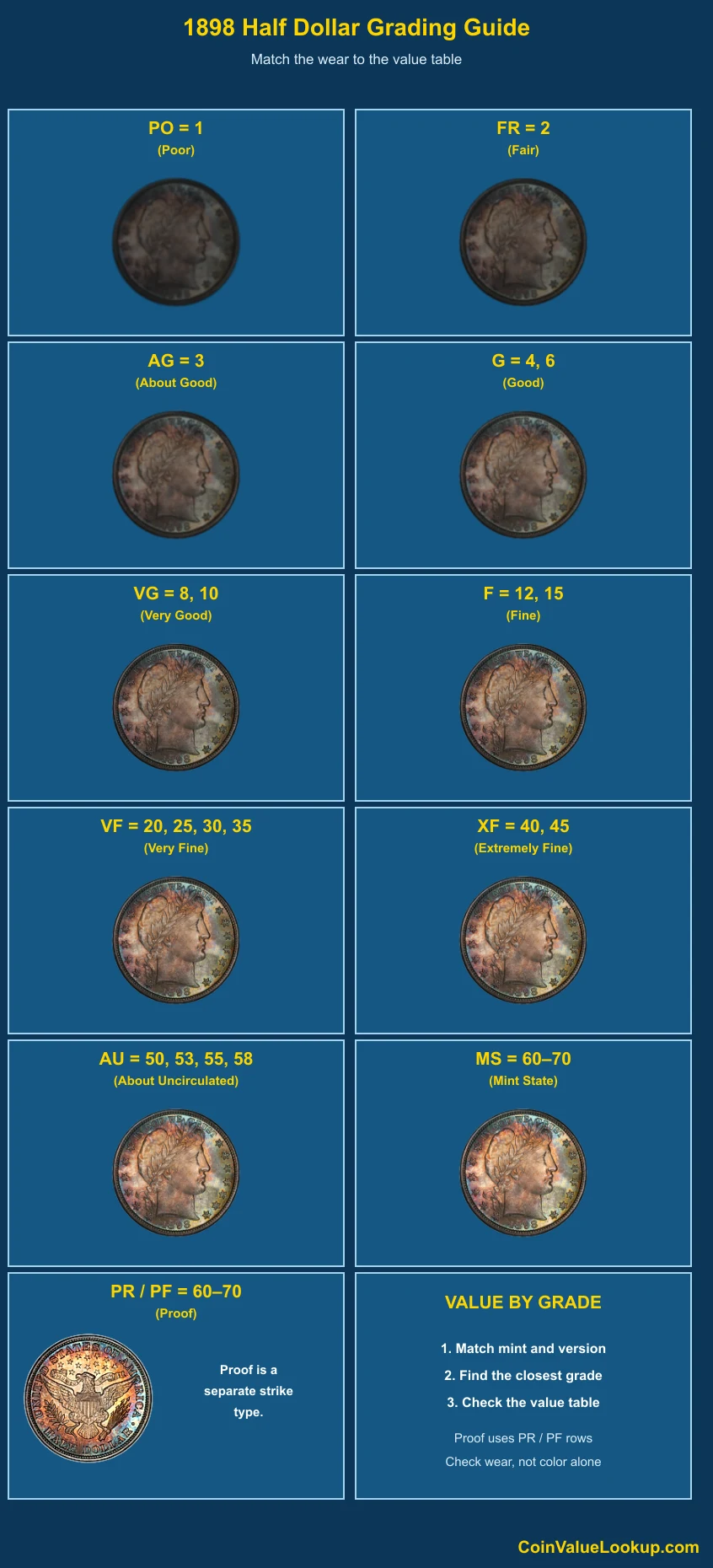
Focus on Liberty's cheek, the hair above the ear, and the LIBERTY inscription on the headband when evaluating wear on the obverse. On the reverse, check the eagle's head, wing tips, and tail feathers.
Compare your coin side-by-side with the grade comparison image to gauge where it falls.
Separate actual wear from a weak strike. New Orleans coins in particular can show soft detail at the eagle's claws and arrow feathers that looks like circulation wear but is actually a striking characteristic.
Mistaking one for the other can lead you to undergrade a coin that is actually better preserved than it appears.
Do not grade solely by whether LIBERTY is fully visible on the headband. Hub changes within the Barber series affect how quickly those letters wear, so a holistic look at the entire coin is more reliable.
Also remember that proof is a manufacturing finish involving specially prepared dies and planchets, not a grade above Mint State. A polished business strike is not a proof.
Step 3: Check 1898 Barber Half Dollar Value by Mint and Version
1898 Barber Half Dollar — No Mint Mark — Regular Issue
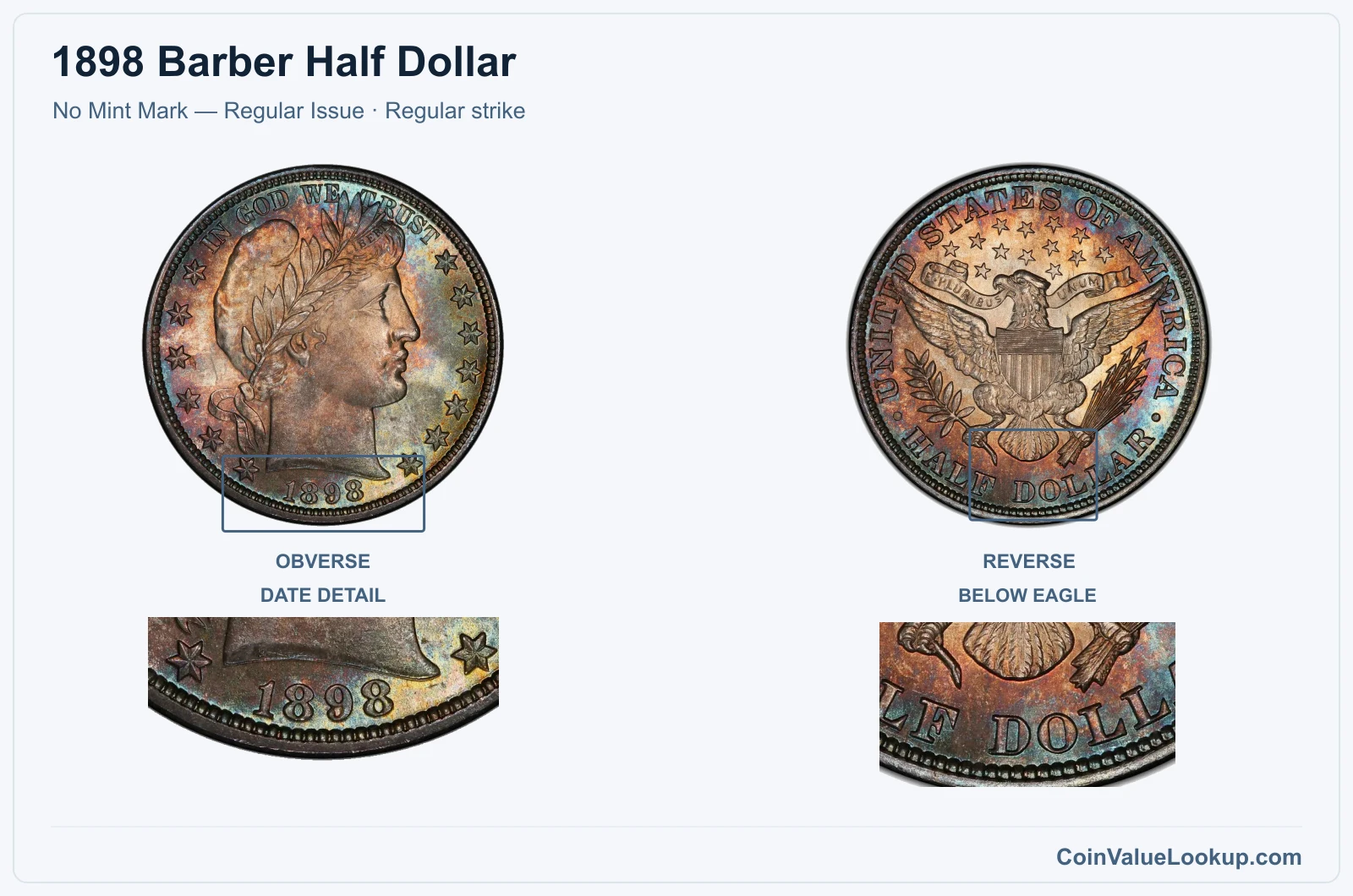
The 1898 Philadelphia Barber Half Dollar carries no mintmark. Look at the reverse below the eagle's tail to confirm the space is blank.
This is the most common mint for the date and the most affordable starting point, with a USA Coin Book guide estimate of about $48 at G4 and roughly $1,261 at MS63.
Condition matters enormously here. A well-circulated example with original surfaces is worth far more than a cleaned or damaged coin in nominally the same grade.
Before referencing any price chart, verify the date, confirm there is no mintmark, and honestly assess the coin's wear and surface quality.
Range Grade
Price Auction Records Appraisal PO PO 1
—
Coin Identifier FR FR 2
—
Coin Identifier AG AG 3
—
Coin Identifier G G 4
—
Coin Identifier
G 6
—
Coin Identifier VG VG 8
Coin Identifier
VG 10
Coin Identifier F F 12
Coin Identifier
F 15
—
Coin Identifier VF VF 20
Coin Identifier
VF 25
Coin Identifier
VF 30
Coin Identifier
VF 35
Coin Identifier XF XF 40
Coin Identifier
XF 45
Coin Identifier AU AU 50
Coin Identifier
AU 53
Coin Identifier
AU 55
Coin Identifier
AU 58
Coin Identifier MS MS 60
Coin Identifier
MS 61
Coin Identifier
MS 62
Coin Identifier
MS 63
Coin Identifier
MS 64
Coin Identifier
MS 65
Coin Identifier
MS 66
Coin Identifier
MS 67
Coin Identifier
MS 68
—
—
—
MS 69
—
—
—
MS 70
—
—
—
1898 Barber Half Dollar — O — Regular Issue
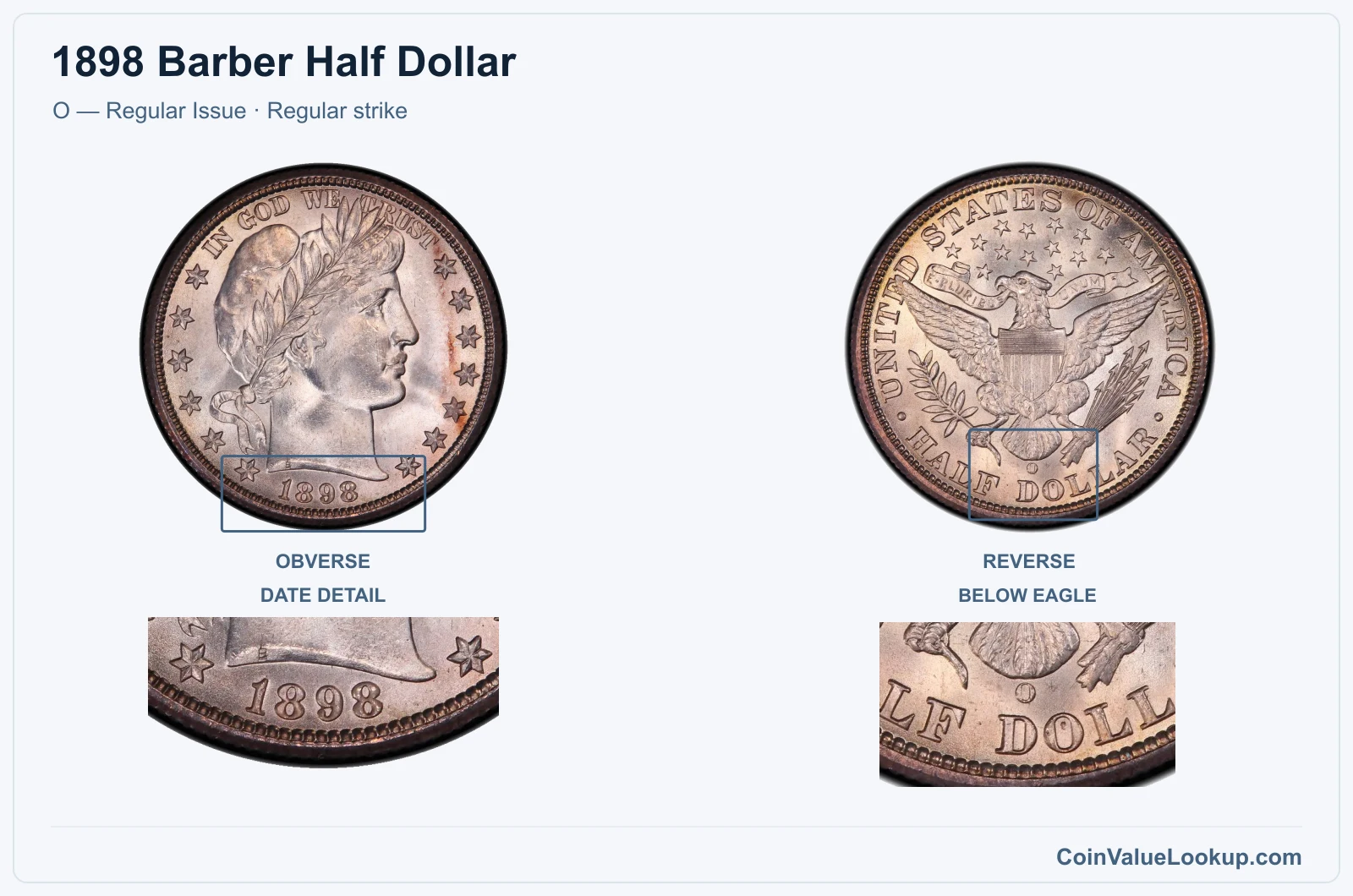
The 1898-O was struck in New Orleans and carries an O mintmark on the reverse, below the eagle's tail feathers. This issue is scarce in better grades, making it one of the more desirable regular-date Barber halves for collectors building a set.
A USA Coin Book guide estimate places it at roughly $68 in G4 and approximately $3,103 at MS63. That gap tells you a lot: survivors in lower grades are common enough, but finding one with strong detail and original luster is a different story.
Watch for strike weakness at the eagle's claws and arrow feathers, which is a known characteristic of New Orleans production and should not be confused with wear.
A rumored Micro O variety for this date has not been confirmed with certainty by the Barber Coin Collectors' Society summary. The recognized Micro O belongs to the 1892-O half dollar.
If your O mintmark looks unusually small, professional attribution is the prudent next step.
Coin Value Lookup is a good place to look up guides for other Barber half dollar dates and mints if you are working through a collection.
Range Grade
Price Auction Records Appraisal PO PO 1
—
Coin Identifier FR FR 2
—
Coin Identifier AG AG 3
—
Coin Identifier G G 4
Coin Identifier
G 6
Coin Identifier VG VG 8
Coin Identifier
VG 10
Coin Identifier F F 12
Coin Identifier
F 15
Coin Identifier VF VF 20
Coin Identifier
VF 25
Coin Identifier
VF 30
Coin Identifier
VF 35
Coin Identifier XF XF 40
Coin Identifier
XF 45
Coin Identifier AU AU 50
Coin Identifier
AU 53
Coin Identifier
AU 55
Coin Identifier
AU 58
Coin Identifier MS MS 60
—
Coin Identifier
MS 61
—
Coin Identifier
MS 62
Coin Identifier
MS 63
Coin Identifier
MS 64
Coin Identifier
MS 65
Coin Identifier
MS 66
Coin Identifier
MS 67
Coin Identifier
MS 68
—
—
—
MS 69
—
—
—
MS 70
—
—
—
1898 Barber Half Dollar — S — Regular Issue
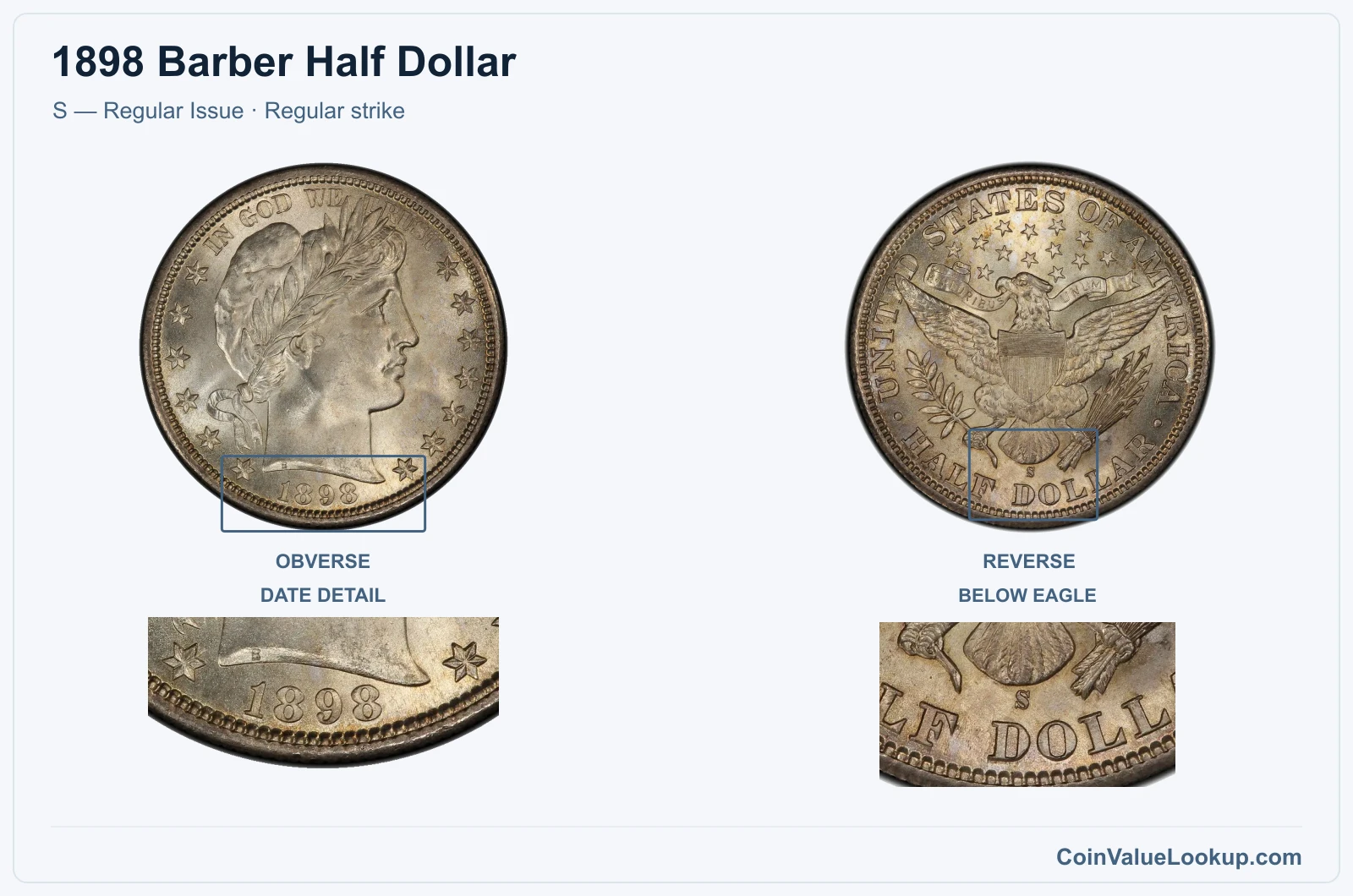
The 1898-S was produced at the San Francisco Mint and shows an S mintmark on the reverse below the eagle's tail. Its guide values track closely to the New Orleans issue, with a USA Coin Book estimate of about $61 at G4 and roughly $3,103 at MS63.
Like many San Francisco Barber halves, surviving examples tend to show honest wear from heavy Western commerce. Original, uncleaned pieces with good detail are the ones collectors chase.
Check the full obverse and reverse carefully for signs of cleaning or tooling, which significantly reduce collector interest and value regardless of the apparent grade.
Range Grade
Price Auction Records Appraisal PO PO 1
—
Coin Identifier FR FR 2
—
Coin Identifier AG AG 3
—
Coin Identifier G G 4
—
Coin Identifier
G 6
—
Coin Identifier VG VG 8
—
Coin Identifier
VG 10
Coin Identifier F F 12
Coin Identifier
F 15
Coin Identifier VF VF 20
—
Coin Identifier
VF 25
Coin Identifier
VF 30
Coin Identifier
VF 35
Coin Identifier XF XF 40
Coin Identifier
XF 45
Coin Identifier AU AU 50
Coin Identifier
AU 53
Coin Identifier
AU 55
Coin Identifier
AU 58
Coin Identifier MS MS 60
—
Coin Identifier
MS 61
Coin Identifier
MS 62
Coin Identifier
MS 63
Coin Identifier
MS 64
Coin Identifier
MS 65
Coin Identifier
MS 66
Coin Identifier
MS 67
—
—
—
MS 68
—
—
—
MS 69
—
—
—
MS 70
—
—
—
1898 Barber Half Dollar — No Mint Mark — Proof
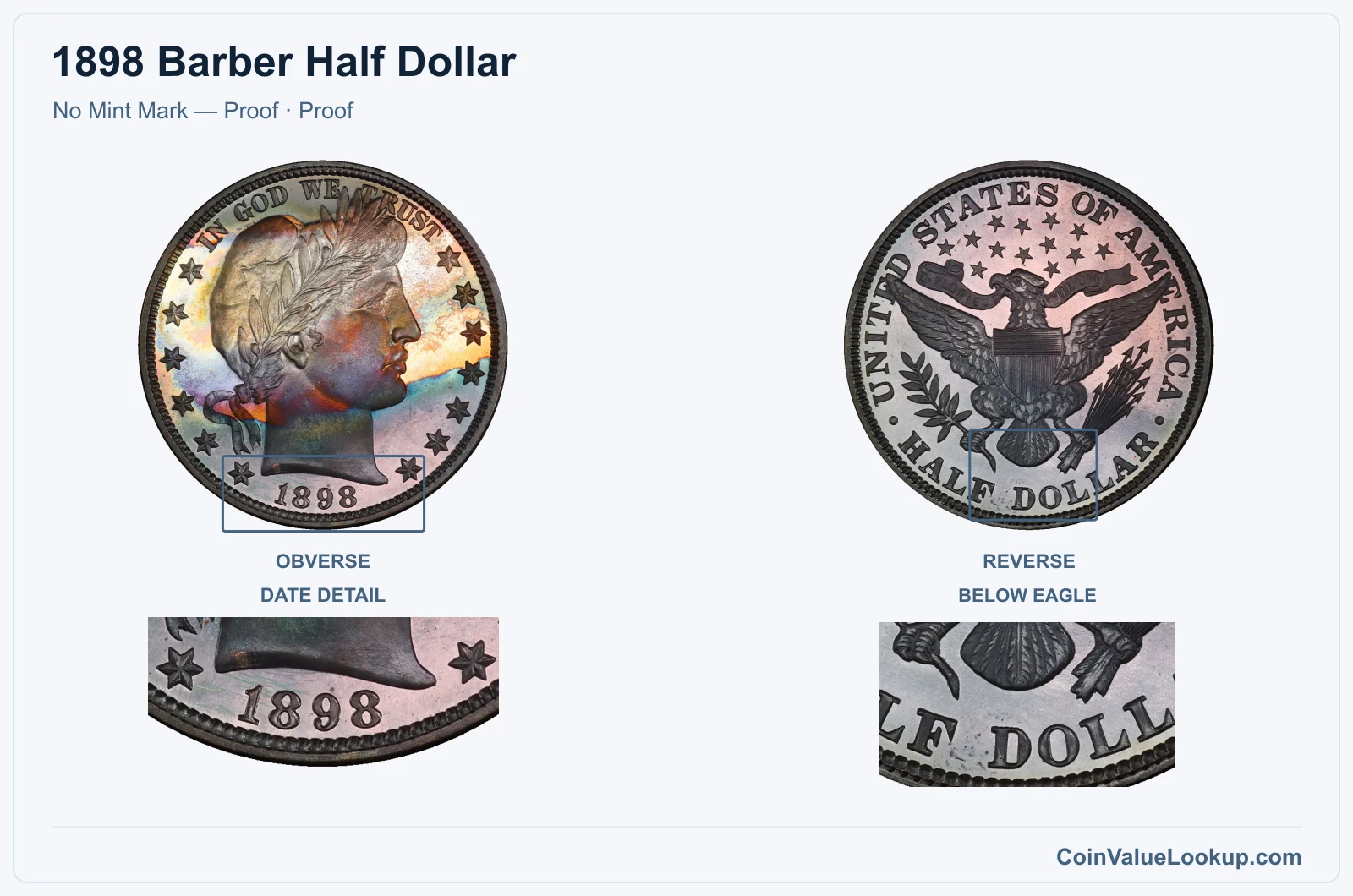
Philadelphia struck proof Barber Half Dollars for collectors in 1898 using specially prepared dies and polished planchets. The result is mirrored fields and sharply defined details that differ visibly from even the finest business strikes.
A USA Coin Book guide estimate places a PR63 example at about $1,363.
To identify a genuine proof, look for deeply reflective surfaces, sharp squared-off rims, and consistent detail across the entire design. A business strike that has been polished may look shiny, but it will show rounded rims, hairlines from polishing, and softer fine details.
Polishing cannot create the die characteristics of a true proof. If you suspect you have one, professional certification is essential before assigning proof status or pricing.
Range Grade
Price Auction Records Appraisal PR PR 1
—
Coin Identifier
PR 2
—
Coin Identifier
PR 3
—
Coin Identifier
PR 4
—
Coin Identifier
PR 6
—
Coin Identifier
PR 8
—
Coin Identifier
PR 10
—
Coin Identifier
PR 12
—
Coin Identifier
PR 15
—
Coin Identifier
PR 20
—
Coin Identifier
PR 25
—
Coin Identifier
PR 30
—
Coin Identifier
PR 35
—
Coin Identifier
PR 40
—
Coin Identifier
PR 45
—
Coin Identifier
PR 50
—
Coin Identifier
PR 53
—
Coin Identifier
PR 55
Coin Identifier
PR 58
—
Coin Identifier
PR 60
Coin Identifier
PR 61
Coin Identifier
PR 62
Coin Identifier
PR 63
Coin Identifier
PR 64
Coin Identifier
PR 65
Coin Identifier
PR 66
Coin Identifier
PR 67
Coin Identifier
PR 68
Coin Identifier
PR 69
—
—
—
PR 70
—
—
—
1898 Barber Half Dollar Error List
1. 1898 Barber Half Dollar — Repunched Date
A repunched date on an 1898 Barber Half Dollar shows remnants of an earlier date-punch position alongside the final numerals. The reported variety for this date involves southward repunching visible on the 9 and 8.
Look closely at the base and tops of those digits for traces of a secondary impression slightly offset from the primary one.
This is a die variety, not a doubled die. The date digits were individually punched into the working die, and if the engraver's first placement was slightly off, they repositioned and struck again.
The remnant of the first attempt is the diagnostic.
Do not confuse this with machine doubling, which produces flat shelf-like distortion, or with simple damage to the date area from circulation hits. A genuine repunched date shows clear, rounded secondary digit outlines.
No specific price range is adopted here because value depends on the visibility of the repunching, overall coin condition, and the particular variety involved. Professional attribution is recommended.
2. 1898 Barber Half Dollar — Struck-Through Error
A struck-through error occurs when foreign material sits between the die and the planchet during striking, leaving a localized depression or incomplete area in the finished design. On an 1898 Barber Half Dollar, this could appear as a smooth indentation, an impression of a thread or fragment, or a patch of missing detail that does not match normal wear patterns.
Keep two categories distinct. A grease-filled die leaves a smooth, slightly raised blank area where grease prevented the die from fully impressing the metal.
A retained struck-through involves a solid object that may leave a sharper, more defined impression.
The lookalikes are numerous: wear, scratches, old cleaning, and ordinary weak strikes can all mimic a struck-through at first glance. The key difference is that a genuine struck-through affects only a specific localized area and does not follow the pattern of normal circulation wear.
No specific price range is adopted because value depends heavily on the size, location, and visibility of the error, plus the coin's overall condition.
3. 1898 Barber Half Dollar — Off-Center Strike
An off-center strike happens when the planchet is not properly seated between the dies, resulting in a displaced design and an unstruck crescent of blank metal along one edge. For an 1898 Barber Half Dollar, the date must remain visible for the coin to be attributed to this specific year, which is important for collector interest.
Off-center errors are graded partly by the percentage of displacement. A slight shift of a few percent may be subtle, while a dramatic 10% or greater shift with a clear blank crescent is more visually striking and generally more collectible.
Do not confuse an off-center strike with a clipped planchet, which shows a straight or curved cut in the blank metal before striking. Post-mint damage that flattens one side of a coin can also mimic this error.
A genuine off-center coin will show the full design detail on the struck portion and a smooth, featureless area on the unstruck portion. No specific price range is adopted because value depends on the degree of misalignment, date visibility, and overall condition.