1899 Barber Half Dollar Coin Value: How Much Is It Worth?
A circulated 1899 Barber Half Dollar starts around $44 at Good-4 condition and can reach roughly $2,647 at MS63 for the San Francisco issue, according to a USA Coin Book guide snapshot. Three business-strike mints were active this year — Philadelphia, New Orleans, and San Francisco — plus a Philadelphia proof.
Condition and mintmark drive value dramatically, so identifying both is where you start.
Fast Way to Identify Your 1899 Barber Half Dollar
Snap a clear photo of the front and back of your 1899 half dollar and upload both images for a preliminary identification. This helps narrow down the mintmark, general condition range, and whether anything unusual is visible.
It is not a substitute for professional authentication, but it gives you a solid starting point.
1899 Barber Half Dollar Value
Upload both sides of your 1899 Barber Half Dollar.
Front Obverse
Upload photo
Back Reverse
Upload photo
Which 1899 Barber Half Dollar Versions Are Worth Money?
- The 1899-S in MS63 condition carries the highest guide estimate among the business strikes at about $2,647, reflecting its relative scarcity in uncirculated grades.
- The 1899-O at MS63 is listed around $2,092 — significantly above its $52 value at Good-4, illustrating how condition multiplies value for this mint.
- Philadelphia proofs in PR63 are estimated near $1,363 and represent a separate collectible finish, not just a high-grade business strike.
- Original, problem-free coins in upper circulated or Mint State grades command far more than heavily worn examples; a jump from G4 to MS63 can mean a 20x or greater difference.
- Always confirm the mintmark and finish before referencing any value chart — an unusual mark alone does not establish a valuable error.
Step 1: Identify Your 1899 Barber Half Dollar Mint Mark and Version
The 1899 Barber Half Dollar shows Liberty facing right on the obverse, wearing a Phrygian cap and laurel wreath, with the date at the bottom. The reverse features a heraldic eagle and the words HALF DOLLAR across the lower portion.
All regular-issue 1899 halves are struck in 90% silver and 10% copper, weigh about 12.5 grams, measure 30.6 mm in diameter, and have a reeded edge. These specs are uniform across all three mints.
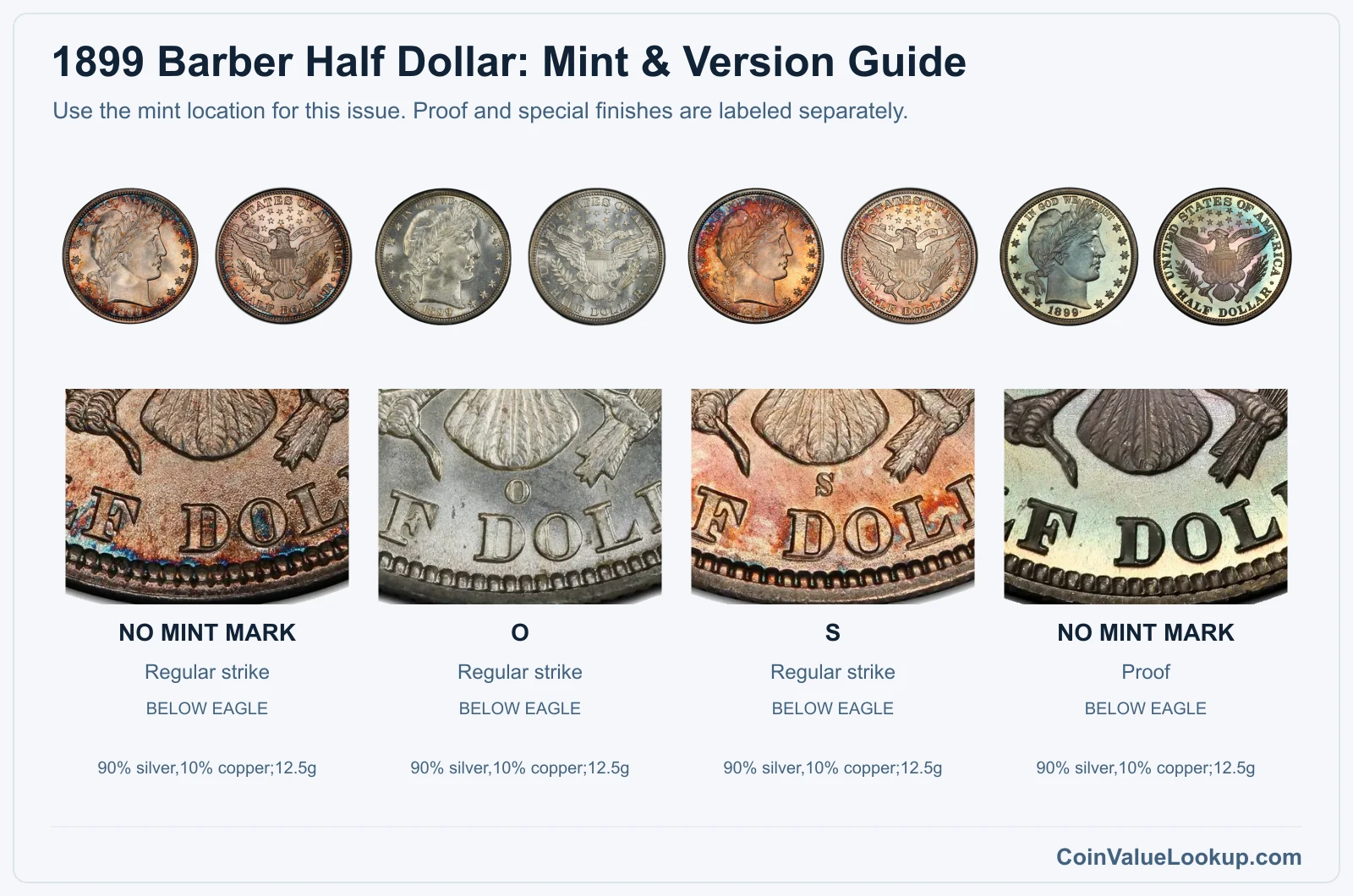
To find the mintmark, flip the coin over and look below the eagle's tail feathers, just above HALF DOLLAR. A small "O" means New Orleans, an "S" means San Francisco.
No letter at all means Philadelphia. You may need a loupe — these mintmarks can be tiny and worn nearly flat on lower-grade coins.
Philadelphia is the most accessible date in this series for 1899. One survey source flagged possible reverse doubling on an 1899-S, but whether that represents a genuine doubled die or simple shelf doubling has not been resolved, so it is not treated here as a confirmed variety.
Step 2: Check Your 1899 Barber Half Dollar Grade
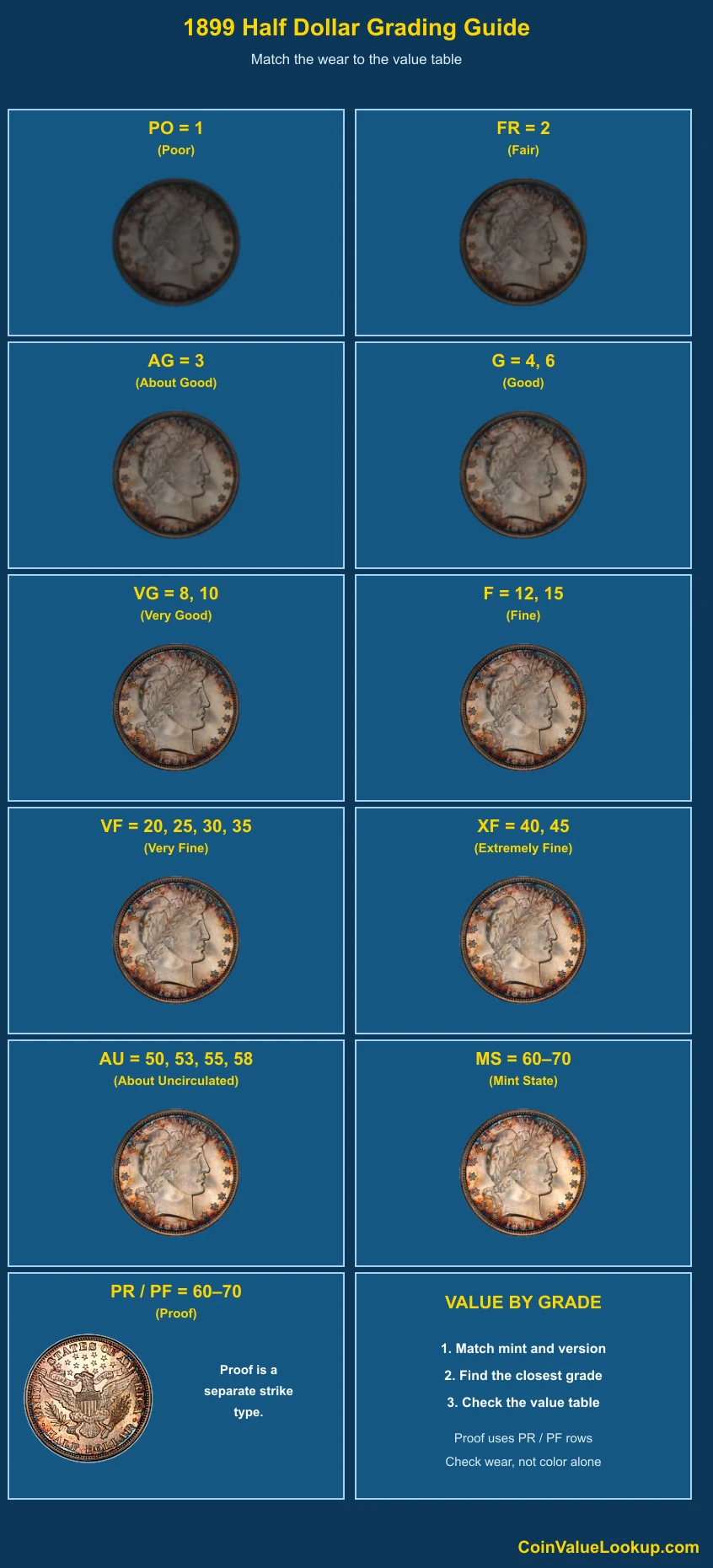
Start by checking Liberty's cheek and the hair detail above her ear. On a well-worn coin, the cheek will be flat and the hair ribbons merged into a smooth surface.
A mid-grade piece retains some separation in the hair curls and partial letters in the LIBERTY headband.
On the reverse, look at the eagle's head, wing tips, and tail feathers. Sharp individual feather detail signals a higher grade.
Keep in mind that New Orleans strikes are often softer at the eagle's claw and arrow feathers — that is a strike characteristic, not wear.
Do not judge grade solely by how many letters of LIBERTY remain visible. Hub changes during the Barber series affect how quickly those letters wore, so the whole coin matters.
Compare your coin against the genuine grade comparison image for a more accurate read.
A proof is a special finish with mirrored fields and sharp rims, produced at Philadelphia only. It is not simply a grade above Mint State.
Polished business strikes sometimes fool newer collectors, but real proofs show distinctive die characteristics, not just shine.
Step 3: Check 1899 Barber Half Dollar Value by Mint and Version
1899 Barber Half Dollar — No Mint Mark — Regular Issue
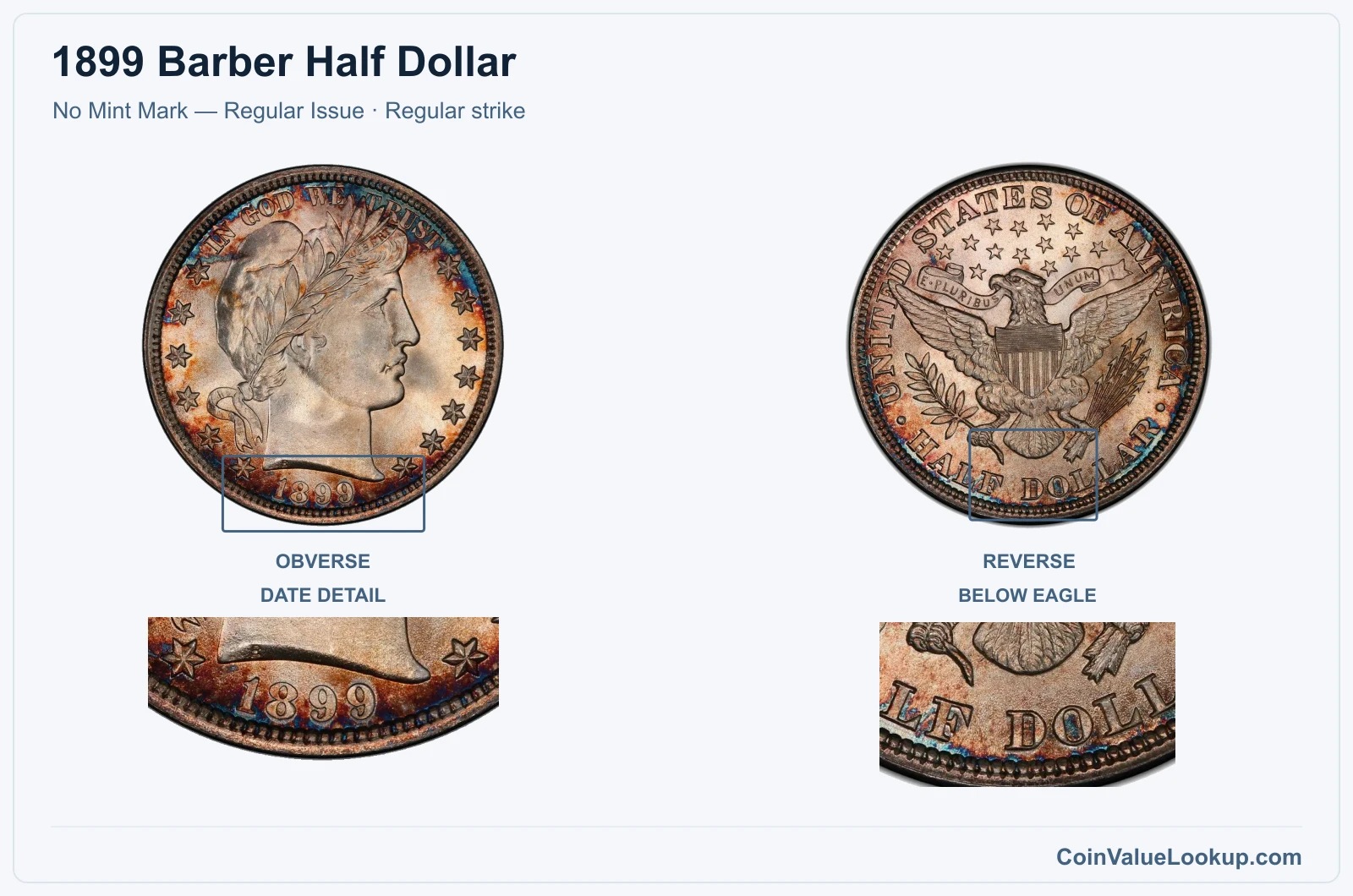
The 1899 Philadelphia half dollar has no mintmark. Look at the reverse below the eagle's tail — if the space is blank, you have the P-mint issue.
This is the most common and affordable entry point for the date.
A USA Coin Book guide estimate places it around $44 at Good-4 and roughly $1,082 at MS63. That is a wide spread, so condition matters a lot.
Original surfaces without cleaning or tooling are essential for the upper end. Even a lightly cleaned coin in otherwise nice shape takes a substantial hit.
Range Grade
Price Auction Records Appraisal PO PO 1
—
Coin Identifier FR FR 2
—
Coin Identifier AG AG 3
—
Coin Identifier G G 4
—
Coin Identifier
G 6
Coin Identifier VG VG 8
—
Coin Identifier
VG 10
Coin Identifier F F 12
Coin Identifier
F 15
Coin Identifier VF VF 20
Coin Identifier
VF 25
Coin Identifier
VF 30
Coin Identifier
VF 35
Coin Identifier XF XF 40
Coin Identifier
XF 45
Coin Identifier AU AU 50
Coin Identifier
AU 53
Coin Identifier
AU 55
Coin Identifier
AU 58
Coin Identifier MS MS 60
Coin Identifier
MS 61
Coin Identifier
MS 62
Coin Identifier
MS 63
Coin Identifier
MS 64
Coin Identifier
MS 65
Coin Identifier
MS 66
Coin Identifier
MS 67
Coin Identifier
MS 68
—
—
—
MS 69
—
—
—
MS 70
—
—
—
1899 Barber Half Dollar — O — Regular Issue
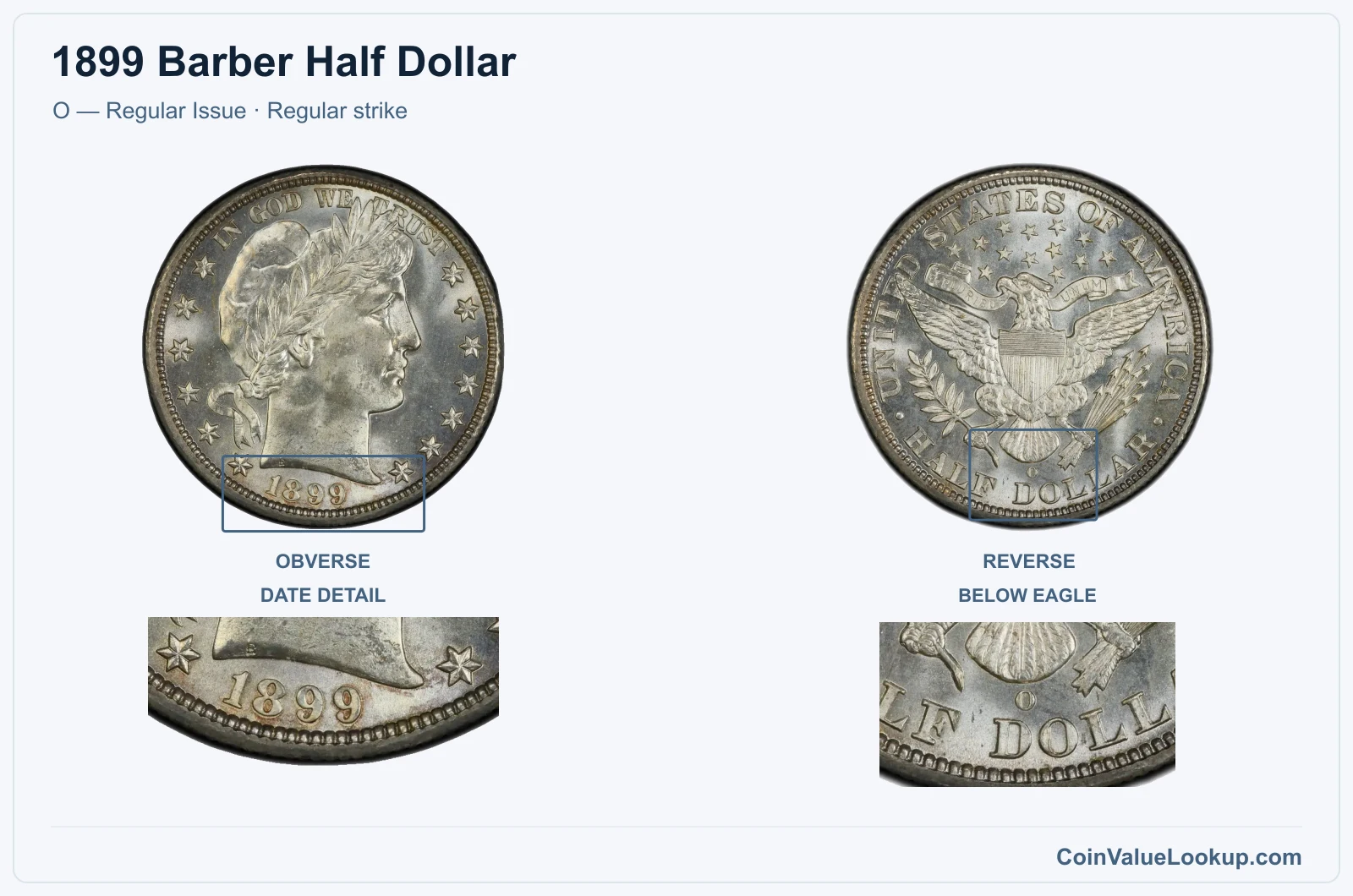
The New Orleans issue carries a small "O" mintmark below the eagle's tail feathers on the reverse. It is slightly scarcer than the Philadelphia coin and starts at about $52 in Good-4 condition per the USA Coin Book guide, climbing to around $2,092 at MS63.
New Orleans Barber halves are known for softer strikes, especially around the eagle's claws and arrow feathers. Do not mistake weak strike detail for heavy wear — they are different problems with very different implications for value.
A soft but original coin in VF or better can still carry a strong premium.
Coin Value Lookup is a useful place to look up guide values for coins like this across dates and mints when you are trying to compare what you have.
Range Grade
Price Auction Records Appraisal PO PO 1
—
Coin Identifier FR FR 2
—
Coin Identifier AG AG 3
—
Coin Identifier G G 4
Coin Identifier
G 6
Coin Identifier VG VG 8
—
Coin Identifier
VG 10
Coin Identifier F F 12
Coin Identifier
F 15
Coin Identifier VF VF 20
Coin Identifier
VF 25
Coin Identifier
VF 30
Coin Identifier
VF 35
Coin Identifier XF XF 40
Coin Identifier
XF 45
Coin Identifier AU AU 50
Coin Identifier
AU 53
Coin Identifier
AU 55
Coin Identifier
AU 58
Coin Identifier MS MS 60
Coin Identifier
MS 61
Coin Identifier
MS 62
Coin Identifier
MS 63
Coin Identifier
MS 64
Coin Identifier
MS 65
Coin Identifier
MS 66
Coin Identifier
MS 67
—
—
—
MS 68
—
—
—
MS 69
—
—
—
MS 70
—
—
—
1899 Barber Half Dollar — S — Regular Issue
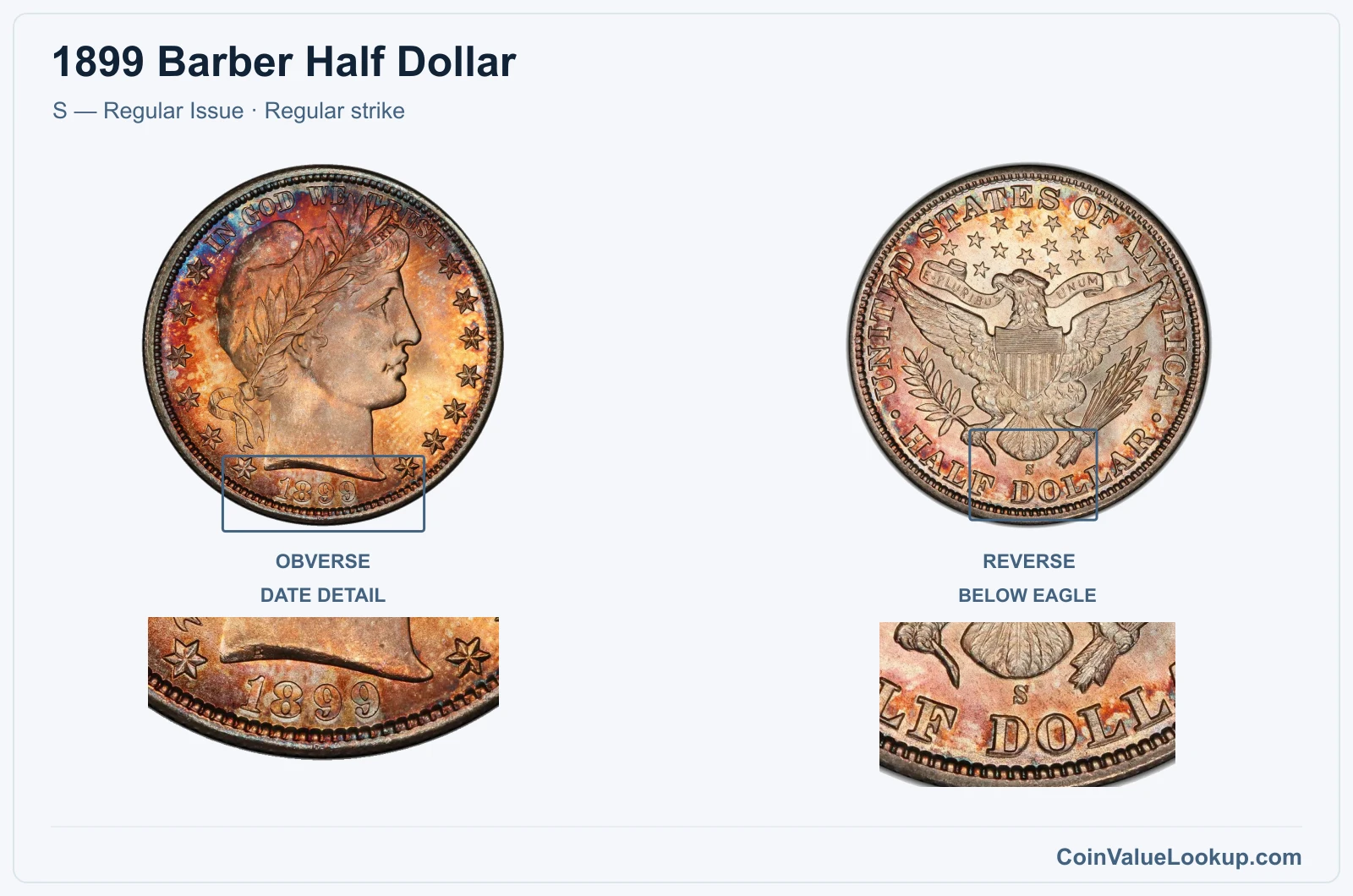
The San Francisco half carries an "S" mintmark in the same position below the eagle's tail. In the USA Coin Book guide, it matches the O-mint at $52 for Good-4 but pulls ahead at MS63 with an estimate near $2,647 — the highest among the three business-strike mints for 1899.
That premium in higher grades reflects genuine scarcity in well-preserved condition. Most surviving examples saw heavy circulation.
If you have one with sharp detail and original luster, it is worth getting a careful, professional opinion. One survey source noted possible reverse doubling on an 1899-S, but this has not been confirmed as a genuine doubled die variety versus shelf doubling, so treat such claims with caution.
Range Grade
Price Auction Records Appraisal PO PO 1
—
Coin Identifier FR FR 2
—
Coin Identifier AG AG 3
—
Coin Identifier G G 4
Coin Identifier
G 6
—
Coin Identifier VG VG 8
Coin Identifier
VG 10
Coin Identifier F F 12
Coin Identifier
F 15
Coin Identifier VF VF 20
Coin Identifier
VF 25
—
Coin Identifier
VF 30
Coin Identifier
VF 35
Coin Identifier XF XF 40
Coin Identifier
XF 45
Coin Identifier AU AU 50
Coin Identifier
AU 53
Coin Identifier
AU 55
Coin Identifier
AU 58
Coin Identifier MS MS 60
—
Coin Identifier
MS 61
—
Coin Identifier
MS 62
Coin Identifier
MS 63
Coin Identifier
MS 64
Coin Identifier
MS 65
Coin Identifier
MS 66
Coin Identifier
MS 67
Coin Identifier
MS 68
Coin Identifier
MS 69
—
—
—
MS 70
—
—
—
1899 Barber Half Dollar — No Mint Mark — Proof
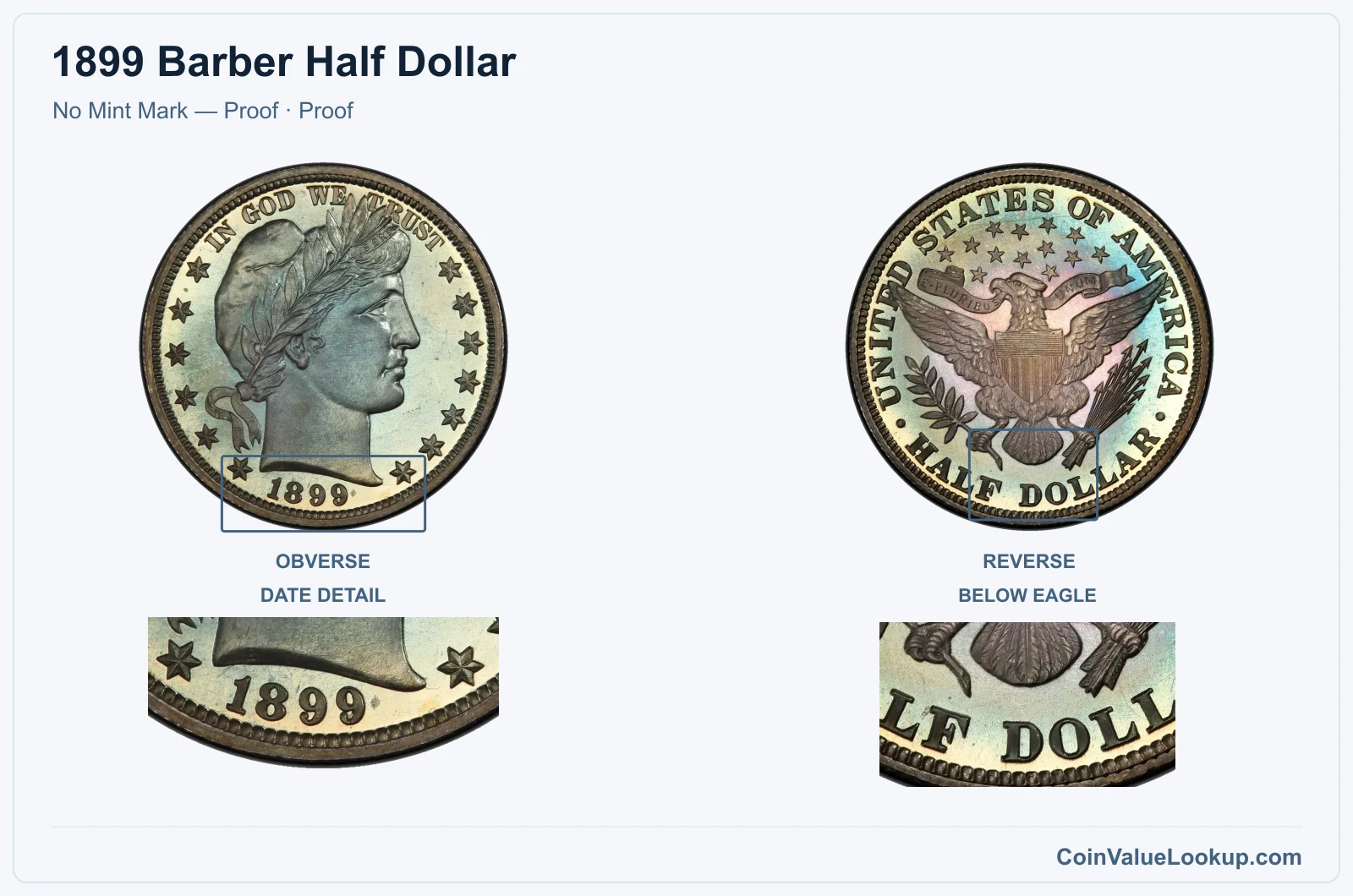
Philadelphia produced proof Barber halves for collectors in 1899, and these are identified by deeply mirrored fields, razor-sharp rim detail, and precise design elements that business strikes simply do not match. The USA Coin Book guide places a PR63 example around $1,363.
No mintmark appears on proofs, same as the regular Philadelphia issue, so you cannot separate them by mintmark alone. The difference is entirely in the finish.
Polishing a business strike will not replicate the squared rims and liquid-mirror fields of a genuine proof. If you suspect you have one, professional attribution is the way to go.
Range Grade
Price Auction Records Appraisal PR PR 1
—
Coin Identifier
PR 2
—
Coin Identifier
PR 3
—
Coin Identifier
PR 4
—
Coin Identifier
PR 6
—
Coin Identifier
PR 8
—
Coin Identifier
PR 10
—
Coin Identifier
PR 12
—
Coin Identifier
PR 15
—
Coin Identifier
PR 20
—
Coin Identifier
PR 25
—
Coin Identifier
PR 30
—
Coin Identifier
PR 35
—
Coin Identifier
PR 40
—
Coin Identifier
PR 45
—
Coin Identifier
PR 50
—
Coin Identifier
PR 53
—
Coin Identifier
PR 55
—
Coin Identifier
PR 58
—
Coin Identifier
PR 60
Coin Identifier
PR 61
Coin Identifier
PR 62
Coin Identifier
PR 63
Coin Identifier
PR 64
Coin Identifier
PR 65
Coin Identifier
PR 66
Coin Identifier
PR 67
Coin Identifier
PR 68
Coin Identifier
PR 69
Coin Identifier
PR 70
—
—
—
1899 Barber Half Dollar Error List
1. 1899 Barber Half Dollar — Repunched Date
A repunched date on an 1899 Barber Half Dollar shows traces of an earlier punch position alongside the final date numerals. You might see a ghost image or partial outline of one or more digits slightly offset from where they ended up.
This is a die variety created during production when the date punch was applied more than once in slightly different positions.
Do not confuse this with machine doubling, which produces flat, shelf-like distortion, or with post-mint damage where the digits look smashed or scratched. A true repunched date shows raised remnants from an earlier impression.
No specific price range is established for this variety. Value depends on the visibility of the repunching, the overall condition of the coin, and collector demand for the specific die pair.
A clear, dramatic repunch on an otherwise problem-free coin will draw more attention than a subtle one on a damaged piece.
2. 1899 Barber Half Dollar — Repunched Mintmark
A repunched mintmark on the 1899-S Barber Half Dollar shows remnants of an earlier "S" punch visible near or overlapping the final mintmark position. Inspect the area below the eagle's tail feathers under magnification and compare against a normal 1899-S at the same zoom level to see whether a second impression is present.
This is distinct from machine doubling, which tends to create a flat, shelf-like shadow, and from die chips or corrosion that may distort the mintmark outline without showing a second discrete punch.
No established price range exists for this variety. The value of a repunched mintmark depends heavily on how visible and dramatic the repunching is, plus the coin's overall grade and originality.
A bold overlap on a sharp coin will always command more interest than a faint trace on a worn example.
3. 1899 Barber Half Dollar — Off-Center Strike
An off-center strike occurs when the planchet is not properly seated between the dies, producing a design that is shifted to one side with an unstruck crescent of blank metal on the opposite edge. One historical catalog example of a 1899 Barber Half Dollar was described as approximately 10% off-center at the 7 o'clock position, with separate scratches noted.
The key feature to look for is a displaced design combined with an unstruck area along the rim. The date should remain visible — off-center coins that retain the full date are generally more collectible.
Do not confuse this with a clipped planchet, which shows a straight or curved bite from the blank, or with one-sided die misalignment that shifts only the obverse or reverse without creating a blank crescent. Post-mint flattening from damage can also mimic the look.
No specific price range has been established; value depends on the degree of off-center shift, date visibility, and overall condition.