1903 Barber Half Dollar Coin Value: How Much Is It Worth?
A 1903 Barber Half Dollar can range from about $44 at G4 grade to around $2,092 at MS63, depending on the mint and condition. That spread comes from a single USA Coin Book retail-guide snapshot and reflects numismatic plus silver content, not a guaranteed sale price.
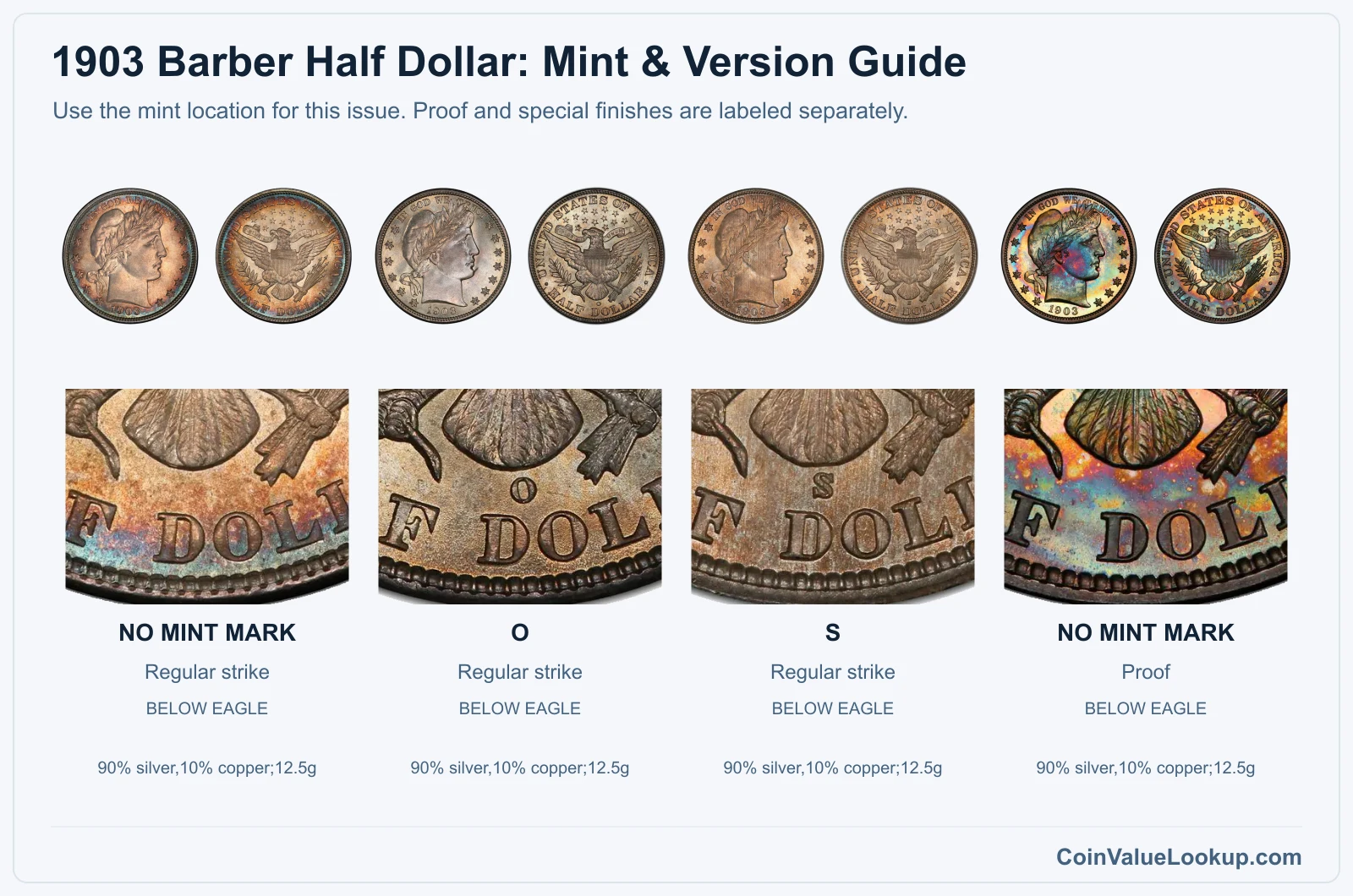
Three business-strike mints exist for this year — Philadelphia, New Orleans, and San Francisco — plus a separate Philadelphia Proof issue. Original, problem-free coins in upper circulated or Mint State grades can be worth dramatically more than heavily worn examples, so accurate grading matters.
Fast Way to Identify Your 1903 Barber Half Dollar
The quickest way to start figuring out what your 1903 Barber Half Dollar is worth is to upload clear photos of both sides of the coin. That lets us give you a preliminary identification of the mint, finish, and approximate condition.
Snap the front (Liberty head) and the back (eagle), making sure the mintmark area below the eagle's tail feathers is in focus.
1903 Barber Half Dollar Value
Upload both sides of your 1903 Barber Half Dollar.
Front Obverse
Upload photo
Back Reverse
Upload photo
Which 1903 Barber Half Dollar Versions Are Worth Money?
- The 1903-S starts higher at G4 (about $52) than the P or O issues ($44 each), making it the pricier option in low grades.
- At MS63, the 1903-O and 1903-S both reach about $2,092 per the guide, versus $1,541 for the Philadelphia coin — condition jumps matter most.
- Philadelphia Proofs are a separate collectible finish, listed at about $1,363 in PR63; they are identified by mirrored fields, not simply a high grade.
- Original, problem-free coins in upper circulated and Mint State grades carry a steep premium over heavily worn pieces across all three mints.
Step 1: Identify Your 1903 Barber Half Dollar Mint Mark and Version
First, confirm you have a genuine 1903 date and the words HALF DOLLAR on the reverse. The obverse shows Liberty's head facing right with a laurel wreath and cap; the reverse features a heraldic eagle with a shield on its breast.
Now check the mintmark. Look on the reverse, just below the eagle's tail feathers and above the words HALF DOLLAR.
A plain field there means Philadelphia. An "O" means New Orleans.
An "S" means San Francisco. There is no "D" mintmark for this date.
All three business-strike versions are 90% silver and 10% copper, weigh about 12.5 grams, measure 30.6 mm across, and have a reeded edge. Proofs were struck only at Philadelphia and share the same specs but have a distinctive mirrored-field finish — more on that below.
One thing worth knowing: a sharply struck shield on the eagle is a sign of quality, not a separate mint or a special designation. Some coins just came off the press better than others.
Read the mint and finish correctly before jumping to value charts; an unusual-looking mark alone does not establish a valuable error.
Step 2: Check Your 1903 Barber Half Dollar Grade
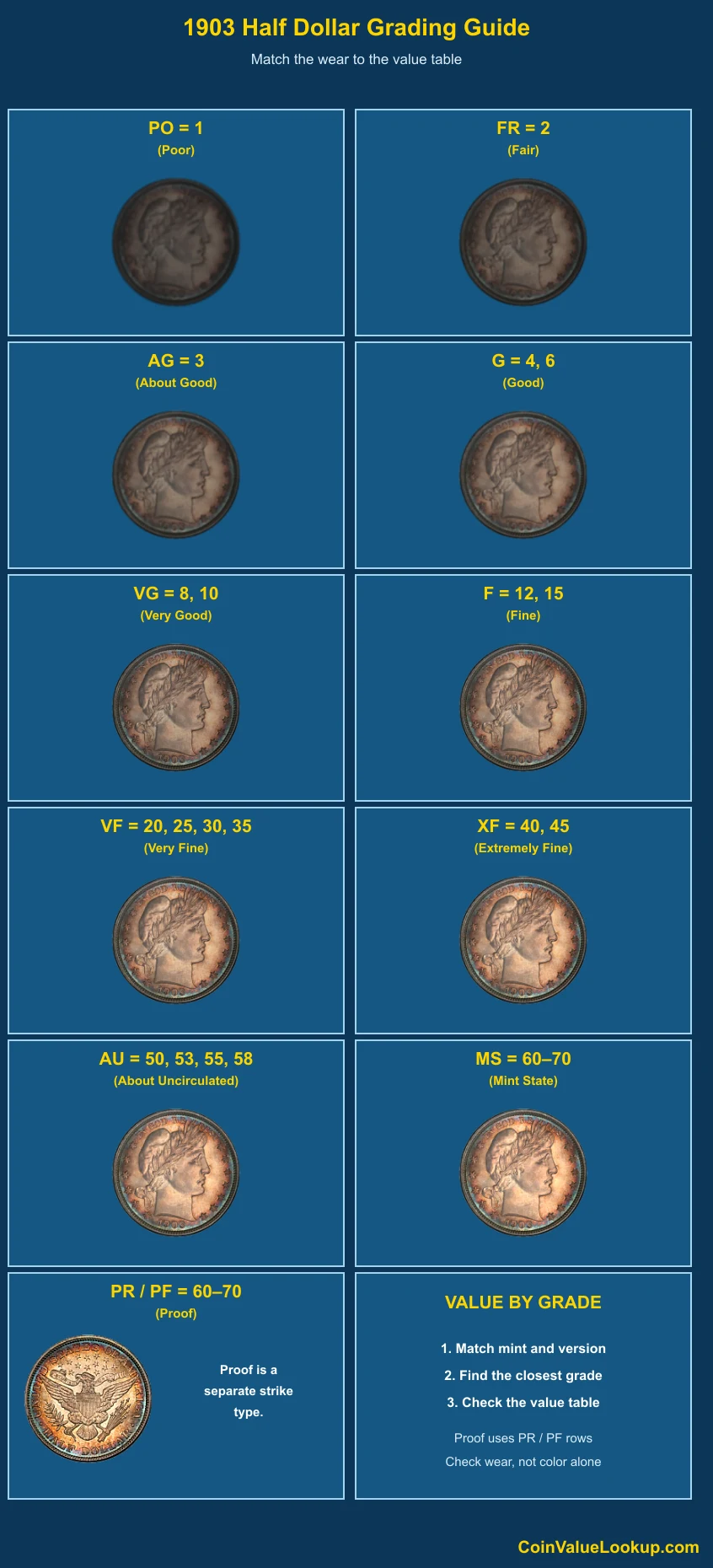
Start by looking at Liberty's cheek and the hair above her ear on the obverse. On a well-worn coin, the cheek is flat and the hair strands have merged into a smooth surface.
Compare that area against the grade comparison image to see where your coin falls.
On the reverse, check the eagle's head, wing tips, and tail feathers. These high points lose detail first as the coin circulates.
Don't rely solely on how many letters of LIBERTY remain visible in the headband. Hub changes during the Barber series mean the headband's protection varies, so letter loss doesn't always map neatly to a specific grade.
New Orleans coins in particular can show weak eagle claws and arrow feathers even on higher-grade pieces. That is a strike characteristic, not wear.
Separate genuine friction — which dulls luster — from areas that were simply soft from the moment the coin was made.
A Proof is a manufacturing finish, not a grade above Mint State. If someone offers you a "Proof-70" as the ultimate grade, that reflects the Proof scale for finish quality, and it does not sit above MS-70 in the business-strike hierarchy.
They are different tracks.
Step 3: Check 1903 Barber Half Dollar Value by Mint and Version
1903 Barber Half Dollar — No Mint Mark — Regular Issue
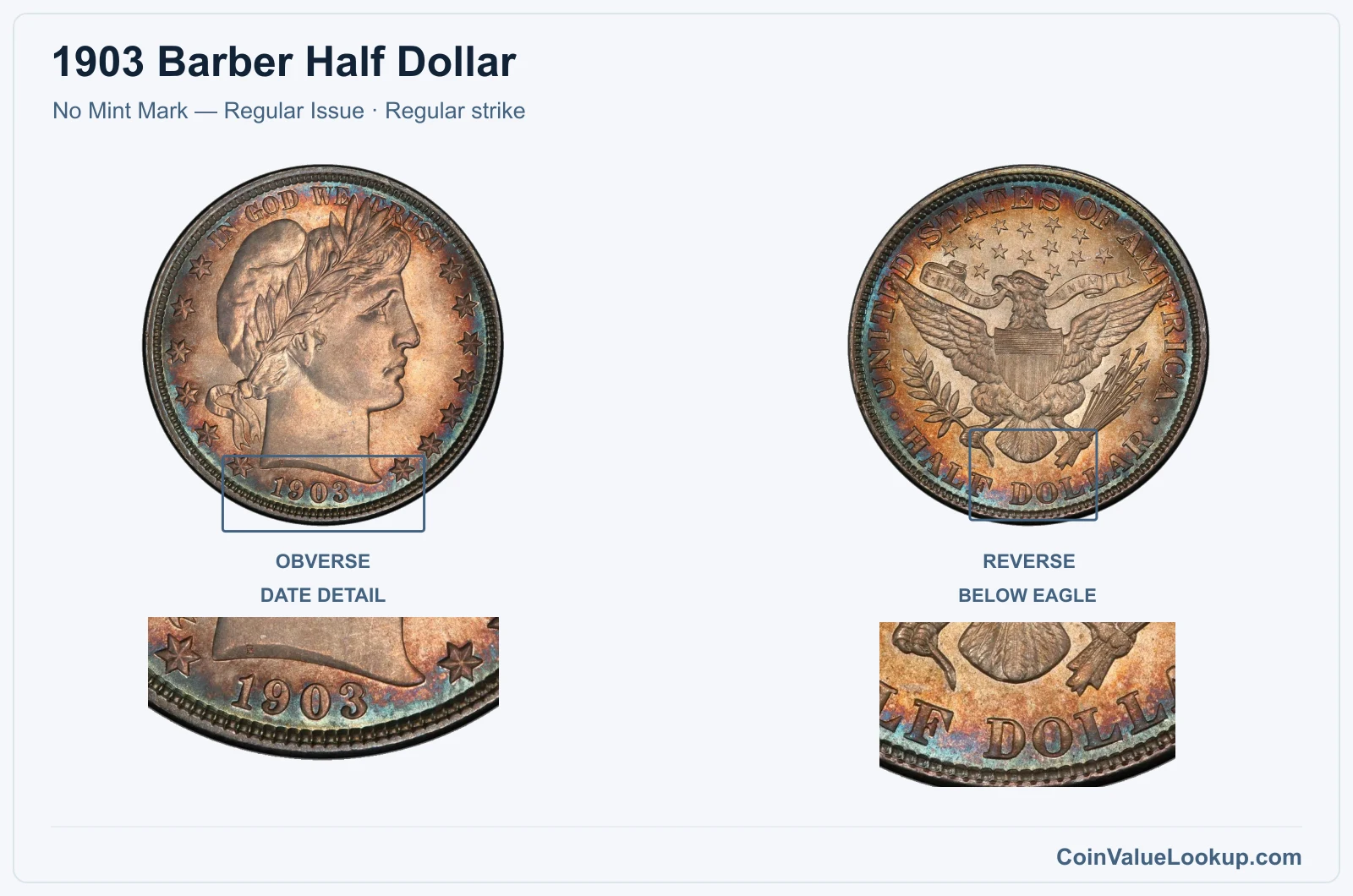
The 1903 Philadelphia half dollar carries no mintmark — the space below the eagle's tail on the reverse is blank. This is the most straightforward version to identify.
A USA Coin Book guide estimate places this coin at about $44 in G4 (a heavily worn but readable example) and around $1,541 in MS63 (a lightly marked coin with good luster). The gap between those two numbers tells you that surface quality and remaining detail drive the value far more than the date alone.
When evaluating one of these, look at the full obverse and reverse for signs of cleaning, tooling, or environmental damage. Original surfaces — even on a well-circulated coin — are always preferable to a cleaned or artificially brightened example.
Range Grade
Price Auction Records Appraisal PO PO 1
—
Coin Identifier FR FR 2
—
Coin Identifier AG AG 3
—
Coin Identifier G G 4
Coin Identifier
G 6
—
Coin Identifier VG VG 8
Coin Identifier
VG 10
—
Coin Identifier F F 12
Coin Identifier
F 15
Coin Identifier VF VF 20
Coin Identifier
VF 25
Coin Identifier
VF 30
Coin Identifier
VF 35
Coin Identifier XF XF 40
Coin Identifier
XF 45
Coin Identifier AU AU 50
Coin Identifier
AU 53
Coin Identifier
AU 55
Coin Identifier
AU 58
Coin Identifier MS MS 60
Coin Identifier
MS 61
—
Coin Identifier
MS 62
Coin Identifier
MS 63
Coin Identifier
MS 64
Coin Identifier
MS 65
Coin Identifier
MS 66
Coin Identifier
MS 67
—
—
—
MS 68
—
—
—
MS 69
—
—
—
MS 70
—
—
—
1903 Barber Half Dollar — O — Regular Issue
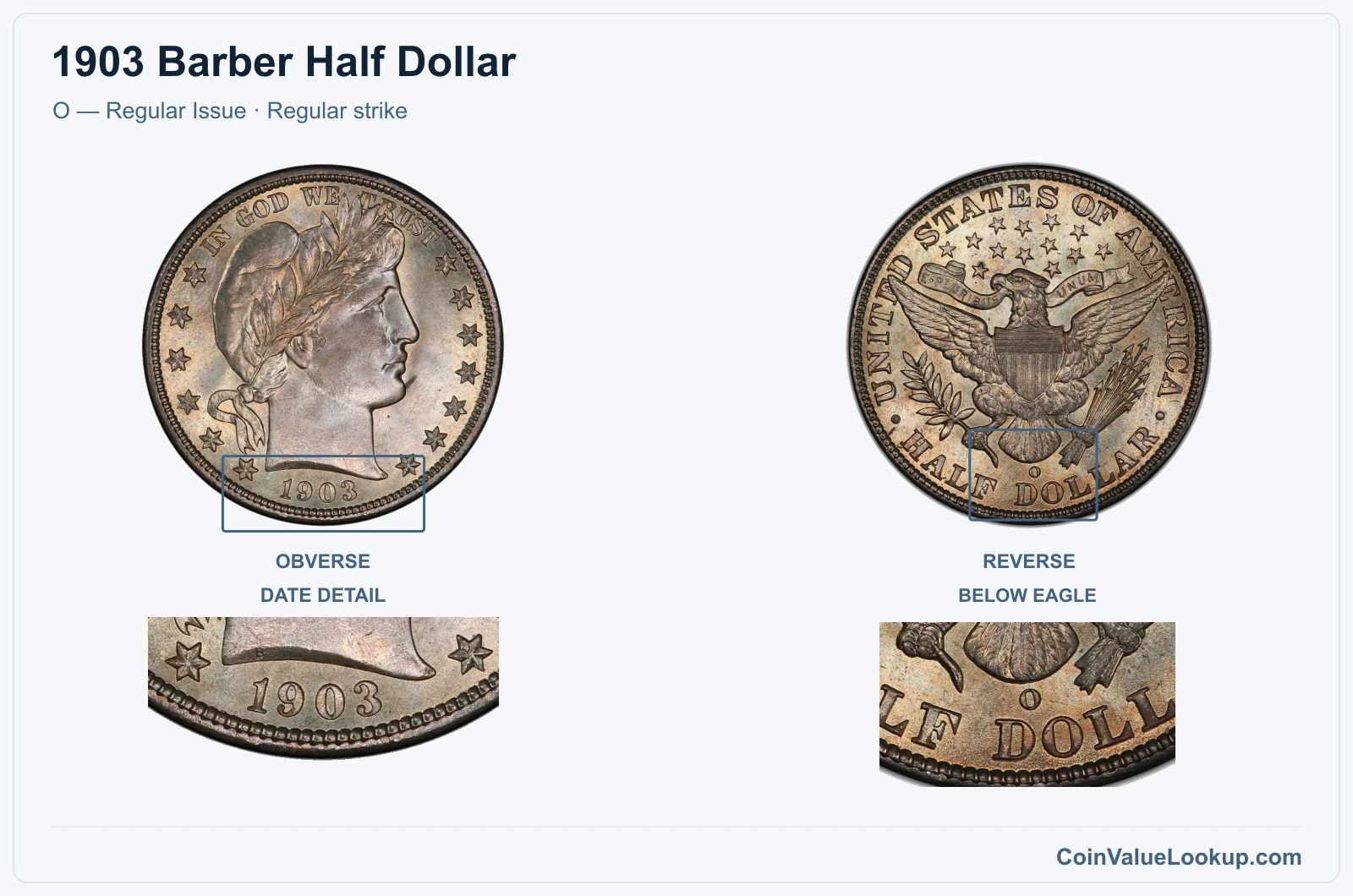
Look for a small "O" mintmark on the reverse, below the eagle's tail feathers and above HALF DOLLAR. That marks a New Orleans issue.
The guide places this version at about $44 in G4 and approximately $2,092 in MS63. That MS63 figure is notably higher than the Philadelphia equivalent, which reflects the relative scarcity of well-preserved New Orleans coins.
Strike quality can be tricky here. New Orleans Barber halves are known for sometimes showing soft detail on the eagle's claws and arrow feathers, even on coins that saw minimal circulation.
Do not mistake a weak strike for heavy wear — check the luster and the high points on Liberty's cheek before deciding.
Range Grade
Price Auction Records Appraisal PO PO 1
—
Coin Identifier FR FR 2
—
Coin Identifier AG AG 3
—
Coin Identifier G G 4
—
Coin Identifier
G 6
—
Coin Identifier VG VG 8
—
Coin Identifier
VG 10
Coin Identifier F F 12
Coin Identifier
F 15
Coin Identifier VF VF 20
Coin Identifier
VF 25
Coin Identifier
VF 30
Coin Identifier
VF 35
Coin Identifier XF XF 40
Coin Identifier
XF 45
Coin Identifier AU AU 50
Coin Identifier
AU 53
Coin Identifier
AU 55
Coin Identifier
AU 58
Coin Identifier MS MS 60
Coin Identifier
MS 61
Coin Identifier
MS 62
Coin Identifier
MS 63
Coin Identifier
MS 64
Coin Identifier
MS 65
Coin Identifier
MS 66
Coin Identifier
MS 67
Coin Identifier
MS 68
—
—
—
MS 69
—
—
—
MS 70
—
—
—
1903 Barber Half Dollar — S — Regular Issue
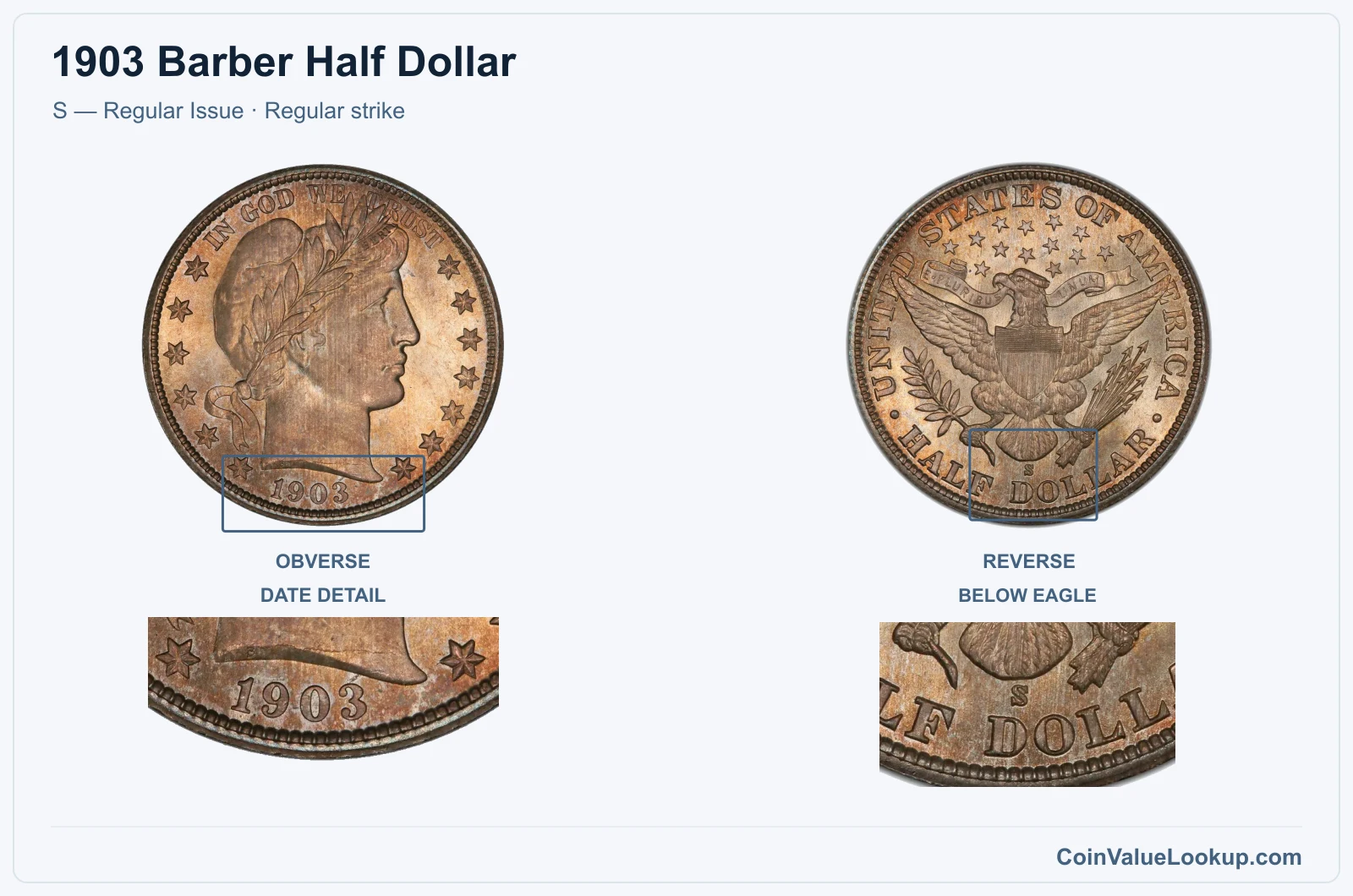
A small "S" below the eagle's tail feathers identifies the San Francisco mint. In heavily worn condition (G4), this version starts at roughly $52 — a few dollars above the Philadelphia and New Orleans issues at the same grade.
At MS63, the guide estimate is about $2,092, matching the New Orleans coin. Finding an original, lustrous example at that level is the challenge; many surviving 1903-S halves show moderate to heavy wear.
Coin Value Lookup is a handy starting point if you want to look up other Barber Half Dollar dates or different denominations entirely. It can help you compare where the 1903-S sits relative to the rest of the series.
Range Grade
Price Auction Records Appraisal PO PO 1
—
Coin Identifier FR FR 2
—
Coin Identifier AG AG 3
—
Coin Identifier G G 4
—
Coin Identifier
G 6
—
Coin Identifier VG VG 8
Coin Identifier
VG 10
Coin Identifier F F 12
Coin Identifier
F 15
Coin Identifier VF VF 20
Coin Identifier
VF 25
Coin Identifier
VF 30
Coin Identifier
VF 35
Coin Identifier XF XF 40
Coin Identifier
XF 45
Coin Identifier AU AU 50
Coin Identifier
AU 53
Coin Identifier
AU 55
Coin Identifier
AU 58
Coin Identifier MS MS 60
Coin Identifier
MS 61
Coin Identifier
MS 62
Coin Identifier
MS 63
Coin Identifier
MS 64
Coin Identifier
MS 65
Coin Identifier
MS 66
Coin Identifier
MS 67
Coin Identifier
MS 68
Coin Identifier
MS 69
—
—
—
MS 70
—
—
—
1903 Barber Half Dollar — No Mint Mark — Proof
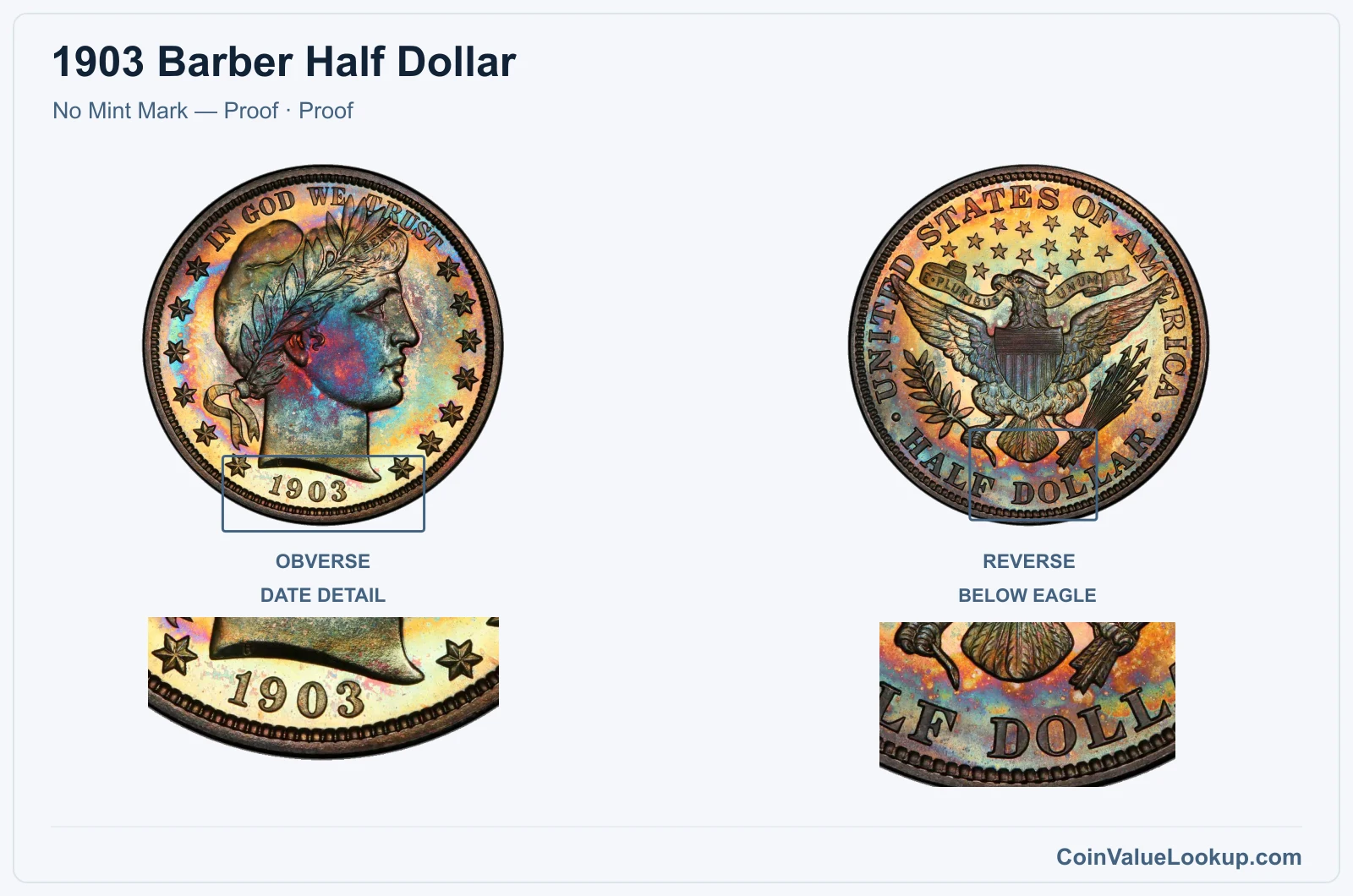
Philadelphia Proofs were struck with specially prepared dies on polished planchets, producing mirrored fields and sharp detail from the moment of manufacture. They carry no mintmark, just like the regular Philadelphia business strike, so the finish itself is the distinguishing feature.
A genuine Proof shows deeply reflective, glass-like surfaces in the fields surrounding Liberty and the eagle. Some Proofs also display contrast between frosted design elements and mirrored backgrounds, but that variation occurs within the Proof category — it does not create a separate mint branch.
The guide lists this version at about $1,363 in PR63. Polishing a business strike cannot turn it into a Proof; the surface structure is fundamentally different.
If you suspect you have a Proof, look at the rim sharpness and field quality under magnification. Professional authentication is the only reliable way to confirm it.
Range Grade
Price Auction Records Appraisal PR PR 1
—
Coin Identifier
PR 2
—
Coin Identifier
PR 3
—
Coin Identifier
PR 4
—
Coin Identifier
PR 6
—
Coin Identifier
PR 8
—
Coin Identifier
PR 10
—
Coin Identifier
PR 12
—
Coin Identifier
PR 15
—
Coin Identifier
PR 20
—
Coin Identifier
PR 25
—
Coin Identifier
PR 30
—
Coin Identifier
PR 35
—
Coin Identifier
PR 40
—
Coin Identifier
PR 45
—
Coin Identifier
PR 50
—
Coin Identifier
PR 53
—
Coin Identifier
PR 55
—
Coin Identifier
PR 58
Coin Identifier
PR 60
Coin Identifier
PR 61
Coin Identifier
PR 62
Coin Identifier
PR 63
Coin Identifier
PR 64
Coin Identifier
PR 65
Coin Identifier
PR 66
Coin Identifier
PR 67
Coin Identifier
PR 68
Coin Identifier
PR 69
—
—
—
PR 70
—
—
—
1903 Barber Half Dollar Error List
1. 1903 Barber Half Dollar — Repunched Date
A repunched date on a 1903 Barber Half Dollar shows remnants of an earlier position of the date numerals alongside the final, accepted placement. Specifically, look south of the "03" digits for traces of a second impression slightly offset from the primary punch.
This is a die variety, created when the date punch was applied more than once during die preparation. It is not the same as mechanical doubling, which is a flatter, shelf-like distortion caused during the striking process, nor is it the same as post-strike damage to the date area from contact or corrosion.
Under magnification, a genuine repunched date will show distinct, rounded remnants that mirror the style of the original numerals. No specific price range is available for this variety; the value of any individual coin depends on the visibility and strength of the repunching, the coin's overall condition, and collector demand at the time of sale.
2. 1903 Barber Half Dollar — Rim Burr
A rim burr is a raised protrusion along the rim of the coin, visible from both the edge and the face. One documented example is a 1903-O graded VG8 by ANACS that was classified with this feature.
When examining your coin, look for a small, irregular ridge or bump that extends from the normal rim line. This differs from a bent or damaged rim, which typically shows a crease or fold from post-strike impact.
It also differs from a filed or altered edge, which would leave flat spots or tool marks visible under magnification.
A coin that was squeezed or compressed after leaving the mint can also produce misleading rim distortion, so careful comparison matters. No established price range exists for this variety; condition, the prominence of the burr, and the specific coin's overall eye appeal all influence what a buyer might pay.