1906 Barber Half Dollar Coin Value: How Much Is It Worth?
A 1906 Barber Half Dollar in heavily worn G4 condition starts around $44 based on a USA Coin Book retail-guide snapshot, while nicer Mint State examples climb considerably higher — up to roughly $2005 at MS63 for the San Francisco issue. This was the first year Denver struck Barber halves, so four business-strike mints (Philadelphia, Denver, New Orleans, San Francisco) plus a Philadelphia Proof are in play.
Proofs and error varieties carry their own separate value considerations.
Fast Way to Identify Your 1906 Barber Half Dollar
Want a quick read on what you have? Upload clear photos of both the front and back of your 1906 Barber Half Dollar.
That lets us provide a preliminary identification of your coin's mint, version, and approximate condition. Good lighting and a straight-on angle help — try to capture the mintmark area below the eagle's tail feathers and any detail on the date.
1906 Barber Half Dollar Value
Upload both sides of your 1906 Barber Half Dollar.
Front Obverse
Upload photo
Back Reverse
Upload photo
Which 1906 Barber Half Dollar Versions Are Worth Money?
- The 1906-S (San Francisco) reaches about $2005 at MS63 per the USA Coin Book guide — the highest guide figure among the four business strikes at that grade.
- The 1906-O (New Orleans) lists around $1954 at MS63, close behind San Francisco, partly because surviving upper-grade examples with strong strikes are scarce.
- The 1906 Proof from Philadelphia lists about $1363 at PR63; only Philadelphia struck Proofs, so no mintmark should be present.
- A 1906-D misplaced date or rotated die error, if properly attributed, can carry additional collector interest beyond normal date pricing.
- The 1906-O "Mumps" die-bulge variety is a recognized die-state collectible that draws specialist attention.
Step 1: Identify Your 1906 Barber Half Dollar Mint Mark and Version
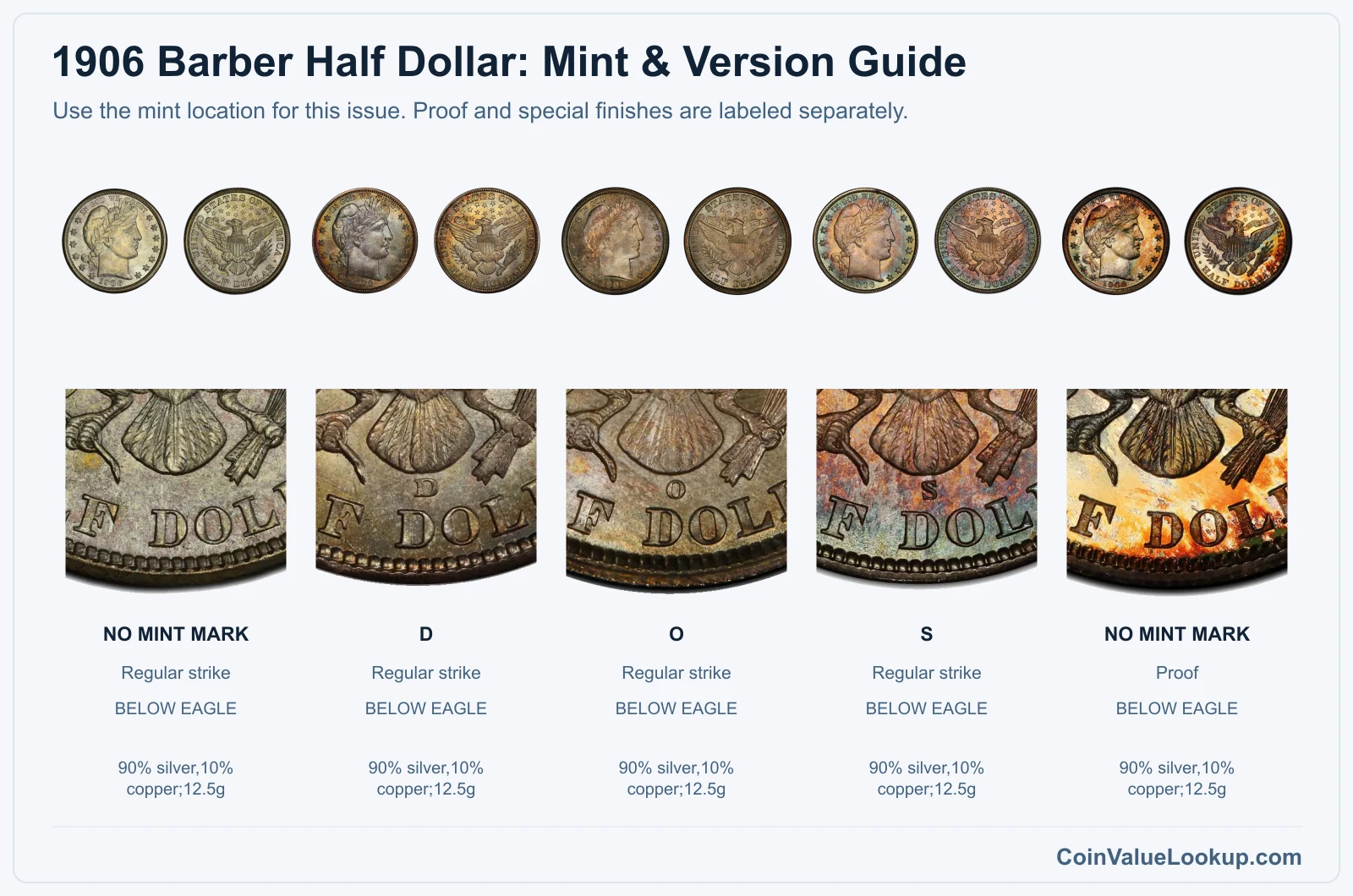
The 1906 Barber Half Dollar shows Liberty's head facing right on the obverse with a heraldic eagle on the reverse. The words HALF DOLLAR appear below the eagle.
All regular strikes are 90% silver and 10% copper, weigh about 12.5 grams, measure 30.6 mm across, and have a reeded edge.
Your first job is finding the mintmark. Philadelphia coins carry no mintmark at all.
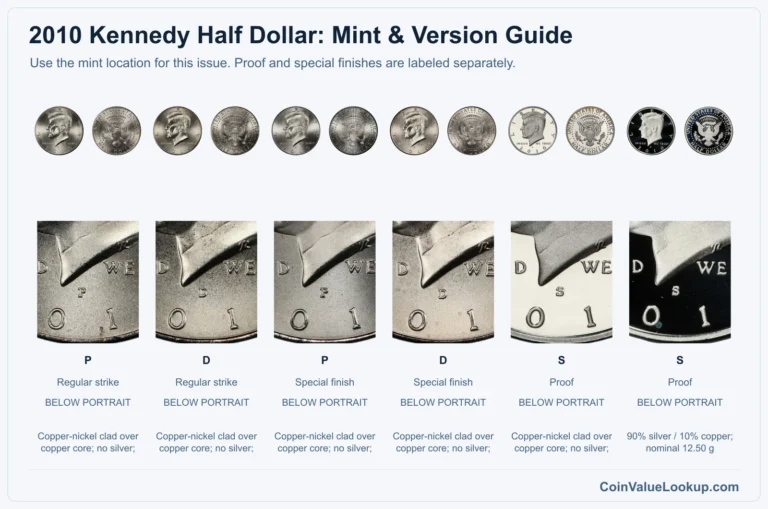
For Denver, New Orleans, and San Francisco issues, look on the reverse just below the eagle's tail feathers and above the words HALF DOLLAR — you will see a small D, O, or S respectively.
1906 is a historically notable date because it marks Denver's very first year producing Barber half dollars. Four business-strike branches exist (P, D, O, S), plus a Proof issue struck only at Philadelphia.
Keep in mind that a misplaced date variety has been reported on the Denver issue, and rotated dies have also been documented on 1906-D coins — these are entirely different error mechanisms and should not be confused with each other.
Step 2: Check Your 1906 Barber Half Dollar Grade
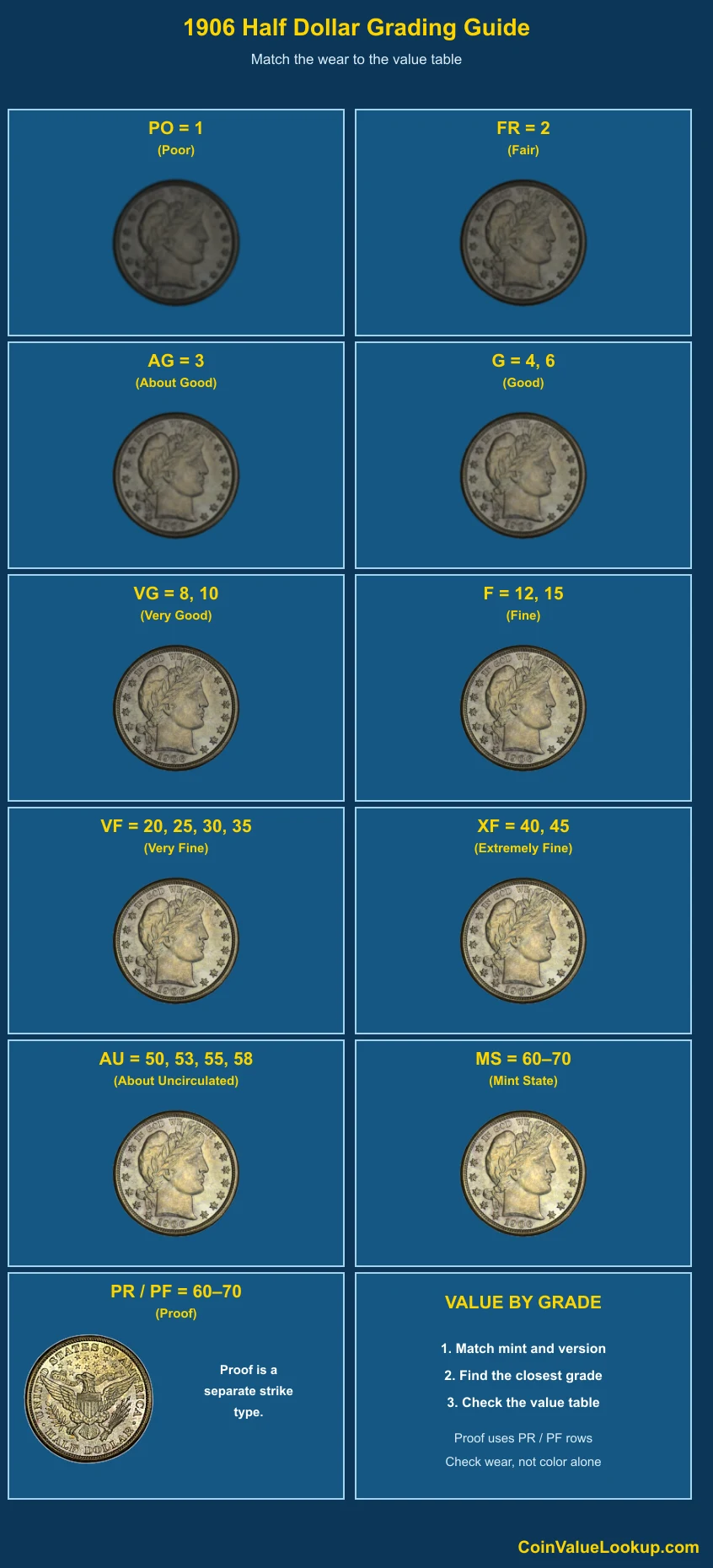
Start by examining Liberty's cheek, the hair above her ear, and the letters of the headband on the obverse. Then flip to the reverse and check the eagle's head, wing tips, and tail feathers.
Compare what you see against the grade comparison image provided on this page.
A coin grading around G4 will have a mostly flat portrait with the outline still visible. Mid-grade pieces (VG through VF) begin showing partial headband lettering and sharper feather definition.
At MS63, you should see full design detail and original luster across both sides.
Do not rely on the LIBERTY headband letters alone to assign a grade. Hub changes during the Barber series affect how quickly those letters wear, so the whole coin matters.
New Orleans strikes are known for softer impressions, particularly at the eagle's claws and arrow feathers. That weakness is a strike characteristic, not wear — learn to tell the difference before downgrading an O-mint coin.
A genuine Proof is a special manufacturing finish with mirrored fields, not simply a high-grade business strike. Polishing a circulated coin does not create a Proof.
Step 3: Check 1906 Barber Half Dollar Value by Mint and Version
1906 Barber Half Dollar — No Mint Mark — Regular Issue
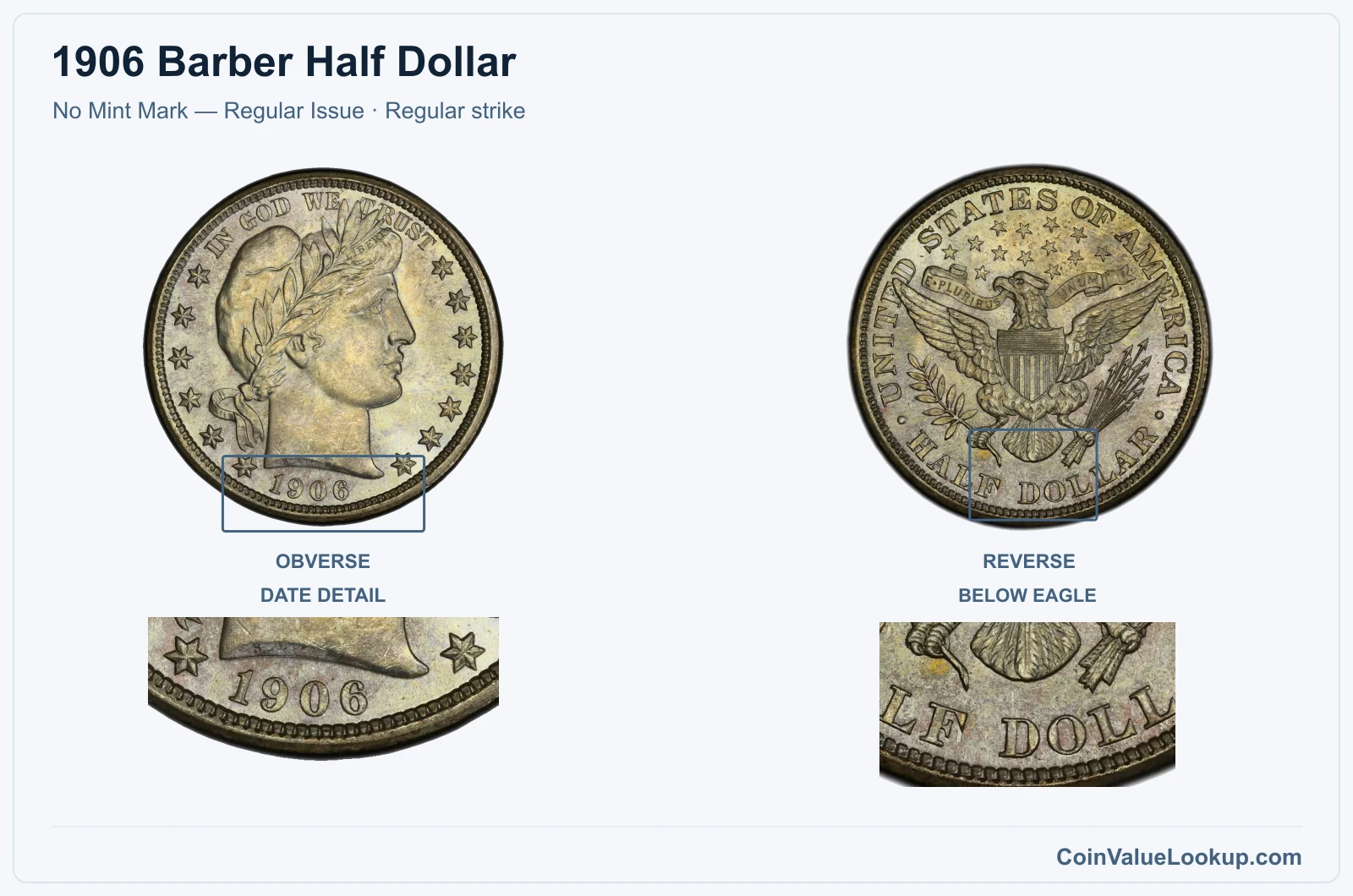
The 1906 Philadelphia half dollar carries no mintmark. Look at the reverse below the eagle's tail — the space should be clean.
This is the most commonly encountered mint for the date.
USA Coin Book lists about $44 at G4 and around $1145 at MS63. Those are guide estimates, not guaranteed sale prices.
Original, problem-free surfaces matter a lot once you move above heavily worn grades. Cleaned or damaged coins trade well below guide figures regardless of technical wear level.
Before assigning value, confirm the full date is legible and check for any signs of tooling, harsh cleaning, or rim damage. A coin with honest wear always beats a doctored one.
Range Grade
Price Auction Records Appraisal PO PO 1
—
Coin Identifier FR FR 2
—
Coin Identifier AG AG 3
—
Coin Identifier G G 4
Coin Identifier
G 6
—
Coin Identifier VG VG 8
—
Coin Identifier
VG 10
Coin Identifier F F 12
Coin Identifier
F 15
Coin Identifier VF VF 20
Coin Identifier
VF 25
Coin Identifier
VF 30
Coin Identifier
VF 35
Coin Identifier XF XF 40
Coin Identifier
XF 45
Coin Identifier AU AU 50
Coin Identifier
AU 53
Coin Identifier
AU 55
Coin Identifier
AU 58
Coin Identifier MS MS 60
Coin Identifier
MS 61
Coin Identifier
MS 62
Coin Identifier
MS 63
Coin Identifier
MS 64
Coin Identifier
MS 65
Coin Identifier
MS 66
Coin Identifier
MS 67
Coin Identifier
MS 68
—
—
—
MS 69
—
—
—
MS 70
—
—
—
1906 Barber Half Dollar — D — Regular Issue
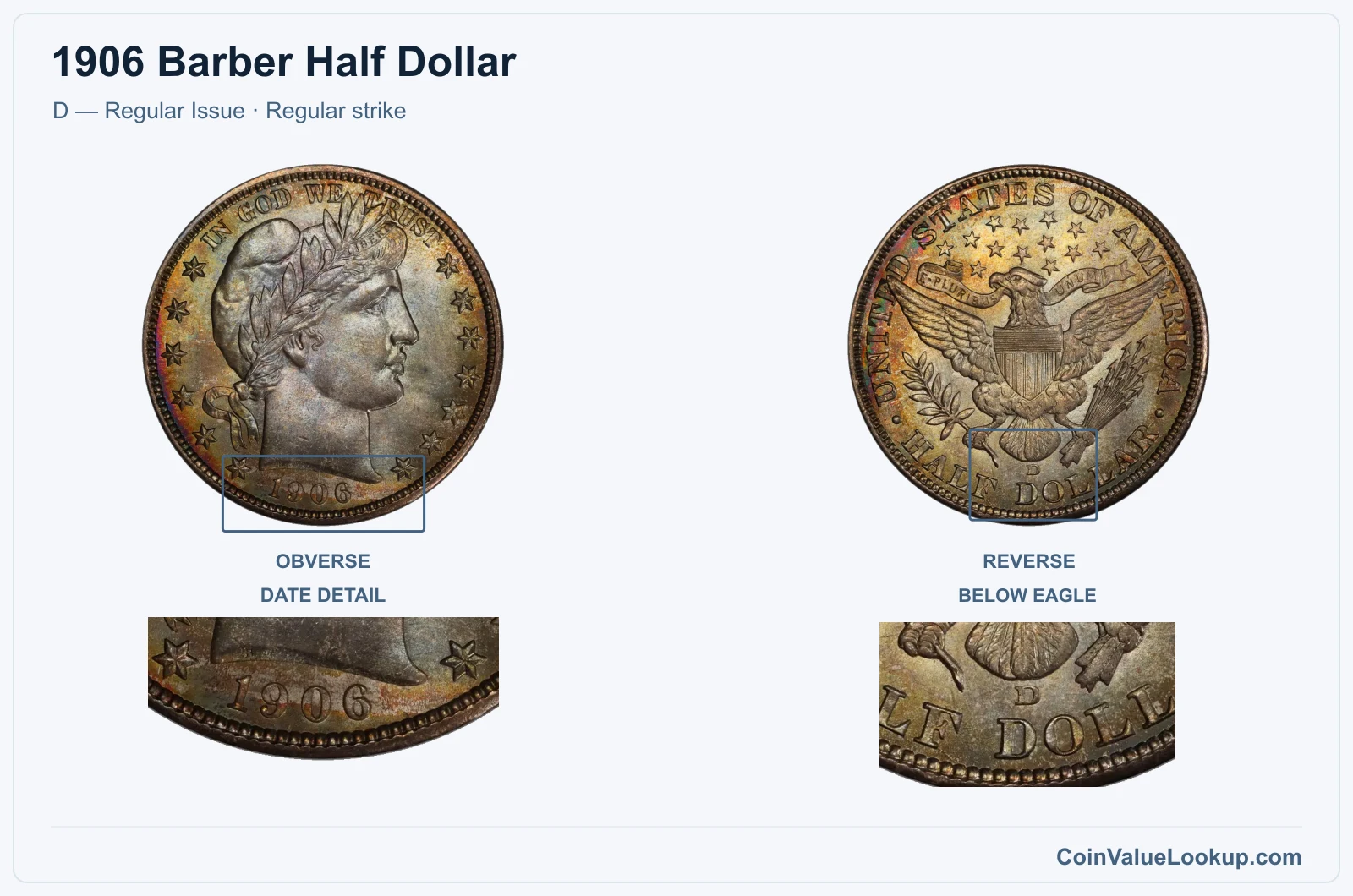
Denver's first-ever Barber half dollar. The D mintmark sits on the reverse below the eagle's tail feathers and above HALF DOLLAR.
Guide estimates from USA Coin Book place the 1906-D at about $44 in G4 and roughly $1145 in MS63. Being Denver's inaugural year for this denomination gives it a bit of historical cachet, though it is not a major rarity.
Pay close attention to the mintmark — a weak or partially filled D can sometimes be mistaken for no mintmark at all, which would incorrectly identify the coin as Philadelphia. Clear photos of that area are essential for accurate identification.
Coin Value Lookup is a good starting point if you are sorting through Barber halves from multiple years and need to look up other dates quickly.
Range Grade
Price Auction Records Appraisal PO PO 1
—
Coin Identifier FR FR 2
—
Coin Identifier AG AG 3
—
Coin Identifier G G 4
—
Coin Identifier
G 6
Coin Identifier VG VG 8
Coin Identifier
VG 10
—
Coin Identifier F F 12
Coin Identifier
F 15
Coin Identifier VF VF 20
Coin Identifier
VF 25
Coin Identifier
VF 30
Coin Identifier
VF 35
Coin Identifier XF XF 40
Coin Identifier
XF 45
Coin Identifier AU AU 50
Coin Identifier
AU 53
Coin Identifier
AU 55
Coin Identifier
AU 58
Coin Identifier MS MS 60
—
Coin Identifier
MS 61
Coin Identifier
MS 62
Coin Identifier
MS 63
Coin Identifier
MS 64
Coin Identifier
MS 65
Coin Identifier
MS 66
Coin Identifier
MS 67
Coin Identifier
MS 68
—
—
—
MS 69
—
—
—
MS 70
—
—
—
1906 Barber Half Dollar — O — Regular Issue
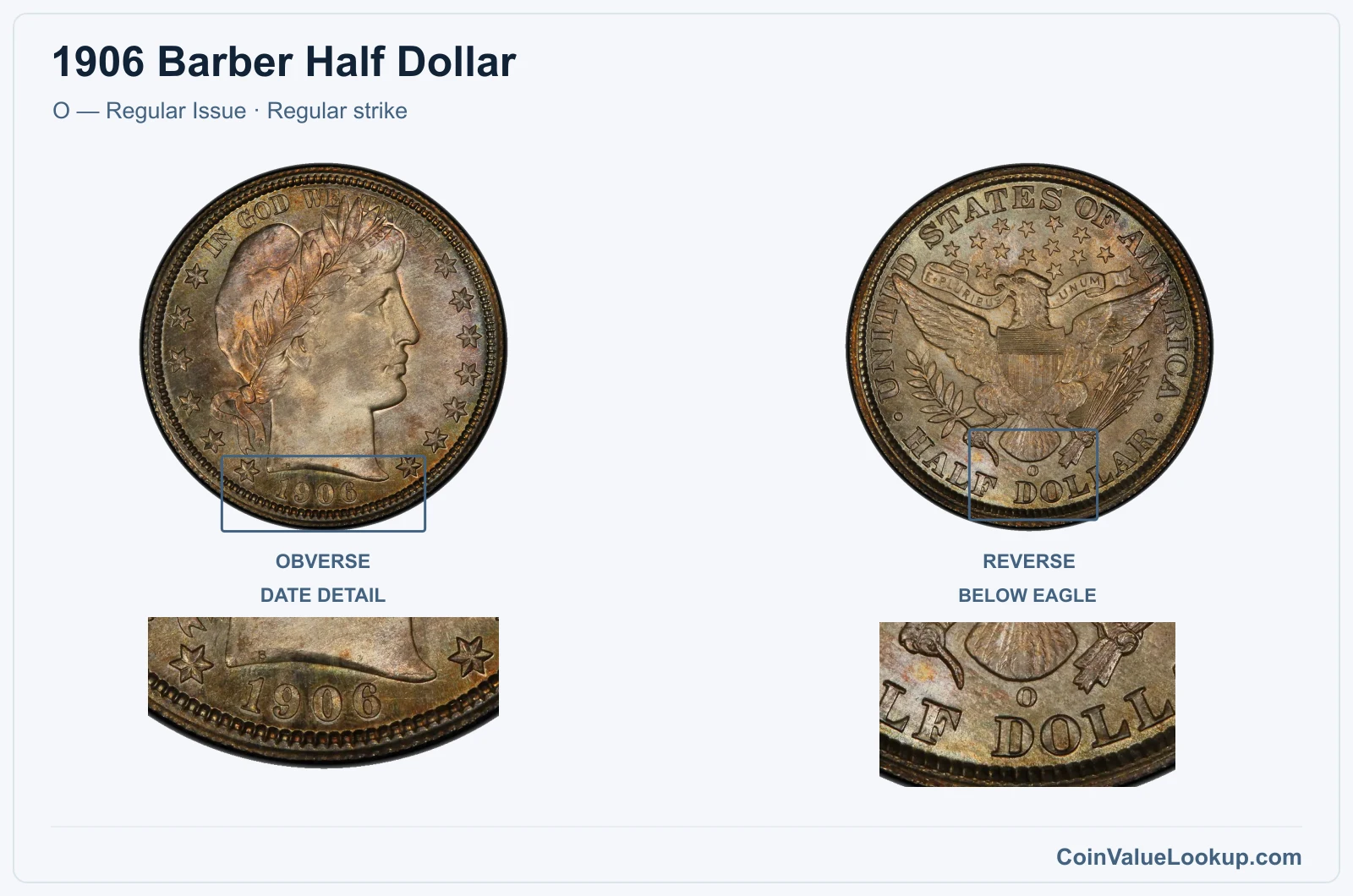
The New Orleans issue carries an O mintmark on the reverse, positioned below the eagle's tail. USA Coin Book lists this branch at about $44 in G4 and around $1954 at MS63 — that MS63 figure is notably higher than the Philadelphia or Denver versions.
New Orleans Barber halves are frequently softer in strike, especially at the eagle's claw and arrow-feather details. Do not mistake that softness for wear.
Compare the high points on Liberty's cheek and headband: if those are sharp but the reverse eagle detail is mushy, you likely have a strike issue rather than a grade issue.
Original surfaces without cleaning are critical for collector-grade pricing. A lightly circulated O-mint coin with honest toning can outperform a higher-technical-grade piece that has been scrubbed.
Range Grade
Price Auction Records Appraisal PO PO 1
—
Coin Identifier FR FR 2
—
Coin Identifier AG AG 3
Coin Identifier G G 4
—
Coin Identifier
G 6
Coin Identifier VG VG 8
Coin Identifier
VG 10
Coin Identifier F F 12
Coin Identifier
F 15
Coin Identifier VF VF 20
Coin Identifier
VF 25
Coin Identifier
VF 30
Coin Identifier
VF 35
Coin Identifier XF XF 40
Coin Identifier
XF 45
Coin Identifier AU AU 50
Coin Identifier
AU 53
Coin Identifier
AU 55
Coin Identifier
AU 58
Coin Identifier MS MS 60
—
Coin Identifier
MS 61
Coin Identifier
MS 62
Coin Identifier
MS 63
Coin Identifier
MS 64
Coin Identifier
MS 65
Coin Identifier
MS 66
Coin Identifier
MS 67
Coin Identifier
MS 68
—
—
—
MS 69
—
—
—
MS 70
—
—
—
1906 Barber Half Dollar — S — Regular Issue
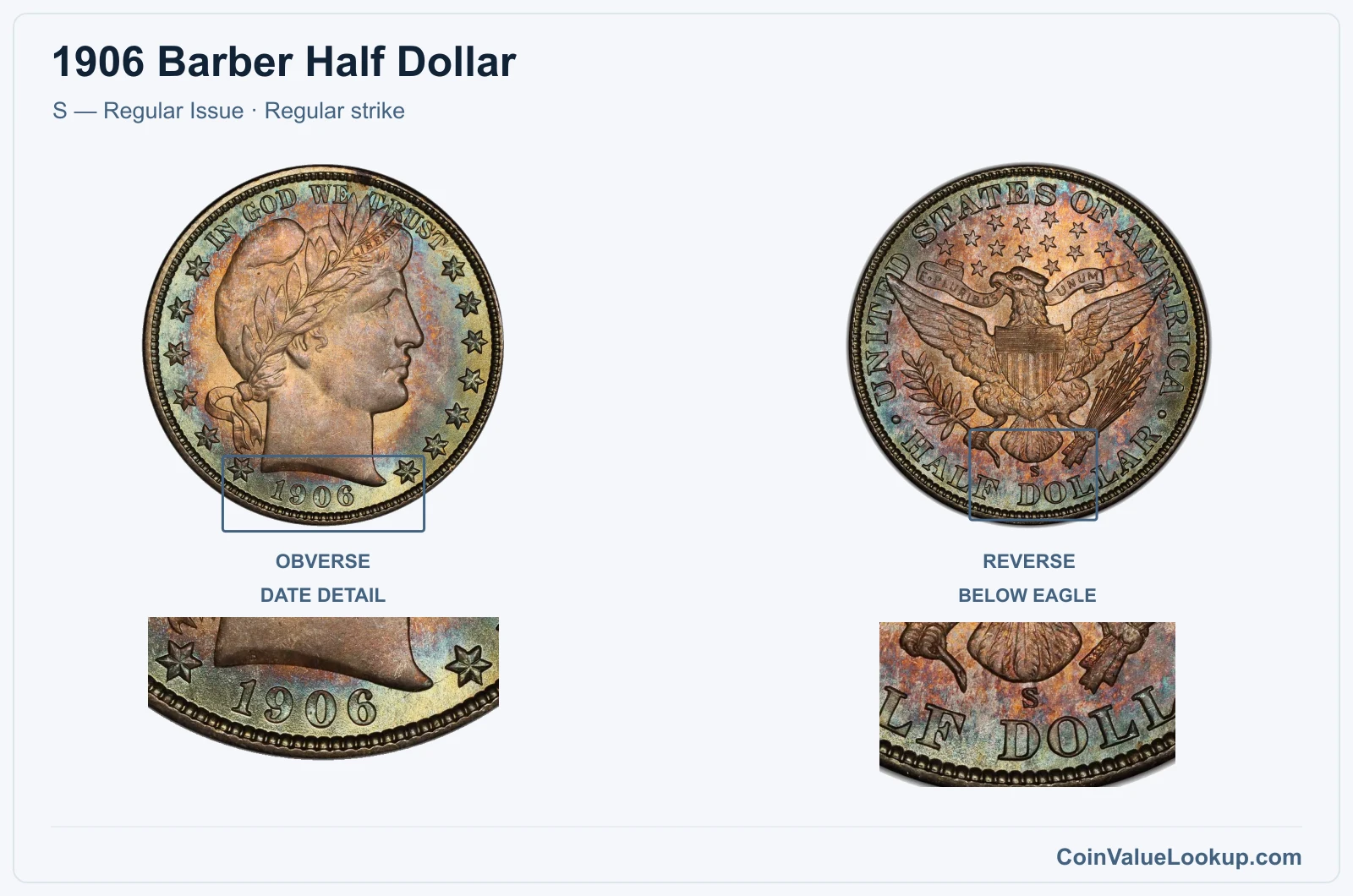
San Francisco's 1906 half carries an S mintmark below the eagle's tail on the reverse. This branch has the highest MS63 guide estimate among the four business strikes — about $2005 per USA Coin Book.
In heavily worn condition (G4), the guide value is the same $44 as the other mints, because at that level the silver content and series demand dominate over mint distinctions. The premium for the S-mint really shows up in upper circulated and Mint State grades.
As always, confirm the mintmark carefully. A worn S can sometimes resemble a blobby O, so use magnification and compare the letter shape.
Full, original luster and no signs of cleaning are what push an S-mint coin toward those higher guide figures.
Range Grade
Price Auction Records Appraisal PO PO 1
—
Coin Identifier FR FR 2
—
Coin Identifier AG AG 3
—
Coin Identifier G G 4
—
Coin Identifier
G 6
—
Coin Identifier VG VG 8
Coin Identifier
VG 10
Coin Identifier F F 12
Coin Identifier
F 15
Coin Identifier VF VF 20
Coin Identifier
VF 25
Coin Identifier
VF 30
Coin Identifier
VF 35
Coin Identifier XF XF 40
Coin Identifier
XF 45
Coin Identifier AU AU 50
Coin Identifier
AU 53
Coin Identifier
AU 55
Coin Identifier
AU 58
Coin Identifier MS MS 60
—
Coin Identifier
MS 61
Coin Identifier
MS 62
Coin Identifier
MS 63
Coin Identifier
MS 64
Coin Identifier
MS 65
Coin Identifier
MS 66
Coin Identifier
MS 67
Coin Identifier
MS 68
Coin Identifier
MS 69
—
—
—
MS 70
—
—
—
1906 Barber Half Dollar — No Mint Mark — Proof
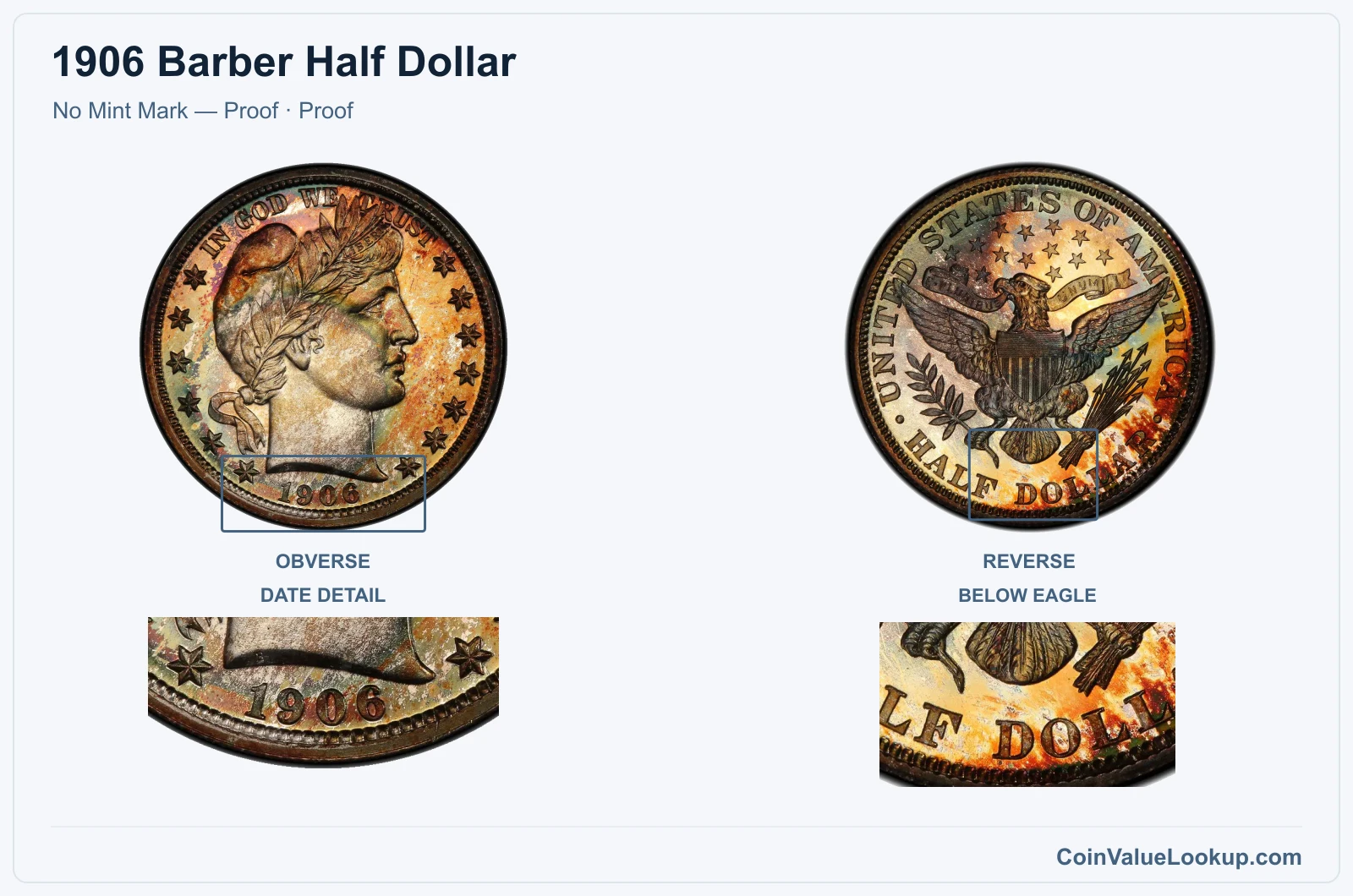
Philadelphia struck Proof Barber halves for collectors, and the 1906 Proof carries no mintmark — same as the business-strike Philadelphia coin. The difference is in the manufacturing finish: genuine Proofs have deeply mirrored fields and sharp, squared-off rims that business strikes simply do not exhibit.
USA Coin Book lists the 1906 Proof at about $1363 in PR63. These were produced in limited numbers for direct sale to collectors of the era.
Do not confuse a polished circulated coin for a Proof. Polishing creates a shiny surface but also leaves fine hairlines and removes the original die-struck mirror quality.
Compare the fields under magnification against a known attributed Proof. Cameo contrast — frosted devices against mirror fields — can appear within the Proof category, but that is a Proof characteristic, not a separate mint branch.
Range Grade
Price Auction Records Appraisal PR PR 1
—
Coin Identifier
PR 2
—
Coin Identifier
PR 3
—
Coin Identifier
PR 4
—
Coin Identifier
PR 6
—
Coin Identifier
PR 8
—
Coin Identifier
PR 10
—
Coin Identifier
PR 12
—
Coin Identifier
PR 15
—
Coin Identifier
PR 20
—
Coin Identifier
PR 25
—
Coin Identifier
PR 30
—
Coin Identifier
PR 35
—
Coin Identifier
PR 40
—
Coin Identifier
PR 45
—
Coin Identifier
PR 50
—
Coin Identifier
PR 53
—
Coin Identifier
PR 55
—
Coin Identifier
PR 58
Coin Identifier
PR 60
Coin Identifier
PR 61
Coin Identifier
PR 62
Coin Identifier
PR 63
Coin Identifier
PR 64
Coin Identifier
PR 65
Coin Identifier
PR 66
Coin Identifier
PR 67
Coin Identifier
PR 68
Coin Identifier
PR 69
—
—
—
PR 70
—
—
—
1906 Barber Half Dollar Error List
1. 1906 Barber Half Dollar — Misplaced Date
A misplaced date on the 1906-D Barber Half Dollar means that numeral fragments from a date punch appear where they should not — specifically in the denticles below the date. This is different from a repunched date, where you see doubled numerals near their correct position.
To check for this, examine the toothy denticle border directly beneath the date digits under magnification. You are looking for partial outlines of numbers that were punched too low during die preparation.
Do not confuse this with rim damage, contact marks, or ordinary die wear. Machine doubling also looks different — it produces flat, shelf-like doubling rather than distinct punch remnants in the wrong spot.
No specific price range is established here. Value depends on the visibility of the misplaced elements, overall coin condition, and how clearly the variety can be attributed.
A professional attribution strengthens any claim.
2. 1906 Barber Half Dollar — Repunched Date
Repunched date varieties on the 1906 Philadelphia Barber Half Dollar show remnants of an earlier date-punch position beside or overlapping the final numerals. This happened when a die received the date punch more than once, with the second impression not perfectly aligned over the first.
Look carefully at each digit — especially the 9, 0, and 6 — for traces of a shadow or secondary outline next to the primary number. Magnification is essential.
This variety is distinct from machine doubling, which produces flat, shelflike distortion across the entire design rather than isolated duplicate punch marks on the date alone. It is also not the same as a misplaced date, which involves numeral fragments appearing in the denticles.
No specific dollar figure applies universally. The value of a repunched date depends on how dramatic the repunching is, the coin's condition, and collector demand for that particular variety.
3. 1906 Barber Half Dollar — Rotated Dies
A rotated die error on the 1906-D has been reported with approximately 90 degrees of clockwise rotation. To test for this, hold the obverse upright and flip the coin top to bottom along a vertical axis.
On a normal U.S. coin, the reverse should appear upright too. A 90-degree rotation means the eagle will face sideways.
Be careful with photographs — a picture can be rotated in software or taken at an angle, creating the illusion of die rotation on a perfectly normal coin. You need to examine the physical coin in hand to confirm this error.
Also note that slight rotations of a few degrees are more common and less dramatic. A full 90-degree rotation is far more visually striking and collectible.
No specific price range is available. The degree of rotation, overall condition of the coin, and market interest at the time of sale all affect value.
4. 1906 Barber Half Dollar — Off-Center Strike
An off-center strike on a 1906-D Barber Half Dollar has been documented — Heritage Auctions listed a lot described as approximately 3% off-center toward the 3:30 position. That is a modest shift, but enough to show a displaced design with a slightly wider rim on one side.
To spot an off-center strike, look for the design being shifted in one direction with a corresponding unstruck crescent or wider blank area on the opposite side. The date must remain visible for the coin to be attributed to a specific year.
Do not confuse this with a clipped planchet (which removes a curved bite from the edge), post-mint damage from a vice or press, or a misaligned die that shifts only one side. An off-center strike affects the entire coin's impression relative to the planchet.
No adopted price range exists for this variety. Value depends on the percentage of off-center shift, whether the date is fully readable, and overall condition.
5. 1906 Barber Half Dollar — Mumps Die-Bulge Variety
The "Mumps" variety is a recognized die-bulge phenomenon reported on the 1906-O Barber Half Dollar. The name comes from an abnormal swelling or bulge on Liberty's neck and jaw area, giving the portrait a puffy, swollen appearance — as if she had the mumps.
Compare the neck and jawline of your coin to a normal 1906-O portrait. The bulge should be visible as a raised area that distorts the profile's contour.
This is a die-state issue caused during the die's working life, not something done to the coin after it left the mint.
Do not mistake post-mint damage, corrosion buildup, or tricky lighting on normal portrait contours for a Mumps variety. The bulge should be consistent and smooth, not rough or pitted.
No specific price range is established. Collector interest exists among Barber specialists, and value depends on the prominence of the bulge and the coin's overall condition.