1910 Barber Half Dollar Coin Value: How Much Is It Worth?
A 1910 Barber Half Dollar can range from about $44 at G4 to around $2,190 at MS63, depending on the mint and condition. Those figures come from a USA Coin Book guide snapshot and reflect two business-strike versions — Philadelphia and San Francisco — plus a Philadelphia Proof.
No Denver or New Orleans mint produced this half dollar in 1910. Original, problem-free coins in upper circulated or Mint State grades can be worth considerably more than heavily worn examples.
Fast Way to Identify Your 1910 Barber Half Dollar
The quickest way to start figuring out what you have is to upload clear photos of both the front and back of your coin. Our identifier can offer a preliminary read on the date, mint, and general type from those images.
It won't authenticate, certify, or pin down an exact grade, but it gives you a solid starting point before digging deeper.
1910 Barber Half Dollar Value
Upload both sides of your 1910 Barber Half Dollar.
Front Obverse
Upload photo
Back Reverse
Upload photo
Which 1910 Barber Half Dollar Versions Are Worth Money?
- The 1910 San Francisco (S mint) business strike lists at about $44 in G4 but jumps to roughly $2,190 at MS63, making high-grade survivors especially worth checking.
- The 1910 Philadelphia (no mintmark) business strike ranges from about $57 at G4 to around $1,363 at MS63 per the guide snapshot.
- A 1910 Philadelphia Proof in PR63 is listed at about $1,363 — these were struck with a special finish and are a separate category from business strikes.
- An S/S repunched mintmark is survey-listed for 1910-S; no confirmed specimen appeared in the cited survey, but it is worth inspecting your mintmark under magnification.
- Original, problem-free coins in upper circulated and Mint State grades carry significantly more value than heavily worn or cleaned pieces.
Step 1: Identify Your 1910 Barber Half Dollar Mint Mark and Version
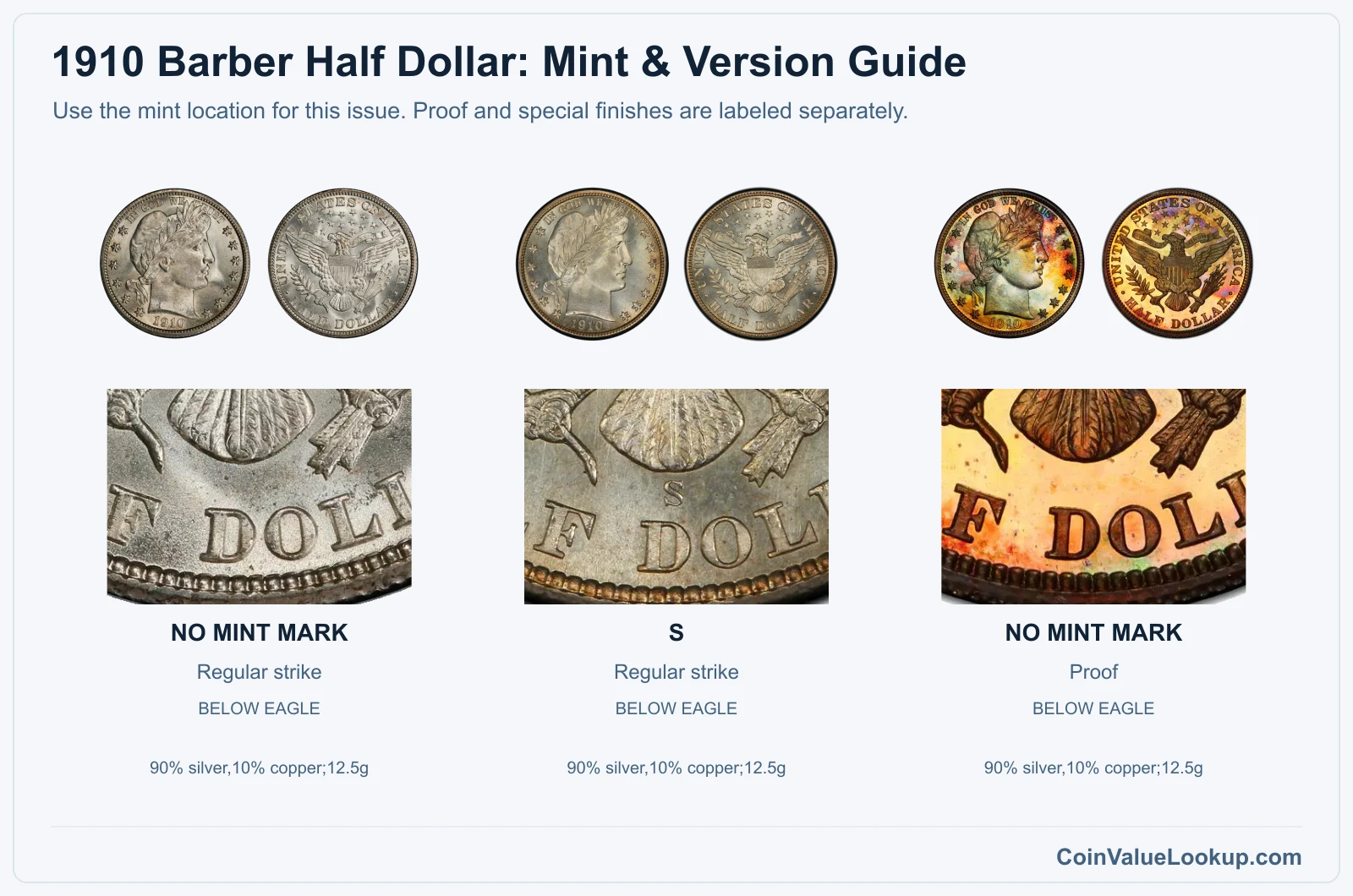
The 1910 Barber Half Dollar shows Liberty's head facing right on the obverse and a heraldic eagle on the reverse, with HALF DOLLAR spelled out below. The date sits at the bottom of the obverse.
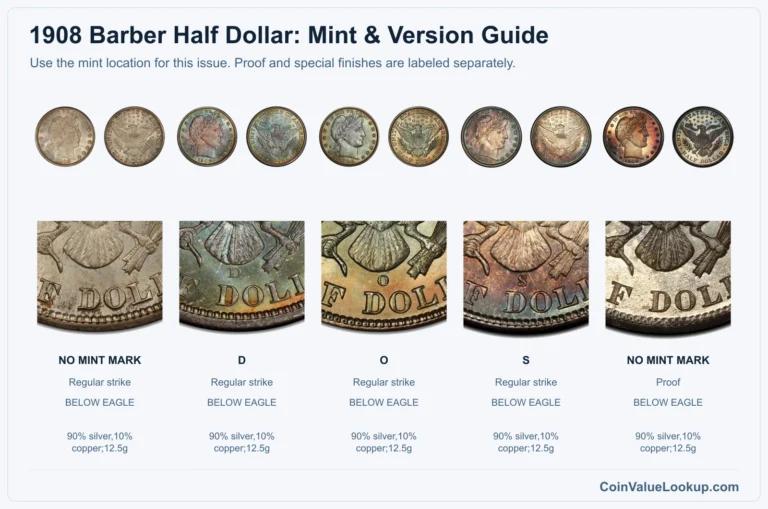
For mintmarks, flip the coin over. Look just below the eagle's tail feathers and above the words HALF DOLLAR.
A Philadelphia coin has no mintmark at all — just open space. A San Francisco coin carries a small "S" in that spot.
Only two mints struck business-strike halves this year: Philadelphia and San Francisco. There is no 1910-D or 1910-O, so if you see a D or O mintmark, double-check the date.
All regular issues are 90% silver and 10% copper, weighing about 12.5 grams with a 30.6 mm diameter and a reeded edge.
The Barber Coin Collectors' Society survey also lists an S/S repunched mintmark variety for 1910, though no respondent specimen appeared in the cited survey. That makes it a reported candidate rather than a confirmed, widely traded variety.
Step 2: Check Your 1910 Barber Half Dollar Grade
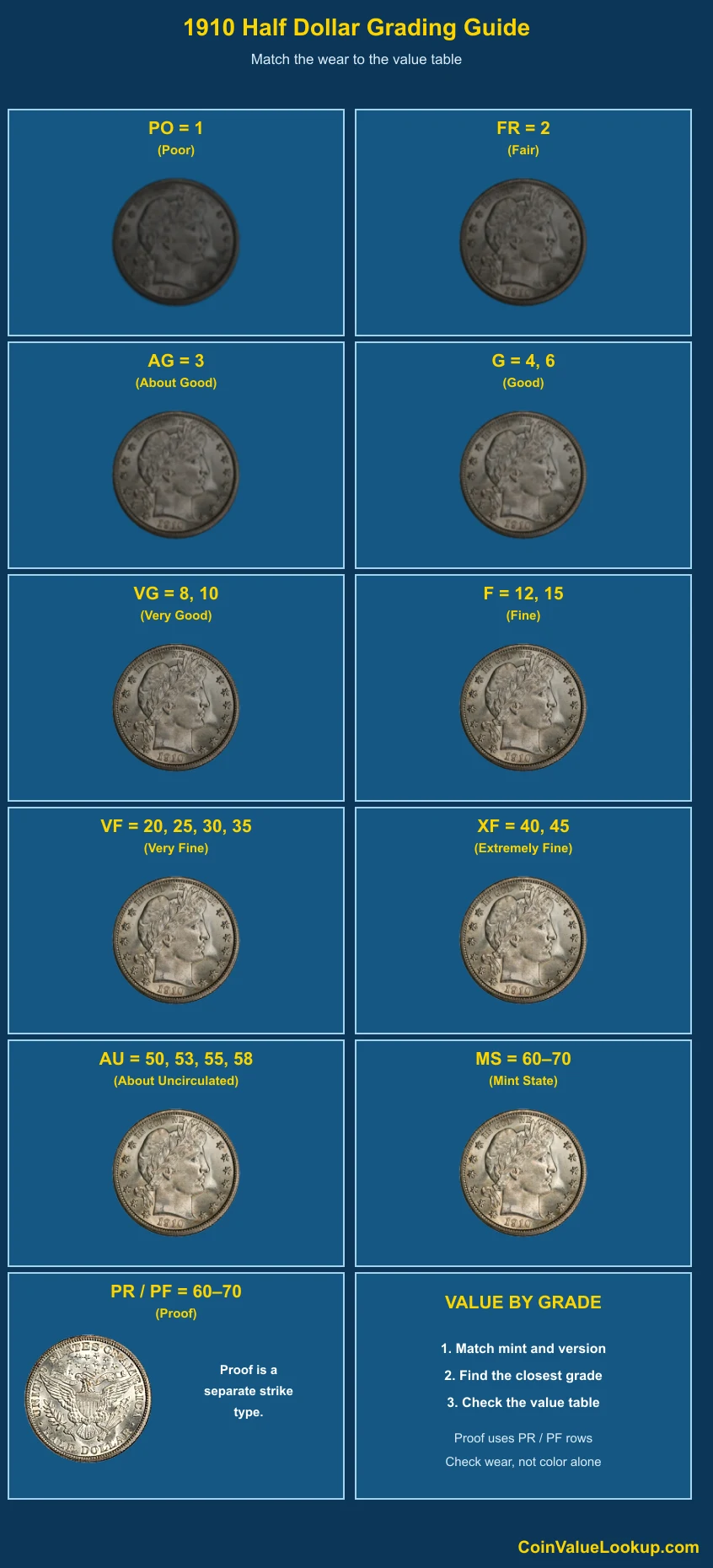
Start by looking at Liberty's cheek, the hair above her ear, and the letters in the headband on the obverse. Then check the eagle's head, wing tips, and tail feathers on the reverse.
Compare your coin to the grade comparison image to see where wear is showing up.
A coin grading around G4 will have a very flat Liberty portrait with most detail gone, while an MS63 piece retains full luster and sharp detail with only minor contact marks. Coins in the VF to AU range sit in between — partial LIBERTY letters visible, some hair detail remaining, and moderate eagle feather definition.
Do not judge grade from the LIBERTY headband letters alone. Hub changes during the Barber series can affect how those letters wear, so you need to evaluate the whole coin.
Separate genuine wear from a weak strike. Some Barber halves left the press with soft detail at the eagle's claws and arrow feathers, especially on certain mints.
That softness is not the same as circulation loss.
Also remember that a Proof is a special manufacturing finish with mirrored fields — it is not a grade above Mint State. A polished circulated coin is not a Proof, no matter how shiny it looks.
Step 3: Check 1910 Barber Half Dollar Value by Mint and Version
1910 Barber Half Dollar — No Mint Mark — Regular Issue
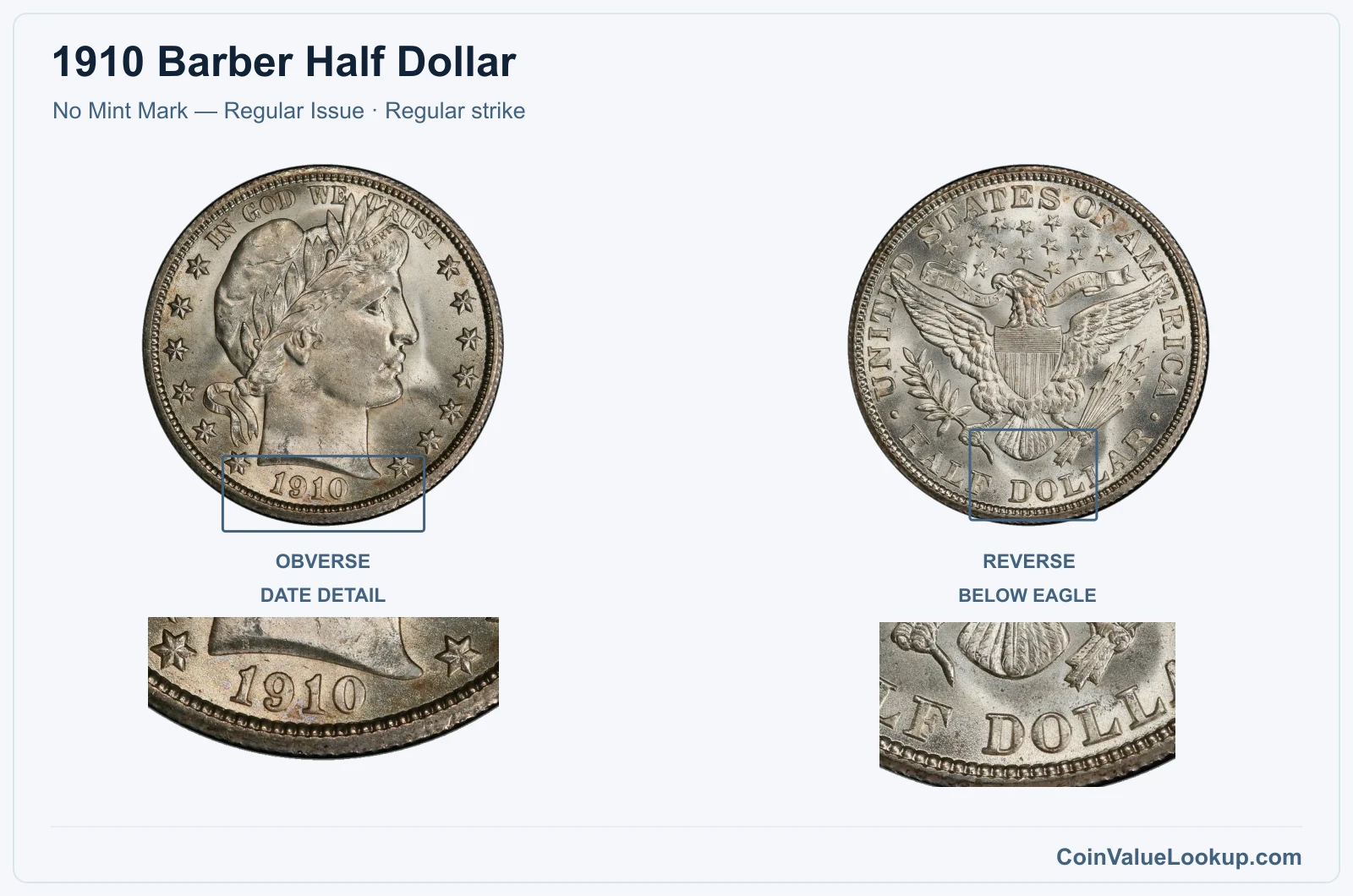
The 1910 Philadelphia half dollar carries no mintmark — the space below the eagle's tail is empty. This is the more common of the two business-strike issues for the year, yet it still commands solid value in higher grades.
A USA Coin Book guide estimate places it at about $57 in G4 and around $1,363 in MS63. Those are guide snapshots, not guaranteed sale prices, so your actual result depends on the coin's surfaces, eye appeal, and whether it has been cleaned or damaged.
Check for original toning and unimpaired luster before assuming a high grade.
Coin Value Lookup is a good place to look up guides for other dates and denominations in the Barber series if you are working through a collection.
Range Grade
Price Auction Records Appraisal PO PO 1
—
Coin Identifier FR FR 2
—
Coin Identifier AG AG 3
—
Coin Identifier G G 4
—
Coin Identifier
G 6
Coin Identifier VG VG 8
Coin Identifier
VG 10
Coin Identifier F F 12
Coin Identifier
F 15
Coin Identifier VF VF 20
Coin Identifier
VF 25
Coin Identifier
VF 30
Coin Identifier
VF 35
Coin Identifier XF XF 40
Coin Identifier
XF 45
Coin Identifier AU AU 50
Coin Identifier
AU 53
Coin Identifier
AU 55
Coin Identifier
AU 58
Coin Identifier MS MS 60
—
Coin Identifier
MS 61
Coin Identifier
MS 62
Coin Identifier
MS 63
Coin Identifier
MS 64
Coin Identifier
MS 65
Coin Identifier
MS 66
Coin Identifier
MS 67
—
—
—
MS 68
—
—
—
MS 69
—
—
—
MS 70
—
—
—
1910 Barber Half Dollar — S — Regular Issue
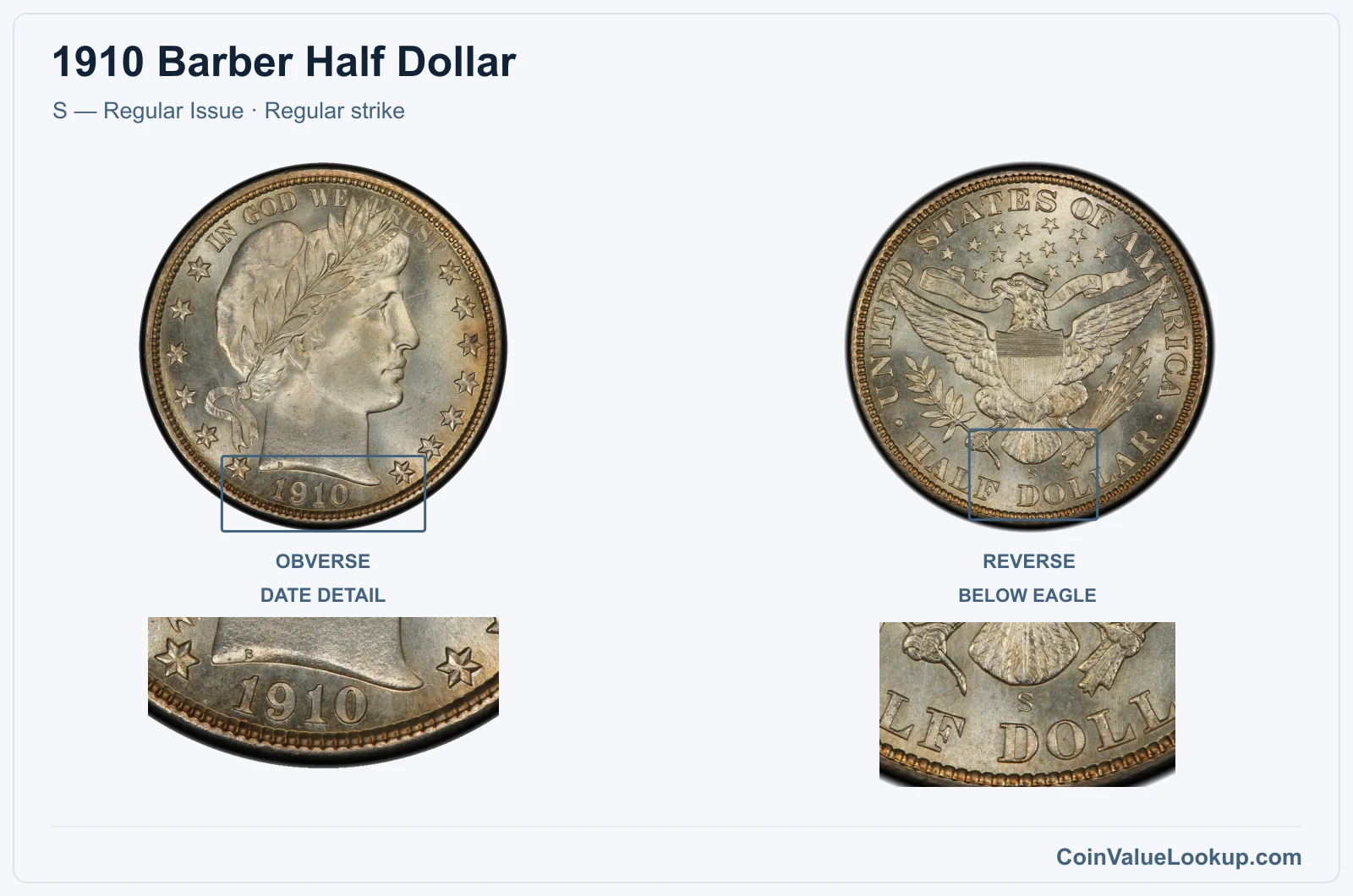
Look for the small "S" mintmark below the eagle's tail feathers. The San Francisco issue starts lower in worn grades — about $44 at G4 per the USA Coin Book guide — but climbs steeply, reaching roughly $2,190 at MS63.
That spread tells you something: plenty of these circulated hard, and surviving Mint State examples are genuinely scarce. If your coin still has strong luster and sharp detail across Liberty's hair and the eagle's feathers, it is worth a careful, independent evaluation.
Original surfaces matter here. A cleaned or harshly dipped coin will not bring the same money, even if the underlying detail looks sharp.
Check for unnatural brightness or hairlines under good light.
Range Grade
Price Auction Records Appraisal PO PO 1
—
Coin Identifier FR FR 2
—
Coin Identifier AG AG 3
—
Coin Identifier G G 4
—
Coin Identifier
G 6
Coin Identifier VG VG 8
Coin Identifier
VG 10
Coin Identifier F F 12
Coin Identifier
F 15
Coin Identifier VF VF 20
Coin Identifier
VF 25
Coin Identifier
VF 30
Coin Identifier
VF 35
Coin Identifier XF XF 40
Coin Identifier
XF 45
Coin Identifier AU AU 50
Coin Identifier
AU 53
Coin Identifier
AU 55
Coin Identifier
AU 58
Coin Identifier MS MS 60
Coin Identifier
MS 61
Coin Identifier
MS 62
Coin Identifier
MS 63
Coin Identifier
MS 64
Coin Identifier
MS 65
Coin Identifier
MS 66
Coin Identifier
MS 67
Coin Identifier
MS 68
—
Coin Identifier
MS 69
—
—
—
MS 70
—
—
—
1910 Barber Half Dollar — No Mint Mark — Proof
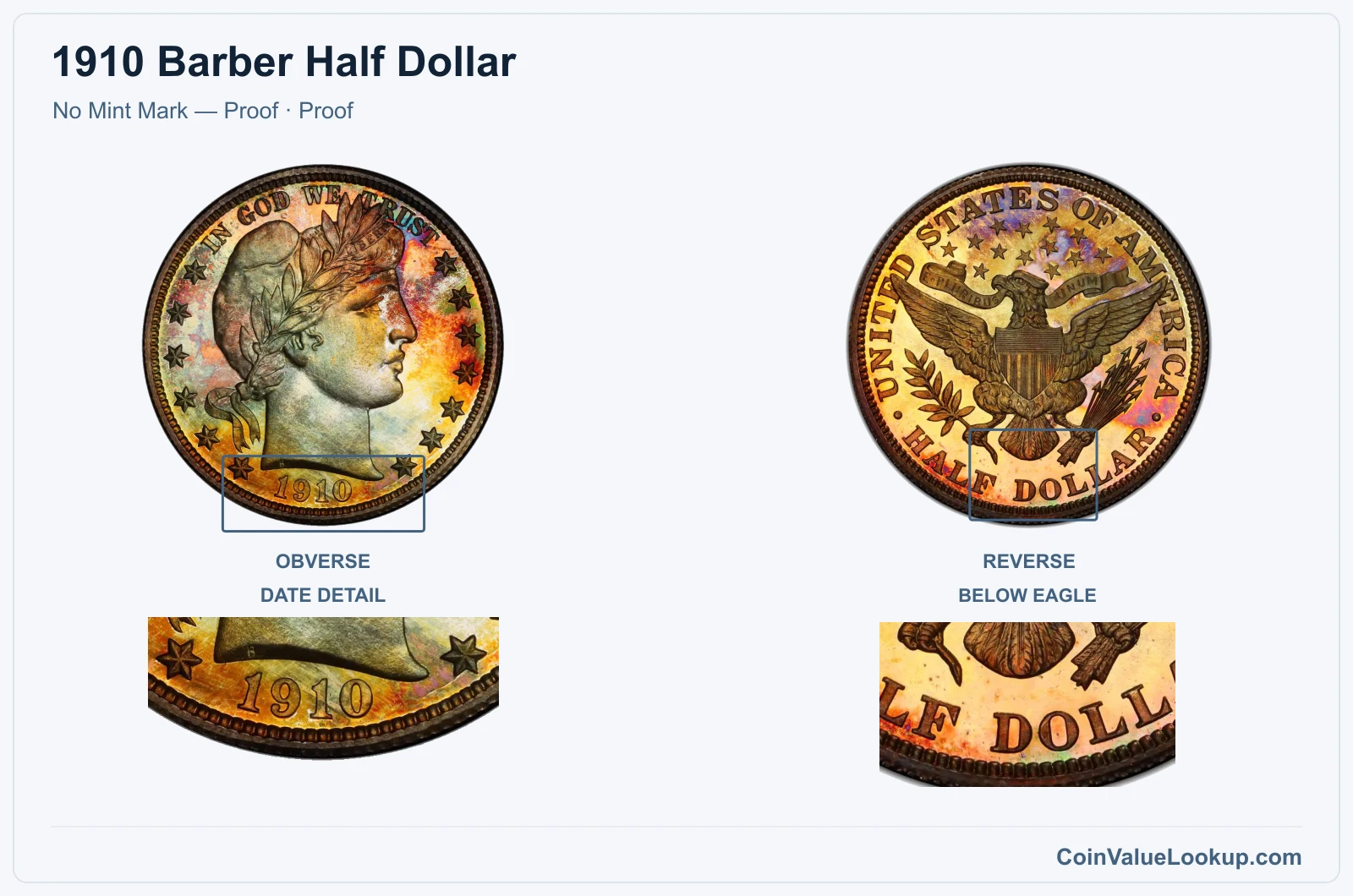
Philadelphia Proofs were struck with specially prepared dies on polished planchets, producing mirrored fields and crisp detail that business strikes simply do not have. The guide lists a PR63 example at about $1,363.
To confirm a Proof, look for deeply reflective, glass-like fields and sharp, squared-off rims. The devices may show contrast against those mirrored fields.
Compare within the Proof category rather than against business strikes — a lightly handled Proof and a fresh Mint State coin can look superficially similar, but the field quality is different.
Polishing a business strike will not create this effect. If the surfaces show swirl marks or uneven reflectivity, you likely have a cleaned coin, not a Proof.
Range Grade
Price Auction Records Appraisal PR PR 1
—
Coin Identifier
PR 2
—
Coin Identifier
PR 3
—
Coin Identifier
PR 4
—
Coin Identifier
PR 6
—
Coin Identifier
PR 8
—
Coin Identifier
PR 10
—
Coin Identifier
PR 12
—
Coin Identifier
PR 15
—
Coin Identifier
PR 20
—
Coin Identifier
PR 25
—
Coin Identifier
PR 30
—
Coin Identifier
PR 35
—
Coin Identifier
PR 40
—
Coin Identifier
PR 45
—
Coin Identifier
PR 50
—
Coin Identifier
PR 53
—
Coin Identifier
PR 55
—
Coin Identifier
PR 58
—
Coin Identifier
PR 60
Coin Identifier
PR 61
Coin Identifier
PR 62
Coin Identifier
PR 63
Coin Identifier
PR 64
Coin Identifier
PR 65
Coin Identifier
PR 66
Coin Identifier
PR 67
Coin Identifier
PR 68
Coin Identifier
PR 69
—
—
—
PR 70
—
—
—
1910 Barber Half Dollar Error List
1. 1910 Barber Half Dollar — Repunched Mintmark
The Barber Coin Collectors' Society survey lists a repunched mintmark (S/S) for the 1910 San Francisco half dollar. This means the "S" mintmark was punched into the die more than once, leaving a trace of an earlier, offset impression beneath or beside the final letter.
To check, examine the mintmark area under at least 5x magnification. You are looking for a ghost outline or partial second "S" that does not align perfectly with the primary mark.
Compare your coin's mintmark to a normal 1910-S at the same magnification so you have a baseline.
Be careful with lookalikes. Machine doubling can create shelf-like distortion around the mintmark, and die chips or corrosion can add lumps that mimic a second punch.
These are not the same thing as a genuine repunched mintmark.
No confirmed specimen appeared in the survey's respondent data, and no numerical price has been established. Condition, the clarity of the repunching, and independent attribution all affect what such a coin might bring.