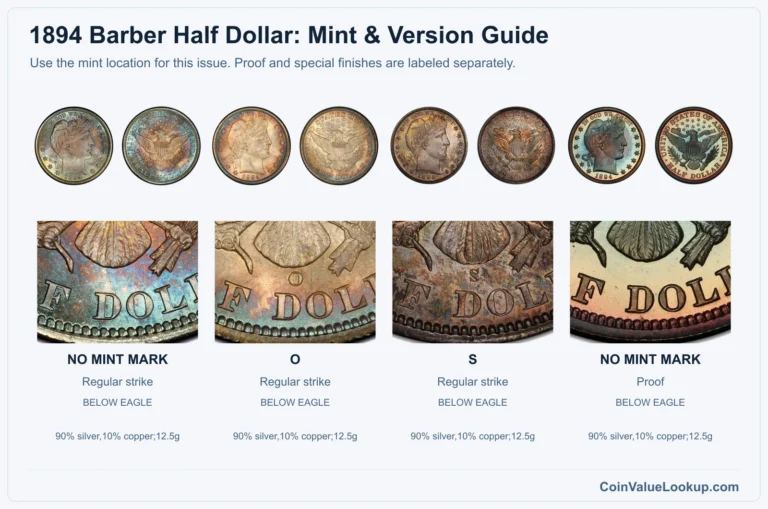
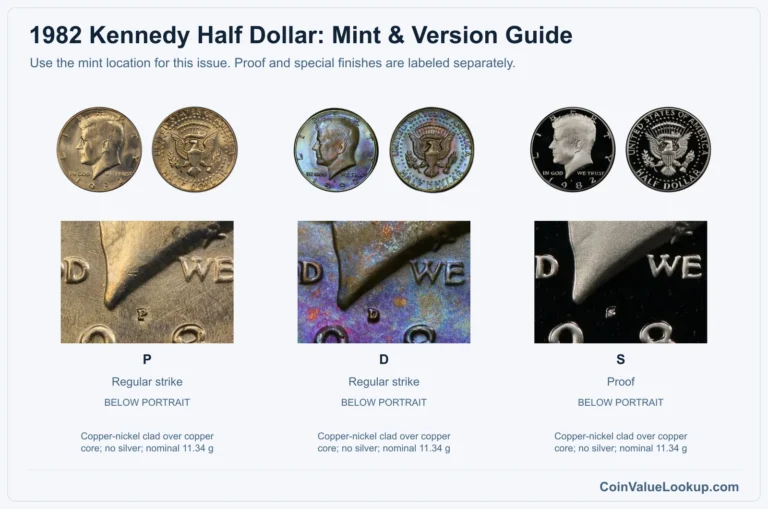
1912 Barber Half Dollar Coin Value: How Much Is It Worth?
A 1912 Barber Half Dollar in well-worn G4 condition starts around $44 based on a recent retail guide snapshot, while uncirculated MS63 examples range from about $1,049 to $1,363 depending on the mint. Proofs carry their own separate pricing.
Three business-strike mints were active this year — Philadelphia, Denver, and San Francisco — so your first job is figuring out which one you have.
Fast Way to Identify Your 1912 Barber Half Dollar
The fastest way to get a preliminary identification is to upload clear photos of both the front and back of your coin. Make sure the date is readable and the area just below the eagle's tail feathers is in focus — that is where the mintmark sits.
Good lighting and a steady hand beat any expensive camera setup.
1912 Barber Half Dollar Value
Upload both sides of your 1912 Barber Half Dollar.
Front Obverse
Upload photo
Back Reverse
Upload photo
Which 1912 Barber Half Dollar Versions Are Worth Money?
- The San Francisco (S) mint issue reaches about $1,363 at MS63, the highest guide figure among the three business-strike mints for this date.
- Philadelphia and Denver business strikes share identical guide values at G4 ($44) and MS63 ($1,049), but original problem-free surfaces matter — cleaned or damaged coins sell for less.
- Proof strikes from Philadelphia are listed at $1,363 in PR63; these are a distinct finish with mirrored fields, not simply high-grade business strikes.
- Upper circulated and Mint State coins with original surfaces can be significantly more valuable than heavily worn pieces, so accurate grading is essential before estimating value.
Step 1: Identify Your 1912 Barber Half Dollar Mint Mark and Version
The 1912 Barber Half Dollar shows Charles Barber's Liberty head facing right on the obverse and a heraldic eagle on the reverse. The denomination HALF DOLLAR appears below the eagle.
All regular issues are struck in 90% silver and 10% copper, weigh about 12.5 grams, and measure 30.6 mm with a reeded edge.
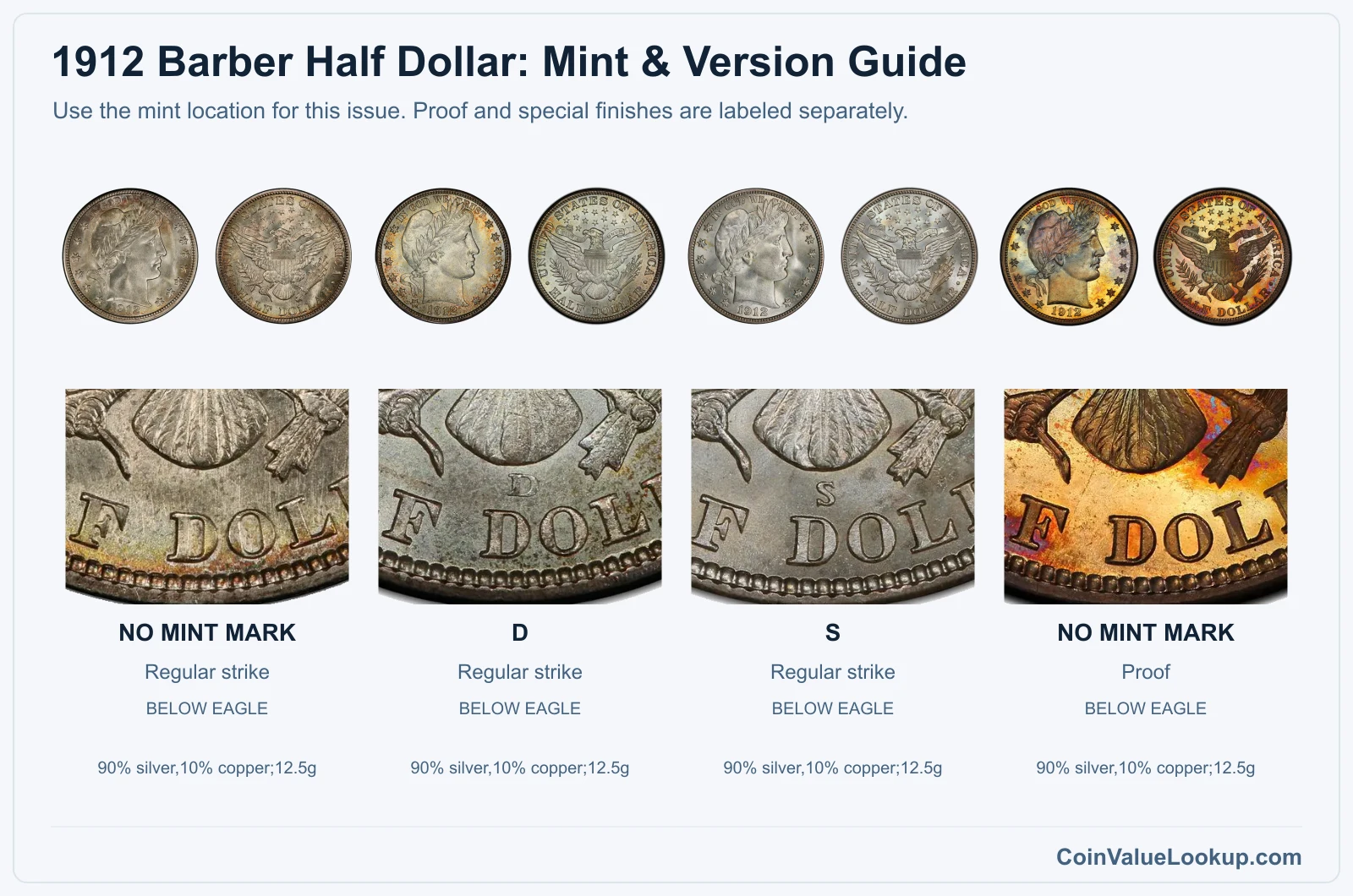
Three mints produced business strikes this year: Philadelphia (no mintmark), Denver (D), and San Francisco (S). The mintmark, if present, sits on the reverse below the eagle's tail feathers and above the words HALF DOLLAR.
Look carefully — on worn coins the small letter can hide in the design.
There is no regular 1912-O issue. If you think you see an O mintmark, double-check under magnification; it may be a misread D or damage.
Philadelphia also struck Proof coins, which are a special mirror-finish production, not a higher grade than Mint State.
Coin Value Lookup is a handy starting point if you want to look up guides for other dates and denominations in this series. Bookmark it before you fall down the Barber rabbit hole.
Step 2: Check Your 1912 Barber Half Dollar Grade
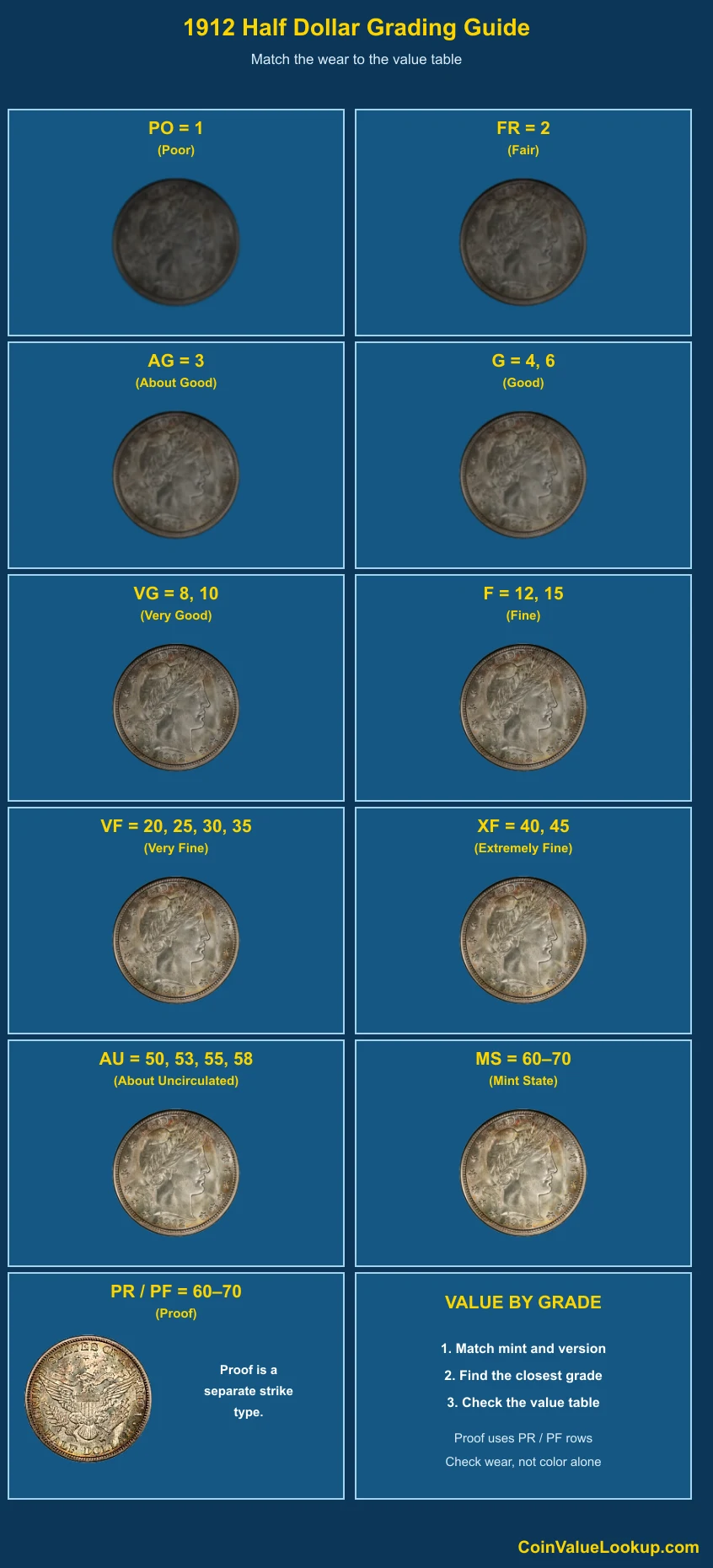
Grading a Barber half dollar means checking the entire coin, not just the word LIBERTY on the headband. Start with Liberty's cheek and the hair above her ear on the obverse — these are high points that lose detail first.
Then flip to the reverse and examine the eagle's head, wing tips, and tail feathers.
Separate genuine wear from a weak strike. Some Barber halves left the press with soft details at the eagle's claws and arrow feathers, which can fool you into thinking the coin circulated more than it did.
Loss of original mint luster is a better wear indicator than mushy feathers alone.
Use the grade comparison image alongside your coin under even lighting. A Proof is identified by its mirrored fields and sharp rims — polishing a business strike will not create a Proof.
Hub changes during the series can also shift how quickly LIBERTY wears, so do not rely on those letters as your only grading shortcut.
Step 3: Check 1912 Barber Half Dollar Value by Mint and Version
1912 Barber Half Dollar — No Mint Mark — Regular Issue
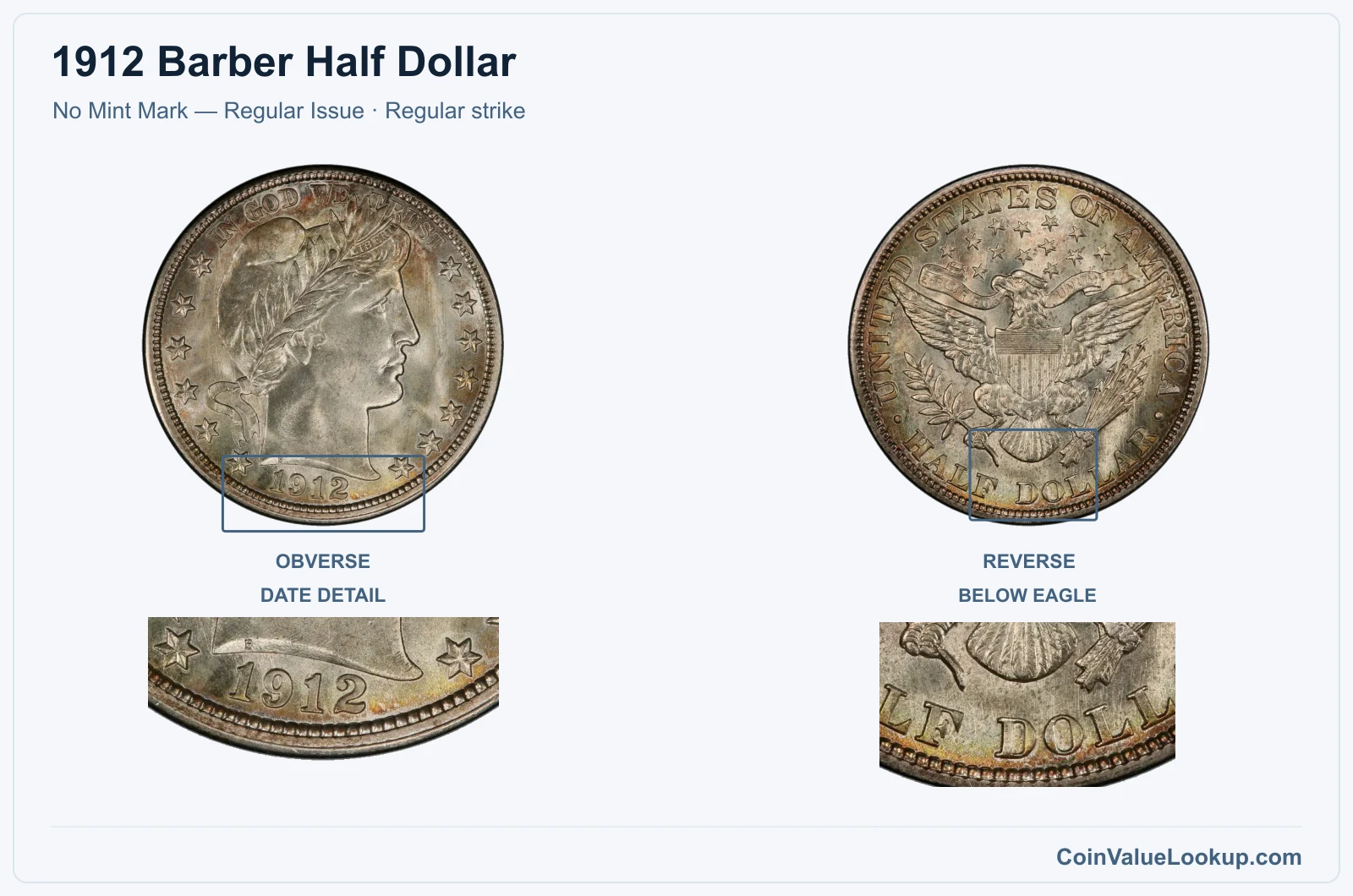
The Philadelphia issue carries no mintmark. Check the reverse below the eagle's tail — if the space is blank, you have the P mint.
At G4, a guide estimate places this coin around $44, rising to roughly $1,049 at MS63.
Condition and original surfaces drive the spread between those numbers. A coin with honest wear and no cleaning will always be more desirable than one that has been scrubbed to look shinier.
Confirm the full date is legible and look for any signs of tooling or whizzing before you get too excited about grade.
Range Grade
Price Auction Records Appraisal PO PO 1
—
Coin Identifier FR FR 2
—
Coin Identifier AG AG 3
—
Coin Identifier G G 4
—
Coin Identifier
G 6
Coin Identifier VG VG 8
Coin Identifier
VG 10
Coin Identifier F F 12
Coin Identifier
F 15
Coin Identifier VF VF 20
Coin Identifier
VF 25
Coin Identifier
VF 30
Coin Identifier
VF 35
Coin Identifier XF XF 40
Coin Identifier
XF 45
Coin Identifier AU AU 50
Coin Identifier
AU 53
Coin Identifier
AU 55
Coin Identifier
AU 58
Coin Identifier MS MS 60
Coin Identifier
MS 61
Coin Identifier
MS 62
Coin Identifier
MS 63
Coin Identifier
MS 64
Coin Identifier
MS 65
Coin Identifier
MS 66
Coin Identifier
MS 67
—
—
—
MS 68
—
—
—
MS 69
—
—
—
MS 70
—
—
—
1912 Barber Half Dollar — D — Regular Issue
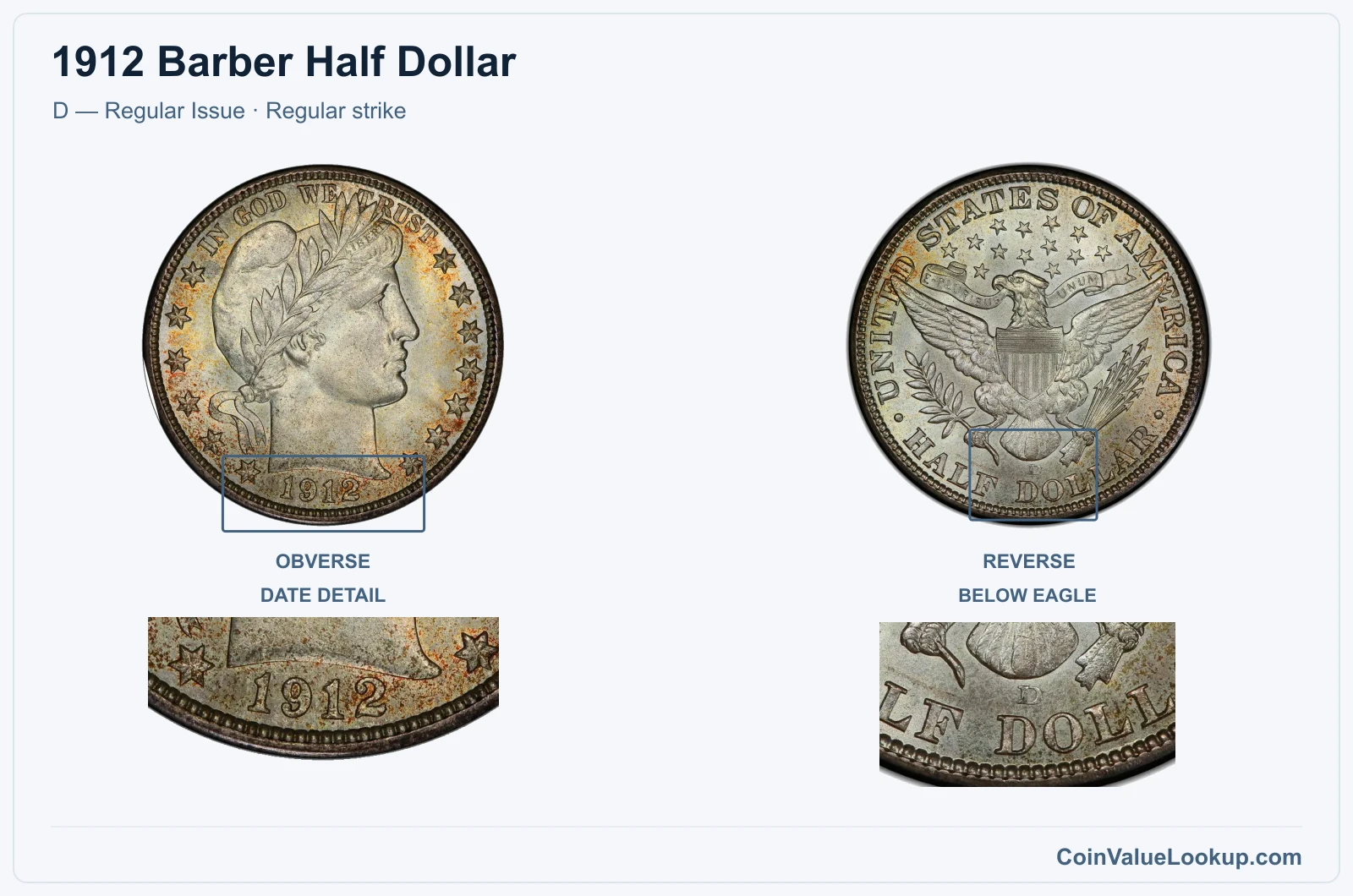
Denver strikes carry a small D mintmark on the reverse, below the eagle's tail feathers and above HALF DOLLAR. Guide estimates for the 1912-D match the Philadelphia issue: about $44 at G4 and $1,049 at MS63.
Denver mintmarks on Barber halves can be faint even on higher-grade coins, so use magnification. Original luster and the absence of cleaning or environmental damage are what separate a coin worth pursuing from one that is just silver weight.
Check both sides under good light before settling on a grade.
Range Grade
Price Auction Records Appraisal PO PO 1
—
Coin Identifier FR FR 2
—
Coin Identifier AG AG 3
—
Coin Identifier G G 4
Coin Identifier
G 6
—
Coin Identifier VG VG 8
—
Coin Identifier
VG 10
Coin Identifier F F 12
Coin Identifier
F 15
Coin Identifier VF VF 20
Coin Identifier
VF 25
Coin Identifier
VF 30
Coin Identifier
VF 35
Coin Identifier XF XF 40
Coin Identifier
XF 45
Coin Identifier AU AU 50
Coin Identifier
AU 53
Coin Identifier
AU 55
Coin Identifier
AU 58
Coin Identifier MS MS 60
Coin Identifier
MS 61
Coin Identifier
MS 62
Coin Identifier
MS 63
Coin Identifier
MS 64
Coin Identifier
MS 65
Coin Identifier
MS 66
Coin Identifier
MS 67
Coin Identifier
MS 68
—
—
—
MS 69
—
—
—
MS 70
—
—
—
1912 Barber Half Dollar — S — Regular Issue
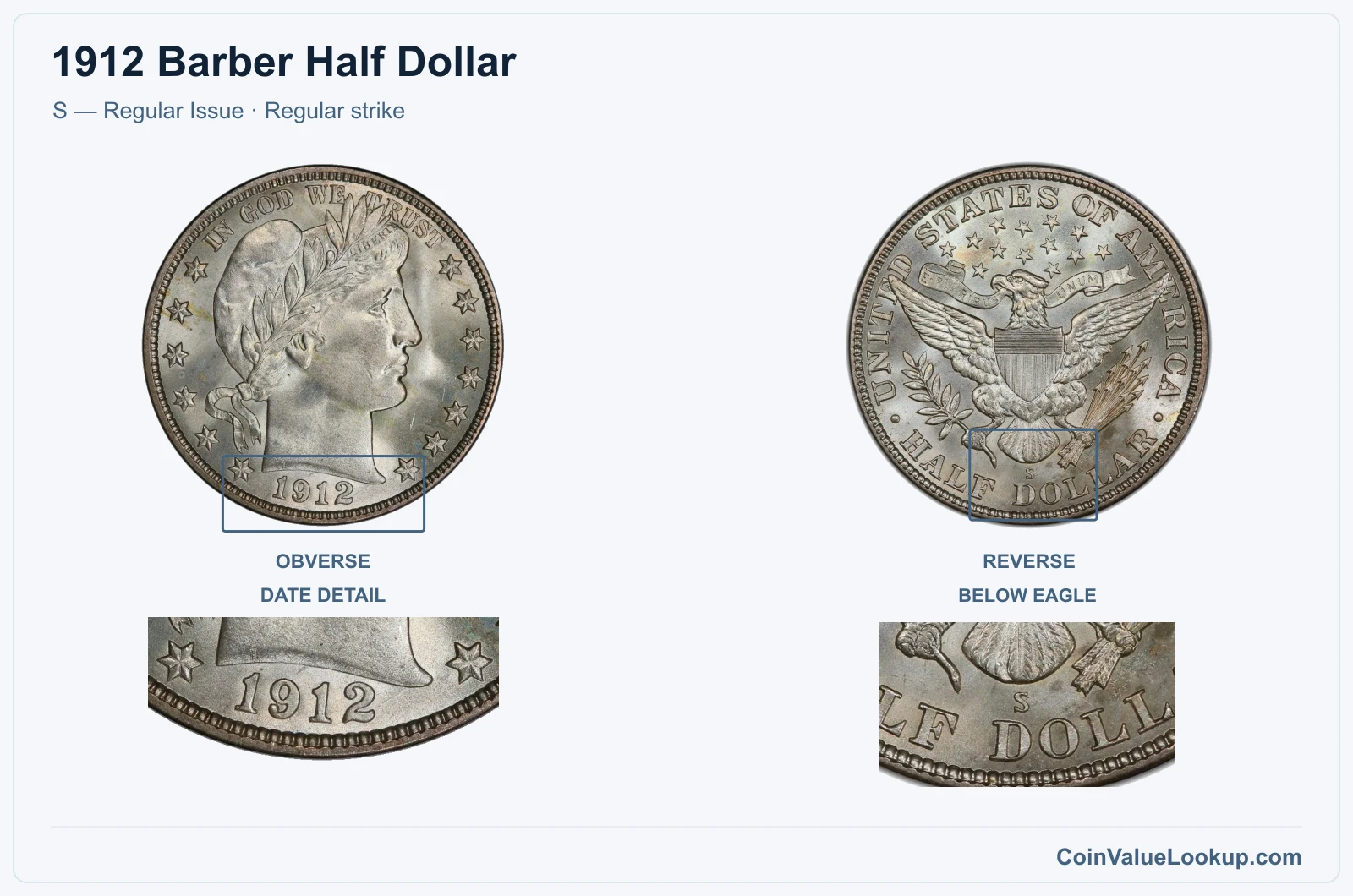
San Francisco pieces show an S mintmark in the same reverse location below the eagle's tail. The 1912-S carries the highest MS63 guide estimate among the three business-strike mints at about $1,363, compared with $1,049 for the P and D issues.
At G4, all three mints share a similar $44 figure.
That premium at the upper end makes accurate identification worthwhile. Confirm the letter is genuinely an S and not a damaged D — under magnification the curves of the S are smooth and symmetrical.
Problem-free examples with original surfaces command the strongest prices, so look carefully for cleaning, scratches, or rim damage before assigning value.
Range Grade
Price Auction Records Appraisal PO PO 1
—
Coin Identifier FR FR 2
—
Coin Identifier AG AG 3
—
Coin Identifier G G 4
—
Coin Identifier
G 6
Coin Identifier VG VG 8
Coin Identifier
VG 10
Coin Identifier F F 12
Coin Identifier
F 15
Coin Identifier VF VF 20
Coin Identifier
VF 25
Coin Identifier
VF 30
Coin Identifier
VF 35
Coin Identifier XF XF 40
Coin Identifier
XF 45
Coin Identifier AU AU 50
Coin Identifier
AU 53
—
Coin Identifier
AU 55
Coin Identifier
AU 58
Coin Identifier MS MS 60
—
Coin Identifier
MS 61
—
Coin Identifier
MS 62
Coin Identifier
MS 63
Coin Identifier
MS 64
Coin Identifier
MS 65
Coin Identifier
MS 66
Coin Identifier
MS 67
Coin Identifier
MS 68
—
—
—
MS 69
—
—
—
MS 70
—
—
—
1912 Barber Half Dollar — No Mint Mark — Proof
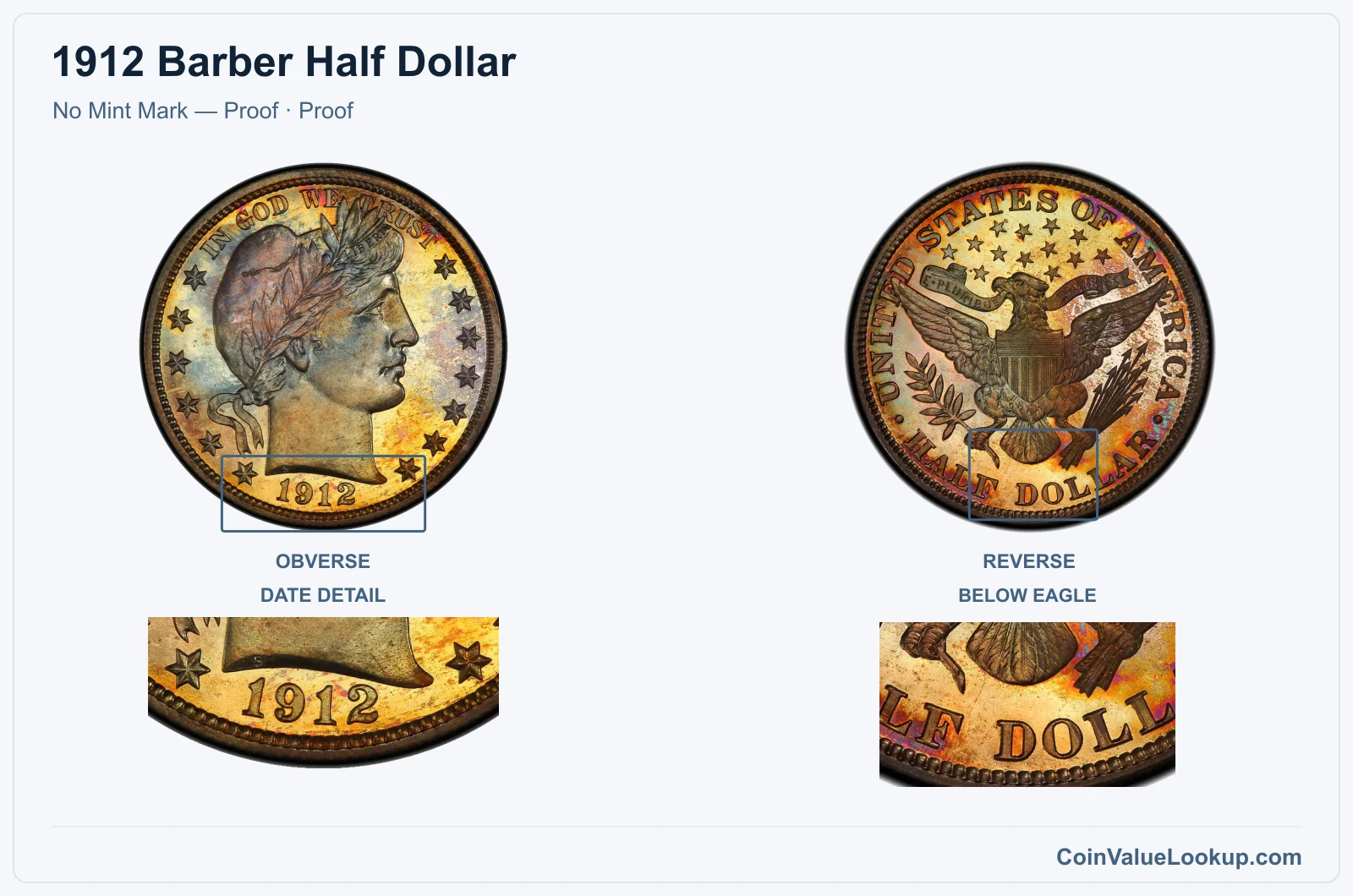
Philadelphia Proof Barber half dollars are a separate production with deeply mirrored fields and crisp rim detail. They were struck for collectors, not commerce, and a PR63 example carries a guide estimate of about $1,363.
A genuine Proof will show reflective, glass-like surfaces in the fields when tilted under a light. The devices are sharply struck with full detail from the moment of production.
Polishing a business strike cannot replicate this finish — the die preparation and striking pressure are fundamentally different. If you suspect you have a Proof, professional attribution from a recognized grading service is the safest path to confirmation.
Range Grade
Price Auction Records Appraisal PR PR 1
—
Coin Identifier
PR 2
—
Coin Identifier
PR 3
—
Coin Identifier
PR 4
—
Coin Identifier
PR 6
—
Coin Identifier
PR 8
—
Coin Identifier
PR 10
—
Coin Identifier
PR 12
—
Coin Identifier
PR 15
—
Coin Identifier
PR 20
—
Coin Identifier
PR 25
—
Coin Identifier
PR 30
—
Coin Identifier
PR 35
—
Coin Identifier
PR 40
—
Coin Identifier
PR 45
—
Coin Identifier
PR 50
—
Coin Identifier
PR 53
—
Coin Identifier
PR 55
—
Coin Identifier
PR 58
Coin Identifier
PR 60
Coin Identifier
PR 61
Coin Identifier
PR 62
Coin Identifier
PR 63
Coin Identifier
PR 64
Coin Identifier
PR 65
Coin Identifier
PR 66
Coin Identifier
PR 67
Coin Identifier
PR 68
Coin Identifier
PR 69
—
—
—
PR 70
—
—
—
1912 Barber Half Dollar Error List
1. 1912 Barber Half Dollar — Rotated Dies
A rotated-die error means the obverse and reverse are not aligned in the normal 180-degree orientation. On a standard US coin, if you hold the obverse upright and flip the coin top to bottom, the reverse should also appear upright.
A reported 1912 Philadelphia example shows roughly 90 degrees of clockwise rotation, so the eagle would appear sideways when flipped.
Do not confuse this with a photograph taken at an angle or a coin you simply turned the wrong way in your hand. Perform the flip test several times to be sure.
The value of a rotated-die error depends on the degree of rotation, the coin's condition, and overall visibility — no specific price range is established here, so individual assessment by a knowledgeable dealer or grading service is the best next step.
2. 1912 Barber Half Dollar — Overstruck on an Earlier Half Dollar
A reported 1912-D overstrike involves a coin struck over a host 1902 Barber half dollar, leaving traces of the earlier date and design beneath the 1912 impression. The diagnostic feature is remnants of the 1902 numerals visible around or overlapping the 1912 date, along with doubled design elements from the underlying coin.
This is not the same as a doubled die, where a single set of dies created a doubled image, nor is it post-mint damage where someone pressed two coins together. The earlier 1902 coin is the host planchet — it went through the press a second time with 1912-D dies.
Condition, the clarity of the surviving earlier details, and the specific nature of the overlap all affect desirability. No firm price range is established for this piece, so professional evaluation is recommended.