1915 Barber Half Dollar Coin Value: How Much Is It Worth?
The 1915 Barber half dollar marks the final year of this long-running design for the half dollar denomination. Barber dimes and quarters continued into 1916, but the half did not.
Three business-strike mints — Philadelphia, Denver, and San Francisco — plus a Philadelphia Proof make up the full lineup.
Based on a USA Coin Book guide snapshot, regular 1915 half dollars range from roughly $44 at G4 up to about $3,519 at MS63, depending on mint and condition. Proofs and special situations price separately.
Philadelphia business strikes are the scarce ones this year.
Fast Way to Identify Your 1915 Barber Half Dollar
Want a quick read on your 1915 Barber half? Upload clear photos of both the front and back of your coin.
Our identifier can offer a preliminary identification of the mint version you have based on those images. It will not authenticate, certify, or assign an exact grade, but it is a solid starting point before you dig deeper into values.
1915 Barber Half Dollar Value
Upload both sides of your 1915 Barber Half Dollar.
Front Obverse
Upload photo
Back Reverse
Upload photo
Which 1915 Barber Half Dollar Versions Are Worth Money?
- The 1915-P (no mintmark) business strike is the scarce mint this year — a USA Coin Book guide estimate places it around $130 at G4 and $3,519 at MS63, well above the Denver and San Francisco issues at the same grades.
- Proofs from 1915 Philadelphia were struck in limited numbers; a PR63 example carries a guide estimate near $1,541.
- Problem-free coins in upper circulated and Mint State grades can be worth dramatically more than heavily worn pieces — condition is everything with this final-year issue.
- Always confirm the mintmark location and finish type before checking values; an unusual surface mark alone does not mean you have a valuable error.
Step 1: Identify Your 1915 Barber Half Dollar Mint Mark and Version
The 1915 Barber half dollar shows Liberty's head facing right on the obverse with the date at the bottom, and a heraldic eagle on the reverse above the words HALF DOLLAR. All regular issues are struck in 90% silver and 10% copper, weighing about 12.5 grams with a 30.6 mm diameter and a reeded edge.
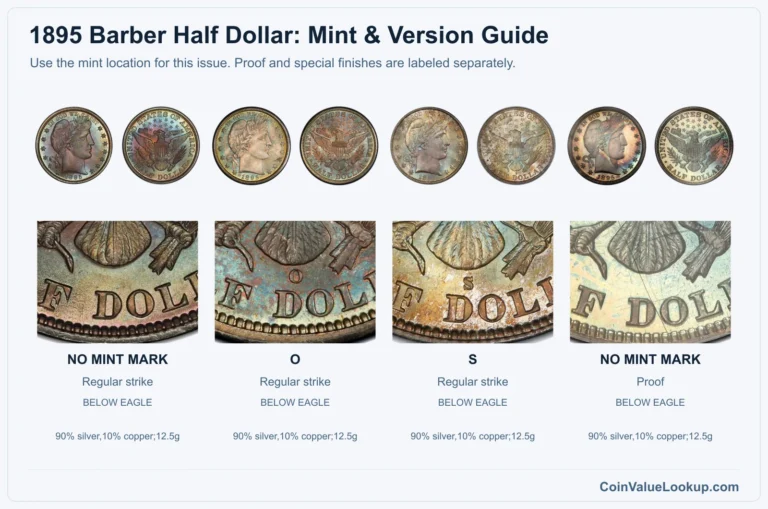
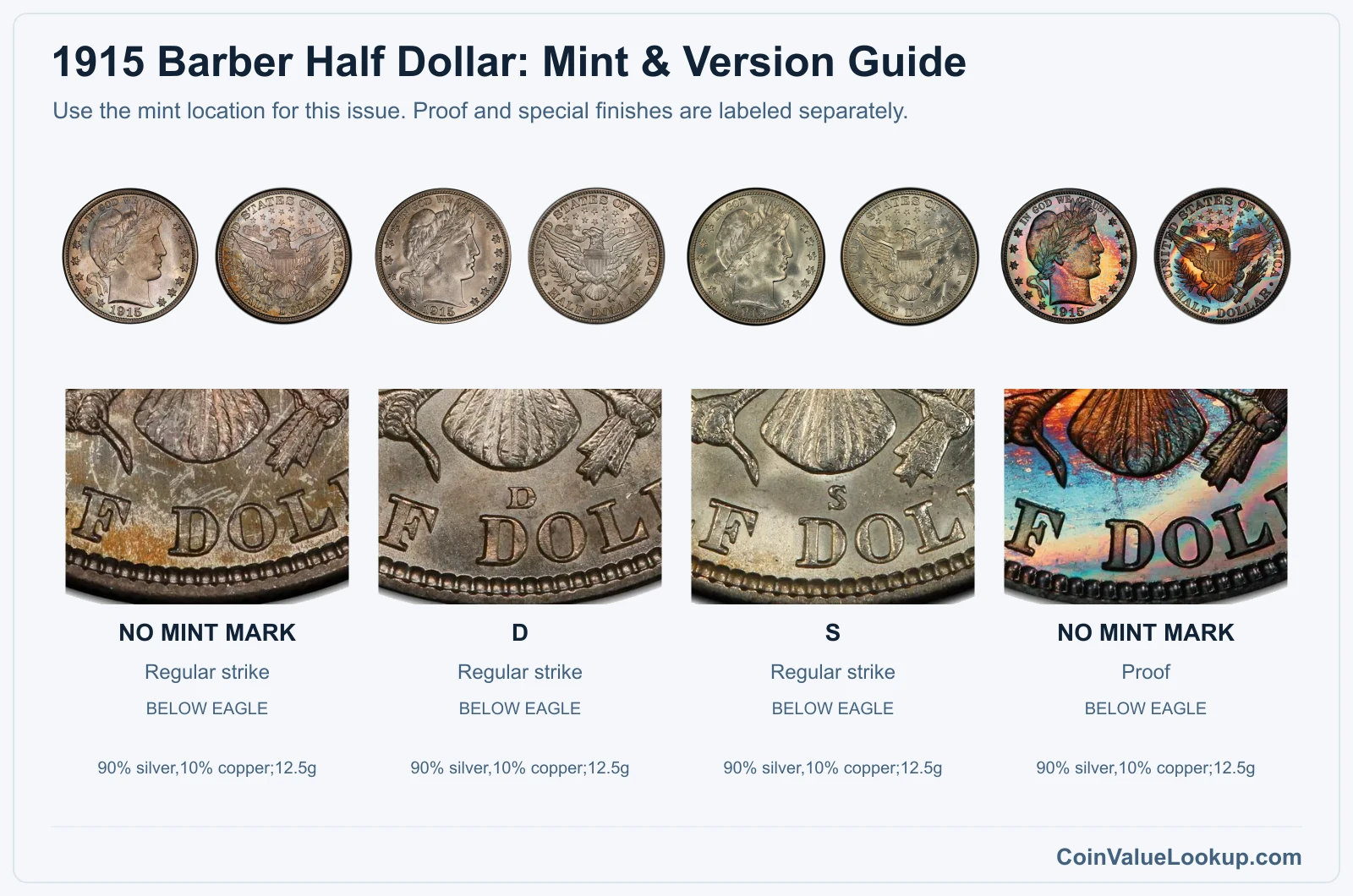
To figure out which mint made yours, flip the coin to the reverse. Look just below the eagle's tail feathers and above the words HALF DOLLAR.
If you see a "D," it is Denver. An "S" means San Francisco.
No letter at all means Philadelphia.
Philadelphia business strikes are the scarce branch for this date. Don't confuse a worn-away mintmark with a genuine no-mintmark coin — if the area looks mushy or damaged, get a second opinion.
A Proof 1915 also carries no mintmark, but its mirrored fields and sharp rims are unmistakable compared to a business strike.
Step 2: Check Your 1915 Barber Half Dollar Grade
Start by looking at the highest points on both sides. On the obverse, check Liberty's cheek, the hair above her forehead, and the detail in the headband.
On the reverse, examine the eagle's head, the tips of its wings, and the tail feathers.
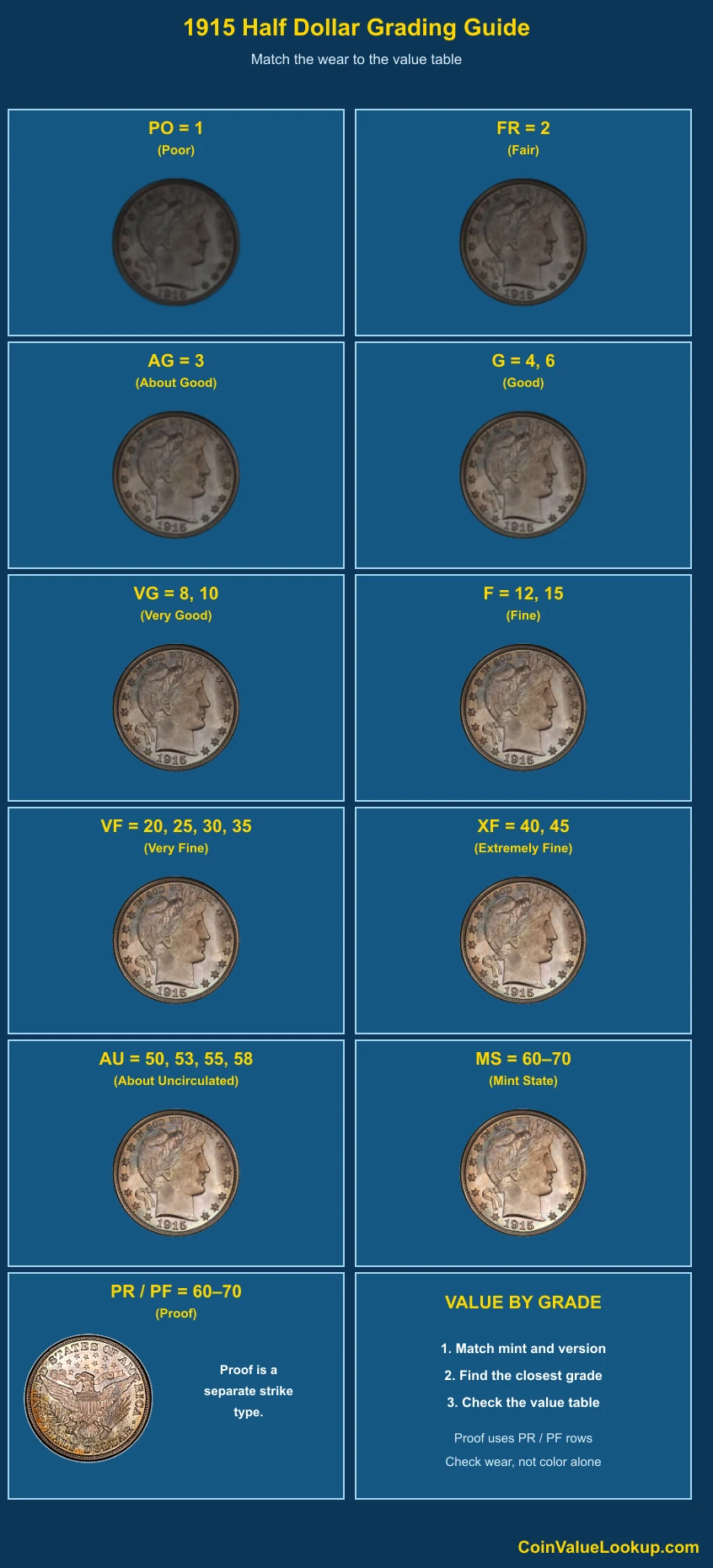
A well-worn coin (around G4) will have a smooth cheek, nearly flat hair, and a mostly gone headband inscription. As you move up toward AU and Mint State, luster becomes the key separator.
Compare your coin to the grade comparison image to see how much original surface shine remains.
Don't rely solely on the LIBERTY letters in the headband to assign a grade. Hub changes during the Barber series affect how those letters wear, so the whole coin matters more than one detail.
Also, weak strikes — especially on eagle claws and arrow feathers — can mimic wear. That is a manufacturing trait, not damage from circulation.
One more thing: a Proof is a special manufacturing finish with mirrored fields, not a grade above Mint State. Polishing a business strike will never turn it into a Proof.
Step 3: Check 1915 Barber Half Dollar Value by Mint and Version
1915 Barber Half Dollar — No Mint Mark — Regular Issue
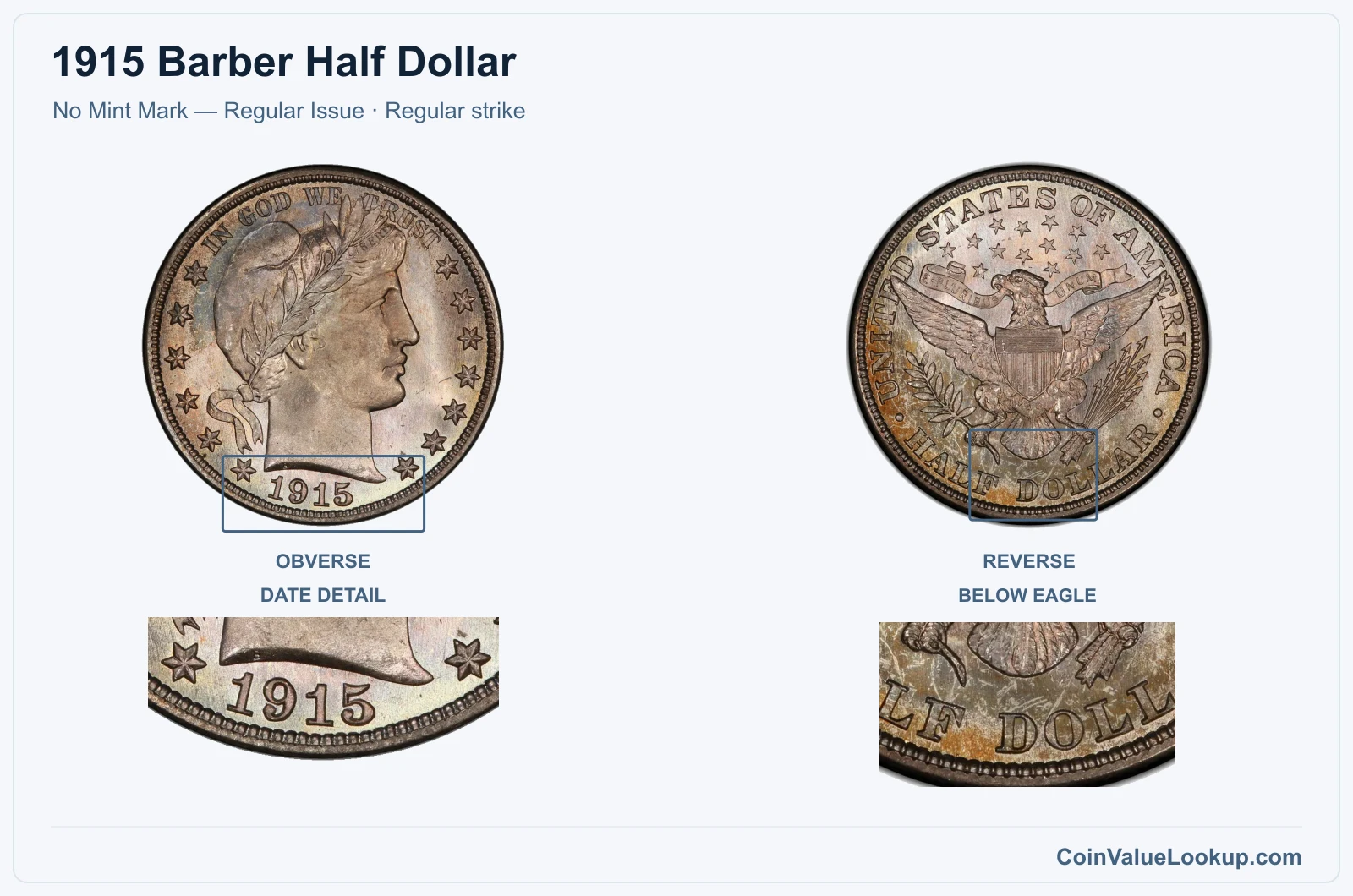
The 1915 Philadelphia business strike carries no mintmark below the eagle's tail. This is the scarce branch of the year, and it shows in the prices.
A USA Coin Book guide estimate puts a G4 example at about $130 — roughly triple the Denver or San Francisco coin in the same grade. At MS63, the guide suggests around $3,519.
Because this is the final Barber half dollar year, collectors pay particular attention to original, problem-free surfaces. Cleaned or damaged coins lose much of that premium.
Before pricing yours, confirm the full date is visible and that the mintmark area is genuinely blank, not just worn flat.
Range Grade
Price Auction Records Appraisal PO PO 1
—
Coin Identifier FR FR 2
—
Coin Identifier AG AG 3
Coin Identifier G G 4
Coin Identifier
G 6
Coin Identifier VG VG 8
Coin Identifier
VG 10
Coin Identifier F F 12
Coin Identifier
F 15
Coin Identifier VF VF 20
Coin Identifier
VF 25
Coin Identifier
VF 30
Coin Identifier
VF 35
Coin Identifier XF XF 40
Coin Identifier
XF 45
Coin Identifier AU AU 50
Coin Identifier
AU 53
Coin Identifier
AU 55
Coin Identifier
AU 58
Coin Identifier MS MS 60
—
Coin Identifier
MS 61
Coin Identifier
MS 62
Coin Identifier
MS 63
Coin Identifier
MS 64
Coin Identifier
MS 65
Coin Identifier
MS 66
Coin Identifier
MS 67
—
—
—
MS 68
—
—
—
MS 69
—
—
—
MS 70
—
—
—
1915 Barber Half Dollar — D — Regular Issue
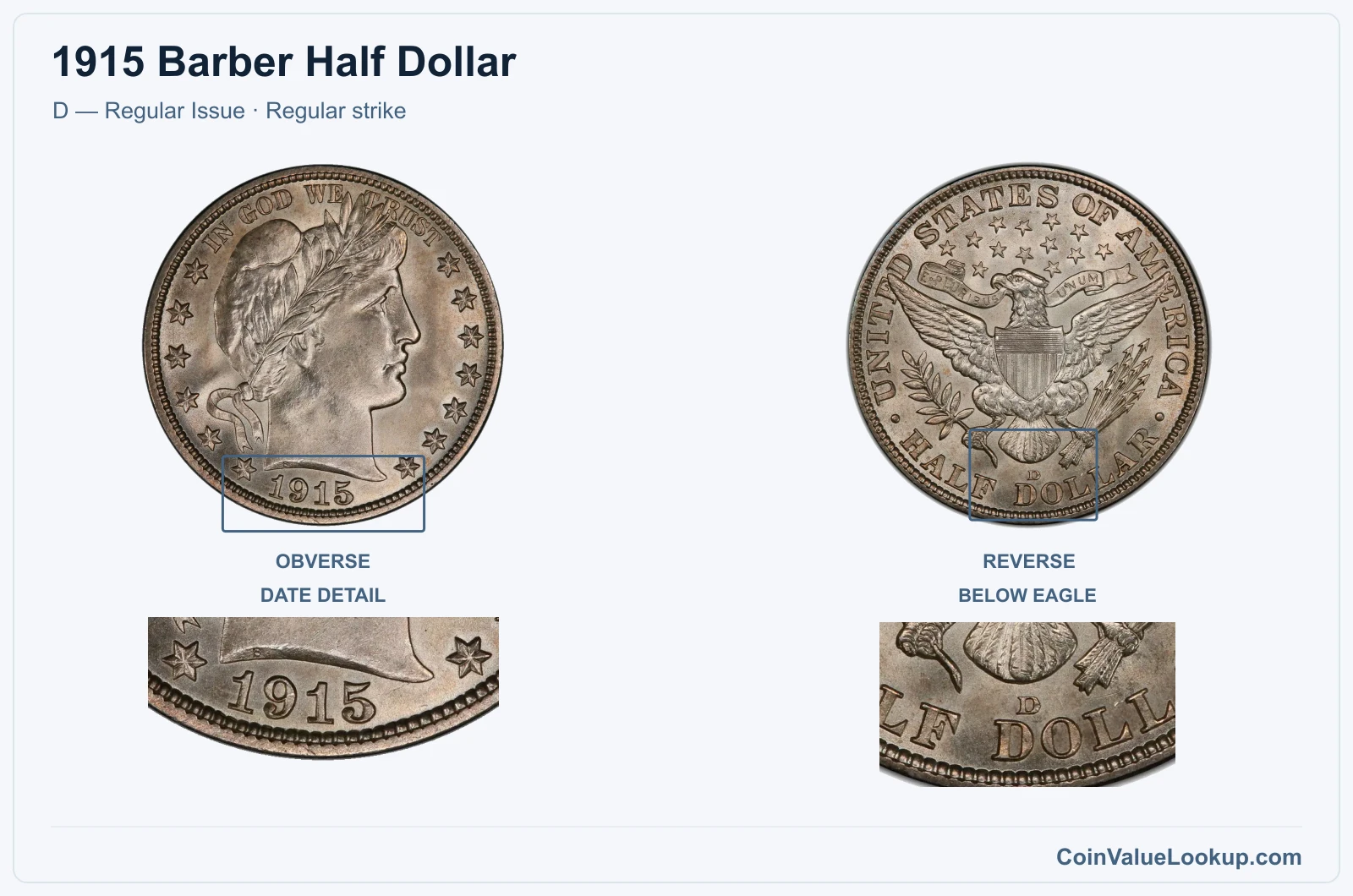
Look for a small "D" mintmark below the eagle's tail feathers on the reverse. The 1915-D is the more available of the three mints this year, making it a common entry point for collectors chasing the final Barber half.
A USA Coin Book guide estimate places the 1915-D at about $44 in G4 and around $1,145 in MS63. The jump between those two grades is substantial, so condition and original surfaces matter a great deal.
Weak strikes at the eagle's claws are a known trait on some Denver coins — that is not wear.
Range Grade
Price Auction Records Appraisal PO PO 1
—
Coin Identifier FR FR 2
—
Coin Identifier AG AG 3
—
Coin Identifier G G 4
—
Coin Identifier
G 6
—
Coin Identifier VG VG 8
Coin Identifier
VG 10
Coin Identifier F F 12
Coin Identifier
F 15
Coin Identifier VF VF 20
Coin Identifier
VF 25
Coin Identifier
VF 30
Coin Identifier
VF 35
Coin Identifier XF XF 40
Coin Identifier
XF 45
Coin Identifier AU AU 50
Coin Identifier
AU 53
Coin Identifier
AU 55
Coin Identifier
AU 58
Coin Identifier MS MS 60
Coin Identifier
MS 61
Coin Identifier
MS 62
Coin Identifier
MS 63
Coin Identifier
MS 64
Coin Identifier
MS 65
Coin Identifier
MS 66
Coin Identifier
MS 67
Coin Identifier
MS 68
—
—
—
MS 69
—
—
—
MS 70
—
—
—
1915 Barber Half Dollar — S — Regular Issue
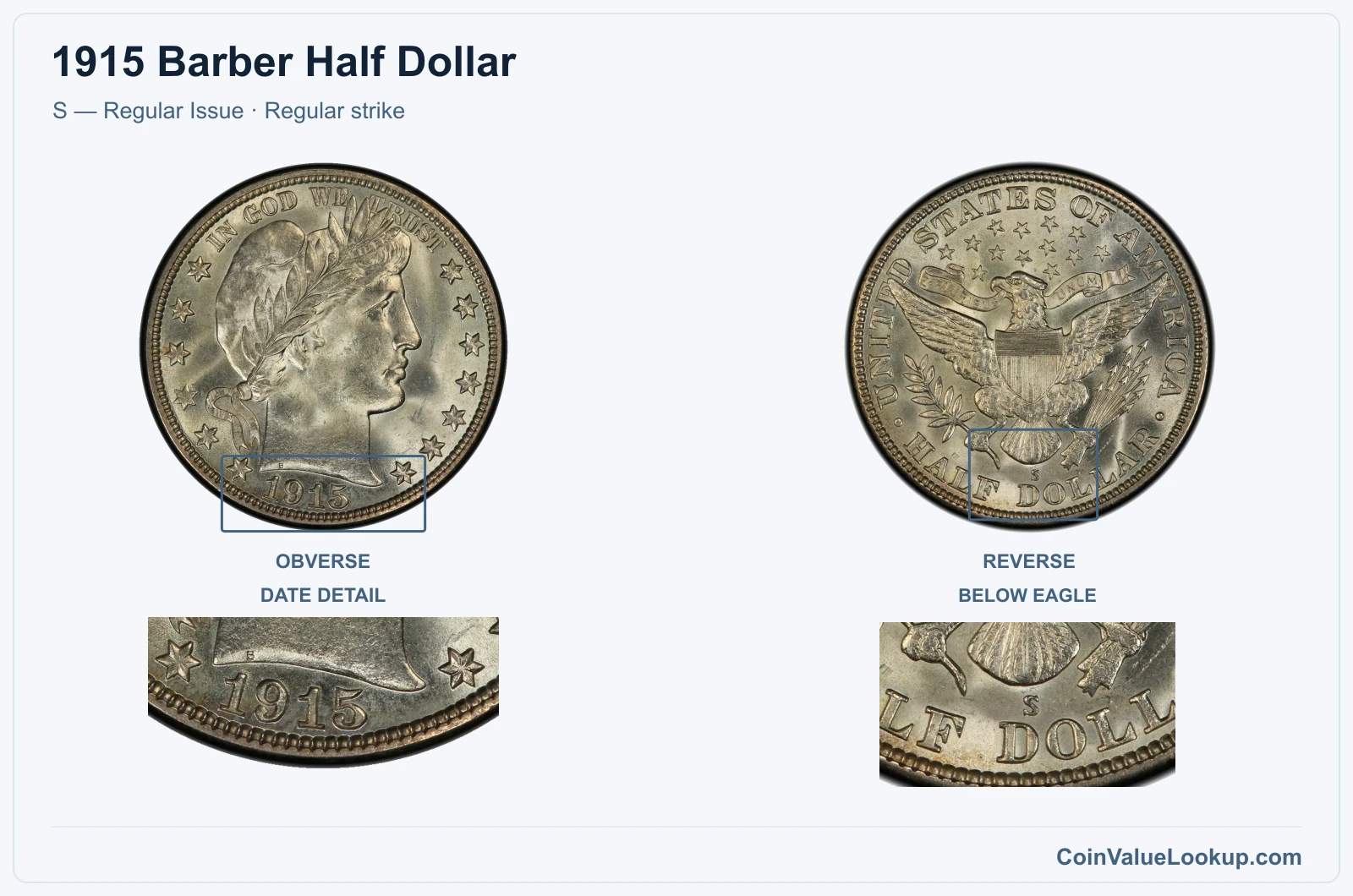
The San Francisco issue carries an "S" mintmark in the same spot below the eagle's tail. In terms of guide pricing, the 1915-S tracks closely with the Denver coin: roughly $44 at G4 and about $1,145 at MS63 per USA Coin Book estimates.
Coin Value Lookup is a handy place to look up guides for other Barber half dates and denominations if you are building a set or just curious about related coins.
As with all Barber halves, check for signs of cleaning or environmental damage. Original toning and undisturbed luster are what push a coin into the higher value tiers.
Range Grade
Price Auction Records Appraisal PO PO 1
—
Coin Identifier FR FR 2
Coin Identifier AG AG 3
—
Coin Identifier G G 4
—
Coin Identifier
G 6
Coin Identifier VG VG 8
Coin Identifier
VG 10
Coin Identifier F F 12
Coin Identifier
F 15
Coin Identifier VF VF 20
Coin Identifier
VF 25
Coin Identifier
VF 30
Coin Identifier
VF 35
Coin Identifier XF XF 40
Coin Identifier
XF 45
Coin Identifier AU AU 50
Coin Identifier
AU 53
Coin Identifier
AU 55
Coin Identifier
AU 58
Coin Identifier MS MS 60
Coin Identifier
MS 61
Coin Identifier
MS 62
Coin Identifier
MS 63
Coin Identifier
MS 64
Coin Identifier
MS 65
Coin Identifier
MS 66
Coin Identifier
MS 67
Coin Identifier
MS 68
—
—
—
MS 69
—
—
—
MS 70
—
—
—
1915 Barber Half Dollar — No Mint Mark — Proof
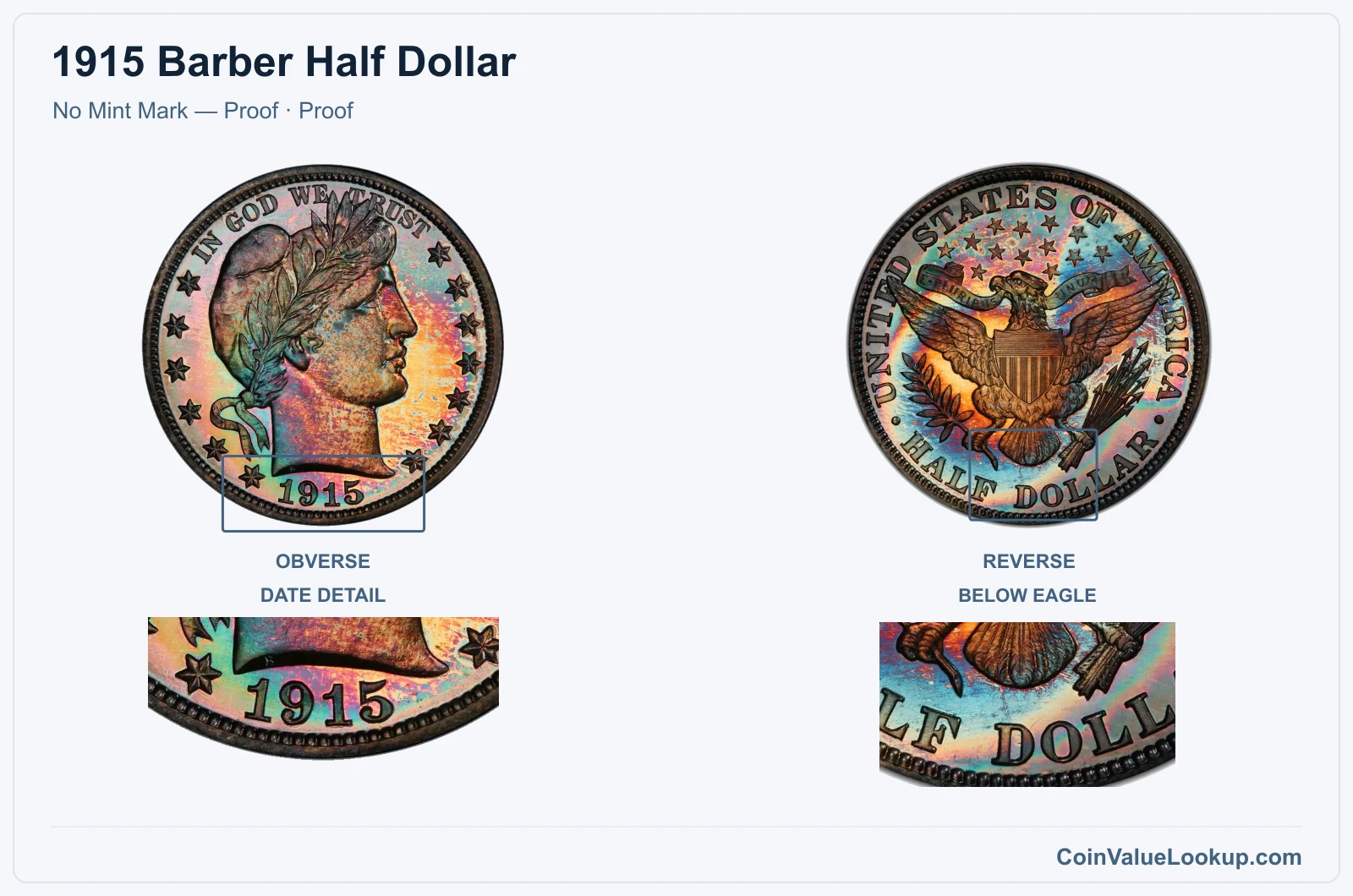
The 1915 Proof was struck at Philadelphia with no mintmark, just like the business strike. The difference is unmistakable once you know what to look for: genuine Proofs have deeply mirrored fields that reflect like a mirror, with crisp, squared-off rims and full detail on every design element.
A USA Coin Book guide estimate places the 1915 Proof at about $1,541 in PR63. Some Proofs show varying degrees of contrast between the mirrored fields and the frosted devices — this is evaluated within the Proof category, not as a separate mint variety.
No amount of polishing can turn a business strike into a Proof. If the fields look shiny but the rims are rounded and the detail is soft, you have a polished circulation coin.
Genuine Proof attribution requires professional confirmation for most collectors.
Range Grade
Price Auction Records Appraisal PR PR 1
—
Coin Identifier
PR 2
—
Coin Identifier
PR 3
—
Coin Identifier
PR 4
—
Coin Identifier
PR 6
—
Coin Identifier
PR 8
—
Coin Identifier
PR 10
—
Coin Identifier
PR 12
—
Coin Identifier
PR 15
—
Coin Identifier
PR 20
—
Coin Identifier
PR 25
—
Coin Identifier
PR 30
—
Coin Identifier
PR 35
—
Coin Identifier
PR 40
—
Coin Identifier
PR 45
—
Coin Identifier
PR 50
—
Coin Identifier
PR 53
—
Coin Identifier
PR 55
—
Coin Identifier
PR 58
—
Coin Identifier
PR 60
Coin Identifier
PR 61
Coin Identifier
PR 62
Coin Identifier
PR 63
Coin Identifier
PR 64
Coin Identifier
PR 65
Coin Identifier
PR 66
Coin Identifier
PR 67
Coin Identifier
PR 68
Coin Identifier
PR 69
—
—
—
PR 70
—
—
—