1808 Capped Bust Half Dollar Coin Value: How Much Is It Worth?
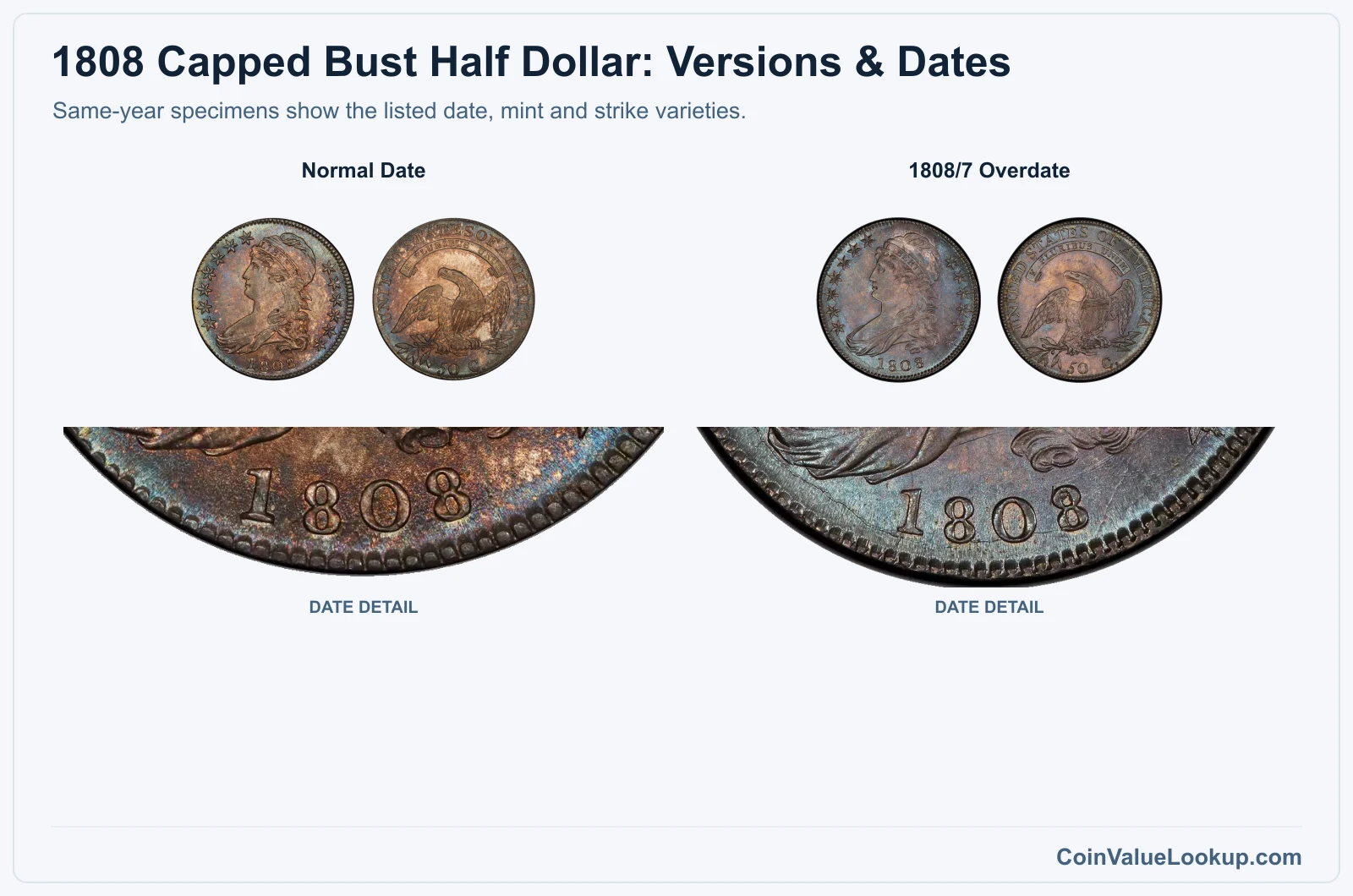
An 1808 Capped Bust Half Dollar in well-worn G4 condition carries a guide estimate around $111, climbing to roughly $1,409 near AU50 for the normal date. The 1808/7 overdate commands a premium at every grade level.
Collector value hinges on which version you hold and how the surfaces have survived two centuries of handling.
Fast Way to Identify Your 1808 Capped Bust Half Dollar
Snap a clear photo of both sides of your half dollar and upload them here. Our identifier can help with a preliminary read on the date, design type, and overall condition.
It is not a substitute for professional authentication, but it is a solid first step before you dig deeper into varieties.
1808 Capped Bust Half Dollar Value
Upload both sides of your 1808 Capped Bust Half Dollar.
Front Obverse
Upload photo
Back Reverse
Upload photo
Which 1808 Capped Bust Half Dollar Versions Are Worth Money?
- The 1808/7 Overdate shows remnants of a 7 beneath the final 8 and carries higher guide estimates at every grade, from about $142 at G4 to roughly $1,897 at AU50.
- A normal-date 1808 in strong AU condition can still reach around $1,409 per guide estimates, rewarding sharp detail and original surfaces.
Step 1: Identify Your 1808 Capped Bust Half Dollar Mint Mark and Version
Every 1808 Capped Bust Half Dollar was struck at Philadelphia, so the absence of a mintmark is completely normal. Do not mistake a missing mint letter for something unusual.
The obverse shows a left-facing Liberty wearing a cloth cap, with stars surrounding her portrait. On the reverse you will find an eagle clutching arrows and an olive branch, framed by a heraldic shield and the inscription UNITED STATES OF AMERICA with 50C below.
The coin is struck in a silver-copper alloy of approximately 89.24% silver. It weighs about 13.48 grams and measures roughly 32.5 mm across.
Check the edge: it should read FIFTY CENTS OR HALF A DOLLAR in raised lettering. If your coin has a plain or reeded edge, you are looking at a different type entirely.
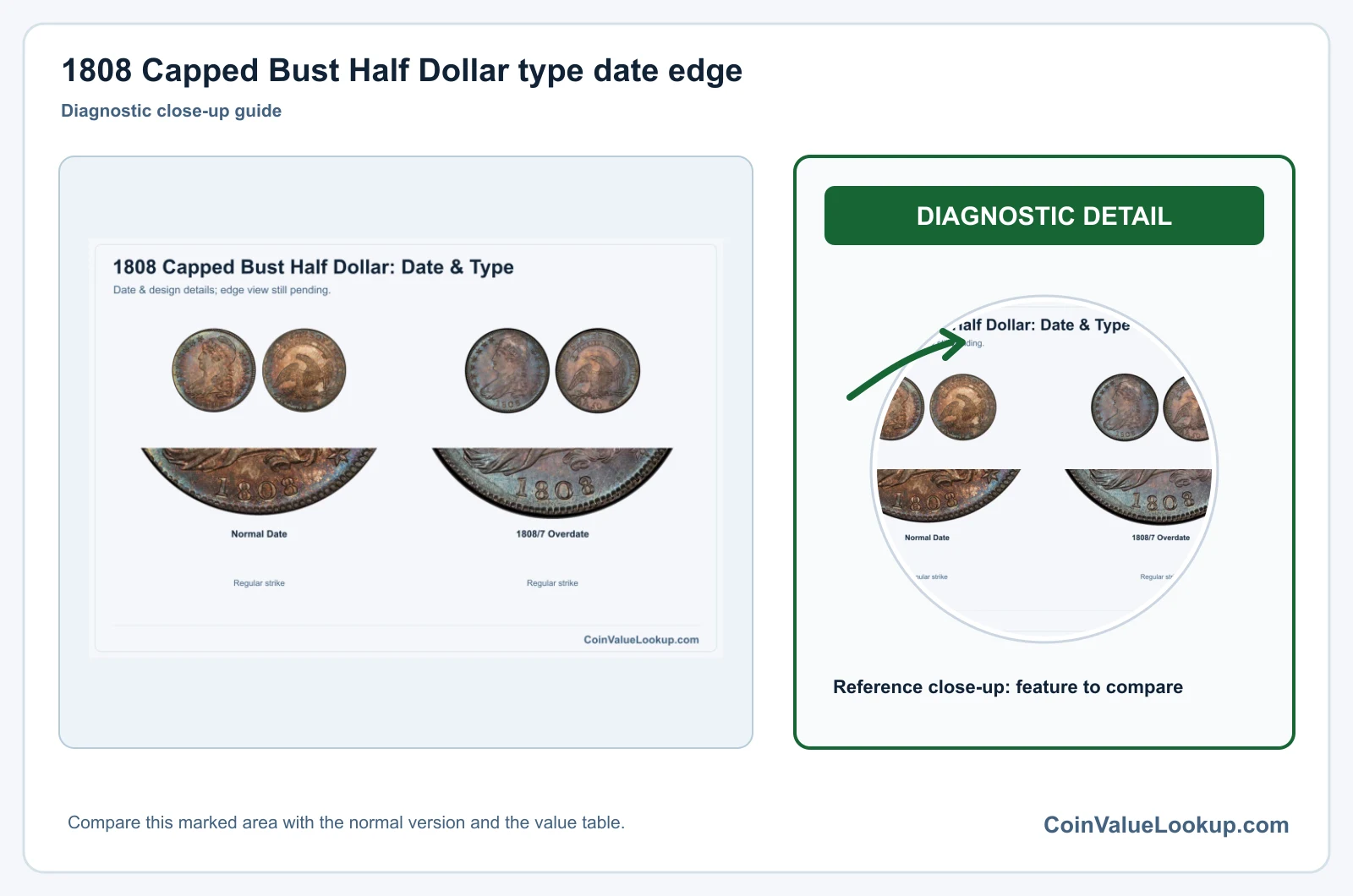
The critical fork is the date. A normal 1808 shows a clean final 8 with no underlying digit.
The 1808/7 overdate reveals traces of a 7 lurking beneath that last 8, a remnant of die preparation rather than a strike anomaly. Grab a loupe and look carefully at the lower loop of the 8 for any straight diagonal line from the original 7.
That single detail separates a common-date coin from the scarcer variety.
Step 2: Check Your 1808 Capped Bust Half Dollar Grade
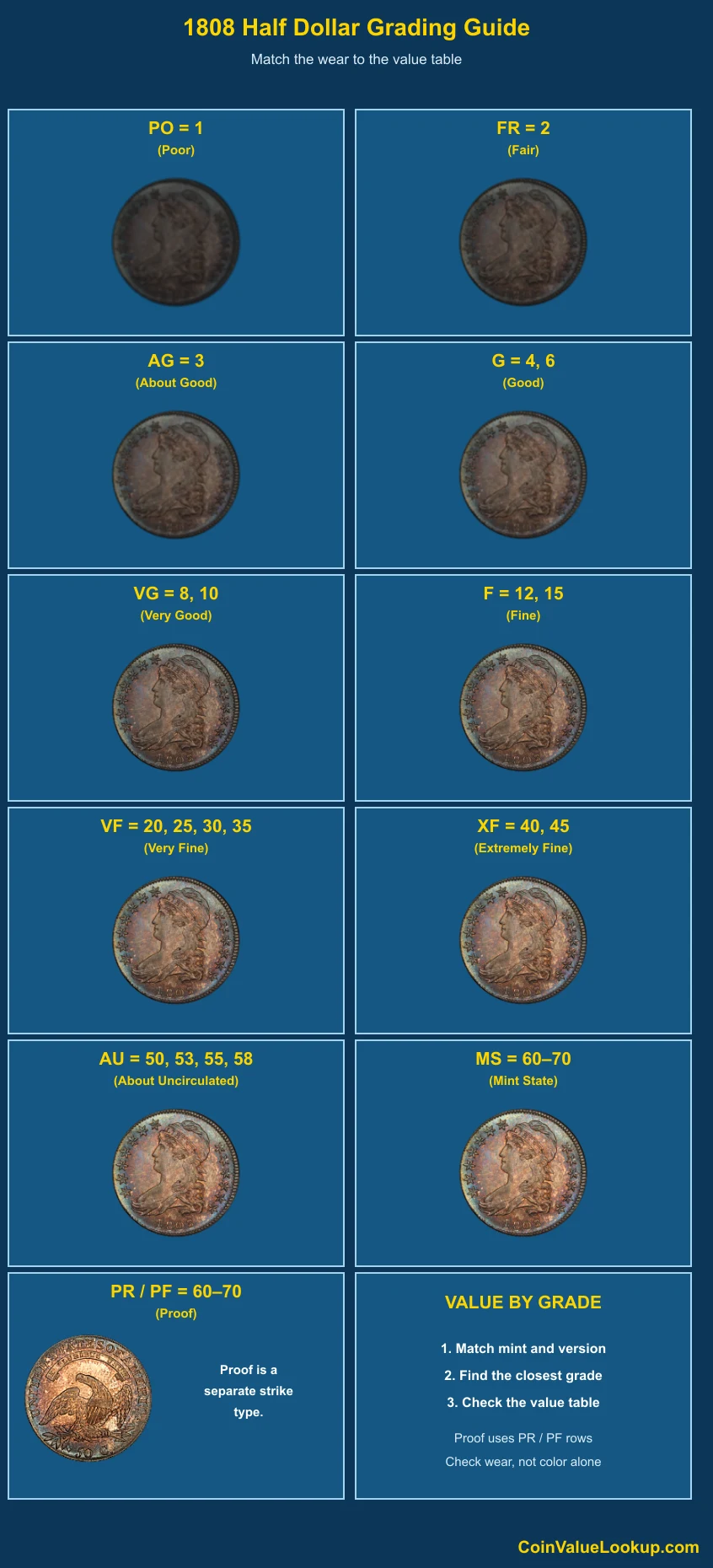
Start at Liberty's hair above the forehead and ear. In lower grades, those curls flatten into a smooth mass.
A mid-grade coin around VF still shows distinct hair strands above the ear, while the cheek and cap retain moderate relief.
The shoulder clasp is another quick checkpoint. On a well-circulated piece it nearly vanishes; on an AU coin it is sharp with only a whisper of friction on the highest points.
Flip the coin over and examine the eagle's breast feathers and wing tips. Weak detail here can mean either heavy wear or a soft strike, so compare the overall sharpness across both sides before deciding.
If the obverse looks AU but the eagle is mushy, suspect a strike issue rather than selective wear.
Luster matters. Original mint luster on a 200-plus year old silver coin is uncommon and adds real value.
If the surfaces look uniformly bright and glassy, that could signal an old cleaning, which drops the coin into a "Details" grade. Holes, tooling, rim damage, and heavy scratches all land a coin in the same category.
Do not price a Details coin using straight-grade numbers; they live in a different market.
Step 3: Check 1808 Capped Bust Half Dollar Value by Mint and Version
1808 Capped Bust Half Dollar — Normal Date
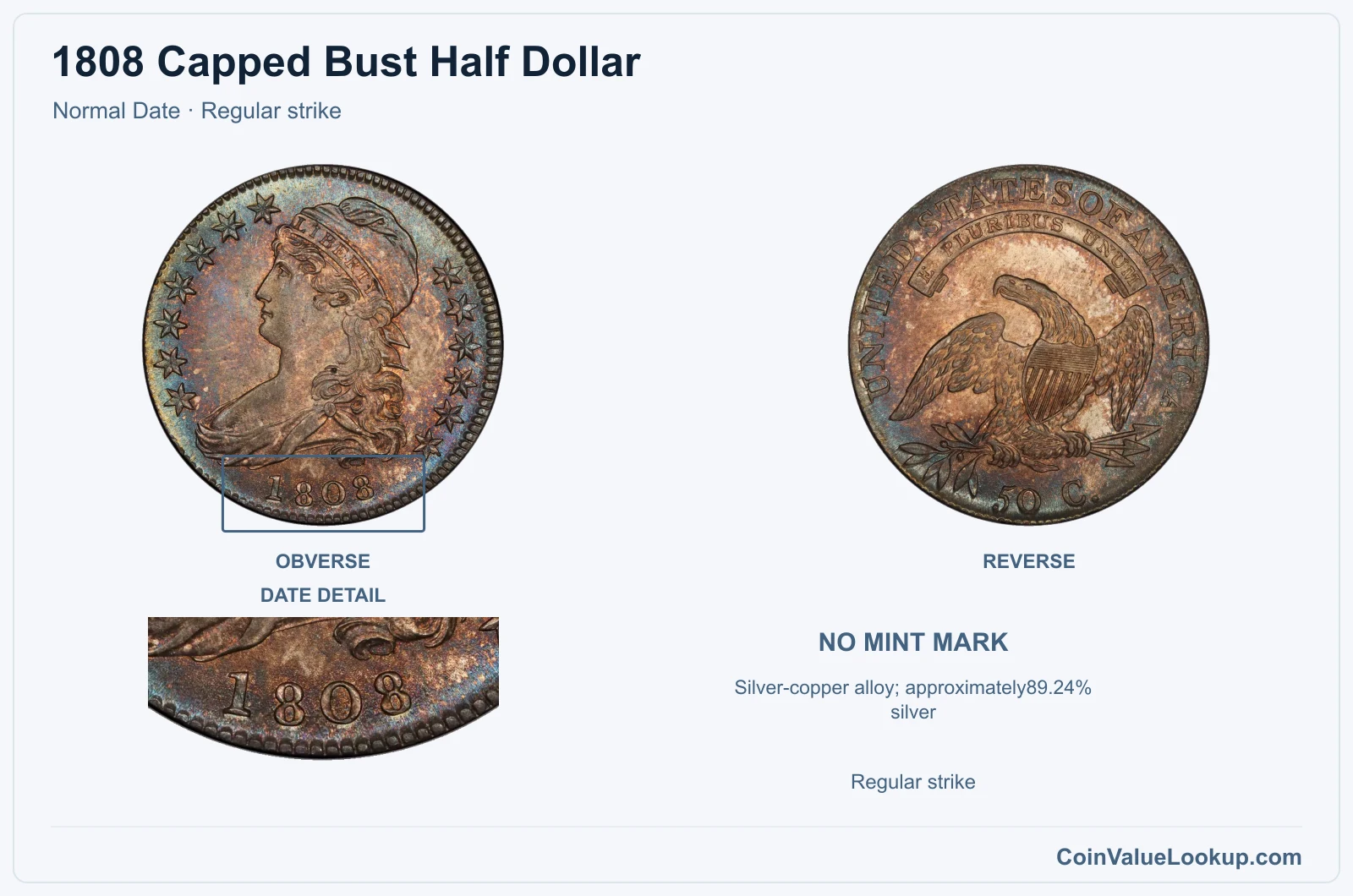
The normal-date 1808 is the baseline issue for this year. Before you settle on this attribution, examine the final 8 closely under magnification to rule out any trace of an underlying 7.
Struck at Philadelphia with no mintmark, this coin is a silver-copper alloy of about 89.24% silver on a lettered edge. Guide estimates from USA Coin Book place the normal date at approximately $111 in G4, $364 in VF20, and $1,409 in AU50.
These are retail estimates, not guaranteed sale prices, so your actual result may vary with eye appeal and market timing.
Coin Value Lookup is a handy starting point if you want to compare this half dollar against other early bust coinage or look up additional denominations from the same era.
Range Grade
Price Auction Records Appraisal PO PO 1
Coin Identifier FR FR 2
—
Coin Identifier AG AG 3
—
Coin Identifier G G 4
Coin Identifier
G 6
Coin Identifier VG VG 8
Coin Identifier
VG 10
Coin Identifier F F 12
Coin Identifier
F 15
Coin Identifier VF VF 20
Coin Identifier
VF 25
Coin Identifier
VF 30
Coin Identifier
VF 35
Coin Identifier XF XF 40
Coin Identifier
XF 45
Coin Identifier AU AU 50
Coin Identifier
AU 53
Coin Identifier
AU 55
Coin Identifier
AU 58
Coin Identifier MS MS 60
Coin Identifier
MS 61
Coin Identifier
MS 62
Coin Identifier
MS 63
Coin Identifier
MS 64
Coin Identifier
MS 65
Coin Identifier
MS 66
Coin Identifier
MS 67
Coin Identifier
MS 68
—
—
—
MS 69
—
—
—
MS 70
—
—
—
1808 Capped Bust Half Dollar — /7 Overdate
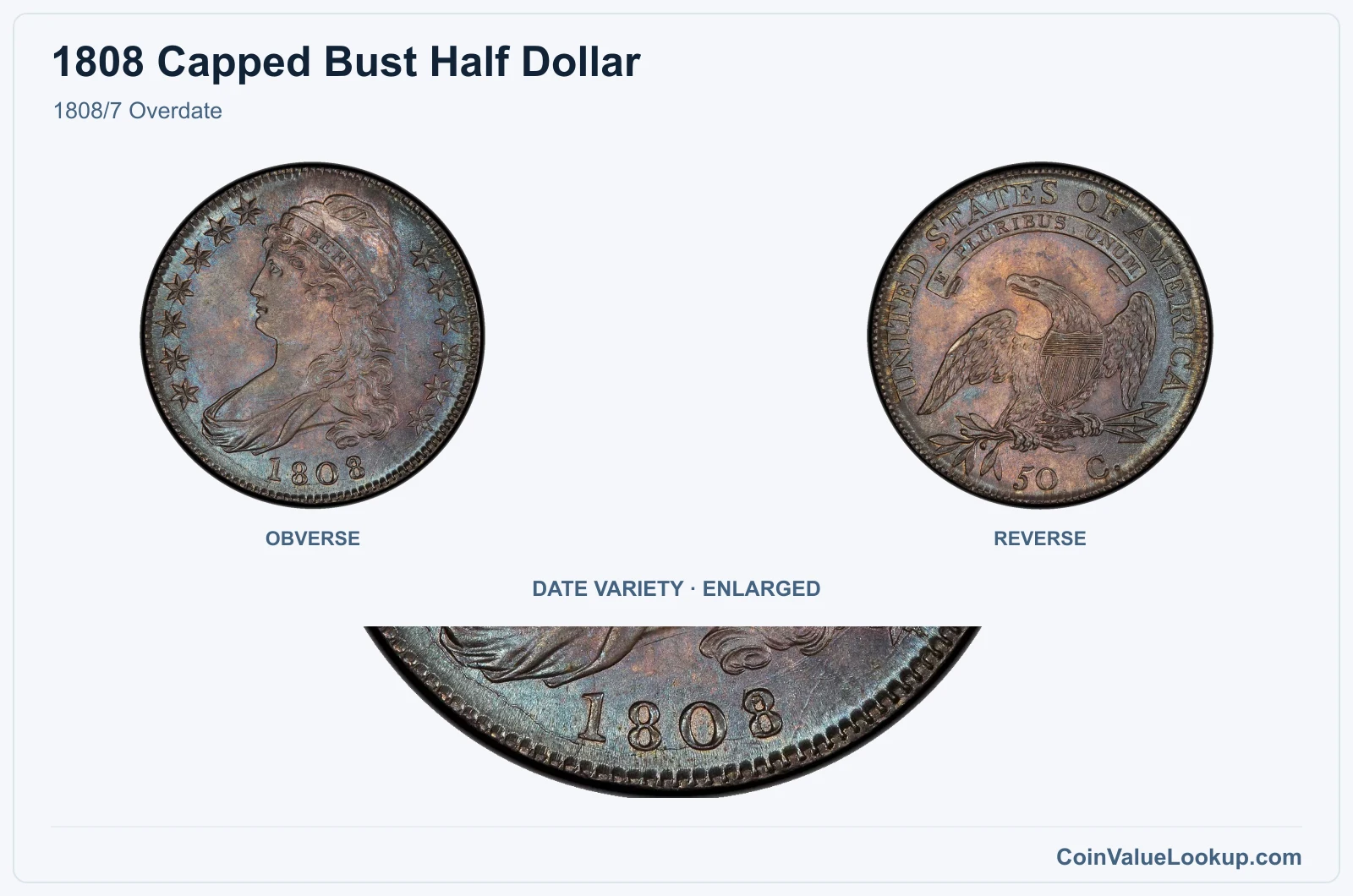
This is the one to watch for. The 1808/7 overdate was created during die preparation when a new 8 punch was driven over an existing 7 in the date.
The remnant of the 7 is visible as a diagonal stroke beneath the lower curve of the final 8. This is a genuine die variety, not machine doubling spread across multiple digits.
A loupe of at least 5x will usually reveal the underlying 7, though on heavily worn examples the evidence can be subtle. Guide estimates from USA Coin Book run about $142 at G4, $517 at VF20, and roughly $1,897 at AU50, a meaningful step above the normal date at every grade level.
The premium reflects genuine scarcity and strong collector demand for early overdate varieties. As always, these figures are retail estimates and individual coins sell based on their specific surfaces, sharpness, and provenance.
Range Grade
Price Auction Records Appraisal PO PO 1
—
Coin Identifier FR FR 2
—
Coin Identifier AG AG 3
—
Coin Identifier G G 4
—
Coin Identifier
G 6
—
Coin Identifier VG VG 8
—
Coin Identifier
VG 10
Coin Identifier F F 12
Coin Identifier
F 15
Coin Identifier VF VF 20
Coin Identifier
VF 25
Coin Identifier
VF 30
Coin Identifier
VF 35
Coin Identifier XF XF 40
Coin Identifier
XF 45
Coin Identifier AU AU 50
Coin Identifier
AU 53
Coin Identifier
AU 55
Coin Identifier
AU 58
Coin Identifier MS MS 60
—
Coin Identifier
MS 61
Coin Identifier
MS 62
Coin Identifier
MS 63
Coin Identifier
MS 64
Coin Identifier
MS 65
Coin Identifier
MS 66
—
Coin Identifier
MS 67
—
—
—
MS 68
—
—
—
MS 69
—
—
—
MS 70
—
—
—
1808 Capped Bust Half Dollar Error List
1. 1808 Capped Bust Half Dollar — Die Crack / Die Chip
Die cracks on 1808 Half Dollars appear as thin raised lines running across the coin's surface, following paths through design elements. On the reported 1808/7 example, a crack runs through the base of the date numerals and continues into the left-side stars, while a separate crack crosses through ATES on the reverse.
Look for raised continuity. A genuine die crack forms a slightly elevated ridge because metal fills the fracture in the die during striking.
Incuse scratches, surface corrosion, or random debris will sit below or level with the field rather than standing above it.
No specific price premium has been adopted for these cracks. The value depends on the crack's visibility, the coin's overall grade, and collector interest in the specific die state.
A dramatic crack on a well-preserved coin generally attracts more attention than a hairline fracture on a worn example.
2. 1808 Capped Bust Half Dollar — Clashed Dies
Clashed dies occur when the obverse and reverse dies strike each other without a planchet between them, leaving ghost impressions of one design transferred onto the opposite side. On the reported 1808/7 example, light clash marks appear on both faces of the coin.
To spot a clash, look for faint outlines of the eagle or shield ghosting onto Liberty's cheek area, or traces of Liberty's portrait appearing in the reverse fields. These impressions follow the contours of the opposite die and appear in predictable locations.
Do not confuse random scratches, raised lines from a damaged die, or brockage effects with genuine clash marks. True clashed-die impressions are symmetrical and correspond precisely to the opposing design.
No numerical price premium is established here. Value depends on the strength and visibility of the clash, the coin's condition, and buyer interest.