1827 Capped Bust Half Dollar Coin Value: How Much Is It Worth?
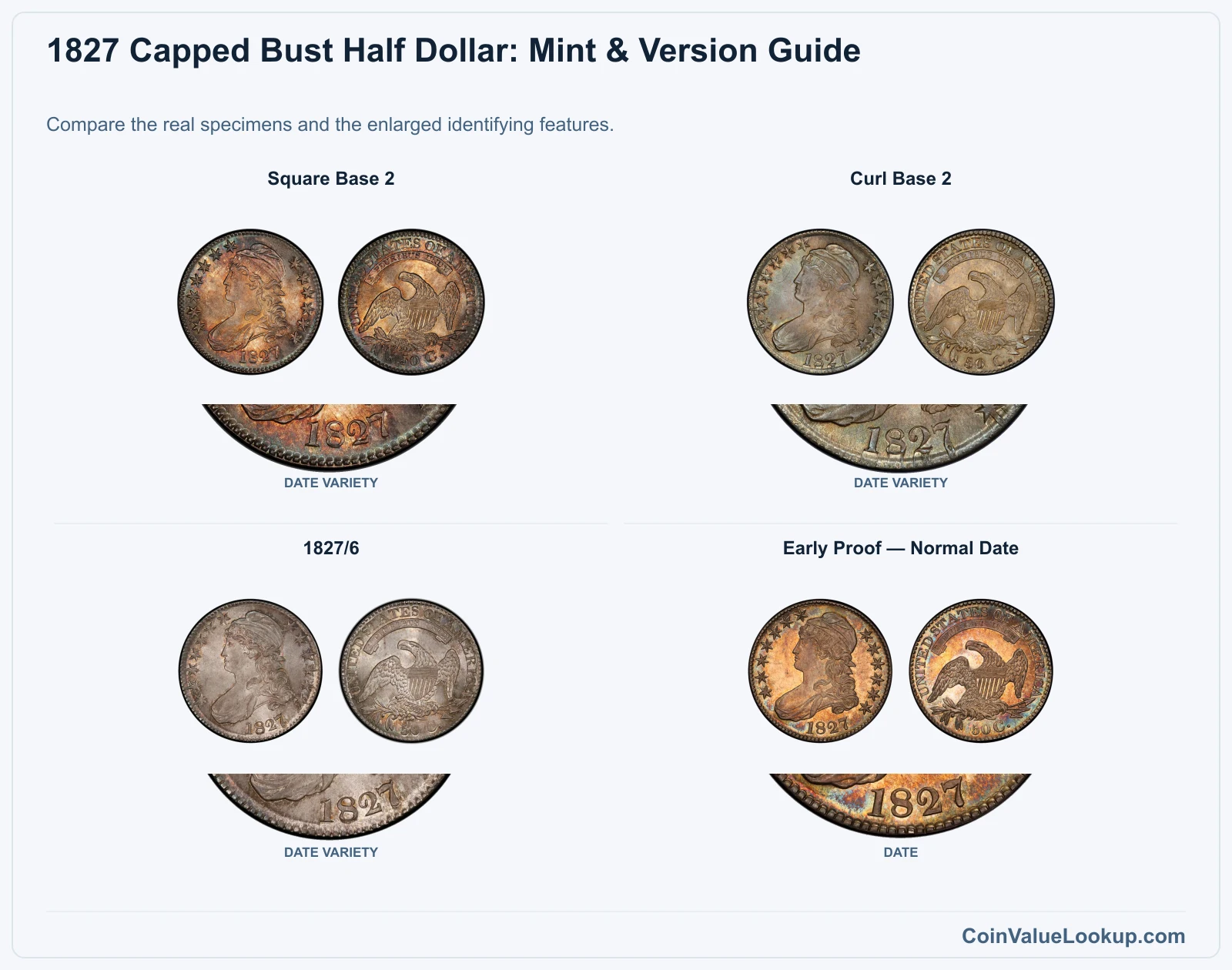
The 1827 Capped Bust Half Dollar is a nearly two-century-old silver coin struck at Philadelphia. Circulated examples of the regular Square Base 2 variety carry guide estimates from about $111 in G4 to $517 in AU50, but values shift depending on the specific variety and condition.
The overdate and Curl Base 2 command their own premiums, and rare early Proofs are an entirely separate collector category that cannot be identified by shine alone.
Fast Way to Identify Your 1827 Capped Bust Half Dollar
Want a quick read on your 1827 half dollar? Upload clear photos of the front and back, and our identifier can offer a preliminary take on which variety you may have and its approximate condition.
This is not a substitute for professional authentication or grading, but it is a solid starting point before you dig deeper.
1827 Capped Bust Half Dollar Value
Upload both sides of your 1827 Capped Bust Half Dollar.
Front Obverse
Upload photo
Back Reverse
Upload photo
Which 1827 Capped Bust Half Dollar Versions Are Worth Money?
- Square Base 2 — the most common regular variety, with guide estimates from $111 at G4 to $517 at AU50; identify it by the flat base of the numeral 2.
- Curl Base 2 — carries a slight premium in mid-to-upper grades, estimated at $182 at VF20 and $685 at AU50; distinguished by the curved base of the 2.
- 1827/6 Overdate — remnants of an underlying 6 visible beneath the 7 push guide values to $142 at G4, $517 at VF20, and $1,016 at AU50.
- Early Proof (Normal Date) — a rare specialist-attributed finish; one PR67 example sold for $258,500 at Stack's Bowers in February 2016.
Step 1: Identify Your 1827 Capped Bust Half Dollar Mint Mark and Version
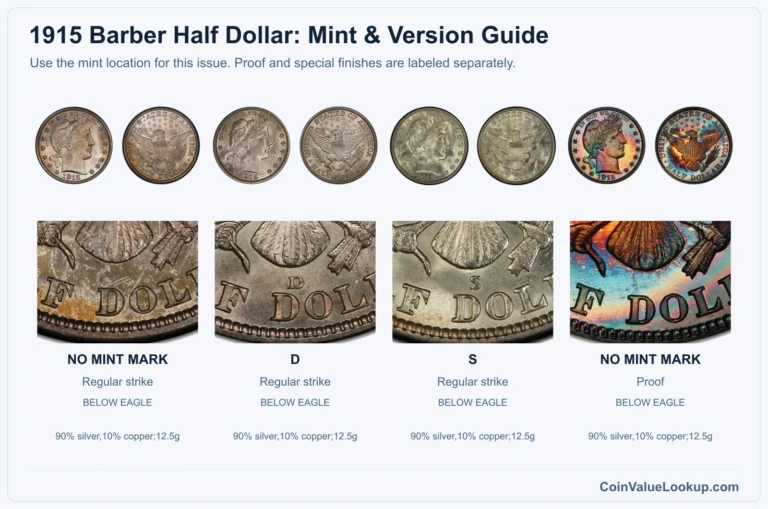
Every 1827 Capped Bust Half Dollar was struck at Philadelphia, so there is no mintmark to look for. The obverse shows Liberty facing left wearing a cap, and the reverse features an eagle with a shield and the denomination 50C.
The edge is lettered: FIFTY CENTS OR HALF A DOLLAR.
The coin is a silver-copper alloy, approximately 89.24% silver, with a nominal weight of 13.48 grams and a diameter of 32.5 mm. A correct weight by itself does not authenticate a coin, but a wildly off number is a red flag.
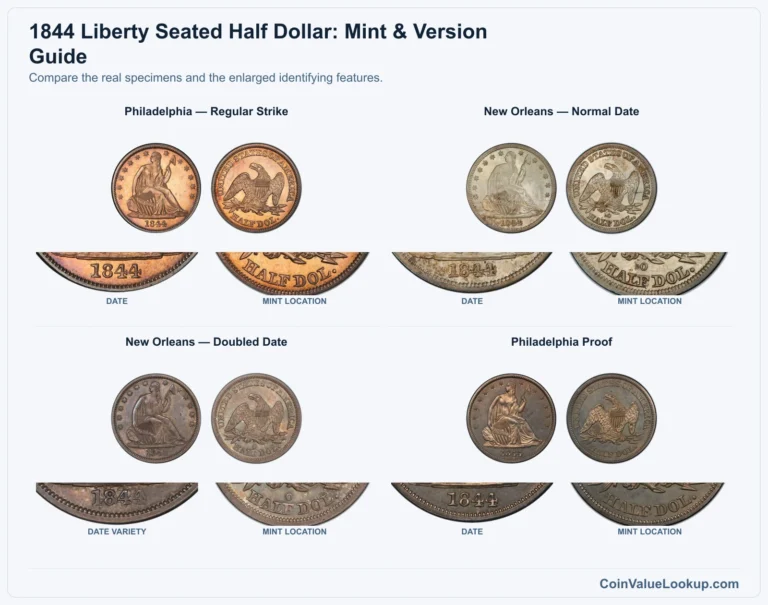
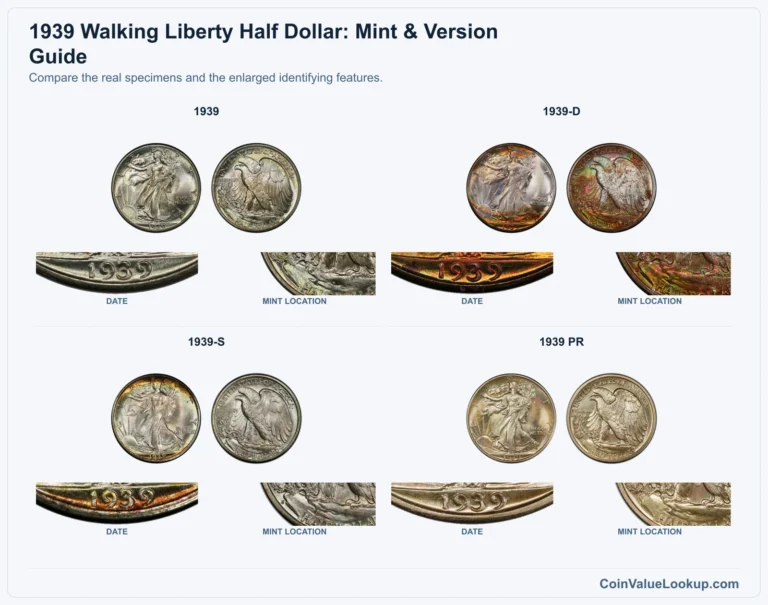
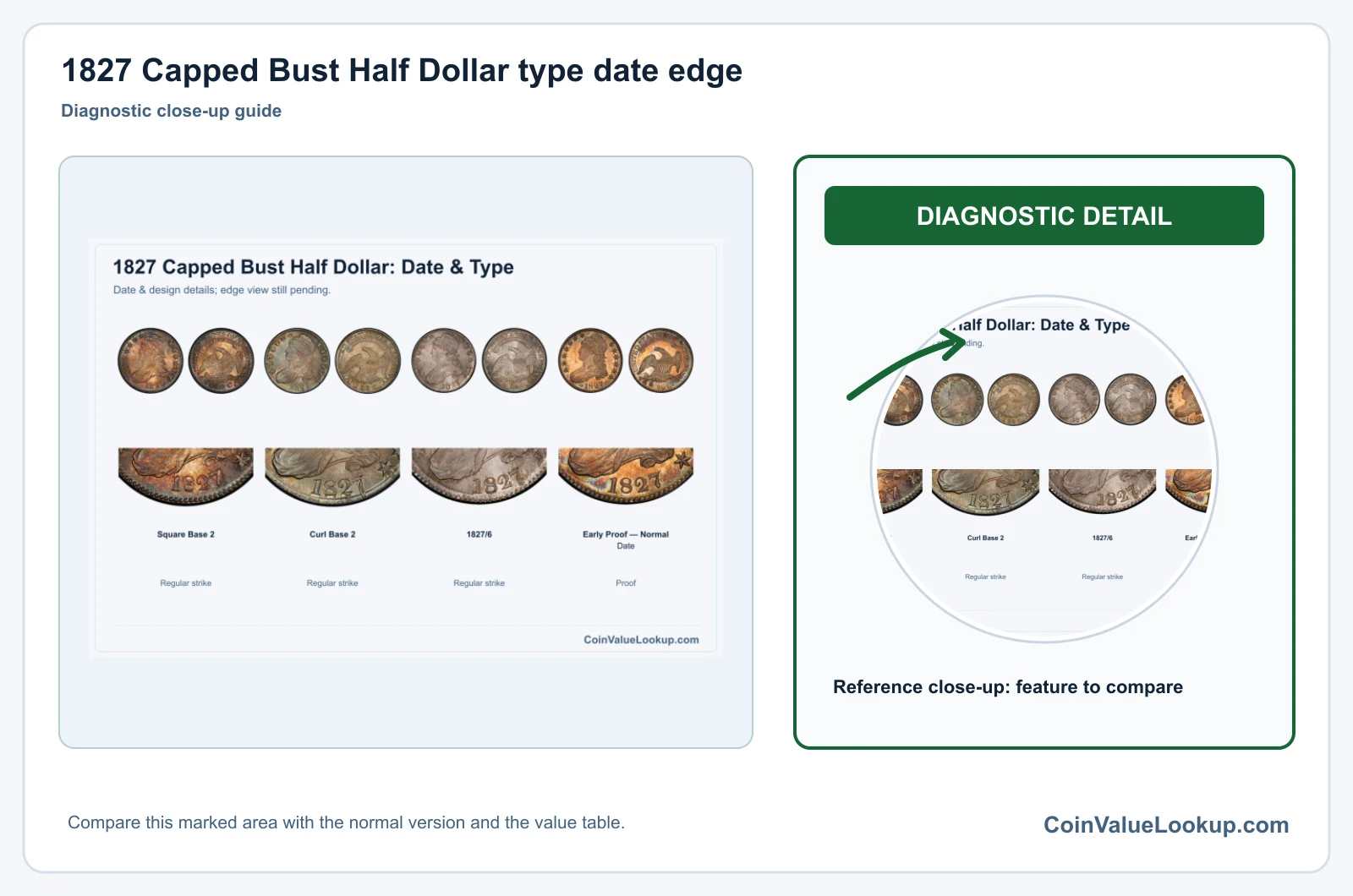
The three major regular-strike identities for the year are the Square Base 2, the Curl Base 2, and the 1827/6 overdate. To tell the first two apart, look closely at the base of the numeral 2 in the date.
The Square Base version has a flat, angular bottom; the Curl Base version curves. Rim wear can sometimes obscure this, so compare under magnification.
For the overdate, look for the remnants of an underlying 6 peeking out to the right of the 7 and beneath its top bar. This is a die feature, not an accidental double strike.
Early Proof attribution requires specialist evaluation of die characteristics, surface quality, and provenance. A shiny, polished, or prooflike regular-strike coin is not automatically a Proof.
Step 2: Check Your 1827 Capped Bust Half Dollar Grade
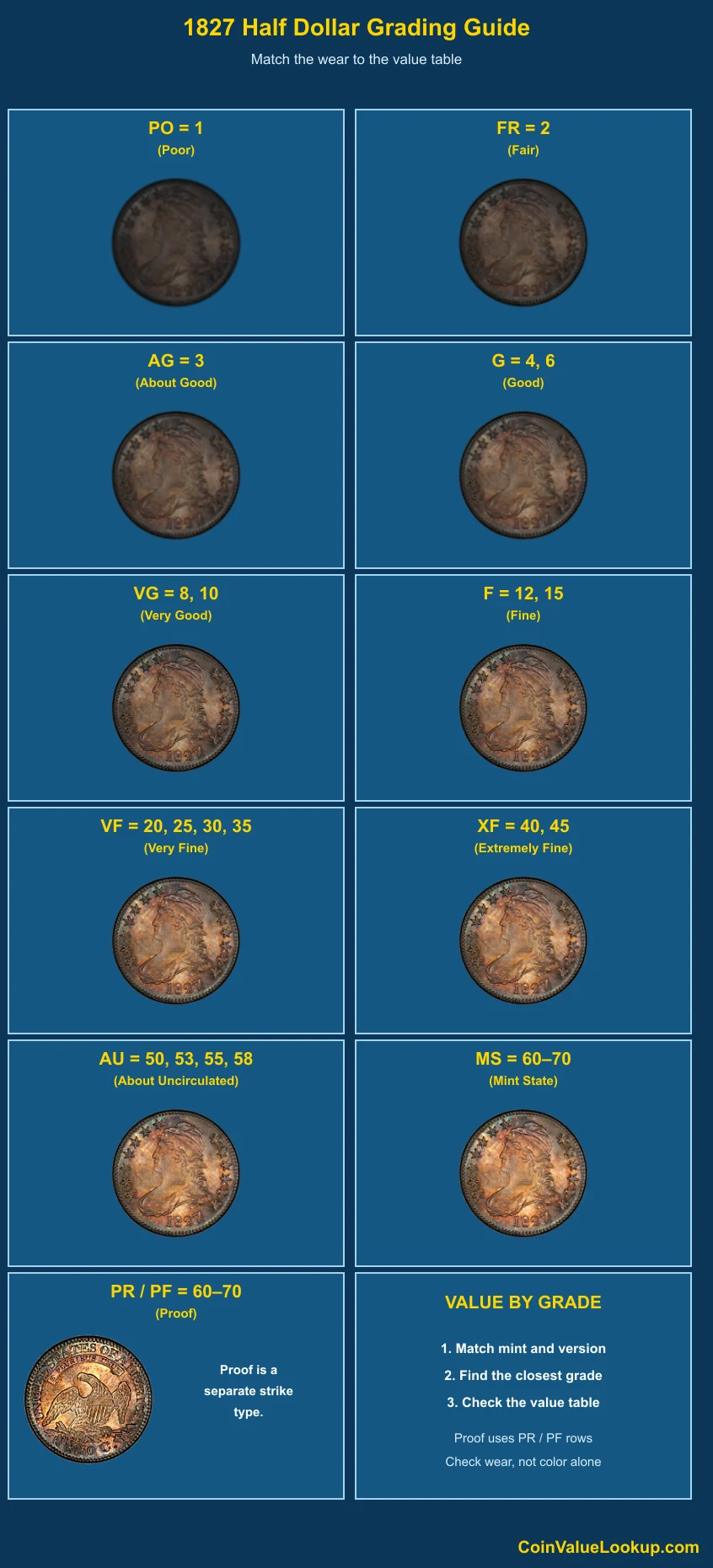
Start with the obverse. Check Liberty's hair above the forehead and around the ear for smoothness, then move to the cheek, cap, and shoulder clasp.
In lower grades the hair curls merge into flat patches, and the cap loses its fine detail.
On the reverse, inspect the eagle's breast feathers and wing tips. These coins sometimes have soft spots from the original strike, so do not assume every flat area is wear.
Look for interrupted or broken luster around high points before calling it light circulation.
Use the comparison image to match your coin against known grade benchmarks for this exact type. Coins that have been cleaned, holed, tooled, or scratched typically receive a "Details" designation and trade well below straight-graded examples.
Resist the urge to clean your coin, no matter how dark it looks.
Coin Value Lookup is a good place to explore guides for other early U.S. silver denominations if you are building a type set or just curious about what else is in the jar.
Step 3: Check 1827 Capped Bust Half Dollar Value by Mint and Version
1827 Capped Bust Half Dollar — Square Base 2
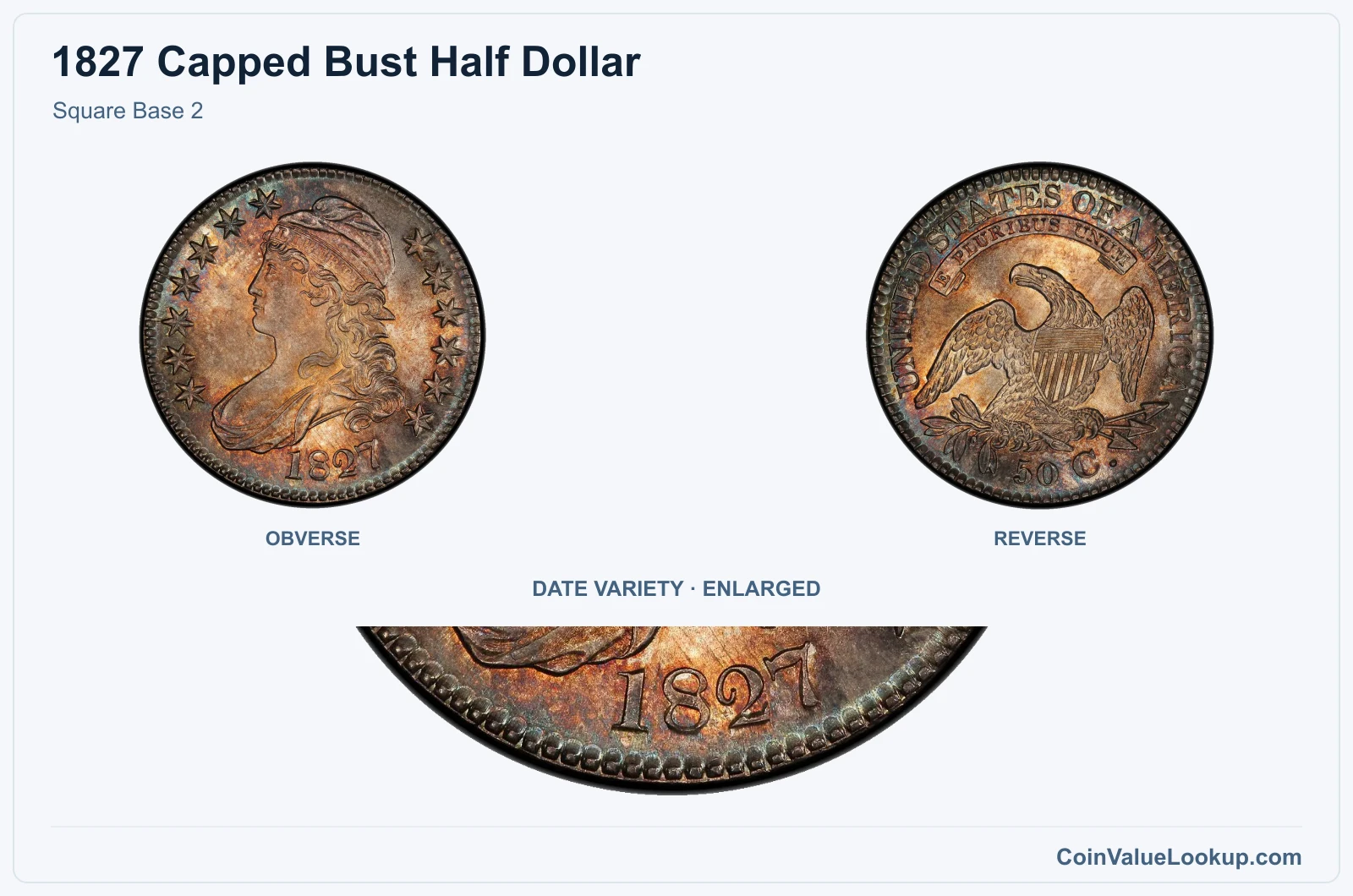
The Square Base 2 is the variety most collectors encounter first. Look at the numeral 2 in the date: its bottom stroke ends in a flat, angular foot rather than curling under.
Placing it next to a Curl Base 2 at the same magnification makes the difference obvious.
This is a regular Philadelphia circulation strike in silver-copper alloy (approximately 89.24% silver), with a lettered edge reading FIFTY CENTS OR HALF A DOLLAR. Guide estimates from USA Coin Book place it at roughly $111 in G4, $163 in VF20, and $517 in AU50.
Range Grade
Price Auction Records Appraisal PO PO 1
—
Coin Identifier FR FR 2
—
Coin Identifier AG AG 3
Coin Identifier G G 4
—
Coin Identifier
G 6
Coin Identifier VG VG 8
—
Coin Identifier
VG 10
Coin Identifier F F 12
Coin Identifier
F 15
Coin Identifier VF VF 20
Coin Identifier
VF 25
Coin Identifier
VF 30
Coin Identifier
VF 35
Coin Identifier XF XF 40
Coin Identifier
XF 45
Coin Identifier AU AU 50
Coin Identifier
AU 53
Coin Identifier
AU 55
Coin Identifier
AU 58
Coin Identifier MS MS 60
Coin Identifier
MS 61
Coin Identifier
MS 62
Coin Identifier
MS 63
Coin Identifier
MS 64
Coin Identifier
MS 65
Coin Identifier
MS 66
Coin Identifier
MS 67
Coin Identifier
MS 68
—
—
—
MS 69
—
—
—
MS 70
—
—
—
1827 Capped Bust Half Dollar — Curl Base 2
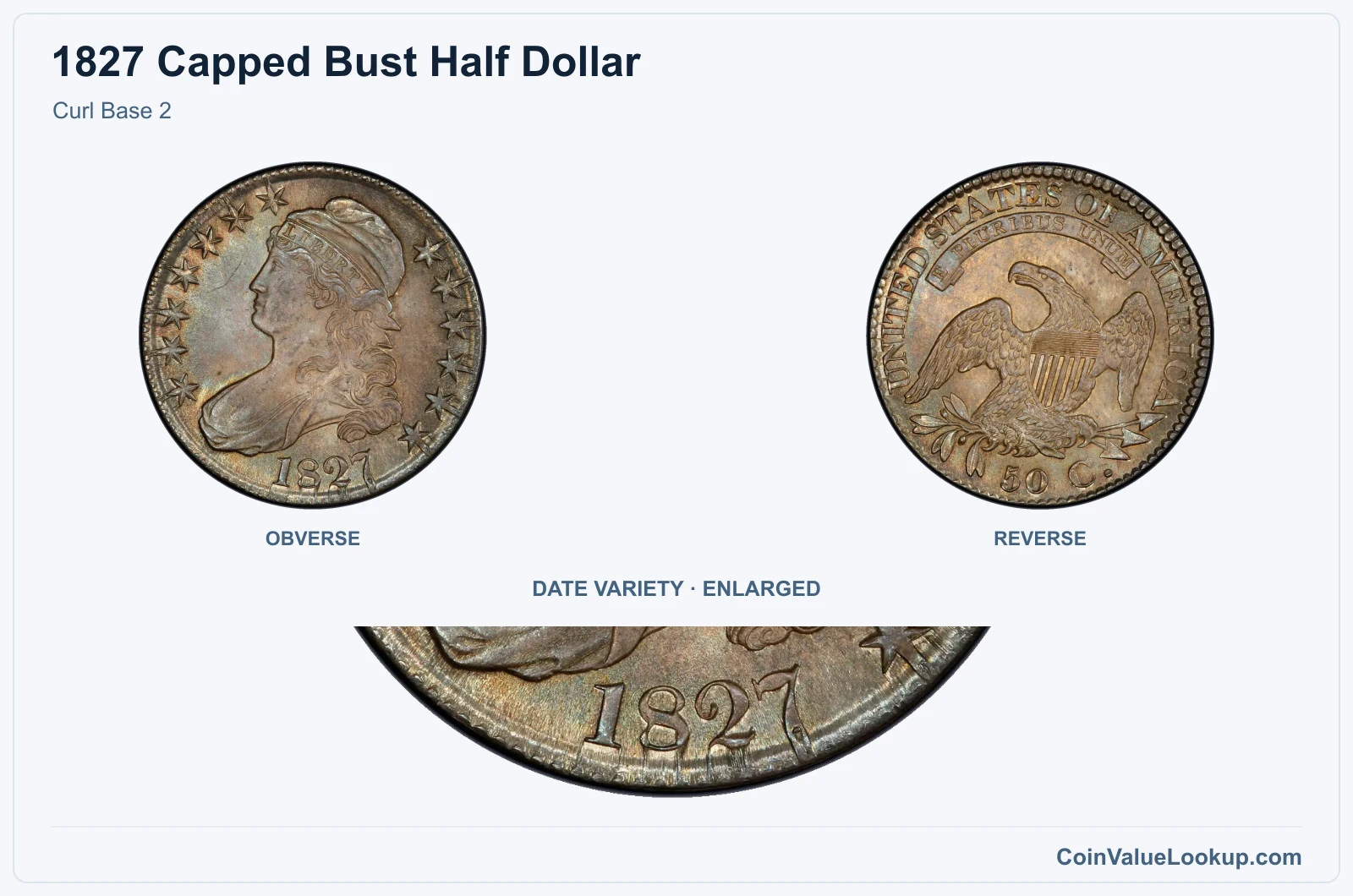
The Curl Base 2 shares the same design, metal, and lettered edge as its Square Base sibling, but the base of the 2 sweeps into a graceful curve instead of ending flat. Under heavy rim wear that curve can look ambiguous, so tilt the coin under a directional light and compare at several angles.
Guide estimates run close to the Square Base 2 in low grades — about $111 in G4 — but pull ahead as condition improves: $182 at VF20 and $685 at AU50 per USA Coin Book. That premium in higher grades makes it worth confirming which punch style your coin carries before you sell.
Range Grade
Price Auction Records Appraisal PO PO 1
—
Coin Identifier FR FR 2
—
Coin Identifier AG AG 3
—
Coin Identifier G G 4
—
Coin Identifier
G 6
—
Coin Identifier VG VG 8
Coin Identifier
VG 10
—
Coin Identifier F F 12
—
Coin Identifier
F 15
—
Coin Identifier VF VF 20
Coin Identifier
VF 25
Coin Identifier
VF 30
Coin Identifier
VF 35
Coin Identifier XF XF 40
Coin Identifier
XF 45
Coin Identifier AU AU 50
Coin Identifier
AU 53
Coin Identifier
AU 55
Coin Identifier
AU 58
Coin Identifier MS MS 60
—
Coin Identifier
MS 61
Coin Identifier
MS 62
Coin Identifier
MS 63
Coin Identifier
MS 64
Coin Identifier
MS 65
Coin Identifier
MS 66
—
—
—
MS 67
—
—
—
MS 68
—
—
—
MS 69
—
—
—
MS 70
—
—
—
1827 Capped Bust Half Dollar — /6
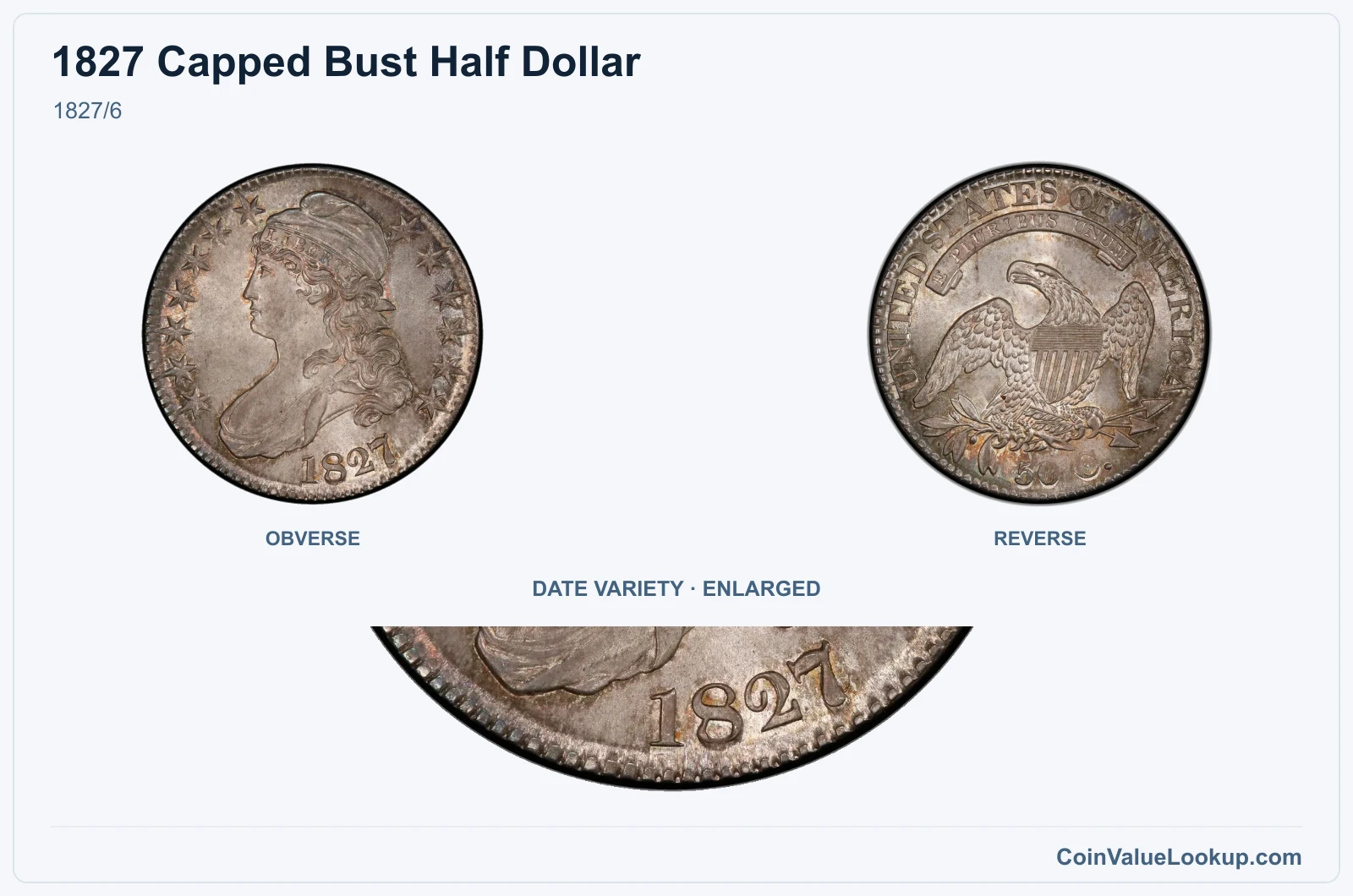
The 1827/6 overdate is one of the more collectible varieties in the entire Capped Bust half dollar series. The die was originally engraved with an 1826 date, then the 7 was punched over the 6.
Under magnification you can see remnants of the underlying 6 protruding to the right of the 7 and peeking beneath its top crossbar.
Do not confuse this with an accidental double strike or mechanical doubling; the overdate is a deliberate re-engraving of the die itself. It is a regular Philadelphia circulation strike on the same silver-copper alloy.
USA Coin Book guide estimates reflect the added collector demand: approximately $142 in G4, $517 in VF20, and $1,016 in AU50. Even well-worn examples with a clearly visible underdigit attract attention.
Range Grade
Price Auction Records Appraisal PO PO 1
—
Coin Identifier FR FR 2
—
Coin Identifier AG AG 3
—
Coin Identifier G G 4
—
Coin Identifier
G 6
—
Coin Identifier VG VG 8
—
Coin Identifier
VG 10
—
Coin Identifier F F 12
—
Coin Identifier
F 15
Coin Identifier VF VF 20
Coin Identifier
VF 25
Coin Identifier
VF 30
Coin Identifier
VF 35
Coin Identifier XF XF 40
Coin Identifier
XF 45
Coin Identifier AU AU 50
Coin Identifier
AU 53
Coin Identifier
AU 55
Coin Identifier
AU 58
Coin Identifier MS MS 60
Coin Identifier
MS 61
Coin Identifier
MS 62
Coin Identifier
MS 63
Coin Identifier
MS 64
Coin Identifier
MS 65
Coin Identifier
MS 66
Coin Identifier
MS 67
—
—
—
MS 68
—
—
—
MS 69
—
—
—
MS 70
—
—
—
1827 Capped Bust Half Dollar — Early Proof — Normal Date
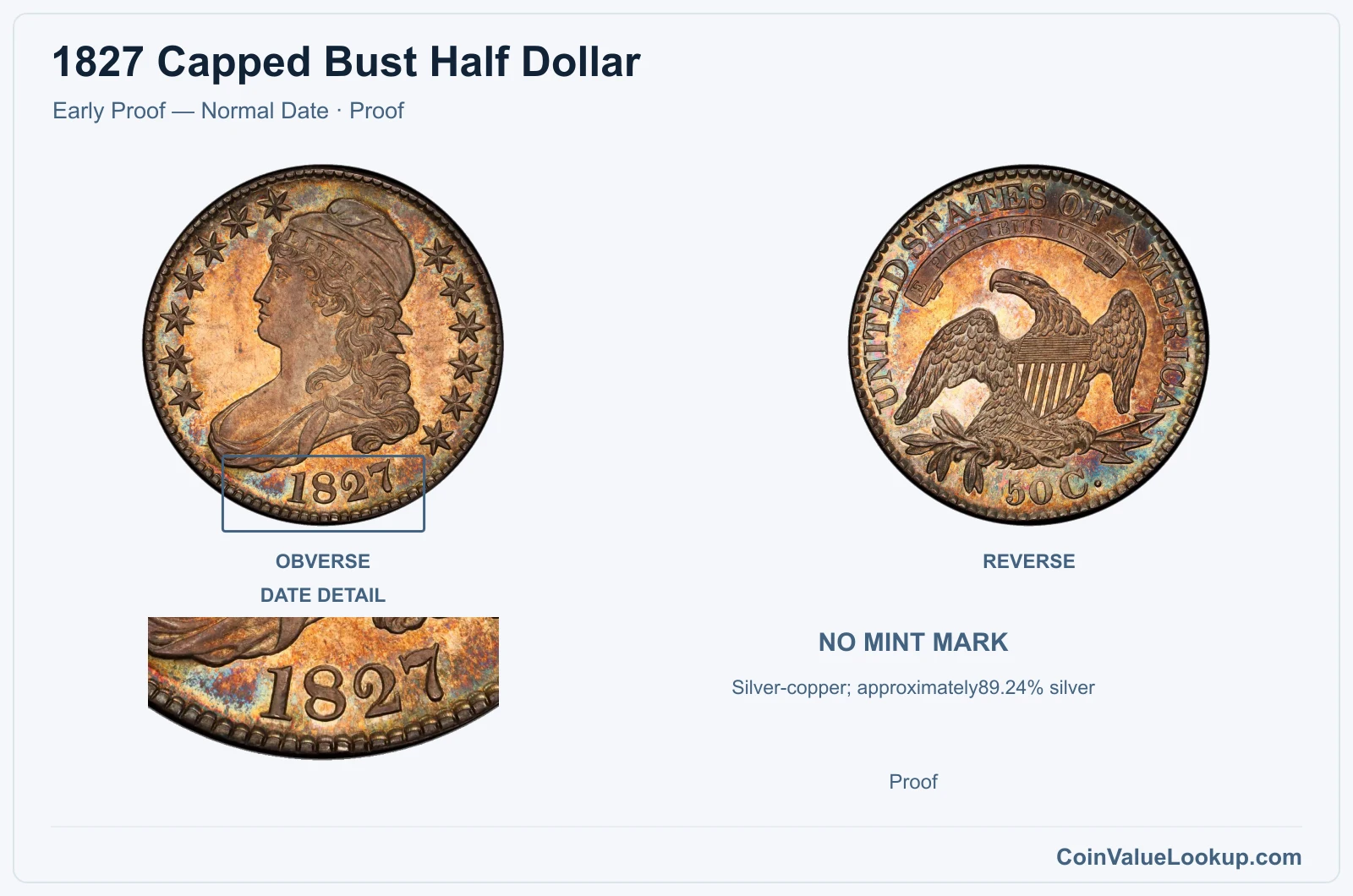
Early Proof Capped Bust Half Dollars from 1827 are exceptionally rare and exist in a completely different collecting lane from the circulation strikes. A Proof is a manufacturing method — specially prepared dies, carefully struck planchets — not simply a high numerical grade above Mint State.
Attribution requires specialist examination of die characteristics, surface quality, rim sharpness, and ideally documented provenance. Every shiny or prooflike coin you find in a junk box is almost certainly a regular strike that was lightly circulated or cleaned.
PCGS catalogs the 1827 Proof as a separate issue. One recorded sale offers a sense of the stakes: a PR67 example brought $258,500 at a Stack's Bowers auction in February 2016.
That is a single historical result, not a current market range, and lower-graded Proofs or unverified pieces cannot be priced by extrapolation from that figure.
Range Grade
Price Auction Records Appraisal PR PR 1
—
Coin Identifier
PR 2
—
Coin Identifier
PR 3
—
Coin Identifier
PR 4
—
Coin Identifier
PR 6
—
Coin Identifier
PR 8
—
Coin Identifier
PR 10
—
Coin Identifier
PR 12
—
Coin Identifier
PR 15
—
Coin Identifier
PR 20
—
Coin Identifier
PR 25
—
Coin Identifier
PR 30
—
Coin Identifier
PR 35
—
Coin Identifier
PR 40
—
Coin Identifier
PR 45
—
Coin Identifier
PR 50
—
Coin Identifier
PR 53
—
Coin Identifier
PR 55
—
Coin Identifier
PR 58
—
Coin Identifier
PR 60
—
Coin Identifier
PR 61
—
Coin Identifier
PR 62
—
Coin Identifier
PR 63
Coin Identifier
PR 64
Coin Identifier
PR 65
—
Coin Identifier
PR 66
Coin Identifier
PR 67
Coin Identifier
PR 68
—
—
—
PR 69
—
—
—
PR 70
—
—
—
1827 Capped Bust Half Dollar Error List
1. 1827 Capped Bust Half Dollar — Off-Center Strike
An off-center strike happens when the planchet is not seated squarely between the dies at the moment of impact. The result is a crescent-shaped blank area on one side of the coin, with the entire design shifted in the opposite direction.
On a reported 1827 example, a Square Base 2 half dollar was struck approximately 10% off center — enough to show a visible blank crescent while the date and most design elements remain legible.
Look for a consistent displacement of the design relative to the rim. A coin that is simply worn on one edge, clipped, or flattened after leaving the mint will not show the uniform directional shift that a genuine off-center strike produces.
Post-mint damage and one-sided die misalignment can mimic the look at a glance.
Condition, the percentage of off-center shift, and whether the date is readable all affect the value of such a piece. No specific price range is adopted here; individual assessment is needed.
2. 1827 Capped Bust Half Dollar — Incomplete Planchet Cut
An incomplete planchet cut occurs during the blanking process, when the punch that cuts a round blank from the silver strip does not complete its full circle. The result is a coin whose edge retains a partial arc from the unfinished cut, giving it an irregular or slightly protruding profile at one point along the rim.
This is different from a traditional clipped planchet, where an entire segment appears missing. With an incomplete cut, you are looking for evidence that the blanking die started but did not finish its stroke — a subtle, curved interruption along the edge.
Compare carefully against post-mint nicks, ordinary edge wear, and design features of the lettered edge. A same-year attributed example is the best reference.
Value depends on the visibility and condition of the error, and no numerical price range is adopted here.
3. 1827 Capped Bust Half Dollar — Die Crack / Die Chip
Die cracks are raised lines on a coin's surface caused by fractures in the steel die during production. As a die ages, stress fractures develop, and metal from the planchet fills those cracks, leaving a thin raised trail on the finished coin.
On the 1827 half dollar, an attributed late die state shows a crack running above the inscription UNITED STATES on the reverse.
To confirm you are looking at a genuine die crack, trace the raised path with magnification. It should follow a consistent line and be raised above the field.
Incuse scratches, corrosion lines, or foreign material sitting on the surface can look similar but will be recessed or sit irregularly.
Die cracks and die chips are cataloged at various die states, but those stage distinctions are specialist details rather than separate error categories. Value depends on prominence and overall coin condition; no specific price range is adopted here.