1829 Capped Bust Half Dollar Coin Value: How Much Is It Worth?
The 1829 Capped Bust Half Dollar carries guide values from about $92 in G4 to $517 in AU50 for the Normal Date — Small Letters variety. Your coin's exact worth depends heavily on its grade and which version you hold.
The Large Letters and 1829/7 overdate varieties command different premiums, and authenticated Proofs are in a different league entirely.
Fast Way to Identify Your 1829 Capped Bust Half Dollar
Snap clear photos of both sides of your 1829 half dollar, plus the lettered edge if you can manage it, and upload them here for a preliminary identification. This helps narrow down your version and approximate condition.
It is not a substitute for professional certification, but it gives you a solid starting point before deciding next steps.
1829 Capped Bust Half Dollar Value
Upload both sides of your 1829 Capped Bust Half Dollar.
Front Obverse
Upload photo
Back Reverse
Upload photo
Which 1829 Capped Bust Half Dollar Versions Are Worth Money?
- The 1829/7 overdate variety guides at $106 in G4 and jumps to $948 at AU50, making it the premium regular-strike branch at higher grades.
- Normal Date — Large Letters guides slightly above Small Letters in lower grades: $100 versus $92 at G4.
- Authenticated Lettered Edge Proofs are rare specialist coins — one graded PR64 sold for $102,813 at Heritage in January 2014.
- Check your reverse letter size carefully; the Small Letters versus Large Letters distinction is easy to overlook but affects value.
Step 1: Identify Your 1829 Capped Bust Half Dollar Mint Mark and Version
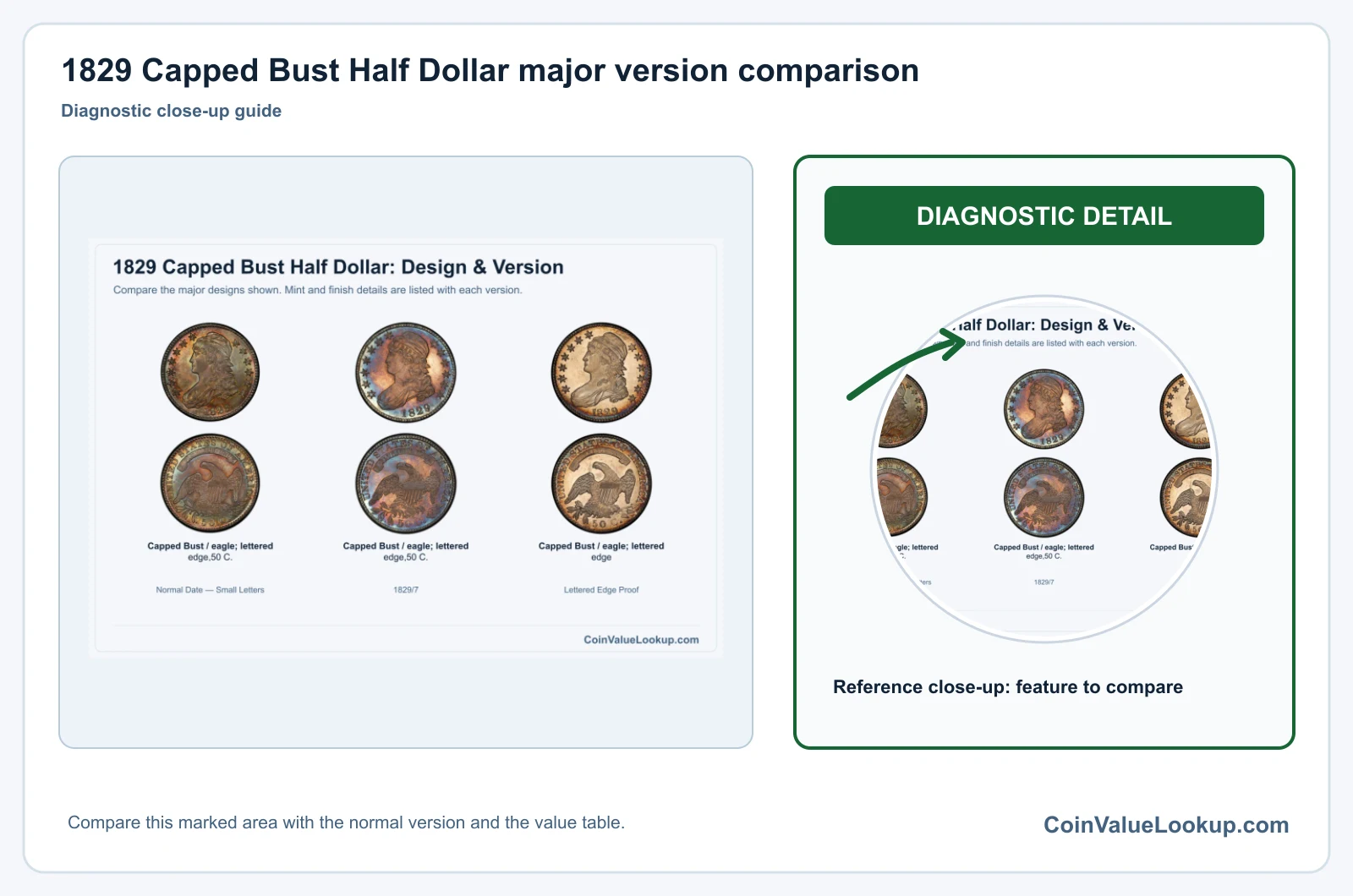
Every 1829 Capped Bust Half Dollar was struck at Philadelphia. There is no mintmark to look for.
The obverse shows Liberty wearing a cap, the date below. The reverse displays a heraldic eagle with UNITED STATES OF AMERICA and the denomination.
The edge is lettered: FIFTY CENTS OR HALF A DOLLAR. Specs run 32.5 mm, roughly 13.48 grams, and approximately 89.24% silver.
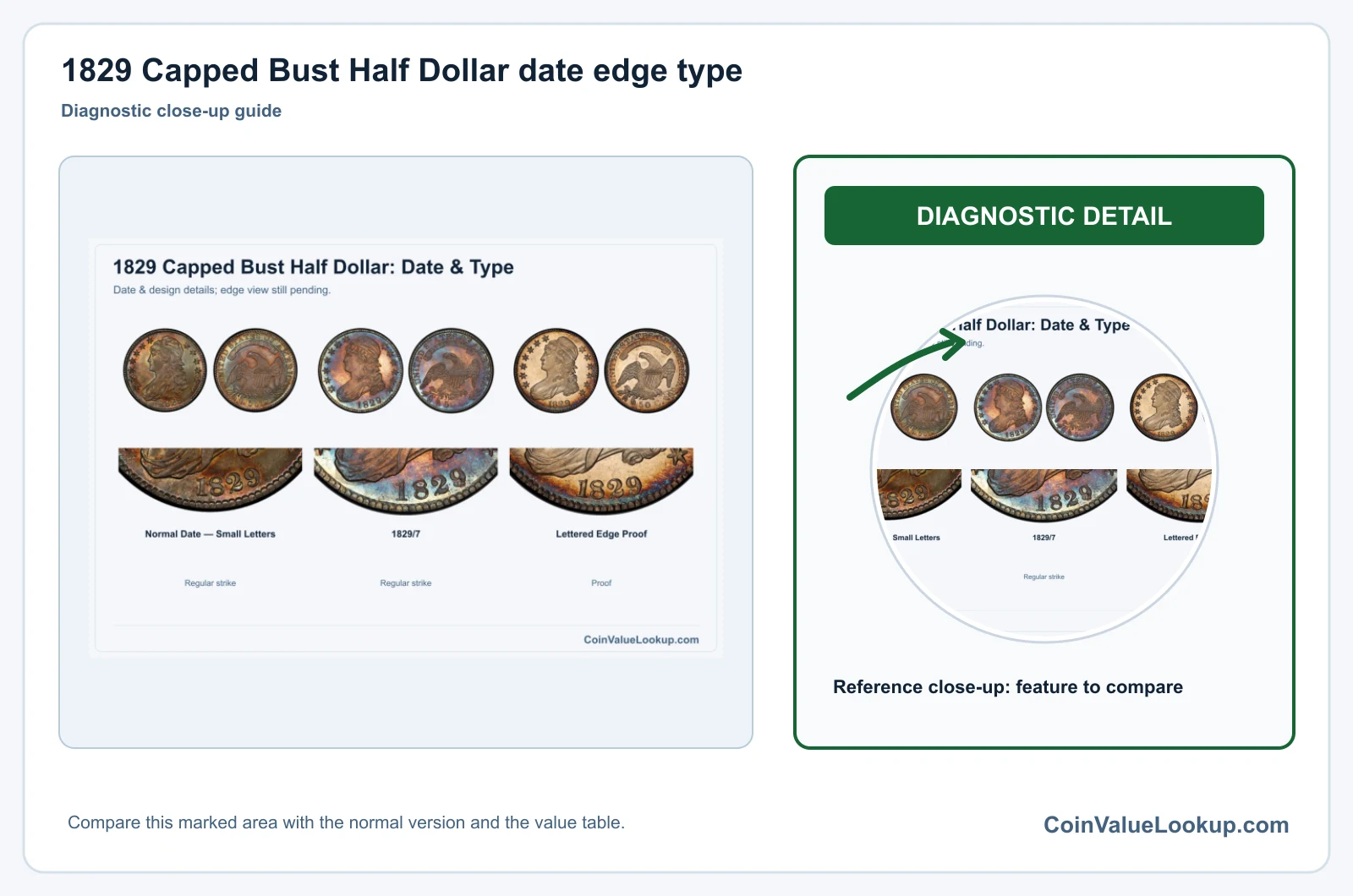
Three main branches matter for valuation. First, determine whether your coin has a normal 1829 date or an overdate — the 1829/7 shows remnants of a 7 beneath the final 9.
Scratches and die polish can mimic an overdate, so look carefully for the distinct curved base of the 7.
If the date is normal, flip the coin over and compare the reverse lettering size against a known reference at the same scale. Small Letters and Large Letters are separate varieties with different guide values.
This distinction is about overall letter size, not a specialist die marriage number.
Proof status requires professional attribution. A shiny or prooflike coin is not automatically a Proof — polished regular strikes and coins with remaining luster can fool you.
Step 2: Check Your 1829 Capped Bust Half Dollar Grade
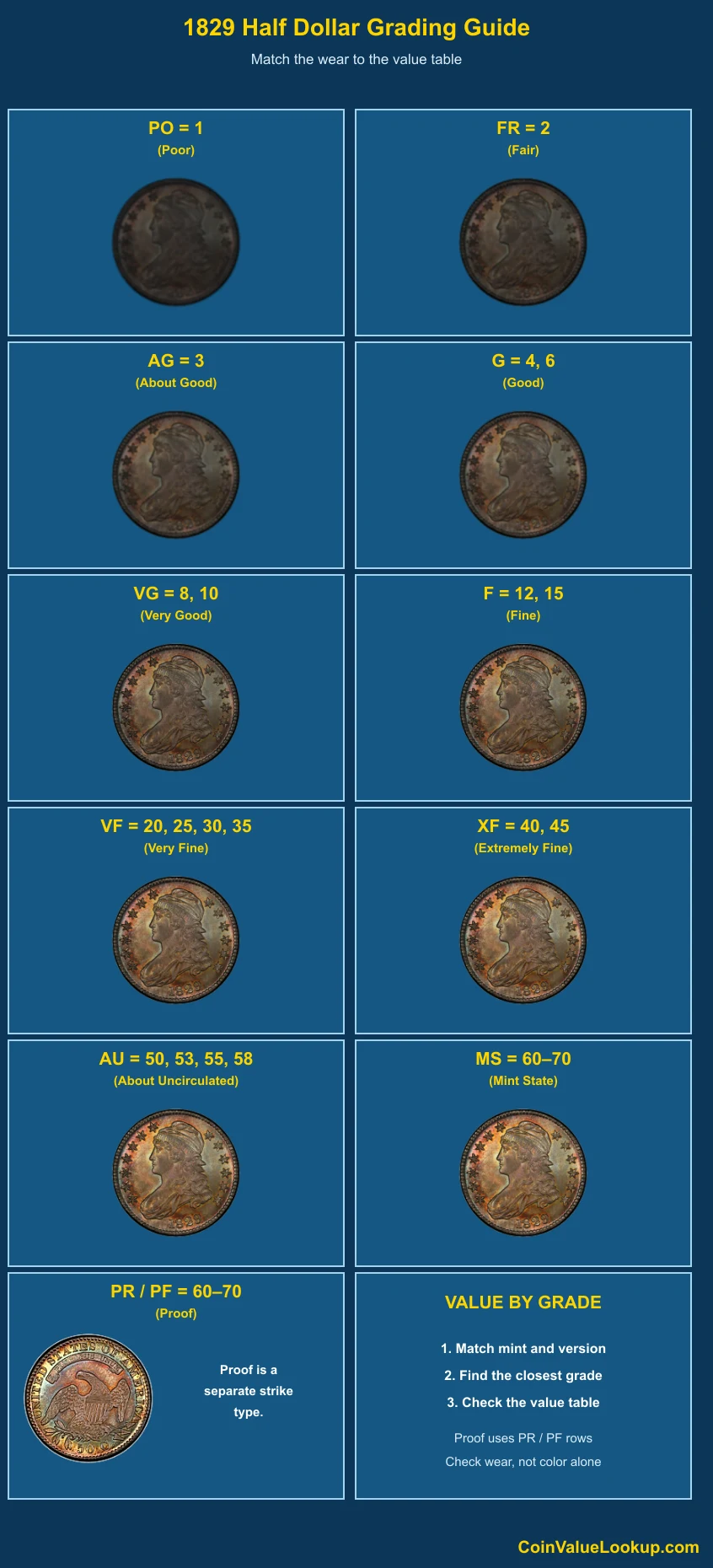
Start with the obverse high points: Liberty's forehead curls, cheek, and the top of the cap pick up wear first. On the reverse, check the eagle's breast feathers and the tops of the wings.
These areas tell the story fast.
A G4 coin will show a clear outline of Liberty and the eagle but most interior detail is smooth. By VF20, major hair curls and feather groups are distinct though worn on the peaks.
At AU50, only the slightest friction shows on the highest points, and most original luster remains in protected areas.
Separate genuine wear from weak original strikes — some dies produced soft detail even on fresh coins. Compare your coin against the type-matched grading images to calibrate your eye.
Also note any cleaning, scratches, or holes; these reduce value significantly regardless of remaining detail.
Proof is a manufacturing method, not a grade above Mint State. Proofs are graded on the PR scale.
Bright surfaces alone do not identify a Proof finish.
Step 3: Check 1829 Capped Bust Half Dollar Value by Mint and Version
1829 Capped Bust Half Dollar — Normal Date — Small Letters
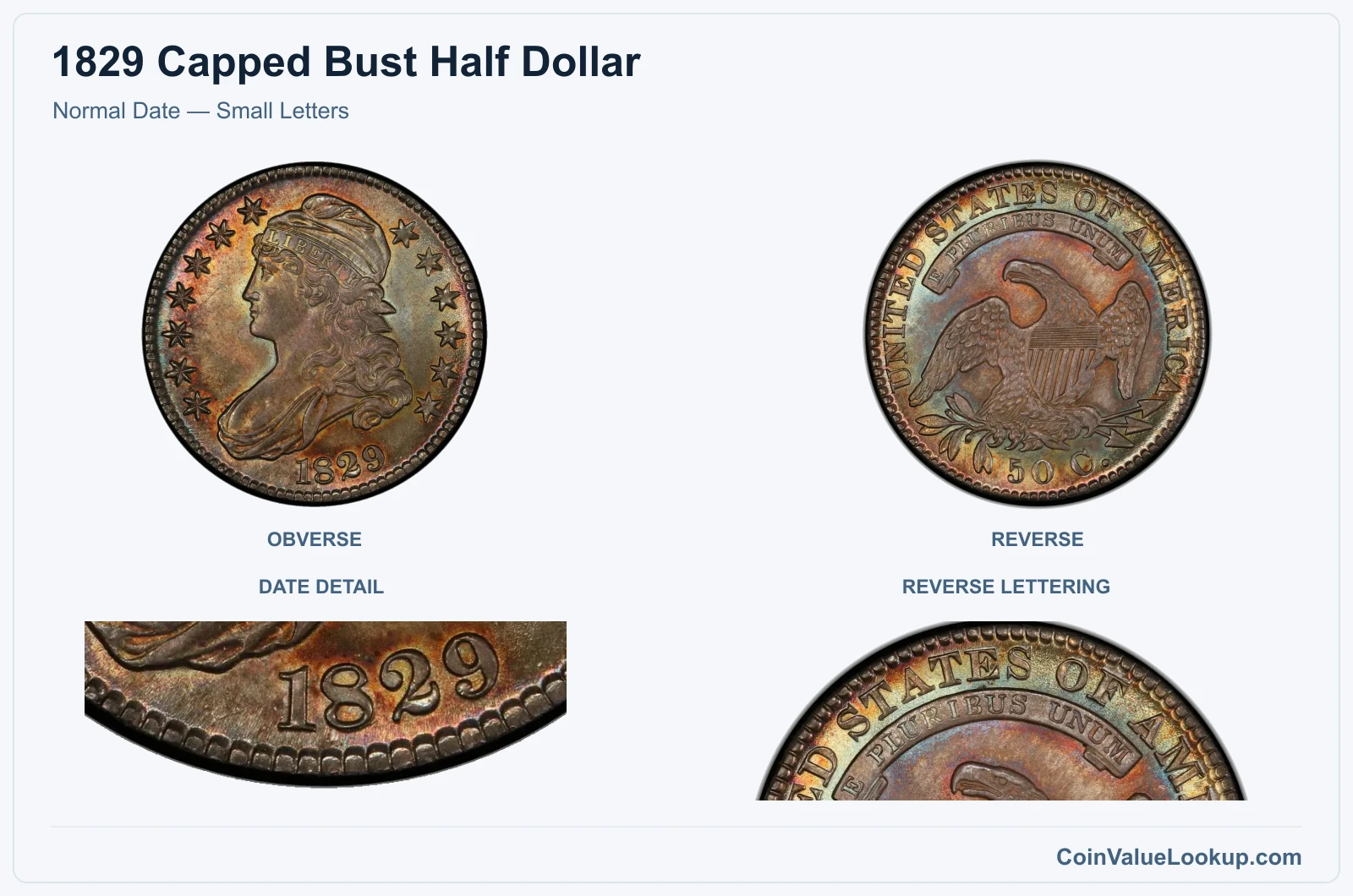
This is the most commonly encountered branch. The obverse carries a normal 1829 date, and the reverse lettering — UNITED STATES OF AMERICA and FIFTY CENTS — appears in a smaller font compared to the Large Letters variety.
You need a same-scale reference image to judge this accurately; eyeballing it alone is unreliable.
Guide estimates from USA Coin Book place this version around $92 at G4, $152 at VF20, and $517 at AU50. These are retail guide figures, not guaranteed sale prices.
Still, even a well-worn example carries solid silver content and collector demand as a classic early federal type coin.
Ordinary-issue reference: Ordinary-issue reference only: The table below shows prices for the 1829 Capped Bust Half Dollar (regular strike). It does not represent the value of the specific Normal Date — Small Letters variety or its variety premium. Year, mint, metal and strike type are matched; the specific variety is not priced by this table.
Range Grade
Price Auction Records Appraisal PO PO 1
—
Coin Identifier FR FR 2
—
Coin Identifier AG AG 3
—
Coin Identifier G G 4
Coin Identifier
G 6
Coin Identifier VG VG 8
Coin Identifier
VG 10
Coin Identifier F F 12
Coin Identifier
F 15
Coin Identifier VF VF 20
Coin Identifier
VF 25
Coin Identifier
VF 30
Coin Identifier
VF 35
Coin Identifier XF XF 40
Coin Identifier
XF 45
Coin Identifier AU AU 50
Coin Identifier
AU 53
Coin Identifier
AU 55
Coin Identifier
AU 58
Coin Identifier MS MS 60
Coin Identifier
MS 61
Coin Identifier
MS 62
Coin Identifier
MS 63
Coin Identifier
MS 64
Coin Identifier
MS 65
Coin Identifier
MS 66
Coin Identifier
MS 67
—
—
—
MS 68
—
—
—
MS 69
—
—
—
MS 70
—
—
—
1829 Capped Bust Half Dollar — Normal Date — Large Letters
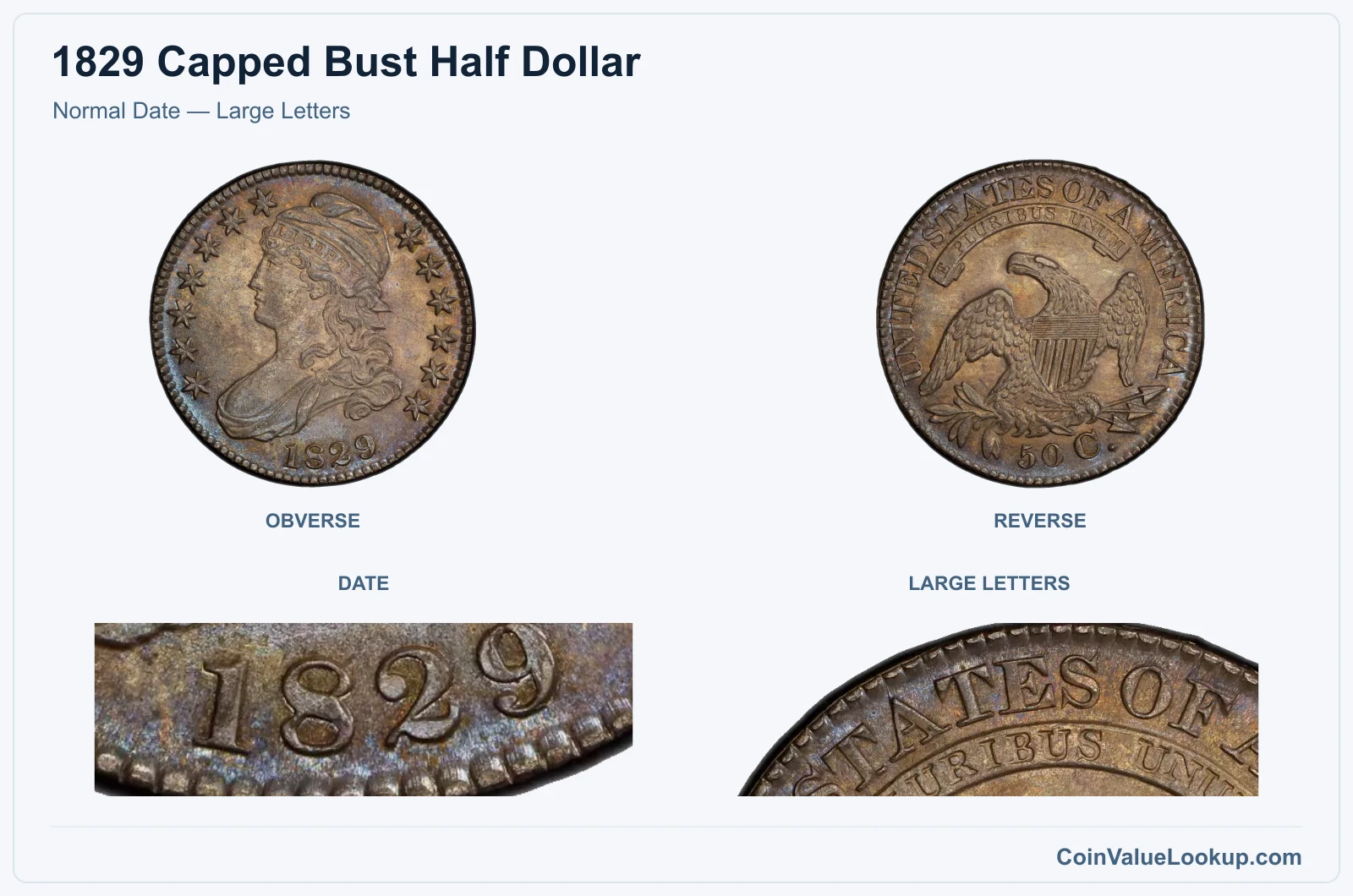
Same date, same mint, different reverse. The Large Letters variety uses noticeably taller lettering on the reverse.
The difference is visible when you compare the two side by side at equal magnification — do not confuse this with die-specific letter spacing quirks.
Guide values run $100 at G4, $167 at VF20, and $517 at AU50 per USA Coin Book. The premium over Small Letters is modest in lower grades and converges at AU50.
As a silver-copper composition struck at Philadelphia with a lettered edge, it shares all other specs with its smaller-lettered sibling.
Coin Value Lookup is a useful resource if you want to compare this coin against other years and denominations in the Capped Bust Half Dollar series.
Ordinary-issue reference: Ordinary-issue reference only: The table below shows prices for the 1829 Capped Bust Half Dollar (regular strike). It does not represent the value of the specific Normal Date — Large Letters variety or its variety premium. Year, mint, metal and strike type are matched; the specific variety is not priced by this table.
Range Grade
Price Auction Records Appraisal PO PO 1
—
Coin Identifier FR FR 2
—
Coin Identifier AG AG 3
—
Coin Identifier G G 4
Coin Identifier
G 6
Coin Identifier VG VG 8
Coin Identifier
VG 10
Coin Identifier F F 12
Coin Identifier
F 15
Coin Identifier VF VF 20
Coin Identifier
VF 25
Coin Identifier
VF 30
Coin Identifier
VF 35
Coin Identifier XF XF 40
Coin Identifier
XF 45
Coin Identifier AU AU 50
Coin Identifier
AU 53
Coin Identifier
AU 55
Coin Identifier
AU 58
Coin Identifier MS MS 60
Coin Identifier
MS 61
Coin Identifier
MS 62
Coin Identifier
MS 63
Coin Identifier
MS 64
Coin Identifier
MS 65
Coin Identifier
MS 66
Coin Identifier
MS 67
—
—
—
MS 68
—
—
—
MS 69
—
—
—
MS 70
—
—
—
1829 Capped Bust Half Dollar — /7
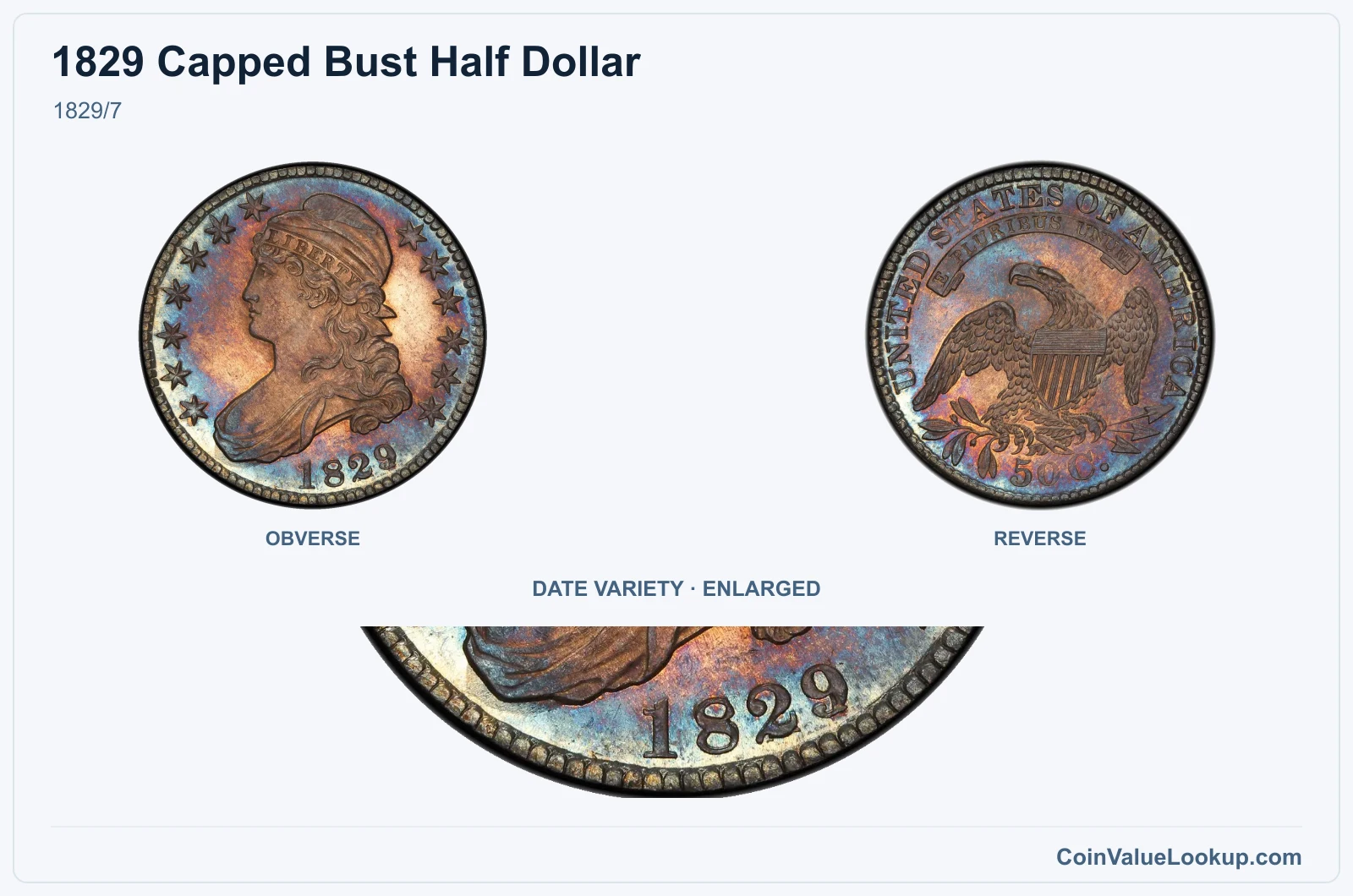
This is the overdate everyone hunts for. The Mint reused an 1827-dated die and punched a 9 over the existing 7.
On genuine examples, you can see traces of the 7's curved lower portion extending beneath and slightly beyond the base of the 9. A loupe at 5x or better helps.
Be cautious: die scratches, contact marks, and corrosion near the date can mimic an underlying digit. If you are not confident, professional attribution is worth pursuing — the premium justifies it.
USA Coin Book guides this variety at $106 in G4, $226 at VF20, and a notable $948 at AU50. That AU50 figure is nearly double the normal-date versions at the same grade.
The overdate is struck at Philadelphia in the same silver-copper composition with a lettered edge, like all 1829 halves.
Range Grade
Price Auction Records Appraisal PO PO 1
—
Coin Identifier FR FR 2
—
Coin Identifier AG AG 3
—
Coin Identifier G G 4
—
Coin Identifier
G 6
—
Coin Identifier VG VG 8
—
Coin Identifier
VG 10
Coin Identifier F F 12
—
Coin Identifier
F 15
Coin Identifier VF VF 20
Coin Identifier
VF 25
Coin Identifier
VF 30
Coin Identifier
VF 35
Coin Identifier XF XF 40
Coin Identifier
XF 45
Coin Identifier AU AU 50
Coin Identifier
AU 53
Coin Identifier
AU 55
Coin Identifier
AU 58
Coin Identifier MS MS 60
—
Coin Identifier
MS 61
Coin Identifier
MS 62
Coin Identifier
MS 63
Coin Identifier
MS 64
Coin Identifier
MS 65
Coin Identifier
MS 66
Coin Identifier
MS 67
—
—
—
MS 68
—
—
—
MS 69
—
—
—
MS 70
—
—
—
1829 Capped Bust Half Dollar — Lettered Edge Proof
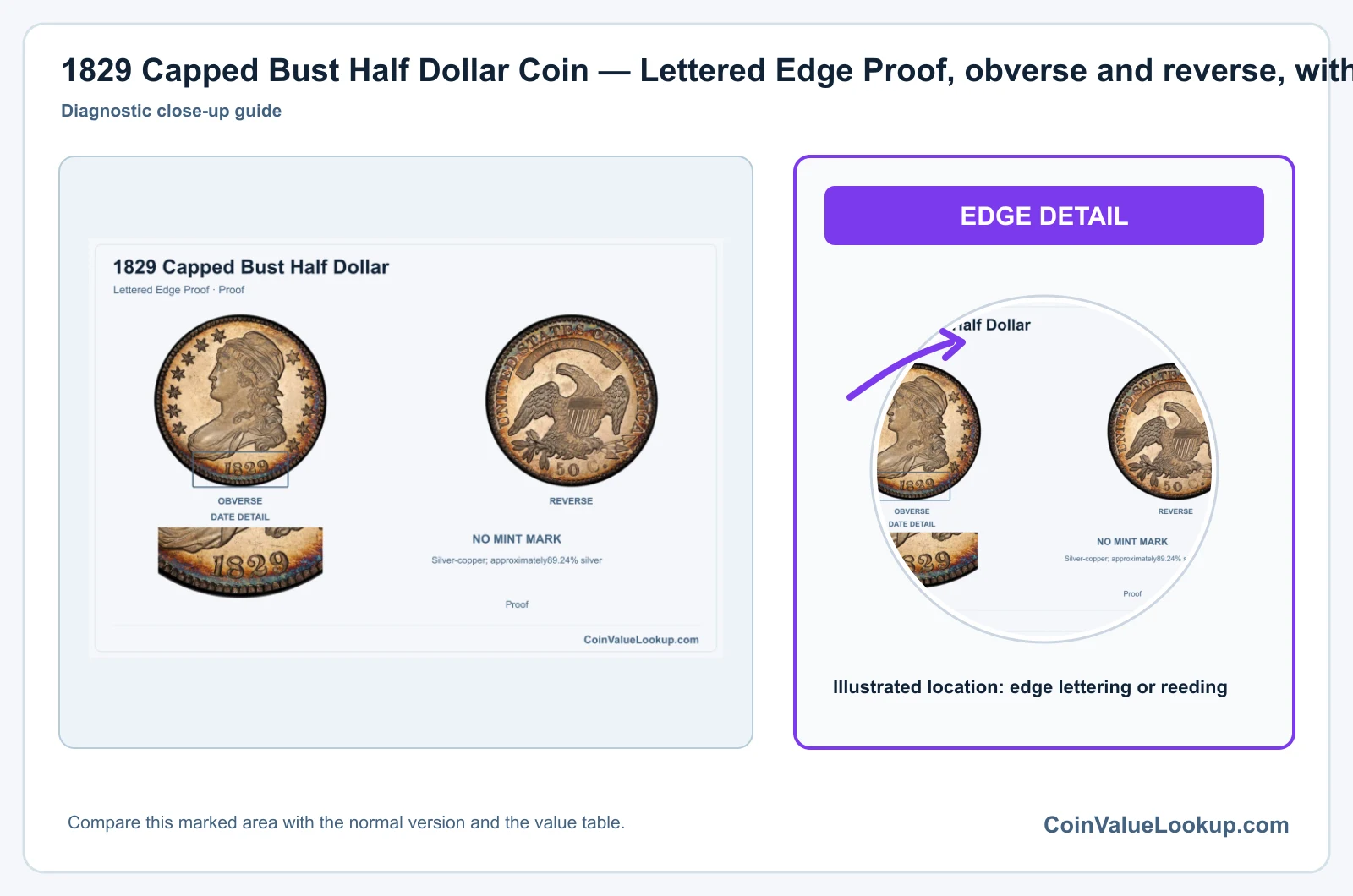
Early Proofs of this series are rare and were produced in very small numbers, likely for presentation or collector purposes. These carry a lettered edge and display specially prepared, mirror-like surfaces with sharp design details that differ from even the best regular strikes.
A single recorded sale anchors the known market: a PR64 example brought $102,813 at Heritage Auctions in January 2014. That is one auction result, not a current price curve across grades.
Critically, a shiny or prooflike coin is not a Proof. Polished regular strikes, coins dipped in cleaning solution, and pieces retaining cartwheel luster can all look mirror-bright to the untrained eye.
Proof attribution for this era requires professional examination of die characteristics, surface texture, and rim details. Do not assign this branch to your coin based on appearance alone.
Range Grade
Price Auction Records Appraisal PR PR 1
—
Coin Identifier
PR 2
—
Coin Identifier
PR 3
—
Coin Identifier
PR 4
—
Coin Identifier
PR 6
—
Coin Identifier
PR 8
—
Coin Identifier
PR 10
—
Coin Identifier
PR 12
—
Coin Identifier
PR 15
—
Coin Identifier
PR 20
—
Coin Identifier
PR 25
—
Coin Identifier
PR 30
—
Coin Identifier
PR 35
—
Coin Identifier
PR 40
—
Coin Identifier
PR 45
—
Coin Identifier
PR 50
—
Coin Identifier
PR 53
—
Coin Identifier
PR 55
—
Coin Identifier
PR 58
—
Coin Identifier
PR 60
—
Coin Identifier
PR 61
—
Coin Identifier
PR 62
—
Coin Identifier
PR 63
Coin Identifier
PR 64
Coin Identifier
PR 65
Coin Identifier
PR 66
Coin Identifier
PR 67
—
—
—
PR 68
—
—
—
PR 69
—
—
—
PR 70
—
—
—
1829 Capped Bust Half Dollar Error List
1. 1829 Capped Bust Half Dollar — Off-Center Strike
An off-center strike occurs when the planchet is not properly seated between the dies at the moment of striking, shifting the design away from center. On a documented 1829 Half Dollar example, the strike was approximately 5% off center toward the 7:30 position, cutting into the lower portion of the date on the obverse and clipping upper reverse letters.
One cataloged specimen had its holder originally mislabeled as 1830 — the catalog corrected the date to 1829 based on die characteristics. So holder labels are not always gospel.
Lookalikes include clipped planchets, one-sided die misalignment, and post-mint flattening from damage. A genuine off-center strike shifts the entire design uniformly in one direction.
Value depends on the degree of off-center shift, overall condition, and how visually dramatic the error is — no specific price range is established here.
2. 1829 Capped Bust Half Dollar — Overlapping Edge Lettering
Overlapping edge lettering is a distinctive error on lettered-edge Capped Bust halves. Because the edge inscription was applied in a separate step from the obverse and reverse striking, misfeeds or slippage during the edge-lettering process could produce doubled or even tripled impressions of the inscription.
A documented 1829 example shows tripled edge lettering — three overlapping sets of FIFTY CENTS OR HALF A DOLLAR compressed onto the edge. This falls under a broader class that includes doubled edge lettering from related mechanical causes.
Do not confuse normal edge wear or post-mint scrapes with genuine overlap. Compare against an attributed same-year coin under consistent lighting.
The value of such pieces depends on the clarity and extent of the overlap, the coin's overall grade, and collector demand for the specific error — no numerical price range is adopted here.
3. 1829 Capped Bust Half Dollar — Die Crack / Die Chip
Die cracks appear as raised lines on the coin's surface, formed when a working die develops fractures from repeated use. On documented 1829 half dollars, raised cracks have been observed running across the reverse lettering — specifically through TATES OF AMERI — and extending from the olive leaves across 50 C.
to the arrowheads.
These are genuinely struck features, not damage. The key diagnostic is that die cracks are raised above the surrounding field because metal fills the crack in the die during striking.
Incuse scratches, corrosion lines, or foreign material sitting on the surface are common lookalikes, but they sit into or on top of the surface rather than rising from it.
The value added by die cracks depends on their size, visual impact, and the coin's overall condition. No specific price premium is established here.
Minor cracks are common on early federal coinage and may add modest interest, while dramatic retained cuds or bisecting cracks draw more attention.