1835 Capped Bust Half Dollar Coin Value: How Much Is It Worth?
An 1835 Capped Bust Half Dollar in typical circulated condition carries a USA Coin Book guide estimate ranging from roughly $92 at G4 to $487 at AU50. That spread matters because grade is doing most of the heavy lifting on price.
Rare Proof versions and recognized die varieties sit on entirely different value scales, so identifying exactly what you have is step one.
Fast Way to Identify Your 1835 Capped Bust Half Dollar
Snap clear photos of your coin's front, back, and edge, then upload them here for a preliminary identification. The lettered edge is especially important on this date because different edge types point to very different versions.
Good lighting at a slight angle helps reveal surface quality and wear patterns that matter for narrowing things down.
1835 Capped Bust Half Dollar Value
Upload both sides of your 1835 Capped Bust Half Dollar.
Front Obverse
Upload photo
Back Reverse
Upload photo
Which 1835 Capped Bust Half Dollar Versions Are Worth Money?
- Philadelphia Regular Strike — the standard version, with guide estimates from about $92 at G4 to $487 at AU50; silver content alone provides a floor.
- Lettered Edge Proof — extremely rare; a single PR66 sold for $121,000 at Bowers & Merena in April 1997, showing the premium authenticated Proofs command.
- Crushed Lettered Edge Proof — a separate Proof variety with flattened edge letters; a PR63 brought $56,400 at Heritage in January 2015.
- Die crack and blundered edge lettering errors have been reported for this date and can add value depending on visibility and condition.
Step 1: Identify Your 1835 Capped Bust Half Dollar Mint Mark and Version
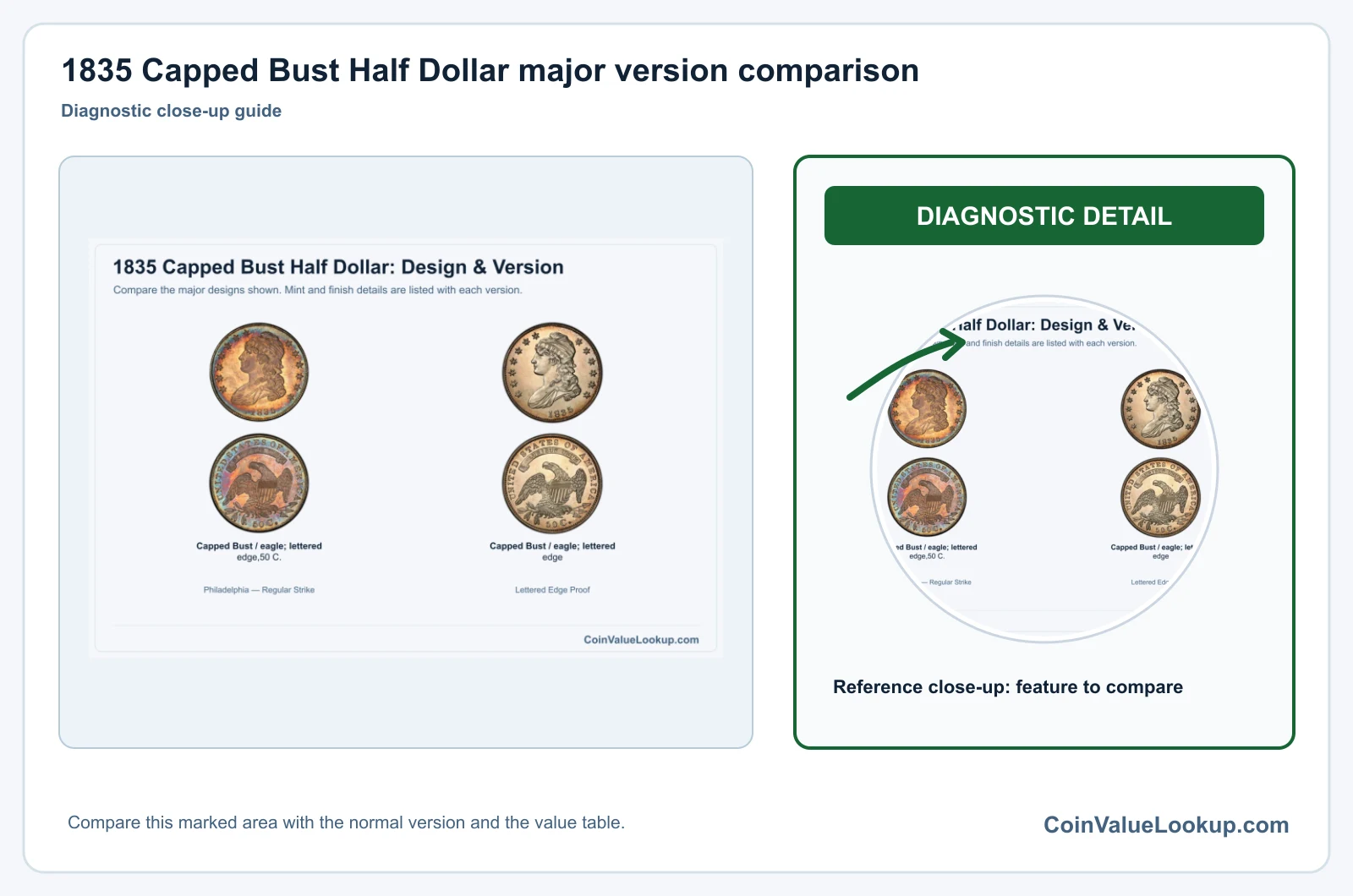
Every 1835 Capped Bust Half Dollar was struck at Philadelphia, so there is no mintmark to hunt for. The obverse shows Liberty wearing a cap with flowing hair, surrounded by stars.
The reverse features a heraldic eagle with UNITED STATES OF AMERICA and 50 C. at the bottom.
The edge should read FIFTY CENTS OR HALF A DOLLAR in raised lettering. Grab a caliper if you can: the coin measures 32.5 mm across, weighs a nominal 13.48 grams, and is approximately 89.24% silver with a copper balance.
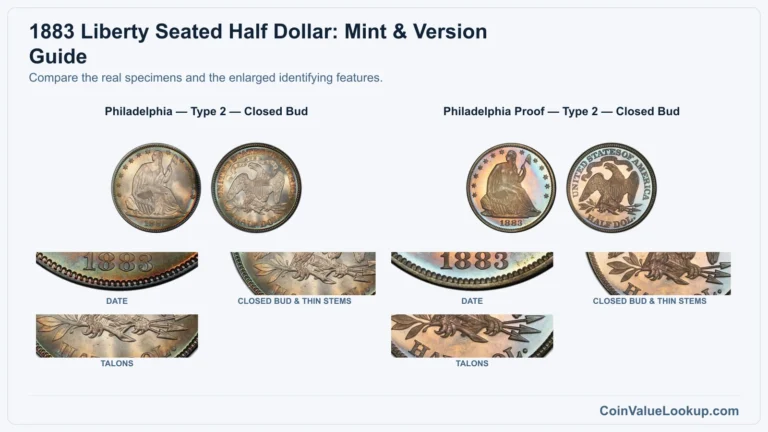
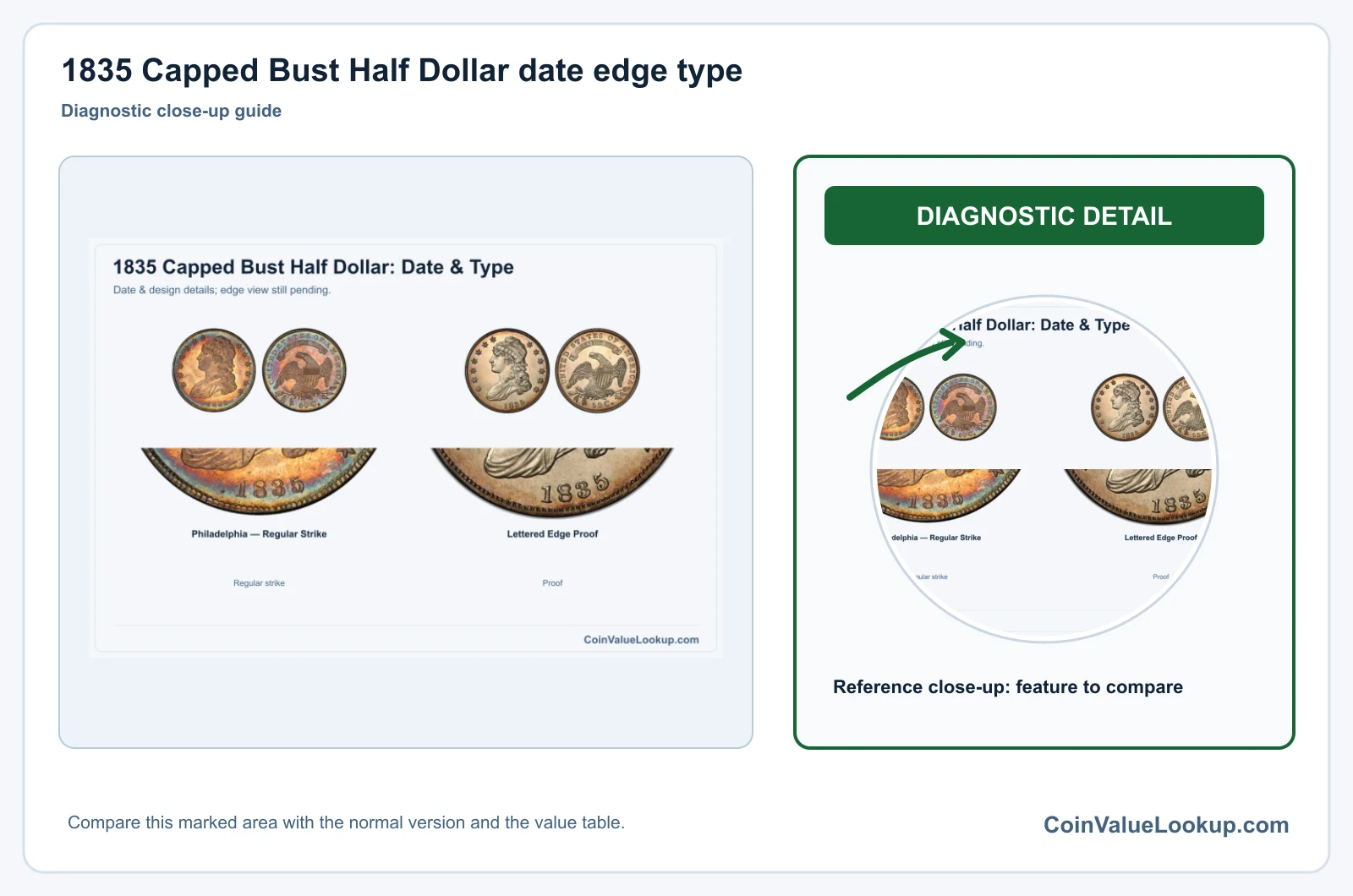
For value purposes, match your coin to the main version first: Philadelphia Regular Strike. Two separate Proof branches also exist for 1835, one with ordinary lettered edge and one with a crushed lettered edge, but Proof status requires professional attribution.
A shiny coin or one with mirror-like fields is not automatically a Proof; polished and prooflike regular strikes are a completely different animal.
Read the full edge inscription carefully. Compare the date digits to known examples, and confirm the denomination before settling on a value branch.
Step 2: Check Your 1835 Capped Bust Half Dollar Grade
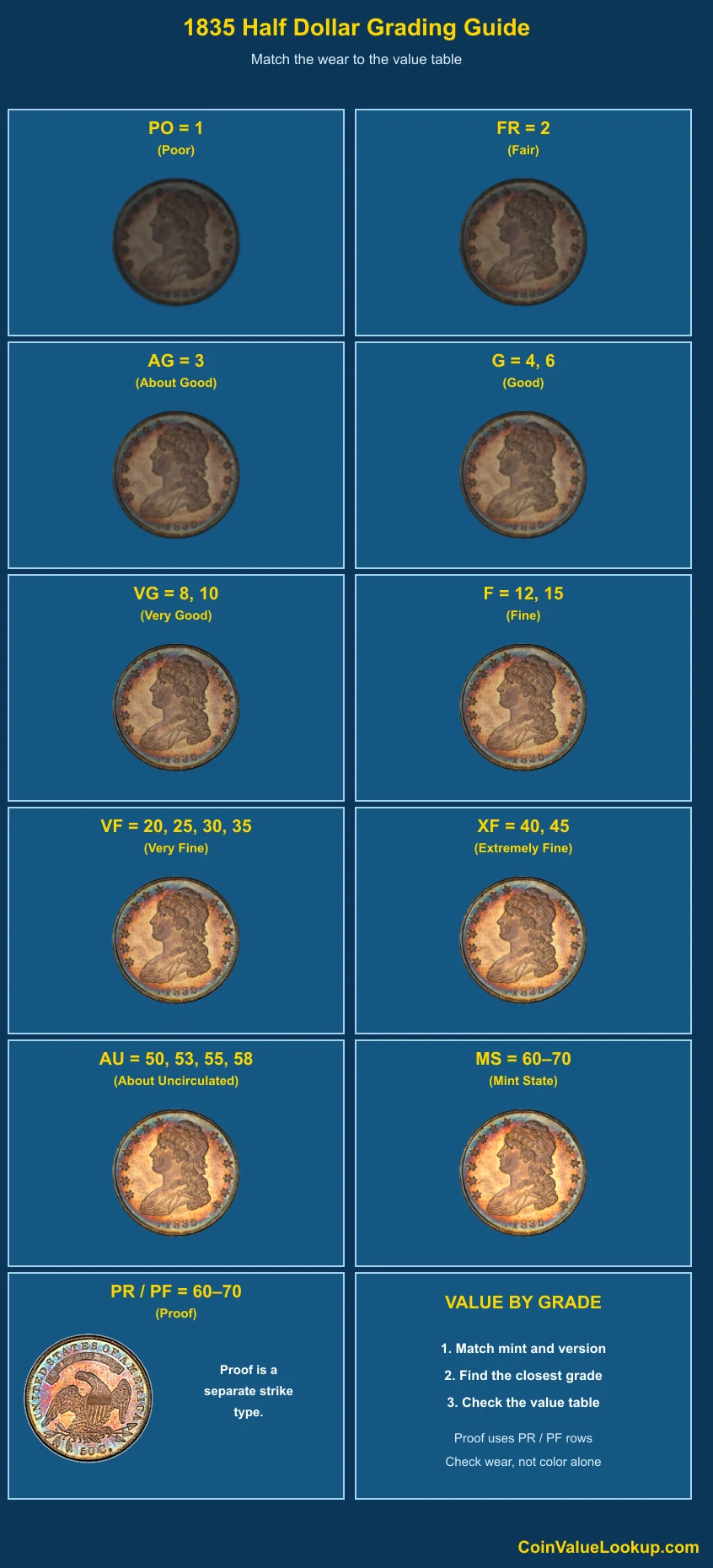
Focus on the high points first. On the obverse, check Liberty's forehead curls, the cheek, and the top of the cap for flattening.
The clasp at her shoulder wears quickly too. Flip the coin over and examine the eagle's breast feathers and the tops of the wings.
A coin at G4 will show a smooth outline of Liberty with almost no interior hair detail, while a VF20 piece retains sharp hair strands along the forehead and partial cap detail. At AU50, you should see only the faintest friction on the highest points with most original luster intact.
Separate genuinely weak original strike detail from actual wear. Some areas on this type came off the dies soft, and that is not the same as a coin that circulated.
Also note any cleaning, scratches, rim damage, or holes, all of which reduce value regardless of remaining detail. Compare your coin to the type-matched grading image to get your bearings.
Proofs are graded on a separate PR scale and judged by surface preservation, not by wear progression. A Proof is a finish, not a grade above Mint State.
Step 3: Check 1835 Capped Bust Half Dollar Value by Mint and Version
1835 Capped Bust Half Dollar — Philadelphia — Regular Strike
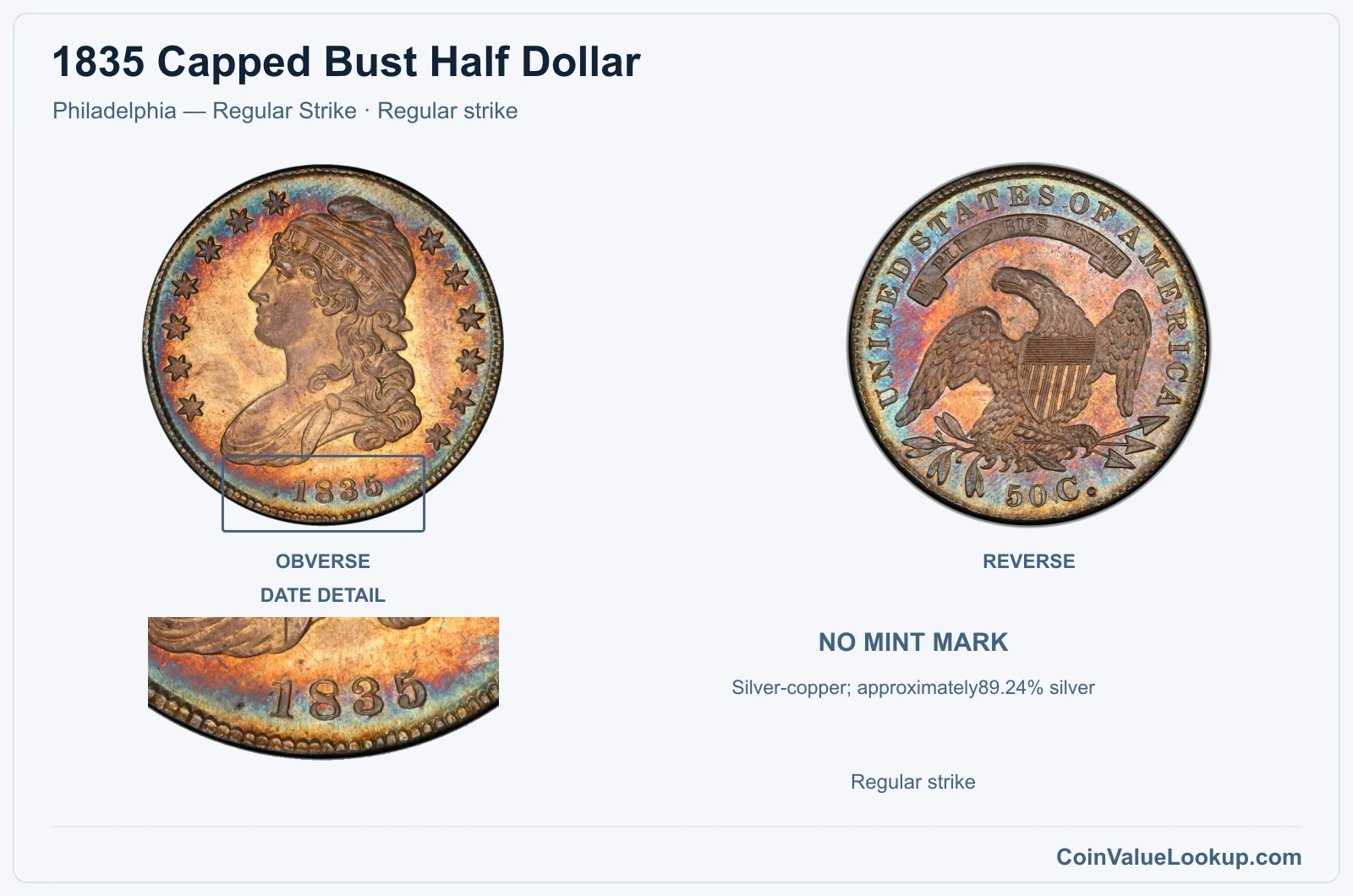
This is the coin most people will have. The Philadelphia Regular Strike 1835 half dollar features the standard lettered edge reading FIFTY CENTS OR HALF A DOLLAR.
It was produced for general circulation in large numbers.
USA Coin Book guide estimates place it at roughly $92 in G4, $152 in VF20, and $487 in AU50. These are retail guide figures, not guaranteed sale prices, and your coin's actual market value depends on its precise condition, eye appeal, and any problems like cleaning or damage.
Even well-worn examples carry meaningful silver weight, so there is always a metal-value floor beneath these guide numbers.
Coin Value Lookup is a handy starting point if you want to look up guides for other dates in this series or compare denominations side by side.
Range Grade
Price Auction Records Appraisal PO PO 1
—
Coin Identifier FR FR 2
Coin Identifier AG AG 3
Coin Identifier G G 4
—
Coin Identifier
G 6
—
Coin Identifier VG VG 8
—
Coin Identifier
VG 10
Coin Identifier F F 12
Coin Identifier
F 15
Coin Identifier VF VF 20
Coin Identifier
VF 25
Coin Identifier
VF 30
Coin Identifier
VF 35
Coin Identifier XF XF 40
Coin Identifier
XF 45
Coin Identifier AU AU 50
Coin Identifier
AU 53
Coin Identifier
AU 55
Coin Identifier
AU 58
Coin Identifier MS MS 60
Coin Identifier
MS 61
Coin Identifier
MS 62
Coin Identifier
MS 63
Coin Identifier
MS 64
Coin Identifier
MS 65
Coin Identifier
MS 66
Coin Identifier
MS 67
Coin Identifier
MS 68
—
—
—
MS 69
—
—
—
MS 70
—
—
—
1835 Capped Bust Half Dollar — Lettered Edge Proof
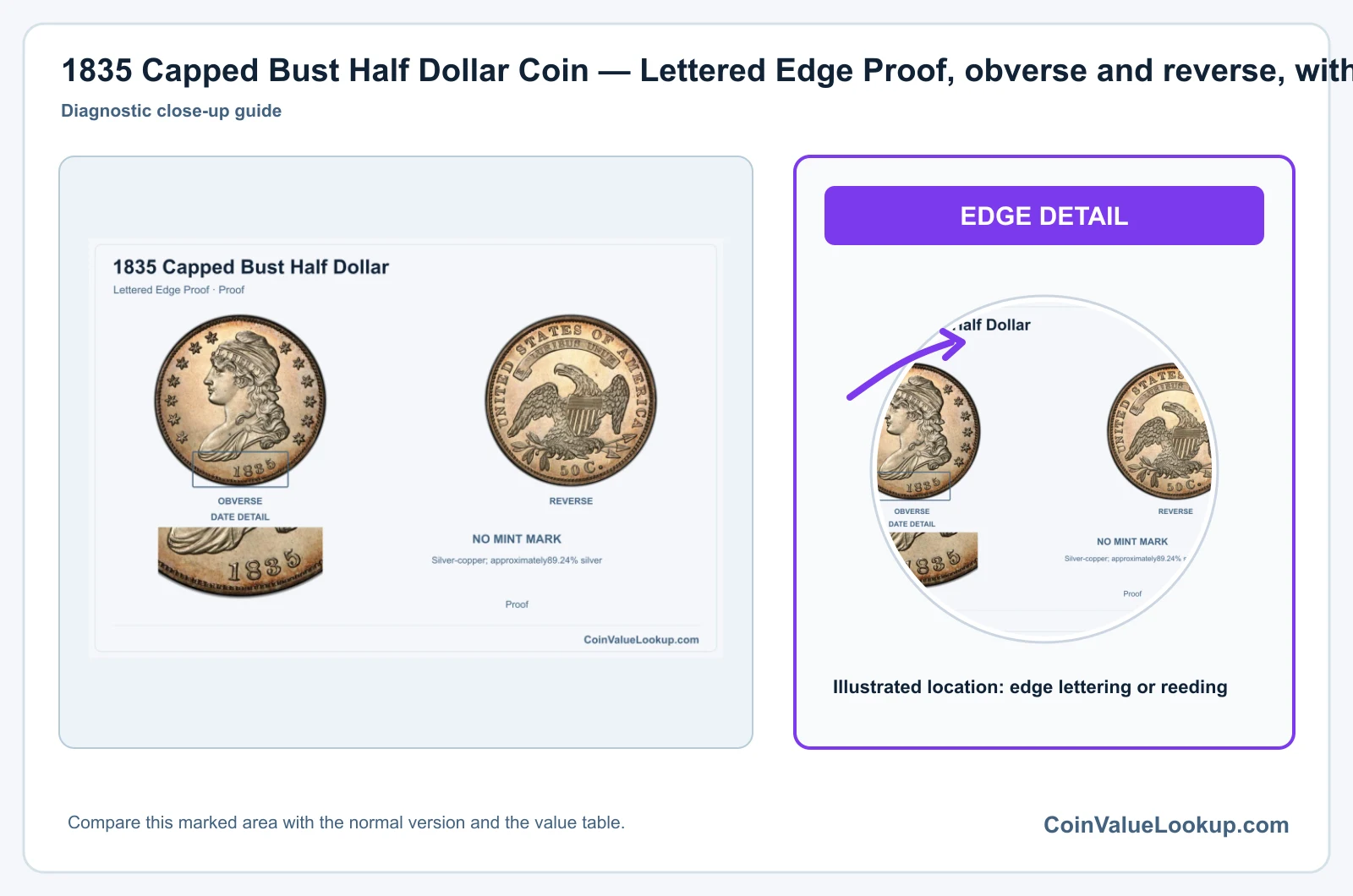
The Lettered Edge Proof 1835 half dollar is a genuine rarity. These were struck with specially prepared dies on polished planchets, producing mirror fields and sharp detail far beyond what circulation strikes exhibit.
Do not confuse a polished or prooflike regular strike with a real Proof; professional attribution from a recognized grading service is essential before assigning this branch.
One historical anchor exists: a PR66 example sold for $121,000 at Bowers & Merena in April 1997. That is a single documented transaction, not a current market range.
Proof survivors from this era are few enough that each one trades on its own merits, surface quality, and provenance. If you suspect you have one, submit it for professional evaluation rather than relying on surface appearance alone.
Range Grade
Price Auction Records Appraisal PR PR 1
—
Coin Identifier
PR 2
—
Coin Identifier
PR 3
—
Coin Identifier
PR 4
—
Coin Identifier
PR 6
—
Coin Identifier
PR 8
—
Coin Identifier
PR 10
—
Coin Identifier
PR 12
—
Coin Identifier
PR 15
—
Coin Identifier
PR 20
—
Coin Identifier
PR 25
—
Coin Identifier
PR 30
—
Coin Identifier
PR 35
—
Coin Identifier
PR 40
—
Coin Identifier
PR 45
—
Coin Identifier
PR 50
—
Coin Identifier
PR 53
—
Coin Identifier
PR 55
—
Coin Identifier
PR 58
—
Coin Identifier
PR 60
—
Coin Identifier
PR 61
—
Coin Identifier
PR 62
—
Coin Identifier
PR 63
—
Coin Identifier
PR 64
Coin Identifier
PR 65
—
—
—
PR 66
—
—
—
PR 67
—
—
—
PR 68
—
—
—
PR 69
—
—
—
PR 70
—
—
—
1835 Capped Bust Half Dollar — Crushed Lettered Edge Proof
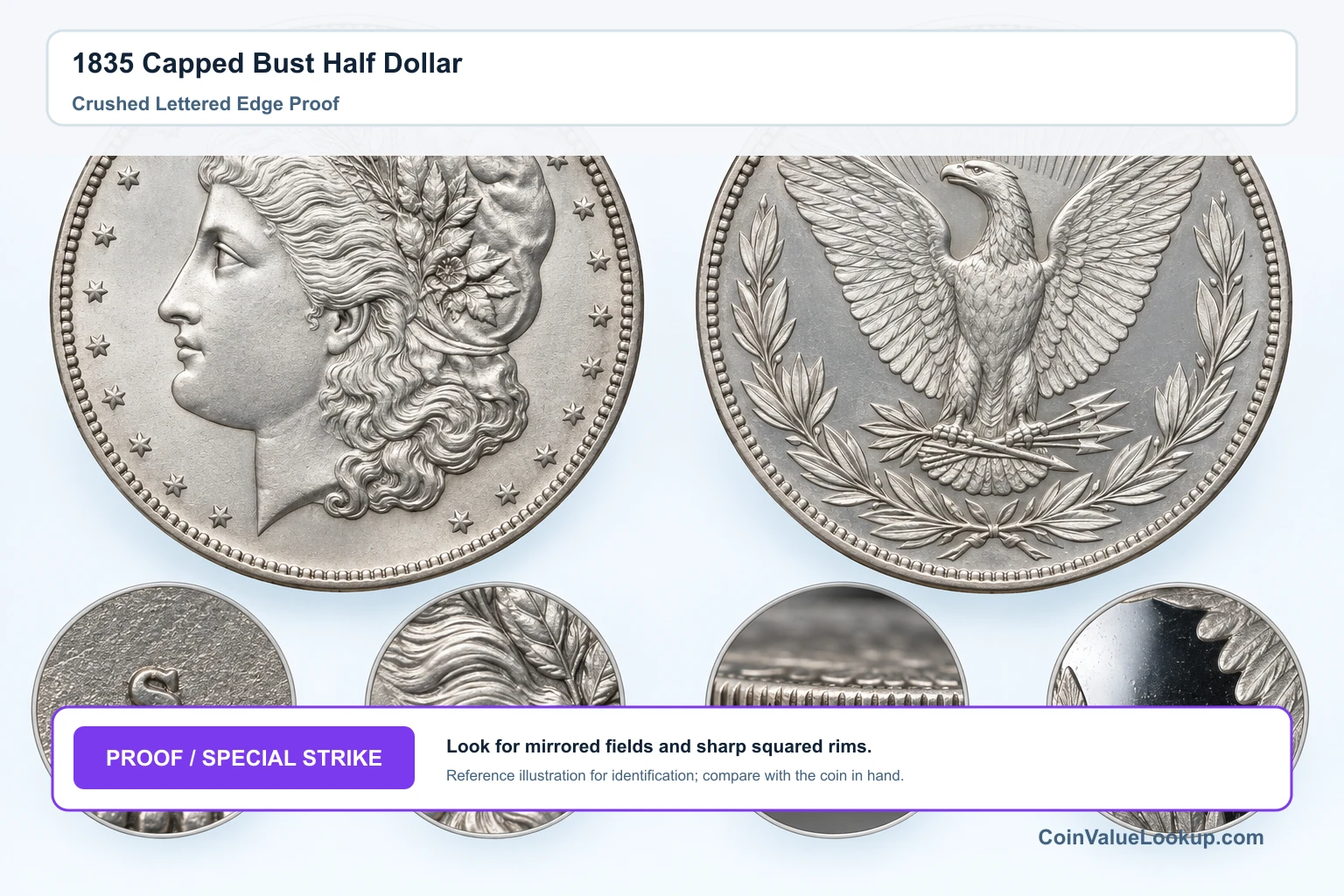
The Crushed Lettered Edge Proof is a separate variety distinguished by visibly flattened edge lettering compared to the standard Lettered Edge Proof. The exact production timing of these pieces is debated among specialists, so treat it as an 1835-dated coin without assuming a precise restrike year.
A PR63 example sold for $56,400 at Heritage in January 2015, providing a historical price point but not a reliable current range. Like the standard Proof, attribution requires professional evaluation.
When examining the edge, compare it directly against a known ordinary lettered-edge coin; the flattening on the crushed version is noticeable but can be confused with heavy wear or damage on a circulated piece if you are not looking carefully.
Range Grade
Price Auction Records Appraisal PR PR 1
—
Coin Identifier
PR 2
—
Coin Identifier
PR 3
—
Coin Identifier
PR 4
—
Coin Identifier
PR 6
—
Coin Identifier
PR 8
—
Coin Identifier
PR 10
—
Coin Identifier
PR 12
—
Coin Identifier
PR 15
—
Coin Identifier
PR 20
—
Coin Identifier
PR 25
—
Coin Identifier
PR 30
—
Coin Identifier
PR 35
—
Coin Identifier
PR 40
—
Coin Identifier
PR 45
—
Coin Identifier
PR 50
—
Coin Identifier
PR 53
—
Coin Identifier
PR 55
—
Coin Identifier
PR 58
—
Coin Identifier
PR 60
—
Coin Identifier
PR 61
—
Coin Identifier
PR 62
—
Coin Identifier
PR 63
Coin Identifier
PR 64
Coin Identifier
PR 65
—
—
—
PR 66
—
—
—
PR 67
—
—
—
PR 68
—
—
—
PR 69
—
—
—
PR 70
—
—
—
1835 Capped Bust Half Dollar Error List
1. 1835 Capped Bust Half Dollar — Die Crack / Die Chip
Die cracks show up as thin raised lines on the coin's surface, caused by fractures in the steel die during striking. On 1835 half dollars, one documented example places a fine raised crack running from around star 5 to star 10 on the obverse, with another crack appearing at the base of the date numerals.
Both features should appear as raised, thread-like lines that follow a path across the design.
Do not confuse these with incuse scratches, corrosion trails, or foreign material sitting on the surface. A genuine die crack is raised above the field because metal flowed into the fracture during striking.
Scratches, by contrast, are cut into the surface. Look under magnification and tilt the coin under a light source to confirm direction and relief.
No specific price range is established here. The value added by a die crack depends on its size, visibility, and the coin's overall condition.
2. 1835 Capped Bust Half Dollar — Incomplete / Blundered Edge Lettering
An incomplete or blundered edge lettering error has been reported for the 1835 half dollar. One documented example reads FIFTY CENTS OR LF DOLLAR, with the letters HA missing entirely from HALF.
This is a manufacturing error from the edge-lettering process, not post-mint damage.
When checking your coin's edge, read the entire inscription slowly and compare it against the expected FIFTY CENTS OR HALF A DOLLAR. Keep in mind that the edge lettering on Capped Bust halves normally reads upside-down relative to one face of the coin; that orientation is standard, not an error.
Look-alikes include heavy wear that has obliterated portions of the edge text, post-mint damage, and environmental corrosion. Compare your coin against an attributed same-year example under equal lighting.
No specific price range is adopted for this error, as value depends on the severity of the blunder, overall coin condition, and collector demand for the particular variety.