1802 Draped Bust Half Dollar Coin Value: How Much Is It Worth?
The 1802 Draped Bust Half Dollar is a scarce early federal issue that commands serious money even in well-worn condition. A USA Coin Book guide estimate places the ordinary Philadelphia strike at roughly $1,897 in G4 and around $21,072 in AU50.
Collector value far exceeds both face value and silver melt, and condition or authenticity questions can shift the number substantially.
Fast Way to Identify Your 1802 Draped Bust Half Dollar
Upload clear photos of both the front and back of your coin, and our identifier can offer a preliminary take on what you have. This step helps confirm the denomination, date and general type before you dig into grading or variety details.
It is not a substitute for professional authentication or exact grading, but it gives you a useful starting point.
1802 Draped Bust Half Dollar Value
Upload both sides of your 1802 Draped Bust Half Dollar.
Front Obverse
Upload photo
Back Reverse
Upload photo
Which 1802 Draped Bust Half Dollar Versions Are Worth Money?
- Philadelphia Heraldic Eagle — the sole ordinary die pairing for 1802, with guide values from roughly $1,897 at G4 to around $21,072 at AU50, making even low-grade survivors valuable.
- Die crack varieties exist for this date and can carry added collector interest, though premiums depend on the specific crack and the coin's overall condition.
Step 1: Identify Your 1802 Draped Bust Half Dollar Mint Mark and Version
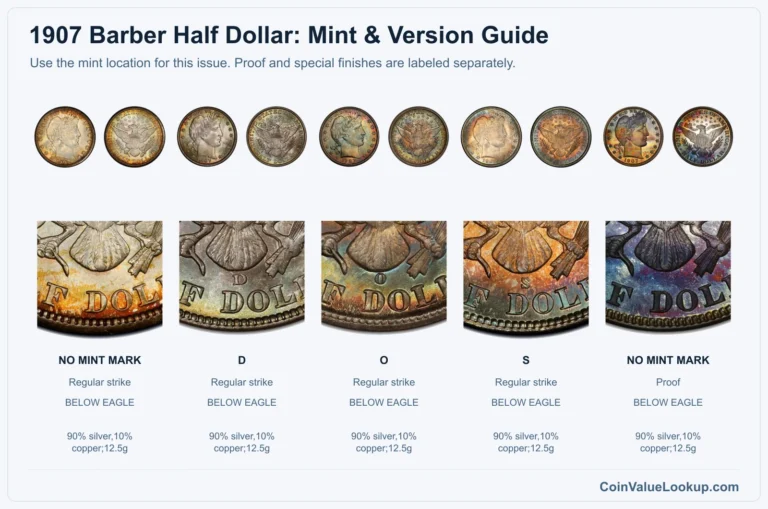
Only the Philadelphia Mint struck half dollars in 1802, so the absence of a mintmark is completely normal. Do not expect a D, S or O mark anywhere on the coin.
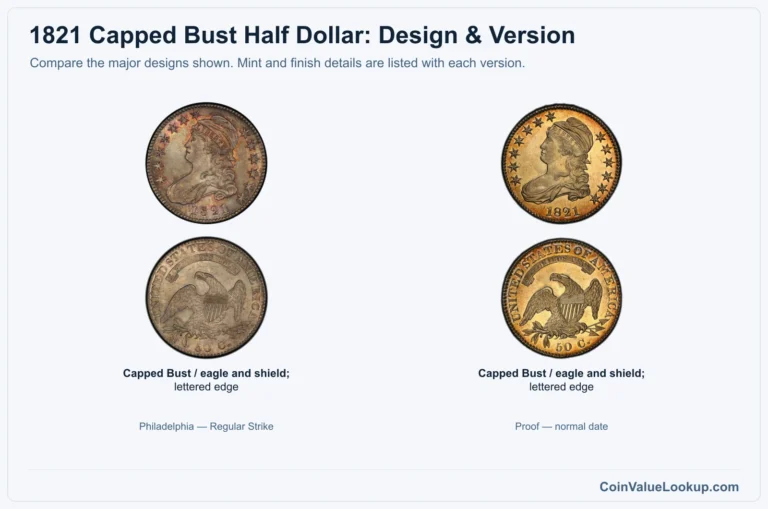
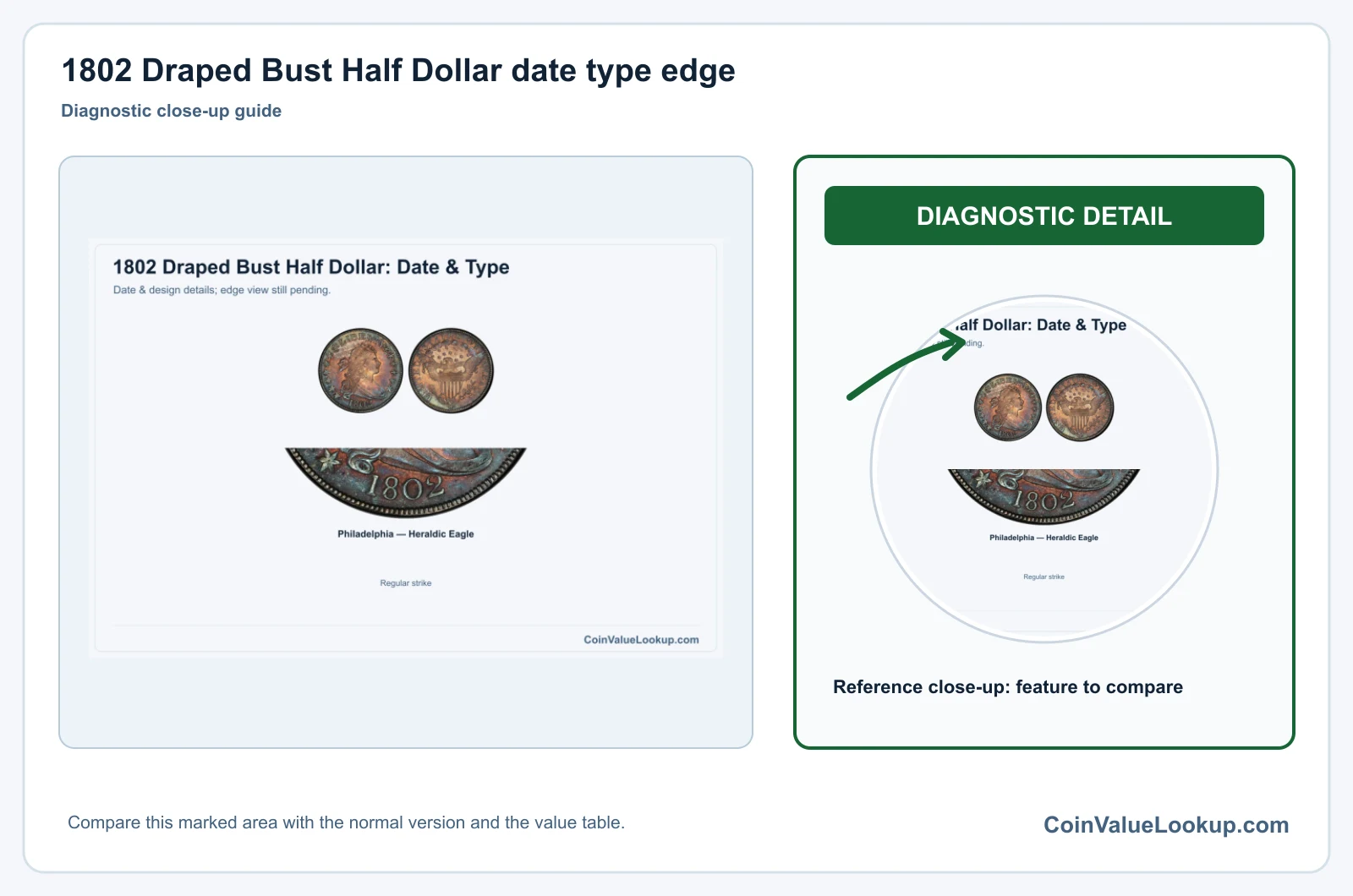
Confirm you actually have a half dollar by checking the lettered edge, which reads FIFTY CENTS OR HALF A DOLLAR. The obverse shows a draped bust of Liberty facing right with the date below, while the reverse features a heraldic eagle with a shield on its breast.
Getting the denomination right matters because the famous 1802 half dime is a different coin entirely, and confusing the two leads people astray.
The expected specifications are roughly 32.5 mm in diameter and about 13.48 grams. Weight is a handy screening clue for fakes or wrong denominations, but it does not authenticate by itself.
Only one ordinary die pairing is known for this year, so the major identity to confirm is simply: Philadelphia, Heraldic Eagle reverse.
Coin Value Lookup is a good place to start if you are looking up values for other early U.S. coins in your collection. The site offers straightforward guides organized by year and denomination.
Step 2: Check Your 1802 Draped Bust Half Dollar Grade
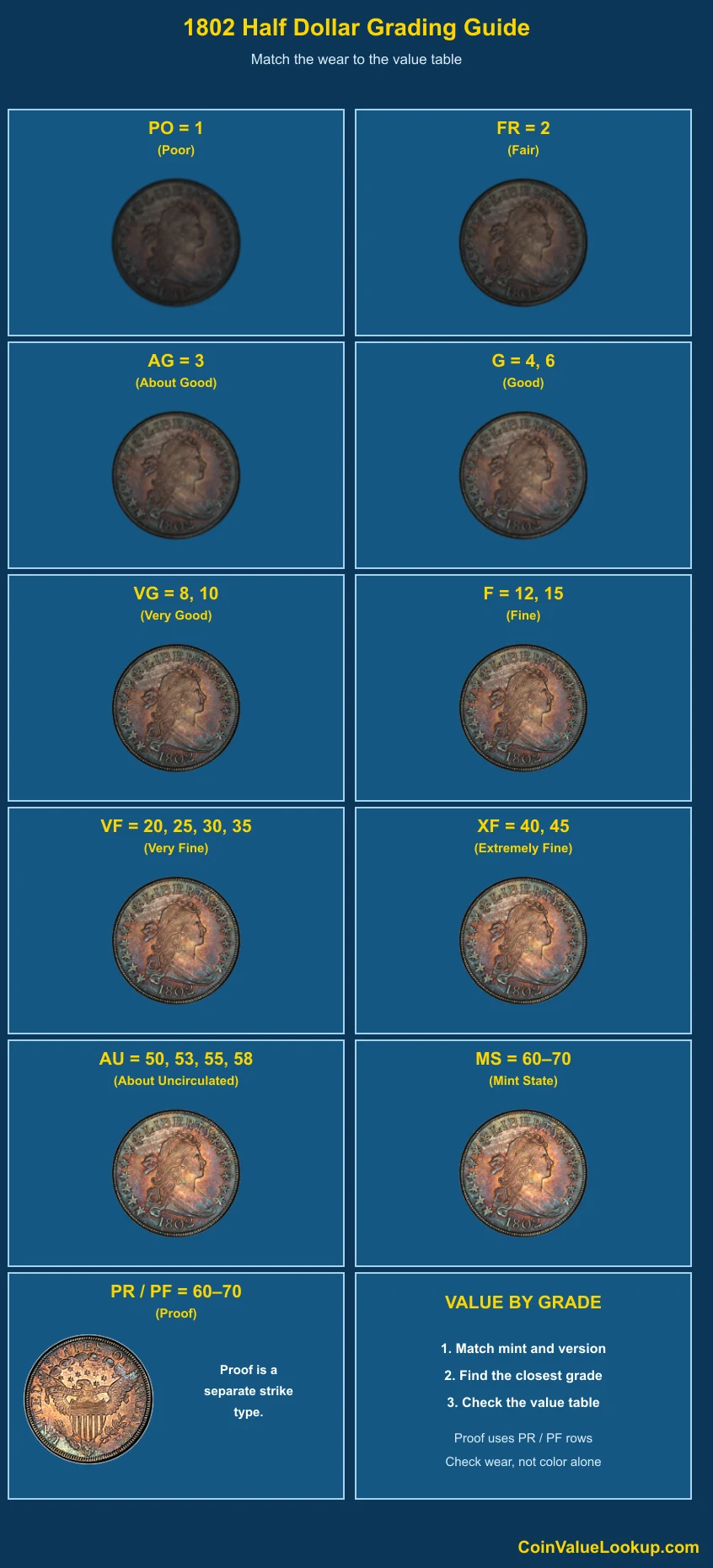
Start with Liberty's hair above the forehead and behind the ear. On a lightly circulated coin, the highest hair strands will show flattening first, then the cheek begins to lose its roundness.
The drapery across Liberty's shoulder is another key wear spot; a sharp example shows fine fabric lines there.
Flip the coin over and look at the eagle's breast feathers and wing tips. Some softness in these areas is normal even on uncirculated pieces due to strike weakness, so do not automatically downgrade a coin because the eagle looks mushy.
The trick is distinguishing original luster loss from an incomplete strike, and examining the fields under good light helps.
Any cleaning, holes, plugs, tooling or heavy scratches push a coin into Details territory. A Details-graded coin does not follow the same price curve as a straight-graded example, and the discount can be steep.
Compare your coin against images of the same Draped Bust type rather than modern designs.
Step 3: Check 1802 Draped Bust Half Dollar Value by Mint and Version
1802 Draped Bust Half Dollar — Philadelphia — Heraldic Eagle
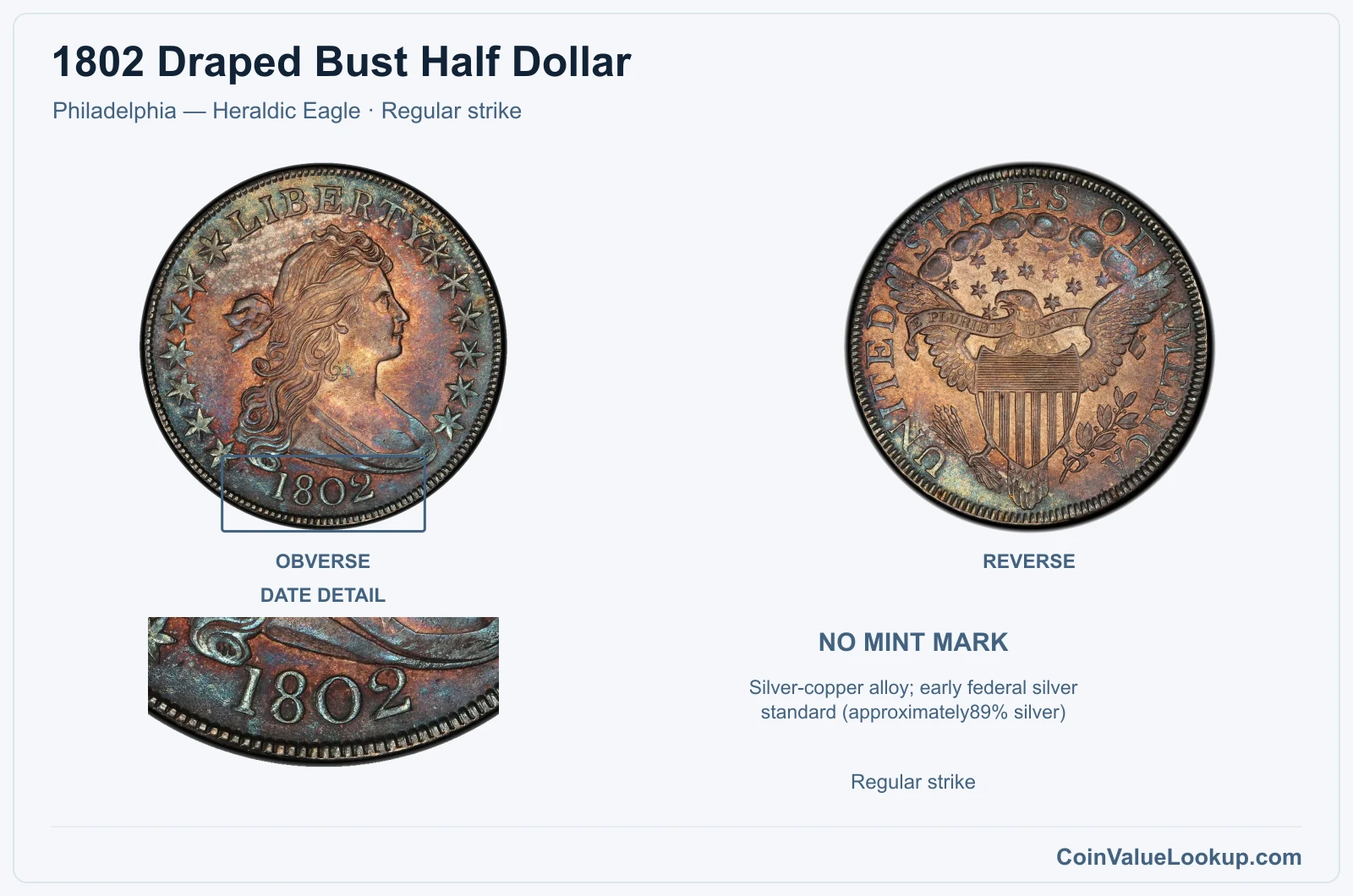
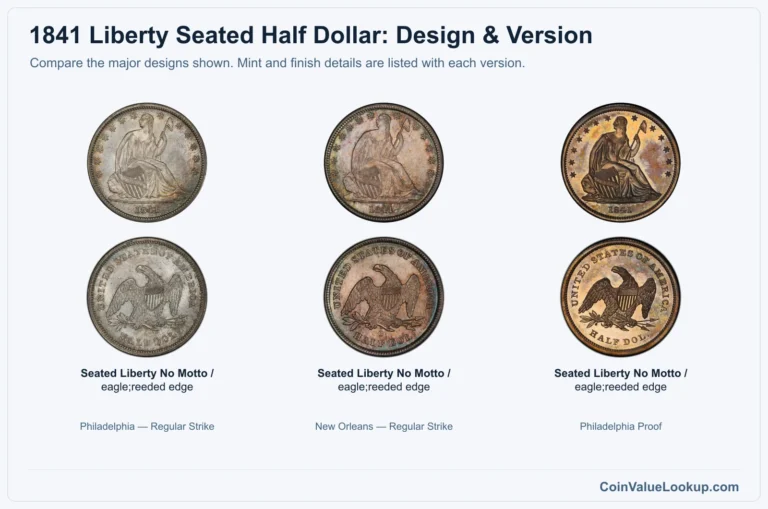
This is the only known regular die pairing for the 1802 half dollar. It was struck at Philadelphia in a silver-copper alloy at the early federal standard of approximately 89% silver, with the Draped Bust obverse and Heraldic Eagle reverse.
USA Coin Book guide estimates place the value at about $1,897 in G4, roughly $3,519 in VF20 and around $21,072 in AU50. The jump from mid-grade to near-uncirculated is dramatic, which tells you that surviving examples with minimal wear are genuinely scarce.
Exact surfaces and confirmed authenticity matter a great deal at every level, since early half dollars attract both dedicated collectors and counterfeiters.
Range Grade
Price Auction Records Appraisal PO PO 1
—
Coin Identifier FR FR 2
Coin Identifier AG AG 3
Coin Identifier G G 4
Coin Identifier
G 6
Coin Identifier VG VG 8
Coin Identifier
VG 10
Coin Identifier F F 12
Coin Identifier
F 15
Coin Identifier VF VF 20
Coin Identifier
VF 25
Coin Identifier
VF 30
Coin Identifier
VF 35
Coin Identifier XF XF 40
Coin Identifier
XF 45
Coin Identifier AU AU 50
Coin Identifier
AU 53
Coin Identifier
AU 55
Coin Identifier
AU 58
Coin Identifier MS MS 60
Coin Identifier
MS 61
—
Coin Identifier
MS 62
Coin Identifier
MS 63
—
—
—
MS 64
—
—
—
MS 65
—
—
—
MS 66
—
—
—
MS 67
—
—
—
MS 68
—
—
—
MS 69
—
—
—
MS 70
—
—
—
1802 Draped Bust Half Dollar Error List
1. 1802 Draped Bust Half Dollar — Die Crack / Die Chip
A die crack on the 1802 half dollar has been reported running from between the letters E and D in UNITED down toward the ribbon on the reverse. On the coin itself this appears as a thin raised line with continuity across the design, because metal flowed into the crack in the die during striking.
Do not confuse it with incuse scratches, surface corrosion or foreign material sitting on the coin. A genuine die crack is raised above the surrounding field and follows a path that makes sense relative to the die's stress points.
Scratches, by contrast, are recessed into the surface.
No specific price premium has been established here because the value depends on the crack's visibility, the coin's overall grade and its surfaces. A bold, well-documented crack on a problem-free coin will always attract more interest than a faint one on a damaged piece.
Professional authentication is the safest route for confirming any error on an early federal coin.