1949 Franklin Half Dollar Coin Value: How Much Is It Worth?
The 1949 Franklin Half Dollar is a 90% silver coin that still turns up in collections and old hoards with surprising regularity. Guide estimates for the three business-strike branches range from about $32.00 in well-worn Good-4 condition up to $394.00 at the gem Mint State 65 level, depending on which mint produced your coin.
These are reference anchors from published guides, not guaranteed selling prices or current silver-melt quotes. Mint, condition, and original surfaces all play a role in what a specific piece is actually worth.
Fast Way to Identify Your 1949 Franklin Half Dollar
Want a quick read on your 1949 Franklin half? Upload clear photos of the front and back, and our identifier can give you a preliminary identification of the mint, version, and approximate condition.
Good lighting and a straight-on angle help a lot. This is not a substitute for professional authentication or certified grading, but it is a solid first step.
1949 Franklin Half Dollar Value
Upload both sides of your 1949 Franklin Half Dollar.
Front Obverse
Upload photo
Back Reverse
Upload photo
Which 1949 Franklin Half Dollar Versions Are Worth Money?
- The 1949-D (Denver) branch carries the highest guide estimate at MS65, listed at $394.00, making it the one to check first in gem condition.
- The 1949-S (San Francisco) reaches $235.00 at MS65, a meaningful step above the Philadelphia issue at the same grade.
- The 1949 Philadelphia issue is the most common starting point, with guide values from $32.00 in G4 to $180.00 in MS65.
- Full Bell Lines examples from any mint can command a premium above standard prices, but the designation requires intact lower bell-line detail confirmed to the relevant grading standard.
- A Bugs Bunny die clash variety has been reported for the 1949 date — condition and visibility of the clash marks affect desirability.
Step 1: Identify Your 1949 Franklin Half Dollar Mint Mark and Version
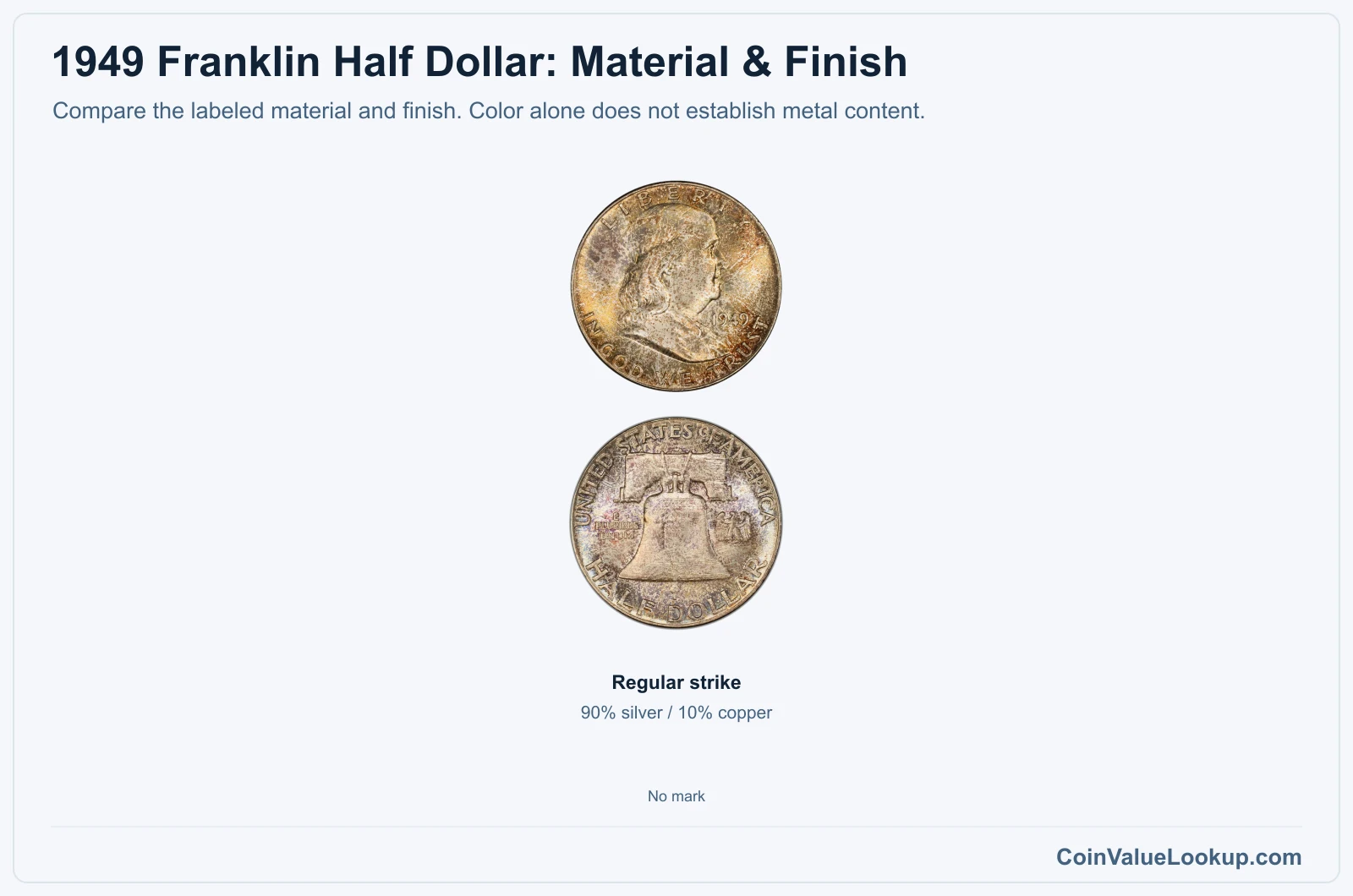
Every 1949 Franklin Half Dollar is struck in 90% silver and 10% copper, with a nominal weight of 12.50 grams. Toning or tarnish does not change the underlying alloy.
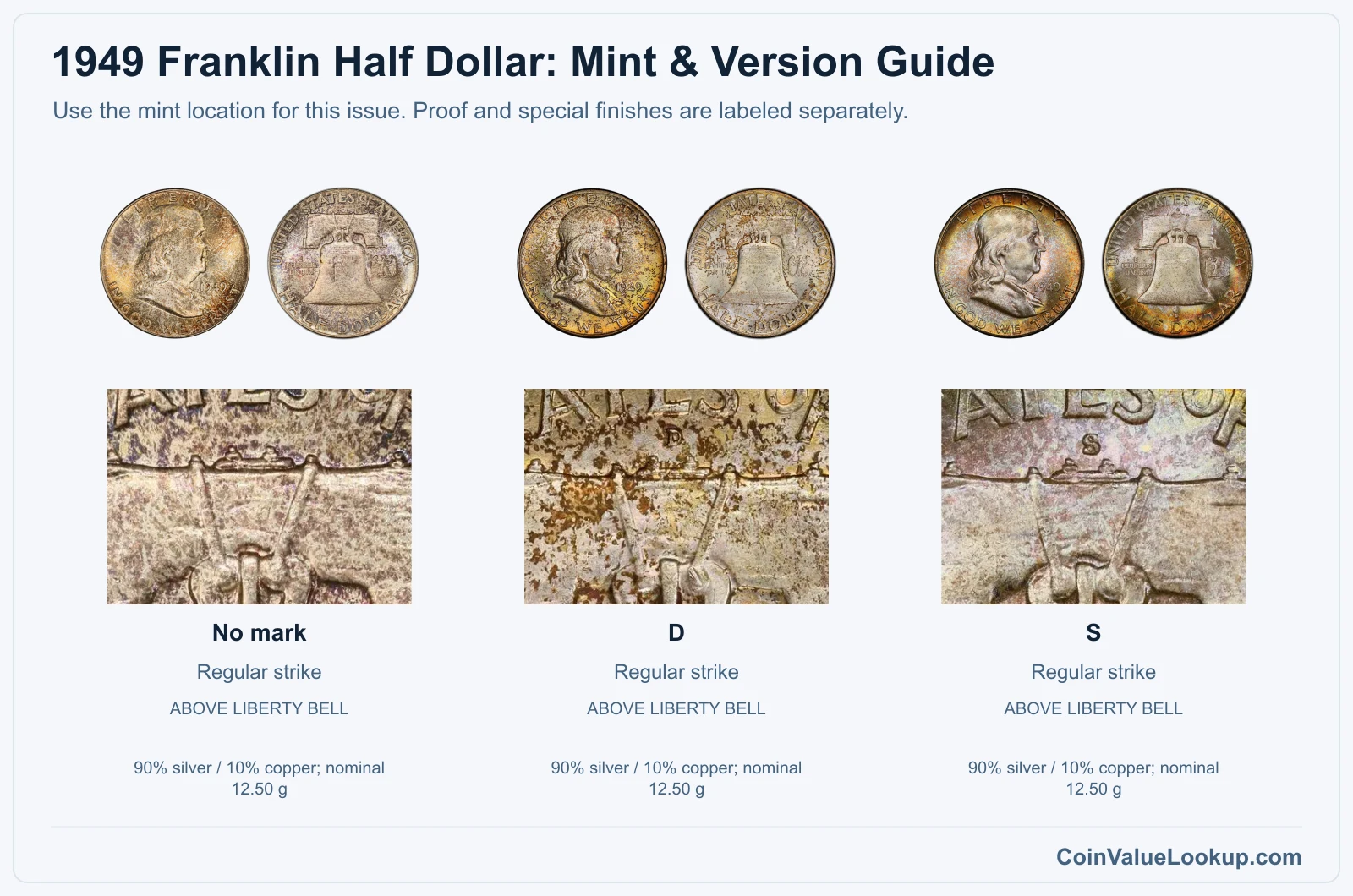
The mintmark sits on the reverse, just above the Liberty Bell and below E PLURIBUS UNUM. No mintmark means Philadelphia.
A small "D" means Denver. A small "S" means San Francisco.
That is it for 1949 — three mints, three branches, all business strikes.
Grab a magnifier and check that spot carefully. A worn or weakly struck mintmark can look absent at first glance, which would lead you to mis-identify a Denver or San Francisco coin as a Philadelphia issue.
The difference matters for value, especially at higher grades.
Step 2: Check Your 1949 Franklin Half Dollar Grade
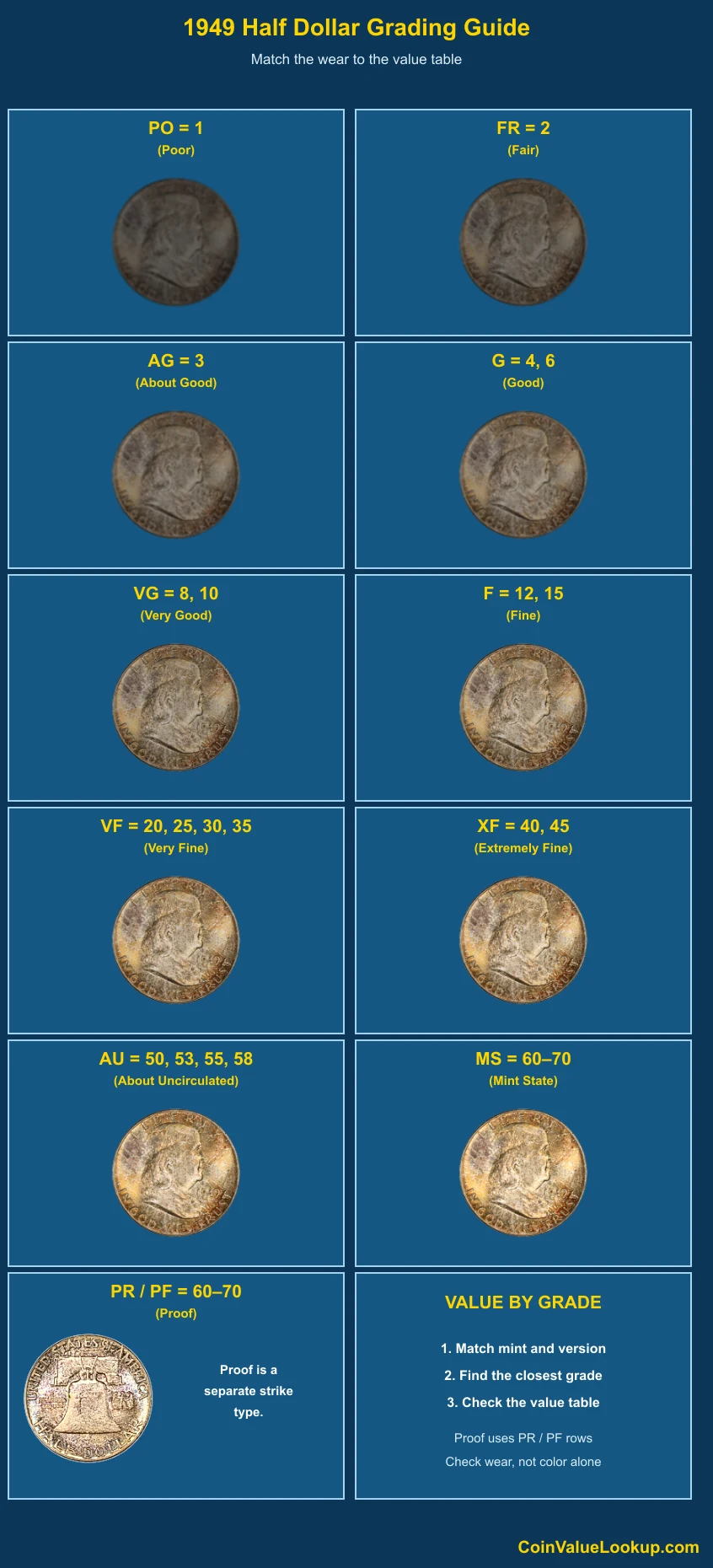
Start with Franklin's cheek and the hair behind his ear. On a lightly circulated piece, these areas show the first smoothing.
A heavily worn coin will have a flat cheek merging into the jawline, with little hair detail visible.
Flip to the reverse. Check the lettering around the Liberty Bell, the rim sharpness, and especially the horizontal lines at the bottom of the bell.
Those lower bell lines are the basis for the Full Bell Lines designation, which is a strike-detail distinction — not a separate grade.
Contact marks are different from wear. Bagmarks are random dings from other coins during storage; circulation wear is progressive smoothing on the high points.
Compare your coin to the reference image to see the difference at each grade level.
Cleaned or damaged coins trade well below problem-free examples at the same apparent grade. Original surfaces with natural luster or honest toning are what collectors want.
Step 3: Check 1949 Franklin Half Dollar Value by Mint and Version
1949 Franklin Half Dollar
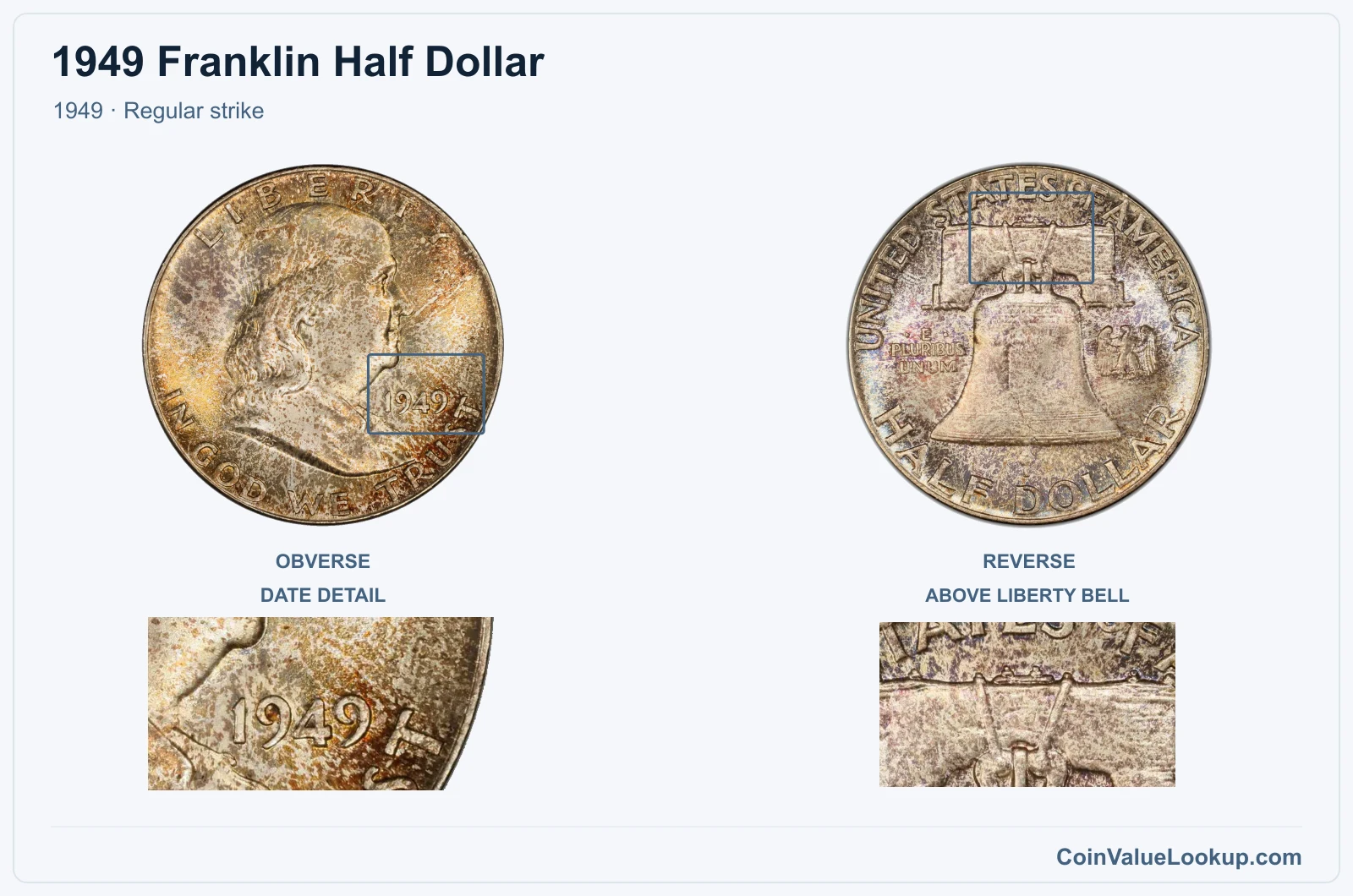
The 1949 Philadelphia half has no mintmark on the reverse. In well-worn G4 condition, guide estimates sit around $32.00, climbing to roughly $180.00 at the MS65 gem level.
Those are USA Coin Book guide anchors, not guaranteed sale prices.
Before assuming your coin is a Philly issue, confirm the mintmark area is genuinely blank and not just obscured by grime or a weak strike. Silver content alone gives the coin a floor value, but cleaned or damaged pieces trade for less than problem-free examples at the same grade.
Full Bell Lines is a strike-quality designation, not a different version — it means the lower bell lines are fully separated and sharp.
Range Grade
Price Auction Records Appraisal PO PO 1
—
Coin Identifier FR FR 2
—
Coin Identifier AG AG 3
—
Coin Identifier G G 4
—
Coin Identifier
G 6
—
Coin Identifier VG VG 8
—
Coin Identifier
VG 10
—
Coin Identifier F F 12
—
Coin Identifier
F 15
—
Coin Identifier VF VF 20
—
Coin Identifier
VF 25
—
Coin Identifier
VF 30
—
Coin Identifier
VF 35
—
Coin Identifier XF XF 40
—
Coin Identifier
XF 45
—
Coin Identifier AU AU 50
—
Coin Identifier
AU 53
—
Coin Identifier
AU 55
Coin Identifier
AU 58
Coin Identifier MS MS 60
—
Coin Identifier
MS 61
—
Coin Identifier
MS 62
—
Coin Identifier
MS 63
Coin Identifier
MS 64
Coin Identifier
MS 65
Coin Identifier
MS 66
Coin Identifier
MS 67
—
—
—
MS 68
—
—
—
MS 69
—
—
—
MS 70
—
—
—
1949 Franklin Half Dollar — D
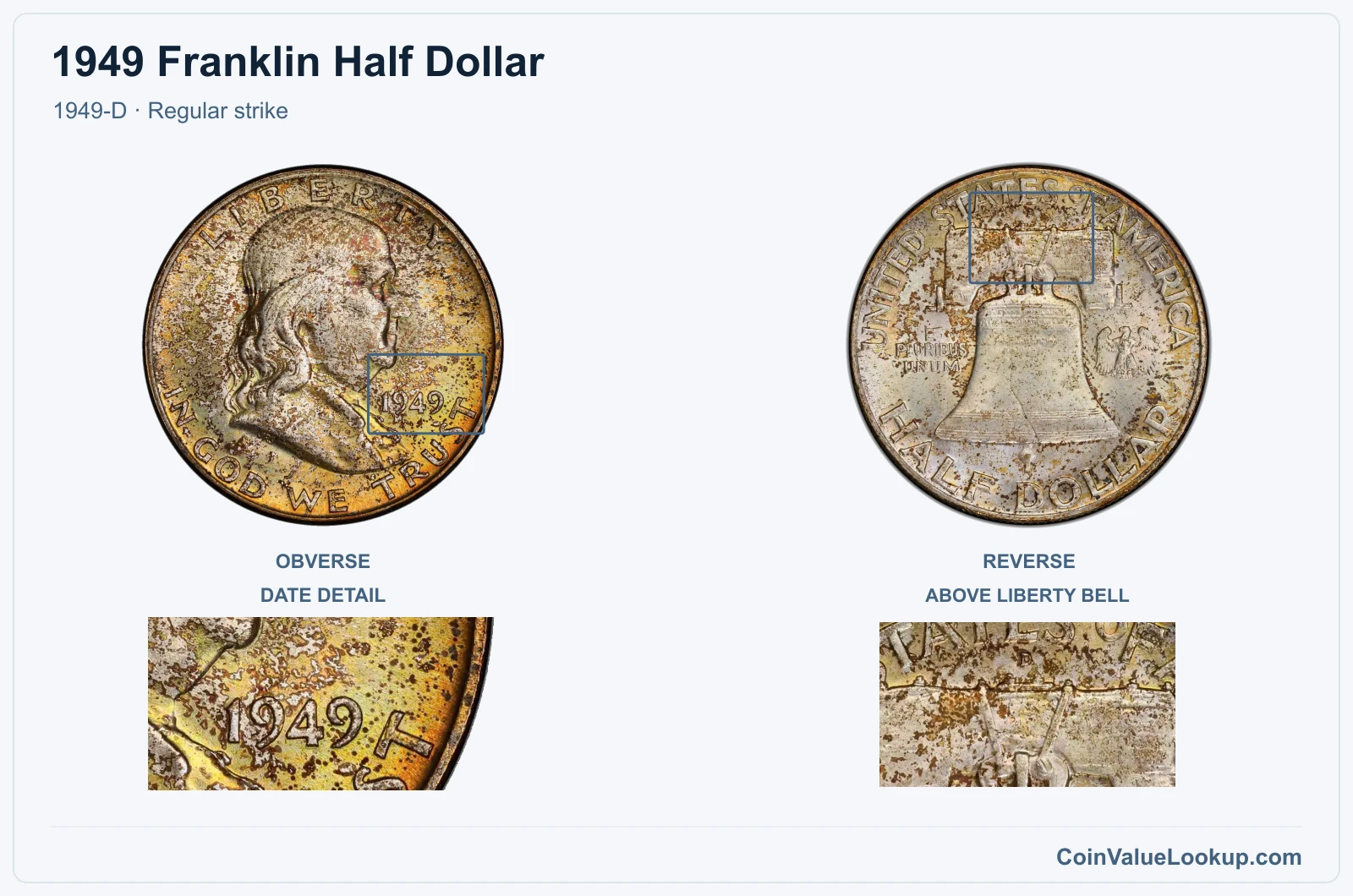
Look for a small "D" on the reverse above the Liberty Bell. The 1949-D carries guide estimates of about $32.00 in G4 and $394.00 at MS65, the highest gem-level figure among the three 1949 mints.
That spread tells you condition is doing a lot of heavy lifting here.
Denver strikes from this year can show softer detail on the bell lines, so finding a true Full Bell Lines example is tougher than it sounds. Original, lustrous surfaces without cleaning or heavy bagmarks are key to the upper price tiers.
As always, these USA Coin Book figures are guide anchors for orientation, not a standing offer.
Coin Value Lookup is a good starting point if you want to look up guides for other dates in the Franklin series or compare across denominations.
Range Grade
Price Auction Records Appraisal PO PO 1
—
Coin Identifier FR FR 2
—
Coin Identifier AG AG 3
—
Coin Identifier G G 4
—
Coin Identifier
G 6
—
Coin Identifier VG VG 8
—
Coin Identifier
VG 10
—
Coin Identifier F F 12
—
Coin Identifier
F 15
—
Coin Identifier VF VF 20
—
Coin Identifier
VF 25
—
Coin Identifier
VF 30
—
Coin Identifier
VF 35
—
Coin Identifier XF XF 40
—
Coin Identifier
XF 45
—
Coin Identifier AU AU 50
—
Coin Identifier
AU 53
—
Coin Identifier
AU 55
Coin Identifier
AU 58
Coin Identifier MS MS 60
—
Coin Identifier
MS 61
Coin Identifier
MS 62
Coin Identifier
MS 63
Coin Identifier
MS 64
Coin Identifier
MS 65
Coin Identifier
MS 66
Coin Identifier
MS 67
—
—
—
MS 68
—
—
—
MS 69
—
—
—
MS 70
—
—
—
1949 Franklin Half Dollar — S
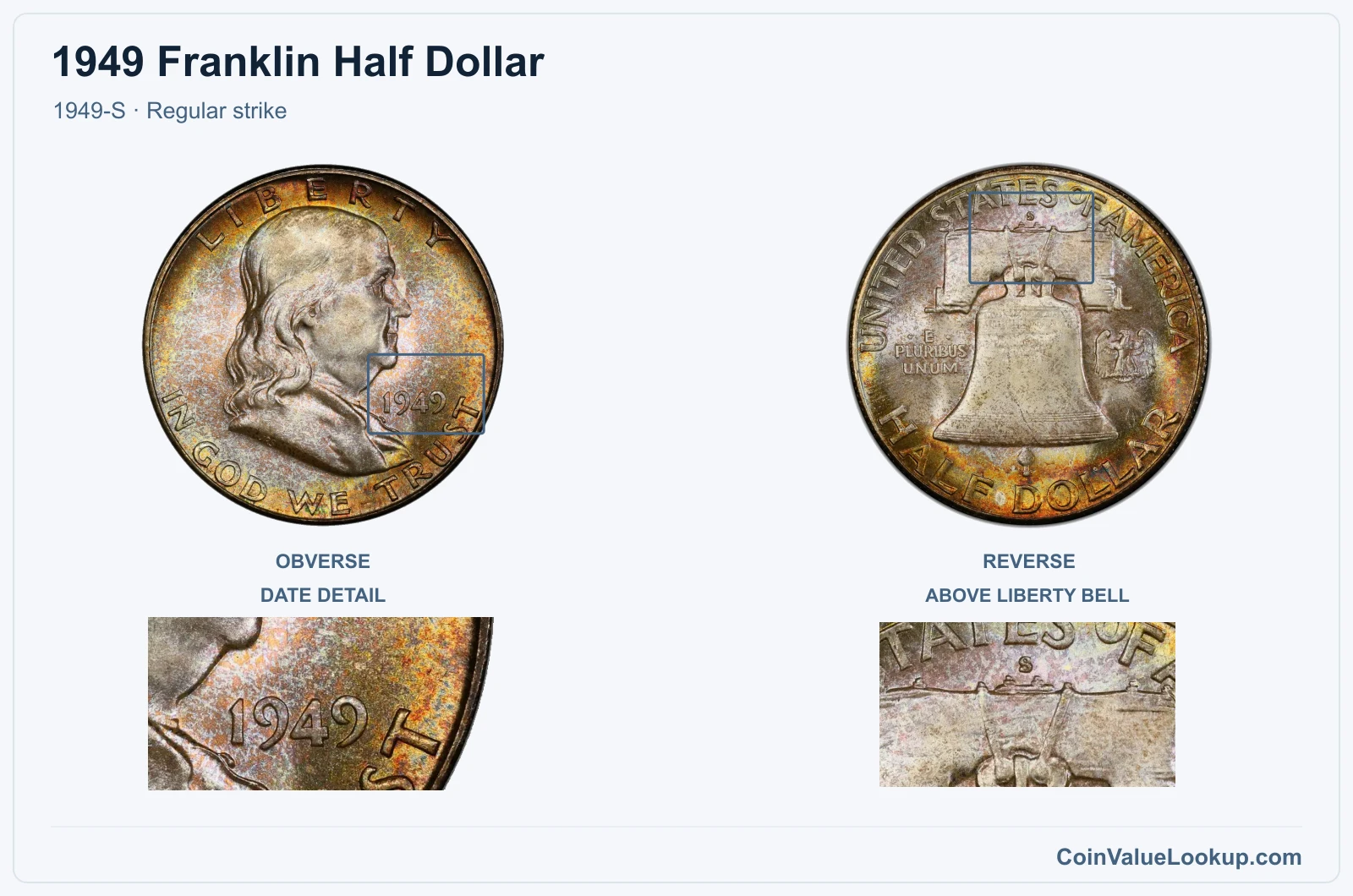
The 1949-S has a small "S" mintmark above the Liberty Bell on the reverse. Guide estimates run from $32.00 in G4 up to $235.00 at the MS65 level, placing it between the Philadelphia and Denver issues at the top end.
San Francisco coins from this era sometimes show strong strikes, but don't assume yours qualifies for Full Bell Lines without a close look — that designation requires the lower horizontal lines on the bell to be completely intact and uninterrupted. Cleaned or damaged examples are not equivalent to original-surface coins even if the remaining detail looks similar.
Match your coin's actual wear to the correct grade before referencing any price chart.
Range Grade
Price Auction Records Appraisal PO PO 1
—
Coin Identifier FR FR 2
—
Coin Identifier AG AG 3
—
Coin Identifier G G 4
—
Coin Identifier
G 6
—
Coin Identifier VG VG 8
—
Coin Identifier
VG 10
—
Coin Identifier F F 12
—
Coin Identifier
F 15
—
Coin Identifier VF VF 20
—
Coin Identifier
VF 25
—
Coin Identifier
VF 30
—
Coin Identifier
VF 35
—
Coin Identifier XF XF 40
—
Coin Identifier
XF 45
—
Coin Identifier AU AU 50
Coin Identifier
AU 53
Coin Identifier
AU 55
Coin Identifier
AU 58
Coin Identifier MS MS 60
—
Coin Identifier
MS 61
Coin Identifier
MS 62
Coin Identifier
MS 63
Coin Identifier
MS 64
Coin Identifier
MS 65
Coin Identifier
MS 66
Coin Identifier
MS 67
Coin Identifier
MS 68
Coin Identifier
MS 69
—
—
—
MS 70
—
—
—
1949 Franklin Half Dollar Error List
1. 1949 Franklin Half Dollar — Bugs Bunny Die Clash
The so-called Bugs Bunny variety is a die clash error reported on the 1949 Franklin Half Dollar. It gets its nickname because the clash leaves raised, tooth-like lines near Franklin's mouth and lip area, giving him a vague buck-toothed look.
To check, magnify the area around Franklin's lips and compare it to a normal 1949 portrait. On a genuine clash, you will see raised lines that follow a pattern consistent with the reverse die having contacted the obverse die without a planchet in between.
The marks are not random.
Don't confuse this with scratches, stray raised metal from a damaged die, or random contact marks. Those lack the symmetrical, repeating pattern of a true die clash.
No specific price range is adopted for this variety, but value depends on the visibility of the clash marks and the coin's overall condition. A barely visible clash on a worn coin will not generate the same interest as a bold example on a higher-grade piece.