1855 Liberty Seated Half Dollar Coin Value: How Much Is It Worth?
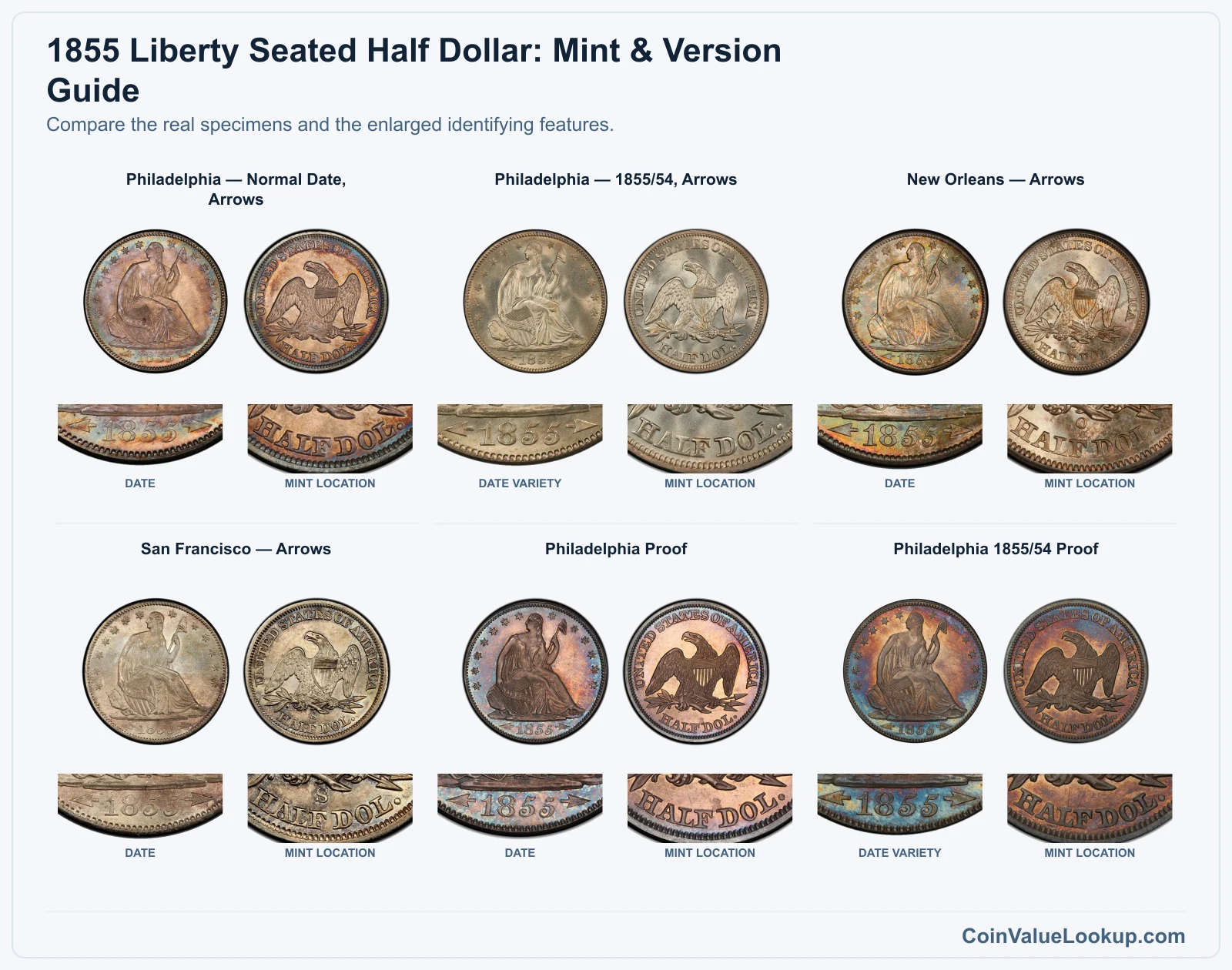
The 1855 Liberty Seated Half Dollar carries real collector value even in well-worn condition. Philadelphia normal-date examples range from roughly $79 at G4 to $516 near AU50 in guide estimates, but other mints, the overdate variety, and Proof issues can command far more.
Grade, mint mark, and specific version are the main drivers, so identifying what you have is the essential first step.
Fast Way to Identify Your 1855 Liberty Seated Half Dollar
Upload clear photos of both the front and back of your coin for a preliminary identification. The images help narrow down the mint, variety, and approximate condition.
Edge shots are useful too, especially if the coin has unusual surface features. This is not a substitute for professional authentication, but it gives you a solid starting point.
1855 Liberty Seated Half Dollar Value
Upload both sides of your 1855 Liberty Seated Half Dollar.
Front Obverse
Upload photo
Back Reverse
Upload photo
Which 1855 Liberty Seated Half Dollar Versions Are Worth Money?
- The San Francisco mint issue (S mint mark) is scarce across all grades, with guide values starting around $630 at G4 and climbing steeply in higher conditions.
- The 1855/54 overdate from Philadelphia carries a premium over the normal date, roughly $110 at G4 up to around $1,463 near AU50.
- Philadelphia Proof coins are extremely rare; one PR66 example sold for $51,750 at Heritage in 2008.
- The 1855/54 Proof overdate is a separate and even scarcer branch; a PR65+ brought $96,000 at Heritage in 2024.
- The New Orleans issue (O mint mark) is the most common branch but still worth checking for die cracks and condition.
Step 1: Identify Your 1855 Liberty Seated Half Dollar Mint Mark and Version
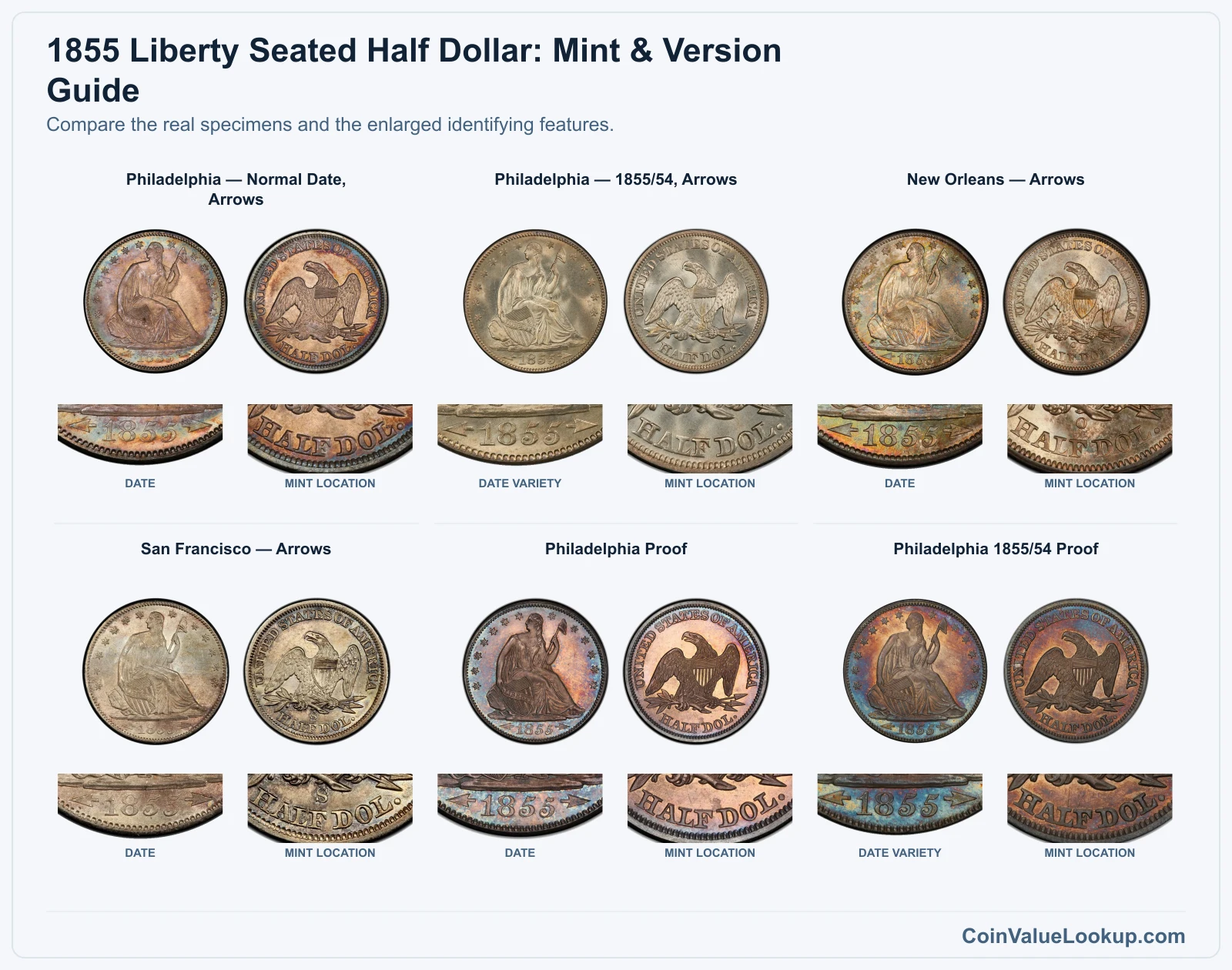
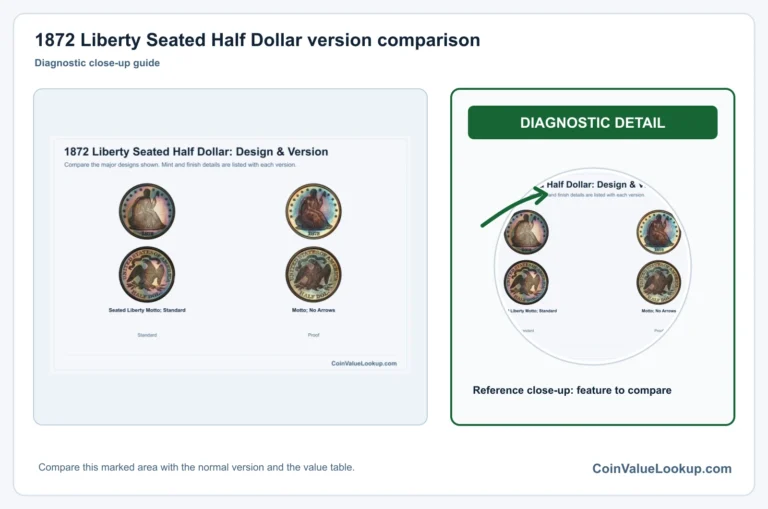
The 1855 half dollar shows a Seated Liberty on the obverse with arrowheads flanking the date, and a reverse eagle above HALF DOL with no motto. It is struck in 90% silver and 10% copper at a reduced weight of about 12.44 grams, the standard adopted in 1853.
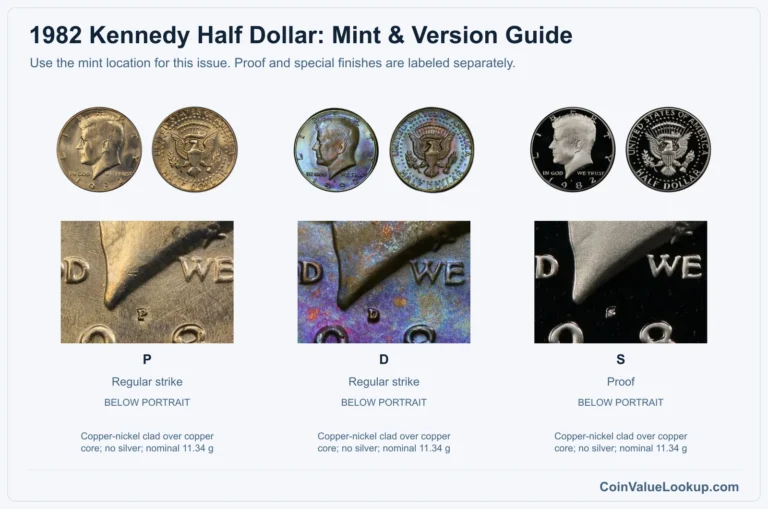
The mint mark sits on the reverse, below the eagle. No mint mark means Philadelphia.
An "O" means New Orleans. An "S" means San Francisco.
Flip the coin and look there first.
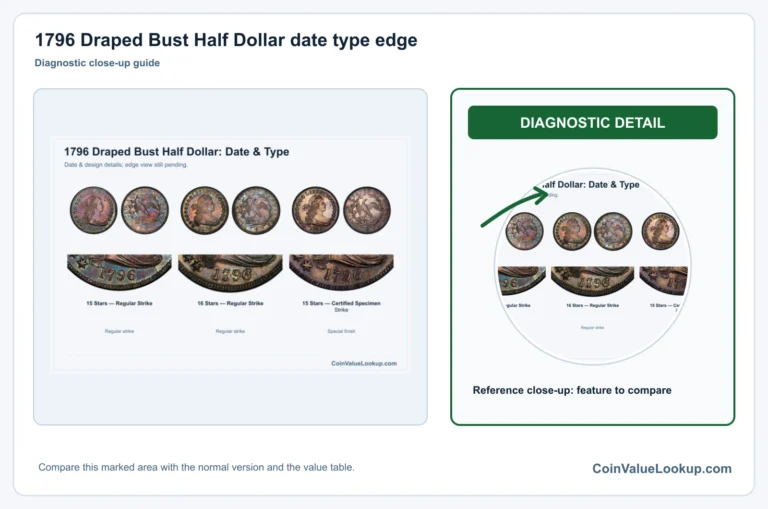
Philadelphia coins split into two date varieties. The normal date is straightforward.
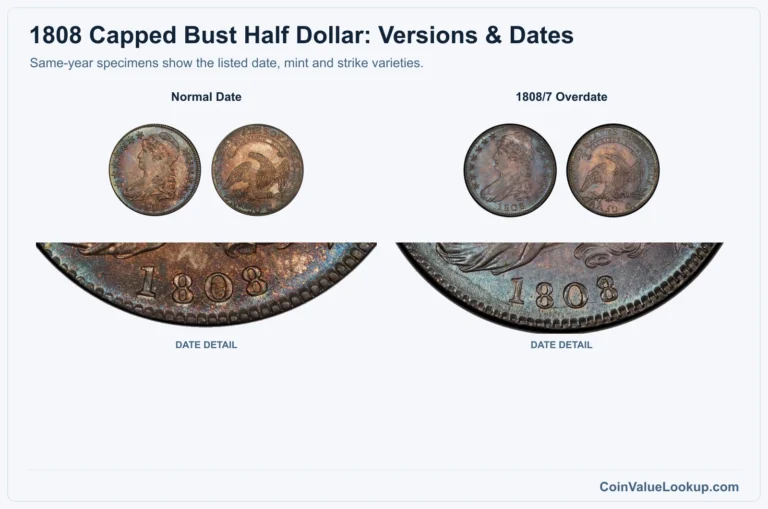
The 1855/54 overdate shows traces of an earlier 4 beneath the final 5, including a faint crossbar remnant. You will need magnification to confirm this, so do not assume you have the overdate based on a casual glance.
Proof coins were also struck at Philadelphia. They have deeply mirrored fields and sharp rims, but a cleaned or lightly circulated business strike can sometimes fool people.
Mirror-like surfaces alone are not proof of a Proof.
Step 2: Check Your 1855 Liberty Seated Half Dollar Grade
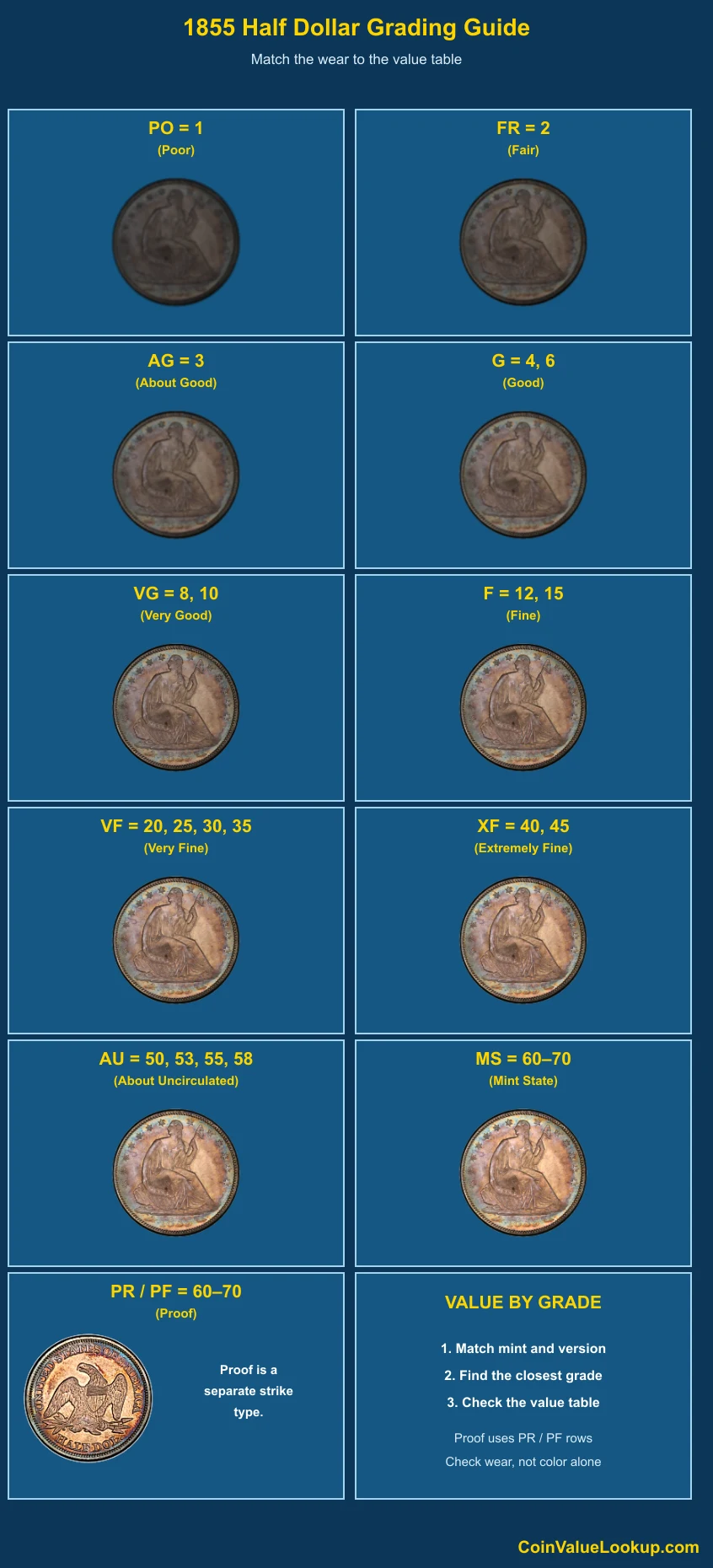
Focus on four obverse checkpoints: Liberty's head, her breast area, the knee, and the shield on her lap. On the reverse, examine the eagle's breast feathers, wing tips, and claws.
As these high points flatten and lose detail, the grade drops.
One thing that trips people up with Seated halves is weak strikes versus actual wear. A weakly struck coin can have mushy centers straight from the mint.
The difference is luster: a weak strike still shows original mint luster in protected areas, while a worn coin loses that sheen and develops smooth, flat spots.
Compare your coin side by side with the grading image provided. Photograph both faces and the edge under even lighting.
And please, do not clean the coin. A naturally toned surface, even if dark, is far preferable to a scrubbed one.
Step 3: Check 1855 Liberty Seated Half Dollar Value by Mint and Version
1855 Liberty Seated Half Dollar — Philadelphia — Normal Date, Arrows
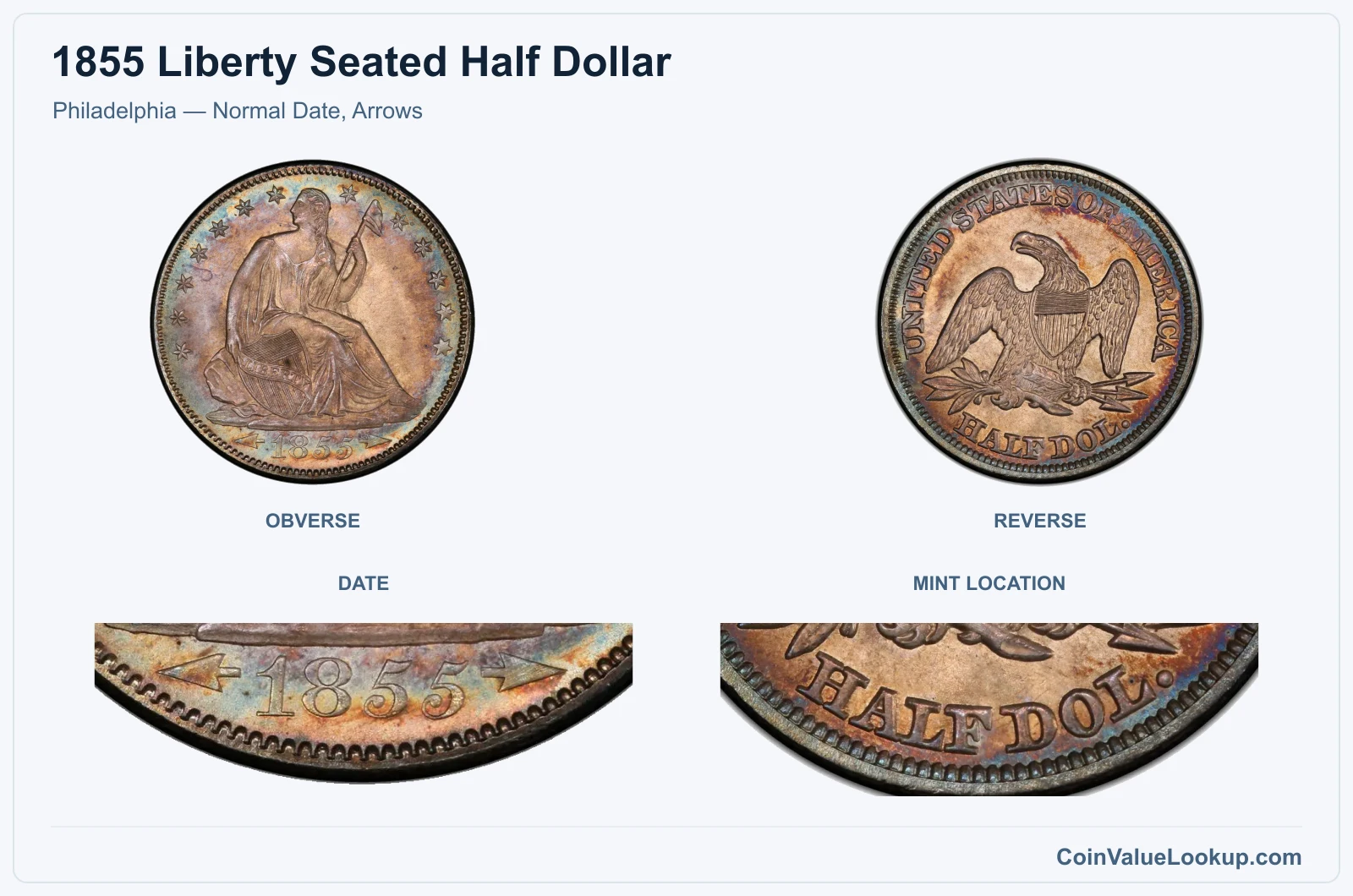
This is the baseline 1855 half dollar. No mint mark on the reverse, arrows at the date, no rays on the reverse.
Philadelphia struck plenty of these, and they are the most available version of the year.
Guide estimates place a well-worn G4 example around $79, a mid-grade VF20 near $236, and an AU50 close to $516. These are indicative anchors from USA Coin Book, not guaranteed sale prices.
Real transactions depend on eye appeal, strike quality, and whether anyone has taken a wire brush to the thing.
Ordinary-issue reference: Ordinary-issue reference only: The table below shows prices for the 1855 Liberty Seated Half Dollar (regular strike). It does not represent the value of the specific Philadelphia — Normal Date, Arrows variety or its variety premium. Year, mint, metal and strike type are matched; the specific variety is not priced by this table.
Range Grade
Price Auction Records Appraisal PO PO 1
—
Coin Identifier FR FR 2
—
Coin Identifier AG AG 3
—
Coin Identifier G G 4
Coin Identifier
G 6
—
Coin Identifier VG VG 8
—
Coin Identifier
VG 10
Coin Identifier F F 12
—
Coin Identifier
F 15
Coin Identifier VF VF 20
—
Coin Identifier
VF 25
Coin Identifier
VF 30
Coin Identifier
VF 35
Coin Identifier XF XF 40
Coin Identifier
XF 45
Coin Identifier AU AU 50
Coin Identifier
AU 53
Coin Identifier
AU 55
Coin Identifier
AU 58
Coin Identifier MS MS 60
—
Coin Identifier
MS 61
Coin Identifier
MS 62
Coin Identifier
MS 63
Coin Identifier
MS 64
Coin Identifier
MS 65
Coin Identifier
MS 66
Coin Identifier
MS 67
—
—
—
MS 68
—
—
—
MS 69
—
—
—
MS 70
—
—
—
1855 Liberty Seated Half Dollar — Philadelphia — 1855/54, Arrows
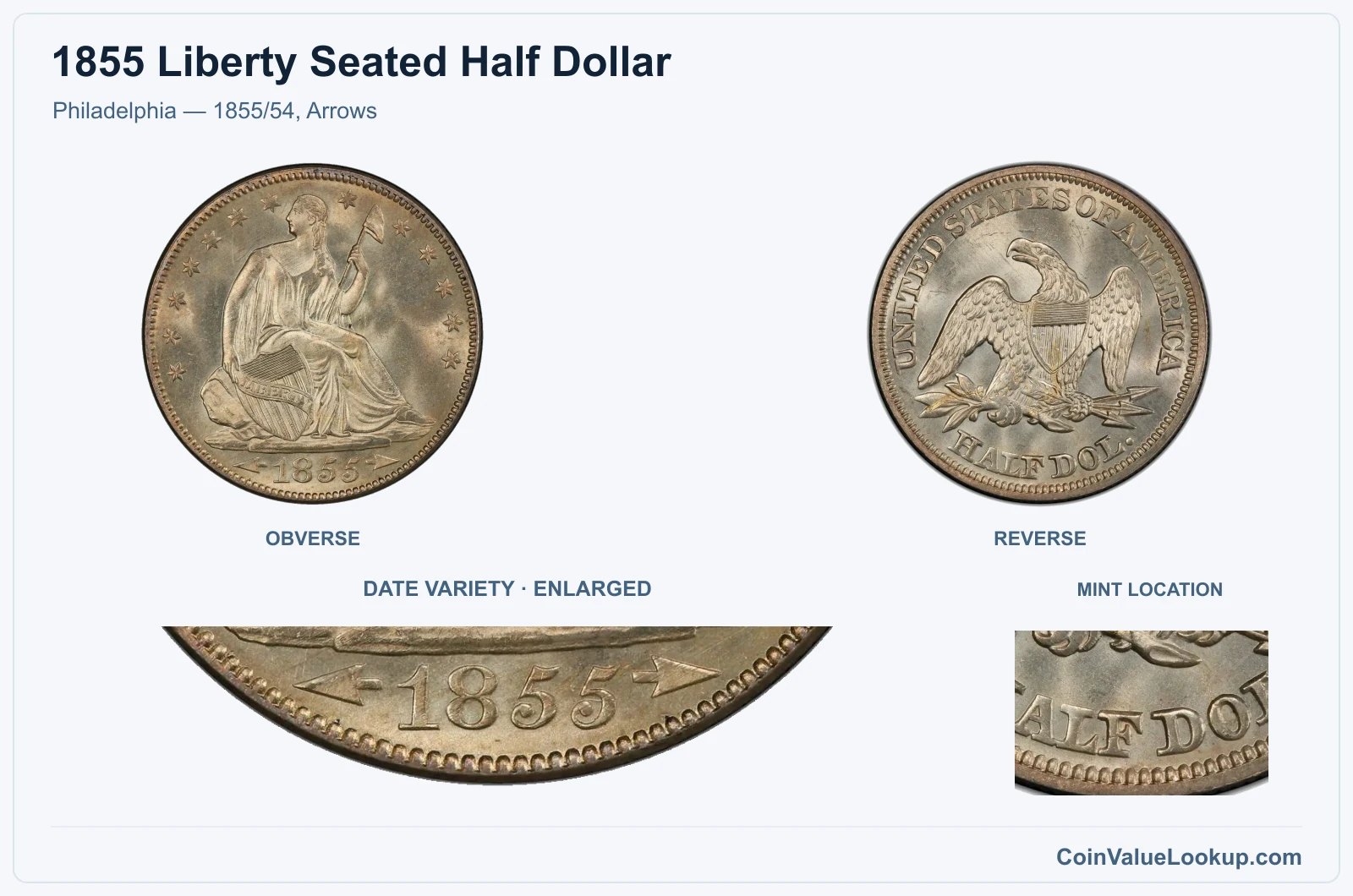
The 1855/54 overdate is one of the more collectible Seated Liberty varieties. Under magnification, you can spot traces of the earlier digits beneath the 5, particularly a crossbar-like remnant inside the final digit and faint outlines of the prior 85 alignment.
This is not something you can reliably confirm with the naked eye.
Guide values reflect the premium: about $110 at G4, $468 at VF20, and $1,463 at AU50 per USA Coin Book. That is a meaningful jump over the normal date, especially in higher grades.
If you suspect an overdate, get it under a loupe before getting excited.
Coin Value Lookup is a good place to look up guides for other Seated Liberty dates and denominations if you are working through a collection.
Range Grade
Price Auction Records Appraisal PO PO 1
—
Coin Identifier FR FR 2
—
Coin Identifier AG AG 3
—
Coin Identifier G G 4
—
Coin Identifier
G 6
—
Coin Identifier VG VG 8
—
Coin Identifier
VG 10
Coin Identifier F F 12
Coin Identifier
F 15
Coin Identifier VF VF 20
—
Coin Identifier
VF 25
Coin Identifier
VF 30
Coin Identifier
VF 35
Coin Identifier XF XF 40
Coin Identifier
XF 45
Coin Identifier AU AU 50
Coin Identifier
AU 53
Coin Identifier
AU 55
Coin Identifier
AU 58
Coin Identifier MS MS 60
—
Coin Identifier
MS 61
Coin Identifier
MS 62
Coin Identifier
MS 63
Coin Identifier
MS 64
Coin Identifier
MS 65
Coin Identifier
MS 66
Coin Identifier
MS 67
—
—
—
MS 68
—
—
—
MS 69
—
—
—
MS 70
—
—
—
1855 Liberty Seated Half Dollar — New Orleans — Arrows
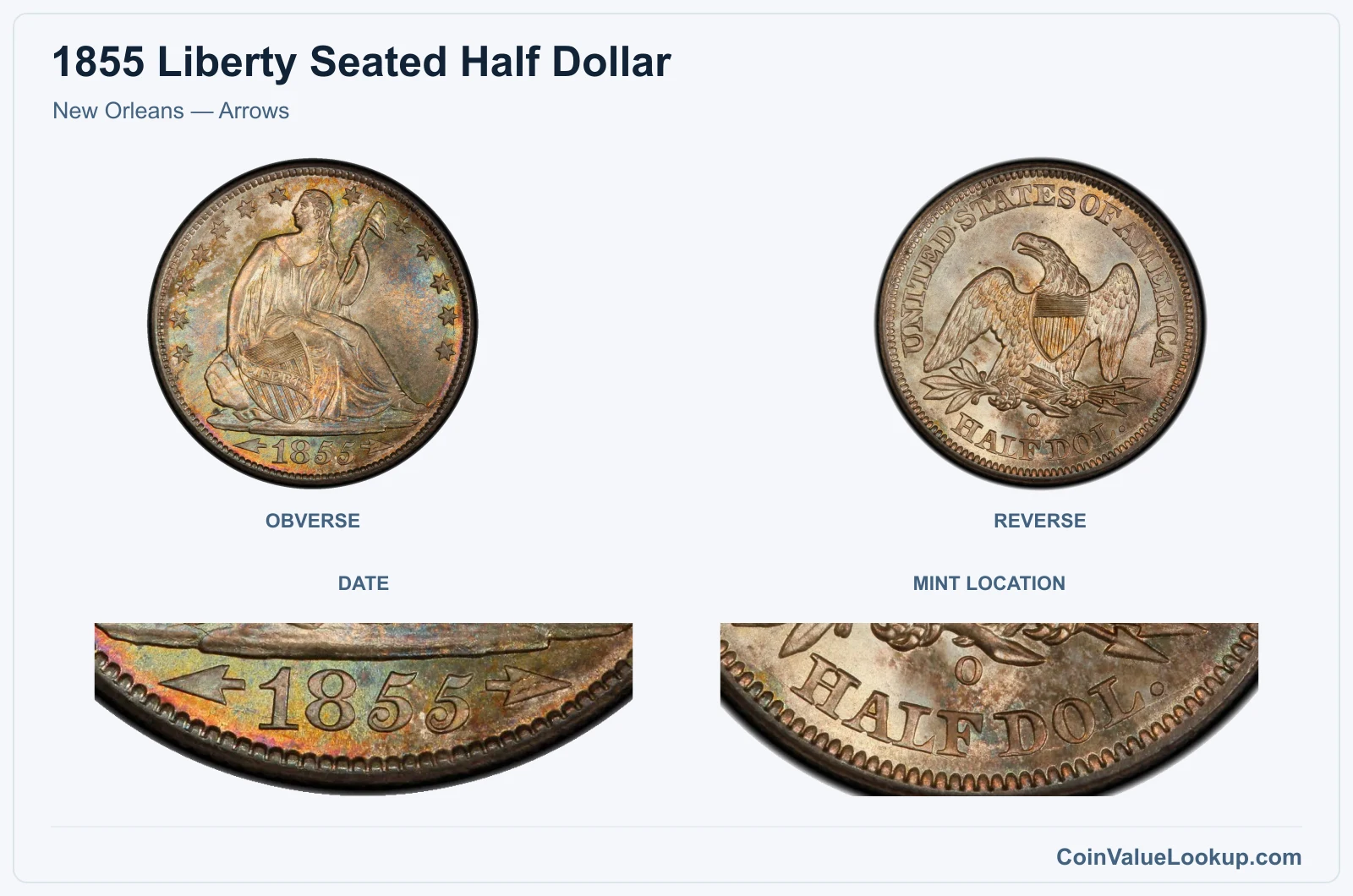
The New Orleans issue carries an "O" mint mark on the reverse below the eagle. In lower grades it trades similarly to the Philadelphia normal date, with guide estimates around $79 at G4, $236 at VF20, and $456 at AU50.
Before looking for die varieties or anomalies, confirm that you have a standard date without overdate traces. New Orleans coins of this era can show softer strikes, so do not mistake weak detail for heavy wear.
Check for luster in the protected areas around the stars and legend.
Ordinary-issue reference: Ordinary-issue reference only: The table below shows prices for the 1855-O Liberty Seated Half Dollar (regular strike). It does not represent the value of the specific New Orleans — Arrows variety or its variety premium. Year, mint, metal and strike type are matched; the specific variety is not priced by this table.
Range Grade
Price Auction Records Appraisal PO PO 1
—
Coin Identifier FR FR 2
—
Coin Identifier AG AG 3
—
Coin Identifier G G 4
Coin Identifier
G 6
—
Coin Identifier VG VG 8
Coin Identifier
VG 10
Coin Identifier F F 12
—
Coin Identifier
F 15
Coin Identifier VF VF 20
Coin Identifier
VF 25
Coin Identifier
VF 30
Coin Identifier
VF 35
Coin Identifier XF XF 40
Coin Identifier
XF 45
Coin Identifier AU AU 50
Coin Identifier
AU 53
Coin Identifier
AU 55
Coin Identifier
AU 58
Coin Identifier MS MS 60
Coin Identifier
MS 61
Coin Identifier
MS 62
Coin Identifier
MS 63
Coin Identifier
MS 64
Coin Identifier
MS 65
Coin Identifier
MS 66
Coin Identifier
MS 67
Coin Identifier
MS 68
—
—
—
MS 69
—
—
—
MS 70
—
—
—
1855 Liberty Seated Half Dollar — San Francisco — Arrows
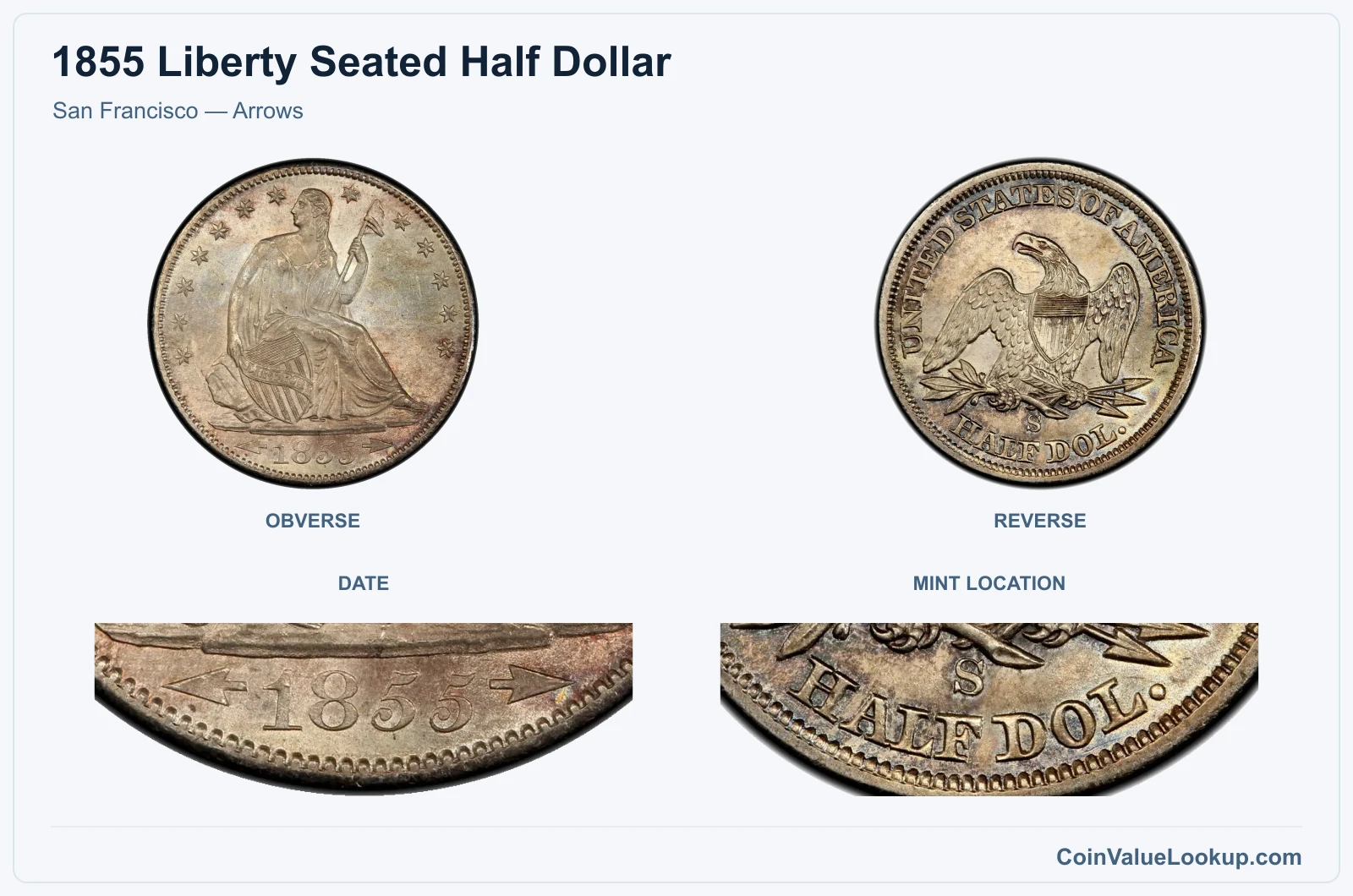
This is the first year San Francisco struck half dollars, and the S-mint 1855 is genuinely scarce. The mint mark is a small "S" on the reverse below the eagle, and you will want a clear photo of it because it can be faint on weakly struck examples.
Guide values reflect the rarity: around $630 at G4, $3,102 at VF20, and a steep $8,601 near AU50 according to USA Coin Book. High-grade survivors are particularly hard to find.
If you have one with original surfaces and decent detail, it is worth professional evaluation. Even a beat-up example in Good condition holds substantial value compared to other 1855 mints.
Ordinary-issue reference: Ordinary-issue reference only: The table below shows prices for the 1855-S Liberty Seated Half Dollar (regular strike). It does not represent the value of the specific San Francisco — Arrows variety or its variety premium. Year, mint, metal and strike type are matched; the specific variety is not priced by this table.
Range Grade
Price Auction Records Appraisal PO PO 1
—
Coin Identifier FR FR 2
Coin Identifier AG AG 3
Coin Identifier G G 4
Coin Identifier
G 6
Coin Identifier VG VG 8
Coin Identifier
VG 10
Coin Identifier F F 12
Coin Identifier
F 15
Coin Identifier VF VF 20
Coin Identifier
VF 25
Coin Identifier
VF 30
Coin Identifier
VF 35
Coin Identifier XF XF 40
Coin Identifier
XF 45
Coin Identifier AU AU 50
Coin Identifier
AU 53
Coin Identifier
AU 55
Coin Identifier
AU 58
Coin Identifier MS MS 60
—
Coin Identifier
MS 61
Coin Identifier
MS 62
Coin Identifier
MS 63
—
Coin Identifier
MS 64
Coin Identifier
MS 65
—
—
—
MS 66
—
—
—
MS 67
—
—
—
MS 68
—
—
—
MS 69
—
—
—
MS 70
—
—
—
1855 Liberty Seated Half Dollar — Philadelphia Proof
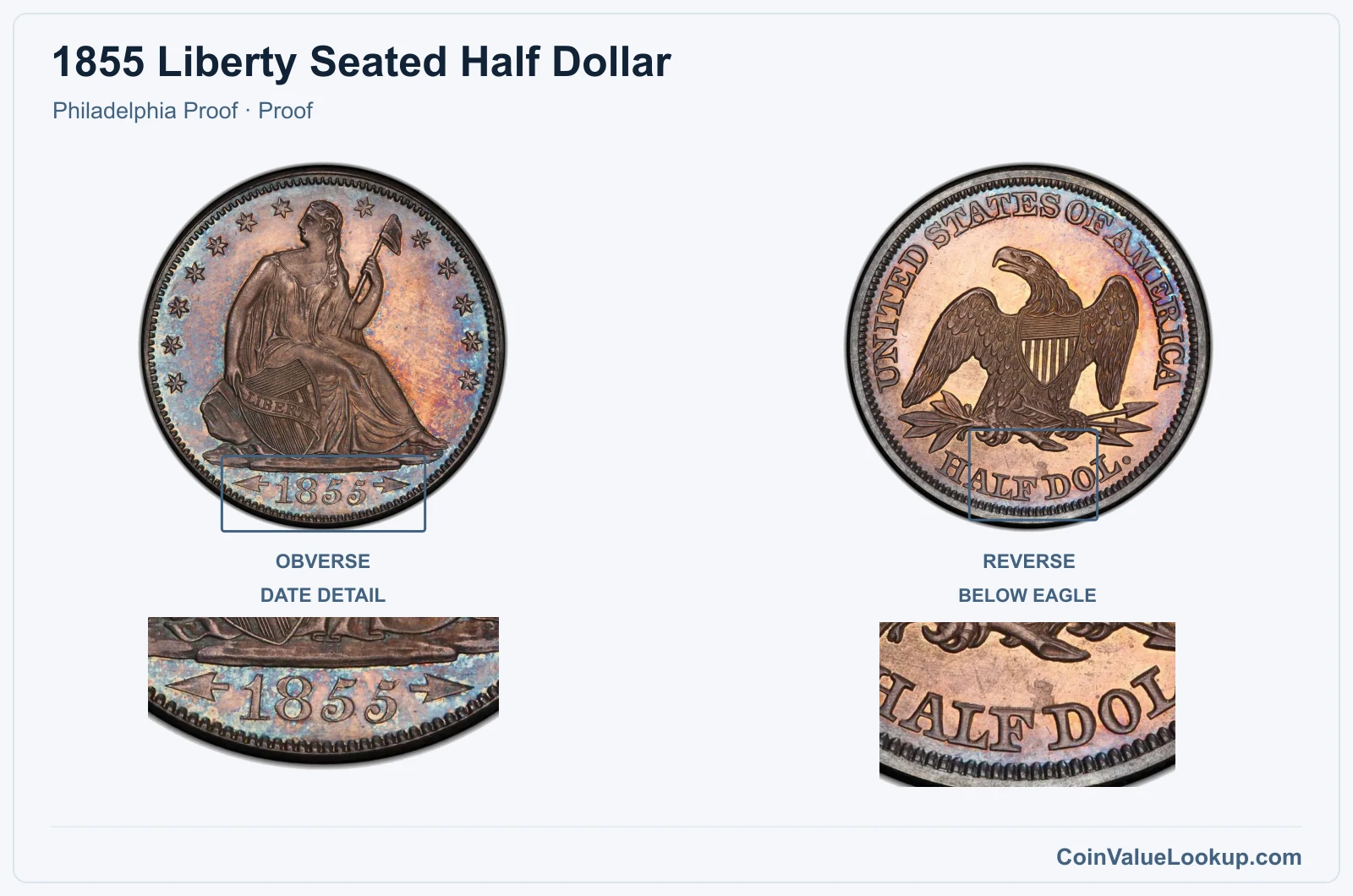
Philadelphia Proof 1855 half dollars are rare collector pieces struck with polished dies on prepared planchets. They show deeply mirrored fields, crisp device edges, and sharp rims that business strikes rarely match.
No current price curve is available, but a single PR66 example sold for $51,750 at a Heritage auction in 2008. That is one historical data point, not a market range.
Cameo and deep cameo designations within this version refer to the contrast between frosted devices and mirror fields, not a separate variety.
Do not assume a shiny coin is a Proof. Cleaned circulation strikes can mimic reflectivity at a glance.
Range Grade
Price Auction Records Appraisal PR PR 1
—
Coin Identifier
PR 2
—
Coin Identifier
PR 3
—
Coin Identifier
PR 4
—
Coin Identifier
PR 6
—
Coin Identifier
PR 8
—
Coin Identifier
PR 10
—
Coin Identifier
PR 12
—
Coin Identifier
PR 15
—
Coin Identifier
PR 20
—
Coin Identifier
PR 25
—
Coin Identifier
PR 30
—
Coin Identifier
PR 35
—
Coin Identifier
PR 40
—
Coin Identifier
PR 45
—
Coin Identifier
PR 50
—
Coin Identifier
PR 53
—
Coin Identifier
PR 55
—
Coin Identifier
PR 58
—
Coin Identifier
PR 60
—
Coin Identifier
PR 61
—
Coin Identifier
PR 62
—
Coin Identifier
PR 63
—
Coin Identifier
PR 64
—
Coin Identifier
PR 65
Coin Identifier
PR 66
—
—
—
PR 67
—
—
—
PR 68
—
—
—
PR 69
—
—
—
PR 70
—
—
—
1855 Liberty Seated Half Dollar — Philadelphia 1855/54 Proof
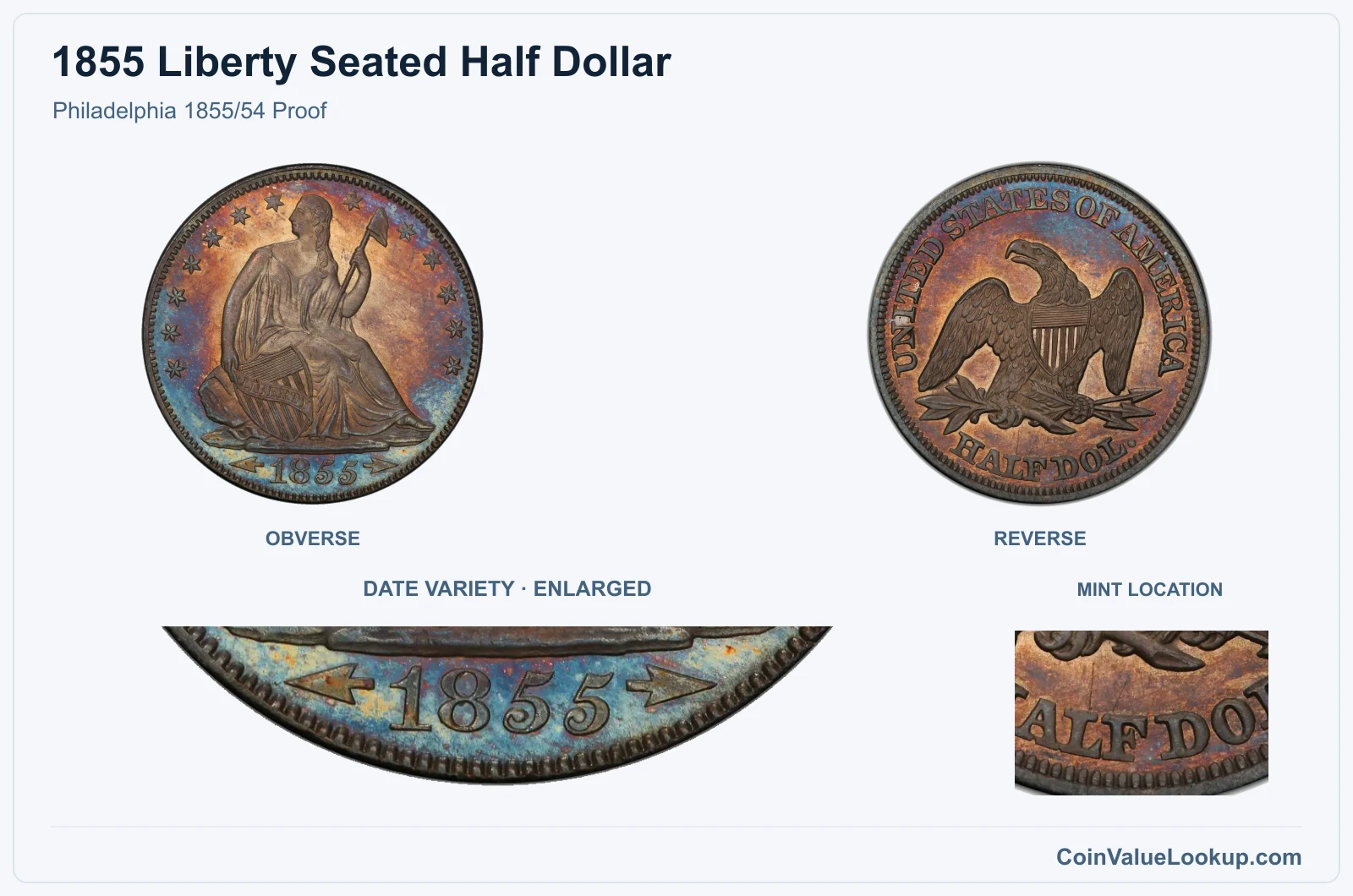
This is the Proof version of the 1855/54 overdate, combining two layers of rarity: Proof manufacture and the overdate die. Both the mirrored Proof surfaces and the overdate diagnostics — the remnant crossbar and earlier digit traces — need to be present.
A PR65+ example sold for $96,000 at Heritage in 2024. That is a single historical sale, not a standing market price.
These are extraordinarily rare coins, and if you believe you have one, professional authentication is essential. A close-up of the date area showing the overdate traces alongside the Proof surface quality would be the starting point for any serious evaluation.
Range Grade
Price Auction Records Appraisal PR PR 1
—
Coin Identifier
PR 2
—
Coin Identifier
PR 3
—
Coin Identifier
PR 4
—
Coin Identifier
PR 6
—
Coin Identifier
PR 8
—
Coin Identifier
PR 10
—
Coin Identifier
PR 12
—
Coin Identifier
PR 15
—
Coin Identifier
PR 20
—
Coin Identifier
PR 25
—
Coin Identifier
PR 30
—
Coin Identifier
PR 35
—
Coin Identifier
PR 40
—
Coin Identifier
PR 45
—
Coin Identifier
PR 50
—
Coin Identifier
PR 53
—
Coin Identifier
PR 55
—
Coin Identifier
PR 58
—
Coin Identifier
PR 60
—
Coin Identifier
PR 61
—
Coin Identifier
PR 62
—
Coin Identifier
PR 63
Coin Identifier
PR 64
Coin Identifier
PR 65
Coin Identifier
PR 66
—
—
—
PR 67
—
—
—
PR 68
—
—
—
PR 69
—
—
—
PR 70
—
—
—
1855 Liberty Seated Half Dollar Error List
1. 1855 Liberty Seated Half Dollar — Die Crack / Die Chip
Die cracks appear as thin, raised lines on the coin's surface where the steel die fractured during use. On 1855-O half dollars, cracks have been reported on the reverse running between specific letters of the legend, such as between S and O and between D and S in HALF DOL or STATES.
To identify a die crack, look for a slightly raised, irregular line connecting design elements or running toward the rim. It will feel raised to a fingernail, not incised.
Scratches, corrosion lines, and foreign material sitting on the surface can mimic cracks, but those are typically incuse or sit loosely rather than standing above the field.
The value impact depends on the crack's size, location, and the coin's overall condition. No specific price premium is established here, so individual assessment is needed.
2. 1855 Liberty Seated Half Dollar — Struck-Through Error
A struck-through error occurs when foreign material — grease, a thread, a metal fragment — sits between the die and the planchet during striking, leaving a smooth, depressed impression on the finished coin. On the 1855/54 overdate, one high-grade example displayed a thin mint-made struck-through impression above and to the left of Liberty's chest.
The key diagnostic is the shape: a struck-through impression is smooth and slightly sunken, with soft edges. It does not have the sharp, displaced-metal ridges of a scratch or the rough texture of corrosion.
Wear, cleaning marks, and ordinary weak detail can all look vaguely similar at first glance, so examine the area under magnification.
No standard price adjustment is established for this error on 1855 half dollars. Value depends on the error's visibility, the coin's grade, and collector demand for the specific combination.