1868 Liberty Seated Half Dollar Coin Value: How Much Is It Worth?
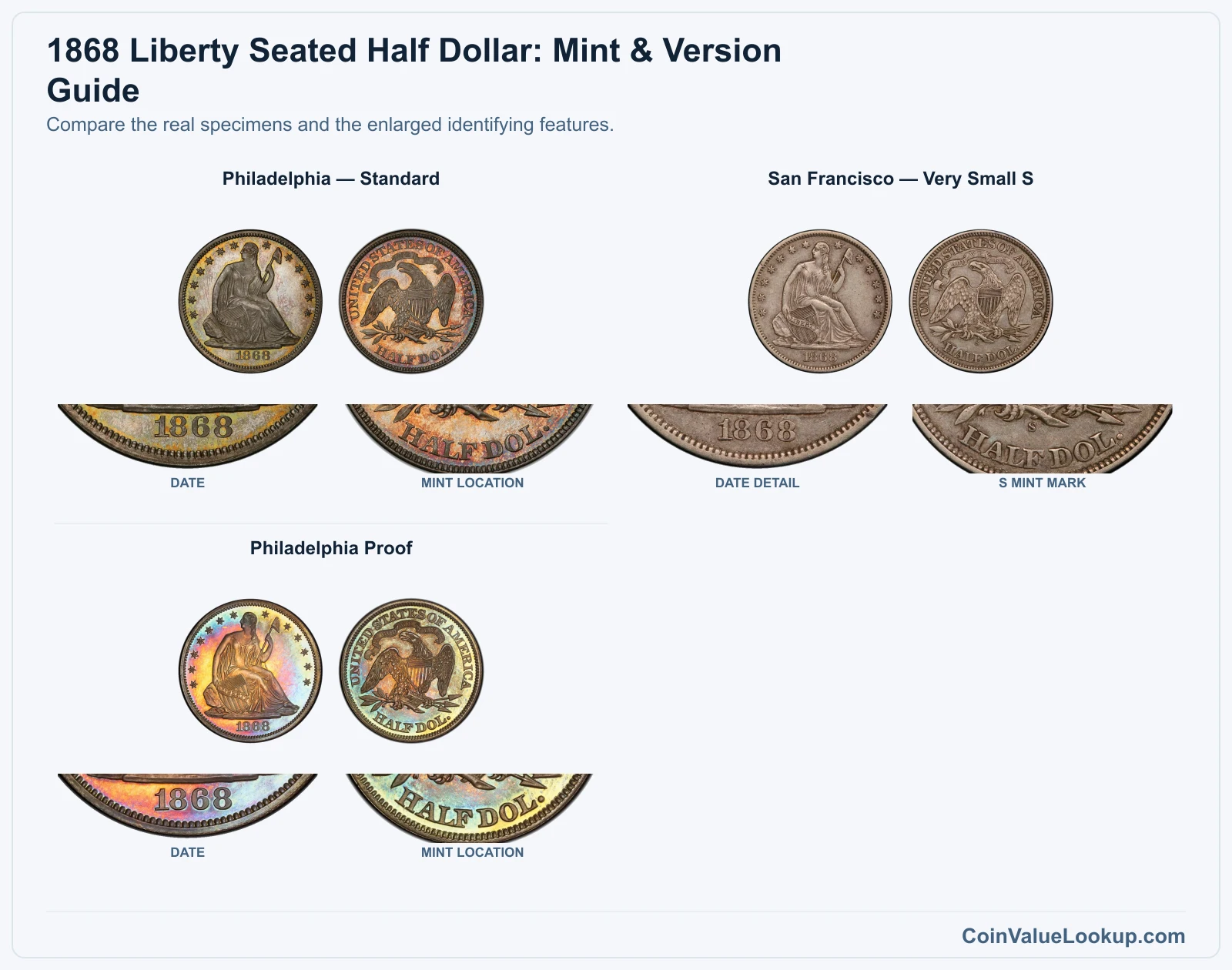
A Philadelphia-struck 1868 Liberty Seated Half Dollar ranges from about $141 in Good (G4) condition to around $947 near About Uncirculated (AU50), based on USA Coin Book guide estimates. The actual mint, exact grade, design variety and finish can shift that number substantially.
Proofs and the San Francisco issue each carry their own value structure and deserve separate comparison.
Fast Way to Identify Your 1868 Liberty Seated Half Dollar
The quickest way to start figuring out what your 1868 half dollar is worth is to upload clear photos of the front and back. Our identifier can give you a preliminary read on the mint, variety and general condition.
Grab your coin, snap both sides in good light, and let the tool do the first pass.
1868 Liberty Seated Half Dollar Value
Upload both sides of your 1868 Liberty Seated Half Dollar.
Front Obverse
Upload photo
Back Reverse
Upload photo
Which 1868 Liberty Seated Half Dollar Versions Are Worth Money?
- Philadelphia and San Francisco strikes use different guide values at higher grades, so confirming the mint matters before estimating worth.
- Proof 1868 half dollars, struck at Philadelphia with mirrored surfaces, carry a separate and higher value track than circulation strikes.
- The 1868-S Very Small S mintmark can be hard to spot on worn coins; confirming it changes which price column applies.
Step 1: Identify Your 1868 Liberty Seated Half Dollar Mint Mark and Version
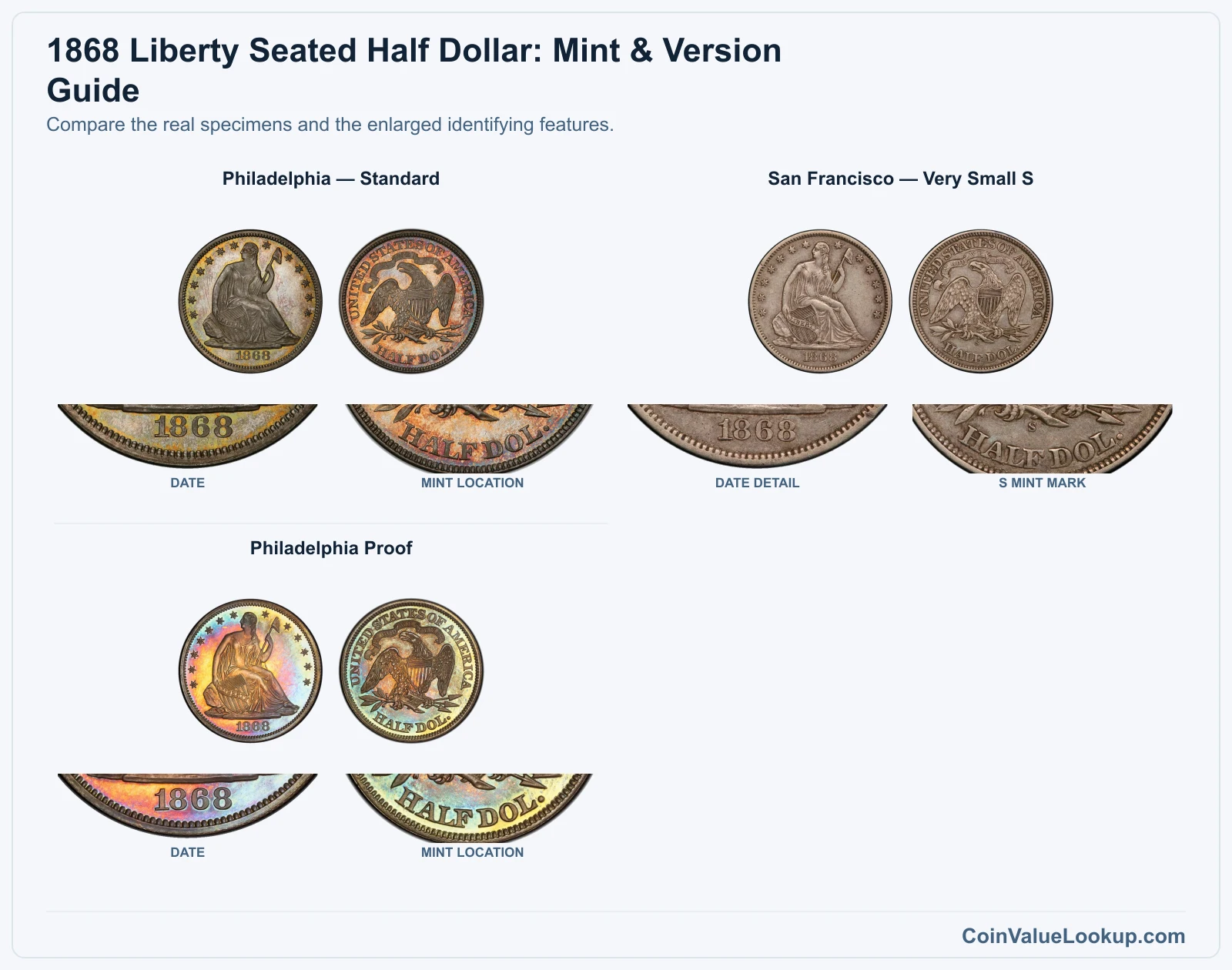
The obverse shows Liberty seated on a rock, holding a pole topped with a cap and a shield inscribed LIBERTY. The reverse features an eagle clutching arrows and an olive branch, with HALF DOL.
below and a motto banner reading IN GOD WE TRUST above. Two mints produced half dollars in 1868.
Philadelphia coins carry no mintmark. San Francisco coins display a small "S" below the eagle on the reverse, and the 1868-S uses a Very Small S style that can be easy to overlook if the coin is worn.
Flip the coin over and inspect that spot carefully with a loupe.
All 1868 halves are struck in 90% silver and 10% copper, weighing 12.44 grams. Later issues from 1873 onward shifted to 12.50 grams (flagged by arrows flanking the date), but that change does not apply here.
A Proof 1868 half dollar exists as well; Proof describes a special manufacturing finish with mirrored fields and sharp rims, not a grade above Mint State.
Step 2: Check Your 1868 Liberty Seated Half Dollar Grade
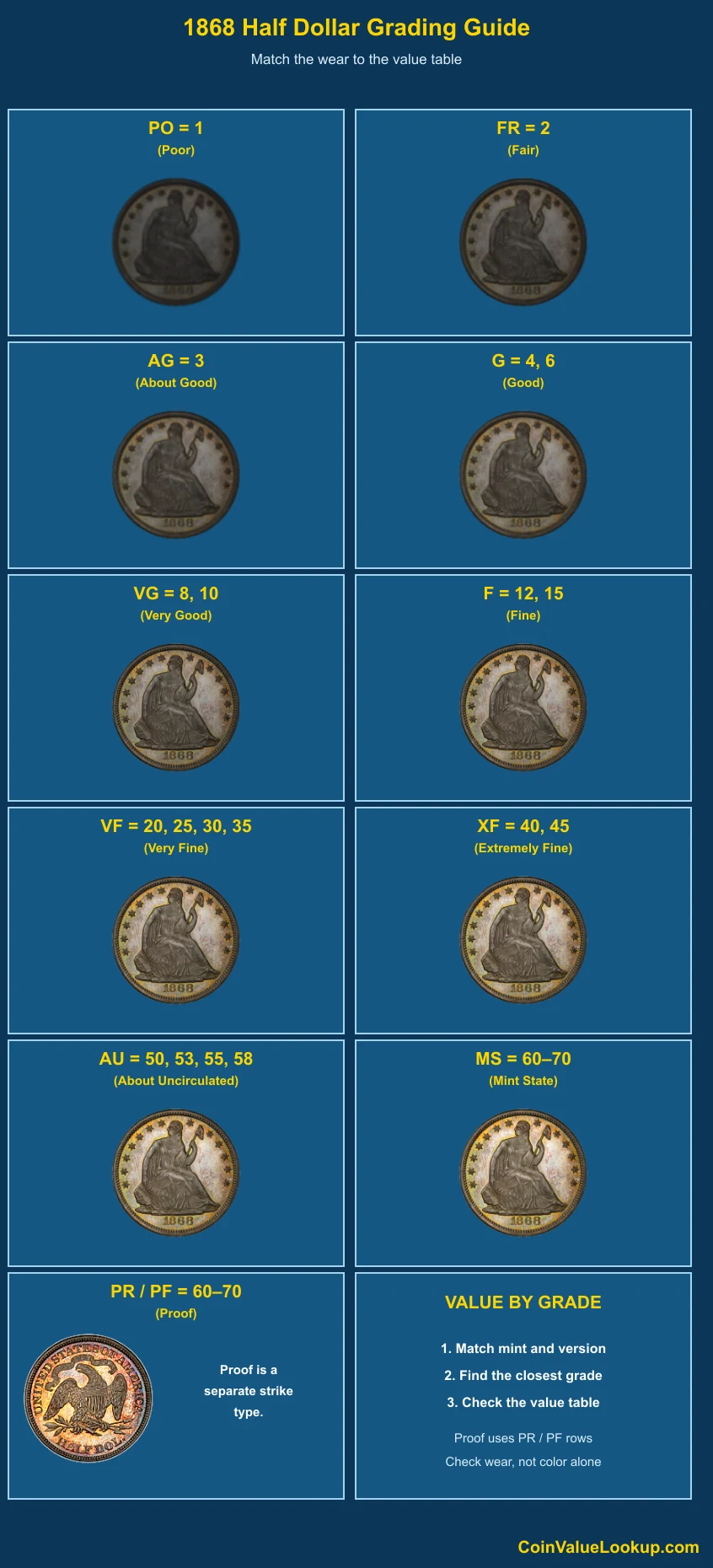
Start by checking the high points on both sides. On the obverse, Liberty's head, breast, knee and the horizontal lines on her shield wear first.
On the reverse, the eagle's breast feathers and wing tips lose detail earliest. Compare your coin against the reference image to judge how much original detail remains.
Luster matters as much as sharpness. A coin with full design detail but no remaining luster has been cleaned or circulated more than it appears.
Look for original mint frost in the protected areas around stars and lettering.
Weak strikes exist on this series and can flatten detail without actual wear. If the high points are soft but the surrounding fields still show cartwheel luster, suspect a strike issue rather than heavy circulation.
Cleaning, rim dings and holes each reduce value independently of the wear grade, so note those separately.
Step 3: Check 1868 Liberty Seated Half Dollar Value by Mint and Version
1868 Liberty Seated Half Dollar — Philadelphia — Standard
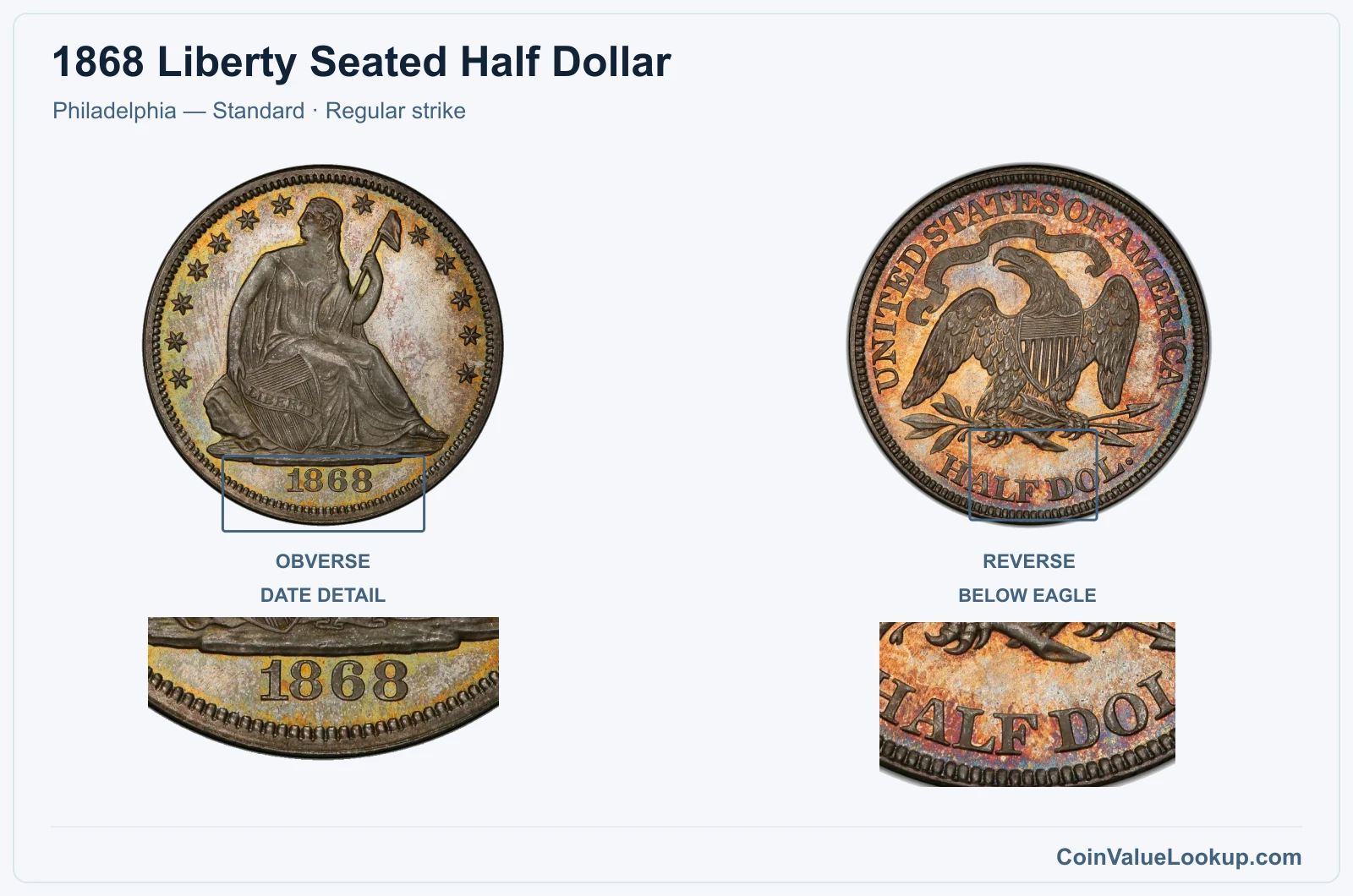
The 1868 Philadelphia half dollar is the no-mintmark issue. Below the eagle on the reverse you will see only open space where a branch-mint letter would sit.
USA Coin Book estimates place this coin at about $141 in G4, $394 in VF20 and $947 in AU50.
These guide figures are not guaranteed offers; actual sale prices depend on eye appeal, strike quality and whether the coin has been cleaned. Still, the Philadelphia issue commands a slight premium over its San Francisco counterpart in the higher circulated grades.
If your coin lacks any letter below the eagle, this is the version you have.
Range Grade
Price Auction Records Appraisal PO PO 1
—
Coin Identifier FR FR 2
—
Coin Identifier AG AG 3
—
Coin Identifier G G 4
—
Coin Identifier
G 6
—
Coin Identifier VG VG 8
Coin Identifier
VG 10
—
Coin Identifier F F 12
—
Coin Identifier
F 15
Coin Identifier VF VF 20
—
Coin Identifier
VF 25
Coin Identifier
VF 30
Coin Identifier
VF 35
Coin Identifier XF XF 40
Coin Identifier
XF 45
Coin Identifier AU AU 50
Coin Identifier
AU 53
Coin Identifier
AU 55
Coin Identifier
AU 58
Coin Identifier MS MS 60
—
Coin Identifier
MS 61
Coin Identifier
MS 62
Coin Identifier
MS 63
Coin Identifier
MS 64
Coin Identifier
MS 65
Coin Identifier
MS 66
—
Coin Identifier
MS 67
—
Coin Identifier
MS 68
—
—
—
MS 69
—
—
—
MS 70
—
—
—
1868 Liberty Seated Half Dollar — San Francisco — Very Small S
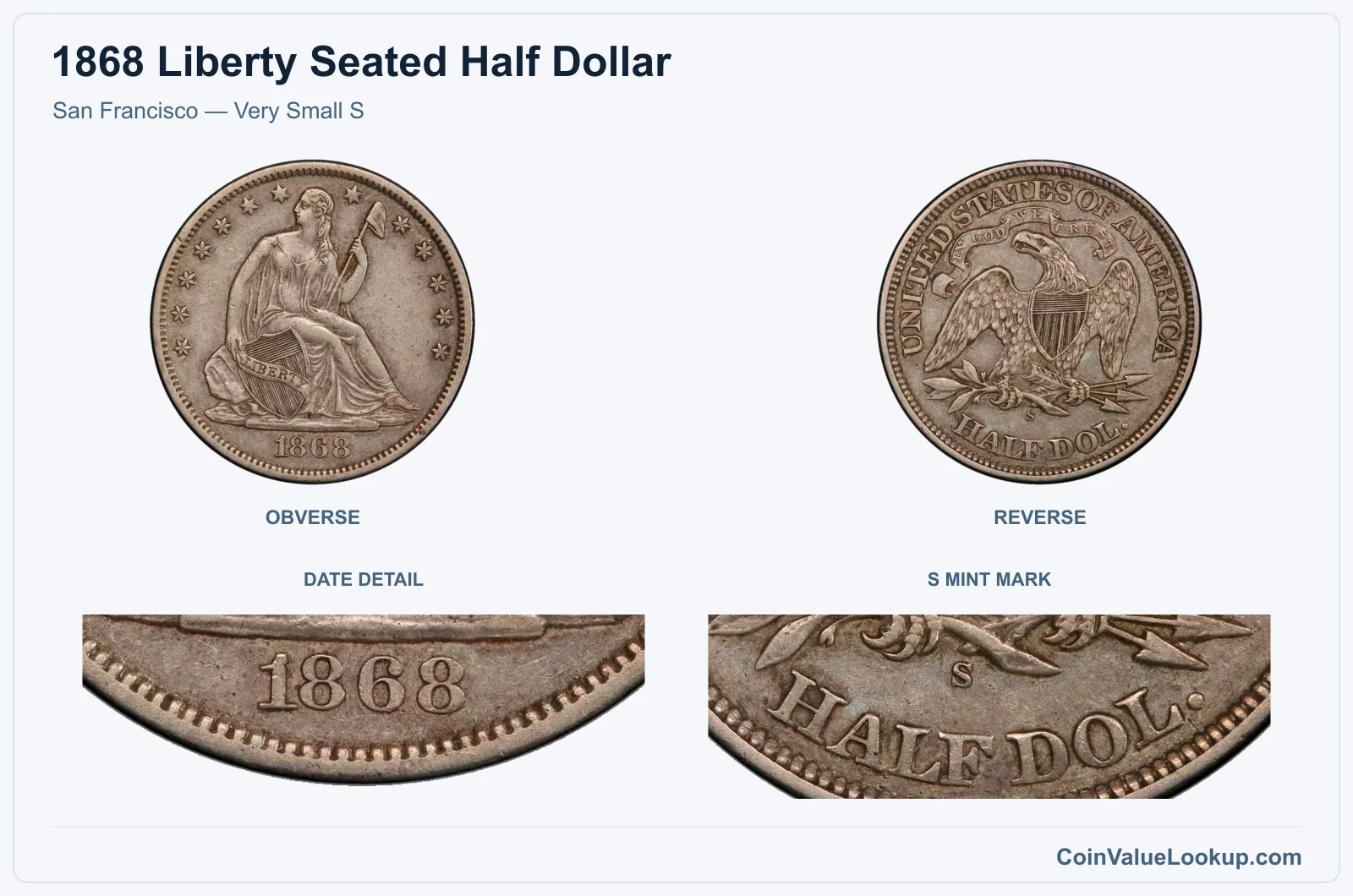
San Francisco struck 1868 halves with a Very Small S mintmark positioned below the eagle on the reverse. This tiny letter can nearly vanish on well-worn pieces, so use magnification and good lighting.
Guide values from USA Coin Book sit at roughly $141 in G4, $394 in VF20 and $739 in AU50.
At the AU50 level the San Francisco coin trails the Philadelphia by about $200 in guide estimates, but lower grades are essentially equal. The Very Small S is the defining feature: if you can see it, you have the branch-mint variety.
If you think the space is blank, double-check under a loupe before concluding it is a Philadelphia coin.
Coin Value Lookup is a good starting point if you want to look up other dates and mints in the Liberty Seated Half Dollar series or compare values across denominations.
Ordinary-issue reference: Ordinary-issue reference only: The table below shows prices for the 1868-S Liberty Seated Half Dollar (regular strike). It does not represent the value of the specific San Francisco — Very Small S variety or its variety premium. Year, mint, metal and strike type are matched; the specific variety is not priced by this table.
Range Grade
Price Auction Records Appraisal PO PO 1
Coin Identifier FR FR 2
—
Coin Identifier AG AG 3
—
Coin Identifier G G 4
—
Coin Identifier
G 6
—
Coin Identifier VG VG 8
—
Coin Identifier
VG 10
—
Coin Identifier F F 12
—
Coin Identifier
F 15
Coin Identifier VF VF 20
Coin Identifier
VF 25
—
Coin Identifier
VF 30
Coin Identifier
VF 35
Coin Identifier XF XF 40
Coin Identifier
XF 45
Coin Identifier AU AU 50
Coin Identifier
AU 53
Coin Identifier
AU 55
Coin Identifier
AU 58
Coin Identifier MS MS 60
—
Coin Identifier
MS 61
—
Coin Identifier
MS 62
Coin Identifier
MS 63
Coin Identifier
MS 64
Coin Identifier
MS 65
Coin Identifier
MS 66
Coin Identifier
MS 67
Coin Identifier
MS 68
—
—
—
MS 69
—
—
—
MS 70
—
—
—
1868 Liberty Seated Half Dollar — Philadelphia Proof
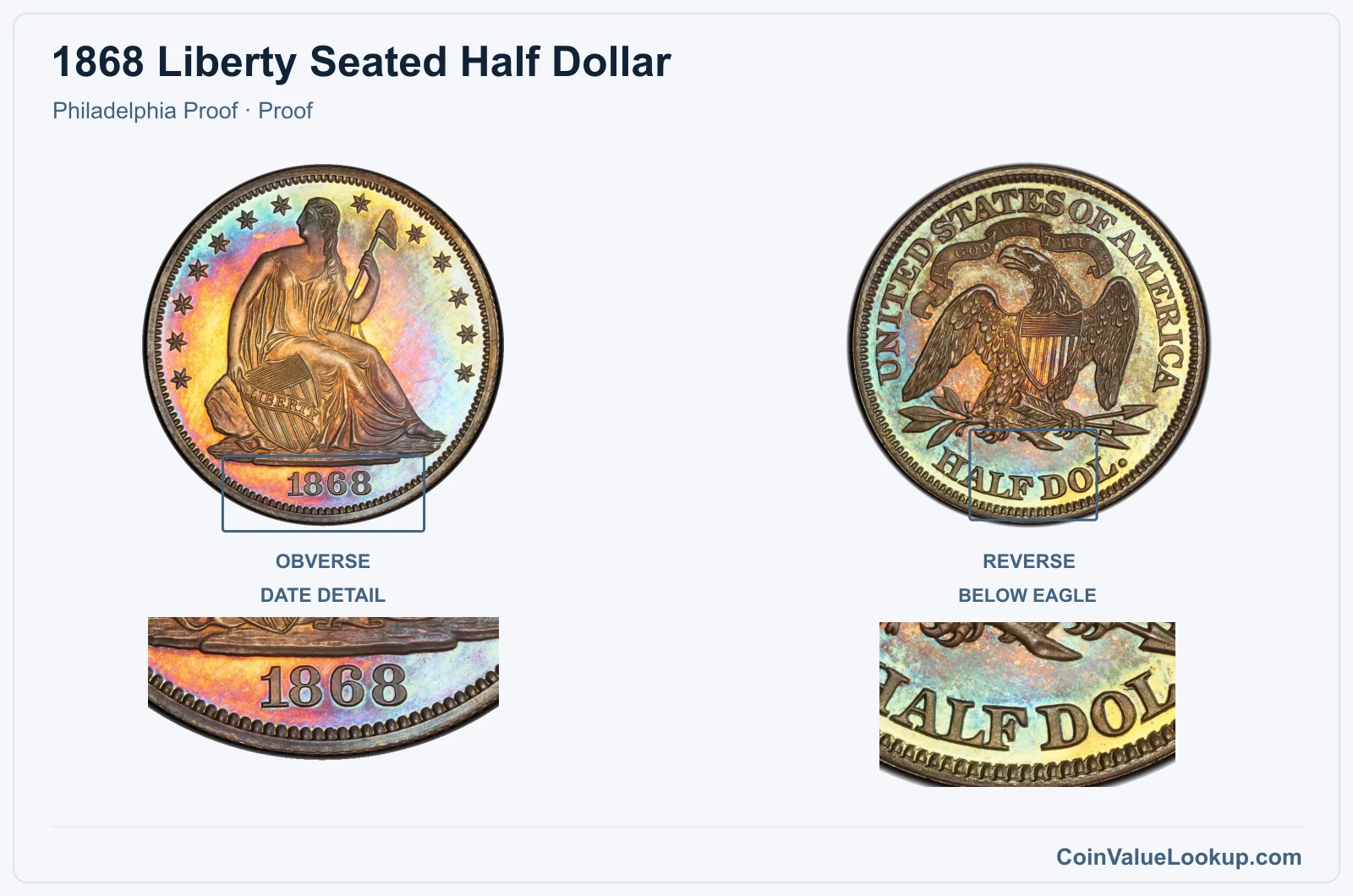
Philadelphia also produced Proof 1868 half dollars for collectors. These were struck on specially prepared planchet with polished dies, resulting in mirror-like fields and razor-sharp rims that circulation strikes do not exhibit.
A Proof is a manufacturing method, not a grade above Mint State, so grading runs on its own scale (PR60 through PR70).
USA Coin Book lists the 1868 Proof at approximately $1,540 in PR63. That makes it the highest single guide anchor among the three 1868 half-dollar versions at their respective listed grades.
Identifying a genuine Proof requires inspecting the surfaces for deep reflectivity and the rims for squared-off, wire-sharp edges. A reflective obverse alone is not proof of Proof status; polished or lightly circulated coins can mimic the look.
Third-party certification is the safest route for confirming this finish.
Range Grade
Price Auction Records Appraisal PR PR 1
—
Coin Identifier
PR 2
—
Coin Identifier
PR 3
—
Coin Identifier
PR 4
—
Coin Identifier
PR 6
—
Coin Identifier
PR 8
—
Coin Identifier
PR 10
—
Coin Identifier
PR 12
—
Coin Identifier
PR 15
—
Coin Identifier
PR 20
—
Coin Identifier
PR 25
—
Coin Identifier
PR 30
—
Coin Identifier
PR 35
—
Coin Identifier
PR 40
—
Coin Identifier
PR 45
—
Coin Identifier
PR 50
—
Coin Identifier
PR 53
—
Coin Identifier
PR 55
—
Coin Identifier
PR 58
—
Coin Identifier
PR 60
Coin Identifier
PR 61
Coin Identifier
PR 62
Coin Identifier
PR 63
Coin Identifier
PR 64
Coin Identifier
PR 65
Coin Identifier
PR 66
Coin Identifier
PR 67
Coin Identifier
PR 68
Coin Identifier
PR 69
—
—
—
PR 70
—
—
—
1868 Liberty Seated Half Dollar Error List
1. 1868 Liberty Seated Half Dollar — Repunched Date
A repunched date on the 1868 half dollar means the date digits were impressed into the die more than once, with the second impression slightly offset from the first. The result is visible doubling or extra contours on one or more numerals.
Look at each digit closely under magnification: traces of an earlier position may appear as thickened serifs, displaced shadows or partial ghost numerals beside the final date.
This category is cataloged for the 1868 Philadelphia half dollar specifically. Do not confuse it with machine doubling, which produces flat shelf-like distortion rather than the rounded secondary contours of a genuine repunched date.
Die damage or post-strike hits can also mimic the look. No adopted price range is available for this variety; value depends on how bold and visible the repunching is, the coin's overall condition and collector demand for the specific die.
2. 1868 Liberty Seated Half Dollar — Misplaced Date
A misplaced date occurs when a date digit (or part of one) is punched into the die in the wrong location, leaving remnants of a numeral where it should not be, typically near the rim, within denticles or partially hidden by another design element close to the normal date position. The 1868-S half dollar has multiple cataloged misplaced-date dies.
To spot this, examine the area around the date and the adjacent rim under magnification for stray numeral fragments that do not belong to the regular design. These traces can be subtle.
Do not mistake normal hub details, wear patterns or tooling marks for misplaced digits; compare against a known reference image of the same year and mint. No numerical price has been adopted for this category.
Value depends on how clearly the misplaced element shows, the coin's grade and overall preservation.