1889 Liberty Seated Half Dollar Coin Value: How Much Is It Worth?
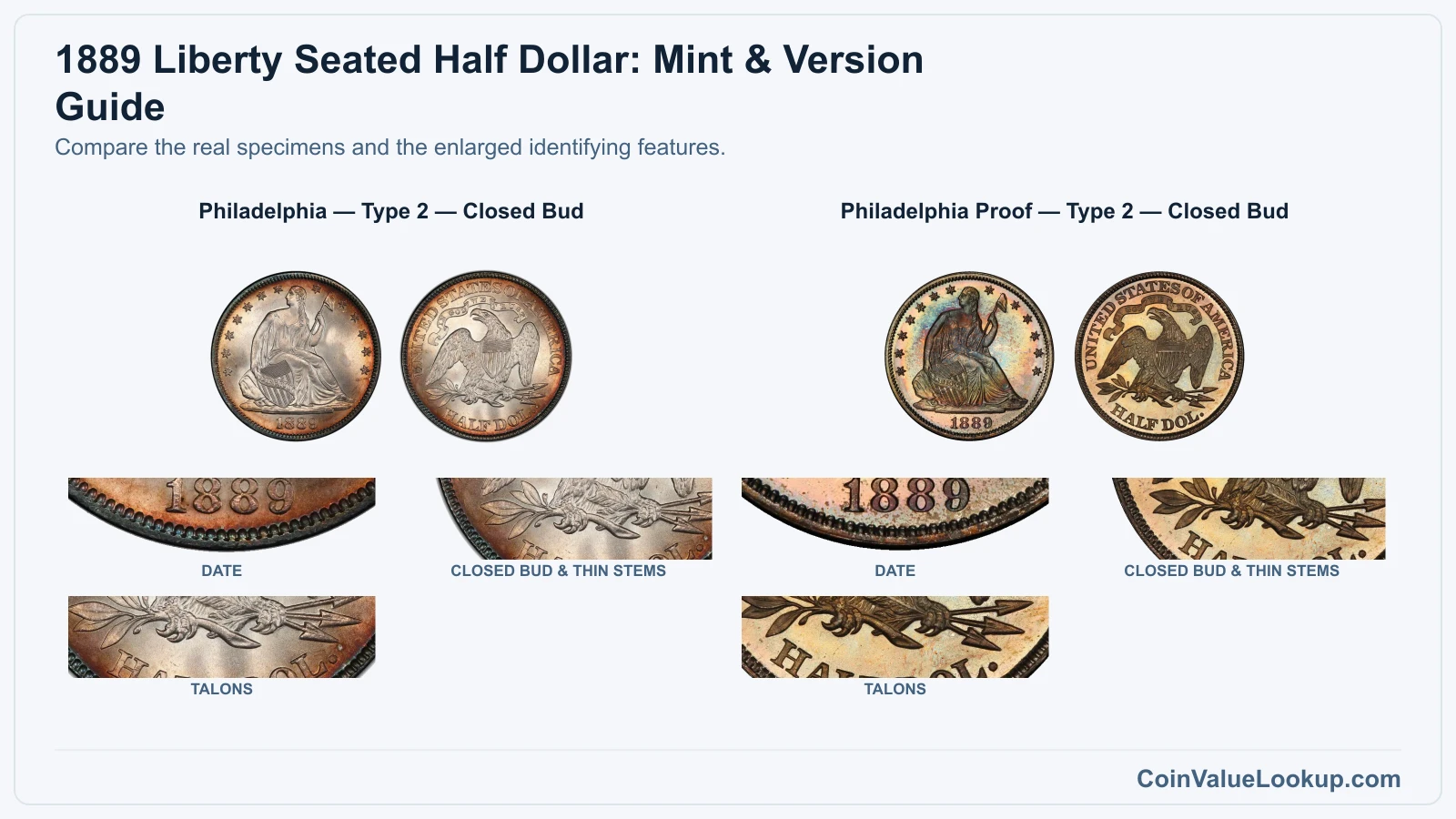
The 1889 Liberty Seated Half Dollar is a low-mintage Philadelphia issue that trades well above its silver content. Guide estimates for circulated examples range from roughly $425 at G4 to $1,145 at AU50, while a Proof in PR63 carries a guide estimate around $1,409 (per USA Coin Book).
These are retail guide figures, not guaranteed buy prices. Grade and original surfaces drive the value far more than melt on this date.
Fast Way to Identify Your 1889 Liberty Seated Half Dollar
Want a quick read on your coin? Upload clear photos of the front and back, and our identifier will give you a preliminary take on what you have.
Good lighting and a sharp image of the date, stars, and reverse eagle help the most. This is not a substitute for professional authentication, but it is a solid starting point.
1889 Liberty Seated Half Dollar Value
Upload both sides of your 1889 Liberty Seated Half Dollar.
Front Obverse
Upload photo
Back Reverse
Upload photo
Which 1889 Liberty Seated Half Dollar Versions Are Worth Money?
- The 1889 Philadelphia circulation strike in the Type 2 Closed Bud variety is a genuinely low-mintage date; guide estimates start at $425 in G4 and climb to $1,145 at AU50.
- Proof examples are a separate manufacturing category, not simply high-grade coins; a PR63 Proof carries a guide estimate of about $1,409.
- Original mint-state or Proof surfaces without cleaning or damage command the strongest interest from collectors of this series.
Step 1: Identify Your 1889 Liberty Seated Half Dollar Mint Mark and Version
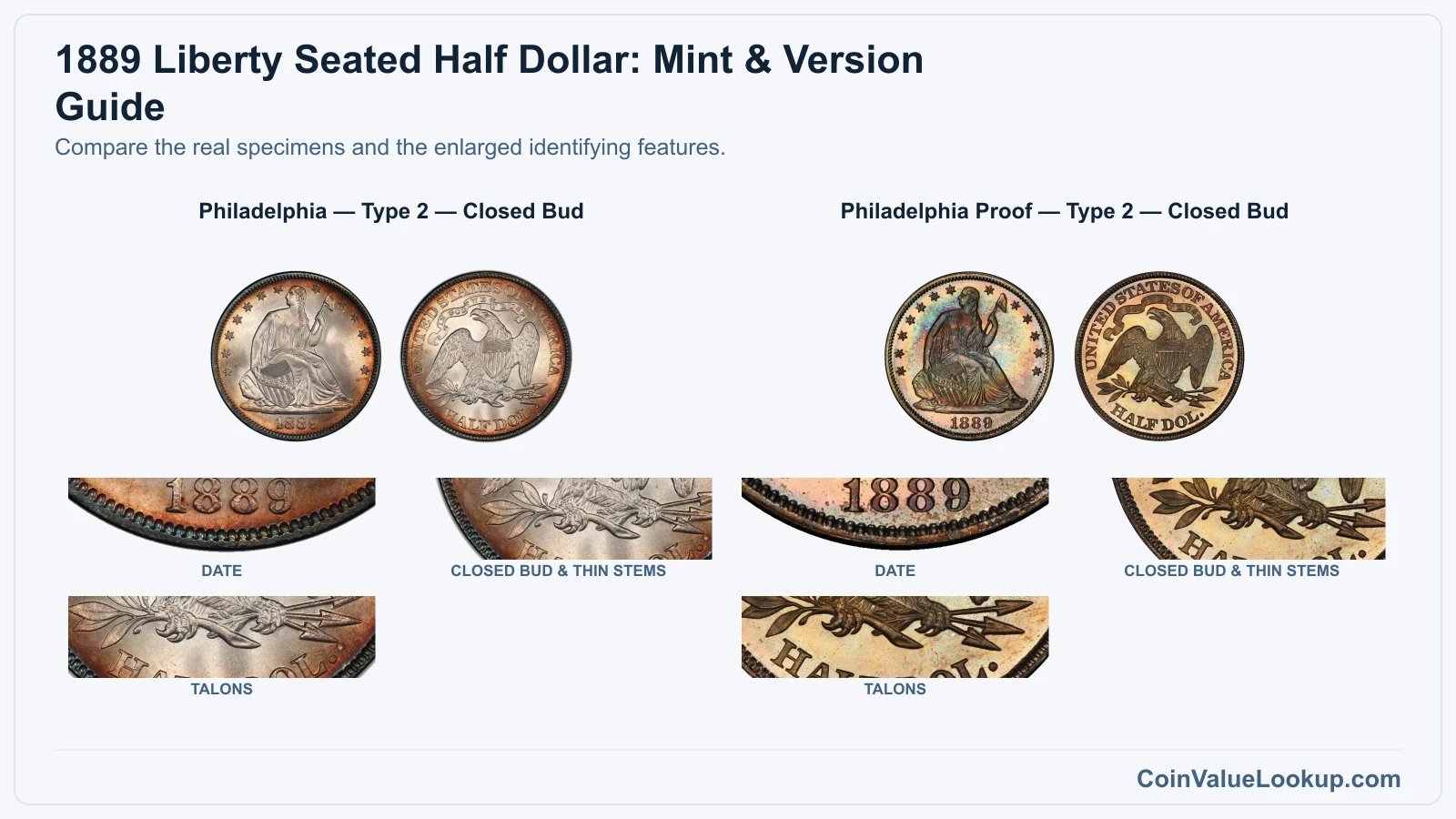
The 1889 half dollar shows the Seated Liberty on the obverse with thirteen stars and the date below. The reverse has a heraldic eagle clutching arrows and an olive branch, a motto banner reading IN GOD WE TRUST, and HALF DOL at the bottom.
The coin is 90% silver, 10% copper, weighs 12.50 grams, and has a reeded edge.
No mintmark means Philadelphia. There is no regular-issue S, O, or CC half dollar for 1889, so if yours has a blank area below the eagle's tail, it is a Philly coin.
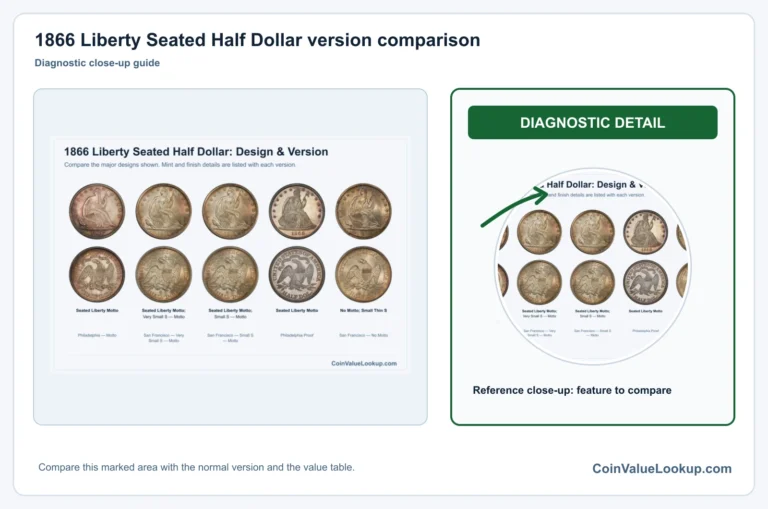
To identify the reverse hub, look at the lower olive bud. A closed bud (the small berry-like shape at the bottom of the olive branch is fully closed) with strong olive stems and open talons marks the Type 2 reverse used on this date.
Some collectors confuse prooflike reflective surfaces on circulation strikes with Proof status. Prooflike brightness alone does not make a coin a Proof; Proof is a specific manufacturing finish with distinct rim and surface characteristics, not a grade above Mint State.
Step 2: Check Your 1889 Liberty Seated Half Dollar Grade
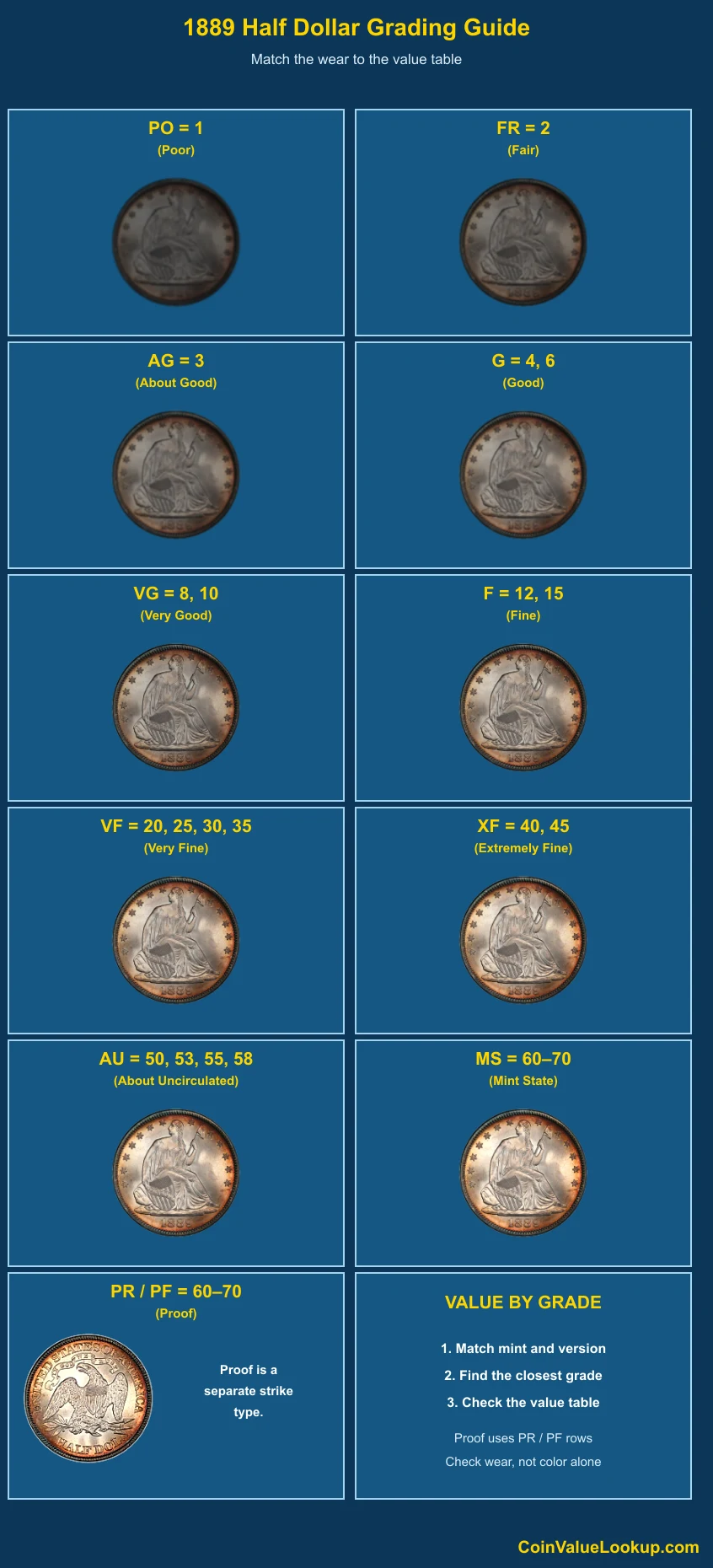
Start with the high points. On the obverse, check the detail on Liberty's head, breast, knee, and the horizontal lines of the shield.
On the reverse, look at the eagle's head, neck, and wing tips. These wear first.
Weak strikes exist on Seated halves and can mimic wear. The trick is to check for original mint luster across both sides.
A weakly struck coin still has luster in protected areas; a worn coin does not. Use the comparison image to match your coin's detail against known grade benchmarks.
Avoid cleaning your coin. Hairlines from polishing, holes, and rim damage all reduce value and are separate from mint-made characteristics.
A naturally toned, original-surface coin in a lower grade is often more desirable than a cleaned coin that looks brighter.
Step 3: Check 1889 Liberty Seated Half Dollar Value by Mint and Version
1889 Liberty Seated Half Dollar — Philadelphia — Type 2 — Closed Bud
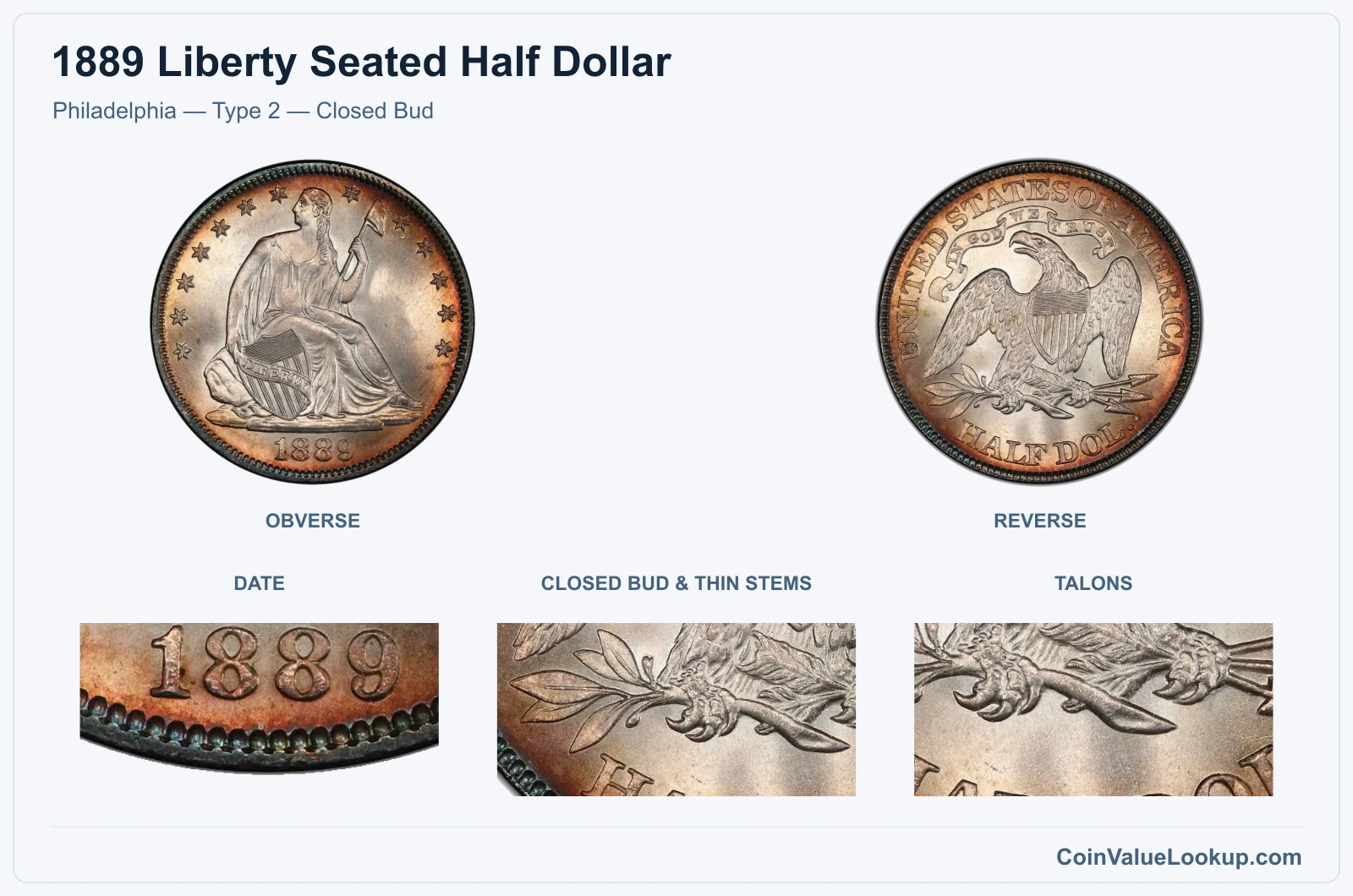
This is the regular circulation strike from the Philadelphia Mint, carrying no mintmark. It uses the Type 2 reverse hub, identified by the closed lower olive bud, open talons, and strong olive stems.
If you see a tightly sealed bud at the base of the olive branch and clearly defined stem lines, you have the correct hub.
USA Coin Book guide estimates place this coin at roughly $425 in G4, $809 in VF20, and $1,145 in AU50. Some regular strikes show prooflike reflective surfaces, which can be visually striking but do not indicate a Proof finish.
A Proof attribution requires examining the rims and overall surface quality, not just reflectivity.
Ordinary-issue reference: Ordinary-issue reference only: The table below shows prices for the 1889 Liberty Seated Half Dollar (regular strike). It does not represent the value of the specific Philadelphia — Type 2 — Closed Bud variety or its variety premium. Year, mint, metal and strike type are matched; the specific variety is not priced by this table.
Range Grade
Price Auction Records Appraisal PO PO 1
—
Coin Identifier FR FR 2
—
Coin Identifier AG AG 3
—
Coin Identifier G G 4
Coin Identifier
G 6
Coin Identifier VG VG 8
Coin Identifier
VG 10
Coin Identifier F F 12
Coin Identifier
F 15
Coin Identifier VF VF 20
Coin Identifier
VF 25
Coin Identifier
VF 30
Coin Identifier
VF 35
Coin Identifier XF XF 40
Coin Identifier
XF 45
Coin Identifier AU AU 50
Coin Identifier
AU 53
Coin Identifier
AU 55
Coin Identifier
AU 58
Coin Identifier MS MS 60
—
Coin Identifier
MS 61
Coin Identifier
MS 62
Coin Identifier
MS 63
Coin Identifier
MS 64
Coin Identifier
MS 65
Coin Identifier
MS 66
Coin Identifier
MS 67
Coin Identifier
MS 68
—
—
—
MS 69
—
—
—
MS 70
—
—
—
1889 Liberty Seated Half Dollar — Philadelphia Proof — Type 2 — Closed Bud
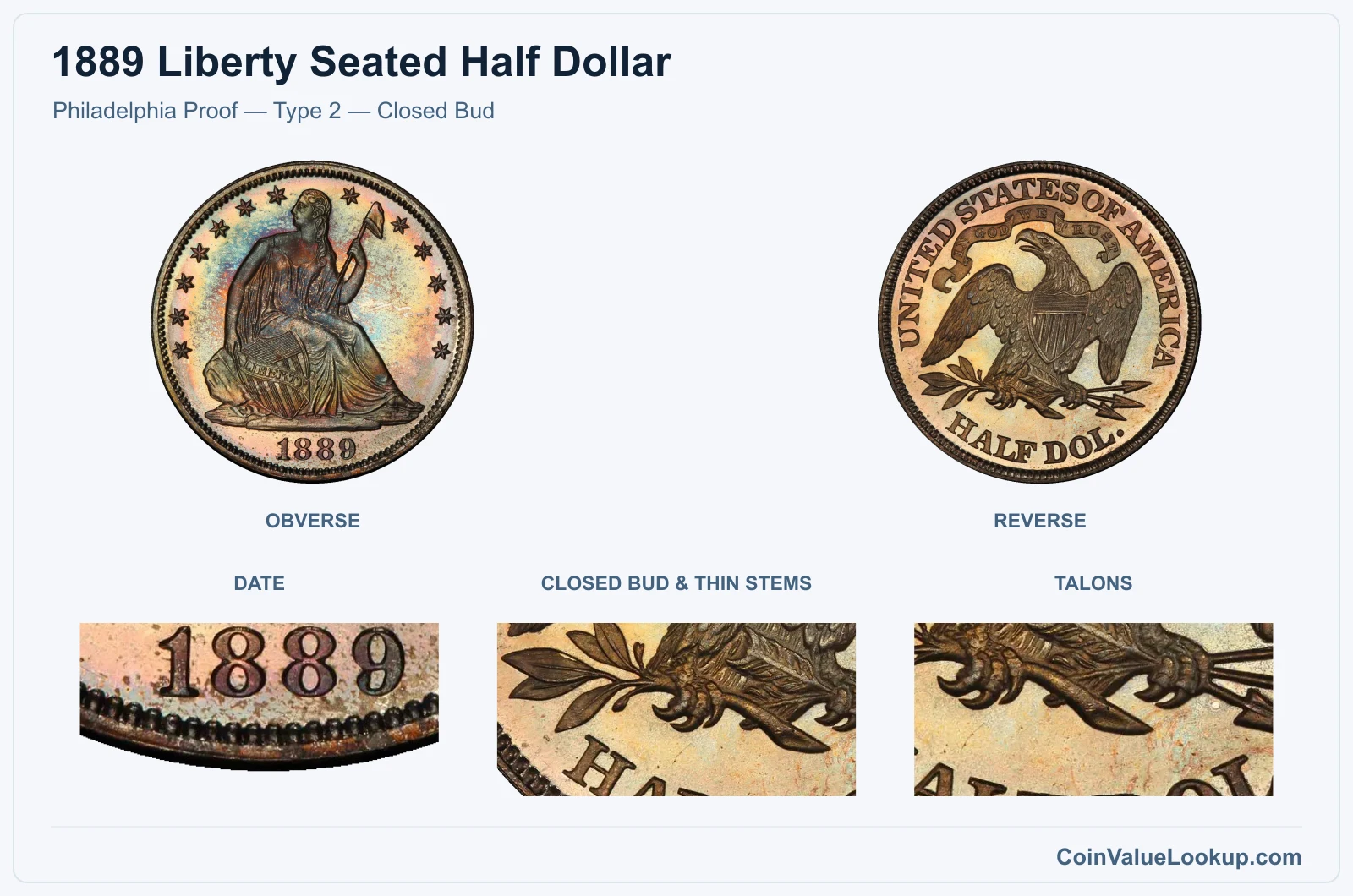
The 1889 Proof half dollar was struck at Philadelphia on specially prepared planchets and dies. It shares the Type 2 Closed Bud reverse with the regular issue, but true Proofs display squared, sharp rims and deeply mirrored fields that differ from the prooflike sheen sometimes seen on business strikes.
A USA Coin Book guide estimate for PR63 is approximately $1,409. Cameo and Deep Cameo are contrast designations within the Proof finish, describing the degree of frost on the devices against the mirrored fields.
These are not separate varieties. Because early regular strikes and Proofs from this era can resemble each other, expert finish attribution is recommended before assuming Proof status.
Coin Value Lookup is a good place to start when you need to look up guide values for other dates and denominations in the Seated Liberty series.
Ordinary-issue reference: Ordinary-issue reference only: The table below shows prices for the 1889 Liberty Seated Half Dollar (proof). It does not represent the value of the specific Philadelphia Proof — Type 2 — Closed Bud variety or its variety premium. Year, mint, metal and strike type are matched; the specific variety is not priced by this table.
Range Grade
Price Auction Records Appraisal PR PR 1
—
Coin Identifier
PR 2
—
Coin Identifier
PR 3
—
Coin Identifier
PR 4
—
Coin Identifier
PR 6
—
Coin Identifier
PR 8
—
Coin Identifier
PR 10
—
Coin Identifier
PR 12
—
Coin Identifier
PR 15
—
Coin Identifier
PR 20
—
Coin Identifier
PR 25
—
Coin Identifier
PR 30
—
Coin Identifier
PR 35
—
Coin Identifier
PR 40
—
Coin Identifier
PR 45
—
Coin Identifier
PR 50
—
Coin Identifier
PR 53
Coin Identifier
PR 55
—
Coin Identifier
PR 58
—
Coin Identifier
PR 60
Coin Identifier
PR 61
Coin Identifier
PR 62
Coin Identifier
PR 63
Coin Identifier
PR 64
Coin Identifier
PR 65
Coin Identifier
PR 66
Coin Identifier
PR 67
Coin Identifier
PR 68
—
—
—
PR 69
—
—
—
PR 70
—
—
—
1889 Liberty Seated Half Dollar Error List
1. 1889 Liberty Seated Half Dollar — Die Crack / Die Chip
Die cracks on 1889 half dollars are reported as raised lines linking stars 6 through 9 on the obverse. These stars sit along the upper left portion of the obverse.
The crack appears as a thin, raised ridge running from one star to the next, created when the working die fractured during use.
Do not confuse this with incuse scratches, corrosion lines, or foreign material stuck to the surface. A genuine die crack is raised above the field, not cut into it.
Run a fingernail across it: a crack catches slightly because it stands proud of the surface, while a scratch is recessed.
This is a known die state for the date, not a unique discovery. No specific price range is available, as the value depends on the crack's visibility, the coin's overall condition, and collector interest in die-state examples.
Have the coin evaluated individually if the crack is prominent and the coin is otherwise problem-free.