1940 Walking Liberty Half Dollar Coin Value: How Much Is It Worth?
The 1940 Walking Liberty Half Dollar is a 90% silver coin that still draws attention from collectors and silver stackers alike. Guide estimates for this date range from about $34.00 in well-worn grades to $808.00 for a gem proof, depending on the mint, condition and whether you hold a business strike or a proof.
These are guide anchors from USA Coin Book, not guaranteed selling prices or current silver-melt quotes. Mint origin, original surfaces and strike quality all push a coin's real-world value up or down.
Fast Way to Identify Your 1940 Walking Liberty Half Dollar
Want a quick read on what you have? Upload clear photos of the front and back of your 1940 Walking Liberty half, and our identifier can give you a preliminary take on the mint, version and approximate condition.
Good lighting and a steady shot of both sides make a big difference in getting useful feedback.
1940 Walking Liberty Half Dollar Value
Upload both sides of your 1940 Walking Liberty Half Dollar.
Front Obverse
Upload photo
Back Reverse
Upload photo
Which 1940 Walking Liberty Half Dollar Versions Are Worth Money?
- The 1940 proof (PR) commands the highest guide figure at $808.00 in PR65, thanks to its mirrored finish and limited collector-only production.
- The 1940-S business strike carries a slightly higher guide estimate than the Philadelphia issue at MS63 ($118.00 vs. $87.00), so confirming the mintmark matters.
- Mint-made errors such as doubled dies, repunched mintmarks and struck-through impressions have been reported for this date and can add a premium, though values depend on the specific error and its visibility.
Step 1: Identify Your 1940 Walking Liberty Half Dollar Mint Mark and Version
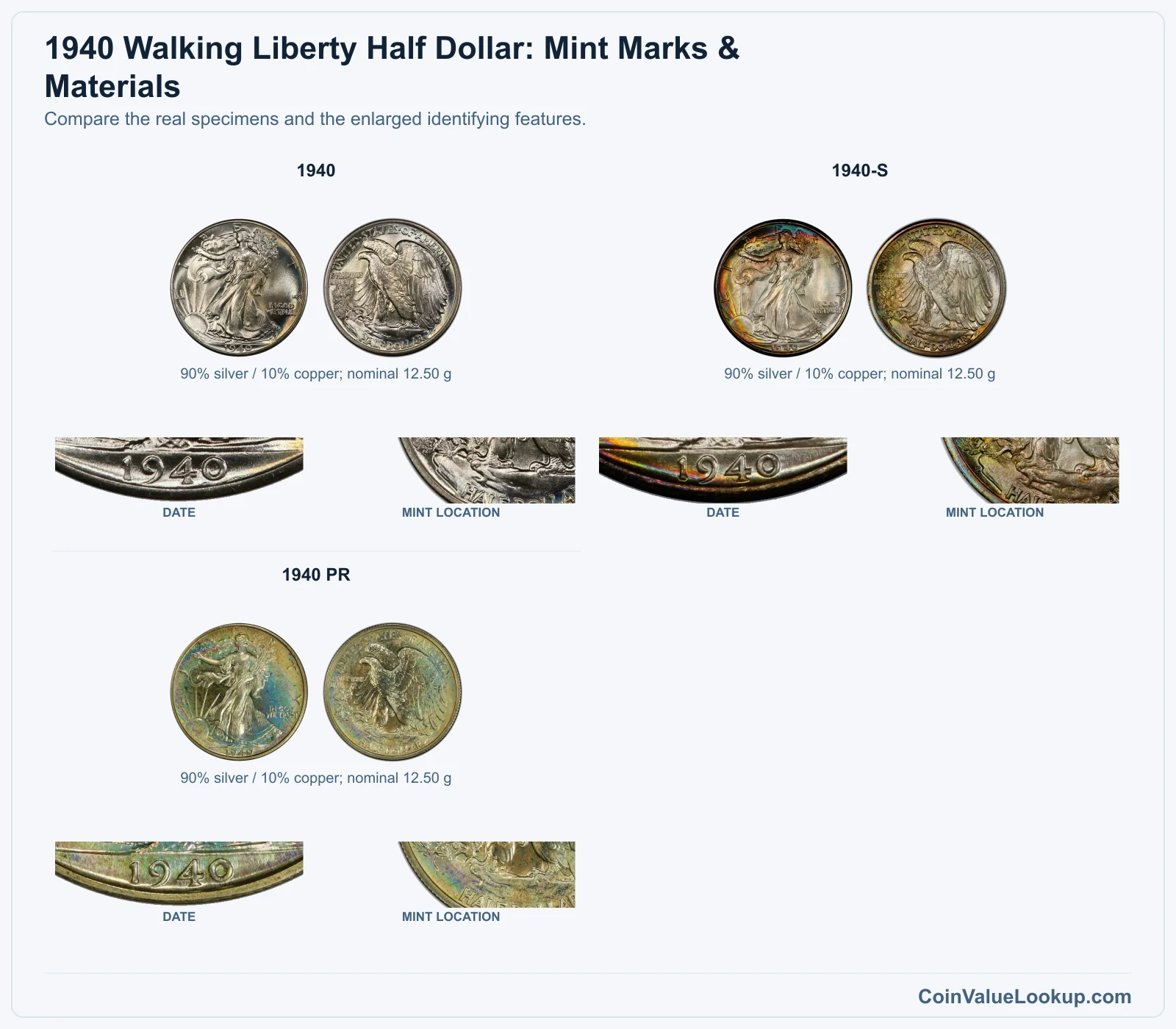
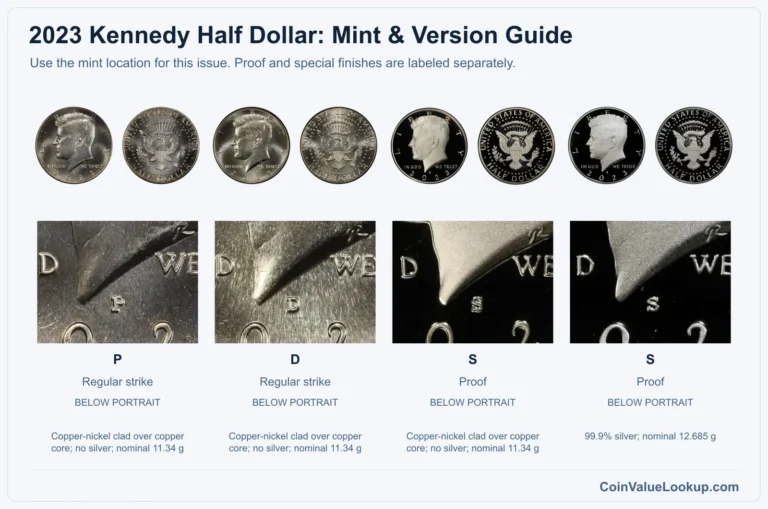
The 1940 Walking Liberty Half Dollar is struck in 90% silver and 10% copper, weighing a nominal 12.50 g. Toning or color changes do not alter the underlying alloy.
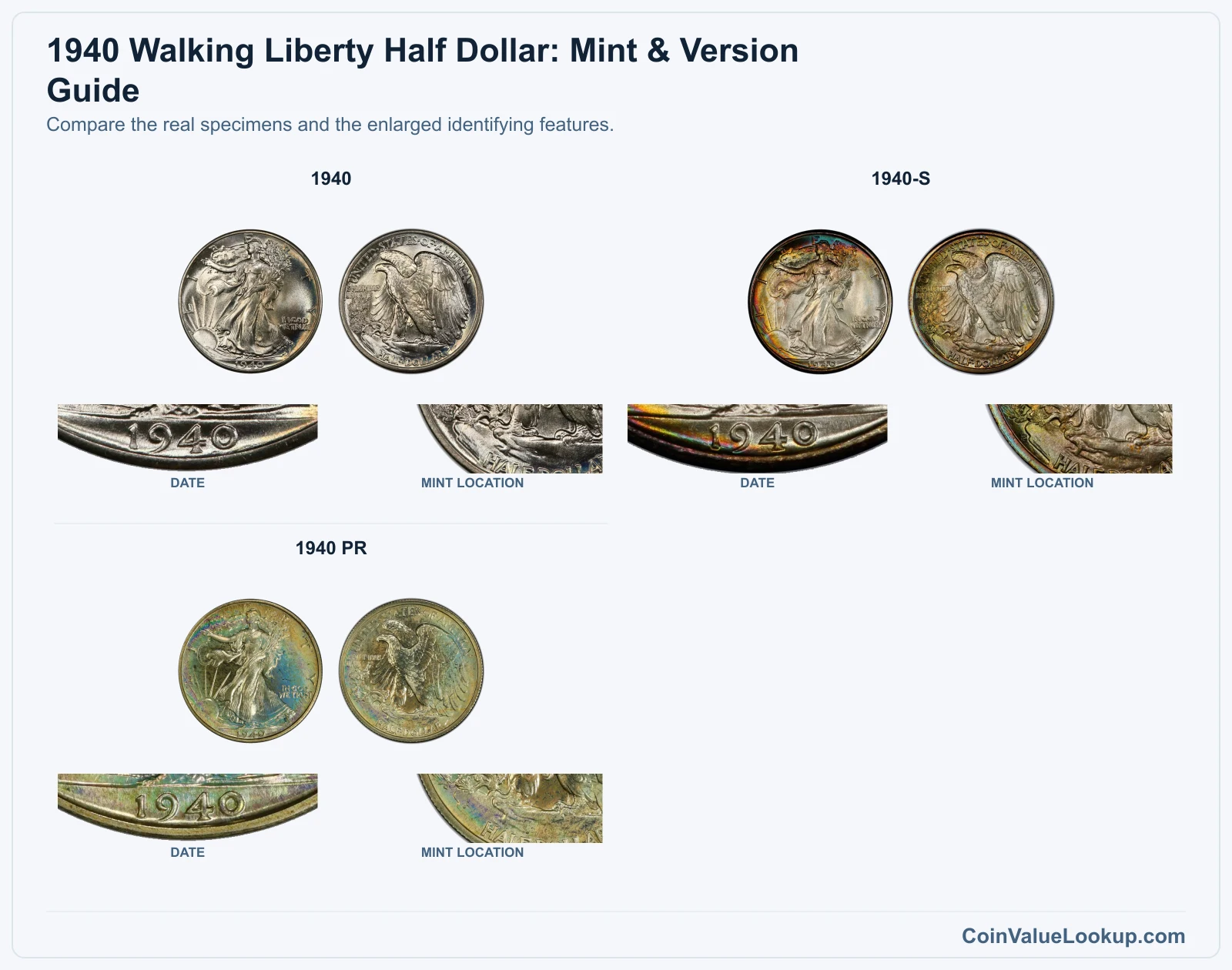
For this date, three branches exist: the 1940 Philadelphia business strike, the 1940-S from San Francisco, and the 1940 Philadelphia proof. Philadelphia coins carry no mintmark.
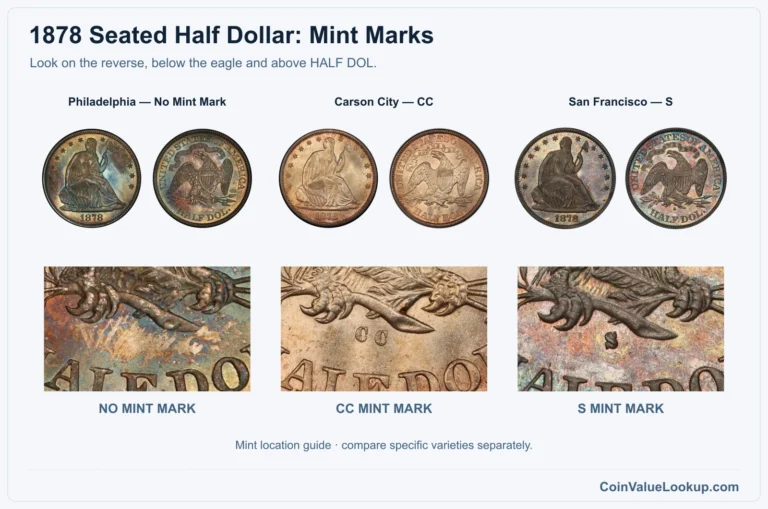
San Francisco coins show a small "S" on the reverse, lower left, near the rim at about the 8 o'clock position.
Do not confuse a polished business strike with a proof. Genuine proofs have deeply mirrored fields and exceptionally sharp device edges that a quick buffing cannot replicate.
If the fields look "shiny but flat" rather than liquid-mirror reflective, you almost certainly have a cleaned business strike.
Separating the two mints on business strikes is straightforward: flip the coin over and look for the S. No letter means Philadelphia.
Step 2: Check Your 1940 Walking Liberty Half Dollar Grade
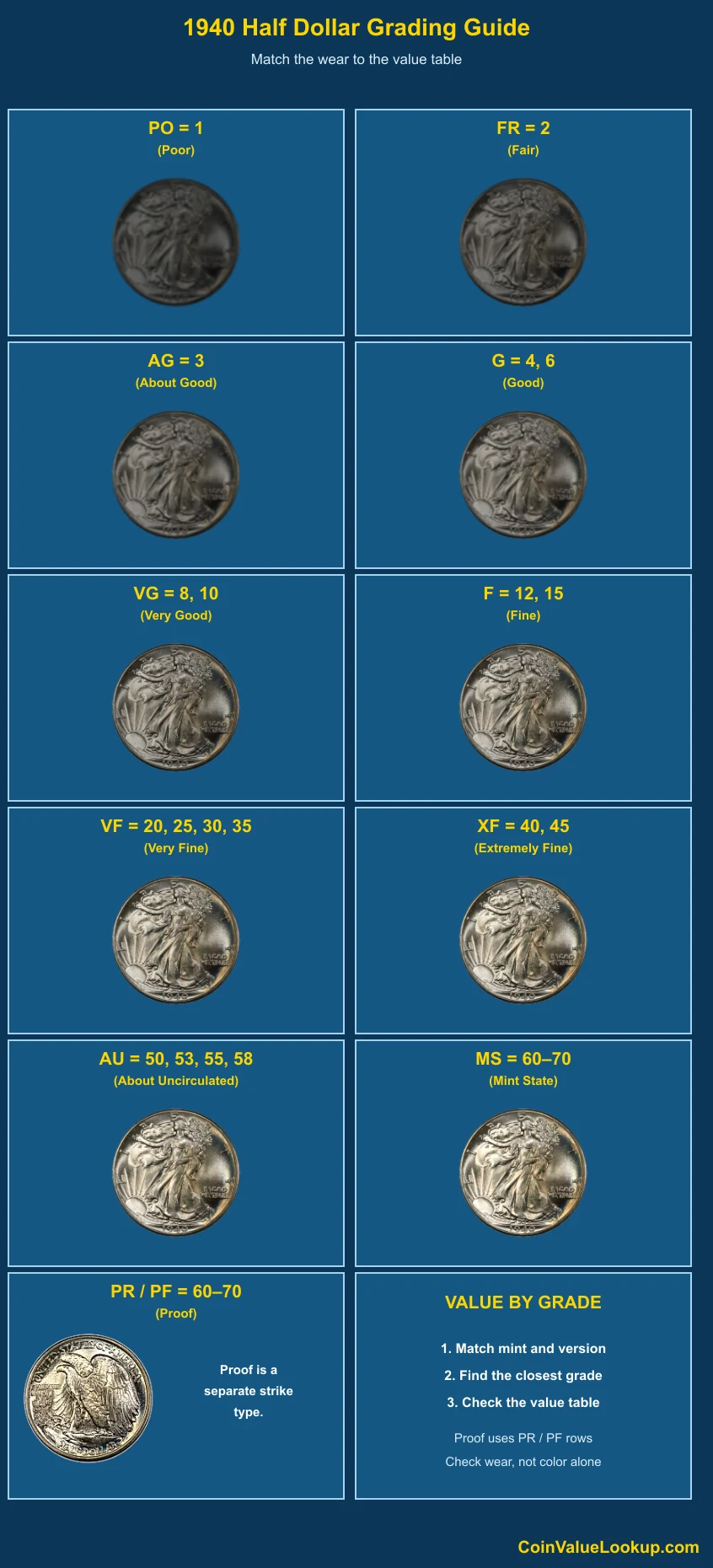
Start with Liberty's head, the hand holding the branches, and the area across her breast and skirt lines. These are the highest points and the first to show smoothing from circulation.
On the reverse, check the eagle's breast feathers, leg and the upper edges of the wings.
Here is the catch with Walkers: weak central strikes are common even on coins that never saw a cash register. A mushy left hand or soft head does not automatically mean the coin is worn.
Look at the surrounding luster instead. If the high points are soft but the fields still carry unbroken cartwheel luster, you likely have a mint-state coin with a mediocre strike, not a circulated one.
Use the comparison image to match your coin's wear pattern against known grade benchmarks. Actual smoothing from contact will interrupt luster in a way that a weak strike does not.
Cleaned or damaged pieces, no matter how much detail remains, trade well below problem-free examples at the same technical grade.
Step 3: Check 1940 Walking Liberty Half Dollar Value by Mint and Version
1940 Walking Liberty Half Dollar
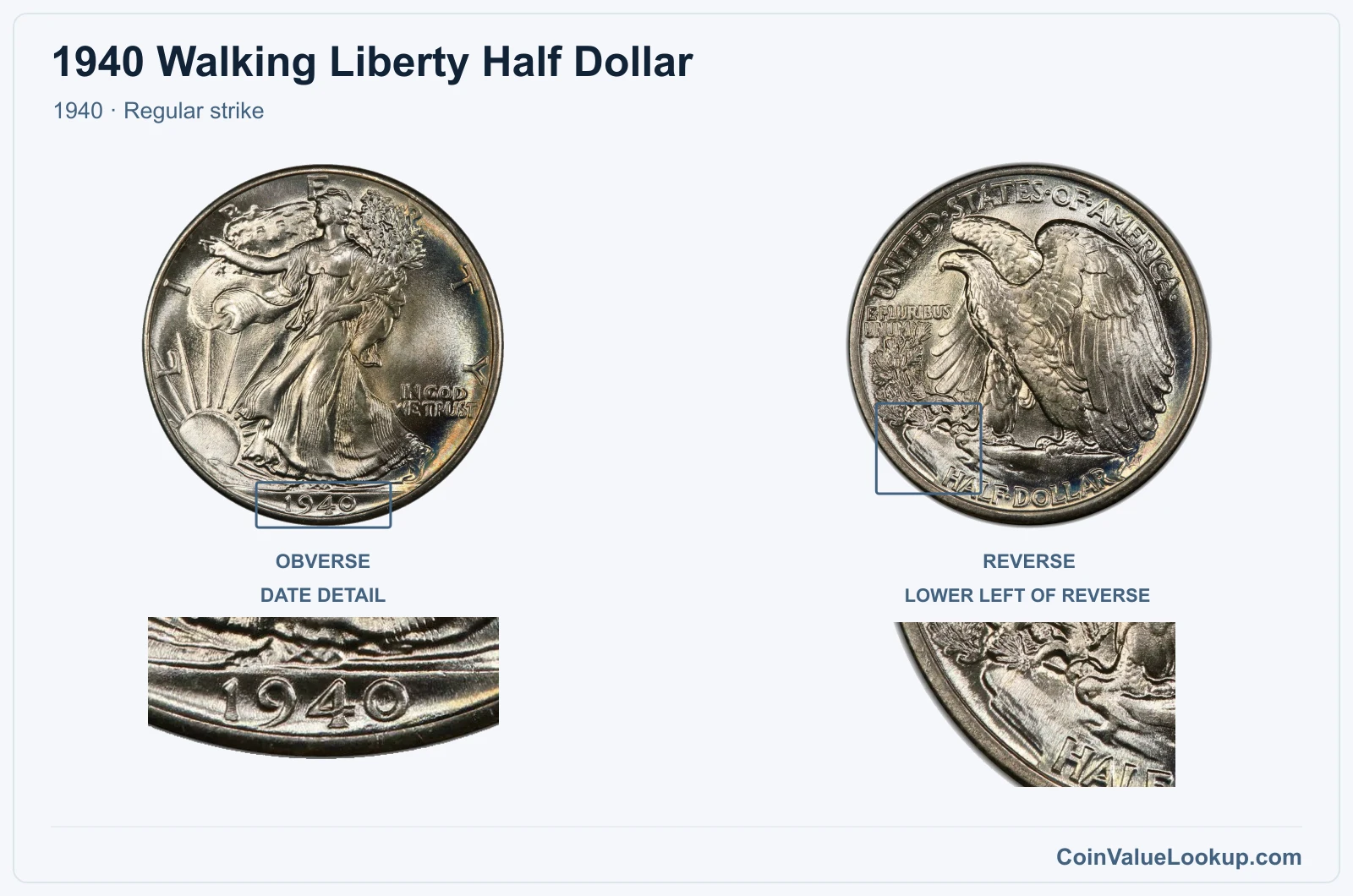
The 1940 Philadelphia business strike has no mintmark. You will find a blank space on the reverse lower left where the San Francisco S would sit.
In G4 condition, guide estimates sit at about $34.00, climbing to roughly $87.00 at MS63 according to USA Coin Book.
Silver content gives the coin a floor value, but do not assume every survivor is equal. Cleaned, scratched or harshly wiped pieces trade below problem-free coins at the same grade.
Strong central detail, full skirt lines and a sharp left hand are the marks of a well-struck example, and those tend to bring stronger bids than flat, mushy strikes even when both technically grade the same.
Range Grade
Price Auction Records Appraisal PO PO 1
—
Coin Identifier FR FR 2
—
Coin Identifier AG AG 3
—
Coin Identifier G G 4
—
Coin Identifier
G 6
—
Coin Identifier VG VG 8
—
Coin Identifier
VG 10
—
Coin Identifier F F 12
—
Coin Identifier
F 15
—
Coin Identifier VF VF 20
—
Coin Identifier
VF 25
—
Coin Identifier
VF 30
—
Coin Identifier
VF 35
—
Coin Identifier XF XF 40
Coin Identifier
XF 45
—
Coin Identifier AU AU 50
—
Coin Identifier
AU 53
—
Coin Identifier
AU 55
—
Coin Identifier
AU 58
Coin Identifier MS MS 60
—
Coin Identifier
MS 61
Coin Identifier
MS 62
Coin Identifier
MS 63
Coin Identifier
MS 64
Coin Identifier
MS 65
Coin Identifier
MS 66
Coin Identifier
MS 67
Coin Identifier
MS 68
Coin Identifier
MS 69
—
—
—
MS 70
—
—
—
1940 Walking Liberty Half Dollar — S
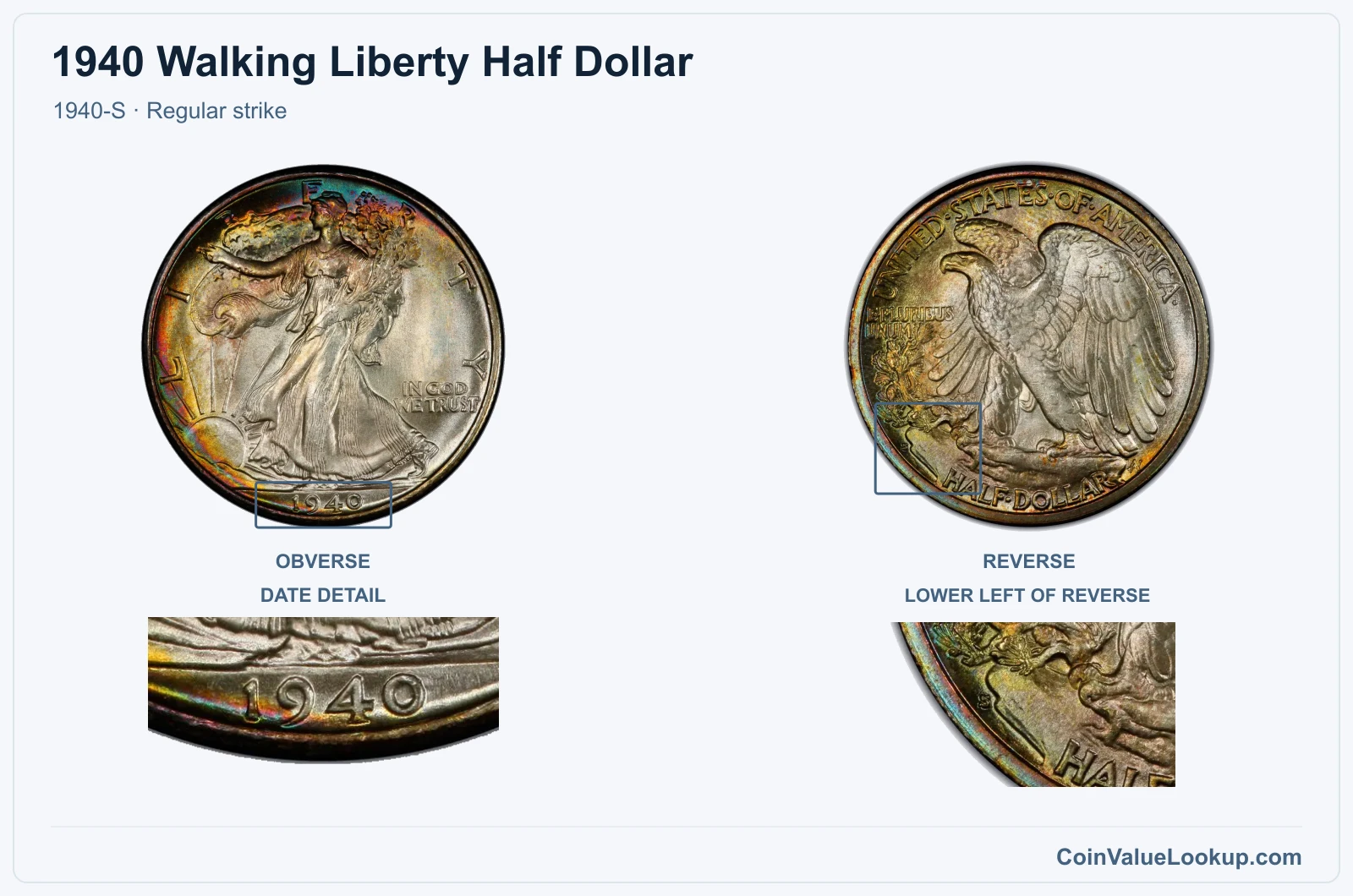
Look for the small "S" mintmark on the reverse, lower left, to confirm you have the San Francisco issue. In G4 the guide estimate matches the Philadelphia at $34.00, but at MS63 the 1940-S pulls ahead at about $118.00 per USA Coin Book.
That premium over the Philly coin reflects the collector preference for the S-mint in higher grades. Original, untampered surfaces are key.
A coin that has been dipped or polished may look bright, but experienced buyers spot it quickly and discount accordingly.
Coin Value Lookup is a handy starting point if you want to compare this date against other Walking Liberty halves or different denominations entirely. It can help you zero in on the right guide for your specific coin.
Range Grade
Price Auction Records Appraisal PO PO 1
—
Coin Identifier FR FR 2
—
Coin Identifier AG AG 3
—
Coin Identifier G G 4
—
Coin Identifier
G 6
—
Coin Identifier VG VG 8
—
Coin Identifier
VG 10
—
Coin Identifier F F 12
—
Coin Identifier
F 15
—
Coin Identifier VF VF 20
—
Coin Identifier
VF 25
—
Coin Identifier
VF 30
—
Coin Identifier
VF 35
—
Coin Identifier XF XF 40
—
Coin Identifier
XF 45
—
Coin Identifier AU AU 50
—
Coin Identifier
AU 53
—
Coin Identifier
AU 55
—
Coin Identifier
AU 58
Coin Identifier MS MS 60
Coin Identifier
MS 61
Coin Identifier
MS 62
Coin Identifier
MS 63
Coin Identifier
MS 64
Coin Identifier
MS 65
Coin Identifier
MS 66
Coin Identifier
MS 67
Coin Identifier
MS 68
—
—
—
MS 69
—
—
—
MS 70
—
—
—
1940 Walking Liberty Half Dollar — PR
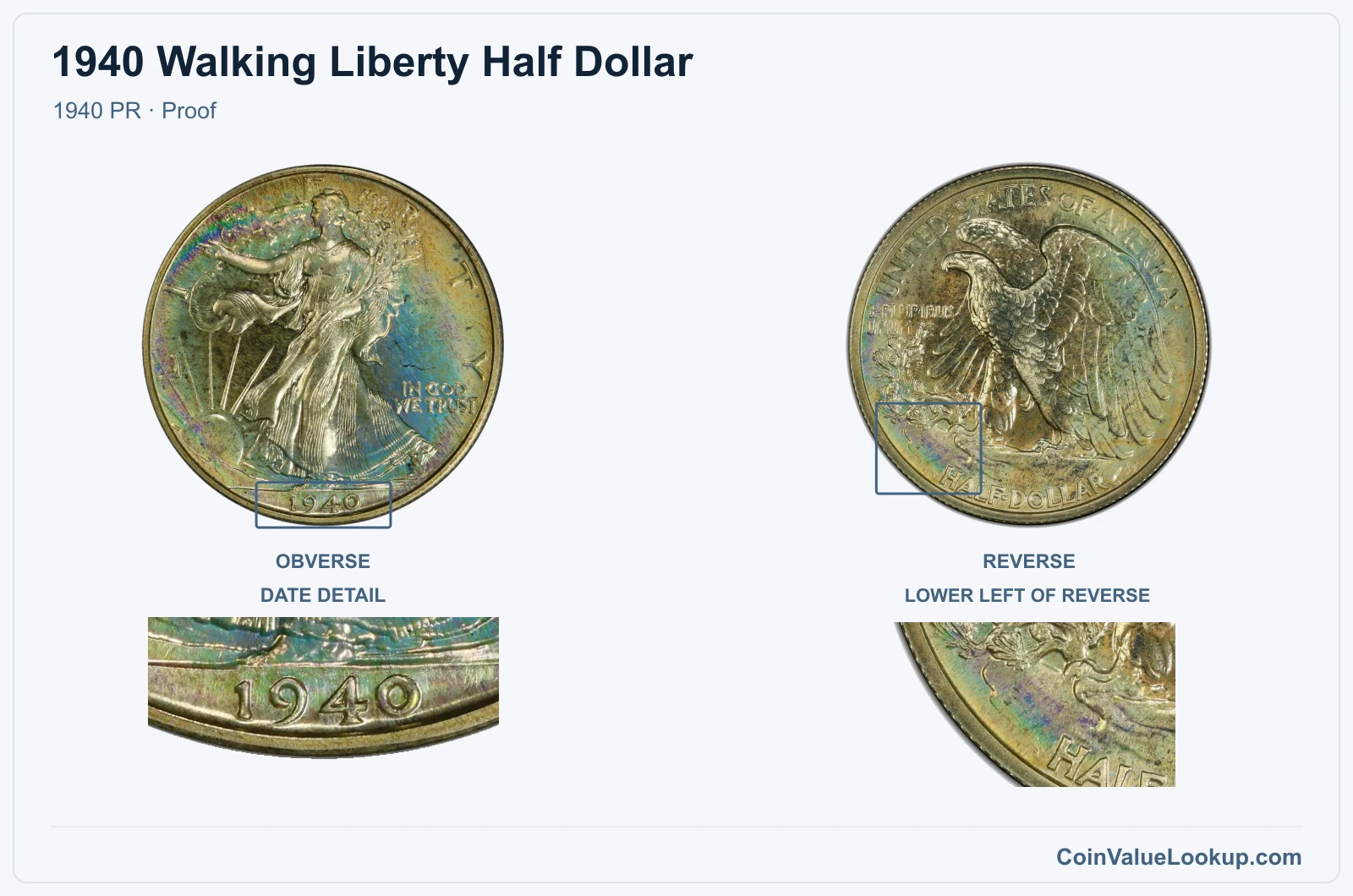
The 1940 proof was struck at Philadelphia for collectors, not for circulation. It carries no mintmark, just like the regular business strike, so you need to look at the surfaces themselves.
Genuine proofs display deeply mirrored fields that act almost like a dark mirror, with design elements standing out in sharp relief.
At PR65, the USA Coin Book guide estimate is $808.00, making this the highest-valued branch for the 1940 date. Hairlines, haze and fingerprints all drag a proof's grade down quickly, so handling and storage history matter enormously.
Cameo contrast, where the devices appear frosty against mirror fields, can further affect desirability, but confirm this through professional assessment rather than assumption. A polished business strike is not a proof, no matter how reflective it looks.
Range Grade
Price Auction Records Appraisal PR PR 1
—
Coin Identifier
PR 2
—
Coin Identifier
PR 3
—
Coin Identifier
PR 4
—
Coin Identifier
PR 6
—
Coin Identifier
PR 8
—
Coin Identifier
PR 10
—
Coin Identifier
PR 12
—
Coin Identifier
PR 15
—
Coin Identifier
PR 20
—
Coin Identifier
PR 25
—
Coin Identifier
PR 30
—
Coin Identifier
PR 35
—
Coin Identifier
PR 40
—
Coin Identifier
PR 45
—
Coin Identifier
PR 50
—
Coin Identifier
PR 53
—
Coin Identifier
PR 55
—
Coin Identifier
PR 58
—
Coin Identifier
PR 60
Coin Identifier
PR 61
Coin Identifier
PR 62
Coin Identifier
PR 63
Coin Identifier
PR 64
Coin Identifier
PR 65
Coin Identifier
PR 66
Coin Identifier
PR 67
Coin Identifier
PR 68
Coin Identifier
PR 69
—
—
—
PR 70
—
—
—
1940 Walking Liberty Half Dollar Error List
1. 1940 Walking Liberty Half Dollar — Doubled Die Obverse
A doubled die obverse on the 1940 Walking Liberty half shows consistent doubling on obverse design elements, such as letters in the legends or portions of Liberty's figure. The key word is consistent: the separation or notching will repeat in the same direction across affected areas.
Under magnification, compare suspect letters or design contours against a known normal coin photographed in matching light. Genuine hub doubling produces shelf-like separation with distinct edges.
Machine doubling, by contrast, tends to look flat and shelf-less, more like a smeared shadow than a true second impression.
No specific price range is adopted for this variety. Value depends on the degree of doubling visible, overall coin condition and collector demand for the particular die pair.
2. 1940 Walking Liberty Half Dollar — Doubled Die Reverse
A doubled die reverse affects the back of the coin. Check the reverse legends, the eagle's feathers and the lettering around the rim for signs of consistent separation or notching that appears on multiple design elements in the same directional pattern.
Get a close-up photo next to a normal 1940 reverse at the same magnification. If the doubling shifts direction from one letter to the next, or looks like flat displacement without raised edges, you are probably seeing machine doubling or die deterioration rather than a true doubled die.
No adopted price range exists for this variety. The coin's worth hinges on the strength and location of the doubling, plus the overall grade and surface quality.
3. 1940 Walking Liberty Half Dollar — Double / Multiple Strike
A double strike or multiple strike means the coin received more than one impression from the dies, often with slight misalignment between hits. The result is two (or more) overlapping but visibly separate impressions of the full design, sometimes rotated or offset from each other.
This is dramatically different from a doubled die, which affects lettering or device contours but still shows a single overall coin shape. A genuine double strike can leave the coin looking like two coins were stamped on top of each other.
Watch for post-mint damage that mimics this effect, such as vise marks or deliberate re-striking outside the mint. No numerical price is adopted.
Value depends on the degree of displacement, condition and how visually dramatic the error is.
4. 1940 Walking Liberty Half Dollar — Lamination / Split Planchet
Lamination errors appear as peeling, flaking or separated layers within the metal of the planchet. On a 1940 half dollar you might see a raised flap of silver that can be gently lifted, or a missing section where metal has broken away entirely, exposing a slightly different texture underneath.
Photograph both the affected face and the coin's edge together, because the edge often reveals how deep the separation goes. This helps distinguish a genuine lamination from surface corrosion, scraping or deliberate alteration.
Corrosion pits or chemical damage can look superficially similar but will not show the clean, layered separation of a true lamination. No specific price range is adopted for this error.
Larger, more dramatic separations with the flap still retained tend to draw more collector interest.
5. 1940 Walking Liberty Half Dollar — Die Crack / Die Chip
Die cracks show up as thin raised lines on the coin's surface, formed when a crack in the steel die transfers as a ridge of metal during striking. Die chips appear as small raised blobs, typically inside letters or near design elements.
A die break that connects to the rim and displaces a section of the design is sometimes called a cud.
These are raised features, not incuse. If the line is recessed into the surface, you are looking at a scratch or tool mark, not a die crack.
Corrosion or encrusted debris can also mimic a raised line, so check under magnification.
No adopted price range applies here. Collector interest tends to scale with the size and location of the crack or chip, and whether the coin is otherwise problem-free.
6. 1940 Walking Liberty Half Dollar — Repunched Mintmark
A repunched mintmark on the 1940-S would show remnants of a prior mintmark punch position near or under the final S on the reverse. You might see a faint trace of a second S slightly offset, or a notch along one edge of the letter where the first punch landed.
This error applies only to mintmarked coins. Philadelphia strikes and proofs carry no mintmark, so they cannot exhibit an RPM.
Compare your S at magnification against a normal 1940-S at the same scale. Machine doubling near the mintmark can look similar but usually produces flat, shelf-like distortion rather than a clearly separate letter trace.
Die chips or corrosion around the mintmark can also fool the eye. No numerical price is adopted for this variety.
7. 1940 Walking Liberty Half Dollar — Struck-Through Error
A struck-through error occurs when foreign material, such as grease, a thread, a metal fragment or debris, sits between the die and the planchet during striking. The result is a localized depression or area of incomplete design on the finished coin, sometimes preserving an impression of whatever was trapped.
Grease-filled dies produce smooth, flat missing detail. A retained foreign object leaves a more distinct, often irregular impression.
Both are legitimate mint errors, but they look quite different and collectors sometimes treat them as separate categories.
Do not confuse ordinary weak strikes, post-mint scratches or cleaning wear with struck-through impressions. The affected area on a genuine struck-through will be confined and often have well-defined borders.
No adopted price range exists; value depends on the size, clarity and visual appeal of the impression.