1947 Walking Liberty Half Dollar Coin Value: How Much Is It Worth?
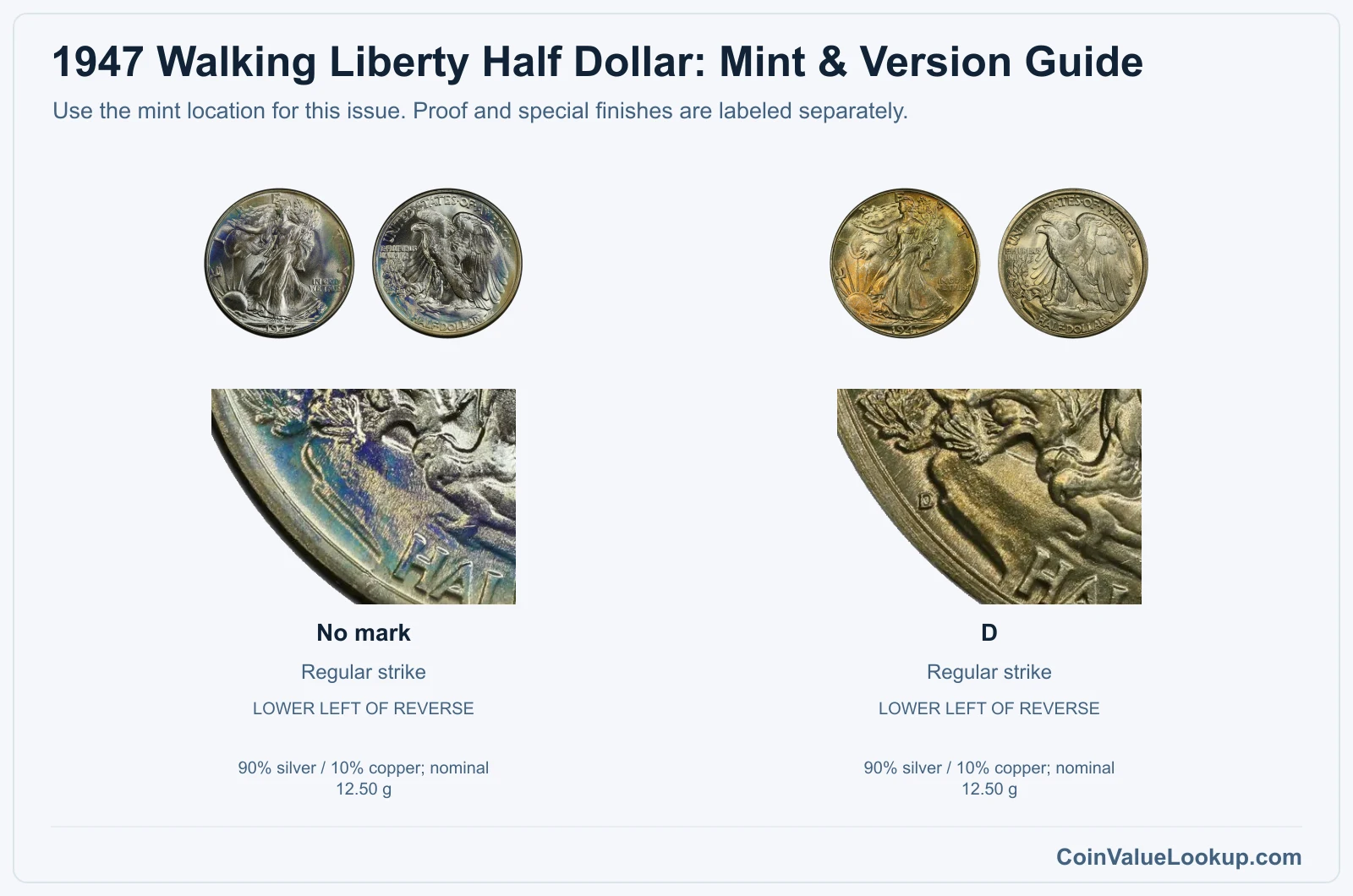
The 1947 Walking Liberty Half Dollar is a 90% silver coin struck in the final year of the series. Guide estimates from USA Coin Book place these across a range of roughly $34.00 to $91.00 depending on mint and grade, though these are not guaranteed selling prices.
Your coin's actual worth depends on which mint produced it, its condition and whether it carries any original surfaces or mint-made anomalies.
Fast Way to Identify Your 1947 Walking Liberty Half Dollar
The quickest way to start figuring out what you have is to upload clear photos of the front and back of your coin. Our identifier can offer a preliminary identification based on those images, helping you narrow down the mint, version and general condition.
It will not authenticate, certify or assign a precise grade, but it gives you a solid starting point.
1947 Walking Liberty Half Dollar Value
Upload both sides of your 1947 Walking Liberty Half Dollar.
Front Obverse
Upload photo
Back Reverse
Upload photo
Which 1947 Walking Liberty Half Dollar Versions Are Worth Money?
- The 1947 Philadelphia (no mintmark) business strike ranges from about $34.00 in G4 to $91.00 in MS63 per USA Coin Book guide estimates.
- The 1947-D (Denver) business strike carries the same guide range of $34.00 in G4 to $91.00 in MS63, so condition matters more than mint for this date.
- Original, problem-free surfaces at any grade level are key; cleaned or scratched coins trade significantly lower than the guide figures suggest.
- Strong central strikes with full hand and head detail on uncirculated examples may attract added collector interest, since this series often comes weakly struck.
Step 1: Identify Your 1947 Walking Liberty Half Dollar Mint Mark and Version
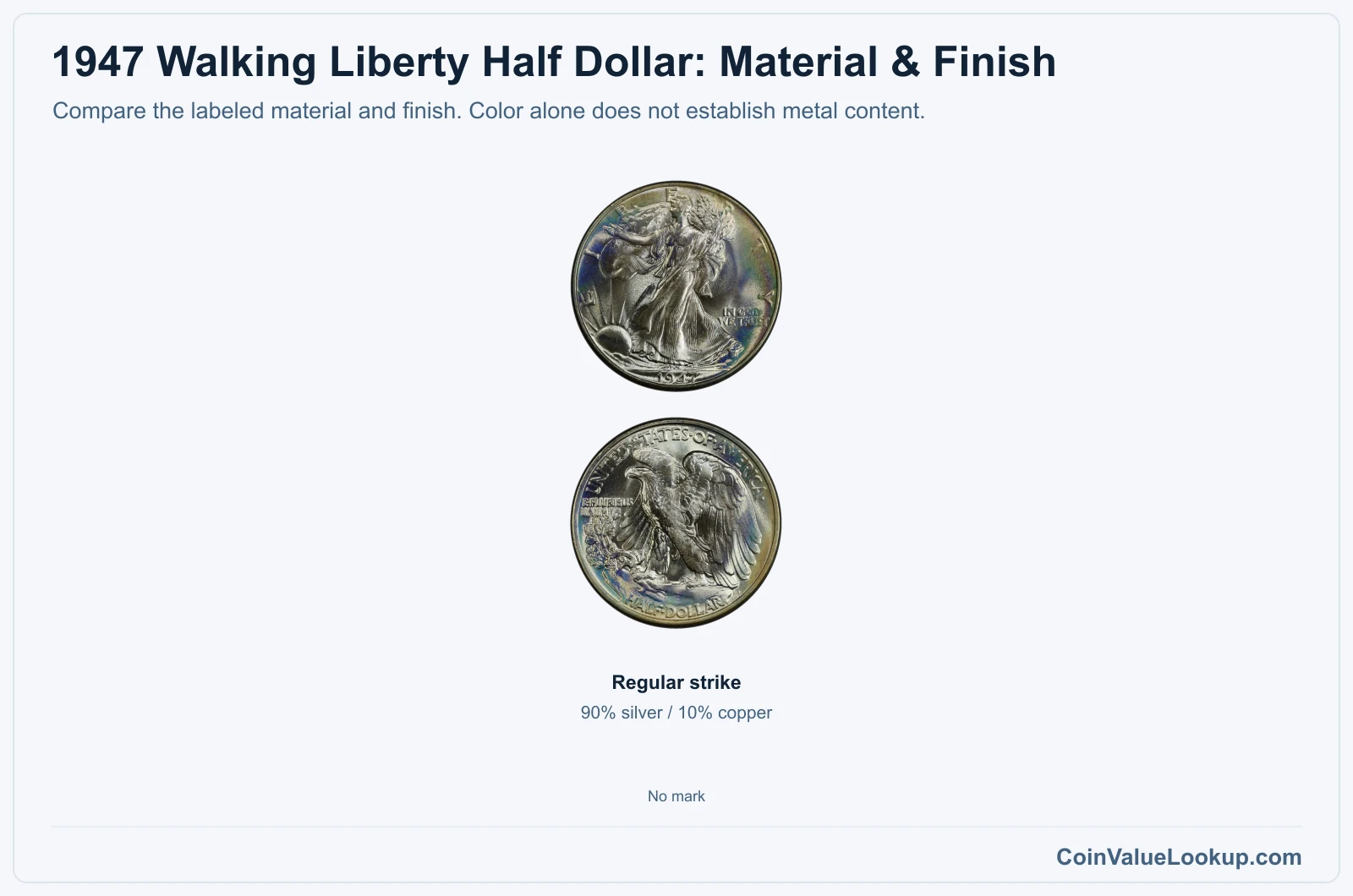
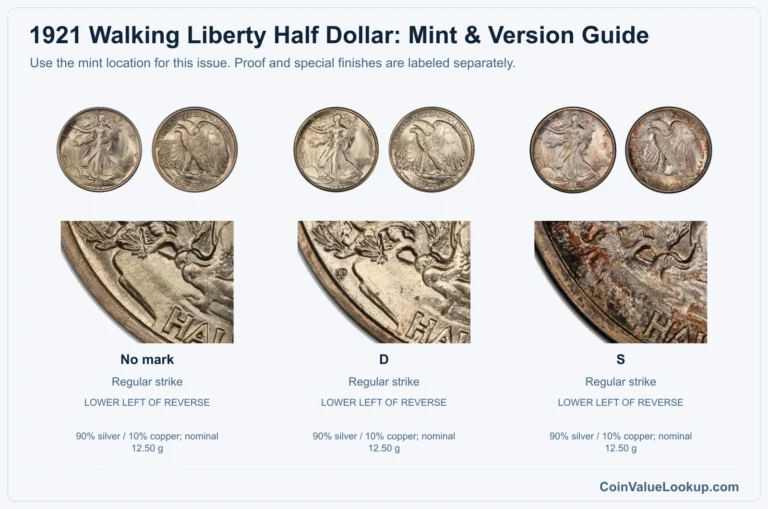
The 1947 Walking Liberty Half Dollar was produced at two facilities: Philadelphia (no mintmark) and Denver (D mintmark). On this date, the mintmark sits on the reverse, at the lower left near the 8 o'clock position.
If you see no mintmark there, you have a Philadelphia coin.
Both versions are struck in 90% silver and 10% copper, weighing about 12.50 grams. Toning, whether golden or dark, does not change the underlying alloy.
A magnet test can rule out counterfeits, since genuine silver will not stick.
Strong central details on Walking Liberty halves can be scarce. A weakly defined left hand or incomplete head feathers do not automatically signal heavy wear; this series is notorious for soft strikes in those areas.
Always check luster and actual smoothing before concluding the coin is heavily circulated.
Cleaned or damaged pieces trade well below problem-free examples at any grade, so look for original surfaces: natural luster, undisturbed toning, and no hairlines from polishing.
Step 2: Check Your 1947 Walking Liberty Half Dollar Grade
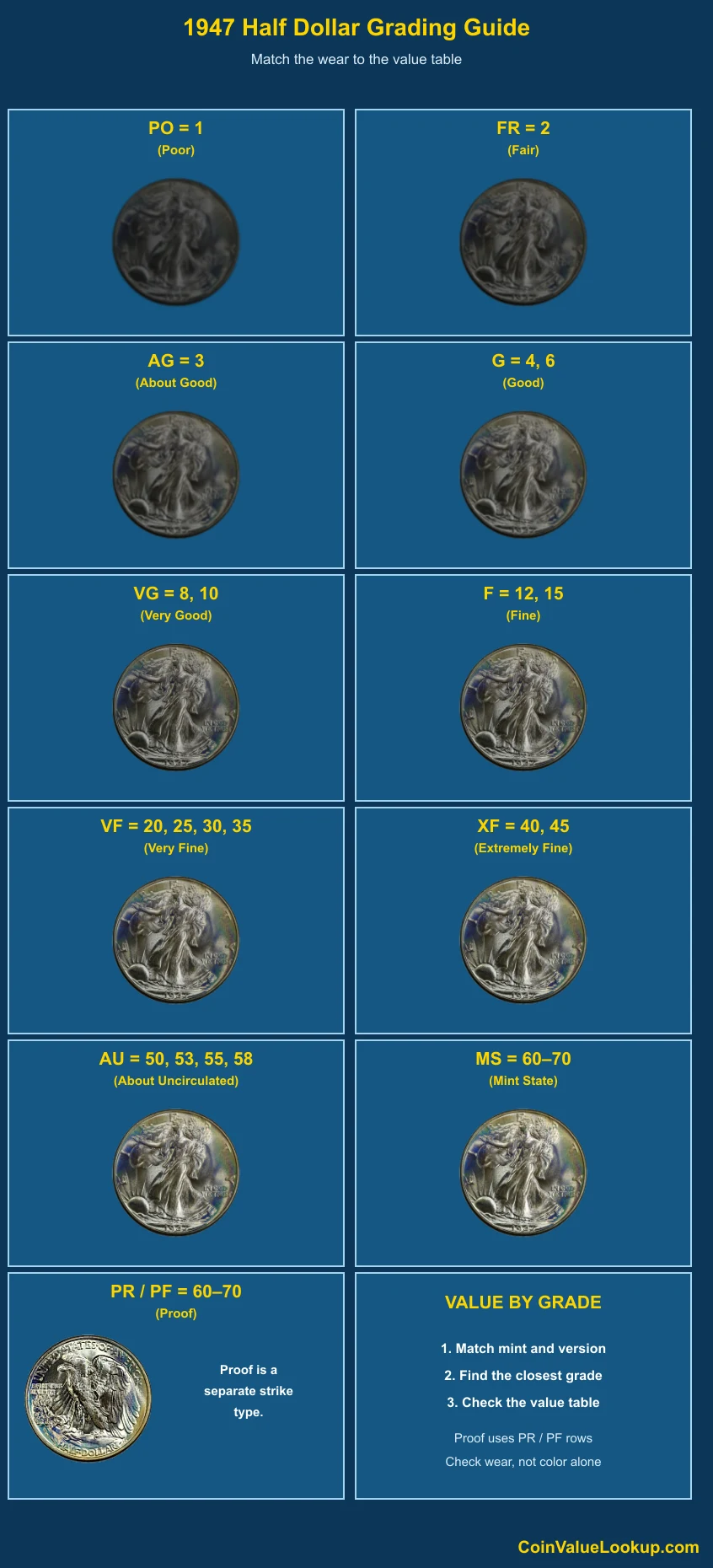
Start by examining Liberty's head, the breast area and the left hand on the obverse. These are the highest points and show wear first.
On the reverse, focus on the eagle's breast feathers, leg feathers and wing tips.
A coin in Good-4 condition will have a fully outlined Liberty figure, but nearly all interior detail is gone. Move up to Fine and you start seeing skirt folds and partial hand details.
Mint State pieces retain full original luster with no smoothing on the high points. Here is where the strike question gets tricky.
Compare your coin to the reference image at a matching grade level.
If the hand and head look soft but the fields still carry unbroken cartwheel luster, you likely have a weakly struck uncirculated coin rather than a worn one. Actual circulation wear creates flat, smooth patches that interrupt luster, while a strike weakness leaves the metal with its original texture intact.
Step 3: Check 1947 Walking Liberty Half Dollar Value by Mint and Version
1947 Walking Liberty Half Dollar
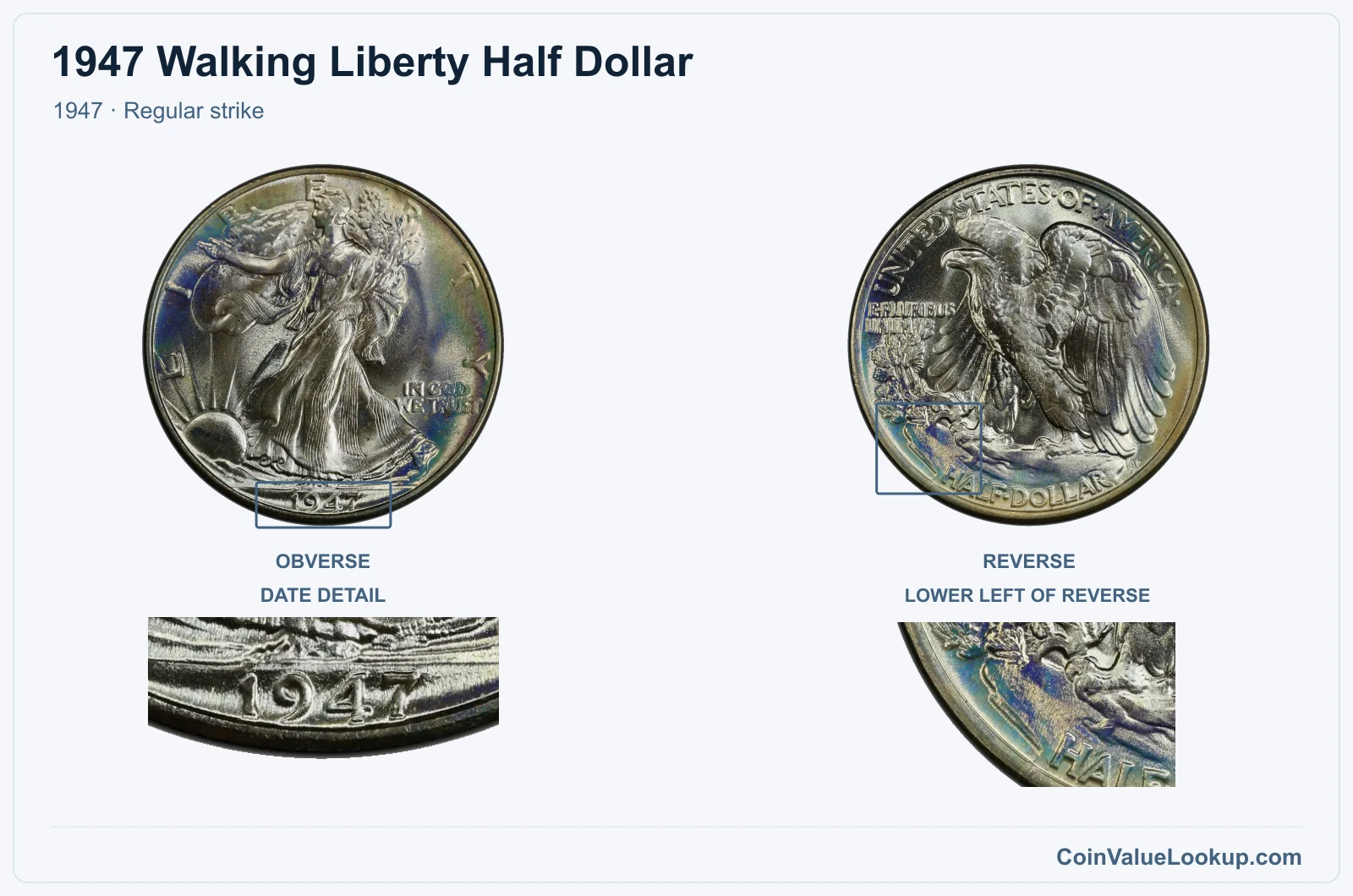
The 1947 Philadelphia half dollar carries no mintmark. You will find the Walking Liberty obverse paired with an eagle perched on a rock on the reverse.
In G4 condition, USA Coin Book estimates about $34.00; in MS63, approximately $91.00. These are guide figures, not guaranteed offers.
Before consulting any price chart, confirm you have a Philadelphia coin by checking the reverse lower left for the absence of a mintmark. Silver content provides a floor of sorts, but a problem-free example with original luster will always outperform a cleaned or damaged piece at the same technical grade.
Coin Value Lookup is a useful starting point if you are working through multiple coins or dates. You can look up guides for other Walking Liberty halves or different series without hunting across a dozen sites.
Range Grade
Price Auction Records Appraisal PO PO 1
—
Coin Identifier FR FR 2
—
Coin Identifier AG AG 3
—
Coin Identifier G G 4
—
Coin Identifier
G 6
—
Coin Identifier VG VG 8
—
Coin Identifier
VG 10
—
Coin Identifier F F 12
—
Coin Identifier
F 15
—
Coin Identifier VF VF 20
—
Coin Identifier
VF 25
—
Coin Identifier
VF 30
—
Coin Identifier
VF 35
—
Coin Identifier XF XF 40
—
Coin Identifier
XF 45
—
Coin Identifier AU AU 50
—
Coin Identifier
AU 53
—
Coin Identifier
AU 55
—
Coin Identifier
AU 58
Coin Identifier MS MS 60
—
Coin Identifier
MS 61
Coin Identifier
MS 62
Coin Identifier
MS 63
Coin Identifier
MS 64
Coin Identifier
MS 65
Coin Identifier
MS 66
Coin Identifier
MS 67
Coin Identifier
MS 68
Coin Identifier
MS 69
—
—
—
MS 70
—
—
—
1947 Walking Liberty Half Dollar — D
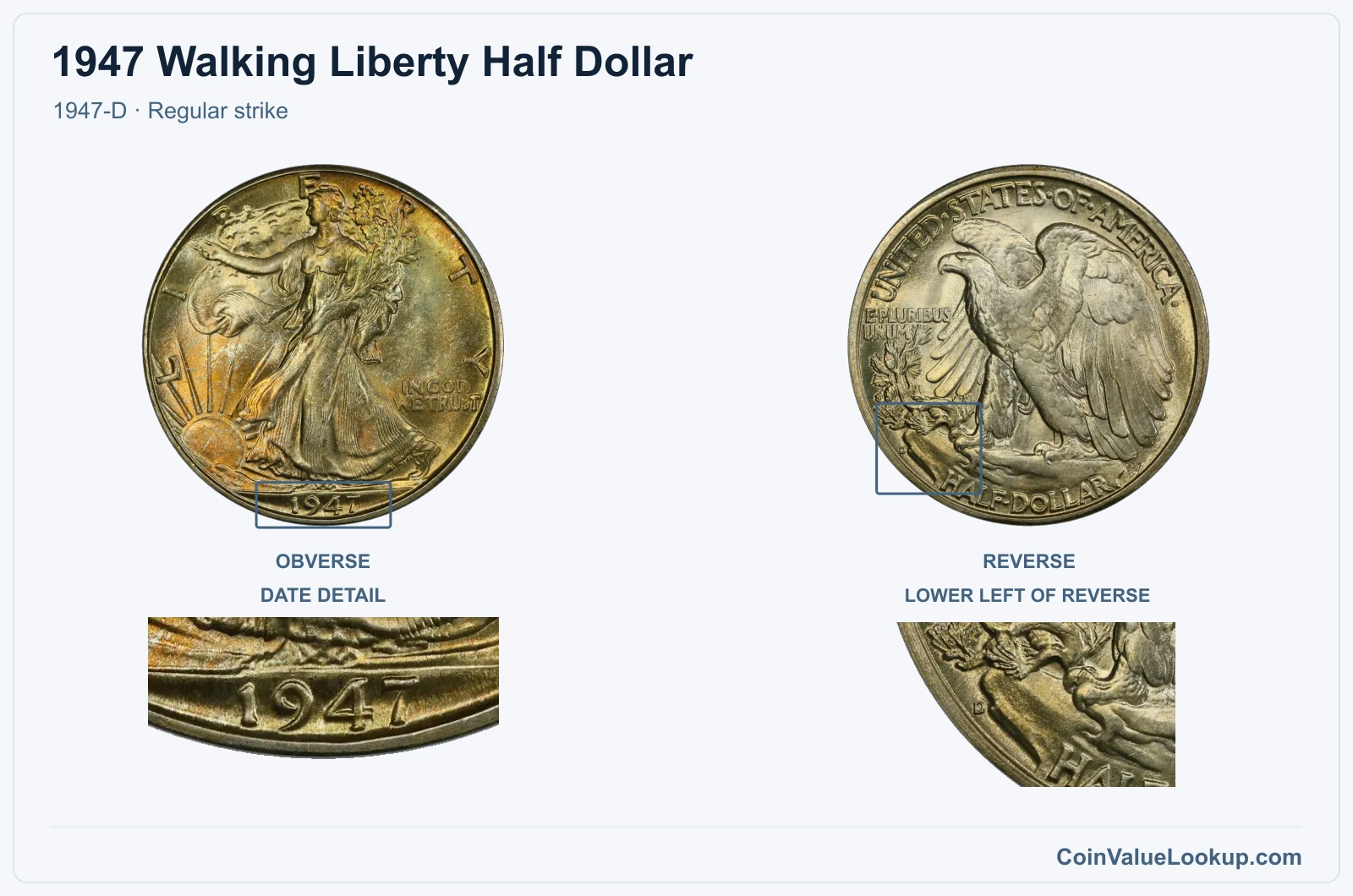
The 1947-D was struck at the Denver Mint and carries a small D on the reverse at the lower left. Same 90% silver composition, same 12.50-gram nominal weight, same design as the Philadelphia issue.
USA Coin Book guide estimates place the 1947-D at about $34.00 in G4 and $91.00 in MS63. These are not buy-it-now prices; actual transactions depend on eye appeal, originality and market timing.
When identifying this coin, make sure the D is genuinely part of the die impression and not a tooled addition. A real mintmark has consistent depth and style that matches the surrounding design elements.
Damaged or cleaned 1947-D halves lose much of the premium above their silver weight, so original surfaces are worth preserving.
Range Grade
Price Auction Records Appraisal PO PO 1
—
Coin Identifier FR FR 2
—
Coin Identifier AG AG 3
—
Coin Identifier G G 4
—
Coin Identifier
G 6
—
Coin Identifier VG VG 8
—
Coin Identifier
VG 10
—
Coin Identifier F F 12
—
Coin Identifier
F 15
—
Coin Identifier VF VF 20
—
Coin Identifier
VF 25
—
Coin Identifier
VF 30
—
Coin Identifier
VF 35
—
Coin Identifier XF XF 40
Coin Identifier
XF 45
—
Coin Identifier AU AU 50
—
Coin Identifier
AU 53
—
Coin Identifier
AU 55
—
Coin Identifier
AU 58
Coin Identifier MS MS 60
Coin Identifier
MS 61
—
Coin Identifier
MS 62
Coin Identifier
MS 63
Coin Identifier
MS 64
Coin Identifier
MS 65
Coin Identifier
MS 66
Coin Identifier
MS 67
Coin Identifier
MS 68
—
—
—
MS 69
—
—
—
MS 70
—
—
—
1947 Walking Liberty Half Dollar Error List
1. 1947 Walking Liberty Half Dollar — Lamination / Split Planchet
Lamination errors on the 1947 Walking Liberty Half Dollar appear as peeling, flaking or separating layers of metal on the coin's surface. You might see a retained flap that lifts away from the body of the coin, or a missing section where the flap has already broken off.
Photograph the affected area alongside the edge to show the depth of the separation. This helps distinguish a genuine lamination from surface corrosion, post-mint scraping or a deliberately altered coin.
Corrosion tends to pit randomly across the surface rather than peel in a coherent layer.
No specific price data is available for this error on the 1947 date. Value depends on the size, location and visibility of the defect, along with the coin's overall condition.
A small hidden flap matters less than a large, dramatic peel across Liberty's figure.
2. 1947 Walking Liberty Half Dollar — Doubled Die Obverse
A doubled die obverse on the 1947 Walking Liberty Half Dollar would show consistent doubling on obverse design elements such as letters, the date or parts of Liberty's figure. The key word is consistent: the separation or notching should repeat in the same direction across multiple features.
Compare suspect areas against a known normal example under the same lighting and magnification. Genuine hub doubling produces a distinct secondary image with rounded profiles, while machine doubling leaves flat, shelf-like distortions that lack depth.
Reflections or worn die contours can also mimic doubling at first glance, so take your time. No specific pricing is available for a DDO on this date.
Value depends on the strength of the doubling, the affected area and the coin's grade.
3. 1947 Walking Liberty Half Dollar — Doubled Die Reverse
A doubled die reverse on a 1947 Walker would show duplicated or notched design elements on the eagle side of the coin. Check the lettering in HALF DOLLAR and UNITED STATES OF AMERICA, as well as the eagle's wing and tail feather outlines.
Compare what you see against a normal reverse under matched magnification and lighting. True hub doubling shows rounded, separated profiles.
Machine doubling, by contrast, produces flat shelves with no real depth, and it is far more common.
Random damage or corrosion can also look like doubling to an untrained eye. Close-up photography is your friend here.
No adopted price range exists for this error on the 1947 date. The value of any confirmed DDR depends on the visibility and location of the doubling plus the coin's overall condition.
4. 1947 Walking Liberty Half Dollar — Repunched Mintmark
A repunched mintmark on the 1947 Walking Liberty Half Dollar would only apply to the Denver issue, since Philadelphia coins carry no mintmark. Look at the D on the reverse lower left for traces of a second punch position: a shadow, partial letter outline or offset remnant near the primary D.
Use magnification and compare your coin's mintmark against a normal 1947-D at the same scale. A genuine RPM shows a clearly displaced second impression, while a die chip adds irregular metal and corrosion creates uneven pitting.
Machine doubling can also affect a mintmark, but it typically leaves a flat, shelf-like distortion rather than a fully formed secondary letter. No specific pricing exists for an RPM on this date; value depends on the clarity of the repunching and the coin's grade.
5. 1947 Walking Liberty Half Dollar — Off-Center Strike
An off-center strike happens when the coin blank is not properly seated between the dies during striking. The result is a displaced design with a blank crescent of unstruck metal on one side.
On a 1947 Walking Liberty Half Dollar, look for a visible shift of the entire design away from center. The date should still be readable for the coin to have much collector appeal.
Minor off-center strikes of just a few percent are more common than dramatic ones.
Do not confuse an off-center strike with a clipped planchet or a coin that has been flattened after minting. A genuine off-center piece shows a complete rim on one side and none on the other, with the design naturally trailing off.
No adopted price exists for this error on the 1947 date. Condition, percentage of offset and date visibility all factor into value.
6. 1947 Walking Liberty Half Dollar — Clipped Planchet
A clipped planchet error means the coin blank was incomplete before striking. You will see a missing curved, straight or irregular section along the edge, and the design may show weakness directly opposite the clip due to uneven metal flow during the strike.
On a 1947 Walking Liberty Half Dollar, examine the edge texture near the missing section. A genuine clip typically has a smooth, slightly concave boundary that was created when the blank was punched from strip metal.
Post-mint damage such as filing, cutting or corrosion leaves rough or angular edges that look quite different.
The Blakesley effect, a zone of weakness opposite the clip, is a helpful confirming sign. No specific price data is available for this error on the 1947 date.
Value depends on clip size, shape and the coin's overall grade.
7. 1947 Walking Liberty Half Dollar — Wrong Planchet / Off-Metal Strike
A wrong planchet or off-metal strike means the 1947 Walking Liberty Half Dollar design was impressed onto a blank intended for a different denomination or composition. The coin would differ noticeably in weight, diameter or edge characteristics compared to the standard 12.50-gram, 90% silver half dollar.
Weigh and measure any suspect coin carefully. If the design is incomplete or the coin looks undersized, compare it against known specifications for other denominations of the era.
Do not assume a different metal based on color alone; plating, corrosion and acid treatments can change a coin's appearance.
No adopted price range exists for this error on the 1947 date. Any confirmed wrong planchet strike would need professional authentication, since deliberate alterations are common.
Value depends on the specific planchet involved and the coin's condition.
8. 1947 Walking Liberty Half Dollar — Double / Multiple Strike
A double or multiple strike on the 1947 Walking Liberty Half Dollar shows two or more distinct impressions of the design, typically displaced or rotated from each other. This is different from a doubled die, which affects every coin struck by that die.
A double strike is a unique event for that individual coin.
Look for clearly separated design outlines, especially in the lettering and major devices, that appear at different angles or positions. Post-mint damage such as vice marks or counter-stamping can mimic a second strike, but genuine double strikes show full die impressions with proper depth and detail.
No specific pricing is available for this error on the 1947 date. Condition and the degree of displacement between strikes both influence value.
Professional authentication is strongly recommended for any suspected double strike.