1945 Jefferson Nickel Coin Value: How Much Is It Worth?
The 1945 Jefferson nickel is a wartime silver coin, and even well-circulated examples carry a bit of a kick. Guide estimates for ordinary pieces in VF20 condition run about $5.34–$5.80 depending on mint, while uncirculated MS65 coins reach around $28.
Those figures cover normal business strikes from the Philadelphia, Denver, and San Francisco mints. Proof coins were not produced this year.
Separate categories like Full Steps designations, authenticated doubled dies, and wrong-planchet errors each follow their own pricing, so condition and variety matter a great deal.
Fast Way to Identify Your 1945 Jefferson Nickel
The quickest way to start figuring out what you have is to upload clear photos of the front and back of your 1945 nickel. That lets us run a preliminary identification based on the mintmark location, surface condition, and any visible oddities.
Good lighting and a steady shot go a long way toward a useful result.
1945 Jefferson Nickel Value
Upload both sides of your 1945 Jefferson Nickel.
Front Obverse
Upload photo
Back Reverse
Upload photo
Which 1945 Jefferson Nickel Versions Are Worth Money?
- Uncirculated examples with undisturbed luster and strong Monticello steps can command a premium, but a Full Steps designation should be confirmed by a grading service before applying those higher comparables.
- All 1945 nickels contain 35% silver, giving them intrinsic metal value that fluctuates with silver prices, so even heavily worn coins are worth more than face value.
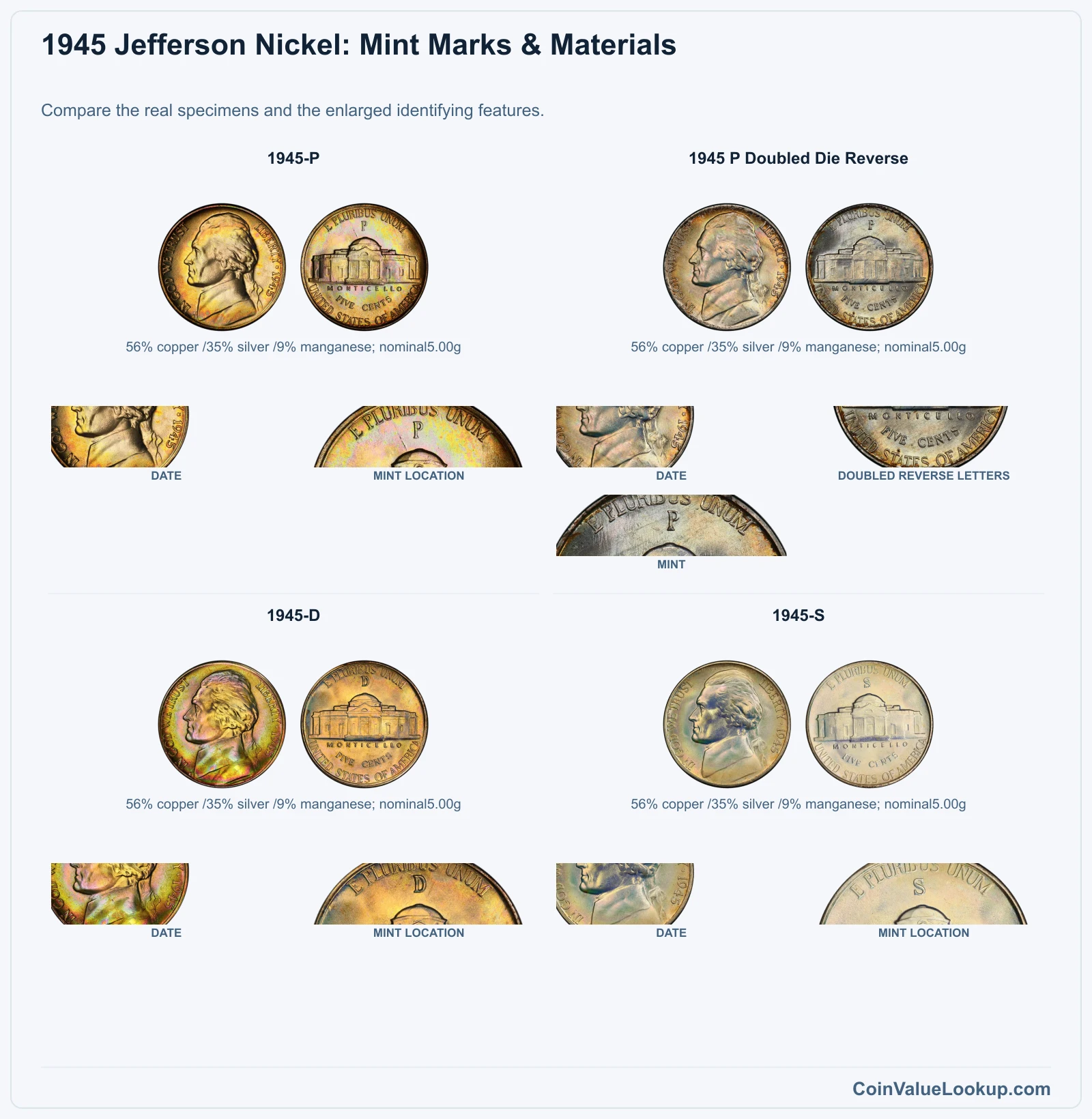
- The 1945-P Doubled Die Reverse shows separated doubled lettering in MONTICELLO and FIVE CENTS, with guide values reaching about $501 at MS65.
Step 1: Identify Your 1945 Jefferson Nickel Mint Mark and Version
Every regular 1945 nickel was struck in the wartime alloy of 56% copper, 35% silver, and 9% manganese. The tell is the large mintmark sitting above Monticello's dome on the reverse: P for Philadelphia, D for Denver, S for San Francisco.
If you don't see that large mintmark above the dome, don't assume you have something rare. Get the coin authenticated before drawing conclusions, because a missing mark could mean damage, a counterfeit, or just hard-to-see detail.
Nominal specs are 21.2 mm diameter and 5.00 grams. A coin that weighs significantly less or looks copper-colored might be on the wrong planchet, but color alone cannot prove composition.
Photograph the date, the mintmark area, and both full sides.
Separate honest wear from problems like corrosion, old cleaning, or evidence of a removed mounting. Those issues affect value independently of the coin's grade.
Step 2: Check Your 1945 Jefferson Nickel Grade
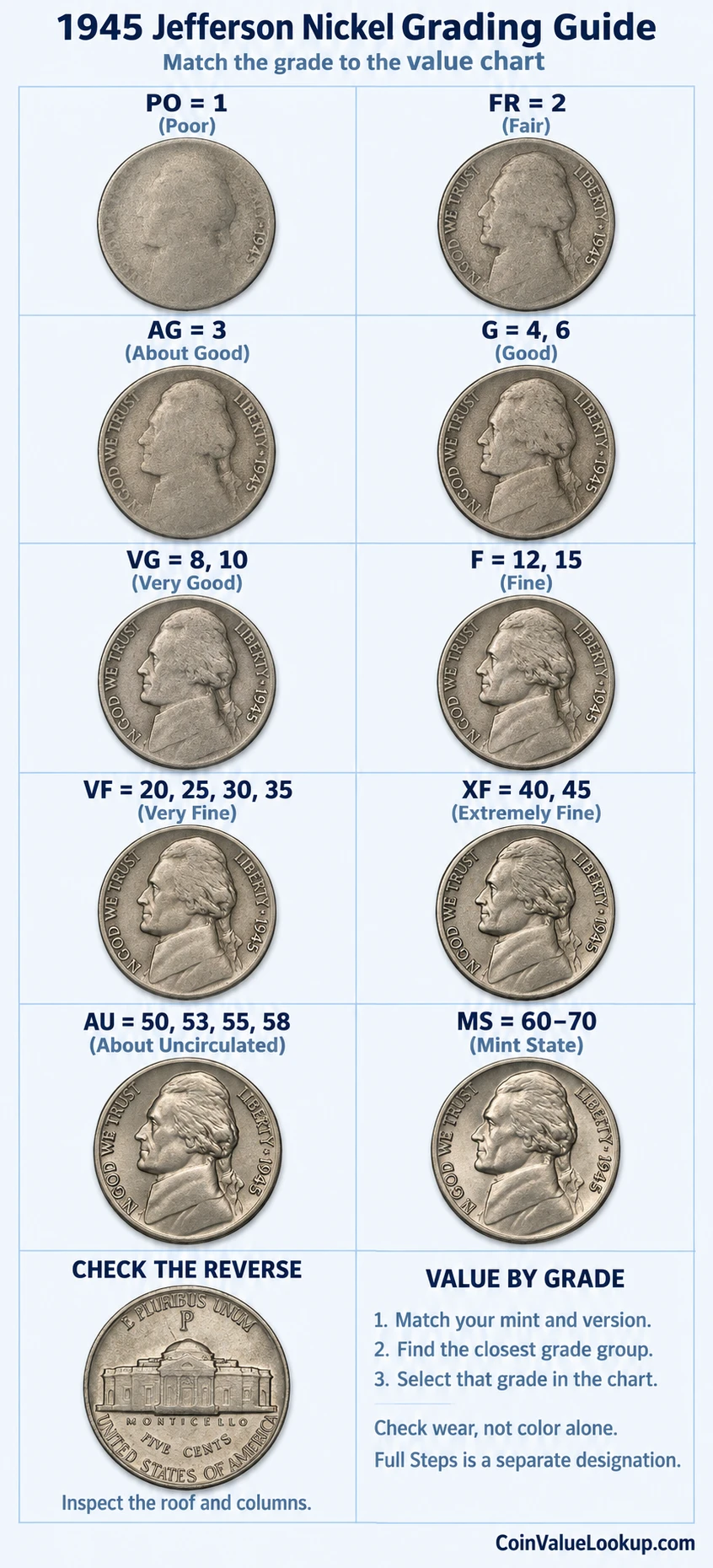
Start on the obverse. Jefferson's cheekbone and the hair detail just above his ear are the first places to lose definition as the coin circulates.
A coin with clear hair strands there but some flatness elsewhere is likely in the VF range.
Flip it over. The roof of Monticello and the four columns show wear next.
If both sides retain full original luster with no rub at all, you're looking at Mint State territory. Compare your coin's surfaces to the reference comparison image to gauge where it falls.
Full Steps is a separate designation applied only to qualifying Mint State coins, where at least five steps on Monticello's base are fully separated. A weak strike can blur those steps even on an uncirculated coin, so missing steps don't necessarily mean the coin is worn.
Have a professional grading service confirm Full Steps before assuming premium value.
Step 3: Check 1945 Jefferson Nickel Value by Mint and Version
1945 Jefferson Nickel — P
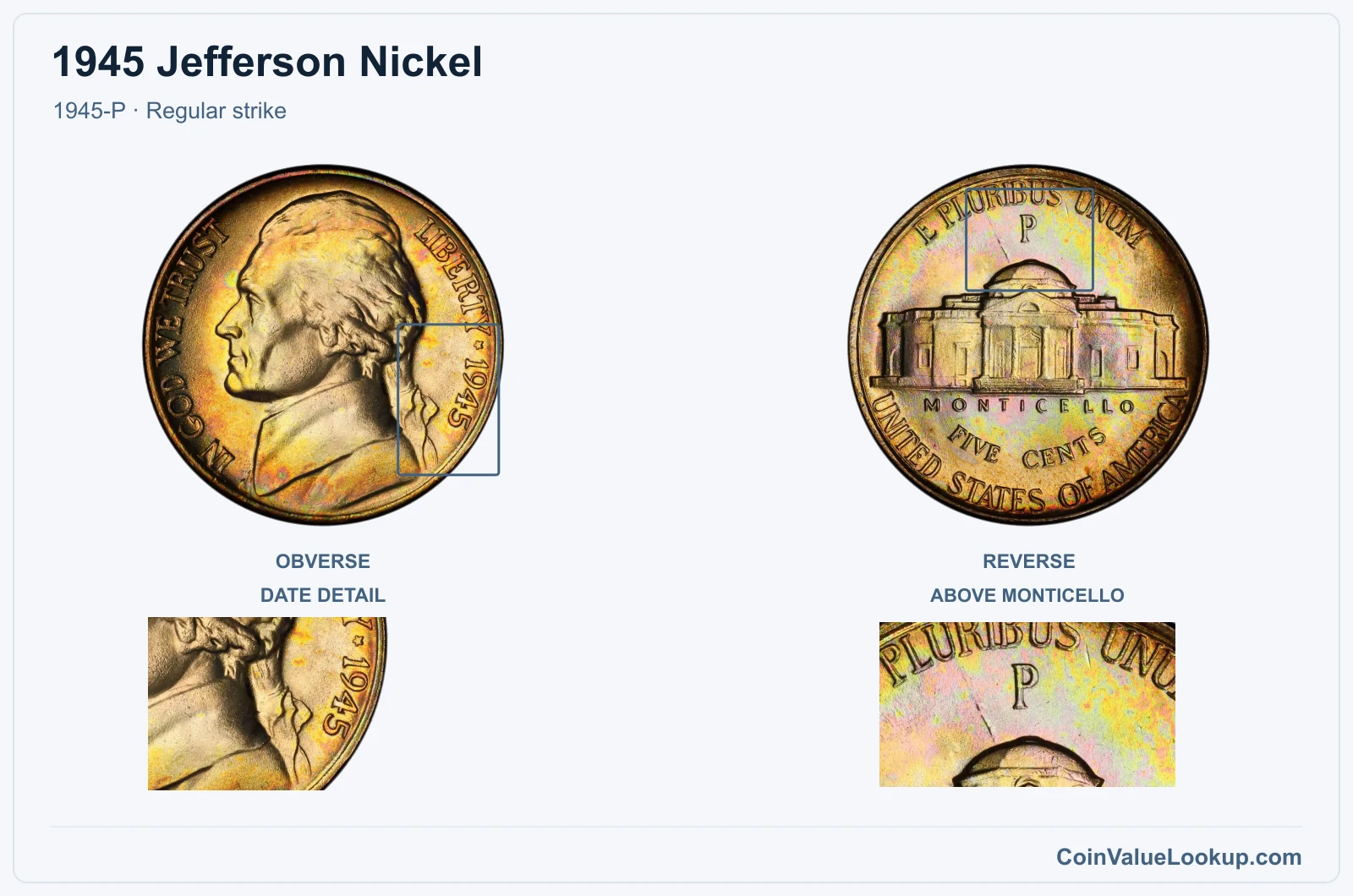
The 1945-P is the Philadelphia mint issue, identifiable by the large "P" above Monticello's dome. Like all wartime nickels, it's struck in the 56% copper, 35% silver, 9% manganese alloy, so every one of these has some silver content.
Guide estimates place a VF20 example at about $5.80, an MS60 at roughly $11.36, and an MS65 at around $28 per USA Coin Book. Circulated coins and Mint State coins live in very different price neighborhoods, and Full Steps examples carry their own separate premium.
Don't confuse the small D or S mintmark position used on later copper-nickel issues (to the right of Monticello) with the large wartime mark above the dome.
| Range | Grade | Price | Auction Records | Appraisal |
|---|---|---|---|---|
| PO | PO 1 | — | Coin Identifier | |
| FR | FR 2 | — | Coin Identifier | |
| AG | AG 3 | — | Coin Identifier | |
| G | G 4 | — | Coin Identifier | |
| G 6 | — | Coin Identifier | ||
| VG | VG 8 | — | Coin Identifier | |
| VG 10 | — | Coin Identifier | ||
| F | F 12 | — | Coin Identifier | |
| F 15 | — | Coin Identifier | ||
| VF | VF 20 | — | — | — |
| VF 25 | — | — | — | |
| VF 30 | — | — | — | |
| VF 35 | — | — | — | |
| XF | XF 40 | — | Coin Identifier | |
| XF 45 | — | Coin Identifier | ||
| AU | AU 50 | — | Coin Identifier | |
| AU 53 | — | Coin Identifier | ||
| AU 55 | — | Coin Identifier | ||
| AU 58 | Coin Identifier | |||
| MS | MS 60 | — | Coin Identifier | |
| MS 61 | — | Coin Identifier | ||
| MS 62 | Coin Identifier | |||
| MS 63 | Coin Identifier | |||
| MS 64 | Coin Identifier | |||
| MS 65 | Coin Identifier | |||
| MS 66 | Coin Identifier | |||
| MS 67 | Coin Identifier | |||
| MS 68 | Coin Identifier | |||
| MS 69 | — | — | — | |
| MS 70 | — | — | — |
1945 Jefferson Nickel — P Doubled Die Reverse
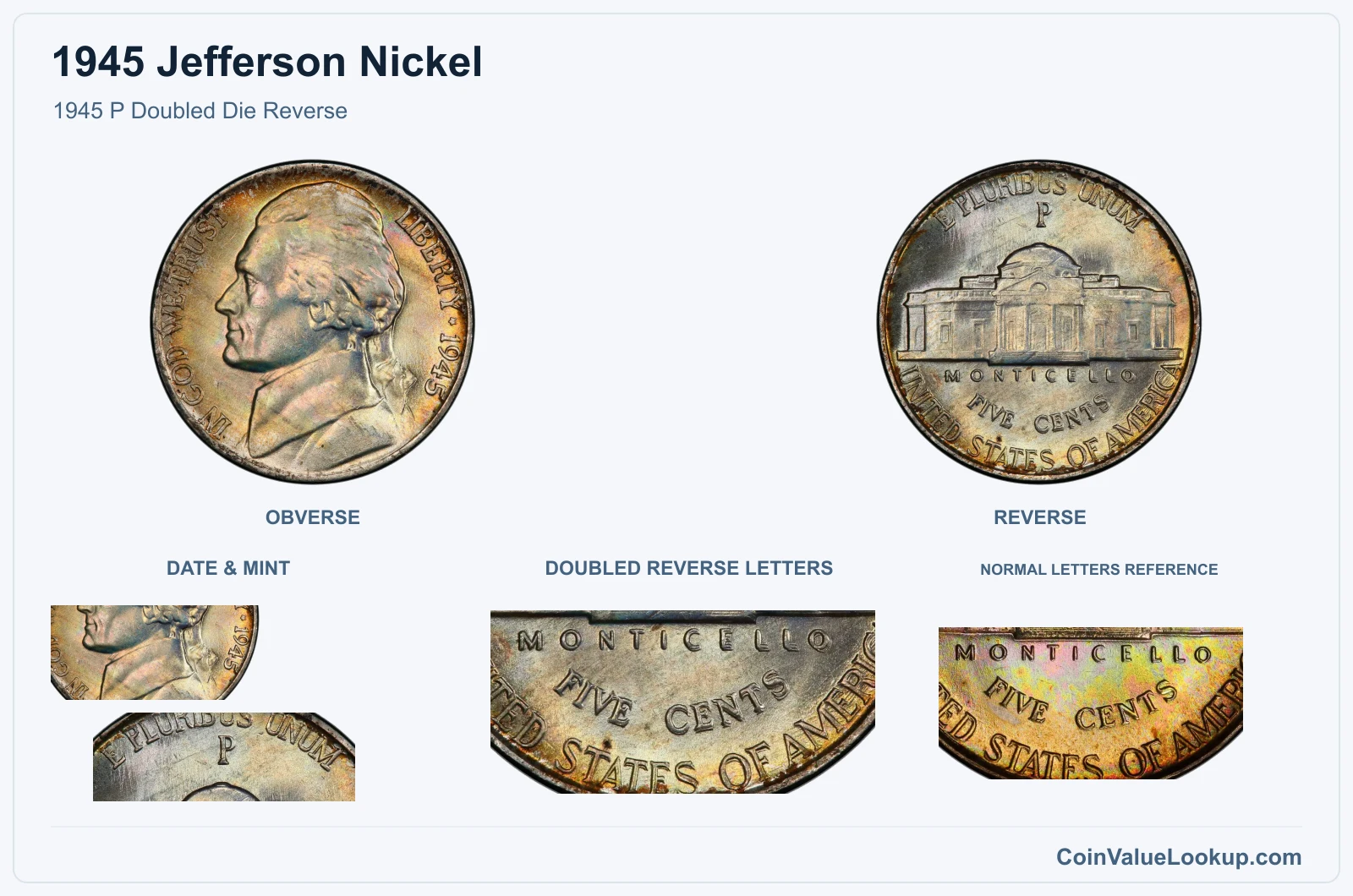
This is the one that gets people excited. The 1945-P Doubled Die Reverse shows distinct doubled outlines in the letters of MONTICELLO and FIVE CENTS on the reverse.
It's a genuine die variety, not machine doubling or a trick of the light.
To identify it, examine those reverse inscriptions under magnification. You should see clearly separated, consistent doubling in the lettering, not a flat shelf or mushy outline.
Machine doubling tends to produce a flattened image that shifts in one direction without the sharp secondary outline.
USA Coin Book guide estimates run about $28 at VF20, $106 at MS60, and $501 at MS65. Grade and Full Steps status remain separate considerations on top of the variety identification.
Not every 1945 war nickel has this, so compare carefully against a normal reverse before drawing conclusions.
| Range | Grade | Price | Auction Records | Appraisal |
|---|---|---|---|---|
| PO | PO 1 | — | Coin Identifier | |
| FR | FR 2 | — | Coin Identifier | |
| AG | AG 3 | — | Coin Identifier | |
| G | G 4 | — | Coin Identifier | |
| G 6 | — | Coin Identifier | ||
| VG | VG 8 | — | Coin Identifier | |
| VG 10 | — | Coin Identifier | ||
| F | F 12 | — | Coin Identifier | |
| F 15 | Coin Identifier | |||
| VF | VF 20 | — | Coin Identifier | |
| VF 25 | — | Coin Identifier | ||
| VF 30 | — | Coin Identifier | ||
| VF 35 | — | Coin Identifier | ||
| XF | XF 40 | — | Coin Identifier | |
| XF 45 | — | Coin Identifier | ||
| AU | AU 50 | — | Coin Identifier | |
| AU 53 | — | Coin Identifier | ||
| AU 55 | — | Coin Identifier | ||
| AU 58 | — | Coin Identifier | ||
| MS | MS 60 | — | Coin Identifier | |
| MS 61 | — | Coin Identifier | ||
| MS 62 | — | Coin Identifier | ||
| MS 63 | Coin Identifier | |||
| MS 64 | Coin Identifier | |||
| MS 65 | Coin Identifier | |||
| MS 66 | Coin Identifier | |||
| MS 67 | Coin Identifier | |||
| MS 68 | — | — | — | |
| MS 69 | — | — | — | |
| MS 70 | — | — | — |
1945 Jefferson Nickel — D
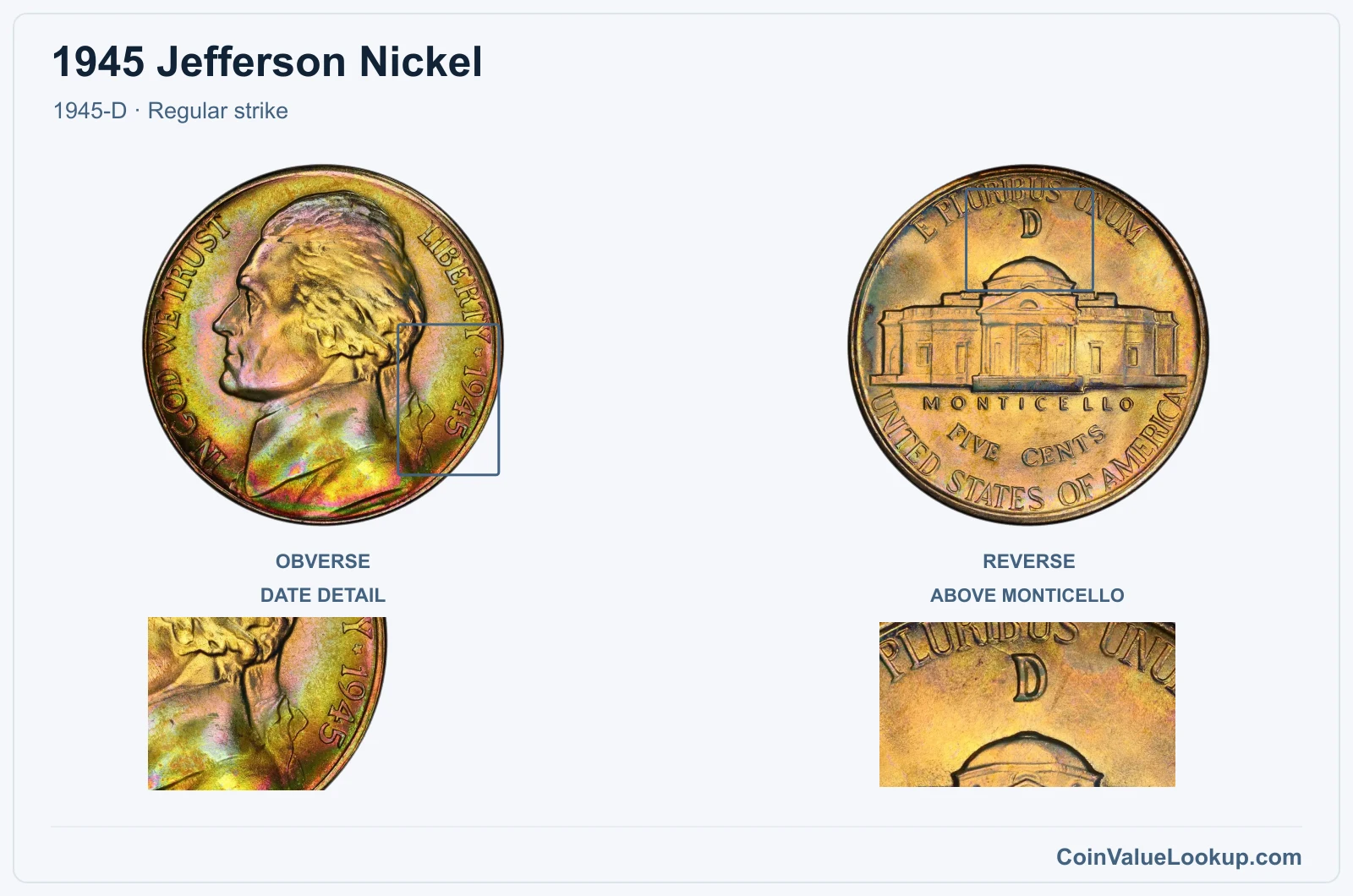
The 1945-D carries a large "D" above Monticello's dome, struck at the Denver mint. Same wartime silver alloy as the other 1945 issues: 56% copper, 35% silver, 9% manganese, weighing 5.00 grams.
Coin Value Lookup is a handy place to look up guides for this and other Jefferson nickel years if you're working through a collection.
USA Coin Book guide estimates put a VF20 at about $5.34, an MS60 at roughly $8.97, and an MS65 at around $28. As with all branches this year, Full Steps coins are priced separately and require professional confirmation.
| Range | Grade | Price | Auction Records | Appraisal |
|---|---|---|---|---|
| PO | PO 1 | — | Coin Identifier | |
| FR | FR 2 | — | Coin Identifier | |
| AG | AG 3 | — | Coin Identifier | |
| G | G 4 | — | Coin Identifier | |
| G 6 | — | Coin Identifier | ||
| VG | VG 8 | — | Coin Identifier | |
| VG 10 | — | Coin Identifier | ||
| F | F 12 | — | Coin Identifier | |
| F 15 | — | Coin Identifier | ||
| VF | VF 20 | — | Coin Identifier | |
| VF 25 | — | Coin Identifier | ||
| VF 30 | — | Coin Identifier | ||
| VF 35 | — | Coin Identifier | ||
| XF | XF 40 | — | Coin Identifier | |
| XF 45 | — | Coin Identifier | ||
| AU | AU 50 | — | Coin Identifier | |
| AU 53 | — | Coin Identifier | ||
| AU 55 | — | Coin Identifier | ||
| AU 58 | — | Coin Identifier | ||
| MS | MS 60 | — | Coin Identifier | |
| MS 61 | — | Coin Identifier | ||
| MS 62 | — | Coin Identifier | ||
| MS 63 | Coin Identifier | |||
| MS 64 | Coin Identifier | |||
| MS 65 | Coin Identifier | |||
| MS 66 | Coin Identifier | |||
| MS 67 | Coin Identifier | |||
| MS 68 | Coin Identifier | |||
| MS 69 | — | — | — | |
| MS 70 | — | — | — |
1945 Jefferson Nickel — S
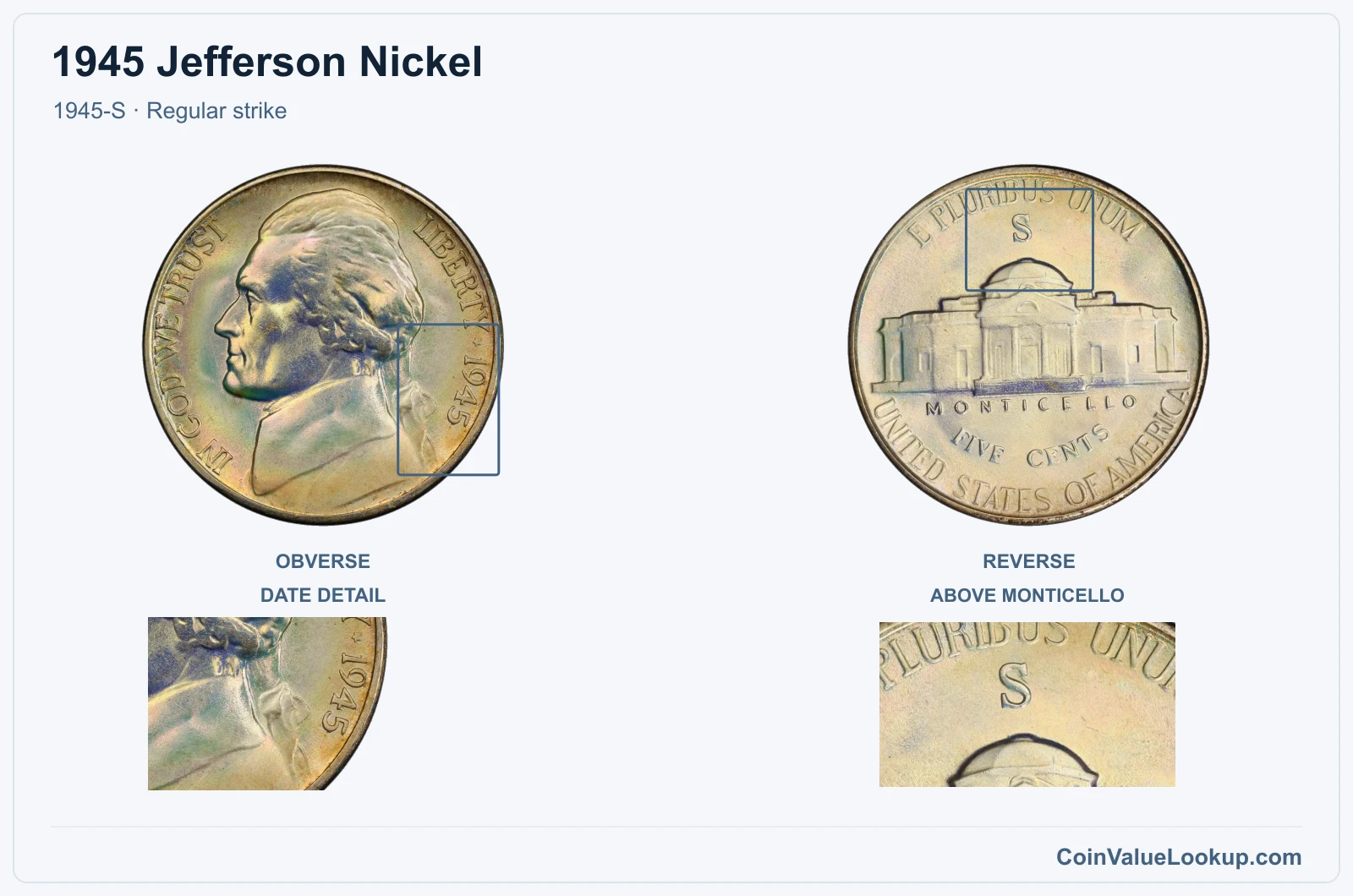
San Francisco's contribution to the 1945 wartime run carries the large "S" above Monticello's dome. Same alloy, same weight, same basic design as the P and D issues.
Guide estimates from USA Coin Book are about $5.34 at VF20, $8.97 at MS60, and $28 at MS65. These track closely with the Denver issue at corresponding grades.
The silver content gives even well-worn pieces a floor above five cents, though that floor shifts with the silver market. Full Steps designation, as always, is a separate matter requiring professional grading service confirmation.
| Range | Grade | Price | Auction Records | Appraisal |
|---|---|---|---|---|
| PO | PO 1 | — | Coin Identifier | |
| FR | FR 2 | — | Coin Identifier | |
| AG | AG 3 | — | Coin Identifier | |
| G | G 4 | — | Coin Identifier | |
| G 6 | — | Coin Identifier | ||
| VG | VG 8 | — | Coin Identifier | |
| VG 10 | — | Coin Identifier | ||
| F | F 12 | — | Coin Identifier | |
| F 15 | — | Coin Identifier | ||
| VF | VF 20 | — | Coin Identifier | |
| VF 25 | — | Coin Identifier | ||
| VF 30 | — | Coin Identifier | ||
| VF 35 | — | Coin Identifier | ||
| XF | XF 40 | Coin Identifier | ||
| XF 45 | — | Coin Identifier | ||
| AU | AU 50 | — | Coin Identifier | |
| AU 53 | — | Coin Identifier | ||
| AU 55 | — | Coin Identifier | ||
| AU 58 | — | Coin Identifier | ||
| MS | MS 60 | — | Coin Identifier | |
| MS 61 | — | Coin Identifier | ||
| MS 62 | — | Coin Identifier | ||
| MS 63 | — | Coin Identifier | ||
| MS 64 | Coin Identifier | |||
| MS 65 | Coin Identifier | |||
| MS 66 | Coin Identifier | |||
| MS 67 | Coin Identifier | |||
| MS 68 | Coin Identifier | |||
| MS 69 | — | — | — | |
| MS 70 | — | — | — |
1945 Jefferson Nickel Error List
1. 1945 Jefferson Nickel — Doubled die reverse
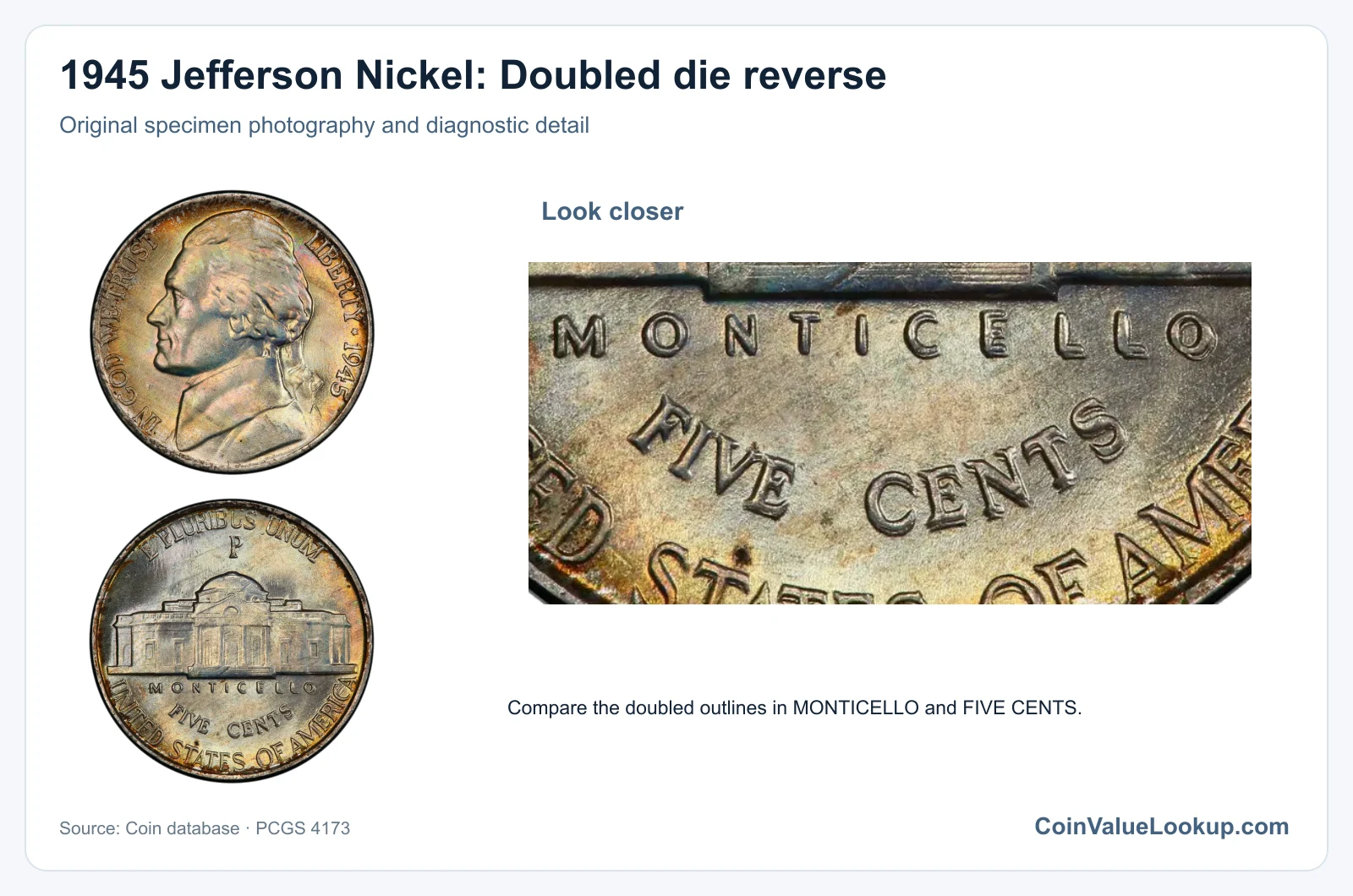
The Doubled Die Reverse on the 1945-P nickel is a major variety. Look for distinctly separated doubled lettering in MONTICELLO and FIVE CENTS on the reverse.
The doubling should be consistent across multiple letters, not confined to one spot.
The main lookalike is machine doubling, which creates a flat, shelf-like displacement rather than a sharp secondary image. Normal serifs on the lettering can also fool you at lower magnification.
Compare your coin against a known normal reverse at the same magnification and lighting angle.
Guide values from USA Coin Book run about $28 in VF20, $106 in MS60, and $501 in MS65. This variety is specifically documented for the Philadelphia mint.
Grade and any Full Steps status are evaluated independently of the variety.
2. 1945 Jefferson Nickel — Struck on a cent planchet
A 1945 nickel struck on a cent planchet is a dramatic wrong-planchet error. A smaller, lighter copper-alloy blank meant for a Lincoln cent ended up in the nickel press.
The result weighs around 3.0 grams instead of the normal 5.0 grams, with a noticeably reduced diameter.
Look for cropped or stretched outer lettering where the smaller blank couldn't fill the full die area. The coin will appear copper-colored, not the usual silvery wartime alloy.
That visual difference alone isn't proof, though. Copper plating, environmental toning, ground-down edges, or souvenir novelty coins can mimic the look.
Authentication and third-party certification are essential. One known example is a Philadelphia mint piece graded NGC MS64 Brown.
Value depends on authenticated identity, condition, and severity of the error, so individual assessment applies.
3. 1945 Jefferson Nickel — Struck on a silver dime planchet
When a silver dime blank found its way into the nickel press, the result was a 1945 nickel struck on a dime planchet. The coin is smaller than normal, with parts of the nickel design running off the edge because the dime blank simply couldn't cover the full die.
Here's where it gets tricky: ordinary 1945 nickels already contain 35% silver, so a bright silvery color alone means nothing. You need to check the diameter and get the planchet identity authenticated.
A genuine example will be visibly undersized compared to a standard nickel.
A San Francisco mint example graded PCGS AU58 sold through Heritage Auctions in January 2006 for $3,220. That is a single recorded sale, not a market range.
Condition, mint, and the specifics of the strike all factor into what any individual piece might bring.
4. 1945 Jefferson Nickel — Repunched Mintmark
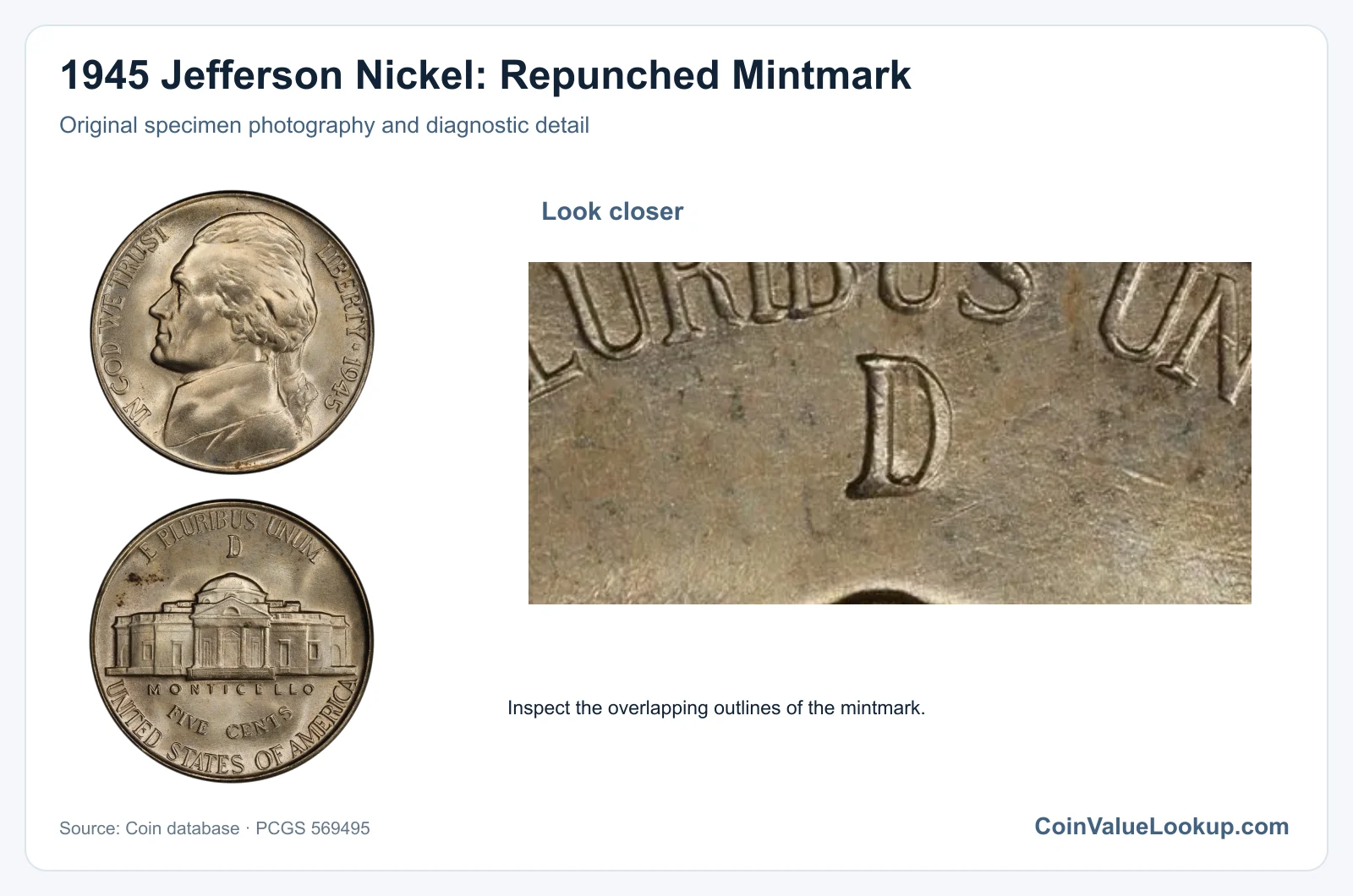
Repunched mintmark varieties on 1945 nickels show remnants of a second mintmark punch position near the primary mark above Monticello's dome. You might see a partial extra letter slightly offset from the main mintmark.
Inspect the mintmark area under magnification. A genuine repunched mintmark will show a consistent secondary impression, not just fuzziness.
Machine doubling around the mark tends to produce a flat shelf rather than a distinct second punch. Die chips or corrosion near the mark can also create misleading shapes.
Condition, the visibility of the repunching, and the specific variety all affect what a repunched mintmark example is worth. There is no single price to cite here, so individual assessment by a qualified grading service is the way to go.
5. 1945 Jefferson Nickel — Lamination / Split Planchet
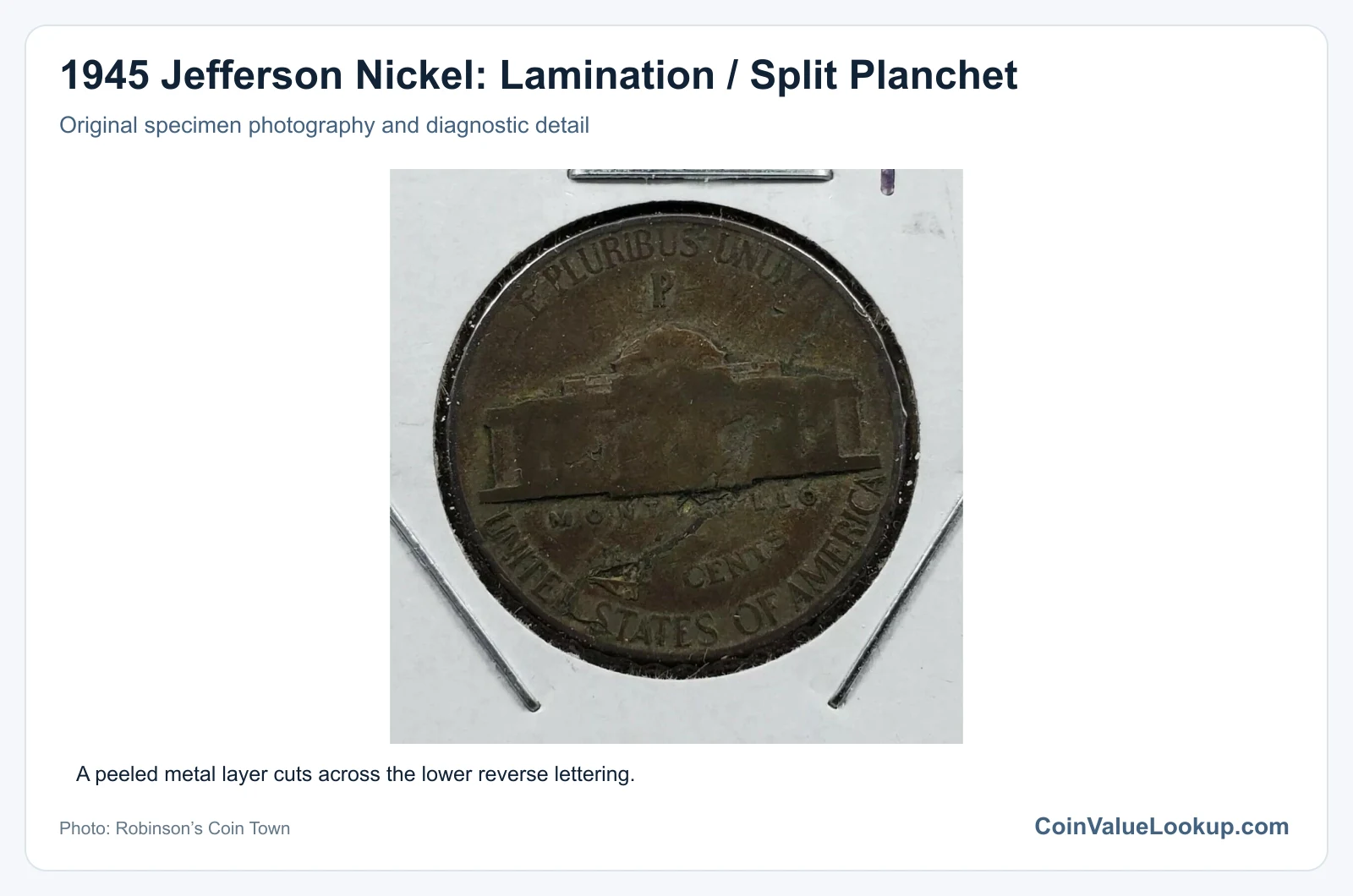
Lamination errors on 1945 nickels appear as peeling metal, a retained flap, or visible separation within the alloy layers. The wartime composition may have been more prone to internal inconsistencies in the planchet.
To document one properly, photograph the edge and the affected face together so the depth of the separation is clear. Look for a raised or partially detached area of metal that is clearly part of the original planchet.
Don't confuse this with post-mint scraping, corrosion, or a deliberately cut coin. A real lamination crack follows the internal structure of the metal rather than showing tool marks or straight-line cuts.
Value depends on the size, visibility, and overall condition of the coin, so individual assessment applies.
6. 1945 Jefferson Nickel — Die Crack / Die Chip
Die cracks and die chips on 1945 nickels show up as raised lines or small raised blobs on the coin's surface. They result from a damaged die, and the raised nature is the key diagnostic: they project above the field rather than being incised into it.
A die crack that runs from the interior to the rim is different from a full cud break, which creates a larger raised area at the edge. Both originate from the die, but cuds are generally more dramatic.
Look closely to distinguish these from incuse scratches, corrosion deposits, or foreign material stuck to the surface. Scratches go into the metal; die cracks sit on top of it.
Value varies with the crack's size, location, and the coin's overall condition, so each piece needs individual evaluation.
7. 1945 Jefferson Nickel — Doubled Die Obverse
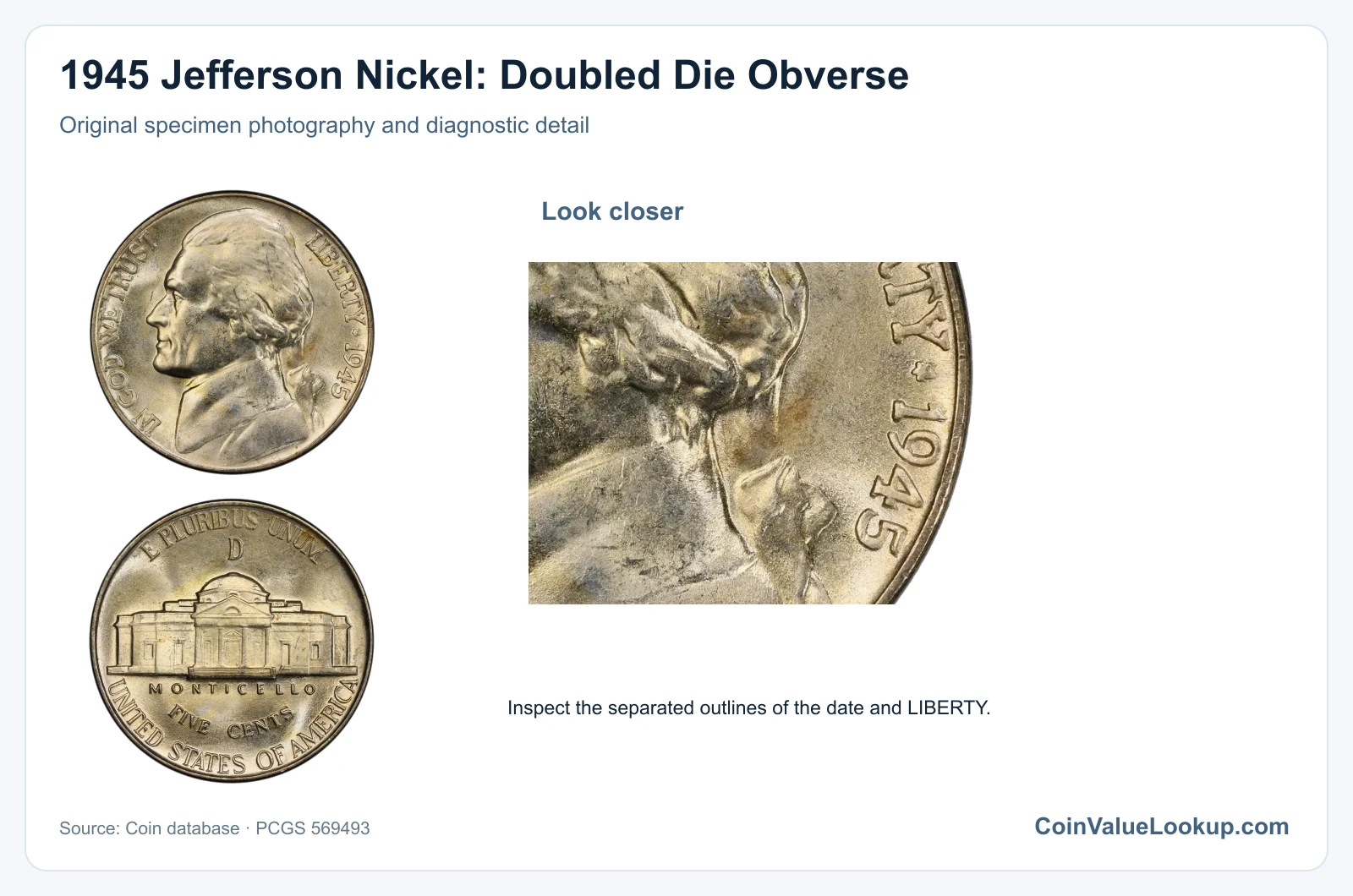
A Doubled Die Obverse has been reported for the 1945-D Jefferson nickel. To check for it, compare the obverse lettering and design elements against a normal 1945-D under the same lighting and magnification.
Genuine hub doubling shows consistent separation or notching in the affected letters or design features.
Machine doubling is the most common lookalike. It produces a flat, shelf-like displacement rather than the crisp secondary image of true hub doubling.
Worn die contours and reflections under certain lighting can also create illusions of doubling that disappear when you change the angle.
This variety applies specifically to the Denver mint issue. Value depends on the coin's condition and the visibility of the doubling, so have any suspected example examined individually by a grading service.
8. 1945 Jefferson Nickel — Off-Center Strike
Off-center strikes on 1945 nickels occur when the planchet isn't properly centered between the dies. The result is a displaced design with an unstruck crescent of blank metal along one edge.
The key to value here is whether the date remains visible. An off-center coin with a clear date and mintmark is far more collectible than one where critical details are lost in the unstruck area.
Don't confuse this with a clipped planchet, which has a curved bite taken from the blank before striking. One-sided die misalignment or post-mint flattening can also mimic the look.
A genuine off-center strike affects both sides of the coin in a corresponding way. Value depends on the percentage off-center, date visibility, and overall condition.