2005 Jefferson Nickel Coin Value: How Much Is It Worth?
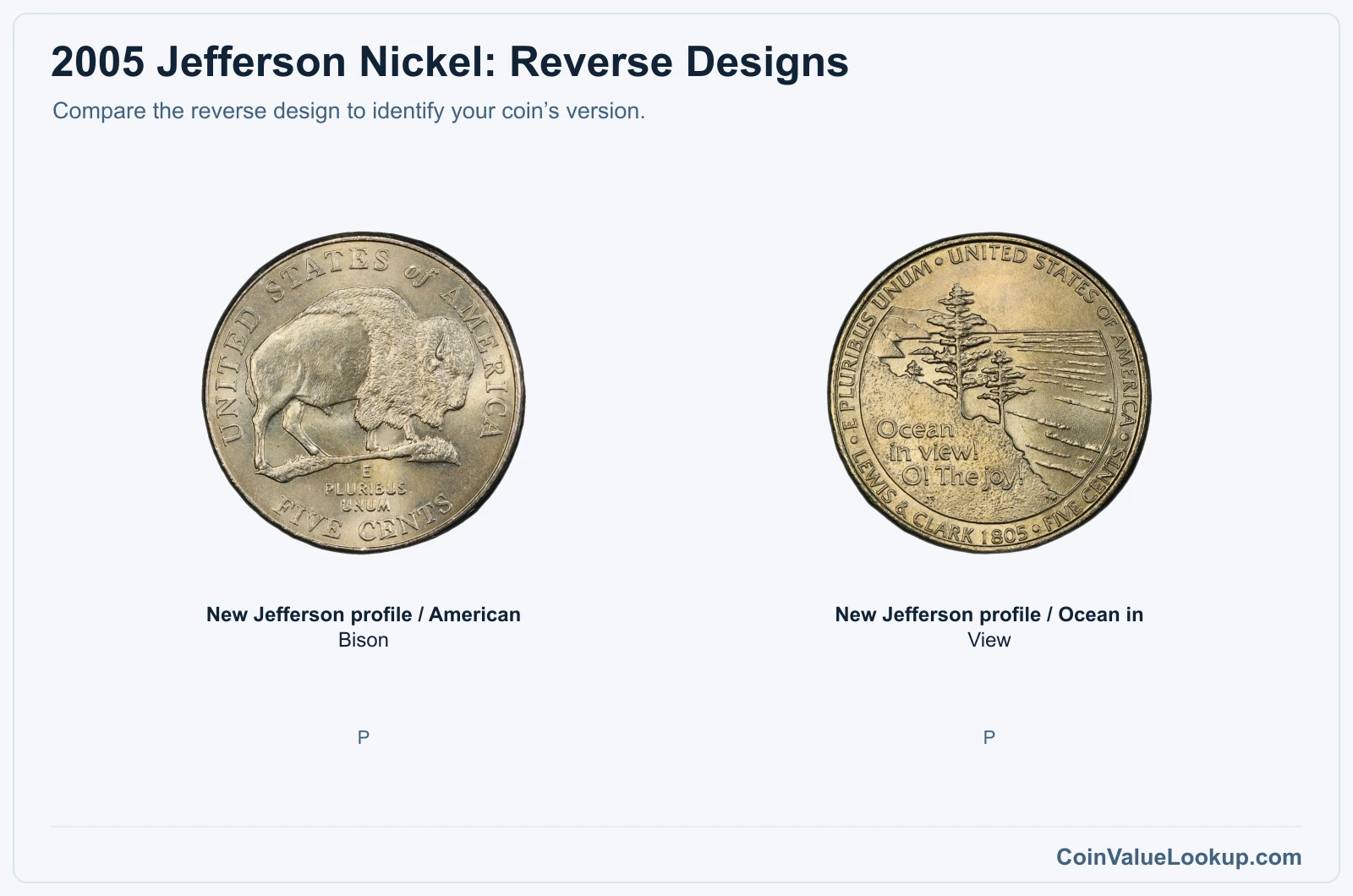
The 2005 Jefferson Nickel is part of the Westward Journey series, featuring two distinct reverse designs: American Bison and Ocean in View. Most circulated examples trade near face value.
For standard P and D business strikes, USA Coin Book guide estimates place these between about $0.43 in MS60 and $1.56 in MS65. Proofs, satin-finish Mint Set coins, and error varieties each follow their own pricing.
Fast Way to Identify Your 2005 Jefferson Nickel
The quickest way to start figuring out what your 2005 nickel is worth is to upload clear photos of the front and back. Our identifier can offer a preliminary identification of your coin's mint, reverse design, and finish type.
That helps you zero in on the right version before digging into values.
2005 Jefferson Nickel Value
Upload both sides of your 2005 Jefferson Nickel.
Front Obverse
Upload photo
Back Reverse
Upload photo
Which 2005 Jefferson Nickel Versions Are Worth Money?
- The 2005-D Speared Bison variety carries a raised die-gouge line across the bison's body, making it a sought-after collectible with values determined by condition and authentication.
- A 2005-P Bison design struck over a 2005 cent sold at Heritage Auctions for $26,400 in a single exceptional example, demonstrating the premium dramatic errors can command.
- 2005-S proof nickels in both Bison and Ocean in View designs carry guide values around $5 to $6 at PR65, well above face value.
- Satin-finish P and D coins from 2005 Mint Sets are separate collectibles whose values depend on authenticated condition and are not interchangeable with business strikes.
- Off-center strikes and double-clipped planchets on 2005 nickels are reported error types where authentication and severity determine individual value.
Step 1: Identify Your 2005 Jefferson Nickel Mint Mark and Version
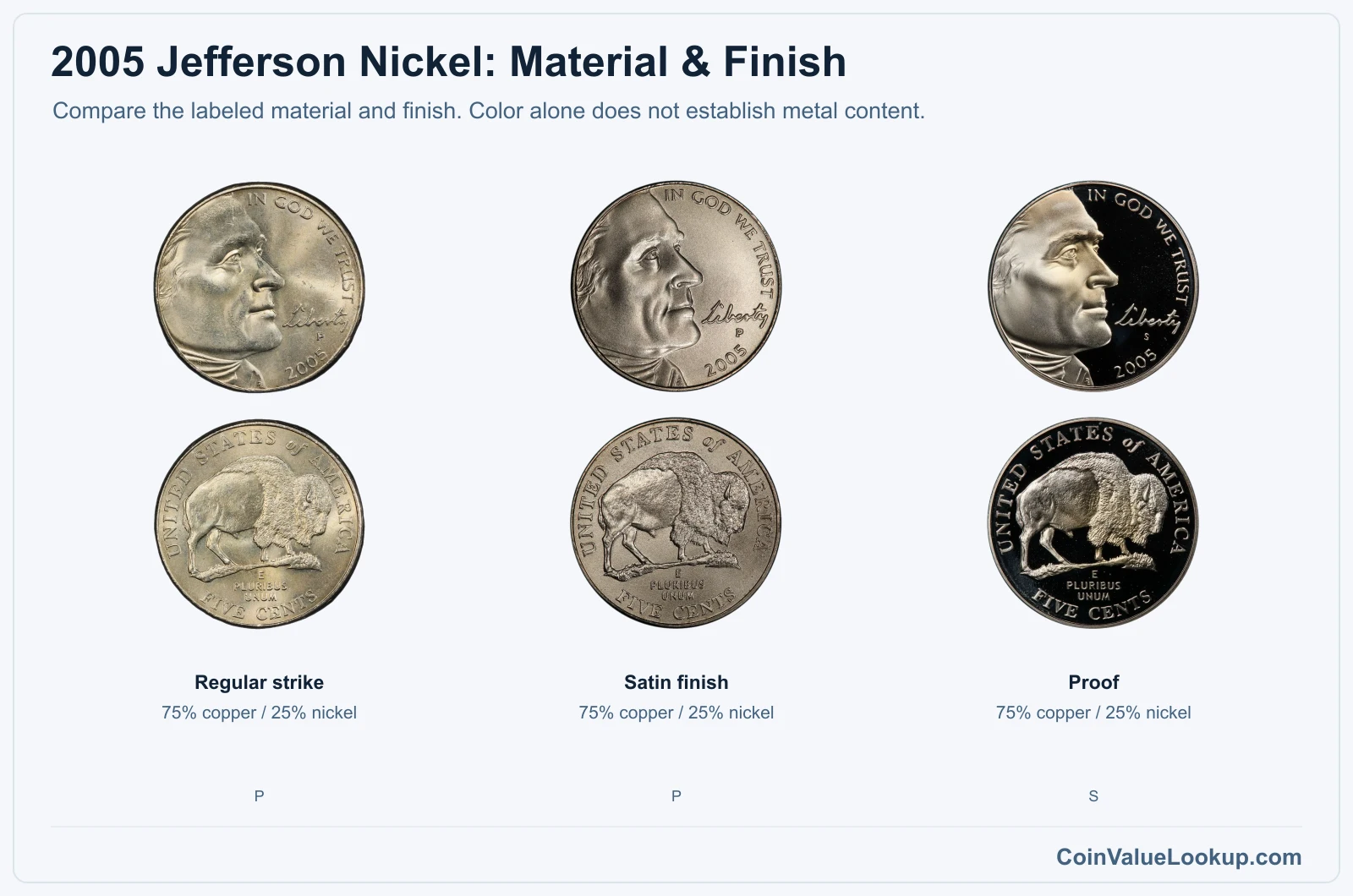
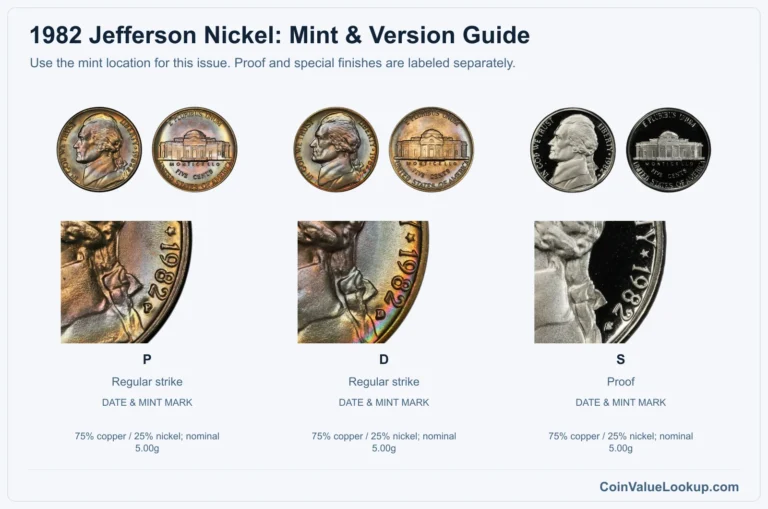
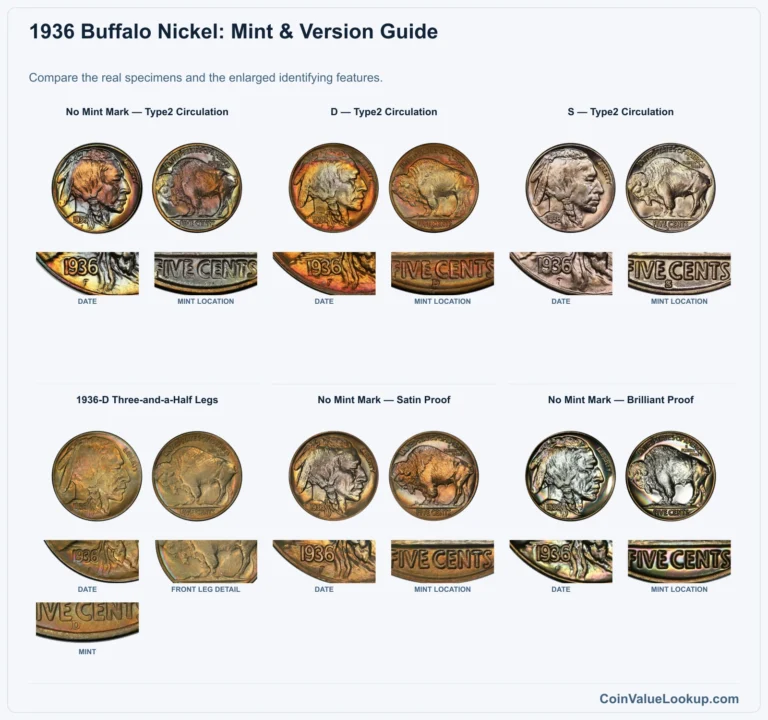
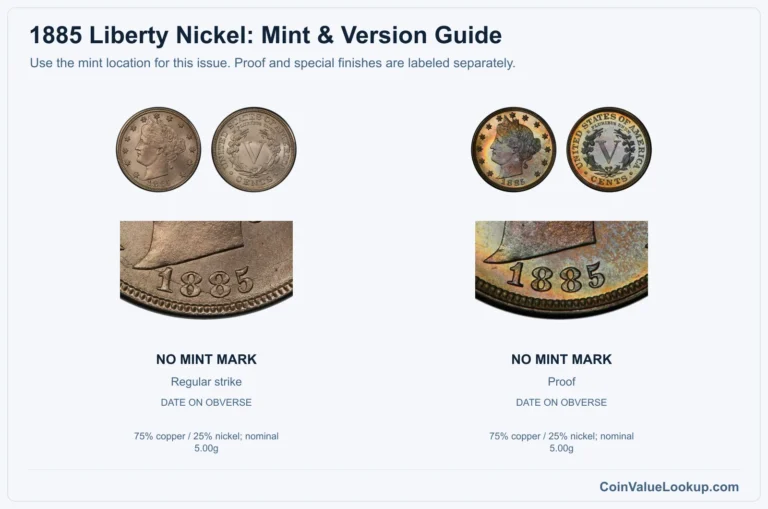
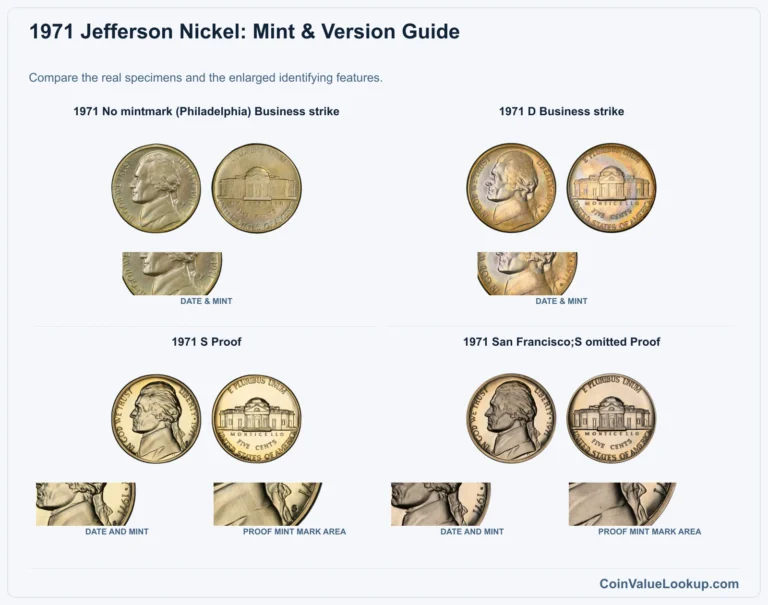
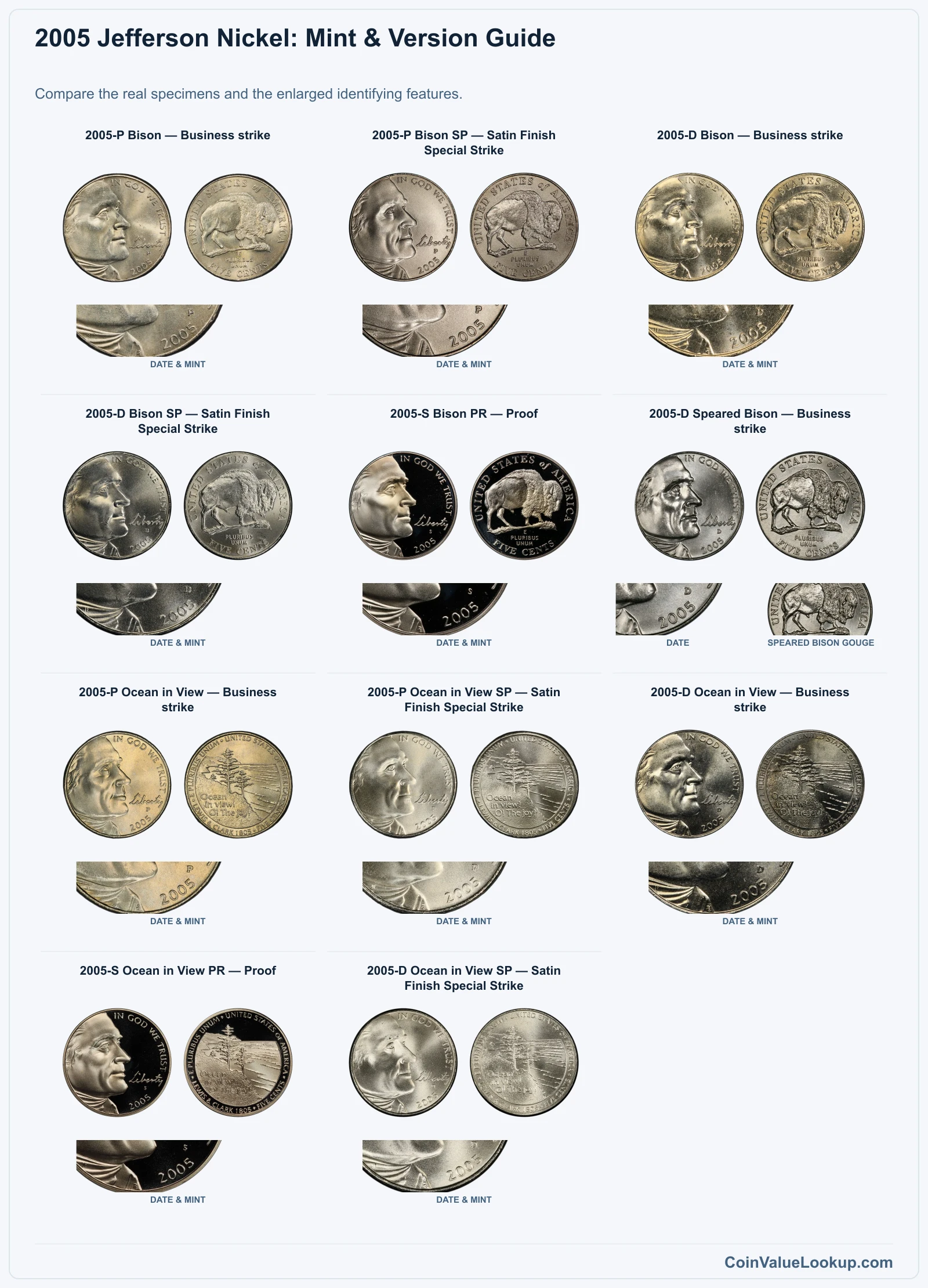
Start by reading the date and the small mintmark letter on the obverse. A "P" means Philadelphia, "D" means Denver, and "S" means San Francisco proof.
All standard 2005 nickels are 75% copper and 25% nickel, weigh about 5 grams, measure 21.2 mm across, and have a plain edge.
Next, flip the coin over. The American Bison reverse shows a bison standing in profile, while the Ocean in View reverse depicts a coastline scene.
These are completely different designs with different value tables, so match yours carefully.
Then determine the finish. Circulation strikes have the typical shiny luster you see on pocket change.
Satin-finish coins came exclusively in 2005 Uncirculated Mint Sets and have a softer, more muted sheen that is distinct from both proof mirrors and business-strike luster. A shiny circulated nickel is not a satin coin.
S-mint proofs were sold in proof sets and show mirror fields with sharp detail. Do not confuse any of these three finishes with each other, because each has its own collector market.
Step 2: Check Your 2005 Jefferson Nickel Grade
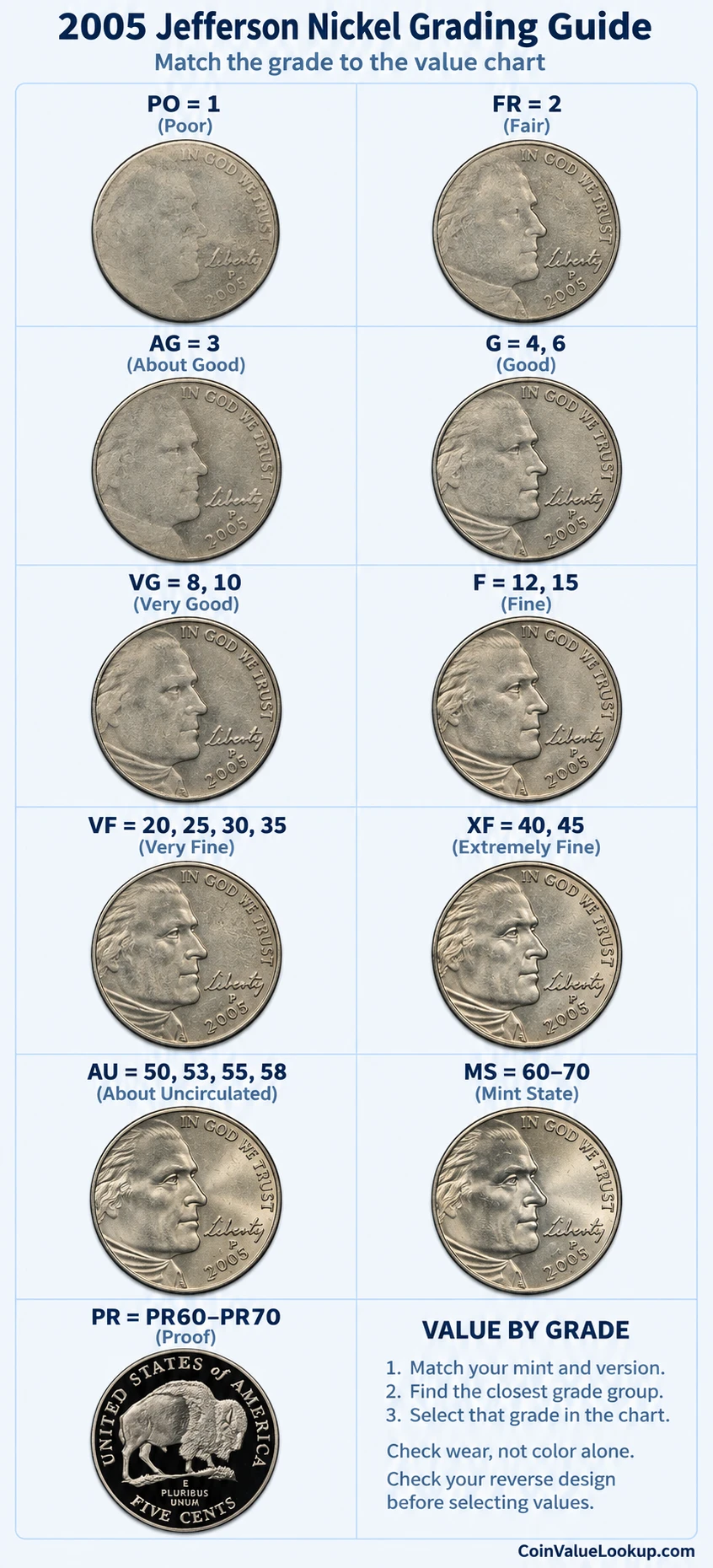
Look at the high points of Jefferson's cheek, hair, and jawline first. On a well-preserved coin, all hair strands remain distinct and the cheek shows no flattening.
As the coin wears, the cheek smooths out and hair detail merges together.
On the reverse, check the fine design details. For the Bison reverse, look at the fur texture along the bison's shoulder and back.
For Ocean in View, examine the landscape and lettering sharpness.
Luster matters a lot at the Mint State level. A coin with full, unbroken luster and minimal bag marks grades higher than one with dull or disrupted surfaces, even if both are technically uncirculated.
Use the comparison image to gauge where your coin falls.
Note that Full Steps is a strike designation that applies only to the traditional Monticello reverse. It does not apply to these 2005 commemorative designs.
Also remember that proof is a manufacturing finish, not a grade above Mint State.
Step 3: Check 2005 Jefferson Nickel Value by Mint and Version
2005 Jefferson Nickel — P Bison — Business strike
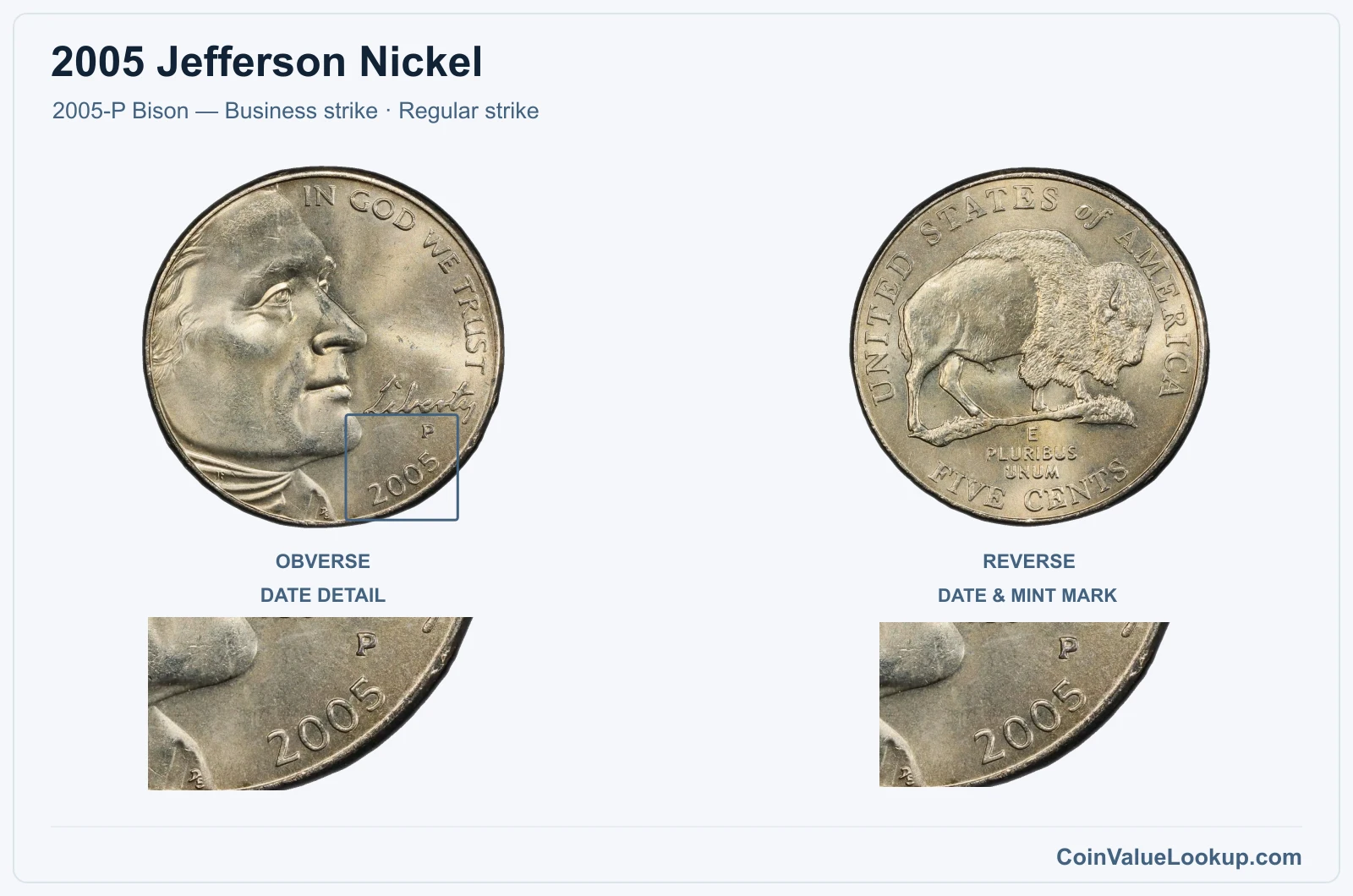
The 2005-P American Bison business strike is the standard Philadelphia circulation issue. It shows the new Jefferson profile on the obverse and a bison standing in profile on the reverse.
USA Coin Book places guide estimates at about $0.43 in MS60 and $1.56 in MS65. Most examples pulled from change will fall below these uncirculated grades and are worth face value.
Look for the "P" mintmark on the obverse below the date.
| Range | Grade | Price | Auction Records | Appraisal |
|---|---|---|---|---|
| PO | PO 1 | — | Coin Identifier | |
| FR | FR 2 | — | Coin Identifier | |
| AG | AG 3 | — | — | — |
| G | G 4 | — | — | — |
| G 6 | — | — | — | |
| VG | VG 8 | — | — | — |
| VG 10 | — | — | — | |
| F | F 12 | — | — | — |
| F 15 | — | — | — | |
| VF | VF 20 | — | — | — |
| VF 25 | — | — | — | |
| VF 30 | — | — | — | |
| VF 35 | — | — | — | |
| XF | XF 40 | — | — | — |
| XF 45 | — | — | — | |
| AU | AU 50 | — | — | — |
| AU 53 | — | — | — | |
| AU 55 | — | — | — | |
| AU 58 | — | — | — | |
| MS | MS 60 | — | — | — |
| MS 61 | — | — | — | |
| MS 62 | — | — | — | |
| MS 63 | — | Coin Identifier | ||
| MS 64 | Coin Identifier | |||
| MS 65 | Coin Identifier | |||
| MS 66 | Coin Identifier | |||
| MS 67 | Coin Identifier | |||
| MS 68 | — | — | — | |
| MS 69 | — | — | — | |
| MS 70 | — | — | — |
2005 Jefferson Nickel — P Bison SP — Satin Finish Special Strike
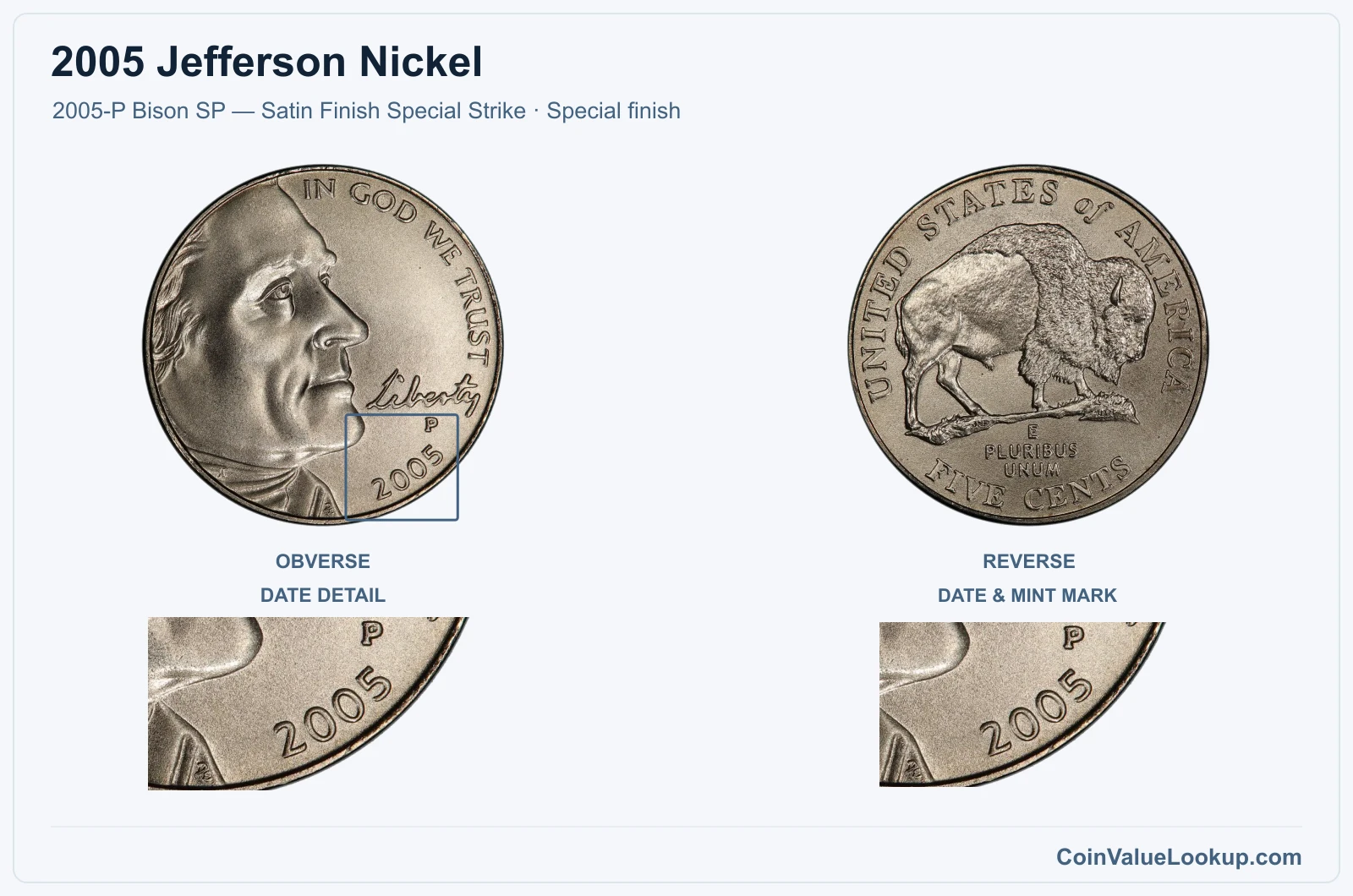
The 2005-P American Bison satin-finish coin was produced exclusively for that year's Uncirculated Mint Sets. It has a distinctive soft, even sheen that differs from the bright luster of a business strike.
These were never released into circulation, so finding one loose means it was removed from its original packaging. Value depends on authenticated condition, and no standard guide range is adopted here.
Have yours examined individually if you believe you have a satin-finish example rather than a regular strike.
| Range | Grade | Price | Auction Records | Appraisal |
|---|---|---|---|---|
| SP | SP 1 | — | Coin Identifier | |
| SP 2 | — | Coin Identifier | ||
| SP 3 | — | Coin Identifier | ||
| SP 4 | — | Coin Identifier | ||
| SP 6 | — | Coin Identifier | ||
| SP 8 | — | Coin Identifier | ||
| SP 10 | — | Coin Identifier | ||
| SP 12 | — | Coin Identifier | ||
| SP 15 | — | Coin Identifier | ||
| SP 20 | — | Coin Identifier | ||
| SP 25 | — | Coin Identifier | ||
| SP 30 | — | Coin Identifier | ||
| SP 35 | — | Coin Identifier | ||
| SP 40 | — | Coin Identifier | ||
| SP 45 | — | Coin Identifier | ||
| SP 50 | — | Coin Identifier | ||
| SP 53 | — | Coin Identifier | ||
| SP 55 | — | Coin Identifier | ||
| SP 58 | — | Coin Identifier | ||
| SP 60 | — | Coin Identifier | ||
| SP 61 | — | Coin Identifier | ||
| SP 62 | — | Coin Identifier | ||
| SP 63 | — | Coin Identifier | ||
| SP 64 | — | Coin Identifier | ||
| SP 65 | — | Coin Identifier | ||
| SP 66 | Coin Identifier | |||
| SP 67 | Coin Identifier | |||
| SP 68 | Coin Identifier | |||
| SP 69 | Coin Identifier | |||
| SP 70 | — | Coin Identifier |
2005 Jefferson Nickel — D Bison — Business strike
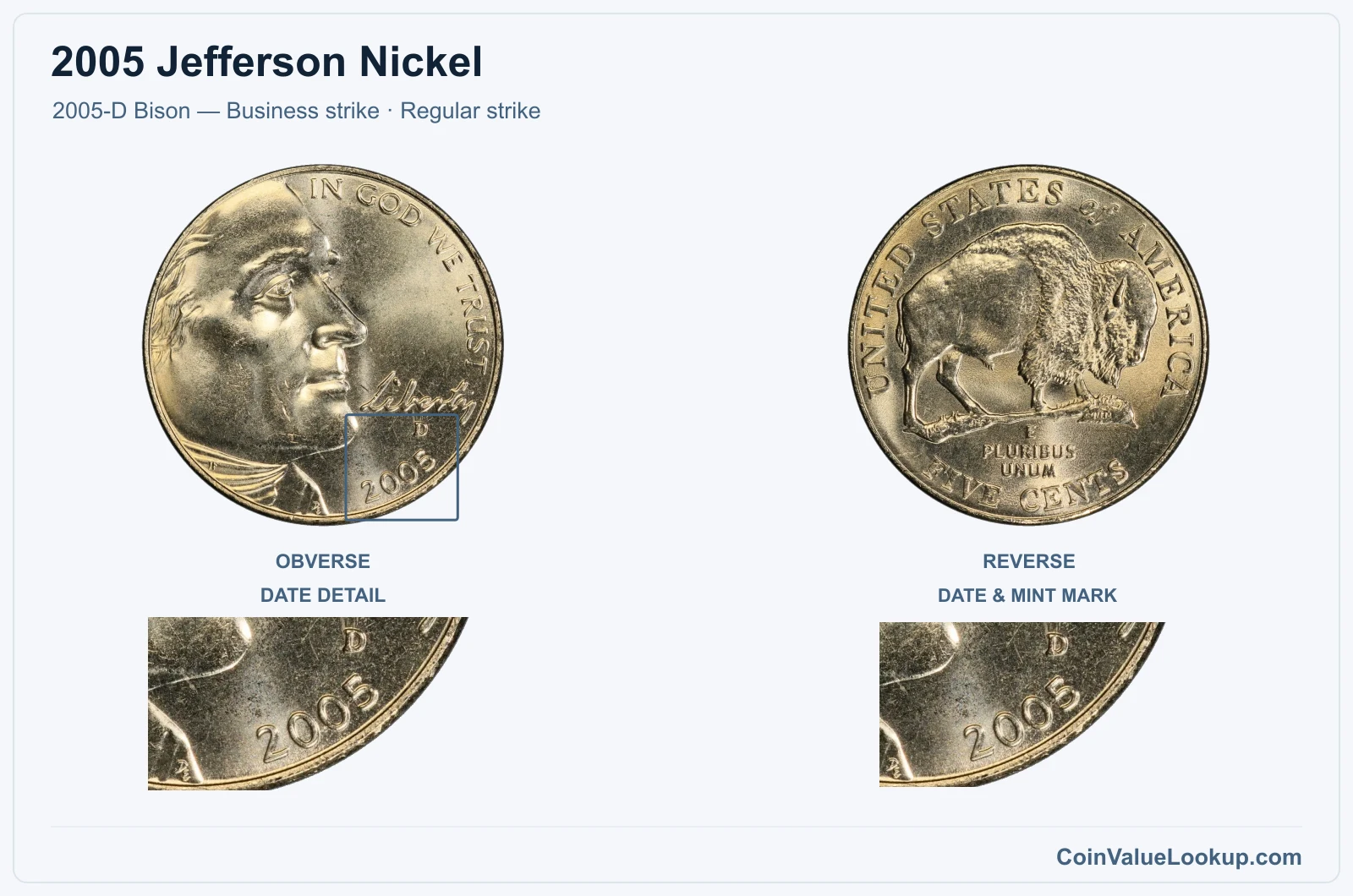
The 2005-D American Bison business strike is the Denver Mint's circulation version. It carries the same bison reverse and new Jefferson portrait as the Philadelphia issue.
Guide estimates from USA Coin Book put it at roughly $0.43 in MS60 and $1.56 in MS65. Look for the "D" mintmark on the obverse.
Circulated examples are common and worth five cents, but well-preserved uncirculated coins have a modest collector premium.
| Range | Grade | Price | Auction Records | Appraisal |
|---|---|---|---|---|
| PO | PO 1 | — | Coin Identifier | |
| FR | FR 2 | — | Coin Identifier | |
| AG | AG 3 | — | Coin Identifier | |
| G | G 4 | — | Coin Identifier | |
| G 6 | — | Coin Identifier | ||
| VG | VG 8 | — | Coin Identifier | |
| VG 10 | — | Coin Identifier | ||
| F | F 12 | — | Coin Identifier | |
| F 15 | — | Coin Identifier | ||
| VF | VF 20 | — | Coin Identifier | |
| VF 25 | — | Coin Identifier | ||
| VF 30 | — | Coin Identifier | ||
| VF 35 | — | Coin Identifier | ||
| XF | XF 40 | — | Coin Identifier | |
| XF 45 | — | Coin Identifier | ||
| AU | AU 50 | — | Coin Identifier | |
| AU 53 | — | Coin Identifier | ||
| AU 55 | — | Coin Identifier | ||
| AU 58 | — | Coin Identifier | ||
| MS | MS 60 | — | Coin Identifier | |
| MS 61 | — | Coin Identifier | ||
| MS 62 | — | Coin Identifier | ||
| MS 63 | — | Coin Identifier | ||
| MS 64 | — | Coin Identifier | ||
| MS 65 | Coin Identifier | |||
| MS 66 | Coin Identifier | |||
| MS 67 | Coin Identifier | |||
| MS 68 | — | — | — | |
| MS 69 | — | — | — | |
| MS 70 | — | — | — |
2005 Jefferson Nickel — D Bison SP — Satin Finish Special Strike
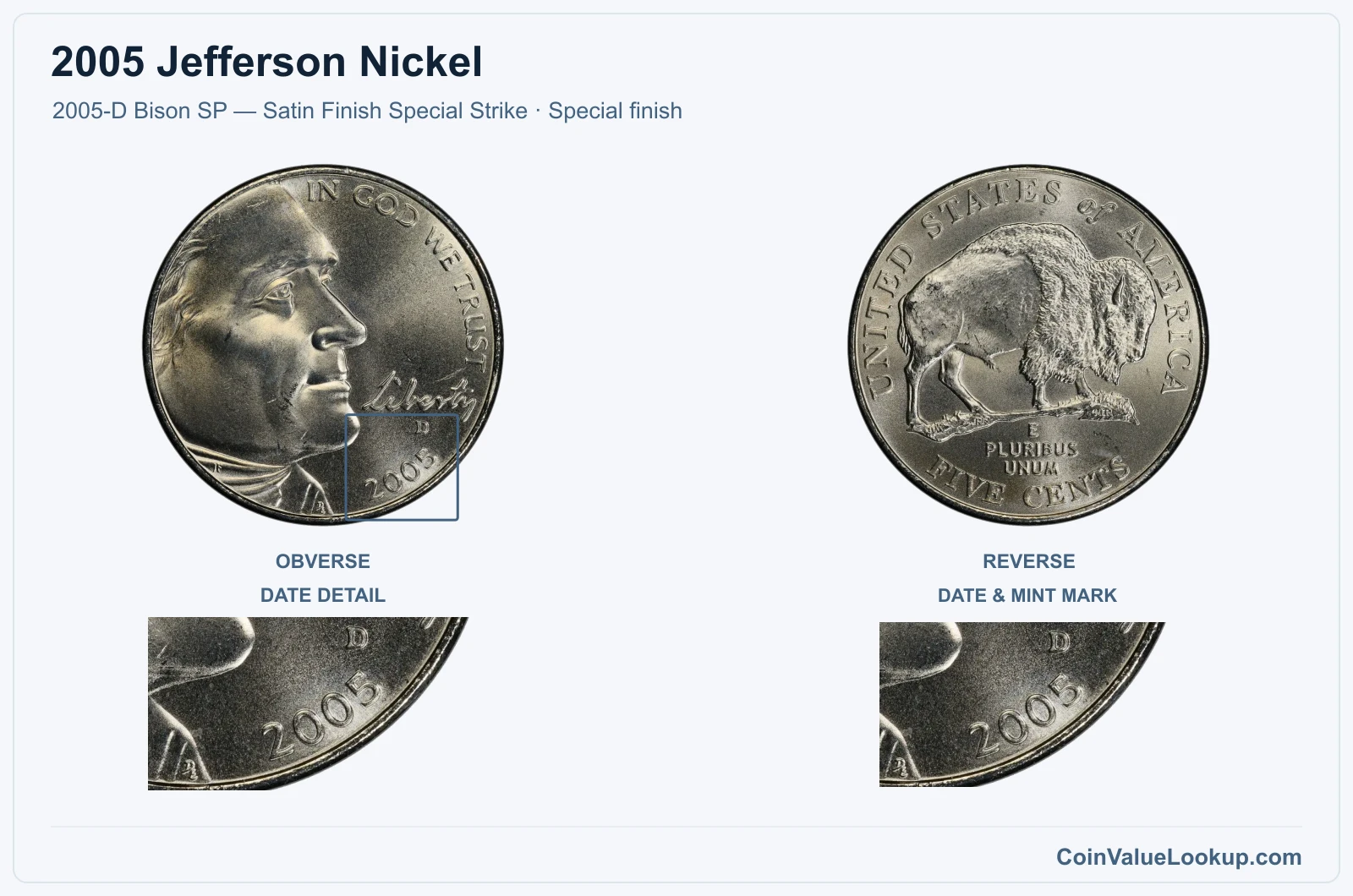
The 2005-D American Bison satin-finish coin came from 2005 Mint Sets, just like its Philadelphia counterpart. The Denver satin coin has that same muted, satiny luster rather than the bright cartwheel of a business strike.
It was not released into general circulation. Pricing depends on authenticated identity and condition rather than a standard guide range.
If your coin has an unusually soft finish and traces of original Mint Set handling, it may be worth having it examined.
| Range | Grade | Price | Auction Records | Appraisal |
|---|---|---|---|---|
| SP | SP 1 | — | Coin Identifier | |
| SP 2 | — | Coin Identifier | ||
| SP 3 | — | Coin Identifier | ||
| SP 4 | — | Coin Identifier | ||
| SP 6 | — | Coin Identifier | ||
| SP 8 | — | Coin Identifier | ||
| SP 10 | — | Coin Identifier | ||
| SP 12 | — | Coin Identifier | ||
| SP 15 | — | Coin Identifier | ||
| SP 20 | — | Coin Identifier | ||
| SP 25 | — | Coin Identifier | ||
| SP 30 | — | Coin Identifier | ||
| SP 35 | — | Coin Identifier | ||
| SP 40 | — | Coin Identifier | ||
| SP 45 | — | Coin Identifier | ||
| SP 50 | — | Coin Identifier | ||
| SP 53 | — | Coin Identifier | ||
| SP 55 | — | Coin Identifier | ||
| SP 58 | — | Coin Identifier | ||
| SP 60 | — | Coin Identifier | ||
| SP 61 | — | Coin Identifier | ||
| SP 62 | — | Coin Identifier | ||
| SP 63 | — | Coin Identifier | ||
| SP 64 | — | Coin Identifier | ||
| SP 65 | — | Coin Identifier | ||
| SP 66 | Coin Identifier | |||
| SP 67 | Coin Identifier | |||
| SP 68 | Coin Identifier | |||
| SP 69 | Coin Identifier | |||
| SP 70 | — | — | — |
2005 Jefferson Nickel — S Bison PR — Proof
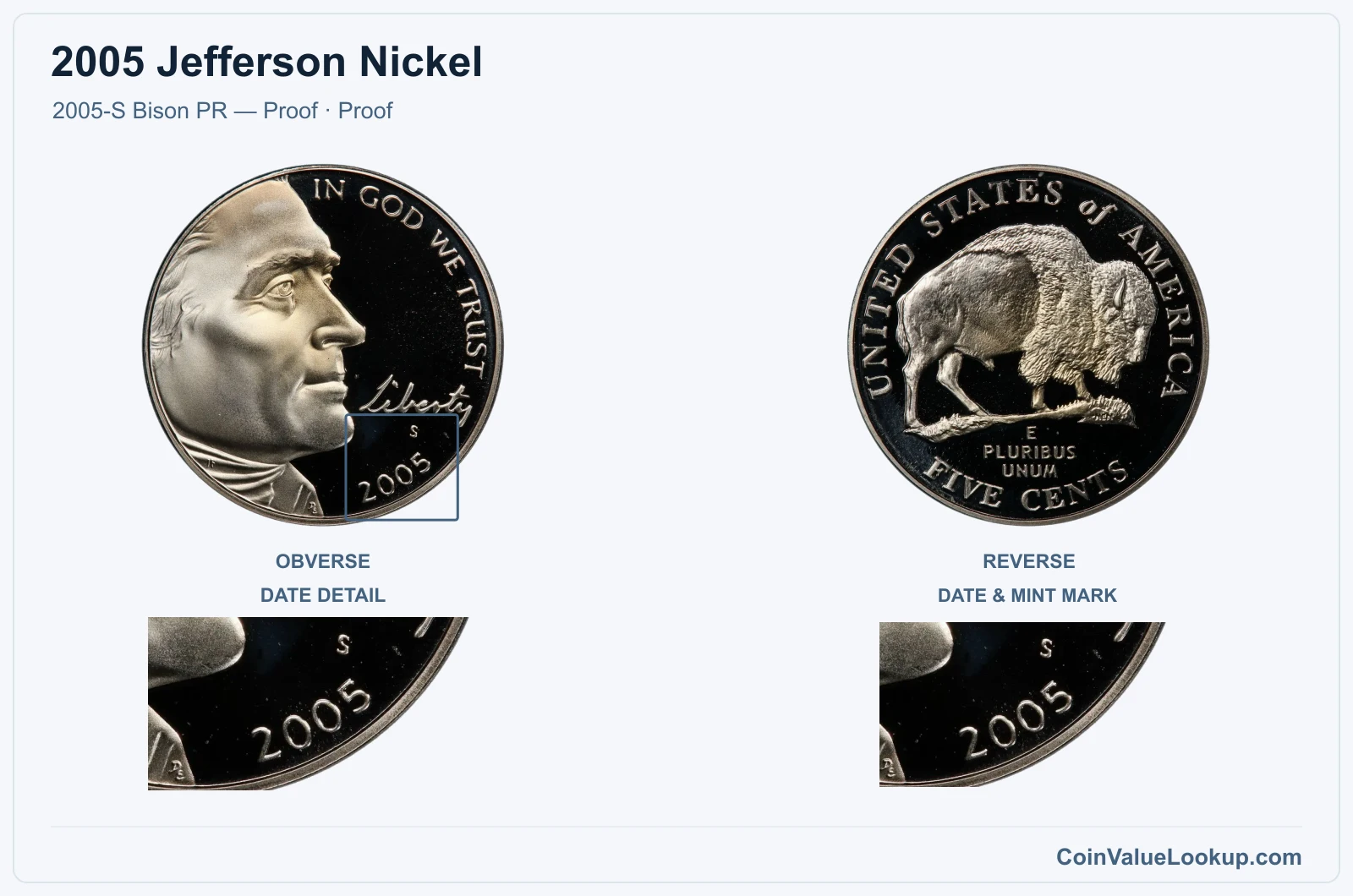
The 2005-S American Bison proof was struck at San Francisco for collector proof sets. It features mirror-like fields and sharply struck devices.
USA Coin Book lists a guide value of approximately $6.25 at PR65. The "S" mintmark confirms San Francisco origin.
These were never circulated, so any example showing wear or damage was likely mishandled after leaving its original packaging.
| Range | Grade | Price | Auction Records | Appraisal |
|---|---|---|---|---|
| PR | PR 1 | — | Coin Identifier | |
| PR 2 | — | Coin Identifier | ||
| PR 3 | — | Coin Identifier | ||
| PR 4 | — | Coin Identifier | ||
| PR 6 | — | Coin Identifier | ||
| PR 8 | — | Coin Identifier | ||
| PR 10 | — | Coin Identifier | ||
| PR 12 | — | Coin Identifier | ||
| PR 15 | — | Coin Identifier | ||
| PR 20 | — | Coin Identifier | ||
| PR 25 | — | Coin Identifier | ||
| PR 30 | — | Coin Identifier | ||
| PR 35 | — | Coin Identifier | ||
| PR 40 | — | Coin Identifier | ||
| PR 45 | — | Coin Identifier | ||
| PR 50 | — | Coin Identifier | ||
| PR 53 | — | Coin Identifier | ||
| PR 55 | — | Coin Identifier | ||
| PR 58 | — | Coin Identifier | ||
| PR 60 | — | Coin Identifier | ||
| PR 61 | — | Coin Identifier | ||
| PR 62 | — | Coin Identifier | ||
| PR 63 | — | Coin Identifier | ||
| PR 64 | — | Coin Identifier | ||
| PR 65 | — | Coin Identifier | ||
| PR 66 | — | Coin Identifier | ||
| PR 67 | — | Coin Identifier | ||
| PR 68 | Coin Identifier | |||
| PR 69 | Coin Identifier | |||
| PR 70 | Coin Identifier |
2005 Jefferson Nickel — D Speared Bison — Business strike
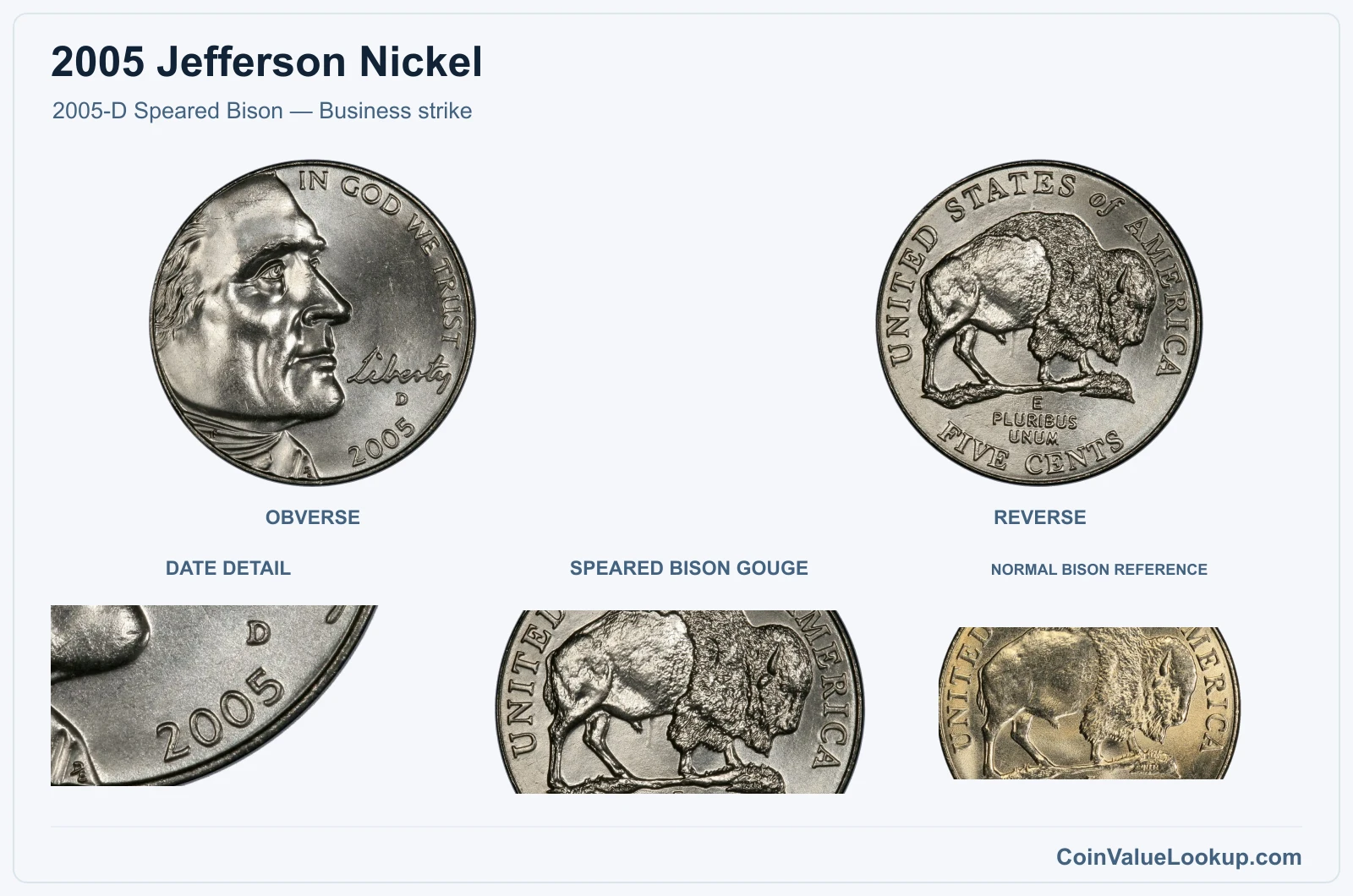
The 2005-D Speared Bison is a recognized die variety, not a random scratch. A raised diagonal line runs across the bison's body, looking like a spear.
This line is raised because it came from a gouge in the die itself, which transferred to every coin struck by that die. A scratch on a coin would be incuse, cutting into the surface.
To confirm you have a genuine Speared Bison, compare your coin to a normal 2005-D Bison side by side. The spear line should be raised and consistent in position.
Value depends on authentication and the coin's condition. Coin Value Lookup is a good starting point if you want to look up guides for this and other Jefferson nickel varieties before seeking professional attribution.
| Range | Grade | Price | Auction Records | Appraisal |
|---|---|---|---|---|
| PO | PO 1 | — | Coin Identifier | |
| FR | FR 2 | — | Coin Identifier | |
| AG | AG 3 | — | Coin Identifier | |
| G | G 4 | — | Coin Identifier | |
| G 6 | — | Coin Identifier | ||
| VG | VG 8 | — | Coin Identifier | |
| VG 10 | — | Coin Identifier | ||
| F | F 12 | — | Coin Identifier | |
| F 15 | — | Coin Identifier | ||
| VF | VF 20 | — | Coin Identifier | |
| VF 25 | — | Coin Identifier | ||
| VF 30 | — | Coin Identifier | ||
| VF 35 | — | Coin Identifier | ||
| XF | XF 40 | — | Coin Identifier | |
| XF 45 | — | Coin Identifier | ||
| AU | AU 50 | — | Coin Identifier | |
| AU 53 | — | Coin Identifier | ||
| AU 55 | — | Coin Identifier | ||
| AU 58 | — | Coin Identifier | ||
| MS | MS 60 | — | Coin Identifier | |
| MS 61 | — | Coin Identifier | ||
| MS 62 | — | Coin Identifier | ||
| MS 63 | Coin Identifier | |||
| MS 64 | Coin Identifier | |||
| MS 65 | Coin Identifier | |||
| MS 66 | Coin Identifier | |||
| MS 67 | — | — | — | |
| MS 68 | — | — | — | |
| MS 69 | — | — | — | |
| MS 70 | — | — | — |
2005 Jefferson Nickel — P Ocean in View — Business strike
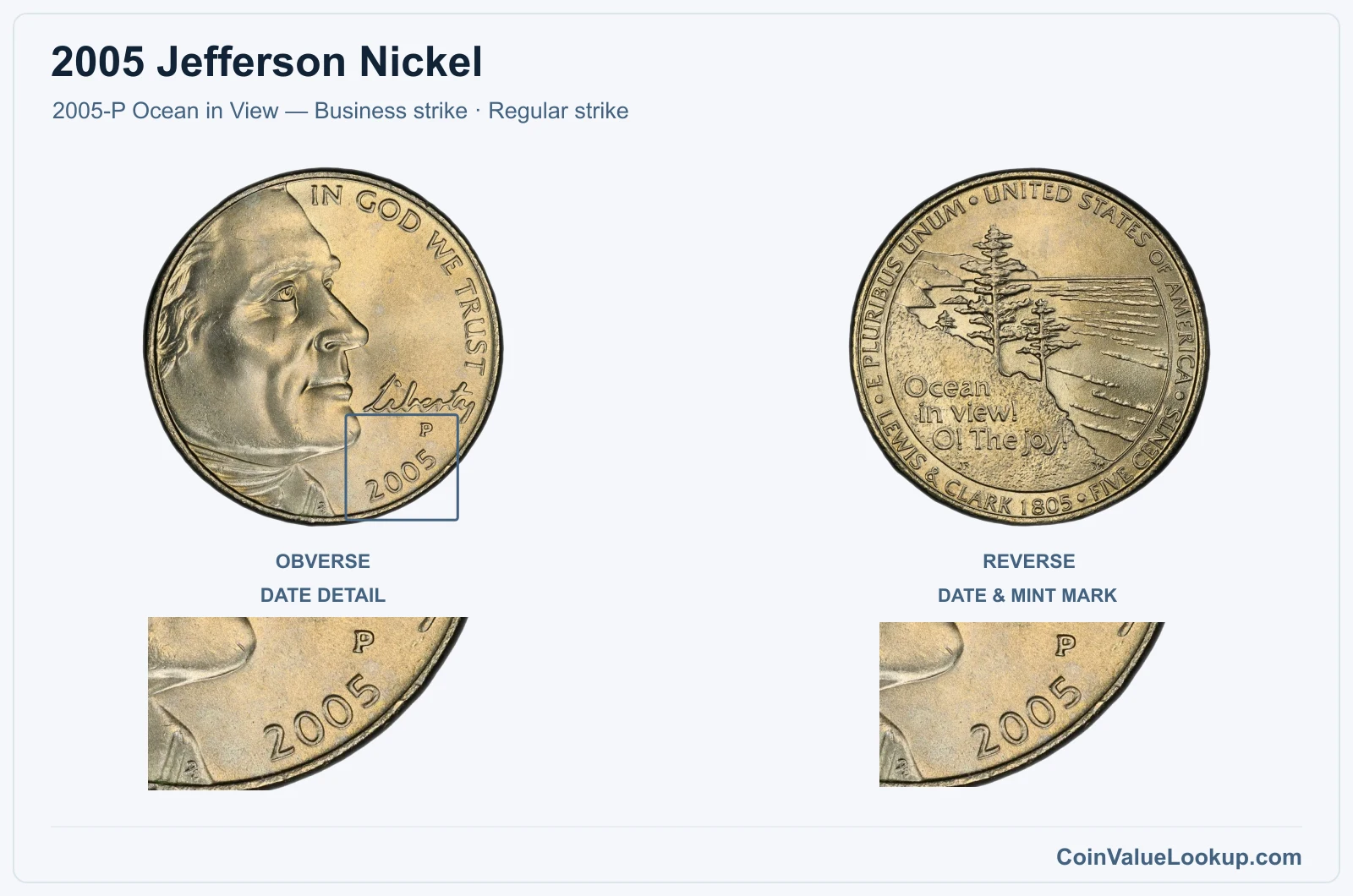
The 2005-P Ocean in View business strike features the second Westward Journey reverse of the year, depicting the Pacific coastline. USA Coin Book guide estimates place it at about $0.30 in MS60 and $0.93 in MS65.
These are common in circulation and worth face value when worn. Check for the "P" mintmark and confirm the reverse shows the ocean scene rather than the bison.
| Range | Grade | Price | Auction Records | Appraisal |
|---|---|---|---|---|
| PO | PO 1 | — | Coin Identifier | |
| FR | FR 2 | — | Coin Identifier | |
| AG | AG 3 | — | Coin Identifier | |
| G | G 4 | — | Coin Identifier | |
| G 6 | — | Coin Identifier | ||
| VG | VG 8 | — | Coin Identifier | |
| VG 10 | — | Coin Identifier | ||
| F | F 12 | — | Coin Identifier | |
| F 15 | — | Coin Identifier | ||
| VF | VF 20 | — | Coin Identifier | |
| VF 25 | — | Coin Identifier | ||
| VF 30 | — | Coin Identifier | ||
| VF 35 | — | Coin Identifier | ||
| XF | XF 40 | — | Coin Identifier | |
| XF 45 | — | Coin Identifier | ||
| AU | AU 50 | — | Coin Identifier | |
| AU 53 | — | Coin Identifier | ||
| AU 55 | — | Coin Identifier | ||
| AU 58 | — | Coin Identifier | ||
| MS | MS 60 | — | Coin Identifier | |
| MS 61 | — | Coin Identifier | ||
| MS 62 | — | Coin Identifier | ||
| MS 63 | — | Coin Identifier | ||
| MS 64 | — | Coin Identifier | ||
| MS 65 | Coin Identifier | |||
| MS 66 | — | Coin Identifier | ||
| MS 67 | — | Coin Identifier | ||
| MS 68 | Coin Identifier | |||
| MS 69 | — | — | — | |
| MS 70 | — | — | — |
2005 Jefferson Nickel — P Ocean in View SP — Satin Finish Special Strike
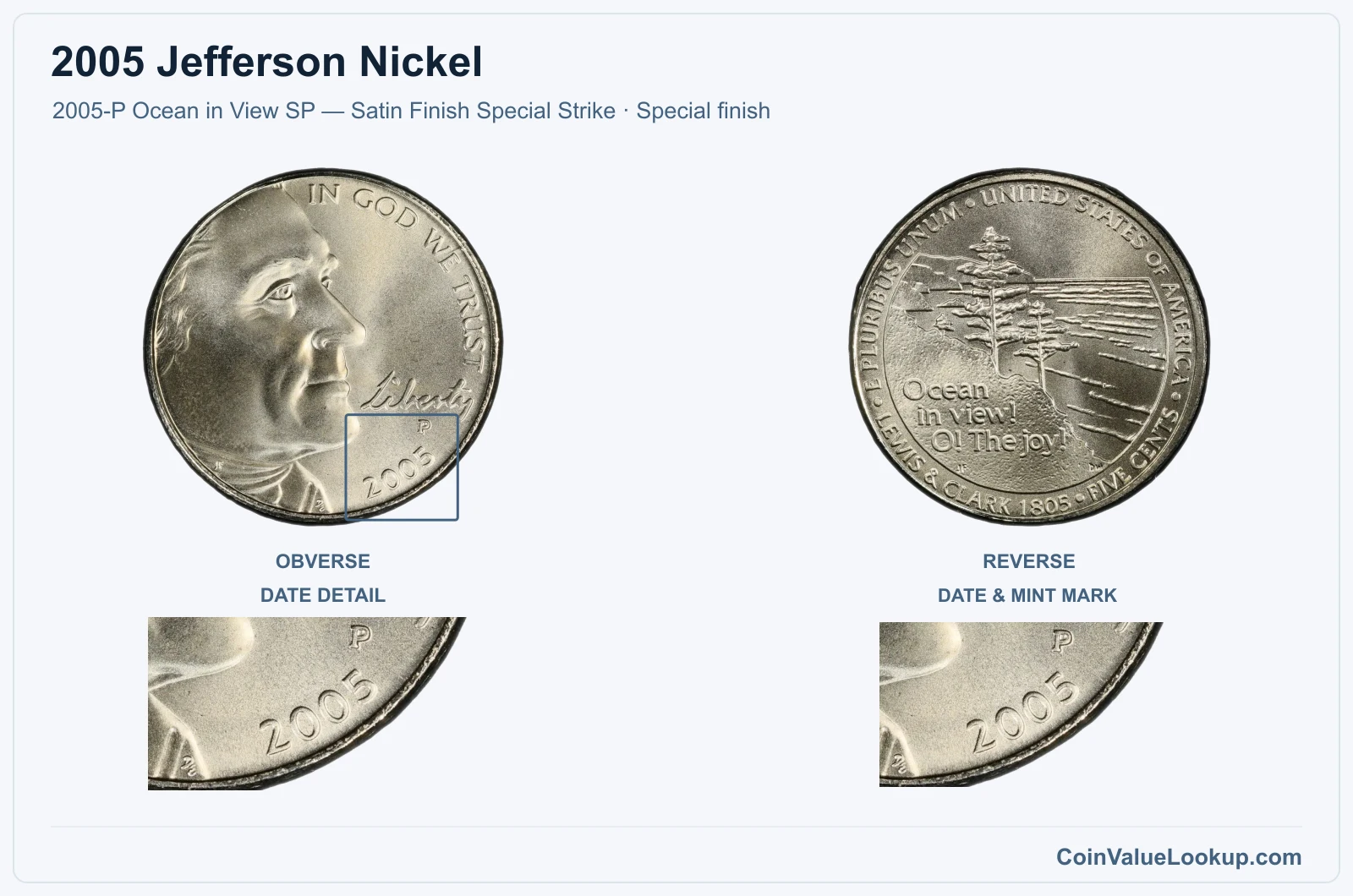
The 2005-P Ocean in View satin-finish coin was included in 2005 Uncirculated Mint Sets. Like all satin issues, it has a softer luster than a circulation strike.
No standard guide price range is adopted for this version. Individual value depends on authenticated condition and finish confirmation.
If you suspect yours is satin rather than a regular strike, compare the surface quality carefully under good lighting.
| Range | Grade | Price | Auction Records | Appraisal |
|---|---|---|---|---|
| SP | SP 1 | — | Coin Identifier | |
| SP 2 | — | Coin Identifier | ||
| SP 3 | — | Coin Identifier | ||
| SP 4 | — | Coin Identifier | ||
| SP 6 | — | Coin Identifier | ||
| SP 8 | — | Coin Identifier | ||
| SP 10 | — | Coin Identifier | ||
| SP 12 | — | Coin Identifier | ||
| SP 15 | — | Coin Identifier | ||
| SP 20 | — | Coin Identifier | ||
| SP 25 | — | Coin Identifier | ||
| SP 30 | — | Coin Identifier | ||
| SP 35 | — | Coin Identifier | ||
| SP 40 | — | Coin Identifier | ||
| SP 45 | — | Coin Identifier | ||
| SP 50 | — | Coin Identifier | ||
| SP 53 | — | Coin Identifier | ||
| SP 55 | — | Coin Identifier | ||
| SP 58 | — | Coin Identifier | ||
| SP 60 | — | Coin Identifier | ||
| SP 61 | — | Coin Identifier | ||
| SP 62 | — | Coin Identifier | ||
| SP 63 | — | Coin Identifier | ||
| SP 64 | — | Coin Identifier | ||
| SP 65 | — | Coin Identifier | ||
| SP 66 | Coin Identifier | |||
| SP 67 | Coin Identifier | |||
| SP 68 | Coin Identifier | |||
| SP 69 | Coin Identifier | |||
| SP 70 | — | Coin Identifier |
2005 Jefferson Nickel — D Ocean in View — Business strike
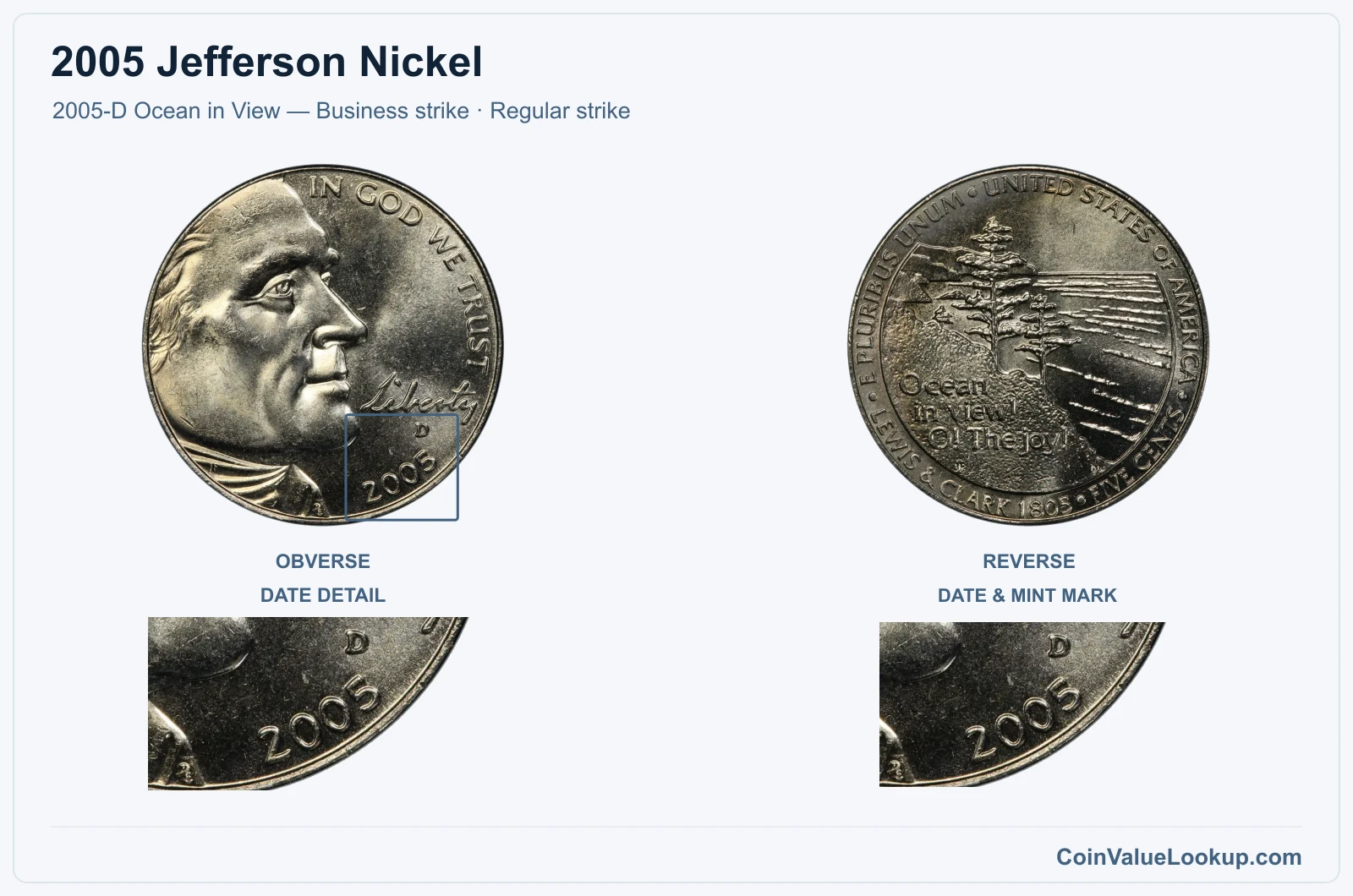
The 2005-D Ocean in View business strike is the Denver Mint circulation version of this reverse design. USA Coin Book estimates put it near $0.30 in MS60 and $0.93 in MS65.
Like most modern nickels, circulated examples are worth five cents. An uncirculated piece in original condition commands a small premium.
Confirm the "D" mintmark and the ocean coastline reverse to place this coin correctly.
| Range | Grade | Price | Auction Records | Appraisal |
|---|---|---|---|---|
| PO | PO 1 | — | Coin Identifier | |
| FR | FR 2 | — | Coin Identifier | |
| AG | AG 3 | — | Coin Identifier | |
| G | G 4 | — | Coin Identifier | |
| G 6 | — | Coin Identifier | ||
| VG | VG 8 | — | Coin Identifier | |
| VG 10 | — | Coin Identifier | ||
| F | F 12 | — | Coin Identifier | |
| F 15 | — | Coin Identifier | ||
| VF | VF 20 | — | Coin Identifier | |
| VF 25 | — | Coin Identifier | ||
| VF 30 | — | Coin Identifier | ||
| VF 35 | — | Coin Identifier | ||
| XF | XF 40 | — | Coin Identifier | |
| XF 45 | — | Coin Identifier | ||
| AU | AU 50 | — | Coin Identifier | |
| AU 53 | — | Coin Identifier | ||
| AU 55 | — | Coin Identifier | ||
| AU 58 | — | Coin Identifier | ||
| MS | MS 60 | — | Coin Identifier | |
| MS 61 | — | Coin Identifier | ||
| MS 62 | — | Coin Identifier | ||
| MS 63 | — | Coin Identifier | ||
| MS 64 | — | Coin Identifier | ||
| MS 65 | Coin Identifier | |||
| MS 66 | Coin Identifier | |||
| MS 67 | — | Coin Identifier | ||
| MS 68 | — | — | — | |
| MS 69 | — | — | — | |
| MS 70 | — | — | — |
2005 Jefferson Nickel — S Ocean in View PR — Proof
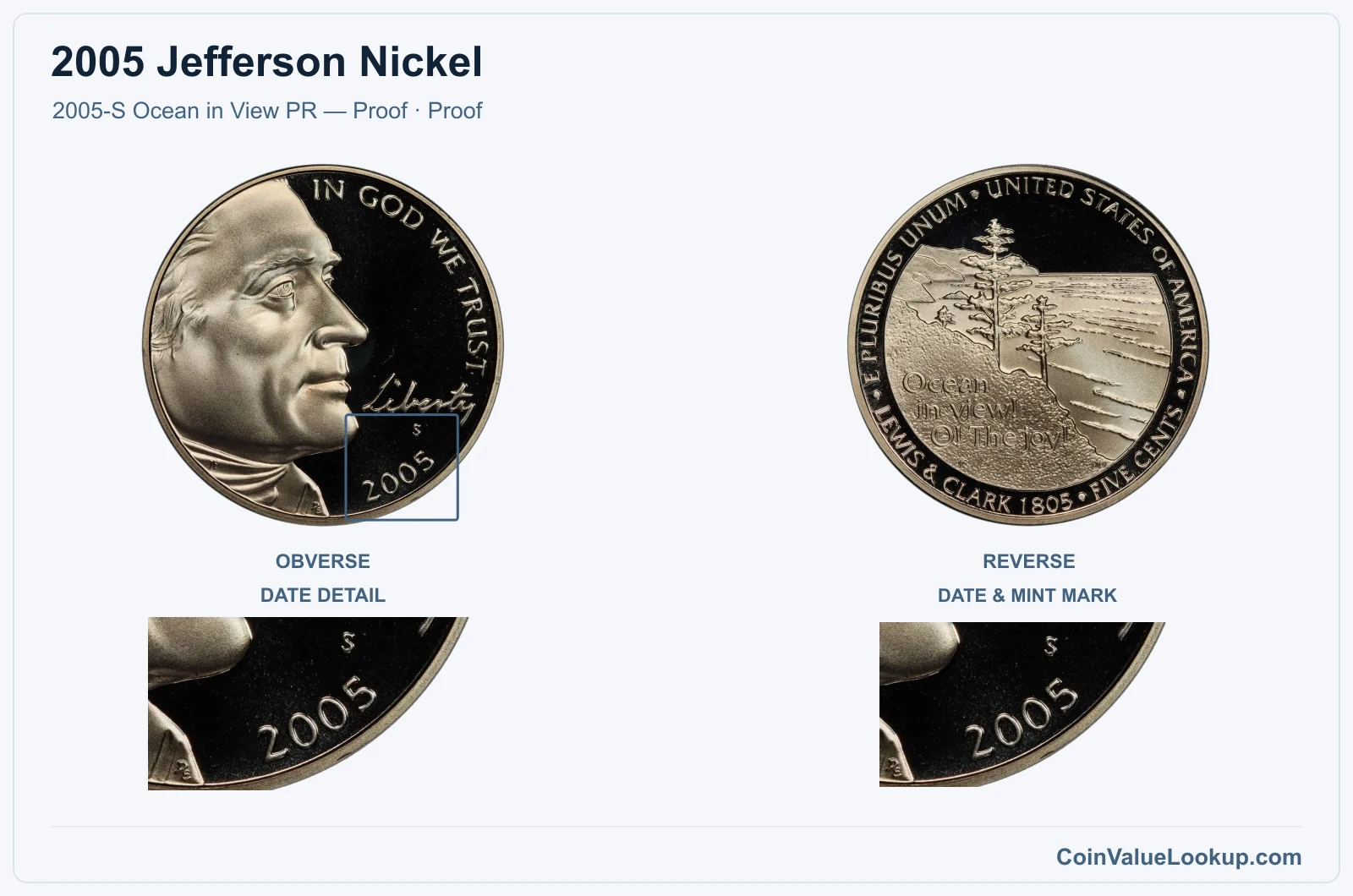
The 2005-S Ocean in View proof was struck at San Francisco for proof sets. It features the same coastline reverse in proof finish with reflective fields and crisp detail.
USA Coin Book lists a guide value of about $5.30 at PR65. The "S" mintmark confirms San Francisco production.
These proofs are collectible but not scarce, so condition and eye appeal drive value differences among examples.
| Range | Grade | Price | Auction Records | Appraisal |
|---|---|---|---|---|
| PR | PR 1 | — | Coin Identifier | |
| PR 2 | — | Coin Identifier | ||
| PR 3 | — | Coin Identifier | ||
| PR 4 | — | Coin Identifier | ||
| PR 6 | — | Coin Identifier | ||
| PR 8 | — | Coin Identifier | ||
| PR 10 | — | Coin Identifier | ||
| PR 12 | — | Coin Identifier | ||
| PR 15 | — | Coin Identifier | ||
| PR 20 | — | Coin Identifier | ||
| PR 25 | — | Coin Identifier | ||
| PR 30 | — | Coin Identifier | ||
| PR 35 | — | Coin Identifier | ||
| PR 40 | — | Coin Identifier | ||
| PR 45 | — | Coin Identifier | ||
| PR 50 | — | Coin Identifier | ||
| PR 53 | — | Coin Identifier | ||
| PR 55 | — | Coin Identifier | ||
| PR 58 | — | Coin Identifier | ||
| PR 60 | — | Coin Identifier | ||
| PR 61 | — | Coin Identifier | ||
| PR 62 | — | Coin Identifier | ||
| PR 63 | — | Coin Identifier | ||
| PR 64 | — | Coin Identifier | ||
| PR 65 | — | Coin Identifier | ||
| PR 66 | — | Coin Identifier | ||
| PR 67 | Coin Identifier | |||
| PR 68 | — | Coin Identifier | ||
| PR 69 | Coin Identifier | |||
| PR 70 | Coin Identifier |
2005 Jefferson Nickel — D Ocean in View SP — Satin Finish Special Strike
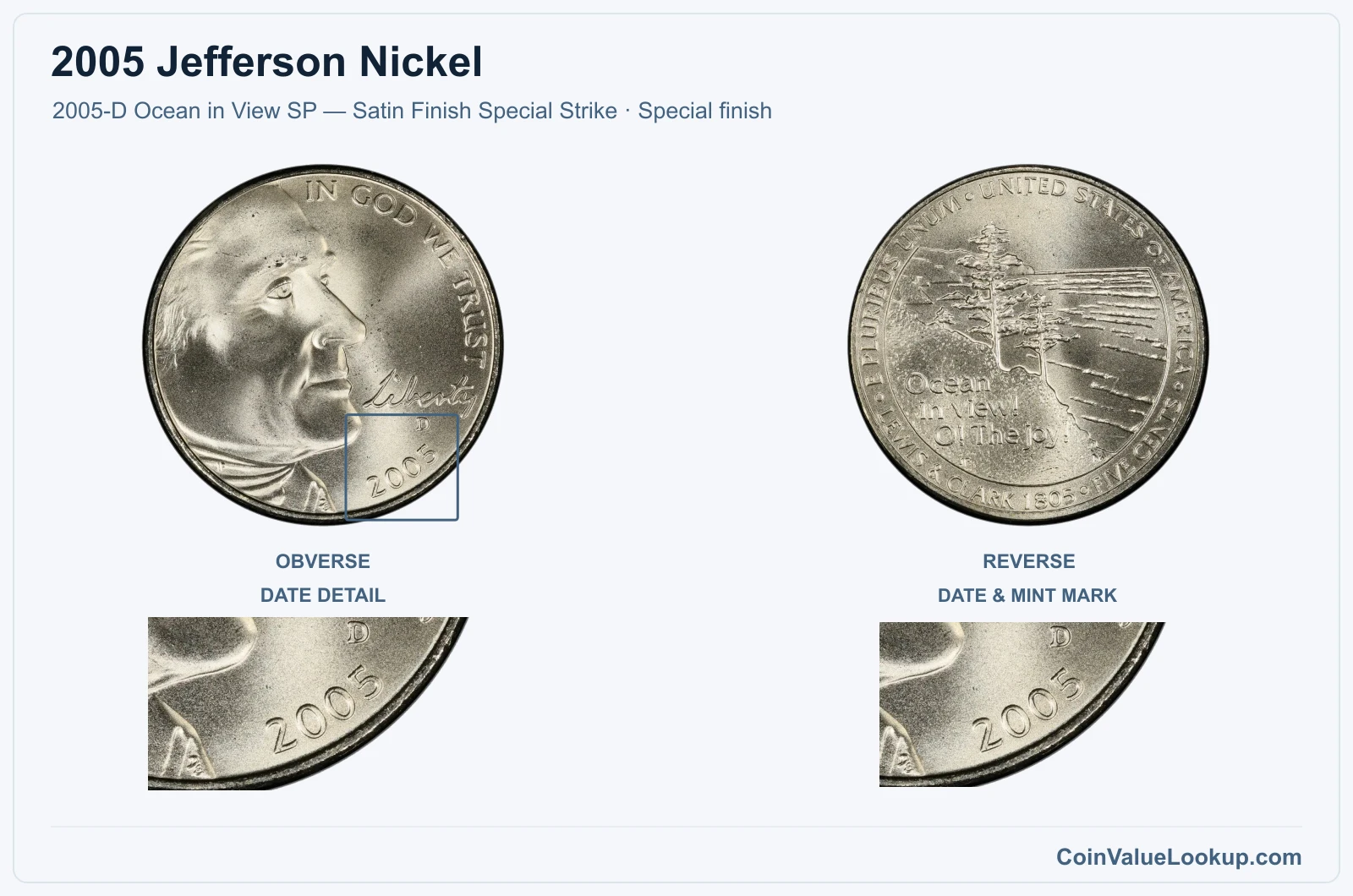
The 2005-D Ocean in View satin-finish coin came from 2005 Uncirculated Mint Sets, paired with the Denver mintmark. It shares the distinctive muted luster of all satin-finish issues from that era.
No standard guide price range is adopted here. Value is assessed individually based on authenticated identity and condition.
Compare it to a known business strike under the same lighting to see the finish difference clearly.
| Range | Grade | Price | Auction Records | Appraisal |
|---|---|---|---|---|
| SP | SP 1 | — | Coin Identifier | |
| SP 2 | — | Coin Identifier | ||
| SP 3 | — | Coin Identifier | ||
| SP 4 | — | Coin Identifier | ||
| SP 6 | — | Coin Identifier | ||
| SP 8 | — | Coin Identifier | ||
| SP 10 | — | Coin Identifier | ||
| SP 12 | — | Coin Identifier | ||
| SP 15 | — | Coin Identifier | ||
| SP 20 | — | Coin Identifier | ||
| SP 25 | — | Coin Identifier | ||
| SP 30 | — | Coin Identifier | ||
| SP 35 | — | Coin Identifier | ||
| SP 40 | — | Coin Identifier | ||
| SP 45 | — | Coin Identifier | ||
| SP 50 | — | Coin Identifier | ||
| SP 53 | — | Coin Identifier | ||
| SP 55 | — | Coin Identifier | ||
| SP 58 | — | Coin Identifier | ||
| SP 60 | — | Coin Identifier | ||
| SP 61 | — | Coin Identifier | ||
| SP 62 | — | Coin Identifier | ||
| SP 63 | — | Coin Identifier | ||
| SP 64 | — | Coin Identifier | ||
| SP 65 | — | Coin Identifier | ||
| SP 66 | Coin Identifier | |||
| SP 67 | Coin Identifier | |||
| SP 68 | Coin Identifier | |||
| SP 69 | Coin Identifier | |||
| SP 70 | — | — | — |
2005 Jefferson Nickel Error List
1. 2005 Jefferson Nickel — Speared Bison die gouge
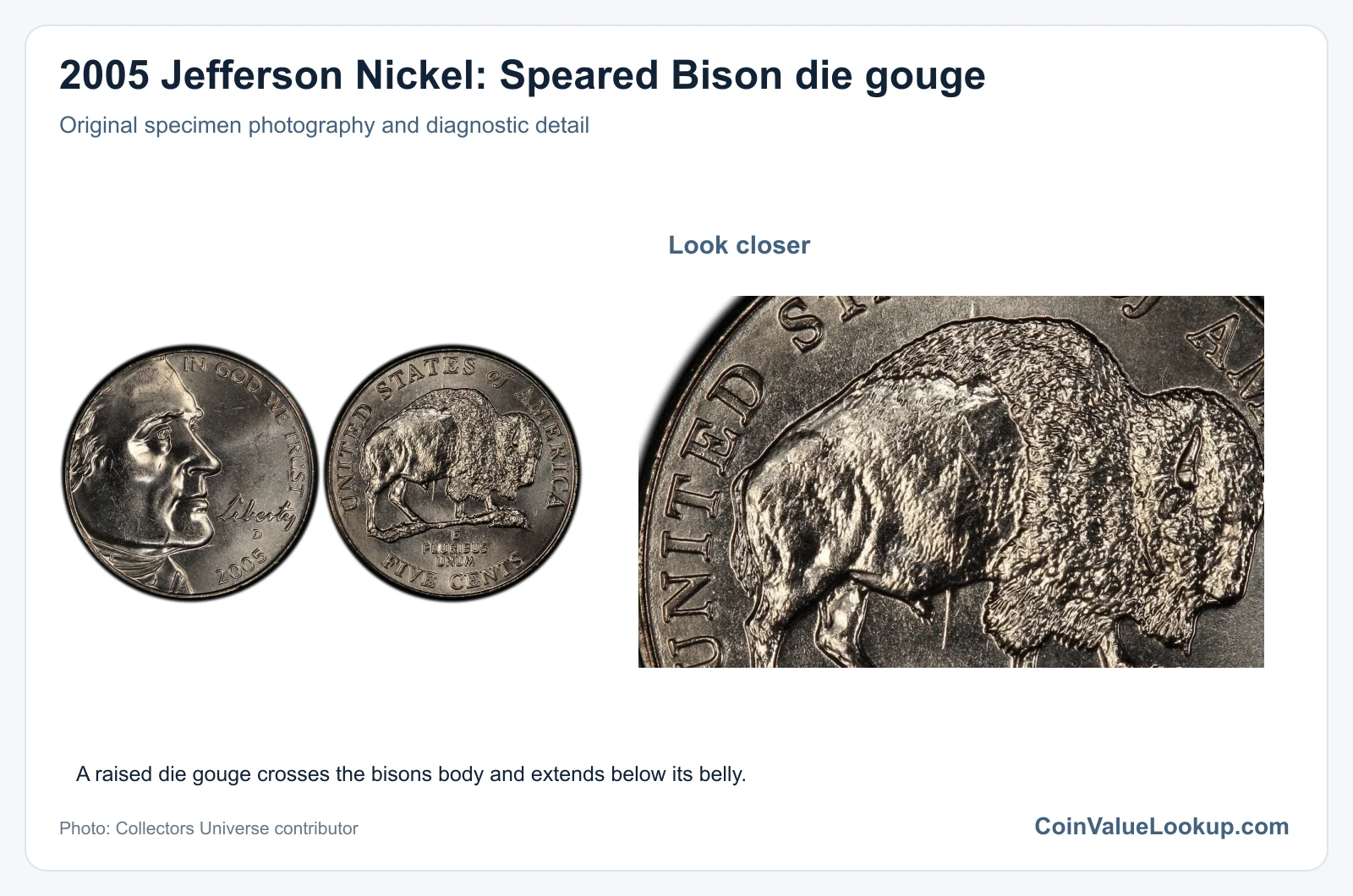
The Speared Bison is specific to the 2005-D American Bison reverse. A raised diagonal line crosses the bison's body, transferred from a gouge in the die.
Because it comes from the die, the line is raised on the coin's surface, not cut into it.
The key distinction from a lookalike is relief. An incuse scratch or random die crack will look different under magnification.
A scratch digs into the metal, while the spear line sits above the surrounding field. A die crack typically follows an irregular path and may show a raised ridge without the clean diagonal angle of the spear.
No standard price range is adopted for this variety. Value depends on authenticated attribution and the coin's overall condition.
2. 2005 Jefferson Nickel — Bison design struck over a2005cent
This is a dramatic double-denomination error: a 2005 Bison nickel design struck over a 2005 cent planchet at the Philadelphia Mint. Residual cent design elements remain visible beneath the nickel's design, confirming two separate strikes on one planchet.
One example, graded NGC MS68 Red, sold through Heritage Auctions in September 2025 for $26,400. That is an exceptional single specimen, not a typical error price.
Do not assume any similar coin would bring the same amount.
Lookalikes include coins simply struck on a blank cent planchet or two coins physically pressed together after leaving the mint. The genuine article shows both designs properly impressed by dies, not mechanical damage.
Authentication by a major grading service is essential for a claim this significant.
3. 2005 Jefferson Nickel — Reverse die crack
Die cracks appear as raised lines on the coin's surface, caused by a fracture in the steel die during production. On the 2005-P American Bison reverse, a documented example graded NGC MS66 sold through Heritage Auctions in April 2022 for $45.
These raised lines follow the path of the crack in the die, so they sit above the coin's surface. Compare this to incuse scratches, which cut below the surface, and die polish lines, which tend to be finer and more uniform.
The location and severity of a die crack vary from die to die, so match your coin to known examples rather than assuming a crack in one spot proves a particular die.
Value depends on the crack's size, visibility, and the coin's overall grade.
4. 2005 Jefferson Nickel — Improperly annealed Bison blank
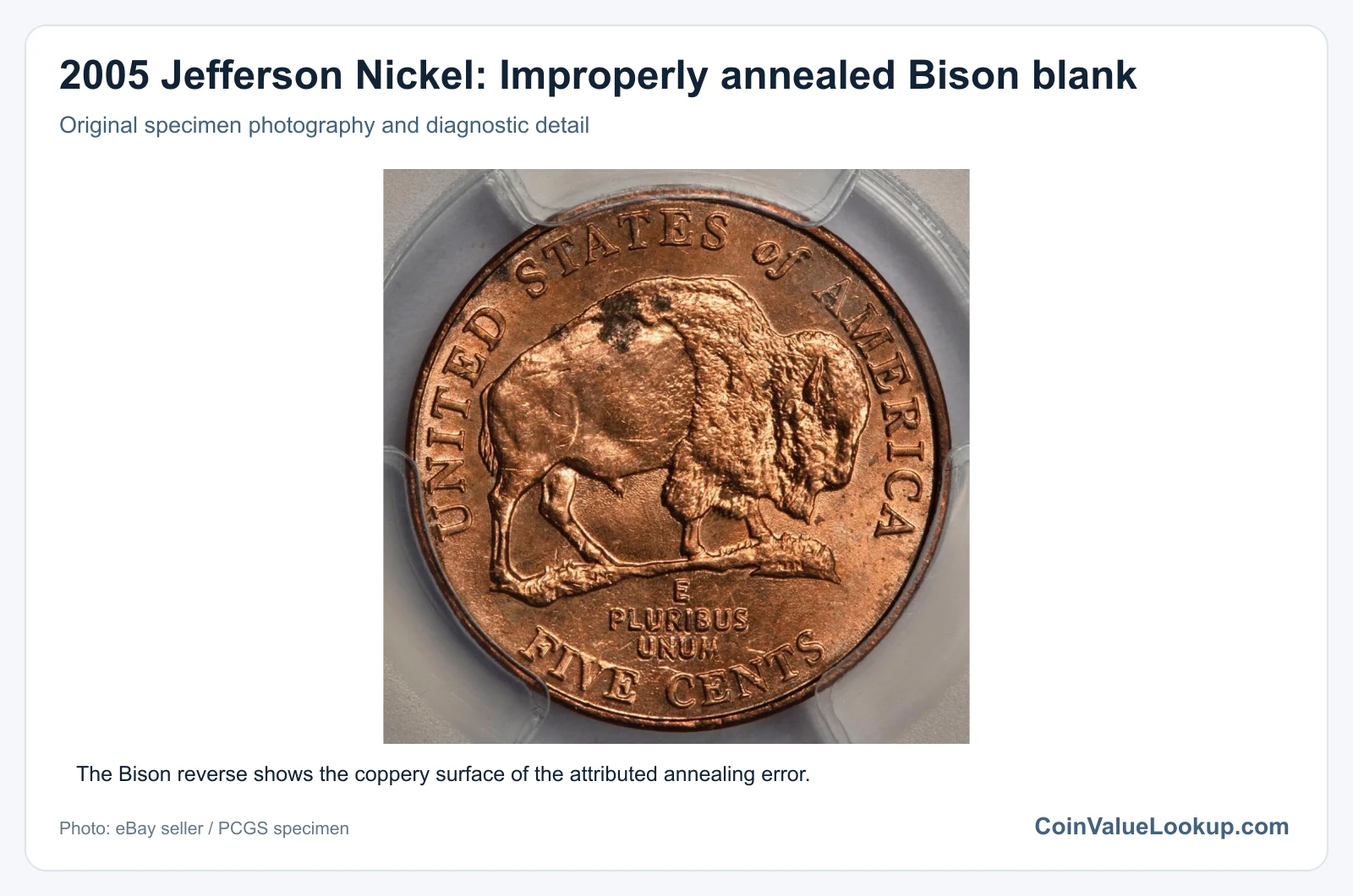
An improperly annealed coin results from an abnormality in the Mint's heat-treatment process for blank planchets. A documented 2005-P American Bison example was authenticated by NGC at MS65.
This kind of error can affect the coin's color, surface texture, or hardness in ways that look unusual but are distinct from post-mint damage. The tricky part is distinguishing it from fire damage, chemical toning, or environmental effects, all of which can produce similar discoloration.
Authentication is critical here. Without professional attribution, a coin with odd toning or surface qualities could easily be dismissed or misidentified.
No standard price range is adopted for this error. Value depends on authenticated identity and the specific characteristics of the individual coin.
5. 2005 Jefferson Nickel — Off-center Bison strike
An off-center strike happens when the planchet is not properly seated between the dies, leaving part of the design missing and an unstruck crescent of blank metal visible. A 2005 American Bison example has been documented and graded PCGS MS63.
The percentage of off-center displacement and whether the date remains visible are the two biggest factors in collector appeal. More dramatic shifts with a readable date tend to attract stronger interest.
Do not confuse an off-center strike with a misaligned die, where the entire design is present but shifted slightly, or a clipped planchet, where the blank itself is incomplete. On an off-center coin, the design simply runs off the edge.
No standard price range is adopted. Value depends on authenticated attribution, displacement percentage, and overall condition.
6. 2005 Jefferson Nickel — Double clips on Ocean in View blank
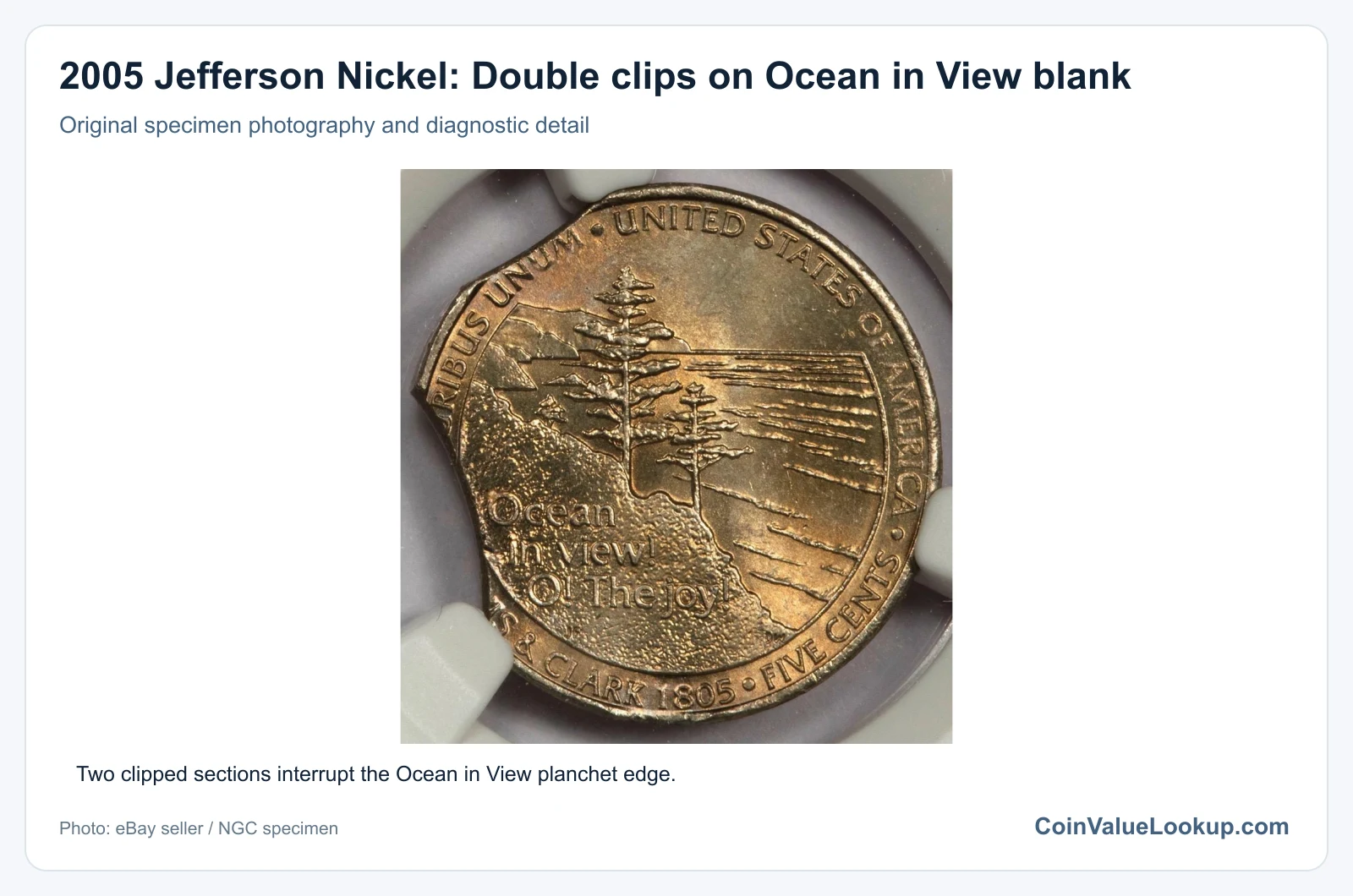
A double-clipped planchet means the coin blank was cut twice in positions that overlapped with adjacent blanks on the metal strip, leaving two curved bite marks in the rim. A 2005 Ocean in View example has been documented and graded NGC MS64.
Genuine clips show natural metal flow where the blank was shorted during the blanking process. The rim in those areas will be incomplete, and the adjacent design may be slightly weak.
Both clip boundaries should be visible.
Lookalikes include coins with rims that have been deliberately cut or ground down after leaving the Mint. Authentic clips produce a characteristic Blakesley effect, where the opposite side of the rim from the clip may show weakness.
No standard price range is adopted. Each example is valued individually based on authentication and severity.
7. 2005 Jefferson Nickel — Doubled Die Obverse
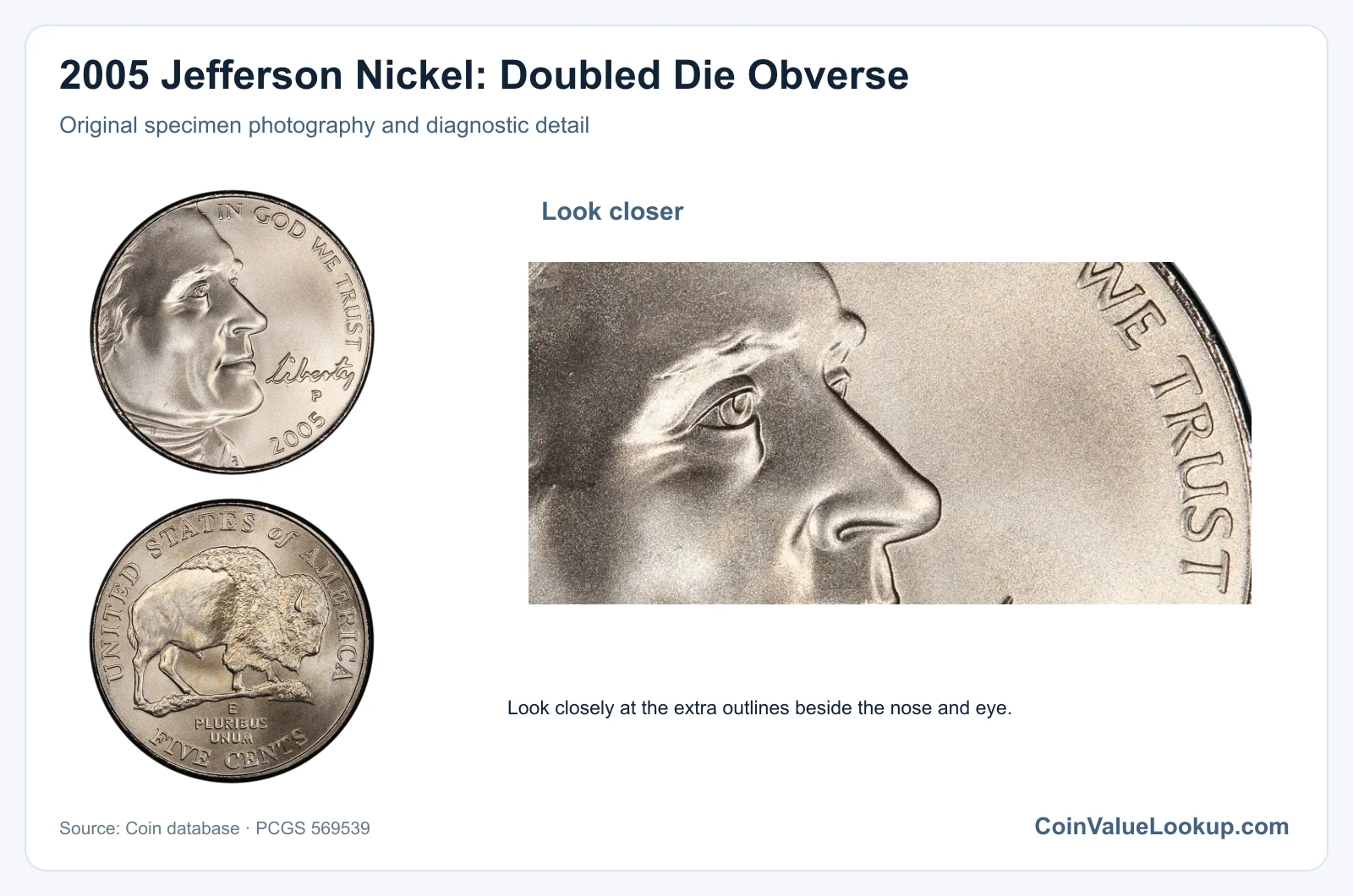
Doubled die obverse errors on 2005 nickels show consistent doubling on obverse design elements such as lettering or portrait details. This doubling is created during the die-making process, so it repeats identically on every coin struck by that die.
To check your coin, compare the obverse inscriptions and profile to a normal 2005 nickel under the same lighting. Look for separation, notching, or a shelf-like effect on letter edges.
True hub doubling is consistent and directional, affecting multiple elements in the same way.
Machine doubling, by contrast, tends to produce flat, shelf-like distortion without the defined separation of a genuine doubled die. Reflections and worn die contours can also mimic doubling.
No standard price range is adopted. Value depends on the visibility of the doubling, the specific die involved, and the coin's condition.
8. 2005 Jefferson Nickel — Doubled Die Reverse
Doubled die reverse errors on 2005 nickels show consistent doubling on reverse legends or design contours. Like obverse doubled dies, the doubling originates in the die itself and will repeat across all coins from that die.
Compare your coin's reverse lettering and design elements to a normal example under magnification. True doubled die effects show clean, consistent separation or notching in the same direction across multiple design points.
Machine doubling looks different. It typically creates a flat, mushy shelf rather than distinct separation.
Random damage and reflections can also fool the eye. If you suspect a doubled die reverse, close-up photos of the affected area are essential for any attribution attempt.
No standard price range is adopted. The specific doubled die, its visibility, and the coin's overall condition all affect value.
9. 2005 Jefferson Nickel — Die-Adjustment / Low-Pressure Strike
A die-adjustment strike occurs when the press is being set up or calibrated and strikes a coin at reduced pressure. The result is an overall weak impression on both sides, but the surfaces themselves remain unworn because the coin was never circulated.
This error has been reported for the 2005-D nickel. The key diagnostic is weak detail across the entire coin, not just in isolated areas.
Both the obverse portrait and reverse design will appear faint or incomplete, yet the surfaces will lack the friction and contact marks of a circulated coin.
The challenge is telling this apart from ordinary wear, a grease-filled die, or simply a weak strike. Circulation wear produces smooth, flattened high points with surface friction.
Grease-filled dies typically affect only localized areas. No standard price range is adopted.
Value depends on authentication and the degree of weakness.
10. 2005 Jefferson Nickel — Feeder-Finger Marks
Feeder-finger marks are reported on 2005 nickels. These occur when the mechanical fingers that feed planchets into the press leave marks on the blank before or during striking.
The result is a set of parallel or repeated impressions visible on the finished coin.
Look for marks that appear in a consistent pattern across the coin's surface. They should be in relief, having been struck into the design, rather than randomly scattered like handling scratches.
Not every scratch is a mint error. Handling marks from rolls, counting machines, or storage are far more common and can look superficially similar.
Cleaning hairlines and die-polish lines also create fine parallel marks. Authentication is important because the distinction between feeder-finger marks and post-mint damage often requires professional examination.
No standard price range is adopted. Value depends on the clarity and confirmed attribution of the marks.
11. 2005 Jefferson Nickel — Struck-Through Error
Struck-through errors on 2005 nickels have been reported, including examples described as struck through grease or with a detached-leg appearance. These occur when foreign material sits between the die and the planchet during striking, blocking part of the design from being fully impressed.
A grease-filled die leaves a smooth, flat area where the design should be. A struck-through retained object may leave an impression or outline of whatever was trapped.
The affected area will typically be recessed or simply absent, not raised.
This looks different from wear, which produces gradual smoothing on high points with surface friction. Scratches and cleaning also create surface disruption but lack the clean, localized character of a struck-through area.
No standard price range is adopted. Value depends on the type and size of the obstruction, visibility of the affected area, and the coin's authenticated condition.