2006 Jefferson Nickel Coin Value: How Much Is It Worth?
The 2006 Jefferson nickel marked the return of the familiar Monticello reverse after two years of Westward Journey commemorative designs. Most circulated examples are worth face value.
For uncirculated business strikes from Philadelphia or Denver, guide estimates from USA Coin Book place values at roughly $0.30 in MS60 condition up to about $0.93 at MS65. These are retail guide figures, not guaranteed offers.
Proofs struck in San Francisco and satin-finish Mint Set coins each have their own collector market worth exploring.
Fast Way to Identify Your 2006 Jefferson Nickel
Snap a clear photo of the front and back of your 2006 nickel and upload both images to our identification tool. It can provide a preliminary identification of your coin's mint, finish type, and design, which is the first step toward understanding what you have.
This is not a substitute for professional authentication or grading.
2006 Jefferson Nickel Value
Upload both sides of your 2006 Jefferson Nickel.
Front Obverse
Upload photo
Back Reverse
Upload photo
Which 2006 Jefferson Nickel Versions Are Worth Money?
- 2006-S Proof nickels carry a guide value around $5.30 at PR65, well above face value, because they were made exclusively for collectors at San Francisco.
- Satin-finish 2006-P and 2006-D nickels from official Mint Sets are a distinct branch; value depends on authenticated identity and condition since no standard guide range is adopted here.
- Certified error coins, such as a combined off-center strike on a clipped planchet, have sold individually for hundreds of dollars at auction.
- Doubled die varieties on 2006-P nickels, both obverse and reverse, are reported and worth checking for under magnification.
Step 1: Identify Your 2006 Jefferson Nickel Mint Mark and Version
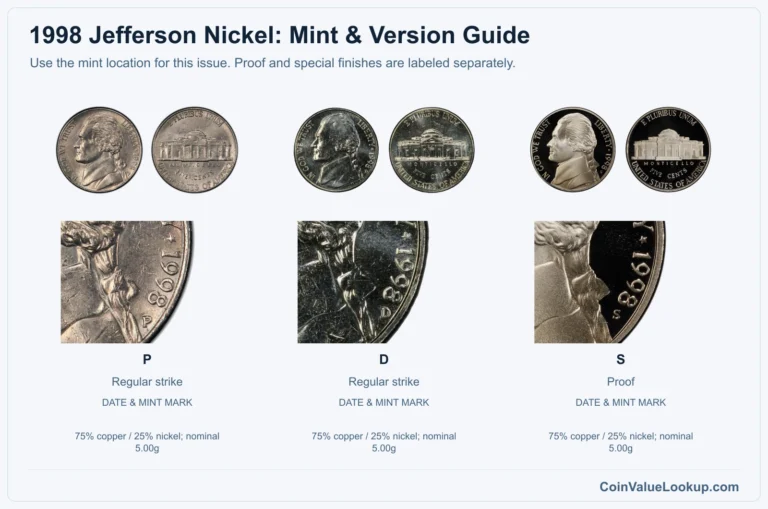
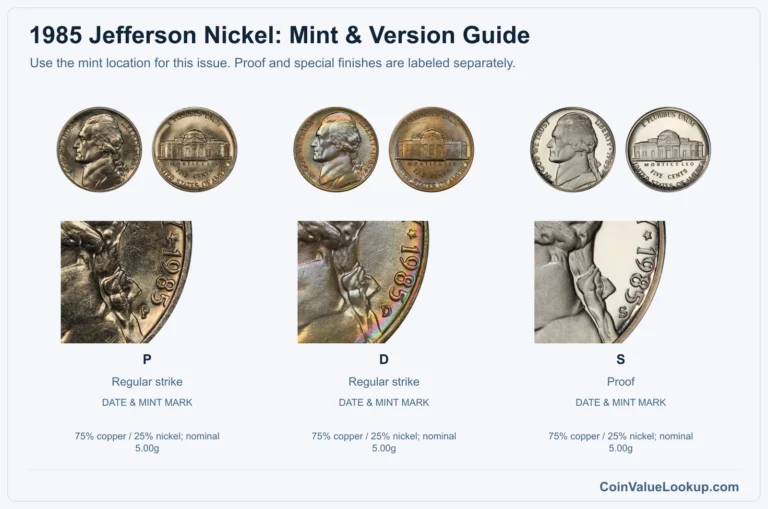
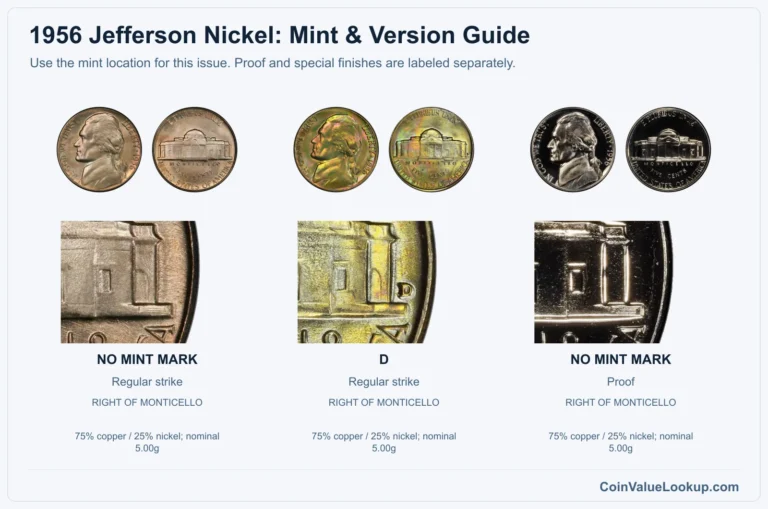
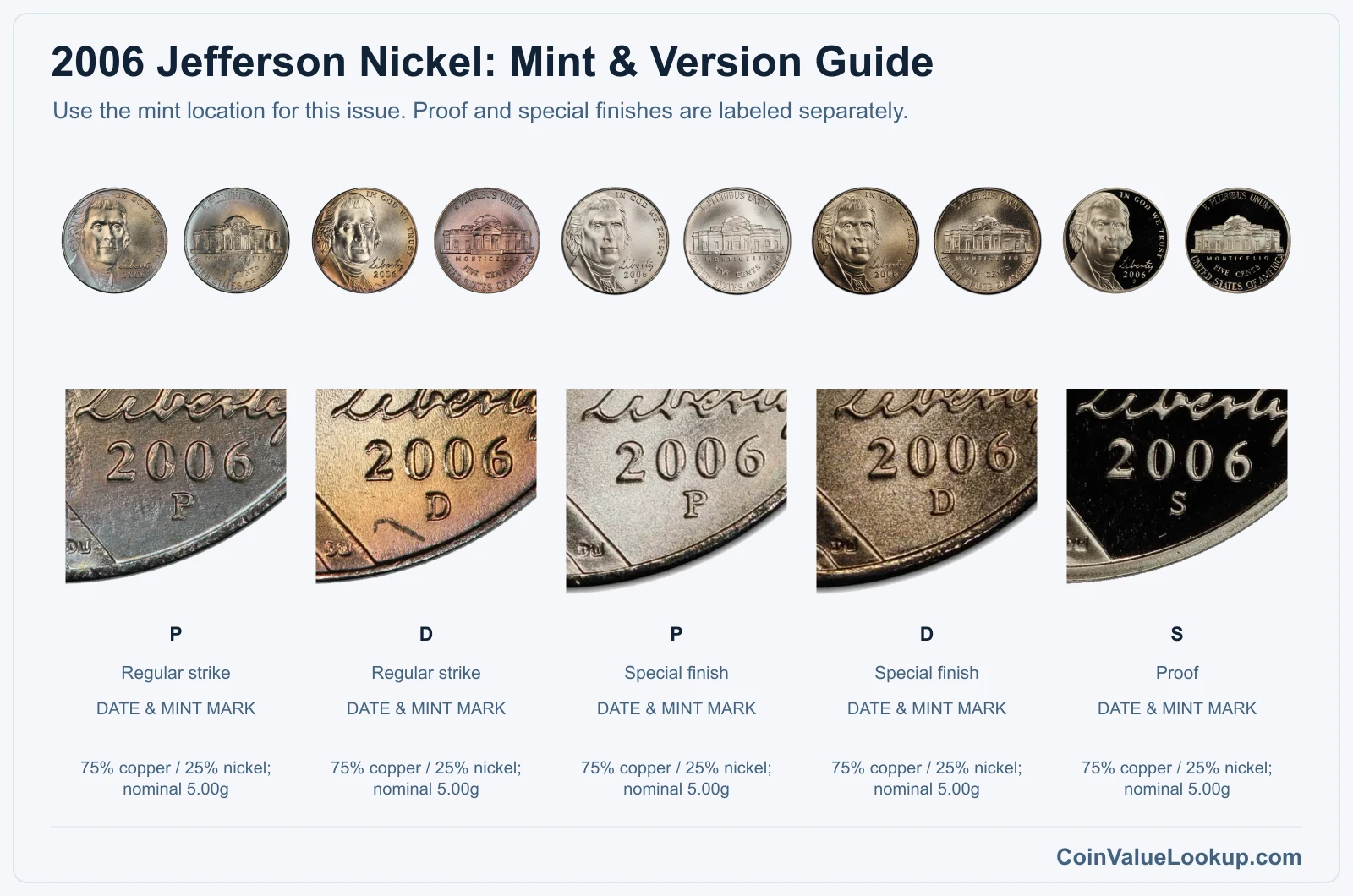
Start by finding the mintmark. Look on the obverse just below the date: a P means Philadelphia, a D means Denver, and an S means San Francisco proof.
No mintmark on a 2006 nickel still means Philadelphia.
The 2006 design features a forward-facing portrait of Jefferson on the obverse and the classic Monticello building on the reverse. This is different from the 2005 nickels, which used a profile portrait and different reverse designs, so do not mix them up when comparing.
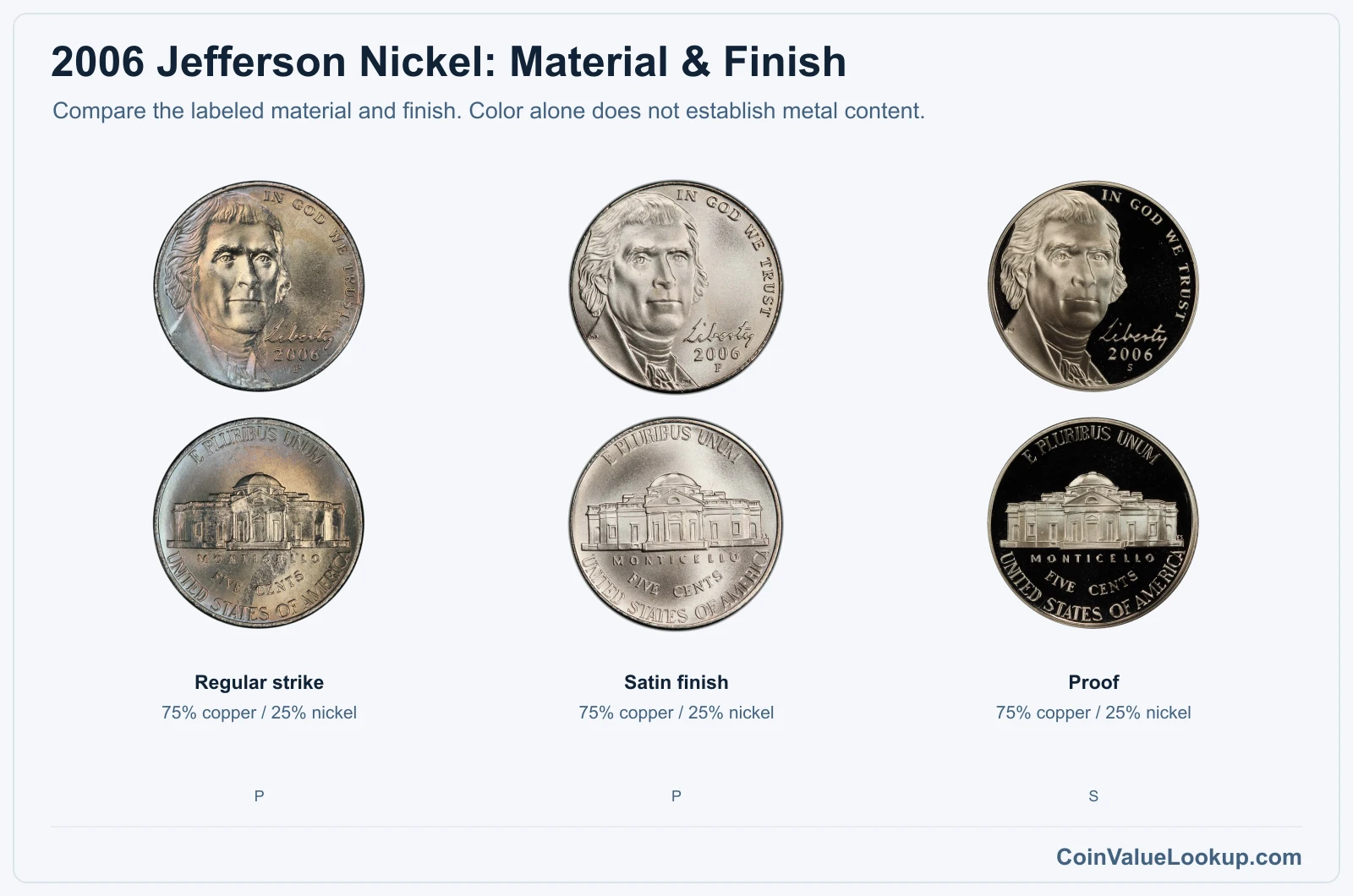
All standard 2006 nickels are 75% copper and 25% nickel, weigh about 5 grams, measure 21.2 mm across, and have a plain edge. Color alone does not prove a different alloy.
Satin-finish coins came in 2006 Mint Sets and have a distinctive matte-like luster compared to the shinier, more reflective look of regular business strikes. A shiny coin from pocket change is not a satin finish.
San Francisco proof strikes have mirror fields and sharp details produced by a special manufacturing process separate from both business and satin production.
Step 2: Check Your 2006 Jefferson Nickel Grade
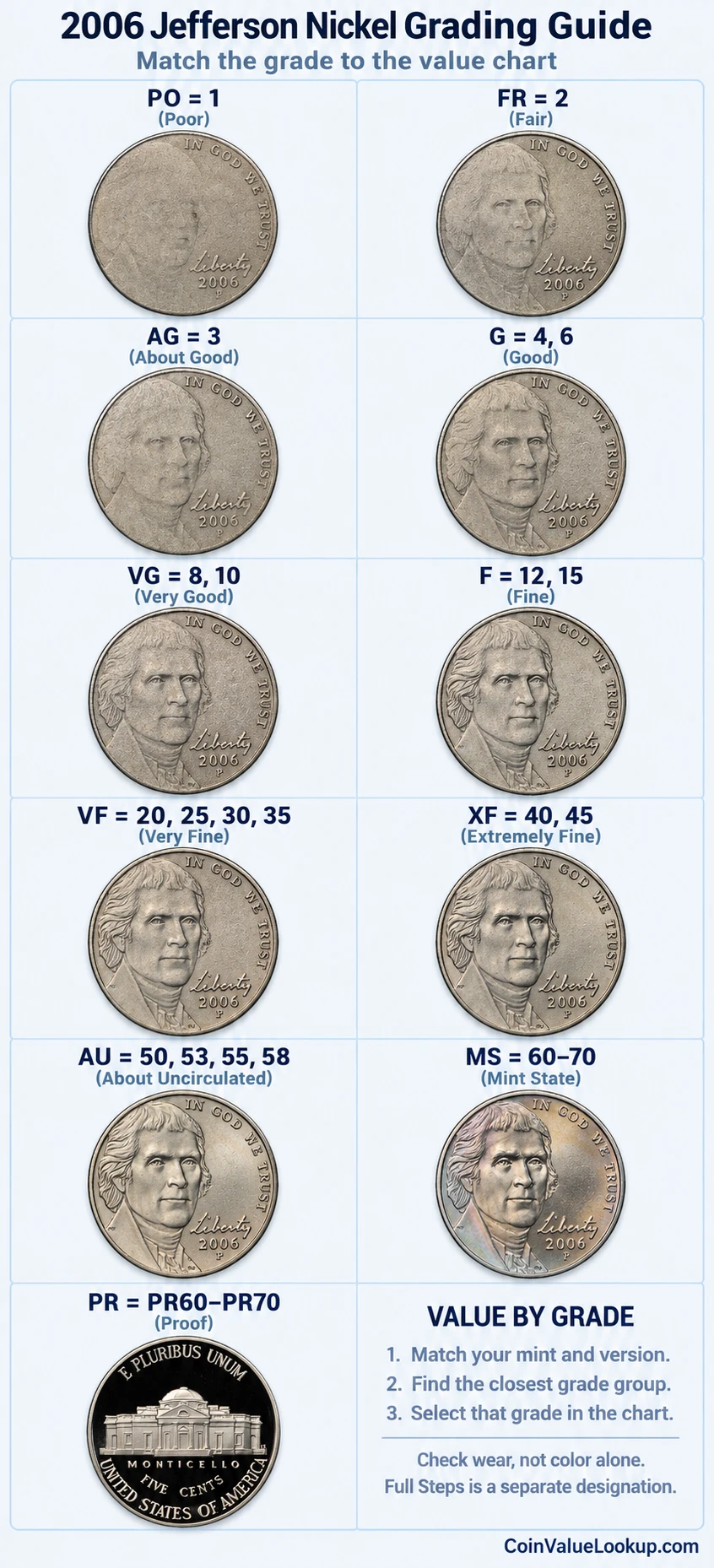
Check Jefferson's cheek and the raised hair detail first. On a well-worn coin, the cheek flattens out and fine hair strands merge together.
An uncirculated coin retains full original luster with no flat spots from wear.
Surface marks matter too. A coin can be technically uncirculated but covered in bag marks from contact with other coins during production and storage, which keeps the grade lower.
On the Monticello reverse, the sharpness of the steps is a strike-quality indicator rather than a measure of wear. Full Steps is a separate designation applied to well-struck examples and should not be confused with a higher grade.
Use the comparison image to match your coin's wear level against known grade examples. Make sure you are comparing against the same 2006 forward-facing portrait, not the 2005 profile design, since wear patterns differ between the two.
Step 3: Check 2006 Jefferson Nickel Value by Mint and Version
2006 Jefferson Nickel — P Monticello — Business strike
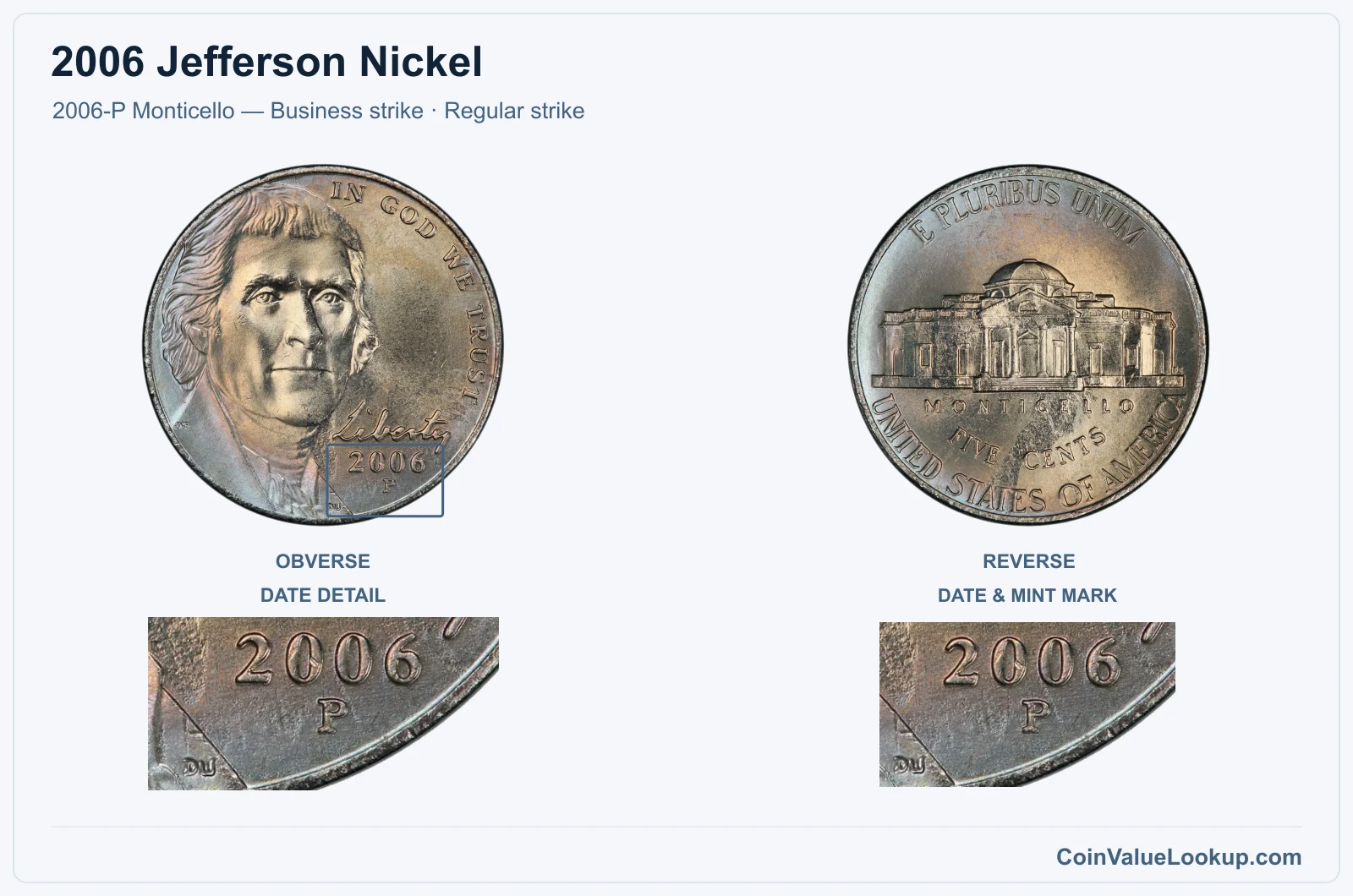
The 2006-P business strike is the Philadelphia Mint's regular-production nickel with the forward-facing Jefferson portrait and Monticello reverse. Look for the small P mintmark below the date on the obverse.
It is 75% copper and 25% nickel, weighing about 5 grams.
USA Coin Book guide estimates place this coin at roughly $0.30 in MS60 and $0.93 in MS65. Circulated examples are worth face value.
These figures reflect ordinary strikes without any special designation.
| Range | Grade | Price | Auction Records | Appraisal |
|---|---|---|---|---|
| PO | PO 1 | — | Coin Identifier | |
| FR | FR 2 | — | Coin Identifier | |
| AG | AG 3 | — | Coin Identifier | |
| G | G 4 | — | Coin Identifier | |
| G 6 | — | Coin Identifier | ||
| VG | VG 8 | — | Coin Identifier | |
| VG 10 | — | Coin Identifier | ||
| F | F 12 | — | Coin Identifier | |
| F 15 | — | Coin Identifier | ||
| VF | VF 20 | — | Coin Identifier | |
| VF 25 | — | Coin Identifier | ||
| VF 30 | — | Coin Identifier | ||
| VF 35 | — | Coin Identifier | ||
| XF | XF 40 | — | Coin Identifier | |
| XF 45 | — | Coin Identifier | ||
| AU | AU 50 | — | Coin Identifier | |
| AU 53 | — | Coin Identifier | ||
| AU 55 | — | Coin Identifier | ||
| AU 58 | — | Coin Identifier | ||
| MS | MS 60 | — | Coin Identifier | |
| MS 61 | — | Coin Identifier | ||
| MS 62 | — | Coin Identifier | ||
| MS 63 | — | Coin Identifier | ||
| MS 64 | — | Coin Identifier | ||
| MS 65 | — | Coin Identifier | ||
| MS 66 | — | Coin Identifier | ||
| MS 67 | — | — | — | |
| MS 68 | — | — | — | |
| MS 69 | — | — | — | |
| MS 70 | — | — | — |
2006 Jefferson Nickel — P Monticello SP — Satin Finish Special Strike
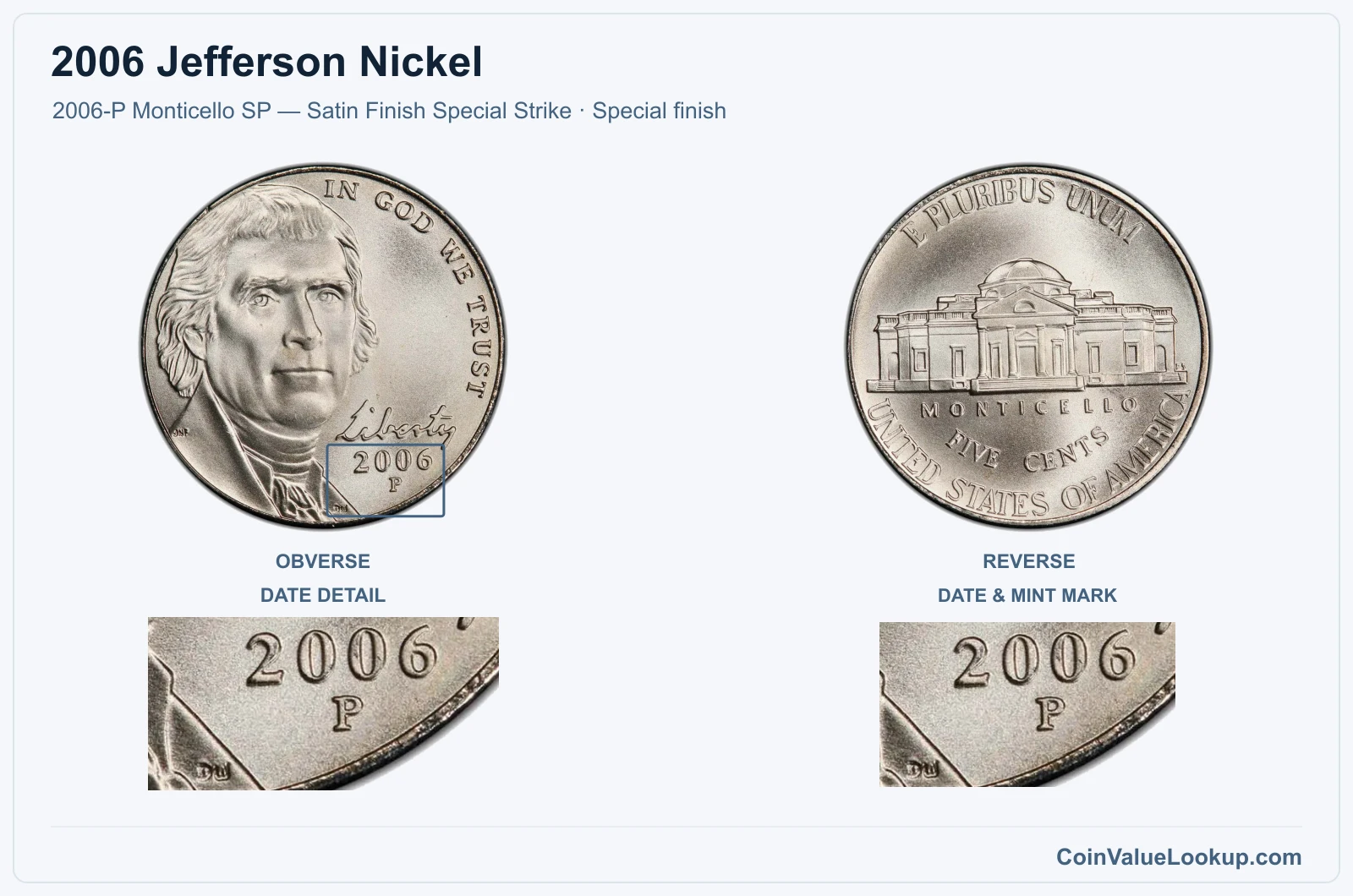
The 2006-P satin-finish nickel was produced for inclusion in official U.S. Mint Sets, not for general circulation. It has the same forward-facing Jefferson portrait and Monticello reverse as the business strike, but the surface has a soft, even luster that looks distinctly different from a standard shiny strike.
Do not confuse a lightly toned circulated nickel for a satin finish. The satin texture is uniform and was applied during manufacturing.
No standard numeric guide range is adopted for this version, so value depends on the coin's authenticated identity and condition. A professional grading service can confirm the satin-finish designation.
| Range | Grade | Price | Auction Records | Appraisal |
|---|---|---|---|---|
| SP | SP 1 | — | Coin Identifier | |
| SP 2 | — | Coin Identifier | ||
| SP 3 | — | Coin Identifier | ||
| SP 4 | — | Coin Identifier | ||
| SP 6 | — | Coin Identifier | ||
| SP 8 | — | Coin Identifier | ||
| SP 10 | — | Coin Identifier | ||
| SP 12 | — | Coin Identifier | ||
| SP 15 | — | Coin Identifier | ||
| SP 20 | — | Coin Identifier | ||
| SP 25 | — | Coin Identifier | ||
| SP 30 | — | Coin Identifier | ||
| SP 35 | — | Coin Identifier | ||
| SP 40 | — | Coin Identifier | ||
| SP 45 | — | Coin Identifier | ||
| SP 50 | — | Coin Identifier | ||
| SP 53 | — | Coin Identifier | ||
| SP 55 | — | Coin Identifier | ||
| SP 58 | — | Coin Identifier | ||
| SP 60 | — | Coin Identifier | ||
| SP 61 | — | Coin Identifier | ||
| SP 62 | — | Coin Identifier | ||
| SP 63 | — | Coin Identifier | ||
| SP 64 | — | Coin Identifier | ||
| SP 65 | — | Coin Identifier | ||
| SP 66 | Coin Identifier | |||
| SP 67 | Coin Identifier | |||
| SP 68 | Coin Identifier | |||
| SP 69 | — | Coin Identifier | ||
| SP 70 | — | — | — |
2006 Jefferson Nickel — D Monticello — Business strike
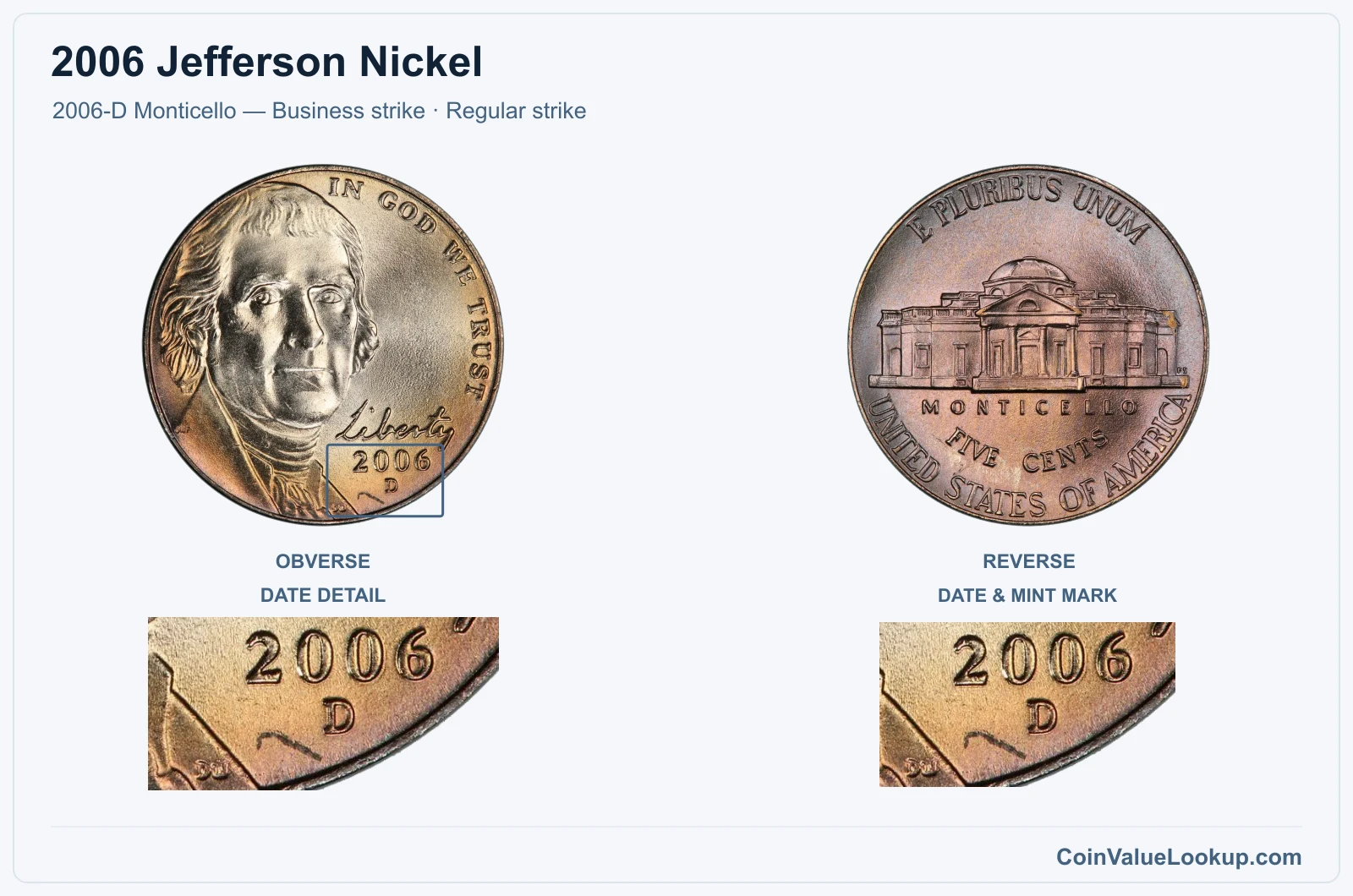
The 2006-D business strike is Denver's version of the same forward-facing Jefferson and Monticello design. Find the D mintmark below the date.
Same alloy, same weight, same edge as the Philadelphia issue.
Guide estimates from USA Coin Book are about $0.30 at MS60 and $0.93 at MS65. In circulated grades, these are five-cent coins.
High-grade uncirculated examples with clean surfaces are what collectors look for.
Coin Value Lookup is a good starting point if you want to compare this nickel against other years and denominations in the Jefferson series.
| Range | Grade | Price | Auction Records | Appraisal |
|---|---|---|---|---|
| PO | PO 1 | — | Coin Identifier | |
| FR | FR 2 | — | Coin Identifier | |
| AG | AG 3 | — | Coin Identifier | |
| G | G 4 | — | Coin Identifier | |
| G 6 | — | Coin Identifier | ||
| VG | VG 8 | — | Coin Identifier | |
| VG 10 | — | Coin Identifier | ||
| F | F 12 | — | Coin Identifier | |
| F 15 | — | Coin Identifier | ||
| VF | VF 20 | — | Coin Identifier | |
| VF 25 | — | Coin Identifier | ||
| VF 30 | — | Coin Identifier | ||
| VF 35 | — | Coin Identifier | ||
| XF | XF 40 | — | Coin Identifier | |
| XF 45 | — | Coin Identifier | ||
| AU | AU 50 | — | Coin Identifier | |
| AU 53 | — | Coin Identifier | ||
| AU 55 | — | Coin Identifier | ||
| AU 58 | — | Coin Identifier | ||
| MS | MS 60 | — | Coin Identifier | |
| MS 61 | — | Coin Identifier | ||
| MS 62 | — | Coin Identifier | ||
| MS 63 | — | Coin Identifier | ||
| MS 64 | Coin Identifier | |||
| MS 65 | — | Coin Identifier | ||
| MS 66 | Coin Identifier | |||
| MS 67 | — | Coin Identifier | ||
| MS 68 | — | — | — | |
| MS 69 | — | — | — | |
| MS 70 | — | — | — |
2006 Jefferson Nickel — D Monticello SP — Satin Finish Special Strike
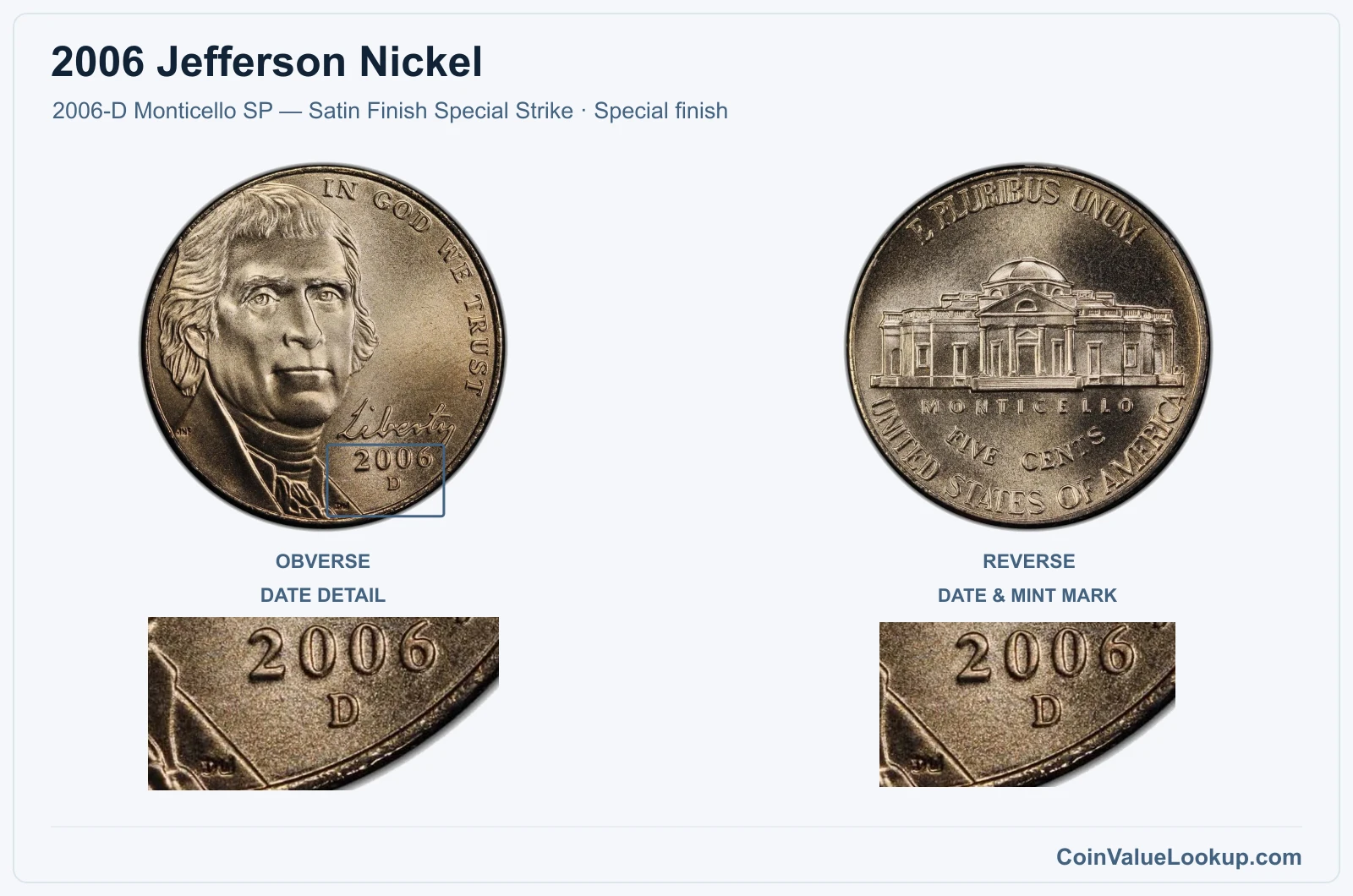
The 2006-D satin-finish nickel is the Denver Mint's counterpart from the 2006 Mint Set. It shares the same design and specifications as the business strike but has the telltale matte-like satin surface created during a special striking process at the Mint.
These are not circulation coins and should not be confused with worn or cleaned nickels. No adopted numeric guide range exists for this version.
Value depends on authenticated identity and the coin's condition, so professional certification helps establish both the finish and grade for potential buyers.
| Range | Grade | Price | Auction Records | Appraisal |
|---|---|---|---|---|
| SP | SP 1 | — | Coin Identifier | |
| SP 2 | — | Coin Identifier | ||
| SP 3 | — | Coin Identifier | ||
| SP 4 | — | Coin Identifier | ||
| SP 6 | — | Coin Identifier | ||
| SP 8 | — | Coin Identifier | ||
| SP 10 | — | Coin Identifier | ||
| SP 12 | — | Coin Identifier | ||
| SP 15 | — | Coin Identifier | ||
| SP 20 | — | Coin Identifier | ||
| SP 25 | — | Coin Identifier | ||
| SP 30 | — | Coin Identifier | ||
| SP 35 | — | Coin Identifier | ||
| SP 40 | — | Coin Identifier | ||
| SP 45 | — | Coin Identifier | ||
| SP 50 | — | Coin Identifier | ||
| SP 53 | — | Coin Identifier | ||
| SP 55 | — | Coin Identifier | ||
| SP 58 | — | Coin Identifier | ||
| SP 60 | — | Coin Identifier | ||
| SP 61 | — | Coin Identifier | ||
| SP 62 | — | Coin Identifier | ||
| SP 63 | — | Coin Identifier | ||
| SP 64 | — | Coin Identifier | ||
| SP 65 | — | Coin Identifier | ||
| SP 66 | — | Coin Identifier | ||
| SP 67 | Coin Identifier | |||
| SP 68 | Coin Identifier | |||
| SP 69 | — | Coin Identifier | ||
| SP 70 | — | — | — |
2006 Jefferson Nickel — S Monticello PR — Proof
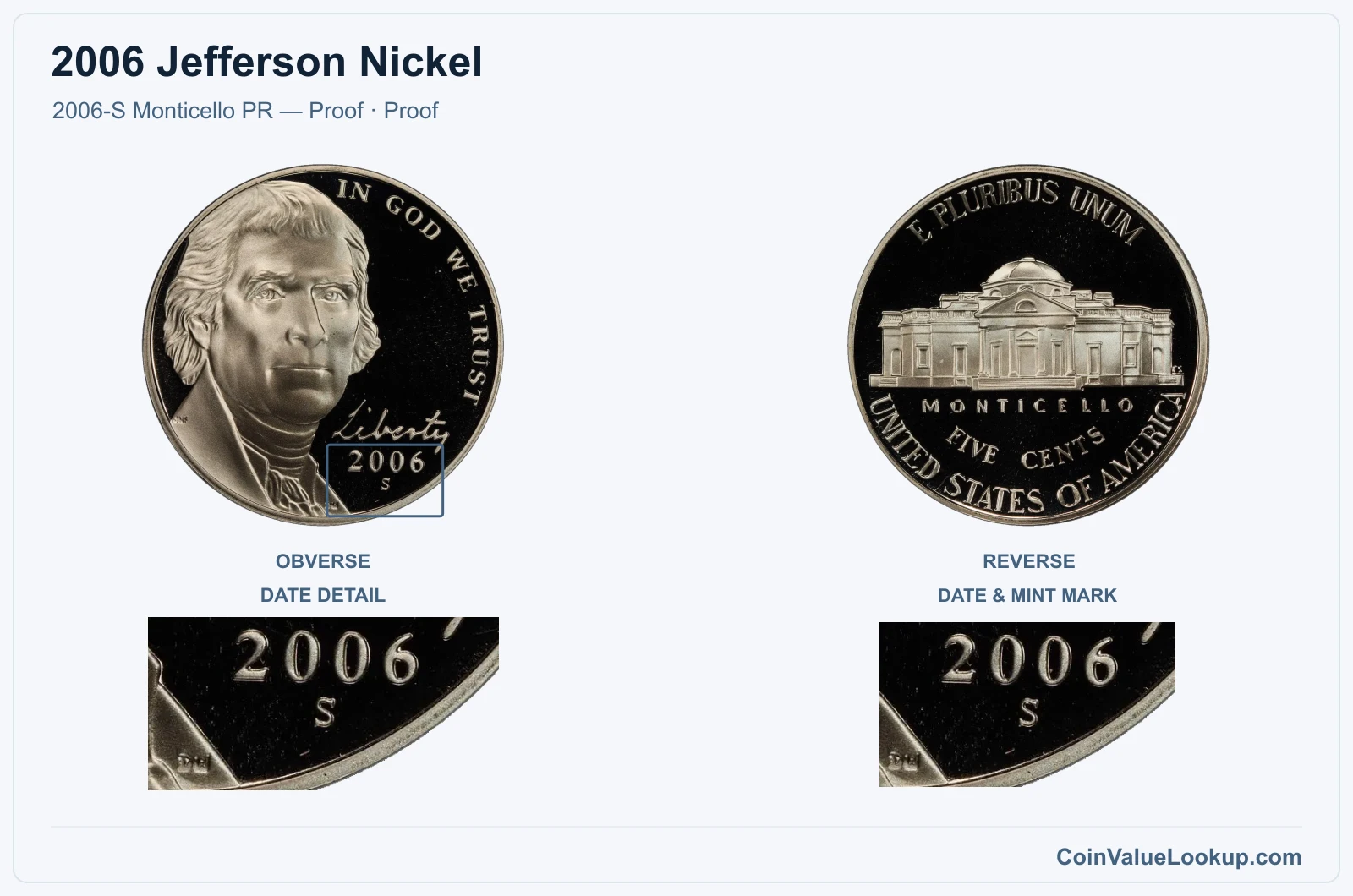
The 2006-S proof nickel was struck at the San Francisco Mint exclusively for collector proof sets. It features mirror-like fields with sharply detailed devices on both the forward-facing Jefferson obverse and Monticello reverse.
The S mintmark sits below the date.
USA Coin Book places the guide estimate at about $5.30 in PR65. A proof is a manufacturing method, not a grade above Mint State, so proof coins are graded on their own PR scale.
Cameo and deep cameo designations are separate finish filters applied by grading services.
| Range | Grade | Price | Auction Records | Appraisal |
|---|---|---|---|---|
| PR | PR 1 | — | Coin Identifier | |
| PR 2 | — | Coin Identifier | ||
| PR 3 | — | Coin Identifier | ||
| PR 4 | — | Coin Identifier | ||
| PR 6 | — | Coin Identifier | ||
| PR 8 | — | Coin Identifier | ||
| PR 10 | — | Coin Identifier | ||
| PR 12 | — | Coin Identifier | ||
| PR 15 | — | Coin Identifier | ||
| PR 20 | — | Coin Identifier | ||
| PR 25 | — | Coin Identifier | ||
| PR 30 | — | Coin Identifier | ||
| PR 35 | — | Coin Identifier | ||
| PR 40 | — | Coin Identifier | ||
| PR 45 | — | Coin Identifier | ||
| PR 50 | — | Coin Identifier | ||
| PR 53 | — | Coin Identifier | ||
| PR 55 | — | Coin Identifier | ||
| PR 58 | — | Coin Identifier | ||
| PR 60 | — | Coin Identifier | ||
| PR 61 | — | Coin Identifier | ||
| PR 62 | — | Coin Identifier | ||
| PR 63 | — | Coin Identifier | ||
| PR 64 | — | Coin Identifier | ||
| PR 65 | — | Coin Identifier | ||
| PR 66 | — | Coin Identifier | ||
| PR 67 | — | Coin Identifier | ||
| PR 68 | — | Coin Identifier | ||
| PR 69 | Coin Identifier | |||
| PR 70 | Coin Identifier |
2006 Jefferson Nickel Error List
1. 2006 Jefferson Nickel — Off-center strike on straight-clipped blank
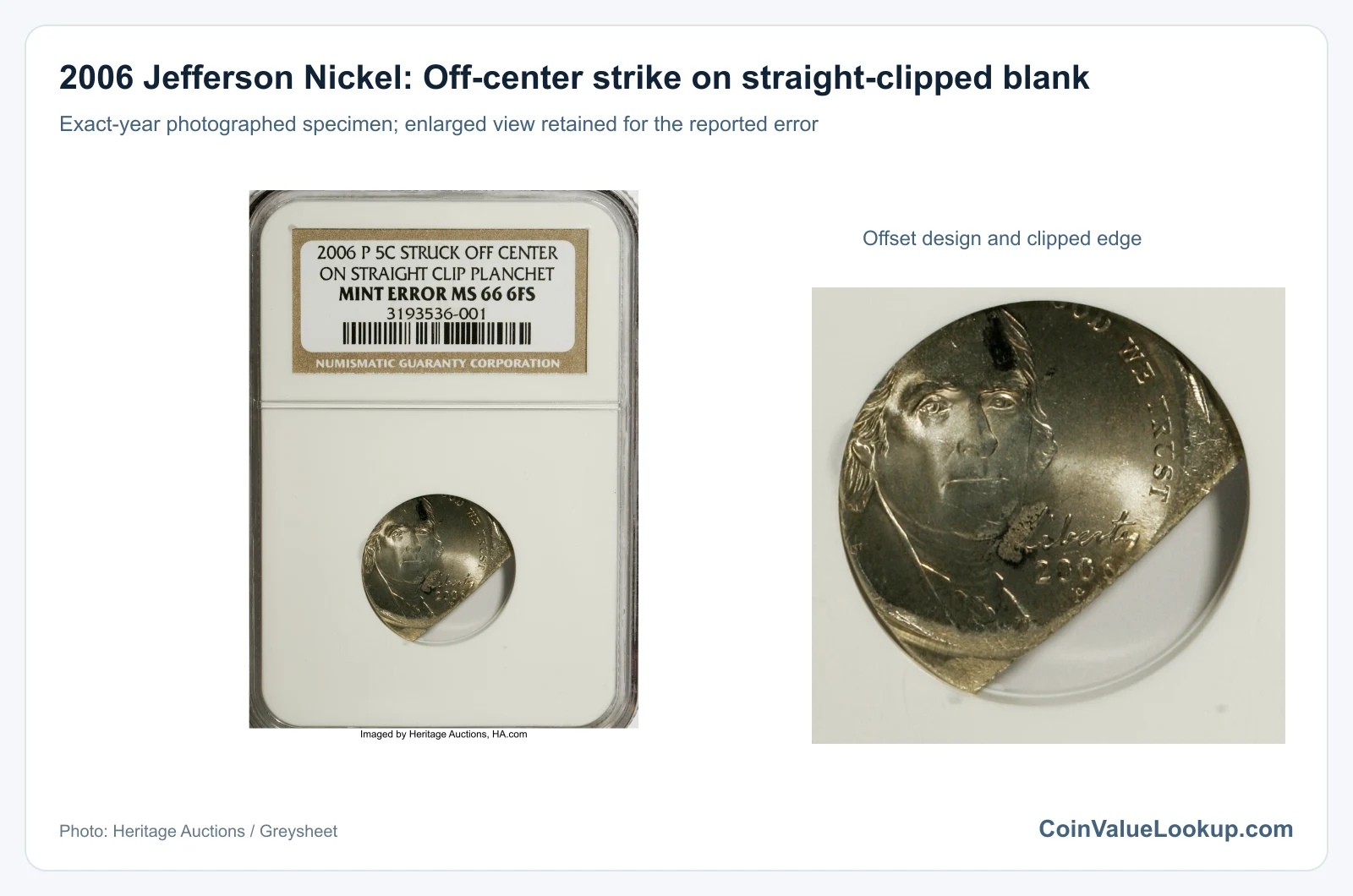
This error combines two minting problems on one coin: an off-center strike and a straight-clipped planchet. The off-center strike shifts the design so that part of it is missing, leaving an unstruck crescent on one side.
The straight clip means the blank itself was cut short before striking, visible as a straight edge rather than the normal round rim.
A Heritage Auctions sale in September 2010 recorded a 2006-P example graded NGC MS66 with Six Full Steps designation, weighing 3.7 grams, which sold for $431.25. That is a single auction result for a specific certified coin, not a general market range.
To check your coin, look at both sides for displaced design elements and examine the edge for a straight cut. Beware of coins that have been sawed, ground, or simply misaligned after leaving the Mint.
2. 2006 Jefferson Nickel — Doubled Die Obverse
A doubled die obverse variety has been reported for the 2006-P nickel, sometimes described as involving the ear area of Jefferson's portrait. To look for this, compare your coin's obverse design under magnification against a normal 2006-P nickel in similar lighting conditions.
You are looking for consistent separation or notching in the design elements, not a flat, shelf-like distortion.
Machine doubling is the most common lookalike and produces a flatter, less defined appearance compared to a true doubled die. Reflections from lighting angles can also trick you.
No numerical price range is adopted for this variety. The value of a doubled die coin depends on the visibility of the doubling, the coin's overall condition, and whether it has been authenticated by a grading service.
3. 2006 Jefferson Nickel — Struck-Through Error
A struck-through error occurs when foreign material sits between the die and the planchet during striking, leaving an impression or depression in the finished coin. On a 2006 nickel, this might appear as a localized area of incomplete design, a smooth depression, or a textured impression where something was pressed into the surface.
Grease fills and retained foreign objects produce different-looking results, so describe what you see carefully. A grease fill tends to produce a smooth, shallow area of missing detail, while a retained object may leave a sharper, more defined impression.
Do not confuse normal wear, scratches, cleaning damage, or weak strikes with a struck-through error. No numerical price range is adopted for this category.
Value depends on the size, visibility, and location of the strike-through, plus the coin's overall condition.
4. 2006 Jefferson Nickel — Doubled Die Reverse
A doubled die reverse has been reported for the 2006-P nickel. To check for this, examine the reverse legends and design contours of your coin under magnification and compare them side by side with a normal example.
True die doubling shows consistent separation in the affected design elements.
Machine doubling is the usual suspect and produces a different, flatter look. Random damage and odd reflections can also mimic doubling to the untrained eye.
If the apparent doubling appears only under certain lighting angles, be skeptical.
No adopted price range exists for this variety. What it is worth depends on the strength and location of the doubling, the coin's grade, and whether a professional service has attributed and authenticated the error.
5. 2006 Jefferson Nickel — Improper Annealing
Improper annealing is a planchet error where the blank was not heat-treated correctly before striking. On a 2006 nickel, this can show up as unusual surface discoloration or an atypical texture that looks different from normal toning or wear.
The key distinction is between something that happened at the Mint during production and something that happened afterward. Environmental toning, corrosion, and post-mint heat exposure can all mimic the appearance of an improperly annealed planchet.
Surface appearance is a screening clue, not definitive proof of the cause.
Compare the edge and surface of your coin to a known normal example. No numerical price range is adopted for this error.
Value depends on the severity of the annealing defect, the coin's condition, and professional authentication.
6. 2006 Jefferson Nickel — Die Crack / Die Chip
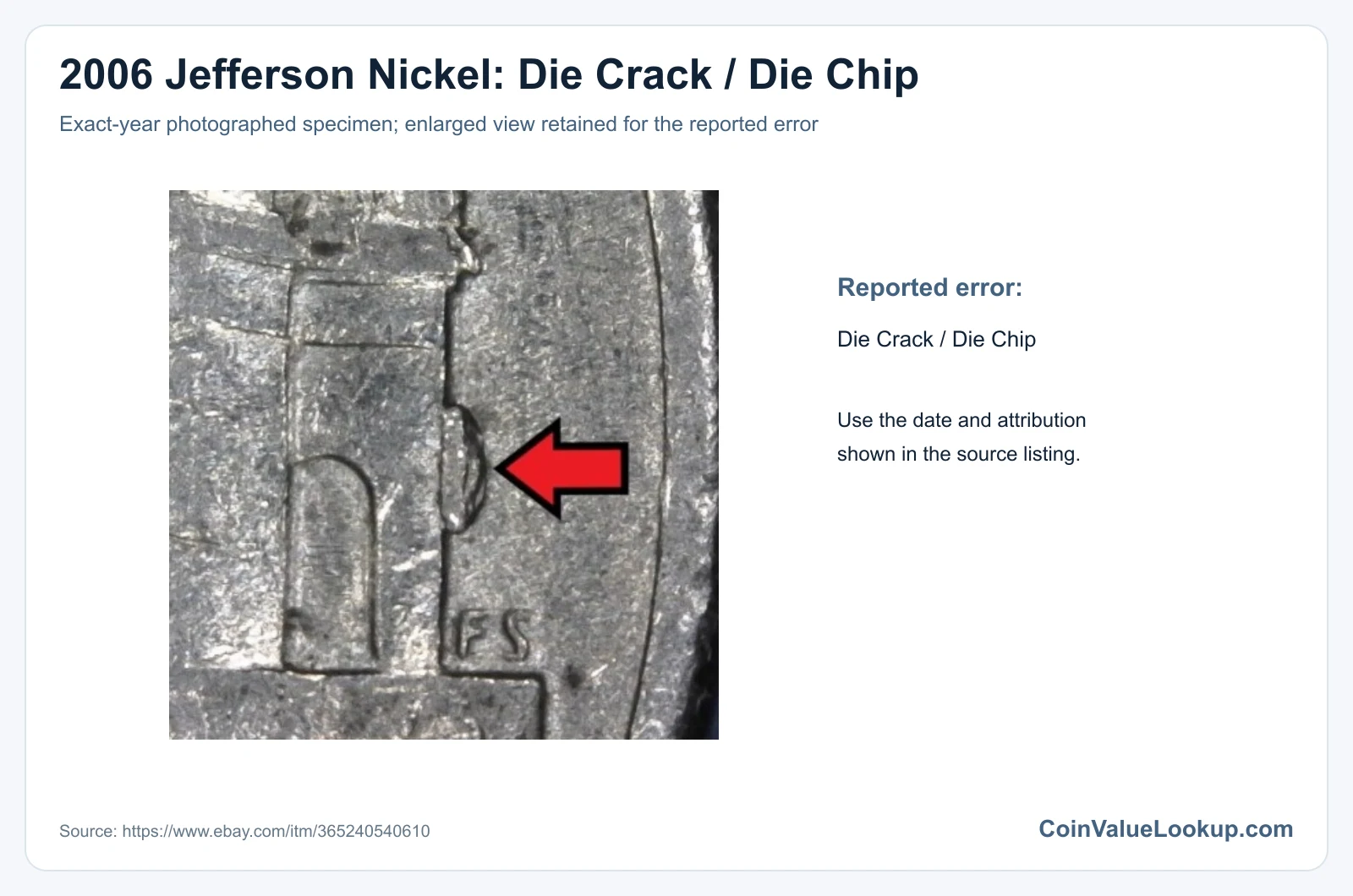
Die cracks and die chips are raised lines or small raised blobs on a coin's surface caused by a damaged or deteriorating die. On a 2006 nickel, look for thin raised lines that may connect design elements or run from the rim inward, as well as small raised lumps that fill in recessed areas of the design.
An interior chip appears as a small raised blob within the design field, while a cud is a larger raised area connected to the rim where a piece of the die has broken away. These are different in appearance and collector interest.
Do not confuse die cracks with incuse scratches, corrosion buildup, or foreign material stuck to the surface. Scratches are recessed; die cracks are raised.
No numerical price range is adopted, and value depends on size, location, and the coin's condition.