1903 Liberty Nickel Coin Value: How Much Is It Worth?
A 1903 Liberty Nickel in well-worn G4 condition runs about $2.50 according to a USA Coin Book guide estimate, while a crisp MS63 business strike jumps to around $154. Proofs sit in their own bracket, with a PR63 example estimated near $344.
These are retail guide figures from a single snapshot, not guaranteed sale prices, so your actual coin's value depends on its specific condition and any varieties present.
Fast Way to Identify Your 1903 Liberty Nickel
The quickest way to start figuring out what your 1903 Liberty Nickel might be worth is to upload clear photos of both the front and back. Our identifier can give you a preliminary read on which version you have and its general condition.
Good lighting and a straight-on angle help, especially for spotting proof surfaces or subtle die varieties.
1903 Liberty Nickel Value
Upload both sides of your 1903 Liberty Nickel.
Front Obverse
Upload photo
Back Reverse
Upload photo
Which 1903 Liberty Nickel Versions Are Worth Money?
- Business strikes in MS63 or better carry guide estimates well above circulated examples, with MS63 near $154 per USA Coin Book.
- Proof strikes are a separate manufacturing category; a PR63 is estimated around $344, reflecting their limited production and collector demand.
- Some 1903 proofs exhibit a rotated reverse die, which is a legitimate striking error worth investigating if your coin's back face is turned from normal alignment.
- Repunched date varieties, where traces of an earlier punch position appear near the final digits, can add collector interest beyond the base value.
- Off-center strikes with a visible date are recognized error types for this year and attract variety collectors.
Step 1: Identify Your 1903 Liberty Nickel Mint Mark and Version
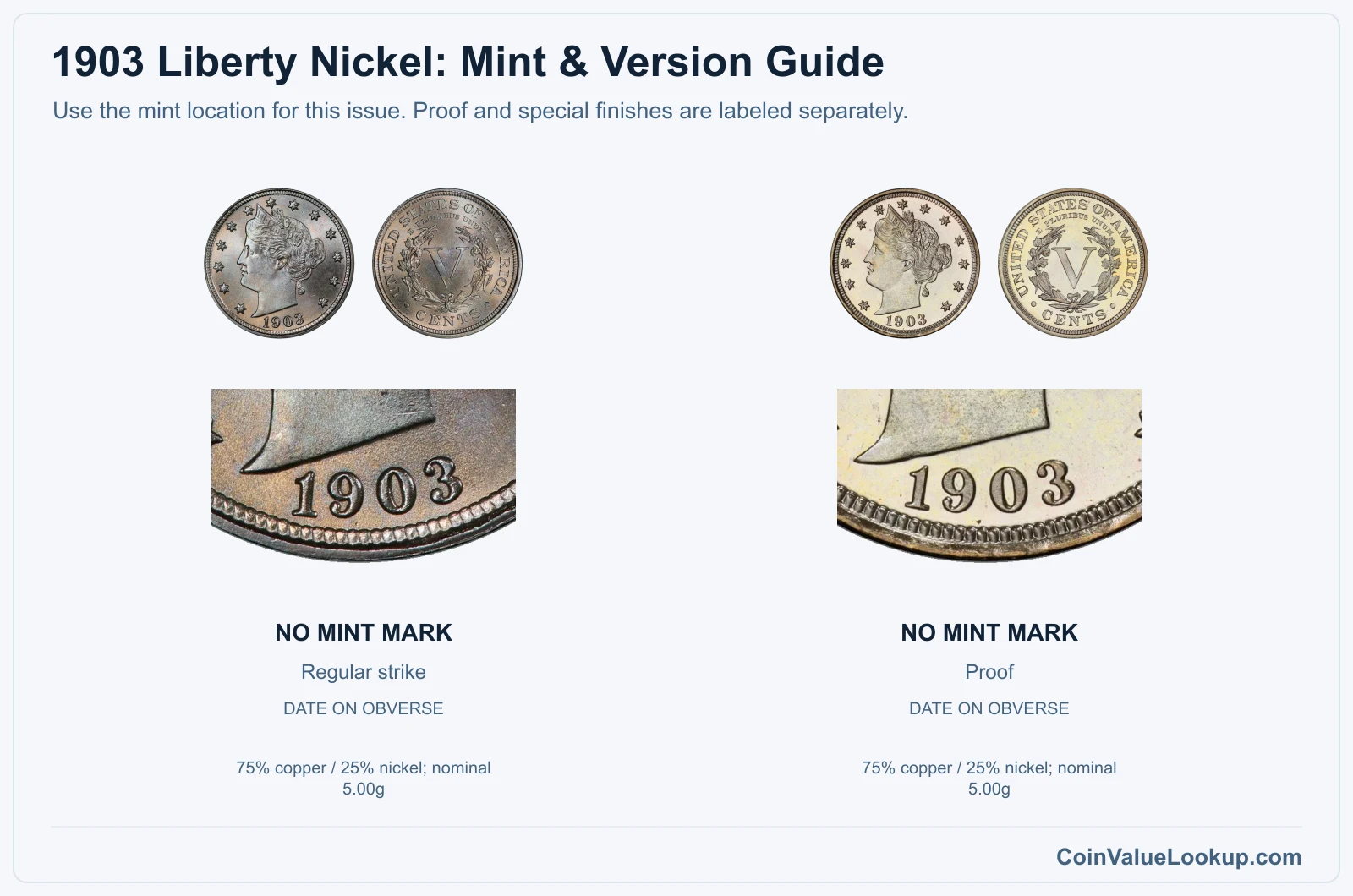
Every 1903 Liberty Nickel was struck at the Philadelphia Mint, so there is no mintmark to hunt for. You will not find a D or S on this date.
The coin is 75% copper and 25% nickel, weighs about 5 grams, and measures 21.2 mm across with a plain edge.
All regular 1903 nickels carry the "CENTS" denomination on the reverse, inside the wreath near the bottom. The earlier "No CENTS" variety only applies to 1883, not 1903, so do not worry about that distinction here.
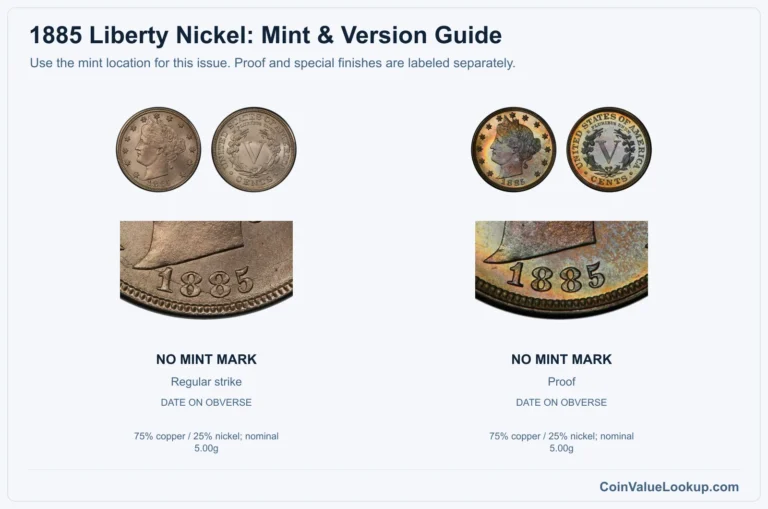
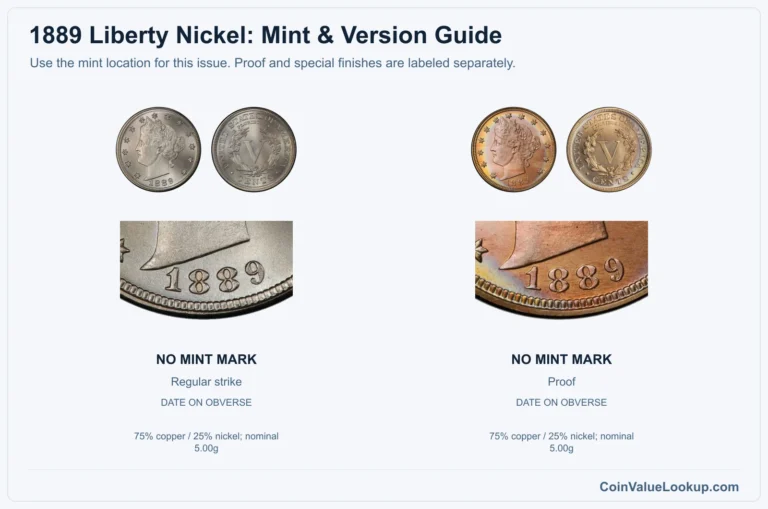
The two main branches for 1903 are the normal business strike and the proof. Proofs were made in smaller numbers for collectors and have mirror-like fields.
Some 1903 proofs have been reported with a rotated reverse, where the back of the coin is turned from the expected orientation. That is a die error, not a separate design type.
Step 2: Check Your 1903 Liberty Nickel Grade
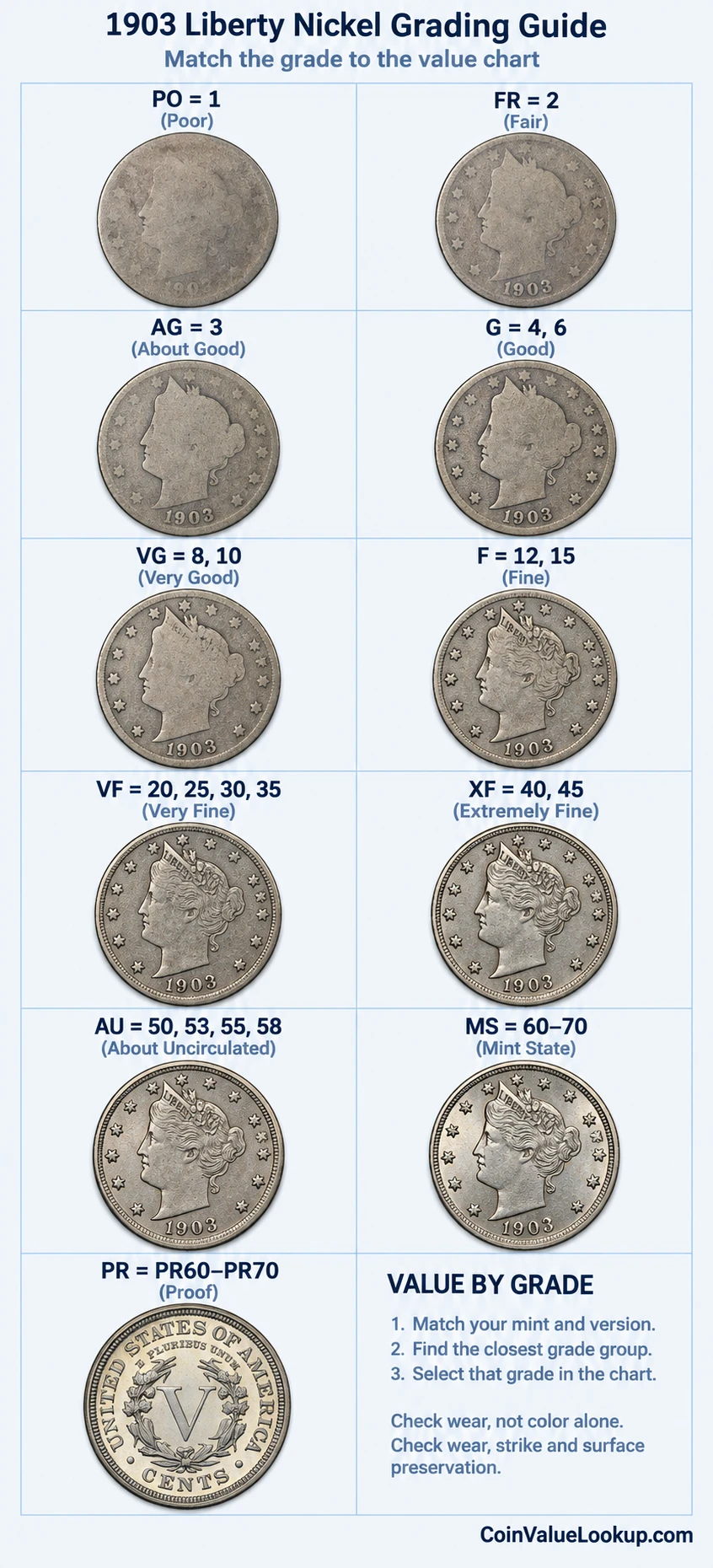
Start by checking the word LIBERTY on the coronet across the forehead. On a well-circulated coin, those letters wear down progressively, with the middle letters going first.
A coin grading around Good (G4) will show a partial LIBERTY at best, while a Very Fine example retains full letters with moderate overall wear.
Look at the high points of the hair curls above and behind the ear, and the cheek just below the eye. These are the first spots to lose detail.
On the reverse, the ear of corn and the wreath tips wear earliest.
Weak hair detail alone does not mean the coin circulated. Some Liberty Nickels left the press with a soft strike in that area.
Compare the fields and luster alongside the high points before you assume wear. The comparison image is your friend here.
Proof is a way the coin was made, not a grade above Mint State. Proof coins have specially prepared surfaces, usually with mirror-like fields.
Inspect the flatness of the fields, the sharpness of the rim, and look for hairlines from cleaning or handling.
Step 3: Check 1903 Liberty Nickel Value by Mint and Version
1903 Liberty Nickel — No Mint Mark — With CENTS Circulation
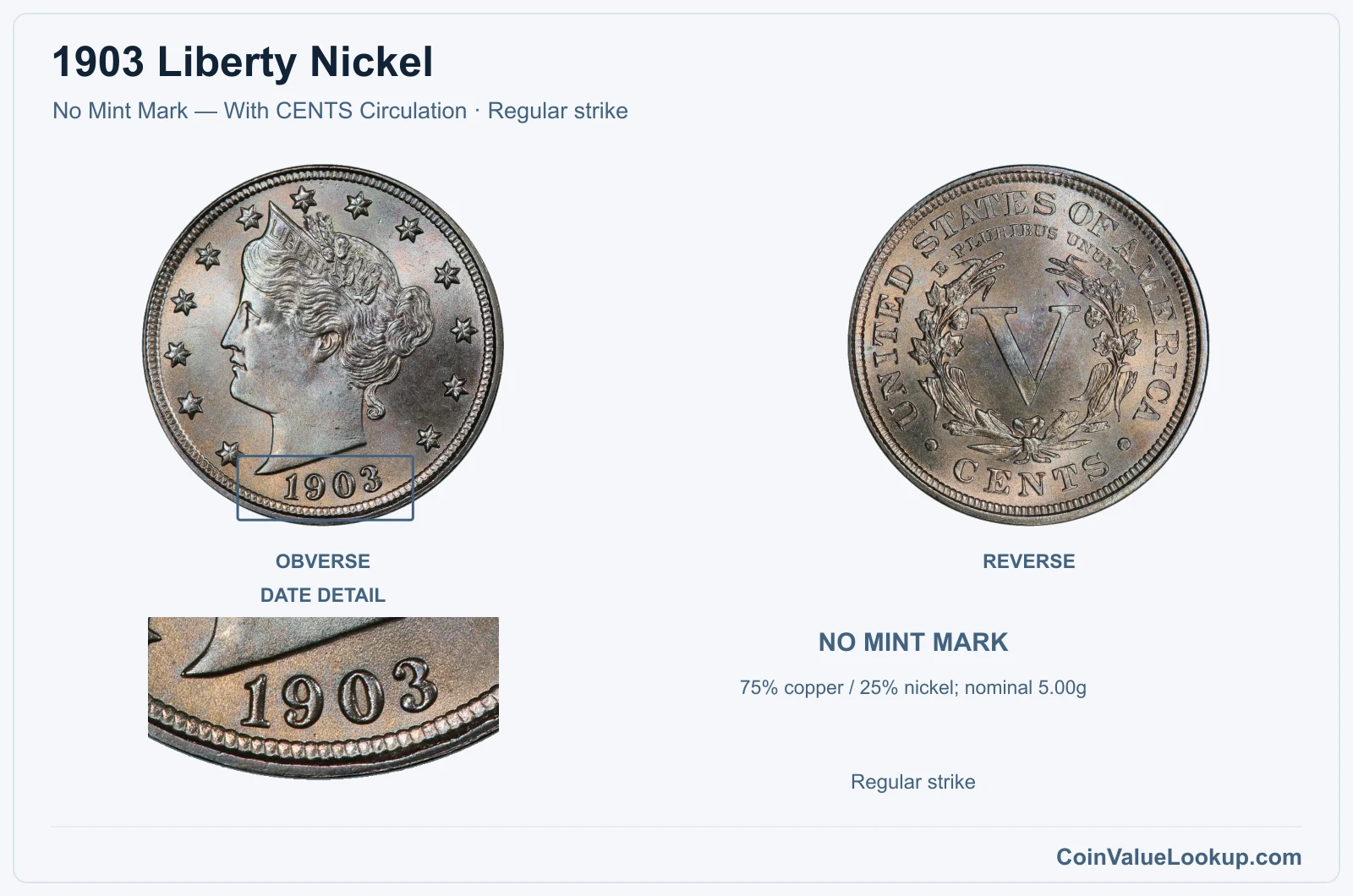
The standard 1903 Liberty Nickel is a Philadelphia business strike with the "CENTS" reverse. No mintmark appears anywhere on the coin.
It is struck in 75% copper and 25% nickel, weighing about 5 grams.
A USA Coin Book guide estimate places the G4 grade at roughly $2.50 and MS63 at around $154. These are retail guide figures from a February 2026 snapshot, not locked-in offers.
Circulated examples in the G4 to VF range are common and affordable. The real jump happens at Mint State, where original luster and minimal contact marks start to matter a lot.
If you are sorting through a jar of old nickels, Coin Value Lookup can help you look up guides for different years and denominations so you know which ones deserve a closer look.
Range Grade
Price Auction Records Appraisal PO PO 1
—
Coin Identifier FR FR 2
—
Coin Identifier AG AG 3
—
Coin Identifier G G 4
—
Coin Identifier
G 6
—
Coin Identifier VG VG 8
—
Coin Identifier
VG 10
—
Coin Identifier F F 12
—
Coin Identifier
F 15
—
Coin Identifier VF VF 20
—
Coin Identifier
VF 25
—
Coin Identifier
VF 30
—
Coin Identifier
VF 35
—
Coin Identifier XF XF 40
—
Coin Identifier
XF 45
—
Coin Identifier AU AU 50
—
Coin Identifier
AU 53
—
Coin Identifier
AU 55
Coin Identifier
AU 58
Coin Identifier MS MS 60
Coin Identifier
MS 61
Coin Identifier
MS 62
Coin Identifier
MS 63
Coin Identifier
MS 64
Coin Identifier
MS 65
Coin Identifier
MS 66
Coin Identifier
MS 67
Coin Identifier
MS 68
—
—
—
MS 69
—
—
—
MS 70
—
—
—
1903 Liberty Nickel — No Mint Mark — With CENTS Proof
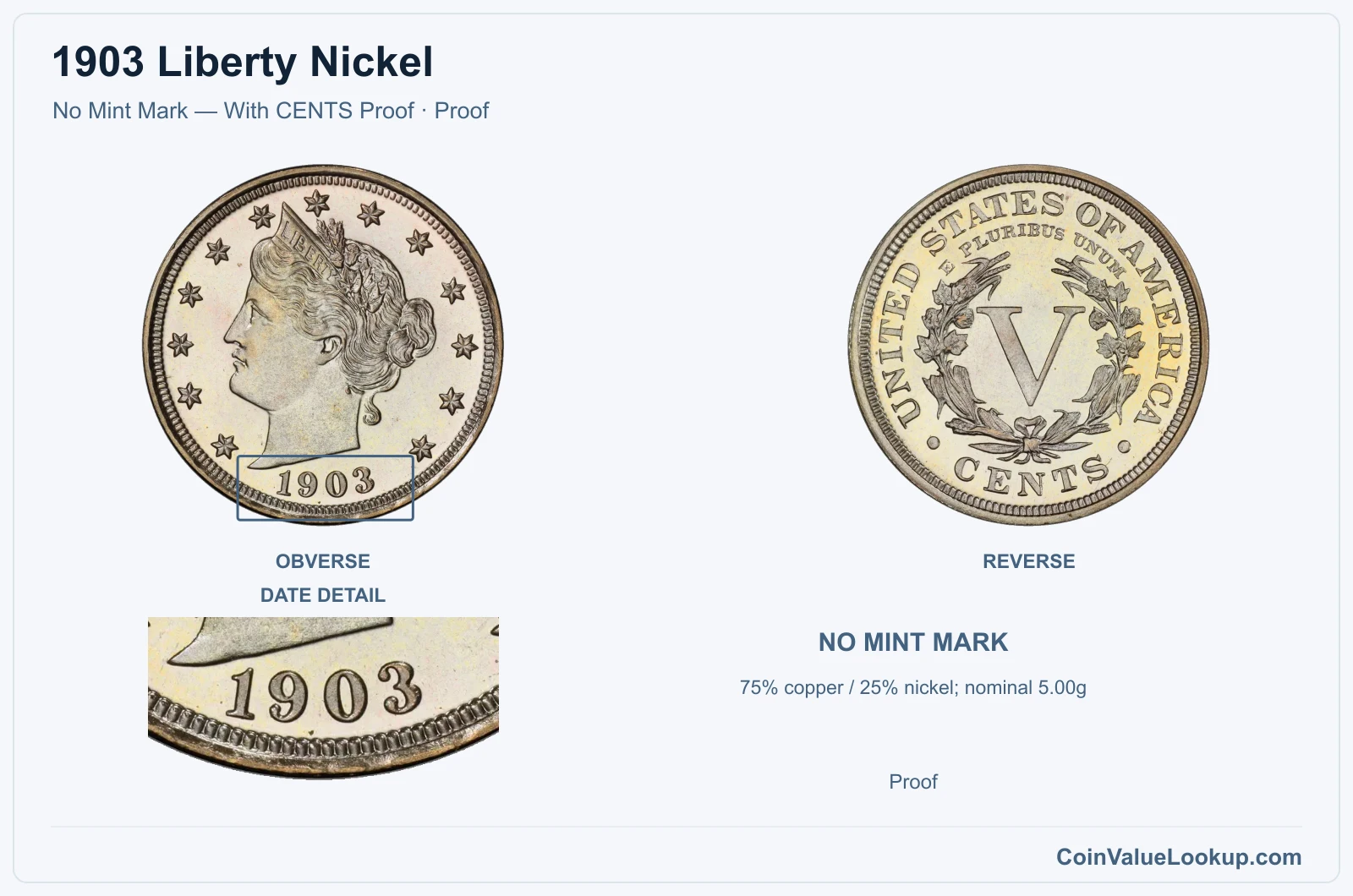
Philadelphia also produced proof 1903 Liberty Nickels for collectors. These were struck with polished dies on prepared planchets, giving the fields a mirror-like surface.
A PR63 example carries a guide estimate of about $344 per USA Coin Book.
To confirm a proof, examine the coin's fields under good light. They should be reflective and flat, distinct from the slightly satiny or bag-marked surfaces of a business strike.
The rims tend to be sharper and more squared-off as well.
Some 1903 proofs have been documented with a rotated reverse. That means the back is turned from the standard US coin alignment.
Not every proof has this, so compare yours carefully by holding one side upright and flipping top-to-bottom. Condition, hairlines, and originality all factor into what a proof will bring at sale.
Range Grade
Price Auction Records Appraisal PR PR 1
—
Coin Identifier
PR 2
—
Coin Identifier
PR 3
—
Coin Identifier
PR 4
—
Coin Identifier
PR 6
—
Coin Identifier
PR 8
—
Coin Identifier
PR 10
—
Coin Identifier
PR 12
—
Coin Identifier
PR 15
—
Coin Identifier
PR 20
—
Coin Identifier
PR 25
—
Coin Identifier
PR 30
—
Coin Identifier
PR 35
—
Coin Identifier
PR 40
—
Coin Identifier
PR 45
—
Coin Identifier
PR 50
—
Coin Identifier
PR 53
—
Coin Identifier
PR 55
—
Coin Identifier
PR 58
—
Coin Identifier
PR 60
—
Coin Identifier
PR 61
Coin Identifier
PR 62
Coin Identifier
PR 63
Coin Identifier
PR 64
Coin Identifier
PR 65
Coin Identifier
PR 66
Coin Identifier
PR 67
Coin Identifier
PR 68
Coin Identifier
PR 69
—
—
—
PR 70
—
—
—
1903 Liberty Nickel Error List
1. 1903 Liberty Nickel — Repunched Date
A repunched date on a 1903 Liberty Nickel shows traces of an earlier position of one or more date numerals alongside or slightly offset from the final digits. Look closely at the "1," "9," "0," and "3" with magnification.
You may see a ghostly secondary impression, usually shifted slightly north, south, or laterally from where the final number sits.
This is different from machine doubling, which produces flat, shelf-like traces rather than the rounded, raised remnants of a true repunched date. It is also not the same as damage from a hit or scratch across the date area.
No specific price range is adopted for this variety. The value depends on the visibility of the repunching, overall coin condition, and collector demand for that particular variety.
A faint trace adds less interest than a bold, clearly doubled digit.
2. 1903 Liberty Nickel — Rotated Dies
Some 1903 proof Liberty Nickels have been documented with a rotated reverse, meaning the back of the coin is turned significantly from the normal US coin alignment. On a standard US coin, if you hold the obverse upright and flip it top-to-bottom, the reverse should also appear upright.
A rotated die error shows the reverse tilted or even fully inverted into medal alignment.
To check, hold your coin with Liberty facing you right-side up. Flip it over along the vertical axis.
If the reverse wreath and denomination appear rotated, you may have this variety.
Be careful not to confuse a rotated photograph or a coin simply turned sideways in a holder with an actual die rotation error. The rotation is inherent to how the coin was struck.
No specific price is adopted for this error. Value depends on the degree of rotation, the coin's overall condition, and whether it is confirmed as a proof strike.
3. 1903 Liberty Nickel — Off-Center Strike
An off-center strike occurs when the planchet is not properly seated between the dies at the moment of striking. The result is a design that is shifted to one side, leaving an unstruck crescent of blank metal on the opposite edge.
The more dramatic the shift, the more visually striking the error.
For a 1903 Liberty Nickel, the key detail collectors want is a visible date. Without the date showing, it is nearly impossible to attribute the coin to 1903 specifically, which limits its appeal.
One cataloged example has been described at 65% off center in MS64 condition.
Do not confuse an off-center strike with a clipped planchet, which produces a different shaped missing area, or with post-mint damage such as a coin being flattened or bent after leaving the press. No specific price range is adopted here.
Value varies with the percentage of off-center shift, date visibility, and overall preservation.