1904 Barber Quarter Coin Value: How Much Is It Worth?
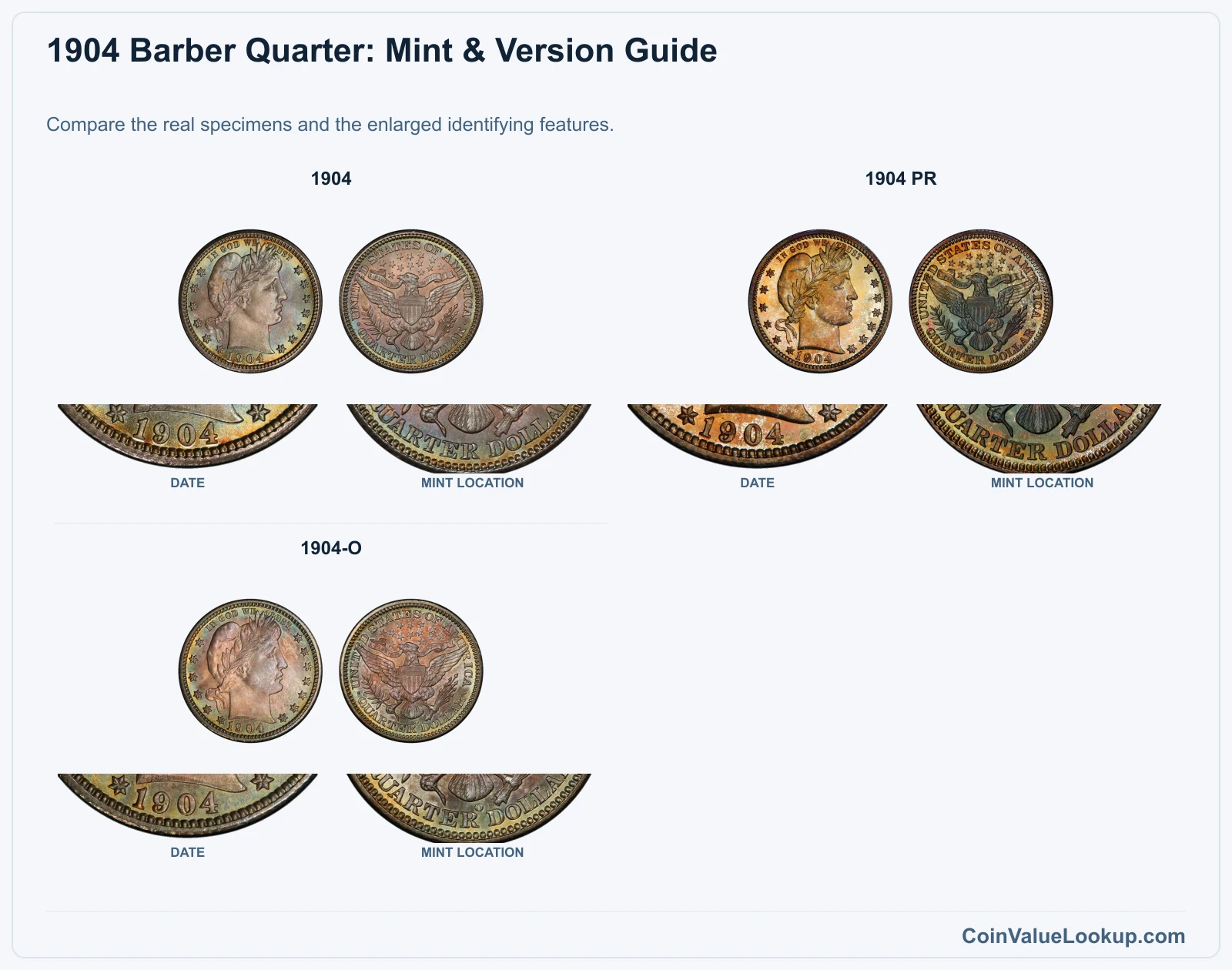
The 1904 Barber Quarter is a 90% silver coin that still turns up in collections and estate lots with surprising regularity. Guide estimates for this year range from about $21.00 to $1,684.00 depending on the specific mint, condition and whether the coin is a proof or business strike.
That is not one blanket price — your coin's version and grade determine where it falls. Mint facility, surface preservation and manufacturing finish all matter, so read on before assuming the best.
Fast Way to Identify Your 1904 Barber Quarter
The quickest way to start figuring out what your 1904 quarter is worth is to upload clear photos of both sides. A well-lit front and back shot lets our identifier give you a preliminary read on the mint, version and approximate condition.
No promises on exact grading or error detection from photos alone, but it beats guessing.
1904 Barber Quarter Value
Upload both sides of your 1904 Barber Quarter.
Front Obverse
Upload photo
Back Reverse
Upload photo
Which 1904 Barber Quarter Versions Are Worth Money?
- 1904-O (New Orleans): Guide estimates reach $1,684.00 at MS63 — the highest listed anchor for this year. Check for the O mintmark below the eagle's tail.
- 1904 Proof: Guide estimate of $799.00 at PR63. Only Philadelphia struck proofs; look for mirror fields and squared rims, not just shininess.
- 1904 Philadelphia business strike: Guide estimate up to $593.00 at MS63. No mintmark present; original surfaces and strong detail drive the value.
- Always confirm mint and finish first. Damage, heavy wear or a cleaned surface does not make a coin rare — it usually lowers value.
Step 1: Identify Your 1904 Barber Quarter Mint Mark and Version
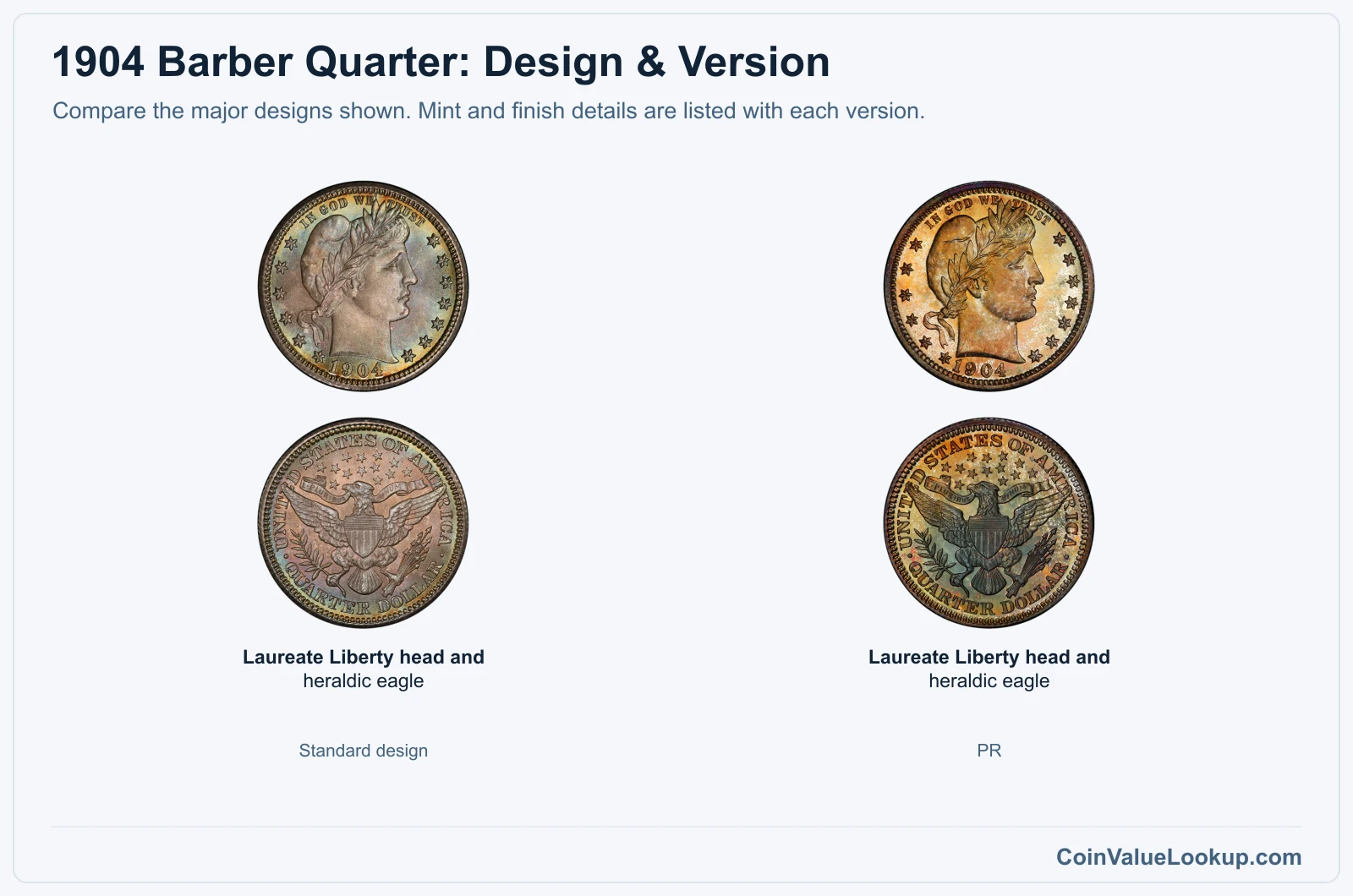
The 1904 Barber Quarter comes in three collectible branches: the Philadelphia business strike (no mintmark), the Philadelphia proof (no mintmark, proof finish), and the New Orleans issue (O mintmark). To find the mintmark, flip the coin over and look below the eagle's tail feathers, just above the "QUARTER DOLLAR" inscription.
No letter there means Philadelphia. An "O" means New Orleans.
All three versions share the same composition — 90% silver and 10% copper, weighing 6.25 grams. The obverse shows Charles Barber's laureate Liberty head, and the reverse carries a heraldic eagle.
Don't confuse a proof with a shiny circulated coin. Proofs were specially manufactured with polished dies and planchets, creating mirror-like fields.
A regular strike that happens to look bright — often because it was cleaned — is not a proof.
Step 2: Check Your 1904 Barber Quarter Grade
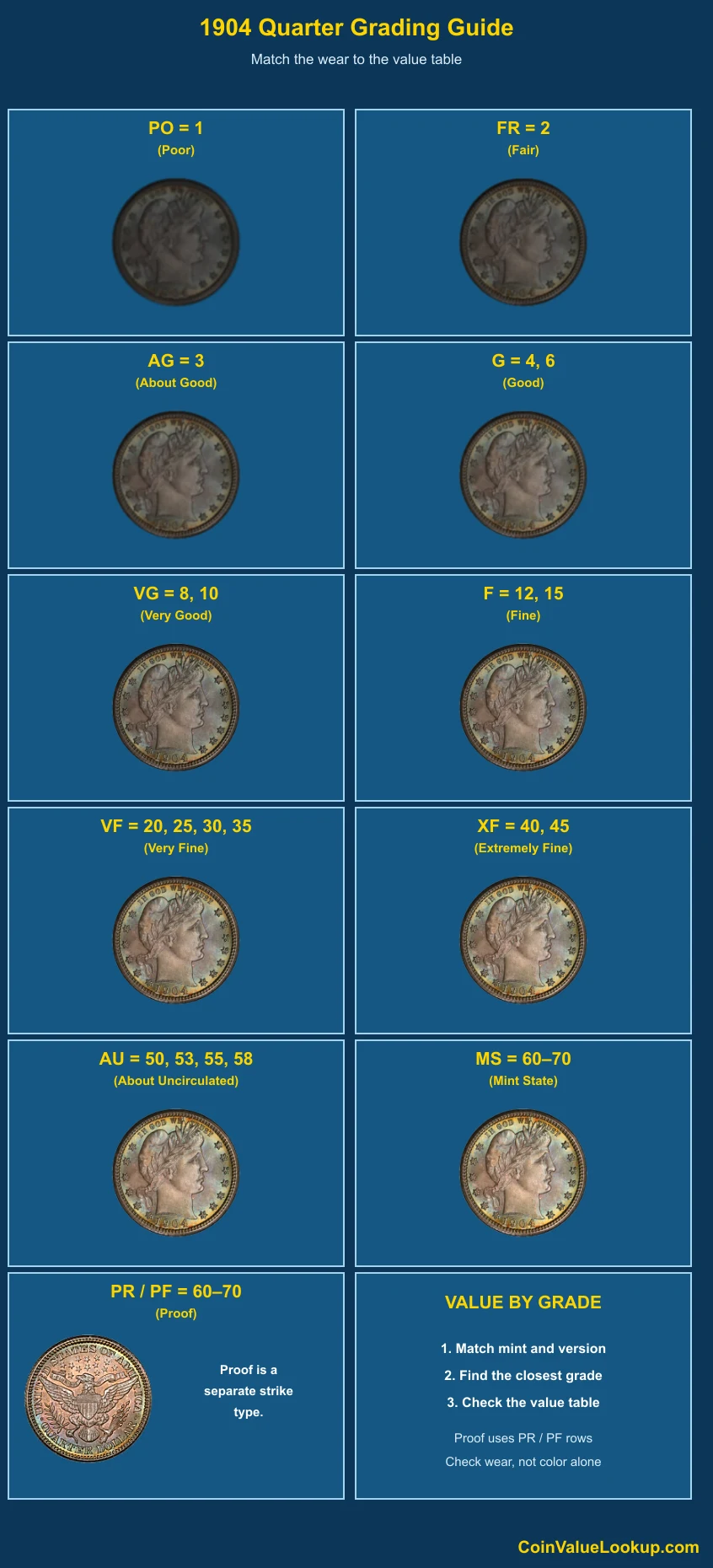
Start with Liberty's hair above the forehead and the detail on her cheek and laurel wreath. On well-worn coins, the hair ribbons merge into a flat mass and the wreath leaves lose their separation.
The word LIBERTY on the headband is a popular quick check, but don't rely on it alone — a weak strike can soften those letters even on an unworn coin.
Flip to the reverse. The eagle's breast feathers, wing tips and tail feathers wear in a predictable order.
Early wear shows on the breast first, then spreads outward.
Compare your coin's overall luster and sharpness against the comparison image for the same type. A coin with full detail but dull, hazy surfaces may have been cleaned, which affects value.
Similarly, a coin with soft letters but cartwheel luster might just be a weak strike rather than a worn piece.
Step 3: Check 1904 Barber Quarter Value by Mint and Version
1904 Barber Quarter
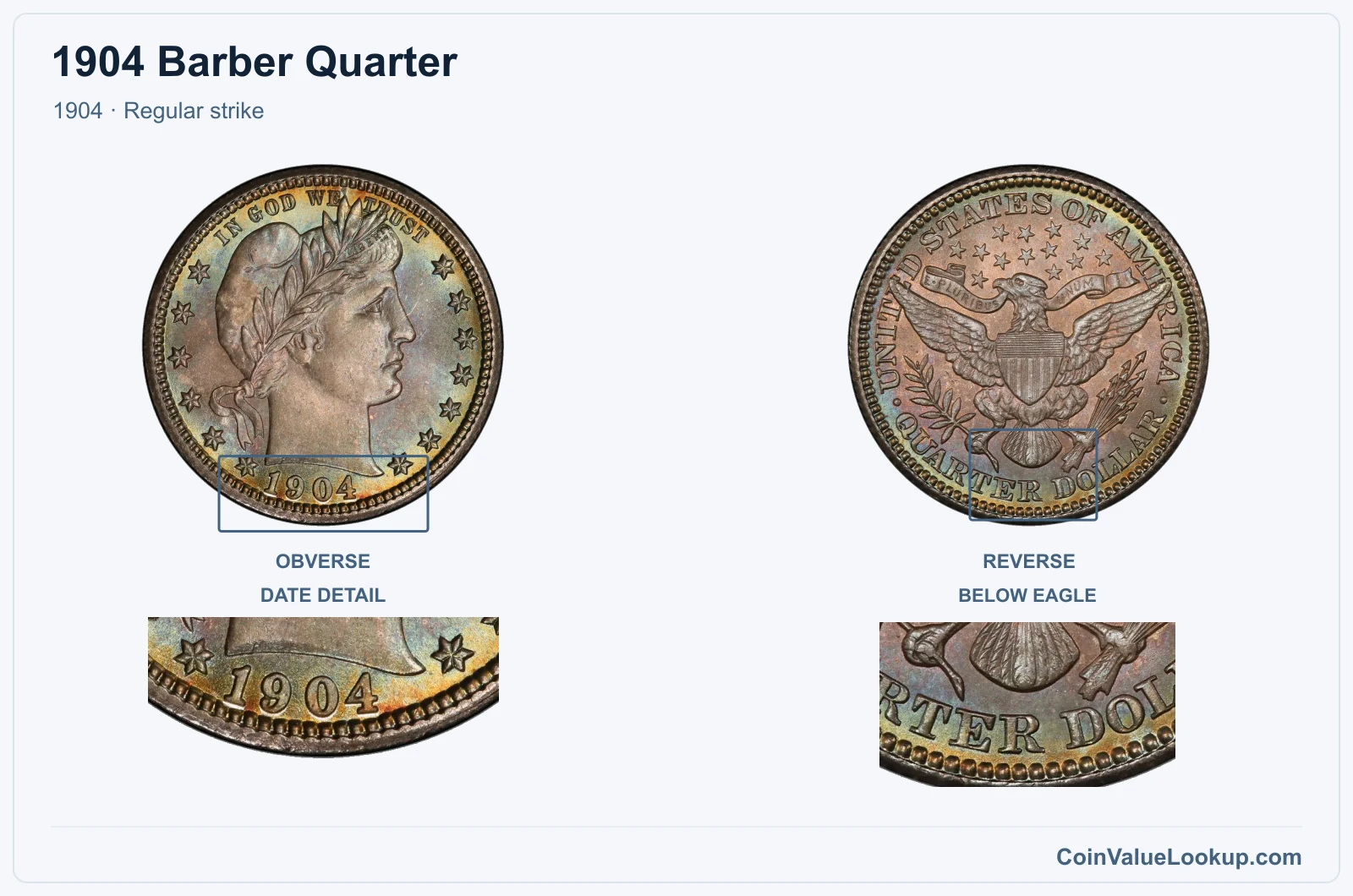
The 1904 Philadelphia business strike carries no mintmark. Look at the reverse below the eagle's tail — if the space is blank, this is your coin.
It was struck in 90% silver at 6.25 grams with the standard Barber design.
USA Coin Book guide estimates place this version at about $21.00 in G4 (a well-worn but readable coin), $309.00 at MS60 (uncirculated but with marks), and $593.00 at MS63 (a cleaner uncirculated example). These are retail estimates, not guaranteed offers.
Original surfaces matter here; a coin that has been cleaned or damaged will trade below these figures even if the detail looks sharp.
Range Grade
Price Auction Records Appraisal PO PO 1
—
Coin Identifier FR FR 2
—
Coin Identifier AG AG 3
—
Coin Identifier G G 4
—
Coin Identifier
G 6
—
Coin Identifier VG VG 8
—
Coin Identifier
VG 10
—
Coin Identifier F F 12
—
Coin Identifier
F 15
—
Coin Identifier VF VF 20
Coin Identifier
VF 25
—
Coin Identifier
VF 30
—
Coin Identifier
VF 35
Coin Identifier XF XF 40
Coin Identifier
XF 45
Coin Identifier AU AU 50
Coin Identifier
AU 53
Coin Identifier
AU 55
Coin Identifier
AU 58
Coin Identifier MS MS 60
Coin Identifier
MS 61
Coin Identifier
MS 62
Coin Identifier
MS 63
Coin Identifier
MS 64
Coin Identifier
MS 65
Coin Identifier
MS 66
Coin Identifier
MS 67
Coin Identifier
MS 68
—
—
—
MS 69
—
—
—
MS 70
—
—
—
1904 Barber Quarter — PR
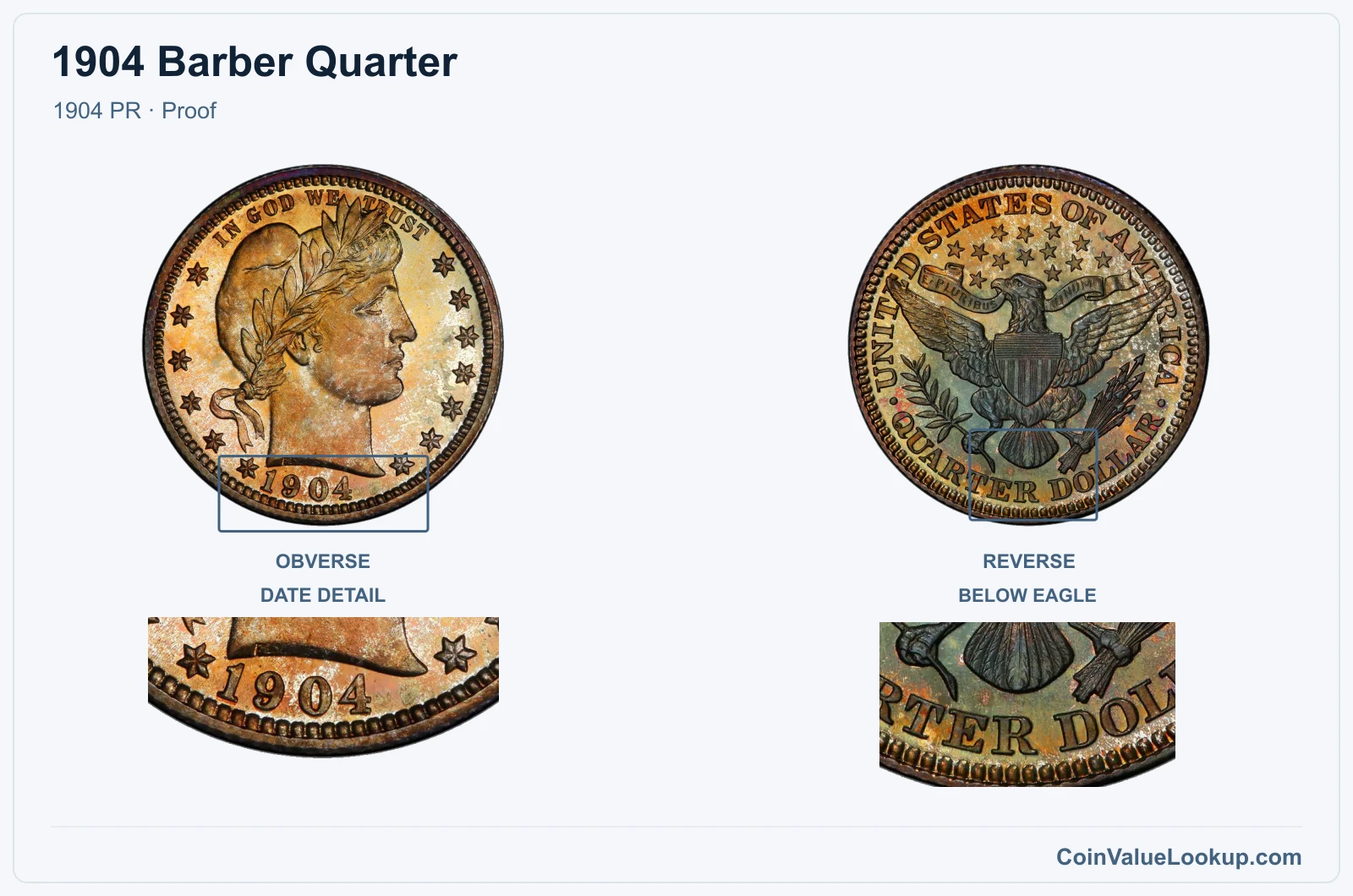
The 1904 Proof was struck at Philadelphia using polished dies and specially prepared planchets. There is no mintmark.
Proofs have deeply mirrored fields and sharply struck devices — but they are not simply "nicer" business strikes. The manufacturing process was entirely different.
A USA Coin Book guide estimate places this coin at about $799.00 in PR63. That grade allows minor hairlines or light haze but expects strong reflectivity and no serious blemishes.
Surface haze, cleaning marks and fingerprint residue all chip away at a proof's appeal. If your coin looks mirror-like but the rims are rounded and the fields show cartwheel luster instead of flat reflection, you probably have a well-preserved business strike, not a proof.
Coin Value Lookup is a good starting point if you want to compare guide values for other Barber Quarter dates and mints before deciding on a next step.
Range Grade
Price Auction Records Appraisal PR PR 1
—
Coin Identifier
PR 2
—
Coin Identifier
PR 3
—
Coin Identifier
PR 4
—
Coin Identifier
PR 6
—
Coin Identifier
PR 8
—
Coin Identifier
PR 10
—
Coin Identifier
PR 12
—
Coin Identifier
PR 15
—
Coin Identifier
PR 20
—
Coin Identifier
PR 25
—
Coin Identifier
PR 30
—
Coin Identifier
PR 35
—
Coin Identifier
PR 40
—
Coin Identifier
PR 45
—
Coin Identifier
PR 50
—
Coin Identifier
PR 53
—
Coin Identifier
PR 55
—
Coin Identifier
PR 58
—
Coin Identifier
PR 60
—
Coin Identifier
PR 61
Coin Identifier
PR 62
Coin Identifier
PR 63
Coin Identifier
PR 64
Coin Identifier
PR 65
Coin Identifier
PR 66
Coin Identifier
PR 67
Coin Identifier
PR 68
Coin Identifier
PR 69
Coin Identifier
PR 70
—
—
—
1904 Barber Quarter — O
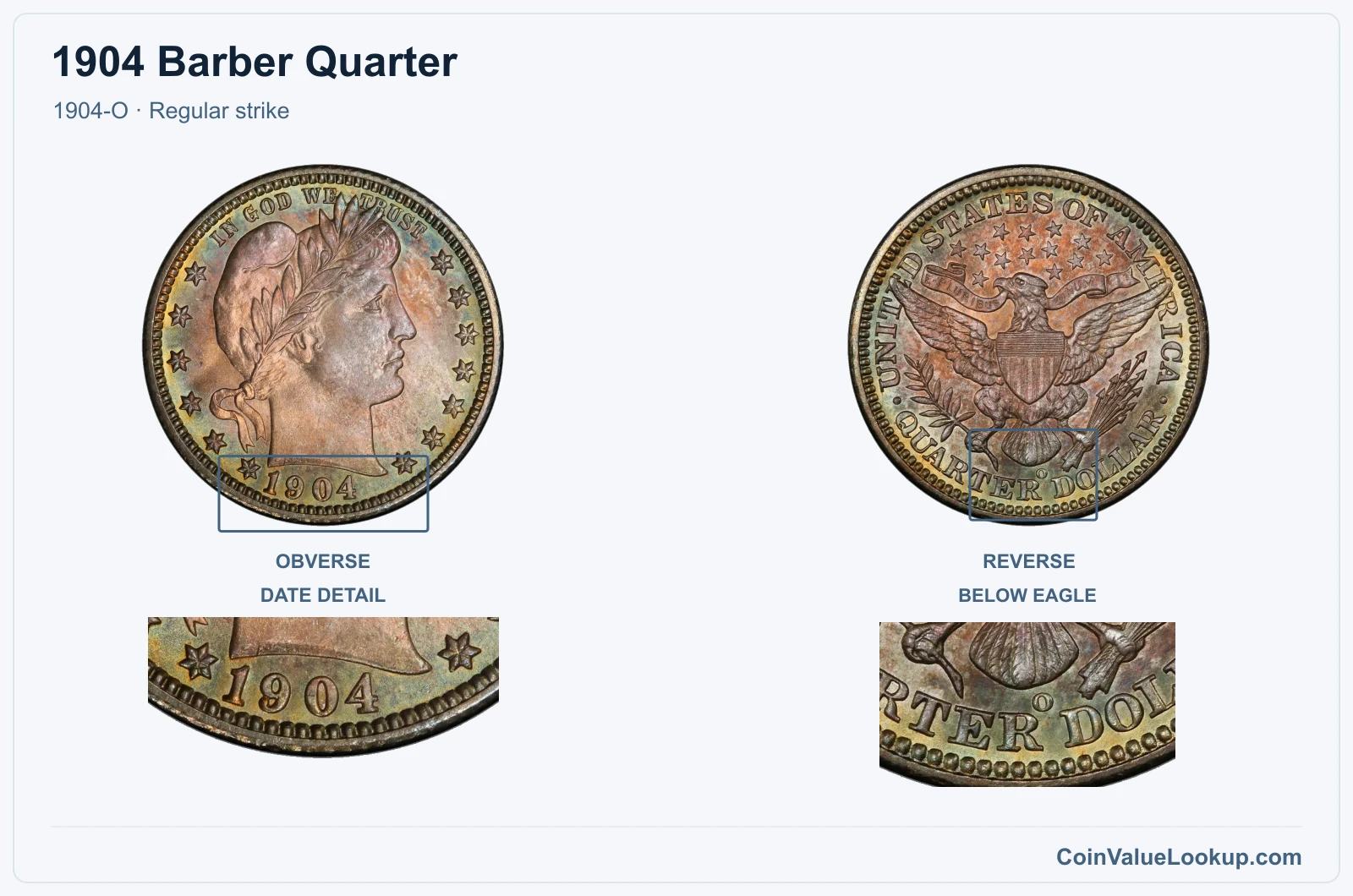
The 1904-O was struck at the New Orleans Mint. Flip the coin and look for a small "O" below the eagle's tail feathers, centered above the denomination.
This version carries the highest guide estimates for 1904 Barber Quarters.
USA Coin Book estimates place the 1904-O at about $52.00 in G4, $1,136.00 at MS60, and $1,684.00 at MS63. That steep jump from circulated to uncirculated tells you something: survivors in mint condition are scarce relative to demand.
Match the mint, design and version before comparing grade. Cleaning or damage can dramatically reduce what a buyer will pay, so original surfaces are critical for coins at this level.
Range Grade
Price Auction Records Appraisal PO PO 1
—
Coin Identifier FR FR 2
—
Coin Identifier AG AG 3
—
Coin Identifier G G 4
Coin Identifier
G 6
—
Coin Identifier VG VG 8
—
Coin Identifier
VG 10
Coin Identifier F F 12
—
Coin Identifier
F 15
Coin Identifier VF VF 20
Coin Identifier
VF 25
Coin Identifier
VF 30
Coin Identifier
VF 35
Coin Identifier XF XF 40
Coin Identifier
XF 45
Coin Identifier AU AU 50
Coin Identifier
AU 53
Coin Identifier
AU 55
Coin Identifier
AU 58
Coin Identifier MS MS 60
—
Coin Identifier
MS 61
Coin Identifier
MS 62
Coin Identifier
MS 63
Coin Identifier
MS 64
Coin Identifier
MS 65
Coin Identifier
MS 66
Coin Identifier
MS 67
Coin Identifier
MS 68
—
—
—
MS 69
—
—
—
MS 70
—
—
—
1904 Barber Quarter Error List
1. 1904 Barber Quarter — Die Crack / Die Chip
Die cracks on 1904 Barber Quarters have been reported for both the Philadelphia and New Orleans issues. They appear as thin raised lines running across the coin's surface, created when a working die developed fractures during production.
A die chip is a related feature — a small raised blob where a tiny piece of the die broke away.
To spot one, look for raised irregular lines that follow no logical design path. They may cross fields, letters or the rim.
An interior chip appears as a small raised lump, usually inside a letter or near a device.
Don't confuse these with scratches, which are incuse (cut into the surface) rather than raised. Corrosion pitting or debris stuck to the coin can also mimic a die chip.
The visibility, size and location of the crack or chip all influence collector interest, so individual assessment matters.
2. 1904 Barber Quarter — Off-Center Strike
Off-center strikes have been reported for the 1904-O Barber Quarter specifically. This error happens when the planchet is not properly seated between the dies at the moment of striking, resulting in a design that is shifted to one side with an unstruck crescent of blank metal on the opposite edge.
The degree of displacement matters a lot. A 5% shift is minor; a 20% or greater shift with the full date still visible tends to attract far more collector attention.
Be careful with lookalikes. A clipped planchet removes metal from the blank before striking and produces a different shape.
Post-mint damage from a vise or hammer can flatten one side of a coin, mimicking a shift. One-sided die misalignment is also distinct from a true off-center strike.
Condition, the percentage of displacement and date visibility all factor into value.
3. 1904 Barber Quarter — Die Break / Cud
A die break or cud error has been reported for the 1904-O Barber Quarter. A cud forms when a section of the die edge breaks away entirely, leaving a raised, featureless lump of metal connected to the rim on the finished coin.
It is essentially a severe, rim-connected die break.
Look along the rim for an area that appears raised and blobby, with no design detail. The boundary between the normal design and the cud is usually sharp.
Smaller interior die breaks exist too, but a true cud always touches the rim.
Rim dents from post-mint contact look similar at first glance but are depressed rather than raised. Corrosion buildup near the rim can also fool you.
An interior die chip lacks the rim connection that defines a cud. The size, location and overall coin condition all affect how much a collector would pay for one of these.
4. 1904 Barber Quarter — Repunched Mintmark
A repunched mintmark (RPM) has been reported for the 1904-O Barber Quarter. During this era, mintmarks were hand-punched into working dies, and sometimes the engraver's first attempt landed slightly off position.
The correction left traces of the original placement visible beneath or beside the final mintmark.
To check, examine the O mintmark under magnification. Look for a shadow, doubling or partial extra outline — remnants of a second punch at a slightly different angle or position.
Compare against a normal 1904-O at the same magnification to see if the extra shape is consistent.
Machine doubling, which produces a flat shelf or smeared look, is not the same thing. Die chips inside or around the mintmark and simple corrosion can also create confusing outlines.
The strength and direction of the repunching affect desirability.
5. 1904 Barber Quarter — Doubled Die Obverse
A Doubled Die Obverse (DDO) error has been reported for the 1904 Barber Quarter. This type of error occurs during die manufacture, producing consistent doubling on the obverse design elements — letters, the date or Liberty's profile may show separation or notching that repeats identically on every coin struck from that die.
Compare the obverse inscriptions and date digits against a normal 1904 quarter under the same lighting. Genuine hub doubling shows consistent directional separation — notches on the same side of every affected letter, for example.
Machine doubling is the most common lookalike. It produces a flat, shelf-like distortion rather than the rounded, separated profiles of true hub doubling.
Reflections from proof-like surfaces and contour changes from a worn die can also mimic doubling at casual glance. Condition, the strength of the doubling and which design elements are affected all influence how collectors value the error.