1831 Capped Bust Quarter Coin Value: How Much Is It Worth?
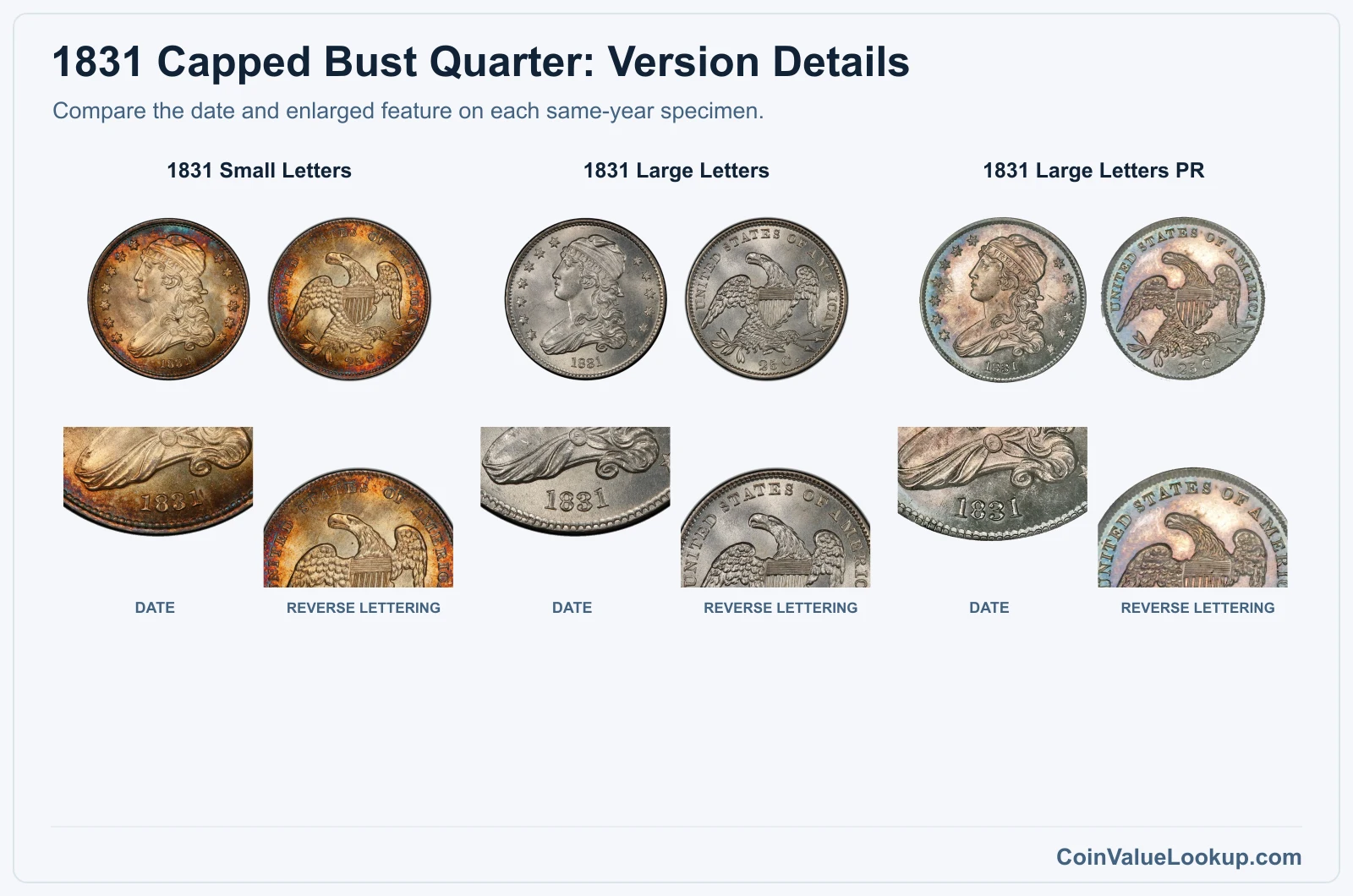
The 1831 Capped Bust Quarter is a nearly 200-year-old silver coin struck only at the Philadelphia Mint. Guide estimates from USA Coin Book range from $132.00 to $5,631.00 depending on the specific version and grade.
That spread covers different reverse lettering varieties and finishes, so your coin's value depends on which version you hold and its condition.
Fast Way to Identify Your 1831 Capped Bust Quarter
The quickest way to start figuring out what your 1831 quarter is worth is to upload clear photos of the front and back. Our identifier can give you a preliminary read on the version and general condition.
Good lighting and a steady shot help, especially for the reverse lettering that separates the two main business-strike varieties.
1831 Capped Bust Quarter Value
Upload both sides of your 1831 Capped Bust Quarter.
Front Obverse
Upload photo
Back Reverse
Upload photo
Which 1831 Capped Bust Quarter Versions Are Worth Money?
- 1831 Large Letters: USA Coin Book guide estimates reach $5,631.00 at MS63, the highest listed anchor for this date.
- 1831 Small Letters: Guide estimates reach $4,951.00 at MS63, close behind the Large Letters version in higher grades.
- 1831 Large Letters Proof: A separate proof finish exists; individual value depends on authenticated identity and condition.
- Reverse lettering size is the key identifier separating the two business-strike varieties, so check that first.
Step 1: Identify Your 1831 Capped Bust Quarter Mint Mark and Version
Every 1831 Capped Bust Quarter came from Philadelphia, so there is no mintmark to look for. The design uses the reduced-diameter format introduced in 1831, and the reverse omits the E PLURIBUS UNUM motto found on earlier large-diameter issues.
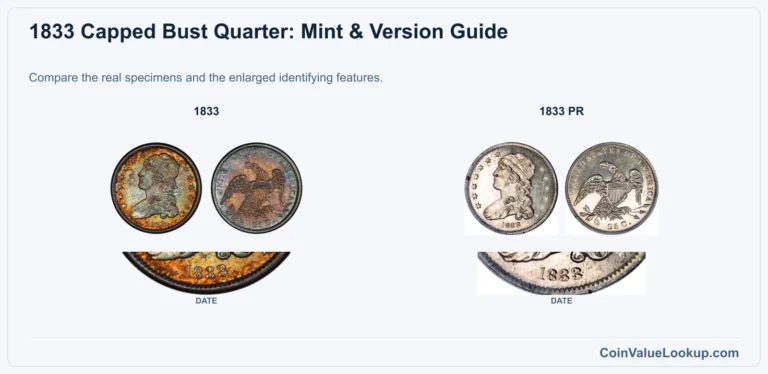
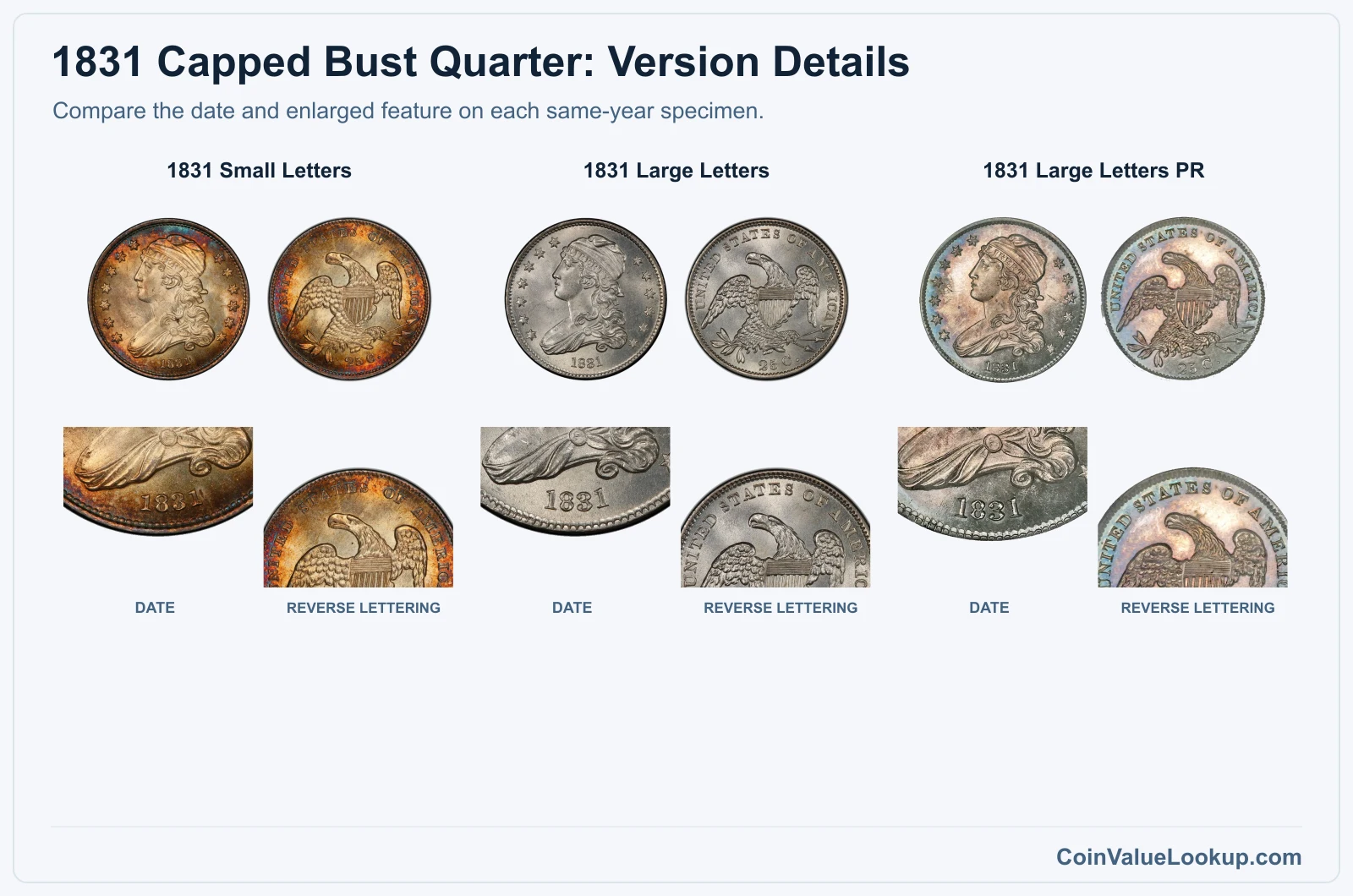
The critical split is the size of the lettering on the reverse legend. Hold the two varieties side by side, or compare against reference images, and focus on UNITED STATES OF AMERICA and the denomination text.
Small Letters coins have noticeably smaller, thinner characters; Large Letters coins have taller, bolder ones.
A proof version also exists with the Large Letters reverse. Proof is a manufacturing finish, not a higher grade than Mint State.
Proof surfaces show mirrored fields and sharply defined devices from specially prepared dies and planchets. A regular strike that happens to be shiny is not a proof.
The alloy is a silver-copper composition of approximately 89.24% silver. All three branches, Small Letters, Large Letters, and Large Letters Proof, share that composition and the same obverse design of Liberty wearing a mob cap.
Step 2: Check Your 1831 Capped Bust Quarter Grade
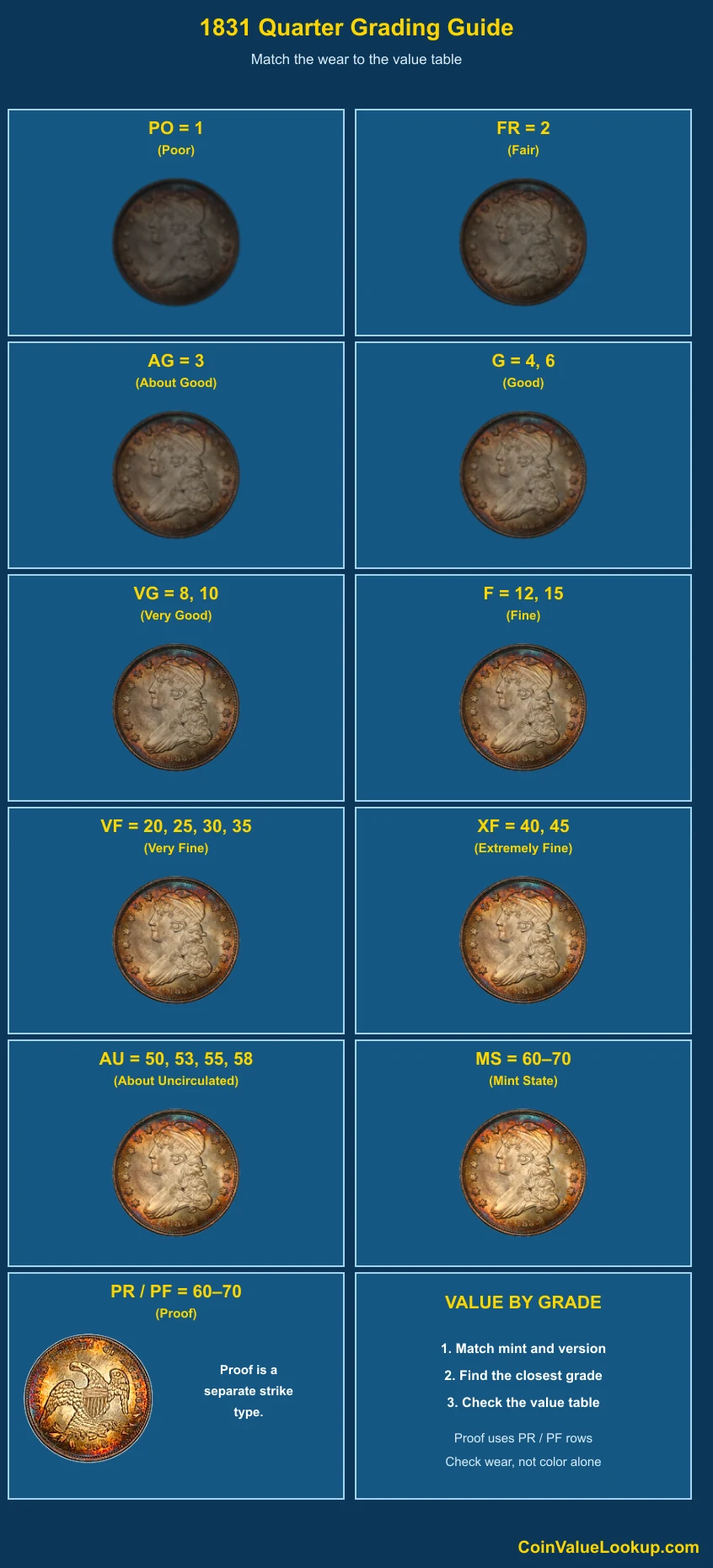
Start with the hair above Liberty's ear and the folds of the cap. On a well-preserved coin these show fine, distinct lines.
As wear progresses, the hair curls merge and the cap folds flatten into smooth patches.
The cheek is another early wear spot. A coin grading around Good-4 will have a fully outlined portrait but almost no interior detail left in the hair or cap.
Flip the coin over. The eagle's breast feathers and the tops of the wings lose definition quickly in circulation.
Compare your coin's eagle against the reference image to gauge how much detail remains.
Strike quality matters here. Some 1831 quarters left the press with soft detail on the hair curls or eagle breast even before anyone spent them.
A weakly struck Mint State coin can look worn at first glance, so compare luster alongside design sharpness. Original luster on an unworn coin has a cartwheel effect when tilted under a light; a cleaned coin loses that and may show fine hairlines instead.
Step 3: Check 1831 Capped Bust Quarter Value by Mint and Version
1831 Capped Bust Quarter — Small Letters
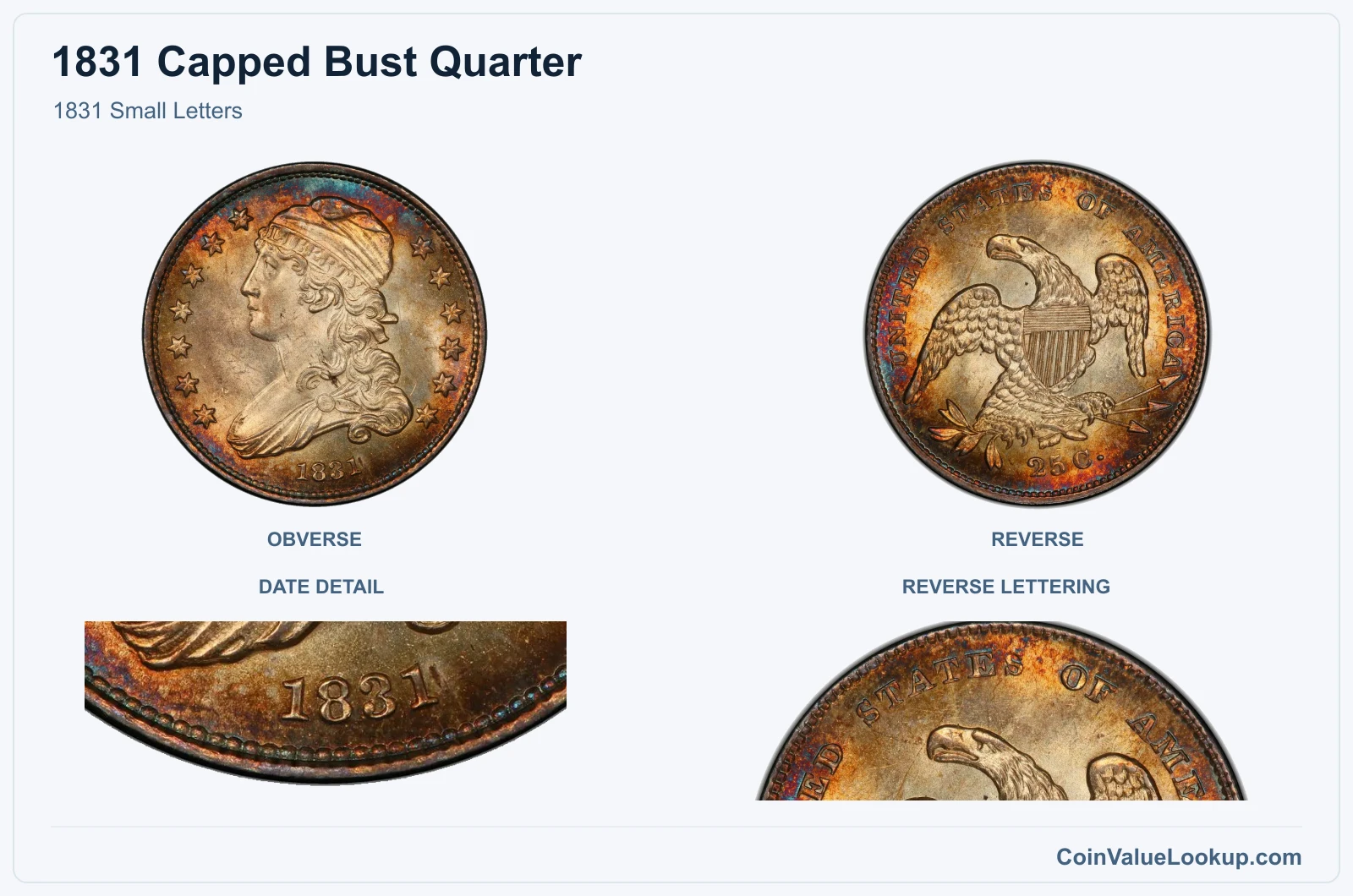
The 1831 Small Letters quarter is a business strike from Philadelphia with noticeably smaller, thinner characters in the reverse legend compared to its Large Letters sibling. No mintmark appears on either variety.
To confirm you have the Small Letters version, compare the height of the letters in UNITED STATES OF AMERICA and the denomination against a known Large Letters example. Keeping the date side visible for scale helps.
USA Coin Book guide estimates place this version at about $132.00 in Good-4, $2,506.00 in MS60, and $4,951.00 in MS63. These are retail guide figures, not guaranteed sale prices.
Cleaning, damage, or heavy wear will push the real-world value well below those anchors.
Range Grade
Price Auction Records Appraisal PO PO 1
Coin Identifier FR FR 2
—
Coin Identifier AG AG 3
—
Coin Identifier G G 4
Coin Identifier
G 6
Coin Identifier VG VG 8
Coin Identifier
VG 10
Coin Identifier F F 12
Coin Identifier
F 15
Coin Identifier VF VF 20
Coin Identifier
VF 25
Coin Identifier
VF 30
Coin Identifier
VF 35
Coin Identifier XF XF 40
Coin Identifier
XF 45
Coin Identifier AU AU 50
Coin Identifier
AU 53
Coin Identifier
AU 55
Coin Identifier
AU 58
Coin Identifier MS MS 60
Coin Identifier
MS 61
Coin Identifier
MS 62
Coin Identifier
MS 63
Coin Identifier
MS 64
Coin Identifier
MS 65
Coin Identifier
MS 66
Coin Identifier
MS 67
—
Coin Identifier
MS 68
—
—
—
MS 69
—
—
—
MS 70
—
—
—
1831 Capped Bust Quarter — Large Letters
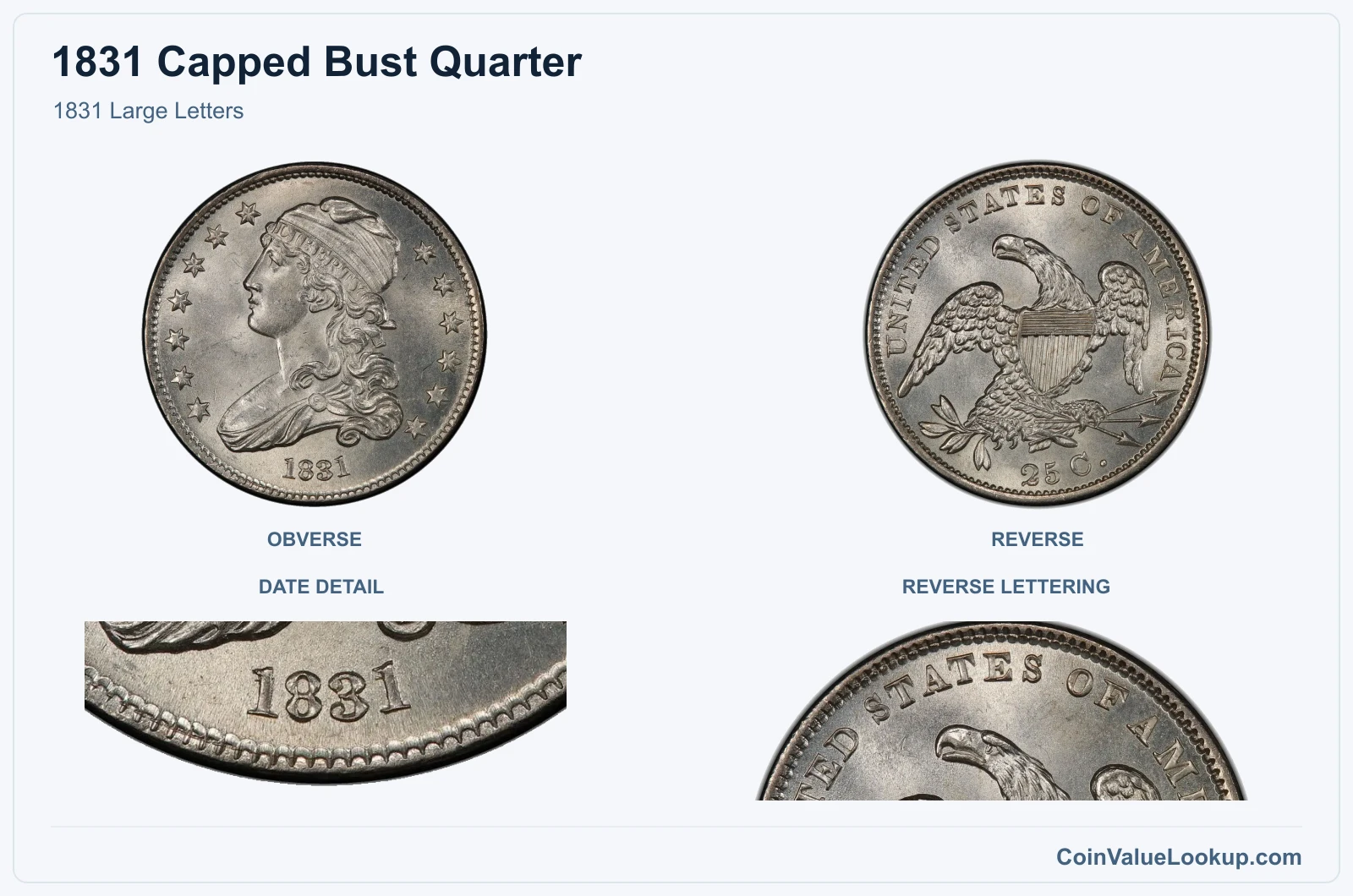
The 1831 Large Letters quarter shares the same Philadelphia origin and reduced-diameter Capped Bust design but carries taller, bolder lettering on the reverse. That is the only reliable way to tell it apart from the Small Letters issue.
USA Coin Book guide estimates run $132.00 in Good-4, $2,910.00 in MS60, and $5,631.00 in MS63. The premium over the Small Letters version becomes noticeable in Mint State grades.
As always, original surfaces matter. A coin that has been cleaned or has rim damage will not bring anywhere near those numbers regardless of the letter size on the back.
Coin Value Lookup is a good starting point if you want to compare this quarter against other Capped Bust dates or denominations in your collection.
Range Grade
Price Auction Records Appraisal PO PO 1
—
Coin Identifier FR FR 2
—
Coin Identifier AG AG 3
—
Coin Identifier G G 4
—
Coin Identifier
G 6
—
Coin Identifier VG VG 8
Coin Identifier
VG 10
Coin Identifier F F 12
—
Coin Identifier
F 15
Coin Identifier VF VF 20
Coin Identifier
VF 25
Coin Identifier
VF 30
Coin Identifier
VF 35
Coin Identifier XF XF 40
Coin Identifier
XF 45
Coin Identifier AU AU 50
Coin Identifier
AU 53
Coin Identifier
AU 55
Coin Identifier
AU 58
Coin Identifier MS MS 60
—
Coin Identifier
MS 61
—
Coin Identifier
MS 62
Coin Identifier
MS 63
Coin Identifier
MS 64
Coin Identifier
MS 65
Coin Identifier
MS 66
—
—
—
MS 67
—
—
—
MS 68
—
—
—
MS 69
—
—
—
MS 70
—
—
—
1831 Capped Bust Quarter — Large Letters PR
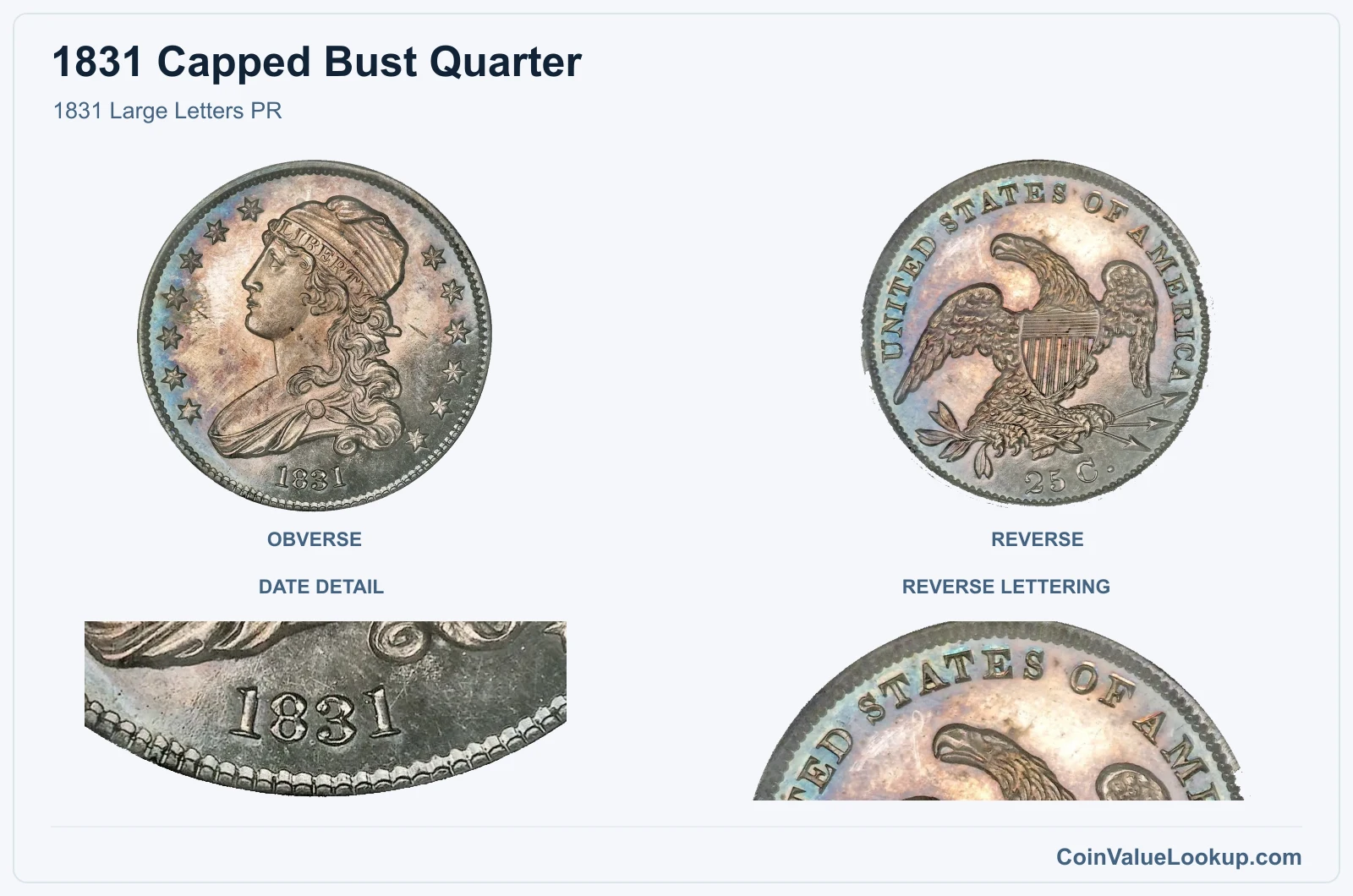
The 1831 Large Letters Proof is a proof-finish striking, not simply a high-grade business strike that looks nice. Genuine proofs were made with polished dies and specially handled planchets, producing mirrored fields and sharp device edges that differ from even the best regular strikes.
No supported numeric price range is available for this version. Value depends entirely on the individual coin's authenticated identity, surface preservation, and the presence or absence of hairlines or haze.
Professional authentication is especially important here because a deeply lustrous business strike can be mistaken for a proof by hopeful owners. If you suspect you have one, third-party certification is the practical next step.
Range Grade
Price Auction Records Appraisal PR PR 1
—
Coin Identifier
PR 2
—
Coin Identifier
PR 3
—
Coin Identifier
PR 4
—
Coin Identifier
PR 6
—
Coin Identifier
PR 8
—
Coin Identifier
PR 10
—
Coin Identifier
PR 12
—
Coin Identifier
PR 15
—
Coin Identifier
PR 20
—
Coin Identifier
PR 25
—
Coin Identifier
PR 30
—
Coin Identifier
PR 35
—
Coin Identifier
PR 40
—
Coin Identifier
PR 45
—
Coin Identifier
PR 50
—
Coin Identifier
PR 53
—
Coin Identifier
PR 55
—
Coin Identifier
PR 58
—
Coin Identifier
PR 60
—
Coin Identifier
PR 61
—
Coin Identifier
PR 62
—
Coin Identifier
PR 63
Coin Identifier
PR 64
Coin Identifier
PR 65
—
Coin Identifier
PR 66
Coin Identifier
PR 67
—
—
—
PR 68
—
—
—
PR 69
—
—
—
PR 70
—
—
—
1831 Capped Bust Quarter Error List
1. 1831 Capped Bust Quarter — Repunched Date
A repunched date on an 1831 Capped Bust Quarter shows traces of an earlier position of one or more date numerals alongside the final, accepted digits. Look closely at each numeral in 1831 for ghost outlines, thickened serifs, or partial secondary impressions slightly offset from the main punch.
This variety has been reported on the Large Letters reverse version. It is a die variety created when the date punch was applied more than once in slightly different positions during die preparation.
Do not confuse a repunched date with machine doubling, which produces flat, shelf-like distortion across the entire design rather than isolated extra impressions limited to the date. Damage from a hit or scratch near the numerals can also mimic a repunch at first glance, but true repunching follows the contour of the original numeral shapes.
No specific price range is adopted for this variety. Condition, the clarity of the repunching, and professional attribution all influence what a collector will pay.