1843 Liberty Seated Quarter Coin Value: How Much Is It Worth?
The 1843 Liberty Seated Quarter is a silver coin that draws attention from collectors thanks to its early New Orleans mintmark varieties and scarce Philadelphia proofs. A guide from USA Coin Book places the regular Philadelphia business strike around $70 in G4 and up to roughly $1,608 in MS63.
The New Orleans issue in MS63 reaches about $7,340 in guide estimates. Identifying your exact mint, mintmark size, and condition matters before comparing prices.
Fast Way to Identify Your 1843 Liberty Seated Quarter
The quickest way to start figuring out what you have is to upload clear photos of both sides of your coin. A front shot captures Liberty's detail and any wear, while the back shows the eagle and, critically, whether there is a small "O" mintmark beneath it.
Share both images for a preliminary identification of your coin's mint, version, and approximate condition.
1843 Liberty Seated Quarter Value
Upload both sides of your 1843 Liberty Seated Quarter.
Front Obverse
Upload photo
Back Reverse
Upload photo
Which 1843 Liberty Seated Quarter Versions Are Worth Money?
- Philadelphia business strikes in original, problem-free high grade can reach around $1,608 at MS63 per guide estimates.
- The 1843-O in MS63 is listed at roughly $7,340 in guide estimates, reflecting the scarcity of surviving high-grade New Orleans pieces.
- Authenticated early Philadelphia proofs are rare specialist coins valued individually based on provenance and condition.
- The 1843-O Large O is a scarce variety; its value depends on authenticated identity and condition rather than a standard guide line.
- A Shattered Reverse Die variety and a Lightning-Bolt Reverse Die Crack variety exist on Philadelphia strikes and are worth checking against reference images.
Step 1: Identify Your 1843 Liberty Seated Quarter Mint Mark and Version
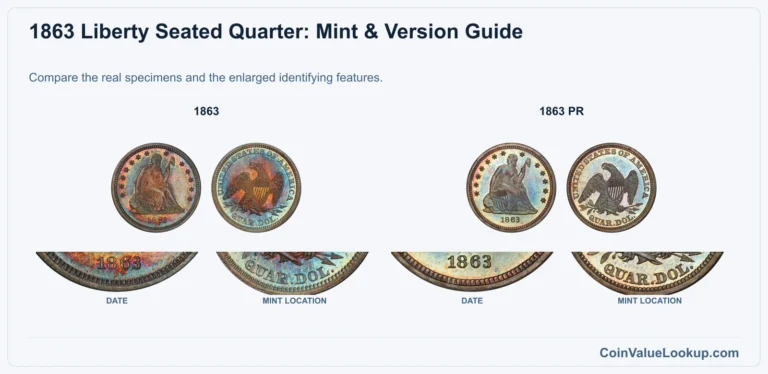
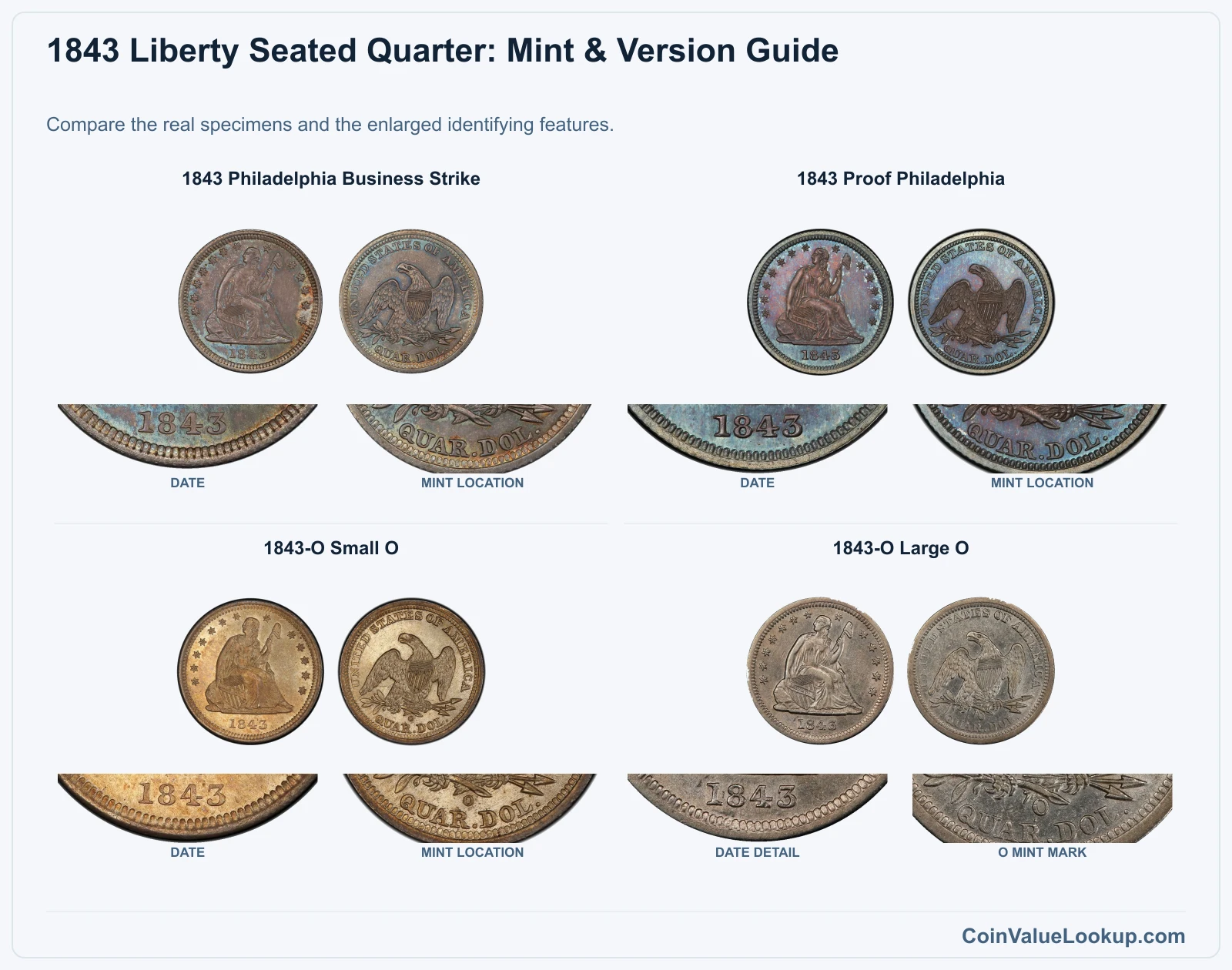
First, confirm the date reads 1843. The obverse shows a seated Liberty figure with drapery at her elbow, and the reverse depicts an eagle without a motto banner.
Philadelphia coins carry no mintmark at all. New Orleans coins have an "O" stamped on the reverse below the eagle.
That New Orleans mintmark comes in two sizes. The Small O is the more commonly encountered version, while the Large O is a distinctly bigger punch, sometimes accompanied by raised die rust lumps on the reverse that help confirm the attribution.
You really need to compare yours side by side with reference images.
The coin is 90% silver and 10% copper, with a nominal weight of 6.68 grams and a diameter of about 24.3 mm. Wear can reduce the weight slightly, so a light coin does not automatically mean it is fake.
A polished or reflective surface does not make a coin a proof; early proof attribution requires expert die analysis and provenance documentation.
Step 2: Check Your 1843 Liberty Seated Quarter Grade
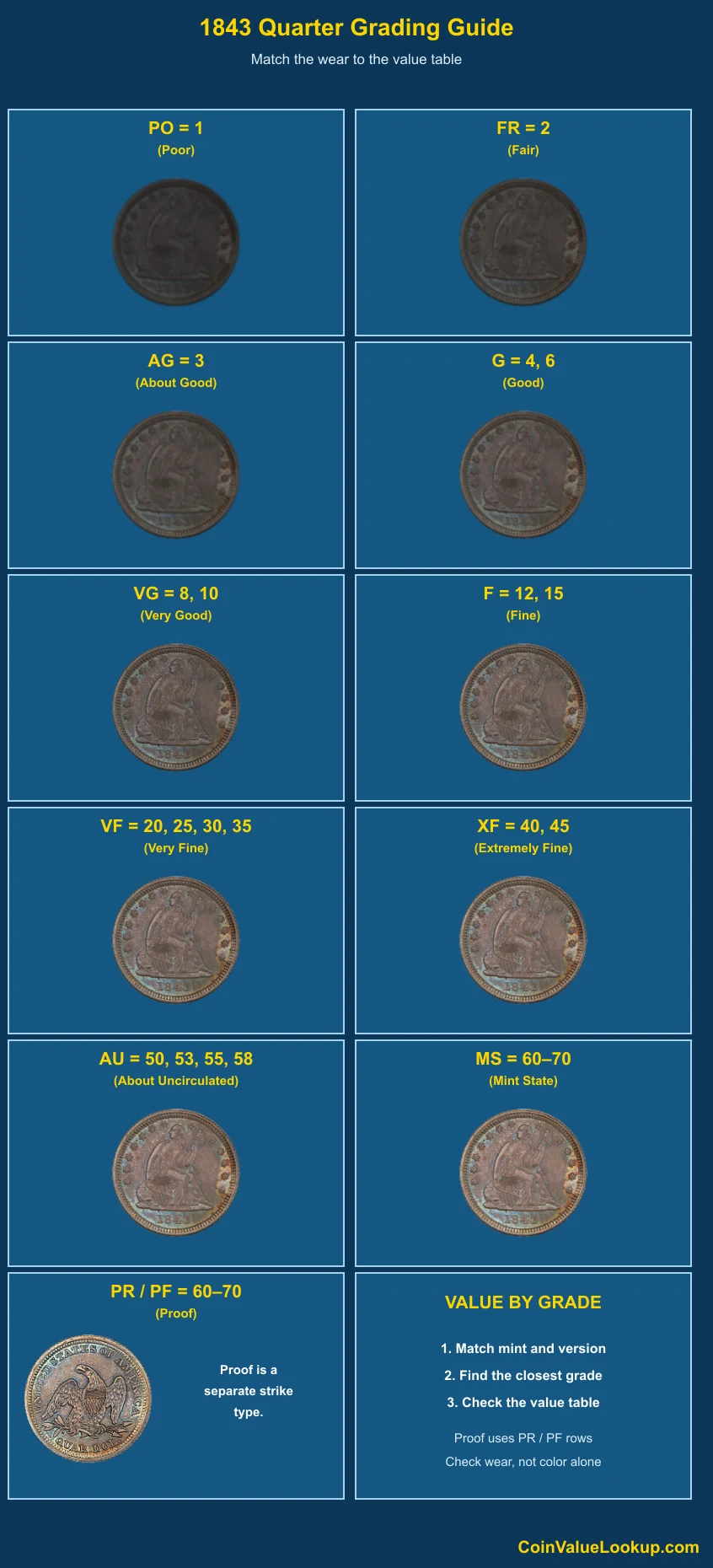
Start with Liberty herself. On a well-worn coin, her head and knee blend into the surrounding field first, and the shield lettering on her lap fades.
A mid-grade piece retains readable shield letters and visible separation at the breast and knee. On the reverse, check the eagle's breast feathers, wing detail, and claw definition.
Do not confuse a weak strike with heavy wear. Some 1843 quarters, especially from New Orleans, came off the press with soft detail in spots.
If surrounding areas show full luster and no friction, the soft spot is likely strike-related. Use the comparison image to match your coin's remaining detail against known grade benchmarks.
Hairlines from old cleaning, filled holes, rim damage, and environmental toning all affect value independent of the numerical grade. A coin grading VF20 with original surfaces will typically outperform one grading the same but showing signs of past problems.
Step 3: Check 1843 Liberty Seated Quarter Value by Mint and Version
1843 Liberty Seated Quarter — Philadelphia Business Strike
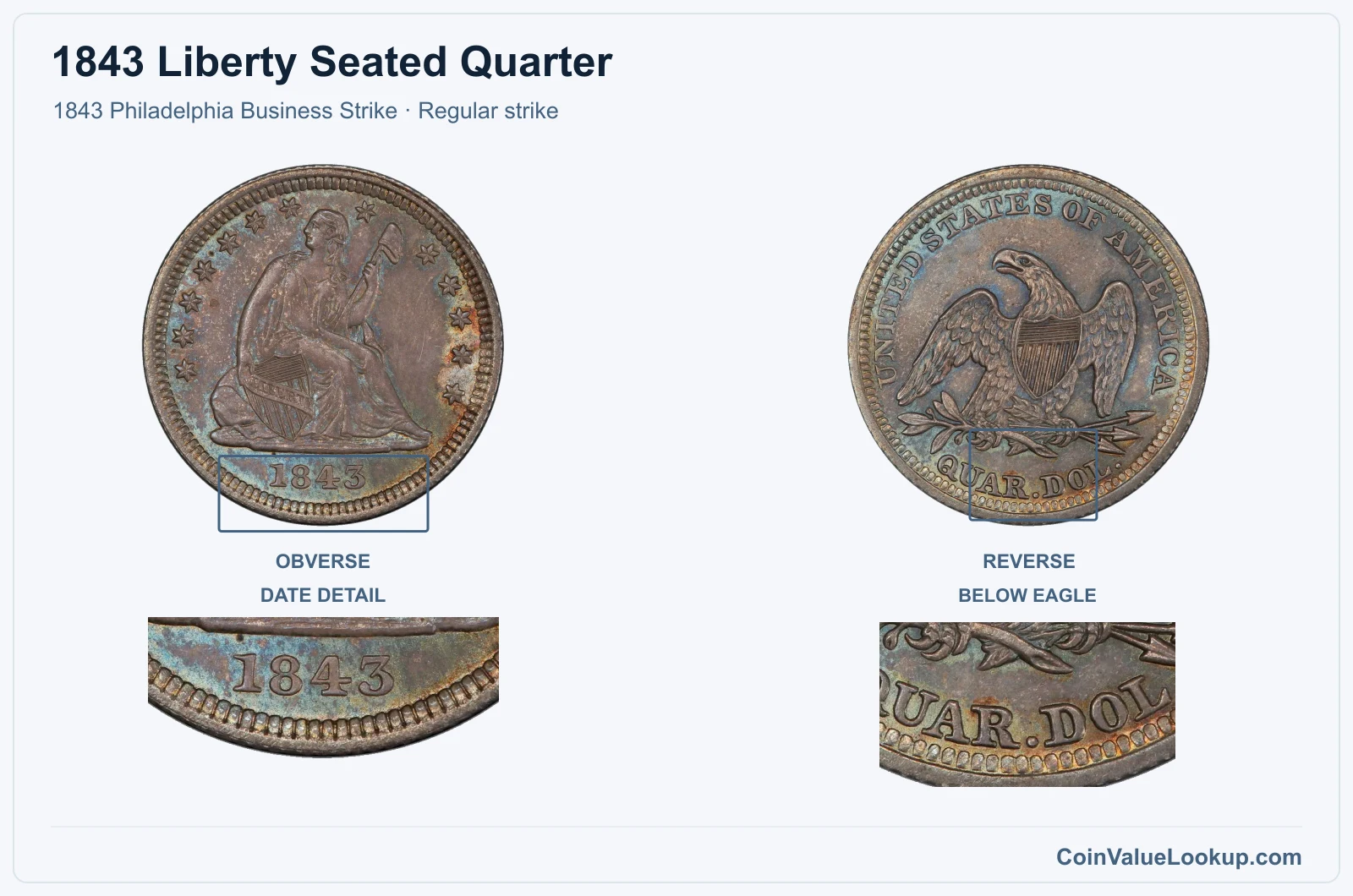
This is the standard 1843 quarter from Philadelphia, struck without a mintmark. It uses the With Drapery design, showing fabric at Liberty's elbow on the obverse.
The USA Coin Book guide places it around $70 in G4, about $127 in VF20, and roughly $1,608 in MS63. These are retail guide estimates, not guaranteed sale prices.
Philadelphia business strikes are the most available version of this date. Problem-free examples with original surfaces command the strongest premiums, especially above VF.
Cleaned or damaged coins trade well below guide figures regardless of apparent detail.
| Range | Grade | Price | Auction Records | Appraisal |
|---|---|---|---|---|
| PO | PO 1 | — | Coin Identifier | |
| FR | FR 2 | — | Coin Identifier | |
| AG | AG 3 | — | Coin Identifier | |
| G | G 4 | — | Coin Identifier | |
| G 6 | — | Coin Identifier | ||
| VG | VG 8 | — | Coin Identifier | |
| VG 10 | — | Coin Identifier | ||
| F | F 12 | — | Coin Identifier | |
| F 15 | — | Coin Identifier | ||
| VF | VF 20 | — | Coin Identifier | |
| VF 25 | — | Coin Identifier | ||
| VF 30 | — | Coin Identifier | ||
| VF 35 | Coin Identifier | |||
| XF | XF 40 | Coin Identifier | ||
| XF 45 | Coin Identifier | |||
| AU | AU 50 | Coin Identifier | ||
| AU 53 | Coin Identifier | |||
| AU 55 | Coin Identifier | |||
| AU 58 | Coin Identifier | |||
| MS | MS 60 | Coin Identifier | ||
| MS 61 | Coin Identifier | |||
| MS 62 | Coin Identifier | |||
| MS 63 | Coin Identifier | |||
| MS 64 | Coin Identifier | |||
| MS 65 | Coin Identifier | |||
| MS 66 | — | Coin Identifier | ||
| MS 67 | — | — | — | |
| MS 68 | — | — | — | |
| MS 69 | — | — | — | |
| MS 70 | — | — | — |
1843 Liberty Seated Quarter — Proof Philadelphia
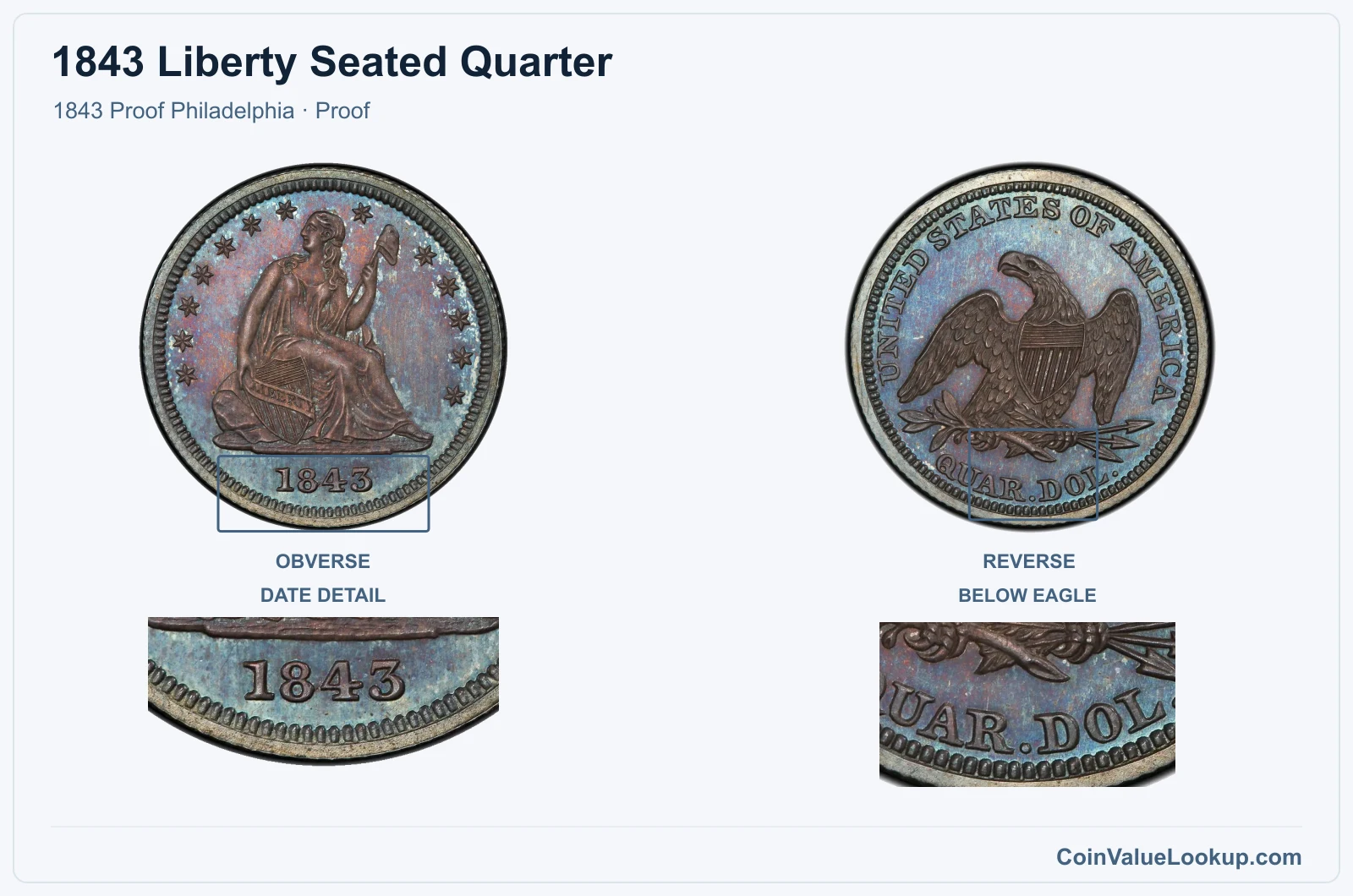
Early Philadelphia proofs from 1843 are rare specialist coins, not something you stumble across in a junk box. A reflective surface alone does not make a coin a proof.
Genuine proof attribution requires examination of specific die characteristics, surface quality, and ideally a documented ownership history.
No standard numeric price range is adopted for this issue because each authenticated example is assessed individually based on its condition, provenance, and the severity of any imperfections. If you believe you have one, professional third-party authentication is essential before drawing any value conclusions.
Coin Value Lookup is a good starting point when you want to look up guides for other dates and denominations in the Liberty Seated series before consulting a specialist.
| Range | Grade | Price | Auction Records | Appraisal |
|---|---|---|---|---|
| PR | PR 1 | — | Coin Identifier | |
| PR 2 | — | Coin Identifier | ||
| PR 3 | — | Coin Identifier | ||
| PR 4 | — | Coin Identifier | ||
| PR 6 | — | Coin Identifier | ||
| PR 8 | — | Coin Identifier | ||
| PR 10 | — | Coin Identifier | ||
| PR 12 | — | Coin Identifier | ||
| PR 15 | — | Coin Identifier | ||
| PR 20 | — | Coin Identifier | ||
| PR 25 | — | Coin Identifier | ||
| PR 30 | — | Coin Identifier | ||
| PR 35 | — | Coin Identifier | ||
| PR 40 | — | Coin Identifier | ||
| PR 45 | — | Coin Identifier | ||
| PR 50 | — | Coin Identifier | ||
| PR 53 | Coin Identifier | |||
| PR 60 | — | — | — | |
| PR 61 | — | — | — | |
| PR 62 | — | — | — | |
| PR 63 | — | Coin Identifier | ||
| PR 64 | Coin Identifier | |||
| PR 65 | Coin Identifier | |||
| PR 66 | — | — | — | |
| PR 67 | — | — | — | |
| PR 68 | — | — | — | |
| PR 69 | — | — | — | |
| PR 70 | — | — | — |
1843 Liberty Seated Quarter — O Small O
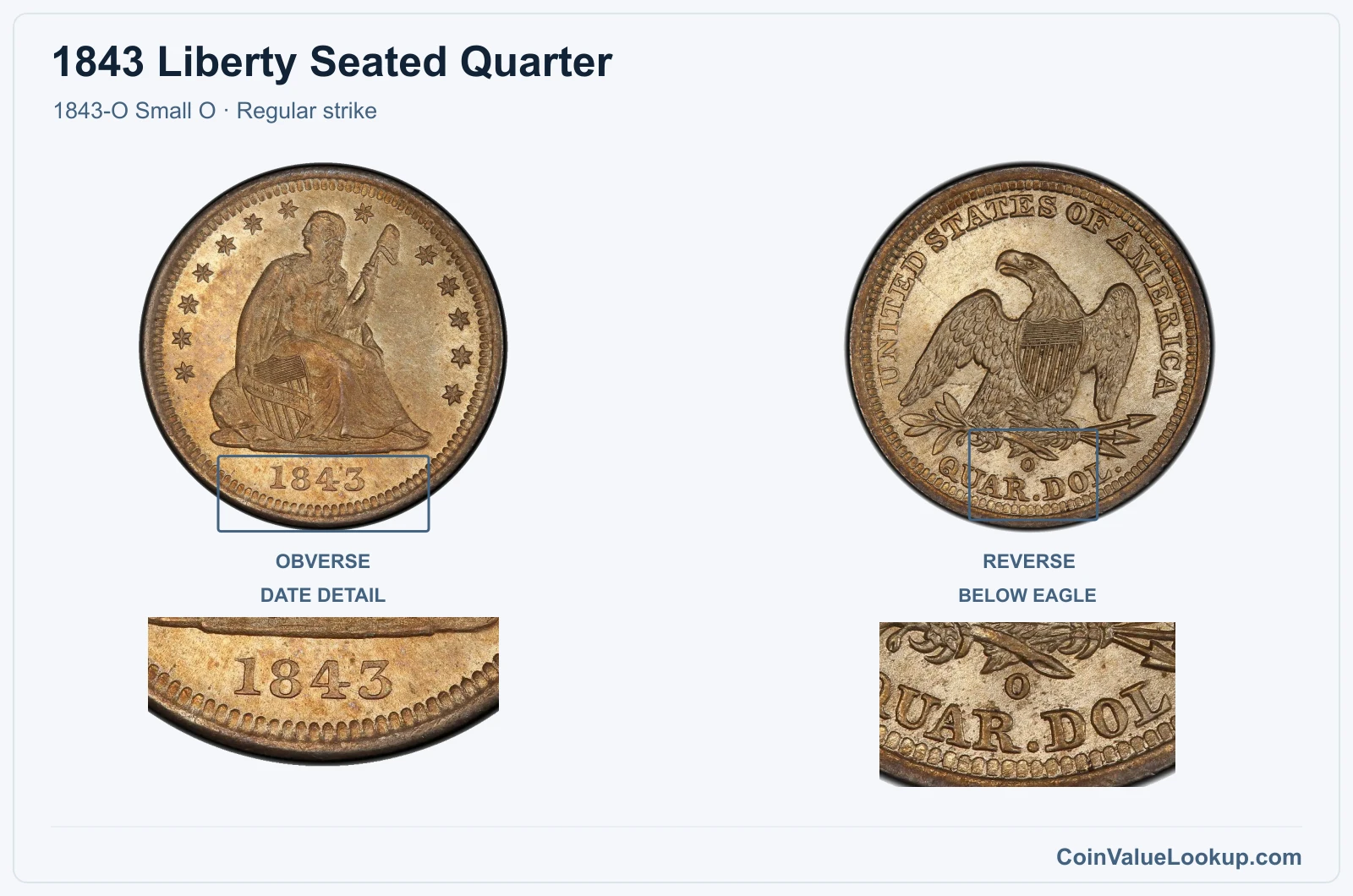
The 1843-O Small O is the more commonly seen New Orleans variety. Look for a relatively small "O" mintmark positioned below the eagle on the reverse.
The general O-mint guide figures from USA Coin Book run about $70 in G4, approximately $507 in VF20, and around $7,340 in MS63.
That MS63 figure reflects how few New Orleans quarters survived in upper grades. No independent premium for the Small O versus Large O mintmark size is confirmed in the adopted guide, so treat these numbers as estimates for the O-mint issue overall.
Actual sale prices depend on surfaces, eye appeal, and strike quality.
Range Grade
Price Auction Records Appraisal PO PO 1
Coin Identifier FR FR 2
—
Coin Identifier AG AG 3
—
Coin Identifier G G 4
—
Coin Identifier
G 6
—
Coin Identifier VG VG 8
—
Coin Identifier
VG 10
Coin Identifier F F 12
Coin Identifier
F 15
Coin Identifier VF VF 20
Coin Identifier
VF 25
Coin Identifier
VF 30
Coin Identifier
VF 35
Coin Identifier XF XF 40
Coin Identifier
XF 45
Coin Identifier AU AU 50
Coin Identifier
AU 53
Coin Identifier
AU 55
Coin Identifier
AU 58
Coin Identifier MS MS 60
—
Coin Identifier
MS 61
Coin Identifier
MS 62
Coin Identifier
MS 63
Coin Identifier
MS 64
Coin Identifier
MS 65
Coin Identifier
MS 66
—
—
—
MS 67
—
—
—
MS 68
—
—
—
MS 69
—
—
—
MS 70
—
—
—
1843 Liberty Seated Quarter — O Large O
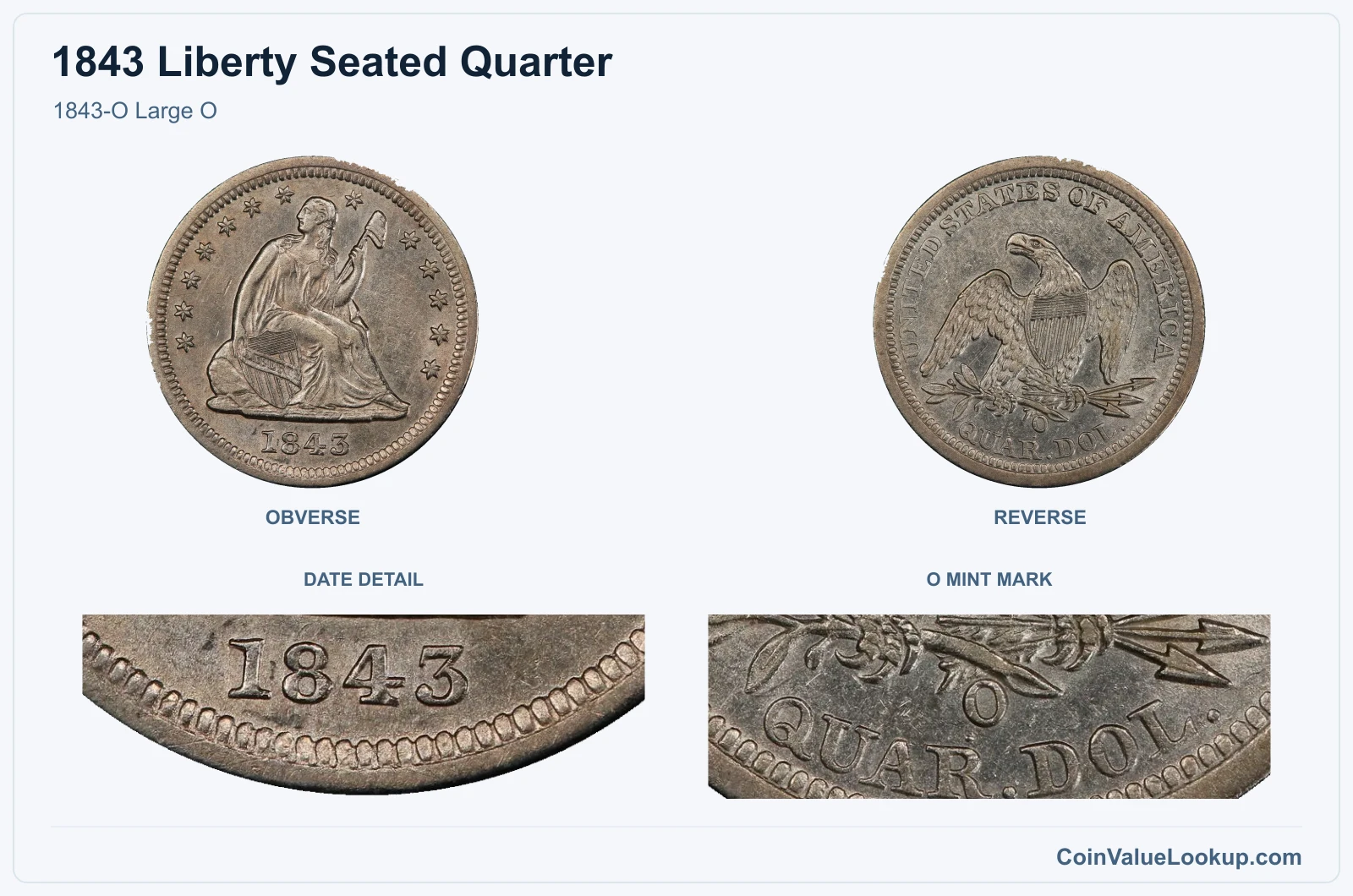
The Large O variety uses a noticeably bigger mintmark punch than the standard 1843-O. Side-by-side comparison is really the only reliable way to tell them apart.
Some Large O reverses also show raised lumps from die rust, which can help confirm the attribution once you know what to look for.
This variety is scarce. No standard numeric price range is adopted, so each coin is assessed individually based on its authenticated identity, condition, and overall eye appeal.
The reverse die from this Large O variety was reportedly reused in 1844, which gives die-variety specialists additional context for tracking these pieces. If you suspect yours is the Large O, reference images and possibly professional attribution are worthwhile steps.
Range Grade
Price Auction Records Appraisal PO PO 1
Coin Identifier FR FR 2
—
Coin Identifier AG AG 3
—
Coin Identifier G G 4
—
Coin Identifier
G 6
—
Coin Identifier VG VG 8
—
Coin Identifier
VG 10
Coin Identifier F F 12
Coin Identifier
F 15
Coin Identifier VF VF 20
Coin Identifier
VF 25
Coin Identifier
VF 30
Coin Identifier
VF 35
Coin Identifier XF XF 40
Coin Identifier
XF 45
Coin Identifier AU AU 50
Coin Identifier
AU 53
Coin Identifier
AU 55
Coin Identifier
AU 58
Coin Identifier MS MS 60
—
Coin Identifier
MS 61
Coin Identifier
MS 62
Coin Identifier
MS 63
Coin Identifier
MS 64
Coin Identifier
MS 65
Coin Identifier
MS 66
—
—
—
MS 67
—
—
—
MS 68
—
—
—
MS 69
—
—
—
MS 70
—
—
—
1843 Liberty Seated Quarter Error List
1. 1843 Liberty Seated Quarter — Shattered Reverse Die
The Shattered Reverse Die variety appears on 1843 Philadelphia business strikes. The diagnostic is a network of multiple strong die cracks that divide the reverse into pie-like sections.
These cracks are raised lines on the coin's surface, created as the die broke apart during use.
Compare your coin against the specific illustrated crack pattern from specialist references. The network is distinctive and covers a wide area of the reverse.
Do not confuse it with cracks in the planchet itself or deliberate post-mint cuts and scratches. Physical planchet cracks tend to be depressed, while die cracks are raised above the field.
No standard numeric price range is adopted for this variety. Value depends on the coin's overall condition, the strength and completeness of the crack pattern, and authenticated identity.
2. 1843 Liberty Seated Quarter — Lightning-Bolt Reverse Die Crack
This is a separate variety from the Shattered Reverse, also found on 1843 Philadelphia business strikes. The Lightning-Bolt Reverse Die Crack shows a single jagged raised crack path across the reverse, distinct from the broader web of the shattered die.
Think of it as one dramatic bolt rather than a spiderweb.
The crack should be raised above the coin's surface, following a specific path documented in specialist references. A scratched line that merely looks like a lightning bolt is not the same thing.
Scratches are incused into the surface and lack the consistent raised profile of a genuine die crack.
No standard numeric price range is adopted here. Each example is valued individually based on condition, crack visibility, and authenticated attribution.
This variety is described as more available than the shattered reverse.
3. 1843 Liberty Seated Quarter — Off-Center Strike
An off-center strike occurs when the planchet is not properly seated between the dies at the moment of striking. The result is a displaced design with an unstruck crescent along one edge.
On an 1843 quarter, the key is whether the date remains visible, since that is what confirms the year and preserves collector interest.
Do not confuse an off-center strike with a clipped planchet, which has a curved bite taken out before striking, or with post-mint flattening from damage. A one-sided die misalignment can also mimic a mild off-center look but typically shows the full design on at least one side.
No specific price range is adopted for this error. Value depends on the percentage of off-center displacement, date visibility, and the coin's overall condition.
Professional assessment is recommended for any significant example.