1851 Liberty Seated Quarter Coin Value: How Much Is It Worth?
An 1851 Liberty Seated quarter is a pre-Civil War silver coin that commands attention from collectors. Guide estimates for Philadelphia strikes start around $132 in G4 and climb to roughly $2,839 at MS63, while the scarce New Orleans issue ranges from about $536 in G4 to an eye-opening $39,368 at MS63.
A separate Philadelphia proof is documented in a museum collection, but no standard retail price applies to it. Mint, condition, and originality drive everything here.
Fast Way to Identify Your 1851 Liberty Seated Quarter
Snap a clear photo of both sides of your coin and upload them for a preliminary identification. The identifier can help you figure out whether you have a Philadelphia or New Orleans strike based on the mintmark location on the reverse.
It will not authenticate, grade, or guarantee a price, but it gives you a useful starting point before seeking professional evaluation.
1851 Liberty Seated Quarter Value
Upload both sides of your 1851 Liberty Seated Quarter.
Front Obverse
Upload photo
Back Reverse
Upload photo
Which 1851 Liberty Seated Quarter Versions Are Worth Money?
- The 1851-O (New Orleans) is the scarce mint for this date, with guide estimates reaching about $39,368 at MS63 versus $2,839 for the Philadelphia strike at the same grade.
- Philadelphia business strikes in original, uncleaned condition above VF20 (guided near $507) are collectible and worth professional grading.
- An 1851 Philadelphia proof is documented in the ANS museum collection; no standard retail price is established, and any claimed proof requires expert authentication.
Step 1: Identify Your 1851 Liberty Seated Quarter Mint Mark and Version
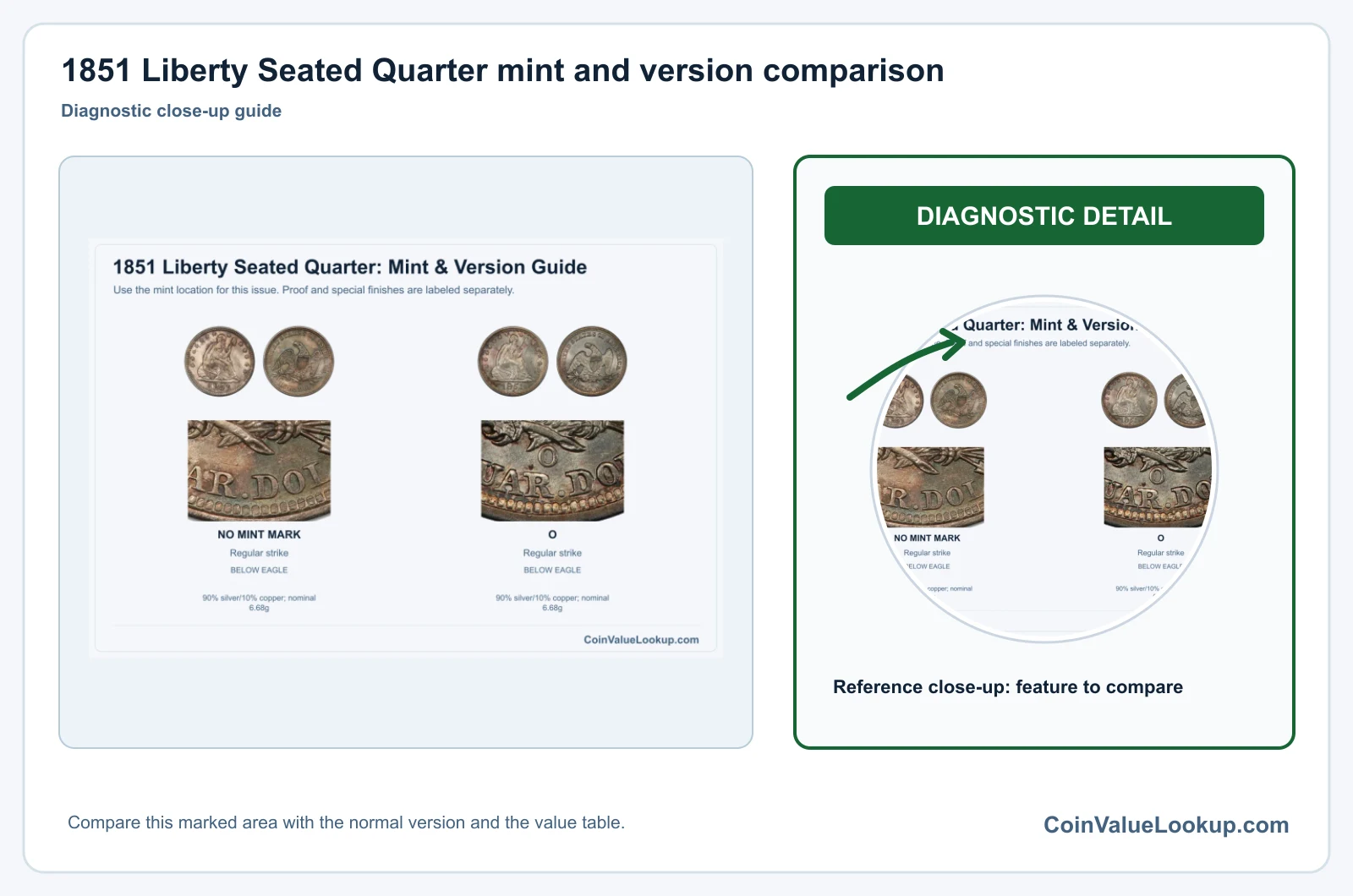
Look at the reverse, below the eagle. No mintmark means Philadelphia.
A small "O" means New Orleans. San Francisco did not strike quarters until 1855, so an S mintmark on an 1851 date would be a red flag.
All regular 1851 quarters are 90% silver and 10% copper, about 24.3 mm across and nominally 6.68 grams. This is the heavier pre-1853 standard, before Congress reduced the weight.
If your coin weighs noticeably less, you may have a later date or a problem coin.
The design is the classic Seated Liberty obverse with thirteen stars and no arrows beside the date. The reverse shows an eagle without the IN GOD WE TRUST motto scroll.
Both Philadelphia and New Orleans used this same layout in 1851. A proof striking from Philadelphia is documented in the American Numismatic Society collection, but that is a museum specimen, not something you will stumble across in a junk silver bin.
Step 2: Check Your 1851 Liberty Seated Quarter Grade
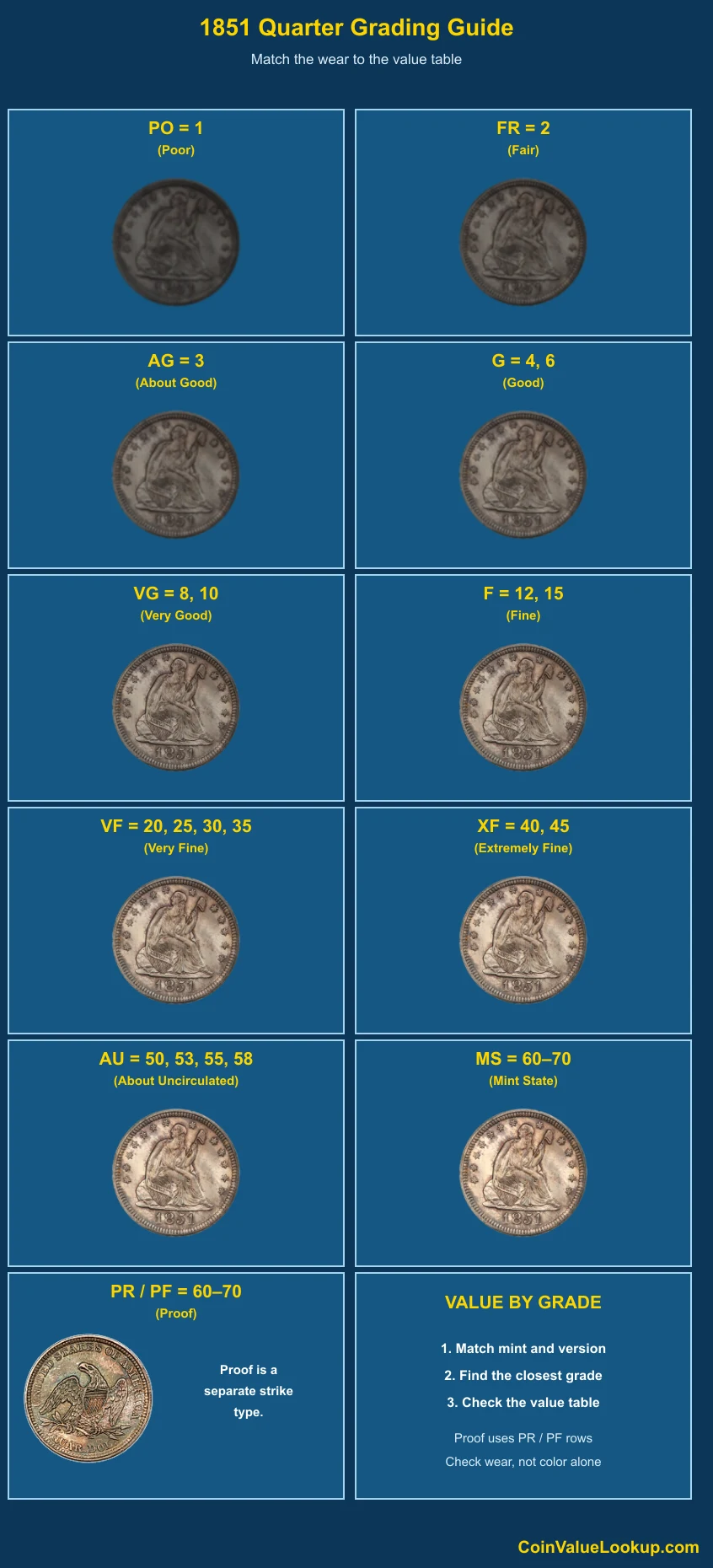
Start with Liberty herself. On a well-worn coin, her head blends into the cap, the breast flattens, and the knee disappears into the drapery folds.
Check the shield on her lap, too; the horizontal lines vanish before the vertical ones as the coin circulates.
Flip it over. The eagle's breast feathers go first, then the wing detail softens, and eventually the claws lose definition.
Compare your coin to the reference image for a side-by-side reality check.
Weak strikes exist on this series. A mushy star or soft head does not automatically mean heavy wear.
Look at the overall luster and surface flow before downgrading.
Hairlines from old cleaning, rim dings, and corrosion all reduce value regardless of how much detail remains. Bright, shiny surfaces on an old silver coin are usually a warning sign, not a bonus.
Proof or special-strike attribution requires comparison to a genuine specimen, not just a reflective surface.
Step 3: Check 1851 Liberty Seated Quarter Value by Mint and Version
1851 Liberty Seated Quarter — Business Strike
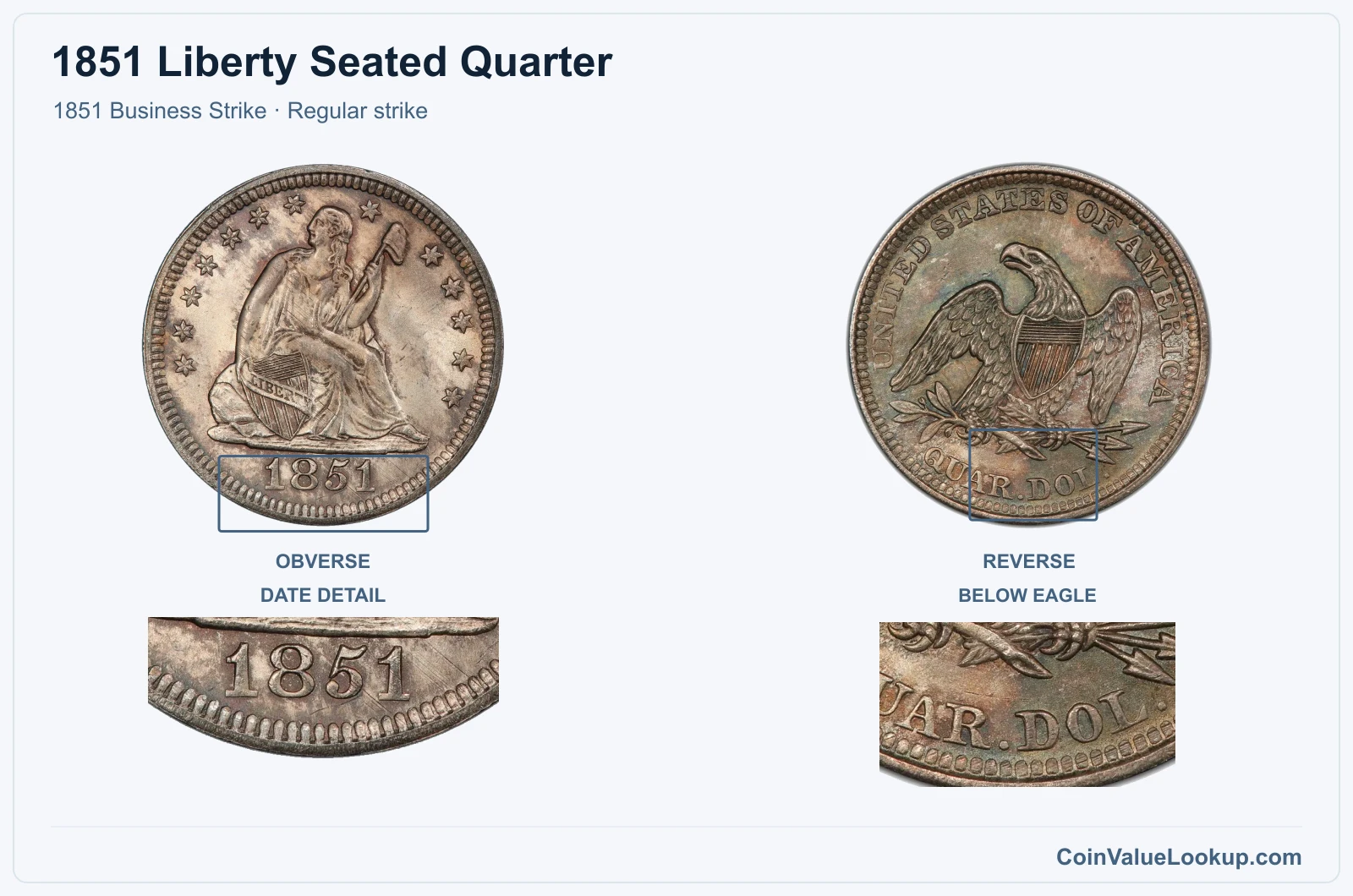
The 1851 Philadelphia business strike carries no mintmark. In G4, a well-worn but honest example guides around $132.
Move up to VF20, where the seated figure still shows clear drapery folds and shield lines, and the estimate jumps to roughly $507. At MS63, which means full luster with only minor contact marks, the guide reaches about $2,839.
This is the more available of the two mints for 1851, but "available" is relative for a coin over 170 years old. Original surfaces without cleaning or tooling are what matter.
A dipped or polished coin at VF detail will trade for less than a crusty, toned one at the same technical grade.
| Range | Grade | Price | Auction Records | Appraisal |
|---|---|---|---|---|
| PO | PO 1 | — | Coin Identifier | |
| FR | FR 2 | — | Coin Identifier | |
| AG | AG 3 | — | Coin Identifier | |
| G | G 4 | — | Coin Identifier | |
| G 6 | — | Coin Identifier | ||
| VG | VG 8 | — | Coin Identifier | |
| VG 10 | Coin Identifier | |||
| F | F 12 | — | Coin Identifier | |
| F 15 | Coin Identifier | |||
| VF | VF 20 | Coin Identifier | ||
| VF 25 | Coin Identifier | |||
| VF 30 | Coin Identifier | |||
| VF 35 | Coin Identifier | |||
| XF | XF 40 | Coin Identifier | ||
| XF 45 | Coin Identifier | |||
| AU | AU 50 | Coin Identifier | ||
| AU 53 | Coin Identifier | |||
| AU 55 | Coin Identifier | |||
| AU 58 | Coin Identifier | |||
| MS | MS 60 | — | Coin Identifier | |
| MS 61 | Coin Identifier | |||
| MS 62 | Coin Identifier | |||
| MS 63 | Coin Identifier | |||
| MS 64 | Coin Identifier | |||
| MS 65 | Coin Identifier | |||
| MS 66 | — | Coin Identifier | ||
| MS 67 | Coin Identifier | |||
| MS 68 | — | — | — | |
| MS 69 | — | — | — | |
| MS 70 | — | — | — |
1851 Liberty Seated Quarter — O Business Strike
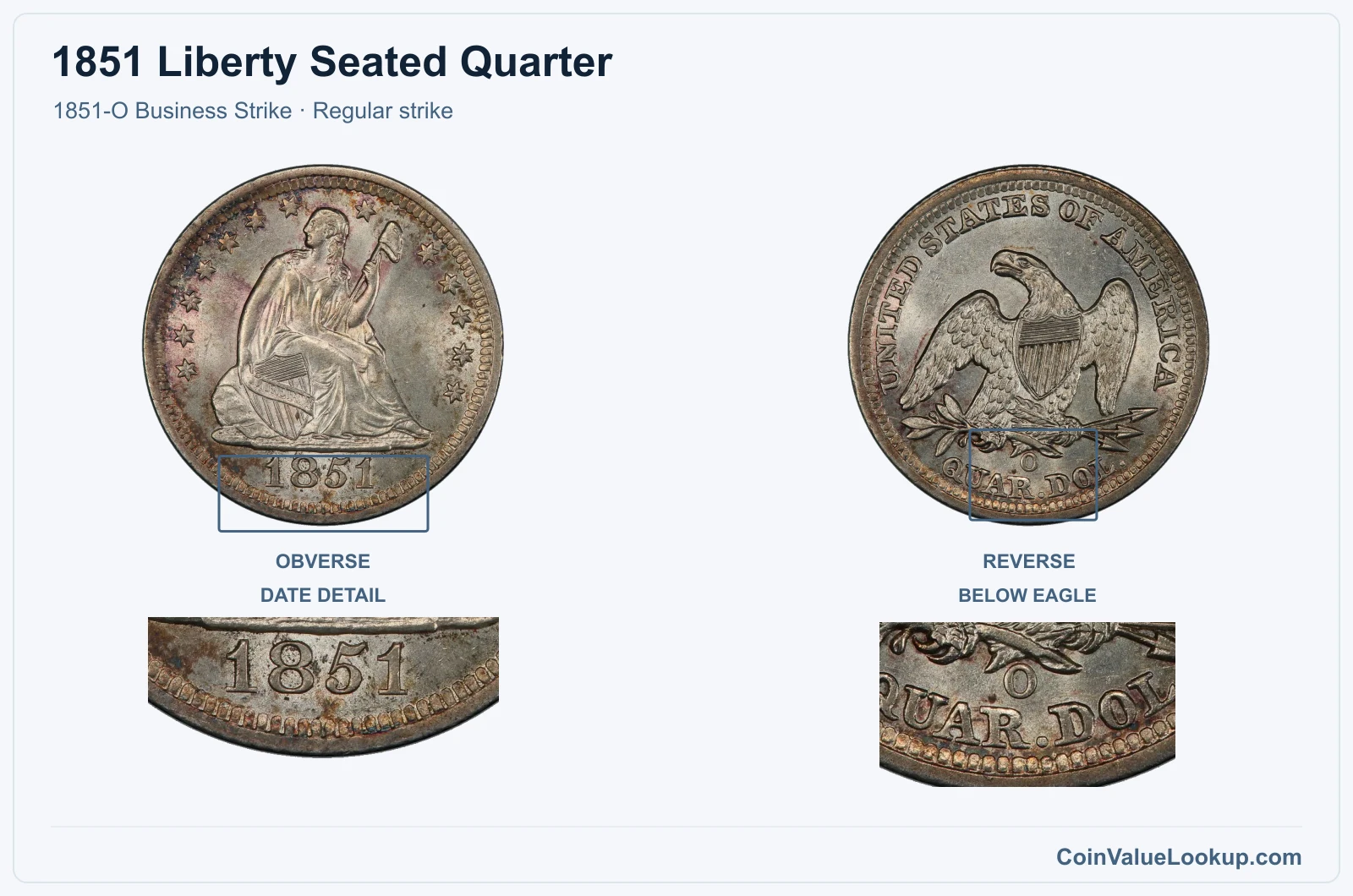
The 1851-O carries a small "O" mintmark on the reverse beneath the eagle. New Orleans production of quarters in this era was limited, and the market reflects that scarcity.
Guide estimates start around $536 in G4 and rise to about $1,454 at VF20. The MS63 figure is approximately $39,368, which tells you how rarely these survive in uncirculated condition.
That gap between VF and MS is enormous because almost none were saved.
Coin Value Lookup is a helpful starting point if you want to compare this date with other years in the Liberty Seated quarter series. You can look up guides across denominations and dates in one place.
Authentication matters here. Given the price spread, a genuine 1851-O in high grade deserves professional certification.
Altered mintmarks from common Philadelphia coins do exist, so confirm the O is original to the die, not added later.
| Range | Grade | Price | Auction Records | Appraisal |
|---|---|---|---|---|
| PO | PO 1 | Coin Identifier | ||
| FR | FR 2 | — | Coin Identifier | |
| AG | AG 3 | Coin Identifier | ||
| G | G 4 | Coin Identifier | ||
| G 6 | Coin Identifier | |||
| VG | VG 8 | Coin Identifier | ||
| VG 10 | Coin Identifier | |||
| F | F 12 | Coin Identifier | ||
| F 15 | — | Coin Identifier | ||
| VF | VF 20 | Coin Identifier | ||
| VF 25 | Coin Identifier | |||
| VF 30 | Coin Identifier | |||
| VF 35 | Coin Identifier | |||
| XF | XF 40 | Coin Identifier | ||
| XF 45 | — | Coin Identifier | ||
| AU | AU 50 | Coin Identifier | ||
| AU 53 | — | Coin Identifier | ||
| AU 55 | Coin Identifier | |||
| AU 58 | Coin Identifier | |||
| MS | MS 60 | Coin Identifier | ||
| MS 61 | Coin Identifier | |||
| MS 62 | Coin Identifier | |||
| MS 63 | Coin Identifier | |||
| MS 64 | — | Coin Identifier | ||
| MS 65 | — | — | — | |
| MS 66 | — | — | — | |
| MS 67 | — | — | — | |
| MS 68 | — | — | — | |
| MS 69 | — | — | — | |
| MS 70 | — | — | — |
1851 Liberty Seated Quarter — Philadelphia Proof — ANS Specimen
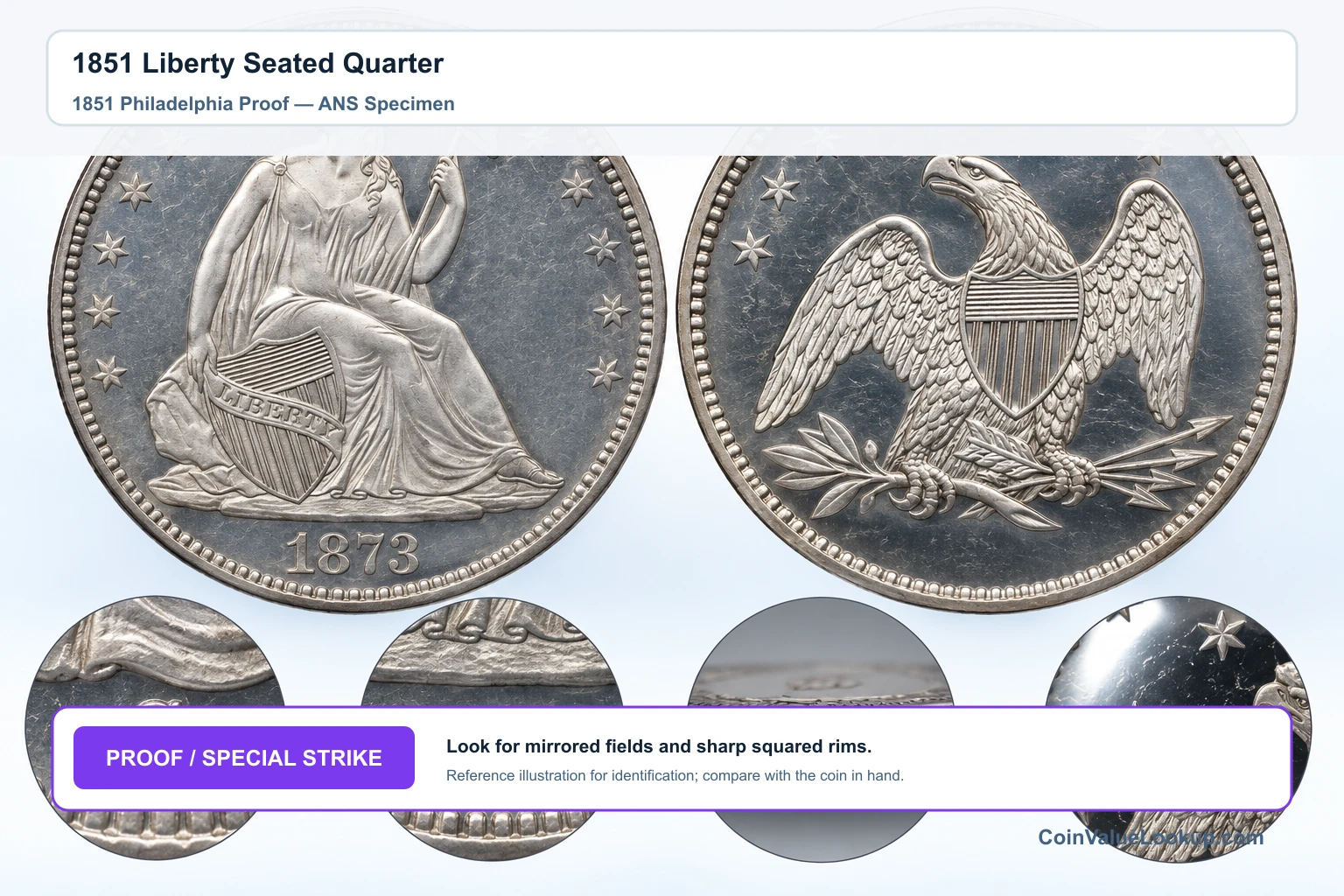
The American Numismatic Society holds an 1851 Philadelphia proof quarter cataloged as ANS 2011.43.2, described as a proof with the Briggs 1:A die pairing. This is a museum specimen, and no standard retail market price has been established for it.
If someone offers you an 1851 proof quarter, be cautious. Proof attribution for coins of this era requires expert comparison to confirmed specimens.
A reflective surface or a prooflike business strike is not the same thing as a true proof. Any coin claimed as an 1851 proof needs authentication by a major grading service with experience in early Seated Liberty proofs.
Without that, you are guessing, and guessing at this level gets expensive fast.
1851 Liberty Seated Quarter Proof — ANS Specimen Value by Grade
Reliable grade-by-grade prices are not currently available. The current price feed has no usable Proof table, and this museum specimen does not have a normal retail grade-price series. Its institutional record and provenance should be considered separately from ordinary coins.