1856 Liberty Seated Quarter Coin Value: How Much Is It Worth?
Guide estimates for 1856 Liberty Seated quarters range from about $43 in G4 for the Philadelphia issue up to $16,588 at the MS63 level for the scarce San Francisco mint. Your coin's value depends heavily on which mint produced it, its condition, and whether it carries a recognized variety such as the Large S over Small S repunched mintmark.
Original, undamaged surfaces are essential for strong prices.
Fast Way to Identify Your 1856 Liberty Seated Quarter
The quickest way to start figuring out what you have is to upload clear photos of both sides of your coin. A front and back image lets us offer a preliminary identification of the mint, design type, and general condition.
Snap the photos in even lighting, and avoid glare on the surfaces so details come through.
1856 Liberty Seated Quarter Value
Upload both sides of your 1856 Liberty Seated Quarter.
Front Obverse
Upload photo
Back Reverse
Upload photo
Which 1856 Liberty Seated Quarter Versions Are Worth Money?
- The 1856-S carries the highest guide estimates of any regular business strike this year, reaching $16,588 at MS63, because San Francisco mintages were small in the series' early western years.
- The 1856-S Large S over Small S repunched mintmark variety is separately collected, with guide estimates of $621 in G4 and $3,093 in VF20, well above a normal 1856-S.
- Philadelphia proofs from 1856 are rare early proof issues; the guide estimate is $5,630 at PR63.
- Higher-grade 1856-O quarters carry strong premiums over Philadelphia pieces, with MS63 estimated at $3,093 versus $799 for the Philadelphia business strike.
- Misplaced date digits have been documented on certain 1856 Philadelphia dies; authenticated examples require individual assessment for value.
Step 1: Identify Your 1856 Liberty Seated Quarter Mint Mark and Version
Every 1856 Seated Liberty quarter shares the same basic design: Liberty seated on the obverse, an eagle without motto on the reverse. No arrows flank the date this year, but the coin still uses the lighter 6.22-gram standard adopted in 1853.
All regular issues are struck in 90% silver and 10% copper, measuring about 24.3 mm across.
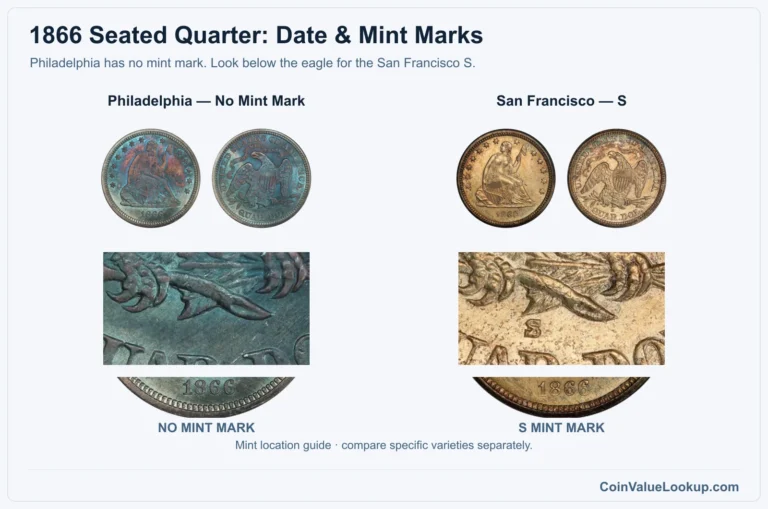
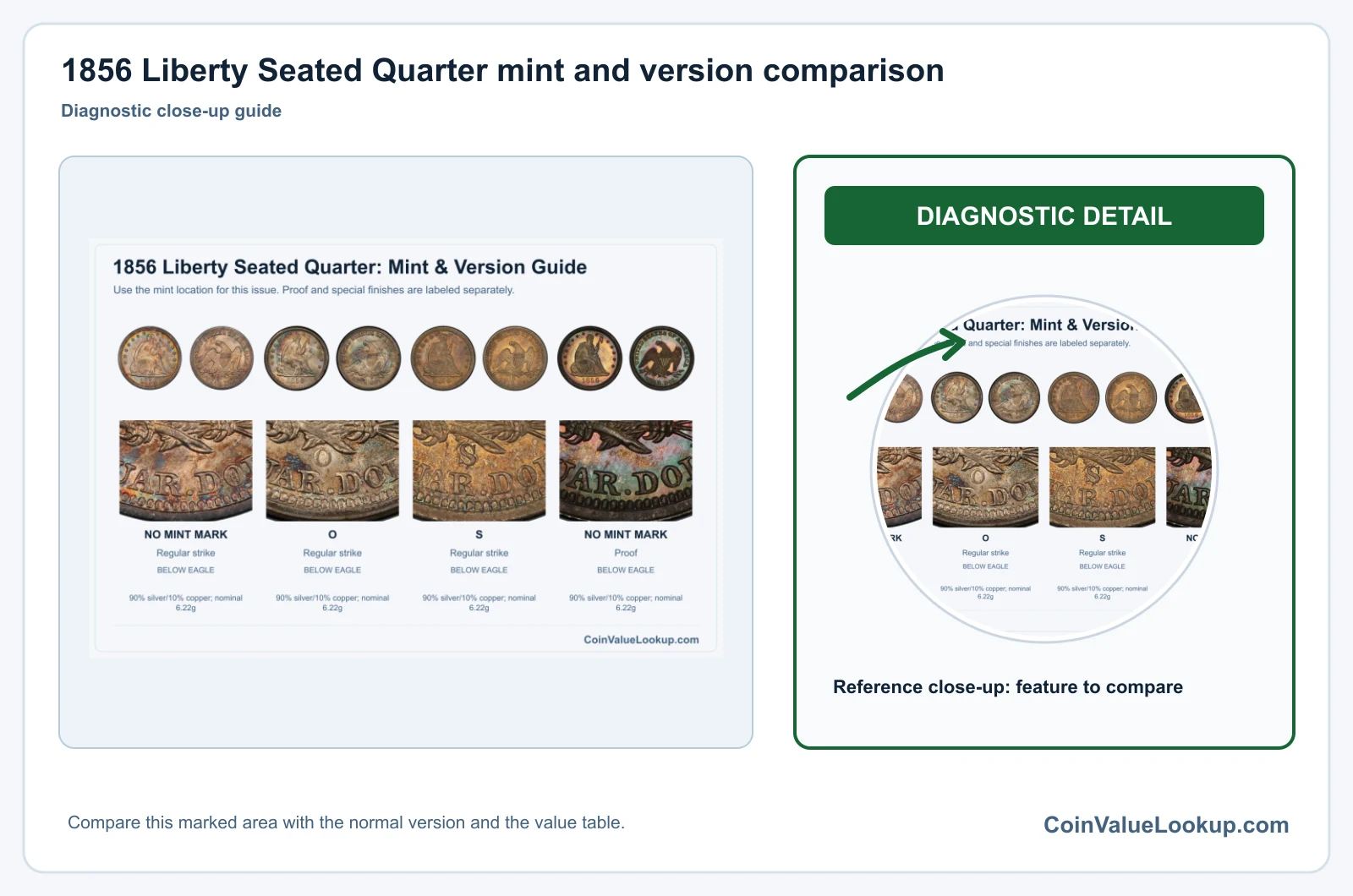
The mintmark sits on the reverse, below the eagle. No mintmark means Philadelphia.
An "O" means New Orleans, and an "S" means San Francisco. Get a loupe and check carefully, because a worn or filled mintmark can look absent.
San Francisco coins deserve extra scrutiny. Some 1856-S quarters show a smaller "S" mintmark underneath the larger final "S," a recognized repunched mintmark variety.
That distinction alone can multiply value several times over, so do not skip the mintmark check.
If your coin has a mirror-like finish and sharp rims, it may be a proof from Philadelphia. Proof attribution requires genuine specimen comparison, not just reflectivity.
Hairlines from cleaning can mimic a proof's surface, and some business strikes come with above-average luster that fools people.
Step 2: Check Your 1856 Liberty Seated Quarter Grade
Start with the obverse. Look at Liberty's head, the detail across her breast, the folds over her knee, and the lettering on the shield.
These are the first places to lose definition as the coin circulates.
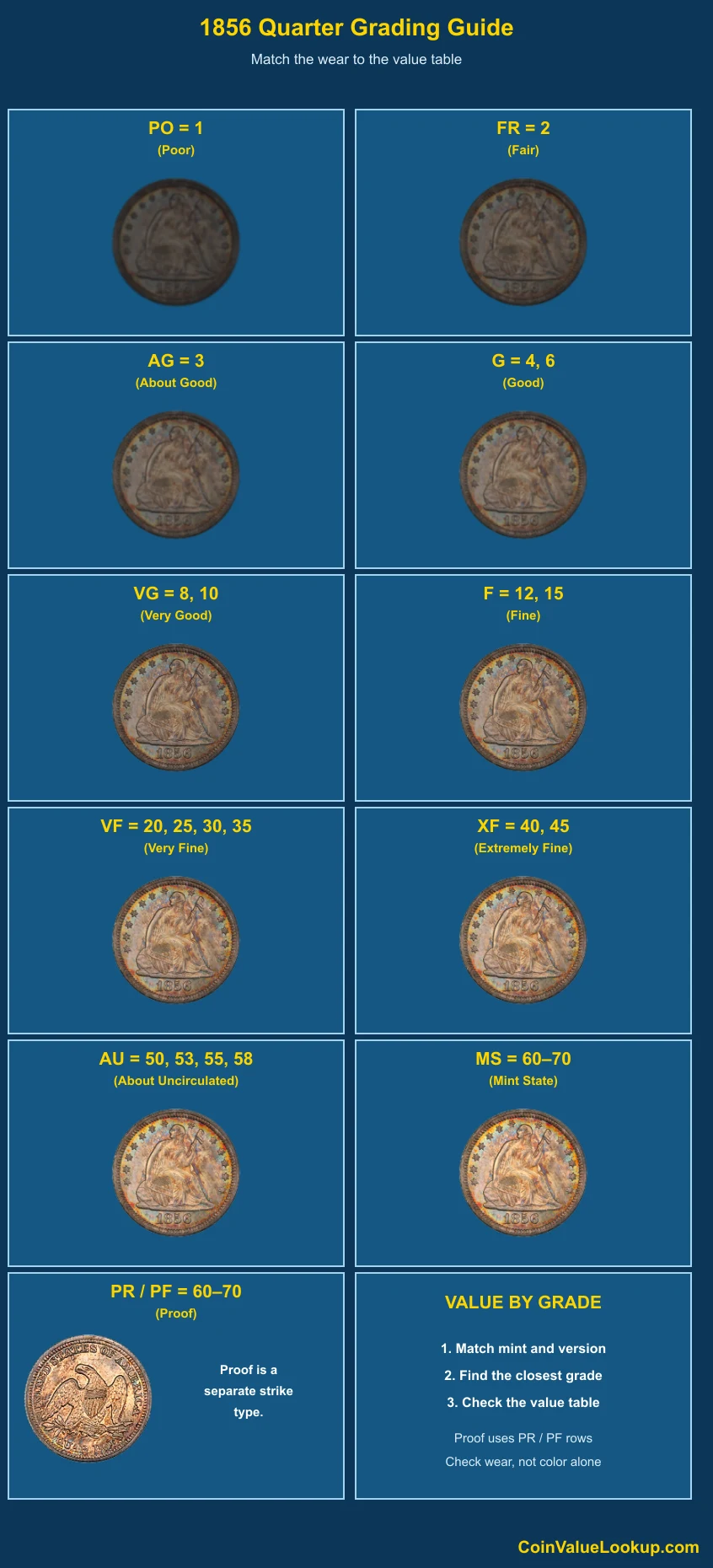
On the reverse, check the eagle's breast feathers, individual wing feathers, and the sharpness of the claws. A coin in G4 will show a smooth Liberty outline with little interior detail, while VF20 retains moderate gown and feather detail with some flatness on the highest points.
One common trap: a weakly struck area is not the same as wear. Some 1856 quarters left the press with soft stars or a mushy head, especially from the branch mints.
Compare your coin to the reference image and look for whether the surrounding fields still show original luster. Luster loss and uniformly rounded high points indicate actual circulation wear.
Hairlines from old cleaning, corrosion spots, and rim dings all reduce value, sometimes drastically. A cleaned coin that looks bright is not the same as a mint-state coin that is bright from original luster.
Step 3: Check 1856 Liberty Seated Quarter Value by Mint and Version
1856 Liberty Seated Quarter — Business Strike
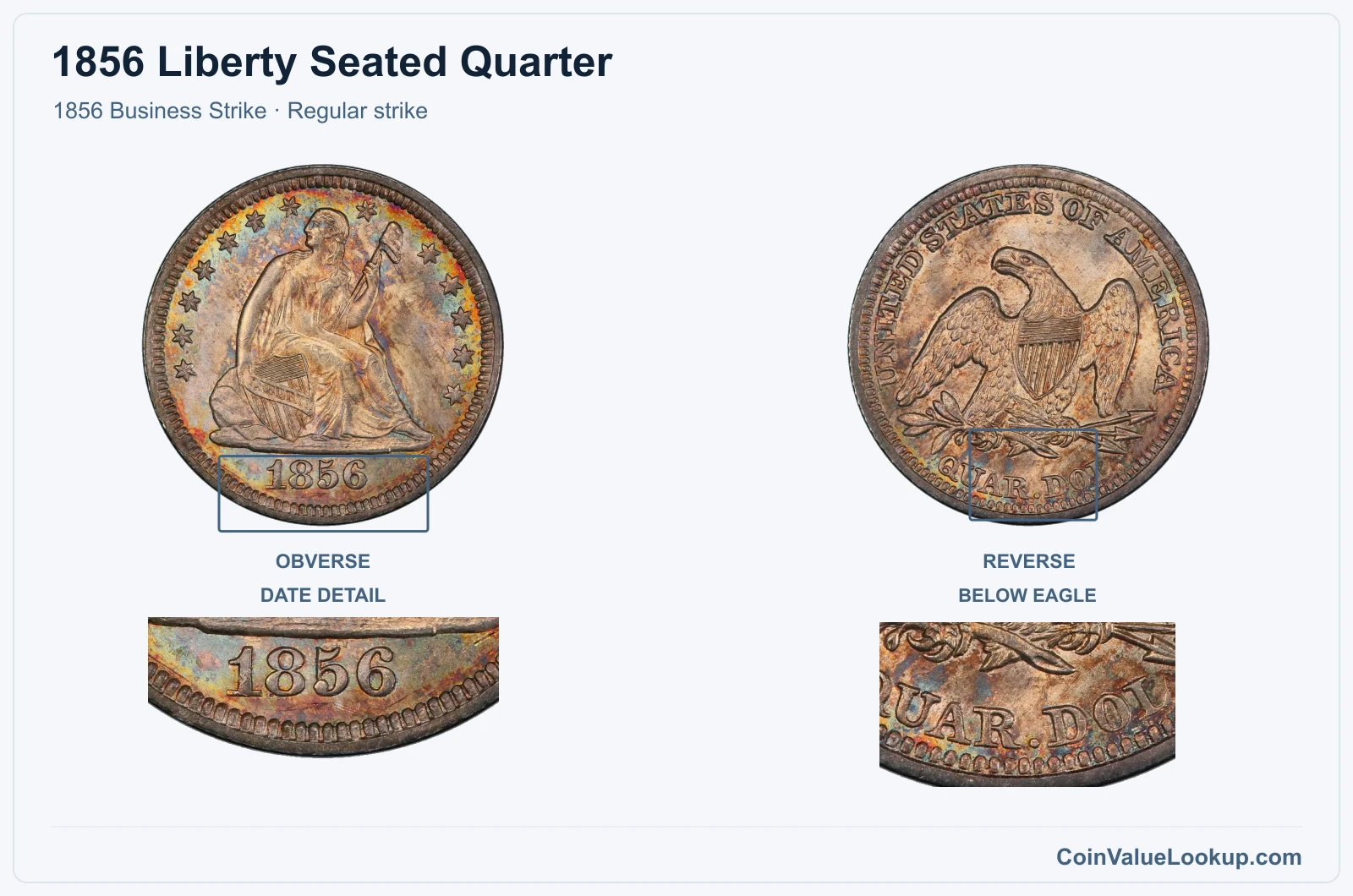
The 1856 Philadelphia business strike is the most available version this year. It carries no mintmark on the reverse.
The design shows Liberty seated without arrows beside the date, using the reduced 6.22-gram weight standard that continued after arrows were removed following 1855.
Guide estimates place this coin at about $43 in G4, $65 in VF20, and $799 at MS63. It is a 90% silver coin, so even a worn example has a meaningful silver content floor.
Original surfaces with no cleaning will always command more than a scrubbed, bright example at the same technical grade.
| Range | Grade | Price | Auction Records | Appraisal |
|---|---|---|---|---|
| PO | PO 1 | — | Coin Identifier | |
| FR | FR 2 | — | Coin Identifier | |
| AG | AG 3 | — | Coin Identifier | |
| G | G 4 | — | Coin Identifier | |
| G 6 | — | Coin Identifier | ||
| VG | VG 8 | — | Coin Identifier | |
| VG 10 | — | Coin Identifier | ||
| F | F 12 | — | Coin Identifier | |
| F 15 | — | Coin Identifier | ||
| VF | VF 20 | Coin Identifier | ||
| VF 25 | Coin Identifier | |||
| VF 30 | Coin Identifier | |||
| VF 35 | Coin Identifier | |||
| XF | XF 40 | Coin Identifier | ||
| XF 45 | Coin Identifier | |||
| AU | AU 50 | Coin Identifier | ||
| AU 53 | Coin Identifier | |||
| AU 55 | Coin Identifier | |||
| AU 58 | Coin Identifier | |||
| MS | MS 60 | — | Coin Identifier | |
| MS 61 | Coin Identifier | |||
| MS 62 | Coin Identifier | |||
| MS 63 | Coin Identifier | |||
| MS 64 | Coin Identifier | |||
| MS 65 | Coin Identifier | |||
| MS 66 | Coin Identifier | |||
| MS 67 | — | — | — | |
| MS 68 | — | — | — | |
| MS 69 | — | — | — | |
| MS 70 | — | — | — |
1856 Liberty Seated Quarter — Proof
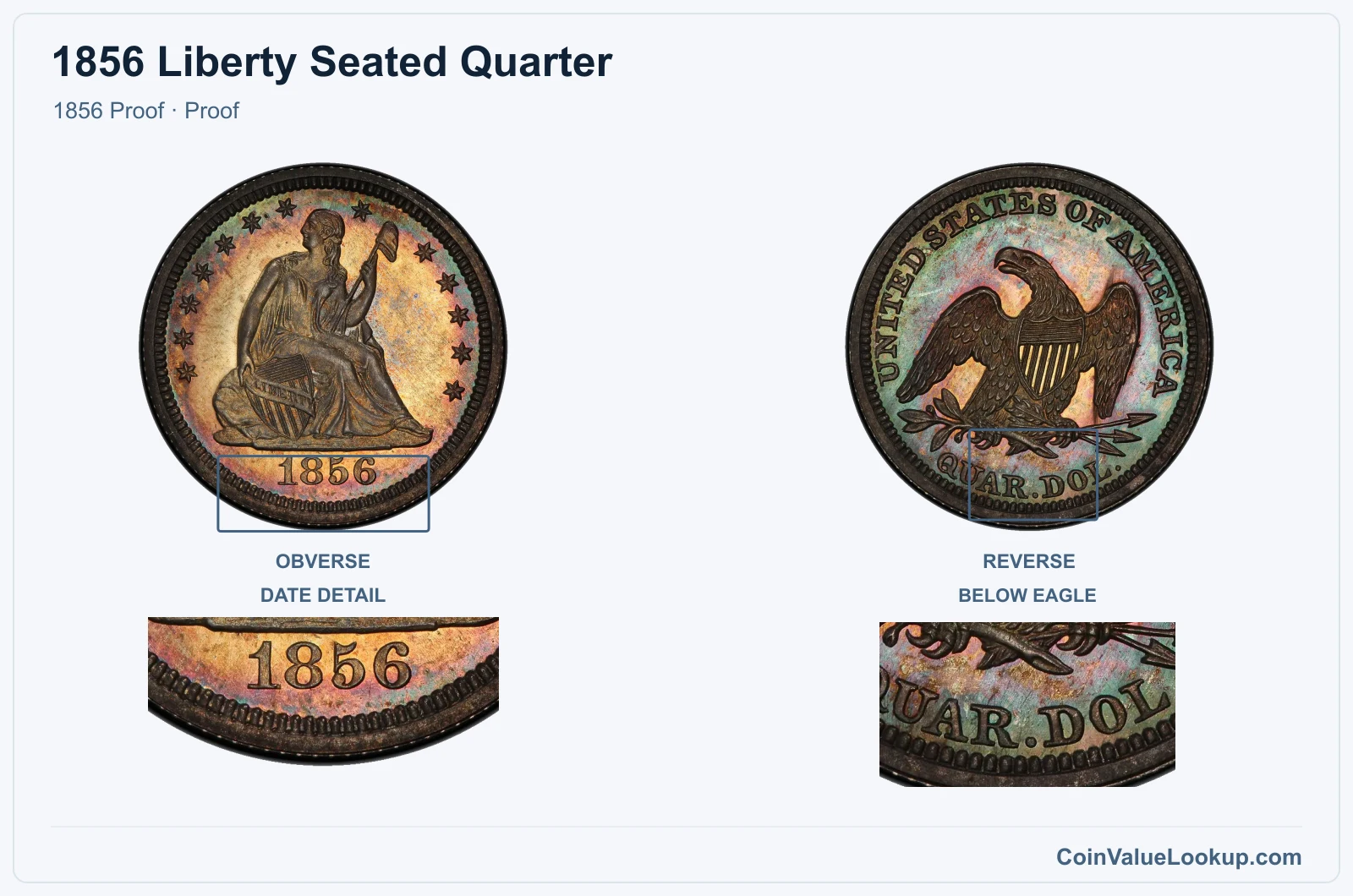
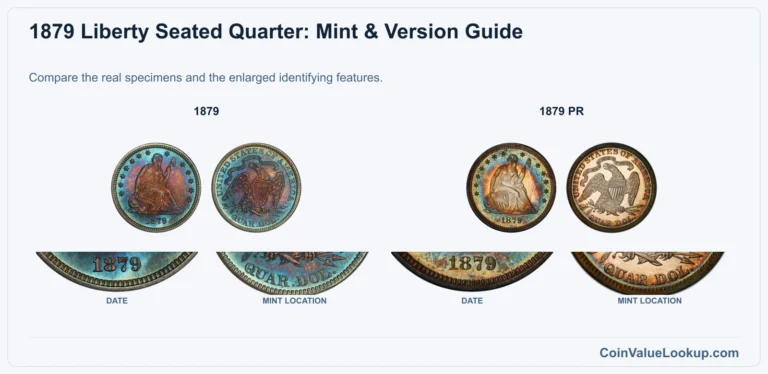
Philadelphia also produced proof quarters in 1856. These carry no mintmark, just like the business strikes, so attribution depends on the coin's surfaces, not its markings.
Genuine proofs show deeply mirrored fields and razor-sharp design details that come from specially prepared dies and planchets.
The guide estimate for a PR63 example is $5,630. That is a serious number, so you want serious confirmation before assuming you have one.
Brightness alone does not make a proof. Cleaned business strikes, coins with die polish, and lightly circulated pieces can all look reflective at first glance.
Comparison against a confirmed specimen is the right approach. If you suspect you have a proof, professional authentication is the logical next step.
| Range | Grade | Price | Auction Records | Appraisal |
|---|---|---|---|---|
| PR | PR 1 | — | Coin Identifier | |
| PR 2 | — | Coin Identifier | ||
| PR 3 | — | Coin Identifier | ||
| PR 4 | — | Coin Identifier | ||
| PR 6 | — | Coin Identifier | ||
| PR 8 | — | Coin Identifier | ||
| PR 10 | — | Coin Identifier | ||
| PR 12 | — | Coin Identifier | ||
| PR 15 | — | Coin Identifier | ||
| PR 20 | — | Coin Identifier | ||
| PR 25 | — | Coin Identifier | ||
| PR 30 | — | Coin Identifier | ||
| PR 35 | — | Coin Identifier | ||
| PR 40 | — | Coin Identifier | ||
| PR 45 | — | Coin Identifier | ||
| PR 50 | — | Coin Identifier | ||
| PR 53 | — | Coin Identifier | ||
| PR 55 | — | Coin Identifier | ||
| PR 58 | — | Coin Identifier | ||
| PR 60 | — | Coin Identifier | ||
| PR 61 | Coin Identifier | |||
| PR 62 | Coin Identifier | |||
| PR 63 | Coin Identifier | |||
| PR 64 | Coin Identifier | |||
| PR 65 | Coin Identifier | |||
| PR 66 | — | — | — | |
| PR 67 | — | — | — | |
| PR 68 | — | — | — | |
| PR 69 | — | — | — | |
| PR 70 | — | — | — |
1856 Liberty Seated Quarter — O Business Strike
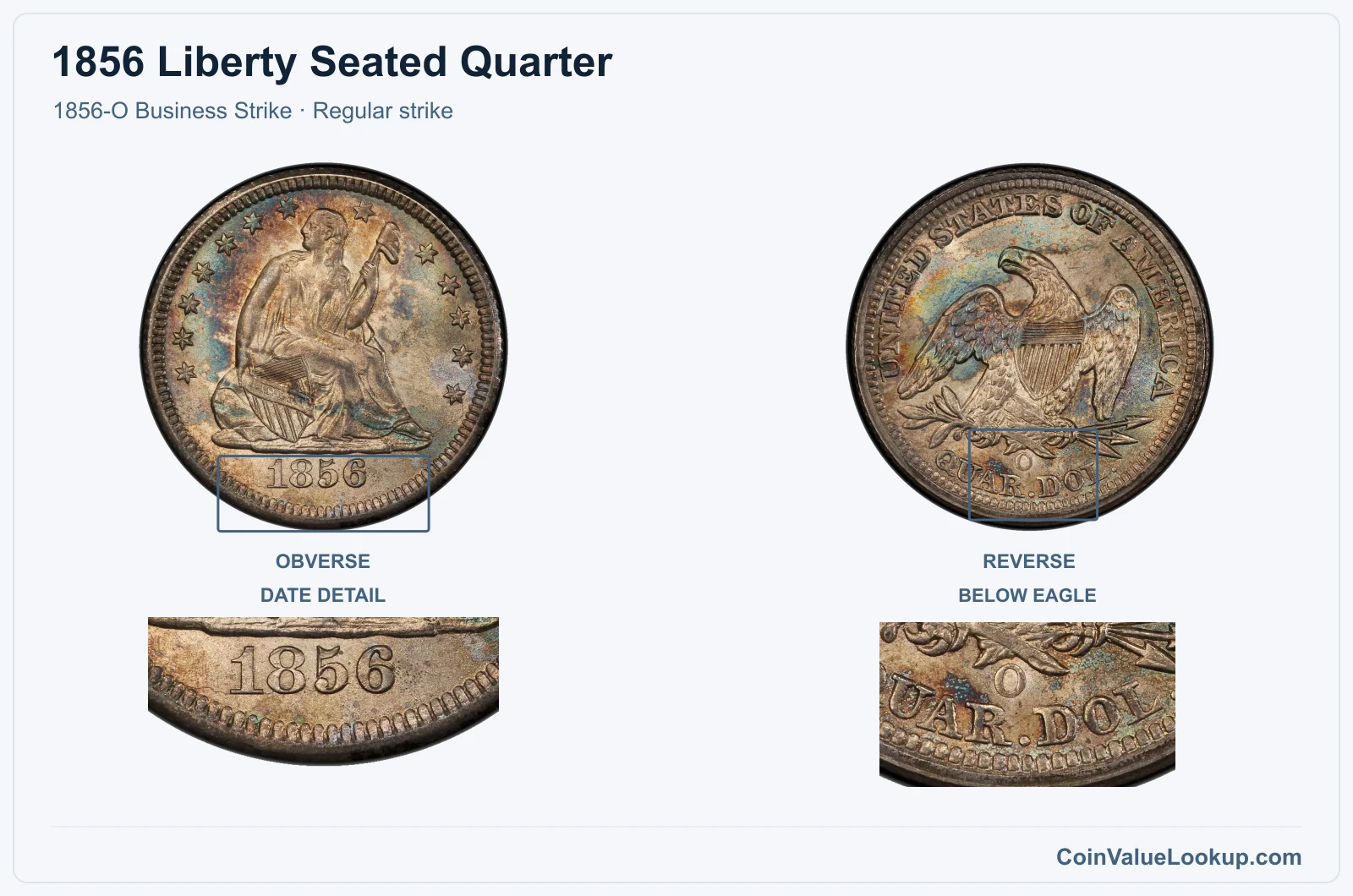
The 1856-O was struck in New Orleans, identified by a small "O" mintmark on the reverse beneath the eagle. These tend to have softer strikes than Philadelphia issues, so do not mistake weak detail for heavy wear.
Guide estimates run $65 in G4, $163 in VF20, and $3,093 at MS63. That MS63 figure is nearly four times the Philadelphia equivalent, reflecting the relative scarcity of surviving high-grade New Orleans quarters from this period.
Original toning and clean surfaces matter a lot here.
Coin Value Lookup is a good starting point if you want to compare this coin against other dates and mints in the Liberty Seated quarter series.
| Range | Grade | Price | Auction Records | Appraisal |
|---|---|---|---|---|
| PO | PO 1 | — | Coin Identifier | |
| FR | FR 2 | — | Coin Identifier | |
| AG | AG 3 | — | Coin Identifier | |
| G | G 4 | — | Coin Identifier | |
| G 6 | — | Coin Identifier | ||
| VG | VG 8 | — | Coin Identifier | |
| VG 10 | — | Coin Identifier | ||
| F | F 12 | — | Coin Identifier | |
| F 15 | Coin Identifier | |||
| VF | VF 20 | Coin Identifier | ||
| VF 25 | Coin Identifier | |||
| VF 30 | Coin Identifier | |||
| VF 35 | Coin Identifier | |||
| XF | XF 40 | Coin Identifier | ||
| XF 45 | Coin Identifier | |||
| AU | AU 50 | Coin Identifier | ||
| AU 53 | Coin Identifier | |||
| AU 55 | Coin Identifier | |||
| AU 58 | Coin Identifier | |||
| MS | MS 60 | — | Coin Identifier | |
| MS 61 | Coin Identifier | |||
| MS 62 | — | Coin Identifier | ||
| MS 63 | Coin Identifier | |||
| MS 64 | Coin Identifier | |||
| MS 65 | Coin Identifier | |||
| MS 66 | — | Coin Identifier | ||
| MS 67 | — | — | — | |
| MS 68 | — | — | — | |
| MS 69 | — | — | — | |
| MS 70 | — | — | — |
1856 Liberty Seated Quarter — S Business Strike
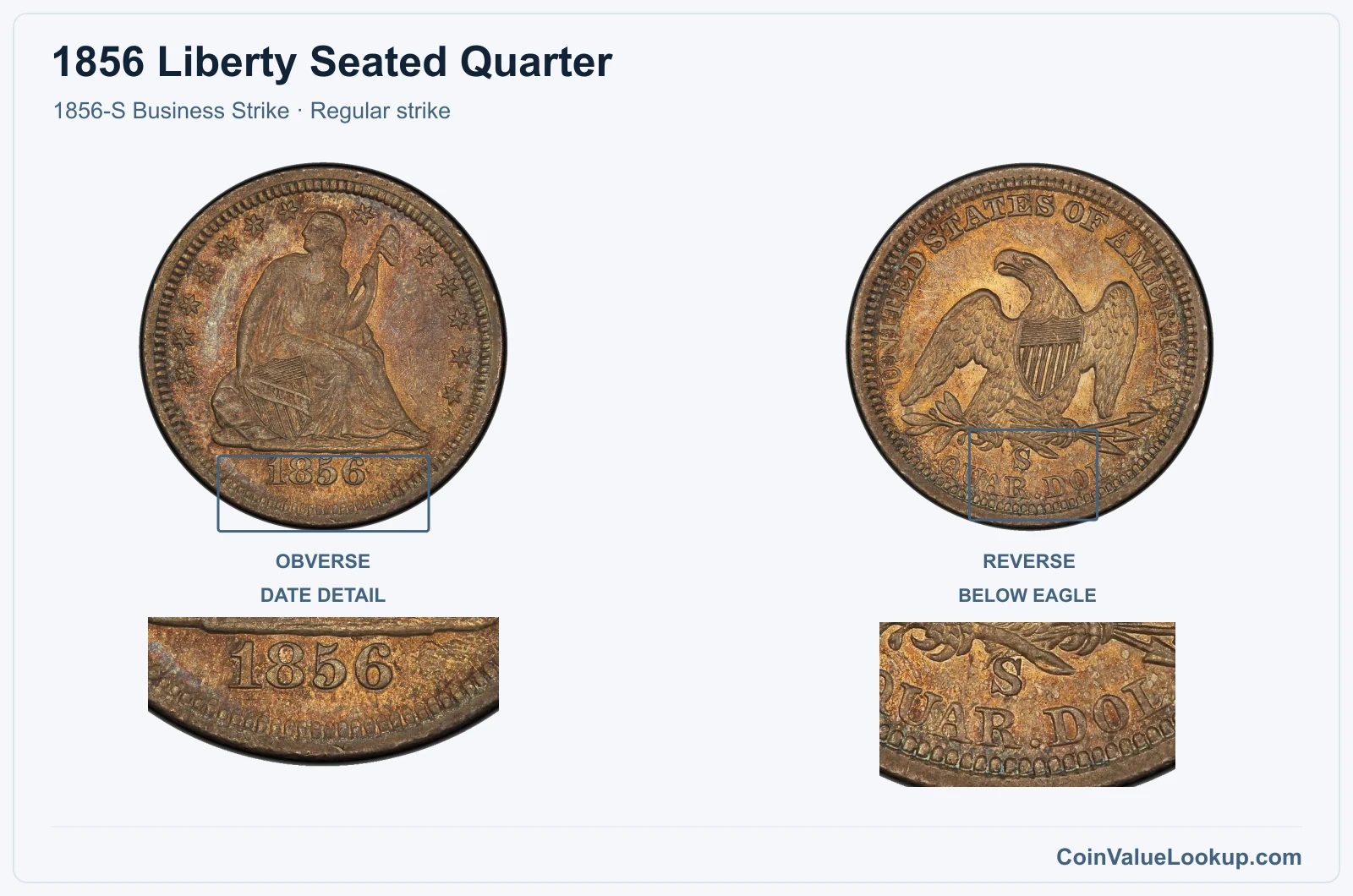
San Francisco quarters from 1856 are genuinely scarce. The "S" mintmark appears on the reverse below the eagle.
This was only the second year the San Francisco Mint struck quarters, and survival rates in higher grades are low.
Guide estimates are $415 in G4, $1,006 in VF20, and $16,588 at MS63. Even a well-worn example carries real value.
Before you celebrate, inspect the mintmark closely to determine whether you also have the Large S over Small S variety, which commands its own premium and is covered separately below. Any 1856-S in original condition deserves careful handling and professional evaluation.
| Range | Grade | Price | Auction Records | Appraisal |
|---|---|---|---|---|
| PO | PO 1 | — | Coin Identifier | |
| FR | FR 2 | — | Coin Identifier | |
| AG | AG 3 | Coin Identifier | ||
| G | G 4 | — | Coin Identifier | |
| G 6 | Coin Identifier | |||
| VG | VG 8 | Coin Identifier | ||
| VG 10 | — | Coin Identifier | ||
| F | F 12 | Coin Identifier | ||
| F 15 | Coin Identifier | |||
| VF | VF 20 | Coin Identifier | ||
| VF 25 | Coin Identifier | |||
| VF 30 | Coin Identifier | |||
| VF 35 | Coin Identifier | |||
| XF | XF 40 | Coin Identifier | ||
| XF 45 | Coin Identifier | |||
| AU | AU 50 | Coin Identifier | ||
| AU 53 | Coin Identifier | |||
| AU 55 | Coin Identifier | |||
| AU 58 | Coin Identifier | |||
| MS | MS 60 | — | Coin Identifier | |
| MS 61 | Coin Identifier | |||
| MS 62 | Coin Identifier | |||
| MS 63 | Coin Identifier | |||
| MS 64 | Coin Identifier | |||
| MS 65 | — | Coin Identifier | ||
| MS 66 | — | — | — | |
| MS 67 | — | — | — | |
| MS 68 | — | — | — | |
| MS 69 | — | — | — | |
| MS 70 | — | — | — |
1856 Liberty Seated Quarter — S Large S over Small S
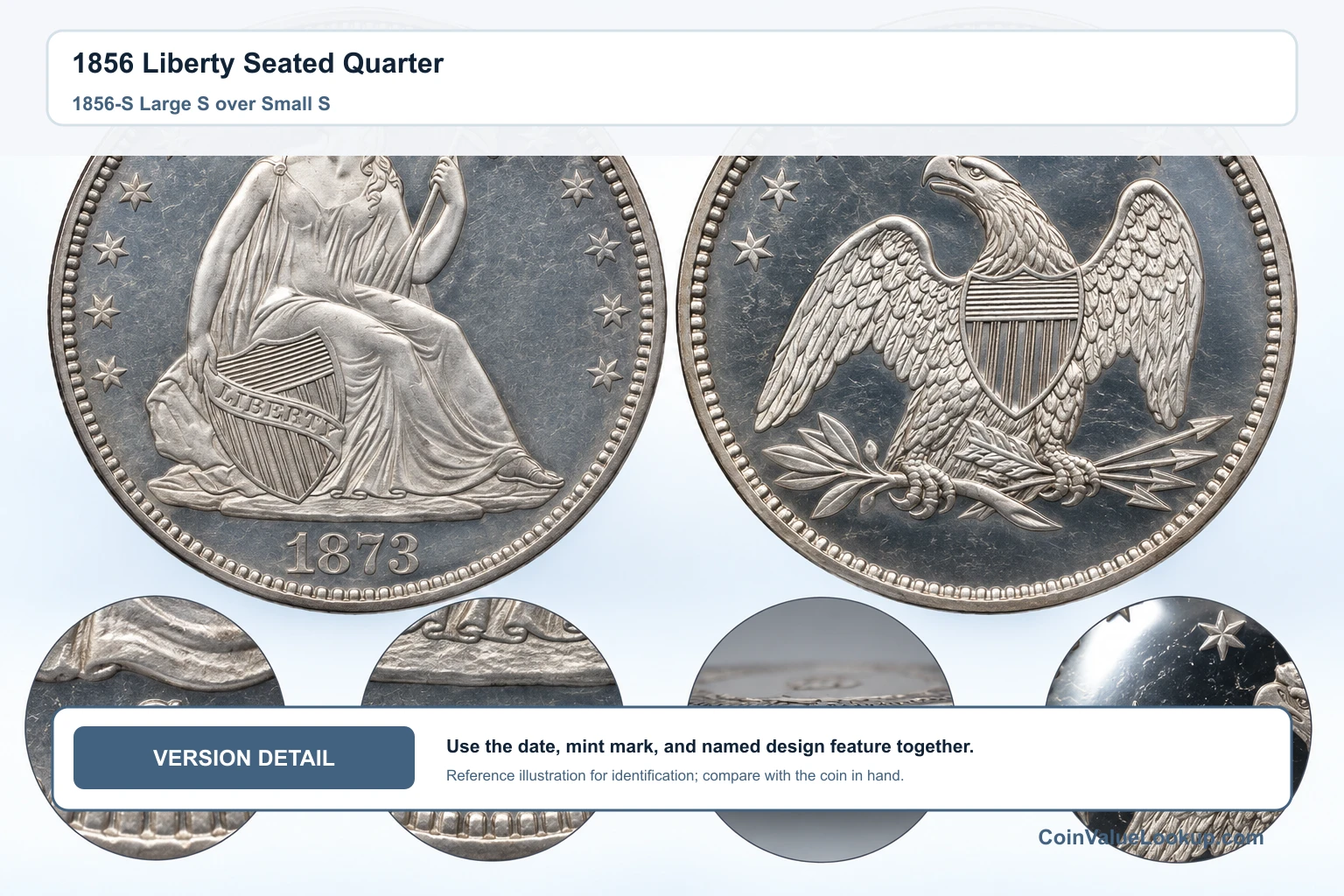
This is the recognized Large S over Small S repunched mintmark on 1856-S quarters. Under magnification, you can see the remnants of a smaller "S" tucked beneath the larger final "S" mintmark on the reverse.
The smaller letter's rounded contours are distinct from die scratches or shelf doubling.
Guide estimates for this variety are $621 in G4 and $3,093 in VF20. No MS63 figure is available.
Those numbers represent a substantial premium over the regular 1856-S, which starts at $415 in G4. The variety is separately tracked by major grading services, meaning it can be attributed on a certified holder.
Confirming the overlap of the two different-sized mintmarks under a loupe is the key diagnostic. Match what you see to a known genuine example rather than assuming any oddness around the mintmark qualifies.
Range Grade
Price Auction Records Appraisal PO PO 1
—
Coin Identifier FR FR 2
—
Coin Identifier AG AG 3
Coin Identifier G G 4
—
Coin Identifier
G 6
Coin Identifier VG VG 8
Coin Identifier
VG 10
—
Coin Identifier F F 12
Coin Identifier
F 15
Coin Identifier VF VF 20
Coin Identifier
VF 25
Coin Identifier
VF 30
Coin Identifier
VF 35
Coin Identifier XF XF 40
Coin Identifier
XF 45
Coin Identifier AU AU 50
Coin Identifier
AU 53
Coin Identifier
AU 55
Coin Identifier
AU 58
Coin Identifier MS MS 60
—
Coin Identifier
MS 61
Coin Identifier
MS 62
Coin Identifier
MS 63
Coin Identifier
MS 64
Coin Identifier
MS 65
—
Coin Identifier
MS 66
—
—
—
MS 67
—
—
—
MS 68
—
—
—
MS 69
—
—
—
MS 70
—
—
—
1856 Liberty Seated Quarter Error List
1. 1856 Liberty Seated Quarter — Misplaced Date Digits
Misplaced date digits have been documented on certain 1856 Philadelphia business-strike dies. These show portions of date numerals appearing outside their normal position, embedded in areas like the gown folds to the right of the shield, within the shield itself, or as traces in the rock below Liberty.
The key is recognizing the specific shape of a digit, such as a "1" or a "6" loop, rather than confusing normal gown lines, die scratches, or planchet marks for displaced numbers.
Not every line or fold in the design is a misplaced digit. Multiple die pairings have been identified, each with digits in different locations, so do not combine features from different dies onto one coin.
There is no adopted price range for these; value depends on the specific die, how visible the misplacement is, and the coin's overall condition. Professional attribution and individual assessment are warranted.
2. 1856 Liberty Seated Quarter — Large S over Small S
The Large S over Small S variety on 1856-S business strikes is a repunched mintmark where a smaller "S" was initially entered into the die and then corrected with a noticeably larger "S" punch. The remnant of the smaller letter sits beneath and slightly within the final mintmark, and its rounded contours are visible under moderate magnification.
Guide estimates are $621 in G4 and $3,093 in VF20. No MS63 value is available.
Look carefully at the mintmark area: flat shelf doubling from die deterioration, a worn or mushy mintmark from a tired die, and foreign material stuck in the recesses can all mimic a repunched mintmark to the untrained eye. The diagnostic difference is the clearly smaller size and distinct shape of the underlying "S" compared to the final strike.
Match your coin's mintmark to a confirmed genuine reference before drawing conclusions.