1870 Liberty Seated Quarter Coin Value: How Much Is It Worth?
The 1870 Liberty Seated quarter is a 90% silver coin struck across two very different mints, and its value reflects that gap. Depending on mint, finish and condition, USA Coin Book guide estimates range from $89.00 to $221,976.00 across the listed versions.
That is not one price for every coin. Your specific quarter's place in that range depends on whether it came from Philadelphia or Carson City, whether it is a proof, and how much wear it has.
Fast Way to Identify Your 1870 Liberty Seated Quarter
The quickest way to start figuring out what you have is to upload clear photos of the front and back of your coin. Our identifier can give you a preliminary identification based on the design, mintmark location and general appearance.
Snap both sides in good light, avoid glare, and let the tool do the initial sorting for you.
1870 Liberty Seated Quarter Value
Upload both sides of your 1870 Liberty Seated Quarter.
Front Obverse
Upload photo
Back Reverse
Upload photo
Which 1870 Liberty Seated Quarter Versions Are Worth Money?
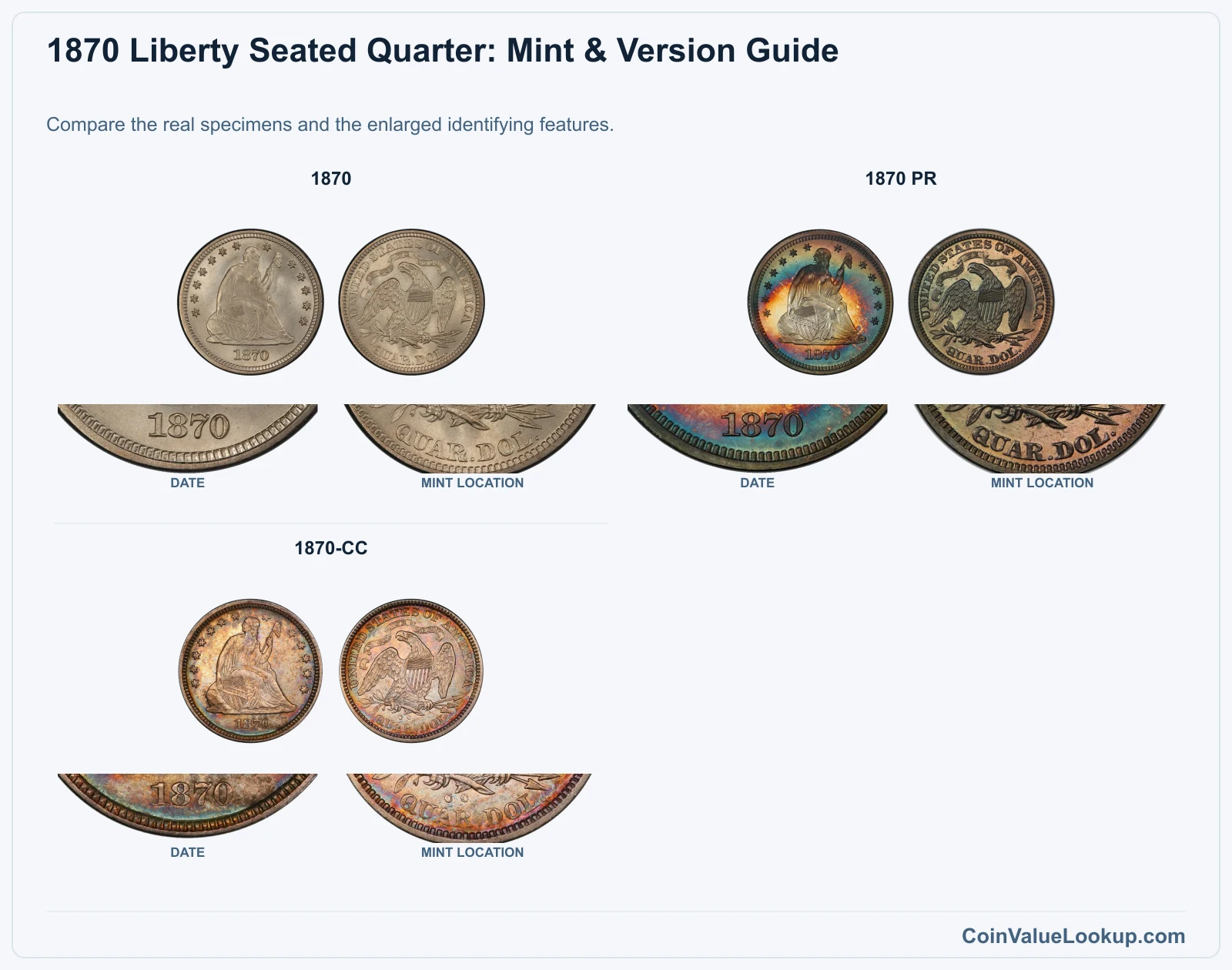
- 1870-CC: The Carson City mint quarter, with a USA Coin Book guide estimate of $221,976.00 in MS60, is the standout version due to extreme rarity from this first-year Carson City branch.
- 1870 Philadelphia business strike: Guide estimates reach $2,120.00 at MS63, making original high-grade survivors worth careful inspection.
- 1870 Proof: A collector finish with a guide estimate of $1,072.00 at PR63; confirm proof surfaces before assuming this version.
- Check your mintmark and finish first. Damage, heavy wear or a bright cleaned surface does not establish a rare version.
Step 1: Identify Your 1870 Liberty Seated Quarter Mint Mark and Version
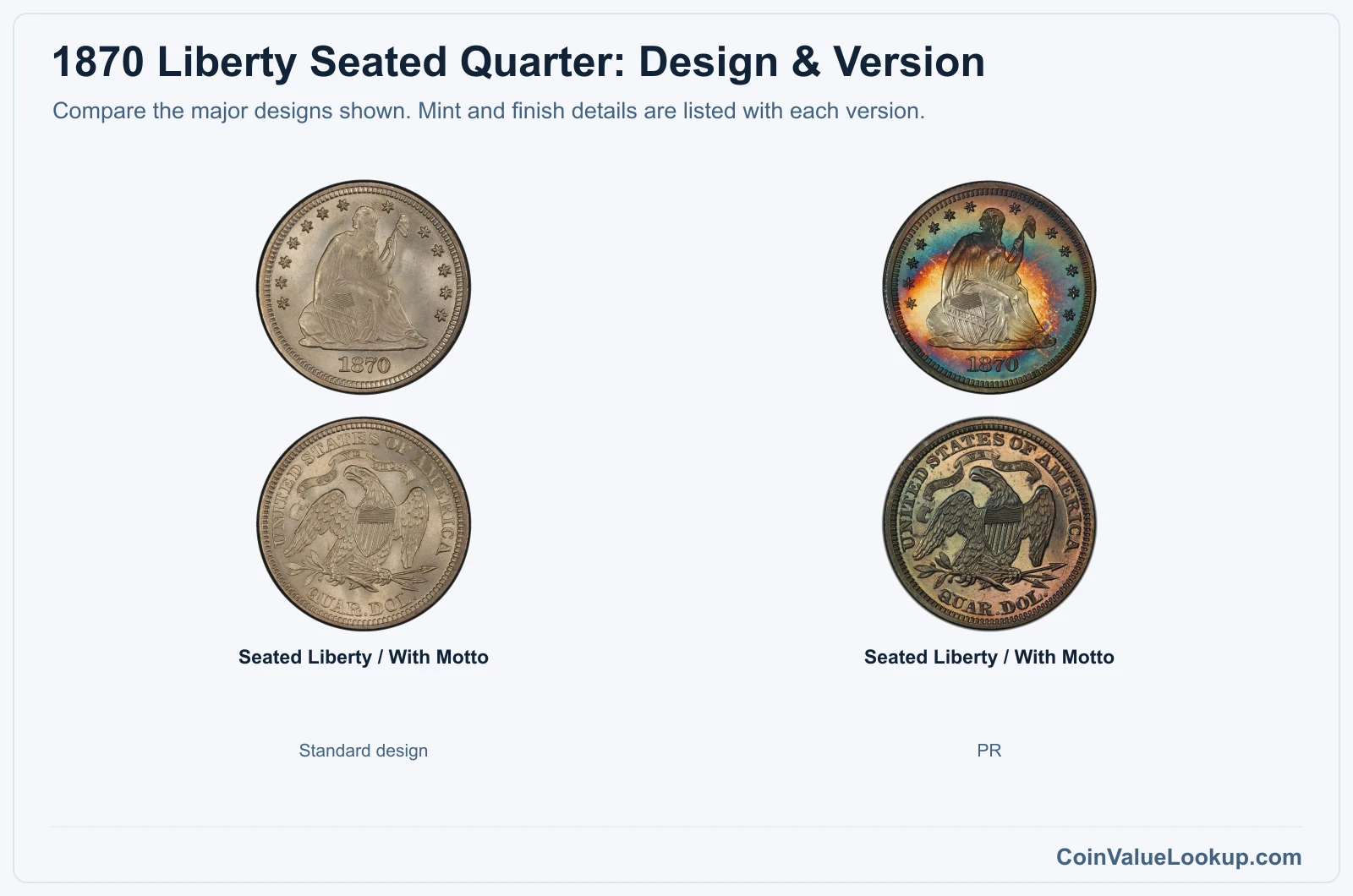
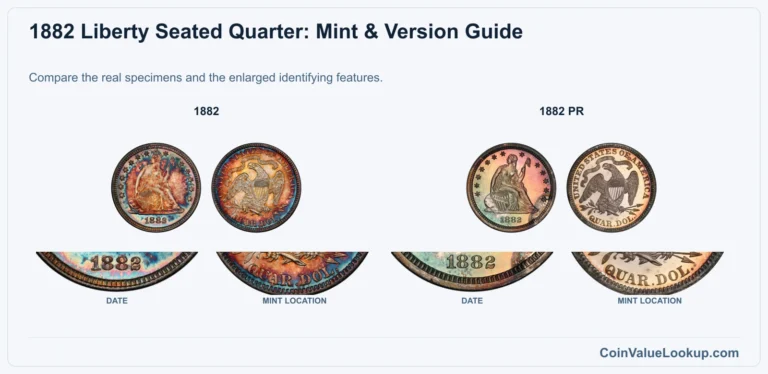
Three versions exist for this year: the 1870 Philadelphia business strike, the 1870 proof and the 1870-CC from Carson City. Philadelphia coins carry no mintmark.
Carson City pieces show a small "CC" on the reverse, beneath the eagle.
All three are 90% silver and 10% copper, weighing 6.22 grams. The obverse features Liberty seated on a rock, and the reverse displays an eagle with a motto banner above it.
If you see a mintmark other than CC, it does not belong to this year's listed branches.
Start with the reverse. Flip the coin over and look directly below the eagle's tail feathers.
No letter means Philadelphia. A clear CC means Carson City, and that changes everything about value.
Once you have the mint settled, determine whether the coin is a business strike or a proof, since Philadelphia produced both.
Step 2: Check Your 1870 Liberty Seated Quarter Grade
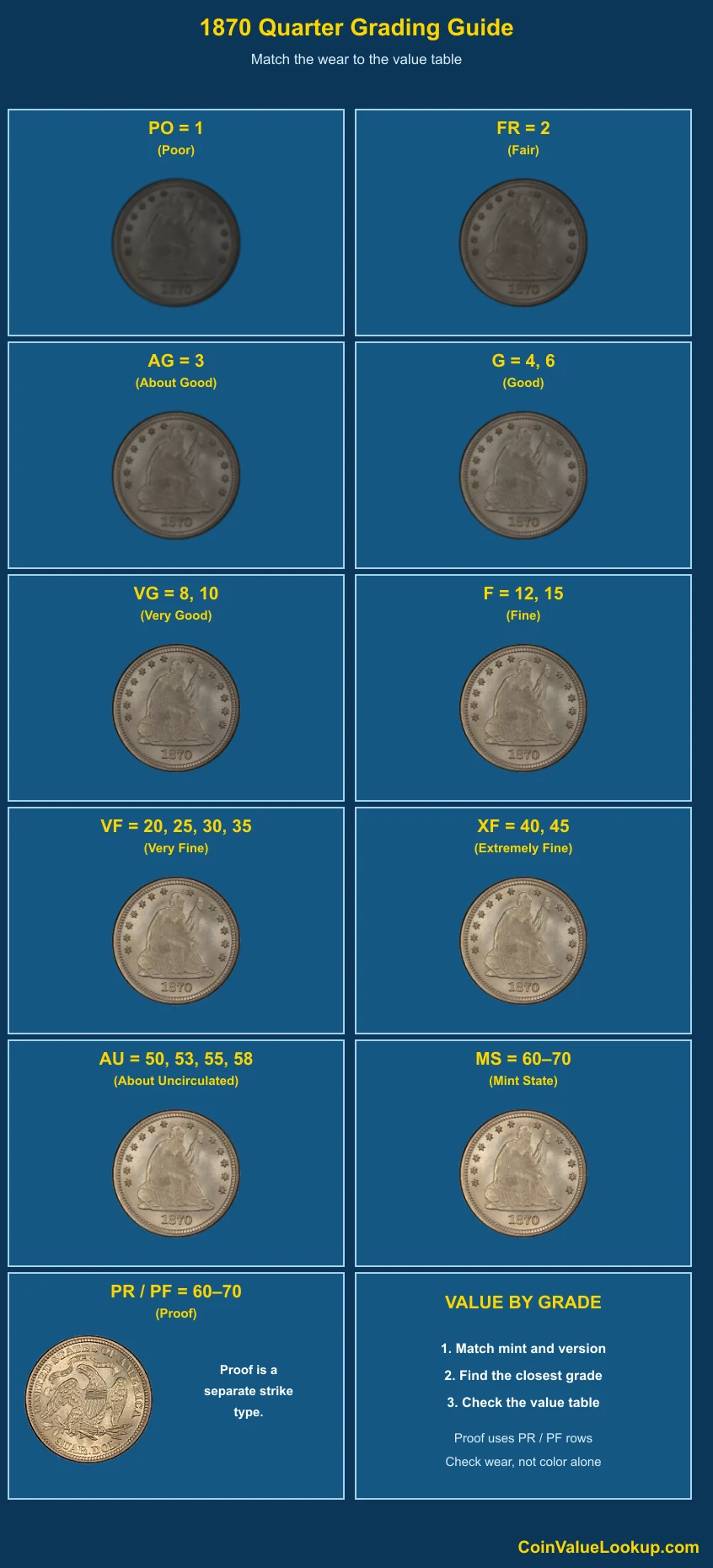
Focus on four spots when evaluating wear: Liberty's head, breast, knee and the shield on the obverse, plus the eagle's breast and upper wing feathers on the reverse. A coin in Good condition will show a clear outline of Liberty but most internal detail is gone.
As grade climbs toward Mint State, you should see increasing sharpness in Liberty's gown lines and the eagle's feather separation. Luster matters too.
Compare your coin to the reference image and look for original mint sheen versus a dull, worn surface.
One trap with this series is weak strikes. A coin can be technically unworn but still lack full detail at the centers because the dies did not impress the metal fully.
Do not mistake a weak strike for light wear, and do not assume a bright, shiny surface means high grade. Cleaning strips original luster and leaves telltale hairlines under magnification, which will reduce value regardless of remaining detail.
Step 3: Check 1870 Liberty Seated Quarter Value by Mint and Version
1870 Liberty Seated Quarter
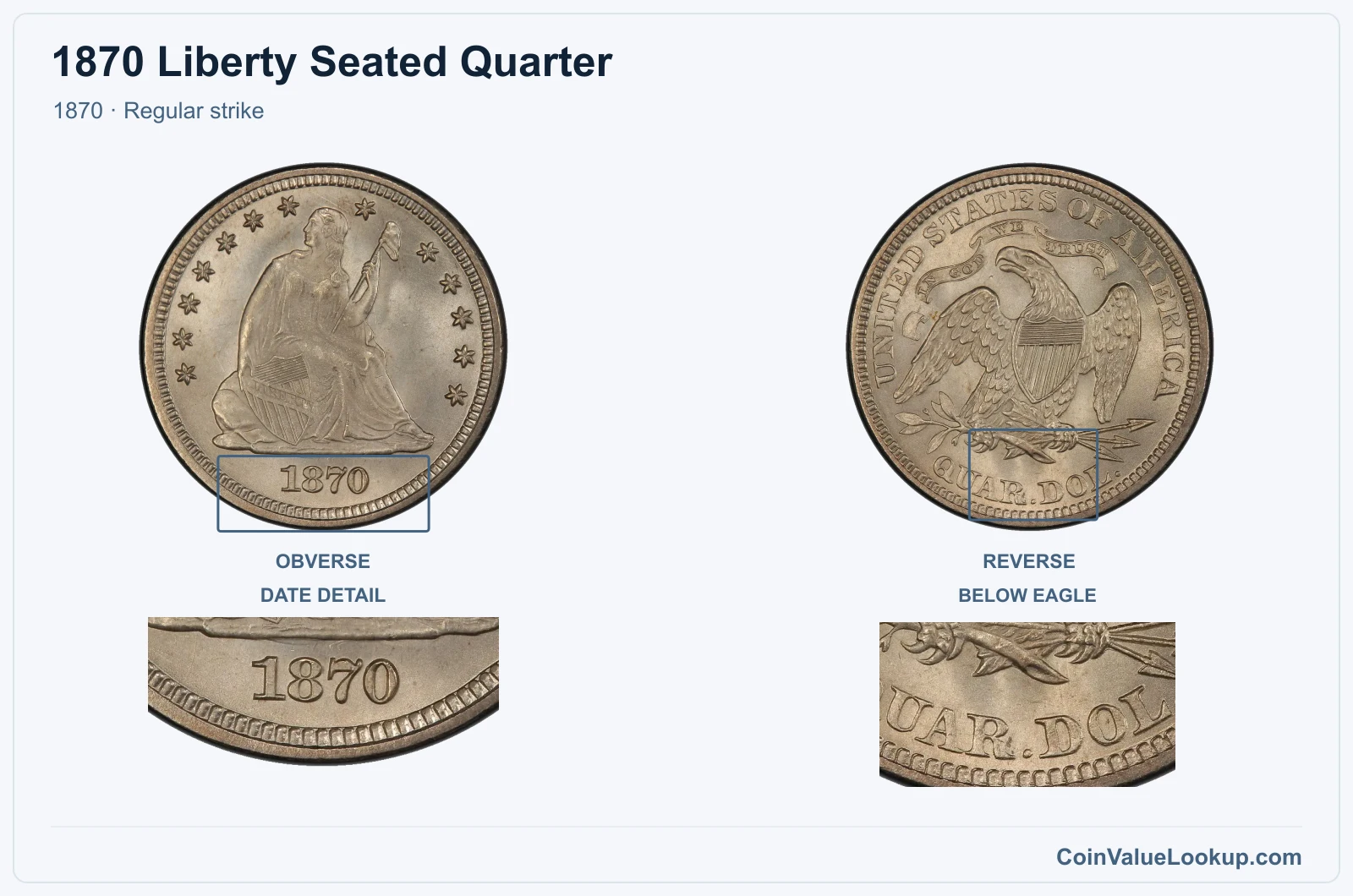
The 1870 Philadelphia business strike has no mintmark. Look at the reverse below the eagle and confirm the space is blank.
This coin is 90% silver, weighs 6.22 grams and carries the With Motto reverse design.
USA Coin Book guide estimates place this version at $89.00 in G4 and $2,120.00 in MS63, with an MS60 estimate of $1,252.00. These are guide estimates, not guaranteed offers.
Original surfaces matter here. A coin with natural toning and no signs of cleaning will compare favorably, while a harshly cleaned example loses collector appeal even if the underlying detail looks sharp.
Range Grade
Price Auction Records Appraisal PO PO 1
—
Coin Identifier FR FR 2
—
Coin Identifier AG AG 3
—
Coin Identifier G G 4
—
Coin Identifier
G 6
—
Coin Identifier VG VG 8
Coin Identifier
VG 10
Coin Identifier F F 12
Coin Identifier
F 15
—
Coin Identifier VF VF 20
Coin Identifier
VF 25
Coin Identifier
VF 30
Coin Identifier
VF 35
Coin Identifier XF XF 40
Coin Identifier
XF 45
Coin Identifier AU AU 50
Coin Identifier
AU 53
—
Coin Identifier
AU 55
Coin Identifier
AU 58
Coin Identifier MS MS 60
—
Coin Identifier
MS 61
Coin Identifier
MS 62
Coin Identifier
MS 63
Coin Identifier
MS 64
Coin Identifier
MS 65
Coin Identifier
MS 66
Coin Identifier
MS 67
—
—
—
MS 68
—
—
—
MS 69
—
—
—
MS 70
—
—
—
1870 Liberty Seated Quarter — PR
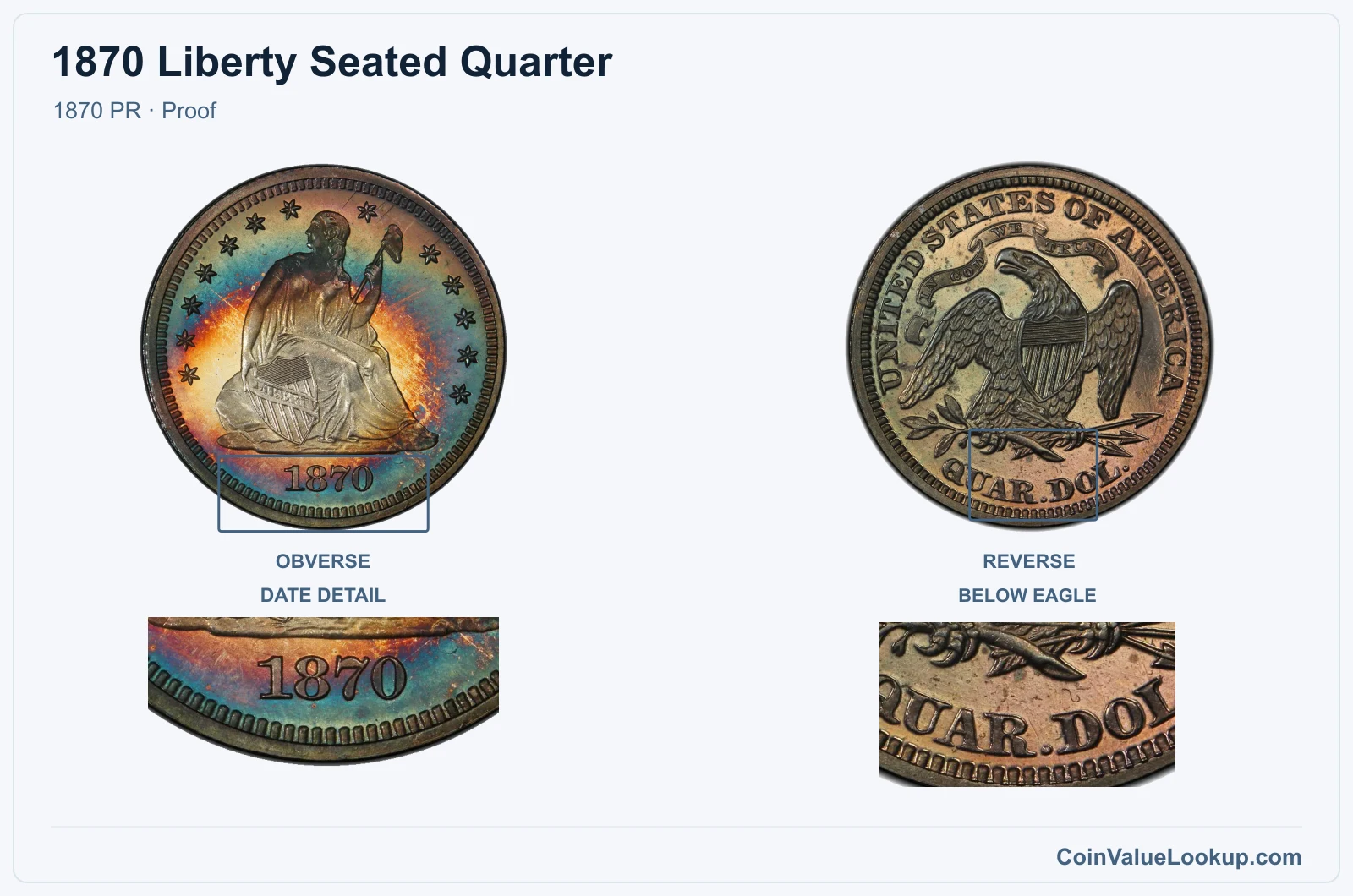
The 1870 proof quarter was also struck at Philadelphia with no mintmark, so you cannot separate it from a business strike by mintmark alone. Proof manufacture creates a distinct look: the fields tend to be deeply mirrored and the devices sharply defined from the first strike.
Do not confuse a shiny, well-preserved business strike for a proof. Genuine proofs were made in small numbers using specially prepared dies and planchets.
Surface haze and hairlines from handling affect collector value.
Coin Value Lookup is a good starting point if you want to look up guides for other Liberty Seated quarters or different denominations from this era. The USA Coin Book guide estimate for this version is $1,072.00 at PR63.
That is a guide figure, not a guaranteed offer, and actual value depends on the coin's specific surfaces and eye appeal.
Range Grade
Price Auction Records Appraisal PR PR 1
—
Coin Identifier
PR 2
—
Coin Identifier
PR 3
—
Coin Identifier
PR 4
—
Coin Identifier
PR 6
—
Coin Identifier
PR 8
—
Coin Identifier
PR 10
—
Coin Identifier
PR 12
—
Coin Identifier
PR 15
—
Coin Identifier
PR 20
—
Coin Identifier
PR 25
—
Coin Identifier
PR 30
—
Coin Identifier
PR 35
—
Coin Identifier
PR 40
—
Coin Identifier
PR 45
—
Coin Identifier
PR 50
—
Coin Identifier
PR 53
—
Coin Identifier
PR 55
—
Coin Identifier
PR 58
—
Coin Identifier
PR 60
Coin Identifier
PR 61
Coin Identifier
PR 62
Coin Identifier
PR 63
Coin Identifier
PR 64
Coin Identifier
PR 65
Coin Identifier
PR 66
Coin Identifier
PR 67
Coin Identifier
PR 68
—
—
—
PR 69
—
—
—
PR 70
—
—
—
1870 Liberty Seated Quarter — CC
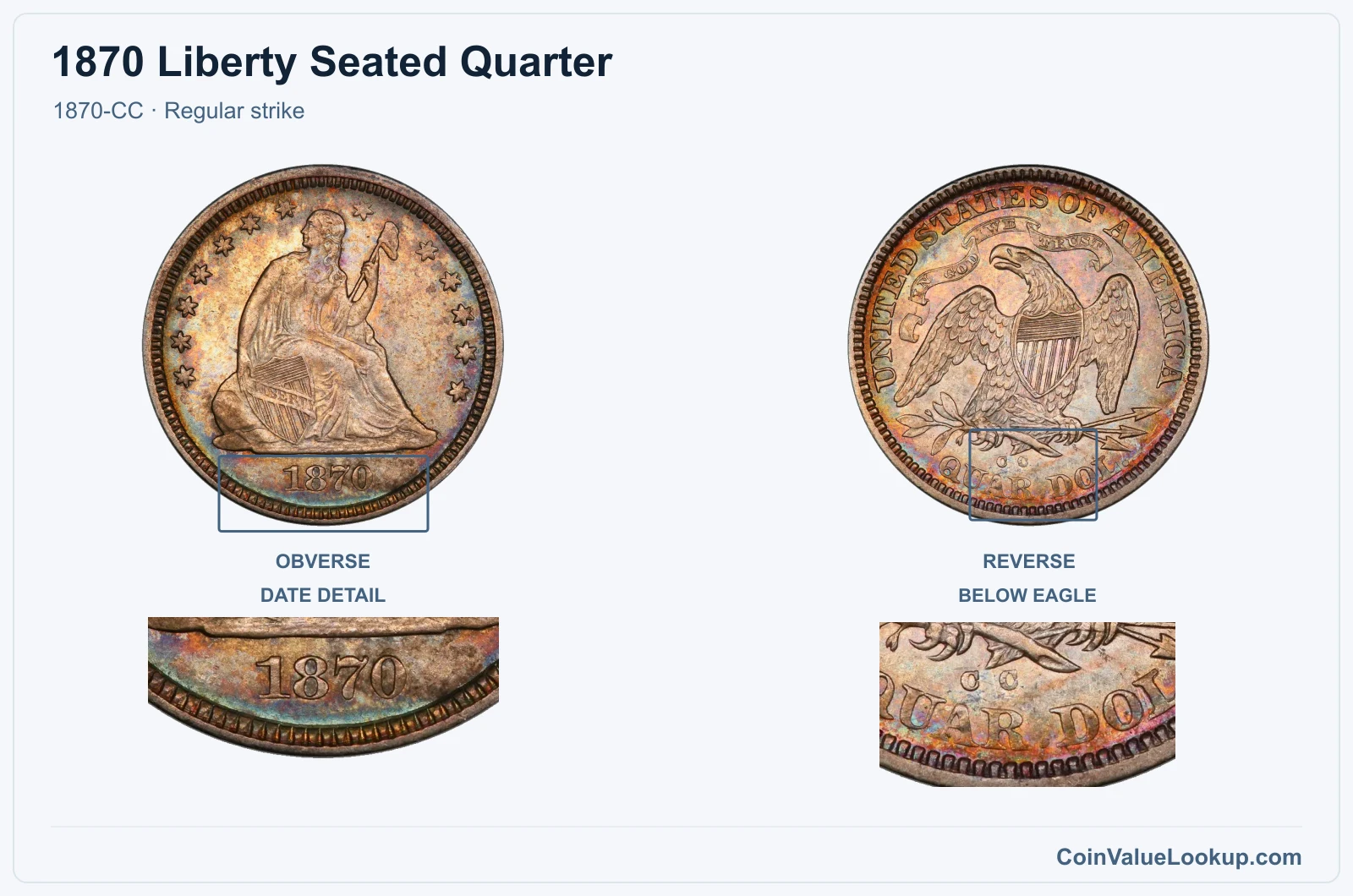
This is the one that makes people sit up straight. The 1870-CC quarter comes from the Carson City Mint in its first year of operation, and survival rates are tiny.
Look for the "CC" mintmark on the reverse below the eagle.
USA Coin Book guide estimates are $13,759.00 in G4 and $221,976.00 in MS60. Read those numbers again: even a heavily worn example carries a five-figure guide estimate.
These are guide estimates, not guaranteed offers, but they reflect genuine scarcity. This coin is 90% silver, 6.22 grams, same as its Philadelphia sibling, but the CC mintmark transforms its collector significance.
Original surfaces are critical. Any cleaning, tooling or damage will significantly reduce value.
If you believe you have one, professional authentication is worth pursuing before any transaction.
Range Grade
Price Auction Records Appraisal PO PO 1
—
Coin Identifier FR FR 2
Coin Identifier AG AG 3
Coin Identifier G G 4
Coin Identifier
G 6
Coin Identifier VG VG 8
Coin Identifier
VG 10
Coin Identifier F F 12
Coin Identifier
F 15
Coin Identifier VF VF 20
Coin Identifier
VF 25
Coin Identifier
VF 30
Coin Identifier
VF 35
Coin Identifier XF XF 40
Coin Identifier
XF 45
Coin Identifier AU AU 50
Coin Identifier
AU 53
Coin Identifier
AU 55
Coin Identifier
AU 58
—
—
— MS MS 60
—
—
—
MS 61
—
—
—
MS 62
—
—
—
MS 63
—
—
—
MS 64
—
—
—
MS 65
—
—
—
MS 66
—
—
—
MS 67
—
—
—
MS 68
—
—
—
MS 69
—
—
—
MS 70
—
—
—
1870 Liberty Seated Quarter Error List
1. 1870 Liberty Seated Quarter — Die Crack / Die Chip
Die cracks appear as thin raised lines on the coin's surface, caused by fractures in the steel die during production. On 1870 Liberty Seated quarters, look for lines that may radiate from the rim toward a design element, or small raised blobs called die chips where a fragment of the die broke away.
A rim-connected crack that leaves a raised blob of metal is sometimes called a cud, which is distinct from an interior die chip. To confirm a die crack, tilt the coin under light.
Genuine cracks are raised above the field because metal filled the gap in the broken die.
Do not confuse die cracks with incuse scratches, corrosion pitting or foreign material stuck to the surface. Scratches sit below the field; cracks sit above it.
The value impact depends on the crack's size, location and the coin's overall condition. No specific price range is adopted for this feature.
2. 1870 Liberty Seated Quarter — Clashed Dies
Clashed dies happen when the obverse and reverse dies strike each other without a planchet between them. The impact transfers ghost traces of one design onto the opposite die.
On a 1870 Liberty Seated quarter, you might see faint outlines of the eagle's wings in the obverse field, or traces of Liberty's figure on the reverse.
These ghost impressions should align with where the opposite design would naturally appear. That alignment is the key diagnostic.
Random scratches, raised lines from die polishing or a brockage error will not line up with the expected opposing features.
Clash marks range from barely visible under magnification to obvious at arm's length. The value effect depends on how dramatic the clash is, the coin's grade and its overall condition.
No specific price range is adopted for this category.