1871 Liberty Seated Quarter Coin Value: How Much Is It Worth?
The 1871 Liberty Seated Quarter is a 90% silver coin struck during the early Reconstruction era, and values vary dramatically depending on which mint produced yours. Guide estimates range from $69.00 for a well-worn Philadelphia strike up to $361,542.00 for a top-condition Carson City piece.
Mint, condition, finish and original surfaces all determine where your coin falls within that spread.
Fast Way to Identify Your 1871 Liberty Seated Quarter
The quickest way to start figuring out what you have is to upload clear photos of both sides of your coin. A front and back image lets us provide a preliminary identification of your mint, design type and approximate condition.
That is not a substitute for professional authentication, but it points you in the right direction fast.
1871 Liberty Seated Quarter Value
Upload both sides of your 1871 Liberty Seated Quarter.
Front Obverse
Upload photo
Back Reverse
Upload photo
Which 1871 Liberty Seated Quarter Versions Are Worth Money?
- 1871-CC — The Carson City mint issue guides at $10,613.00 even in G4 (heavy wear) and climbs to $361,542.00 at MS63, making it the standout version this year.
- 1871-S — San Francisco strikes guide at $1,135.00 in G4 and reach $12,164.00 at MS63, well above Philadelphia prices at comparable grades.
- 1871 Philadelphia business strike — More affordable but still a 150-plus-year-old silver coin, guiding at $1,886.00 in MS63 condition.
- Check your mintmark first. The difference between no mintmark and a "CC" is the difference between a few hundred dollars and potentially six figures.
Step 1: Identify Your 1871 Liberty Seated Quarter Mint Mark and Version
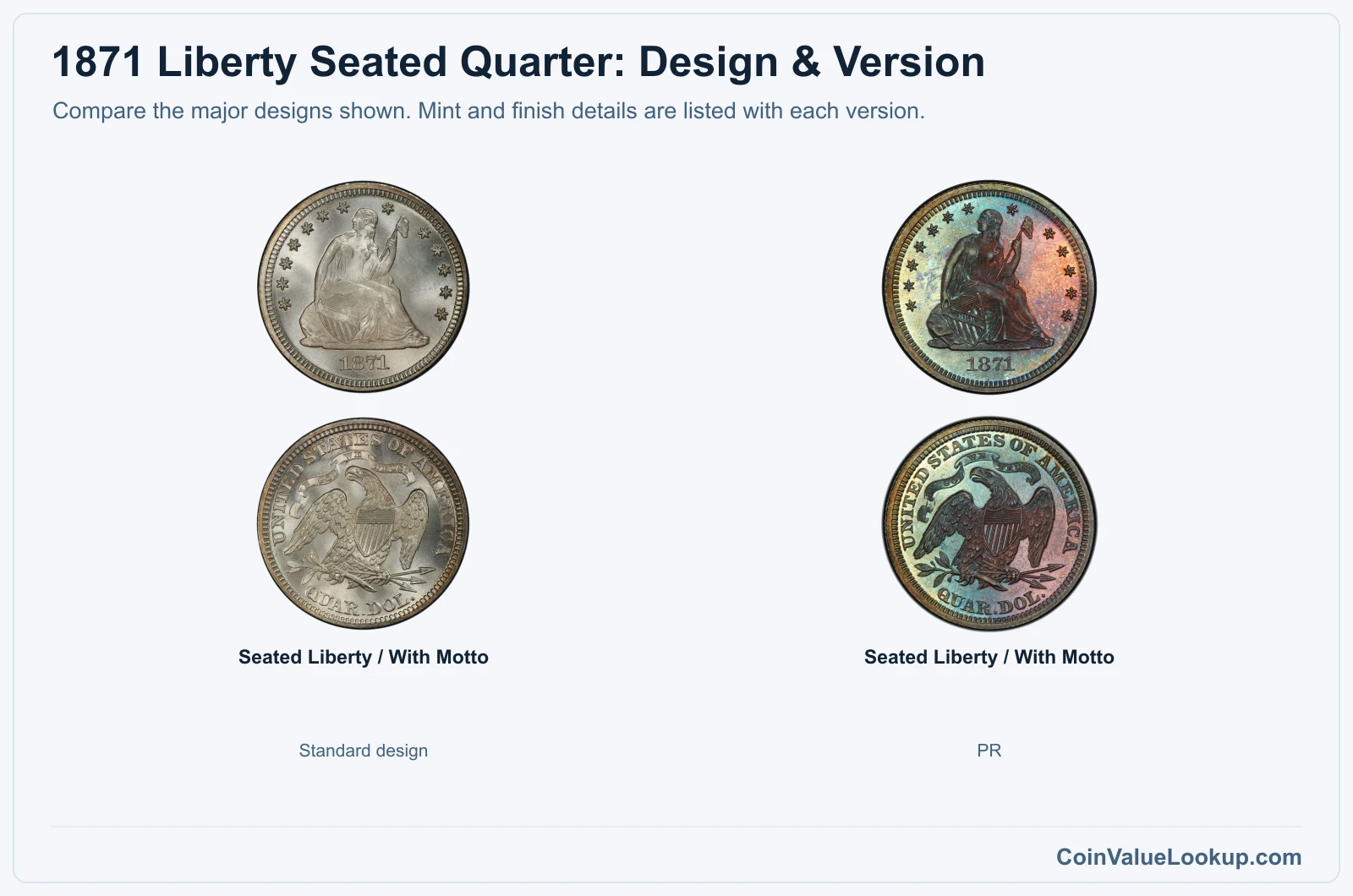
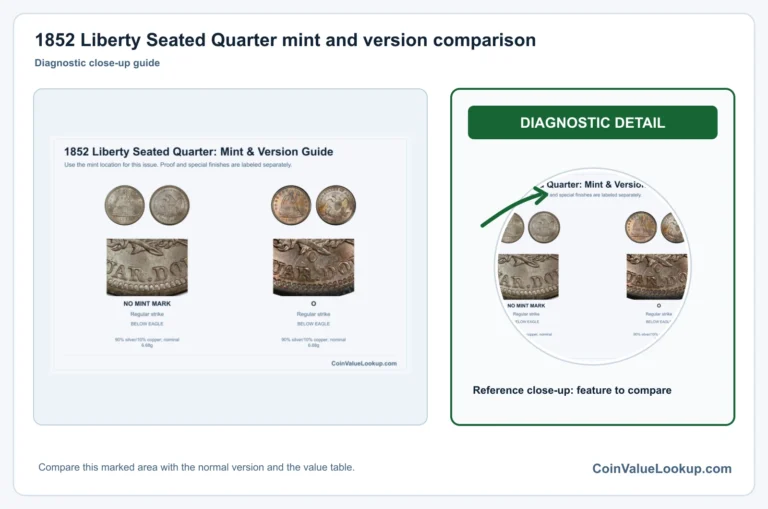
First, flip the coin over and look below the eagle on the reverse. Philadelphia coins carry no mintmark at all.
If you see a small "CC," that is Carson City — and your pulse should quicken. An "S" means San Francisco.
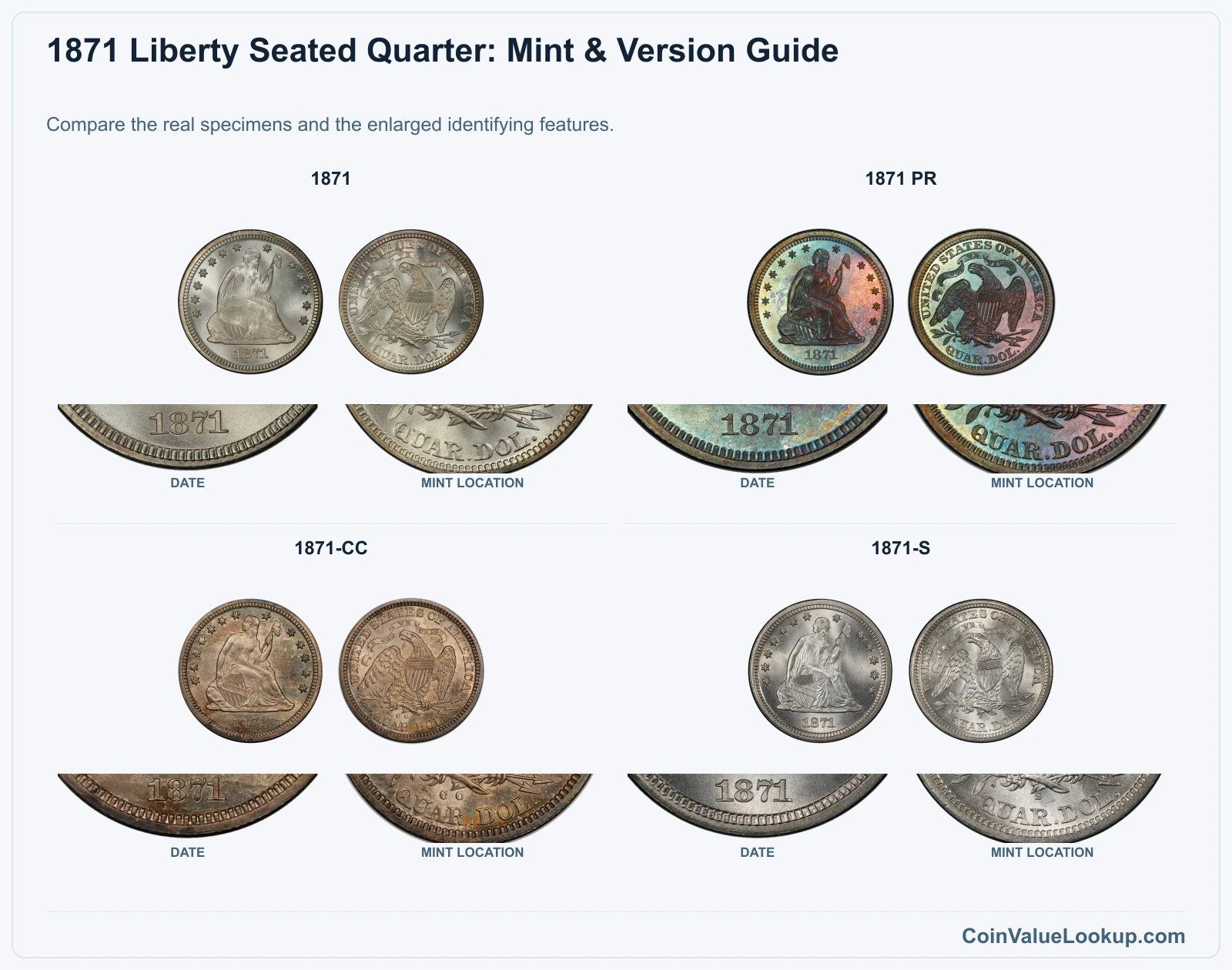
All four branches this year use the Seated Liberty obverse paired with an eagle reverse that includes the "IN GOD WE TRUST" motto banner above the eagle. The coin is struck in 90% silver with 10% copper, weighing 6.22 grams when uncirculated.
There are four collectible branches for 1871: the Philadelphia business strike, the Philadelphia proof, the Carson City business strike and the San Francisco business strike. Match your mintmark and finish before you even think about grade.
A shiny, reflective surface does not automatically mean proof — Philadelphia proofs were a separate manufacturing process with mirror-like fields, not just a well-preserved regular coin.
Step 2: Check Your 1871 Liberty Seated Quarter Grade
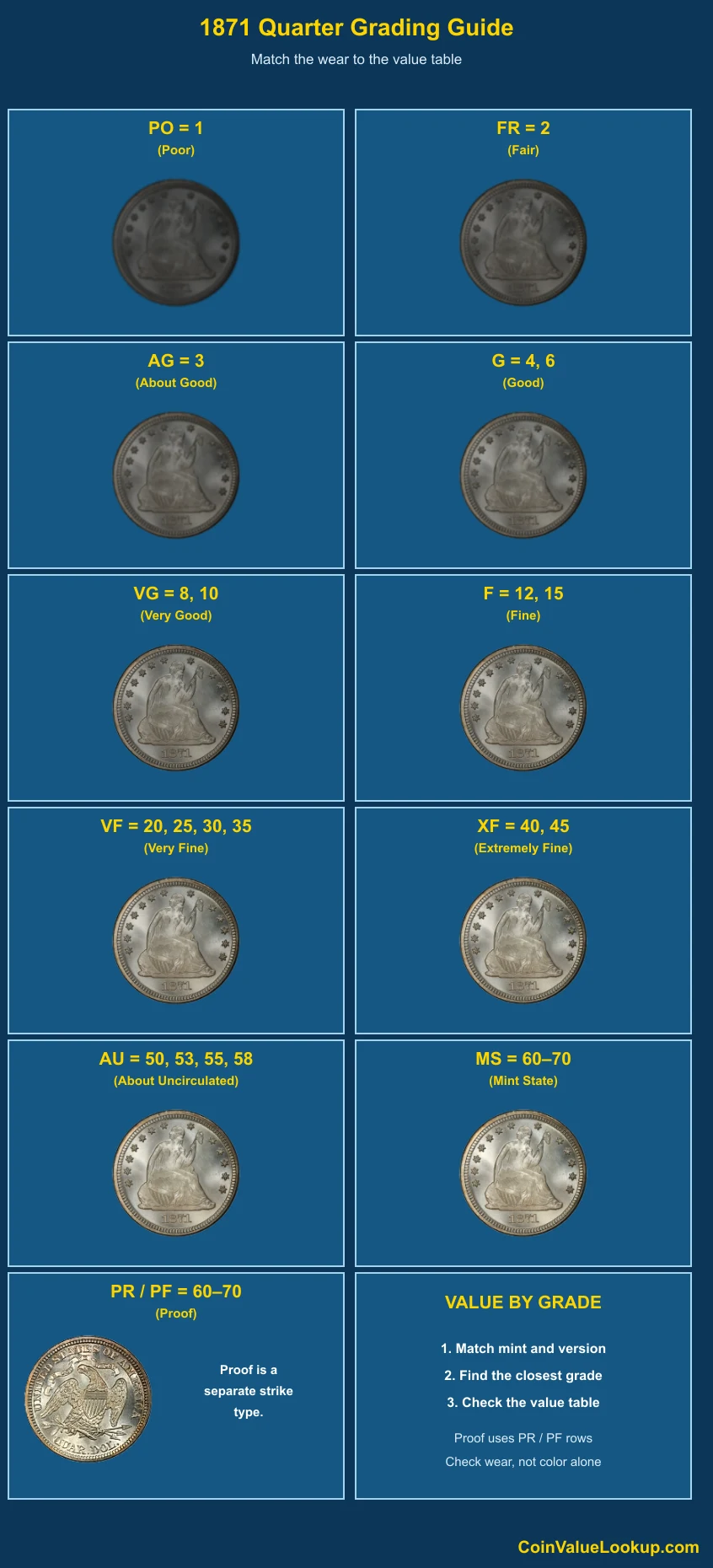
Start by examining Liberty's head, her breast area, the knee and the shield on the obverse. These are the high points that wear down first.
On the reverse, check the eagle's breast feathers and upper wing tips.
Compare your coin's wear against the reference image showing the same Liberty Seated quarter type. Luster matters as much as detail — a coin can look sharp in the centers but show friction on the high points that drops it several grades.
Weak strikes are common on this series, especially from branch mints. A soft center on an otherwise lustrous coin does not necessarily mean wear; it may reflect the original strike.
But do not assume the best case. Cleaned coins lose their original surface texture and often show fine hairlines under magnification, which significantly reduces collector value regardless of remaining detail.
Coin Value Lookup is a good starting point if you want to look up other dates and denominations from this series alongside your 1871 quarter.
Step 3: Check 1871 Liberty Seated Quarter Value by Mint and Version
1871 Liberty Seated Quarter
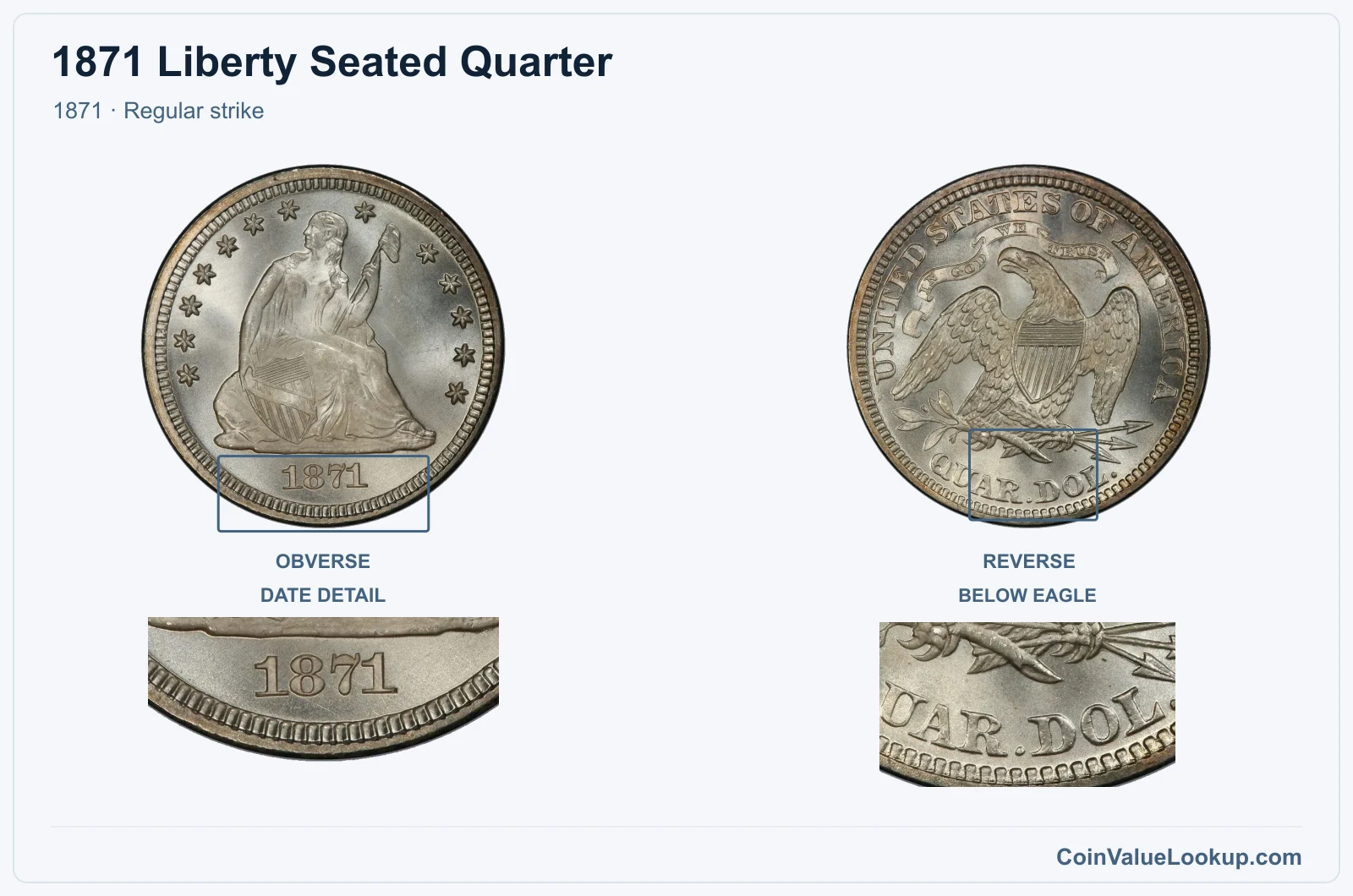
The 1871 Philadelphia quarter has no mintmark on the reverse. It is the most available version this year, which keeps prices lower relative to the branch mints.
USA Coin Book guide estimates place it at $69.00 in G4 (a grade showing heavy, even wear with major design elements still visible), $938.00 at MS60 (uncirculated but possibly with bag marks or weak luster) and $1,886.00 at MS63 (a choice uncirculated coin with decent eye appeal).
Original surfaces matter here. A cleaned or damaged example will trade well below these guide figures even if the detail looks sharp.
Match mint, design and condition before drawing any value conclusions.
Range Grade
Price Auction Records Appraisal PO PO 1
—
Coin Identifier FR FR 2
—
Coin Identifier AG AG 3
—
Coin Identifier G G 4
—
Coin Identifier
G 6
—
Coin Identifier VG VG 8
—
Coin Identifier
VG 10
—
Coin Identifier F F 12
—
Coin Identifier
F 15
—
Coin Identifier VF VF 20
—
Coin Identifier
VF 25
Coin Identifier
VF 30
Coin Identifier
VF 35
Coin Identifier XF XF 40
Coin Identifier
XF 45
Coin Identifier AU AU 50
Coin Identifier
AU 53
Coin Identifier
AU 55
Coin Identifier
AU 58
Coin Identifier MS MS 60
—
Coin Identifier
MS 61
Coin Identifier
MS 62
Coin Identifier
MS 63
Coin Identifier
MS 64
Coin Identifier
MS 65
Coin Identifier
MS 66
Coin Identifier
MS 67
—
Coin Identifier
MS 68
—
Coin Identifier
MS 69
—
—
—
MS 70
—
—
—
1871 Liberty Seated Quarter — PR
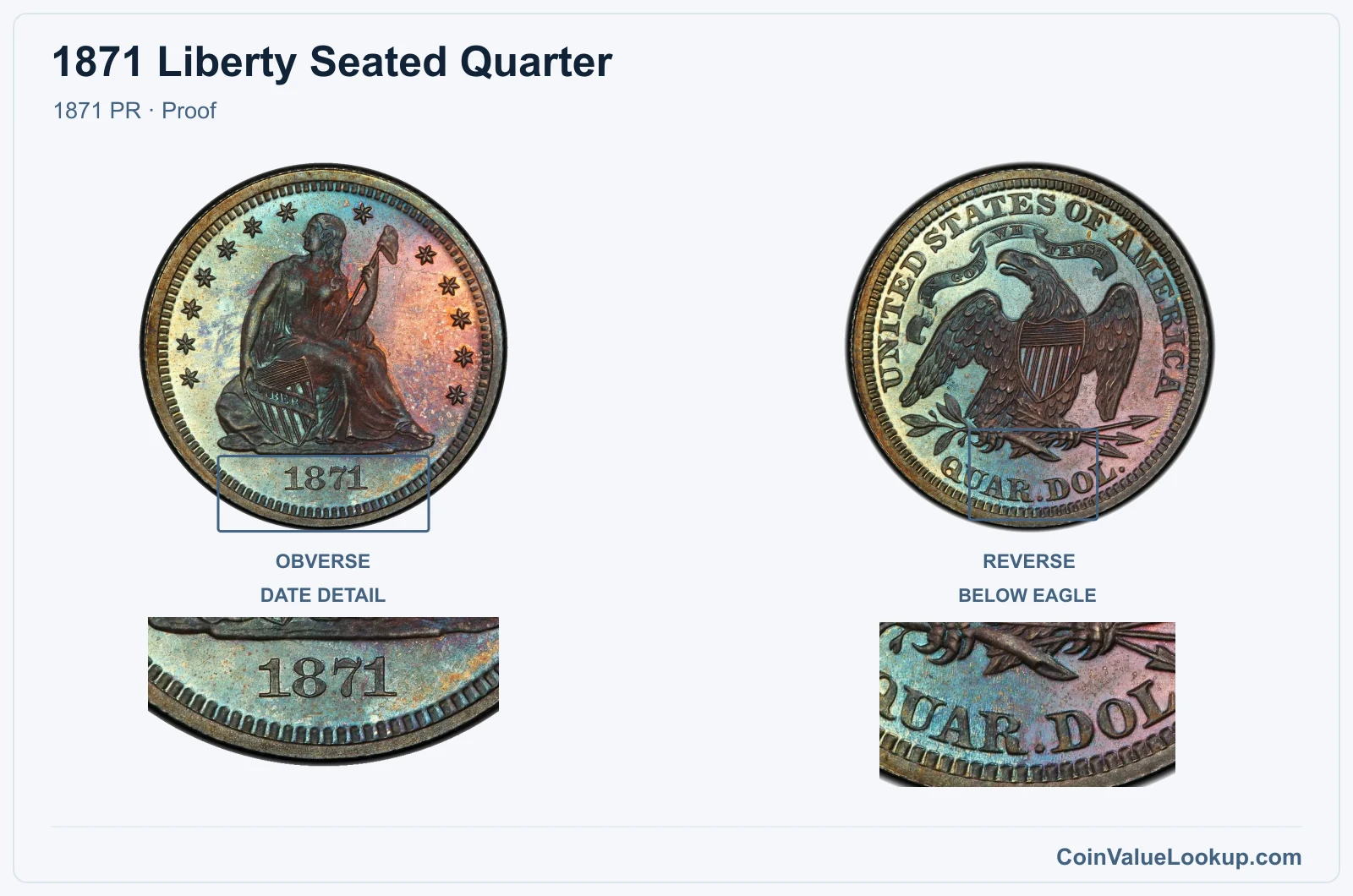
The 1871 proof quarter was struck at Philadelphia using specially prepared dies and polished planchets, producing mirror-like fields. These are collectible in their own right, separate from the business strikes.
The USA Coin Book guide estimate for a PR63 example is $1,072.00. That grade means the proof surfaces are largely intact but may show light hairlines or minor haze under magnification.
Heavier hairlines, clouding or cleaning push the grade and value down.
Do not confuse a proof with a shiny circulated coin. Genuine proofs have deeply reflective fields and squared-off rims that differ from even the best-preserved business strikes.
If you think you have one, professional certification is the way to confirm it.
Range Grade
Price Auction Records Appraisal PR PR 1
—
Coin Identifier
PR 2
—
Coin Identifier
PR 3
—
Coin Identifier
PR 4
—
Coin Identifier
PR 6
—
Coin Identifier
PR 8
—
Coin Identifier
PR 10
—
Coin Identifier
PR 12
—
Coin Identifier
PR 15
—
Coin Identifier
PR 20
—
Coin Identifier
PR 25
—
Coin Identifier
PR 30
—
Coin Identifier
PR 35
—
Coin Identifier
PR 40
—
Coin Identifier
PR 45
—
Coin Identifier
PR 50
—
Coin Identifier
PR 53
—
Coin Identifier
PR 55
Coin Identifier
PR 58
Coin Identifier
PR 60
Coin Identifier
PR 61
Coin Identifier
PR 62
Coin Identifier
PR 63
Coin Identifier
PR 64
Coin Identifier
PR 65
Coin Identifier
PR 66
Coin Identifier
PR 67
Coin Identifier
PR 68
Coin Identifier
PR 69
—
—
—
PR 70
—
—
—
1871 Liberty Seated Quarter — CC
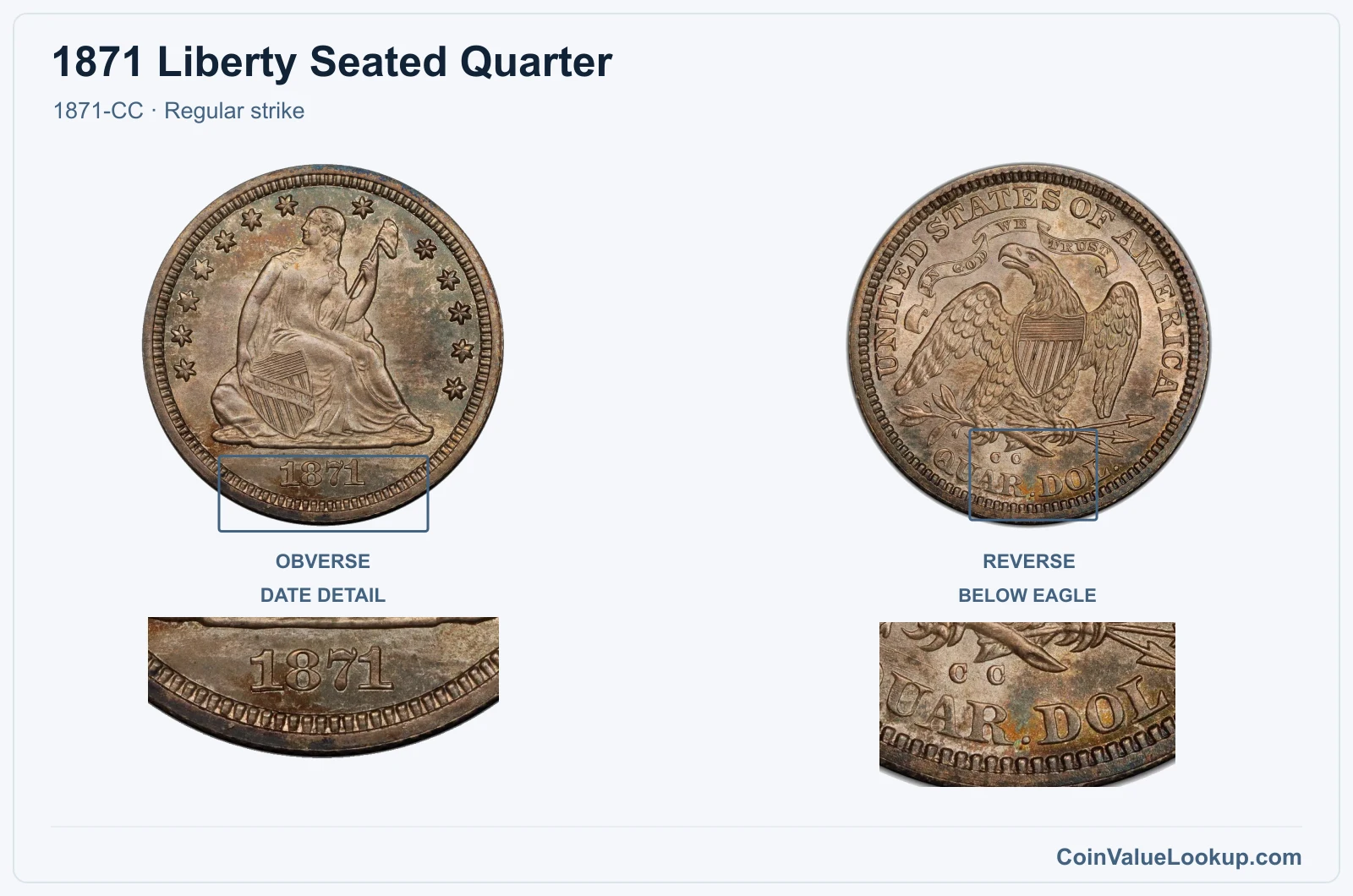
This is the one that gets collectors excited, and for good reason. The 1871-CC quarter was struck at the Carson City Mint in Nevada, which had only opened the year before.
Production numbers were tiny, and survival rates are even smaller.
Look for the "CC" mintmark on the reverse beneath the eagle. USA Coin Book guide estimates start at $10,613.00 in G4 — a coin that has been through serious circulation — and escalate to $98,544.00 at MS60 and a staggering $361,542.00 at MS63.
Even a heavily worn, genuine example is a significant coin.
The catch: because of these values, counterfeits and altered mintmarks exist. If you believe you have an 1871-CC quarter, professional authentication by a major grading service is not optional.
Cleaning or damage will reduce value, but the coin is still worth real money if genuine.
Range Grade
Price Auction Records Appraisal PO PO 1
—
Coin Identifier FR FR 2
Coin Identifier AG AG 3
Coin Identifier G G 4
Coin Identifier
G 6
Coin Identifier VG VG 8
Coin Identifier
VG 10
Coin Identifier F F 12
Coin Identifier
F 15
Coin Identifier VF VF 20
—
Coin Identifier
VF 25
—
Coin Identifier
VF 30
Coin Identifier
VF 35
Coin Identifier XF XF 40
Coin Identifier
XF 45
Coin Identifier AU AU 50
—
Coin Identifier
AU 53
Coin Identifier
AU 55
Coin Identifier
AU 58
—
Coin Identifier MS MS 60
—
Coin Identifier
MS 61
—
Coin Identifier
MS 62
—
Coin Identifier
MS 63
—
Coin Identifier
MS 64
Coin Identifier
MS 65
Coin Identifier
MS 66
—
—
—
MS 67
—
—
—
MS 68
—
—
—
MS 69
—
—
—
MS 70
—
—
—
1871 Liberty Seated Quarter — S
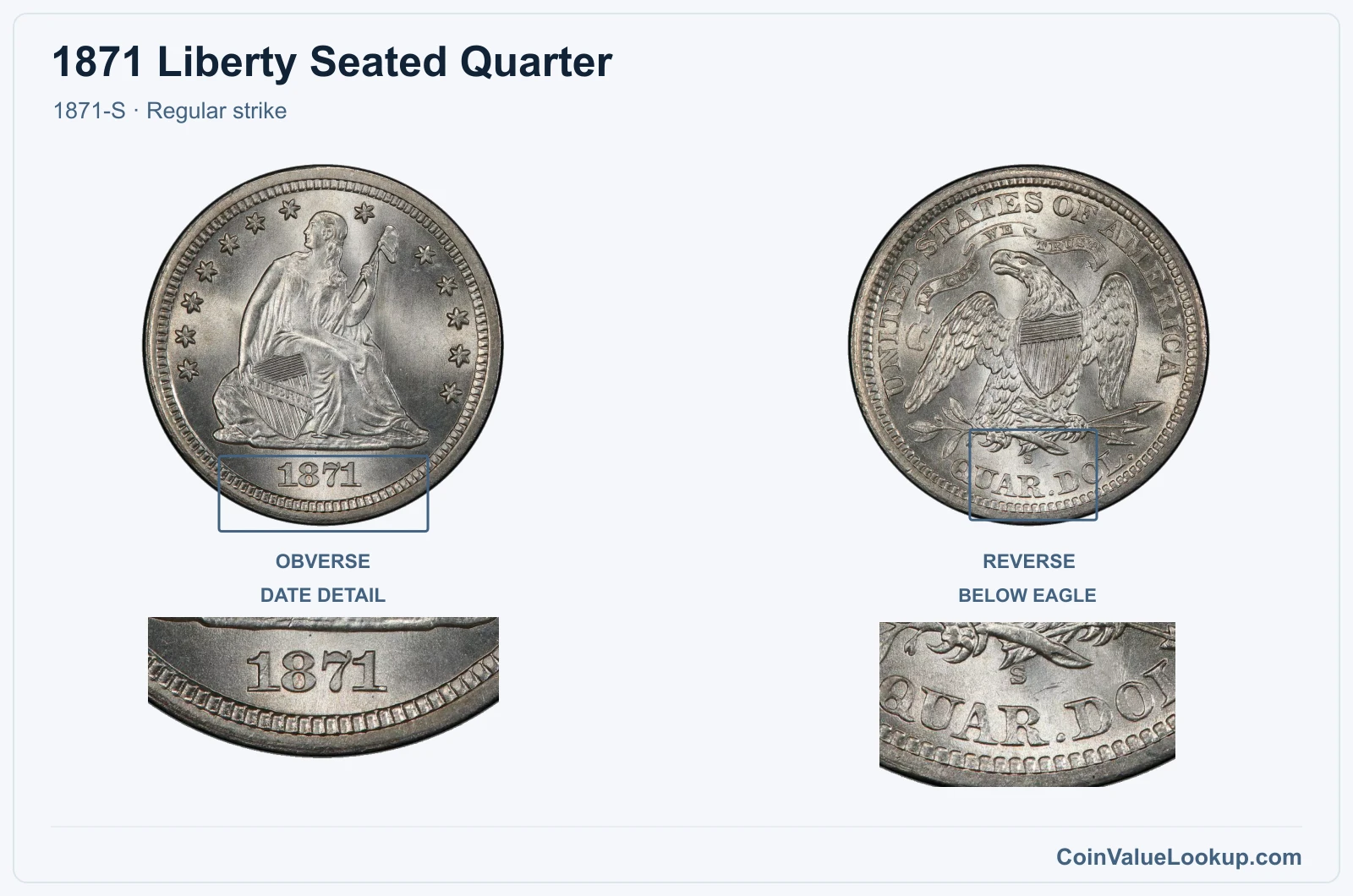
The 1871-S quarter carries an "S" mintmark on the reverse beneath the eagle, identifying it as a San Francisco Mint product. It is scarcer than the Philadelphia issue and commands higher prices across the board.
USA Coin Book guide estimates come in at $1,135.00 for a G4 example, $8,978.00 at MS60 and $12,164.00 at MS63. These are not small numbers, even in well-worn condition.
Original surfaces and honest wear are what collectors want. A cleaned coin with the detail of a VF may bring less than a naturally toned coin grading Fine.
Match the mintmark, confirm the design includes the motto banner, and assess wear before comparing to these guide figures.
Range Grade
Price Auction Records Appraisal PO PO 1
—
Coin Identifier FR FR 2
—
Coin Identifier AG AG 3
Coin Identifier G G 4
Coin Identifier
G 6
Coin Identifier VG VG 8
Coin Identifier
VG 10
Coin Identifier F F 12
Coin Identifier
F 15
Coin Identifier VF VF 20
Coin Identifier
VF 25
Coin Identifier
VF 30
Coin Identifier
VF 35
Coin Identifier XF XF 40
Coin Identifier
XF 45
Coin Identifier AU AU 50
Coin Identifier
AU 53
—
Coin Identifier
AU 55
Coin Identifier
AU 58
Coin Identifier MS MS 60
—
Coin Identifier
MS 61
Coin Identifier
MS 62
Coin Identifier
MS 63
Coin Identifier
MS 64
Coin Identifier
MS 65
Coin Identifier
MS 66
Coin Identifier
MS 67
Coin Identifier
MS 68
—
—
—
MS 69
—
—
—
MS 70
—
—
—