1879 Liberty Seated Quarter Coin Value: How Much Is It Worth?
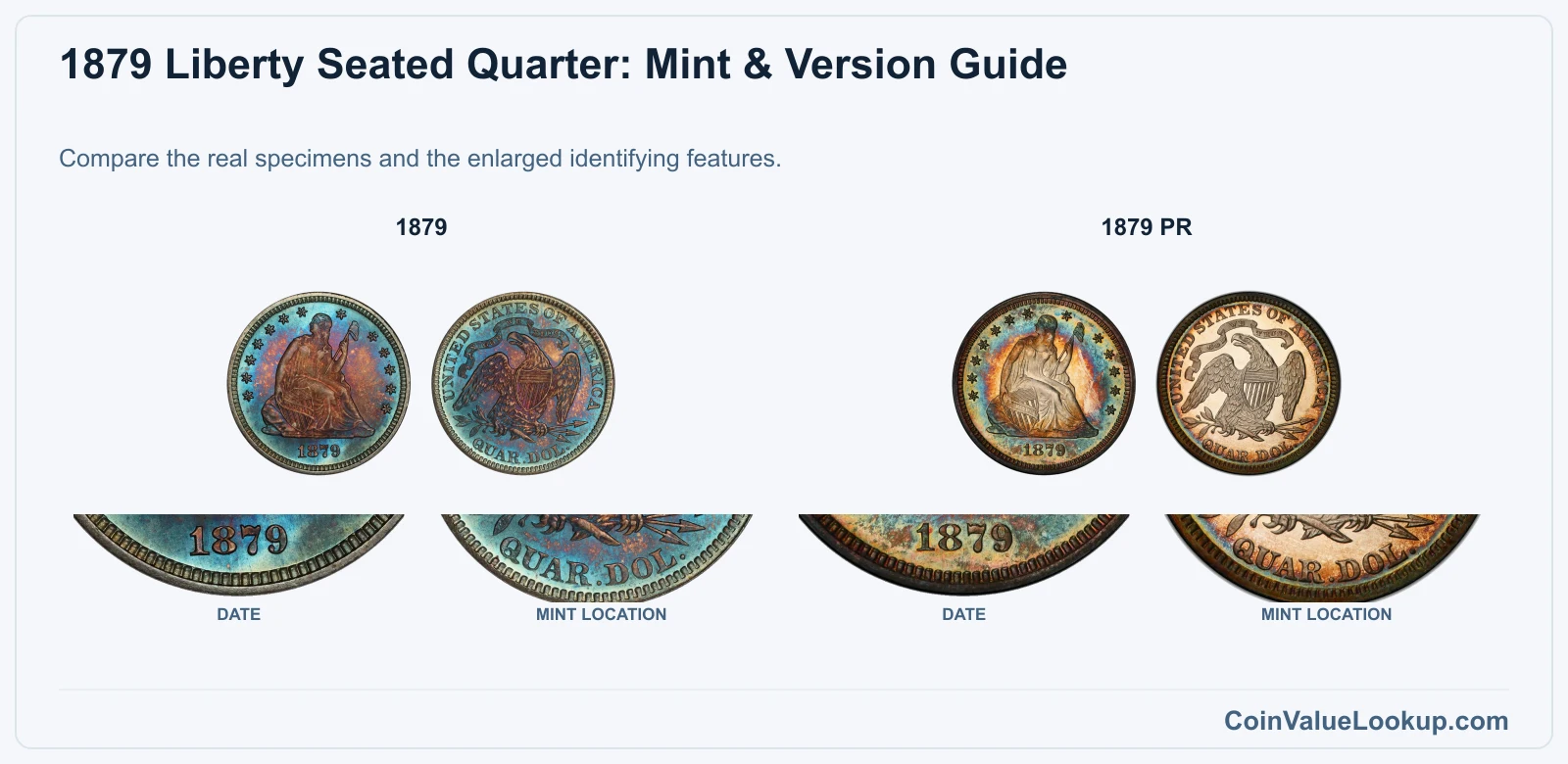
The 1879 Liberty Seated Quarter is a low-mintage Philadelphia issue struck in 90% silver. USA Coin Book guide estimates range from about $258.00 in well-worn Good-4 condition up to $1,072.00 for an uncirculated MS63 business strike, while proofs carry their own separate pricing.
Your coin's actual position in that spread depends on whether it is a regular strike or a proof, its condition, and whether the surfaces are original.
Fast Way to Identify Your 1879 Liberty Seated Quarter
The quickest way to start figuring out what you have is to upload clear photos of both the front and back of your coin. Our identifier can give you a preliminary read on the version and general condition from those images alone.
Grab a well-lit shot with minimal glare, and make sure the mintmark area beneath the eagle is visible.
1879 Liberty Seated Quarter Value
Upload both sides of your 1879 Liberty Seated Quarter.
Front Obverse
Upload photo
Back Reverse
Upload photo
Which 1879 Liberty Seated Quarter Versions Are Worth Money?
- 1879 business strike: USA Coin Book estimates reach $1,072.00 at the MS63 grade level, reflecting the low mintage and demand for original uncirculated examples.
- 1879 Proof: Guide estimate of $938.00 at PR63; proofs were struck in small numbers for collectors and command strong premiums when surfaces are free of hairlines and haze.
- Always confirm whether your coin is a proof or a regular strike before comparing prices — the grading scales and values are completely different.
Step 1: Identify Your 1879 Liberty Seated Quarter Mint Mark and Version
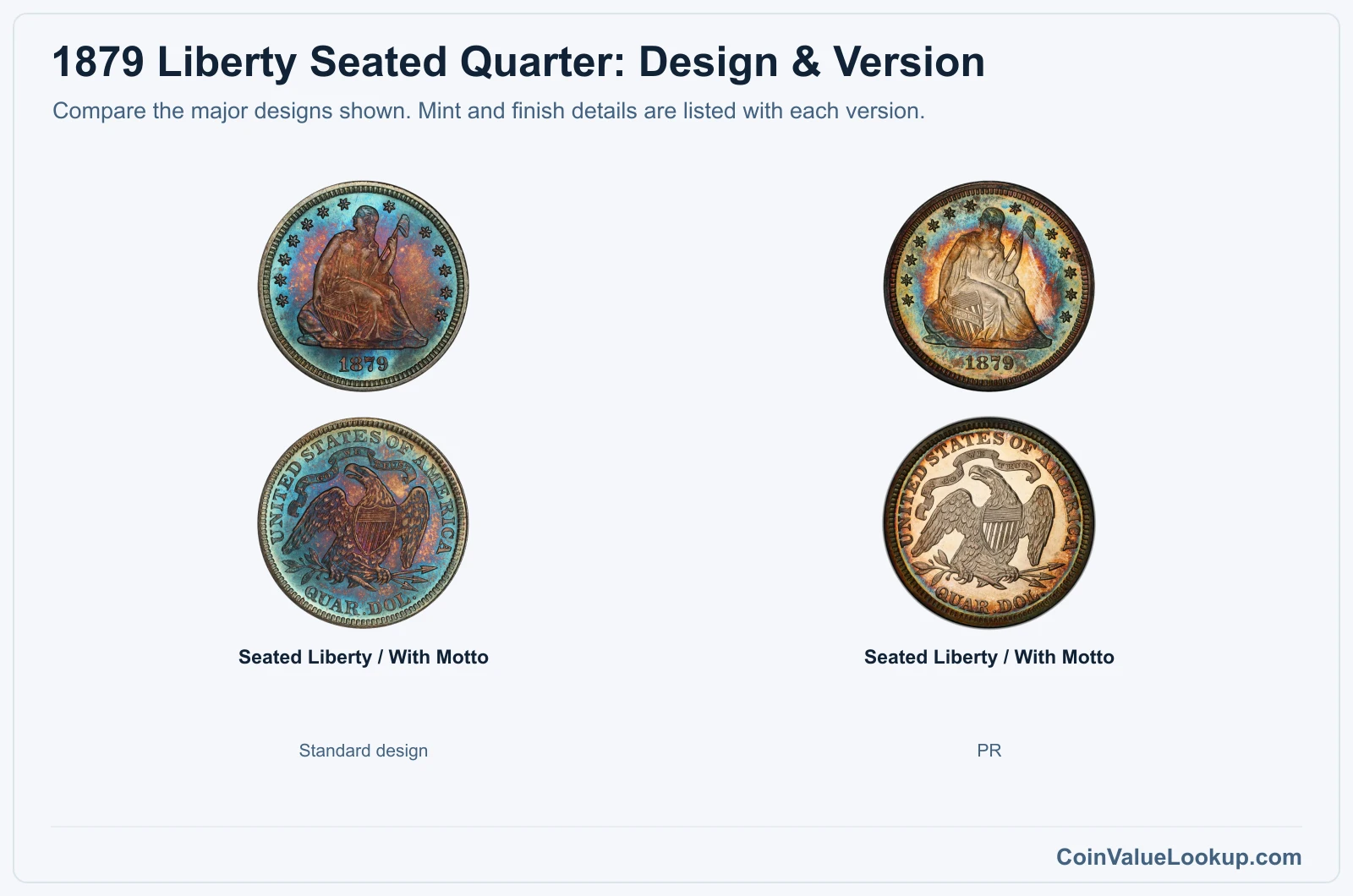
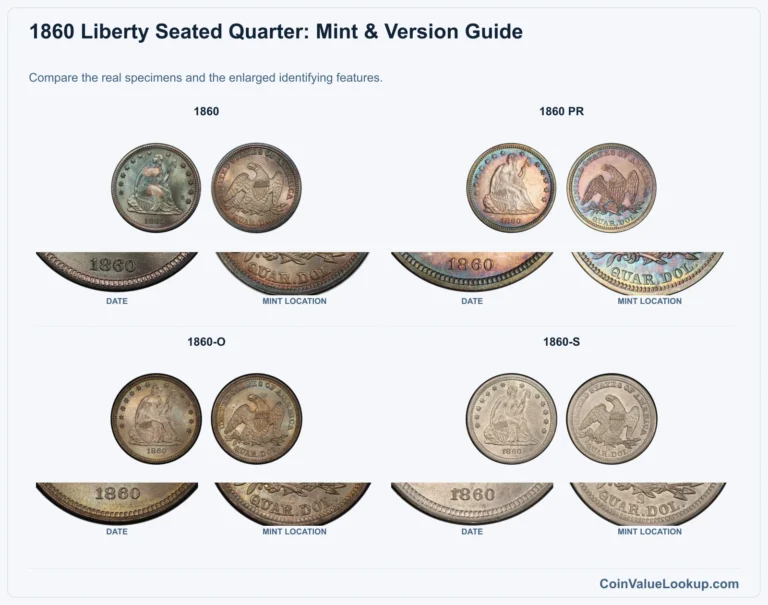
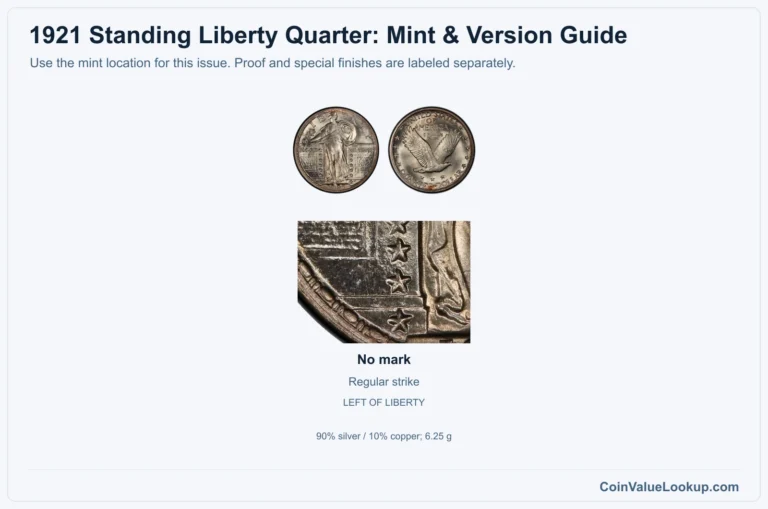
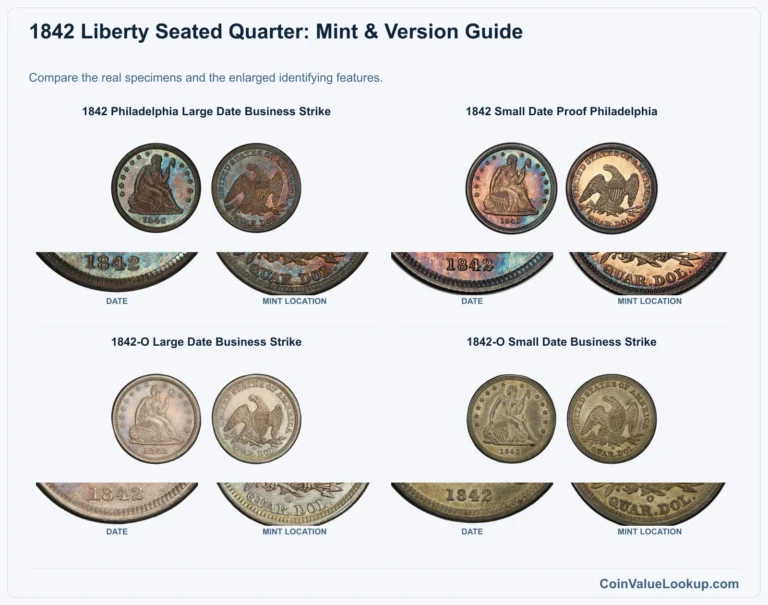
Every 1879 quarter was struck at Philadelphia, so there is no mintmark. If you see a small letter below the eagle on the reverse — O, S, or CC — you are looking at a different year or a misattributed coin.
The design shows Liberty seated on the obverse with a shield at her side and thirteen stars around the border. The reverse features a heraldic eagle beneath the motto IN GOD WE TRUST on a scroll.
This motto was added to the series in 1866, so its presence is expected here.
The two collectible branches for this date are the regular business strike (1879) and the proof (1879 PR). Both were made in Philadelphia from the same 90% silver, 10% copper alloy at a standard weight of 6.25 grams.
Distinguishing a proof from a business strike matters a great deal — a shiny coin is not automatically a proof. Proofs were intentionally struck on specially prepared planchets with polished dies, producing mirror-like fields and sharp rims that differ from even a well-preserved circulation strike.
Step 2: Check Your 1879 Liberty Seated Quarter Grade
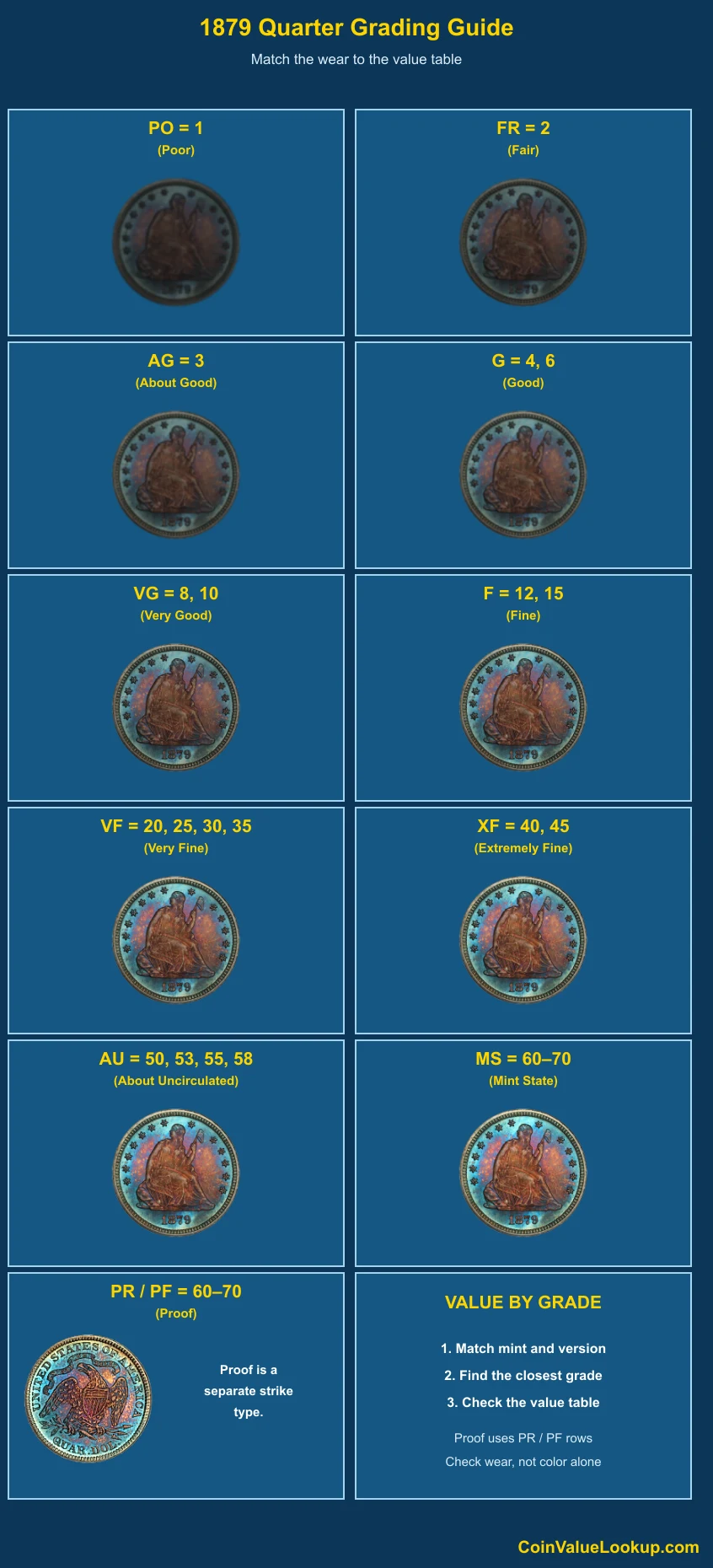
Start by checking Liberty's head, the area across her breast, her knee, and the details of the shield on the obverse. These are the highest points and the first to show friction.
On the reverse, look at the eagle's breast feathers and the tops of the wings.
A coin in Good-4 will have Liberty's outline visible but most interior detail worn smooth. Move up to Extremely Fine and you will see clear drapery lines, defined shield horizontals, and only light rub on the high points.
Uncirculated coins retain full original luster with no wear, though a weakly struck center can fool you. A soft strike reduces detail on an otherwise unworn coin, so compare your piece against the reference image for this type rather than assuming flat areas equal wear.
Cleaning is a value killer. If the surfaces look unnaturally bright, uniformly hairlined, or have a dull grey haze where luster should be, the coin may have been cleaned.
A cleaned coin will not command the same price as one with original toning and surfaces, regardless of how little actual wear it shows.
Step 3: Check 1879 Liberty Seated Quarter Value by Mint and Version
1879 Liberty Seated Quarter
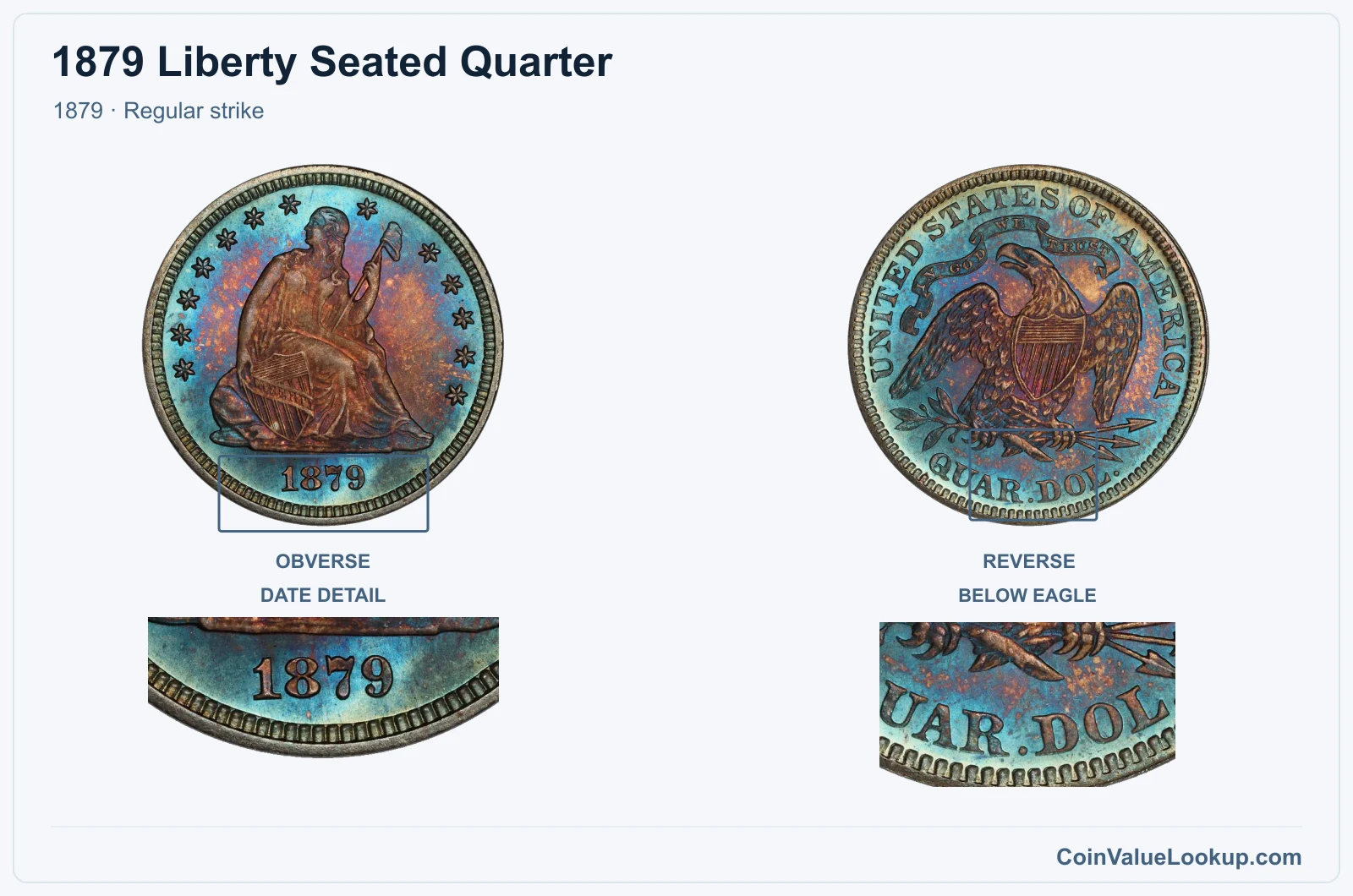
The 1879 business-strike quarter was produced at the Philadelphia Mint with no mintmark. It is struck in 90% silver and 10% copper at 6.25 grams.
Before comparing any price guide, confirm your coin matches this branch: no mintmark, Seated Liberty obverse with the WITH MOTTO eagle reverse, and regular (non-proof) surfaces.
USA Coin Book estimates place a well-worn G4 example around $258.00, an MS60 uncirculated piece near $834.00, and an MS63 example at approximately $1,072.00. These are guide estimates, not guaranteed sale prices.
Original surfaces matter — cleaning or damage can push a coin well below these figures even if wear is minimal. Strike quality varies, so weak central details on an otherwise lustrous coin do not necessarily mean it circulated.
Range Grade
Price Auction Records Appraisal PO PO 1
—
Coin Identifier FR FR 2
—
Coin Identifier AG AG 3
—
Coin Identifier G G 4
Coin Identifier
G 6
—
Coin Identifier VG VG 8
Coin Identifier
VG 10
—
Coin Identifier F F 12
Coin Identifier
F 15
—
Coin Identifier VF VF 20
—
Coin Identifier
VF 25
Coin Identifier
VF 30
Coin Identifier
VF 35
Coin Identifier XF XF 40
Coin Identifier
XF 45
Coin Identifier AU AU 50
Coin Identifier
AU 53
Coin Identifier
AU 55
Coin Identifier
AU 58
Coin Identifier MS MS 60
—
Coin Identifier
MS 61
Coin Identifier
MS 62
Coin Identifier
MS 63
Coin Identifier
MS 64
Coin Identifier
MS 65
Coin Identifier
MS 66
Coin Identifier
MS 67
Coin Identifier
MS 68
Coin Identifier
MS 69
—
—
—
MS 70
—
—
—
1879 Liberty Seated Quarter — PR
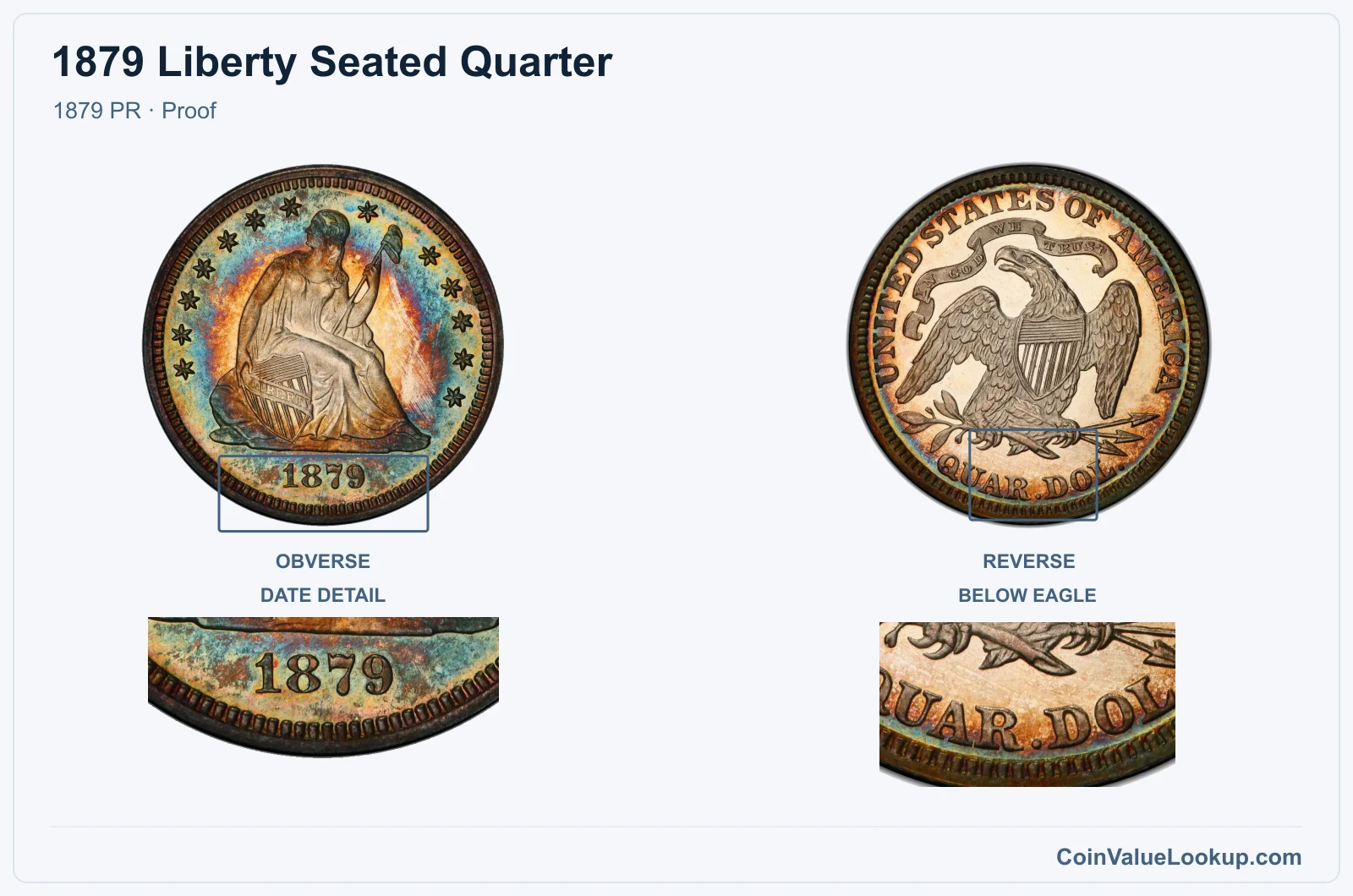
The 1879 Proof quarter was also struck at Philadelphia with no mintmark, in the same 90% silver alloy and 6.25-gram weight as its business-strike sibling. The difference is manufacturing: proof coins were produced using polished dies and specially prepared planchets, creating deeply mirrored fields and crisp design edges.
Do not mistake a bright, lightly circulated coin for a proof. Genuine proofs show a distinctive reflective quality in the flat fields and squared-off rims that regular strikes simply do not have.
Surface haze, hairlines from mishandling, and light cleaning all affect a proof's desirability.
USA Coin Book estimates this version at about $938.00 in PR63 condition. That figure is a guide estimate, not a guaranteed offer.
A proof with heavy hairlines or retoned surfaces will typically sell for less.
Coin Value Lookup is a handy starting point if you are researching other dates or denominations in this series. You can look up additional coin guides there to compare values across years.
Range Grade
Price Auction Records Appraisal PR PR 1
—
Coin Identifier
PR 2
—
Coin Identifier
PR 3
—
Coin Identifier
PR 4
—
Coin Identifier
PR 6
—
Coin Identifier
PR 8
—
Coin Identifier
PR 10
—
Coin Identifier
PR 12
—
Coin Identifier
PR 15
—
Coin Identifier
PR 20
—
Coin Identifier
PR 25
—
Coin Identifier
PR 30
—
Coin Identifier
PR 35
—
Coin Identifier
PR 40
—
Coin Identifier
PR 45
—
Coin Identifier
PR 50
—
Coin Identifier
PR 53
—
Coin Identifier
PR 55
—
Coin Identifier
PR 58
Coin Identifier
PR 60
Coin Identifier
PR 61
Coin Identifier
PR 62
Coin Identifier
PR 63
Coin Identifier
PR 64
Coin Identifier
PR 65
Coin Identifier
PR 66
Coin Identifier
PR 67
Coin Identifier
PR 68
—
—
—
PR 69
—
—
—
PR 70
—
—
—