2014 Quarter Coin Value: How Much Is It Worth?
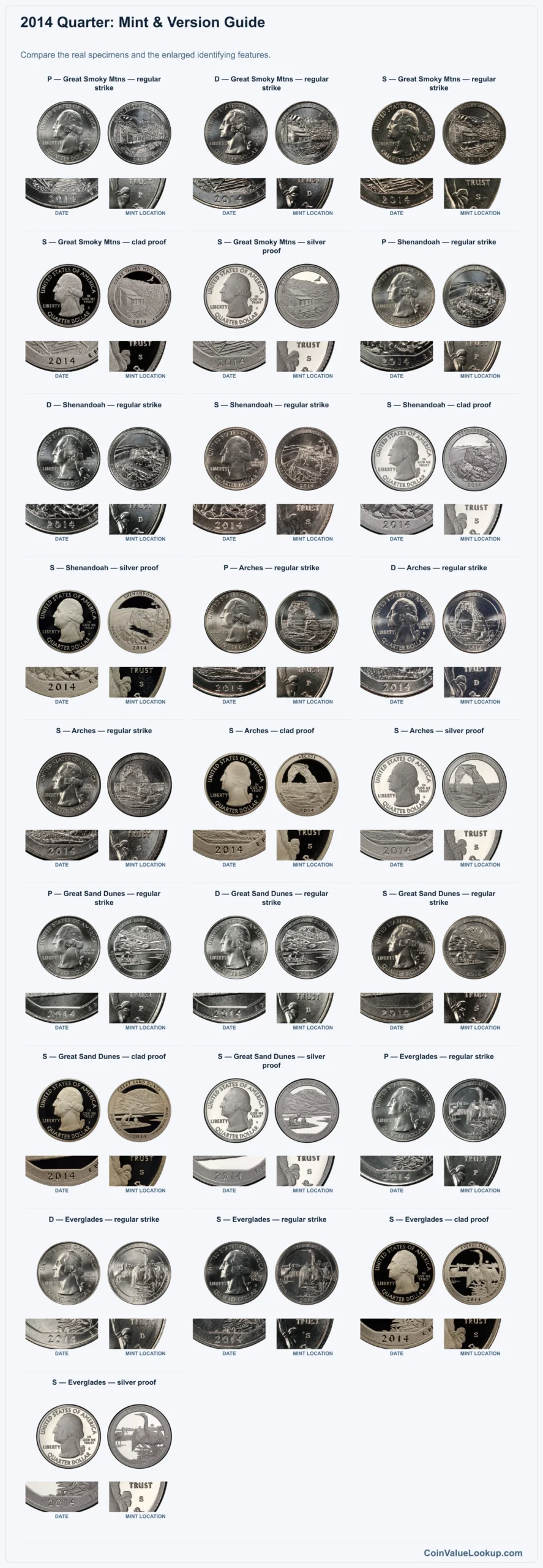
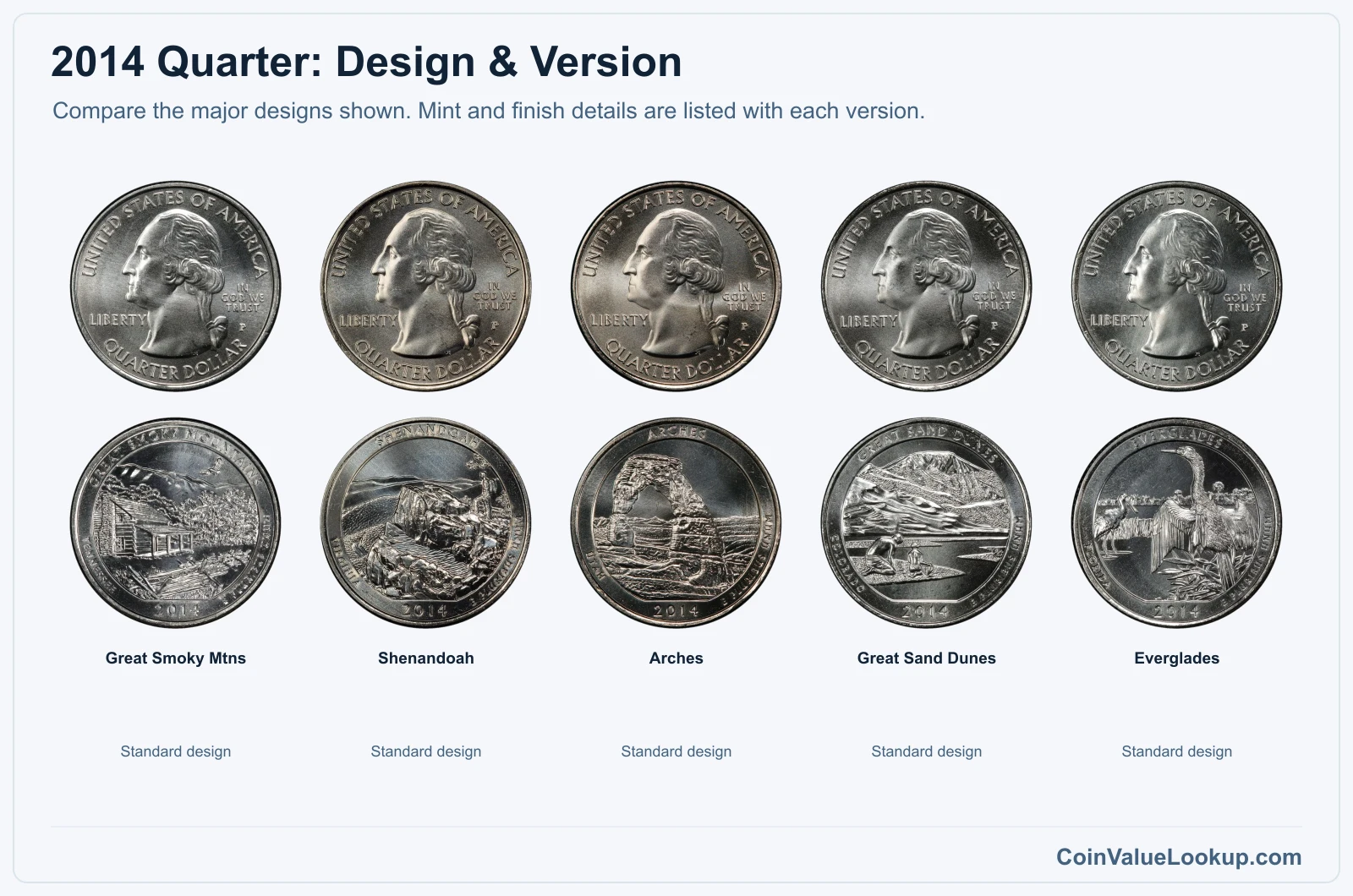
The 2014 quarter belongs to the America the Beautiful series, and five different reverse designs were struck that year: Great Smoky Mountains, Shenandoah, Arches, Great Sand Dunes and Everglades. Guide estimates from USA Coin Book range from about $0.61 to $24.00 depending on mint, finish and grade.
Mint, condition and whether you hold a clad or silver proof determine where your coin falls in that spread.
Fast Way to Identify Your 2014 Quarter
Upload clear photos of your coin's front and back, and our identifier can give you a preliminary read on which 2014 quarter version you have. That means matching the mintmark, reverse design and likely finish so you know where to look next.
It is not a substitute for professional authentication or exact grading.
2014 Quarter Value
Upload both sides of your 2014 Quarter.
Front Obverse
Upload photo
Back Reverse
Upload photo
Which 2014 Quarter Versions Are Worth Money?
- Silver proof versions across all five designs carry the highest guide estimates at $24.00 in PR65 — check your edge and weight to confirm silver content.
- San Francisco uncirculated (non-proof) clad strikes list at $10.00 in MS65 per USA Coin Book, well above Philadelphia or Denver business strikes.
- Clad proof versions from San Francisco are estimated at $5.63 in PR65, so distinguishing clad proof from silver proof matters for value.
- Several error categories have been reported for 2014 quarters, including doubled dies, cuds and off-center strikes — condition and visibility drive their individual value.
Step 1: Identify Your 2014 Quarter Mint Mark and Version
Start on the obverse. Look near the base of Washington's portrait for the mintmark: P for Philadelphia, D for Denver, or S for San Francisco.
Then flip the coin and identify the reverse scene — Great Smoky Mountains, Shenandoah, Arches, Great Sand Dunes or Everglades. The design name is inscribed on the reverse, so this step is straightforward.
An S mintmark alone does not mean you have a proof. San Francisco also produced non-proof clad collector strikes in 2014.
To tell the difference, check for mirrored fields and frosted raised devices — that is proof finishing. A business-strike S-mint coin will have a normal satin or luster appearance instead.
Silver proofs and clad proofs can look similar face-on. The silver version weighs about 6.25 grams versus roughly 5.67 grams for a clad coin.
If you look at the edge, a clad coin shows a visible copper-colored stripe from the core, while a silver proof has a uniform silver-toned edge. Original mint packaging also confirms composition.
This guide covers standard 24.26 mm quarters only. The U.S. Mint also issued five-ounce silver collector pieces sharing these designs — those are a completely different product with different values.
Step 2: Check Your 2014 Quarter Grade
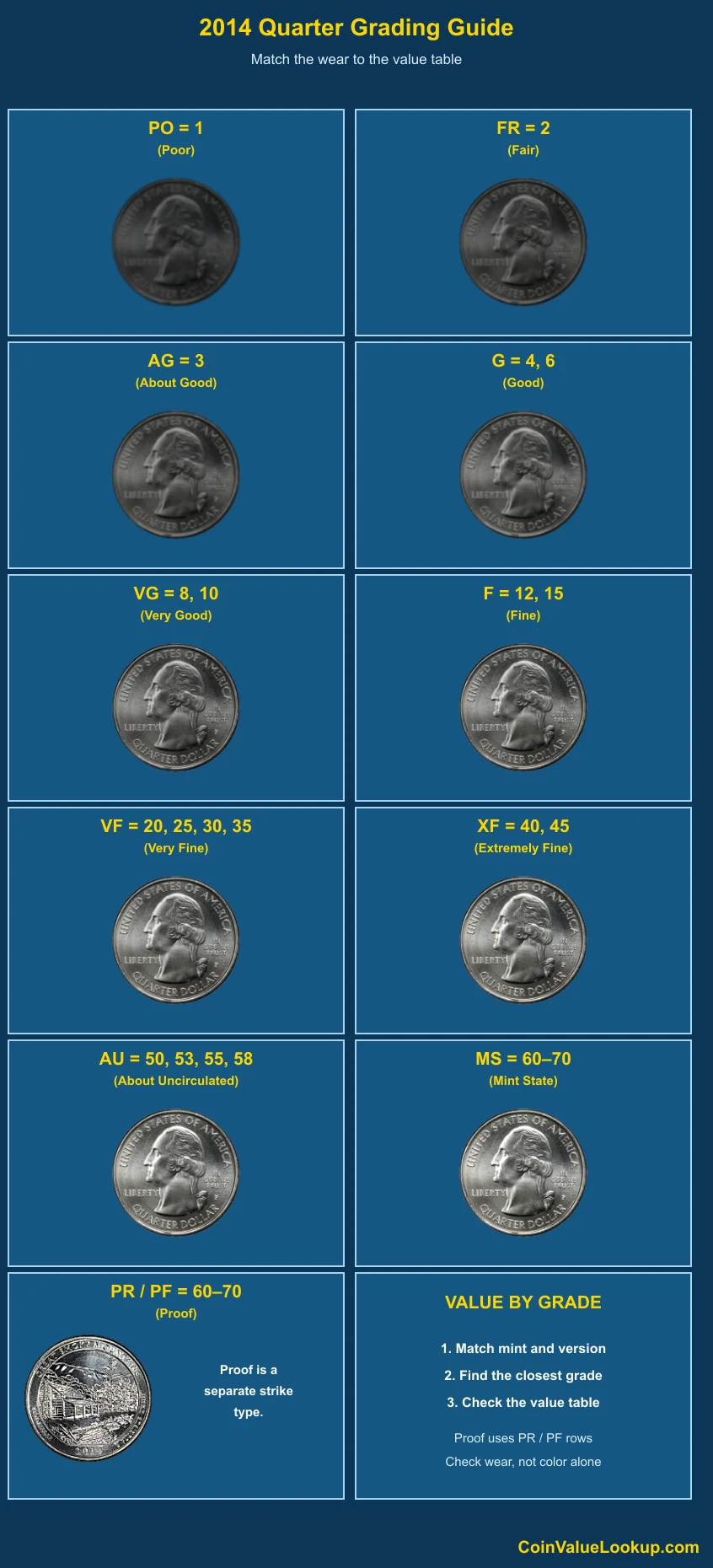
For business strikes, focus on Washington's cheek and the hair detail above his ear on the obverse. These are the first spots to show wear.
On the reverse, check the highest relief points of whichever park design you have.
Compare your coin's luster with the reference image. A coin grading MS65 should show full original mint luster with no distracting contact marks in the prime focal areas.
At MS60, you still have no wear, but bag marks and reduced eye appeal bring the grade down.
For proofs, examine the mirror fields under good light. Hairlines from handling or cleaning lower the grade quickly, even when the devices still look sharp.
Haze or milky toning on the fields also matters.
Do not confuse a weak strike with wear. Some 2014 quarters came off the press with soft detail on certain design elements.
If the surrounding luster is intact and there is no friction, the coin may be uncirculated despite looking "flat" in spots.
Step 3: Check 2014 Quarter Value by Mint and Version
2014 Quarter — P — Great Smoky Mtns — regular strike
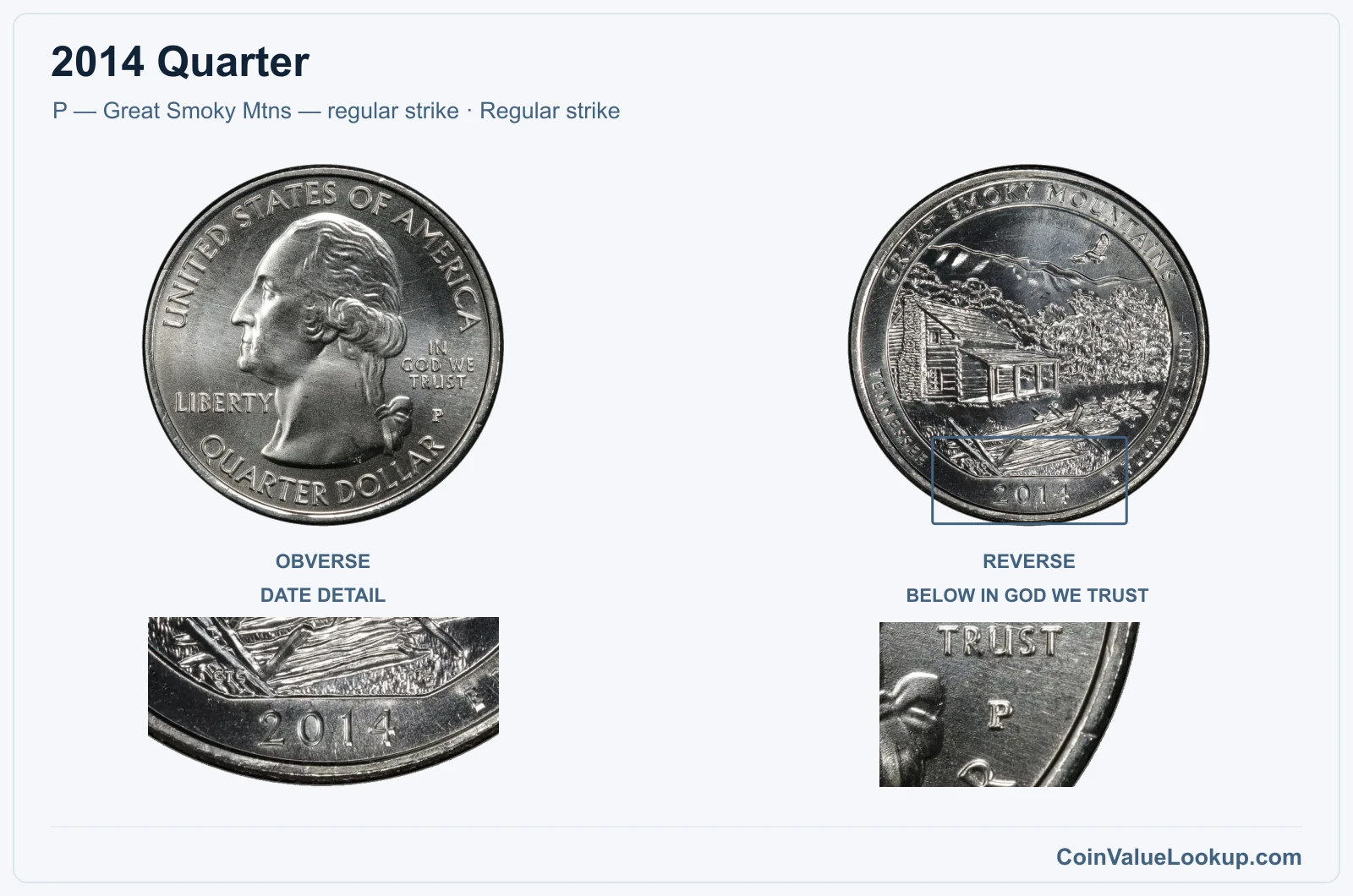
This is the Philadelphia mint business strike with the Great Smoky Mountains reverse, showing a log cabin and mountain ridge. It is made of copper-nickel clad over a copper core, weighs about 5.67 grams and measures 24.26 mm across.
Worn examples from pocket change are worth face value. USA Coin Book estimates about $0.74 at MS60 and $1.24 at MS65.
To reach those guide levels the coin needs full original luster and minimal contact marks.
Range Grade
Price Auction Records Appraisal PO PO 1
—
Coin Identifier FR FR 2
—
Coin Identifier AG AG 3
—
Coin Identifier G G 4
—
Coin Identifier
G 6
—
Coin Identifier VG VG 8
—
Coin Identifier
VG 10
—
Coin Identifier F F 12
—
Coin Identifier
F 15
—
Coin Identifier VF VF 20
—
Coin Identifier
VF 25
—
Coin Identifier
VF 30
—
Coin Identifier
VF 35
—
Coin Identifier XF XF 40
—
Coin Identifier
XF 45
—
Coin Identifier AU AU 50
—
Coin Identifier
AU 53
—
Coin Identifier
AU 55
—
Coin Identifier
AU 58
—
Coin Identifier MS MS 60
—
Coin Identifier
MS 61
—
Coin Identifier
MS 62
—
Coin Identifier
MS 63
—
Coin Identifier
MS 64
—
Coin Identifier
MS 65
—
Coin Identifier
MS 66
—
Coin Identifier
MS 67
—
Coin Identifier
MS 68
Coin Identifier
MS 69
—
—
—
MS 70
—
—
—
2014 Quarter — D — Great Smoky Mtns — regular strike
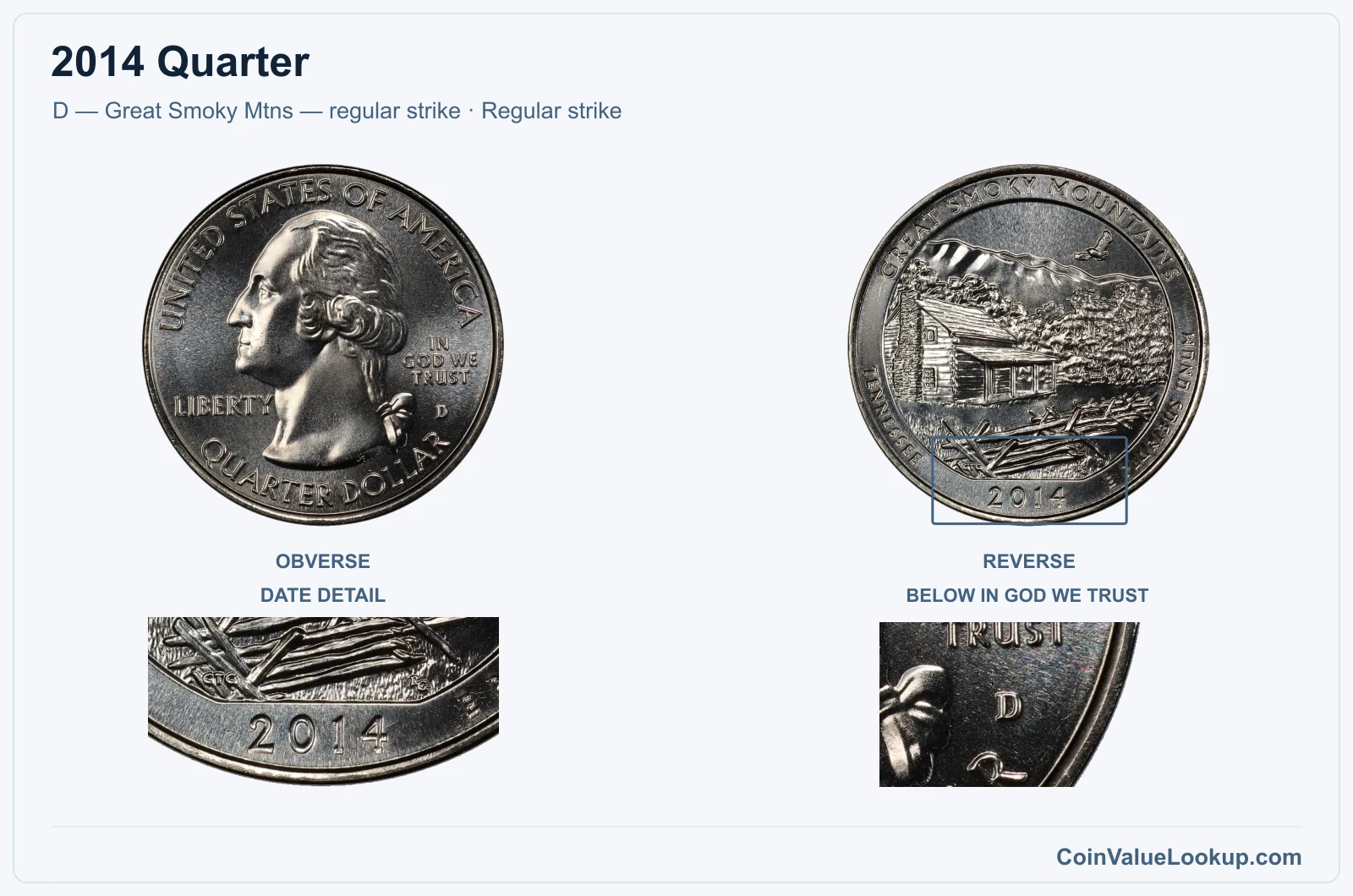
Denver's Great Smoky Mountains quarter is the same clad composition and design as the P-mint version, just with a D mintmark. Circulated pieces trade at face value.
USA Coin Book lists about $0.74 at MS60 and $1.24 at MS65. Look for the D below Washington's portrait to confirm the mint.
High-grade rolls from Denver are common, so condition has to be genuinely clean to command a premium.
Range Grade
Price Auction Records Appraisal PO PO 1
—
Coin Identifier FR FR 2
—
Coin Identifier AG AG 3
—
Coin Identifier G G 4
—
Coin Identifier
G 6
—
Coin Identifier VG VG 8
—
Coin Identifier
VG 10
—
Coin Identifier F F 12
—
Coin Identifier
F 15
—
Coin Identifier VF VF 20
—
Coin Identifier
VF 25
—
Coin Identifier
VF 30
—
Coin Identifier
VF 35
—
Coin Identifier XF XF 40
—
Coin Identifier
XF 45
—
Coin Identifier AU AU 50
—
Coin Identifier
AU 53
—
Coin Identifier
AU 55
—
Coin Identifier
AU 58
—
Coin Identifier MS MS 60
—
Coin Identifier
MS 61
—
Coin Identifier
MS 62
—
Coin Identifier
MS 63
—
Coin Identifier
MS 64
—
Coin Identifier
MS 65
—
Coin Identifier
MS 66
—
Coin Identifier
MS 67
—
Coin Identifier
MS 68
—
Coin Identifier
MS 69
—
—
—
MS 70
—
—
—
2014 Quarter — S — Great Smoky Mtns — regular strike
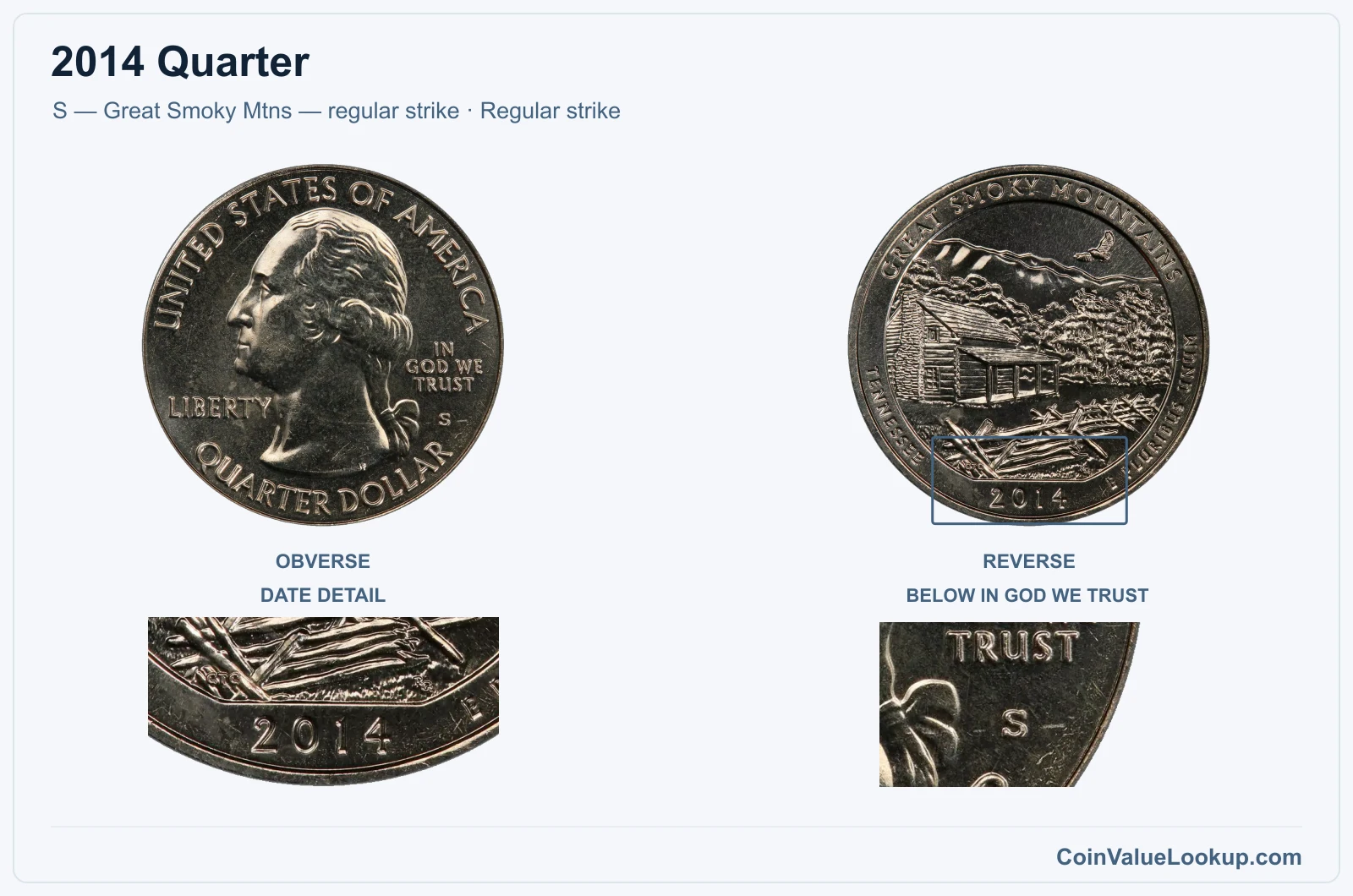
San Francisco struck a non-proof clad version of the Great Smoky Mountains quarter. This is not a proof — it has normal luster rather than mirrored fields.
The S mintmark alone does not make it special in the proof sense, but these were produced in smaller quantities for collector sets. USA Coin Book estimates $10.00 at MS65, a meaningful step up from the P and D business strikes.
Confirm the finish before applying this value.
Range Grade
Price Auction Records Appraisal PO PO 1
—
Coin Identifier FR FR 2
—
Coin Identifier AG AG 3
—
Coin Identifier G G 4
—
Coin Identifier
G 6
—
Coin Identifier VG VG 8
—
Coin Identifier
VG 10
—
Coin Identifier F F 12
—
Coin Identifier
F 15
—
Coin Identifier VF VF 20
—
Coin Identifier
VF 25
—
Coin Identifier
VF 30
—
Coin Identifier
VF 35
—
Coin Identifier XF XF 40
—
Coin Identifier
XF 45
—
Coin Identifier AU AU 50
—
Coin Identifier
AU 53
—
Coin Identifier
AU 55
—
Coin Identifier
AU 58
—
Coin Identifier MS MS 60
—
Coin Identifier
MS 61
—
Coin Identifier
MS 62
—
Coin Identifier
MS 63
—
Coin Identifier
MS 64
—
Coin Identifier
MS 65
—
Coin Identifier
MS 66
—
Coin Identifier
MS 67
—
Coin Identifier
MS 68
—
Coin Identifier
MS 69
—
—
—
MS 70
—
—
—
2014 Quarter — S — Great Smoky Mtns — clad proof
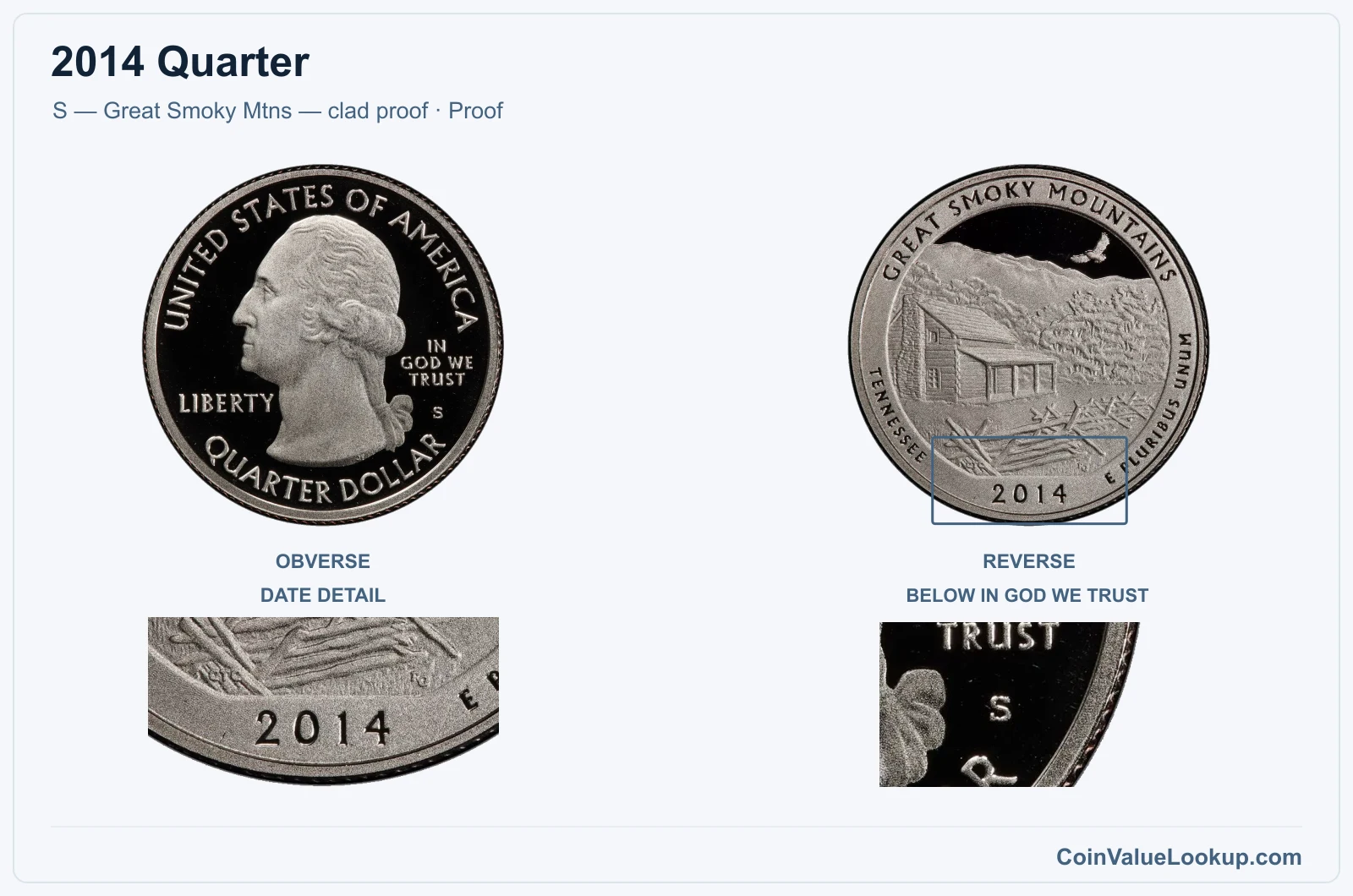
The clad proof Great Smoky Mountains quarter was struck at San Francisco with mirror fields and frosted devices. It is still copper-nickel clad over a copper core, not silver.
USA Coin Book estimates about $5.63 at PR65. Check the edge — a visible copper-toned stripe means clad.
If you bought a standard 2014 proof set from the Mint, the quarters inside are clad proofs.
Range Grade
Price Auction Records Appraisal PR PR 1
—
Coin Identifier
PR 2
—
Coin Identifier
PR 3
—
Coin Identifier
PR 4
—
Coin Identifier
PR 6
—
Coin Identifier
PR 8
—
Coin Identifier
PR 10
—
Coin Identifier
PR 12
—
Coin Identifier
PR 15
—
Coin Identifier
PR 20
—
Coin Identifier
PR 25
—
Coin Identifier
PR 30
—
Coin Identifier
PR 35
—
Coin Identifier
PR 40
—
Coin Identifier
PR 45
—
Coin Identifier
PR 50
—
Coin Identifier
PR 53
—
Coin Identifier
PR 55
—
Coin Identifier
PR 58
—
Coin Identifier
PR 60
—
Coin Identifier
PR 61
—
Coin Identifier
PR 62
—
Coin Identifier
PR 63
—
Coin Identifier
PR 64
—
Coin Identifier
PR 65
—
Coin Identifier
PR 66
—
Coin Identifier
PR 67
—
Coin Identifier
PR 68
—
Coin Identifier
PR 69
—
Coin Identifier
PR 70
Coin Identifier
2014 Quarter — S — Great Smoky Mtns — silver proof
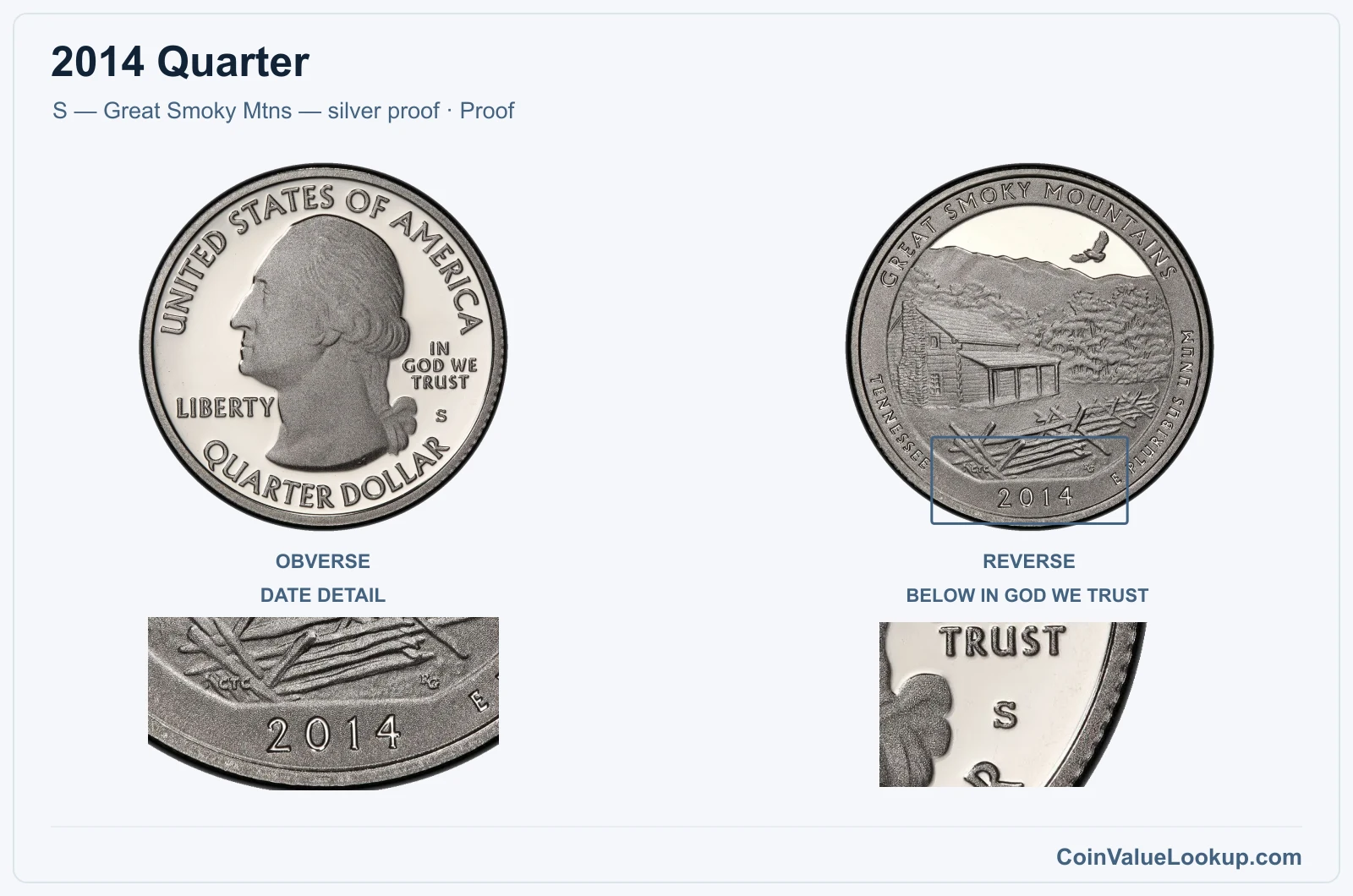
This is the silver proof version of the Great Smoky Mountains quarter, struck at San Francisco in 90% silver and 10% copper. It weighs roughly 6.25 grams, noticeably heavier than a clad quarter.
The edge shows a uniform silver tone with no copper stripe. USA Coin Book estimates $24.00 at PR65, making it one of the higher-value 2014 quarter versions at that grade.
These came in the silver proof sets sold by the Mint. Hairlines from mishandling are the biggest grade killer on proofs, so check the fields carefully under angled light.
Range Grade
Price Auction Records Appraisal PR PR 1
—
Coin Identifier
PR 2
—
Coin Identifier
PR 3
—
Coin Identifier
PR 4
—
Coin Identifier
PR 6
—
Coin Identifier
PR 8
—
Coin Identifier
PR 10
—
Coin Identifier
PR 12
—
Coin Identifier
PR 15
—
Coin Identifier
PR 20
—
Coin Identifier
PR 25
—
Coin Identifier
PR 30
—
Coin Identifier
PR 35
—
Coin Identifier
PR 40
—
Coin Identifier
PR 45
—
Coin Identifier
PR 50
—
Coin Identifier
PR 53
—
Coin Identifier
PR 55
—
Coin Identifier
PR 58
—
Coin Identifier
PR 60
—
Coin Identifier
PR 61
—
Coin Identifier
PR 62
—
Coin Identifier
PR 63
—
Coin Identifier
PR 64
—
Coin Identifier
PR 65
—
Coin Identifier
PR 66
—
Coin Identifier
PR 67
—
Coin Identifier
PR 68
—
Coin Identifier
PR 69
—
Coin Identifier
PR 70
Coin Identifier
2014 Quarter — P — Shenandoah — regular strike
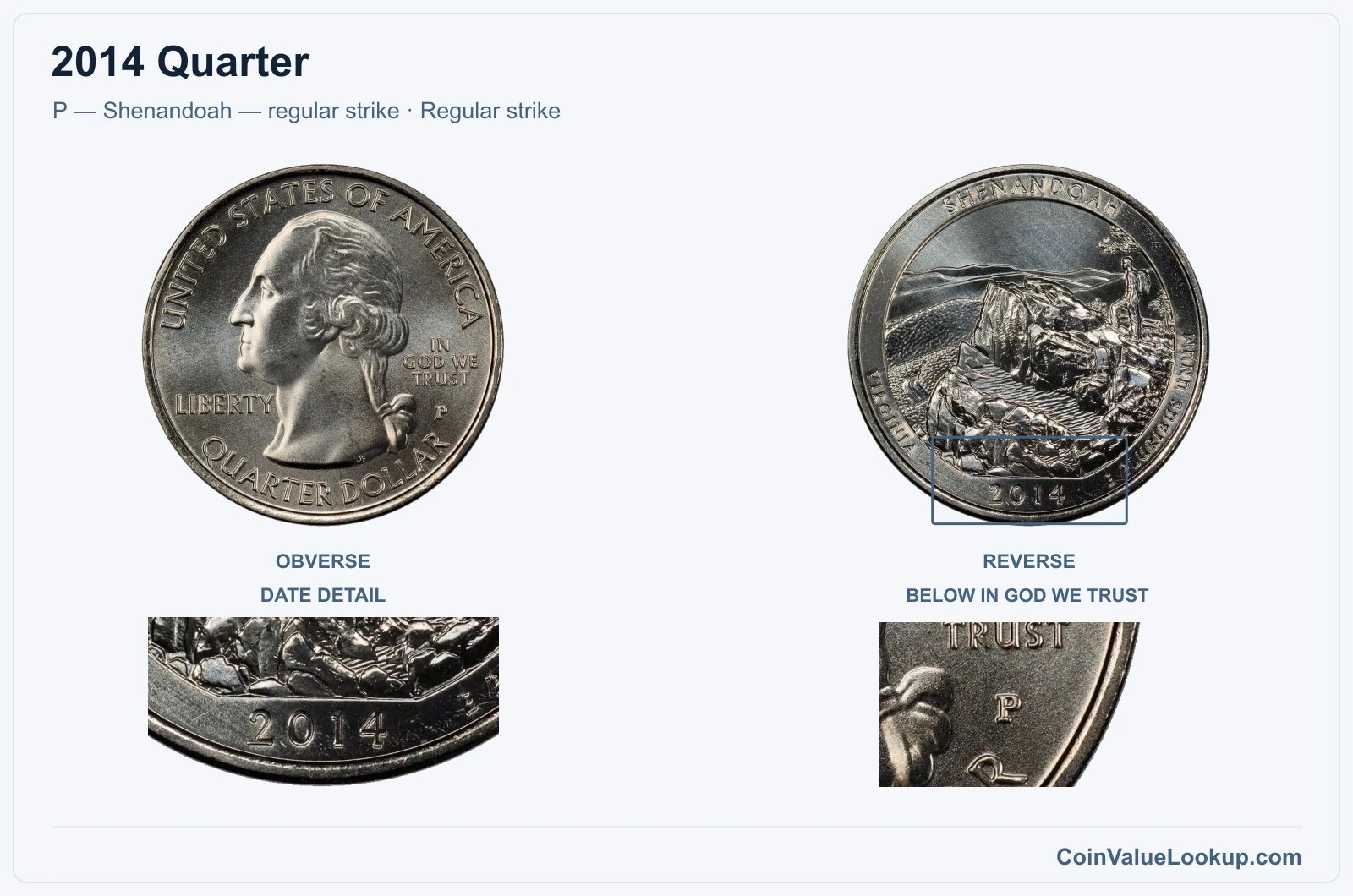
Philadelphia's Shenandoah quarter depicts a hiker overlooking the Shenandoah Valley. Standard copper-nickel clad, 5.67 grams, 24.26 mm.
Circulated coins are worth 25 cents. USA Coin Book puts the guide at $0.74 in MS60 and $1.24 in MS65.
To matter, the coin needs to be original and free of handling marks in the open field areas around the hiker figure.
Range Grade
Price Auction Records Appraisal PO PO 1
—
Coin Identifier FR FR 2
—
Coin Identifier AG AG 3
—
Coin Identifier G G 4
—
Coin Identifier
G 6
—
Coin Identifier VG VG 8
—
Coin Identifier
VG 10
—
Coin Identifier F F 12
—
Coin Identifier
F 15
—
Coin Identifier VF VF 20
—
Coin Identifier
VF 25
—
Coin Identifier
VF 30
—
Coin Identifier
VF 35
—
Coin Identifier XF XF 40
—
Coin Identifier
XF 45
—
Coin Identifier AU AU 50
—
Coin Identifier
AU 53
—
Coin Identifier
AU 55
—
Coin Identifier
AU 58
—
Coin Identifier MS MS 60
—
Coin Identifier
MS 61
—
Coin Identifier
MS 62
—
Coin Identifier
MS 63
—
Coin Identifier
MS 64
—
Coin Identifier
MS 65
—
Coin Identifier
MS 66
—
Coin Identifier
MS 67
—
Coin Identifier
MS 68
Coin Identifier
MS 69
—
—
—
MS 70
—
—
—
2014 Quarter — D — Shenandoah — regular strike
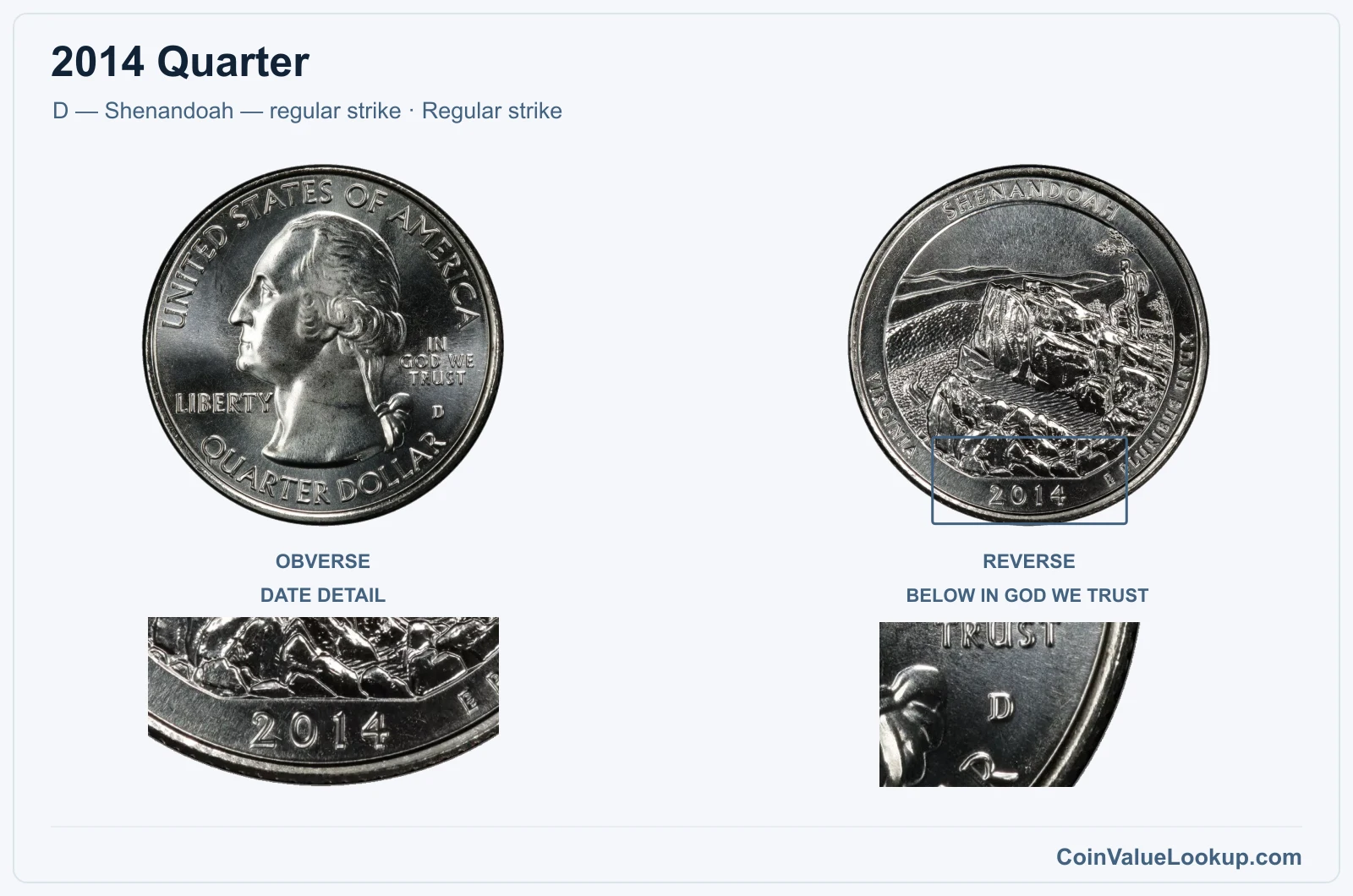
The Denver Shenandoah quarter is identical in design and composition to the P-mint, just carrying a D mintmark. Worn pieces are face value.
USA Coin Book estimates $0.74 at MS60 and $1.24 at MS65. These are plentiful in uncirculated condition from mint-sewn bags and rolls, so the premium above face is small unless the coin grades well above MS65.
Range Grade
Price Auction Records Appraisal PO PO 1
—
Coin Identifier FR FR 2
—
Coin Identifier AG AG 3
—
Coin Identifier G G 4
—
Coin Identifier
G 6
—
Coin Identifier VG VG 8
—
Coin Identifier
VG 10
—
Coin Identifier F F 12
—
Coin Identifier
F 15
—
Coin Identifier VF VF 20
—
Coin Identifier
VF 25
—
Coin Identifier
VF 30
—
Coin Identifier
VF 35
—
Coin Identifier XF XF 40
—
Coin Identifier
XF 45
—
Coin Identifier AU AU 50
—
Coin Identifier
AU 53
—
Coin Identifier
AU 55
—
Coin Identifier
AU 58
—
Coin Identifier MS MS 60
—
Coin Identifier
MS 61
—
Coin Identifier
MS 62
—
Coin Identifier
MS 63
—
Coin Identifier
MS 64
—
Coin Identifier
MS 65
—
Coin Identifier
MS 66
—
Coin Identifier
MS 67
—
Coin Identifier
MS 68
—
Coin Identifier
MS 69
—
—
—
MS 70
—
—
—
2014 Quarter — S — Shenandoah — regular strike
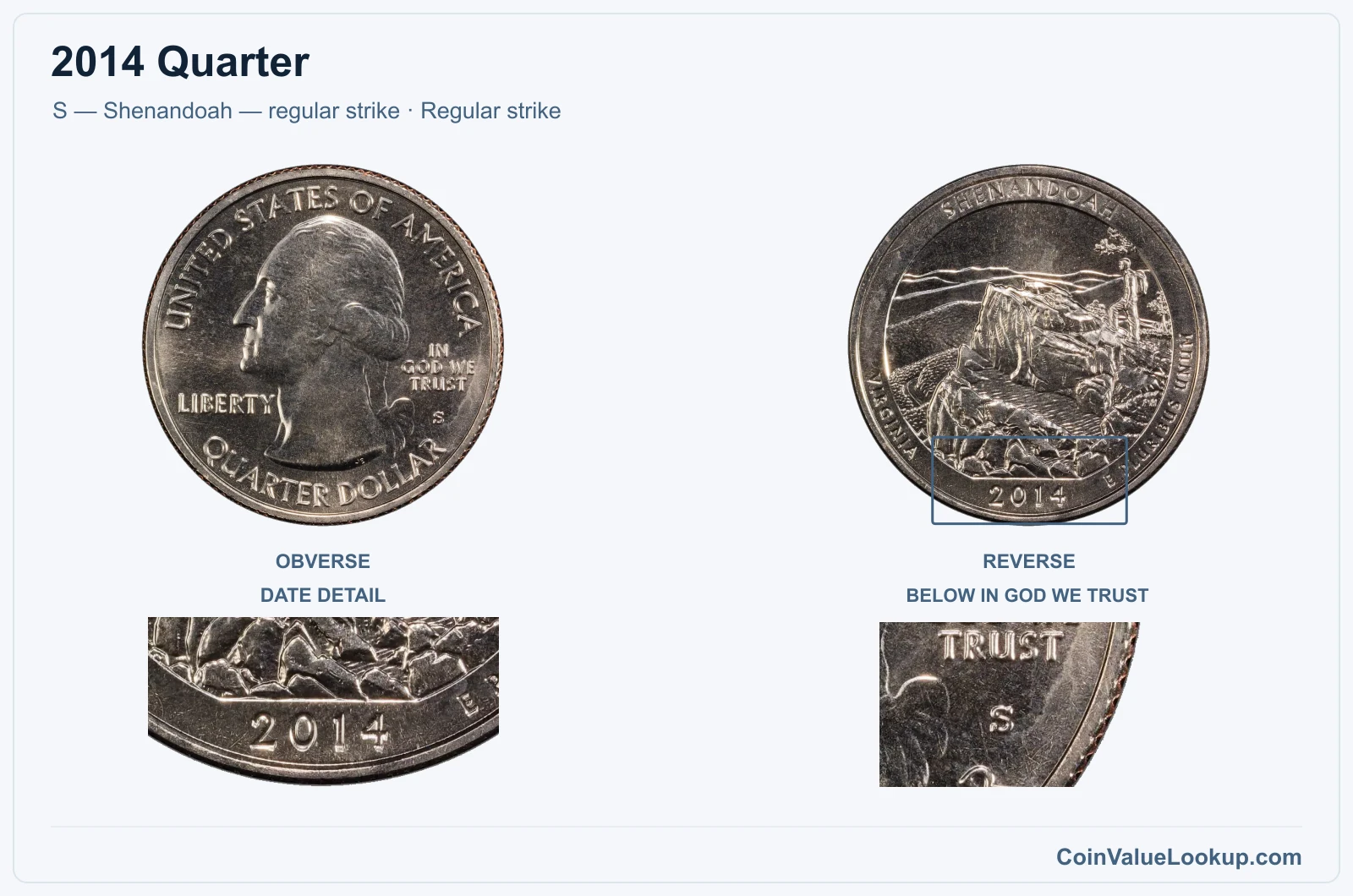
San Francisco's uncirculated clad Shenandoah quarter has an S mintmark but no proof finish. The fields show normal luster, not mirrors.
USA Coin Book lists $10.00 at MS65, significantly above the P and D strikes. Verify the finish before attributing this value — a proof coin from the same mint belongs in a different category.
Coin Value Lookup is a good starting point when you need to look up guides for other quarters in the America the Beautiful series or compare across different years.
Range Grade
Price Auction Records Appraisal PO PO 1
—
Coin Identifier FR FR 2
—
Coin Identifier AG AG 3
—
Coin Identifier G G 4
—
Coin Identifier
G 6
—
Coin Identifier VG VG 8
—
Coin Identifier
VG 10
—
Coin Identifier F F 12
—
Coin Identifier
F 15
—
Coin Identifier VF VF 20
—
Coin Identifier
VF 25
—
Coin Identifier
VF 30
—
Coin Identifier
VF 35
—
Coin Identifier XF XF 40
—
Coin Identifier
XF 45
—
Coin Identifier AU AU 50
—
Coin Identifier
AU 53
—
Coin Identifier
AU 55
—
Coin Identifier
AU 58
—
Coin Identifier MS MS 60
—
Coin Identifier
MS 61
—
Coin Identifier
MS 62
—
Coin Identifier
MS 63
—
Coin Identifier
MS 64
—
Coin Identifier
MS 65
—
Coin Identifier
MS 66
—
Coin Identifier
MS 67
—
Coin Identifier
MS 68
—
Coin Identifier
MS 69
—
—
—
MS 70
—
—
—
2014 Quarter — S — Shenandoah — clad proof
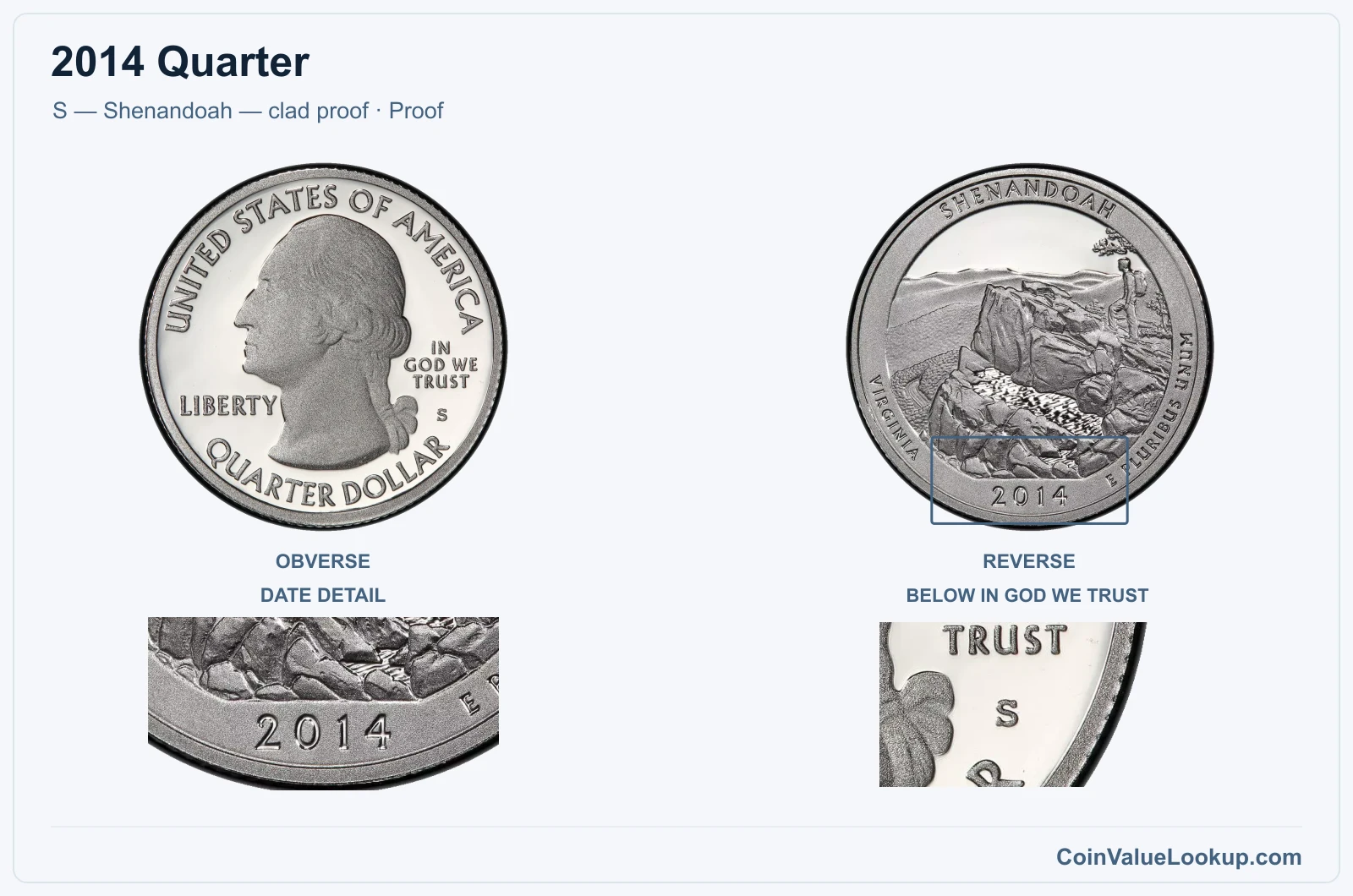
The clad proof Shenandoah quarter has deeply mirrored fields and frosted raised devices, struck at San Francisco. Composition is copper-nickel clad, not silver.
USA Coin Book estimates $5.63 at PR65. These came in the standard proof sets.
If you are unsure whether yours is clad or silver, weigh it and check the edge for a copper stripe.
Range Grade
Price Auction Records Appraisal PR PR 1
—
Coin Identifier
PR 2
—
Coin Identifier
PR 3
—
Coin Identifier
PR 4
—
Coin Identifier
PR 6
—
Coin Identifier
PR 8
—
Coin Identifier
PR 10
—
Coin Identifier
PR 12
—
Coin Identifier
PR 15
—
Coin Identifier
PR 20
—
Coin Identifier
PR 25
—
Coin Identifier
PR 30
—
Coin Identifier
PR 35
—
Coin Identifier
PR 40
—
Coin Identifier
PR 45
—
Coin Identifier
PR 50
—
Coin Identifier
PR 53
—
Coin Identifier
PR 55
—
Coin Identifier
PR 58
—
Coin Identifier
PR 60
—
Coin Identifier
PR 61
—
Coin Identifier
PR 62
—
Coin Identifier
PR 63
—
Coin Identifier
PR 64
—
Coin Identifier
PR 65
—
Coin Identifier
PR 66
—
Coin Identifier
PR 67
—
Coin Identifier
PR 68
—
Coin Identifier
PR 69
—
Coin Identifier
PR 70
Coin Identifier
2014 Quarter — S — Shenandoah — silver proof
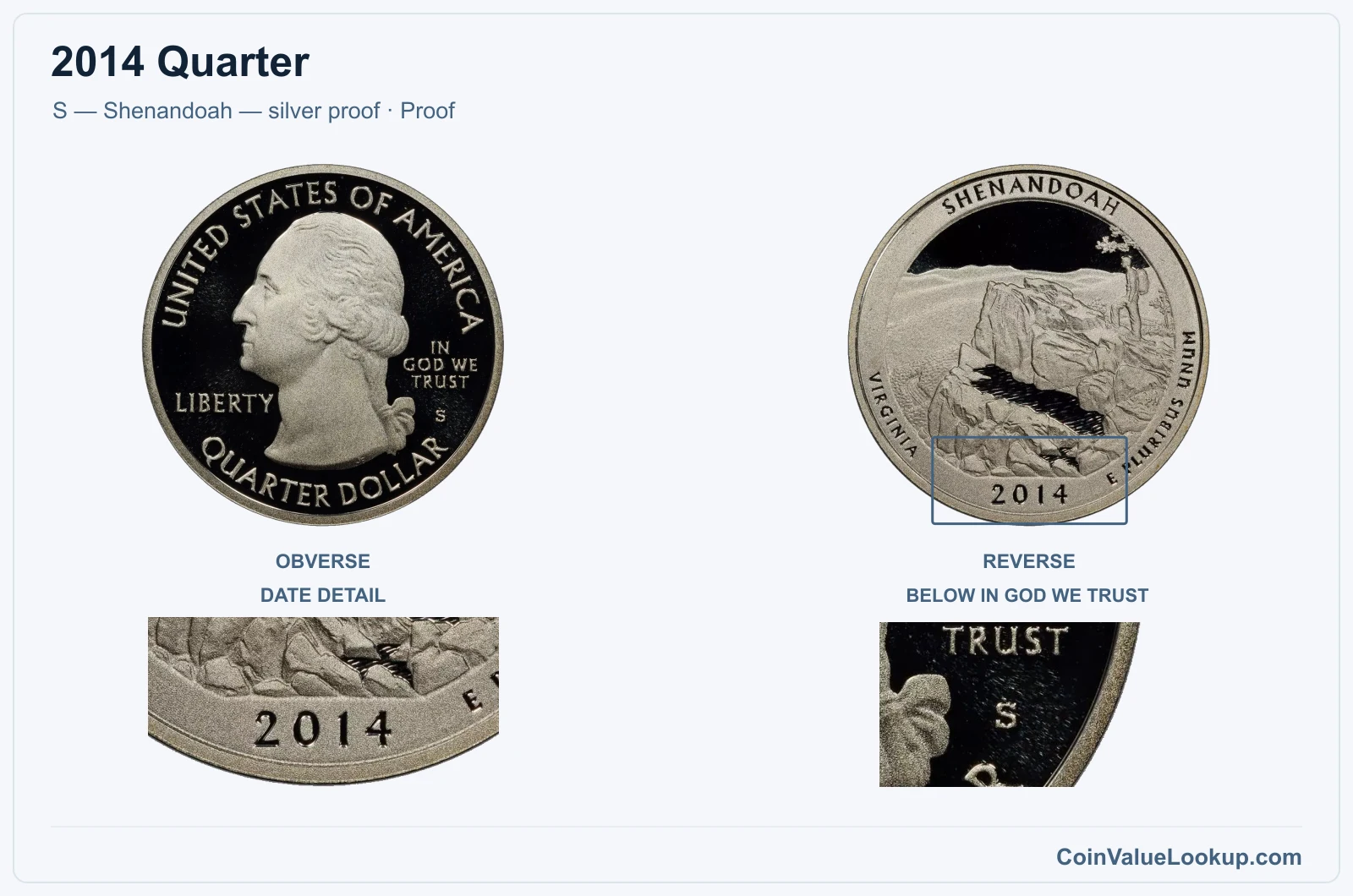
San Francisco's silver proof Shenandoah quarter is 90% silver and 10% copper, weighing about 6.25 grams. The edge is uniformly silver-toned.
USA Coin Book estimates $24.00 at PR65. Silver proof sets from 2014 contained all five designs in this composition.
Handle these by the edges — fingerprints on proof surfaces are permanent and reduce the grade.
Range Grade
Price Auction Records Appraisal PR PR 1
—
Coin Identifier
PR 2
—
Coin Identifier
PR 3
—
Coin Identifier
PR 4
—
Coin Identifier
PR 6
—
Coin Identifier
PR 8
—
Coin Identifier
PR 10
—
Coin Identifier
PR 12
—
Coin Identifier
PR 15
—
Coin Identifier
PR 20
—
Coin Identifier
PR 25
—
Coin Identifier
PR 30
—
Coin Identifier
PR 35
—
Coin Identifier
PR 40
—
Coin Identifier
PR 45
—
Coin Identifier
PR 50
—
Coin Identifier
PR 53
—
Coin Identifier
PR 55
—
Coin Identifier
PR 58
—
Coin Identifier
PR 60
—
Coin Identifier
PR 61
—
Coin Identifier
PR 62
—
Coin Identifier
PR 63
—
Coin Identifier
PR 64
—
Coin Identifier
PR 65
—
Coin Identifier
PR 66
—
Coin Identifier
PR 67
—
Coin Identifier
PR 68
—
Coin Identifier
PR 69
—
Coin Identifier
PR 70
Coin Identifier
2014 Quarter — P — Arches — regular strike
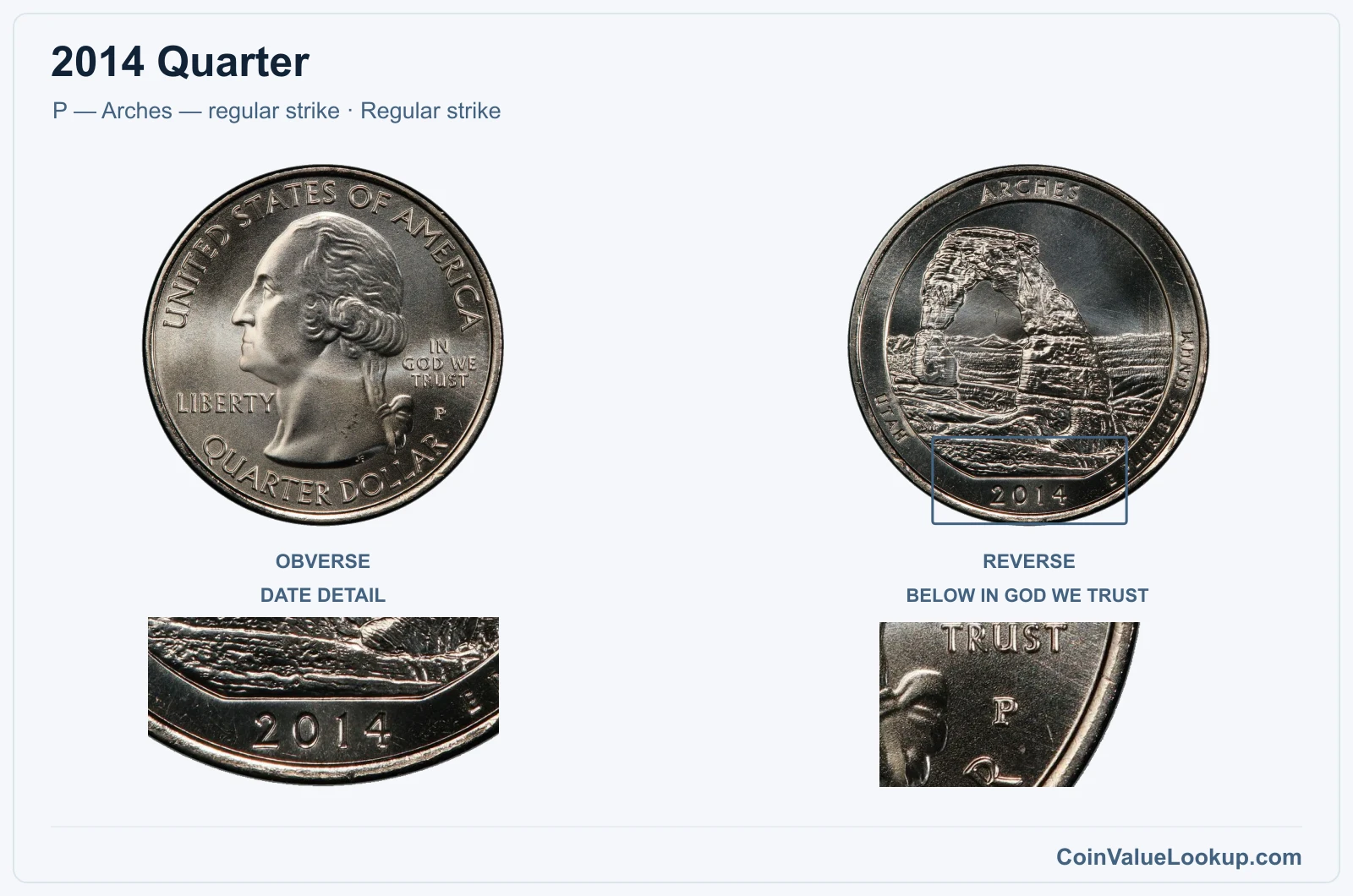
The Philadelphia Arches quarter shows the iconic rock formation from Arches National Park in Utah. Copper-nickel clad, 5.67 grams, standard size.
In circulation it is worth 25 cents. USA Coin Book lists $0.74 at MS60 and $1.24 at MS65.
The high-relief areas of the natural arch are the first place to check for contact marks.
Range Grade
Price Auction Records Appraisal PO PO 1
—
Coin Identifier FR FR 2
—
Coin Identifier AG AG 3
—
Coin Identifier G G 4
—
Coin Identifier
G 6
—
Coin Identifier VG VG 8
—
Coin Identifier
VG 10
—
Coin Identifier F F 12
—
Coin Identifier
F 15
—
Coin Identifier VF VF 20
—
Coin Identifier
VF 25
—
Coin Identifier
VF 30
—
Coin Identifier
VF 35
—
Coin Identifier XF XF 40
—
Coin Identifier
XF 45
—
Coin Identifier AU AU 50
—
Coin Identifier
AU 53
—
Coin Identifier
AU 55
—
Coin Identifier
AU 58
—
Coin Identifier MS MS 60
—
Coin Identifier
MS 61
—
Coin Identifier
MS 62
—
Coin Identifier
MS 63
—
Coin Identifier
MS 64
—
Coin Identifier
MS 65
—
Coin Identifier
MS 66
—
Coin Identifier
MS 67
—
Coin Identifier
MS 68
—
Coin Identifier
MS 69
—
—
—
MS 70
—
—
—
2014 Quarter — D — Arches — regular strike
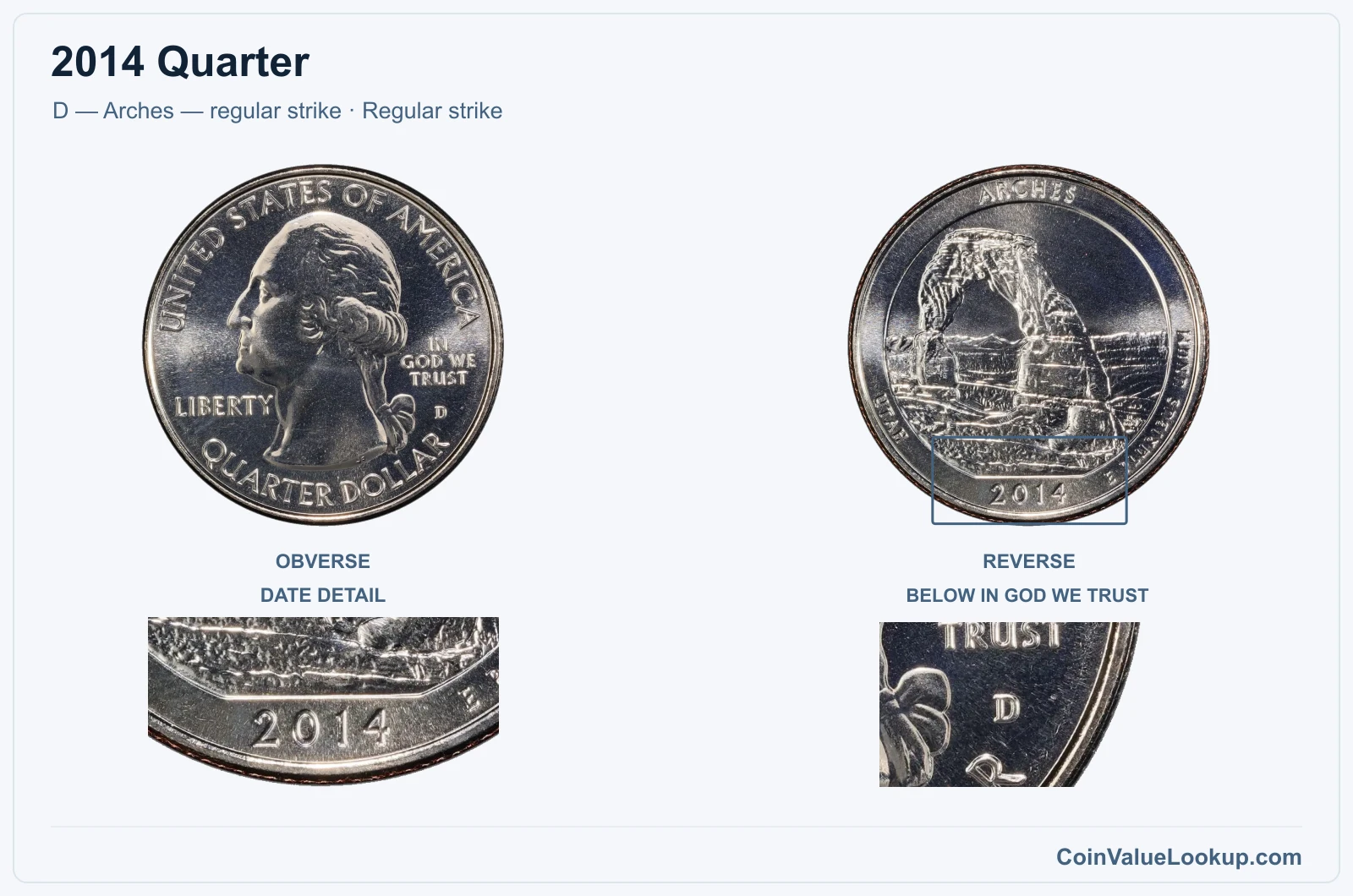
Denver's Arches quarter is the same design and clad composition, marked with a D. Circulated examples are worth face value.
USA Coin Book estimates $0.74 at MS60 and $1.24 at MS65. Plenty of uncirculated examples exist, so only well-preserved coins with minimal marks approach the higher guide levels.
Range Grade
Price Auction Records Appraisal PO PO 1
—
Coin Identifier FR FR 2
—
Coin Identifier AG AG 3
—
Coin Identifier G G 4
—
Coin Identifier
G 6
—
Coin Identifier VG VG 8
—
Coin Identifier
VG 10
—
Coin Identifier F F 12
—
Coin Identifier
F 15
—
Coin Identifier VF VF 20
—
Coin Identifier
VF 25
—
Coin Identifier
VF 30
—
Coin Identifier
VF 35
—
Coin Identifier XF XF 40
—
Coin Identifier
XF 45
—
Coin Identifier AU AU 50
—
Coin Identifier
AU 53
—
Coin Identifier
AU 55
—
Coin Identifier
AU 58
—
Coin Identifier MS MS 60
—
Coin Identifier
MS 61
—
Coin Identifier
MS 62
—
Coin Identifier
MS 63
—
Coin Identifier
MS 64
—
Coin Identifier
MS 65
—
Coin Identifier
MS 66
—
Coin Identifier
MS 67
—
Coin Identifier
MS 68
Coin Identifier
MS 69
—
Coin Identifier
MS 70
—
—
—
2014 Quarter — S — Arches — regular strike
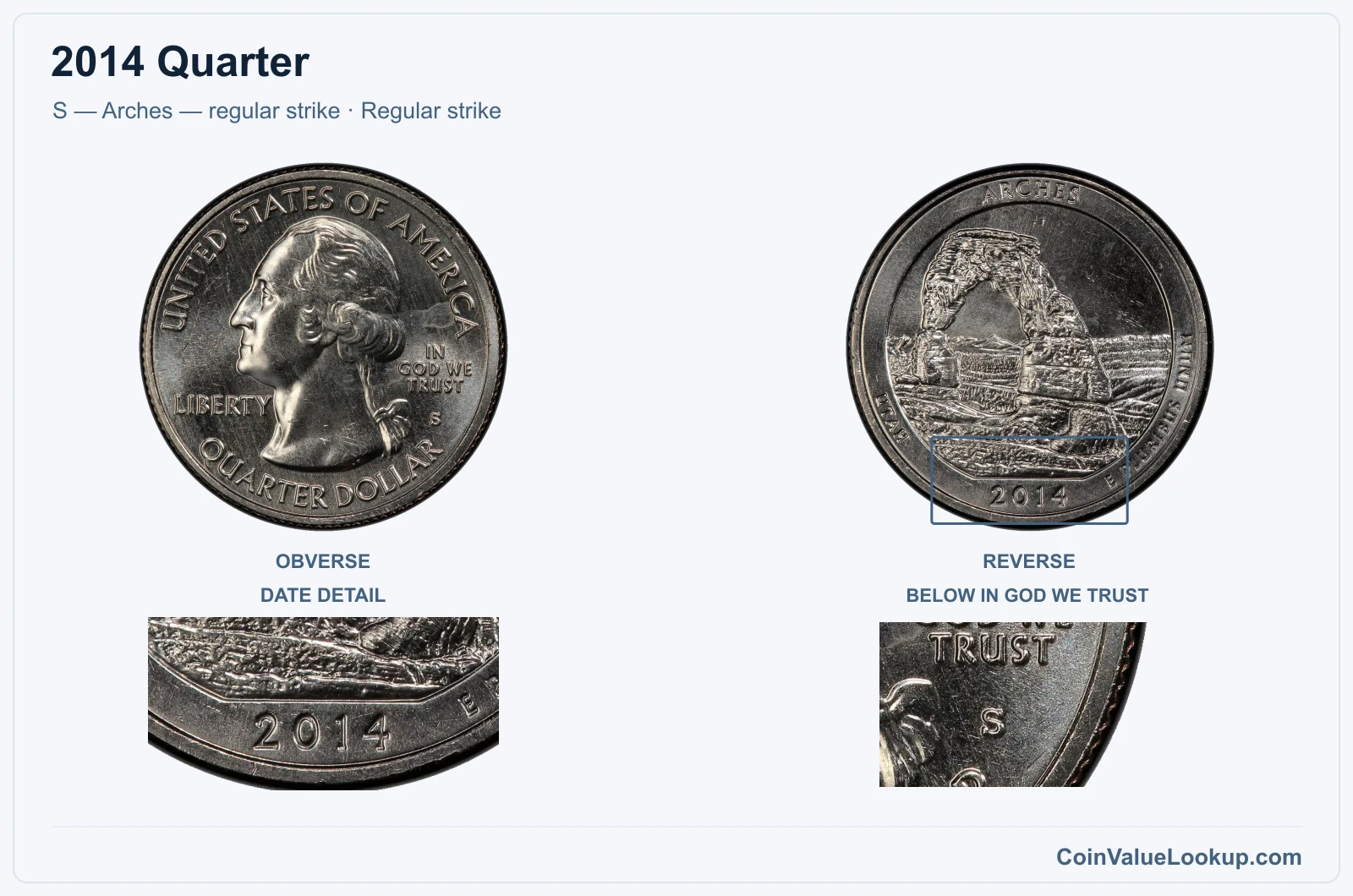
This is the San Francisco uncirculated clad Arches quarter — not a proof. It has the S mintmark and normal luster.
USA Coin Book estimates $10.00 at MS65, reflecting its lower mintage compared to Philadelphia and Denver. Double-check the finish: mirrored fields would make it a proof, which uses a different value line.
Range Grade
Price Auction Records Appraisal PO PO 1
—
Coin Identifier FR FR 2
—
Coin Identifier AG AG 3
—
Coin Identifier G G 4
—
Coin Identifier
G 6
—
Coin Identifier VG VG 8
—
Coin Identifier
VG 10
—
Coin Identifier F F 12
—
Coin Identifier
F 15
—
Coin Identifier VF VF 20
—
Coin Identifier
VF 25
—
Coin Identifier
VF 30
—
Coin Identifier
VF 35
—
Coin Identifier XF XF 40
—
Coin Identifier
XF 45
—
Coin Identifier AU AU 50
—
Coin Identifier
AU 53
—
Coin Identifier
AU 55
—
Coin Identifier
AU 58
—
Coin Identifier MS MS 60
—
Coin Identifier
MS 61
—
Coin Identifier
MS 62
—
Coin Identifier
MS 63
—
Coin Identifier
MS 64
—
Coin Identifier
MS 65
—
Coin Identifier
MS 66
—
Coin Identifier
MS 67
—
Coin Identifier
MS 68
—
Coin Identifier
MS 69
—
—
—
MS 70
—
—
—
2014 Quarter — S — Arches — clad proof
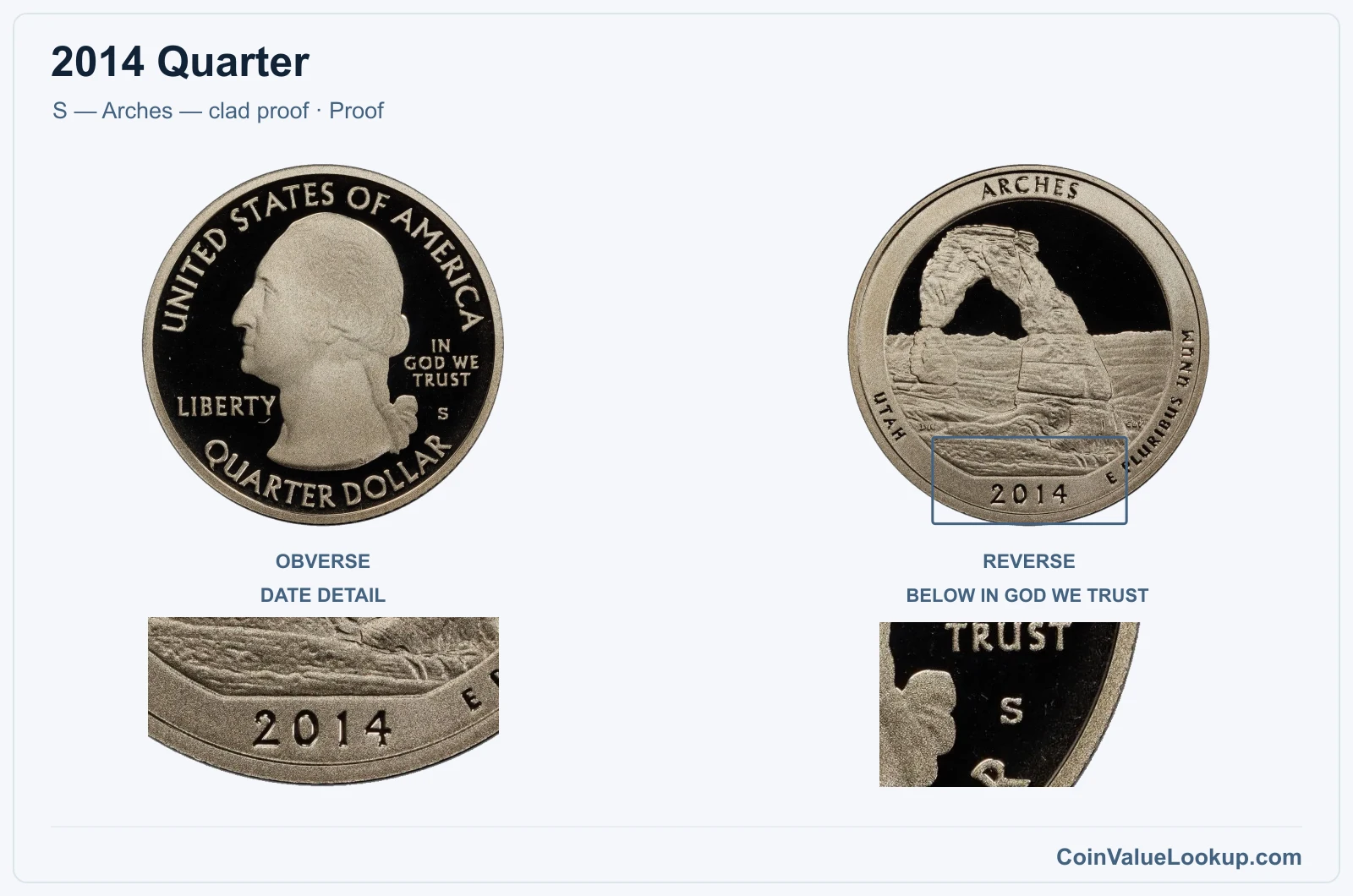
The clad proof Arches quarter was struck at San Francisco with proof finishing. Fields are mirrored, devices frosted.
Composition remains copper-nickel clad. USA Coin Book estimates $5.63 at PR65.
These were part of the standard 2014 proof set. The edge copper stripe distinguishes clad from silver if you no longer have the original packaging.
Range Grade
Price Auction Records Appraisal PR PR 1
—
Coin Identifier
PR 2
—
Coin Identifier
PR 3
—
Coin Identifier
PR 4
—
Coin Identifier
PR 6
—
Coin Identifier
PR 8
—
Coin Identifier
PR 10
—
Coin Identifier
PR 12
—
Coin Identifier
PR 15
—
Coin Identifier
PR 20
—
Coin Identifier
PR 25
—
Coin Identifier
PR 30
—
Coin Identifier
PR 35
—
Coin Identifier
PR 40
—
Coin Identifier
PR 45
—
Coin Identifier
PR 50
—
Coin Identifier
PR 53
—
Coin Identifier
PR 55
—
Coin Identifier
PR 58
—
Coin Identifier
PR 60
—
Coin Identifier
PR 61
—
Coin Identifier
PR 62
—
Coin Identifier
PR 63
—
Coin Identifier
PR 64
—
Coin Identifier
PR 65
—
Coin Identifier
PR 66
—
Coin Identifier
PR 67
—
Coin Identifier
PR 68
—
Coin Identifier
PR 69
—
Coin Identifier
PR 70
Coin Identifier
2014 Quarter — S — Arches — silver proof
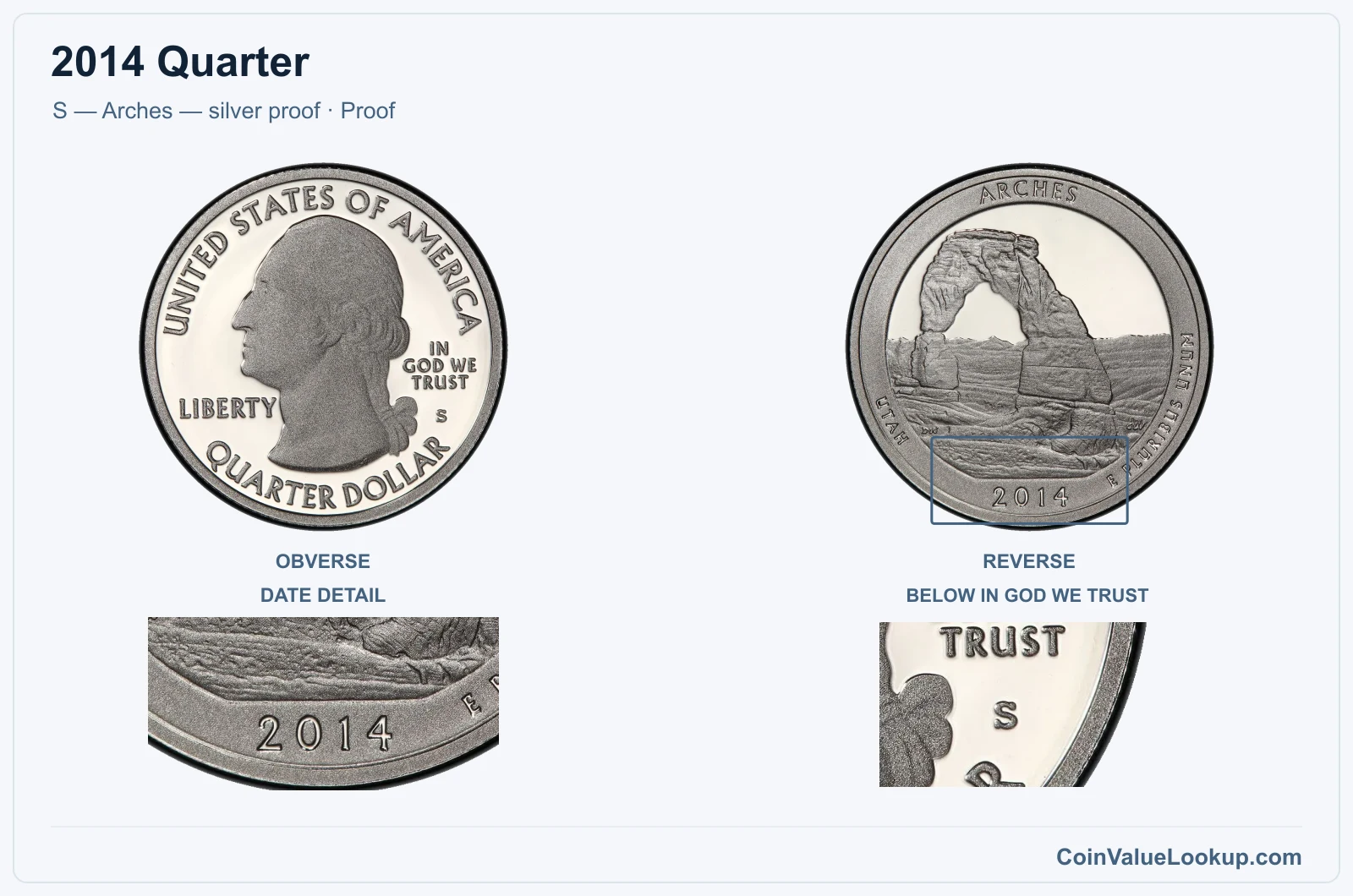
The silver proof Arches quarter is 90% silver, struck at San Francisco with full proof finishing. It weighs about 6.25 grams — roughly half a gram heavier than the clad version.
USA Coin Book estimates $24.00 at PR65. The uniform silver edge and extra heft are the key identifiers.
In high grades these are attractive coins, with the rock arch design lending itself well to the cameo contrast of frosted devices over mirrored fields.
Range Grade
Price Auction Records Appraisal PR PR 1
—
Coin Identifier
PR 2
—
Coin Identifier
PR 3
—
Coin Identifier
PR 4
—
Coin Identifier
PR 6
—
Coin Identifier
PR 8
—
Coin Identifier
PR 10
—
Coin Identifier
PR 12
—
Coin Identifier
PR 15
—
Coin Identifier
PR 20
—
Coin Identifier
PR 25
—
Coin Identifier
PR 30
—
Coin Identifier
PR 35
—
Coin Identifier
PR 40
—
Coin Identifier
PR 45
—
Coin Identifier
PR 50
—
Coin Identifier
PR 53
—
Coin Identifier
PR 55
—
Coin Identifier
PR 58
—
Coin Identifier
PR 60
—
Coin Identifier
PR 61
—
Coin Identifier
PR 62
—
Coin Identifier
PR 63
—
Coin Identifier
PR 64
—
Coin Identifier
PR 65
—
Coin Identifier
PR 66
—
Coin Identifier
PR 67
—
Coin Identifier
PR 68
—
Coin Identifier
PR 69
—
Coin Identifier
PR 70
Coin Identifier
2014 Quarter — P — Great Sand Dunes — regular strike
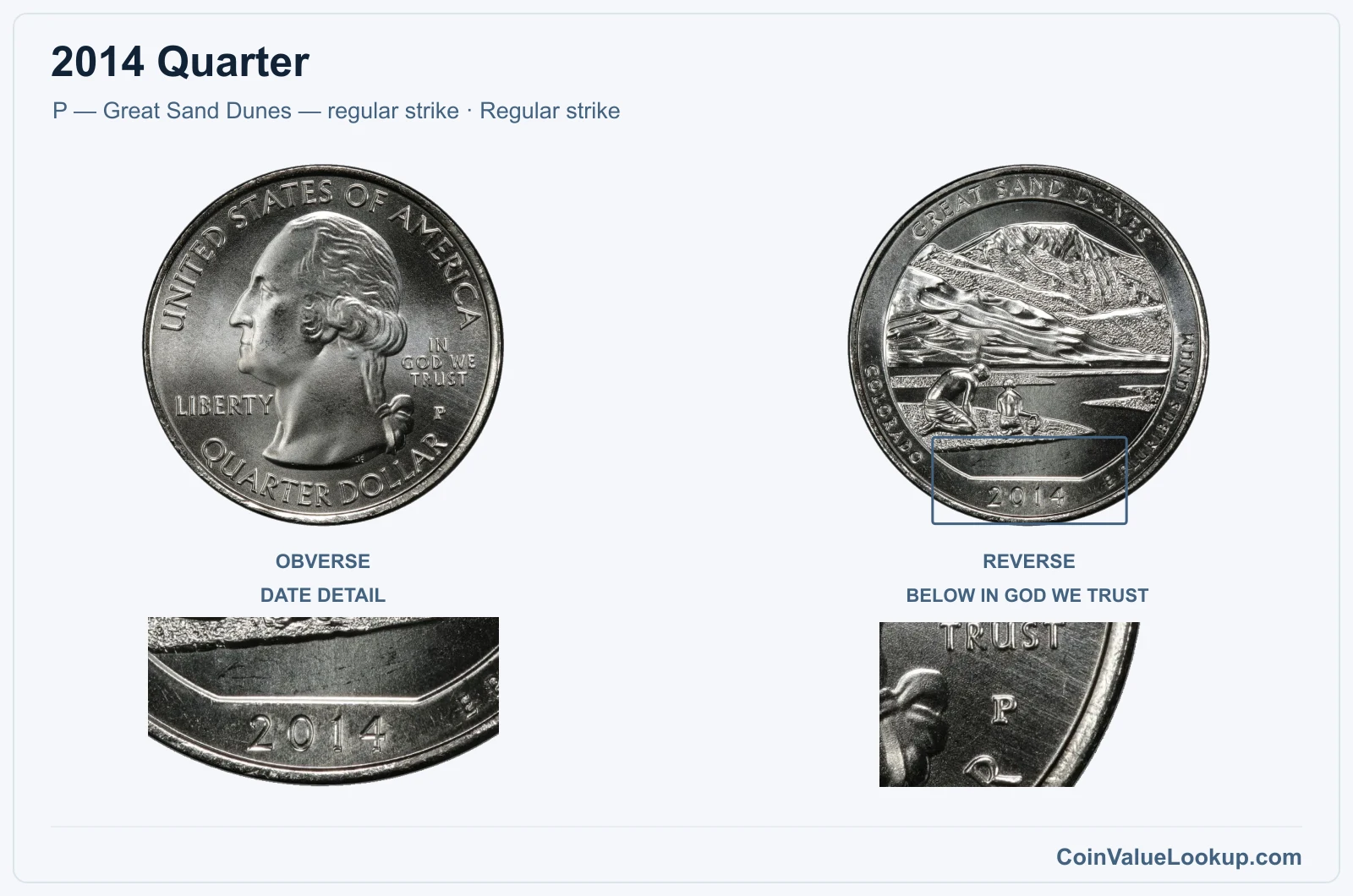
Philadelphia's Great Sand Dunes quarter features the dramatic dune field of Colorado's national park. Copper-nickel clad, 5.67 grams, 24.26 mm.
Circulated pieces are face value. USA Coin Book estimates $0.74 at MS60 and $1.24 at MS65.
Check the dune ridges for bag marks — that open design area picks up contact easily.
Range Grade
Price Auction Records Appraisal PO PO 1
—
Coin Identifier FR FR 2
—
Coin Identifier AG AG 3
—
Coin Identifier G G 4
—
Coin Identifier
G 6
—
Coin Identifier VG VG 8
—
Coin Identifier
VG 10
—
Coin Identifier F F 12
—
Coin Identifier
F 15
—
Coin Identifier VF VF 20
—
Coin Identifier
VF 25
—
Coin Identifier
VF 30
—
Coin Identifier
VF 35
—
Coin Identifier XF XF 40
—
Coin Identifier
XF 45
—
Coin Identifier AU AU 50
—
Coin Identifier
AU 53
—
Coin Identifier
AU 55
—
Coin Identifier
AU 58
—
Coin Identifier MS MS 60
—
Coin Identifier
MS 61
—
Coin Identifier
MS 62
—
Coin Identifier
MS 63
—
Coin Identifier
MS 64
—
Coin Identifier
MS 65
—
Coin Identifier
MS 66
—
Coin Identifier
MS 67
—
Coin Identifier
MS 68
—
Coin Identifier
MS 69
—
—
—
MS 70
—
—
—
2014 Quarter — D — Great Sand Dunes — regular strike
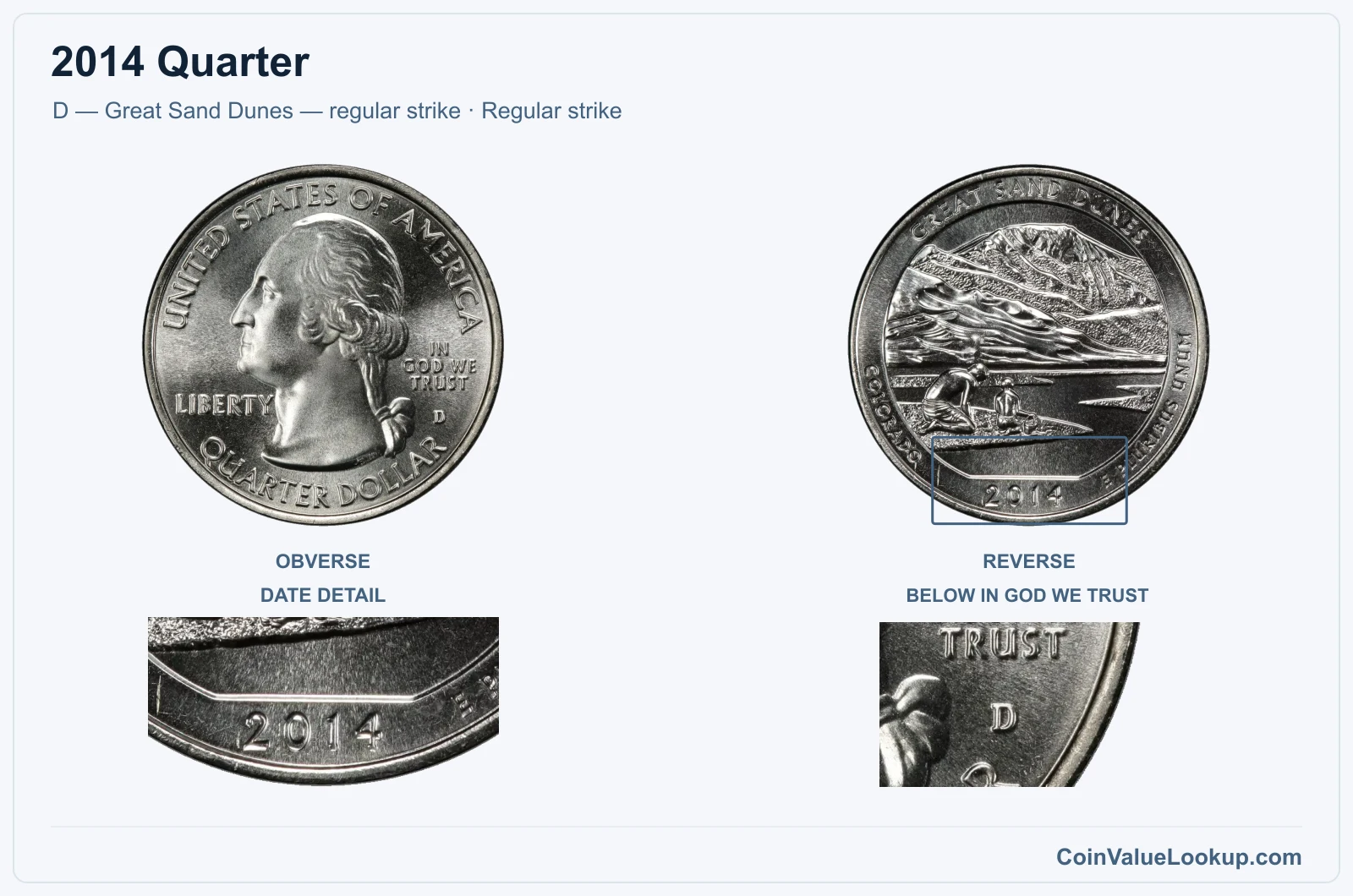
The Denver Great Sand Dunes quarter is clad, D-mint. It trades at face value in circulated grades.
USA Coin Book estimates $0.68 at MS60 and $1.24 at MS65 — the MS60 guide is slightly lower than most other 2014 P and D quarters. As always, confirm the mintmark and reverse design before looking up a value.
Range Grade
Price Auction Records Appraisal PO PO 1
—
Coin Identifier FR FR 2
—
Coin Identifier AG AG 3
—
Coin Identifier G G 4
—
Coin Identifier
G 6
—
Coin Identifier VG VG 8
—
Coin Identifier
VG 10
—
Coin Identifier F F 12
—
Coin Identifier
F 15
—
Coin Identifier VF VF 20
—
Coin Identifier
VF 25
—
Coin Identifier
VF 30
—
Coin Identifier
VF 35
—
Coin Identifier XF XF 40
—
Coin Identifier
XF 45
—
Coin Identifier AU AU 50
—
Coin Identifier
AU 53
—
Coin Identifier
AU 55
—
Coin Identifier
AU 58
—
Coin Identifier MS MS 60
—
Coin Identifier
MS 61
—
Coin Identifier
MS 62
—
Coin Identifier
MS 63
—
Coin Identifier
MS 64
—
Coin Identifier
MS 65
—
Coin Identifier
MS 66
—
Coin Identifier
MS 67
—
Coin Identifier
MS 68
Coin Identifier
MS 69
—
—
—
MS 70
—
—
—
2014 Quarter — S — Great Sand Dunes — regular strike
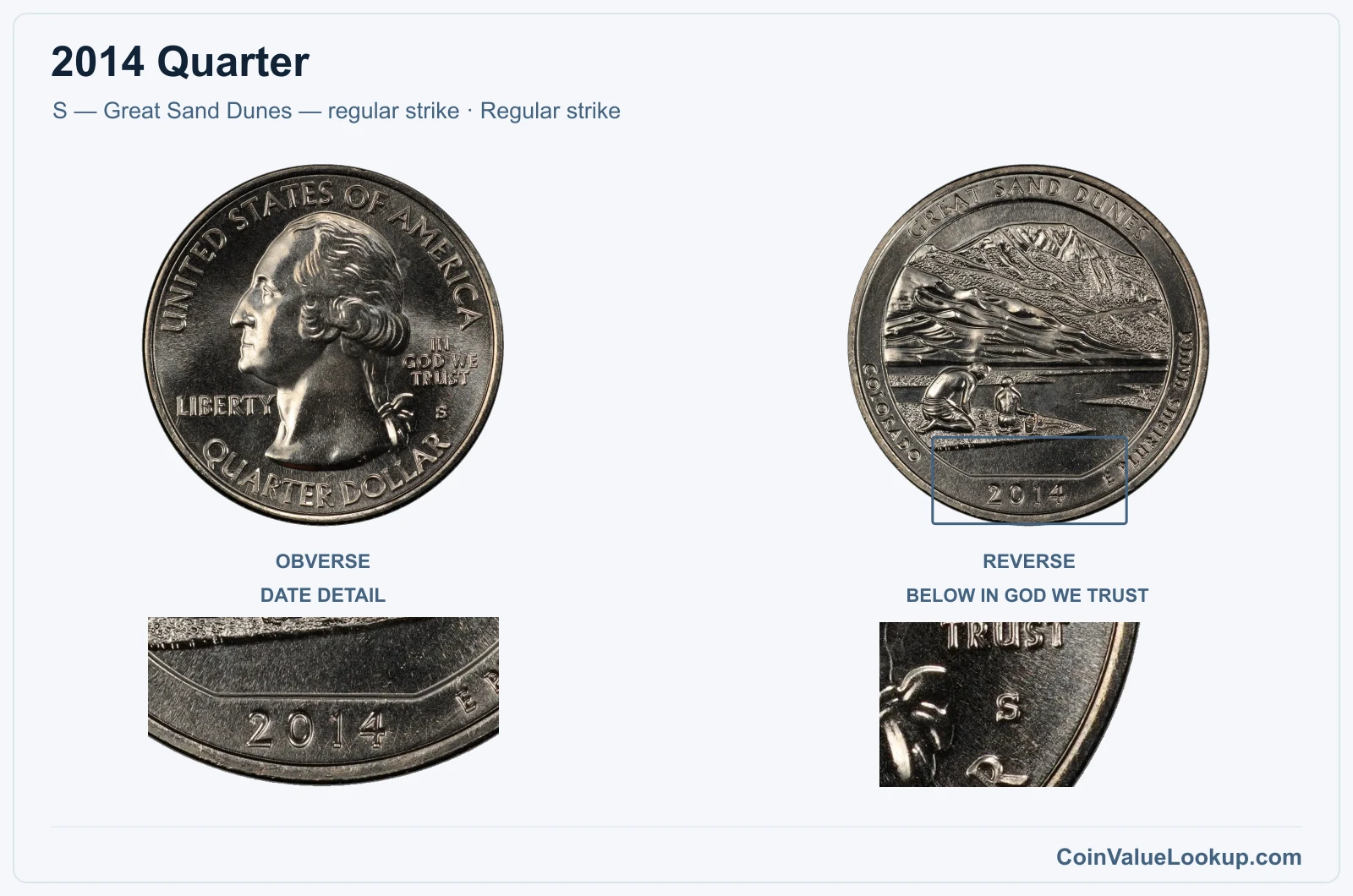
San Francisco's uncirculated clad Great Sand Dunes quarter carries an S mintmark but has business-strike luster, not proof mirrors. USA Coin Book estimates $10.00 at MS65.
These were available through collector channels, not general circulation. If the fields look reflective rather than satiny, you may have a proof instead — check the edge and weigh it to be sure.
Range Grade
Price Auction Records Appraisal PO PO 1
—
Coin Identifier FR FR 2
—
Coin Identifier AG AG 3
—
Coin Identifier G G 4
—
Coin Identifier
G 6
—
Coin Identifier VG VG 8
—
Coin Identifier
VG 10
—
Coin Identifier F F 12
—
Coin Identifier
F 15
—
Coin Identifier VF VF 20
—
Coin Identifier
VF 25
—
Coin Identifier
VF 30
—
Coin Identifier
VF 35
—
Coin Identifier XF XF 40
—
Coin Identifier
XF 45
—
Coin Identifier AU AU 50
—
Coin Identifier
AU 53
—
Coin Identifier
AU 55
—
Coin Identifier
AU 58
—
Coin Identifier MS MS 60
—
Coin Identifier
MS 61
—
Coin Identifier
MS 62
—
Coin Identifier
MS 63
—
Coin Identifier
MS 64
—
Coin Identifier
MS 65
—
Coin Identifier
MS 66
—
Coin Identifier
MS 67
Coin Identifier
MS 68
Coin Identifier
MS 69
—
—
—
MS 70
—
—
—
2014 Quarter — S — Great Sand Dunes — clad proof
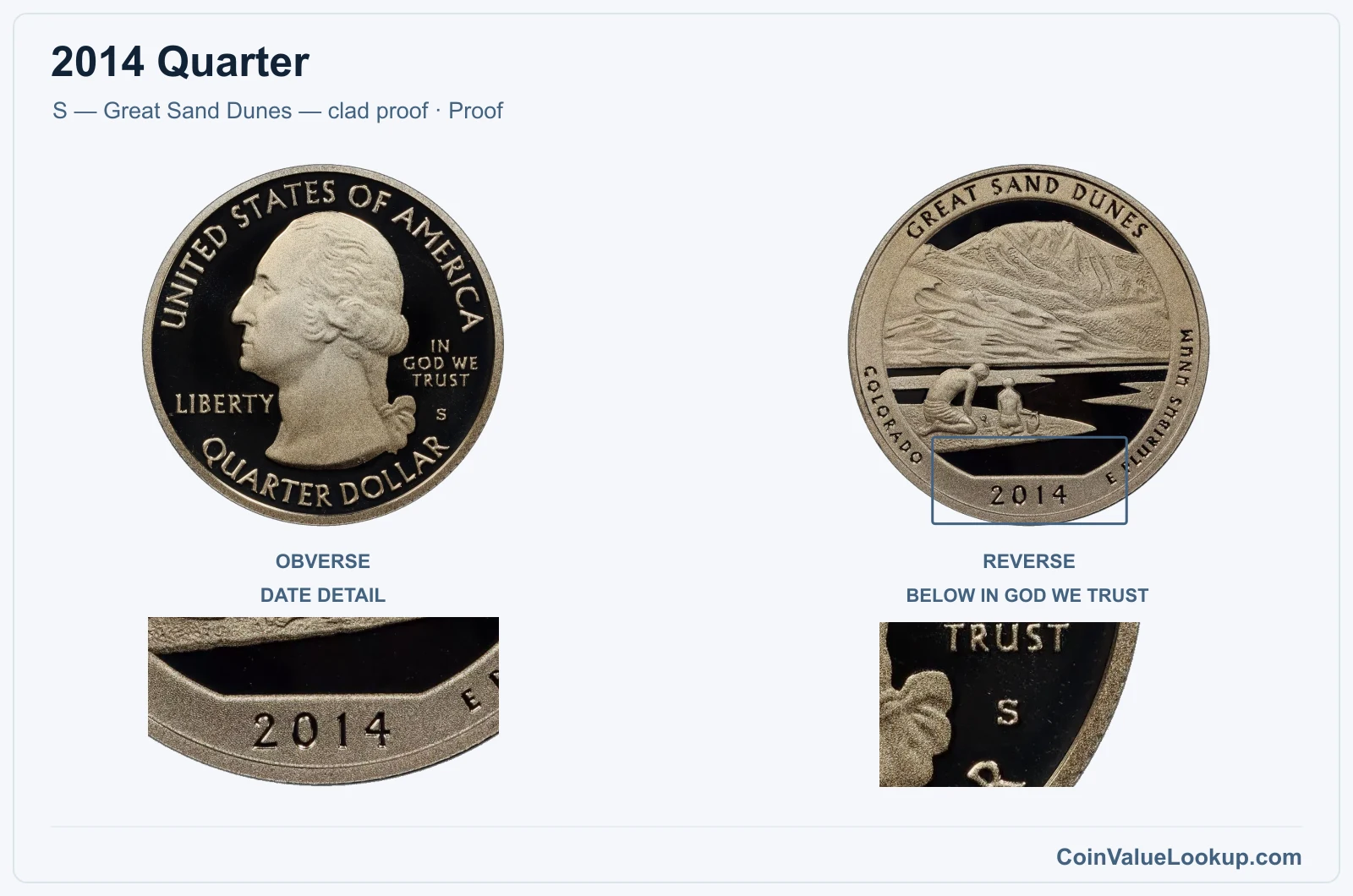
The clad proof Great Sand Dunes quarter has mirrored fields and frosted devices, struck at San Francisco in copper-nickel clad composition. USA Coin Book estimates $5.63 at PR65.
It came in the 2014 standard proof set. Look at the edge for the copper-colored core stripe that confirms clad rather than silver.
Range Grade
Price Auction Records Appraisal PR PR 1
—
Coin Identifier
PR 2
—
Coin Identifier
PR 3
—
Coin Identifier
PR 4
—
Coin Identifier
PR 6
—
Coin Identifier
PR 8
—
Coin Identifier
PR 10
—
Coin Identifier
PR 12
—
Coin Identifier
PR 15
—
Coin Identifier
PR 20
—
Coin Identifier
PR 25
—
Coin Identifier
PR 30
—
Coin Identifier
PR 35
—
Coin Identifier
PR 40
—
Coin Identifier
PR 45
—
Coin Identifier
PR 50
—
Coin Identifier
PR 53
—
Coin Identifier
PR 55
—
Coin Identifier
PR 58
—
Coin Identifier
PR 60
—
Coin Identifier
PR 61
—
Coin Identifier
PR 62
—
Coin Identifier
PR 63
—
Coin Identifier
PR 64
—
Coin Identifier
PR 65
—
Coin Identifier
PR 66
—
Coin Identifier
PR 67
—
Coin Identifier
PR 68
—
Coin Identifier
PR 69
—
Coin Identifier
PR 70
Coin Identifier
2014 Quarter — S — Great Sand Dunes — silver proof
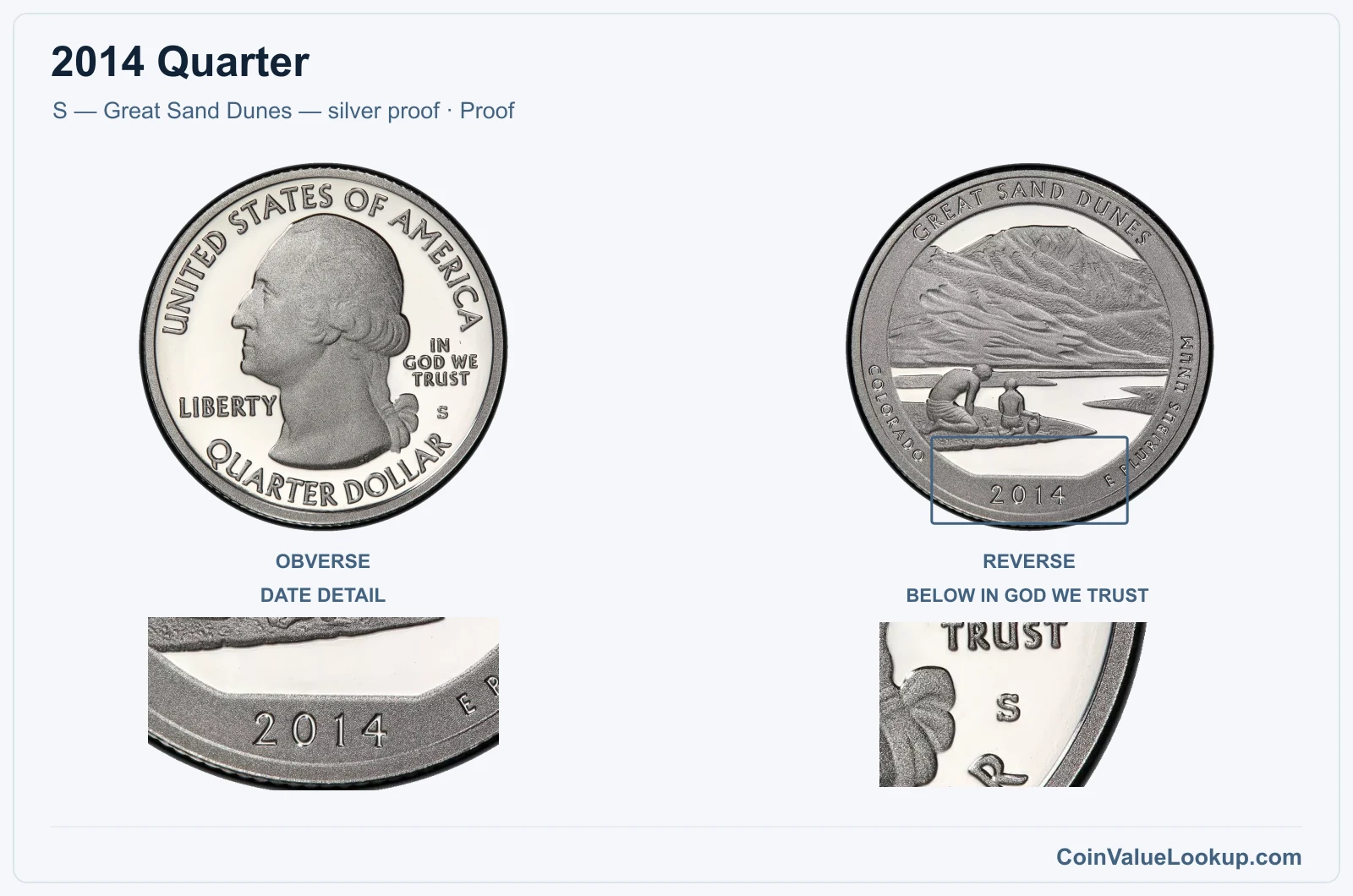
The silver proof Great Sand Dunes quarter is 90% silver and 10% copper, weighing about 6.25 grams. USA Coin Book estimates $24.00 at PR65.
The edge is uniformly silver in color, with no layered stripe. These came in the 2014 silver proof set.
High-grade examples with deep cameo contrast are the ones collectors target, so keep the fields hairline-free if you plan to have one graded.
Range Grade
Price Auction Records Appraisal PR PR 1
—
Coin Identifier
PR 2
—
Coin Identifier
PR 3
—
Coin Identifier
PR 4
—
Coin Identifier
PR 6
—
Coin Identifier
PR 8
—
Coin Identifier
PR 10
—
Coin Identifier
PR 12
—
Coin Identifier
PR 15
—
Coin Identifier
PR 20
—
Coin Identifier
PR 25
—
Coin Identifier
PR 30
—
Coin Identifier
PR 35
—
Coin Identifier
PR 40
—
Coin Identifier
PR 45
—
Coin Identifier
PR 50
—
Coin Identifier
PR 53
—
Coin Identifier
PR 55
—
Coin Identifier
PR 58
—
Coin Identifier
PR 60
—
Coin Identifier
PR 61
—
Coin Identifier
PR 62
—
Coin Identifier
PR 63
—
Coin Identifier
PR 64
—
Coin Identifier
PR 65
—
Coin Identifier
PR 66
—
Coin Identifier
PR 67
—
Coin Identifier
PR 68
—
Coin Identifier
PR 69
—
Coin Identifier
PR 70
Coin Identifier
2014 Quarter — P — Everglades — regular strike
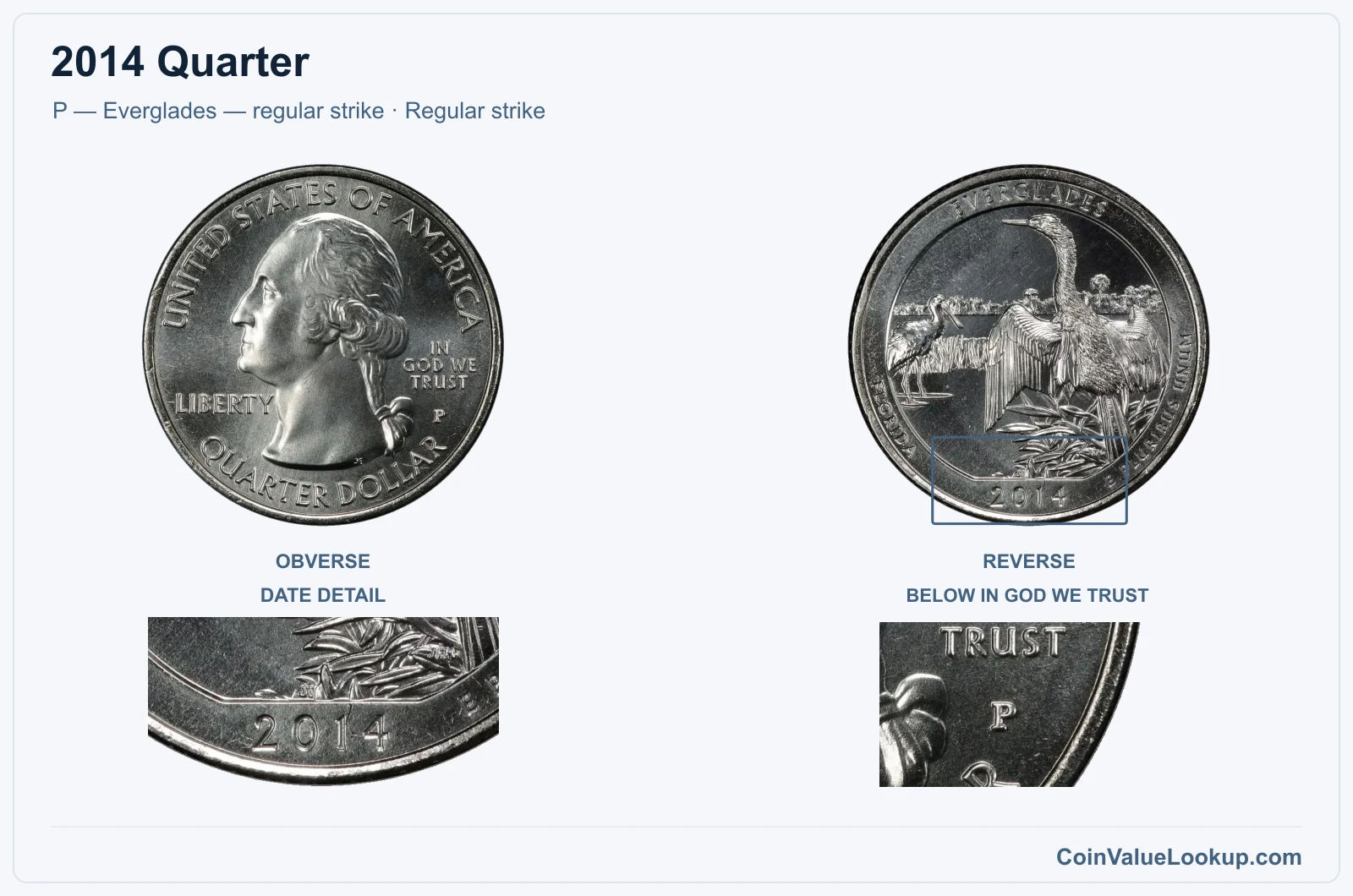
Philadelphia's Everglades quarter depicts a great blue heron wading in the Florida wetlands. Copper-nickel clad, 5.67 grams, standard diameter.
In circulated condition it spends at face value. USA Coin Book estimates $0.61 at MS60 and $1.24 at MS65.
That MS60 figure is the lowest among all 2014 P-mint quarters in this guide, though the MS65 level matches the rest.
Range Grade
Price Auction Records Appraisal PO PO 1
—
Coin Identifier FR FR 2
—
Coin Identifier AG AG 3
—
Coin Identifier G G 4
—
Coin Identifier
G 6
—
Coin Identifier VG VG 8
—
Coin Identifier
VG 10
—
Coin Identifier F F 12
—
Coin Identifier
F 15
—
Coin Identifier VF VF 20
—
Coin Identifier
VF 25
—
Coin Identifier
VF 30
—
Coin Identifier
VF 35
—
Coin Identifier XF XF 40
—
Coin Identifier
XF 45
—
Coin Identifier AU AU 50
—
Coin Identifier
AU 53
—
Coin Identifier
AU 55
—
Coin Identifier
AU 58
—
Coin Identifier MS MS 60
—
Coin Identifier
MS 61
—
Coin Identifier
MS 62
—
Coin Identifier
MS 63
—
Coin Identifier
MS 64
—
Coin Identifier
MS 65
—
Coin Identifier
MS 66
—
Coin Identifier
MS 67
—
Coin Identifier
MS 68
Coin Identifier
MS 69
—
—
—
MS 70
—
—
—
2014 Quarter — D — Everglades — regular strike
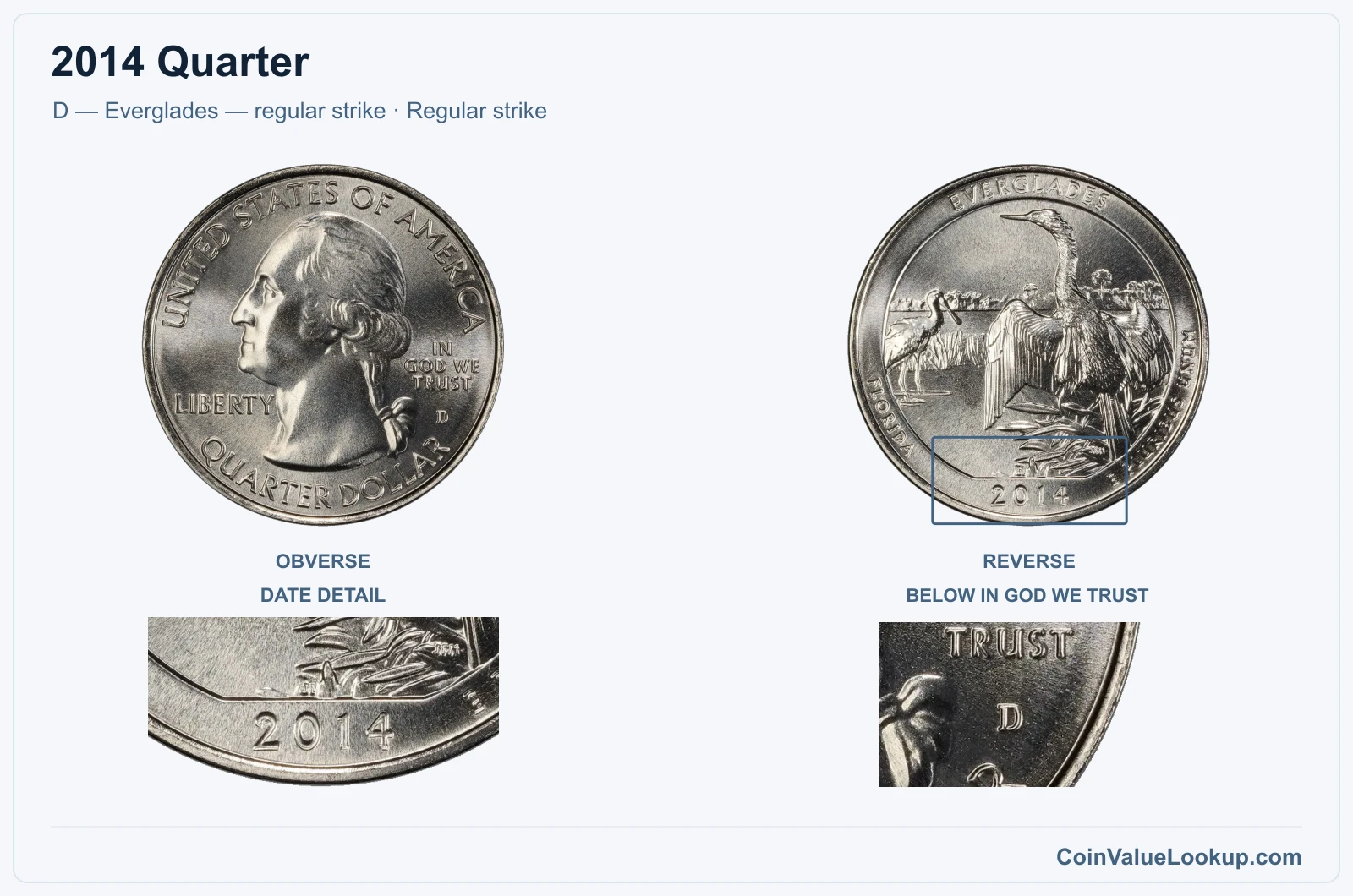
The Denver Everglades quarter matches the P-mint in design and composition, with a D mintmark. Worn coins are 25 cents.
USA Coin Book estimates $0.61 at MS60 and $1.24 at MS65. The heron's long neck and legs are the high-relief focal points — marks there affect eye appeal disproportionately.
Range Grade
Price Auction Records Appraisal PO PO 1
—
Coin Identifier FR FR 2
—
Coin Identifier AG AG 3
—
Coin Identifier G G 4
—
Coin Identifier
G 6
—
Coin Identifier VG VG 8
—
Coin Identifier
VG 10
—
Coin Identifier F F 12
—
Coin Identifier
F 15
—
Coin Identifier VF VF 20
—
Coin Identifier
VF 25
—
Coin Identifier
VF 30
—
Coin Identifier
VF 35
—
Coin Identifier XF XF 40
—
Coin Identifier
XF 45
—
Coin Identifier AU AU 50
—
Coin Identifier
AU 53
—
Coin Identifier
AU 55
—
Coin Identifier
AU 58
—
Coin Identifier MS MS 60
—
Coin Identifier
MS 61
—
Coin Identifier
MS 62
—
Coin Identifier
MS 63
—
Coin Identifier
MS 64
—
Coin Identifier
MS 65
—
Coin Identifier
MS 66
—
Coin Identifier
MS 67
—
Coin Identifier
MS 68
Coin Identifier
MS 69
—
Coin Identifier
MS 70
—
—
—
2014 Quarter — S — Everglades — regular strike
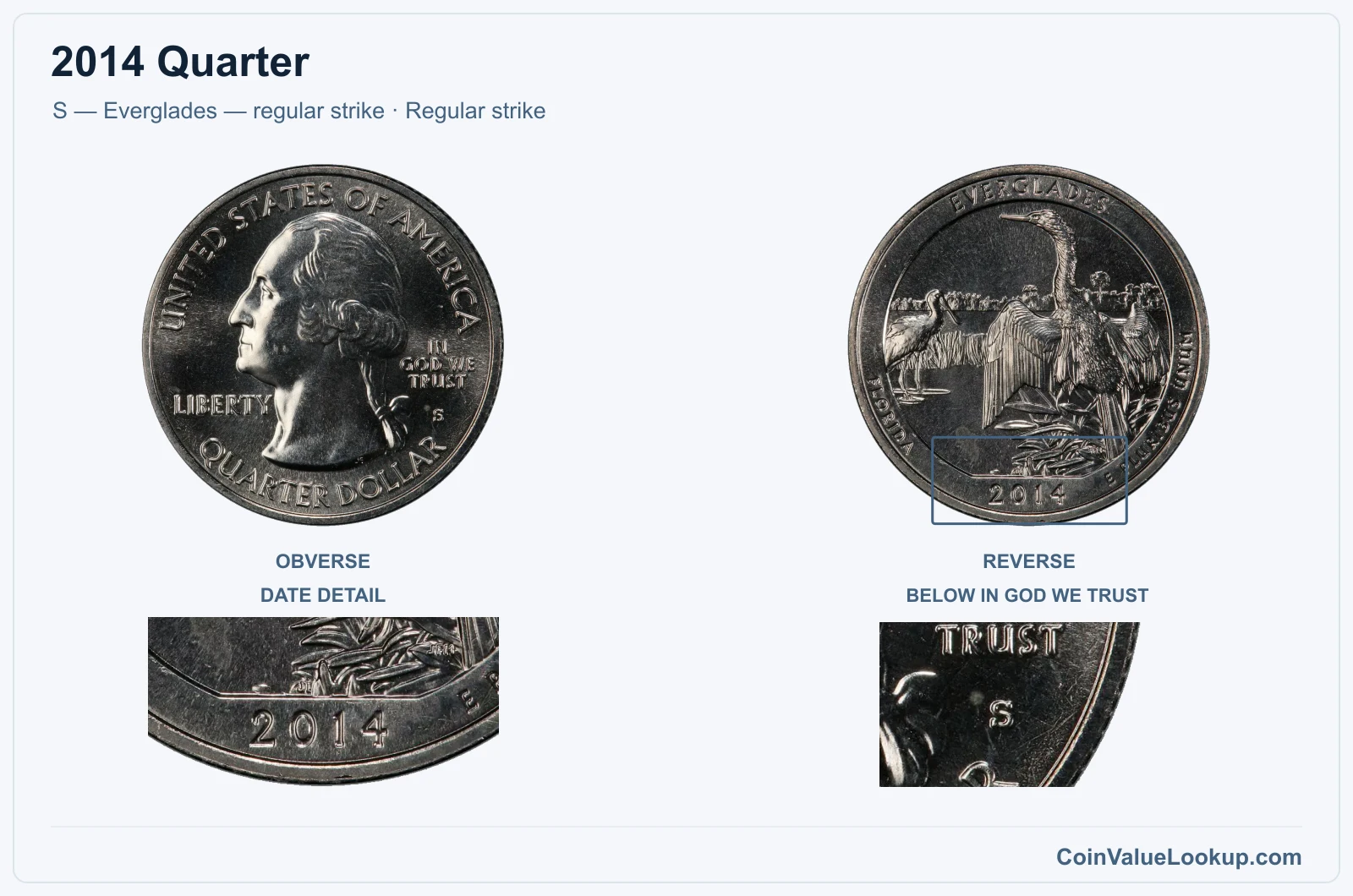
San Francisco produced an uncirculated clad Everglades quarter with normal luster and an S mintmark. This is not a proof.
USA Coin Book estimates $10.00 at MS65. As with the other S-mint uncirculated issues, the smaller production run is what supports the guide premium over P and D strikes.
Verify the finish before assuming the higher value applies.
Range Grade
Price Auction Records Appraisal PO PO 1
—
Coin Identifier FR FR 2
—
Coin Identifier AG AG 3
—
Coin Identifier G G 4
—
Coin Identifier
G 6
—
Coin Identifier VG VG 8
—
Coin Identifier
VG 10
—
Coin Identifier F F 12
—
Coin Identifier
F 15
—
Coin Identifier VF VF 20
—
Coin Identifier
VF 25
—
Coin Identifier
VF 30
—
Coin Identifier
VF 35
—
Coin Identifier XF XF 40
—
Coin Identifier
XF 45
—
Coin Identifier AU AU 50
—
Coin Identifier
AU 53
—
Coin Identifier
AU 55
—
Coin Identifier
AU 58
—
Coin Identifier MS MS 60
—
Coin Identifier
MS 61
—
Coin Identifier
MS 62
—
Coin Identifier
MS 63
—
Coin Identifier
MS 64
—
Coin Identifier
MS 65
—
Coin Identifier
MS 66
—
Coin Identifier
MS 67
—
Coin Identifier
MS 68
—
Coin Identifier
MS 69
—
—
—
MS 70
—
—
—
2014 Quarter — S — Everglades — clad proof
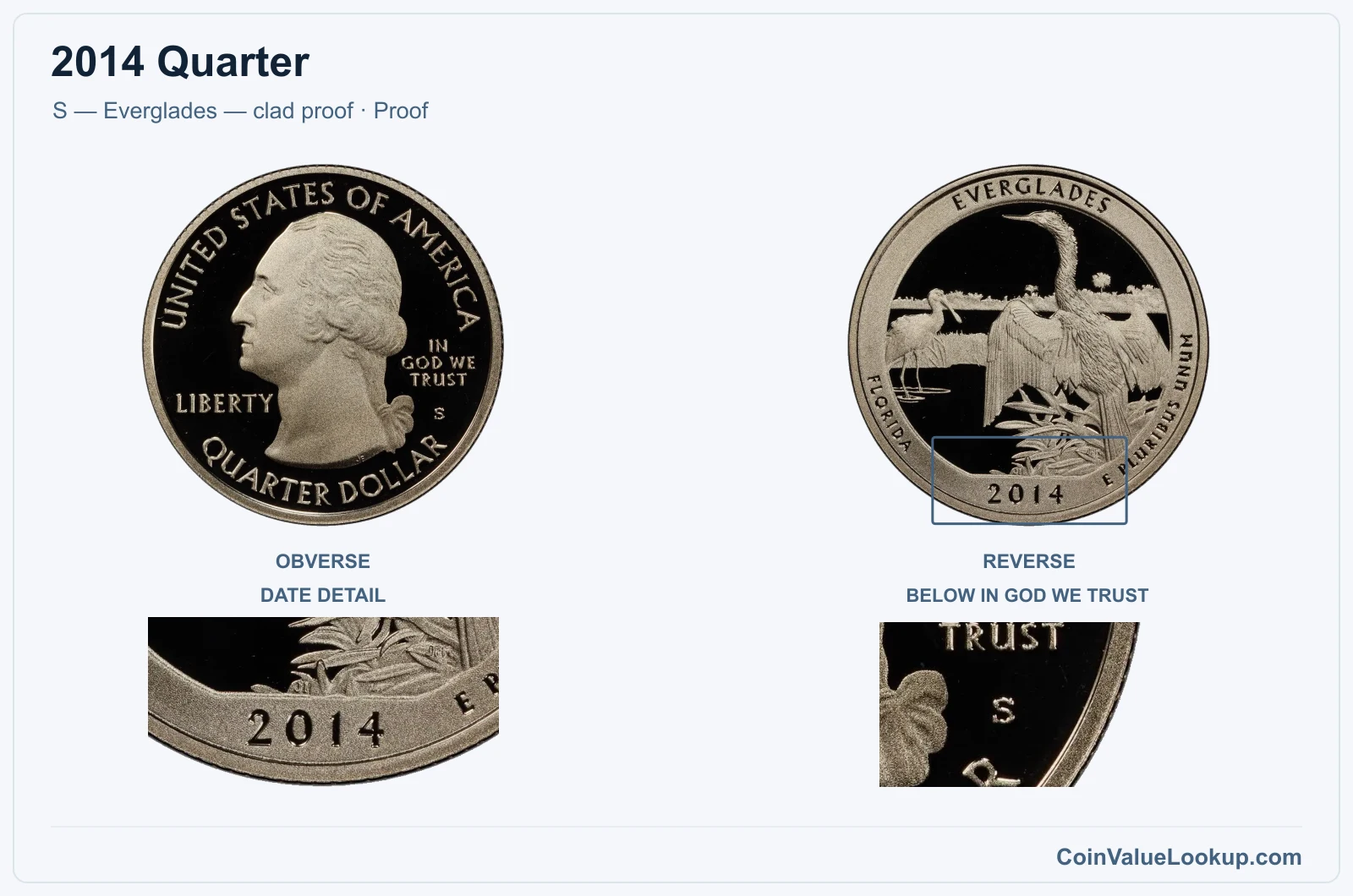
The clad proof Everglades quarter was struck at San Francisco with proof finishing — mirrored fields, frosted devices. Composition is copper-nickel clad.
USA Coin Book estimates $5.63 at PR65. These were included in the regular 2014 proof set.
Edge inspection is the quickest way to separate clad from silver if you do not have original packaging.
Range Grade
Price Auction Records Appraisal PR PR 1
—
Coin Identifier
PR 2
—
Coin Identifier
PR 3
—
Coin Identifier
PR 4
—
Coin Identifier
PR 6
—
Coin Identifier
PR 8
—
Coin Identifier
PR 10
—
Coin Identifier
PR 12
—
Coin Identifier
PR 15
—
Coin Identifier
PR 20
—
Coin Identifier
PR 25
—
Coin Identifier
PR 30
—
Coin Identifier
PR 35
—
Coin Identifier
PR 40
—
Coin Identifier
PR 45
—
Coin Identifier
PR 50
—
Coin Identifier
PR 53
—
Coin Identifier
PR 55
—
Coin Identifier
PR 58
—
Coin Identifier
PR 60
—
Coin Identifier
PR 61
—
Coin Identifier
PR 62
—
Coin Identifier
PR 63
—
Coin Identifier
PR 64
—
Coin Identifier
PR 65
—
Coin Identifier
PR 66
—
Coin Identifier
PR 67
—
Coin Identifier
PR 68
—
Coin Identifier
PR 69
—
Coin Identifier
PR 70
Coin Identifier
2014 Quarter — S — Everglades — silver proof
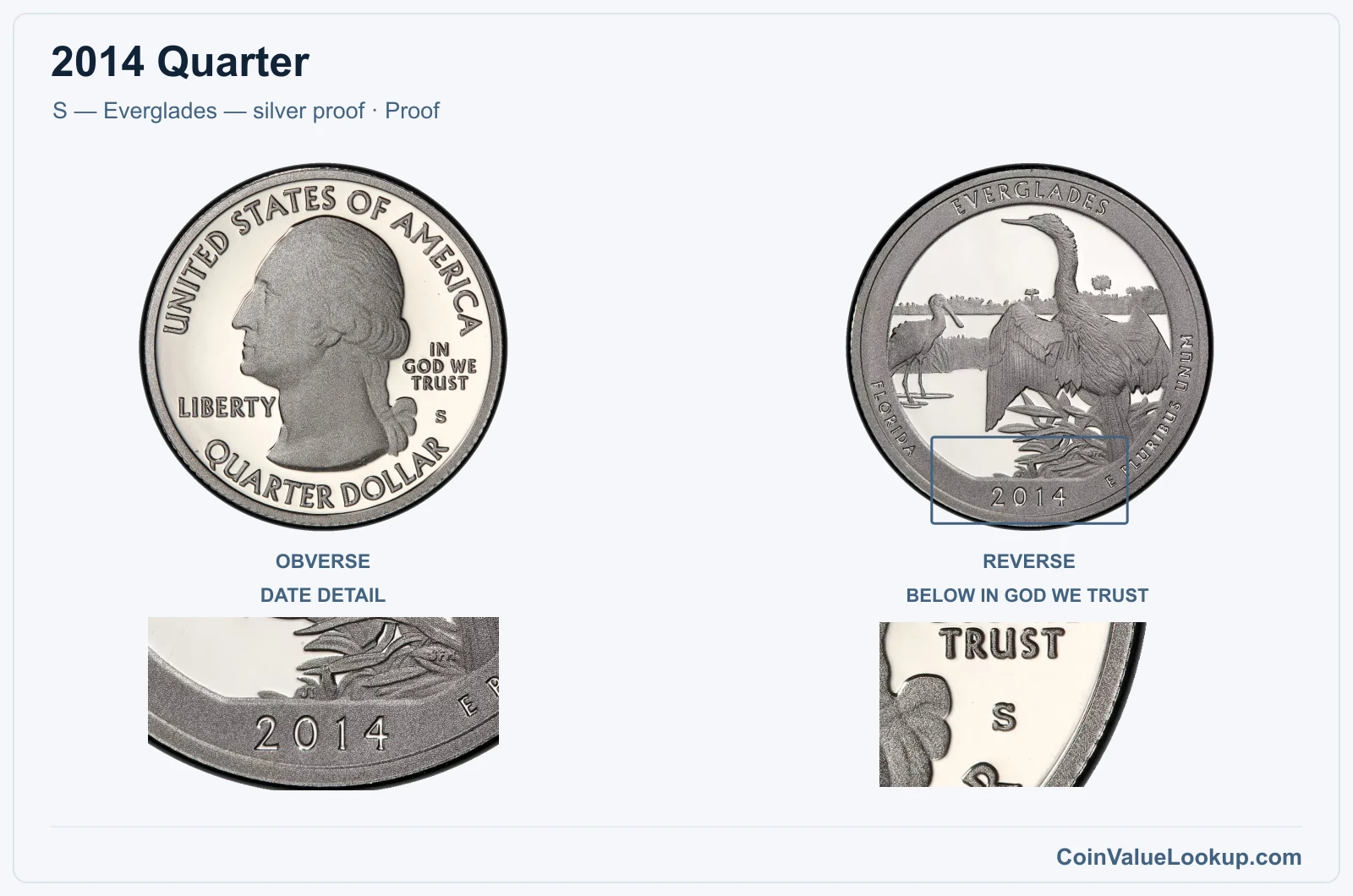
The silver proof Everglades quarter is 90% silver, weighing about 6.25 grams, struck at San Francisco. USA Coin Book estimates $24.00 at PR65.
The heron design looks particularly sharp in the proof format, with the water detail in the background lending depth to the mirrored field. Confirm silver content via the edge — a uniform silver color with no layered stripe.
These came in the 2014 silver proof set and should be stored in non-PVC holders to prevent toning damage.
Range Grade
Price Auction Records Appraisal PR PR 1
—
Coin Identifier
PR 2
—
Coin Identifier
PR 3
—
Coin Identifier
PR 4
—
Coin Identifier
PR 6
—
Coin Identifier
PR 8
—
Coin Identifier
PR 10
—
Coin Identifier
PR 12
—
Coin Identifier
PR 15
—
Coin Identifier
PR 20
—
Coin Identifier
PR 25
—
Coin Identifier
PR 30
—
Coin Identifier
PR 35
—
Coin Identifier
PR 40
—
Coin Identifier
PR 45
—
Coin Identifier
PR 50
—
Coin Identifier
PR 53
—
Coin Identifier
PR 55
—
Coin Identifier
PR 58
—
Coin Identifier
PR 60
—
Coin Identifier
PR 61
—
Coin Identifier
PR 62
—
Coin Identifier
PR 63
—
Coin Identifier
PR 64
—
Coin Identifier
PR 65
—
Coin Identifier
PR 66
—
Coin Identifier
PR 67
—
Coin Identifier
PR 68
—
Coin Identifier
PR 69
—
Coin Identifier
PR 70
Coin Identifier
2014 Quarter Error List
1. 2014 Quarter — Struck-Through Error
A struck-through error occurs when foreign material — grease, wire, cloth or a metal fragment — gets between the die and the planchet during striking. The result is a localized depression or incomplete area where the design did not fully form.
On a 2014 quarter, look for a distinct impression or flattened zone that differs from normal wear patterns.
Do not confuse this with ordinary weak strikes, surface scratches or post-mint damage. A genuine struck-through impression typically has sharp boundaries and sits within normally struck surrounding detail.
Grease fill-ins tend to produce a smoother, more uniform depression, while a retained foreign object may leave a textured imprint. Value depends on the size, visibility and location of the obstruction — no single guide price applies across all examples.
2. 2014 Quarter — Missing Clad Layer
A missing clad layer error means one of the outer copper-nickel layers was absent before the planchet was struck. The exposed side may show a copper-colored surface from the core, and the coin will weigh noticeably less than the standard 5.67 grams.
Both the affected face and the edge profile will look different from a normal quarter.
This is not the same as a coin that has been corroded, plated, chemically stripped or simply toned to a different color. Genuine missing clad errors have a uniform exposed surface with full design detail struck into the softer core metal.
Post-mint removal of a clad layer usually leaves tool marks, uneven surfaces or missing detail. The value of a missing clad quarter depends on how dramatic the error is, overall condition and whether one or both layers are affected.
3. 2014 Quarter — Arches — Doubled Die
A doubled die on the 2014 Arches quarter from the P mint shows consistent doubling in the design or lettering caused by a misaligned hub impression during die manufacture. Under magnification, you will see design elements that appear to have a second, slightly offset image — separation lines, notching on serifs, or thickened features in a uniform direction.
This is different from machine doubling, which produces a flat, shelf-like displacement without the rounded secondary image of a true doubled die. Reflections under certain lighting can also mimic doubling, so compare your coin against a confirmed normal example.
Value depends on the strength and location of the doubling and overall coin condition.
4. 2014 Quarter — Arches — Clipped Planchet
A clipped planchet error on the 2014 Arches quarter from the P mint means the blank was incomplete before it was struck. You will see a missing curved, straight or irregular portion along the edge, and the design in that area may be weak or absent.
Metal flow lines often appear near the clip, and there may be weakness on the opposite side of the coin — a characteristic called the Blakesley effect.
Do not mistake a filed edge, post-mint cut, or corrosion pit for a genuine clip. A real clip has smooth edges consistent with the original blanking process and shows design distortion that follows the missing metal.
Value depends on clip size, type and the coin's overall condition.
5. 2014 Quarter — Arches — Die Break / Cud
A cud on the 2014 Arches quarter from the P mint is a raised, featureless blob that connects to the rim. It forms when a piece of the die breaks away, leaving a void that fills with metal during striking.
The result is an area of the coin where normal design detail is replaced by a smooth raised mass.
Do not confuse a cud with a rim ding, corrosion bump or interior die chip. A true cud always touches the rim and displaces the design beneath it.
Interior die chips produce small raised dots or lumps but do not reach the rim. The size and location of the cud, along with overall coin condition, determine value — larger cuds affecting prominent design areas tend to attract more collector interest.
6. 2014 Quarter — Arches — Broadstrike
A broadstrike error on the 2014 Arches quarter from the P mint occurs when the coin is struck outside the normal retaining collar. The result is a coin that spreads outward, appearing slightly larger than standard 24.26 mm diameter, with the rim absent or poorly formed.
The full design is still present, just expanded.
This differs from an off-center strike, where part of the design is entirely missing. It also differs from a coin that was flattened after minting by a train, vise or other external force — those show distorted, irregular edges without the uniform radial expansion of a broadstrike.
Value depends on how dramatic the spread is and the coin's condition.
7. 2014 Quarter — Arches — Off-Center Strike
An off-center strike on a 2014 Arches quarter means the planchet was not properly seated between the dies during striking. Part of the design is missing entirely, replaced by a blank crescent of unstruck metal.
The percentage off-center and whether the date remains visible are the two biggest factors affecting collector interest.
Do not confuse this with a clipped planchet, which has a missing section of the blank itself, or a misaligned die, which shifts the design but typically keeps the coin within normal diameter. Post-mint flattening can also remove rim detail on one side, mimicking an off-center appearance.
A genuine off-center coin has a clean unstruck area with smooth metal and the struck portion is fully detailed.
8. 2014 Quarter — Arches — Lamination / Split Planchet
A lamination error on a 2014 Arches quarter appears as peeling, flaking or separation within the coin's metal. You may see a retained flap of metal lifting away from the surface, or a void where a flap has already broken off.
The edge can also show visible layer separation.
This results from impurities or trapped gas in the strip metal before the blank was punched. It is distinct from post-mint scraping, corrosion pitting or deliberate cutting.
A genuine lamination has a natural, irregular boundary and the exposed underlying metal usually shows some design impression. Photograph both the affected face and the edge to document the extent.
Value varies with the size and visual impact of the lamination.
9. 2014 Quarter — Everglades — Die Break / Cud
A cud on the 2014 Everglades quarter is a raised, featureless mass connected to the rim, caused by a broken die. Where the die fragment fell away, the coin received no impression, and metal flowed into the gap to create a smooth raised area.
The adjacent design detail may be distorted.
Compare carefully with rim dents, which are incuse rather than raised, and with interior die chips, which appear as small raised lumps away from the rim. Corrosion can also produce irregular raised areas, but it lacks the clean boundary of a true cud.
Value depends on size, placement and overall coin condition — no single guide price covers all cuds.
10. 2014 Quarter — Double / Multiple Strike
A double or multiple strike on a 2014 quarter means the coin received more than one impression from the dies. You will see two or more distinct, overlapping images of the design, often rotated or displaced relative to each other.
The effect is dramatic and unmistakable on a strong example.
This is not the same as a doubled die, which is a single strike from an already-doubled die. Machine doubling — a flat, shelf-like displacement — is also different.
Post-mint damage from a vise or press can create a second impression, but it typically lacks the sharpness and alignment pattern of a genuine in-press double strike. Value depends on the degree of displacement and overall condition.
11. 2014 Quarter — Shenandoah — Die Crack / Die Chip
Die cracks and die chips on the 2014 Shenandoah quarter appear as raised lines or small raised blobs on the coin's surface. They are caused by progressive damage to the steel die, which transfers as raised features onto every coin struck afterward.
A crack typically runs as a thin raised line across the design or from the rim inward, while a chip produces a small raised dot or irregular lump.
Do not confuse raised die cracks with incuse scratches, which are cut into the surface. Corrosion bumps or foreign material stuck to the surface can also mimic die chips but lack the consistent appearance seen across multiple coins from the same die.
Value depends on size, prominence and location.
12. 2014 Quarter — Shenandoah — Misaligned Die
A misaligned die error on the 2014 Shenandoah quarter means one die was shifted horizontally relative to the other during striking. The result is a design that appears off-center on one side but centered on the other.
The rim will be wider on one side than the opposite.
This is different from a true off-center strike, where the entire planchet was mispositioned and part of the design is missing. It is also different from a rotated die error, which involves angular rather than lateral displacement.
Post-mint rim damage or a tilted photograph can create the illusion of misalignment. Compare both sides carefully — the shift should be consistent and the coin should be normal diameter.
13. 2014 Quarter — Shenandoah — Partial Collar Strike
A partial collar strike on the 2014 Shenandoah quarter occurs when the coin was only partly seated in the retaining collar during striking. One portion of the edge will show normal reeding, while the other portion may be smooth, expanded or stepped.
The coin often has a slightly irregular shape or a visible shelf where the collar stopped confining the metal.
Do not mistake post-mint edge damage, a flattened rim from a coin counter, or a complete broadstrike for a partial collar. A broadstrike lacks any collar confinement, while a partial collar shows a clear transition zone.
Value depends on how dramatic the collar effect is and the coin's overall condition.
14. 2014 Quarter — Rotated Dies
A rotated die error on a 2014 quarter means the obverse and reverse dies were not aligned at the standard 180-degree coin-turn orientation. To check, hold the obverse upright and flip the coin top to bottom.
On a normal U.S. quarter, the reverse should also appear upright. If the reverse is tilted, you may have a rotated die error.
Small rotations of a few degrees are relatively common and not highly valued. Larger rotations — 45 degrees or more — attract more attention.
Do not confuse this with a photograph taken at an angle, or with simply turning the coin sideways. The rotation must be consistent every time you flip.
Value depends on the degree of rotation and overall coin condition.
15. 2014 Quarter — Arches — Die Crack / Die Chip
Die cracks and die chips on the 2014 Arches quarter show up as raised lines or small raised lumps on the coin's surface. These result from stress fractures or chipping in the die steel.
A die crack may run across lettering, through design elements, or from the rim into the field. A die chip is usually a small raised blob, sometimes appearing inside a letter.
Incuse scratches — lines cut into the surface — are not the same thing. Corrosion or stuck debris can also create raised bumps but will not match the consistent, repeatable pattern of a die defect.
Value depends on the crack's size, location and visual impact within the overall design.
16. 2014 Quarter — Arches — Misaligned Die
A misaligned die error on the 2014 Arches quarter shows one side of the coin with the design shifted laterally while the other side appears normally centered. The rim will be wider on one edge than the opposite edge on the affected side.
The coin retains its full diameter.
This is not the same as an off-center strike, where part of the blank is entirely unstruck. A tilted photograph or post-mint rim ding can simulate the look of misalignment, so verify by examining the coin in hand and comparing both sides.
The degree of shift determines collector interest — minor misalignments are common and not particularly valuable.
17. 2014 Quarter — Great Sand Dunes — Misaligned Die
A misaligned die error has been reported on the 2014-D Great Sand Dunes quarter specifically. One die was displaced horizontally, shifting the design on one face relative to the other.
You will notice an uneven rim — wider on one side, narrower on the opposite — on the affected face, while the other face may appear normally centered.
Check both sides of the coin. If the misalignment is only on one face, that confirms which die moved.
Do not confuse this with a complete off-center strike, a rotated die or simple rim damage. Value depends on the degree of visible shift and overall condition of the coin.
18. 2014 Quarter — Doubled Die Obverse
A doubled die obverse has been reported on 2014-P quarters. This type of error produces consistent doubling on the obverse design elements — lettering, date, or portrait features — caused during the die-making process.
Under magnification, look for notching on letter serifs, split design contours, or a secondary image with rounded rather than flat characteristics.
Machine doubling is the most common lookalike. It produces a flat shelf of displaced metal without the rounded secondary contour of a genuine doubled die.
Worn die contours and lighting reflections can also be deceptive. Compare your coin to a known normal example under matching light conditions.
Value depends on the strength and location of the doubling, along with overall coin condition.
19. 2014 Quarter — Everglades — Doubled Die Reverse
A doubled die reverse has been reported on the 2014 Everglades quarter. This means the reverse die received a misaligned secondary hub impression, creating consistent doubling in the design or lettering on the Everglades side of the coin.
Look closely at the legends and design contours under magnification for separation, notching or a secondary outline.
Machine doubling is the most frequent mimic — it leaves a flat, shelf-like displacement rather than a rounded secondary image. Random scratches or damage can also create the illusion of doubling on a casual glance.
Compare your coin with a confirmed normal example and photograph the suspected area at high magnification. Value depends on visibility, strength and overall condition.
20. 2014 Quarter — Great Sand Dunes — Die Crack / Die Chip
Die cracks and die chips have been reported on 2014 Great Sand Dunes quarters. These appear as raised lines or small raised blobs on the coin.
A die crack runs as a thin raised ridge, sometimes spanning from the rim through design elements. A die chip produces a localized raised lump, often inside a letter or at a junction of design features.
Genuine die cracks are raised above the coin's surface. Incuse scratches — the most common lookalike — are cut into the surface instead.
Corrosion or foreign debris can also produce raised bumps but will not show the consistent pattern of a die defect. Value depends on size, placement and visual impact.
21. 2014 Quarter — Great Sand Dunes — Partial Collar Strike
A partial collar strike has been reported on 2014 Great Sand Dunes quarters. This happens when the planchet is only partially seated in the collar die during striking.
Part of the edge shows normal reeding, while another section is smooth, expanded or has a visible step or shelf where the collar ended.
Compare the edge profile with a normal quarter — normal coins have uniform reeding all the way around. Do not confuse a partial collar with edge damage from a coin-counting machine, a flattened rim, or a full broadstrike where no collar was engaged at all.
The transition zone between reeded and unreeded edge is the key diagnostic. Value depends on how obvious the effect is and the coin's overall condition.