2021 Quarter Coin Value: How Much Is It Worth?
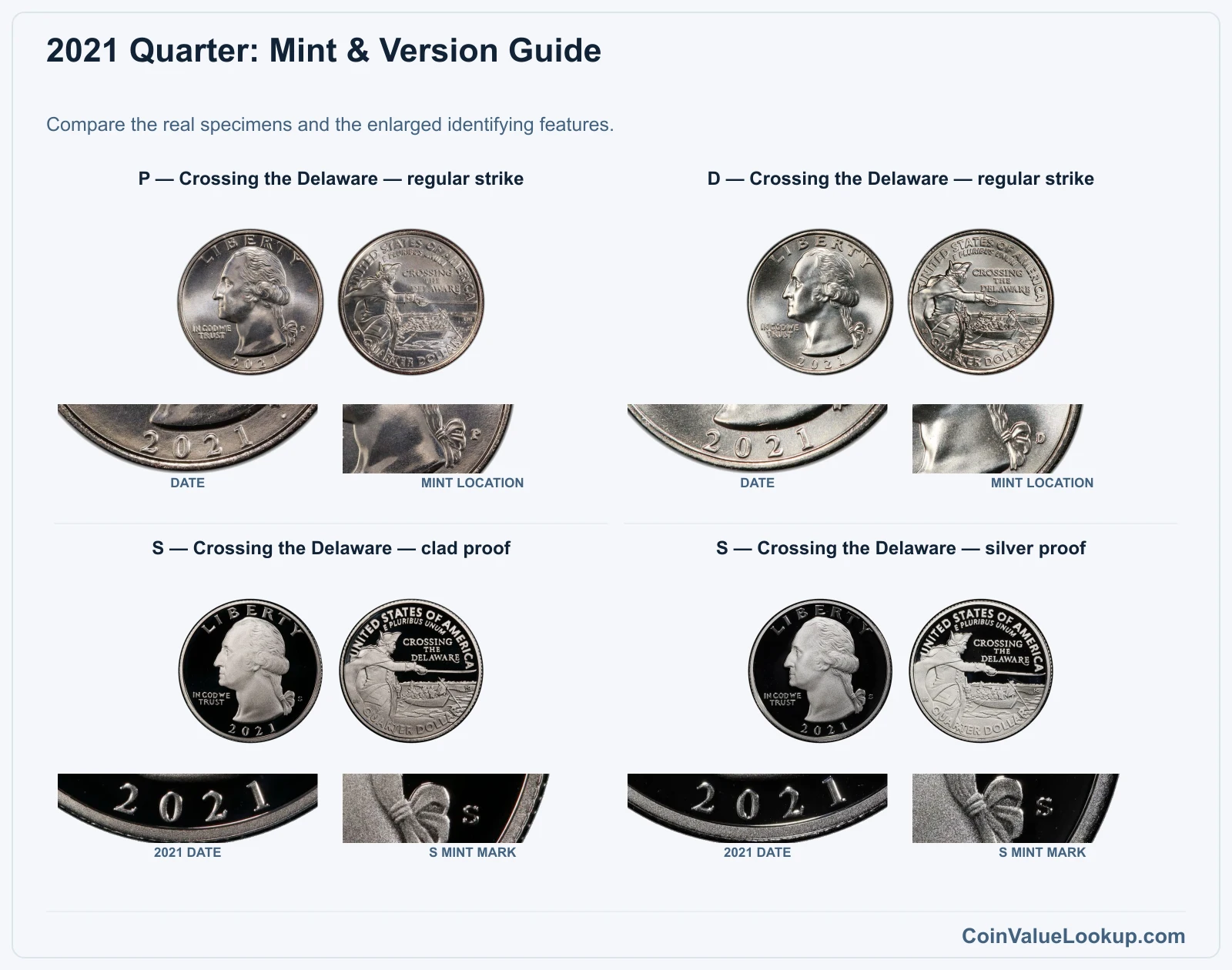
The 2021 Washington Crossing the Delaware quarter marked the end of an era, closing out the long-running series of special-reverse Washington quarters before the new obverse portrait arrived in 2022. Most circulated examples are worth face value, but the right combination of mint, finish, condition or die error can push a coin well above twenty-five cents.
Your specific version matters, so read on to pin down exactly what you have.
Fast Way to Identify Your 2021 Quarter
The quickest way to start is to upload clear photos of both sides of your coin. A sharp front image lets us read the mintmark and date, while the back confirms the Crossing the Delaware reverse design.
This preliminary identification helps narrow down which version and approximate condition range applies to your quarter.
2021 Quarter Value
Upload both sides of your 2021 Quarter.
Front Obverse
Upload photo
Back Reverse
Upload photo
Which 2021 Quarter Versions Are Worth Money?
- The S-mint .999 silver proof is a collector-only issue with a higher precious-metal content and limited distribution compared to business strikes.
- Confirmed die errors such as a doubled die reverse, doubled die obverse, struck-through or die break can carry premiums that depend on visibility and authenticated condition.
- High-grade business strikes from the P or D mint, when professionally graded near the top of the Mint State scale, may exceed face value depending on eye appeal and market demand.
- The S-mint clad proof, sold in government proof sets, is worth checking for deep cameo contrast and the absence of handling marks.
Step 1: Identify Your 2021 Quarter Mint Mark and Version
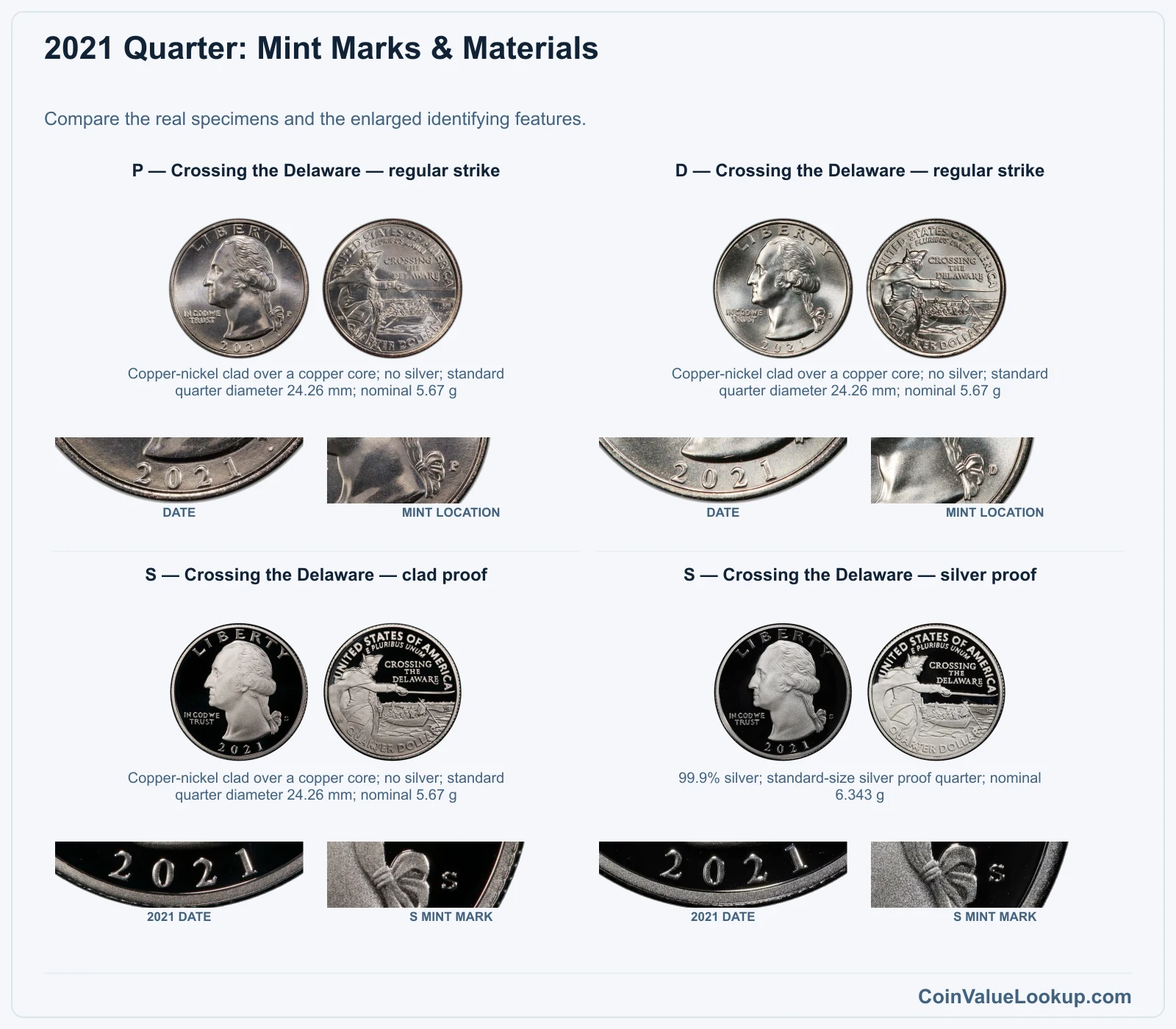
Start on the obverse. Look near Washington's portrait for a small mintmark: P for Philadelphia, D for Denver, or S for San Francisco.
No mintmark at all on a modern quarter is unusual and worth a closer look, but on 2021 issues P and D are the standard business-strike mints.
Next, confirm the reverse. The Crossing the Delaware design shows General Washington standing in a boat with soldiers.
Do not confuse a date in the reverse artwork with the coin's issue year; the obverse date is 2021.
Now determine the finish. Business strikes from P and D have a satiny, somewhat muted luster.
Proof strikes from San Francisco display mirror-like fields and frosted raised devices. The S mint produced two proof versions: a copper-nickel clad proof and a .999 fine silver proof.
Telling clad from silver takes more than eyeballing the color. Check the edge: a clad coin shows a visible copper-colored stripe sandwiched between nickel layers, while a silver proof edge is uniformly gray.
Weight also helps. A clad quarter weighs about 5.67 grams; the silver proof comes in around 6.34 grams.
Original government packaging is the easiest confirmation of all.
Step 2: Check Your 2021 Quarter Grade
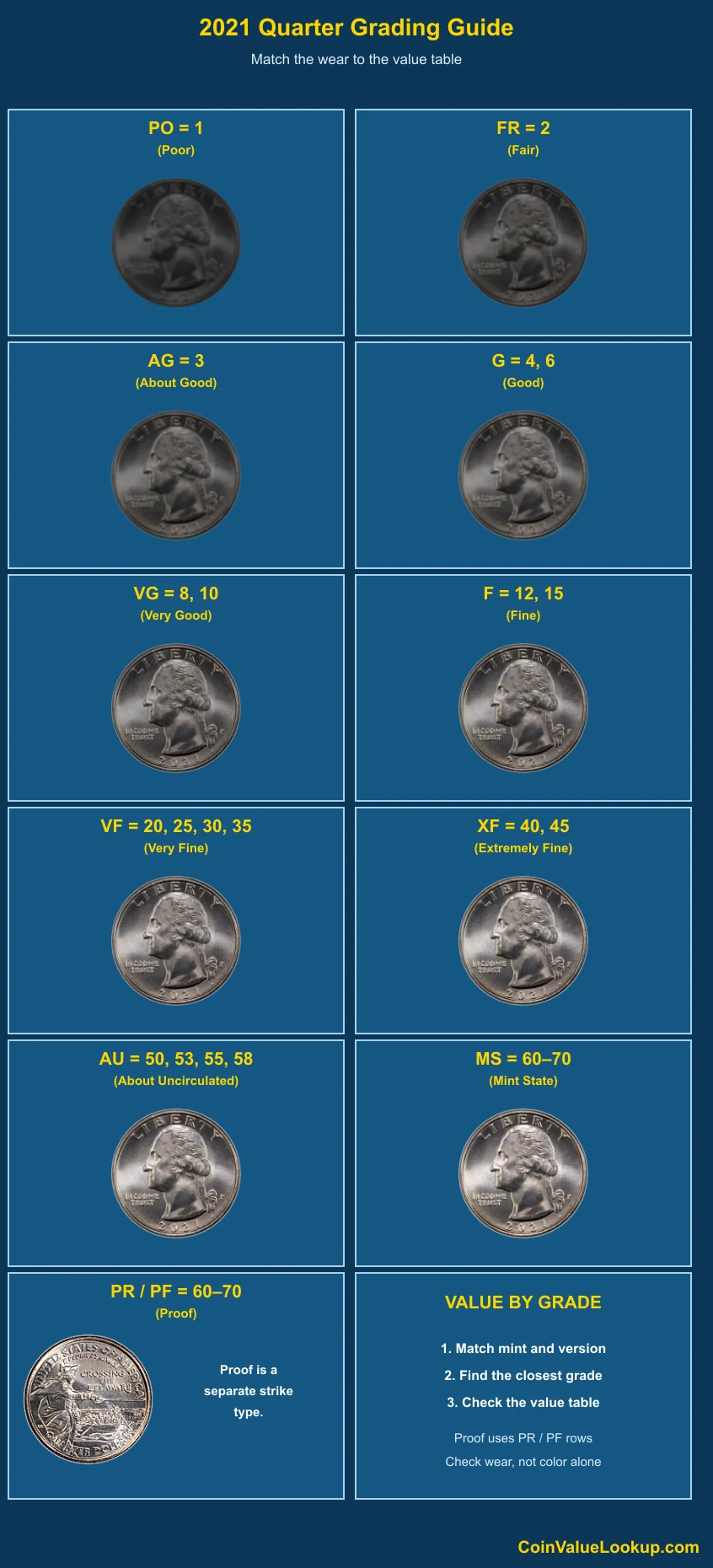
For business strikes, focus on Washington's cheek and the hair detail above the ear. These are the highest relief points and the first to show friction.
A coin that has been in a pocket for a week will already show a slight flattening there, which drops the grade below Mint State.
On the reverse, examine the figures in the boat. The folds in clothing and the flag details wear progressively.
Compare your coin side-by-side with the grading comparison image to gauge how much original luster remains.
Luster is critical. An unworn coin with full, cartwheel-style luster across both sides is a strong Mint State candidate.
One that looks dull or has been cleaned loses that original surface and grades lower regardless of how sharp the design appears.
For proofs, check the mirror fields under a single light source. Hairlines from improper handling, haze from moisture exposure, and fingerprints all reduce the grade.
A deep cameo contrast between frosted devices and reflective fields is desirable, but do not assume every proof qualifies for a cameo designation just because it looks bright.
Step 3: Check 2021 Quarter Value by Mint and Version
2021 Quarter — P — Crossing the Delaware — regular strike
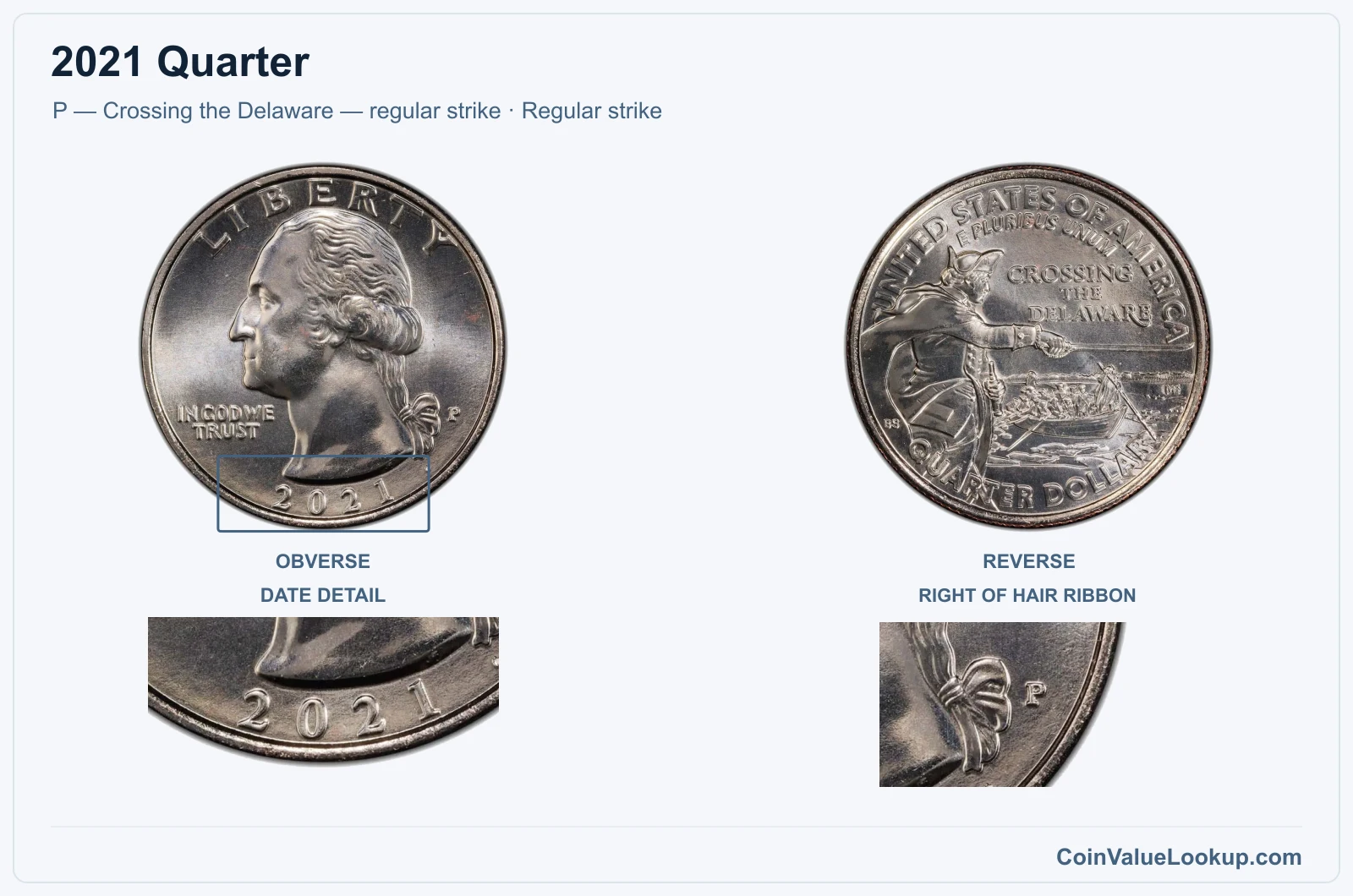
The 2021-P Crossing the Delaware quarter is a copper-nickel clad coin struck at the Philadelphia Mint. It weighs about 5.67 grams and measures 24.26 mm in diameter.
Look for the small "P" mintmark on the obverse near Washington's portrait.
Worn examples from pocket change are worth face value. Original, uncirculated pieces with full luster and no contact marks move into collectible territory, but the value of any individual coin depends on its authenticated grade and whether it carries a recognized die variety or error.
Condition is everything here.
Range Grade
Price Auction Records Appraisal PO PO 1
—
Coin Identifier FR FR 2
—
Coin Identifier AG AG 3
—
Coin Identifier G G 4
—
Coin Identifier
G 6
—
Coin Identifier VG VG 8
—
Coin Identifier
VG 10
—
Coin Identifier F F 12
—
Coin Identifier
F 15
—
Coin Identifier VF VF 20
—
Coin Identifier
VF 25
—
Coin Identifier
VF 30
—
Coin Identifier
VF 35
—
Coin Identifier XF XF 40
—
Coin Identifier
XF 45
—
Coin Identifier AU AU 50
—
Coin Identifier
AU 53
—
Coin Identifier
AU 55
—
Coin Identifier
AU 58
—
Coin Identifier MS MS 60
—
Coin Identifier
MS 61
—
Coin Identifier
MS 62
—
Coin Identifier
MS 63
—
Coin Identifier
MS 64
—
Coin Identifier
MS 65
—
Coin Identifier
MS 66
—
Coin Identifier
MS 67
—
Coin Identifier
MS 68
—
—
—
MS 69
—
—
—
MS 70
—
—
—
2021 Quarter — D — Crossing the Delaware — regular strike
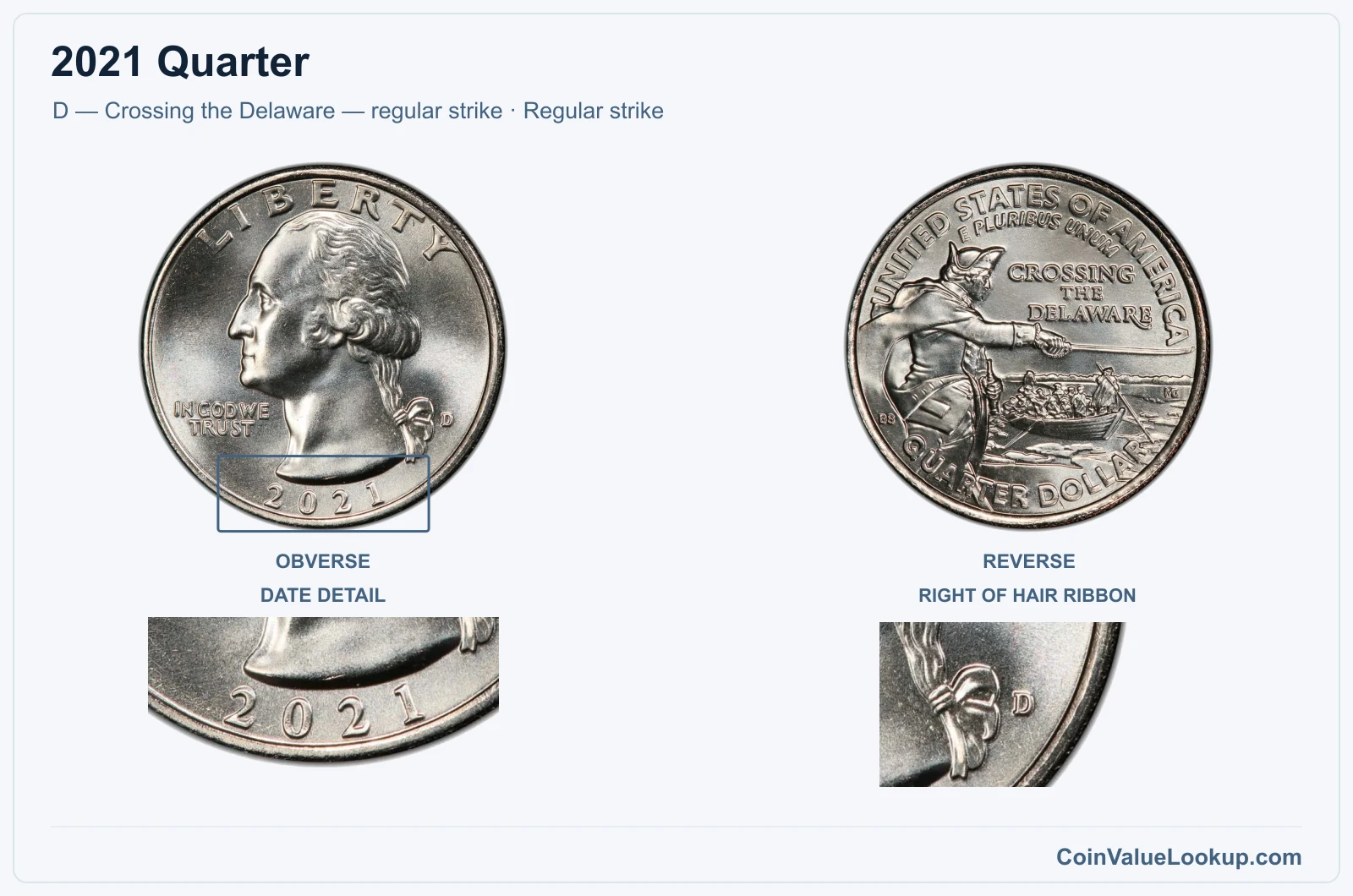
The 2021-D version was struck at the Denver Mint. Same copper-nickel clad composition, same 5.67-gram weight, same 24.26 mm diameter.
The distinguishing feature is the "D" mintmark on the obverse.
Like its Philadelphia counterpart, a circulated 2021-D quarter is a spender. Uncirculated examples with strong luster and minimal bag marks have collectible potential, particularly at the upper end of the Mint State scale.
Individual value depends on authenticated condition and the presence or absence of recognized errors.
Coin Value Lookup is a good starting point if you want to look up guides for other dates, mints or denominations in this series.
Range Grade
Price Auction Records Appraisal PO PO 1
—
Coin Identifier FR FR 2
—
Coin Identifier AG AG 3
—
Coin Identifier G G 4
—
Coin Identifier
G 6
—
Coin Identifier VG VG 8
—
Coin Identifier
VG 10
—
Coin Identifier F F 12
—
Coin Identifier
F 15
—
Coin Identifier VF VF 20
—
Coin Identifier
VF 25
—
Coin Identifier
VF 30
—
Coin Identifier
VF 35
—
Coin Identifier XF XF 40
—
Coin Identifier
XF 45
—
Coin Identifier AU AU 50
—
Coin Identifier
AU 53
—
Coin Identifier
AU 55
—
Coin Identifier
AU 58
—
Coin Identifier MS MS 60
—
Coin Identifier
MS 61
—
Coin Identifier
MS 62
—
Coin Identifier
MS 63
—
Coin Identifier
MS 64
—
Coin Identifier
MS 65
—
Coin Identifier
MS 66
—
Coin Identifier
MS 67
—
Coin Identifier
MS 68
—
Coin Identifier
MS 69
—
—
—
MS 70
—
—
—
2021 Quarter — S — Crossing the Delaware — clad proof
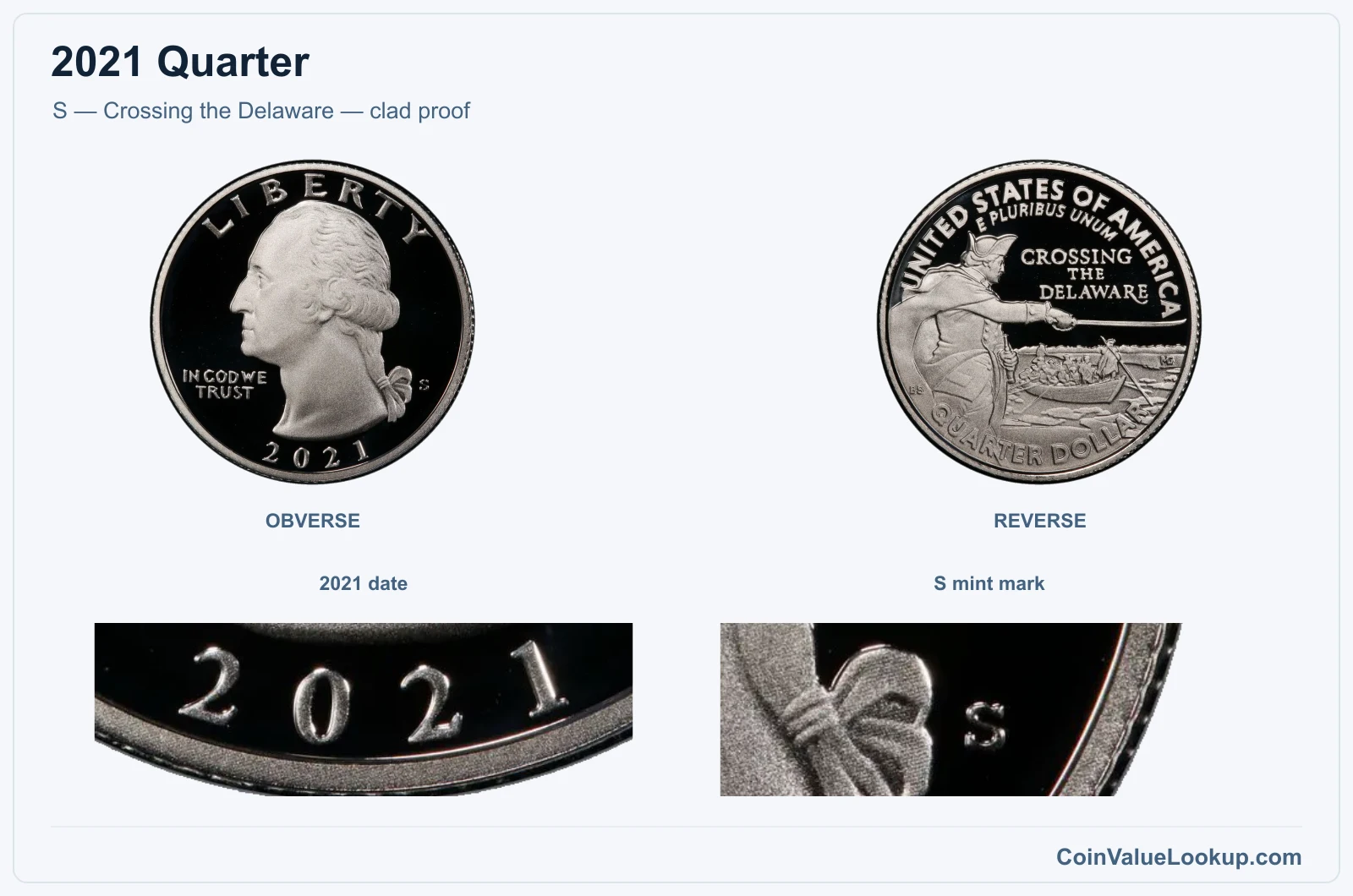
The 2021-S clad proof was produced at the San Francisco Mint for inclusion in annual proof sets. It is copper-nickel clad over a copper core, the same composition as business strikes, but struck with polished dies and specially prepared planchets to produce mirror fields and frosted devices.
Confirm the "S" mintmark on the obverse. Then check the edge for that telltale copper stripe, which separates this clad version from the silver proof.
The value of a clad proof depends on how well it has been preserved: hairlines, haze and fingerprints on the fields reduce desirability. Deep cameo contrast with pristine surfaces is what collectors want.
Range Grade
Price Auction Records Appraisal PR PR 1
—
Coin Identifier
PR 2
—
Coin Identifier
PR 3
—
Coin Identifier
PR 4
—
Coin Identifier
PR 6
—
Coin Identifier
PR 8
—
Coin Identifier
PR 10
—
Coin Identifier
PR 12
—
Coin Identifier
PR 15
—
Coin Identifier
PR 20
—
Coin Identifier
PR 25
—
Coin Identifier
PR 30
—
Coin Identifier
PR 35
—
Coin Identifier
PR 40
—
Coin Identifier
PR 45
—
Coin Identifier
PR 50
—
Coin Identifier
PR 53
—
Coin Identifier
PR 55
—
Coin Identifier
PR 58
—
Coin Identifier
PR 60
—
Coin Identifier
PR 61
—
Coin Identifier
PR 62
—
Coin Identifier
PR 63
—
Coin Identifier
PR 64
—
Coin Identifier
PR 65
—
Coin Identifier
PR 66
—
Coin Identifier
PR 67
—
Coin Identifier
PR 68
—
Coin Identifier
PR 69
—
Coin Identifier
PR 70
—
Coin Identifier
2021 Quarter — S — Crossing the Delaware — silver proof
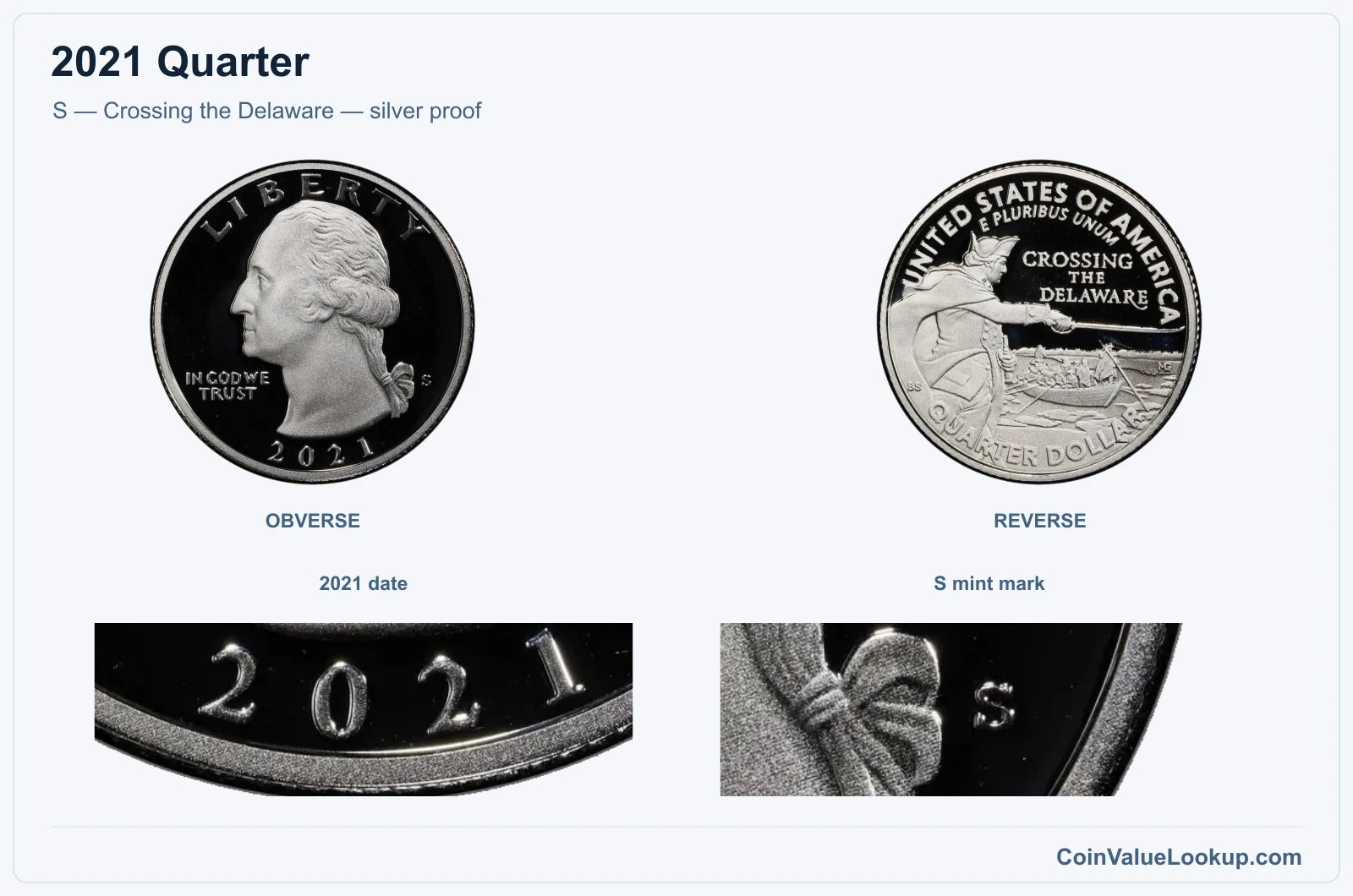
This is the premium version. The 2021-S silver proof is struck in .999 fine silver, weighing approximately 6.34 grams.
It carries the same "S" mintmark and proof finish as the clad proof, but the edge is uniformly silver-gray with no copper stripe visible.
Silver proofs were sold in the U.S. Mint's Silver Proof Set, so original government packaging is the simplest way to confirm what you have. A kitchen scale accurate to a tenth of a gram also works.
The higher precious-metal content and limited production give this version a baseline worth above clad issues, but the final value depends on the coin's condition and whether it has been handled outside its original capsule.
Range Grade
Price Auction Records Appraisal PR PR 1
—
Coin Identifier
PR 2
—
Coin Identifier
PR 3
—
Coin Identifier
PR 4
—
Coin Identifier
PR 6
—
Coin Identifier
PR 8
—
Coin Identifier
PR 10
—
Coin Identifier
PR 12
—
Coin Identifier
PR 15
—
Coin Identifier
PR 20
—
Coin Identifier
PR 25
—
Coin Identifier
PR 30
—
Coin Identifier
PR 35
—
Coin Identifier
PR 40
—
Coin Identifier
PR 45
—
Coin Identifier
PR 50
—
Coin Identifier
PR 53
—
Coin Identifier
PR 55
—
Coin Identifier
PR 58
—
Coin Identifier
PR 60
—
Coin Identifier
PR 61
—
Coin Identifier
PR 62
—
Coin Identifier
PR 63
—
Coin Identifier
PR 64
—
Coin Identifier
PR 65
—
Coin Identifier
PR 66
—
Coin Identifier
PR 67
—
Coin Identifier
PR 68
—
Coin Identifier
PR 69
—
Coin Identifier
PR 70
—
Coin Identifier
2021 Quarter Error List
1. 2021 Quarter — Crossing the Delaware — Struck-Through Error
A struck-through error occurs when foreign material, often grease or a small fragment, sits on the die or planchet during striking. The result is a localized area of missing or distorted design, sometimes with an impression of the object left behind.
On a 2021 Crossing the Delaware quarter, look for a smooth, depressed patch where detail should be. Grease-filled errors tend to produce a flat, featureless zone, while a retained foreign object may leave a distinct outline.
These are not the same thing, so describe what you see accurately.
Do not confuse normal wear, cleaning or a weak strike for a struck-through. Wear removes metal gradually and follows high points; a struck-through is abrupt and localized.
Value depends on the size, location and visibility of the affected area, as well as the coin's overall condition.
2. 2021 Quarter — Crossing the Delaware — Doubled Die Reverse
A doubled die reverse on the 2021 Crossing the Delaware quarter shows a secondary, slightly offset impression of part of the reverse design. One reported variety has been nicknamed the "Ghost Oar" because the doubling is visible in that area of the boat scene.
To check, compare your coin's reverse details against a normal example under good lighting and magnification. True die doubling produces consistent separation or notching on affected design elements, and it will appear in the same spot on every coin struck from that die.
Machine doubling is the most common lookalike. It creates a flat, shelf-like distortion rather than the rounded, separated profiles of a genuine doubled die.
Random scratches, reflections and post-strike damage can also mimic doubling. Condition, clarity of the doubling and professional authentication all factor into value.
3. 2021 Quarter — Crossing the Delaware — Die Crack / Die Chip
Die cracks and die chips show up as raised features on the finished coin because they correspond to recesses that formed in a deteriorating die. On the 2021 Crossing the Delaware quarter, a reported variety is nicknamed the "Crown" die chip, referring to a small raised blob in a specific location on the design.
A die chip appears as a tiny raised lump, often irregular in shape. A die crack is a thin raised line running across part of the design.
Both are distinct from incuse scratches, which are pressed into the surface, and from corrosion or adhesive residue sitting on top of it.
Larger, more visually dramatic examples generally attract more collector interest. Value depends on size, placement and the coin's overall grade.
4. 2021 Quarter — Doubled Die Obverse
A doubled die obverse on a 2021 Crossing the Delaware quarter means that part of the obverse die received a secondary, misaligned impression during its manufacture. The result is consistent doubling visible on affected letters, numbers or design elements on the front of the coin.
Check the date, motto and lettering under at least 5x magnification. Genuine die doubling shows rounded, separated contours that repeat in the same direction on every coin from that die.
Compare your coin to a known normal example under the same lighting.
Machine doubling is the usual false alarm. It produces a flat, shelf-like distortion instead of distinct separated profiles.
Worn die contours and optical reflections can also trick the eye. Visibility, sharpness of the doubling and authenticated condition all affect what a confirmed doubled die obverse is worth.
5. 2021 Quarter — Die Break / Cud
A cud is a specific type of die break where a piece of the die breaks away at the rim, leaving a raised, featureless blob that extends from the rim into the design area. On a 2021 Crossing the Delaware quarter, this shows up as an irregular raised lump connected to the coin's edge.
The key diagnostic is that connection to the rim. An interior die chip sits entirely within the design field and is not a cud.
A rim dent is incuse, pushed inward rather than raised, and is caused by post-strike damage rather than a die problem.
Corrosion deposits and adhesive residue can sit on the surface and mimic a raised feature, but they can usually be distinguished under magnification because they sit on top of the original surface rather than replacing design detail. The size and location of a cud, along with the coin's condition, determine its collector appeal.