1957 Washington Quarter Coin Value: How Much Is It Worth?
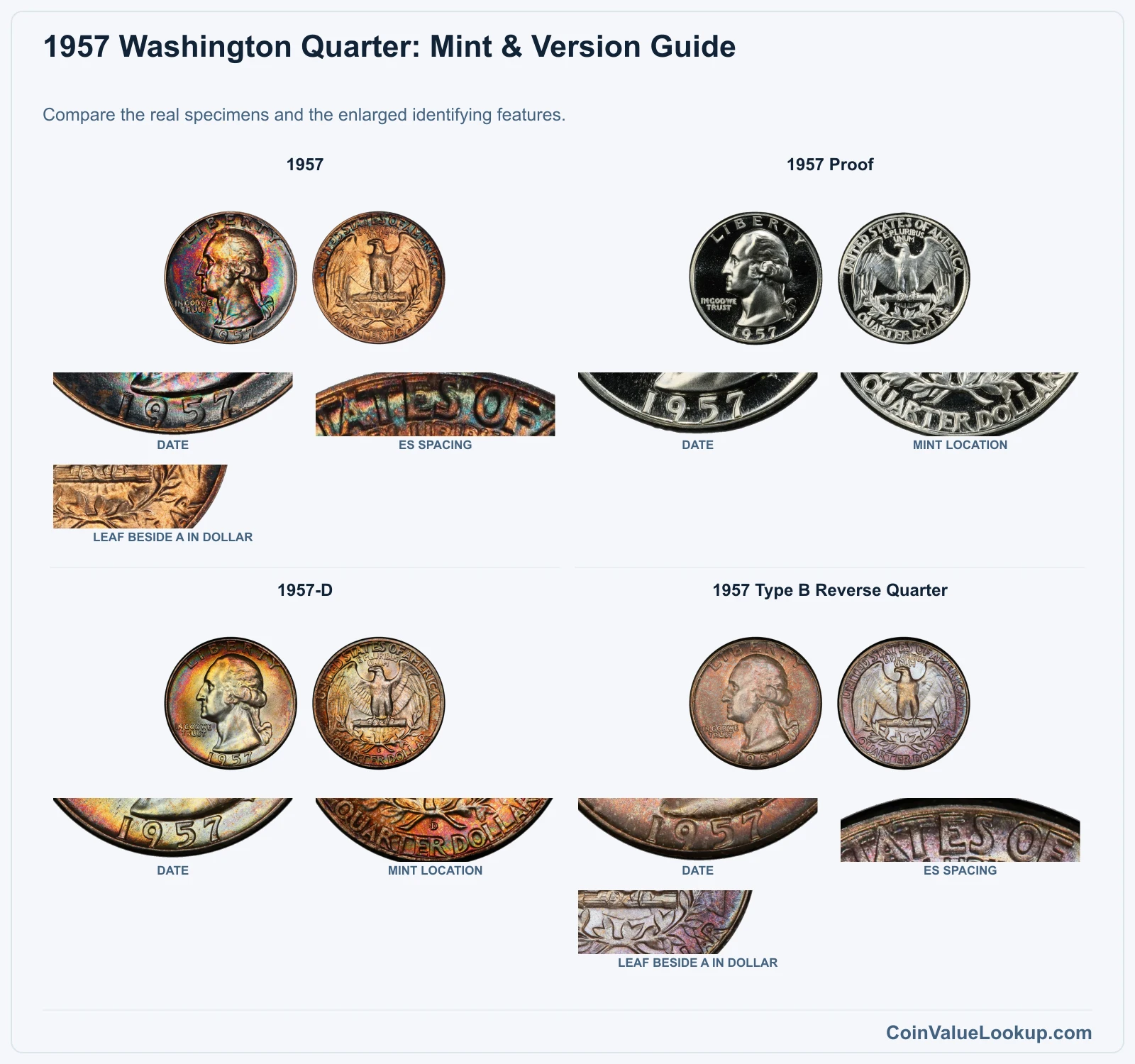
A 1957 Washington quarter is a 90% silver coin worth at least around $16.43 in well-worn condition, according to USA Coin Book guide estimates. In higher uncirculated grades, Philadelphia and Denver business strikes can reach the mid-$30s at MS65.
Certain varieties and errors push values well beyond those figures, so the specifics matter. All prices are condition-sensitive and reflect the coin's silver content.
Fast Way to Identify Your 1957 Washington Quarter
The quickest way to start figuring out what your 1957 quarter is worth is to upload clear photos of the front and back. Our identifier can give you a preliminary read on which version you have — Philadelphia, Denver, proof or possibly the scarce Type B reverse.
Snap both sides in good light and let the tool do the initial sorting for you.
1957 Washington Quarter Value
Upload both sides of your 1957 Washington Quarter.
Front Obverse
Upload photo
Back Reverse
Upload photo
Which 1957 Washington Quarter Versions Are Worth Money?
- The 1957 Type B Reverse is a scarce circulation-strike variety identified by the separated E and S in STATES — one example sold for $423 in MS67 at Heritage in January 2015.
- A 1957 Philadelphia quarter struck on a dime planchet brought $1,920 in MS64 at Heritage in December 2023, making wrong-planchet errors among the most dramatic for this date.
- A 1957-D Misplaced Mintmark variety, recognized by PCGS, realized $1,860 in MS66+ at Heritage in July 2021.
- High-grade 1957-D business strikes reach an estimated $37 at MS65 per USA Coin Book, slightly above the Philadelphia issue at that grade.
- Philadelphia proofs in PR65 carry a guide estimate around $30 — affordable, but cameo or deep cameo designations can change the picture.
Step 1: Identify Your 1957 Washington Quarter Mint Mark and Version
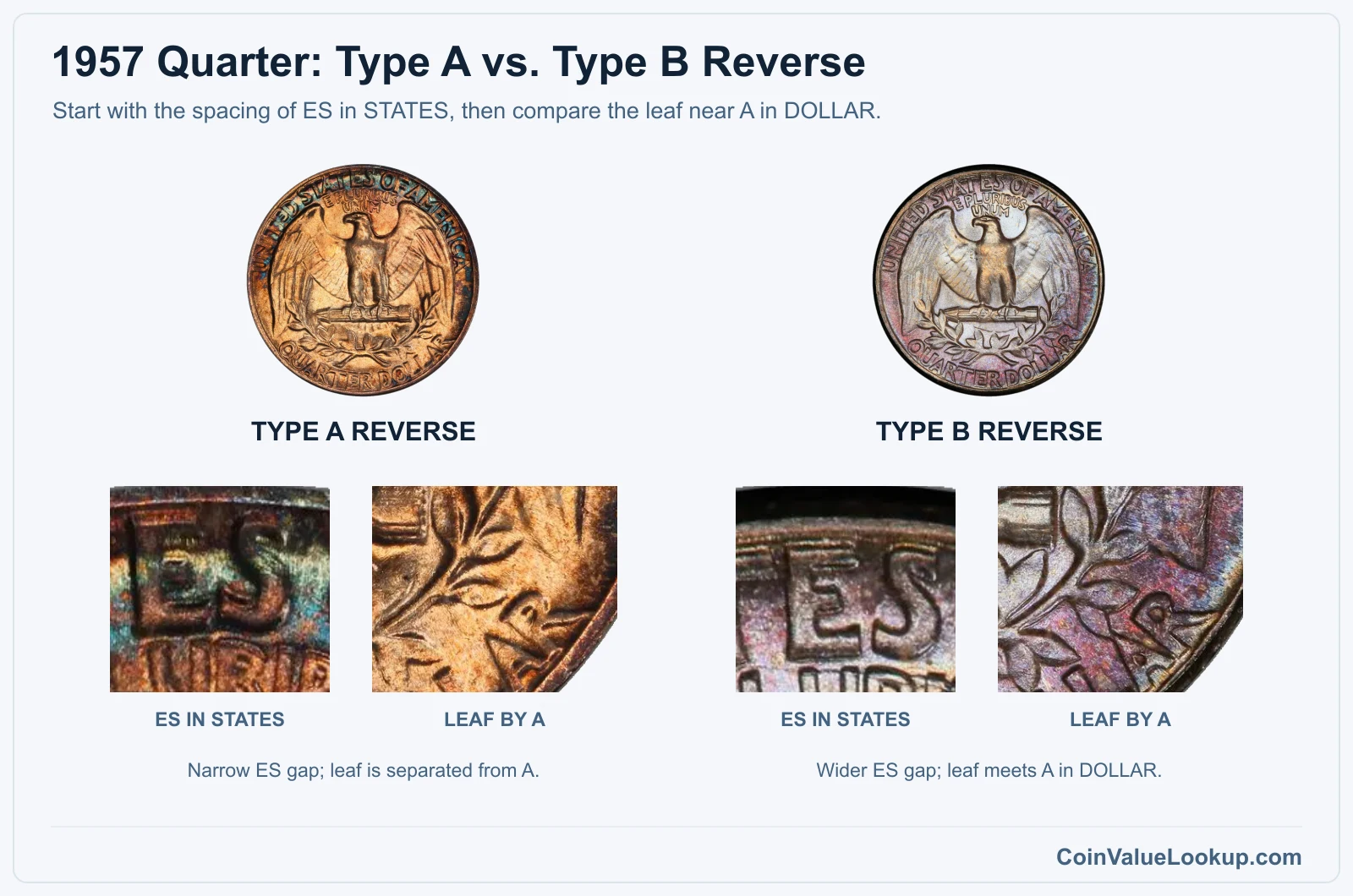
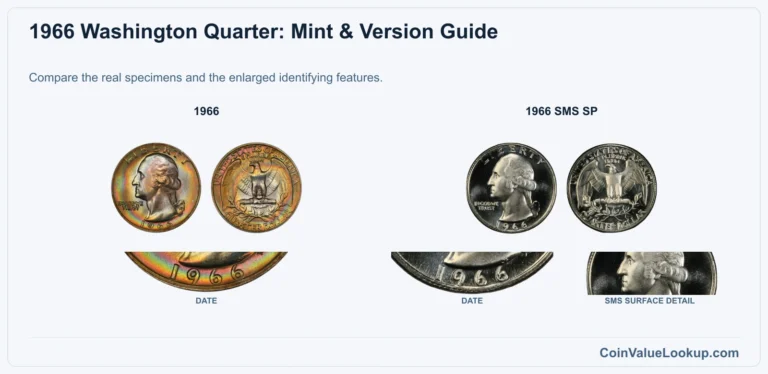
The 1957 Washington quarter features Washington facing left on the obverse with the date at the bottom. On the reverse, an eagle with spread wings sits above arrows and olive branches.
Philadelphia coins carry no mintmark. Denver coins show a small D below the wreath on the reverse.
A blank mintmark position is normal for Philadelphia in this era — it does not mean something is missing.
All standard 1957 quarters are struck in 90% silver and 10% copper, weigh approximately 6.25 grams and measure about 24.3 mm across. Proofs were made only at Philadelphia and share the same alloy.
Beyond the regular Philadelphia and Denver business strikes and the Philadelphia proof, there is a Type B reverse variety. This is a reverse-design distinction on a circulation strike, not a proof.
The key diagnostic is the spacing between the letters E and S in STATES — separated on a Type B, nearly touching on the ordinary reverse.
Step 2: Check Your 1957 Washington Quarter Grade
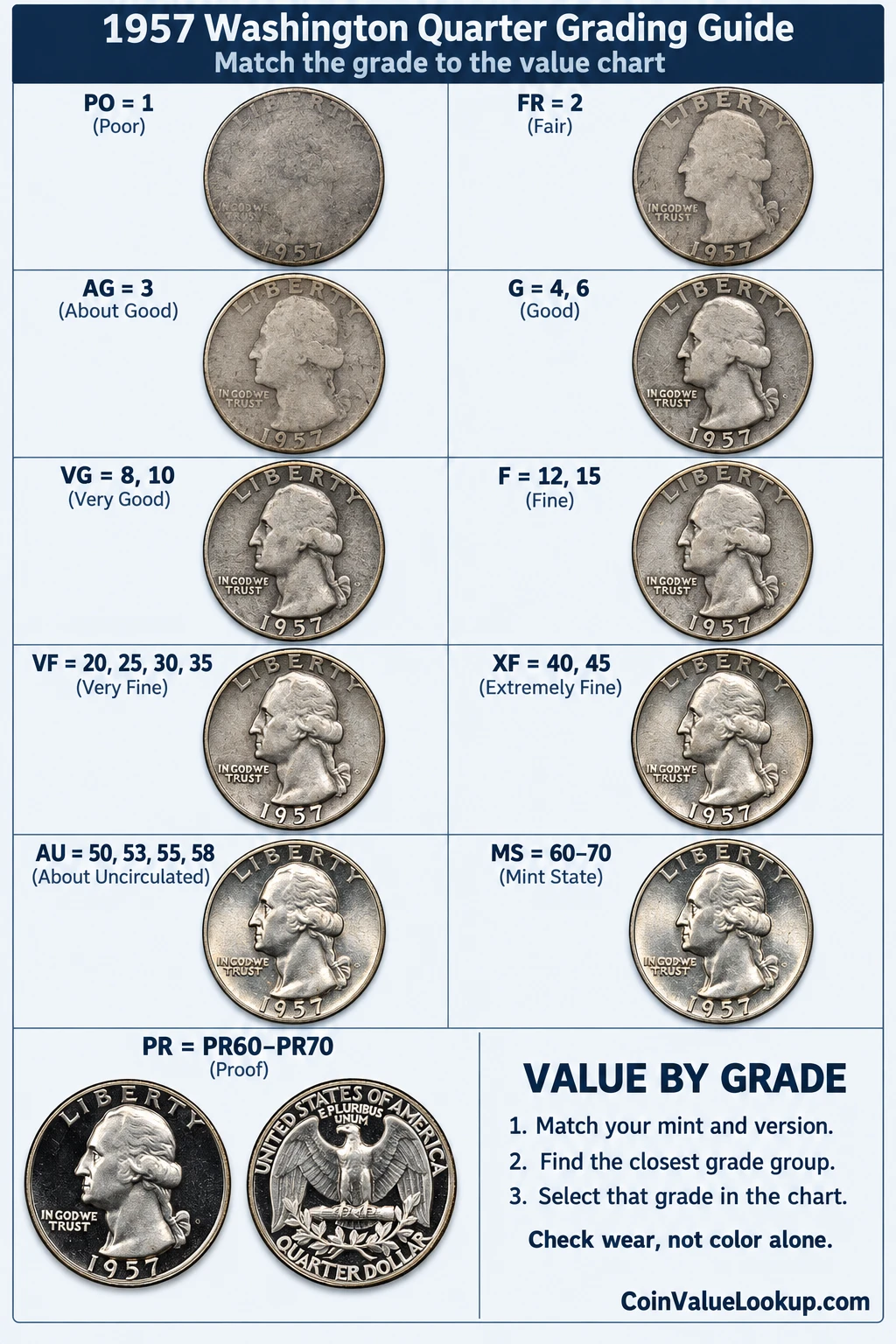
Start on the obverse. Washington's cheek, jawline and the hair directly above the ear are the first places to lose detail.
Even light friction will dull the luster on that high cheekbone before anywhere else.
Flip to the reverse and check the eagle's breast feathers and the tops of the wings. These are the corresponding high points that wear first on the back side.
Use the comparison image to match your coin's remaining detail against known grade benchmarks. An MS60 coin shows full design but may have contact marks and uneven luster.
An MS65 should display strong, original mint luster with only minor marks.
Watch for cleaning. Hairline scratches from a past polishing will reduce a coin's grade and desirability even if the design detail looks sharp.
Rim dings and heavy bag marks also count against the grade. Proof coins should show mirrored fields — any cloudiness or friction on those fields lowers the numerical grade regardless of how crisp the devices remain.
Step 3: Check 1957 Washington Quarter Value by Mint and Version
1957 Washington Quarter
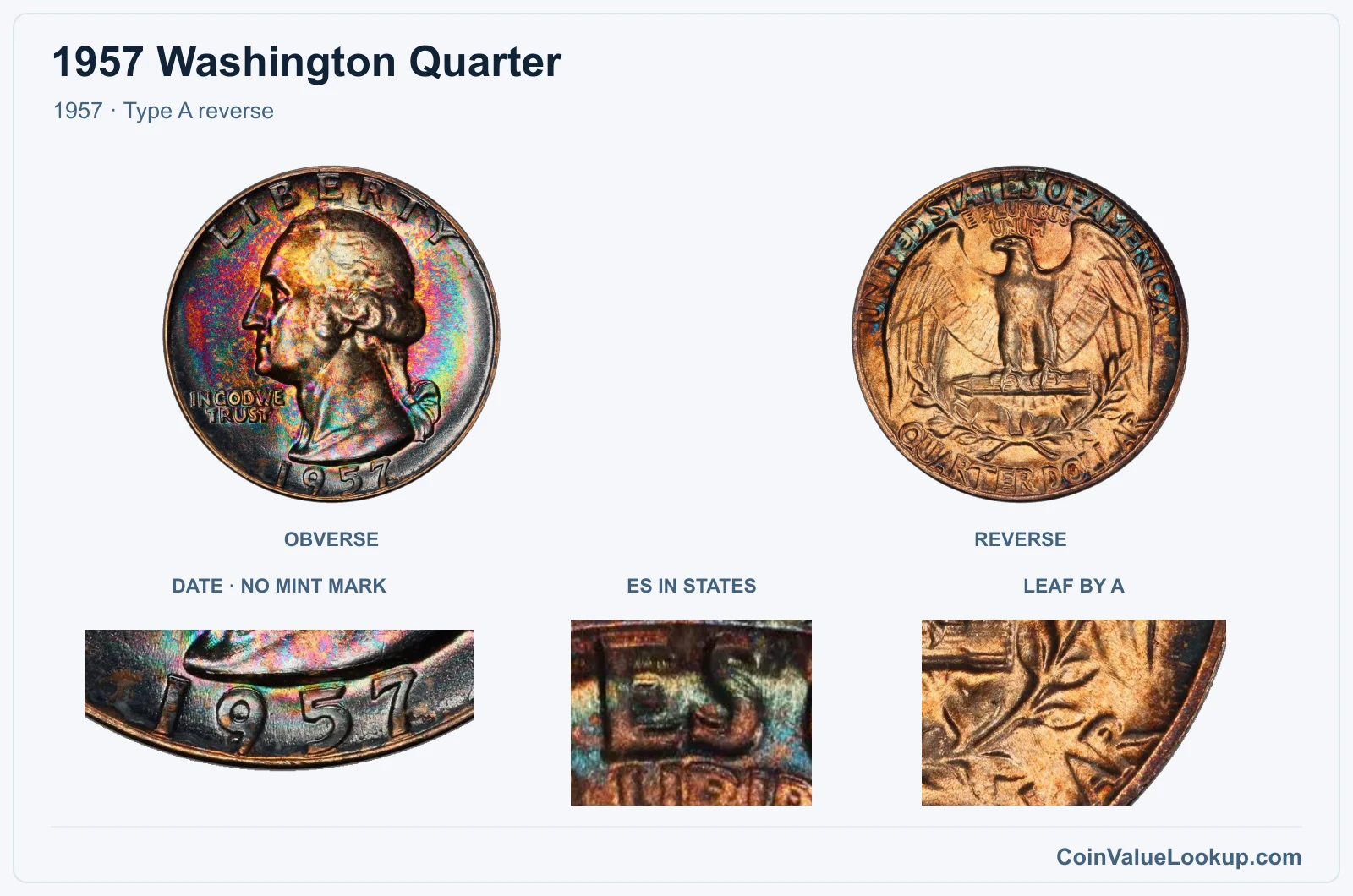
The 1957 Philadelphia quarter is the standard business strike with no mintmark. It uses the ordinary Type A circulation reverse where the E and S in STATES nearly touch.
USA Coin Book guide estimates place this coin at about $16.43 in G4, around $20 at MS60 and roughly $34 at MS65. These are retail guide figures, not guaranteed purchase prices, and they reflect the coin's silver content plus numismatic demand.
Gem examples are fairly accessible for this date, so condition and original luster are what separate a common coin from a desirable one.
| Range | Grade | Price | Auction Records | Appraisal |
|---|---|---|---|---|
| PO | PO 1 | — | Coin Identifier | |
| FR | FR 2 | — | Coin Identifier | |
| AG | AG 3 | — | Coin Identifier | |
| G | G 4 | — | Coin Identifier | |
| G 6 | — | Coin Identifier | ||
| VG | VG 8 | — | Coin Identifier | |
| VG 10 | — | Coin Identifier | ||
| F | F 12 | — | Coin Identifier | |
| F 15 | — | Coin Identifier | ||
| VF | VF 20 | — | Coin Identifier | |
| VF 25 | — | Coin Identifier | ||
| VF 30 | — | Coin Identifier | ||
| VF 35 | — | Coin Identifier | ||
| XF | XF 40 | — | Coin Identifier | |
| XF 45 | — | Coin Identifier | ||
| AU | AU 50 | — | Coin Identifier | |
| AU 53 | — | Coin Identifier | ||
| AU 55 | — | Coin Identifier | ||
| AU 58 | — | Coin Identifier | ||
| MS | MS 60 | — | Coin Identifier | |
| MS 61 | — | Coin Identifier | ||
| MS 62 | Coin Identifier | |||
| MS 63 | Coin Identifier | |||
| MS 64 | Coin Identifier | |||
| MS 65 | Coin Identifier | |||
| MS 66 | Coin Identifier | |||
| MS 67 | Coin Identifier | |||
| MS 68 | Coin Identifier | |||
| MS 69 | — | — | — | |
| MS 70 | — | — | — |
1957 Washington Quarter — Proof
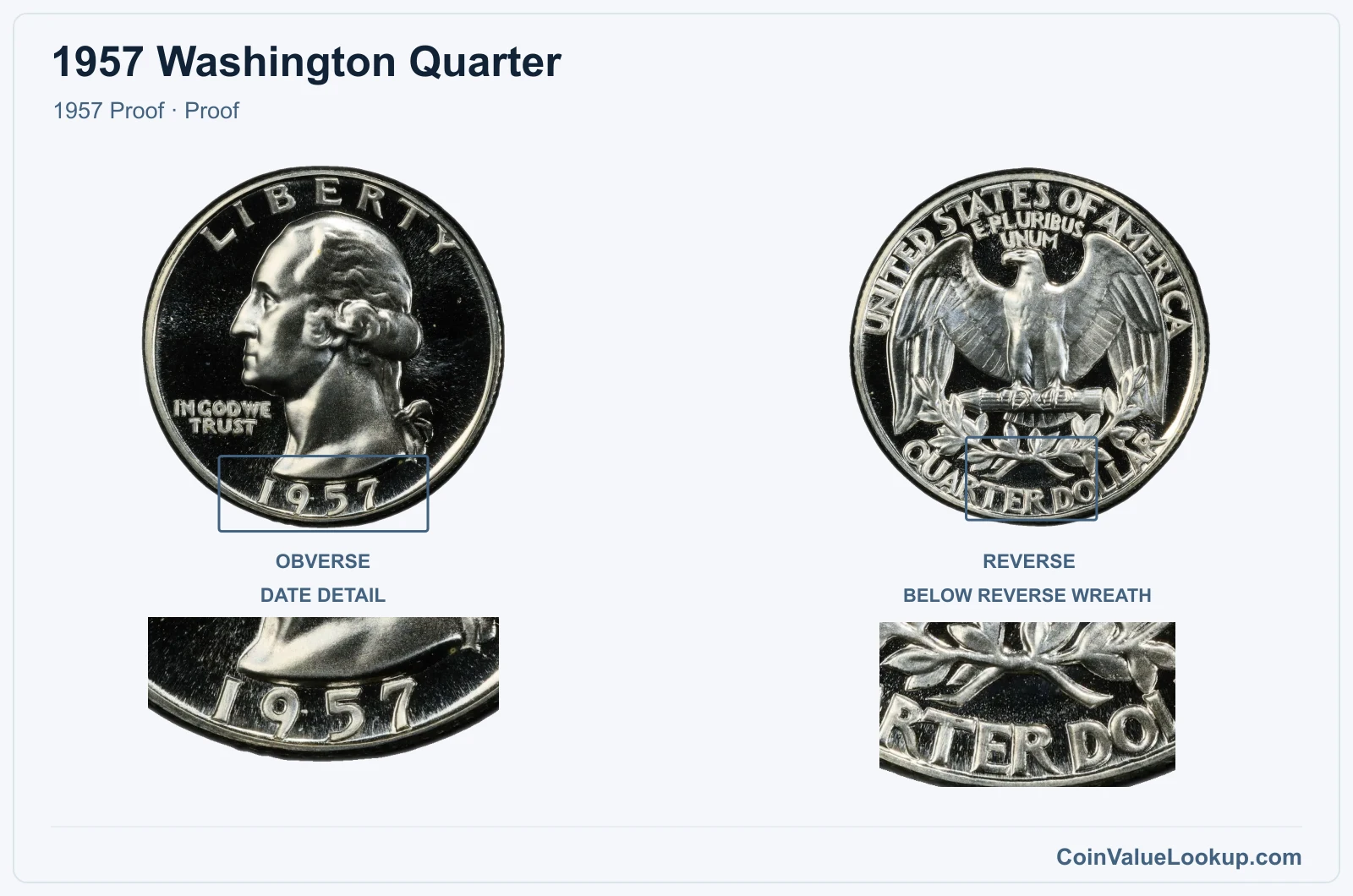
Philadelphia struck proof quarters in 1957 using the same 90% silver alloy as circulation coins. The proof finish produces deeply mirrored fields and sharp design edges that a business strike cannot match.
A PR65 example carries a USA Coin Book guide estimate of about $30. Cameo and Deep Cameo designations — describing the contrast between frosted devices and mirror fields — are separate from the numerical grade and can affect value independently.
Coin Value Lookup is a good starting point if you want to compare proof and business-strike values across different Washington quarter dates. A few minutes of comparison can save you from overpaying or undervaluing what you already own.
| Range | Grade | Price | Auction Records | Appraisal |
|---|---|---|---|---|
| PR | PR 1 | — | Coin Identifier | |
| PR 2 | — | Coin Identifier | ||
| PR 3 | — | Coin Identifier | ||
| PR 4 | — | Coin Identifier | ||
| PR 6 | — | Coin Identifier | ||
| PR 8 | — | Coin Identifier | ||
| PR 10 | — | Coin Identifier | ||
| PR 12 | — | Coin Identifier | ||
| PR 15 | — | Coin Identifier | ||
| PR 20 | — | Coin Identifier | ||
| PR 25 | — | Coin Identifier | ||
| PR 30 | — | Coin Identifier | ||
| PR 35 | — | Coin Identifier | ||
| PR 40 | — | Coin Identifier | ||
| PR 45 | — | Coin Identifier | ||
| PR 50 | — | Coin Identifier | ||
| PR 53 | — | Coin Identifier | ||
| PR 55 | — | Coin Identifier | ||
| PR 58 | — | Coin Identifier | ||
| PR 60 | — | Coin Identifier | ||
| PR 61 | — | Coin Identifier | ||
| PR 62 | — | Coin Identifier | ||
| PR 63 | Coin Identifier | |||
| PR 64 | Coin Identifier | |||
| PR 65 | Coin Identifier | |||
| PR 66 | Coin Identifier | |||
| PR 67 | Coin Identifier | |||
| PR 68 | Coin Identifier | |||
| PR 69 | Coin Identifier | |||
| PR 70 | — | — | — |
1957 Washington Quarter — D
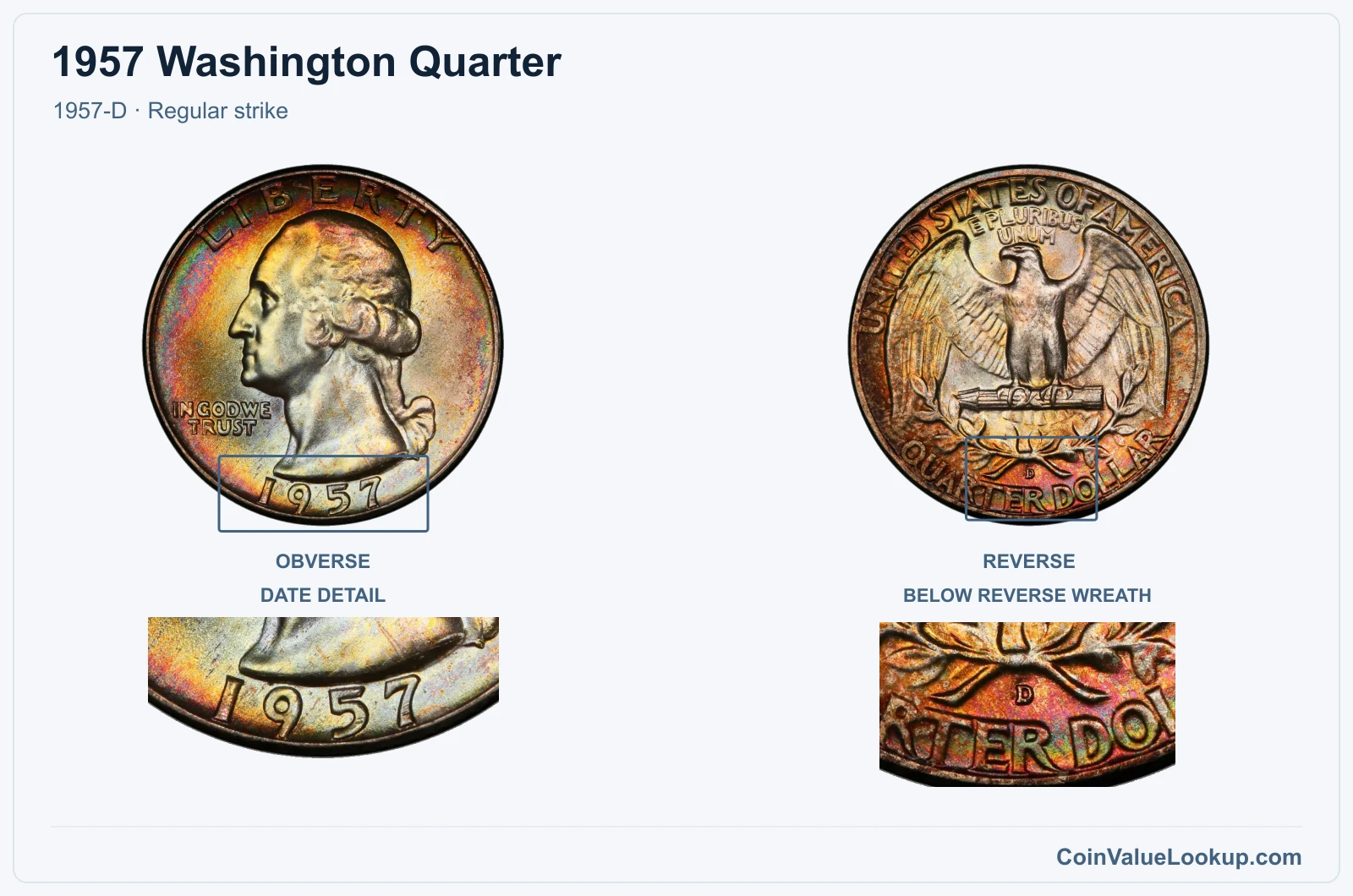
The 1957-D quarter was struck at the Denver Mint and carries a small D below the wreath on the reverse. Same 90% silver composition, same weight.
USA Coin Book guide estimates run about $16.43 in G4, around $20 at MS60 and approximately $37 at MS65. That MS65 figure is a touch higher than the Philadelphia business strike at the same grade.
As always, original luster and the absence of cleaning or heavy marks make the difference at the upper end.
| Range | Grade | Price | Auction Records | Appraisal |
|---|---|---|---|---|
| PO | PO 1 | — | Coin Identifier | |
| FR | FR 2 | — | Coin Identifier | |
| AG | AG 3 | — | Coin Identifier | |
| G | G 4 | — | Coin Identifier | |
| G 6 | — | Coin Identifier | ||
| VG | VG 8 | — | Coin Identifier | |
| VG 10 | — | Coin Identifier | ||
| F | F 12 | — | Coin Identifier | |
| F 15 | — | Coin Identifier | ||
| VF | VF 20 | — | Coin Identifier | |
| VF 25 | — | Coin Identifier | ||
| VF 30 | — | Coin Identifier | ||
| VF 35 | — | Coin Identifier | ||
| XF | XF 40 | — | Coin Identifier | |
| XF 45 | — | Coin Identifier | ||
| AU | AU 50 | — | Coin Identifier | |
| AU 53 | — | Coin Identifier | ||
| AU 55 | — | Coin Identifier | ||
| AU 58 | — | Coin Identifier | ||
| MS | MS 60 | — | Coin Identifier | |
| MS 61 | — | Coin Identifier | ||
| MS 62 | — | Coin Identifier | ||
| MS 63 | Coin Identifier | |||
| MS 64 | Coin Identifier | |||
| MS 65 | Coin Identifier | |||
| MS 66 | Coin Identifier | |||
| MS 67 | Coin Identifier | |||
| MS 68 | Coin Identifier | |||
| MS 69 | — | — | — | |
| MS 70 | — | — | — |
1957 Washington Quarter — Type B Reverse Quarter
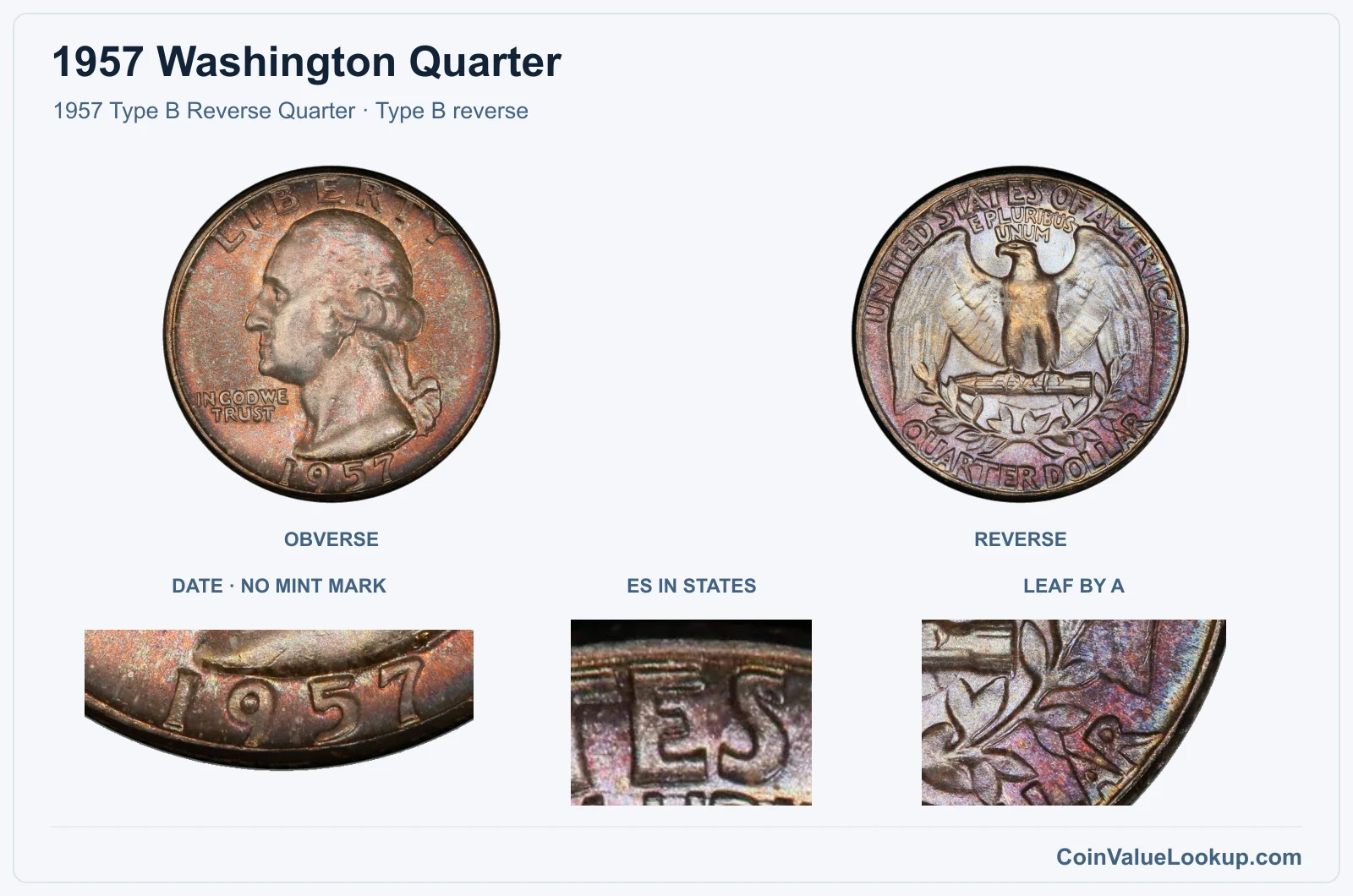
This is the variety to actually look for. The 1957 Type B Reverse quarter was struck at Philadelphia using a proof-style reverse hub on a regular business-strike planchet.
It is not a proof — the obverse and overall finish are standard circulation quality.
The diagnostic is in the word STATES on the reverse. On the ordinary circulation reverse, the E and S nearly touch.
On the Type B, those letters are clearly separated. You will want magnification and a normal 1957 quarter side by side for comparison.
One example graded MS67 sold for $423 at Heritage in January 2015. That is a single historical sale at a specific high grade, not a broad market range.
Lower-grade examples would bring less, but correctly identified Type B coins are scarce enough to attract serious collector interest.
Range Grade
Price Auction Records Appraisal PO PO 1
—
Coin Identifier FR FR 2
—
Coin Identifier AG AG 3
—
Coin Identifier G G 4
—
Coin Identifier
G 6
—
Coin Identifier VG VG 8
—
Coin Identifier
VG 10
—
Coin Identifier F F 12
—
Coin Identifier
F 15
—
Coin Identifier VF VF 20
—
Coin Identifier
VF 25
—
Coin Identifier
VF 30
—
Coin Identifier
VF 35
—
Coin Identifier XF XF 40
—
Coin Identifier
XF 45
—
Coin Identifier AU AU 50
—
Coin Identifier
AU 53
—
Coin Identifier
AU 55
—
Coin Identifier
AU 58
—
Coin Identifier MS MS 60
—
Coin Identifier
MS 61
—
Coin Identifier
MS 62
—
Coin Identifier
MS 63
Coin Identifier
MS 64
—
Coin Identifier
MS 65
Coin Identifier
MS 66
Coin Identifier
MS 67
Coin Identifier
MS 68
—
—
—
MS 69
—
—
—
MS 70
—
—
—
1957 Washington Quarter Error List
1. 1957 Washington Quarter — Struck on a Dime Planchet
A 1957 Philadelphia quarter struck on a silver dime planchet is a dramatic wrong-planchet error. The coin weighs roughly 2.5 grams instead of the normal 6.25 grams, and the quarter's design is cropped because the smaller blank could not accommodate the full die impression.
An NGC-graded MS64 example sold for $1,920 at Heritage in December 2023. That is one recorded sale at one grade — not a price curve.
To distinguish this from damage, check for a complete strike impression on all visible portions. The design should be sharp where it exists, with natural strike-made surfaces.
Post-mint grinding, cutting or hammering will leave tool marks and irregular edges that a genuine small-planchet strike will not show. Weight is the simplest first test: if your 1957 quarter feels noticeably thin and light, weigh it on a gram scale.
2. 1957 Washington Quarter — Misplaced D Mintmark
PCGS recognizes a 1957-D quarter with a misplaced mintmark — the D appears in an abnormal location relative to the wreath and denomination on the reverse. An MS66+ example recorded by PCGS sold for $1,860 at Heritage in July 2021.
To check your coin, compare the D's position against a normal 1957-D at the same magnification. A genuine misplaced mintmark is a die-level error that will match the recognized reference position exactly.
A D that merely looks slightly shifted could just be normal variation in punch placement.
Beware post-mint alterations. Scratches, corrosion or added material near the mintmark can mimic a misplaced punch.
The surfaces around the D should look consistent with the rest of the coin, not disturbed or tooled.
3. 1957 Washington Quarter — Type B Reverse Variety
The Type B reverse variety on the 1957 Philadelphia quarter uses a proof-style reverse hub paired with a business-strike obverse and normal circulation-quality surfaces. This is not a proof coin — it left the mint through regular channels.
The identifier is the gap between E and S in STATES on the reverse. On the ordinary circulation reverse, those letters nearly touch.
On the Type B hub, they are visibly separated. Use magnification and a known normal 1957 quarter for direct comparison.
A Heritage auction in January 2015 recorded $423 for an MS67 example. Do not confuse this variety with a standard Philadelphia proof, which also has separated ES but shows mirrored proof surfaces.
Machine doubling or worn lettering can also create odd spacing, but the Type B distinction is consistent across the entire reverse design, not isolated to one area.
4. 1957 Washington Quarter — Repunched Mintmark
A repunched mintmark on the 1957-D quarter means the D was punched into the working die more than once, leaving traces of a second or earlier impression near the final mintmark position.
Under magnification, look for remnants of another D — a partial outline, notching or an extra serif — next to or overlapping the primary mark. Compare what you see against a normal 1957-D at the same scale so you can distinguish a genuine repunch from ordinary die wear.
Machine doubling can produce a flat shelf around the mintmark that looks similar at first glance but lacks the distinct, separately positioned punch remnant. Die chips and corrosion near the D can also fool you.
The condition and visibility of the repunch, along with the specific die pair involved, affect value. Professional attribution is the surest path to a confirmed identification.
5. 1957 Washington Quarter — Misplaced Mintmark
A misplaced mintmark error on a 1957 quarter occurs when the mintmark punch lands in the wrong spot on the die — away from its intended position beneath the wreath. The result is a letter impressed into an unexpected part of the reverse design.
To evaluate your coin, compare the mintmark location with a normal example of the same date and mint. The surrounding design elements act as your reference grid.
A genuine misplaced mintmark will appear as a clear, die-struck letter in an unusual location.
Do not confuse a normal mintmark that sits slightly high or low with a true misplacement. Surface marks, corrosion spots or small scratches near the mintmark area can also mimic a letter.
The specific placement, the coin's condition and overall eye appeal all affect what the error is worth.
6. 1957 Washington Quarter — Doubled Die Reverse
A doubled die reverse on a 1957 quarter shows doubling in the reverse legends or design elements caused by a misalignment during hub-to-die transfer. This is a die-manufacturing error, and every coin struck from that die will show the same doubling.
Examine the reverse lettering — especially UNITED STATES, QUARTER DOLLAR and E PLURIBUS UNUM — for consistent separation, notching or thickening that repeats across multiple letters. Compare against a normal 1957 reverse at the same magnification.
Machine doubling is the most common lookalike. It produces flat, shelf-like distortion rather than the rounded, separately defined profiles of a true doubled die.
Light reflections and random contact marks can also create misleading impressions. Condition, the strength of the doubling and the specific die involved all factor into value.
7. 1957 Washington Quarter — Partial Collar Strike
A partial collar strike happens when the planchet is not fully seated in the collar die during striking. Part of the coin receives its normal reeded edge while the rest spreads outward, producing a visible step or ledge in the rim.
Check the edge of your 1957 quarter. One section should show normal reeding, and the opposite section should show a smooth, expanded lip where the metal flowed beyond the collar's confinement.
The transition between the two is usually obvious.
Do not confuse this with simple rim damage from a coin counter or drop. Post-mint dings dent inward and often leave irregular marks, while a partial collar produces a consistent raised step with undisturbed surfaces.
A complete broadstrike — where no collar was present at all — is a different error category. Value depends on the extent of the collar misalignment and the coin's overall condition.
8. 1957 Washington Quarter — Doubled Die Obverse
A doubled die obverse on the 1957 quarter is created during the die-making process, producing consistent doubling on obverse design elements. Every coin from the affected die shares the same doubled features.
Look at the date, LIBERTY and IN GOD WE TRUST for separation, notching or extra thickness in the letters and digits. The doubling should be consistent in direction and magnitude across multiple elements — that consistency is what separates a true doubled die from random damage.
Machine doubling is the usual false alarm. It leaves flat, shelf-like distortion rather than clearly separated secondary images.
Worn die contours can also mimic doubling by softening letter edges. Examine under steady lighting and compare with a normal 1957 obverse.
The specific die, doubling strength and coin condition all influence what the error is worth.
9. 1957 Washington Quarter — Off-Center Strike
An off-center strike occurs when the planchet is not properly centered between the dies. The result is a displaced design with a blank, unstruck crescent on one side of the coin.
The most collectible off-center errors still show the full date, because without it the coin is much harder to attribute and less desirable. The percentage of off-center displacement and whether the date survived both drive value.
Do not mistake a clipped planchet — which removes material before striking — for an off-center strike. A clip leaves the design intact but with a missing edge section, while an off-center strike shifts the entire design.
Post-mint flattening can also distort a coin's shape but will show damage to the existing design rather than a clean unstruck area.
10. 1957 Washington Quarter — Broadstrike
A broadstrike happens when a quarter is struck without the collar die in place. The metal spreads outward freely, producing a coin that is wider than normal with no raised rim or reeded edge.
The full design should still be present — just expanded. Look at the edge: it will be smooth and rounded rather than reeded.
The coin may feel slightly thinner than a normal quarter due to the outward spread of metal.
This differs from an off-center strike, which shifts the design to one side and leaves an unstruck area. A broadstrike keeps the design centered but loses its confinement.
Post-mint flattening from machinery can widen a coin, but it will also distort the existing design details and leave evidence of pressure damage. Condition, centering and overall eye appeal determine value for this type of error.
11. 1957 Washington Quarter — Clipped Planchet
A clipped planchet error means the blank was incomplete before it was struck. The most common type is a curved clip, where the punch overlapped a previously punched hole in the strip of metal.
Look for a missing section along the edge. The clip area will show a smooth, natural edge — not a rough cut.
The design near the clip may be weak because the metal could not flow fully into the die in that area. Weakness on the opposite side of the coin from the clip, called the Blakesley effect, is another confirming sign.
Filed notches, deliberate cuts and corrosion-eaten edges are the common lookalikes. These leave irregular surfaces and tool marks that a genuine pre-strike clip will not have.
Value depends on the clip's size, type and the coin's overall grade.
12. 1957 Washington Quarter — BIE Die Break
A BIE error is a die break that produces a small raised vertical line or blob between the B and E in LIBERTY on the obverse. The name comes from the visual impression that an extra letter I has appeared.
These are caused by a crack or chip in the die surface. Metal flows into the void during striking, leaving a raised feature on the finished coin.
Look between the B and E under magnification — the raised area should be consistent with the surrounding die-struck surface, not sitting on top of it.
Dirt lodged between letters, fine scratches and bits of foreign material stuck to the surface can all create a similar appearance. The key distinction is that a genuine BIE is raised, matches the coin's surface texture and will be found on other coins struck from the same die.
Condition and the clarity of the break affect collector interest.
13. 1957 Washington Quarter — Struck-Through Error
A struck-through error occurs when foreign material — grease, a thread, a metal fragment or other debris — gets between the die and the planchet during striking. The result is a localized depression, a textured impression or an area of missing design detail.
Grease-filled dies tend to produce soft, undefined areas where the design fades out. A retained foreign object will leave a more distinct impression, sometimes with visible texture from whatever was trapped.
The two look quite different and are valued differently.
Ordinary wear, cleaning and scratches can mimic struck-through errors. The key is that a genuine struck-through impression is recessed into the coin's surface and interrupts the design in a way consistent with the striking process, not with post-mint handling.
Value depends on the size, type of obstruction and the coin's overall condition.
14. 1957 Washington Quarter — Die Crack / Die Chip
Die cracks and die chips on the 1957 quarter appear as raised lines or small raised lumps on the coin's surface. A crack forms when the die fractures, and metal fills the resulting void during each strike.
A chip is a localized piece that breaks away from the die face.
An interior die crack runs across the design field, while a rim-connected break that produces a raised blob at the edge is called a cud. Cuds are generally more collectible than minor interior cracks.
Incuse scratches look like lines too, but they are recessed into the surface rather than raised. Corrosion and foreign material stuck to the coin can also resemble a die chip.
Run a fingernail or a toothpick across the feature — if it is raised and follows the coin's surface texture, it is more likely a genuine die break. Value varies with size, location and overall coin condition.