1899 Morgan Silver Dollar Coin Value: How Much Is It Worth?
The 1899 Morgan Silver Dollar is a collectible issue struck in 90% silver and 10% copper, weighing 26.73 grams. Its value depends on which mint produced it, its condition, surface quality and whether it carries a recognized variety or error.
Because this date was produced at multiple facilities — and includes a scarce proof finish and the sought-after Micro O variety — identifying your exact coin is the essential first step.
Fast Way to Identify Your 1899 Morgan Silver Dollar
The quickest way to start figuring out what you have is to upload clear photos of both the front and back of your coin. This gives a preliminary identification of the mint, design details and overall condition.
Snap both sides in even lighting, avoiding glare, and include the edge if you suspect damage or a lamination issue.
1899 Morgan Silver Dollar Value
Upload both sides of your 1899 Morgan Silver Dollar.
Front Obverse
Upload photo
Back Reverse
Upload photo
Which 1899 Morgan Silver Dollar Versions Are Worth Money?
- The 1899-O Micro O uses a distinctly smaller mintmark punch than the standard 1899-O, making it a recognized variety worth checking with a loupe.
- The 1899 Proof (PR) is a specially manufactured finish from Philadelphia with mirror fields and sharp detail — not simply a shiny business strike.
- PL and DMPL surface designations on eligible business strikes can affect pricing; confirm these through professional attribution rather than visual impression alone.
- Scarce date and mint combinations in high grades may carry premiums; always match the exact mint and condition before comparing values.
Step 1: Identify Your 1899 Morgan Silver Dollar Mint Mark and Version
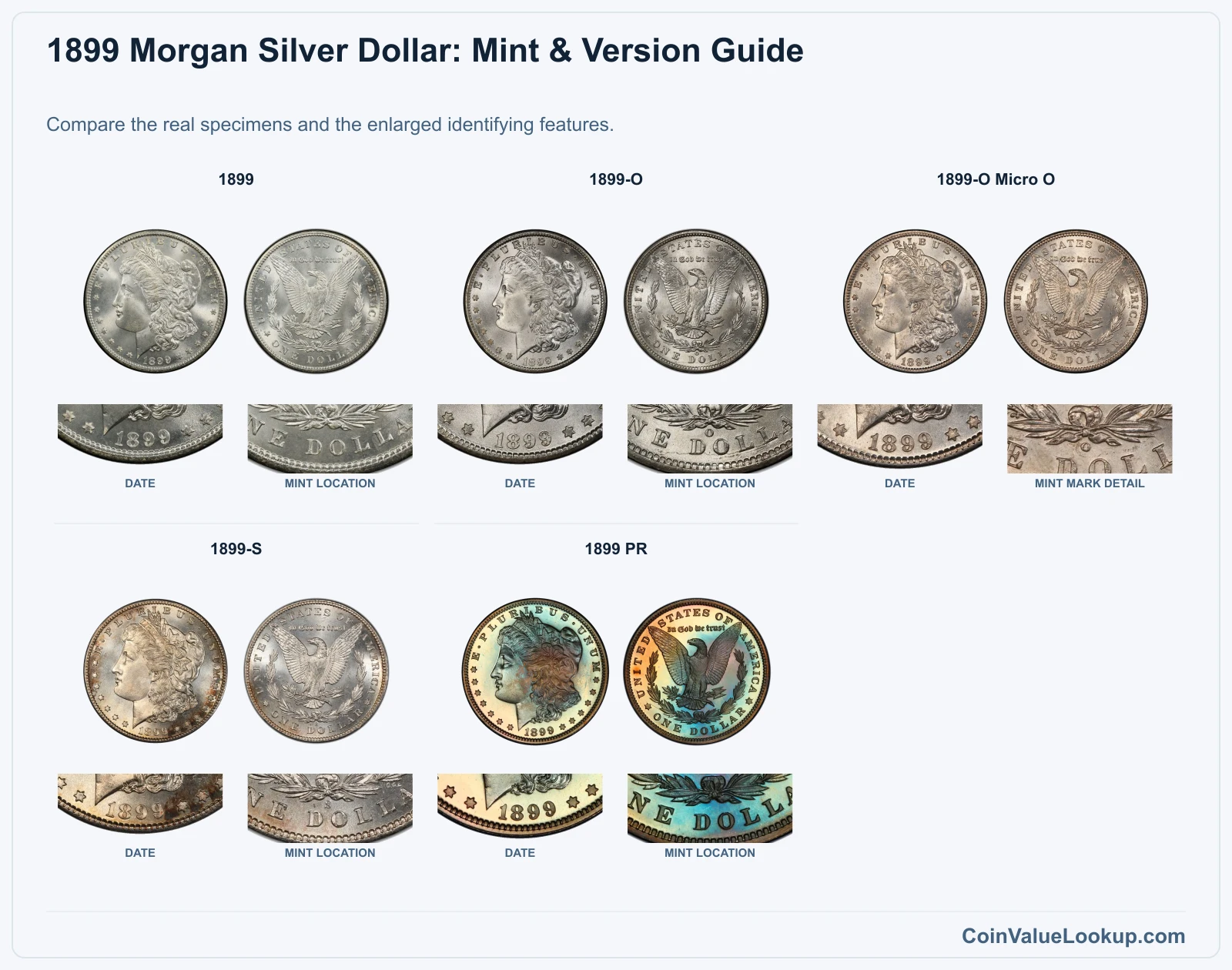
Flip your 1899 Morgan Dollar to the reverse and look below the bow that ties the wreath together. That is where the mintmark sits.
No letter means Philadelphia. An "O" means New Orleans, and an "S" means San Francisco.
There is no CC or D mintmark for this date.
All genuine 1899 Morgan Dollars are struck in 90% silver and 10% copper and weigh 26.73 grams. The obverse features the Morgan Liberty head with a Phrygian cap, and the reverse shows an eagle with outstretched wings within a wreath.
The edge is reeded.
If you see an "O" mintmark, look closely at its size. The standard O is noticeably larger than the scarce Micro O variety, which uses a smaller punch.
This distinction matters for value, so compare your mintmark against known reference images before assuming either version.
A proof 1899 Morgan Dollar was made at Philadelphia and carries no mintmark, just like the business strike. Proof coins were specially manufactured with polished dies and planchets, producing sharp detail and mirror-like fields.
A shiny or high-grade regular strike is not a proof — that distinction is about how the coin was made, not how nice it looks today.
Step 2: Check Your 1899 Morgan Silver Dollar Grade
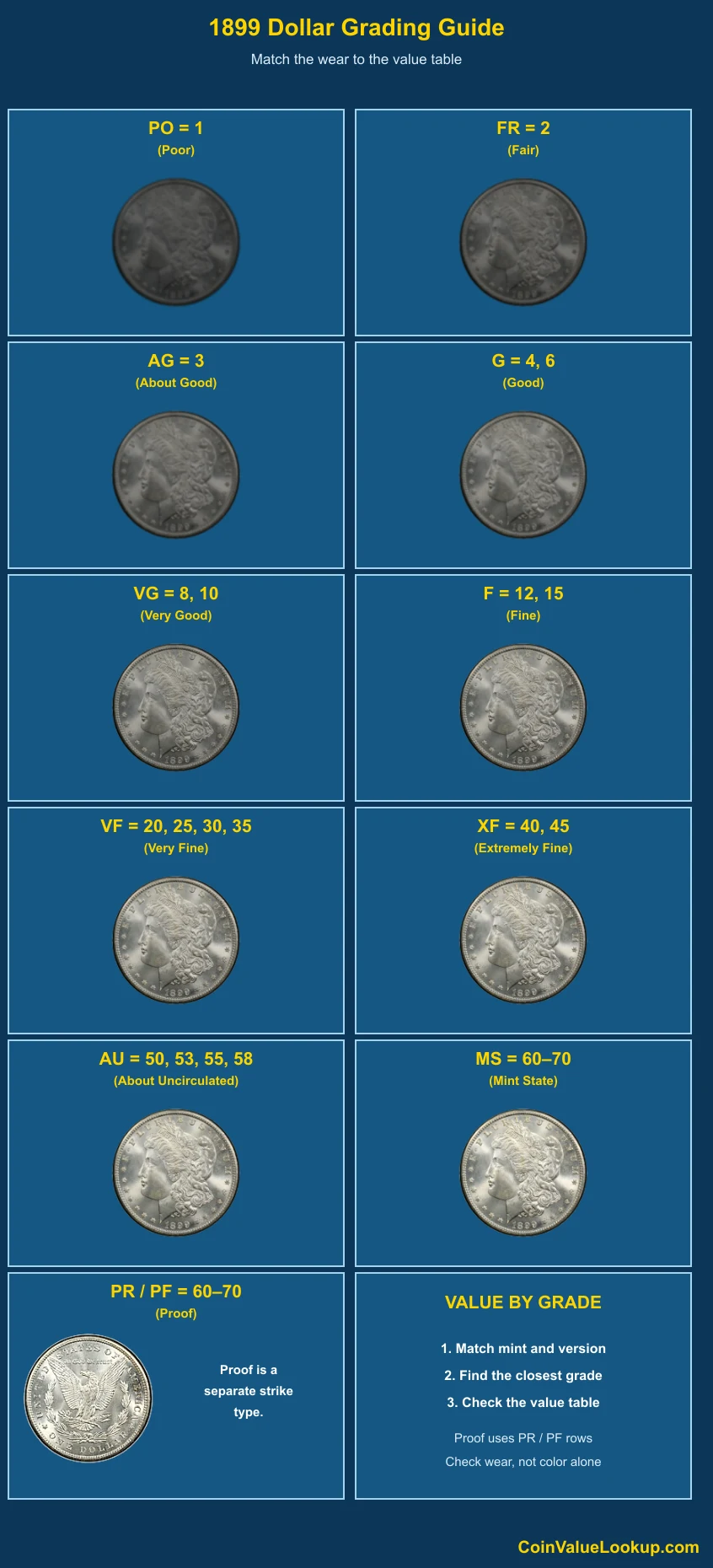
When grading an 1899 Morgan Dollar, start with the hair detail above Liberty's ear and across the cap. These are the first areas to show wear.
On the reverse, check the eagle's breast feathers — flattening there confirms circulation.
Bag marks are common on Mint State Morgan Dollars because millions were stored loose in canvas bags at the Treasury. These contact marks lower the coin's grade even though they are not from spending.
A coin riddled with bag hits might technically be uncirculated but will grade lower than a clean example.
Use the comparison image to see the difference between a well-circulated coin, an About Uncirculated piece retaining most luster, and a full Mint State example. Look at luster as a whole-surface quality, not just one bright spot.
Prooflike (PL) and Deep Mirror Prooflike (DMPL) are surface designations applied to qualifying business strikes, not separate proof manufacture. They describe reflective fields on coins struck from fresh or polished dies.
Cleaning, polishing or plating can mimic reflectivity but will reduce a coin's grade and desirability, not increase it.
Step 3: Check 1899 Morgan Silver Dollar Value by Mint and Version
1899 Morgan Silver Dollar
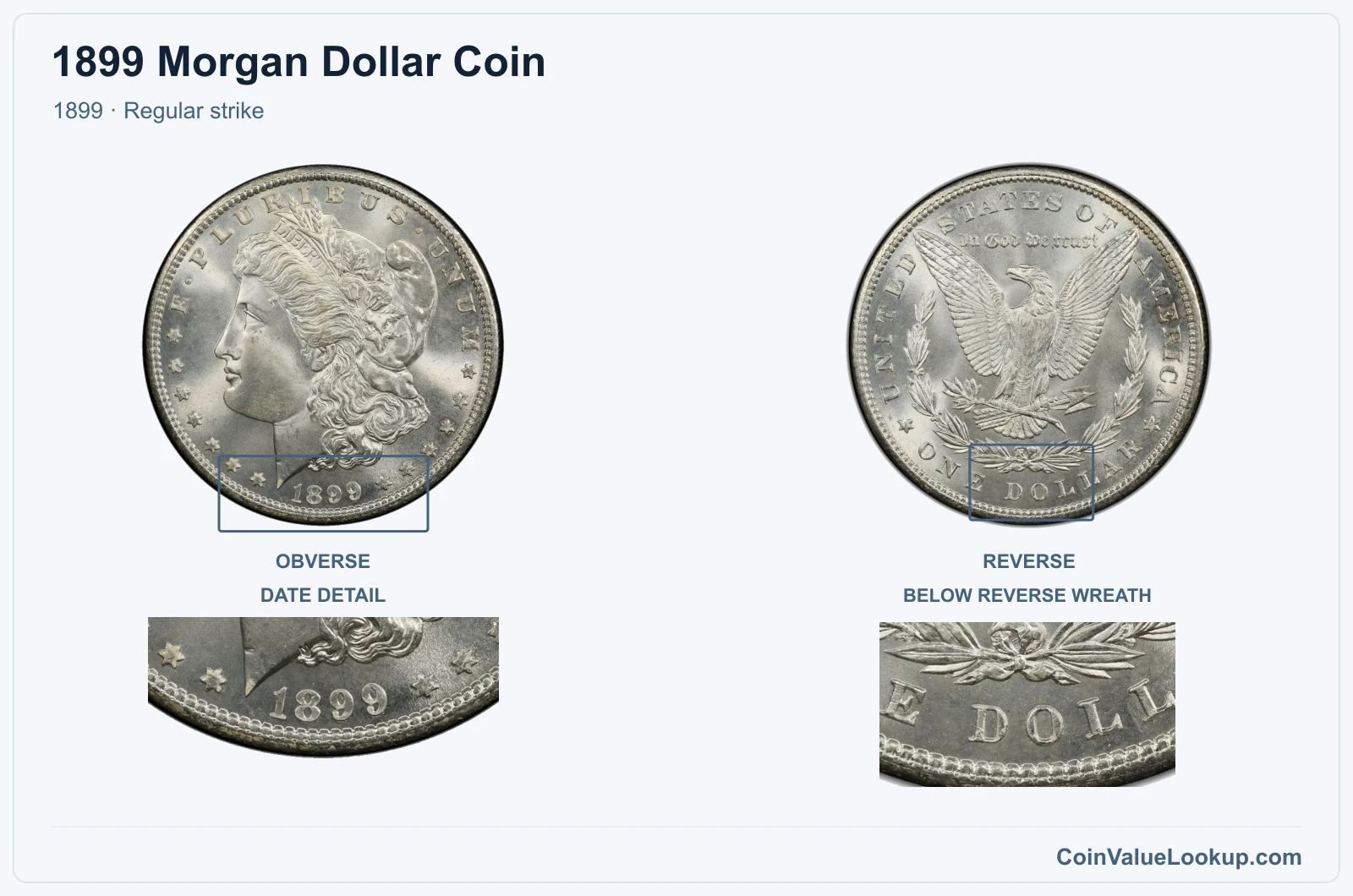
The 1899 Philadelphia Morgan Dollar carries no mintmark. Look below the wreath bow on the reverse — if the space is empty, this is your coin.
It was struck as a regular business issue in 90% silver.
Condition and originality drive its value. Cleaned or polished coins lose the natural luster that graders look for, which reduces their standing compared to original-surface examples.
Prooflike or Deep Mirror Prooflike designations apply to business strikes with qualifying reflective fields, and those surface qualities can influence pricing.
Because no numeric price range is adopted here, your best path is individual assessment through authenticated identity and professional grading. The exact grade — from worn circulated to pristine Mint State — is what separates a bullion-value coin from a collectible one.
Range Grade
Price Auction Records Appraisal PO PO 1
—
Coin Identifier FR FR 2
—
Coin Identifier AG AG 3
Coin Identifier G G 4
Coin Identifier
G 6
Coin Identifier VG VG 8
Coin Identifier
VG 10
Coin Identifier F F 12
Coin Identifier
F 15
Coin Identifier VF VF 20
Coin Identifier
VF 25
Coin Identifier
VF 30
Coin Identifier
VF 35
Coin Identifier XF XF 40
Coin Identifier
XF 45
Coin Identifier AU AU 50
Coin Identifier
AU 53
Coin Identifier
AU 55
Coin Identifier
AU 58
Coin Identifier MS MS 60
Coin Identifier
MS 61
Coin Identifier
MS 62
Coin Identifier
MS 63
Coin Identifier
MS 64
Coin Identifier
MS 65
Coin Identifier
MS 66
Coin Identifier
MS 67
Coin Identifier
MS 68
—
—
—
MS 69
—
—
—
MS 70
—
—
—
1899 Morgan Silver Dollar — O
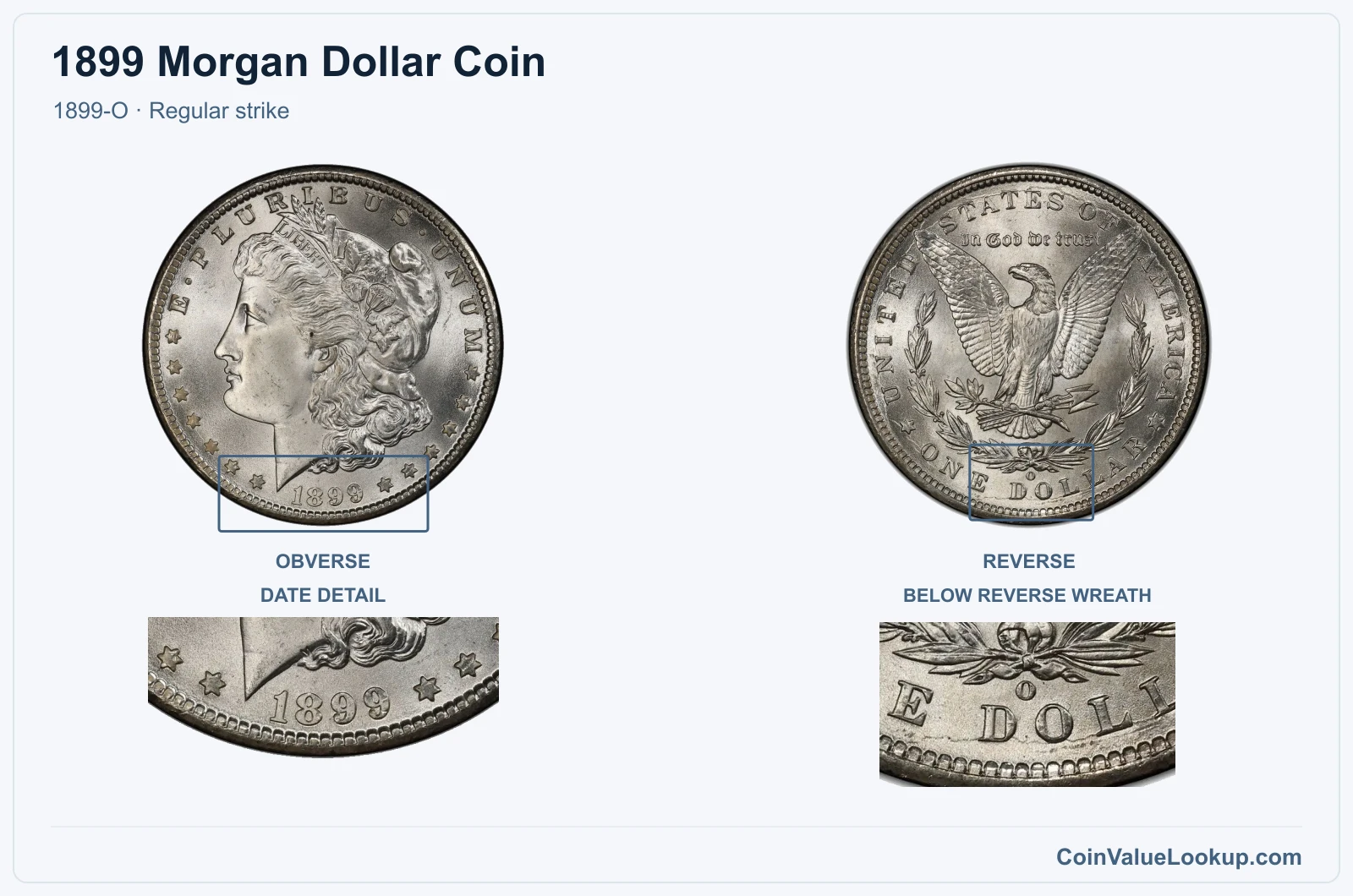
The 1899-O was struck at the New Orleans Mint. You will see a standard-sized "O" below the wreath bow on the reverse.
Before you proceed, confirm that the O is the normal large size and not the smaller Micro O punch, which is a separate variety.
This is a business-strike issue in 90% silver. Its value depends on grade, surface preservation and whether it qualifies for PL or DMPL designations.
Cleaning or artificial toning will hurt comparability with price references.
Coin Value Lookup is a useful starting point if you want to look up guides for other Morgan Dollar dates or denominations. It covers a wide range of U.S. coins and can help you identify what else might be sitting in that collection.
No specific numeric range is adopted for this version, so an individually assessed grade from a recognized service is the most reliable way to establish value.
Range Grade
Price Auction Records Appraisal PO PO 1
Coin Identifier FR FR 2
Coin Identifier AG AG 3
—
Coin Identifier G G 4
—
Coin Identifier
G 6
Coin Identifier VG VG 8
—
Coin Identifier
VG 10
Coin Identifier F F 12
Coin Identifier
F 15
Coin Identifier VF VF 20
Coin Identifier
VF 25
Coin Identifier
VF 30
Coin Identifier
VF 35
Coin Identifier XF XF 40
Coin Identifier
XF 45
Coin Identifier AU AU 50
—
Coin Identifier
AU 53
Coin Identifier
AU 55
—
Coin Identifier
AU 58
Coin Identifier MS MS 60
—
Coin Identifier
MS 61
Coin Identifier
MS 62
Coin Identifier
MS 63
Coin Identifier
MS 64
Coin Identifier
MS 65
Coin Identifier
MS 66
Coin Identifier
MS 67
Coin Identifier
MS 68
Coin Identifier
MS 69
—
—
—
MS 70
—
—
—
1899 Morgan Silver Dollar — O Micro O
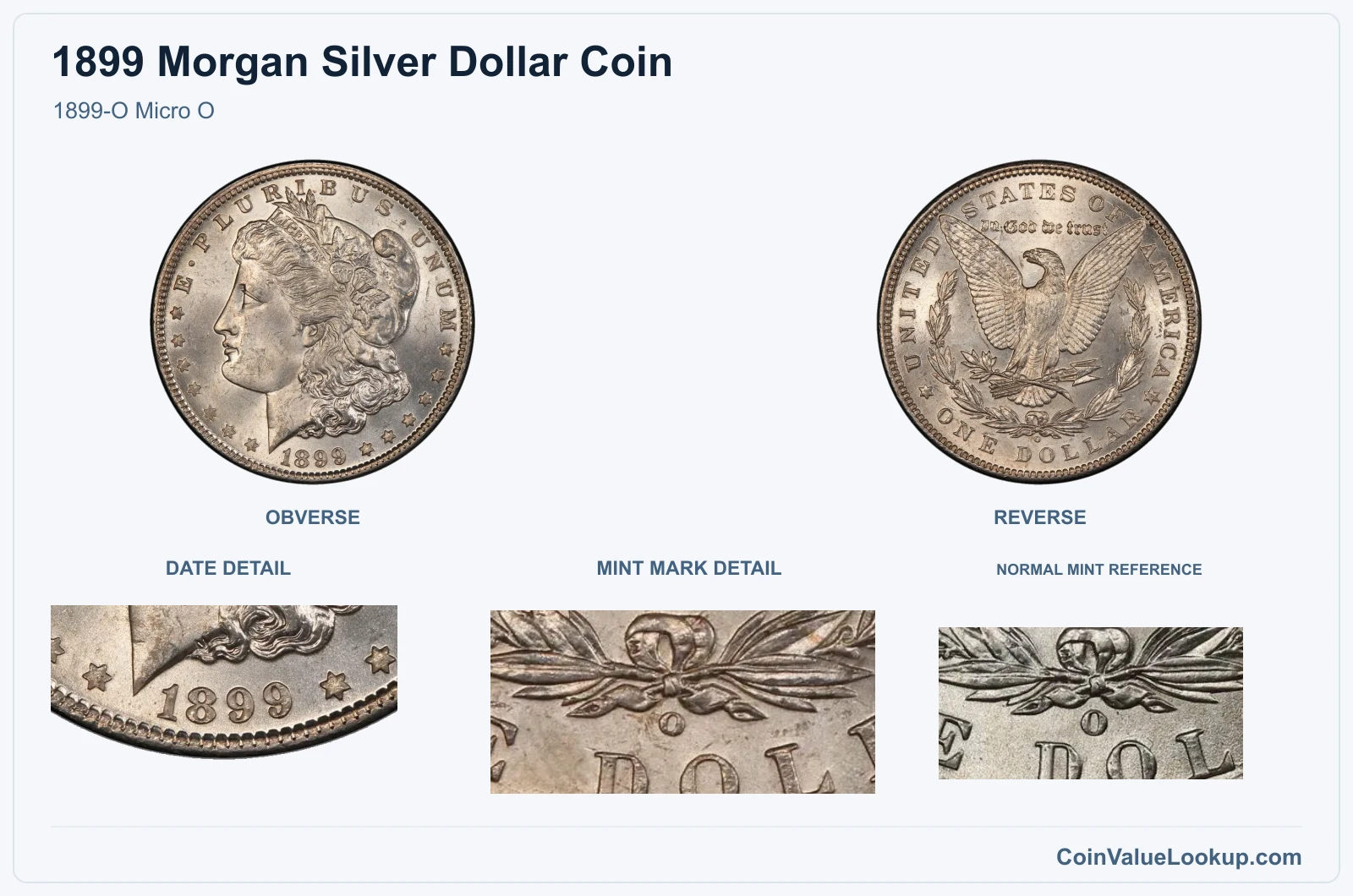
The 1899-O Micro O is one of the more notable Morgan Dollar varieties. It was struck at the New Orleans Mint, but the mintmark punch used is visibly smaller than the standard O found on regular 1899-O dollars.
You need magnification to confirm this — a 5x loupe or better.
Compare your coin's mintmark directly against images of both the standard O and the Micro O. The size difference is real but subtle enough that wishful thinking can fool you.
If you are not sure, professional attribution is the way to go.
This variety is struck in the same 90% silver composition and weighs 26.73 grams, identical to every other 1899 Morgan. What sets it apart is the die preparation, not the metal.
Grade and surface originality still matter enormously. A cleaned Micro O in a low grade is a different proposition than an original-surface example in Mint State.
No numeric price range is adopted here, so have the coin authenticated and graded individually for the most accurate assessment.
Range Grade
Price Auction Records Appraisal PO PO 1
—
Coin Identifier FR FR 2
—
Coin Identifier AG AG 3
—
Coin Identifier G G 4
Coin Identifier
G 6
—
Coin Identifier VG VG 8
Coin Identifier
VG 10
Coin Identifier F F 12
—
Coin Identifier
F 15
Coin Identifier VF VF 20
Coin Identifier
VF 25
Coin Identifier
VF 30
Coin Identifier
VF 35
Coin Identifier XF XF 40
Coin Identifier
XF 45
Coin Identifier AU AU 50
Coin Identifier
AU 53
Coin Identifier
AU 55
Coin Identifier
AU 58
Coin Identifier MS MS 60
Coin Identifier
MS 61
Coin Identifier
MS 62
Coin Identifier
MS 63
Coin Identifier
MS 64
Coin Identifier
MS 65
—
Coin Identifier
MS 66
Coin Identifier
MS 67
—
—
—
MS 68
—
—
—
MS 69
—
—
—
MS 70
—
—
—
1899 Morgan Silver Dollar — S
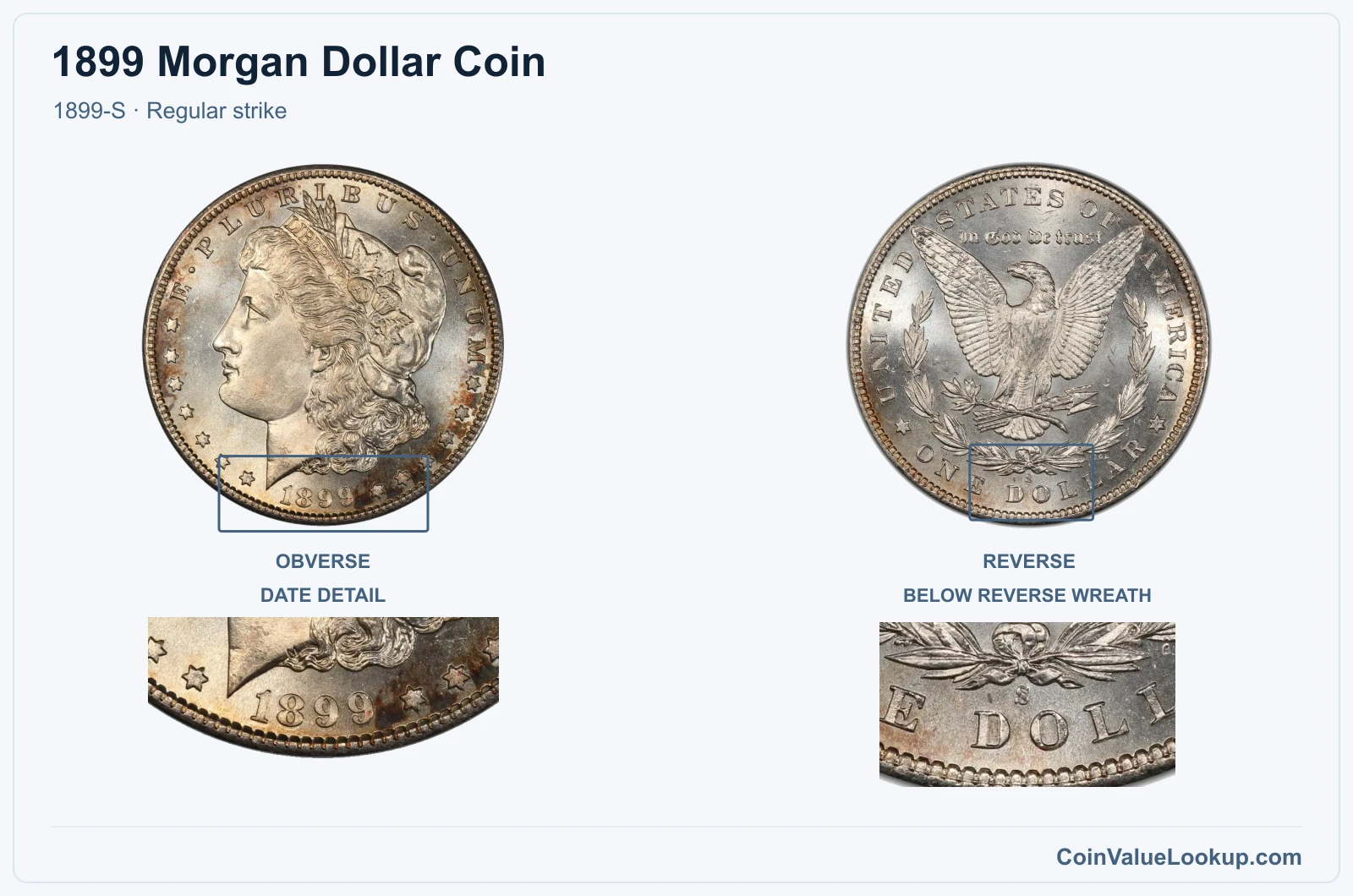
The 1899-S was produced at the San Francisco Mint. You will find an "S" mintmark below the wreath bow on the reverse.
San Francisco strikes from this era are generally well-regarded for strike quality, though individual coins vary.
This is a 90% silver business strike weighing 26.73 grams. As with all Morgan Dollars, original surfaces matter.
A coin that has been cleaned, whizzed or artificially toned will grade lower and sell for less than a comparable piece with natural luster intact.
PL and DMPL designations can apply to qualifying 1899-S business strikes, acting as price filters rather than separate categories. No numeric price range is adopted for this version; value depends on authenticated identity, condition and any recognized error or surface distinction.
Range Grade
Price Auction Records Appraisal PO PO 1
—
Coin Identifier FR FR 2
—
Coin Identifier AG AG 3
—
Coin Identifier G G 4
—
Coin Identifier
G 6
—
Coin Identifier VG VG 8
—
Coin Identifier
VG 10
—
Coin Identifier F F 12
Coin Identifier
F 15
Coin Identifier VF VF 20
—
Coin Identifier
VF 25
Coin Identifier
VF 30
Coin Identifier
VF 35
Coin Identifier XF XF 40
Coin Identifier
XF 45
Coin Identifier AU AU 50
Coin Identifier
AU 53
Coin Identifier
AU 55
Coin Identifier
AU 58
Coin Identifier MS MS 60
Coin Identifier
MS 61
Coin Identifier
MS 62
Coin Identifier
MS 63
Coin Identifier
MS 64
Coin Identifier
MS 65
Coin Identifier
MS 66
Coin Identifier
MS 67
Coin Identifier
MS 68
—
—
—
MS 69
—
—
—
MS 70
—
—
—
1899 Morgan Silver Dollar — PR
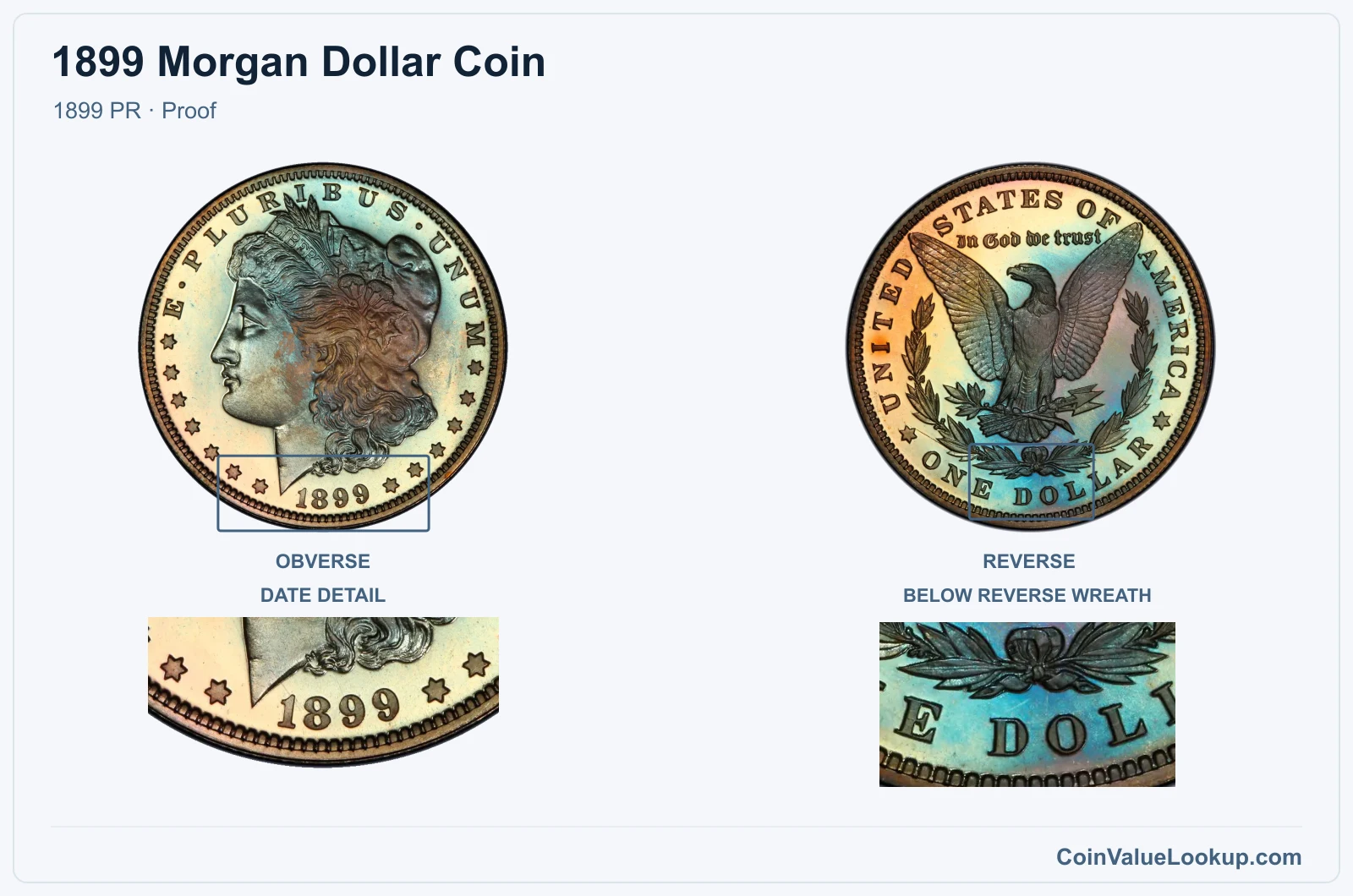
The 1899 Proof Morgan Dollar was manufactured at Philadelphia using specially prepared dies and planchets. It carries no mintmark — the same as the Philadelphia business strike — so identification depends on the coin's manufacturing characteristics, not just the absence of a letter.
Proof Morgans have deeply mirrored fields and sharp, fully struck devices. They were made in small quantities for collectors, not for commerce.
A proof is a finish, not a grade above Mint State. You can have a proof that has been mishandled or impaired, and it will still be a proof by manufacture — just a lower-grade one.
Do not confuse a prooflike business strike with a proof. PL and DMPL surfaces occur on regular coins struck from fresh dies; proof manufacture is a separate, deliberate process.
If the coin has not been professionally attributed as a proof, do not assume it is one based on shininess alone.
No numeric price range is adopted. Individual assessment through a recognized grading service is the reliable path to establishing both authenticity and value for this scarce finish.
Range Grade
Price Auction Records Appraisal PR PR 1
—
Coin Identifier
PR 2
—
Coin Identifier
PR 3
—
Coin Identifier
PR 4
—
Coin Identifier
PR 6
—
Coin Identifier
PR 8
—
Coin Identifier
PR 10
—
Coin Identifier
PR 12
—
Coin Identifier
PR 15
—
Coin Identifier
PR 20
—
Coin Identifier
PR 25
—
Coin Identifier
PR 30
—
Coin Identifier
PR 35
—
Coin Identifier
PR 40
—
Coin Identifier
PR 45
—
Coin Identifier
PR 50
Coin Identifier
PR 53
Coin Identifier
PR 55
Coin Identifier
PR 58
Coin Identifier
PR 60
Coin Identifier
PR 61
Coin Identifier
PR 62
Coin Identifier
PR 63
Coin Identifier
PR 64
Coin Identifier
PR 65
Coin Identifier
PR 66
Coin Identifier
PR 67
Coin Identifier
PR 68
Coin Identifier
PR 69
—
—
—
PR 70
—
—
—
1899 Morgan Silver Dollar Error List
1. 1899 Morgan Silver Dollar — Off-Center Strike
An off-center strike occurs when the planchet is not properly seated in the striking chamber, resulting in a displaced design and an unstruck crescent of blank metal along one edge. On a 1899 Morgan Dollar, the reported example is specifically a 1899-O off-center strike.
Other mints for this date are not implied by this listing.
When examining a possible off-center error, confirm that the date remains visible — this is critical for attribution and collectibility. The degree of off-center displacement matters too.
A 5% shift is far less dramatic than 20% or more.
Watch out for lookalikes. A clipped planchet, a one-sided die misalignment or post-mint flattening from damage can all mimic an off-center appearance.
Genuine off-center errors show the displacement consistently across the entire design. No numeric price is adopted, but value depends on the percentage of displacement, condition, and whether the date and mintmark are fully legible.
2. 1899 Morgan Silver Dollar — Struck-Through Error
A struck-through error happens when foreign material — grease, a fragment of metal, thread or other debris — sits between the die and the planchet during striking. The result is a localized depression or incomplete design area where the obstruction blocked the die's impression.
The reported example for this date is a 1899-O strike-through error. Other mints are not confirmed by this listing.
Grease-filled dies tend to produce soft, rounded depressions, often in recessed areas of the design. A retained foreign object, on the other hand, may leave a sharper, more distinct impression.
These are different categories within the struck-through family.
Do not confuse a struck-through with ordinary wear, scratches from handling, cleaning marks or weak strikes from tired dies. Genuine struck-throughs show a clear interruption in the design that does not match normal wear patterns.
No numeric price is adopted for this error; value depends on the visibility and size of the obstruction impression, overall coin condition, and professional confirmation.
3. 1899 Morgan Silver Dollar — Lamination / Split Planchet
A lamination error on a Morgan Dollar shows up as peeling metal, a retained flap, or a visible separation within the silver alloy. This happens during planchet preparation when impurities or improper mixing create weak layers in the metal.
The reported example is listed as an 1899 Silver Dollar lamination error without specifying a single mint, so be aware this could appear on different 1899 issues.
If you suspect a lamination, photograph both the affected face and the edge of the coin together. Edge views often reveal the separation most clearly.
The size and location of the lamination affect its visual impact and collectibility.
Do not mistake scraping, corrosion, environmental damage or a deliberately cut or gouged coin for a lamination. Genuine laminations follow the metal's internal structure and often have a natural, layered appearance rather than sharp tool marks.
No numeric price is adopted; value depends on the extent of the separation, the coin's overall grade and professional attribution of the error.