1963 Jefferson Nickel Coin Value: How Much Is It Worth?
The 1963 Jefferson nickel is one of the most common dates in the series, so worn examples carry only modest collector value. Uncirculated pieces are where things get more interesting: a USA Coin Book guide estimate places an MS60 around $0.30 and an MS65 around $19 to $30 depending on mintmark.
Proof specimens and recognized mint errors occupy their own value tiers entirely.
Fast Way to Identify Your 1963 Jefferson Nickel
The quickest way to start figuring out what your 1963 nickel is worth is to upload clear photos of both sides. A front-and-back image lets us offer a preliminary identification of your coin's mintmark, finish and general condition, which are the first things you need before looking up values.
1963 Jefferson Nickel Value
Upload both sides of your 1963 Jefferson Nickel.
Front Obverse
Upload photo
Back Reverse
Upload photo
Which 1963 Jefferson Nickel Versions Are Worth Money?
- Uncirculated 1963-D nickels at the MS65 level carry a USA Coin Book guide estimate around $30, making condition a key factor for this mint.
- Proof 1963 nickels with certified cameo contrast occupy a separate value curve from ordinary proofs; check the finish carefully.
- A 1963 nickel confirmed struck on a cent planchet sold for $264 in a 2018 Heritage auction, illustrating how wrong-planchet errors can dramatically increase value.
Step 1: Identify Your 1963 Jefferson Nickel Mint Mark and Version
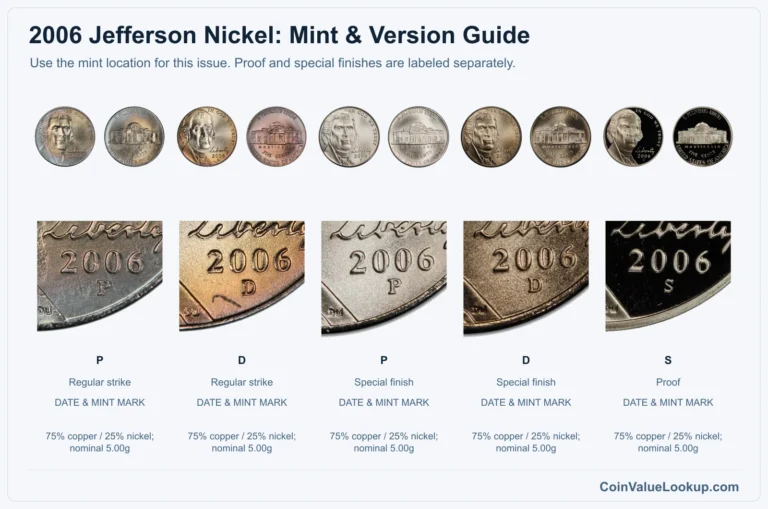
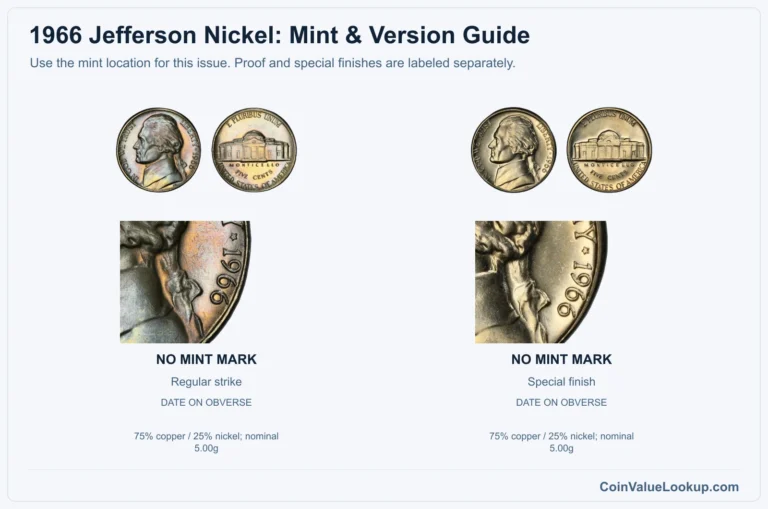
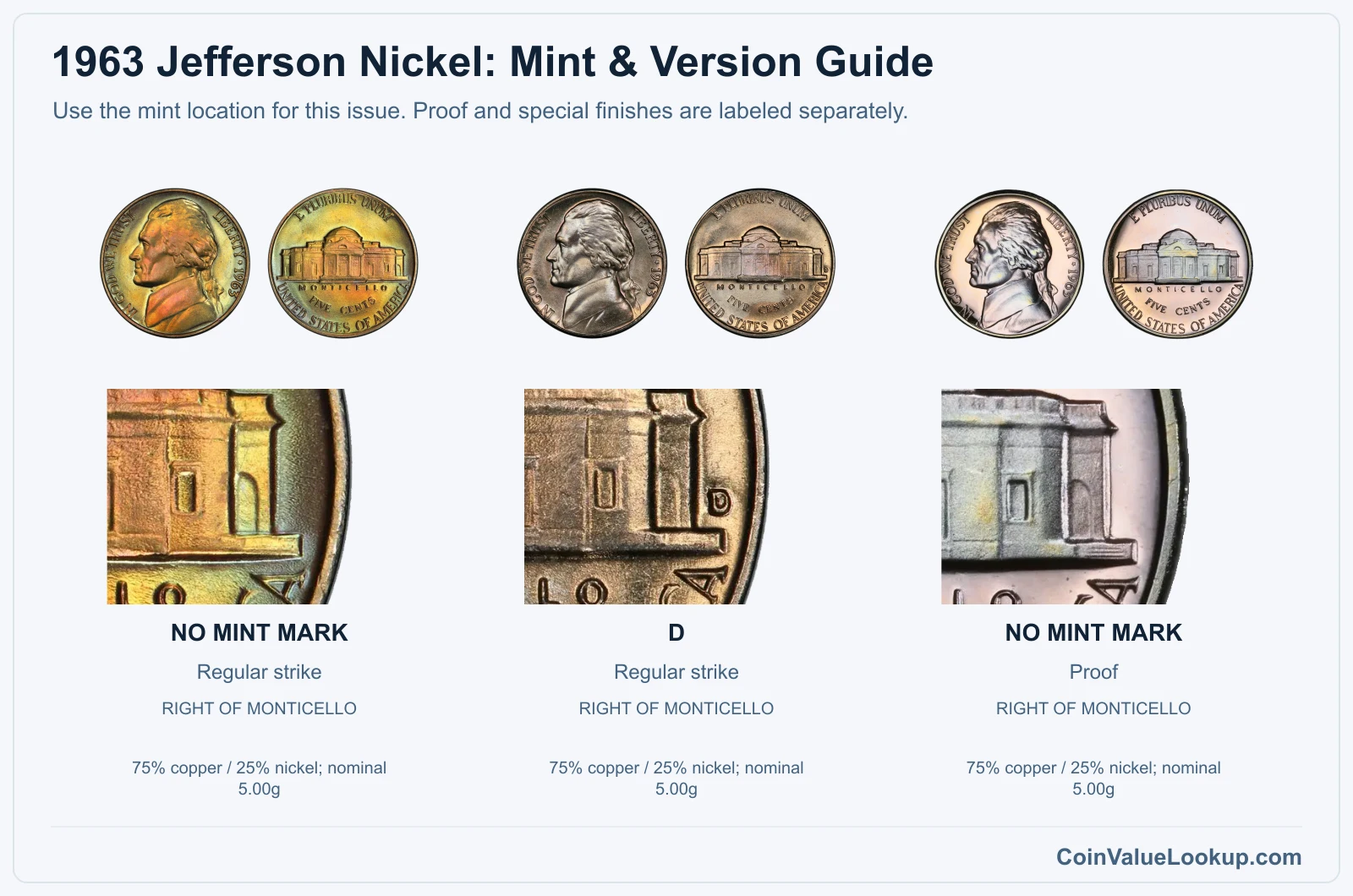
Two business-strike versions exist for 1963: a Philadelphia issue with no mintmark and a Denver issue carrying a small "D" to the right of Monticello on the reverse. Proof coins were struck only at Philadelphia and also carry no mintmark, so the finish itself is your main clue there.
Proofs show mirror-like fields and sharply defined details that a normal business strike will not have, even in uncirculated condition.
All 1963 nickels are 75% copper and 25% nickel, weigh about 5.00 grams and measure 21.2 mm with a plain edge. A coin that weighs significantly more or less than 5 grams could be a wrong-planchet error, but weight alone does not authenticate anything.
Before looking up values, record the date, check for a mintmark, decide if the finish is business strike or proof, and photograph both faces.
Step 2: Check Your 1963 Jefferson Nickel Grade
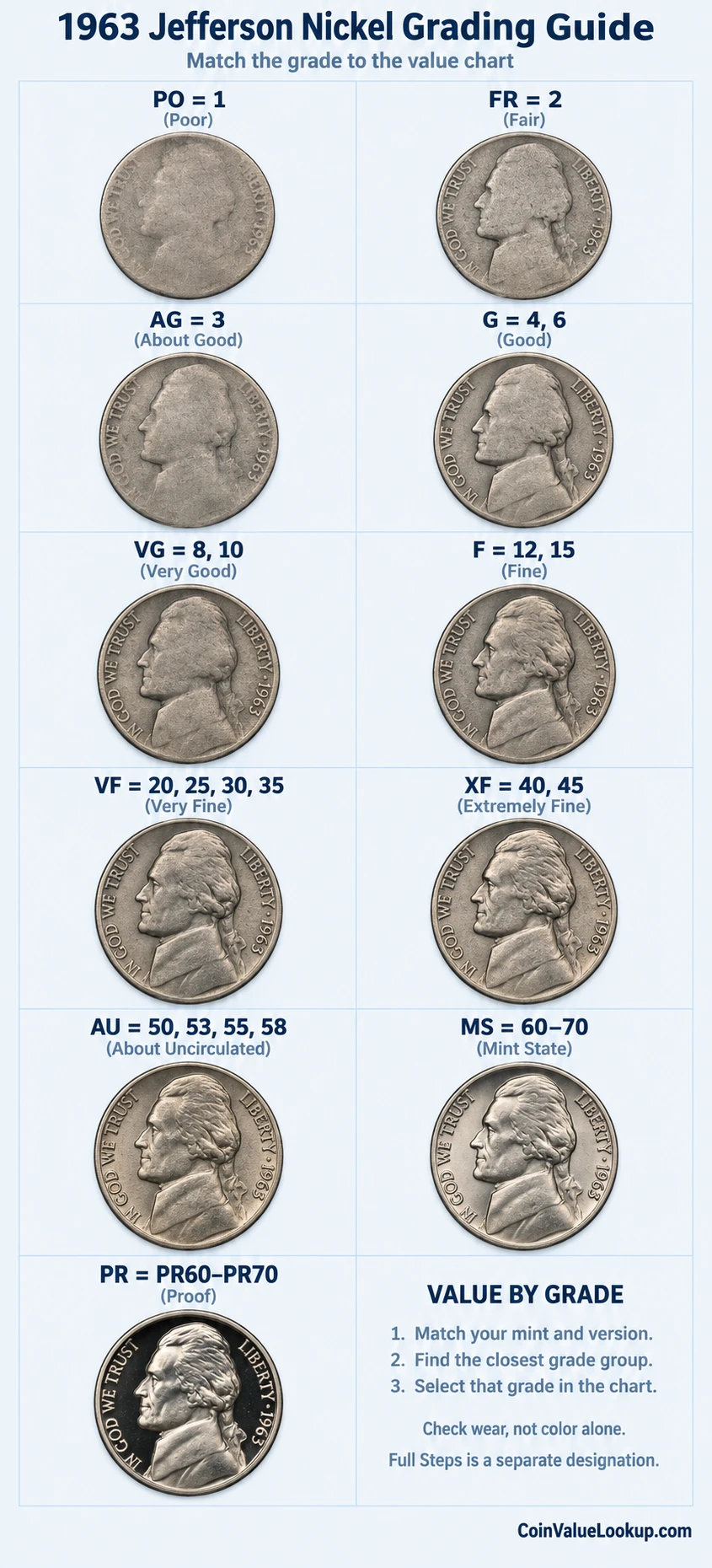
Start with Jefferson's cheek and the hair detail above his ear. On a lightly worn coin these areas go flat first, losing their original luster.
A coin with full, frosty detail across the portrait and no contact marks visible to the naked eye is heading into Mint State territory.
On the reverse, check the roof and columns of Monticello. Wear shows there as flattening of the horizontal lines and loss of definition in the column capitals.
Use the comparison image to match your coin's remaining detail against known grade benchmarks.
Do not mistake a shallow strike for circulation wear. Some 1963 nickels left the press with soft details, especially on the steps of Monticello.
Full Steps is a separate strike-quality designation applied only to Mint State business strikes where the staircase lines remain complete and uninterrupted. A shiny surface alone does not guarantee a high grade.
Step 3: Check 1963 Jefferson Nickel Value by Mint and Version
1963 Jefferson Nickel — No mintmark (Philadelphia) Business strike
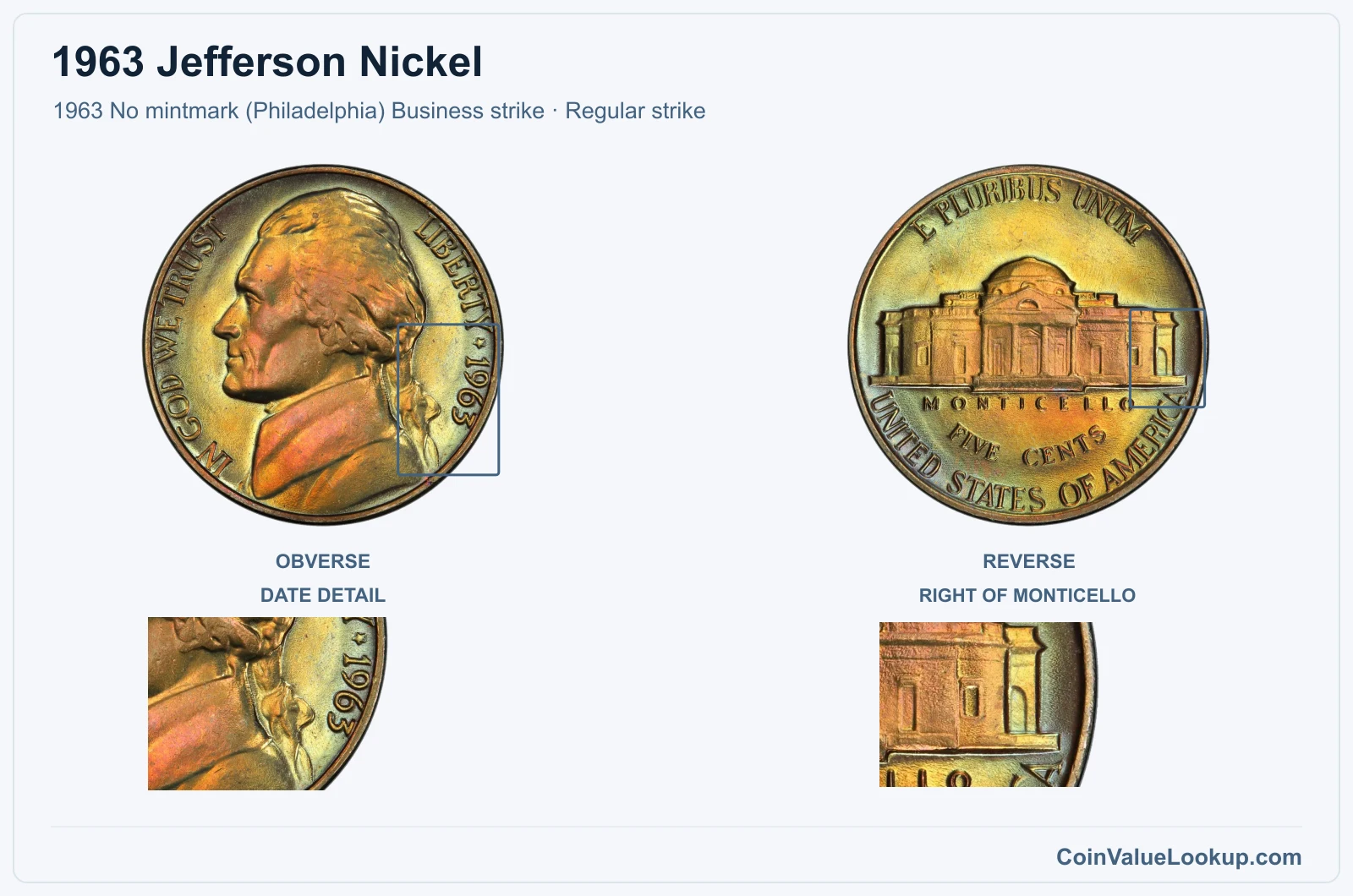
The 1963 Philadelphia business strike carries no mintmark. You will not see any letter near Monticello on the reverse.
USA Coin Book guide estimates place this coin at roughly $0.30 in MS60 and about $19 in MS65. Billions of nickels rolled out of Philadelphia in 1963, so circulated examples are worth face value in almost every case.
The jump from MS60 to MS65 reflects the importance of surface quality. Even small bag marks or a weak strike can keep a coin well below gem territory.
If yours looks uncirculated, examine it under good light for contact marks before assuming it grades high.
| Range | Grade | Price | Auction Records | Appraisal |
|---|---|---|---|---|
| PO | PO 1 | — | Coin Identifier | |
| FR | FR 2 | — | — | — |
| AG | AG 3 | — | — | — |
| G | G 4 | — | — | — |
| G 6 | — | — | — | |
| VG | VG 8 | — | — | — |
| VG 10 | — | — | — | |
| F | F 12 | — | — | — |
| F 15 | — | — | — | |
| VF | VF 20 | — | — | — |
| VF 25 | — | — | — | |
| VF 30 | — | — | — | |
| VF 35 | — | — | — | |
| XF | XF 40 | — | Coin Identifier | |
| XF 45 | — | Coin Identifier | ||
| AU | AU 50 | — | Coin Identifier | |
| AU 53 | — | Coin Identifier | ||
| AU 55 | — | Coin Identifier | ||
| AU 58 | — | Coin Identifier | ||
| MS | MS 60 | — | Coin Identifier | |
| MS 61 | — | Coin Identifier | ||
| MS 62 | — | Coin Identifier | ||
| MS 63 | Coin Identifier | |||
| MS 64 | Coin Identifier | |||
| MS 65 | Coin Identifier | |||
| MS 66 | Coin Identifier | |||
| MS 67 | Coin Identifier | |||
| MS 68 | — | — | — | |
| MS 69 | — | — | — | |
| MS 70 | — | — | — |
1963 Jefferson Nickel — No mintmark (Philadelphia) Proof
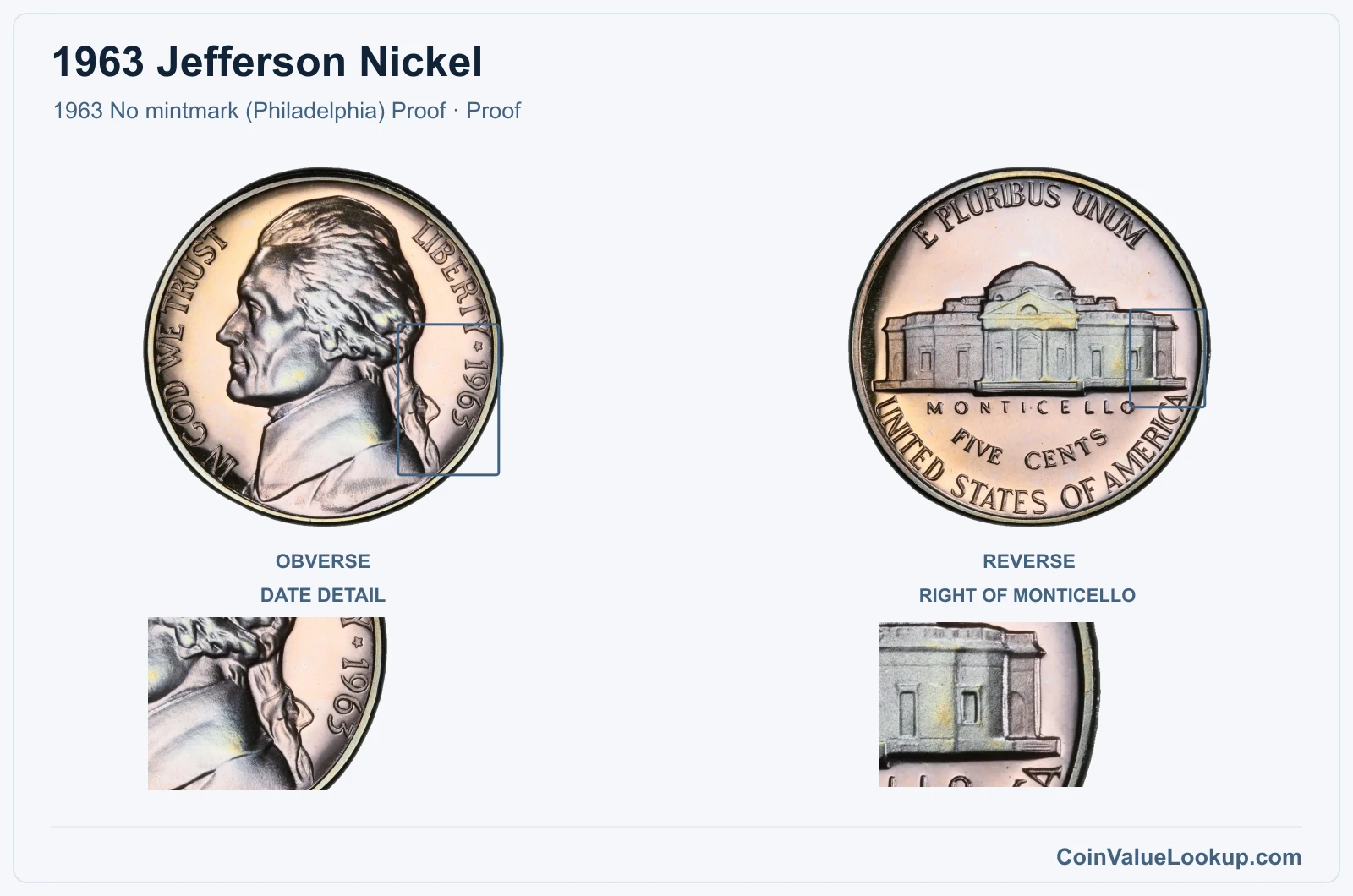
The 1963 proof nickel was struck at Philadelphia with no mintmark, just like the business strike, so finish is the distinguishing feature. Proofs display deeply mirrored fields and crisp, squared-off design edges that a circulation-strike coin simply cannot replicate.
Some certified examples also carry a cameo designation for frosted devices against those mirror fields.
A USA Coin Book guide estimate puts a PR65 example at about $3.62. Value rises with grade and the presence of a cameo or deep cameo contrast.
These were sold in proof sets, so most survivors are already in decent shape. Coin Value Lookup is a good starting point if you want to compare your proof against other Jefferson nickel years and denominations.
| Range | Grade | Price | Auction Records | Appraisal |
|---|---|---|---|---|
| PR | PR 1 | — | Coin Identifier | |
| PR 2 | — | Coin Identifier | ||
| PR 3 | — | Coin Identifier | ||
| PR 4 | — | Coin Identifier | ||
| PR 6 | — | Coin Identifier | ||
| PR 8 | — | Coin Identifier | ||
| PR 10 | — | Coin Identifier | ||
| PR 12 | — | Coin Identifier | ||
| PR 15 | — | Coin Identifier | ||
| PR 20 | — | Coin Identifier | ||
| PR 25 | — | Coin Identifier | ||
| PR 30 | — | Coin Identifier | ||
| PR 35 | — | Coin Identifier | ||
| PR 40 | — | Coin Identifier | ||
| PR 45 | — | Coin Identifier | ||
| PR 50 | — | Coin Identifier | ||
| PR 53 | — | Coin Identifier | ||
| PR 55 | — | Coin Identifier | ||
| PR 58 | — | Coin Identifier | ||
| PR 60 | — | Coin Identifier | ||
| PR 61 | — | Coin Identifier | ||
| PR 62 | — | Coin Identifier | ||
| PR 63 | — | Coin Identifier | ||
| PR 64 | — | Coin Identifier | ||
| PR 65 | Coin Identifier | |||
| PR 66 | Coin Identifier | |||
| PR 67 | Coin Identifier | |||
| PR 68 | Coin Identifier | |||
| PR 69 | Coin Identifier | |||
| PR 70 | Coin Identifier |
1963 Jefferson Nickel — D Business strike
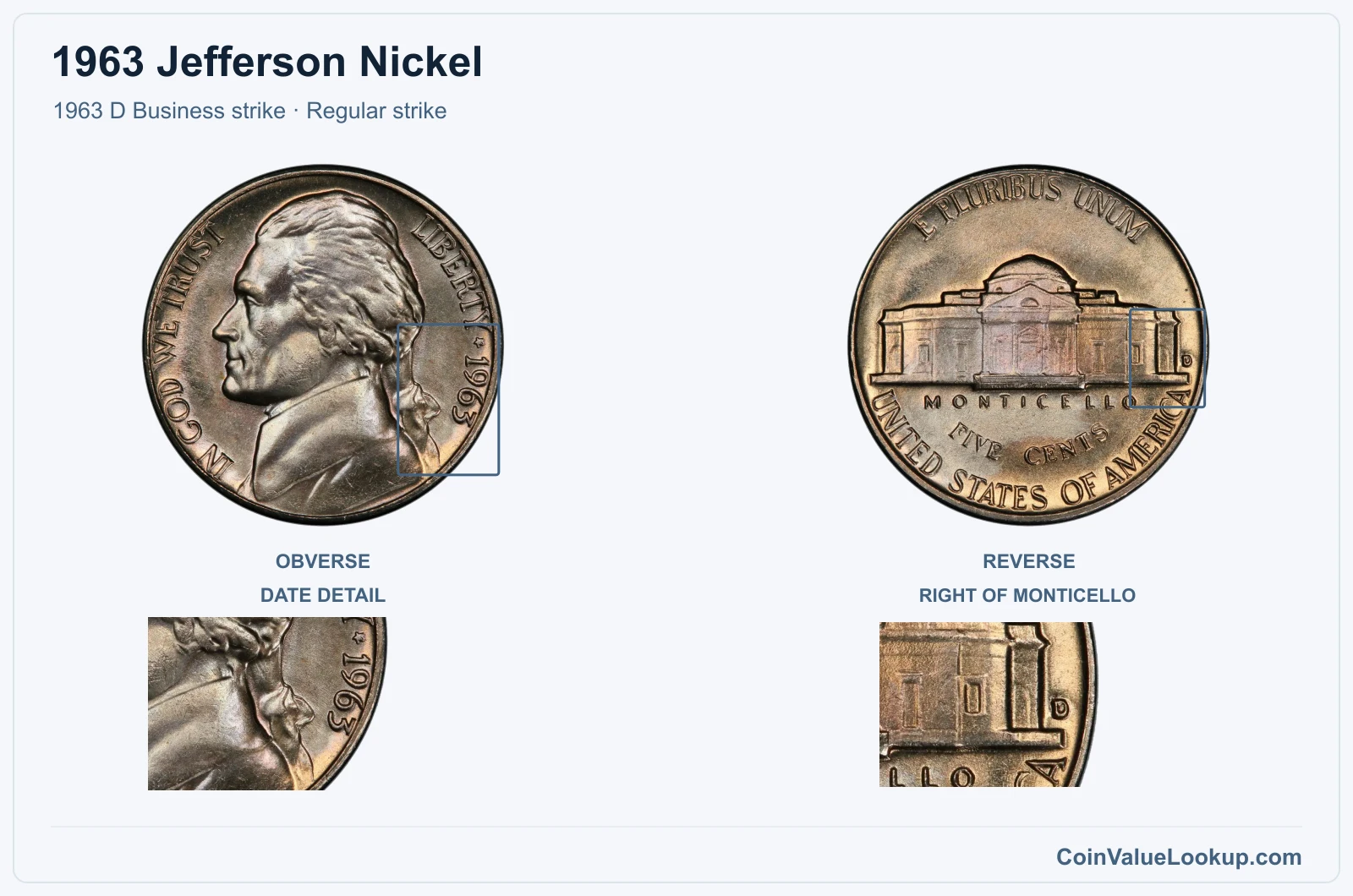
The 1963-D nickel has a small "D" mintmark to the right of Monticello on the reverse. Denver produced huge quantities this year, so finding one in pocket change is no achievement.
In circulated grades it is a face-value coin.
Uncirculated examples are another story. USA Coin Book guide estimates run about $0.30 at MS60 and climb to around $30 at MS65, the highest guide anchor among the 1963 business strikes.
That premium at MS65 reflects the difficulty of finding a Denver coin with clean surfaces and a strong strike, since high-volume production tends to mean more bag marks and softer impressions.
| Range | Grade | Price | Auction Records | Appraisal |
|---|---|---|---|---|
| PO | PO 1 | — | Coin Identifier | |
| FR | FR 2 | — | — | — |
| AG | AG 3 | — | — | — |
| G | G 4 | — | — | — |
| G 6 | — | — | — | |
| VG | VG 8 | — | — | — |
| VG 10 | — | — | — | |
| F | F 12 | — | — | — |
| F 15 | — | — | — | |
| VF | VF 20 | — | — | — |
| VF 25 | — | — | — | |
| VF 30 | — | — | — | |
| VF 35 | — | — | — | |
| XF | XF 40 | — | Coin Identifier | |
| XF 45 | — | Coin Identifier | ||
| AU | AU 50 | — | Coin Identifier | |
| AU 53 | — | Coin Identifier | ||
| AU 55 | — | Coin Identifier | ||
| AU 58 | — | Coin Identifier | ||
| MS | MS 60 | — | Coin Identifier | |
| MS 61 | — | Coin Identifier | ||
| MS 62 | — | Coin Identifier | ||
| MS 63 | — | Coin Identifier | ||
| MS 64 | — | Coin Identifier | ||
| MS 65 | Coin Identifier | |||
| MS 66 | Coin Identifier | |||
| MS 67 | — | — | — | |
| MS 68 | — | — | — | |
| MS 69 | — | — | — | |
| MS 70 | — | — | — |
1963 Jefferson Nickel Error List
1. 1963 Jefferson Nickel — Struck on a cent planchet
A 1963 Jefferson nickel struck on a cent-sized copper planchet is a dramatic wrong-planchet error. The entire nickel design is impressed onto the smaller, lighter blank, which causes the legends and rim to appear cropped and stretched compared to a normal nickel.
Weight is the first screening tool: a genuine example weighs around 3.1 grams versus the standard 5 grams for a nickel.
One authenticated specimen, graded NGC MS63 Full Steps, sold through Heritage Auctions in January 2018 for $264. That price reflects a single confirmed sale for that specific coin and grade, not a universal range.
Watch out for nickels that have been copper-plated, chemically toned to look copper, or physically ground down to a smaller size. Confirming the planchet identity typically requires professional authentication.
2. 1963 Jefferson Nickel — Struck on foreign copper-nickel blank
A 1963 nickel struck on a foreign copper-nickel blank is a recognized wrong-planchet error. The design appears softer and centered differently than normal because the blank's dimensions do not match a standard nickel planchet.
One example has been cataloged as PCGS MS63.
To verify this kind of error you need weight and alloy analysis, since the foreign blank may look similar in color and feel to a regular nickel. The exact foreign denomination is identified during authentication, not by visual inspection alone.
Do not confuse a normal weak strike or an altered coin with a wrong-planchet error. Coins that simply look "off" may have been damaged or polished after leaving the mint.
Professional certification is important here because the value depends on confirmed identity, condition and the severity of the error.
3. 1963 Jefferson Nickel — Curved clipped planchet
A curved clipped planchet occurs when the blanking press overlaps a previously punched area of the metal strip, leaving a crescent-shaped section missing from the coin. A 1963 example with an approximately 40% curved clip has been certified NGC MS64 as part of a multi-coin lot.
Look at the rim where the missing area meets the normal edge. A genuine clip shows a smooth, tapered transition called the Blakesley effect on the opposite rim, plus design weakness near the clip.
Metal flow lines follow the incomplete blank during striking.
Coins with edges cut by pliers, sawed after minting, or broken from corrosion can mimic a clip. Those post-mint alterations usually leave sharp, irregular edges rather than the smooth curved boundary of a blanking error.
Value depends on the clip's size, the coin's condition and professional verification.
4. 1963 Jefferson Nickel — Doubled / Multiple-Hubbed Reverse
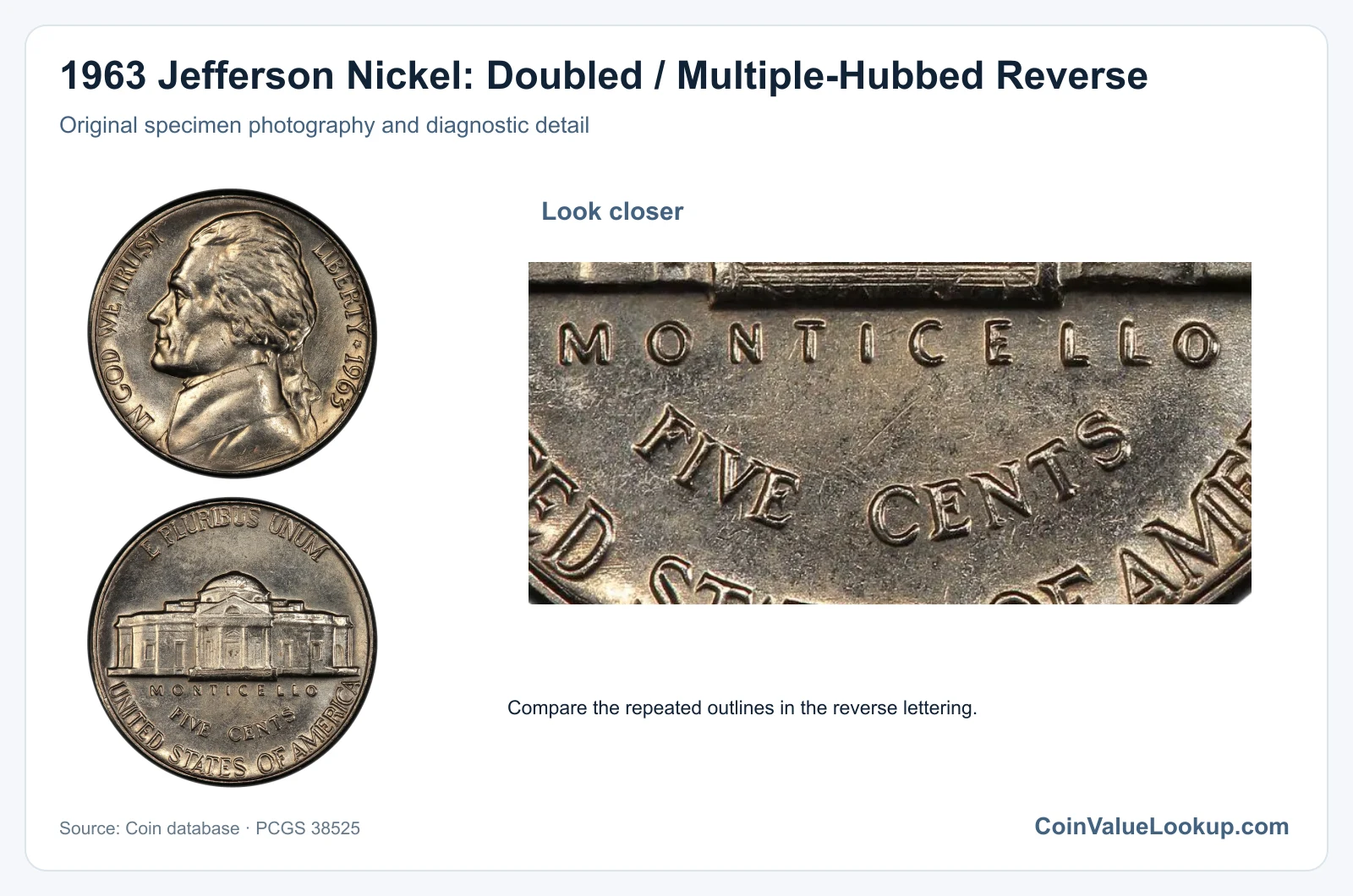
A tripled die reverse has been reported for the 1963 nickel. This type of error results from misaligned hub impressions during die production, creating consistent doubling or tripling visible on the reverse design elements, such as lettering or architectural details on Monticello.
Compare your coin's reverse legends and design contours with a normal 1963 nickel under the same lighting. Genuine hub doubling shows consistent separation or notching in the same direction across multiple letters or features.
Machine doubling, which is flat and shelf-like, is far more common and generally adds little value. Reflections and photographic artifacts can also mimic doubling on screen.
Condition, the visibility of the doubling and the specific die involved all affect what the coin is worth.
5. 1963 Jefferson Nickel — Struck-Through Error
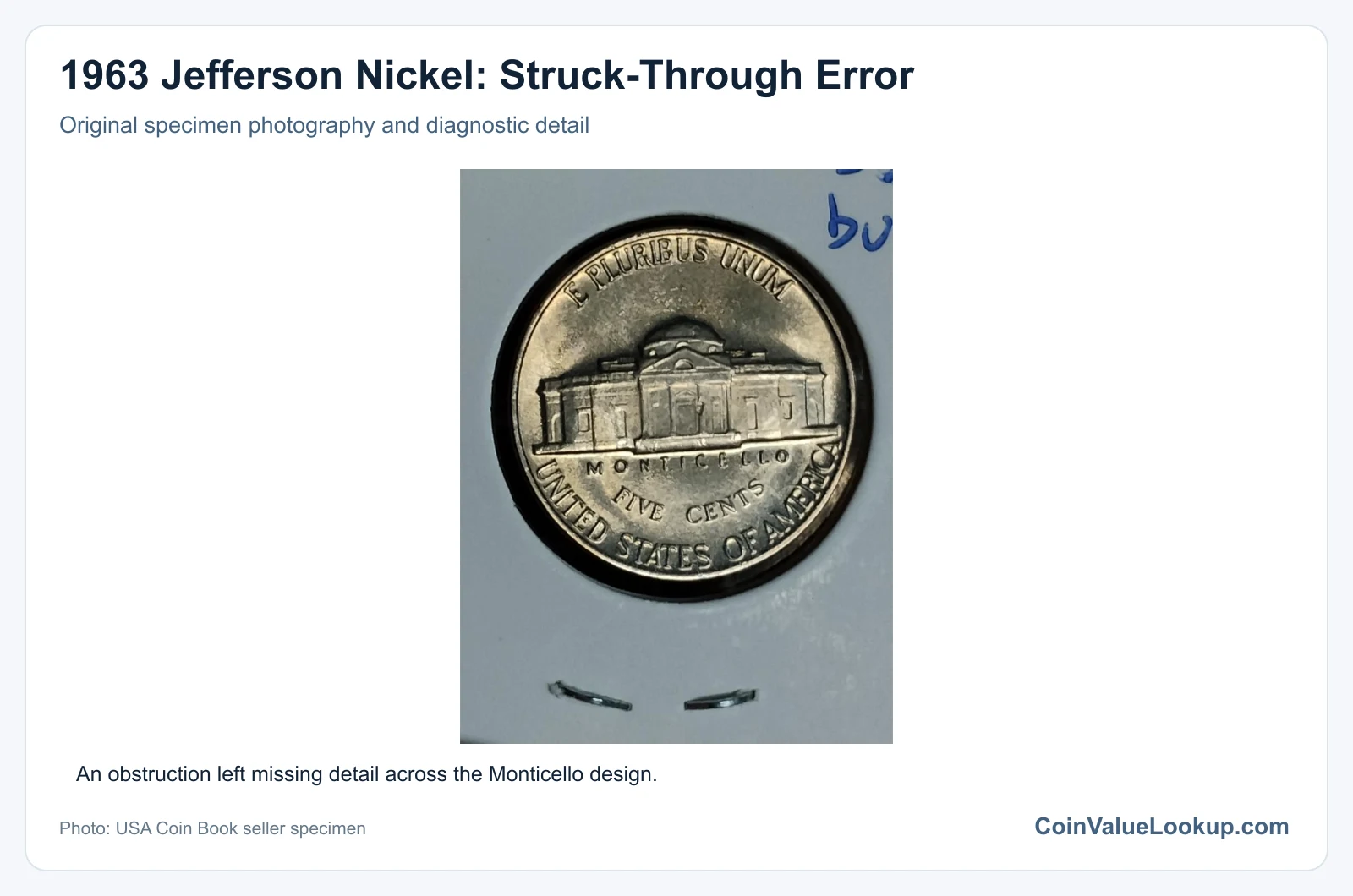
A 1963 nickel with a retained staple strike-through error has been reported. This means a staple (or similar foreign object) was sitting on the planchet or die face when the coin was struck, leaving an impression of that object pressed into the coin's surface.
Look for a localized depression that matches the shape of a small metallic object, distinct from general weakness or wear. In a retained strike-through, the foreign material may still be partially embedded in the coin.
Grease-filled die errors look different: they produce smooth, filled-in areas without a defined impression shape.
Ordinary wear, scratches and cleaning can create surface irregularities that resemble a strike-through at first glance. Value depends on how clearly the obstruction's impression is visible, the coin's overall condition and authenticated identification of the error.
6. 1963 Jefferson Nickel — Doubled Die Obverse
A doubled die obverse has been reported for the 1963 nickel. This involves misaligned hub impressions on the obverse die, producing consistent doubling visible on Jefferson's portrait, the date or the obverse lettering.
To check your coin, compare the obverse inscriptions and design elements against a normal 1963 nickel under matching light conditions. True hub doubling shows separation or notching that repeats in the same direction across multiple design points.
Machine doubling is the most common lookalike. It produces a flat, shelf-like displacement, usually strongest on one side of a letter.
Worn die contours can also soften letter edges in ways that resemble doubling. Condition and the strength of the visible doubling both play into what a doubled die obverse is worth.
7. 1963 Jefferson Nickel — Double / Multiple Strike
A double-strike error has been reported on the 1963 nickel. Unlike a doubled die, a double strike means the coin was physically struck by the dies more than once, often with the coin slightly shifted or rotated between impacts.
This creates two separate, displaced design impressions on the same planchet.
Look for overlapping but clearly distinct sets of design elements, where one image is offset or turned relative to the other. The effect is much more dramatic than enlarged or thickened letters.
A doubled die, which originates in the die itself, will show identical doubling on every coin struck from that die. Post-mint damage or impressions added outside the press can mimic a double strike.
Professional authentication clarifies the distinction, and value depends on condition, displacement and visual impact.
8. 1963 Jefferson Nickel — Repunched Mintmark
A repunched mintmark has been reported for the 1963-D nickel, where the D mintmark shows traces of a second, slightly offset punch position. This applies only to the Denver-minted coin.
Inspect the D on your coin's reverse under magnification. Remnants of the earlier punch position may appear as a partial outline, a thickened edge or a shadow next to the final mintmark.
Compare what you see with a normal 1963-D at matching magnification to make the difference clear.
Machine doubling around the mintmark, small die chips and corrosion or verdigris near the letter can all look like a repunched mark. Value depends on how clearly the repunching is visible and the coin's overall condition.
9. 1963 Jefferson Nickel — Off-Center Strike
An off-center strike has been reported for the 1963 nickel. This happens when the planchet is not properly seated between the dies, so the design is displaced toward one side and a blank, unstruck crescent appears on the opposite edge.
The key collecting factor is whether the date remains visible. An off-center coin with a readable date is generally worth more than one where the date has been struck off the edge.
The percentage of off-center displacement also matters: dramatic shifts tend to attract more collector interest.
Do not confuse an off-center strike with a clipped planchet or post-mint flattening. A clipped coin has missing metal before striking, while an off-center coin has a full-size blank that was simply misaligned.
Value varies with the degree of displacement, date visibility and condition.
10. 1963 Jefferson Nickel — Improper Annealing
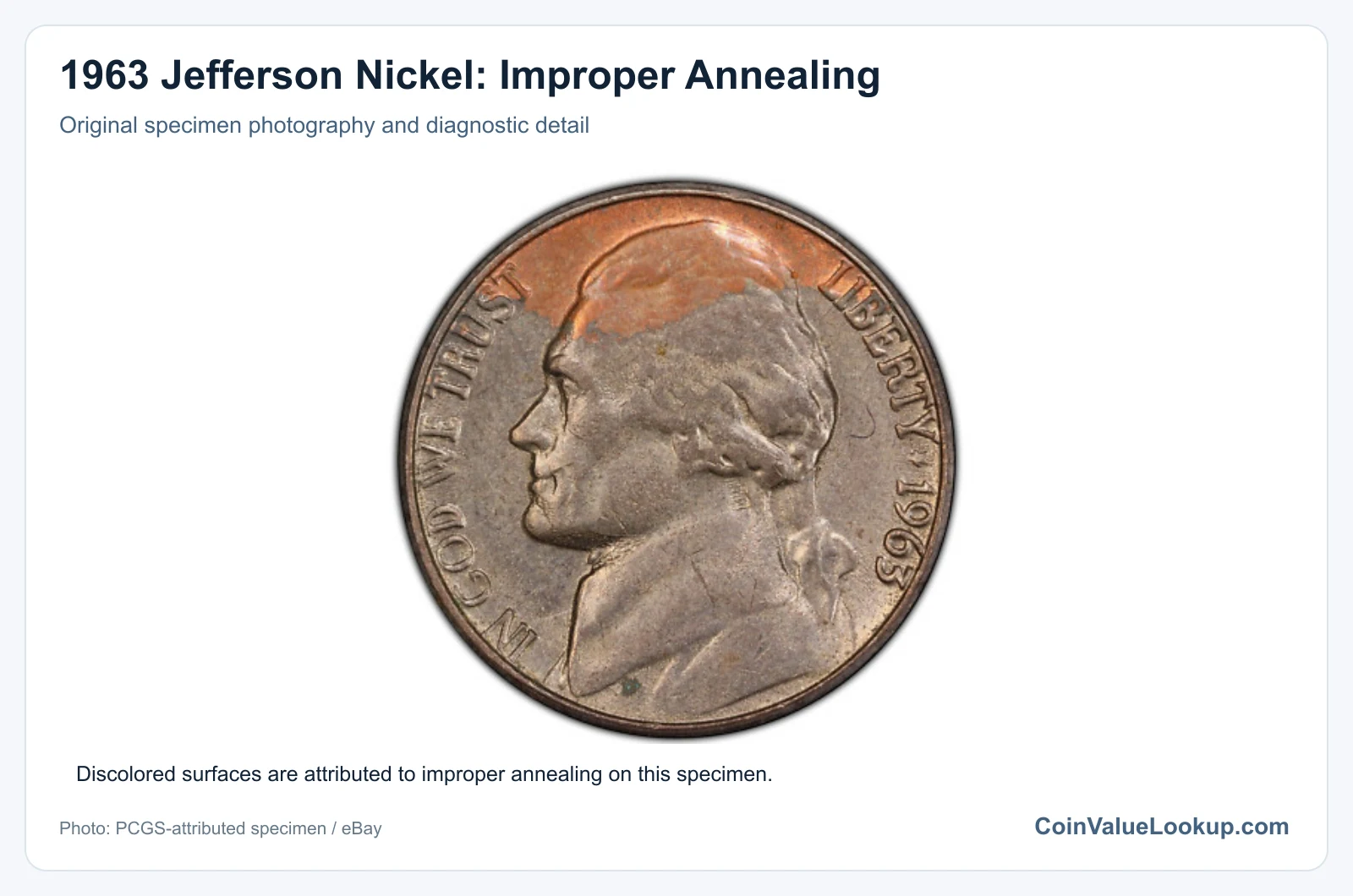
An improperly annealed 1963 nickel, sometimes called a "Black Beauty," has been reported. These coins have an unusually dark surface caused by incomplete or incorrect annealing during the planchet preparation stage, which affects how the metal's surface looks after striking.
The dark appearance can range from a deep charcoal to nearly black, often with an unusual texture compared to a normal nickel. Examine the edge as well, since the discoloration on a genuine annealing error typically extends consistently around the entire coin.
Environmental toning, corrosion and deliberate heat treatment after minting can all produce dark surfaces that look similar. The visual appearance is a screening clue, not proof of the manufacturing cause.
Value depends on the coin's condition, how pronounced the discoloration is and professional confirmation that the surface is a mint-produced anomaly.
11. 1963 Jefferson Nickel — Rotated Dies
A rotated die error has been reported for the 1963 nickel. Normal United States coins have a specific die alignment: when you hold the obverse upright and flip the coin top to bottom, the reverse should also appear upright.
A rotated die error means one die was turned from its correct position, so the reverse appears tilted.
To test your coin, hold Jefferson's portrait right-side up and rotate the coin on its vertical axis. If Monticello appears rotated from its expected orientation, you may have this error.
The degree of rotation matters, with larger rotations attracting more collector attention.
A photograph taken with the coin turned sideways, or a coin loosely mounted in a holder, can give the false impression of die rotation. Always test with the physical coin in hand.
Value depends on the degree of rotation and the coin's condition.